

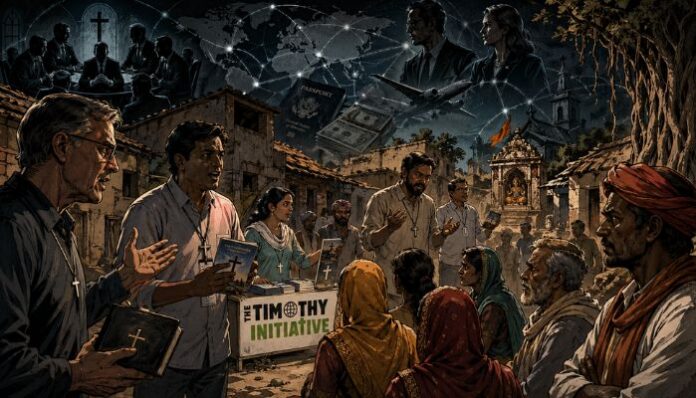
On 18th and 19th April, the Enforcement Directorate conducted raids at several locations linked to an organisation named The Timothy Initiative, TTI. According to the investigation agency, in just six months, TTI withdrew 95 crores using foreign bank debit cards across different states, including 6.5 crores in Naxal-affected Chhattisgarh’s Bastar and Dhamtari regions. While doing so, TTI bypassed FCRA regulations. Notably, this organisation is not registered under FCRA.
OpIndia is doing a series of reports on how TTI functions. During our research, we found that TTI has published 10 books that its members follow to convert Hindus and members of other communities. While nine books do not mention any religion directly, the tenth book of TTI presents a training text for “church planting leaders” on how to approach Hindus, enter villages that have a dominant Hindu population, and convince them to convert.
Chapter 3 of the book, titled World Religions and Cults, asks the church planters to examine religions against the “standard of Scriptures”. The book gives suggestions for apologetic responses and witnessing while coercing Hindus to convert to Christianity. It is essential to understand how TTI has spoken about Hinduism, posing it as the main target. The section on Hinduism in the book is not written as an academic survey or a neutral theological comparison. It is written as a practical guide for engaging Hindus and advancing missionary work among them.
How TTI targets Hindu villages as conversion ground
The book lays down the plan to target the core beliefs of Hindus, including the existence of many Gods. It pushes the idea that Jesus should be shown as an avatar to Hindus, which apparently makes it easier to lure Hindus to convert. Furthermore, it talks about the idea that sin is ignorance rather than moral rebellion, and that the doctrines of karma and reincarnation should be discussed in such a way that Hindus depart from their beliefs.
The book perfectly explains that the “ultimate goal of a Hindu” is release from the cycle of karma and rebirth, and it presents Hindu scriptures as a long and layered tradition centred around the Vedas, Upanishads, and Bhagavad Gita. However, this doctrinal summary is only the first part. Immediately after it, the book shifts into a section titled “Apologetic Responses and Witnessing Suggestions”, making it clear that the purpose is not just description but intervention.
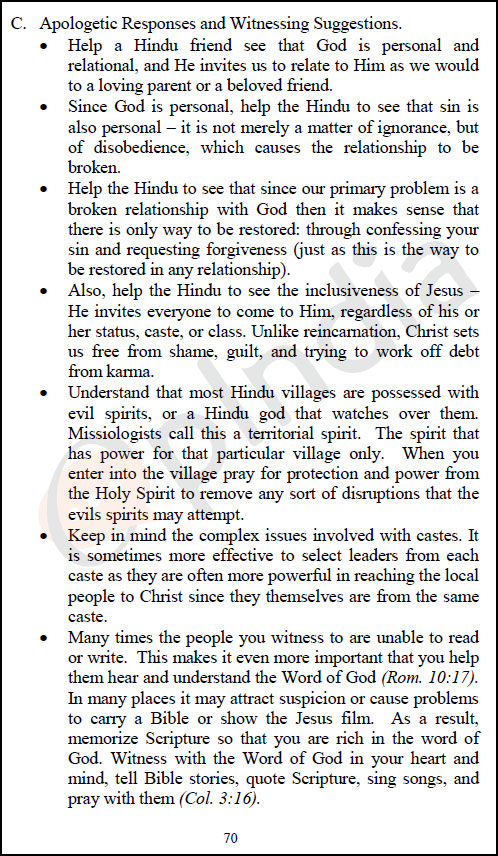
The structure of the text matters, as it does not just explain what Hindus believe, but also how missionaries should answer them. In simple terms, Hindu communities are treated as mission territory and Hindu belief as a field to be worked upon through argument, persuasion, and carefully designed outreach. It is not just theology but a conversion playbook.
‘Pray before entry’ – Demonisation of Hindu Gods and local beliefs
The most problematic aspect of the book is the way it demonises Hindu beliefs and Gods. The book reads, “Understand that most Hindu villages are possessed with evil spirits, or a Hindu god that watches over them.” It then adds, “Missiologists call this a territorial spirit. The spirit that has power for that particular village only.” The instruction that follows is direct, “When you enter into the village pray for protection and power from the Holy Spirit to remove any sort of disruptions that the evil spirits may attempt.”
This is not incidental word choice. Instead, it frames Hindu villages not merely as places where people hold different beliefs, but as spiritually hostile spaces under dark influence. Notably, “evil spirits” and “a Hindu God” are placed in the same frame, which clearly states that, for them, Hindu Gods are “demonic”. The village is thus portrayed as being under supernatural control that the missionary must confront before meaningful work can begin.
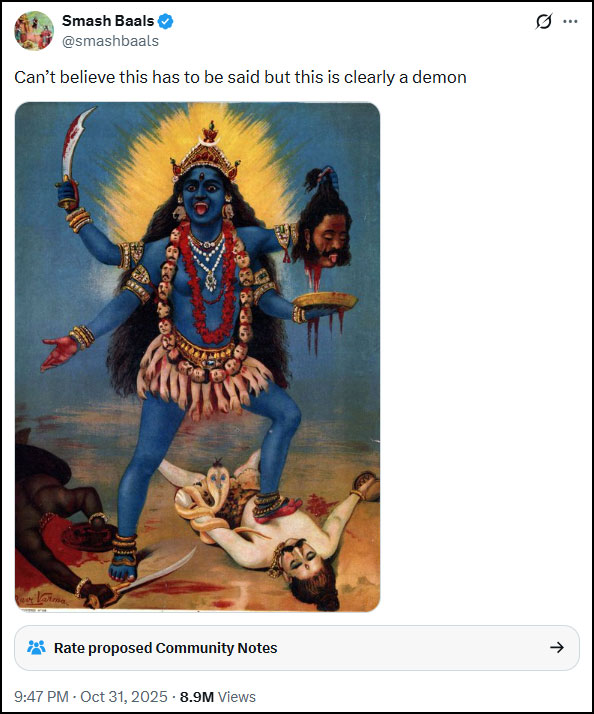
Notably, not only TTI, but many hardcore Christians and evangelists describe Hindu Gods as ‘demons’, especially when it comes to Maa Kali and Bhagwan Shiv. Same goes for self-proclaimed atheists, ex-Muslims and Islamists. Social media posts by Christians calling Maa Kali a demon are common and are often not removed by platforms despite the fact that they hurt the religious sentiments of Hindus.
Step by step entry strategy to avoid suspicion in villages
The book clearly says that missionaries face hostility in Hindu-dominant villages and often get accused of forceful conversions. It notes that “many times the people you witness to are unable to read or write” and then warns that “in many places it may attract suspicion or cause problems to carry a Bible or show the Jesus film.” The book clearly shows that the people behind TTI know that open Christian proselytisation may not be welcomed and that visible missionary tools can generate doubt or opposition.
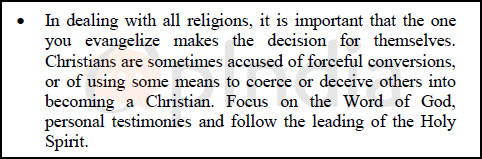
However, instead of reconsidering the outreach model because of the suspicion Hindus have against missionaries, the book offers an alternative entry strategy. It tells missionaries to “memorise Scriptures so that you are rich in the word of God” and to proceed orally rather than through overt material symbols. In other words, the concern is not whether entry is ethically appropriate in a resistant environment. The concern is how to continue the mission in a way that attracts less notice and invites fewer questions.
Soft tactics over direct preaching: Songs, bonding, gradual messaging
The book tells missionaries to “witness with the Word of God in your heart and mind, tell Bible stories, quote Scripture, sing songs, and pray with them.” It is a clear tactic of using softer methods of religious insertion. Instead of leading with a Bible in hand or a film screening, the missionary is told to rely on stories, songs, prayer, and remembered scripture. While the message remains the same and the aim revolves around converting Hindus, the process becomes more socially acceptable and less visibly confrontational.
Such instructions show how carefully the outreach is calibrated. Songs and stories are not suggested merely because they are culturally warm or pastorally gentle. They are suggested in a context where carrying explicit Christian material “may attract suspicion”. That makes these methods part of a tactical adjustment. The text is effectively training missionaries to rely on gradual messaging and interpersonal embedding when direct preaching is likely to be resisted.
Countering Hindu beliefs – Focus on karma, reincarnation, core philosophy
The manual is equally direct in how it wants missionaries to challenge Hindu belief itself. It describes karma as a system in which actions lead to consequences across rebirths, then adds the sharp line that “karma does not allow forgiveness”. This interpretation becomes the basis for the missionary response. The text then says Christians should explain that Christ frees people from “shame, guilt, and trying to work off debt from karma.”
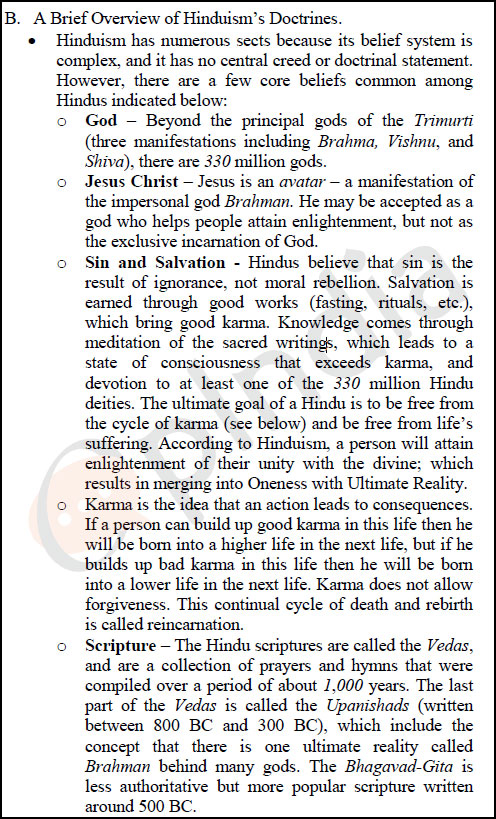
The same pattern appears in its treatment of sin and salvation. The book says Hindus see sin as “the result of ignorance, not moral rebellion”, but then instructs missionaries to argue the opposite. It tells them to say that sin is “personal”, that it is “not merely a matter of ignorance, but of disobedience”, and that the human problem is a “broken relationship with God”. The next step is to present confession and forgiveness in Christ as the sole answer. This is not casual comparative religion. It is a targeted attempt to dismantle core Hindu philosophical categories and replace them with Christian ones.
From religious teaching to organised conversion playbook
In short, the book, especially the sections on Hinduism, reveals a pattern that is difficult to dismiss as routine evangelism. The way the process has been orchestrated shows that TTI’s mission is not to get caught or come face to face with law enforcement agencies.
The implications of such ideas are serious. It is not about personal belief, but about the way TTI has a well-structured training module where it treats Hindu communities as conversion ground. They portray Hindus’ sacred landscape as spiritually polluted. The book teaches missionaries how to enter, adapt, persuade, and neutralise suspicion.
TTI was established in 2007. Its founder, David Nelms, first visited India around 1992. Since its establishment, David has visited India several times. Now, his son Jared Nelms serves as the president of the organisation and follows in his footsteps to plant churches in India and convert as many Hindus as possible to Christianity.
In coming chapters of this series, we will discuss how the organisation functions and how it establishes connections with other missionary programmes to convert Hindus across states.


