

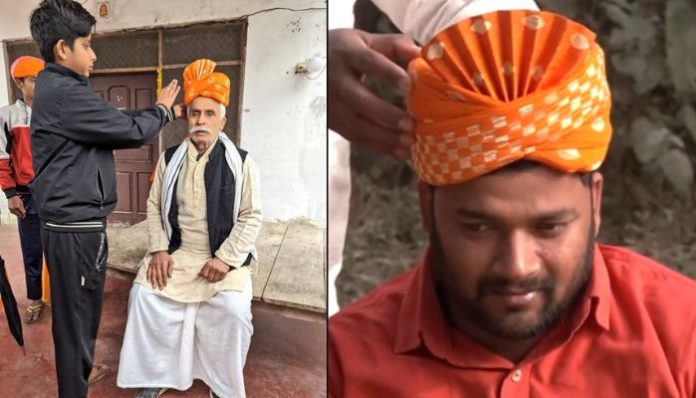
On Thursday (18th January), members of the Suryavanshi Thakur community donned their turbans (padgdi) in anticipation of the consecration ceremony of Ram Mandir in Ayodhya.
It must be mentioned that the community had vowed to not wear a turban until a majestic Ram Mandir was reconstructed at the site where a disputed structure was built by Mughal tyrant Babur.
The wait of almost 500 years ended for the Suryanshi Thakur community on Thursday (18th January) when they finally wore their turbans at the Sarairasi village of Ayodhya.
#WATCH | Uttar Pradesh: People from the 'Suryavanshi Thakur' community in Sarairasi village of Ayodhya wear turbans after almost 500 years, ahead of Ram Temple's 'pranpratishtha'. The community had taken an oath that they would not wear a turban till the temple was reconstructed… pic.twitter.com/9QZckTGbEk
— ANI (@ANI) January 18, 2024
Residing in approximately 115 villages along both banks of the Saryu River in Ayodhya and the neighboring Basti district, the Suryavanshi Thakurs identify themselves as the descendants of the Lord Ram.
Their belief is rooted in the historical account that around 90,000 of their ancestors fought a war against Mir Baqi, the commander of the first Mughal tyrant Babur who demolished an ancient Ram temple and built a disputed structure atop it.
While speaking about the matter, a 63-year-old Suryanvanshi Thakur named Dayaram Singh told The Print, “A total of 76 battles were fought for the liberation of the Ram janmabhoomi from Babur’s era till British rule. When our forefathers heard about Mir Baqi having brought down the temple, they were incensed and decided to liberate the Ram janmabhoomi. They gathered an army of 90,000 Suryavanshi Thakurs and decided to wage a war against the Mughal army.”
He added, “As they marched towards the Ram janmabhoomi, the warriors gathered at Surya Kund where they took a vow that they would not wear a pagdi on their heads, neither wear a panahi [leather shoes] on their feet nor cover their heads with an umbrella till they liberated Lord Ram’s janmabhoomi”
Ram Mandir Rises: Meet the Suryavanshi Thakurs who wore their turbans after 500 years. Watch #RamMandir #ITVideo #Ayodhya #PranPrathistha @poojashali pic.twitter.com/NnX27z5X0N
— IndiaToday (@IndiaToday) January 18, 2024
During the Ram Janmabhoomi movement of the 1990s, the Suryavanshi Thakurs played a crucial role in supporting the karsevaks (Lord Ram drboteee) who arrived from various parts of the country. They provided food, shelter, and assistance to these karsevaks and ensure their safe passage to the janmabhoomi site.
Shiv Singh, a member of the Rashtriya Swayamsevak Sangh and a resident of Sarairasi village, has appealed to Prime Minister Narendra Modi and Uttar Pradesh Chief Minister Yogi Adityanath to extend an invitation to at least one representative from the Suryavanshi Thakur community to Ram Mandir consecration ceremonu.


