

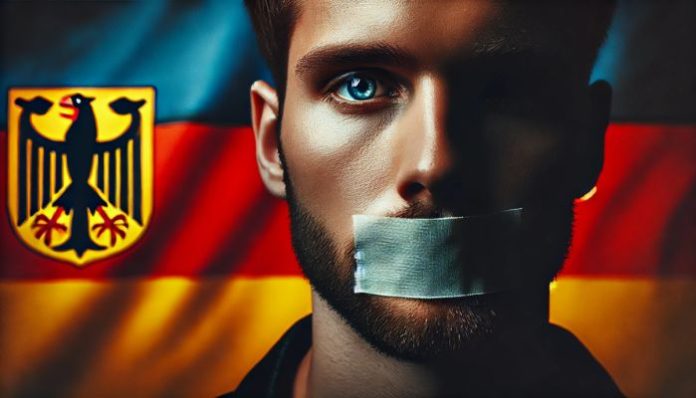
In 2022, Germany expressed concerns over the arrest of Alt News co-founder and propagandist Mohammed Zubair. In 2023, Germany tried to ‘educate’ India after the crackdown on the BBC documentary. This is not the end. Germany has repeatedly “expressed concerns” whenever India has tried to curb misinformation or stop false narratives and propaganda from spreading on social media in the country.
In short, Germany, while posing as a protector of free speech, has complained about India, claiming that law enforcement agencies “jail” journalists or target media houses.
However, recent reports emerging from Germany tell a different story about the country. A nation that poses as a protector of free speech has been hunting people for posting something which, according to German laws, can be considered “hate speech.” In fact, even posting a meme can lead to arrest and jail time in Germany if the publisher of the post is not careful enough with the words he or she is using.
Posting or reposting false information in Germany can be a crime, and the punishment for repeat offenders can include jail time. pic.twitter.com/25OLFeLfna
— 60 Minutes (@60Minutes) February 17, 2025
The crackdown on ‘internet trolls’
On 11th February (local time), dozens of police teams initiated raids at houses across Germany in a coordinated crackdown on ‘internet trolls.’ There were 50 coordinated raids across the country involving hundreds of police officers confiscating the electronic devices of internet users who had apparently posted something online that could be classified as ‘hate speech.’
The prosecutors claim that the Constitution of Germany protects free speech, but there is no room for ‘hate speech’ in the country. Experts from Germany assert that free speech comes with certain limits. German law prohibits speech that could incite hatred or is deemed insulting.
In November 2024, a 64-year-old man faced action by German authorities for calling German Vice-Chancellor Robert Habeck an “idiot” on social media in June that year. According to media reports, a doctored image of Habeck alongside a shampoo brand was posted on social media with the pun “Schwachkopf Professional”—meaning “professional idiot.” A criminal complaint was filed, leading to a raid at the man’s house.
Not long ago, in 2021, a local politician, Andy Grote, was called a ‘pimmel,’ a German word for the male anatomy. Grote was enraged and filed a complaint against the person who used the term, leading to a police raid at the individual’s house. What followed were accusations of excessive censorship by the government.
Speaking during a discussion on 60 Minutes with correspondent Sharyn Alfonsi, German prosecutors explained that in Germany, it is acceptable to debate politics online, but if someone calls another person a ‘pimmel,’ including a politician, they can face legal consequences, including jail time.
Prosecutor Dr Matthäus Fink said, “Comments like ‘You’re son of a b—h,’ excuse me for using this, but these words have nothing to do with a political discussion or a contribution to a discussion.” While people in Germany fear that the country is backsliding into the Germany of 80 years ago, with the policing of ‘free speech’ resembling surveillance of citizens’ words, Josephine Ballon, CEO of HateAid, a Berlin-based human rights organisation, claims it is not surveillance and that free speech needs boundaries.
She said, “And in the case of Germany, these boundaries are part of our constitution. Without boundaries, a very small group of people can rely on endless freedom to say anything that they want, while everyone else is scared and intimidated.” Interestingly, Ballon claimed that half of internet users in Germany rarely participate in political debates because they are afraid of being attacked online.
Fink justified the crackdown on ‘internet trolls’ by suggesting that it is a bigger crime to insult someone online than in public. His argument was that a public insult fades away quickly, while an online insult remains indefinitely.
The statements given by German prosecutors even shocked American politicians. The Vice President of the United States JD Vance recently said in a post on X, “Insulting someone is not a crime, and criminalising speech is going to put real strain on European-US relationships. This is Orwellian, and everyone in Europe and the US must reject this lunacy.”
Insulting someone is not a crime, and criminalizing speech is going to put real strain on European-US relationships.
— JD Vance (@JDVance) February 17, 2025
This is Orwellian, and everyone in Europe and the US must reject this lunacy. https://t.co/WZSifyDWMr
The Constitution and Criminal Code
Article 5 of the Basic Law, also known as the German Constitution, states that every person shall have the right “freely to express and disseminate his opinions in speech, writing, and pictures and to inform himself without hindrance from generally accessible sources. Freedom of the press and freedom of reporting by means of broadcasts and films shall be guaranteed. There shall be no censorship.” However, it places limitations on freedom of expression in Article 5(2), stating, “These rights shall find their limits in the provisions of general laws, in provisions for the protection of young persons and in the right to personal honour.”
Coming to the Criminal Code, Section 130 of the German Criminal Code criminalises acts of incitement to hatred, public disturbance, and violations of human dignity. There is a provision to penalise individuals who incite hatred or call for violence against racial, religious, or ethnic groups. Furthermore, anyone who insults, maligns, or defames someone in a manner that may disrupt public peace can be penalised.
Interestingly, the law also prohibits the production and distribution of any content that promotes hatred or degrades human dignity. The penalties range from fines to imprisonment for up to five years. It does not impose restrictions on hate speech solely in offline spaces but also in online spaces. According to German prosecutors, anyone who retweets hateful speech is equally involved in the alleged “crime” and can be punished with a fine or jail time, depending on the severity or frequency of the offence.
German laws, if applied in India, would have thrown left-liberals behind bars
Speaking to propagandist YouTuber Akash Banerjee, fake news peddler and YouTuber Dhruv Rathee had praised free speech in Germany. When Germany supported Mohammed Zubair and the BBC, the left-liberals applauded the “guts” the German government showed in “protecting” free speech. However, all these people, including Zubair, would have been in jail if German laws were followed in India.
Let’s take an example. Zubair, on several occasions, has indulged in activities that led to violence on the ground. In the case of former national spokesperson of the Bharatiya Janata Party (BJP), Nupur Sharma, he intentionally trimmed a clip from a Times Now debate and used it for propaganda against Sharma. He presented her as someone who insulted Islam without providing the context that another panellist in the debate, Tasleem Rehmani, had insulted Bhagwan Shiv, which incited Sharma’s remarks.
As a result, protests erupted across India against Sharma, with calls to behead her (commonly known as the call for ‘Sar Tan Se Juda’). In the aftermath of the uproar Zubair provoked, Kanhaiyalal from Udaipur, Rajasthan, and Umesh Kolhe from Amravati, Maharashtra, were brutally murdered simply for supporting Sharma. While Zubair roams freely, had he been in Germany and its laws been applied, he would have been behind bars.
Conclusion
The hypocrisy of Germany in terms of free speech is nothing short of laughable. It lectures India on human rights and press freedom. However, the law enforcement agencies in Germany are busy raiding homes in early mornings over internet memes. They are jailing citizens for calling politicians names. If such laws are followed around the world, half of the population would be in jail by now.
Germany actually thinks that words said online are more dangerous than actual crime. It is the same nation that wants to teach India about democratic values but run a digital police state where the bureaucratic apparatus decides what is “acceptable” speech and if the person for “insulting” a politician should be thrown behind bars.
The free speech laws in Germany seem so fragile that they consider retweeting a post an offense. While the country shelters Islamic radicals under the guise of asylum and allows them to spread extremist ideologies, they go ahead and arrest its own citizens for “offensive” humour. Instead of pretending to be the moral guardian of global speech, Germany should take a long, hard look at the dystopian nightmare it has created for its own people.


