

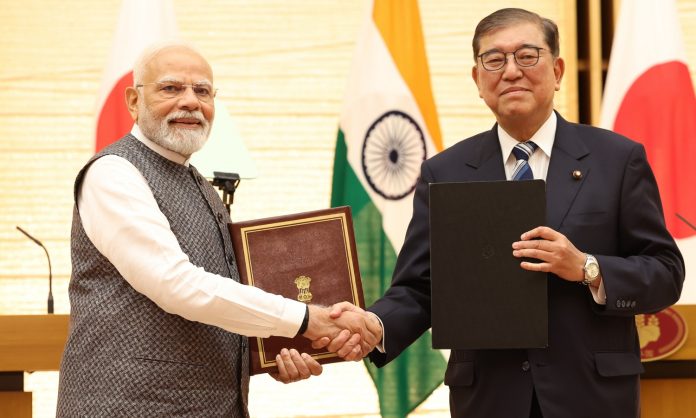
In a bid to deepen bilateral ties and build stronger people-to-people links, India and Japan have unveiled an ambitious action plan targeting the exchange of over 500,000 individuals in both directions over the next five years, including a focused movement of 50,000 skilled professionals and talents from India to Japan. The agreement was reached at the 2025 India–Japan Annual Summit attended by PM Narendra Modi during his ongoing Japan visit. It signals a renewed commitment by both nations to foster meaningful cooperation across public, private, and academic spheres.
Bridging Talent and Cultural Gaps
The exchange initiative is designed to promote mutual understanding and harness complementary strengths across sectors. Its core objectives encompass attracting Indian talent to Japan, fostering joint research and innovation, facilitating cultural and educational linkages, and addressing Japan’s manpower shortages while boosting India’s skill development and manufacturing capacities.
High-Skilled Professionals: Engineering and Academia
To encourage Indian engineering experts and academics to move to Japan, the plan includes dispatching delegations from Japanese corporations to Indian universities, surveying employment trends to highlight success stories, and increasing awareness of professional opportunities. It also encourages participation of Indian educators in the JET (Japan Exchange and Teaching) Programme.
Fostering Student & Research Collaboration
A wide array of initiatives targets student and research exchanges. These include strengthening India–Japan educational dialogues, expanding MEXT’s inter-university exchange projects, and facilitating visits through programs like the Sakura Science Exchange (promoting female researcher participation), scholarships for Indian students, and newly launched platforms such as MIRAI-Setu, the LOTUS programme, and youth science exchanges.
Skilled Workers: SSW System and Technical Intern Training
The plan seeks to broaden opportunities for Indian skilled workers under Japan’s Specified Skilled Worker (SSW) and Technical Intern Training Program (TITP) frameworks. Measures include expanding testing centres across India for skill and language exams, offering pre-departure language training via the Pravasi Kaushal Vikas Yojana, and creating a dedicated India–Japan corridor on the National Career Service platform for streamlined recruitment.
Boosting Skills with Japanese Expertise
India aims to leverage Japan’s managerial and industrial prowess to upskill its workforce through joint training schemes like INPACT (India-Nippon Programme for Applied Competency Training), the India–Japan Talent Bridge initiative, and state-led programmes via the NSDC. Additionally, Centres of Excellence in Yoga and Ayurveda will be established in Japan to promote traditional wellness practices, especially in geriatric care.
Expanding Japanese Language Capabilities
To support these exchanges, both countries will promote practical Japanese language education in India, subsidize language training, train more language teachers, scale the Teachers’ Training Course by the Japan Foundation, deploy Japanese language partners via the NIHONGO Partners initiative, and increase the availability of JLPT and JFT-Basic testing centres across India.
Ongoing Awareness and Coordination
Sustained efforts will ensure the plan evolves organically beyond its five-year horizon. Activities include job fairs, social media outreach, targeted advertising, employer-employee matchmaking in Japanese prefectures, orientation support upon arrival, grievance mechanisms, an information portal, symposiums, and talent exchange aligned with state–prefecture partnerships.
Institutional Oversight and Next Steps
The Ministry of External Affairs (India) and Ministry of Foreign Affairs (Japan) will jointly oversee the plan’s implementation and hold annual high-level consultations. Existing dialogues in education, skills, science & technology, and digital economy will reinforce coordination and support further collaboration.


