

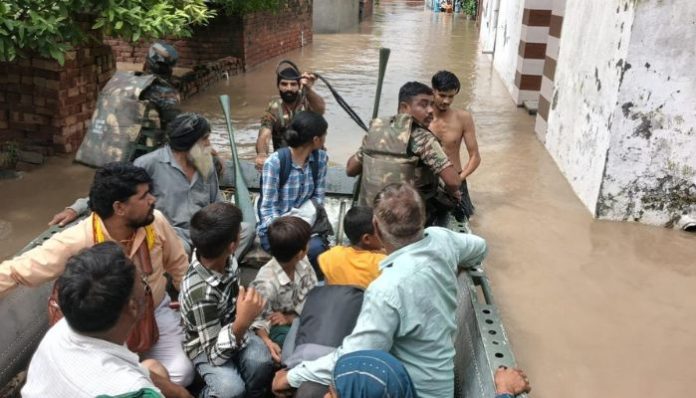
Punjab is suffering from one of the worst floods in the last 37 years. Non-stop rain in the last week has converted huge tracts of the state into a sea of water. However, the threat is far from over, as the Indian Meteorological Department (IMD) has predicted more rainfall on Sunday and Monday in isolated areas of Punjab.
According to reports from district headquarters, 1018 villages are affected, the majority in Gurdaspur district. While over 61,000 hectares of agricultural land have been severely impacted. Rescue and relief efforts are being conducted at full capacity by the NDRF, Army, BSF, and local authorities, but the destruction is yet to cease.
According to the media reports, over 11,000 individuals have been rescued and relocated to safer areas. Currently, 77 relief camps are operating in flood-affected districts, accommodating nearly 5,000 individuals.
These camps are rendering essential facilities such as food, water, and medical facilities, with the administration reporting that they are doing everything in their power to take care of the displaced.
110 individuals are residing in four camps in Kapurthala, 3,450 individuals in eight camps in Ferozepur, which has the largest number. Hoshiarpur, Gurdaspur, Pathankot, Barnala, Fazilka, Moga, and Amritsar have a few active camps too.
The majority of these places are under the influence of floodwaters due to Sutlej, Beas, and Ravi rivers overflows, which had swelled perilously after rains lashed their catchments in Himachal Pradesh and Jammu and Kashmir.
Army-NDRF operations continue in villages near border
Over 1,000 villages have been hit in several districts, 323 in Gurdaspur, 101 in Ferozepur, 107 in Kapurthala, 85 in Hoshiarpur, 81 in Pathankot, 52 in Fazilka, and several others in Tarn Taran, Sri Muktsar Sahib, Sangrur, and Moga.
The devastation of agricultural land is immense. Fazilka has lost almost 16,600 hectares of agricultural land, Ferozepur more than 10,800 hectares, Kapurthala 11,620 hectares, and Tarn Taran almost 10,000 hectares. Crops in Pathankot, Hoshiarpur, and other districts have also met with enormous losses as fields of ripe paddy stood inundated in muddy water.
#Punjab is facing a grim flood situation. Heavy flow of water from hilly areas in Raavi, Beas and Satluj rivers, full to the brim dams leading to controlled release of water and rain in some parts of the state are adding to the woes of the people in the flood-affected districts… pic.twitter.com/kzrokTos2f
— All India Radio News (@airnewsalerts) August 30, 2025
In Fazilka’s border villages, the Army and NDRF, aided by civil authorities, have been operating day and night to evacuate people trapped in water-logged homes. Villagers are being rescued from waist-deep water using boats.
35 people were rescued during one operation from Nihala Lavera, Dheera Ghara, and Talligram villages. Medical and veterinary personnel are also on the job, providing both people and cattle with immediate treatment.
Relief camps are being operated with the help of social organisations and gurdwaras. 260 people are being given food, water, and other necessities at one of the biggest relief camps, Bare Ke. Gurdwaras have come forward with langar services, while school officials are imparting education to children in camps so that they do not lose out entirely.
VIDEO | Gurdaspur, Punjab: Villagers join Indian Army and NDRF teams in rescue and relief operations in the flood-affected areas.
— Press Trust of India (@PTI_News) August 29, 2025
(Full video available on PTI Videos – https://t.co/n147TvrpG7) pic.twitter.com/chLGaHyz9j
Opposition targets AAP govt for “failure
Even while the rescue operations are on, political blame games have escalated. Opposition parties on Saturday, 30th August, slammed the Aam Aadmi Party (AAP) government in Punjab for its flood management situation, which has worsened the plight of several of the affected people.
Highlighting the situation in Kharar, Kurali, Nayagaon, and villages in Majri block, Mohali, senior BJP leader and Punjab state media head Vineet Joshi said on Saturday that “floods in Punjab may partly be nature’s wrath, but Kharar’s misery is entirely due to the incompetence, negligence, and corruption of the AAP government”.
He said local MLA Anmol Gagan Mann failed her constituency. “No water in summer, flooded streets in monsoon… people suffer, MLA missing,” Joshi remarked, adding that residents face power cuts, water shortages, and sewage mixing with drinking water.
Joshi demanded the Punjab government “immediately provide relief and restore basic amenities like electricity, water, and roads.”
“AAP government’s negligence has turned Kharar into hell,” Joshi declared.
Punjab Congress leader and Ludhiana MP Amrinder Singh Raja Warring described the floods as a “manmade disaster” and accused the government of “doubly failing” the people. “By not taking preventive and precautionary measures first, and then by not providing effective relief and rehabilitation,” he added during his visit to flood-affected Ferozepur.
According to the media reports, after visiting the flood-affected areas in Ferozepur district, Warring said the Punjab government “miserably failed” in helping the flood victims. The Congress leader was accompanied by MP Sher Singh Ghubaya.
He further added that Congress MPs and MLAs have promised to give one month’s salary and pension for relief operations, emphasising that Punjab now requires a long-term and permanent solution to floods.
The Shiromani Akali Dal (SAD) also hit out at the Punjab, accusing it of abandoning flood victims at a time of devastation.
“Floods have wreaked havoc, but the government has turned its back on its responsibilities,” SAD spokesperson Shamsher Purkhalvi said.
The floods of 1988: A haunted reminder
As Punjab is struggling today, memories from the floods of 1988 returned to haunt people. Hundreds died that year, and the devastation left behind was so bad that it has been used as a point of reference each time rivers have burst over their banks.
The 37-year-old nightmare describes bodies pouring over the border into Pakistan, extensive destruction of crops, devastated villages, and even political instability. Indian Punjab alone saw 600 to 1,500 dead, depending on the reports. Crops worth hundreds of crores were lost, and over 9,000 villages got inundated.
The Pong and Bhakra dams, brimming with rainwater, were strained to capacity. Catchment area rainfall was more than five times above predictions, causing a disastrous outburst of water.
Reports from the time say the dam management had expected the catchment area to receive up to 120 mm of rain that September, since the monsoon is usually over in the North by that time. But, between 22nd to 26th September, 1988, there was more than five times the forecasted rain.
As per a report by IndiaToday, flash floods damaged around 75 to 80 per cent of what promised to be a record kharif crop in the districts that are deluged this time too.
Around 9,000 of the 12,000-odd villages were hit in Punjab, plus there was devastation in large parts of Himachal and J&K upstream, and Haryana, Rajasthan, and Delhi further down the Indo-Gangetic plains.
Prominent Punjabi newspapers also reported that bodies flowed into the Punjab across the border, in Pakistan, which was also ravaged. Images of one such news report, which speaks of 1,300 bodies flowing across the border, have gone viral on social media.


