

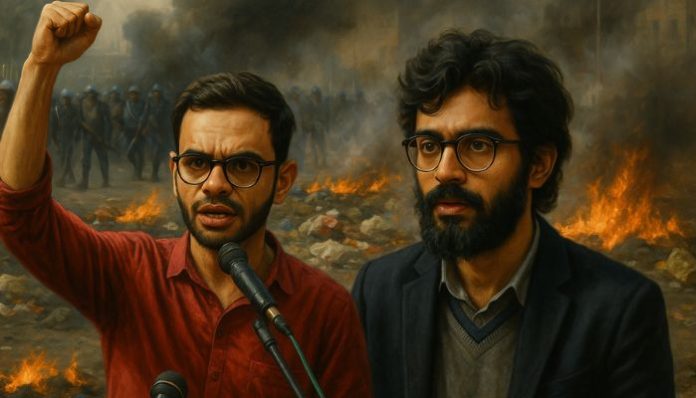
On 2nd September, the Delhi High Court dismissed the bail application of Umar Khalid and Sharjeel Imam in the 2020 anti-Hindu Delhi riots larger conspiracy case. The division bench of Justice Naveen Chawla and Justice Shalinder Kaur noted that at this stage, prima facie material exists to show both of them played a role in planning and mobilising protests that spiralled into riots. While rejecting the bail applications of Khalid and Imam, the court clarified that it was not going into the merits of the case but found no ground for parity with other accused who had been granted bail earlier, as the roles attributed to the two were of a different nature.
Court on early mobilisation after CAB
The Delhi High Court observed that in the events that unfolded soon after the Citizenship Amendment Bill was passed in December 2019, it was Khalid and Imam who allegedly took the first steps towards mobilising dissent. The judgment noted, “prima facie it appears that the appellants were the first ones to act after the CAB was passed in early December 2019, by creating WhatsApp groups and distributing pamphlets in the Muslim populated areas calling for protests and Chakka-Jaams, including the disruption of essential supplies.”
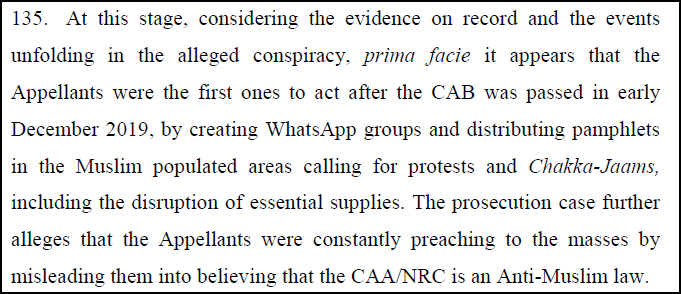
The bench noted that the prosecution has alleged that there was a deliberate attempt to mislead the public, specifically the Muslim community, into believing that CAA and NRC were anti-Muslim laws. According to the court, this went beyond simple political opposition and was aimed at laying the groundwork for disruption.
Khalid and Imam described as intellectual architects of conspiracy
The court also emphasised the role of speeches delivered by Khalid and Imam, and observed that when considered together with other material, they revealed more than just routine political expression. During the hearing, the Solicitor General argued that Imam and Khalid were “the intellectual architects behind the entire conspiracy, working in tandem with the other co-conspirators.”
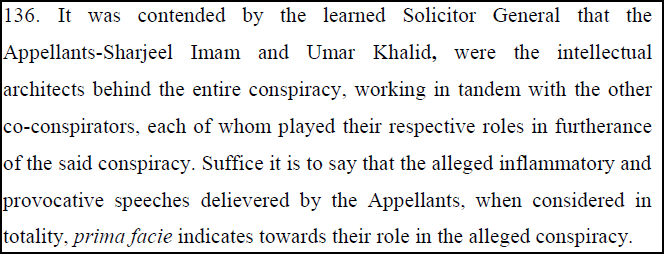
Though the bench did not comment on the ultimate merits, it accepted that, prima facie, “the alleged inflammatory and provocative speeches delivered by the appellants, when considered in totality, prima facie indicates towards their role in the alleged conspiracy.”
The court was satisfied that the speeches could not be viewed in isolation. Such speeches had to be read in the wider context of coordination, mobilisation and disruption that the prosecution alleged was by design.
Physical absence not enough to negate role
The defence had strongly pressed the point that Sharjeel Imam had been in custody since January 2020 and therefore could not have had a role in the riots. In the case of Umar Khalid, he was also not present at the protest sites on the day of the riots. The High Court, however, dismissed this line of argument.
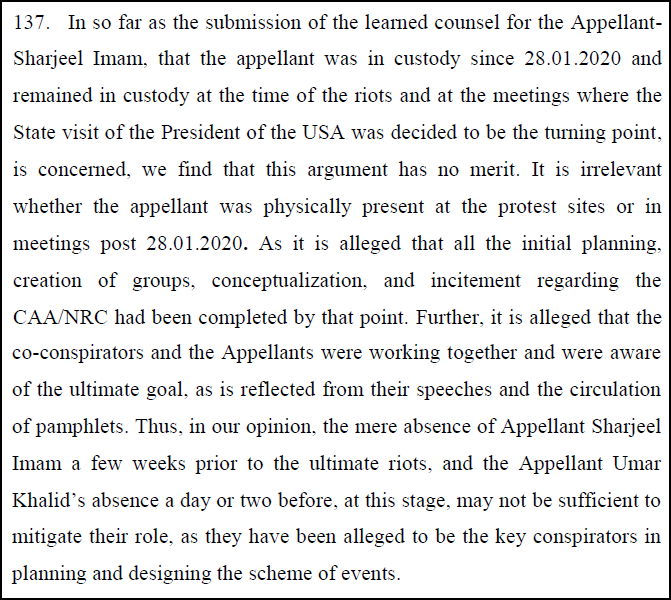
The bench noted, “it is irrelevant whether the appellant was physically present at the protest sites or in meetings” that were held after 28th January 2020 as the key acts attributed to them, “initial planning, creation of groups, conceptualisation, and incitement regarding the CAA/NRC”, had already been completed.
The absence of Imam and Khalid, therefore, could not wipe away their involvement in the larger conspiracy behind the riots. The order concluded that “the mere absence of appellant Sharjeel Imam a few weeks prior to the ultimate riots, and the appellant Umar Khalid’s absence a day or two before, at this stage, may not be sufficient to mitigate their role, as they have been alleged to be the key conspirators in planning and designing the scheme of events.”
Bail rejected on distinct roles
While refusing bail, the court stressed that though it was not entering into a detailed evaluation of the evidence or the merits of the charges, bail could not be granted on parity. The court noted that unlike some other accused, including Devangana Kalita and Natasha Narwal, who had obtained bail, Khalid and Imam could not be granted bail as they stood on a different footing. Their actions, as recorded in the observations, showed a degree of planning and leadership that could not be equated with others.


