

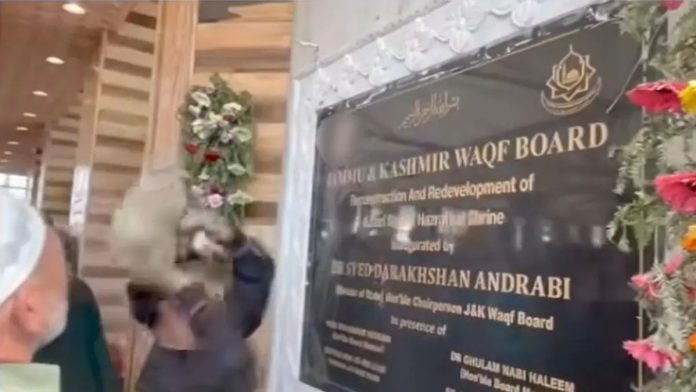
The defacement of the Ashoka emblem at the revered Hazratbal shrine in Jammu and Kashmir has snowballed into a major political controversy, with regional leaders attempting to justify the vandalism by citing hurt religious sentiments, even as the BJP has called it a direct assault on India’s national symbols.
On Friday, angry Muslim mob at the shrine vandalized a plaque engraved with the national emblem during Eid-e-Milad celebrations, shouting slogans against the Jammu and Kashmir Waqf Board. The plaque had been installed after the completion of renovation works and was inaugurated earlier this week.
Chief Minister Omar Abdullah questioned the very decision to install the emblem at a religious site. “The first question is whether the emblem should have been etched on the stone. What was the compulsion to have the emblem on the stone at Hazratbal Shrine? There was no need to put up a plaque. If work is good, people would recognise,” he told reporters, adding that the emblem should never have been used at a religious function.
#WATCH | Anantnag, J&K | On viral video of a mob tarnishing the national emblem on the foundation stone of Hazratbal Shrine, CM Omar Abdullah says, "The first question is whether the emblem should have been etched on the foundation stone. I have never seen the emblem being used… pic.twitter.com/oAyyby5HGN
— ANI (@ANI) September 6, 2025
Calling the plaque a “mistake,” Abdullah argued that religious places are not government institutions and therefore should not carry state emblems. He further urged the Waqf Board to apologise for “hurting public sentiments.”
Former Chief Minister and PDP leader Mehbooba Mufti went a step further, terming the vandalism an act of “emotion” rather than a crime. “The people who vandalised after getting overcome with emotions are not against the emblem. It is not right to say they should be arrested under the Public Safety Act and called terrorists. This is blasphemy for us,” Mufti said.
"Emblem on plaque at our religious place is GUSTAKHI (blasphemous). Instead of punishing arsonists, case shld be registered against those who ordered this plaque."
— Megh Updates ?™ (@MeghUpdates) September 6, 2025
:Mehbooba Mufti comes out in support of the vandalism of the Ashoka emblem plaque at Hazratbal Dargah pic.twitter.com/cPaDCO2P80
She alleged that the real offence was committed by Waqf Board chairperson Darakhshan Andrabi, a BJP leader, who had the plaque installed with her name inscribed on it. “An FIR should be filed under section 295-A (blasphemy) against those who got the plaque installed, not against those who were hurt and acted out of anger,” she said, demanding Andrabi’s resignation.
Andrabi, however, condemned the defacement, calling it a “terrorist attack” and demanded strict punishment under the Public Safety Act. She maintained that the act insulted both the dignity of the shrine and the nation’s emblem.
The Hazratbal shrine, situated on the banks of Dal Lake, houses the Moi-e-Muqqadas, believed to be a hair from the Prophet’s beard. It is one of the holiest sites for Kashmiri Muslims and attracts massive gatherings during religious occasions.
Yet, instead of unequivocally condemning the attack on the Ashoka emblem, Kashmiri politicians have chosen to contextualise it. Both Abdullah and Mufti have directed their ire at the Waqf Board rather than the vandals themselves — effectively shifting the blame onto the BJP and attempting to turn the controversy into a question of faith versus politics.
This episode once again reveals how deep-rooted radicalism has seeped into Kashmir’s political discourse. In any civilised society, vandalism of a national emblem would have drawn immediate calls for strict punishment of the culprits. But in Kashmir, political leaders have chosen to rationalise and even justify the act, knowing that pandering to radicalised sections of the population ensures their political survival.
By shielding those who openly defaced a symbol of the Indian state, Kashmiri politicians have sent a troubling message: that acts of fundamentalism and vandalism can be tolerated, nay even encouraged, if cloaked in the language of religious sentiment. It highlights the enduring reality of Kashmir: Islamic fundamentalism is an indelible part of the Kashmiri society — aided, encouraged, and emboldened by the very politicians who claim to abide by the Indian Constitution.


