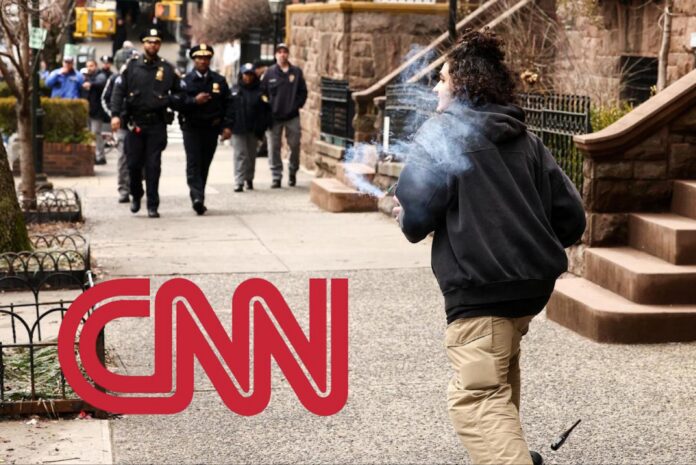
The credibility crisis facing legacy Western media deepened this week after CNN was forced to delete an astonishingly tone-deaf post that appeared to humanise two ISIS-inspired suspects who hurled homemade explosive devices outside the residence of New York City Mayor Zohran Mamdani near Gracie Mansion.
The now-deleted tweet read like the opening paragraph of a travel blog rather than a report about a suspected terror incident.
“Two Pennsylvania teenagers crossed into New York City Saturday morning for what could’ve been a normal day, enjoying the city during abnormally warm weather,” CNN wrote.
Only later in the post did the network casually mention that the pair had allegedly thrown homemade bombs packed with screws and bolts during a protest outside the mayor’s residence.
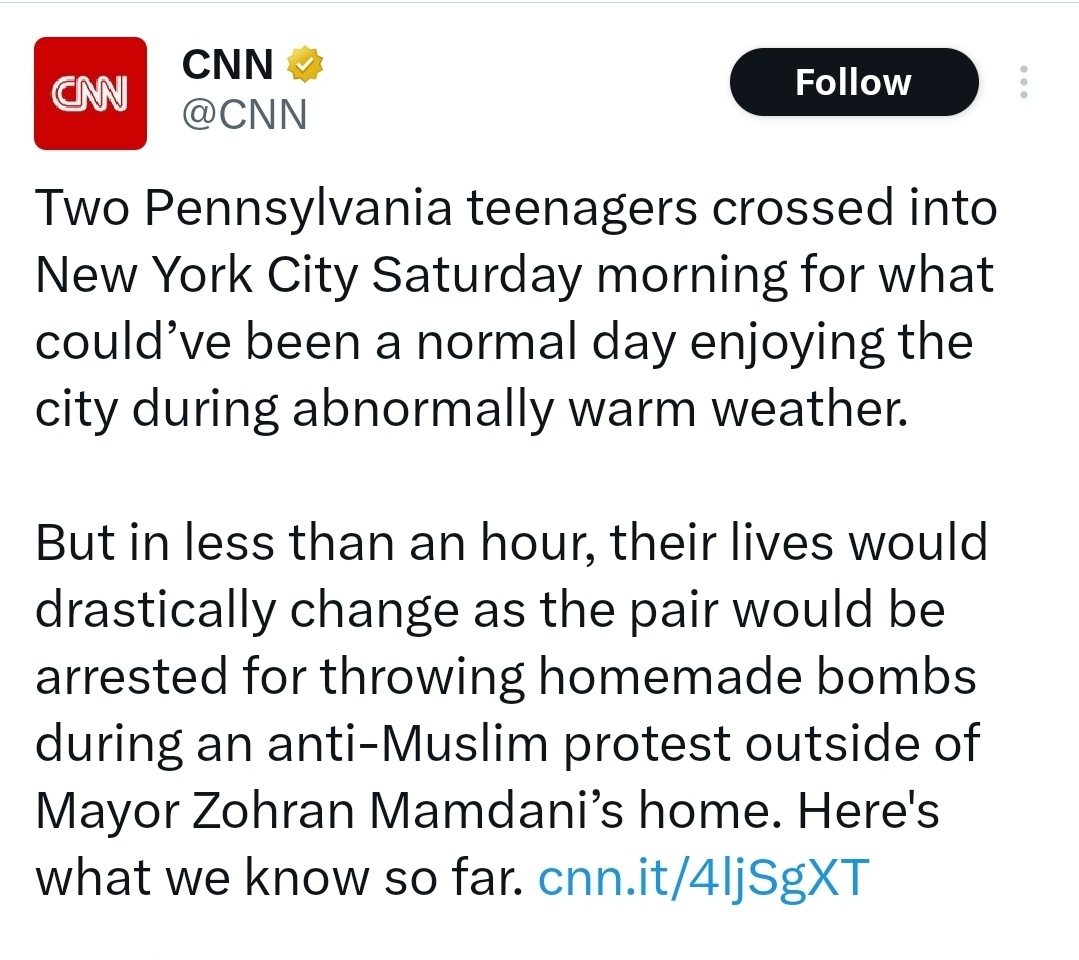
In other words, an ISIS-inspired attack attempt involving explosive devices was framed as a pleasant spring outing gone wrong.
The backlash online was immediate and brutal.
Social media users were stunned that a major global news organisation could describe suspected terrorists in such sympathetic terms.
One widely shared comment captured the absurdity perfectly: “Two ISIS-inspired teenagers drive from Pennsylvania to NYC, bring IEDs packed with screws and bolts, and throw them at an anti-Muslim protest outside Gracie Mansion. CNN: Shame their nice day enjoying the city didn’t work out.”
Two ISIS-inspired teenagers drive from Pennsylvania to NYC, bring IEDs packed with screws and bolts, and throw them at an anti-Muslim protest outside Gracie Mansion.
— Yehuda Teitelbaum (@chalavyishmael) March 10, 2026
CNN: Shame their nice day enjoying the city didn’t work out.
(tweet has now been deleted) https://t.co/k0DuUYjByw pic.twitter.com/np58vTg8Y9
Another furious user wrote, “OMG, omg, omg. @CNN delete your network.”
OMG, omg, omg .@CNN delete your network.
— KK Berd 🇺🇸 (@keny_berd) March 10, 2026
“Two Pennsylvania teenagers crossed into New York City Saturday morning for what could've been a normal day enjoying the city during abnormally warm weather.” https://t.co/zjBpJpZQj6 pic.twitter.com/TntRNd3XuC
Yet another user identified the reporters behind the piece, Gloria Pazmino and Taylor Romine, accusing them of downplaying what appeared to be a jihad-inspired attack by describing the perpetrators merely as “Pennsylvania teenagers.”
The outrage forced CNN into damage control mode.
The network eventually deleted the tweet and issued a clarification admitting that the post “failed to reflect the gravity of the incident” and therefore breached its editorial standards.
A post regarding the two individuals arrested for throwing homemade bombs outside of New York City Mayor Zohran Mamdani’s home failed to reflect the gravity of the incident thereby breaching the editorial standards we require for all our reporting. It has therefore been deleted.
— CNN (@CNN) March 10, 2026
But the controversy did not end there.
Several users pointed out that even in its initial framing of the incident, CNN had inserted another questionable narrative: describing the gathering outside the mayor’s residence as an “anti-Muslim protest.”
However, it is worth noting that the protest taking place outside the residence was not an anti-Muslim event at all. CNN’s framing appeared to inject a politically convenient label that shifted attention away from the alleged perpetrators and toward the protesters themselves.
In other words, the framing accomplished two remarkable things simultaneously: it softened the portrayal of the suspected bomb-throwers while casting the surrounding protest in a negative ideological light.
For many observers, this was not an isolated editorial lapse but a textbook example of a broader pattern that has increasingly defined sections of Western media.
When Islamist extremism surfaces, the language often becomes curiously restrained. At times, facts of the incidents are obscured for the fear of “fanning Islamophobia.” The perpetrators are humanised as “teenagers”, “youth”, or merely “individuals”, with no ideological or religious moorings to drive them towards committing such atrocities.
In fact, the ideological motivations behind the violence are often buried several paragraphs deep, if they are mentioned at all. Meanwhile, contextual framing frequently shifts attention toward the surrounding political environment rather than the act of violence itself.
The result is a bizarre moral inversion where suspected terrorists are subtly humanised while the ideological backdrop is reframed to dilute the seriousness of the crime.
CNN’s tweet was a perfect case study in this phenomenon. The first line focused on a “normal day enjoying the city.” The second line mentioned the bombs. One would imagine that if individuals transport explosive devices packed with shrapnel into a major metropolitan area, the explosives, not the weather, would be the headline.
But that assumption apparently no longer holds in the editorial culture of certain legacy media organisations.
What made the episode even more revealing was how accountability arrived. It did not come from CNN’s editorial oversight mechanisms. It came from ordinary social media users who instantly spotted the absurdity and called it out.
Within minutes, screenshots of the tweet spread across the internet, accompanied by ridicule and anger. The network eventually had no choice but to delete the post.
But deletion does not erase the deeper question. How did such framing pass through editorial review in the first place? Major networks like CNN operate with multiple layers of editorial scrutiny. Tweets and headlines are reviewed, approved and distributed through structured workflows. A narrative that trivialises an ISIS-inspired attack cannot simply appear out of thin air.
It reflects a newsroom culture where such framing no longer triggers alarm bells. And that culture is precisely why public trust in legacy media institutions continues to erode. Increasingly, audiences believe that these organisations are less interested in reporting events as they are and more interested in shaping narratives that align with ideological preferences.
CNN’s deleted tweet is therefore not just an embarrassing social media mistake. It is a revealing glimpse into the editorial instincts of an industry that once claimed to be the guardian of truth.
If describing suspected terrorists as unfortunate teenagers whose pleasant day in the city went wrong passes as acceptable journalism in elite newsrooms, then the crisis facing Western media is far deeper than a single tweet.
And no amount of post-facto deletions can restore credibility once the public has seen behind the curtain.