

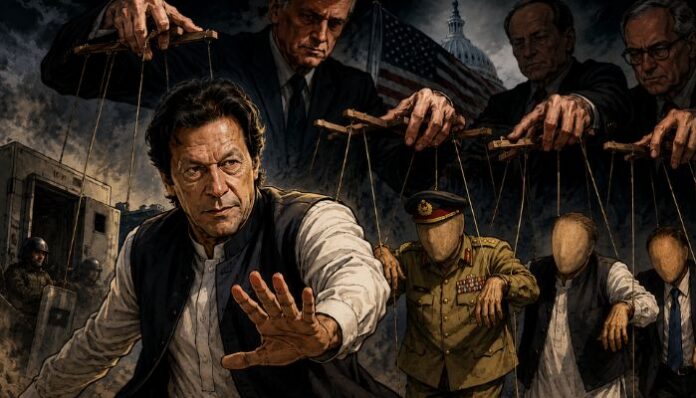
On 17th May (local time), a leaked Pakistani diplomatic cypher surfaced that brought the 2022 ouster of former Prime Minister Imran Khan into focus. The cypher showed how the United States views his removal through a no-confidence vote as the way to reset the relationship with Islamabad.
🚨BREAKING: For the first time, the original Pakistani cypher — cable I-0678, the document that triggered the removal of former Pakistani Prime Minister Imran Khan — is being released in full by Drop Site. https://t.co/nlX8uZCQRX pic.twitter.com/SYskivzAK9
— Drop Site (@DropSiteNews) May 17, 2026
The document, which was marked “SECRET” and “No circulation”, had information about a meeting that took place on 7th March 2022 between then-ambassador of Pakistan to Washington, Asad Majeed Khan and then-US Assistant Secretary of State for South and Central Asian Affairs, Donald Lu.
It is a fact that Imran Khan is no saint. His own politics, governance record and ideological contradictions caused enough trouble for India’s hostile neighbour. However, the cypher does show something far more dangerous for Pakistan as a state. It showed how Khan’s foreign policy line was treated by Washington as a problem to be corrected and how the military establishment of Pakistan appeared to have found its utility in serving American interests. It further showed how the eventual political arrangement after Khan’s removal brought Islamabad back into the familiar role of a client state for the US.
The leaked cable has been published by Drop Site News. It has strengthened the allegations that the regime change that happened in 2022 in Pakistan was backed by the US. The document draws a connection between Khan’s Russian policy, which was disliked by the US, and the internal no-confidence vote that removed him from office. It also records a blunt signal from the American side that if Khan is removed, Washington will “forgive everything”.
What the cypher actually records
Pakistan’s Washington mission had sent the cypher to Foreign Islamabad on 7th March 2022. It records that Asad Majeed Khan had a lunch meeting with Donald Lu, who was accompanied by Deputy Assistant Secretary of State Les Viguerie. Pakistan’s Deputy Chief of Mission and Counsellor Qasim also joined the meeting.
During the meeting, Lu referred to Pakistan’s position on the Ukraine crisis and stated that people in Europe were concerned about why Pakistan was taking an “aggressively neutral position” in the matter. He further claimed that such a position did not seem possible to Washington and that it appeared to be Khan’s policy.
Pakistan’s ambassador asked if the reaction coming from Washington was because Pakistan abstained from voting in the United Nations General Assembly. Lu reportedly replied in the negative and stated that the issue was due to Khan’s visit to Moscow. He then added that if the no-confidence vote against him succeeded, “all will be forgiven in Washington”, because the Russia visit was being looked at as a decision of PM Khan. Otherwise, he warned, “it will be tough going ahead”.
In simple words, the US gave a clear message beyond merely diplomatic displeasure. It linked the future of Pakistan’s relationship with Washington to the fate of Khan’s government. Lu reportedly added that he could not say how Europe would react. However, he suspected the reaction would be similar. He further added that isolation of PM Khan would become “very strong” from Europe and the US.
It cannot be seen as a vague geopolitical assessment but a direct message that if Khan survived the no-confidence vote, Pakistan would face trouble. However, if the political situation changed, Washington would move on.
During the conversation, Lu again made the point clearer. When the Pakistani ambassador expressed hope that PM Khan’s Russian visit would not affect bilateral ties, Lu reported replies that it had “already created a dent in the relationship”. He added that they should wait for a few days to see whether the political situation changed, which would mean that Washington would not have a “big disagreement” and the issue would “go away very quickly”.
The cypher also records that Pakistan’s ambassador pushed back strongly against Lu’s framing. He said it was wrong to present Khan’s Moscow visit as an isolated personal decision. He stated that the visit had been in the works for years and was the result of a deliberate institutional process. He also said that when Khan flew to Moscow, the Russian military action of Ukraine had not started, and there was still hope for a peaceful resolution.
The ambassador further said that Pakistan’s position on Ukraine was dictated by its desire to keep communication channels open with all sides. He stressed that Pakistan had reaffirmed its commitment to the principles of the UN Charter, including non-use of force, sovereignty, territorial integrity and peaceful settlement of disputes.
He also told Lu that Pakistan was worried about how the Ukraine crisis would affect Afghanistan. Islamabad’s priority, he said, was peace and stability in Afghanistan, for which coordination with all major powers, including Russia, was essential. Pakistan did not want the Ukraine crisis to divert attention away from Afghanistan.
The pushback matters because it shows that Islamabad’s official diplomatic position was more nuanced than what Washington wanted to accept. Yet the American side appeared determined to personalise the issue around Khan, as if Pakistan’s entire foreign policy disagreement could be solved by removing one Prime Minister.
The US expected obedience, and the Pakistan Army delivered it.
The cypher records another important complaint from Pakistan’s ambassador. He told Lu that over the past year, Islamabad had sensed reluctance from the US leadership to engage with Pakistan’s leadership. This had created a perception that Pakistan was being ignored and taken for granted. He said the US expected Pakistan’s support on issues important to Washington, but did not reciprocate on issues important to Pakistan, particularly Kashmir.
When Khan was elected, the US expected Pakistan to act as a loyal instrument. It was believed that Khan became Prime Minister with Washington’s backing, and there was chatter that he was a puppet of the US. However, as time passed by, his foreign policy, among other things, appeared to have angered the “bosses” sitting in Washington.
After Khan’s removal in April 2022, the new government, backed by the Pakistani military establishment, moved to repair ties with Washington. According to the report, Pakistan soon emerged as a quiet supplier of artillery shells and other military equipment to Ukraine. The weapons were reportedly routed through US defence contractors and third-country intermediaries.
The report also said that American support for Pakistan’s next IMF programme was linked to the continuation of the weapons pipeline. In July 2023, the IMF approved a 3-billion-dollar standby arrangement for Pakistan.
The sellout could not have been clearer. Under Khan, Pakistan abstained at the UN and tried to maintain a neutral line. After his ouster, Pakistan’s military-backed dispensation became useful to Washington’s Ukraine war effort. Sovereignty became negotiable. Foreign policy became a commodity. The Pakistan Army, once again, pimped the country’s strategic position to foreign powers in exchange for survival, acceptance and money.
The India comparison exposes American double standards.
Interestingly, the cypher also contains a conversation on India. Pakistan’s ambassador told Lu that he had seen Lu’s defence of the Indian position on Ukraine during the Senate Subcommittee hearing on US-India relations. He added that it appeared that the US was applying different criteria to India and Pakistan.
Lu responded that US lawmakers had strong feelings about India’s abstentions in the UN Security Council and UN General Assembly. However, he then said Washington looked at the US-India relationship through the lens of what was happening in China. He also claimed that while India had a close relationship with Moscow, Washington believed there would be a change in India’s policy once all Indian students were out of Ukraine.
It has consistently had an independent position on the Russia-Ukraine conflict, and it has been treated as a strategic complication because India matters in the larger China equation. Pakistan’s independent position was treated as disobedience by a client that needed to be disciplined.
It has to be noted that Washington never cared about the democracy of the rules-based order. All it cares about is utility. While India has a strategic value, Pakistan was expected to function as a rented-out security state.
While things have changed over the years, especially after India refused to give credit to US President Donald Trump for the ceasefire between India and Pakistan during Operation Sindoor, Pakistan’s puppet-like role in front of the US has continued to remain consistent. Especially after Khan’s government did not behave like one, and Washington’s displeasure was communicated in the language of political consequences.
The ambassador’s assessment directly flagged US interference
Towards the end of the cypher, there was the ambassador’s own assessment, where he wrote that Lu could not have conveyed such a strong demarche without the express approval of the White House, to which Lu had repeatedly referred. The assessment further stated that Lu “spoke out of turn on Pakistan’s internal political process”. It added that Pakistan needed to seriously reflect on this and consider making an appropriate démarche to the US chargé d’affaires in Islamabad.
Shehbaz Sharif and Asim Munir became Washington’s eager courtiers
The aftermath of Khan’s ouster shows how quickly Pakistan’s rulers returned to their default setting. Prime Minister Shehbaz Sharif and Army chief Asim Munir, who preside over a Pakistan where Khan remains jailed and the military establishment dominates politics, have increasingly presented themselves as useful partners for Washington.
Shehbaz Sharif recently described Pakistan’s role in US-Iran engagement as “one of the shining moments in our history”. Former Pakistani ambassador Masood Khan went even further, saying Pakistan was “in seventh heaven and on cloud nine” and had never been on “such a high pedestal”.
This language does not sound like the confidence of a sovereign state. It sounds like the excitement of a regime that has once again received approval from its foreign master.
Munir’s own rise has coincided with Pakistan’s deepening submission to American strategic priorities. According to the report, after becoming Army chief in November 2022, Munir consolidated power, Khan remained in prison, and Pakistan’s military-led order strengthened its control over politics. The report also said Munir later promoted himself to Field Marshal and created new arrangements that placed Pakistan’s nuclear command under his personal authority.
Trump reportedly called Munir “my favourite Field Marshal”. That one line sums up the current arrangement. Washington gets a pliant military strongman in a nuclear-armed Islamic country. Pakistan’s generals get international legitimacy. Shehbaz Sharif gets to sit in power. The Pakistani public gets rigged politics, jailed opposition and a state that keeps offering itself to foreign powers.
Pakistan’s fake mediator role and its one-sided tilt towards Trump
Pakistan has also tried to project itself as a mediator in US-Iran tensions. Pakistani officials promoted Islamabad’s role in possible talks involving Washington and Tehran, while the country’s military media arm quietly briefed reporters about Iran-related diplomatic developments.
However, Iranian voices questioned Pakistan’s credibility. Iranian national security spokesperson Ebrahim Rezaei reportedly said Pakistan was not a suitable intermediary because it always took Trump’s interests into account and did not say a word against American wishes. He added that a mediator must be impartial, not always leaning to one side.
The real scandal is not Imran Khan’s fall alone, but Pakistan’s permanent capture
The cypher does not demand that anyone romanticise Imran Khan. He had his own failures, contradictions and political sins. However, the document does show that Washington saw Khan’s removal as a way to fix a foreign policy problem. It also shows that Pakistan’s own ambassador believed Donald Lu had spoken out of turn on Pakistan’s internal political process and could not have done so without White House approval.
The larger scandal is Pakistan’s permanent capture by its military establishment and foreign patrons. The United States wanted a more obedient Pakistan. The Pakistani Army wanted to regain value in Washington. Shehbaz Sharif and Pakistan’s dynastic parties wanted power. The result was the 2022 regime change that removed Khan, restored the old order and pushed Pakistan back into America’s strategic lap.
The ‘Cypher’ made appearance in 2023
This is not the first time “Cypher” of the “secret cabal” has made its way to the media. Back in August 2023, The Intercept published a report based on this same cypher. However, at that time, only the text was published and not the actual document. Our detailed report from that time can be checked here.
Donald Lu and the wider South Asia pattern
The Pakistan cypher controversy also fits into a wider pattern in South Asia, where Donald Lu’s name has repeatedly appeared around political turbulence, pressure campaigns and regime change narratives.
Lu, who has served as the US Assistant Secretary of State for South and Central Asian Affairs since September 2021, was accused by Imran Khan of facilitating his ouster, an allegation Lu dismissed as a conspiracy theory. However, Pakistan was not the only country where his role came under scrutiny.
Bangladesh witnessed violent unrest that eventually forced Sheikh Hasina to flee the country, while Sri Lanka saw similar scenes in 2022 when protesters stormed the presidential residence and Gotabaya Rajapaksa resigned. Lu’s earlier diplomatic tenures in Albania and Kyrgyzstan have also remained controversial, with allegations that he publicly encouraged political pressure against governments.
In India too, Lu’s comments on Jammu and Kashmir, human rights, journalists and domestic issues have raised concerns about American interference in internal matters. His sudden visit to Chennai during the 2024 Lok Sabha elections also raised eyebrows. Around the same larger period of US engagement with Indian politics, Congress leader Rahul Gandhi reportedly met Donald Lu and other Biden administration officials during a secret White House visit, while also making remarks abroad about seeking foreign attention over India’s democracy.
Washington dresses up pressure campaigns in the language of democracy and human rights, while its diplomats apply pressure wherever a government refuses to fall in line with American strategic interests.


