

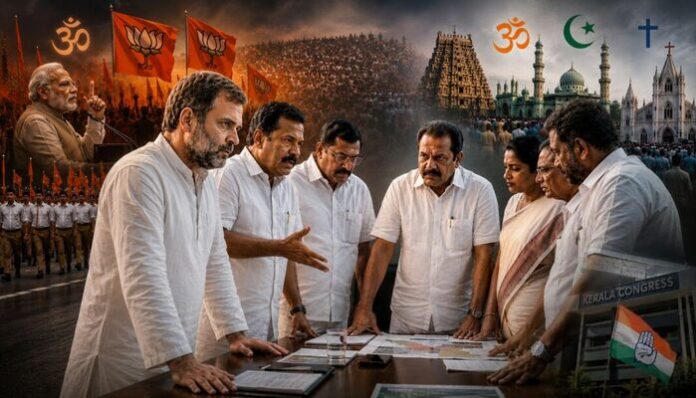
Putting an end to the speculations on Thursday (14th May), the Congress-led United Democratic Front in Kerala announced the name of VD Satheesan as the next chief minister of the state. The announcement comes 10 days after the Kerala Assembly election results were announced. The Congress-led United Democratic Front (UDF), which won the election, struggled for over a week to finalise a name for the chief ministerial post.
Usually, after receiving a clear mandate, political parties are swift to decide on a leadership position to convey a message of stability and confidence to the public. However, the situation for the Congress in Keralam appeared to be different. Political circles echoed the question as to what compulsions are keeping the Congress party from reaching a consensus on a Chief Ministerial candidate? Let’s take a look at the possible reasons why it took so long for the Congress party to come up with a name for the Keralam CM post.
Social balance in Keralam politics and the challenge of Congress
Keralam is one of those states where politics is directly linked to social equations. These social equations have become a challenge for the Congress party. The Congress and Muslim League won the Keralam elections with the support of Muslim and Christian voters. Let’s try to understand this through statistics.
In terms of statistics, a total of 35 Muslim MLAs have been elected to the 140-member Keralam Assembly, representing approximately 25 per cent of the total strength. The UDF alliance, comprising the Congress and Indian Union Muslim League (IUML), has the largest share, with a combined total of 30 Muslim MLAs, representing approximately 85.7 per cent.
The IUML alone has 22 MLAs, and the Congress has 8 MLAs. The LDF coalition, on the other hand, has a total of 5 Muslim MLAs, including 4 from the CPI(M) and 1 from the CPI, amounting to around 14.3 per cent.
Party-wise speaking, the Congress has eight Muslim MLAs out of a total of 63, which is about 12.7 per cent. All 22 IUML MLAs are Muslim, while the CPI(M) has 4 and the CPI has 1.
The Hindu population here is estimated to be around 54 per cent, the Muslim population around 26 per cent, and the Christian population around 18 per cent. These figures are based on census data and various official reports.
The biggest challenge for Congress was balancing this equation. Since it won the election based on Muslim and Christian support, these groups have been pushing for a Chief Minister from their individual communities, and Congress was feeling the pressure. However, it was unable to make a final decision. Because if it had chosen a Muslim Chief Minister, it would be difficult for the party to please the state’s largest community, the Hindus.
On the contrary, a Hindu chief minister would most likely have eroded the trust of the state’s minorities in the party, and their support might have shifted to the CPM. However, it seems that the Congress party was unable to ignore the Hindu majority in the state and chose a Hindu to head the government in the state.
The growing presence of the BJP has raised concerns for the Congress
For many years, Keralam was considered a state where the BJP had limited electoral influence. However, over the past decade, the picture has gradually changed. The BJP’s vote share has steadily increased. The BJP’s emergence as a key player in the state’s electoral battle further exacerbated Congress’s challenges.
The BJP has strengthened its presence in several seats in the 2019 Lok Sabha elections and subsequent elections. While the party may not have achieved significant success in terms of seats, its vote share and organisational expansion have certainly alerted other parties.
The RSS’s long-standing grassroots presence is also considered a key contributor to this growth. Keralam has been one of the states where the RSS has cultivated a cadre-based network over decades.
This network is now seen as instrumental in the BJP’s political expansion. The BJP is not only fighting for power, but also attempting to transform itself from a third alternative between the Congress and the Left parties into the main opposition force.
This is why Congress did not want to send a political message that could allow the BJP to gain a foothold among new voters. Choosing a Christian or Muslim candidate would have strengthened the BJP’s narrative that Congress wants nothing more than symbolic representation for Hindus. This would’ve created fertile ground for the BJP’s expansion.
Why the West Bengal example troubles the Congress
The BJP’s landslide victory in West Bengal has also troubled the Congress party. In the 2026 assembly election, the BJP won 3 seats in Keralam, the same number of seats it won in the 2016 Bengal elections. In 10 years, the BJP has completely transformed its image in West Bengal and ultimately swept the state assembly polls. This time, the BJP won 207 out of 293 seats in Bengal.
The Congress party’s confusion over choosing a CM was further aggravated by the growing strength of the BJP in Keralam. Congress doesn’t want to give the BJP or the leftists any opportunity that could create a problem for it, but this is almost impossible given the current circumstances.
In Keralam, the Congress faced the challenge of maintaining its traditional minority support base and strengthening its acceptance among Hindu voters. Furthermore, the BJP’s growing political influence and the changing electoral landscape further compounded the Congress’s difficulties.
The decision regarding the Keralam CM was not just a matter of leadership change for Congress; it also determined how strongly the party can preserve its long-standing social alliance and adapt to the changing Indian political landscape. The real test for the Congress, in effect, was not just choosing a Chief Minister, but also keeping its entire voter base intact.
(This article is a translation of the original article published at OpIndia Hindi.)


