

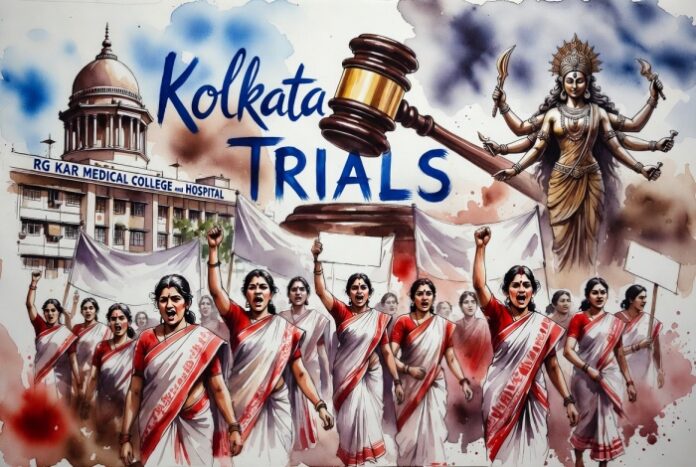
The night Kali danced
At midnight, she arrived. Thousands of people watched in quiet, broken only by tears, as she danced in the streets outside RG Kar Medical College in Kolkata while dressed in the resemblance of Maa Kali, the goddess of time, destruction, and righteous rage. The month was of August 2024. A few weeks prior, during a 36-hour shift, a 31-year-old doctor was raped and killed inside that hospital. She had gone to sleep in a room that was supposed to be safe. She never stepped out. That night, the woman who danced wasn’t giving a performance. She was delivering a verdict.
“Witch you’ll be reduced to ashes. Your reign will end.“
Through the streets, those words echoed. They were intended against a system that had determined, quietly and then openly, fifteen years ago, that certain lives in Bengal, specifically Hindu lives in Bengal, did not matter. That powerful men could exploit women as they pleased. That particular communities could be terrorised during election season while the police looked the other way because the police reported to the party, which had decided these people were not its people. Maa Kali performed a dance. Something, somehow, started to end.
What the Nuremberg Trials taught the world
The successful Allied powers accomplished something the world had never witnessed in October 1945 in the ruined city of Nuremberg. A government was placed on trial. Not only particular criminals. Not merely troops with triggers. The administrators who established the system, the ministers who signed the directives, and the bureaucrats who observed what was going on and decided to take part rather than decline all, were all put on trial.
Like all abusers of power, the Third Reich’s architects had thought that the truth would eventually be buried if they moved quickly enough, suppressed enough witnesses, and controlled enough institutions. Nuremberg proved otherwise.
The Nuremberg Trials established a fundamental principle that should, ideally, never need to be reiterated, but it must be reiterated in every generation; that power does not equate to immunity, and accountability never ends. The portfolio of a minister does not shield you. The position of chief minister does not shield you. An election victory will not safeguard you. And an election loss does not absolve you. If you exploited the state’s apparatus to persecute, terrorise, rape, murder, or silence others, you will be held accountable. That answer may take years to come. But it arrives nonetheless.
Anywhere in the world, systematic, identity-based persecution takes place under the cover of a government which controls the police, the tribunals, and the narrative. Nuremberg’s lesson is applicable anywhere victims are intimidated and threatened, as the Hindu women of Sandeshkhali were, to keep quiet, to say that nothing happened, and attempts are made to systematically prove that they are lying.
In the 2026 West Bengal Assembly election, Bengal witnessed the BJP secure an overwhelming majority with more than 200 seats, while the TMC, after fifteen years in power, was confined to about 80 seats. A democratic decision has been made. The balance of power has shifted. However, history reminds us that a democratic mandate does not deliver justice on its own. Power is transferred through elections, but it does not completely rejuvenate the dignity of victims who suffered because of it. Something more challenging is needed for that.
For the first time, we are calling it ‘The Kolkata Trials.’ Not a catchphrase for politics. Not a call to action. Bengal owes its people a framework that is systematic, evidence-based, and ethical. Tailored for Bengal’s reality, based on the spirit of Nuremberg and posing the same queries as Nuremberg – Who issued the direction? The criminal was facilitated by whom? The witness was suppressed by whom? The state was weaponised by whom?
Fifteen years of the broken shield and a chronology of documented failure
In order to put an end to the bloodshed of Left Front government, the Trinamool Congress (TMC) was elected in 2011. Every billboard featured the term ‘paribortan,’ which means change. But nothing changed. The victims and targets of the violence were reorganised as a result. Partisan pamphlets were not used to compile the timeline that follows. It is derived from Supreme Court suo motu hearings, CBI charge sheets, NCRB reports, National Commission for Women findings, Calcutta High Court orders, and published news coverage from media sources, local and national.
This, of course, is merely an indicative list. The atrocities are overwhelming. For example, during the 2021 post-poll violence itself, there are scores of cases that deserve individual attention, and there are several other instances of violence that haven’t been listed here for the sake of brevity. For example, the 2010 Deganga riots. It was a time when TMC was not in power in the state, but it won the seat in question. Its goons went on a rampage against the Hindus of the area and terrorised them for weeks. At the heart of the violence was a Hindu place of worship. What makes the case far more insidious is that the TMC leader, Haji Nurul Islam, who masterminded the violence against Hindus, was fielded again in 2024 by TMC. Given how TMC ruled on the basis of unbridled violence against Hindus and those who did not ideologically agree with them, it would not be a stretch to say that Nurul Islam had been rewarded for persecuting Hindus and the shocking violence his goons had unleashed.
While we will be documenting the string of violence perpetrated by TMC over the years, the following list is merely a hint of the carnage unleashed by the criminal regime.
Canning riots, 2013
In Canning, South 24 Parganas, violence between communities breaks out. Mobs target and destroy hundreds of Hindu owned businesses. Three years later, the cycle would repeat itself. Police complaints are made by families who had lost their means of living. The grievances were unanswered. The cycle of impunity, silence, and violence has already been formed.
Baduria-Basirhat riots, 2017
The location is North 24 Parganas, and families wake up to discover their homes on fire. Temples are vandalised. Under the TMC government, the 2017 violence in Baduria and Basirhat represented a significant communal flashpoint. The inability or unwillingness of the state machinery to defend its own inhabitants ultimately prompted the central government to deploy paramilitary forces. Hindu families had to flee their ancestral villages. They are informed, both informally and openly, that they are responsible for their situation.
Post poll massacre, 2021
This chapter is the darkest, most well-documented and irrefutable. Violence erupted around the state following the announcement of the 2021 West Bengal Legislative Assembly election results. According to the BJP, attacks by members of the ruling Trinamool Congress resulted in the deaths of at least six of its workers. TMC workers are accused of raping numerous women, including a little girl, because their families voted against them. The Supreme Court heard the story of a 60-year-old widow who was reportedly raped and her daughter-in-law physically assaulted by TMC workers.
Lynchings, crude bombings, and forced conversions were among the incidents that occurred between May and July of 2021. Families fled to Assam, homes were set on fire, and women were beaten. Victims claimed police had threatened them and refused to register complaints. In one known instance, Joy Prakash Yadav, a 28 year old BJP worker, was killed in a crude bombing in Bhatpara. One of the perpetrators was heard stating, ‘Forget police,’ prior to his murder. ‘You’re doing too much BJP.’ Forget the police. Just two words. Two phrases summed up the entire impunity architecture. Because they had spent years witnessing the authorities ignore them, these men had learned that they had nothing to fear from the law.
On July 2, 2021, TMC workers killed BJP worker Chandana Haldar in South 24 Parganas by beating her to death. According to her husband Gautam Haldar, they went to support a cousin who was being attacked. Together, they were attacked. His spouse passed away. 52 incidents of murder or unnatural death and 39 cases of rape and molestation were investigated by the CBI, which eventually filed 10 charge sheets for these crimes. At least 303 BJP workers who had left Bengal in 2021 had not yet returned home as of April 2022.
Ram Navami clashes, 2023
Stone throwing and vandalism targeted Hindu religious processions in Howrah, Hooghly, and North Dinajpur. The trend of Hindu public religious expression being confronted with coordinated violence repeats again during the TMC years, which critics claimed demonstrated planned administrative indulgence rather than spontaneous communal violence.
Sandeshkhali, 2024
Approximately 100 kilometres from Kolkata, Sandeshkhali is one of the Sundarbans’ thousand islands. It’s the type of village that doesn’t make headlines until something unusual occurs. An astonishing event took place. Officers from the Enforcement Directorate went to Sandeshkhali on January 5, 2024, to question Sheikh Shahjahan, the local TMC leader, about corruption. Three people were hurt when his followers attacked the ED officers. After that, Shahjahan ran away and was at large for 55 days.
The Sandeshkhali women started speaking throughout those fifty-five days. Their words were heartbreaking. Atrocities such as property confiscation, arbitrary imprisonment of male family members, and threats of future violence against women who dared to speak were documented by the National Commission for Women. On that tiny island, sexual assault, land grabs, and terror had become so prevalent that you had to live under them. State police stopped and returned opposition politicians who were trying to visit Sandeshkhali to meet victims. The case was brought before the Calcutta High Court. At first, the state government responded with denial, saying nothing took place, they’re lying, and the BJP is using them. The Sandeshkhali women were familiar with those words. They refused to back down.
The RG Kar rape and murder, 2024
A 31-year-old postgraduate doctor working a 36-hour shift at RG Kar Medical College Hospital in Kolkata was brutally raped and murdered inside the hospital’s seminar room on August 9, 2024. She had endured all that the Indian medical system requires of its doctors, including years of laborious study, the rigorous nature of entrance exams, the hierarchy of hospitals, and the exhausting residency. She had decided to dedicate her life to curing people. She rested in a room that, in principle, was part of an institution that had pledged to protect her in its charter. She had been brutally raped before her murder, according to an autopsy. Additionally, it implied that she might have resisted the perpetrator and endured torture before being killed.
Unsatisfied with how the police handled the inquiry, the Calcutta High Court transferred the matter to the CBI on August 13, 2024. Additionally, they pointed out that if the state police carried out the inquiry, evidence might be destroyed. The matter was taken up suo motu by the Supreme Court on August 18. The three-judge panel slammed the college administration, the state government, and the Kolkata police for mishandling the case. The college principal, who had administrative protection and political connections, was fired. Then, to the surprise of even seasoned observers, he was temporarily reappointed to another esteemed institution. Outrage from the public compelled another change. The CBI later arrested him for financial irregularities and evidence tampering.
Thousands of women from West Bengal marched on the streets at midnight on September 4th as part of the ‘Reclaim the Night‘ movement. In a nation where women are advised against leaving the house at night, it was a demonstration of rage and trauma, to reclaim spaces and streets that have been made unsafe for women for no fault of them.
The architecture of impunity
The Nuremberg prosecutors’ understanding that individual acts, no matter how horrible, remain individual crimes is what makes their work everlasting. The system that permits individual crimes is what turns them into crimes against humanity.
The system reveals the story itself.
This was how the system operated in Bengal. A man with ties to the TMC commits violent crimes against a woman, a political opponent and/or a Hindu family. The complaint is not registered by the state police, which answers to a home ministry under the control of the ruling party. If it registers it and moves at snail’s pace, or lodges a counter complaint against the victim after registering it. The accused man is still free, visible, and sometimes captured on camera at social gatherings. The victim receives the message, through the grinding silence of institutions that should have protected her, that ‘you do not matter enough for us to protect you.’
There is no guesswork here. It is the recorded ruling of multiple courts. It was said by the Calcutta High Court. It was said by the Supreme Court. Every time the CBI had to grab control of a case from state police, it was made clear by their investigation.
The extent and gravity of the incidents that occurred after 2021 prompted the Calcutta High Court to intervene and order investigations into several cases, raising serious questions about the state machinery’s capacity and willingness to guarantee citizens’ fair and equal protection. This statement, expressed in a court order, bears the significance of the entirety. A court never uses words carelessly. When it refers to willingness, it means that this was a decision.
Impunity is a decision. Someone picked it somewhere.
The legal architecture of The Kolkata Trials and can it be done?
A critic’s first query is always procedural: is it really possible to set up such a tribunal? If the Kolkata Trials are to have any significance, they cannot be a metaphor; hence, it is a reasonable question that requires a thoughtful response. There must be a way for them. This idea is not ruled out by the Indian Constitution’s framework.
The Constitution’s Article 323-B specifically provides Parliament the authority to create tribunals to decide complaints and disputes pertaining to certain issues, amending that article and adding a further sub clause to include heinous crimes is what Parliament needs to do.
Furthermore, the Supreme Court’s governing Articles (124 to 147) provide it an authority that most people never fully understand – the ability to form special benches, take suo motu cognisance of matters of serious public importance, and, most importantly, direct the establishment of investigative and quasi judicial structures when regular institutional mechanisms have clearly failed. This position of power has previously been exercised by the Supreme Court. The Special Investigation Team for the 2002 Gujarat riot cases was appointed using it. The anti-Sikh genocide investigations in 1984 made use of it. There is already a legal framework in place.
Additionally, Parliament has an alternate path. In order to properly administer the legislation it has passed, Parliament may create more courts under Article 247. A Bengal Atrocities Tribunal with a defined jurisdiction could be established by a specific legislative act passed by a government with the mandate currently held nationally by the BJP. This tribunal would have the authority to look into, record, and prosecute acts of rape, violence, displacement, and institutional cover-up that occurred in West Bengal between 2011 and 2026. From the National Green Tribunal to the several commissions established under the Commissions of Inquiry Act of 1952, Indian legal history has established a pattern for time-bound, cause-specific tribunals.
Such a tribunal’s composition is just as important as its structure. It cannot be a political tool dressed in judicial garb, as it would make it identical to the exact system it aims to replace. A retired Supreme Court judge should serve as the tribunal’s presiding officer, with two retired High Court judges from states other than West Bengal on either side. This is a crucial safeguard because the Bengal judiciary has occasionally been seen as functioning under Nabanna’s long shadow. The women of Sandeshkhali and the families of the 2021 post-poll violence victims have already shown, at great personal cost, what happens when the state that is meant to protect witnesses is the same state that produced the accused. Therefore, it should include an independent prosecutor appointed through a transparent approach and a witness protection mechanism with real teeth.
Critics from any and all political camps have observed an increasingly frustrating pattern in Indian judicial activism; the court roars during public outcry and fades by the time the cameras leave. They need a tribunal with a defined mandate, a defined time frame, and the absolute support of both the executive and a Supreme Court order, a system that is immune to the whims of political weather and news cycles. Without that protection, the Kolkata Trials run the risk of turning into what far too many Indian commissions of inquiry have become: eloquently phrased written documents that collect dust in the hallways of establishments too complacent to take action on their contents.
It is worthwhile to draw one more parallel, which is the most structurally significant. Robert H. Jackson, an Associate Justice of the United States Supreme Court who left the bench to act as Chief Prosecutor, was the one who started the Nuremberg Trials, not a politician, a soldier, or a diplomat. Jackson felt that the finest practitioners of the law had an obligation to pursue justice in the arena, even in uncomfortable situations, rather than just interpreting it from a safe distance. He thought that in order to create a procedure that would withstand historical scrutiny, a judge who was knowledgeable about the fundamentals of the law was more qualified than a politician.
What the Kolkata Trials must be
The term we’ve coined needs to be defined precisely because words overused become the very wrong they claim to resist.
The Kolkata trials are not revenge: The satisfaction of the wronged is what revenge is all about. Justice is about safeguarding the future. Even in their retrospective view, the Kolkata Trials must be forward-looking. Their goal is not to punish for the sake of punishing, but to prove, permanently and transparently, what happened and what accountability looks like when a state fails its people.
The Kolkata trials are not political persecution: Due process, legal counsel, and a case of innocence must be available to all accused individuals. It is imperative that the same institutions that were used as weapons during TMC administration not be used again under a different political banner. If that occurs, the Kolkata Trials should be criticised as just another chapter of impunity.
Who issued the directive prohibiting state police from assisting CBI investigations? Who made the decision to let a TMC leader who was charged with sexual assault be on the run for 55 days without an actual manhunt? When a college principal was being investigated for tampering with evidence in a rape murder case, who gave the go ahead for his administrative reappointment? These are the issues that extend beyond individual crime to what history refers to as complicity and what the law refers to as criminal conspiracy.
The Kolkata trials must begin with survivors: Not with the intentions of politicians and particularly with lawyers. It should start with Sandeshkhali’s women, the relatives of the 2021 deceased, and the parents of the RG Kar doctor. Their story is not evidence that can be manipulated. It serves as the cornerstone for any serious reckoning.
The democratic mandate and the moral mandate
In a state that had eluded it for decades, the Bharatiya Janata Party (BJP) won a majority on the day of the 2026 West Bengal Assembly Elections. After winning the elections in 2021, the TMC was reduced to about 80. A democratic decision of remarkable force resulted from fifteen years of dictatorship and fifteen years of the accumulated grievances detailed in this piece.
A political majority is not synonymous with justice. Power is transferred through elections. They do not, however, restore the dignity of people who suffered as a result of the transferred power. Something else is needed for it.
There will be a lot of pressure on Bengal’s new government to go forward and concentrate on infrastructure, development, the economy, and the future. These items are important. However, they cannot be constructed upon an unexamined past. A house that is constructed on unresolved grief will eventually crumble. Without a reckoning, the patterns that led to Sandeshkhali, RG Kar, and the 2021 post election violence will just wait for the next political storm to blow. This is why Bengal’s new chapter needs to start. Perhaps, it is this realisation that led to the newly sworn-in Chief Minister, Suvendu Adhikari, to order the re-opening of the 2021 post poll violence cases. While it is a welcome step, what is needed is a systematic approach to try TMC and its administrative system, including Mamata Banerjee and Abhishek Banerjee, for crimes against humanity itself.
Vengeance is not the goal of the Kolkata Trials. They serve as a model for the only future worth constructing, one in which Bengali women know deep down that the state will be held accountable for its abandonment of them. One where a young, aspiring doctor can safely rest her head after a 36-hour shift and awaken to the profession she has chosen.
The goddess does not forget
She is not a soft deity, Maa Kali. She is shown wielding a sword and holding a decapitated head. On her husband’s, Lord Shiva’s, chest, she dances. She represents the end of things that have to end, the devastation that comes before creation, and the fire that needs to go out so the field may be replenished. She is the one who birthed Bengal. It is Bengal that reposed its faith in her, as their mother. That decision was wise.
The women who dressed like her outside RG Kar in August 2024 realised that time is on the side of the oppressed, something that the powerful inevitably forget. that each recorded act of violence adds to an existing debt. That the goddess, in which we include the essence, the past, and the combined voice of every woman who refused to remain silent, never forgets. She has patience, and she shows up eventually.
The Kolkata Trials will be an indication of her coming.


