

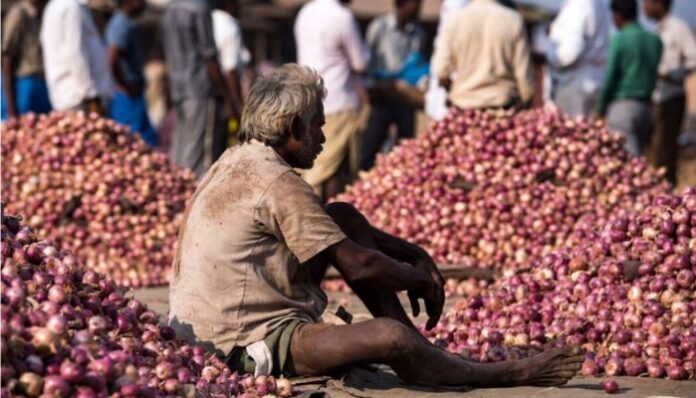
For a farmer, a crop is not just a source of income. It carries the hopes of an entire family. A good harvest means old debts may finally get cleared, household expenses can be managed, and some savings can be kept aside for children’s future. But when that same farmer reaches the market after months of hard work and discovers that his produce is worth almost nothing, the emotional and financial shock can be devastating.
A recent case from Maharashtra’s Chhatrapati Sambhajinagar district has once again triggered debate around the struggles of Indian farmers, the role of agricultural markets and the controversy surrounding the now-repealed farm laws brought by the Narendra Modi government in 2020.
The farmer earns less than his transportation cost
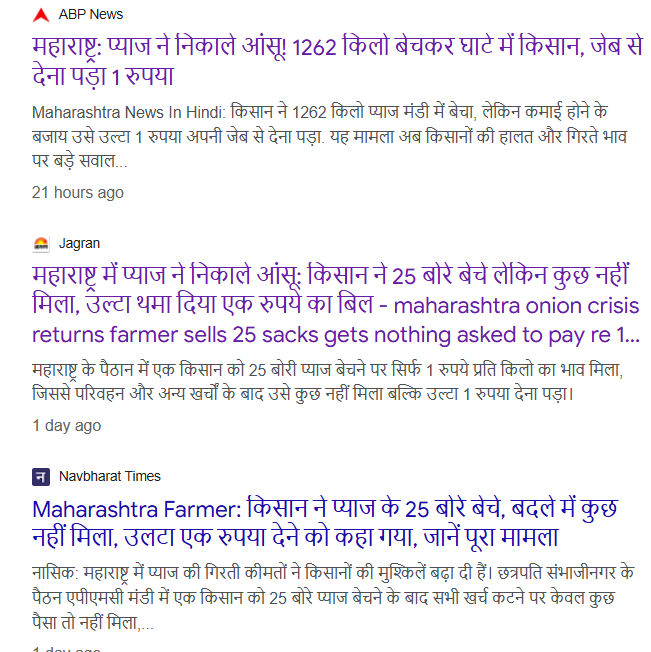
According to reports circulating in the media, a farmer named Prakash Galadhar from Varudi village in Paithan taluka spent nearly three months cultivating onions. After harvesting his crop, he packed 1,262 kilograms of onions into 25 sacks and transported them to the mandi, hoping to earn enough to recover his investment and support his family.
महाराष्ट्र में किसानों को प्याज का जो भाव मिल रहा, उससे उनकी लागत तक नहीं निकल पा रही है। किसान परेशान हैं। pic.twitter.com/Uy5dJaEZmR
— News Potli (@PotliNews) May 13, 2026
However, the price he received in the market left him shattered.
Traders reportedly offered him only ₹100 per quintal for his onions, which effectively came down to around ₹1 per kilogram. After selling the entire stock, the farmer received just ₹1,262.
The situation became even more painful when the total transportation and mandi-related expenses were calculated. Reports stated that the farmer spent ₹1,263 on loading, weighing, labour and transport costs while bringing the onions to the market. In simple terms, he spent one rupee more transporting the crop than what he earned from selling it.
महाराष्ट्र के छत्रपति संभाजीनगर जिले में एक किसान ने 1262 किलो प्याज मंडी में बेचा. लेकिन मंडी में प्याज का भाव मिला सिर्फ 100 रुपए प्रति क्विंटल, यानि एक किलो प्याज की कीमत लगी महज 1 रुपया. 1262 किलो प्याज बेचने पर किसान को कुल 1262 रुपए मिले. किसान से हमाली के 125 रुपए, तुलाई… pic.twitter.com/R6wuQdna5F
— ABP News (@ABPNews) May 12, 2026
This meant that after three months of hard work, the farmer not only failed to make a profit but actually suffered a financial loss.
Media coverage and the missing debate
Stories like these often trigger emotional reactions across the country. Images of distressed farmers and reports of crops being sold at extremely low prices usually lead to public anger directed at governments and administrative systems.
Many media reports focus heavily on the emotional suffering of farmers, but they often leave out the larger policy debate surrounding agricultural reforms and market access.
The recent onion case has once again revived discussion over whether Indian farmers remain trapped in a system where they are still heavily dependent on mandis and middlemen to sell their produce. The farm reforms introduced by the Modi government six years ago, through the now-repealed laws, were designed specifically to reduce this dependence and give farmers more freedom in selling their crops.
What were the farm laws about?
In 2020, the central government introduced three farm laws that it described as major agricultural reforms. According to the government, the purpose of these laws was to allow farmers to sell their produce outside traditional mandi systems and directly connect with private buyers, companies and larger markets across India.
The government argued that these reforms would create more competition, give farmers better prices and reduce the control of middlemen in agricultural trade.
आज भारत के किसानों के पास अपनी फसल मंडियों के साथ ही बाहर भी बेचने का विकल्प है।
— BJP (@BJP4India) December 12, 2020
आज भारत मे मंडियों का आधुनिकीकरण तो हो ही रहा है, किसानों को डिजिटल प्लेटफार्म पर फसल बेचने और खरीदने का भी विकल्प दिया है।
– पीएम @narendramodi pic.twitter.com/uf8UNdlaME
Prime Minister Narendra Modi repeatedly defended the reforms during speeches, interviews and episodes of Mann Ki Baat. He stated that the laws would open new markets for farmers, attract investment into agriculture and improve storage and supply chain infrastructure, such as cold storage facilities.
The government also claimed that farmers would eventually be able to use digital platforms and direct agreements to sell produce more profitably instead of depending only on local mandis.
Massive protests and political opposition
Despite the government’s claims, the farm laws triggered massive protests, especially in Punjab, Haryana and western Uttar Pradesh. Several farmer groups feared that the reforms would weaken the mandi system and eventually remove the Minimum Support Price (MSP) framework, even though the government repeatedly denied such intentions.
The protests continued for months, with thousands of farmers camping at Delhi’s borders. Roads were blocked, and large demonstrations took place across several states. Opposition parties strongly backed the protests and accused the government of bringing “anti-farmer” laws.
During that period, political tensions rose sharply. Initially, many farmer organisations supported the law, but figures like Rakesh Tikait and opportunistic politicians resorted to misinformation. Gradually, reports emerged that if this continued, it could compromise national security.
The government maintained that the reforms were meant to modernise Indian agriculture and give farmers greater flexibility. However, amid growing tensions and concerns over public order, the Modi government eventually decided to repeal the laws in 2021.
While announcing the repeal, Prime Minister Modi said that the government had failed to convince a section of farmers about the benefits of the reforms.
The debate returns amid farmer distress
Now, incidents like the Maharashtra onion case are bringing the debate back into public discussion.
If farmers had more freedom to directly access buyers or larger markets, many of them would not be forced to sell crops at distress prices inside local mandis. Farmers like Prakash Galadhar might have had alternative selling options if the reforms had remained in place.
Maharashtra | Onion farmers at Nashik's Lasalgaon APMC today stopped auctions due to low wholesale price of onions. Maharashtra State Onion Grower's Association also staged a protest against the govt pic.twitter.com/09xL3ZrnVU
— ANI (@ANI) February 27, 2023
Still, the case has once again highlighted the harsh reality faced by many farmers across India. Despite months of labour, uncertainty over the weather and rising cultivation costs, many farmers continue to struggle to get fair prices for their produce.
The emotional impact of such losses is often severe. In several parts of the country, financial distress among farmers has repeatedly led to mental stress, debt and in extreme cases even suicides.
It’s also important to remember that the media, which is highlighting the farmers’ suffering with headlines today, would not have faced this situation if it had been focused on farmers’ interests at the time. Unfortunately, they still don’t dare to admit that the confusion spread about the agricultural laws is a major reason for the current situation.
(This article is a translation of the original article published at OpIndia Hindi.)


