

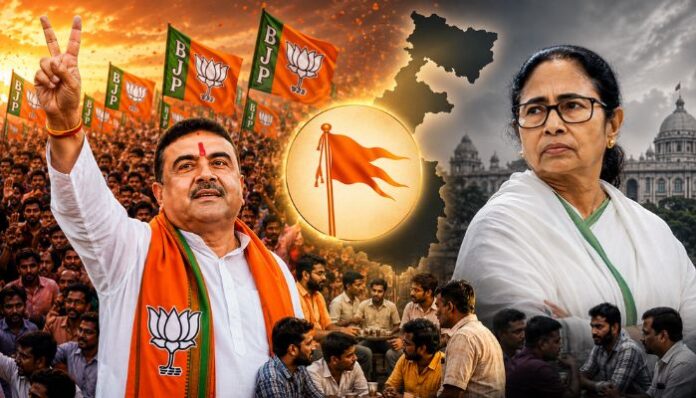
The BJP registered a massive victory in the 2026 Assembly elections, winning 206 out of 293 seats, while the ruling Mamata Banerjee-led Trinamool Congress (TMC) was reduced to just 81 seats. BJP leader Suvendu Adhikari took oath as the ninth Chief Minister of the state on 9th May, becoming the first Chief Minister from the Bharatiya Janata Party in Bengal’s history.
One of the biggest political shocks came from Bhabanipur, where former Chief Minister Mamata Banerjee lost her seat. Just a decade ago, such a political outcome would have seemed impossible in Bengal.
The BJP’s rise in Bengal has been long and gradual. From having zero seats in 2011 to now forming the government in 2026, the party spent years building its organisation at the grassroots level. BJP leaders and workers repeatedly claimed that the people of Bengal were frustrated with the “jungle raj” of the TMC government.
But behind this political rise was another organisation working almost invisibly on the ground, the Rashtriya Swayamsevak Sangh and its affiliates. While BJP leaders addressed massive rallies and dominated headlines, the RSS quietly built a deep social network across villages, towns and urban colonies that eventually helped unseat the TMC government.
A silent campaign that Bengal barely noticed
Unlike traditional elections, where a visible wave can be sensed months in advance, Bengal’s political shift came through what many BJP and RSS workers describe as a “silent undercurrent”. There were no loud campaign slogans on every street corner for most of the year. Instead, the campaign operated through conversations at tea stalls, beauty parlours, grocery shops, auto-rickshaws and evening gatherings over tea and chanachur.
According to a report by India Today, an RSS functionary from Bengal said that the Sangh and BJP realised early that people were angry but hesitant to openly speak against the TMC due to fear and political pressure. According to him, the strategy was simple: go micro, not mega.
“For over a year, around 50,000 auto drivers in Kolkata silently campaigned for the BJP. They did not openly ask for votes. They would simply drop one or two lines during conversations with passengers about corruption, women’s safety or cut-money,” the RSS functionary said.
This became one of the defining features of the BJP-RSS campaign in Bengal. Instead of relying solely on giant political rallies, the focus shifted to ordinary people with daily contact with voters. Local tea sellers, grocery store owners, beauticians, temple volunteers and small businessmen became informal communicators of political messaging.
According to RSS workers, these “local influencers” were identified long before the elections. The Sangh believed that people trusted familiar faces from their neighbourhood more than political speeches from distant leaders.
Tea stalls, beauty parlours and whisper campaigns
One of the most unusual parts of the campaign was what RSS workers called the “whisper campaign”. Instead of holding loud political meetings everywhere, small groups of five to ten people would meet informally and discuss issues affecting Bengal. Those people would then carry the discussion into their families and neighbourhoods.
Hindu Jagaran Manch leader Sarnath Ghosh explained how the strategy worked. “We held whisper campaigns with small groups. Those ten people would then speak to a hundred others. Slowly, the message spread everywhere without noise,” he said.
According to Ghosh, social media also played a major role in amplifying these discussions. Videos related to violence, corruption, alleged atrocities against Hindus, the RG Kar rape-murder case, Sandeshkhali violence and syndicate extortion were widely circulated through WhatsApp groups and local networks.
“We asked people a simple question: Who will protect your safety, your family and your faith?” Ghosh reportedly said, while adding that Sangh affiliates themselves do not directly ask people to vote for any political party.
The RSS and BJP also focused heavily on informal door-to-door contact. BJP workers would visit homes in the evening for tea and snacks, often without openly discussing politics. The idea was to build familiarity and trust rather than pressure people for votes.
Bengal BJP spokesperson Bimal Sankar Nanda said that the party conducted nearly 2.5 lakh small and big meetings before the election. “This time, the focus was not on formal speeches. The focus was on direct human contact,” he explained.
Anger against TMC became BJP’s biggest strength
The BJP and RSS workers believed that Bengal already had a strong anti-incumbency mood. Their task was not to create anger, but to quietly organise and channel it.
Several incidents became central talking points during the campaign. The RG Kar rape-murder case created massive outrage over women’s safety. The Sandeshkhali violence and allegations of land grabbing angered rural voters. Complaints about syndicate culture, cut-money extortion and political violence also damaged the image of the TMC government in many areas.
RSS leaders repeatedly argued that ordinary Bengalis felt politically suffocated under the TMC’s rule. Jisnu Basu, the Purba Kshetra Prachar Pramukh of the RSS, claimed that many voters believed Bengal’s identity and security were under threat. “This election became an organic reaction against fear, criminalisation and political oppression,” he said.
According to RSS workers, many voters were especially angry after the devastating floods in Bengal in 2025. BJP and RSS campaigners frequently reminded voters that while many parts of Bengal were suffering during the floods, Mamata Banerjee was attending public events and carnivals in Kolkata.
An RSS worker from Tollygunge who runs a tea stall said such incidents deeply affected public sentiment. “People felt the government had become disconnected from common citizens,” he reportedly said.
RSS built the ground structure while BJP expanded organisationally
The RSS campaign alone would not have been enough without the BJP simultaneously strengthening its organisational machinery across Bengal. After the BJP’s strong performance in the 2019 Lok Sabha elections, where it won 18 parliamentary seats, the party began aggressively expanding its grassroots structure. Ahead of the 2026 Assembly election, BJP leaders focused on booth-level management and local mobilisation.
Senior BJP leader Sunil Bansal, who started as an RSS pracharak, played a major role in reorganising the BJP structure in Bengal. Union minister Bhupender Yadav and Tripura leader Biplab Kumar Deb also spent long periods in Bengal helping the party strengthen its network.
The BJP identified nearly 44,000 booths and categorised them based on the party’s strength in each area. “Panna pramukhs” were assigned responsibility for maintaining contact with groups of 30 to 60 voters. These workers remained in constant touch with voters till polling day.
RSS volunteers also gave constant feedback to BJP leaders about local public sentiment and the opposition’s moves. BJP leaders admitted that this helped the party fine-tune its campaign strategy constituency by constituency.
West Bengal BJP spokesperson Bimal Sankar Nanda told India Today Digital that the party held nearly two lakh small meetings across Bengal before the election. During these interactions, people were encouraged to vote without fear and assured that central security forces would protect the polling process.
Hindutva politics and border concerns became major issues
Another major factor in the election was the growing traction of Hindutva politics in Bengal. Issues like illegal immigration from Bangladesh, demographic changes in border districts and appeasement politics became central themes in the BJP’s campaign.
RSS affiliates repeatedly raised concerns about attacks on Hindus and religious polarisation. Through small meetings and local discussions, they framed the election as a fight for Bengal’s identity and security. The BJP also linked law-and-order concerns with border infiltration and illegal networks operating in parts of Bengal. These issues resonated strongly in border districts and among sections of urban Hindu voters.
In many constituencies, BJP candidates focused heavily on hyper-local campaigning. In Bankura, BJP candidate Niladri Shekhar Dana campaigned on an e-rickshaw while volunteers conducted door-to-door outreach from morning till night.
Dana further said that a team of reveals a team of 100 volunteers was working tirelessly from 8 am to 9 pm, conducting door-to-door outreach efforts. He claims that a strong pro-BJP sentiment is sweeping the region, asserting that the ruling Trinamool Congress is on the verge of defeat. He lambasts the TMC using harsh descriptors such as ‘thief’ and ‘thug rule,’ accusing them of neglecting law and order and ignoring the public’s demands for change.
In Birbhum, BJP leaders visited fish markets and villages, speaking directly to people about water shortages, corruption and unemployment. The slogan of “poriborton” slowly transformed from a campaign message into a wider public sentiment.
The fall of TMC’s stronghold
By the time polling concluded, the BJP and RSS workers believed that the political tide had already shifted beneath the surface. What looked like a normal election on the outside had actually become a massive social mobilisation at the ground level.
The RSS leadership publicly downplayed its role after the results, saying that Bengal’s people themselves had rejected the TMC government. But BJP leaders privately acknowledged that the Sangh’s grassroots work played a major role in converting public anger into electoral victory.
The BJP’s Bengal victory ultimately became a combination of organisational discipline, booth-level planning, ideological mobilisation and silent social outreach. Massive rallies by leaders like Prime Minister Narendra Modi and Home Minister Amit Shah gave energy to the campaign, but the real groundwork happened quietly inside neighbourhoods, tea stalls and homes across Bengal.
For years, the TMC appeared politically unbeatable in Bengal. But the RSS spent months building a near-invisible network of conversations, local influence and voter outreach that slowly chipped away at the ruling party’s dominance. When the results finally came on 4th May, that silent campaign had turned into one of the biggest political upsets in Bengal’s history.


