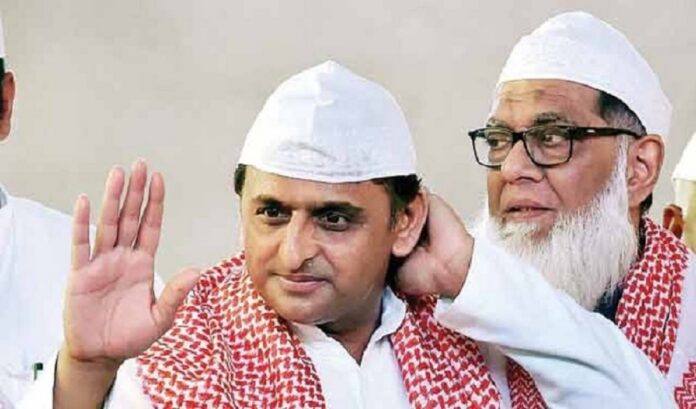
As Uttar Pradesh heads towards the 2027 Assembly election, Samajwadi Party (SP) chief Akhilesh Yadav appears to be attempting one of the biggest political image makeovers of his career. After years of projecting himself as the face of backward caste politics under the ‘PDA’ (Pichhda, Dalit, Alpsankhyak) banner and routinely accusing the BJP of practising divisive politics, Akhilesh has suddenly discovered a new constituency that he now claims has always been part of his social justice formula: Pandits.
Addressing a Brahmin/Prabuddh Varg Sammelan in Lucknow on August 5, Akhilesh declared that the “P” in PDA also stands for “Pandit”, accused the BJP of victimising Brahmins, invoked Swami Avimukteshwaranand, and even alleged that the BJP had “stolen” offerings made to Lord Ram at the Ayodhya Ram Mandir.
For a politician whose party has long been associated with antagonising Hindu sentiments and whose politics revolved around minority consolidation, the sudden embrace of Brahmins and overt Hindu symbolism is difficult to miss. It raises an obvious question: what changed?
The answer appears less ideological than electoral.
The mathematics behind the makeover
Political analysts view Akhilesh’s outreach as a recognition of changing electoral realities in Uttar Pradesh. Brahmins constitute roughly 10-14% of the state’s population and have traditionally voted overwhelmingly for the BJP. Winning even a fraction of this vote could significantly improve the SP’s prospects in a closely fought election.
The PDA slogan itself was unveiled only in 2023, replacing the SP’s earlier emphasis on Yadav-Muslim arithmetic with a broader coalition of backward classes, Dalits and minorities. The formula helped the SP improve its performance in the 2024 Lok Sabha election.
Now, however, Akhilesh appears to believe that the coalition alone may not be sufficient against a BJP led by Chief Minister Yogi Adityanath, whose popularity among Hindu voters remains strong. Hence, the latest attempt to reinterpret PDA by retrospectively adding “Pandit” to it.
The timing is hardly accidental.
A remarkable departure from the SP’s political legacy
The outreach also sits uneasily with the Samajwadi Party’s own political history.
The party’s founder, Mulayam Singh Yadav, remains synonymous with one of the most contentious episodes in the Ram Janmabhoomi movement. In October-November 1990, as Chief Minister, Mulayam ordered police firing on kar sevaks attempting to reach the disputed site in Ayodhya.
The official death toll stood at 16, although several organisations have disputed that figure over the years. Mulayam later expressed regret over the firing but continued to defend the decision, arguing that it was necessary to reassure the Muslim community.
That episode earned him the political nickname “Mullah Mulayam” among his critics.
The political messaging did not stop there.
Following the demolition of the disputed structure in 1992, the SP-BSP alliance famously campaigned in the 1993 Assembly election with the slogan:
“Mile Mulayam Kanshi Ram, Hawa Ho Gaye Jai Shri Ram.”
The slogan explicitly positioned itself against the Ram Janmabhoomi movement and the BJP’s mobilisation around it.
Today, however, Mulayam’s son invokes Lord Ram in nearly every election campaign.
Akhilesh’s own record
The ideological shift is not confined to Mulayam’s era.
During Akhilesh Yadav’s tenure as Chief Minister, his government banned the Vishwa Hindu Parishad’s proposed 84-Kosi Parikrama in 2013, citing law and order concerns. The decision drew sharp criticism from Hindu organisations, which accused the SP government of selectively restricting Hindu religious activities.
Over the years, the SP leadership repeatedly portrayed the BJP’s emphasis on Hindutva as communal politics while simultaneously cultivating Muslim vote banks through identity-based mobilisation.
Even after launching PDA in 2023, the formulation itself conspicuously referred only to Pichhda, Dalit and Alpsankhyak, backward classes, Dalits and minorities. This was around the same time that Rahul Gandhi was strutting around demanding “Jiski Jitni Aabadi, Uska Utna Haq” and a caste census. Mr Yadav perhaps thought of cashing in on the sentiments and launching his own initiative to reach out to the Dalits and the minorities.
So predictably, there was no mention whatsoever of Brahmins or Pandits back then.
Three years later, Akhilesh has suddenly declared that Pandits were always part of PDA.
The reinterpretation appears less like an ideological evolution and more like political improvisation.
Why the change now?
The answer lies in the transformation of Indian politics over the past decade.
The Ram Mandir movement has culminated in the consecration of the Ayodhya temple. Public celebration of Hindu identity has become increasingly mainstream across caste lines. Even parties historically uncomfortable with overt expressions of Hindu religiosity now routinely invoke temples, festivals and Hindu icons during election campaigns.
The Congress has already undergone its own version of this transformation, with Rahul Gandhi frequently highlighting temple visits and describing himself as a “janeu-dhari Hindu.”
Regional parties now appear to be following the same trajectory.
A political observation often attributed to Vinayak Damodar Savarkar was that if Hindus united politically, parties opposing Hindutva would eventually be compelled to display their Hindu credentials openly to remain electorally relevant.
Whether one agrees with Savarkar’s politics or not, the present political landscape increasingly resembles that prediction.
Tactical adjustment, not ideological conversion
Akhilesh’s latest statements about Brahmins, Lord Ram and Hindu religious figures should therefore be viewed in their broader political context.
His outreach comes after years of identity politics centred around caste and minority consolidation. It comes months before a crucial Assembly election. It comes at a time when the BJP continues to enjoy significant support among Hindu voters in Uttar Pradesh.
None of this necessarily proves insincerity. Politicians are entitled to evolve, revisit old positions and broaden their appeal.
But genuine ideological shifts are usually accompanied by sustained changes in political conduct, introspection about past positions and consistency over time.
So far, Akhilesh’s latest embrace of Brahmins appears driven more by electoral arithmetic than philosophical transformation.
The SP’s sudden attempt to redefine PDA by inserting “Pandit” into a slogan that originally stood for backward classes, Dalits and minorities is less a reinvention of ideology than an acknowledgement of political reality.
In today’s Uttar Pradesh, no party can afford to appear indifferent or hostile to Hindu sentiment.
That, perhaps, is the most significant political message behind Akhilesh Yadav’s latest reinvention.