

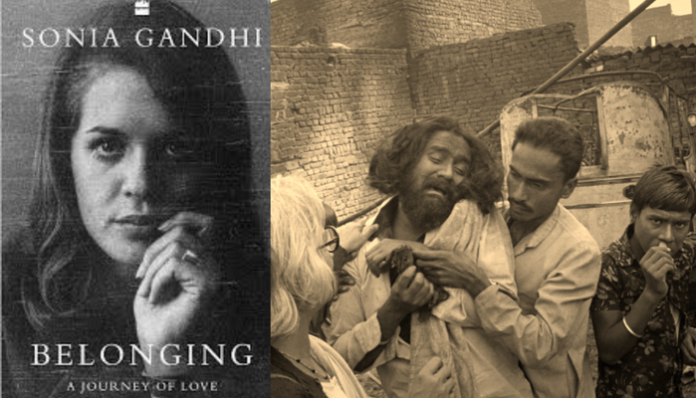
Congress leader Sonia Gandhi‘s recently published memoir, Belonging: A Journey of Love, has revealed her political ideology and exposed her attempts to distort history. In her memoir, the Congress leader made a sly attempt to whitewash the Congress Party’s role in the 1984 anti-Sikh riots. Instead, she put the blame on the Indian Army, alleging that a delay in the deployment of the Army troops in the national capital led to the killings of Sikhs. Here’s what Gandhi wrote in her memoir and what the official records say about the events.
Sonia Gandhi’s claims about deployment of the Army
In her memoir, Sonia Gandhi claimed that then Chief of Army Staff, General AS Vaidya, did not deploy the forces on time, which contributed to the situation getting worse. She said that General Vaidya decided not to mobilise nearby troops, including Sikh soldiers, in light of reports of “sporadic mutinies in Gurdaspur, Ramgarh in Bihar, Pune, and Jammu by Sikh soldiers, in which a number of Sikh officers had also participated”.
“Although the Chief of Army Staff, General AS Vaidya, had received his orders the same night as the assassination, we heard later that he decided not to mobilise the nearest units because they were manned by Sikh soldiers, a factor that might have exacerbated the situation,” Gandhi claimed in her memoir. “Many contradictory reports have appeared about that harrowing period, some concerning the delay in the deployment of the army,” Gandhi wrote.
“Whatever the reason, General Vaidya ordered units further away, in Dehradun, to move to Delhi. This took some time, but by the night of November 1, army units had started moving into place and by noon of November 2 had been positioned in parts of the city affected by rioting; a curfew was in force, and shoot-at-sight orders had been issued,” the Congress leader stated.
As per Sonia Gandhi’s account, General Vaidya had received the order for deployment of forces on October 31, 1984, the day Indira Gandhi was assassinated by her Sikh bodyguards. Gandhi claimed that the General did not mobilise nearby Army units because they included Sikh soldiers, which could have further exacerbated the situation. Interestingly, she makes the claim not based on any official records but on hearsay, as is clear from her words: “…we heard later that he decided not to mobilise the nearest units because they were manned by Sikh soldiers”.
Findings of the Commission that probed the 1984 anti-Sikh riots
When checked against plain facts, Sonia Gandhi’s claims turn out to be miserable attempts at giving a clean chit to the Congress Party and putting the blame on the Army. Her statement is contradicted by the findings of the one-member Justice Ranganath Misra Commission of Inquiry, which was appointed by her late husband and former Prime Minister of India Rajiv Gandhi to probe the 1984 Sikh massacre.
According to the findings of the Commission, the General AS Vaidya ordered the mobilisation of a brigade from Meerut to Delhi on October 31, 1984, around 10.30 am, which was roughly an hour after Indira Gandhi was assassinated at around 9:30 am. As per the statement of Major General JS Jamwal, the General Officer Commanding, Delhi Area, recorded by the Inquiry Commission, the Army’s available strength at the time was approximately 6,100 personnel. 3,000 of these personnel were available for field duty, while 3,100 were deployed for security arrangements at Teen Murti Bhavan and along the route to Shakti Sthal for Indira Gandhi’s funeral.
Thus, according to the Commission, at least 5000 Army troops were available for deployment the day Indira Gandhi was killed. The same unrest was reported in the national capital as crowds outside AIIMS targeted the motorcade of President Zail Singh at around 5.30 pm. This was followed by organised attacks on Sikh-majority localities across Delhi, including Trilokpuri, Sultanpuri, and Mangolpuri, the following day, on November 1, 1984. Riots continued across the national capital on November 2, 1984, when a curfew was declared, and the Army deployment was announced in the afternoon. The following day, on November 3, 1984, the Army was given shoot-at-sight orders.
So, it is evident from the records that the Army troops that had been ordered to be mobilised on October 31, 2026, were not fully deployed until November 2, 2026. The Army troops were kept on hold, waiting for a go-ahead from the civil authorities in Delhi, which were under the command of the Congress-led central government.
The Commission noted in its report that a timely deployment of Army troops across the national capital would have mitigated the impact of riots and would have saved many lives. “If the Army had been called in on the morning of November 1, 1984 — and by then about 5,000 Army people were at Delhi — the position would certainly not have been as bad as it turned out to be. 5,000 Army jawans divided into columns and moving into the streets properly armed would not have brought about the death of at least 2,000 people,” the Commission stated.
The Commission held the then Police Commissioner SC Tandon and Lieutenant Governor P.G. Gavai responsible for delayed deployment of the Army, both of whom were under the Congress government at the Centre. The findings of the Commission raise suspicion about the role of the leadership at the Centre during the riots. Notably, a later investigation into the 1984 riots accused Congress leader Jagdish Tytler of inciting a mob to commit violence resulting in the death of Sikhs near Gurudwara Pul Bangash in Delhi.
Interestingly, Sonia Gandhi made unfounded claims about the Army’s deployment and conveniently chose to overlook the official records, including the findings of the Commission, which present a completely opposite picture of the events. Clearly, Gandhi tried to pass off her hearsay-based version of events as facts to absolve the Congress Party of its role in the anti-Sikh riots.


