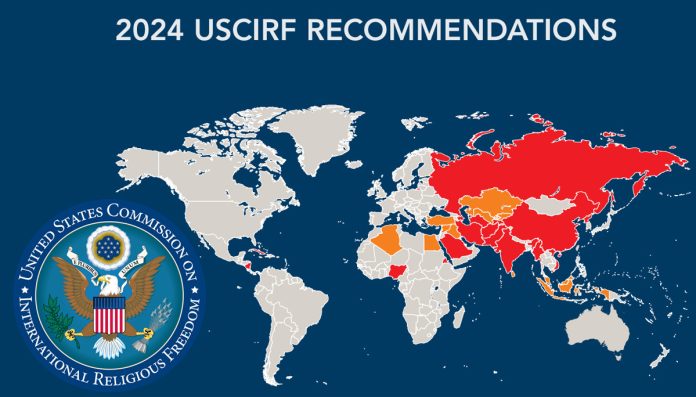
India on Thursday rejected the report of the US Commission on International Religious Freedom that accused the ruling Bharatiya Janata Party (BJP) of “reinforcing discriminatory nationalist policies” and said the organisation is completely ‘biased’ and it doesn’t even expect from the organization to understand country’s diverse, pluralistic and democratic ethos.
“The US Commission on International Religious Freedom (USCIRF) is known as a biased organization with a political agenda. They continue to publish their propaganda on India masquerading as part of an annual report,” Ministry of External Affairs official spokesperson Randhir Jaiswal said at a press briefing on Thursday.
“We really have no expectation that USCIRF will even seek to understand India’s diverse, pluralistic and democratic ethos. Their efforts to interfere in the largest electoral exercise of the world will never succeed,” he added.
The United States Commission on International Religious Freedom is a U.S. federal government commission created by the International Religious Freedom Act of 1998. USCIRF Commissioners are appointed by the President and the leadership of both political parties in the Senate and the House of Representatives.
Earlier on Wednesday, the US Commission on International Religious Freedom (USCIRF) which alleged that last year, Indian government failed to address communal violence disproportionately affecting Muslims, Christians, Sikhs, Dalits, Jews, and Adivasis (indigenous peoples).
“In 2023, religious freedom conditions in India continued to deteriorate. The government, led by the Bharatiya Janata Party (BJP), reinforced discriminatory nationalist policies, perpetuated hateful rhetoric, and failed to address communal violence disproportionately affecting Muslims, Christians, Sikhs, Dalits, Jews, and Adivasis (indigenous peoples). Continued enforcement of the Unlawful Activities Prevention Act (UAPA), Foreign Contribution Regulation Act (FCRA), Citizenship Amendment Act (CAA), and anti-conversion and cow slaughter laws resulted in the arbitrary detention, monitoring, and targeting of religious minorities and those advocating on their behalf,” the report said.
“Both news media and nongovernmental organizations (NGOs) reporting on religious minorities were subjected to strict monitoring under FCRA regulations. In February 2023, India’s Ministry of Home Affairs suspended the FCRA license of the Centre for Policy Research, an NGO dedicated to reporting on social issues and state capacity, including discrimination against religious and ethnic minorities. Similarly, authorities raided the offices and homes of NewsClick journalists, including Teesta Setalvad for her reporting on anti-Muslim violence during the 2002 Gujarat riots,” it added.
(This news report is published from a syndicated feed. Except for the headline, the content has not been written or edited by OpIndia staff)