

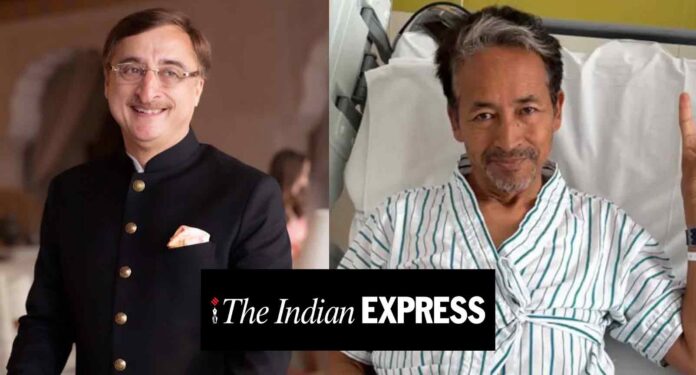
Congress Rajya Sabha MP and senior Supreme Court advocate Vivek Tankha has issued a legal notice to The Indian Express Private Limited and its Hindi editor Saurabh Dwivedi, alleging that the publication and its platforms have disseminated false, misleading and defamatory content regarding his role in the recent conclusion of climate activist Sonam Wangchuk’s hunger strike. The publication has been asked to withdraw the article claiming that Tankha had facilitated discussions between Sonam Wangchuk and the Government of India that led to Wangchuk ending his hunger strike.
On Sunday, advocate Ujjawal Anand Sharma of the law firm Lawmen & White, acting on instructions from Tankha, served the notice calling upon Dwivedi and the newspaper to immediately cease and desist from publishing or circulating the impugned material across print, digital and social media platforms. The notice further demands that the content be permanently removed, that misleading headlines and promotional material be corrected or deleted, and that an unconditional public apology and clarification be published within 48 hours.
Failure to comply, the notice states, will leave Tankha with no option but to initiate appropriate civil and criminal proceedings.
The Indian Express article by Deeptiman Tiwary claimed that Congress MP Vivek Tankha “played a significant role in opening communication channels between the government and Wangchuk and finding a middle ground that both could agree on.” The report also claimed that Wangchuk issued an open letter to minister Nadda on Tankha’s persuasion.
Tankha has denied these claims in the notice, stating that he urged the activist to end the fast due to concerns of his health, and he was not acting on behalf of the central govt, as the article implies.
The notice sets out at length the factual background of Tankha’s long-standing professional association with Wangchuk. It records that Tankha, who had earlier represented the activist in the Supreme Court in the habeas corpus petition challenging his detention under the National Security Act, visited Wangchuk at the Jantar Mantar protest site on 17 July and later at Medanta Hospital in Gurugram on 22 July along with other Members of Parliament. On both occasions, according to the notice, Tankha expressed genuine concern over the activist’s deteriorating health after he had lost more than 11 kilograms and urged him, purely on humanitarian grounds, to consider ending the fast in the interest of his own well-being and the safety of the protesting students.
On behalf of Shri Shri Vivek Tankha, Senior Advocate and Member of Parliament (Rajya Sabha) @VTankha I have today issued a legal notice to Mr. Saurabh Dwivedi @saurabhtop and The Indian Express Pvt. Ltd. @IEhindi @IndianExpress calling upon them to immediately cease and desist… pic.twitter.com/86zbhn6HrH
— Ujjawal Anand Sharma (@LawyerUjjawal) July 26, 2026
The notice emphasises that Tankha never acted on behalf of the Union Government, the Ministry of Home Affairs or any official, that he received no request or instruction from the government to negotiate, and that Wangchuk ultimately ended the fast only after receiving a written assurance from the Centre.
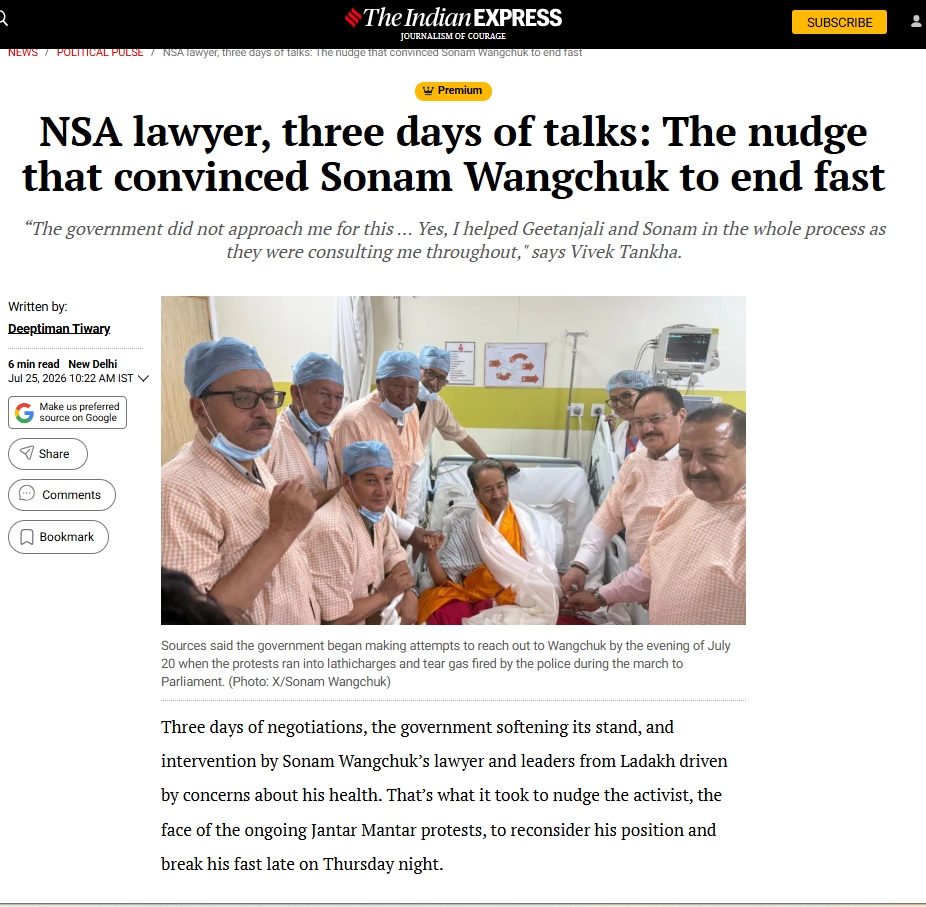
The publications, the notice alleges, have twisted these facts into a narrative that portrays Tankha as the central figure whose intervention persuaded Wangchuk to dilute the movement’s demands and end the fast. Particular objection is taken to the article authored by Deeptiman Tiwary that first appeared on the Indian Express website on 24 July under the title “How a Congress MP became bridge between Centre and Sonam Wangchuk,” which suggested that the Congress MP had convinced Wangchuk to end the hunger strike.
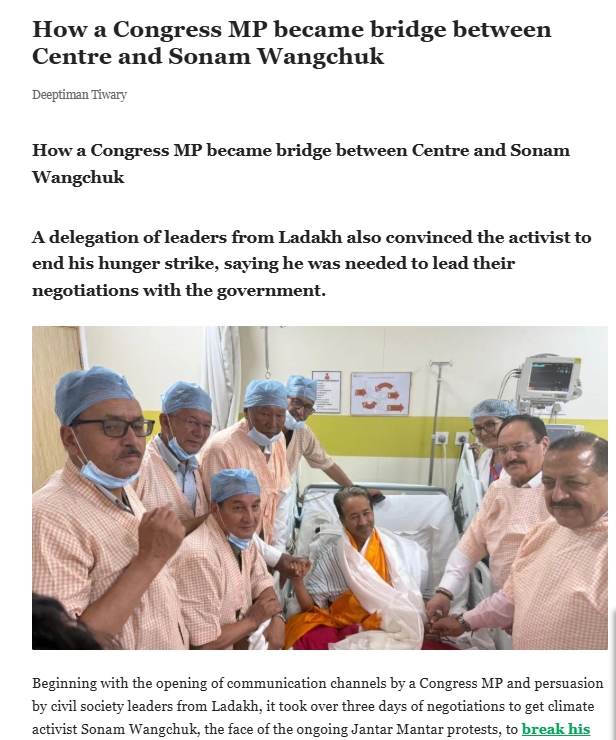
The title was subsequently altered to “NSA lawyer, three days of talks: The nudge that convinced Sonam Wangchuk to end fast.” The article states that Tankha “played a significant role in persuading him to end the fast” and quotes unnamed sources attributing the decision to discussions with him. Although the piece also carries Tankha’s own clarification that “the government did not approach me for this” and that his involvement stemmed from concern for Wangchuk’s life, the notice contends that the sensational headline, sub-headings and overall framing create a false impression of political intermediary work on behalf of the government.
Compounding the alleged false claims, the notice points to promotional material circulated by Indian Express Hindi on X and Instagram. One video posted on 25 July carried the caption “वांगचुक का अनशन तुड़वाने में किस कांग्रेसी सांसद का हाथ है?” (Which Congress MP played a role in getting Wangchuk to end his fast?) while an Instagram reel used the caption “इस कांग्रेसी सांसद ने की अमित शाह की मदद” (This Congress MP helped Amit Shah), both of which, according to the notice, maliciously name Tankha and seek to fasten responsibility on him for “breaking” the fast while linking him to the Home Minister.
वांगचुक का अनशन तुड़वाने में किस कांग्रेसी सांसद का हाथ है?#SonamWangchuk #IndianExpressHindi #SaurabhDwivedi pic.twitter.com/AH87RwNTcV
— Indian Express Hindi (@IEhindi) July 25, 2026
These assertions, the notice maintains, are wholly unverified, lack any documentary basis and amount to a calculated attempt to damage Tankha’s reputation as a Congress parliamentarian by suggesting that he abandoned his party’s position and acted in connivance with the ruling dispensation.
Notably, a delegation of opposition MPs had visited Sonam Wangchuk at Gurugram’s Medanta Hospital on 22nd July to persuade him to end his fast. Apart from Congress MP Vivek Tankha, others included TMC MP Sagarika Ghose and CPI(M) MP John Brittas. The delegation handed over a letter to Wangchuk, requesting him to withdraw the fast.

Wangchuk had been on an indefinite hunger strike for 26 days in solidarity with the Cockroach Janta Party-led student protest at Jantar Mantar demanding accountability for examination paper leaks, including the NEET controversy, and broader reforms in the education system. He ended the fast late on the night of 23 July at Medanta Hospital in the presence of Union Ministers JP Nadda and Jitendra Singh after receiving written assurances that no cases would be registered against peaceful protesters, that the issue of paper leaks and educational reforms would be discussed in Parliament, and that compensation for families of students who had died by suicide would be positively considered. Wangchuk himself later stated that the decision followed a hard bargain and was also influenced by the risk of the agitation turning violent.
In a post on X shortly after the notice was issued, Tankha expressed gratitude to Sharma and the firm, describing the reporting as “blatant journalistic lies being mixed to nix a true humanitarian story” and “cheap journalism.” He asserted that there is no freedom of expression to peddle lies and urged that the matter be taken to its logical conclusion.
Grateful to Sol firm Lawmen & White through Adv Ujjawal Anand Sharma for taking up this brief. It’s abt blatant Journalistic lies being mixed to nix a true humanitarian story. It’s cheap journalism. There is no freedom of expression to peddle lies. Take this case to its fruition https://t.co/GQMltRu1uz
— Vivek Tankha (@VTankha) July 26, 2026
The notice grants the addressees a strict timeline for compliance, including the publication of a correction that expressly states Tankha was never approached or authorised by the government and that his intervention was motivated solely by concern for Wangchuk’s health. They have been granted 48 hours to comply, failing which the MP will initiate appropriate civil and criminal proceedings and pursue all remedies available in law. The notice reserves Tankha’s right to claim damages for the reputational harm caused. As of Sunday evening, there has been no public response from The Indian Express or Saurabh Dwivedi.


