Japan prevailed over the Russian Empire and was hailed as the “first” Asian nation to subdue a European force in early modern history. However, the feat was already achieved by the Kingdom of Travancore, which covered small portions of modern-day southern Kerala and southern Tamil Nadu, after it defeated the Dutch East India Company (VOC) at Colachel in a battle in 1741.
The previous article detailed how the Dutch were unsettled by Marthanda Varma’s desire to extend his territory and challenge their monopoly. The local kingdoms, apprehensive about a potential assault from Travancore, also backed them. Additionally, there were suspicions that the king had military connections with the English, who supposedly equipped him with three ships, artillery and gunpowder. The Dutch-Travancore relationship became even more complicated as a result.
Therefore, the Dutch command in Malabar began a second assault against Travancore in November 1740 after requesting personnel from Ceylon. Travancore ruler Marthanda Varma, having experienced a succession of losses and setbacks from the Dutch and their allies, learned from past errors and formulated an efficient approach to crush the enemy permanently.
The Travancore army reassembled, strengthened by a renewed sense of purpose, discipline and morale. They attacked Dutch factories with precision, focusing on trading outposts and supply routes. The seizure of their stockpiled commodities and the emptying of their warehouses dealt an unexpected blow to the VOC. This economic warfare was not only symbolic but also aimed at the bedrock of their power, which was trade.
An alliance of convenience
Varma understood that an encounter on the battlefield was approaching. He enlisted trained soldiers, improved commercial ties with the English East India Company at Anjengo and secured firearms. The king also fostered diplomatic relations with the French, which resulted in a friendship contract in 1740 that permitted them to purchase items from Travancore, including pepper.
Varma pledged rewards and agreed to grant land for factory construction in return for military support. He even dispatched a delegation to meet the French. He also dissuaded the Carnatic Nawab’s generals, Chanda Sahib and Bada Sahib from attacking Trivandrum through financial tributes. Otherwise, Varma would have found himself in a similar scenario where he had to defend against aggression on multiple fronts.
The fall of Colachel
The Dutch sent three sloops and two big ships to Colachel, which is a key port in the current Kanyakumari district, on 26th November 1740. They received small reinforcements of 105 and 70 soldiers from Ceylon. The Dutch had fortified the region earlier and launched a barrage upon their return. The defences of nearby outposts, including Midalam, Kadiapattanam and Eraniel, were rocked by their bombardment.
The blockade of Travancore
On 29th November, their commander, Julius Valentijn Stein van Gollenesse, declared a total blockade of the Travancore coast. He ordered the confiscation of every ship, with the exception of the English vessels transporting cargo to Edava. They concentrated on the coastline between Colachel and Cape Comorin, which was critical for Travancore’s tax revenue and textile commerce.
The Dutch intended to gain the upper hand and deplete the kingdom’s resources by obstructing this route. They proceeded by capturing other pivotal places as the circumstances for Travancore deteriorated.
Their ship “Maarseveen” with men helmed by Eustachius De Lannoy, sailed south on 13th January 1741, to anchor between Thengapattanam and Colachel. Another mission, consisting of seven large ships and many smaller vessels, docked just north of Colachel on 10th February. The spot was deliberately chosen since they had their eyes on Varma’s capital Padmanabhapuram.
The Dutch intended to take over the whole area between Colachel and Kanyakumari with the help of the soldiers of Kollam (Quilon) and Kayamkulam. However, the local mukkuvars or fishermen reportedly confronted the much stronger force and stopped the advance for a brief period of time.
They pretended to be soldiers with rifles as they flanked the shore with oars lying on their shoulders. Additionally, palm trunks were set up on bullock carts to resemble sea-facing cannons, successfully confusing the Dutch. However, the ruse could not impede them for long.
The Dutch took over villages and progressed nearer to Padmanabhapuram daily as they looted and devastated the areas under Varma. A section of their force was stationed in a place adjacent to the port which they secured with wooden stockades and transformed it into their base.
They occupied Thengapattanam, Midalam and Kadiapattinam and made their way to Eraniel as Julius desired to have the entire territory between Cape Comorin and Colachel. “They committed many depredations and atrocities, plundered all the valuables in the bazaars and houses of rich people,” highlighted historian P Shungoony Menon in History of Travancore from the Earliest Times.
The Travancore army was under constant fire from the Dutch. Hundreds of houses were burnt down as torrential rains, high winds and severe sea waves pounded the coast. Varma had even addressed a letter of complaint to the Batavian government and vehemently protested with the Dutch Governor of Kochi as well.
Travancore army and the residents abandoned the area but the Dutch needed fortifications, trenches, temporary sheds and storerooms to sustain themselves. Therefore, they tried to win over the natives. They used money to lure the Mukkuvar community to muster support but could not purchase their loyalty.
According to local lore, these fishermen hindered Dutch troops from reaching Colachel. A small mail boat carrying an officer and some Mukkuvar men went out to their camp in Kanyakumari for reinforcements. However, the Mukkuvars brought the officer to the Travancore camp.
Similarly, many others were tricked into marching directly into the midst of Varma’s army. Some of them even shared Dutch strategy tips with his men. The Mukkuvars reportedly used sea divers to sink a few Dutch ships anchored in Colachel under the cover of night after the king’s request for assistance.
The Dutch even turned to Jesuit priests who adamantly refused to become involved. The furious Dutch bombarded the Jesuit church in Colachel and claimed the life of a priest while three were kidnapped to be tortured on their ship.
The Dutch sought supplies from Ceylon and Batavia to effectively control the newly acquired lands, but the “Java War” in Indonesia prevented the company government at Batavia from sparing any reserve forces. Hence, Julius ordered the available army to fight Travancore while asking for at least 300-400 men from Ceylon. However, they made a late entrance, misjudged the conditions and were unable to penetrate Varma’s resistance.
Furthermore, the situation in the Dutch cantonment was far from stable, as certain officials opted to defect and collaborate with Travancore due to severe conflicts, including the German sergeant Carl August Duijvenschot, who deserted them in Kanniyakumari. The Dutch were targeted by their estranged officials and the English on 6th June.
The Englishmen were trained by Duijvenschot, who had teamed up with Travancore and “supervised the siege of Colachel.” The Dutch supplies and troops were exhausted by frequent assaults and the protracted standoff. They were short on both provisions and armaments, but their problems were going to multiply shortly. Travancore started to advance into Colachel while the Dutch were on the defensive.
A decisive attack by Varma
Varma had been waiting for the right moment to hit back, and he used the opportunity without hesitation as the timing was perfect. He did not have any siege equipment to stun the foe, but the astute ruler decided to cut Dutch supplies with the aid of his ships and army from all sides.
He called upon his dewan (prime minister), Ramayyan Dalawa, another seasoned administrator and strategist, who was in North Malabar and handed him the charge to reclaim Colachel. The Travancore men moved forward with the aim of breaking the blockade, eliminating the Dutch garrison and regaining the prominent area.
While the Dutch eagerly awaited reinforcements that would not arrive, Ramayyan proceeded to Kalkulam, a crucial military hub, at the helm of a formidable contingent. They had artillery, cavalry and infantry trained in hybrid tactics, along with a fleet of local boats, quick and manoeuvrable, which were ideal for disrupting the coast.
With extraordinary ingenuity, an entire regiment of Mukkuvars took the role of spies and scouts to track Dutch movements. Ramayyan effectively blocked Colachel’s land access by putting his men between Nagercoil and Eraniel. The supply lines were severed from the sea by Travancore’s patrol boats.
The clever tactic worked in Varma’s favour. The previously confident Dutch garrison was stranded, grappling with uncertainty about what lay ahead for them. Varma, a devout Hindu, worshipped Adi Kesava (Lord Vishnu) for divine blessings and consecrated his sword in the Adikesava Temple in Thiruvattar before facing the enemy.
He reached Kalkulam when the Dutch had already taken control of every settlement between there and Colachel. However, he learned that they were preparing to assault Padmanabhapuram and created a regiment of 2000 Nairs to assist the active regular infantry. The Nair Brigade greatly outnumbered the Dutch, who had less ammunition due to the simultaneous flooding, rain and strong winds that prevented them from having dry gunpowder.
The victory after the massive blast
The Travancore army fired a cannonball on 5th August, and the shot struck a gunpowder keg within the Dutch stockade, resulting in a blast that destroyed all of their food and ammunition. A massive explosion transpired as the angry flames engulfed their stock for at least two days after which the men, under the command of Varma and Ramayyan attacked the Dutch on 10th (or 7th per some sources) August, in an event that would reverberate for generations.
The Mukkuvars also joined their king as patriots protecting their homeland. The fast pace and coordination of the onslaught took the Dutch by surprise. There were approximately 400 Dutch men, including 150 other Europeans who were surrounded by between 12,000 and 15,000 Varma’s personnel. Their superior technology allowed them to inflict fatalities on Travancore despite the numerical advantage.
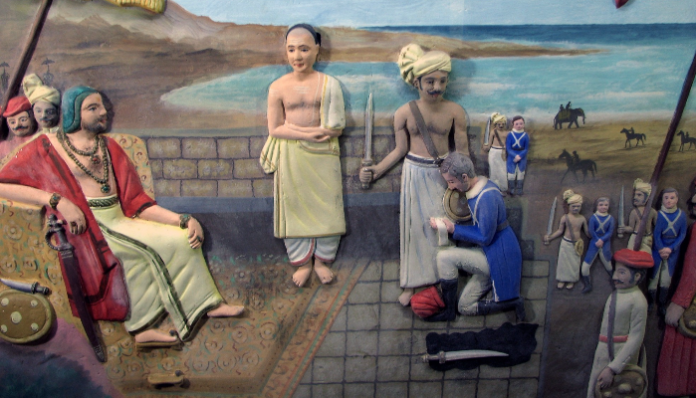
However, trouble continued to mount for the Dutch as constant firing pushed their countless provisions-laden ships to retreat. Their defences were overwhelmed as Travancore broke through their ranks. The Dutch had no alternative but to surrender and they did. This marked a pivotal moment in their strategic plans for India. Many Dutch soldiers lost their lives, suffered injuries or were imprisoned.
Twenty-four senior Dutch officers were caught and incarcerated in Udayagiri Fort in Puliyoorkurichi after their muskets, swords and cannons were seized. Commanders Eustachius de Lannoy and Donadi were among the prisoners. However, Varma exhibited kindness and wisdom by pardoning them.
The visionary leader employed them and utilised their skills to modernise the Travancore army with modern European-style training, fortification methods, artillery and enhancements in logistics. According to local accounts, all of the Dutch defences in the area had been taken by 14th August.
With their hopes of dominating the West Coast dashed, they were compelled to leave for Kochi. Travancore even built a victory pillar to commemorate their success in the armed conflict. The Dutch would then suffer an enormous setback as Varma reinforced his monopoly over the pepper trade and annexed several pepper-producing areas, including Odanand, Ambalapuzha, Changanassery and Meenachil.
From Dutch ranks to Travancore’s service
Dutch had been defeated and forced to retreat, but Varma was aware that the challenge had not been entirely extinguished and could resurface in time. He displayed foresight and decided to harness the capabilities of the captured or surrendered Dutch officers to update his army and empower his kingdom, felicitating them for the invaluable service they rendered to Travancore.
Eustachius, the Flemish man, raised the number of regiments and substantially improved defence constructions while organising the Travancore army according to European standards. He trained Varma’s palace guards in three months and introduced European military discipline norms to Travancore. He was one of the main men behind the construction of Nedumkottai, a line of fortifications in the north of the kingdom that later repelled Tipu Sultan’s troops during his invasion of Travancore in 1789.
Eustachius rose to the posts of commander-in-chief and Valiya Kapittan (Great Captain) of the Travancore army. He continued to serve the kingdom for the following 37 years, under both Varma and his successor, until his death. Over time, the military prowess of Eustachius, along with the strategies of the Ramayyan and the statecraft of Varma, proved to be highly successful in the subsequent military campaigns and acquisitions of the Northern kingdoms up to Kochi.
They conquered Kollam, Kayamkulam, Kottarakkara, Pandalam, Ambalapuzha, Edappalli, Thekkumkoor and Vadakkumkoor. Varma also rewarded Duijvenschot and appointed him as a general in appreciation of his contributions and his ability to successfully recruit Europeans into the Travancore army.
Mark de Lannoy of Leiden University wrote, “He was then in command of 30,000 soldiers, 4,000 or 5,000 of whom were armed with European firearms. They were spread all over the country but could unite within two days in Attingal. He stated that Eustachius “fought under Duijvenschot on the side of the Travancoreans against the Dutch. He also served as instructor in the use of flintlocks.”
The impact and the protracted aftermath
The Dutch held their ground at Kanyakumari in the hopes of getting reinforcements from Ceylon. However, a 5,000-strong Travancore force stopped them from moving closer to Padmanabhapuram. The former also deployed 150 men to strengthen their forward stations at Paravur and Ayiroor.
The Dutch eventually vacated their position at Kanyakumari in October 1741 and left Attingal after their ally Deshinganad deserted them. Their morale had been seriously damaged by Travancore’s success at Colachel. The same was conveyed by their leadership at Kochi to Batavia on 26th October.
They outlined that the local chiefs believed that the Dutch East India Company could be driven off the coast of Malabar. A ceasefire was agreed upon by the Dutch and Travancore, but they were unable to come to an understanding. Hence, warfare broke out again and Varma besieged the Dutch-occupied Kilimanoor fort after receiving aid from a Tirunelveli cavalry troop.
Kollam and Kayamkulam walked away from the Dutch coalition and reached a covert deal with Travancore during this period. The disappointed foreigners then hurriedly evacuated the fort on 10th April 1742 and abandoned their supplies and ammunition. The Travancore army surrounded them and fought the forces headed by Jacob Hinderman and Captain Daniel Bergen. The latter had to withdraw to Ayiroor and the contingent was rescued by the vessels dispatched by the Dutch Malabar command.
Another opportunity for Travancore emerged when the queen of the Elayadathu Swaroopam kingdom, who had been reinstated by the Dutch, became increasingly unpopular among her subjects. The Madampis and Pillais grew dissatisfied with her neglect of administrative affairs, which had triggered a steady decay in governance.
The Dutch commissioners had no resources to spare for the kingdom’s security and suggested designating a Kariyakkar (administration) to rule alongside the queen. Sensing a potential window, Varma acted quickly and invaded its capital Kottarakkara, encountering little resistance as the queen escaped to Kochi.
The monarch had nearly accomplished his goal of a unified, sovereign Travancore. However, the Kingdom of Kochi, which was still supported by Dutch forces posed the final challenge.
Meanwhile, the Dutch were beset by problems on all sides. The ruler of Purakkad had declared his intention to sever ties with them, and the king of Tekkumkur and two princes of Kochi had defied their orders. The Europeans were also deserting the Dutch, and the local allies were distancing themselves from their command.
On 17th April, the Dutch commander communicated these issues to Batavia, requesting 2,000 soldiers from the company’s supreme government due to the dire situation in Malabar. Varma wanted to capitalise on the chance to target Kochi. However, Duijvenschot guided him to win Kollam before that, but the strategy failed, and Travancore was pressured to retreat after losing 6,000 soldiers. Afterwards, Julius sought 2,000 soldiers from Batavia.
The high-stakes round of negotiations
The Dutch decided to start talks with Travancore again because Ceylon and Batavia were not providing them with funds or assistance. This time, Varma agreed to peace negotiations on specific terms after previously rejecting the Dutch attempts at diplomacy.
The Dutch rejected his conditions and offered their own demands which were refused by him. Julius was convinced that Varma would ease his negotiating stance if he were to lose in battle, and in July, the Dutch representatives in India were informed of Gustaaf Willem van Imhoff’s impending arrival with a substantial army.
Nevertheless, this did not happen and they once again turned to Batavia in August. Julius insisted that he would be forced to agree to a peace treaty with Travancore under conditions detrimental to the company without their help. However, Varma withdrew to his core region and began peace talks with the Dutch after learning of the reported impending arrival of Dutch troops.
He asked Tekkumkur and Kochi for mediation. The Dutch also approached the two kingdoms after Batavia instructed the Malabar Command to participate in peace talks. However, the monarchs were unwilling to cooperate because they were convinced that such an arrangement would be harmful to their interests.
As a result, the Dutch initiated direct talks with Travancore, and Mavelikkara was selected as the meeting location. They sent their influential diplomats Ezckiel Rahabi and Silvester Mendes while Varma was represented by his envoy Krishna Annavy. On the other hand, Kollam was unable to get reinforcements since Dutch forces failed to show up.
Thus, the ruler of Kollam and Kayamkulam signed a treaty agreeing to become a tributary of Varma. A large part of the region was ceded alongside the promise of an elephant and 1,000 rupees each year. Varma also discovered that Gustaaf was still in Europe and dragged on the negotiations until he was positive that the latter’s arrival in Kerala had been deferred.
Afterwards, he took a firm stance and declined to accept what his delegates had decided upon in Mavelikkara, which prompted further talks at Paravur in Kollam. Tough bargaining positions were adopted by both parties. The monarch of Kollam and Kayamkulam, dissatisfied with the conditions of his treaty, visited Julius on the ship Popkensburg on 27th February 1743 and sought assistance.
However, the Dutch wanted to carry on the talks and hence Julius declined the request and advised him against any clashes with Varma. On 3rd March, Mendes notified Julius that Varma presented proposals for a peace deal, which were once more rejected, and the talks were terminated but Travancore delegates requested him to detail his complaints.
Julius responded by presenting his preferred draft of the pact. Afterwards, another round of negotiations began in Pulikkara when Varma responded that he was prepared to resolve the differences. Julius consented and entrusted the task to his envoys, but the outcome remained unchanged. He was informed by Varma on 6th April that the meeting had flopped.
In the meantime, Reinicus Siersma succeeded Julius who resigned in May to assume charge as the Governor of Dutch Ceylon. The former recognised that the chiefs in Kerala were no longer afraid of the Dutch and the company’s pepper business in Malabar would suffer if an accord with Travancore could not be reached. Siersma signed a peace deal with Varma on 22nd May, yielding to the majority of his demands.
The attainment of a long-cherished goal
The king of Odanad had signed the “Treaty of Mannar” with Travancore in 1742. He wanted to extricate himself from this agreement and joined hands with Vadakkumkur, Thekkumkur and Purakkad. On the contrary, Varma had taken over Kayamkulam and formed an alliance with its ruler in 1746.
Furthermore, Mathur Panikkar and Tekkedathu Bhattatiri, two prominent military commanders of the Ambalapuzha (Chempakassery) Kingdom, also deflected to the Travancore army. Afterwards, the annexation of Thekkumkur and Vadakkumkur occurred in 1749 and 1750, respectively.
The Dutch also signed the “Treaty of Mavelikkara” with Varma in 1753, promising to sell weapons and ammunition in exchange for not meddling with his expansion policy. The end of their dominance in India began with this event. However, peace and tranquillity remained elusive for Travancore.
The exiled kings of Ambalapuzha, Thekkumkur and Vadakkumkur encouraged the uprising in the northern regions of the recently established state of Travancore in that year. The rebels received support from the king of Kochi and the Dutch. Their forces were presided over by Palliyil Idikkela Menon, a courtier of the Kochi ruler and Purakkad was seized towards the end of 1753.
The prince attacks Kochi: Fall of Dutch power
On 3rd January 1754, Travancore troops commanded by Prince Rama Varma, Ramayyan and Eustachius confronted the rebels backed by the armies of Kochi and the Dutch, in the battle of Anadeswaram. Varma earned a strategic edge even if the confrontation ended in a tactical standoff because the allies had to retreat to Ambalapuzha where they were soundly defeated in a battle and many Kochi nobles were either slain or taken prisoners.
The Travancore troops had marched north under the direction of Eustachius. His upgraded tactics, such as synchronised infantry and artillery, fort siege techniques and naval aid from Travancore’s patrol boats were demonstrated in the decisive and rapid face-off. Weakened and dispersed, Kochi’s forces were overrun by the carefully orchestrated attack.
The Dutch stretched thin throughout Asia and unable to bounce back from Colachel were handed another defeat. The king of Kochi had to sue for peace, after which his Prime Minister Paliath Komi Achan and the Dutch had to ink a peace pact in 1757.
Travancore took full possession of the pepper-producing areas after capturing Dutch forts and breaking their naval blockade. It controlled important spice routes and ports due to the acquisition of Kollam, Attingal and portions of Kochi. The monarchy started negotiating commerce on its own terms, using its monopoly to improve its diplomatic and economic prestige.
The relationship between Travancore and the Dutch saw an improvement after the latter transferred ownership of the Cranganore and Pallipuram forts to Varma, which were then included in the kingdom’s fortifications (Nedumkotta). The Dutch, who had once held a commanding position on the Malabar Coast, were now merely modest traders.
They continued to market Indonesian sugar in India until 1795, but their political and military presence had all but dissipated. The Dutch exited Indian affairs that year when the British East India Company assumed control of their properties, including Fort Cochin. On 31st December 1799, the VOC was formally liquidated and the Batavian Republic inherited its assets and debts.
A legacy forged against all odds
Varma’s successful campaign against the Dutch not only served as a death knell to their colonial aspirations in India but also resulted in an economic disaster alongside a military defeat. The pepper trade of Kerala, often referred to as “black gold,” was a significant source of wealth stretching from Amsterdam to Batavia and had been the centre of centuries-long rivalry among European powers.
However, it was an Indian monarch who valiantly took a stand against them for his kingdom’s sovereignty, status and progress, and transformed history by overthrowing the imposing Dutch against all expectations.
In 1750, Varma who was a staunch Hindu, submitted his wealth and authority to Lord Padmanabhaswamy, the god who had inspired the name of his capital. He assumed the title “Sri Padmanabhadasa,” or “Servant of the Lord,” in a custom carried on by the Travancore rulers for many generations.
In fact, the treasure of the Padmanabhaswamy Temple, which was uncovered in 2011 and captured global attention, traces its roots back to the pepper trade and Varma’s triumph over the Dutch. Furthermore, the rare military heritage of Travancore was carried forward into modern India.
The Nair brigade officially joined the Indian Army in 1954 following independence, becoming the 9th and 16th Battalions of the Madras Regiment. It was formed as an elite combat unit and initially composed solely of Nairs who had a rich martial background.
Over time, however, it began to include members from other communities. They became the cornerstone of Travancore’s military initiatives and Kumaraswamy Pillai, the brigade’s first commander, transformed it into an elite force.
Most importantly, Varma and Travancore exemplified how tactical brilliance, discipline, conviction and courage could deliver a crushing strike to a superior nemesis and cement a glorious imprint on the golden pages of history.