

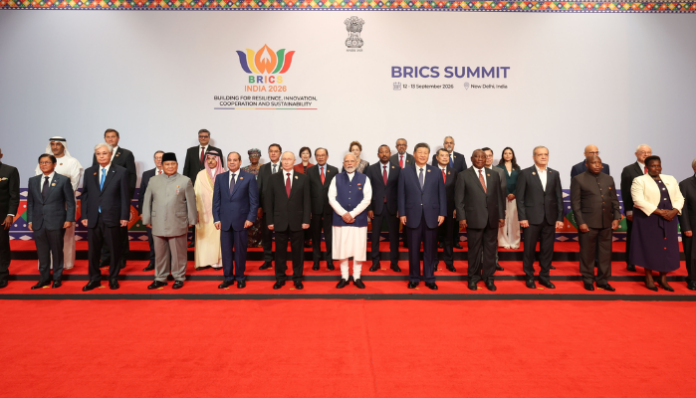
The 18th BRICS Summit officially concluded in New Delhi on Sunday, 13th September, with the adoption of the New Delhi Declaration, marking a significant diplomatic achievement for India. The two-day summit, held under India’s BRICS presidency, brought together leaders of the expanded grouping to discuss international security, economic cooperation, global governance, trade, technology, climate change and sustainable development. The declaration was adopted by consensus despite major differences among member countries over conflicts in West Asia, Ukraine and the changing global order.
Thank you to all BRICS leaders for making the Delhi Summit very productive and outcome oriented! pic.twitter.com/C3DMZWGgLL
— Narendra Modi (@narendramodi) September 13, 2026
The summit was held under the theme “Building for Resilience, Innovation, Cooperation and Sustainability” and came at a time when geopolitical tensions are affecting economies and ordinary people across the world. The Russia-Ukraine war, the conflict in West Asia, new tariff barriers and growing competition over technology and critical minerals created a difficult backdrop for the meeting.
Addressing the concluding session, Prime Minister Narendra Modi said BRICS must respond to these challenges through cooperation and inclusive growth. He also warned against the “weaponisation of technology and critical minerals”, saying that it could become a hurdle to shared progress and prosperity. Modi said developing countries increasingly trust BRICS because their voices are heard and solutions are developed in partnership with them rather than imposed on them.
Sharing my concluding remarks during BRICS Session on ‘Resilience, Innovation, Cooperation and Sustainability: Shaping the Future for Inclusive Global Growth.’ https://t.co/4E8aBDksfK
— Narendra Modi (@narendramodi) September 13, 2026
Chinese President Xi Jinping, Russian President Vladimir Putin, Iranian President Masoud Pezeshkian and senior UAE leadership were among the prominent leaders attending the summit. Xi also announced initiatives aimed at increasing cooperation in areas such as artificial intelligence and trade, as China seeks to strengthen BRICS as a practical platform for Global South cooperation.
New Delhi Declaration: The biggest diplomatic outcome
The biggest achievement of the summit was the unanimous adoption of the New Delhi Declaration. The 45-page document contains 140 points and covers a wide range of political, economic and developmental issues. Its adoption was particularly important because BRICS has become much more diverse after its expansion, with member countries having sharply different interests and positions on international conflicts.
The challenge before India was not simply to host the summit successfully but to make sure that an increasingly divided grouping could still agree on a common document. This was a particularly difficult task because BRICS members include countries such as Iran and the UAE, which have been on different sides of tensions in West Asia, as well as China and Russia, which have increasingly challenged aspects of the Western-led international order.
The fact that the members ultimately reached consensus therefore became an important institutional achievement. The New Delhi Declaration demonstrates that disagreements among BRICS countries do not necessarily have to make the grouping dysfunctional. Instead, members can identify areas of common interest even when they disagree on major geopolitical questions.
The declaration calls for cooperation across three broad areas: political and security cooperation, economic and financial cooperation, and cultural and people-to-people exchanges. It also places strong emphasis on development, resilience, innovation and sustainability, which were central themes of India’s BRICS presidency.
India succeeds in keeping BRICS together despite geopolitical differences
For India, one of the biggest tests was whether it could prevent BRICS from becoming paralysed by the conflicts involving its members. Earlier difficulties in reaching consensus had shown how complicated the expanded grouping had become.
This time, New Delhi managed to bring the members together around a common declaration. The achievement is important because the credibility of BRICS depends heavily on its ability to reach consensus and produce concrete outcomes.
India’s diplomatic balancing was visible throughout the summit. New Delhi maintained close engagement with Russia and China while also keeping the larger agenda focused on development and the concerns of developing countries. PM Modi held bilateral meetings with several foreign leaders, including Xi Jinping, Vladimir Putin and Masoud Pezeshkian, using the summit as an opportunity to strengthen India’s relationships across competing geopolitical camps.
The Modi-Xi meeting was particularly significant because India-China relations have been under pressure for years due to border tensions. The two leaders discussed the need to manage differences without allowing them to turn into disputes, along with issues related to the border, trade and economic relations.
At the same time, Modi’s engagement with Putin and Pezeshkian showed India’s continuing ability to maintain diplomatic channels with countries that have difficult relations with the West.
This balancing act is important because India has consistently argued that BRICS should not become an anti-American or anti-Western military or political alliance. Instead, New Delhi has attempted to position it as a platform where developing countries can demand a greater voice in global institutions while continuing to engage with all major powers.
Pahalgam attack gets strong condemnation
Another major diplomatic gain for India was the reference to the 22nd April, 2025, Pahalgam terror attack in the New Delhi Declaration.
The BRICS countries condemned the attack, which killed 26 people, in the strongest terms and reiterated their commitment to “zero tolerance” towards terrorism. The declaration also called for action against terrorism financing, terrorist safe havens and the cross-border movement of terrorists.
It specifically identified the Pahalgam attack and condemned it as a terrorist attack. It also stated that those involved in terrorist activities and their supporters must be held accountable.

For India, this was diplomatically significant because China is a major strategic partner of Pakistan and a permanent member of the UN Security Council. Getting a consensus among BRICS members, including China, on the condemnation of the Pahalgam attack allowed New Delhi to place the issue within a broader international framework on terrorism rather than treating it only as an India-Pakistan dispute.
The declaration also reaffirmed that terrorism cannot be associated with any particular religion, nationality, civilisation or ethnic group. BRICS called for international cooperation against terrorist organisations and stressed the need to eliminate terrorist financing and safe havens.
West Asia: BRICS chooses dialogue and diplomacy
The crisis in West Asia was one of the most difficult issues before the summit. The presence of Iran, along with the UAE and other countries with different positions on the conflict, made consensus particularly challenging.
Yet BRICS members managed to agree on language calling for maximum restraint, dialogue and diplomacy. The declaration expresses serious concern over the worsening situation in the region and stresses the need to protect civilians and civilian infrastructure.
On Gaza, BRICS called for a ceasefire and unhindered humanitarian assistance. It also reaffirmed support for a two-state solution based on the internationally recognised 1967 borders, with East Jerusalem as the capital of a sovereign Palestinian state. The grouping also supported Palestine’s full membership of the United Nations.

The declaration’s language is important because BRICS includes countries with very different views on the conflict. Instead of allowing these differences to prevent a joint statement, India helped the members arrive at a common position centred on restraint, diplomacy and humanitarian concerns.
The summit also provided an unusual diplomatic setting for Iran and the UAE. Iranian President Masoud Pezeshkian met Abu Dhabi Crown Prince Sheikh Khaled bin Mohamed bin Zayed Al Nahyan on the sidelines of the summit. The meeting was significant given the tensions between Tehran and Gulf Arab states and showed how New Delhi could serve as a platform for diplomatic engagement.
A bigger voice for the Global South
Beyond immediate conflicts, the BRICS summit was also about changing the balance of power in international institutions.
The New Delhi Declaration calls for reforms in the United Nations, including the Security Council, and greater representation for developing countries in global decision-making. China and Russia reiterated support for the aspirations of India and Brazil to play a greater role in the UN, including the Security Council.
This is particularly important for India. New Delhi has been seeking permanent membership of the UN Security Council for years, arguing that the existing structure does not reflect the current global economic and political realities.
BRICS also called for greater representation of developing countries in institutions such as the International Monetary Fund (IMF) and the World Bank. The grouping wants the decision-making structures of these institutions to better reflect the growing importance of emerging economies.
Trade, tariffs and local currencies
Economic cooperation was another major focus of the summit. BRICS criticised unilateral tariffs and non-tariff measures that can disrupt international trade and supply chains.
The declaration supports a more open, fair and predictable global trading system, with the World Trade Organisation (WTO) remaining at its centre. BRICS members also continued discussions on improving cross-border payments and increasing the use of local currencies for trade settlements and investment.
The idea is not necessarily to create a single BRICS currency immediately, but to reduce some of the difficulties involved in cross-border transactions and make trade less dependent on a limited number of international payment systems.
The New Development Bank is also expected to play a larger role in financing infrastructure and sustainable development projects in emerging economies. Greater use of local-currency financing could help developing countries reduce some exposure to fluctuations in major international currencies.
Food, energy and critical minerals
The summit also highlighted food and energy security, both of which have become major concerns because of wars and disruptions in global supply chains.
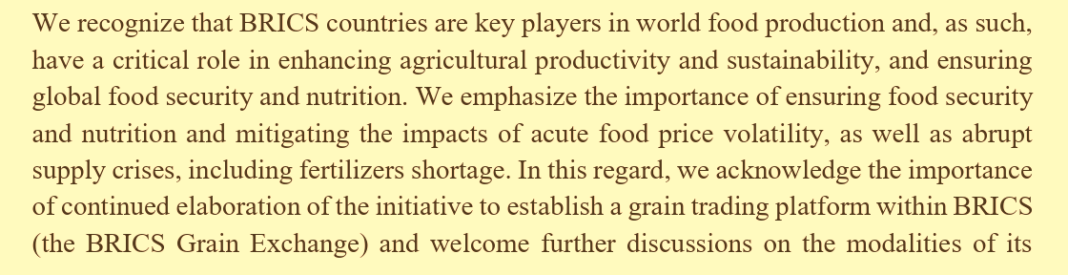
BRICS countries want stronger cooperation on agriculture, food prices, agricultural inputs and supply chains. Discussions around a proposed BRICS Grain Exchange are aimed at making food trade more resilient.
Energy security was another important issue. The declaration supports stable energy markets and secure supply chains while recognising that developing countries have different energy needs. Critical minerals received particular attention because they are increasingly important for electric vehicles, renewable energy, batteries and advanced technologies. India has warned that control over critical minerals could become another source of geopolitical pressure.
This is where Modi’s warning about the “weaponisation of technology and critical minerals” becomes significant. For developing economies, access to technology and raw materials is increasingly linked to economic security and national development.
AI, technology and digital cooperation
Artificial intelligence emerged as another major area of BRICS cooperation.
Technology has emerged as another important area of BRICS cooperation. The declaration recognises Artificial Intelligence as a major opportunity for economic growth and sustainable development, but says AI development must also focus on safety, security, reliability, inclusion and risk reduction.
BRICS is also working towards greater cooperation on digital public infrastructure, digital skills, cybersecurity and future communication networks. A proposed high-speed submarine cable network connecting BRICS countries is being studied to improve digital connectivity and resilience.
The bloc has also welcomed the BRICS Incubator Network and further consideration of a BRICS Startup Innovation Fund, aimed at supporting startups and innovation-led growth. India has also established the India Centre for BRICS Industrial Competencies as part of wider cooperation on advanced manufacturing and Industry 4.0.
Climate, health and sustainable development
The declaration expands BRICS cooperation in healthcare, including universal health coverage, disease surveillance, pandemic preparedness and medical research. Tuberculosis has been identified as a major global health challenge requiring greater research and cooperation.
BRICS has also backed a BRICS Mission for Healthy Lifestyle and a 2026-2029 roadmap for promoting healthier lifestyles. Mental health has received particular attention, with plans for a network of Centres of Excellence, with NIMHANS serving as the coordinating centre.

Climate change and disaster preparedness are also major parts of the declaration. BRICS leaders reaffirmed support for the Paris Agreement, called for more climate finance for developing countries and highlighted the need for stronger early-warning systems and climate-resilient infrastructure.
Why the summit matters for India and the global order
The success of the New Delhi Summit ultimately lies in the fact that India managed to keep a deeply diverse BRICS together at a time when the global diplomatic environment is highly divided.
BRICS is no longer the small five-member grouping that emerged around Brazil, Russia, India, China and South Africa. Its expansion has brought in countries from the Middle East, Africa and Southeast Asia, making it much larger but also much harder to manage.
India’s challenge was therefore to make sure that expansion did not result in paralysis. The adoption of the New Delhi Declaration suggests that the grouping can still find common ground.
For India, the summit strengthened its image as a country capable of talking to different sides at the same time. New Delhi maintained its strategic partnership with Russia, engaged China, hosted Iran and Gulf leaders, and continued to argue for a larger role for developing countries without turning BRICS into an explicitly anti-Western alliance.
This is particularly important in the emerging global order, where countries are increasingly unwilling to choose completely between competing power blocs. India’s approach has been to push for a more multipolar world while retaining strategic autonomy.
The summit also gave India an opportunity to push issues that matter directly to the Global South: development finance, food and energy security, technology access, climate finance, trade reforms and greater representation in international institutions.
PM Modi’s message at the concluding session reflected this larger vision. He said BRICS must respond to global challenges through cooperation and inclusive growth, while warning that ordinary people should not be made to bear the cost of geopolitical rivalries.
The 18th BRICS Summit therefore ended with more than a ceremonial declaration. Its biggest message was that despite deep disagreements among members, the grouping can still function as a diplomatic and economic platform.
The next challenge will now shift to China, which will take over the BRICS presidency for 2027. For the moment, however, the New Delhi Summit has strengthened BRICS as a platform for the Global South and given India a significant diplomatic achievement at a time when the international order is undergoing major change.


