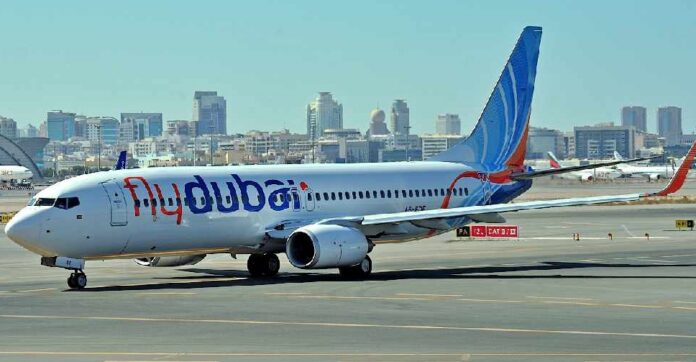
A Flydubai flight travelling from Dubai to Tel Aviv was forced to divert to Saudi Arabia on Wednesday after a dramatic incident unfolded on board, triggering emergency alerts, an Israeli military response and brief fears that the aircraft had been hijacked.
Flight FZ1073, carrying around 180 people, was heading towards Ben Gurion Airport when it transmitted the international emergency code 7700 and later the more alarming 7500, which indicates unlawful interference and is commonly associated with a suspected hijacking. The aircraft subsequently diverted from its route and landed safely at Tabuk Airport in Saudi Arabia, where security forces surrounded the plane.
Flydubai later confirmed that an incident had taken place on the flight and said that the aircraft had landed safely, with all passengers and crew accounted for.
What happened on board?
The exact chain of events remains unclear and is now the subject of an investigation. However, Israeli officials and media reports have indicated that the emergency may have been triggered by a physical confrontation between the two pilots inside the cockpit.
According to reports citing passengers and Hebrew-language media, the confrontation was serious enough to affect the aircraft’s flight path. Some accounts claim one pilot attempted to force the aircraft into a dangerous descent before the other pilot intervened and fought to regain control.
FLYDUBAI PLANE ATTACK: HERE’S WHAT WE KNOW SO FAR
— Open Source Intel (@Osint613) September 30, 2026
Flydubai flight FZ1073 from Dubai to Tel Aviv was forced to make an emergency landing in Tabuk, Saudi Arabia, after a violent altercation broke out between the 2 pilots.
The Boeing 737 MAX 8 suddenly plunged thousands of feet…
Channel 14 reported that one of the pilots may have attempted suicide, allegedly forcing the aircraft into a rapid descent before the second pilot intervened. That account, however, has not been independently established.
A terrifying descent
Flight-tracking data showed unusual altitude changes during the incident. The aircraft reportedly experienced an extremely rapid descent before subsequently climbing again, with its calculated vertical speed fluctuating dramatically.
The Boeing 737 MAX 8 briefly climbed to around 21,650 feet before descending below 14,000 feet. It later stabilised at approximately 15,000 feet while the situation was being brought under control.
The sudden altitude changes, combined with the emergency transponder signals, immediately raised concerns that something seriously wrong was happening aboard the aircraft.
Why did Israel scramble fighter jets?
Israeli authorities were initially unable to establish exactly what was happening aboard FZ1073. The transmission of the 7500 code, in particular, raised the possibility of a hijacking or other form of unlawful interference.
Israel responded by scrambling fighter jets to monitor the aircraft. Prime Minister Benjamin Netanyahu and senior military officials also held consultations as authorities attempted to determine the nature of the emergency.
Netanyahu’s office later said the situation was under control and that the necessary measures were being taken to ensure the safe return of the Israeli passengers.
Was it actually a hijacking?
According to Israeli officials, the incident was not a conventional hijacking.
The emerging account instead points towards a confrontation between the two pilots inside the cockpit. However, authorities have not publicly released a complete account of what caused the confrontation or precisely how it unfolded.
The use of the 7500 transponder code explains why the incident was initially treated as a potential hijacking, even if the subsequent investigation points to an entirely different scenario.
What are passengers saying?
Some passengers have described moments of panic during the flight. According to Israeli media reports, passengers heard shouting coming from the direction of the cockpit and felt the aircraft make a steep and sudden descent.
More serious allegations have also emerged. Some passengers reportedly claimed that one of the pilots was stabbed with a pocketknife and that blood was visible inside the cockpit. Other accounts said passengers and cabin crew helped restrain one of the pilots during the struggle.
These claims have not been independently confirmed and should therefore be treated as passenger accounts rather than established facts.
There have also been reports suggesting that one pilot deliberately attempted to send the aircraft into a steep dive before the other pilot intervened. Whether that happened, and if so, what motivated the action, remains to be established by investigators.
How did the flight end up in Saudi Arabia?
With the situation unfolding and the aircraft no longer continuing towards Israel, FZ1073 was diverted to Tabuk Airport in northwestern Saudi Arabia.
The aircraft landed safely, after which Saudi security forces surrounded the plane as authorities dealt with the incident.
Despite the dramatic events in the air, the flight ended without a crash or mass casualty event. Flydubai said that all passengers were safe and accounted for.
What do we know for certain?
What is clear is that FZ1073 experienced a serious in-flight incident while travelling from Dubai to Tel Aviv. The aircraft transmitted both the general emergency 7700 code and the 7500 unlawful-interference code, experienced significant altitude changes and diverted to Saudi Arabia.
Israel scrambled fighter jets because authorities initially feared the aircraft could have been hijacked. The plane ultimately landed safely in Tabuk, and Flydubai confirmed that its passengers and crew were accounted for.
Israeli officials have subsequently indicated that the incident was linked to an altercation between the pilots rather than a conventional hijacking.
What remains unclear?
The most dramatic details remain unverified. Investigators still need to establish exactly what happened inside the cockpit, why the confrontation began, whether a weapon was involved and whether either pilot deliberately attempted to alter the aircraft’s flight path.
Claims that one pilot attempted suicide, that another was stabbed and that passengers physically intervened have all been reported, but have not yet been independently confirmed by the airline or authorities.
For now, the picture that has emerged is of a serious cockpit confrontation that sent a passenger aircraft into an emergency, triggered a hijacking alert and prompted Israel to scramble fighter jets, before the aircraft was diverted and landed safely in Saudi Arabia.
The investigation will determine what actually happened during those critical minutes inside the cockpit.