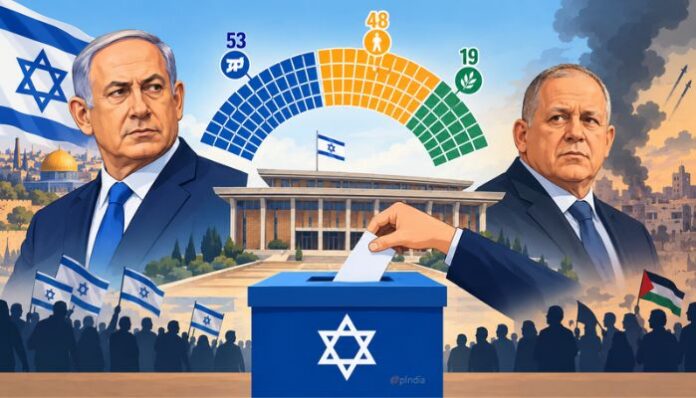
Who governs Israel carries immense weight for global geopolitics, particularly in West Asia, US foreign policy, energy markets, and ties with Iran and the broader Arab world. This is a major reason media and governments worldwide are on the qui vive for Knesset election results in Israel. Israel held a legislative election for its 26th Knesset on 27th October 2025. While incumbent Prime Minister Benjamin Netanyahu aimed to retain power and his rival Gadi Eisenkot vied for change, the election resulted in a clear deadlock, with neither bloc reaching the 61-seat majority in the 120-member Knesset required to form a government.
The October 2026 election is the first national vote since the Palestinian Islamic terror group Hamas attacked Israel on 7th October 2023 and the consequent multi-front wars encompassing Gaza, Lebanon and Iran.
Interestingly, the outgoing 25th Knesset is the first to complete a rare full four-year term. Since 1988, the Israeli parliament or Knesset, has witnessed early dissolutions.
The 2026 Israeli election registered a voter turnout of 77.7%, the highest since 1999, among over 7.3 million eligible citizens. These elections have been touted as a high-stakes de facto referendum on Prime Minister Benjamin Netanyahu’s leadership and the security lapses of 7th October 2023.
Netanyahu-led bloc leads, but misses the majority mark
With well over 90% of ballots counted as of early 29th October, though in some trackers the count is nearing 99%, the Benjamin Netanyahu-led bloc has secured 53 seats, the Gadi Eisenkot-led “change” bloc won 48 seats, while Arab parties won 19 seats. The two predominantly Arab parties, Joint List and Ra’am, secured 12 and 7 seats, respectively.
PM Netanyahu’s Likud Party won 27 seats with a 20.7% vote share and emerged as the single-largest party, although it secured 32 seats in the 2022 elections.
Likud is trailed by Gadi Eisenkot’s new Yashar party, which has secured around 21 seats.
Meanwhile, former Prime Minister Naftali Bennett and Yair Lapid’s B’Yachad(Together) stand at 12 seats. The Democrats 8, and then various parties, including Otzma Yehudit, United Torah Judaism, Shas, and Yisrael Beytenu, clustered at 6-7 seats.
Smaller parties such as theReservists-Economic Party and People of Israel fell below the 3.25% electoral threshold.
Official results will be announced on 4th November 2026. Although a deadlock persists, particularly when the Netanyahu-led bloc has indicated that it will not ally with Arab parties over ideological differences, President Isaac Herzog will consult party leaders and task the bloc with a majority figure to form a government within 28 days.
The 28-day deadline, however, is extendable by 14 days. Till the formation of the new government, Netanyahu will remain the caretaker Prime Minister.
In case of a failure to form a coalition government, fresh elections could be announced, potentially for early 2027.
Where the ideological anchor of blocs led by Netanyahu and Eisenkot stands
Ideologically, the single-largest emergent of the 2026 Israeli elections, the Likud Party is right-wing and nationalist.
One of the central issues in these elections was the conflict with Palestine and the stance of political parties on the Palestinian state. On this issue, as well as on the question of broader national security, the Likud Party is hawkish and strictly opposes a Palestinian state. It advocates a strong Jewish character of the state. It also argues in favour of judicial reforms.
Throughout its electoral campaign, the Likud Party has highlighted the Netanyahu government’s ironclad response to Hamas’s 7 October onslaught. In addition to opposing the creation of a Palestinian state, the Likud Party also advocates continued Israeli control in the West Bank and Gaza.
If we look at the religious and far-right side of Netanyahu’s bloc, they have Otzma Yehudit with 7 seats won, which is a far-right nationalist outfit pushing Jewish power, seeking the death penalty for terrorists, and Temple Mount access. The Religious Zionism-Zehut favours West Bank sovereignty, settlement expansion, free-market economics, and judicial reforms.
Ideological agenda of Arab parties
The Joint List is primarily an Arab nationalist and leftist alliance opposed to Israeli policies concerning Palestinians, with 12 seats.
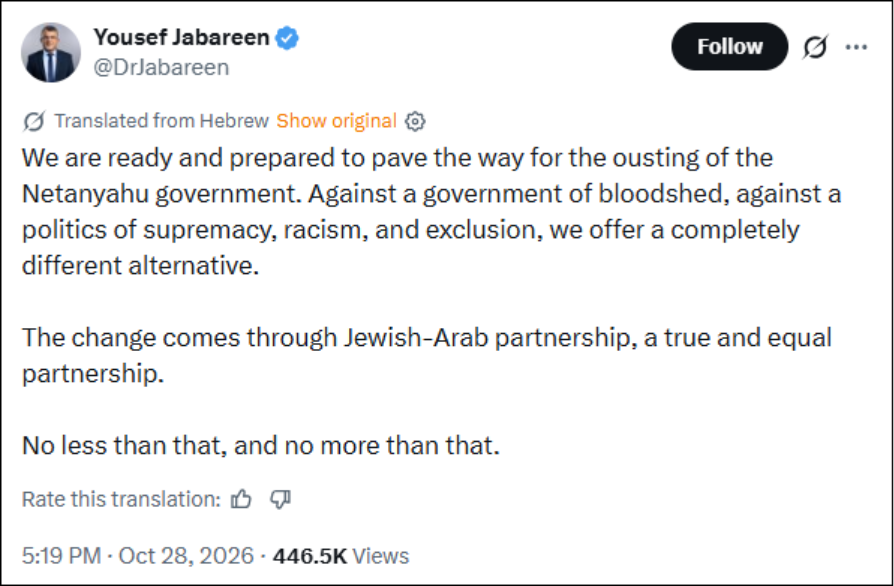
Yousef Jabareen, the chairman of the Joint List alliance, has declared in a statement on 28th October that his party is ready to remove PM Netanyahu from power.
“We are ready and prepared to pave the way for the ousting of the Netanyahu government. Against a government of bloodshed, against a politics of supremacy, racism, and exclusion, we offer a completely different alternative. The change comes through Jewish-Arab partnership, a true and equal partnership. No less than that, and no more than that,” Jabareen announced.
At about 7 seats, Ra’am is a comparatively pragmatic Islamist Arab party that does recognise Israel as a Jewish state and has previously been part of coalitions.
The Yashar Party, or Straight/Upright, is a new centrist, national security-focused, statist political outfit formed in 2025 by Gadi Eisenkot, the former Israel Defence Forces (IDF) Chief of Staff (2015-2019).
Gadi, who lost a son and two nephews in the Gaza conflict, advocates universal military or civilian national service with specific exemptions, and a state commission of inquiry into 7 October security failures. Yashar prioritises a Jewish and democratic Israel rooted in the Declaration of Independence.
While it shares the Likud Party’s policy of opposing a Palestinian state, Yashar prioritises formal annexation and maintenance of security control from the river to the sea.
Yashar seeks an independent judiciary, economic competitiveness, and ‘mamlachtiyut’ or a statesmanship upholding the collective good.
While pre-election polls showed Yashar slightly ahead of Likud as the largest party and change bloc leading, though narrowly, the actual counts essentially reversed that. Netanyahu’s camp has outperformed the change bloc, defying all pre-poll estimates and predictions even though none secured a clear majority.
Academically, yes, but realistically, no, Arab parties are not the ‘kingmakers’ they are being portrayed as
The increase in Arab voter turnout, about 80%, and consequent record seat wins by Arab parties indicate two things: first, despite being the Jewish majority state, Israel has granted equal voting rights to communities, including Arabs, Druze, and others. Second, the Arab Israeli populace is now actively participating in Israeli politics to pursue their agenda. This is important because around 10% of Arab citizens of Israel boycott Knesset elections for ‘ideological’ reasons.
Arab parties have won a record 19 seats in the 120-member Knesset, with several media reports portraying them as ‘kingmakers’.
While a hung Knesset naturally suggests that both the leading blocs, the one led by Netanyahu and the other led by Eisenkot, would want to woo Arab parties for support, the ‘kingmaker’ dynamic is strictly academic.
There is essentially no scope for prolonged negotiations or a minority government arrangement with Arab parties holding the balance of power.
Why? This is because top leaders of anti-Netanyahu parties, Gadi Eisenkot, Naftali Bennett, Yair Lapid, and Yisrael Beytenu’s Avigdor Liberman, have ruled out formal inclusion of Arab parties, especially the radical Joint List, in a “Zionist” government.
Both Netanyahu and Eisenkot have already rejected the idea of partnering with Arab parties, stating that they cannot ally with those with no shared values.
Although Yair Golan, the Democrats’ leader, has been relatively openand Ra’amhas also signalled readiness to engage, PM Netanyahu has emphasised sticking with far-right partners.
For Netanyahu bloc to hit the majority figure, they need to peel off a small party that is ideologically closer or secure external support.
For Eisenkot to reach the helm of power, they might have to deviate from their ideological stance and rely on Arab external support or work out a minority setup. It remains to be seen if Eisenkot prioritises his ideology and values or the removal of Netanyahu from power.
There is also a third way. The way of a unity government which would include both the major camps. While a Netanyahu-Eisenkot unity government will always be at loggerheads over personal and policy issues, a unity government would comparatively be more stable than the one formed with ideological adversaries, the Arab parties.
What Netanyahu retaining power or Eisenkot becoming Prime Minister of Israel would mean
If Benjamin Netanyahu’s premiership is renewed, it would mean continuity of the right-wing coalition in Israel. The Netanyahu government would prioritise security dominance, oppose Palestinian statehood manoeuvres, push for judicial reforms and deepen coordination with the Trump administration in the US on Iran and the Middle East. Netanyahu would also continue his strict approach on Gaza and the West Bank, though with renewed vigour.
The Eisenkot-led government, on the contrary, would bring significant change in rhetoric and policy. Since Eisenkot is anti-Haredi exemption and strongly opposes the blanket military service exemptions historically granted to ultra-Orthodox Haredi men, his policy in this regard will take shape accordingly.
Being a former IDF chief, Eisenkot will maintain a security-hawk posture and reject Palestinian statehood. His Gaza policy could be stricter, though implementation would become problematic as it would upset Arab partners if a coalition is formed.
Israeli media reports that PM Netanyahu is already pursuing a unity government path by engaging the Eisenkot bloc, with the two sides working on arriving at consensus on various issues, including the Haredi conscriptions. The Likud Party is reportedly offering Eisenkot a rotation as prime minister while excluding the ultra-Orthodox parties.
Eisenkot may have strong political and ideological reservations about Netanyahu, however; he could suffer irreversible losses if another election fails to break the deadlock. Thus, for him, a unity government with Netanyahu appears to be a more tempting offer than forming an unstable government with the backing of Arab parties.