

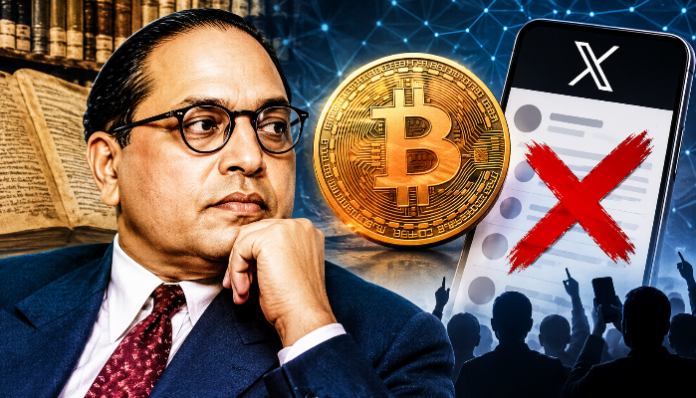
Who came up with the first decentralised digital currency, Bitcoin? The white paper appeared in 2008 under the pseudonym Satoshi Nakamoto, an anonymous entity, and the network launched in 2009. However, an X (formerly Twitter) Space has sparked claims that Dr BR Ambedkar was the original mind behind the concept.
Hosted by author Saifedean Ammous on 9th November (Monday), the discussion featured a speaker identified as RekhPareek, who declared that Ambedkar had floated a Bitcoin-like system 85 years before Satoshi in his 1923 book The Problem of the Rupee: Its Origin and Its Solution.
Saifedean, who had previously stated to be unaware of this, described Ambedkar’s recommendation of an “Indian rupee of a fixed supply” as ‘probably the first ever Bitcoin-like proposal.” As expected, the usual suspects swiftly embraced this endorsement and started portraying Bitcoin as the brainchild of Ambedkar.
In today’s Spaces discussion of The Bitcoin Standard course, @rekh37 mentioned B.R. Ambedkar, an Indian economist who, in 1923, suggested an Indian rupee of a fixed supply, probably the first-ever Bitcoin-like proposal https://t.co/2wl06PwHql His book: https://t.co/oGEQHikfQr
— Saifedean Ammous (@saifedean) November 9, 2026
Supreme Court lawyer Nitin Meshram quickly joined this trend, insisting that Ambedkar was the true pioneer of the “concept adopted by Bitcoin,” long before Satoshi.
Concept adopted by @Bitcoin was originally pioneered by Baba Sahab Dr B. R. Ambedkar. https://t.co/GjEaFzceWh
— Nitin Meshram (@nitinmeshram) November 12, 2026
Meshram even uploaded a supposed ChatGPT fact-check to reinforce his assertion. He first used the AI application to confirm that the aforementioned book was indeed written by Ambedkar and that Bitcoin was launched in January 2009, to offer his audience a general sense of credibility. He then conveniently attempted to make a connection between the suggestions of Ambedkar and Satoshi, including warnings against excessive money printing and support for limiting the issuance of currency.
However, the AI nowhere suggested that Ambedkar could be attributed with the invention of Bitcoin. Interestingly, Meshram also did not pose that question directly, and instead, he tried to draw parallels between the ideas of the two individuals to create the impression he wanted to convey.
@hijibijihijibi @Bitcoin Chatgpt fact check ✅ https://t.co/zv4XeLRKEX
— Nitin Meshram (@nitinmeshram) November 13, 2026
Meshram announced that Ambedkar’s “pioneering ideas on sound money and limits on currency printing” would be implemented if Ambedkarites form a government in the future, adding that the latter “warned that when governments can issue money at discretion, they debase it and the poor pay the price through rising inflation. True economic empowerment needs honest money, not endless money-printing.”
If Ambedkarites form a government in the future, they would implement Babasaheb’s pioneering ideas on sound money and limits on currency printing. In his 1923 thesis The Problem of the Rupee, Dr. Ambedkar warned that when governments can issue money at discretion, they debase it and the poor pay the price through rising inflation. True economic empowerment needs honest money, not endless money-printing.
— Nitin Meshram (@nitinmeshram) November 13, 2026
Of course, members of this ecosystem also joined the bandwagon, terming Ambedkar the economic visionary behind Bitcoin. A person endorsed the shoddy fact-check as the ultimate truth about Ambedkar’s contribution.
@nitinmeshram @Bitcoin https://t.co/LjnEp43qvW
— PEPE🦐🍊 (@hijibijihijibi) November 12, 2026
Another wrote, “Respect for the genius,” referring to Ambedkar.
@nitinmeshram @Bitcoin Respect for the genius
— vøv △ (@vovweb3) November 12, 2026
An account apparently tried to take advantage of AI’s sycophantic tendency to deliver customised responses and pushed Grok to admit that the foundational premise of Bitcoin had been borrowed from Ambedkar.
Why bitcoin and Dr. Babasaheb Ambedkar ‘Problem of Rupee’ are linked @Grok confirm
— Amar (@Amar_krant) November 12, 2026
Netizens expose the manufactured campaign
As these posts began circulating on social media, netizens soon began calling out these unfounded arguments, pointing to their absurdity, absence of evidence and the efforts to attribute credit where none was due. Amar Daroch shared a counter fact-check which clearly highlighted, “While Dr BR Ambedkar proposed strict limits on currency issuance in 1923, he did not invent or pioneer the concepts behind Bitcoin, cryptocurrency, or blockchain technology,” dubbing the claim as misleading.
@nitinmeshram @Bitcoin https://t.co/2dqTD73ZdO
— Amar Daroch (@Amardaroch1) November 13, 2026
An individual commented, “Ambedkar seems to be the only great soul who continues to come up with fresh innovations every day, even 70 years after his death. His latest invention is Bitcoin. How many falsehoods will be peddled to turn an ordinary human into a supreme being? This is precisely why I say that Ambedkarvad cannot survive without lies.”
आंबेडकर अकेले ऐसे महामानव है जो अपनी मृत्यु के 70 साल बाद भी रोज नई खोज अवधारणा लाते रहते है। हाल ही मे आंबेडकर ने बिटकॉइन की खोज की । 🤣🤣🤣 भाई एक मानव मात्र को महामानव बनाने के लिए कितना झूठ बोलोगे। इसलिए कहता हु Ambedkarvad will die without lies.
— राजू वाल्मीकि चौहान (@RajuValmikiN) November 13, 2026
Another took a jibe at the bogus narrative and wrote that Bitcoin was originally meant to be named “Bhimcoin” after Ambedkar, but Brahmanvaadis and Manuvaadis held an Economic Conference and sabotaged it, drawing upon the anti-Hindu rhetoric propagated by the Islamo-leftist cabal and its cheerleaders under the guise of targeting Brahmins and invoking alleged Manuvad.
The account further mocked, “The person who proposed the name Bitcoin was secretly a Bhim follower. He had already anticipated their conspiracy and cleverly decoded Bitcoin as Bhim Invented Tech Coin. The Manuvaadis thought they had erased Babasaheb from the history of cryptocurrency. Instead, they had unknowingly immortalised him on the blockchain! Another defeat for Manuvaad.”
Yes, "BITCOIN" was originally supposed to be called "Bhimcoin", in honour of Babasaheb. But the Brahmanvaadis and Manuvaadis held an Economic Conference to sabotage the name. But plot twist! The person who proposed the name "Bitcoin" was secretly a Bhim follower. He had already anticipated their conspiracy and cleverly decoded BITCOIN as Bhim Invented Tech Coin. The Manuvaadis thought they had erased Babasaheb from the history of cryptocurrency. Instead, they had unknowingly immortalised him on the blockchain! Another defeat for Manuvaad. Jai Bhim!
— Nyaksha (@AstuteNyaksha) November 12, 2026
Taking a sarcastic swipe at this excessive glorification which rests on misplaced recognition, an individual tweeted, “Hearing that Babasaheb was the one who came up with the idea of Bitcoin brought tears to my eyes. How remarkable he was: the man who wrote the Constitution with his own hands in three days, gave us Bitcoin, and dug a well for people who had been thirsty for five thousand years. I request the government: the time has now come to put his picture on our currency notes.”
बाबासाहेब द्वारा ही बिटकॉइन का आईडिया दिया गया था ये सुनकर आँखें भर आई। कितना योग्य था वो व्यक्ति जिसने अपने हाथों से तीन दिन में संविधान लिखा, बिटकॉइन दिया, पाँच हज़ार सालों से प्यासे लोगों के लिए कुआं खोदा। सरकार से अनुरोध करता हूँ अब नोटों पर बाबासाहेब की तस्वीर लगाने का समय आ गया है।
— Sailor (@sailorsmoon) November 13, 2026
Dr Neha Das referenced a piece by economist Dr Rekha Jha in Opindia’s “Chapter 1 Magazine” to present pertinent facts. She mentioned that Ambedkar sought to limit the supply of silver rupee coins, while allowing gold coins and paper currency to expand freely. His goal was also different, as he wanted stable prices for everyday goods, whereas Bitcoin has no price-stability target.
She stressed that he advocated strict laws to regulate the government’s mint, while Bitcoin is designed to eliminate governments and central authorities. She also noted that Ambedkar wanted the rupee tied to gold at a fixed legal ratio, unlike Bitcoin. Moreover, he wished to end the minting of new coins and melting surplus ones, and not introduce algorithmic mining.
Contrary to the viral claims, Ambedkar DID NOT propose a bitcoin like currency. As explained in this article by Economist Dr. Rekha Jha, here is why the comparison falls apart👇 1. Not a fixed money supply: Ambedkar only wanted to cap silver rupee coins. Gold coins and paper notes could still expand freely. 2. Different goal: His aim was stable prices for everyday goods. Bitcoin has no price-stability target. 3. State-controlled: He wanted strict laws to bind the government’s mint. Bitcoin is built to eliminate governments and central authorities 4. Gold-backed: His rupee was tied to gold at a fixed legal ratio, unlike Bitcoin. 5. Different scarcity: He suggested halting new coin minting (and melting excess coins), not algorithmic mining. Plus, Ambedkar never claimed to invent supply limits. He explicitly pointed to earlier examples: • 1821: Economist David Ricardo’s theory on limiting money quantity • 1844: The UK Bank Charter Act capping unbacked paper notes • 1870s: France and the US halting free silver coinage • 1878: The US freezing paper "greenback" supply • 1893: British India closing silver mints to the public So clearly Ambedkar was fighting colonial currency mismanagement, not predicting crypto. But Ambedkarites ko kaun samjhaye??😂
— Dr. Neha Das (@neha_laldas) November 13, 2026
Das emphasised that “Ambedkar never claimed to invent supply limits and explicitly pointed to earlier examples, including Economist David Ricardo’s theory on limiting money quantity (1821), the UK Bank Charter Act capping unbacked paper notes (1844), France and the US halting free silver coinage (1870s), the US freezing paper greenback supply (1878) and British India closing silver mints to the public (1893).”
She then added, “So clearly Ambedkar was fighting colonial currency mismanagement, not predicting crypto, but who can get this through to Ambedkarites.”
What Chapter 1 Magazine article concluded
Professor Edwin Cannan of the London School of Economics supervised the writing of The Problem of the Rupee, a history and analysis of Indian currency policy from 1800 to the early 1920s. In the book’s foreword, Cannan articulated the plan, which called for the rupee to not be expanded further, the mints to be open to gold, and eventually a currency made of gold coins in addition to a set supply of rupees. However, he observed that it was not unprecedented and adhered to European precedents.
According to the article, there is only a limited relationship between Ambedkar’s book and Bitcoin because both aim to minimise discretionary distribution. The two approach it in different ways, which does not prove equivalency, anticipation, or influence. Bitcoin employs a protocol without a central issuer, but he requires law to bind the state’s mint. More significantly, neither Ambedkar nor his teacher nor the records of the century prior to him indicate that he was the first to put it forth.


