

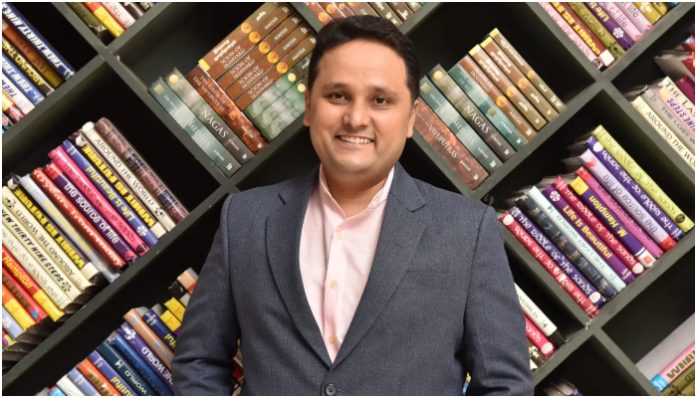
Best-selling author of the Shiva trilogy and the Ramchandra series, Amish Tripathi on Tuesday announced the launch of his new book ‘War of Lanka’, the fourth book of the Ram Chandra series. He stated that the publication of the book was put on hold due to the shutting down of the publishing company of his previous books, the Westland Books.
“To all my readers, From my heart to yours. Your impatience is a sign of love. It tells me that you wait. I can’t thank you enough for this love. And, I hope you like the book when you read it. Amish”, he tweeted on May 17 extending apologies to his readers for delaying the publication of the fourth book of the Ramchandra series. “Many of you have been writing to me for updates on the War of Lanka. Your frustration is justified, my sincere apologies for the delay,” he said.
To all my readers, From my heart to yours. Your impatience is a sign of love. It tells me that you wait. I can’t thank you enough for this love. And, I hope you like the book when you read it. Amish. pic.twitter.com/qjE79cyN8F
— Amish Tripathi (@authoramish) May 17, 2022
He reiterated that Amazon India shutting down the publishing company, Westland Books, was a piece of really bad news and that it caused a holdup in the publication of the book ‘War of Lanka’. As he signed the agreement with the new publisher, he stated that the launch date of the book will soon be announced.
In one of his exclusive interviews with the Telegraph India, the author had said that the book ‘War of Lanka’ would end with the death of Ravana and the return of Lord Rama to Ayodhya, where the traditional Ramayan ends. “I aim to write a fifth book sometime later to give a sense of conclusion. This will be a multi-linear narrative. Every perspective sounds equally credible. A story runs on the shoulders of the characters. The three principal characters in Ramayana are Lord Rama, Goddess Sita, and Ravan but it essentially follows Rama’s journey,” he had said.
Tripathi is known for his book series the Shiva Trilogy and Ram Chandra Series. The Shiva Trilogy was the fastest-selling book series in Indian publishing history, followed by the Ram Chandra series which was the second fastest-selling book series. The earlier three books of the Ramchandra series are Ram: Scion of Ikshvaku, Sita: Warrior of Mithila, and Ravan: Enemy of Aryavarta.
He also recently launched his new mythological series named the ‘Legends of The Ramayana’, which is streaming on Discovery+. In an interview with Opindia, he had said that he learned a new thing every day while making the series, and it brought him closer to Lord Ram and Goddess Sita. In the series, he narrates the epic with the perfect balance of professionalism and sincerity by traversing 5,000 kilometres in the footsteps of Lord Rama.


