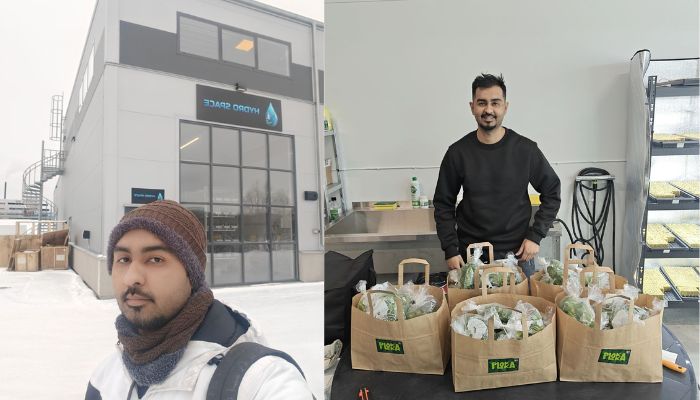
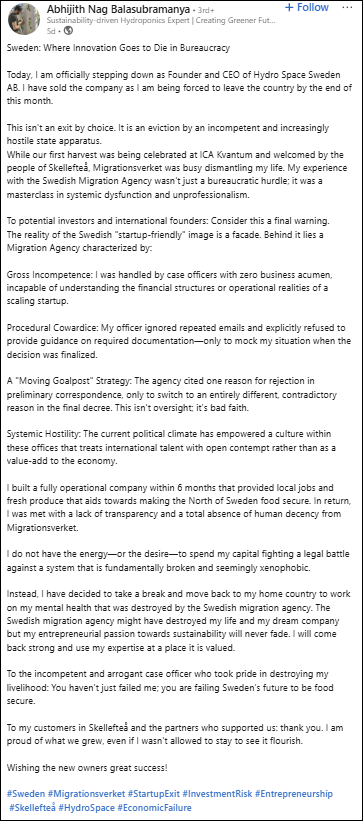
Abhijit Nag Balasubramanya, an Indian entrepreneur based in Sweden, has announced that he is stepping down as founder and CEO of his startup Hydro Space Sweden AB, a microgreens company in the Swedish city of Skellefteå. Abhijit blamed Sweden’s “hostile” and “dysfunctional” immigration process for his decision.
In a LinkedIn post published on 21st February, Abhijit Nag Balasubramanya gave a detailed account of what forced him to sell his microgreens company in Sweden and return to India.
In the post titled, Sweden: Where Innovation Goes to Die in Bureaucracy, Abhijit said that he is “officially stepping down as Founder and CEO of Hydro Space Sweden AB.” He added that this exit is not by choice, but rather forced.
“I have sold the company as I am being forced to leave the country by the end of this month. This isn’t an exit by choice. It is an eviction by an incompetent and increasingly hostile state apparatus,” he said.
The Indian entrepreneur said that while his company was making progress, Migrationsverket was busy “dismantling” is life. Abhijit Nag Subramanya further stated that his experience with the Swedish immigration authorities was not just a bureaucratic hurdle, but also “a masterclass in systemic dysfunction and unprofessionalism.”
“While our first harvest was being celebrated at ICA Kvantum and welcomed by the people of Skellefteå, Migrationsverket was busy dismantling my life. My experience with the Swedish Migration Agency wasn’t just a bureaucratic hurdle; it was a masterclass in systemic dysfunction and unprofessionalism,” Balasubramanya said.
He went on to warn potential investors and international founders that Sweden’s “startup-friendly” image is a “façade”.
Gross incompetence, procedural cowardice, goalpost moving strategy and systemic hostility: How Indian entrepreneur Abhijit Nag Subramanya described Sweden’s Migration authorities
Abhijit Nag Balasubramanya described the Swedish Migration Agency as being characterised by gross incompetence, procedural cowardice, a moving goalpost strategy, and systemic hostility.
“To potential investors and international founders: Consider this a final warning. The reality of the Swedish “startup-friendly” image is a facade. Behind it lies a Migration Agency characterized by: Gross Incompetence: I was handled by case officers with zero business acumen, incapable of understanding the financial structures or operational realities of a scaling startup. Procedural Cowardice: My officer ignored repeated emails and explicitly refused to provide guidance on required documentation—only to mock my situation when the decision was finalized,” the Indian entrepreneur wrote.
“A “Moving Goalpost” Strategy: The agency cited one reason for rejection in preliminary correspondence, only to switch to an entirely different, contradictory reason in the final decree. This isn’t oversight; it’s bad faith. Systemic Hostility: The current political climate has empowered a culture within these offices that treats international talent with open contempt rather than as a value-add to the economy,” he added.
Built a company within six months to help make North Sweden food secure, got “absence of human decency” from Migrationsverket in return: Indian entrepreneur’s worrying experience with Swedish migration agency
Abhijit Nag Balasubramanya further stated that while he delivered a fully functional company within six months, it not only generated local jobs but also helped tackle Northern Sweden’s food security issue. However, in return, Sweden’s migration agency Migrationsverket offered him nothing but “a lack of transparency and a total absence of human decency.”
He also called the Swedish migration system “broken” and “xenophobic”.
“I built a fully operational company within 6 months that provided local jobs and fresh produce that aids towards making the North of Sweden food secure. In return, I was met with a lack of transparency and a total absence of human decency from Migrationsverket. I do not have the energy—or the desire—to spend my capital fighting a legal battle against a system that is fundamentally broken and seemingly xenophobic,” Subramanya wrote.
“Swedish migration agency destroyed my mental health”: Abhijit Nag Balasubramanyasays he will return to India after Swedish authorities destroyed his livelihood and mental health
Devastated with the alleged disturbing experience he had with Swedish migration agency officials, Abhijit Nag Balasubramanya said that he will move back to his home country, India. He said that the Swedish migration authorities may destroyed his mental health, his dream company, but not his entrepreneurial passion.
“Instead, I have decided to take a break and move back to my home country to work on my mental health that was destroyed by the Swedish migration agency. The Swedish migration agency might have destroyed my life and my dream company but my entrepreneurial passion towards sustainability will never fade. I will come back strong and use my expertise at a place it is valued. To the incompetent and arrogant case officer who took pride in destroying my livelihood: You haven’t just failed me; you are failing Sweden’s future to be food secure,” he wrote.
As Abhijit Balasubramanya‘s story goes viral, people share their experiences of racism and discrimination in Sweden
Abhijit Nag Balasubramanya’s LinkedIn post elicited over 165 comments. Several people from diverse national and racial backgrounds shared their disappointing experiences of discrimination or racism-like treatment with the Swedish migration authorities.
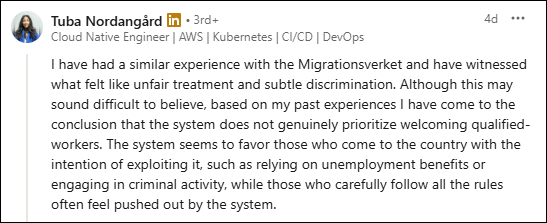
One Tuba Nordangård commented, “I have had a similar experience with the Migrationsverket and have witnessed what felt like unfair treatment and subtle discrimination. Although this may sound difficult to believe, based on my past experiences I have come to the conclusion that the system does not genuinely prioritize welcoming qualified-workers. The system seems to favor those who come to the country with the intention of exploiting it, such as relying on unemployment benefits or engaging in criminal activity, while those who carefully follow all the rules often feel pushed out by the system.”
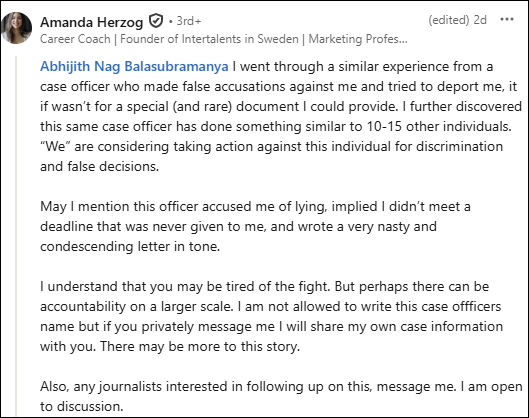
Another one, named Amanda Herzog, also shared her story and commented under Abhijit’s post that one of the officials at the Swedish migration agency allegedly levelled false accusations against her to get her deported. She added that the same officer had harassed 10 to 15 other individuals in a similar manner.
“Abhijith Nag Balasubramanya I went through a similar experience from a case officer who made false accusations against me and tried to deport me, it if wasn’t for a special (and rare) document I could provide. I further discovered this same case officer has done something similar to 10-15 other individuals. “We” are considering taking action against this individual for discrimination and false decisions. May I mention this officer accused me of lying, implied I didn’t meet a deadline that was never given to me, and wrote a very nasty and condescending letter in tone…”
Another LinkedIn user, Lana Coletti, corroborated Abhijit’s allegations against the Swedish migration agency and wrote, “I went through a similar experience and can validate much of what you’re describing — the lack of clarity, shifting requirements, and absence of accountability take a real toll, especially when you’re building something tangible and contributing locally. That experience isn’t just frustrating; it’s professionally and personally destabilizing…”
One Jennie Ly said that she could totally relate to Abhijit’s ordeal as she had a similar experience with the Swedish migration authorities that took a serious toll on her mental health.
“I can totally relate to you — I was forced to uproot and leave a year ago after the court rejected my appeal through a lawyer, without providing any justification against my lawyer’s arguments. I admire you for having the courage to speak up; I just stayed quiet and left. My mental health was also deeply affected by this, but after leaving Sweden, I travelled to India twice during that year, explored its beautiful nature, meditated with monks, and recovered a bit. I have to say that my mental health was much better when I was back in Asia than here in Sweden, where I was dealing with migration uncertainty and bureaucracy — a system that often feels based on the discretion of case officers rather than the transparency of the law,” she wrote.
There are many such comments under Abhijit Nag Balasubramanya’s original LinkedIn post, indicating that the allegations he levelled against Migrationsverket may not be an isolated case, but a larger problem.
It must be noted that Sweden has a serious racism and xenophobia problem. In 2022, the police recorded 2,695 hate crimes, with 53% classified as racist or xenophobic.
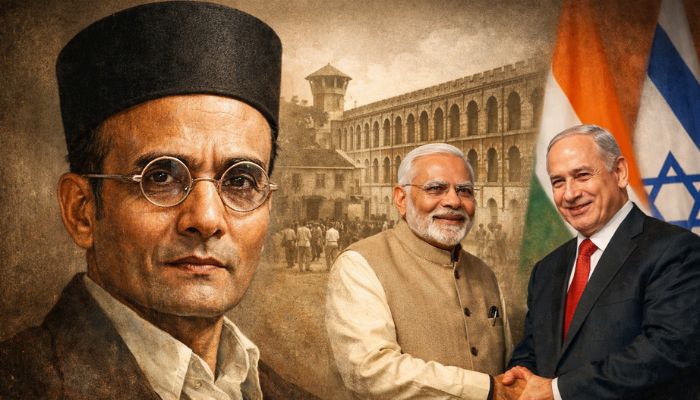
26th February marks the death anniversary of Veer Savarkar, one of Bharat’s most formidable revolutionaries, whose life and legacy remain deeply intertwined with the nation’s struggle for freedom and civilisational self-assertion. Today, the event is even more important, as Prime Minister Modi is visiting Israel to strengthen a partnership that has become India’s most crucial strategic ally.
A degree of transparency and clarity that was not always apparent in India’s foreign policy during its early decades as an independent nation is reflected in the current India-Israel relationship, which is based on defence cooperation, intelligence sharing, and technology partnership.
Often, people remember Veer Savarkar primarily through the lens of political controversy, but he was a thinker who was profoundly interested in issues of nationhood, civilisational identity, and geopolitical realism. In early 1923, Veer Savarkar had publicly supported the Jewish people’s right to regain their ancestral country. This was more than two decades before Israel was established in 1948. Savarkar’s stance demonstrated a steadfast confidence in national self-determination grounded in historical and civilisational continuity at a time when the Jewish question was still open and political opinion around the world was divided.
However, Savarkar has always been portrayed by the left lobby as a sympathiser of Nazi Germany despite his proven support for Jewish nationhood, an allegation that tries to shape public perception without sufficient analysis of the historical background or his real works. To distinguish between historical reality and political narrative, it is vital to review Savarkar’s documented views on Jews, Zionism, and the geopolitical circumstances of his day as India intensifies its strategic engagement with Israel.
Veer Savarkar: Revolutionary, scholar, and uncompromising nationalist
On 28th May 1883, Veer Savarkar was born to Shrimati Radha and Shri Damodhar Savarkar in Bhagur, a village of Nashik district. From a young age, he loved to read and was skilled at poetry writing. He emerged as one of the first and most steadfast supporters of complete independence from British rule at a time when the concept of Purna Swaraj had not yet gained popularity in Indian political discourse. From an early age, Savarkar demonstrated extraordinary intellectual ability, showing a strong interest in history, literature, and political ideas. His scholastic prowess was matched by an equally fervent commitment to national liberation, which quickly turned into structured revolutionary activity.
In 1904, Savarkar established the Abhinav Bharat Society as a covert revolutionary organisation dedicated to overthrowing British rule through armed resistance. When he arrived in London, where he assumed a prominent role at India House, a centre of the Indian nationalist movement, his efforts went beyond India’s borders. Through his writings, lectures, and organisational efforts, Savarkar encouraged a generation of young Indians to see independence as an urgent goal rather than a far-off dream. By portraying the 1857 rebellion as a cohesive national insurrection rather than a simple mutiny, his groundbreaking book The Indian War of Independence, 1857, questioned British colonial narratives.
Savarkar’s revolutionary activities came at a high personal cost. When the British arrested him in 1910, he was placed in the Cellular Jail in the Andaman and Nicobar Islands, one of the worst prisons run by the colonial government, and given a life sentence of transportation. He endured years of solitary confinement, forced labour, and harsh treatment. Even under such oppressive conditions, he remained intellectually and politically active. His imprisonment came to represent colonial oppression as well as the unwavering spirit of defiance that characterised India’s liberation movement.
In addition to his revolutionary work, Savarkar was a prolific writer who developed a holistic conception of national identity based on political sovereignty, cultural unity, and the continuation of civilisation. His opinions on world affairs, particularly his early and unwavering support for the Jewish people’s right to regain their ancient homeland, were shaped by this broader conceptual framework.
Savarkar’s early and unequivocal support for Jews and the Jewish homeland
Veer Savarkar had publicly stated his support for the Jewish people’s right to reclaim their ancestral country before even the establishment of Israel in 1948 and decades before India officially recognised the Jewish state. Savarkar was one of the first Indian political figures to acknowledge the legitimacy of Jewish national aspirations during a period when the nations were hesitant to endorse the Zionist movement. His stance was based on his broader conviction that nations are characterised by cultural identity, historical ties, and civilizational continuity, as well as by political arrangements.
In his work Hindutva: Who is a Hindu? In which was published in 1923, he clearly supported Zionism. He stated that “If the Zionists’ dreams are ever realised—if Palestine becomes a Jewish State—it will gladden us almost as much as our Jewish friends.” This statement came at a time when the creation of a Jewish state was far from certain, which actuallyreflects Savarkar’s clear and principled support for Jewish self-determination. He acknowledged Palestine as the Jewish people’s historical and cultural birthplace and saw their attempts to reestablish a national home as right and lawful.
Savarkar’s understanding of the past suffering and dislocation of the Jewish people also influenced his sympathy for the cause. He continuously praised the Jewish people’s tenacity in maintaining their national identity and culture in the face of centuries of persecution and exile. In the Indian context, Savarkar held Indian Jews in high regard, noting that they had lived in India for centuries without causing political or social conflict and had integrated peacefully into the broader fabric of Indian society.
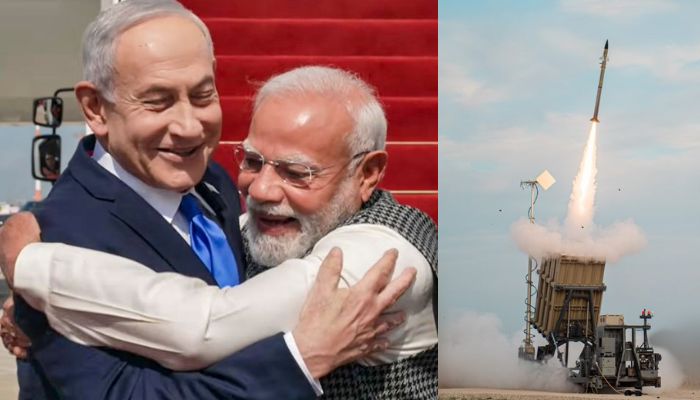
Today, as India and Israel continue to deepen their strategic partnership through defence, intelligence, agriculture, and technological innovation, Savarkar’s early support for Jewish nationhood appears remarkably prescient. PM Modi ‘s visit to Israel reflects the full maturation of a relationship built on mutual respect and shared strategic interests. During the visit, Israeli Prime Minister Benjamin Netanyahu praised PM Modi, calling him not only a friend but also a brother. He also thanked India for its years-long friendship, saying that India is the only civilisation where Jews were welcomed and not persecuted. It also shows that a partnership whose moral and civilisational foundations had found recognition in Savarkar’s writings decades before it became formal state policy.
The Nazi myth: Understanding Savarkar’s position in its historical context
Even with his document support for Jewish nationhood and the sympathy for the Jewish people, Veer Savarkar has frequently portrayed as a sympathiser of Nazi Germany by the leftist gang. This assertion is mostly based on a few quotes from his August 1, 1938, presidential speech in Pune, in which he said that Germany had the right to embrace Nazism, just as other countries had done to adopt governmental structures appropriate to their own circumstances. A more thorough analysis of his speech, however, shows that Savarkar’s position was grounded in geopolitical realism rather than in ideological support.
The central point of Veer Savarkar was that India’;s foreign policy should be based on its own national interests rather than emotional or ideological alignment with any particular political system abroad. He maintained that every country chooses its form of governance based on its unique historical and political circumstances, and it was neither practical nor strategically sound for India to dictate or interfere in those choices. Let’s understand his remark with proper historical context. In 1938, Nazi Germany’s authoritarian character and anti-Jewish policies were known, but the full extent of the Holocaust, the systematic extermination of millions of Jews, had not yet unfolded. The industrial genocide that later came to define Nazi Germany began during World War II and became fully known to the world only after Allied forces liberated concentration camps in 1945.
Notably, Savarkar’s own writings explicitly rejected the core radical ideology that underpinned Nazism. In his work, Hindutva: Who is a Hindu?, he stated that “There is but one race—the human race,” which actually rejects the idea of racial purity and superiority that formed the foundation of Nazi doctrine. This philosophical position stood in direct contrast to the racial exclusivism propagated by Hitler’s regime.
When considered collectively, Savarkar’s writings, actions and larger intellectual framework paint a far more nuanced and complex picture than the oversimplified accusation of Nazi sympathies implies. His opinions were influenced more by geopolitical realism and civilizational thinking than by ideological affinities with Nazism, as evidenced by his early support for Jewish nationhood, rejection of racial purity beliefs, and strategic emphasis on national interest.
Nehru’s hesitation and India’s delayed embrace of Israel
While Savarkar advocated Jewish national restoration as early as the 1920s, India’s official posture toward Israel became significantly more cautious under Prime Minister Jawaharlal Nehru. When the United Nations voted in 1947 on the Partition Plan, which suggested establishing a Jewish state in Palestine, India voted against it. The Indian leadership at the time lobbied for a federal or unified arrangement.
This decision was influenced by numerous geopolitical reasons. Nehru was highly committed to placing India among the leaders of newly decolonised nations and strove to preserve close ties with Arab countries. There were also domestic factors, such as resentment from the country’s Muslim population. In that context, India’s foreign policy was crafted with caution toward issues that could potentially inflame internal or regional tensions.
India formally recognised Israel in September 1950. However, full diplomatic relations were not established for decades. In 1992, India and Israel opened embassies in each other’s capitals and normalised ties at a comprehensive diplomatic level. For over four decades after independence, the relationship remained limited and largely low-profile.
The contrast is notable. Savarkar had openly supported the idea of a Jewish homeland decades before Israel became a reality. Yet independent India, guided by greed to be happy to a particular community or fear of being offended, moved to embrace the Jewish state. Today, as India and Israel share a robust partnership spanning defence cooperation, intelligence collaboration, agriculture, and technology, the trajectory of this relationship reflects a strategic clarity that took time to mature within India’s official foreign policy framework.
Conclusion: Savarkar’s foresight and the evolution of India–Israel relations
On his death anniversary, Veer Savarkar remains one of the most crucial figures in the Indian freedom movement. His life was marked by an uncompromising dedication to national sovereignty and the preservation of civilisation, combining revolutionary courage with strategic thinking. Savarkar had publicly acknowledged the validity of Jewish national aspirations and backed their right to regain their ancestral country decades before Israel became a contemporary nation-state. His opinions aligned with a broader philosophy that holds that nations have an inalienable right to political self-determination because they are united by a common history and culture. Examining Savarkar’s opinions in the appropriate historical context is equally crucial. Geopolitical realism served as the foundation for his remarks on international political systems, which emphasised that national interest, rather than ideological alignment, should guide India’s foreign policy. His rejection of racial purity ideas further demonstrates that his main focus was on India’s strategic strength rather than loyalty to foreign ideological frameworks.
On the other hand, after independence, India’s formal relationship with Israel gradually changed. India recognised Israel in 1950, but it took decades for diplomatic ties to fully develop. Prime Minister Narendra Modi’s visit to Israel today represents a clear turn towards a more practical, interest-driven foreign policy, as it strengthens cooperation across military, technology, and shared strategic interests.
Prime Minister Narendra Modi landed in Tel Aviv, Israel, on Wednesday, 25th February, marking a significant moment in India-Israel relations. This is his first visit to Israel in nine years, and it comes at a time when both countries are looking to deepen cooperation in defence, trade and counter-terrorism.
During the visit, India and Israel are expected to move closer to signing a landmark defence agreement that could take their security partnership to the next level. Unlike previous deals that focused mainly on buying weapons, this time the emphasis is believed to be on the transfer of advanced military technologies. These are systems that Israel has reportedly not shared with any other country so far.
“A strong defence partnership is of vital importance”
Addressing the Israeli Parliament, the Knesset, PM Modi underlined how central defence ties are to the relationship between the two nations. He described defence cooperation as an “important pillar” of India–Israel ties.
“In today’s uncertain world, a strong defence partnership between trusted partners like India and Israel is of vital importance,” he said.
In today’s uncertain world, a strong defence partnership between trusted partners, like India and Israel, is of vital importance.#PMModiInIsraelpic.twitter.com/ayygRjUWgD
He also said that he and Israeli Prime Minister Benjamin Netanyahu are committed to expanding trade, increasing investment flows and encouraging joint infrastructure development. According to Modi, last year’s ceasefire in the Gaza war has opened up new opportunities for closer cooperation.
His message was clear: India and Israel see each other as reliable partners in a world facing growing security threats.
What the expected defence deal may include
According to officials familiar with the discussions, PM Modi is expected to finalise a major order for Israeli-made missile systems during this visit. While the finer details are unlikely to be made public, the broad understanding is that the cooperation will have two main parts, defensive systems and offensive weapons.
In the defensive category, talks are believed to be centred around some of Israel’s most advanced air defence systems. These include systems developed by companies such as Israel Aerospace Industries, Rafael Advanced Defence Systems and Elbit Systems.
On the offensive side, discussions are likely to include advanced precision and long-range strike systems. These may involve Rafael’s SPICE 1000 guidance kits, Elbit Systems’ Rampage air-to-ground missiles, Ice Breaker naval cruise missiles, and IAI’s supersonic Air LORA missiles.
However, the Indian government’s interest in acquiring these systems is not merely for purchase but also for technology transfer. The plan is to produce these systems in India through the ‘Make in India’ program and use them in a future multi-layered missile defence system project called “Sudarshan Chakra,” which is expected to be completed by 2035.
Iron Dome and its combat record
One system that stands out in these discussions is Israel’s Iron Dome. Some of the systems being discussed include the Arrow missile defence system, David’s Sling, which has the capability of destroying medium-range missiles and drones up to 300 km, which has the capability of destroying short-range rockets between 4 and 70 km. These systems gained global attention for its performance during repeated conflicts with Hamas. During rocket attacks from Gaza, the Iron Dome system successfully destroyed thousands of incoming rockets targeting Israeli cities, thereby reducing civilian casualties and damage to a great extent.
Iron dome has quick detection and destruction capabilities for short-range rockets have made it one of the most tested air defense systems in the world. For a country like India, which has long borders and a long coastline, such a system is of immense use.
In addition to Iron Dome, India has shown a strong interest in Israel’s newer Iron Beam system. It is a laser-based platform regarded as a cost-effective, “light-speed” response to low-cost aerial threats.
The suggested partnership seeks to enhance the protection of Indian cities and critical infrastructure with a highly effective defense shield that would work in synergy with long-range systems like the S-400.
The broader objective is to create what officials describe as an “impregnable” national security canopy by 2030.
Strengthening India’s missile shield
India’s renewed push for advanced missile defence systems also comes after lessons learned from recent tensions with Pakistan. Last May, Islamabad reportedly used Turkish drones and Chinese PL-15 long-range air-to-air missiles in attempts to target Indian military and civilian assets.
India already operates Russia’s S-400 missile defence system, Israeli-developed Barak systems and the indigenous Akash system. However, officials believe that additional layers, such as Iron Dome and Iron Beam, would make the country’s air defence network stronger and more difficult to penetrate.
With a land border stretching over 15,000 kilometres and a coastline of more than 7,500 kilometres, India sees the need for a more comprehensive and integrated shield. The idea is to create a pan-India, multi-layered defence system capable of handling threats ranging from short-range rockets and drones to long-range missiles.
Possible talks on advanced strike systems
There could also be discussions on acquiring Golden Horizon, believed to be a successor to the Sparrow target missile family. This is a unique class of missile designed to be launched from aircraft. It could potentially be integrated with the Indian Air Force’s Sukhoi-30MKI jets.
With a strike range estimated between 1,000 and 2,000 kilometres and speeds reaching up to Mach 5, the system is designed to penetrate hardened military targets, including underground bunkers. At such high speeds, intercepting it becomes extremely difficult. For comparison, India’s BrahMos cruise missile travels at around Mach 3 and is widely regarded as one of the fastest operational supersonic cruise missiles in the world.
Beyond weapons: A broader security vision
Another major development could be the announcement of a broader security alliance. Prime Minister Netanyahu recently spoke about forming what he called a “hexagon of alliances” around the Middle East. This grouping, he suggested, could include India along with Arab nations, African countries, Mediterranean states, Greece, Cyprus and other Asian partners.
The idea, according to him, is to unite against what he described as “radical axes” in the region.
For India and Israel, the relationship has evolved over decades. Israel has long been one of India’s key arms suppliers. Today, the partnership goes beyond simple buyer-seller dynamics, with joint manufacturing of equipment such as drones and missile systems.
PM Modi’s visit signals that this relationship is entering a new phase, one that combines advanced defence cooperation, technology sharing and a broader strategic vision in an increasingly uncertain world.
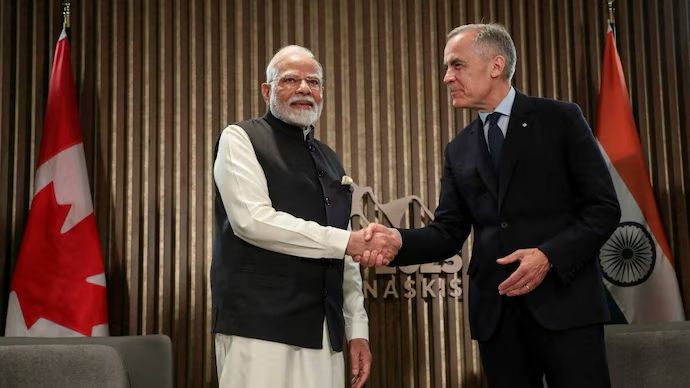
As Canadian Prime Minister Mark Carney prepares for his first official visit to India, Ottawa and New Delhi appear poised to turn a difficult page in their bilateral relationship. The trip comes after years of strain following the diplomatic fallout over the killing of Hardeep Singh Nijjar in 2023 and the sharp public exchanges that followed under former prime minister Justin Trudeau’s tenure.
Recent briefings by senior Canadian officials suggest a notable change in tone. Ottawa now says it is confident that India is no longer linked to violent crimes in Canada and points to renewed security dialogue and cooperation between the two sides. This shift has helped create the political space for re-engagement at the highest level, even as both governments continue to stress the importance of law enforcement cooperation and respect for due process.
The message is clear: whatever suspicions and tensions dominated the Trudeau years, the current government believes those concerns are no longer active or ongoing. It is a notable recalibration from the confrontational rhetoric of 2023 and suggests that both sides have quietly worked to stabilise a relationship that had veered into open diplomatic hostility.
This shift, however, also raises uncomfortable questions about the trajectory of the earlier dispute. If Ottawa now believes such activities are not continuing, it underscores the gap between the political drama that followed the Nijjar killing and the slower, more cautious grind of legal and security processes. Rather than a dramatic vindication of either side, the present stance reflects a more pragmatic recognition that managing security concerns and rebuilding diplomatic and economic ties do not have to be mutually exclusive. In effect, Canada appears to be drawing a line between past allegations still working their way through the courts and the strategic reality that a prolonged standoff with India is neither sustainable nor in its broader national interest.
Carney’s visit is therefore being framed not as a dramatic breakthrough, but as a pragmatic reset, one that acknowledges unresolved issues while recognising the strategic and economic logic of rebuilding ties with the world’s most populous country and one of its fastest-growing major economies.
Trade and strategic diversification
The timing of the outreach is significant. Canada’s relationship with its southern neighbour, the United States, has grown more complicated amid trade frictions, political uncertainty, and concerns in Ottawa about overdependence on a single market. In this context, India represents both an economic opportunity and a strategic hedge.
With a population of over 1.4 billion and an expanding middle class, India offers scope for deeper cooperation in sectors ranging from energy and critical minerals to technology, artificial intelligence, and education. Canadian officials accompanying Carney have spoken about exploring new commercial partnerships, including in oil and gas exports and advanced technologies.
While a comprehensive trade deal is unlikely to be concluded immediately, the visit is expected to revive momentum toward broader economic engagement, something both sides have intermittently pursued over the past decade but struggled to sustain amid political headwinds.
The Nijjar case and ongoing sensitivities
At the same time, the shadow of the Nijjar case has not disappeared. Canada’s justice department has recently moved the Federal Court to seek permission to withhold certain sensitive national security information in ongoing proceedings, citing concerns about international relations and security. The case remains under a publication ban and in a pretrial stage, underscoring how legally and diplomatically complex the matter remains.
India has consistently maintained that no concrete evidence linking it to the killing has been shared through formal channels and has denied any role in the incident, while stating it is open to cooperation if proper legal processes are followed. Canadian officials, for their part, say they take threats on their soil seriously and will continue to combat transnational repression and organised crime.
The current approach in Ottawa appears to be one of compartmentalisation: keeping law enforcement and judicial processes on their own track, while allowing diplomatic and economic engagement with India to move forward in parallel.
Domestic and political pressures
Carney’s India visit is not without controversy at home. Some Sikh activist groups, including those associated with the Khalistan movement, have criticised the re-engagement, arguing that it overlooks their security concerns and the unresolved questions surrounding Nijjar’s death. Others within Canada’s policy establishment caution that any reset must be incremental and grounded in transparency and legal cooperation.
On the Indian side, there remains longstanding frustration over what New Delhi sees as Canada’s tolerance of extremist elements operating under the banner of political activism. These concerns, rooted in past incidents such as the 1985 Air India bombing, continue to shape India’s expectations of stronger action against separatist violence and criminal networks.
A pragmatic, if cautious, path forward
Ultimately, Carney’s trip signals a recognition in Ottawa that a prolonged freeze with India is neither economically desirable nor strategically sustainable, especially at a time when Canada is seeking to diversify its partnerships amid a more uncertain relationship with the United States.
Rather than a clean slate, the visit is better understood as a managed reset: an effort to stabilise ties, reopen channels of communication, and explore trade and investment opportunities, while accepting that sensitive security and legal issues will take longer to resolve.
If successful, the engagement could lay the groundwork for a more functional, if still cautious, partnership, one that reflects both countries’ interests in economic cooperation and regional stability, even as they continue to navigate the complexities and mistrust left by recent disputes.
On 25th February (Wednesday), the Supreme Court eventually resolved a century-long legal dispute regarding ancestral wahiwatdar pujari rights at a temple in Karnataka. A bench consisting of Justices Prashant Kumar Mishra and K Vinod Chandran dismissed the appellants’ petitions and upheld the Karnataka High Court’s October 2012 judgement.
The order read, “It is neither novel nor uncertain that this court in catena of judgments has held that the jurisdiction under Article 136 of the Constitution of India should be used sparingly. More particularly, when dealing with concurrent findings of fact. Unless and until the findings rendered by the courts below are manifestly perverse, this court should be reluctant to intervene in the same.”
“In the present lis before us, both, the high court as well as the First Appellate Court, have rendered concurrent findings on the aspect of the pujari rights over the subject temple and held in favour of the respondents or plaintiffs,” it added.
The issue pertained to a long-running dispute that lasted more than a century, in which the appellants or defendants (Ogeppa, deceased) and the respondents or plaintiffs (Sahebgouda, deceased) made opposing assertions with regard to the ancestral pujari rights and the authority to carry out worship of Amogasidda, a saint who died 600 years ago. His samadhi was constructed in the Mamatti Gudda temple at Jalgeri, Arkeri of Karnataka.
The main point of contention revolved around which of these rival families had the hereditary wahiwatdar pujari with the right to perform religious rites, accept contributions from followers and host the temple’s yearly Jatra celebrations.
The court’s significant observations
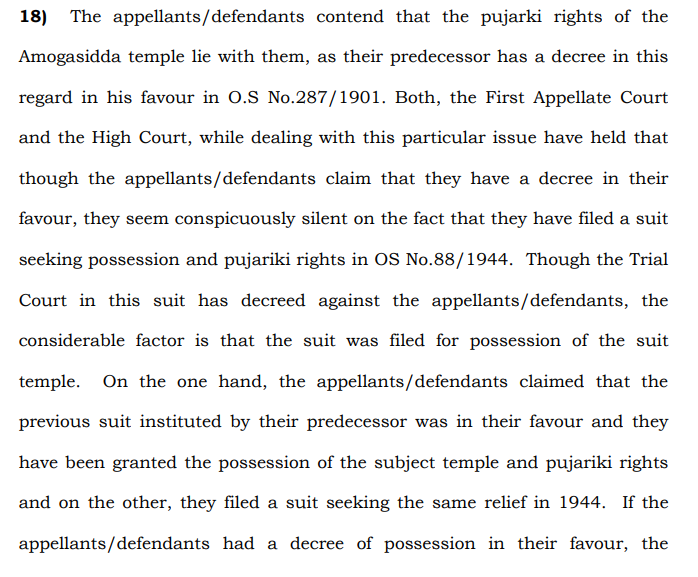
According to the court, the appellants outlined that since their predecessor had a ruling favourable to him in the initial suit (287/1901), they were entitled to the pujarki rights of the temple. When dealing with this specific situation, the First Appellate Court and the high court determined that, they appear to be “conspicuously silent” about the fact that they started the case (88/1944) for possession and the rights in the first place, despite their insistence.
The justices mentioned, “Though the Trial Court in this suit has decreed against them, the considerable factor is that the suit was filed for possession of the temple. On the one hand, they claimed that the previous suit instituted by their predecessor was in their favour and they have been granted the possession of the temple and pujariki rights and on the other, they filed a suit seeking the same relief in 1944.”
“If the appellants or defendants had a decree of possession in their favour, the question arises as to how and when they lost possession of the subject premises. This fact has been considered by both the courts and it also manifests that the written statement of the appellants or defendants is silent on this aspect,” they noted.
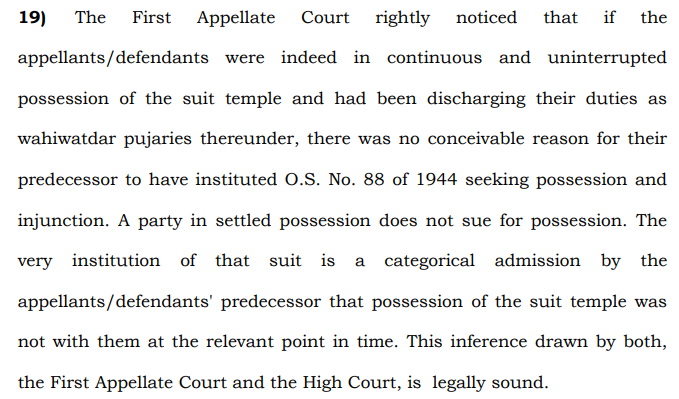
The court stated that the First Appellate Court rightly spotted that there was no plausible reason for their predecessor to have filed the first suit for the temple’s control and an injunction if the appellants were in fact doing their duties as wahiwatdar pujaries and had a continuous and uninterrupted hold over it.
It charged, “A party in settled possession does not sue for possession. The very institution of that suit is a categorical admission by the predecessor of the appellants or defendants that the possession was not with them at the relevant point in time. This inference drawn by both, the First Appellate Court and the high court, is legally sound.”
No action by the appellants for a duration exceeding a decade
The court emphasised that the predecessor raised a civil appeal after losing the litigation on merits before the Trial Court in 1945 and a motion was brought for the claim to be dropped with the ability to bring a new suit rather than continuing the same. The order permitting it was issued on 15th June 1946 and no new suit was opened for more than three and a half decades after that.
It further chastised, “The appellants or defendants have offered no explanation, either in their pleadings or in their evidence, as to what transpired during this long interregnum. As the high court correctly observed, when a party obtains liberty to file a fresh suit and consciously refrains from doing so for thirty-six years, the inevitable inference is that it had reconciled itself to the factual reality on the ground. This conduct speaks louder than any decree of 1901 that the appellants or defendants seek to wave before this court.”
The court stated that the high court extensively reviewed the documentary material after remand. The names of the ancestors of the plantiffs in relation to the lands awarded by the British government at the time in exchange for service to the Amogasidda temple are listed in the Record of Rights (RTC). However, these revenue records make absolutely no reference to the identities of appellants.
It underlined that they and their forebears have been engaged in legal disputes over this very temple for more than a century and cannot pretend that they are unaware of the revenue records or assert that they are not supported by any proof in these situations.
The court points to Ogeppa’s statement, poses relevant inquiries
The justices mentioned that the admission that was taken from Defendant Witness 1 (Ogeppa) during cross-examination is quite important. The witness denied that the government had handed over land to the Amogasidda temple in Mammatigudda and offered that it was in reference to the Amogasidda temple in Jalageri village which is the subject of the contention between the two sides. He even acknowledged that the plaintiffs were cultivating the property. This confession from the witness of appellants settled the issue concerning the grant and its ties to the plaintiffs.
They expressed, “We also find ourselves in agreement with the observations made by the high court as regards the written statement filed by the appellants or defendants. A party setting up a competing claim to hereditary pujari rights is obligated to plead specifically – when they came into possession of the suit temple, when they commenced performing puja, when and how the respondents or plaintiffs began obstructing them and what steps, if any, they took to vindicate their rights during the long intervening period.”
The court outlined that the written declaration of appellants is reluctant on all of these important details and they defend themselves by citing the 1901 edict along with a simple denial which was termed as completely inadequate. It declared that the oral testimony of the witness trying to bridge these gaps must inevitably be ignored in the absence of any underlying plea. Oral testimony cannot be used in place of pleadings, and evidence cannot be used to build a case that is not presented in the same.
The decision is pronounced
The bench conveyed that it had become clear that the plaintiffs have consistently substantiated their claim through revenue records, consistent documentary evidence, the admission of the witness of the appellants and the testimony of independent witnesses, including devotees who informed that they were performing puja at the temple as hereditary wahiwatdar pujaries.
“The appellants or defendants, on the other hand, rest their claim almost entirely on a century-old decree, the effect of which was demonstrably undone by their own predecessor’s subsequent conduct in instituting a suit for possession in 1944. The concurrent findings of the First Appellate Court and the high court reflect a correct and careful ppreciation of this entire factual matrix,” the court highlighted.
It concluded, “Hence, we find no perversity in the impugned judgment of the high court dated 04.10.2012. Accordingly, the Civil Appeals are sans merit and are dismissed. No orders as to costs.”
Background of the matter
This ancient dispute began in 1944 when the predecessor-in-interest, the late Ogeppa Biradar alongside others lodged an original suit for possession of the temple and other properties. They charged that the plaintiffs had taken over the religious site against their will and had claimed the right to perform puja. However, their plea was dismissed by the Trial Court after which a First Appeal was initiated in 1945.
The appeallants introduced as application to withdraw the case with liberty to launch a new suit while their prayer was pending and the plaintiffs agreed to it. As a result, the Appellate Court granted approval and overturned the verdict, a year later. Afterwards, the the plantiffs 1967 stated that the appeallants began to interfere with the worship at the temple, leading to a lawsuit.
It sought a perpetual injunction prohibiting the latter from interfering with their peaceful ownership and enjoyment of the assets as well as pujariki and pujaries rights. They were given an ex-parte decree but it was later dismissed for lack of prosecution.
A confrontation of opposing assertions and arguments
On 24th March 1982, the current plaintiffs brought forth the original suit before the Court of the Principal Munsiff in Bijapur, requesting a permanent injunction and a declaration that they are the ancestral wahiwatdar pujargi with the jurisdiction to worship at the temple. They emphasised that they were ancestral wahiwatdar pujaries who have the privilege to perform puja of the deity. The number 1 plaintiff had eight annas of these rights while the others shared the remaining rights and exercised them alternately.
They reported to have performed regular services during the year-round puja and annual jatra at Chaity Amavasya and received donations from devotees. The plaintiffs expressed that the appellants with police assistance had blocked the daily ceremony, tried forced night entry and removed puja articles since since 20th March 1982.
They had to file a trespass complaint and a lawsuit to have their rights as temple pujaris recognised. The plaintiffs demanded to register the temple as a public trust with the Assistant Charity Commissioner of Belgaum.
The appellants cited the original litigation in which their ancestors gained a ruling granting the rights to Gurappa son of Manigeppa Poojari, rejecting the submissions of the plaintiffs. They explained that the current plaintiffs are the offspring of the defendants in the case whereas they are the plaintiff’s successors.
The appellants insisted that they continuously performed jatra celebrations, accepted tributes from the devotees and exercised their pujarki responsibilities as wahiwatdars. It was also remarked that they were the owners of the temple and the associated religious structures.
The matter was partially decreed by the Trial Court in its judgement and order dated 18th November 1986. It pornounced that the appellants and the plaintiffs are both pujargies of the temple and must offer puja and jatra in a certain proportion and rejected the call for injuction.
The appellants then launched a regular appeal before the Additional Civil Judge on 10th December 1986 and the plaintiffs also followed suit on 12th December. On 5th July 1990, the First Appellate Court junked the former’s motion while upheld the other, observing that the plantiffs were the temple’s ancestral pujari.
The conflict reaches the Karnataka High Court and the Supreme Court
The appellants preferred regular two second appeals with the Karnataka High Court which approved them, reversing the decree in their favour and setting aside the earlier verdict on 24th July 1992. It concluded that the Additional Civil Judge, Bijapur did not have the judicial power to consider the regular appeal filed by the plaintiffs because the Civil Court’s jurisdiction is prohibited by section 80 of the Bombay Public Trust Act, 1950.
The plaintiffs presented special leave applications with the Supreme Court in opposition to the ruling which were subsequently transformed into civil appeals. On 28th March 2003, the court sustained the same and remanded the case to the high court. It further highlighted that the restriction implied by section 80 of the act was not relevant and the contest needed to be decided on its merits.
The high court again heard the objection voiced by the appellants and dismissed it, supporting the plantiffs on 4th October 2012. Afterwards, the apex court was approached via civil appeals against the outcome.
India is rapidly digitising its healthcare system with e-health records and interconnected services. In such a scenario, many people learn about making an ABHA card, but they remain confused about whether it is meant for them and when it would actually be of use. An ABHA Card, unlike an insurance or a benefit scheme, is simply a digital health ID that helps organise your medical information in one place.
Understanding the purpose of an ABHA Card
An ABHA Card is a unique 14-digit digital health identity. Its primary function is to enable a person to store and access their medical records, such as prescriptions, lab reports, and hospital summaries, in a digitally secure format. Such records, upon the user’s consent, could be shared with doctors, hospitals, or diagnostic centres, thereby lessening the need for paper files.
Who should consider creating an ABHA Card
An ABHA Card especially benefits those who regularly interact with the healthcare system or see several different providers for their care.
Patients, particularly those dealing with chronic or long-term illnesses, can benefit greatly from having their health details saved in one single place. When getting treated at different hospitals or clinics, an ABHA-linked record helps doctors quickly understand previous treatments, without having to start all over again.
Those who engage in telemedicine or digital health platforms benefit from it, too. An ABHA ID can significantly facilitate online consultations as it allows doctors to access the necessary medical information in a secure and verified manner, leading to better healthcare advice.
Deciding whether to create one
Creating an ABHA Card is a personal choice. It is often appreciated by those who prefer keeping their health records organised, digitally accessible, and well-maintained. For others, it may simply serve as a useful option to have on hand during health emergencies.
For those who decide to create one, the ABHA Card download process is easy and straightforward. Since it is completely digital, it can be completed anytime and from anywhere.
How the ABHA Card relates to the Ayushman Card
The Ayushman Card and the ABHA Card are often mistaken for the same, but in reality, they have different functions. The Ayushman Card is tied to a government health insurance scheme so that the hospitalisation costs of eligible families can be covered. The ABHA Card, however, is a tool for the efficient management of health records.
Many individuals may be using both. Making an ABHA Card by itself doesn’t mean you are enrolled in the Ayushman scheme, and you don’t need an ABHA ID to have an Ayushman Card either. Once this difference is clear, it becomes much easier to know which card to use and when, without any confusion.
Situations where an ABHA Card may not be essential
An ABHA Card may feel less relevant for those who usually visit the same family doctor, have a limited medical history, and prefer keeping their records on paper. Since access to healthcare does not depend on having an ABHA Card, choosing not to create one does not restrict treatment options.
That said, situations can change over time. Health needs evolve, and something that may not seem useful today could turn out to be helpful later.
Conclusion
An ABHA Card isn’t an insurance policy. It’s simply a digital way to keep your health records organised in one place. It can be especially useful if you have ongoing health needs, consult more than one doctor, or prefer using online health services. Used with the right understanding, it works quietly in the background to make healthcare smoother, while schemes like the Ayushman Card continue to take care of the financial side separately.
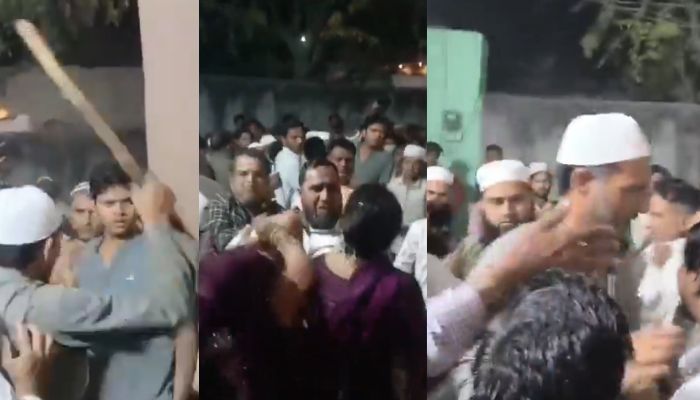
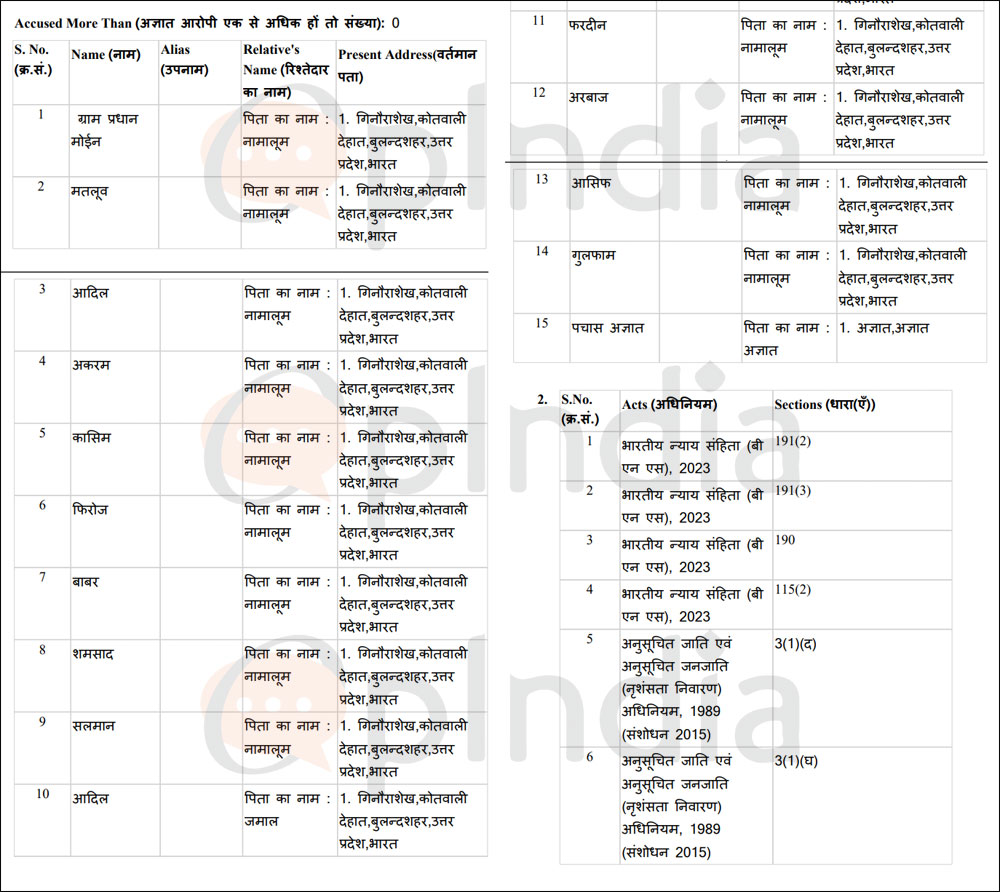
On 24th February, Bulandshahr police arrested 12 individuals from the Muslim community for attacking Dalit Hindus during a Kuaan Poojan and Devi Jagran programme. According to media reports, members of the Muslim community attacked Dalit Hindus over DJ music during the programme.
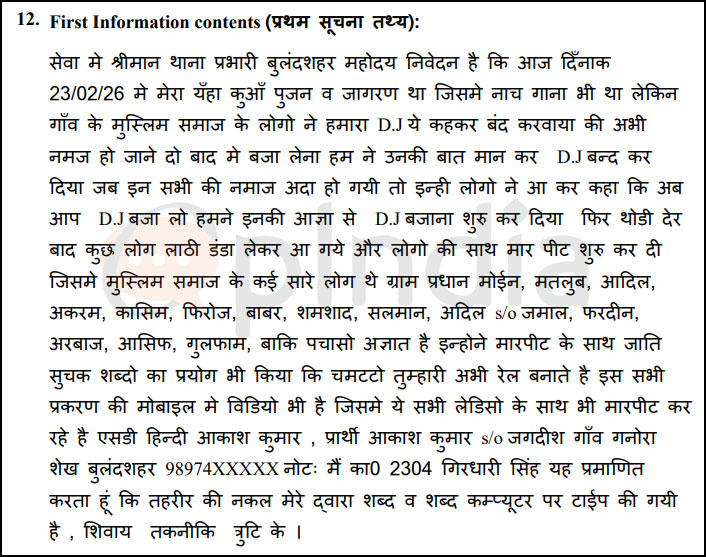
A case has been registered on the complaint of one of the victims, Akash Kumar, against 64 individuals, including 15 named and 50 unnamed persons, under the BNS and the SC/ST Act. The incident took place on the night of 23rd February. OpIndia accessed the FIR registered in the matter.
How the dispute escalated
According to the police, the incident took place on Monday evening when a Kuaan Poojan ceremony was being held at the residence of Akash Kumar, a member of the Dalit community. A Devi Jagran was also scheduled later that night. Family members and relatives were dancing to music played on a DJ system.
During the programme, members of the Muslim community objected to the music, claiming it was the time of namaz, and asked that the DJ be switched off. The complainant’s side complied and stopped the music.
However, after the namaz concluded, the DJ was restarted. It was then that the dispute flared up. Both sides got into a heated argument, leading to physical assault on Dalit Hindus. Videos of the altercation went viral on social media.
#बुलंदशहर: कुंआ पूजन और जागरण में डीजे बजाने को लेकर दो पक्षों में टकराव, दलित के घर में घुस महिलाओं से की धक्का मुक्की, हाथापाई,जाति सूचक शब्दों के प्रयोग का भी आरोप,वीडियो सोशल मीडिया पर वायरल, कोतवाली देहात के गिनोरा शेख गांव का मामला.@Uppolice@bulandshahrpol#Bulandshahrpic.twitter.com/Mrn3TxDq6X
In his complaint, Akash said that dozens of Muslim men entered his house, assaulted those present, and used caste based slurs. Furthermore, Akash accused the attackers of misbehaving with women present in the house during the incident.
Media reports suggest that bricks were thrown, resulting in one youth getting injured and one woman being hit in the eye.
Police officials told the media that the situation is under control. SP City Shankar Prasad said that adequate police force has been deployed in the village. Station House Officer, SHO, Neeraj Kumar Malik confirmed that a case has been registered and legal action is underway.
उपरोक्त प्रकरण में थाना कोतवाली देहात पर प्राप्त तहरीर के आधार पर सुसंगत धाराओं में अभियोग पंजीकृत है तथा 07 अभियुक्तों को पुलिस हिरासत में लेकर विधिक कार्यवाही की जा रही है।
The FIR has been registered on the complaint of Akash Kumar under Sections 191(2), 191(3), 190 and 115(2) of the Bharatiya Nyaya Sanhita, BNS, and Sections 3(1)(s) and 3(1)(w) of the Scheduled Castes and Scheduled Tribes, Prevention of Atrocities Act, SC ST Act, against Gram Pradhan Moin, Matlub, Adil, Akram, Qasim, Firoz, Babar, Shamshad, Salman, Adil son of Jamal, Fardeen, Arbaz, Asif, Gulfam and about fifty unidentified persons.
Source: UP police
In his written complaint, Akash stated that a Kuaan Poojan and Jagran programme was being held at his residence where DJ music was being played. Members of the Muslim community first got the DJ switched off during namaz and, after it resumed, returned with lathis and sticks, and assaulted those present.
Source: UP police
He further stated in his complaint that casteist abuses were used, including threats directed at members of the SC community. He added that the entire incident was recorded on a mobile phone video showing women being assaulted.
Police action and arrests
Twelve accused have been arrested so far. Police are conducting raids to apprehend the remaining accused. Senior officers are monitoring the situation. Officials have said that strict action will be taken against anyone found disturbing law and order.
At first glance, this looks like just another banking scam. But peel back the layers of the Rs 590 crore fraud detected at IDFC First Bank’s Chandigarh branch, and what emerges is a textbook case of how insider access, weak oversight, and family-linked shell operations can be combined to quietly drain public money until a routine administrative request blows the cover.
It began with a simple request and exposed a massive hole
The entire scam came to light not because of a whistleblower or an audit, but because a Haryana government department asked for its account to be closed and the balance transferred elsewhere. When bank officials began the process, they noticed something that should never happen in a government account: the numbers didn’t match. The balance on paper and the actual money available were not the same.
Once this discrepancy surfaced, other Haryana government-linked accounts at the same branch were checked. The result was multiple mismatches across accounts. What initially looked like a clerical issue quickly snowballed into the discovery of a suspected fraud running into hundreds of crores. That is when IDFC First Bank informed regulators that around Rs 590 crore had been siphoned off through unauthorised and fraudulent activities, allegedly involving its own employees and outside beneficiaries.
The alleged architects: insiders who knew the system
The Haryana Anti-Corruption Bureau has so far arrested four people in the case: Ribhav Rishi, the former branch head; Abhay, a former relationship manager at the same branch; Swati Singla, Rishi’s wife; and Abhishek Singla, Swati’s brother. According to investigators, Ribhav and Abhay were not minor functionaries but officers who understood the bank’s internal processes, controlled client relationships, and had access to sensitive systems.
In other words, they allegedly knew exactly where the guardrails were and how to drive around them. Both had left the bank months before the scam became public, which suggests this was not a one-off act of opportunism but a scheme that may have been running quietly for a considerable period.
Follow the money: from government accounts to a family-linked firm
The most incriminating aspect of the case is the money trail uncovered so far. Investigators say around ₹300 crore was transferred from Haryana government-linked accounts to a private company called Swastik Desh Projects. On paper, it appears to be an ordinary firm, but its ownership structure immediately raises red flags. The company is largely owned by Swati Singla, the wife of the former branch head, with the remaining stake held by her brother Abhishek Singla.
In simple terms, a massive chunk of public money allegedly moved from government accounts into a company controlled by the prime accused’s immediate family. From there, the money was reportedly routed further onwards, a classic layering technique commonly used in financial crimes to make tracing funds more difficult and to blur the audit trail.
The geography puzzle: Chandigarh, Haryana, Mohali and blurred oversight
Another detail that has drawn the attention of investigators is the unusual geographical spread of the transactions. The bank branch involved is in Chandigarh, the account holders are Haryana government departments, and at least some of the recipient transfers went through a bank branch in Mohali.
On a map, these places are close to each other, but administratively they fall across different jurisdictions, involving two states and one Union Territory. Investigators have questioned how and why government accounts were being operated and routed in this manner without earlier scrutiny. In complex financial frauds, such jurisdictional grey zones often become convenient cover, not by accident but by design.
Why this is not just another “bank scam”
This case cannot be brushed aside as a routine instance of bank fraud. At its core, it involves public money allegedly being siphoned off from government departments, which means the ultimate victim is the taxpayer. It also points to a serious breach of trust, because the main accused were not outsiders breaking into the system but insiders who allegedly used their authority and access to manipulate it. Most importantly, it exposes systemic failures, because for such large sums to move without immediate detection, internal controls, audits, and supervisory mechanisms clearly did not function as they should have.
The bank’s damage control: pay first, investigate later
Amid the unfolding investigation, IDFC First Bank has said it has already repaid 100 per cent of the claimed amount, around ₹583 crore including principal and interest, to the Haryana government departments. The bank’s public stance is that depositors should not suffer because of wrongdoing that occurred within the system. While this step may limit the immediate financial damage to the state, it does not answer the more uncomfortable question of how a scheme of this scale was allowed to operate undetected in the first place.
What happens next
The Anti-Corruption Bureau has made it clear that the investigation is still at an early stage. In the coming weeks, more details are expected to emerge about how internal controls were bypassed, whether more people were involved, where the remaining money went, and how long the alleged operation had been running. What already seems evident, however, is that this was not an accidental error or a one-off lapse. If the allegations hold, this was a carefully structured, insider-driven operation that treated a government account like a private cash pipeline, until a routine transfer request finally pulled the curtain back.
The bigger takeaway
The Rs 590 crore IDFC First Bank fraud is a reminder of an uncomfortable reality in financial systems: the most dangerous breaches often do not come from outsiders forcing their way in, but from insiders who already have the keys and know exactly which doors do not squeak.
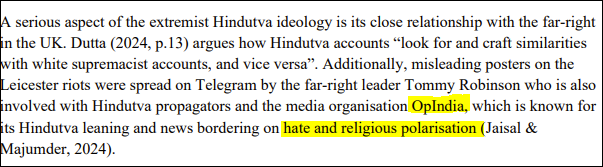
OpIndia has been documenting crimes against Hindus in India and globally. Covering persecution of Hindus based on their religious identity has earned us massive community support, making OpIndia one of the most unapologetically vocal Hindu media outlets. For this reason, the Hinduphobic Islamo-leftist lobby has long been targeting OpIndia to push us into silence through FIRs, court cases, hitjobs, campaigns to slash OpIndia’s ad revenues, trashy ‘research’ papers and whatnot.
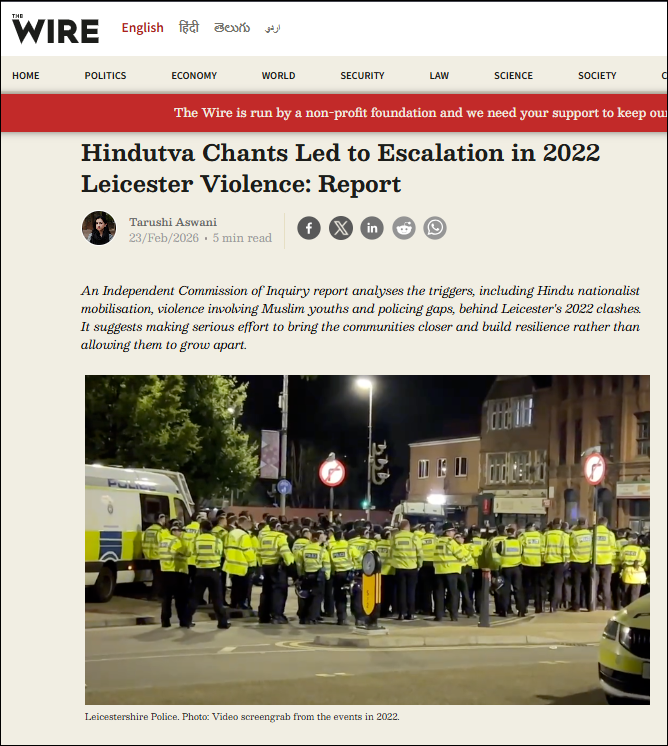
OpIndia has been targeted (again) for its 2022 Leicester violence reportage. This time by a Soros-funded ‘inquiry’ published by the SOAS University of London.
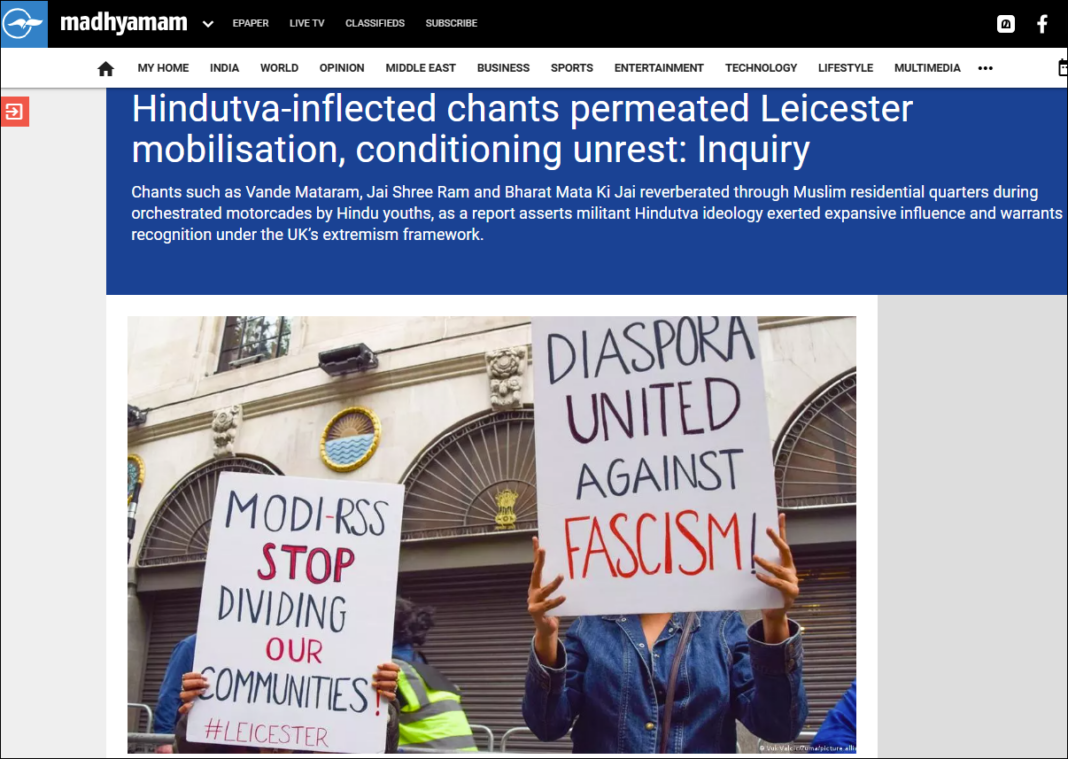
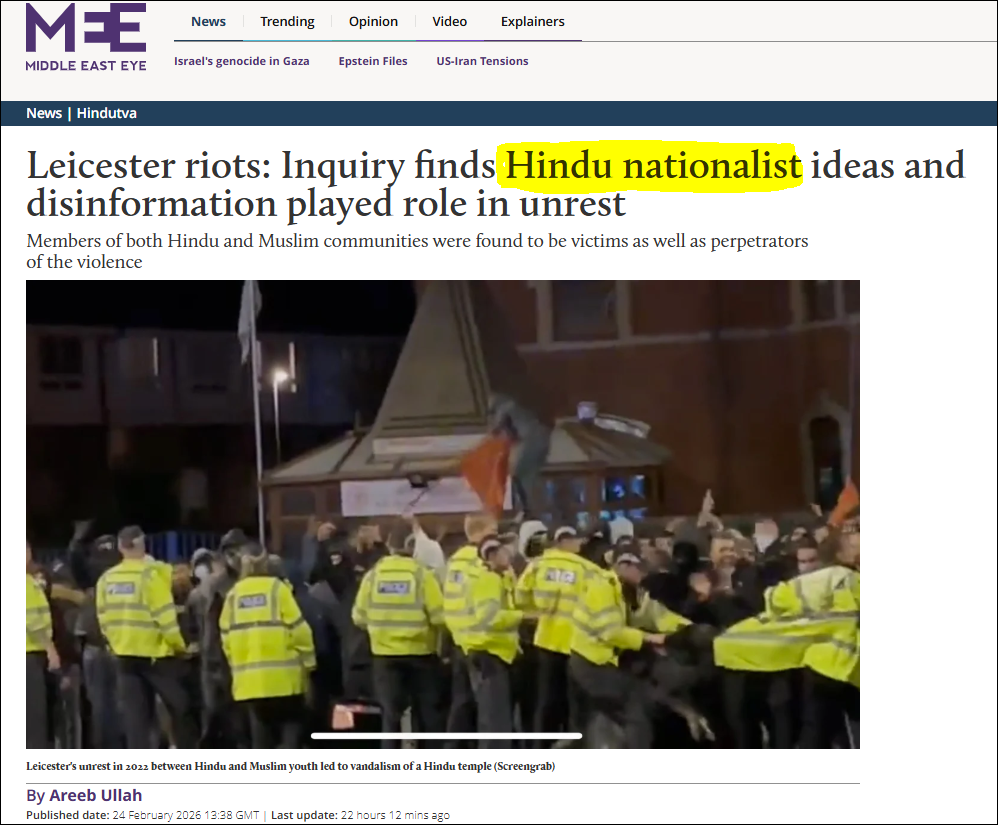
On 23rd February 2026, the School of Oriental and African Studies (SOAS) released its 218-page report titled ‘Better Together: Understanding the 2022 Violence in Leicester’.The inquiry ditches its initial claim “no single community or group is to blame” for the violence, distrust, and tensions in Leicester; by repeating blame on Hindus, and dedicating a full chapter and recommendations to portraying Hindus and Hindutva. OpIndia reported earlier that the SOAS University researchers with an anti-Hindu past, presented Hindutva or Hindu nationalism as a ‘clear factor’, a ‘state-backed international project’, and a form of ‘extremism’ equating it to what they called “political Islamism”.
Unsurprisingly, the propaganda report prepared by the SOAS University targeted OpIndia for its Leicester violence coverage. In the segment analysing the impact of social media on the incidents in Leicester back in 2022 and vice versa, the report almost ridiculed Hindu social media users for raising their voice against Islamist attacks on Hindus in India, Pakistan, Bangladesh, particularly in Leicester under the hashtag #HindusUnderAttack.
The report claimed that social media narrative manipulation was at play during the Leicester violence in 2022, with OpIndia being a significant contributor.
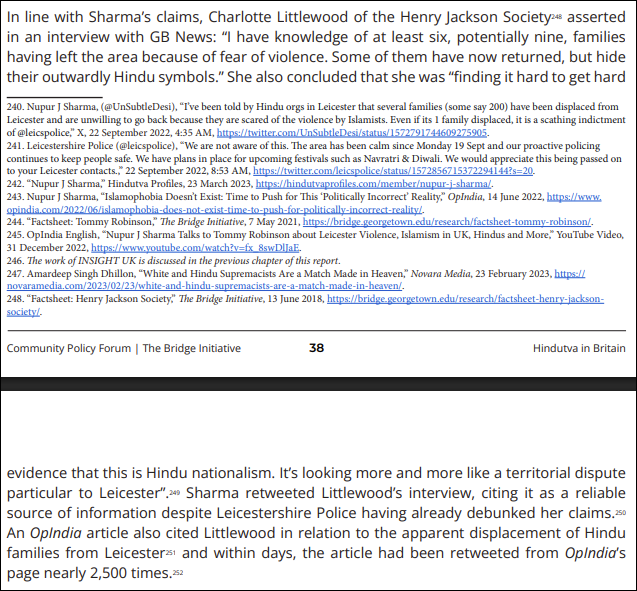
“Of the top 30 shared URLs in tweets, 11 were from OpIndia, a media outlet that strongly supports Narendra Modi, the BJP and Hindutva politics,” the report claimed. “Building on Henry Jackson Society researcher Charlotte Littlewood’s interview with GB News, reports from OpIndia alleged that ‘Islamists’ were calling for the removal of Hindus from Leicester as they had done in Kashmir,” it added.
OpIndia does not support Prime Minister Narendra Modi, the BJP or Hindutva politics. OpIndia supports Hindus, Hinduism and Hindutva sans politics. Adding the ‘politics’ suffix to suggest that we are a part of or an extended arm of any political party is factually incorrect. We have, as exemplified in OpIndia’s coverage of the outrageous UGC caste discrimination guidelines issue, been critical of the BJP, the Modi government and their specific policies as and when required.
This, however, is not the first time that OpIndia’s Leicester violence coverage has irked the Islamo-leftist cabal.
As OpIndia articles reportedly topped social media trends highlighting attacks on Hindus in Leicester, the BBC cried hoarse
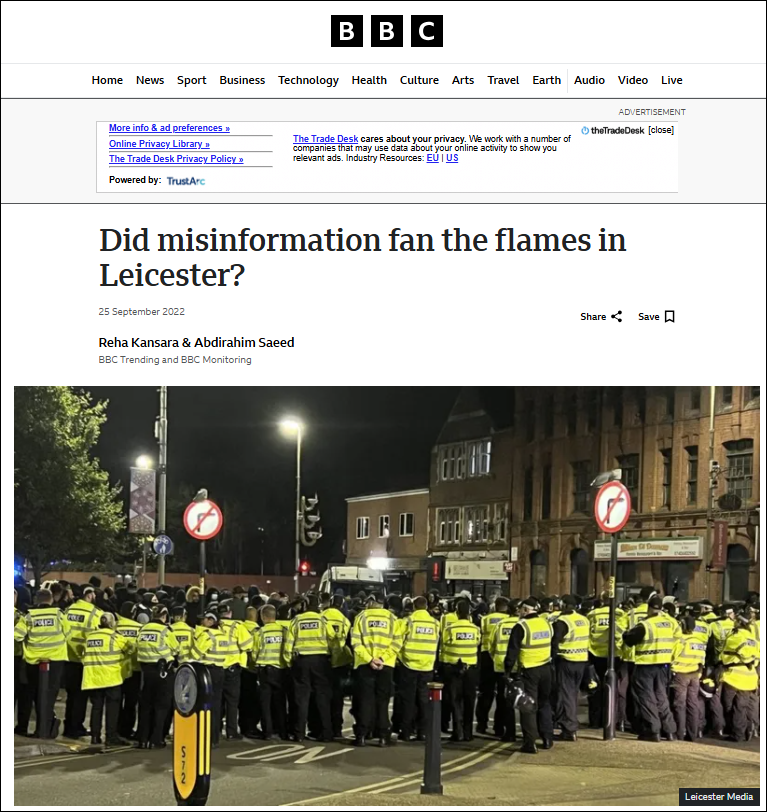
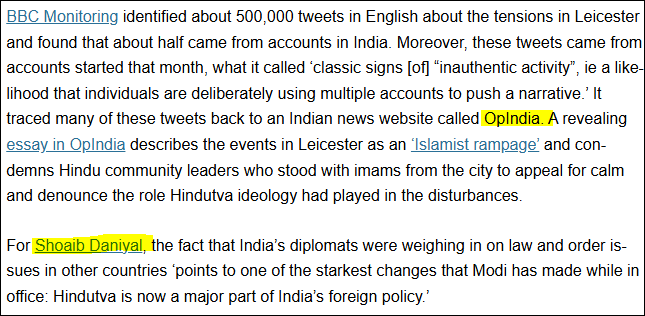
Notorious for peddling fake news and propaganda about Hindus, Prime Minister Narendra Modi and contextualising Islamist violence against Hindus in Bangladesh, the BBC had published a report on 24th September 2022, wherein it claimed that the top 30 URLs shared under the hashtag #HindusUnderAttackinUK were of OpIndia articles. The BBC tried to dismiss the hashtag as inorganic. It also highlighted the massive reach of one of OpIndia’s articles based on Henry Jackson Society researcher Charlotte Littlewood’s concern that at least nine families had left Leicester due to threats of violence from Muslims.
Since the Leicestershire Police back then said that they were “not aware” of Hindu families leaving Leicester, the BBC tried to suggest that OpIndia peddled misinformation. However, it was seen how the BBC itself downplayed the disinformation and violence by the Muslim side.
Of the 30 OpIndia URLS, BBC claimed trended under #HindusUnderAttackinLeicester, the British state media chose to highlight only the ‘Hindus leaving Leicester’ report, in a classic case of cherry-picking material useful for pushing ‘international Hindutva-aligned actors’ peddled more misinformation than the Islamists.
“The BBC examined the top 30 URLs that were shared using these hashtags. Of them, 11 were links to articles written by news website OpIndia.com, which describes itself as “bringing the right side of India to you”. As well as potentially inauthentic accounts, these articles were also widely shared by genuine accounts including some with hundreds of thousands of followers,” the BBC article stated.
“One of the OpIndia articles cited British researcher Charlotte Littlewood, from the Henry Jackson Society, who told GB News that several Hindu families had left Leicester due to threats of violence from Muslims. The article was retweeted nearly 2,500 times. Leicester Police have since said that they were unaware of any reports of families having to leave,” it added.
OpIndia had highlighted back in 2022, how the BBC’s Leicester violence reportage was riddled with anti-Hindu bias, with a deliberate attempt at villainising Hindutva and the BJP-RSS, even though there was nothing linked to RSS, BJP of so-called Right-Wing extremists or fascist orientation to the violence at all. BBC’s Leicester violence coverage had sparked significant backlash from the British Hindu community back then.
In its report titled Did misinformation fan the flames in Leicester?”, BBC said, “Some people link the disorder and the reaction to it to the Hindutva ideology. They believe that Indian politics is being imported to the city, but thus far the BBC has found no direct link to such groups in the run-up to the disorder”.
While on the face of it, it appeared that the BBC was being unbiased by not directly linking Hindutva with violence in Leicester, the BBC, despite conducting an ‘investigation’ into the violence, could not find any evidence to support that it was Muslims who started the clashes, even as video evidence corroborated the same.
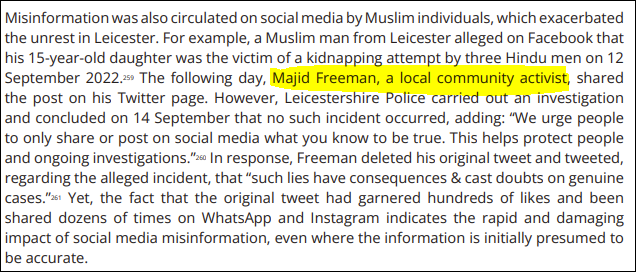
Despite mentioning the names of Islamists like Majid Freeman, who was among the top instigators of violence against Hindus, the BBC did not shun its balancing act and blamed Hindus for spreading misinformation. In fact, Freeman was interviewed by the BBC to set the narrative in favour of the Muslim perpetrators.
OpIndia had highlighted back then that the BBC went on to suggest that the desecration of a sacred saffron flag from the Shivalaya Mandir by a Muslim man may have been done by a Hindu.
The BBC had also lamented that the Hindus in Leicester found support from Hindus in India, the Hindu-majority nation. Indians have a massive social media presence, and yet the BBC, based on its analysis of 20,000 tweets in English about Leicester violence originating from India, suggested that this was a “manipulation of the hashtags”, insinuating that the Hindu support from India somehow worsened the violence in Leicester. This clownish assertion finds mention in the recently released SOAS Inquiry as well.
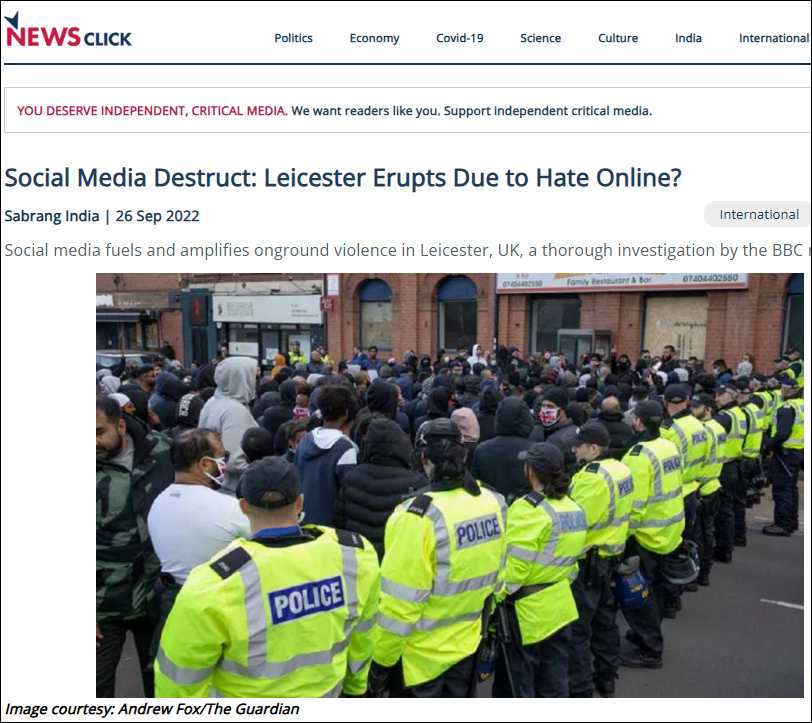
Newsclick amplified the BBC’s anti-Hindu propaganda
Leftist propaganda outlet Newsclick had amplified the BBC report to push the propaganda against Hindus in the context of the 2022 Leicester violence. Even while highlighting the fake news peddled by Majid Freeman about Hindus kidnapping a Muslim girl, Newsclick called him a ‘community activist’ and not the main instigator of the violence against Hindus.
Newsclick’s anti-Hindu bias is not hidden. Moreover, Newsclick is also under scrutiny for its alleged connections with the Chinese Communist Party (CCP). In 2023, an investigation by the New York Times uncovered an ecosystem of activist organisations, non-profits, shell corporations, and their intimate ties to China and Chinese propaganda, with Neville Roy Singham at its helm. A Delhi Police chargesheet filed in 2024 called the Chinese state the “ultimate paymaster”, with funds routed to stoke anti-India narratives, especially regarding Kashmir, and farmers’ protests. The case is ongoing in the court.
In 2021, OpIndia conducted a detailed investigation into the links of NewsClick and uncovered how it was linked to several individuals who regularly spew venom against India, from Urban Naxals to those like Teesta Setalvad, Abhisar Sharma and several others. That investigation by OpIndia can be read here.
The Bridge Initiative, full of Pakistanis, publisheda ‘Hindutva in Britain’ propaganda report blaming Hindutva for Leicester violence, targeted OpIndia for not peddling Muslim victimhood bogey
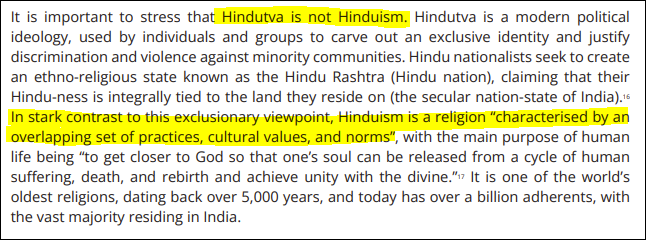
In November 2023, The Bridge Initiative under Georgetown University in the US published a report titled “Hindutva in Britain”. At the very onset, the report attempted to distinguish Hindutva from Hinduism by reducing Hindutva to a mere ‘political ideology’.
“It is important to stress that Hindutva is not Hinduism. Hindutva is a modern political ideology, used by individuals and groups to carve out an exclusive identity and justify discrimination and violence against minority communities. Hindu nationalists seek to create an ethno-religious state known as the Hindu Rashtra (Hindu nation), claiming that their Hindu-ness is integrally tied to the land they reside on (the secular nation-state of India),” the report said, adding that this exclusionary viewpoint of Hindutva is in stark contrast to the teachings of Hinduism.
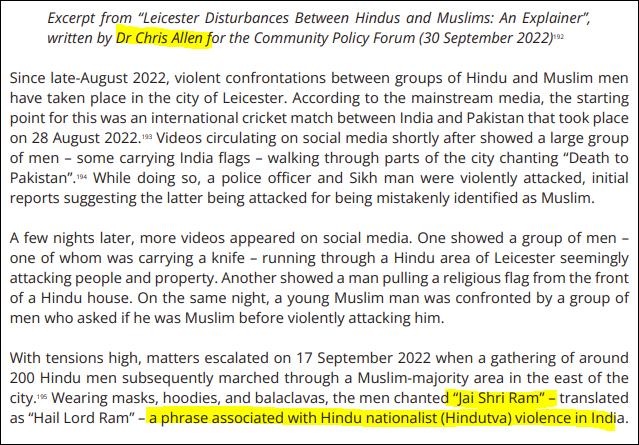
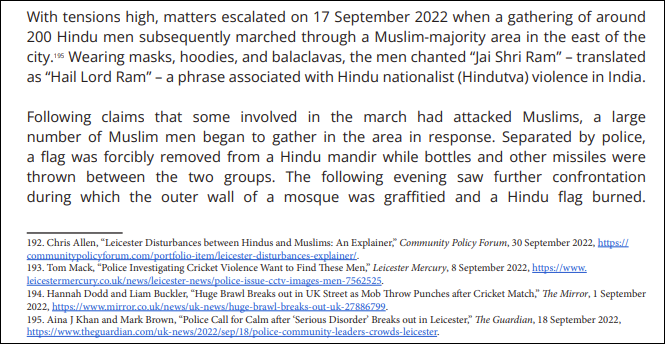
In the chapter titled “Case study: The 2022 Leicester riots”, The Bridge Initiative peddled the same and repetitive Muslim victimhood bogey, even as the clashes were started by Muslims. The report cited Islamist sympathisers like Chris Allen, The Guardian’s Aina J Khan and Hanah-Ellis Peterson, Hindutva Watch’s Pakistani admin Raqeeb Hamid Naik, and other such notorious Hinduphobes to establish Hindutva as a bigger threat than Islamic Jihadism.
It must be recalled that Chris Allen was named by Leicester mayor Peter Soulsby to lead an ‘independent inquiry’ into the Leicester violence; however, he had to step down after local Hindu organisations protested.
The report had also amplified Muslim victimhood propaganda by Islamists like Shockat Adam, who had a problem with Belgrave being supposedly called a ‘Hindu area’, but no such objections to the Green Road area being a Muslim area. OpIndia reported earlier that Shockat Adam is associated with a radical Islamic outfit named ‘Muslim Engagement and Development’ (MEND) for quite a long time, even holding the position of ‘Leicester Chair.’ Shockat Adam had attempted to downplay the Islamist violence in Leicester carried out by his co-religionists by labelling it as a ‘reaction to provocation.’
The Bridge Initiative- Community Policy Forum report also attempted to paint Hindus as ‘Islamophobes’ for objecting to the application for the construction of a mosque in the Hindu-dominated area, as if there are at least two to three temples in Muslim-dominated areas in the city.
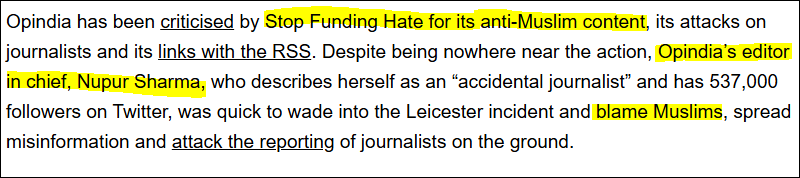
The Bridge Initiative also targeted OpIndia, particularly the Editor-in-Chief, Nupur Sharma, for her tweet raising concern over claims emerging that, amidst rising tensions, several Hindu families, as many as 200, were displaced from Leicester. In her tweet, Sharma had tagged Leicestershire Police, clearly with the intent to solicit a clarification from the police, and yet, The Bridge Initiative then and the SOAS Inquiry now have used the same tweet to suggest that OpIndia was peddling misinformation.
There’s a reason why OpIndia, in its report on the SOAS Inquiry, called the Soros-funded report a “recycled propaganda”. Much like the SOAS report, The Bridge Initiative had also tried to discredit the claim by Charlotte Littlewood of the Henry Jackson Society, about nine Hindu families leaving Leicester due to fear of violence.
It also cited the BBC report, which claimed that 11 of the top 30 URLs that used the hashtags “#ProtectLeicesterHindus”, “#StopLeicesterIslamicTerrorism”, “#HindusUnderAttackInLeicester”, #” HindusUnderAttackUK”, and “#HinduHateInUK, linked to articles written by OpIndia. Apparently, much like the BBC, the SOAS, and The Bridge Initiative were also irked by OpIndia’s “extraordinary international reach”.
Akin to the pattern seen in the SOAS Inquiry, The Bridge had also briefly highlighted the Islamist-manufactured and amplified anti-Hindu disinformation; however, it refrained from calling Islamist instigators like Majid Freeman and Mohammed Hijab as Islamists but rather, called them “community activist” and “Muslim social media influencer”.
The report described Mohammed Hijab as a mere Muslim social media influencer, despite quoting his video statement, which was filled with pejoratives against Hindus. Unsurprisingly, The Bridge Initiative did not find Allahu-Akbar-screeching Muslim mobs attacking Hindus offensive and terrorising, but somehow, the sacred Jai Shri Ram slogan became a ‘Hindu nationalist war cry’.
The background of The Bridge Initiative and its past shenanigans are even more interesting. In October 2022, the Initiative published a 40-page report claiming that Muslims are in the 8th stage of genocide in India. It suggested that India is seeing serious genocide of Muslims, which is allegedly on the 8th stage in a 10-stage scale created by Gregory Stanton. The eighth stage includes expropriation, forced displacement, ghettos, and concentration camps. In reality, however, there is no religion-based targeting of Muslims in India.
It also painted the Ayodhya Ram Mandir judgement and Kashi’s Gyanvapi dispute as “anti-Muslim”. In addition, they also peddled fake news that the CAA was an anti-Muslim policy of the Modi government, when the fact is that the CAA only accelerates granting citizenship to persecuted minorities in neighbouring countries.
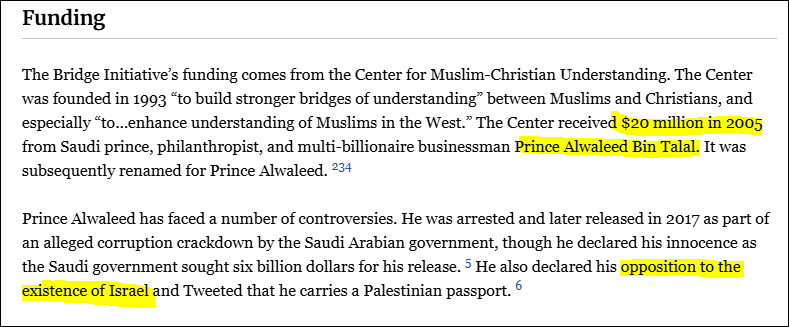
The Bridge Initiative is described as a “multi-year research project on Islamophobia”, and it functions under the Prince Alwaleed Bin Talal Centre for Muslim-Christian Understanding (ACMCU) at Georgetown University in Washington DC. The ACMCU was set up with a donation of $20 million by Saudi Arabian billionaire businessman Alwaleed bin Talal Al Saud in 2005. Talal has been a controversial businessman and was arrested on corruption charges.
The lead researcher mentioned in the report is Mobashra Tazamal, a Pakistan-origin researcher who has done her Master’s degree in Islamic Societies & Cultures. Her profile on the Georgetown University website states that “her current research centres on global Islamophobia with a particular focus on China’s campaign targeting Uighur Muslims and its use of surveillance technology, the rise of ethno-nationalism, and the financial and trans-Atlantic connections of the Islamophobia ‘industry’.” She is the associate director at the Initiative.
Other prominent members of The Bridge Initiative include Arsalan Iftikhar, another Pakistan-origin researcher. Arsalan Iftikhar is infamous for his racist comments against American politician Bobby Jindal, when Jindal was Louisiana’s governor. Appearing on MSNBC, Iftikhar had said about Jindal, “He might be trying to, you know, scrub some of the brown off his skin as he runs to the right in a Republican presidential exploratory bid.” This remark had triggered massive outrage, and MSNBC had announced that Iftikhar would not be appearing on the channel again.
Another member of the Initiative is Farid Hafez, who was investigated by Austria for suspected terror funding and association with the Muslim Brotherhood. The Austrian authorities raided his Vienna house in 2020 and questioned him after monitoring him for years under Operation Luxor.
Clearly, behind the intellectual façade, The Bridge Initiative is an Islamist propaganda machinery targeting Hindus and other communities and leaders who resist Islamist dominance and intransigence.
Commonwealth Magazine, The Times, Vice and The Caravan: Names change, but target remains the same— OpIndia
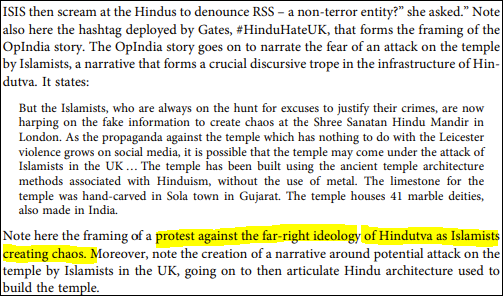
A concerted effort by the Islamo-leftist media in India and abroad to target OpIndia for its Leicester violence coverage has been seen since 2022. In this vein, the UK-based Commonwealth Magazine had published a propaganda piece on 28th September 2022, wherein it not only peddled the Muslim victimhood bogey, blaming Hindus for Leicester violence, but also cried hoarse of OpIndia calling anti-Hindu violence in Leicester as what it was— “Islamist rampage”.
What better to have been expected from the Magazine when it quotes Islamists like Scroll’s Shoiab Daniyal in a report.
Joining the anti-Hindu and Hindutva smear campaign, US-based Vice also amplified the same ‘Hindutva is bad’ bogey, Hindu nationalism imported in the UK, villainising the Jai Shri Ram slogan, etc. It not only highlighted the BBC report, which claimed that OpIndia articles were linked in most of the tweets under the hashtag #HindusUnderAttackinLeicester, but also lamented OpIndia’s Editor-in-Chief, Nupur J Sharma’s massive Twitter following. It also declared OpIndia’s content as “anti-Muslim”, apparently, for Islamo-leftists, there is pro-Muslim content or anti-Muslim content; there is no in between.
The Guardian whitewashed Islamist violence in Leicester
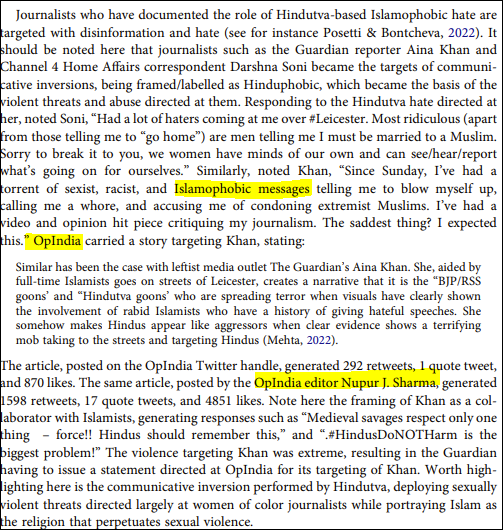
Back in 2022, Opindia exposed the tactics adopted by The Guardian journalist Aina J Khan to blame the violence against Hindus in Leicester on themselves.
In an intellectually dishonest piece published on 19th September 2022, Khan had distinctly associated religious identity with groups of Hindu protestors, with phrases such as “unplanned protest of Hindu men,” and “Hindu men were filmed marching.”
However, she shrewdly chose not to point out the religious affiliation of the man who desecrated a Hindu temple and uprooted a saffron flag. In a bid to shield her co-religionist who desecrated the Hindu place of worship, Aina J Khan used the bait of a ‘good Imam.’
The Guardian journalist thereby shifted the public discourse from the vicious attack on a temple by her co-religionist to the alleged benevolence of a ‘bystander’ Imam. When OpIndia pointed out the obvious discrepancy in her reportage, Aina J Khan cried foul and dubbed the criticism as ‘Islamophobia.’
On 17th October 2022, the antisemitic organisation ‘Stop Funding Hate (SFH)’ went on an unhinged tirade against Opindia for exposing ‘The Guardian’.
‘Stop Funding Hate’ desperately wanted to strip OpIndia of advertisement revenue for showcasing the true plight of Leicester Hindus to the world, who were left at the mercy of Islamists and their sympathisers in the media industry.
Meanwhile, UK-based ‘counter-extremism’ think tank, Institute for Strategic Dialogue (ISD), had in October 2022, published a ‘dispatch’ titled “Violence in Leicester: Understanding online escalation and offline fallout,” wherein it largely blamed Hindus for Leicester violence, downplayed the role of Islamists like Majid Freeman and Mohammed Hijab. It also targeted OpIndia over British patriot and activist Tommy Robinson sharing an OpIndia article, which rightly described Muslims as the instigators of the 2022 anti-Hindu Leicester violence.
The Times also echoed the ‘Hindutva’ escalated tensions in Leicester bogey and accused OpIndia of being prominent ‘Hindu nationalist actors’ behind amplifying disinformation about the incidents in Leicester in September 2022.
Similarly, Indian far-left propaganda magazine The Caravan, which prioritises studying the caste composition of martyrs from the Indian Army in Islamic terror attacks, had also targeted OpIndia for the latter’s Leicester violence coverage. In its hit-job titled, “Agent Orange The toxic business of OpIndia’s anti-journalism”, Caravan author Amrita Singh, portrayed OpIndia as a hate amplifier in Leicester coverage for the latter calling the Islamist-orchestrated anti-Hindu violence as what it was: Islamist-orchestrated anti-Hindu violence.
‘Academic paper’ by Mohan J Dutta labelled OpIndia a part of ‘Hindutva propaganda infrastructure’ over Leicester coverage
A research-cum-propaganda paper, one Mohan J Dutta vilified Hindutva and Hindus, particularly in context of the 2022 Leicester violence, and also attacked OpIndia. It called X handles of OpIndia and its Editor-in-Chief Nupur Sharma, “part of the Hindutva propaganda infrastructure producting hate.”
It also echoed The Guardian journalist Aina J Khan’s fake ‘Islamophobia’ victimhood after OpIndia exposed her anti-Hindu bias reflected in her Leicester violence report.
Further, it framed OpIndia’s report calling out Islamists planning protests against Shree Sanatan Hindu Mandir by falsely accusing it of involvement in violence against Muslims in Leicester, as a “protest against the far-right ideology of Hindutva.”
UK Parliament submission attacked OpIndia
A written submission made anonymously in the UK Parliament had previously peddled an alarmist and apocryphal narrative about the imaginary ‘democratic backsliding in India’. The submission had vilified Hindutva and the Hindu rights group, describing Hindutva as an ‘extremist’ ideology. It went on to target OpIndia, claiming that the Hindutva-aligned media organisation’s content borders on “hate and religious polarisation.”
CIA-front Bellingcat targeted OpIndia for its unapologetically pro-Hindu reporting
Bellingcat, which has previously been exposed as a CIA front, had also attacked OpIndia in the past. In a report authored by brown sepoy Pooja Chaudhari, Bellingcat criticised OpIndia’s pro-Hindu reporting, critical of Islamist crimes, as somehow “anti-Muslim”. It quoted Islamist fake news peddlers like Alishan Jafri, who equated OpIndia with Nazi propaganda newspapers like Der Stürmer. Besides the general attacks on OpIndia’s editorial style and tone, the Bellingcat garbage also blamed OpIndia articles for the escalation of tensions during the Leicester violence.
It further targeted OpIndia’s revenue sources and cried hoarse over platforms like Facebook and Google not heeding the leftist smear campaign to demonetise OpIndia.
Interestingly, Bellingcat, a Netherlands-based “open source investigations” collective lauded by Western media for its work on Russia, Syria, and other conflict theatres, is a crucial component of the network highlighted in the OpIndia-CSDS study.
Bellingcat has received donations from the National Endowment for Democracy (NED), a US-Congress-funded organization specifically established to assist organizations that promote US interests overseas. Additionally, it gets funding from various Western government-affiliated institutions and benefactors, notably European and British sources. Bellingcat has been directly accused by the Russian government and others of being a Western intelligence cutout, citing instances in which its “open source” conclusions coincidentally matched classified disclosures and biased attributions of culpability in disputed occurrences. Bellingcat also has links with the anti-India Reporters Sans Frontiers (RSF) outfit.
In fact, Bellingcat’s co-founder Allen Weinstein once publicly disclosed: “A lot of what we do today was done covertly 25 years ago by the CIA.”
Source: Washington Post article from 1991
From Middle East Eye to Madhayamam, leftist media amplifies the anti-Hindu SOAS Inquiry into Leicester violence, even as Hindus condemn it
All the articles and research papers targeting OpIndia we discussed here cited each other as ‘credible’ sources, creating a loop of citations to lend ‘academic’ credence to the ongoing attempt at establishing a narrative that Hindutva is a massive menace of religious extremism, apparently, even bigger than Islamic Jihadism. The Islamo-leftist media is also playing its role in amplifying the anti-Hindu propaganda quite efficiently.
Ever since the Soros-funded SOAS University Inquiry into the 2022 anti-Hindu Leicester violence was published on 23rd February 2026, the Islamo-leftist media globally have amplified it with headlines like ‘Hindutva permeated Leicester violence’.
Indian news outlet Madhyamam headlined its report as, “Hindutva-inflected chants permeated Leicester mobilisation, conditioning unrest: Inquiry.”
Meanwhile, Middle East Eye published its report with the headline, “Leicester riots: Inquiry finds Hindu nationalist ideas and disinformation played role in unrest.”
Islamo-leftist propaganda portal The Wire has amplified the anti-Hindu trash produced by the SOAS University and headlined its report as, “Hindutva chants led to escalation in 2022 Leicester violence: Report.”
Conclusion
Clearly, there is a coordinated echo chamber that has been recycling the same old, and most importantly, debunked anti-Hindu propaganda to whitewash Islamist extremism and violence. These attempts to delegitimise OpIndia’s exposure of anti-Hindu violence in Leicester, by recycling the same tropes since 2022, will not deter OpIndia from its mission. Be it Leicester violence, persecution of Hindus in Bangladesh and Pakistan or in India, or in any corner of the world, OpIndia has and will report what leftist and mainstream media would ignore, equivocate or suppress. We will not allow scapegoating of Hindus and Hindutva for the Islamo-leftist pursuit of whitewashing and humanising Hindu-hating violent Islamists, no matter how many ‘research papers’, hit jobs, and smear campaigns come our way.
A controversy has erupted in Gujarat’s Kutch district after a Muslim teacher at Archana St. Xavier’s School in Nakhatrana was accused of snatching a Hanuman Chalisa booklet from a Class 6 student and throwing it away inside the classroom. The incident has led to protests from Hindu organisations and parents, leading the school administration to relieve the teacher from duty. However, demands are now growing for legal action in the matter instead of closing the issue at the school level.
According to information shared by local groups, the incident took place on 11th February. The student was sitting in the classroom with a small Hanuman Chalisa booklet when the teacher entered. Soon after noticing it, the Muslim teacher reportedly took the booklet from the child and threw it aside.
A Hindu girl accidentally carried Hanuman Chalisa in her bag to St. Xavier's School in Kutch, Gujarat.
The teacher snatched and threw it away.
Hindu groups protested, filed complaint and the teacher fired.
The entire incident was recorded on the school’s CCTV cameras, which have now become an important part of the controversy.
Protests by organisations and parents
After the matter came to light, members of the Vishwa Hindu Parishad (VHP) and the Akhil Bharatiya Vidyarthi Parishad (ABVP) reached the school and raised objections over the incident. Representatives from the two groups, along with police officials, spoke with the students in the classroom to understand what had happened.
Nakhatrana, Gujarat: A teacher allegedly snatched the Hanuman Chalisa from a sixth-grade student and used offensive language about Hinduism. The incident sparked strong protests and widespread outrage from the ABVP (Akhil Bharatiya Vidyarthi Parishad). pic.twitter.com/IYpjkmA4CM
Members of the VHP stated that the students told them the teacher had scolded the child and made comments about the Hindu religion rituals while taking away the Hanuman Chalisa. They further claimed that after the incident, the student was pressured inside the school and made to record a video saying that nothing inappropriate had happened.
The organisations later submitted a memorandum to the local education officer demanding strict action against the teacher as well as accountability from the school management. Protests by parents and activists continued until the school administration announced that the teacher had been relieved from duty.
Despite this step, Hindu organisations maintain that removing the teacher alone is not enough since the incident took place within the school premises. They are insisting that a formal legal case should be registered so that similar incidents do not occur in the future.
VHP leader shares details of the incident
In a conversation with OpIndia, Kutch Division Minister of Vishwa Hindu Parishad Chandubhai Raiyani stated that the school initially tried to prevent the matter from becoming public. According to him, smaller incidents had taken place earlier as well, but were handled internally without wider attention.
He said that in this case too, efforts were made to settle the issue quietly and that the student and her parents were reportedly put under pressure. Raiyani claimed that the child was made to record a video denying the incident and that there were concerns raised about the student’s future if the matter continued. He added that action was taken only after CCTV footage surfaced and protests intensified.
Raiyani also mentioned that the school had faced controversy earlier. He referred to a past case where a teacher reportedly collected money from students by promising to take them to a sports academy and later disappeared, after which police action was taken.
Activists connected with Hindu organisations have also expressed concern about increasing religious conversion activities in Nakhatrana and nearby rural areas. They say missionary groups frequently visit remote regions, and therefore, incidents inside missionary-run schools are being closely watched by local communities.
School responds, denies religious remarks
When contacted regarding the issue, the school administration confirmed that the concerned teacher is no longer working at the institution. However, the school stated that it is not obligated to initiate further legal action since the teacher has already been removed from service.
The school also rejected claims that any religious remarks were made during the incident. According to the administration, the teacher handled subjects like mathematics and science, which do not involve religious discussions. School representatives suggested that the situation has already been addressed through internal action.
On the other hand, Hindu organisations continue to stand by the students’ version of events, saying children present in the classroom stated that comments were made at the time the Hanuman Chalisa was taken away.
Demand for legal action continues
At present, the school considers the matter closed after relieving the teacher, but protests from organisations and parents have not completely stopped. They argue that legal proceedings are necessary to set a clear example and ensure respect for students’ religious beliefs within educational institutions.
Parents involved in the protests say the issue is not only about one incident but about creating confidence that children’s faith and sentiments will be respected inside schools. Organisations have indicated that they will continue to pursue the matter with education authorities and local administration until further action is taken.
The incident has now become a topic of discussion across the region, with many awaiting clarity on whether authorities will step in and initiate formal proceedings following the protests and demands raised by community groups.