Home Blog Page 1396

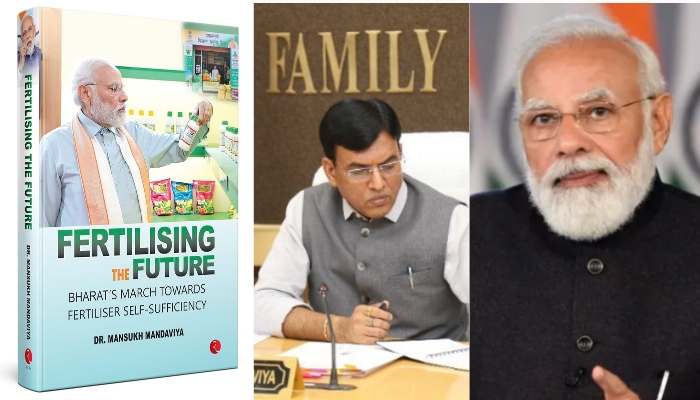
From fertilizer import scam under UPA to fertilizer self-sufficiency under Modi govt: Union Minister Mansukh Mandaviya’s book captures how India has transformed itself

0

Being primarily an agrarian economy, India under PM Modi has fared rather successfully against the global food and fertiliser crisis even when several countries have been reeling under this challenge.

Union Minister Mansukh Mandaviya’s recently launched book titled “Fertilising the Future: Bharat’s March Towards Fertiliser Self-Sufficiency” has delved in great detail into this very subject.

This was only achieved after the Modi government had to make right the many wrongs committed by the UPA-1 and UPA-2. The fertiliser, and by extension, the farm and agriculture sector had become a source of kickbacks for the UPA government across both its terms, particularly from 2007 to 2014.

The scam also involves Ratul Puri, nephew of senior Congress leader and former MP CM Kamal Nath – who is also an accused in the AgustaWestland chopper scam and Moser Baer scam. Black marketing of urea thrived under the Congress government including in the state governments. Shortage of urea in MP and Rajasthan during the previous Congress government and black marketing by private traders was rampant.

Measures taken by the Modi government to combat fertiliser crisis

22 crore soil health cards have been given to the farmers in the country. In the last 7-8 years, more than 1700 varieties of seeds have been made available to the farmers.

Under ‘One Nation, One Fertiliser’, urea will be sold with the same name, same brand, and same quality.

Work has also been done to promote the production and use of alternative fertilisers, making India the first country in the world to start commercial production of nano urea.

The Central Government took an important step towards encouraging new investment in urea production units by amending the new investment policy on October 7, 2014.

How India is on the path to becoming self-reliant in the fertiliser sector under Modi govt

“In the last few years, many countries of the world faced the problem of fertiliser crises. But under the leadership of the Prime Minister Narendra Modi, India did not let these crises affect the farmers and agriculturists of our country. Modi ji ensured that the rising prices of fertilisers in the global markets will not affect the farmers of the country,” an excerpt from the book reads.

It further states, “For this, the government worked to increase the subsidy. Even though the burden of subsidies on the government continued to increase, the Prime Minister was determined not to let the country’s food providers feel its burden.”

Presenting data to shed light on India’s growth story in the field of fertiliser, Mandaviya said India’s import of urea has been on a continuous decline. He said that the country is on the path to becoming self-sufficient in urea much to the credit of the closed urea factories restarted under Prime Minister Narendra Modi’s leadership.

“Besides this, new urea production plants were also set up. Apart from this, by developing Nano urea and producing it on a large scale, India has made significant progress in becoming self-sufficient in urea. In the case of DAP also, remarkable work is being done towards making the country self-reliant,” Dr Mandaviya said during the book launch.

The book “Fertilising the Future: Bharat’s March Towards Fertiliser Self-Sufficiency” has been published by Rupa Publications and can be bought from here.

(With input from agencies)

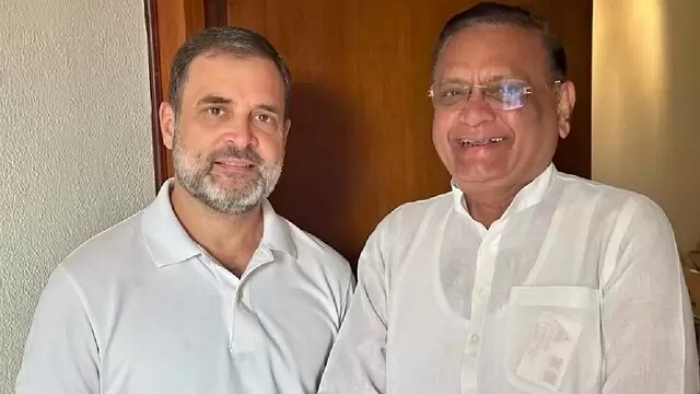
First respect your party workers then think about the country, he is a thief: Furious Congress workers in Katihar slam Rahul Gandhi for ignoring them during Bharat Jodo Nyay Yatra

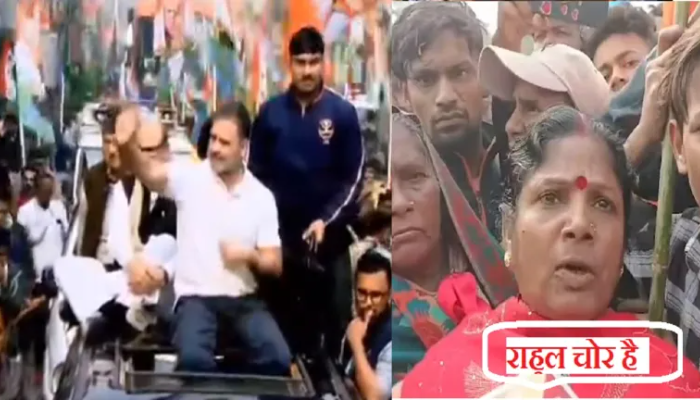
Congress MP Rahul Gandhi resumed his Bharat Jodo Nyay Yatra from Katihar in Bihar on January 31. After spending the night at Katihar, he started his road show around 11.30 on an SUV, not the bus he had been using. He was sitting on the roof of the vehicle and was welcomed by people lined on both sides of the road. However, not everyone was happy with Rahul Gandhi, a large number of people were outraged that Rahul Gandhi didn’t stop to speak despite arrangements made by them for the same.

Notably, young party workers had decorated a stage and were eagerly waiting to meet him near DS College Chowk. Many male and female members including youth activists Izhar Ali and Nikku called him repeatedly through the microphone from the stage. However, Rahul Gandhi didn’t respond to this, angering the Congress workers.

Rahul Gandhi did not even garland the statue of Mahatma Gandhi at Shaheed Chowk as he continued his yatra.

The unhappy Congress workers also threatened to leave the party but the Gandhi scion refused to go on the podium and talk to them. This further infuriated them after which multiple Congress activists together declared that they were quitting the party from the platform citing their displeasure with Rahul Gandhi’s behaviour.

“All of us remained up all night anticipating his arrival. We toiled day and night only to get to see him. A woman was crying, but even her voice didn’t reach him. Tariq Anwar who contests election from here along with other leaders including Tauqir and Shakeel wanted to meet him. How can the nation come together if the party workers are not treated with dignity,” a visibly furious Congress member Nikku Singh questioned.

He added, “First unite your party workers and give them respect. We are very upset and sad. If the confidence of the workers is undermined in this manner and there is a gulf between the leader and them, I want to warn those who fund the party that if they continue to isolate people and party workers from the leader, they will have to deal with the consequences of their actions.”

“We are staff members of an NGO (Non-governmental organisation). We have been cleaning from 7 am to 10 am in the hopes that sir will come and we will meet and have a conversation with him, but he didn’t even meet us once,” an irate woman named Munni complained. “All of us comprising the ward commissioner were waiting for him with boards. He passed through here but didn’t talk to us. We are angry with him. He claims to do a lot for females but what exactly has he accomplished,” she asked.

“Rahul Gandhi is a thief, which is why he left discreetly from here. He didn’t come in front of us,” a second woman charged. When queried if there was any conversation about Rahul Gandhi’s yatra, she replied, “Nothing is going on.”

Nikku Singh claimed that despite their two attempts, the Special Protection Group (SPG) turned down their request to meet Rahul Gandhi on the grounds of security. “You saw he walked out of his car,” he observed. In response to the question of if a woman was crying in order to see him, he answered, “There is a lot of noise and ruckus here but we are unhappy.”

Interestingly, as Rahul Gandhi was giving a speech his party workers were launching a protest against the treatment meted out to them.

Congress leader Rahul Gandhi’s Bharat Jodo Nyaya Yatra left Katihar for Bengal on the morning of 31st January. Interestingly, Congress has claimed that Rahul Gandhi’s automobile was stoned as it approached West Bengal’s Malda which is roughly 100 kilometres from Katihar. 

Adhir Ranjan Chowdhury, the president of the Bengal Congress has alleged that stones were thrown at Rahul Gandhi’s convoy by unknown males in the Harischandrapur district of Malda. “The rear window pane of the vehicle Rahul Gandhi was travelling in was smashed after being pelted with stones. This is unacceptable,” he accused.

On the other hand, Congress leader and spokesperson Supriya Shrinate posted, “False news needs clarification. A huge crowd had come to greet Rahul Gandhi. When a woman suddenly came forward to meet him, the car had to be stopped abruptly. The windshield of the car was broken due to the rope used in the security circle. Rahul Gandhi is fighting the battle for justice diligently and this country not only stands with him but will also keep him safe.”

Big victory to Hindus as court allows puja in Vyas Ji Ka Tehkhana at Gyanvapi complex, orders arrangements within 7 days: Read court order details

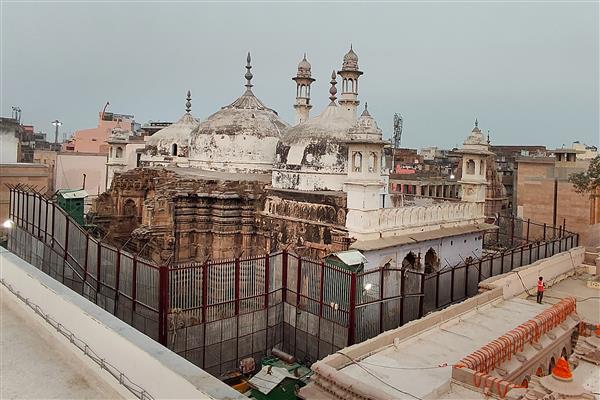
In a big victory for Hindus, the district court of Varanasi ruled on Wednesday (31st January) that the Hindus have the right to worship in the Vyas cellar of the Gyanvapi structure. The court has ordered the district administration to make arrangements for worship at the basement within 7 days. This cellar is below the so-called mosque inside the structure. Now regular worship rituals will take place here as per the court’s order. The puja will be performed by the Kashi Vishwanath Trust Board.

The district judge had reserved the order on 30th January after hearing a petition filed by Shailendra Kumar Pathak seeking the right to recite prayers and perform worship rituals at the Vyas Ji Ka Tehkhana (the basement cellar of the Vyas family) located in Varanasi’s Gyanvapi complex. The decision in this case has come today.

District Judge Justice Ajay Krishna Vishvesh said in his order, “The District Magistrate, Varanasi is directed to get the priest to perform the puja, raga-blog, of the idols located in the basement in the basement – which is the suit property, as designated by the plaintiff and the Kashi Vishwanath Trust Board. For this purpose, make proper arrangements in iron fences etc. within 7 days. The respondent has applied. The letter for disposal of this application should be submitted on 08.02.2004. In the meantime, the plaintiff party can raise objections.” A copy of this order is with OpIndia.

The Vyas Ji Ka Tehkhana is one of the four basement chambers at the Gyanvapi complex, which is managed by the Vyas family. As per the family, they have a long history of association with the temple since 1551. However, the worship was stopped in December 1993 on the orders of the state govt.

The court order states that there is enough evidence showing that Vyas family has been worshipping there since the British period and they have been doing it up to December 1993. The court notes that materials related to Hindu rituals, several ancient Hindu idols and other materials of religious significance has been found in the basement. It is needed to worship the idols on a regular basis, the court said.

Importantly, the court order states that the state govt had stopped the worship under the basement without any authority to do so. Therefore, the court ordered the administration to make arrangements for worship at the basement.

In 1991, the Vyas family filed a case seeking the transfer of the Gyanvapi mosque structure to Hindus. They asserted that, except for the upper structure dedicated to namaz and the domes, the entire structure still belongs to the Lord Visheshwar temple. Even though the Vyas family no longer resides in the Kashi Vishwanath-Gyanvapi complex, they still retain ownership of one of the four basements of the mosque.

After the petition was filed by the family, the Muslim side had sought the dismissal of the same citing the Place of Worship Act. During the hearing, the Muslims claimed that there was no evidence of Vyas family continuing worship at the basement, and therefore there was no question of stopping the worship in December 1993. However, the court found enough evidence to show that several generations of the family has been worshipping at the Vyas cellar.

The court order also notes that the family retains the key to the lock put on the door of the cellar. As per the court order, the Vyas Ji Ka Tehkhana is located on the southern side, which has been barricaded with an iron fence and there is no door in this fence. Therefore, the basement can only be accessed from the door made on the northern side. When the city magistrate along with lawyers reached the door of the Vyas cellar, two locks were seen on it. The key to one of the locks was with Somnath Vyas, while the other lock has been put by the administration. The magistrate said that as there was no order to open the cellar, the second lock could not be opened.

The order also cites will of Bejnath Vyas in July 1968, will of Somnath Vyas in February 2000, and the will of Chandranath Vyas in January 2014, along with an agreement signed in February 2016 with the CEO of the trust of the Kashi Vishwanath Mandir, handing over some rights over the cellar to the temple trust. As per the agreement, Shailendra Kumar Pathak had handed over his rights to the Mandir trust.

In view of these findings, the court rejected the argument of the Muslim side and gave the Hindu side the right to worship in the Vyas cellar of Gyanvapi. The court ordered the district magistrate to arrange for regular worship of the idols at the Vyas cellar by a priest appointed by the Kashi Vishwanath Trust Board. The court ordered the admin to do this within 7 days.

Advocate Vishnu Shankar Jain, representing the Hindu side in the Gyanvapi case, said that the administration has been asked to make arrangements for worship by Hindus within 7 days, and puja will start soon. He added that as soon as arrangements are made by the administration, worship will start immediately. He said that the court rectified a wrong decision by the govt to stop the worship. He claimed that there was never any written order to stop puja, and it was done base only on oral orders of the govt.

It is notable that on 25th January, the report by the Archaeological Survey of India (ASI) report on the Gyanvapi Masjid was made public. It revealed the existence of a large Hindu temple structure underneath the disputed structure.

The petitioner Shailesh Kumar Pathak ‘Vyas’ has earlier said, “Vyas family has a history of association with the Kashi Vishwanath Temple (KVT) since 1551. It had started living in this complex in 1883. My ancestors not only contested different cases with the mosque authorities since 1880 but also filed the first petition in the Varanasi civil court in 1991, seeking permission for worship at Gyanvapi.”

Telling about the basement under the possession of the Vyas family, he had said, “This ‘tehkhana’ (basement) is in the southern part of the Gyanvapi mosque located in front of the face of Nandi (in Kashi Vishwanath Dham). We used to call this portion ‘garbhgriha’ (sanctum sanctorum) of the old Visheshwar temple. Goddess Shringar Gauri’s idol was worshipped there till December 5, 1992, a day before the Babri masjid demolition.”

He added, “Since December 6, 1992, the regular worship was stopped there. The basement was under the possession of our family and we were allowed to use it to keep articles related to Ramayan recitals like wooden poles, ‘kanats’ etc. The recital used to take place twice every year in Magh and Kartik. The Vyas family was allowed to offer prayer at Shringar Gauri on the fourth day of Chaitra Navratri.”

Madras HC restricts entry of non-Hindus into Temples: Argument over burqa-clad visitors, and how TN govt tried to force ‘secularism’ in Temples 

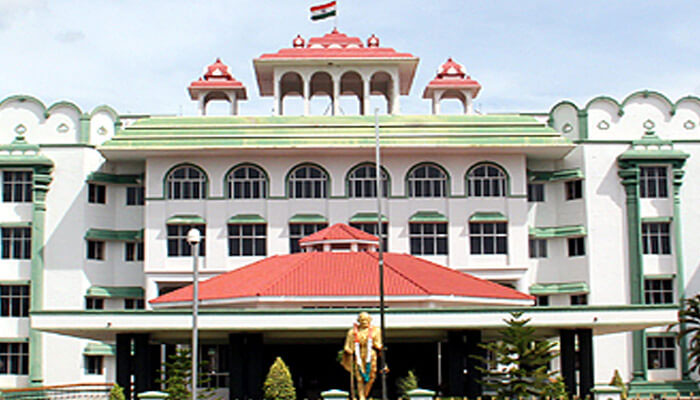
On 30th January, the Madurai Bench of Madras High Court restricted non-Hindus’ entry into Hindu temples across Tamil Nadu. The landmark judgment came in the matter related to the entry of non-Hindus into the Palani Murugan Temple. The ruling specifically stipulates that non-Hindus and those lacking Hindu beliefs are prohibited from proceeding beyond the temple’s ‘Kodimaram.’ Additionally, the judgment emphasised the necessity of prominently displaying notices conveying this restriction at various locations within the temple premises.

OpIndia accessed a copy of the judgment passed by Justice S Srimathy. D Senthilkumar filed the petition against the Government of Tamil Nadu and the Hindu Religious Charitable Endowments Department (HR&CE) under Article 226 of the Constitution of India. The petitioner pleaded to allow only Hindus to the Hill Temple premises and its sub-temples. Furthermore, the petitioner prayed to the court to issue directions to the HR&CE to install display boards announcing the same at all entrances of the temples.

Events that led to the petition

The petition was filed in the High Court on 26th June 2023. In his plea, the petition said he runs a toy shop at Adivaram Pazhani and is also an organiser of Pazhani Hill Temple Devotee Organisation. Every day, he would visit the temple to worship Bhagwan Dhandapani. A few days before the petition was submitted, one Sahul, who runs a fruit shop near Pazhani Bus Stand, brought his relatives who were wearing burqas. They bought tickets to visit the Hill Top. When the ticket issuing authorities noticed them wearing burqas, they retrieved the ticket as Sahul’s family was non-Hindu. An argument broke out between Sahul and the employees. He claimed the place was a tourist place, and there should be a notice if non-Hindus were not allowed.

When devotees learned about the incident, they gathered at Winch Station and supported the temple authorities. Furthermore, temple authorities were criticised for not putting up banners mentioning non-Hindus were not allowed on the premises. Interestingly, there were such banners in the temple, but they were removed during the renovation. New banners were placed, but they were again removed within a few hours. Devotees speculated there was pressure from “higher authorities” to do so. Social media posts by Atheists and Islamists against the banners gave credence to the speculations.

Notably, a group of Muslims was previously caught eating non-veg food in Brihadeeswara Temple premises in Thanjavur. Another group was seen eating meat in the Hampi temple complex. A Muslim man was caught for offering namaz in a Hindu temple in UP. Amidst reports of such incidents, the appellant argued that preserving the sanctity of Hindu places of worship was essential.

He also argued that Muslims do not allow non-Muslim activities on mosque premises. He contended, “These rules of propriety, being a matter of Islamic religion, are promptly respected by all citizens of India embracing other religions. There are positive indications to hold that if a Hindu Temple is intended for the spiritual benefit of all classes of Hindus and the temple as a whole, starting from the Gopuram and leading to Kodimaram, Artha-Mandapam, Maha-Mandapam, and GarbaGraham is to be kept undefiled and unpolluted; no non-Hindu can for pleasure and social evaluation seek entry into such places.” He also contended that specific rules must be followed when worshipping at any particular Hindu temple, and Agama backs such practices.

The petitioner pointed out that HR&CE manages the majority of the temples in the state. However, “to get fame and media attention, some problem makers are trying to enter the temple premises. The maximum devotees are observing fasting and coming to Pazhani for Darshan. Further, Pazhani Hill Temple is not a picnic spot, and the land has rich culture and epic.”

Interim order the respondents’ arguments

As the legal battle continued, the court passed an interim order to install the boards prohibiting non-Hindus on the premises. Respondents argued against the entering order, saying that the temple is revered as the abode of Lord Murugan and attracts devotees from across the country and foreign nations.

The respondents argued that the temple premises, specifically the Winch Service Station and the Rope Car Station, do not fall under the definition of a temple. They contended that placing boards was unnecessary as it would not affect the sanctum sanctorum, where non-Hindus are traditionally restricted. They highlighted the inclusive nature of the temple and emphasised that Lord Murugan is worshipped by both Hindus and non-Hindus who adhere to Hindu customs and practices.

Citing examples of several other prominent Hindu temples in the state, they argued that these temples allow non-Hindus to enter the premises and restrict them only from entering certain sacred places. They criticised the petitioner for rushing to the court before allowing the Temple Administration to address the matter and argued that the incident mentioned was not adequately documented. Thus, there is an immediate need for the installation of display boards.

TN Government argued that sentiments of non-Hindus would be hurt

The respondents expressed concerns that such boards would lead to unrest and disharmony. They asserted that it would infringe on the rights provided by the Constitution of India. They argued that the court’s orders should be considered in the context of the circumstances and possible repercussions. They further argued that it would hurt the “sentiments of the non-Hindus” who have “faith in Lord Murugan”.

The judgment also talks about Section 3 of the Temple Entry Act, which allows all classes of Hindus to enter and offer worship in the temples. The right to bathe in or use the waters of the sacred tank, well, spring or water court in temple premises and passage over any sacred place, including a hill or hillock or a road, street or pathway, can be accessed only by Hindus. Those who are not entitled to enter or offer worship in a temple include persons who are not Hindus, drunken or disorderly persons, suffering from a contagious disease, unsound of mind except when taken for worship under proper control and professional beggars, among others. The Act mentions explicitly that non-Hindus cannot use services inside temple premises.

Interestingly, the government amended the rule and inserted provisions under which non-Hindus could be allowed in the temple premises. However, it was challenged and struck down in the Supreme Court in 1972. The court noted, “It is well-known that there could be no such thing as an unregulated and unrestricted right of entry in a public temple or other religious institution for persons not connected with the spiritual functions thereof. It is a traditional custom universally observed not to allow access to any outsider to the particularly sacred parts of a temple, for example, the place where the deity is located. There are also fixed hours of worship and rest for the idol when no disturbance by any public member is allowed.”

Contending to the respondents’ argument that non-Hindus who have faith in the deity should be allowed in the temple, the petitioner argued how they could identify the non-Hindus having faith in the particular deity of the temple and are willing to abide by the customs of Hindu religion and customs of the concerned temple.

Contending to the notion that installing boards would hurt the “religious sentiments of the non-Hindus who would like to visit the temple, the petitioner stated that the respondents were confusing the issue. “If a non-Hindu does not have faith and declines to follow the customs and practices of the Hindu religion and to follow the Temple Customs, then the said non-Hindu cannot be allowed, and hence there is no question of hurting his sentiments. On the other hand, if non-Hindu who decline to follow the customs and practices of the Hindu religion and decline to follow the Temple Customs is allowed inside the temple, it would affect the sentiments of the large number of Hindus who practice the faith as Hindu reverently. This would affect the rights of Hindus guaranteed under the Constitution of India.”

The court directed authorities to install boards and not to allow non-Hindus in temples

In its order, the Madras High Court directed the respondents to install boards indicating “Non-Hindus are not allowed inside the temple after Kodimaram” at the entrance of the temples, near Kodimaram and at prominent places in the temple. Furthermore, the respondents were directed not to allow the non-Hindus who do not believe in the Hindu religion.

Also, the court said, “if any Non-Hindu claims to visit particular deity in the temple, then the respondents shall obtain an undertaking from the said Non-Hindu that he is having faith in the deity and he would follow the customs and practices of Hindu religion and also abide by the Temple customs and on such undertaking the said Non-Hindu may be allowed to visit the temple. Whenever a Non-Hindu is allowed based on the undertaking, the same shall be entered in the register, which shall be maintained by the temple. The respondents shall maintain the temple premises by strictly following the agamas, customs and practices of the temple.”

Ayodhya: How a critically injured Devi Deen Pandey single-handedly killed 700 soldiers of Mir Baqi’s Mughal army to save Ram Janmabhoomi

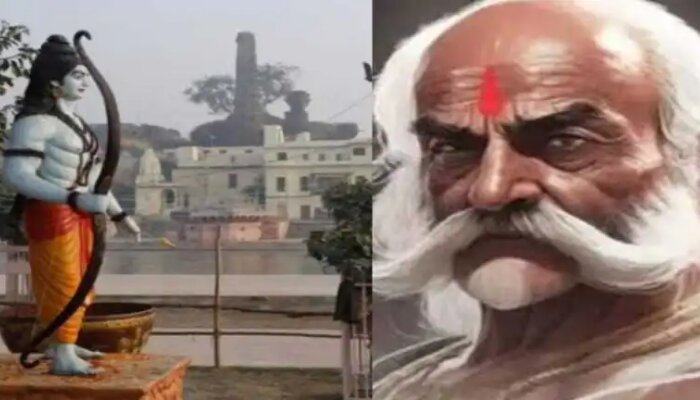
The Pran Pratishtha ceremony of the Ram Lalla idol at Ramjanmbhoomi in Ayodhya took place on January 22, 2024. On this significant occasion, Hindus worldwide pay tribute to both well-known and unknown devotees of Lord Ram who sacrificed their lives during the struggles spanning from the Babar era to the Mulayam Singh Yadav administration. Among these courageous individuals who fought during the Mughal rule, Devi Deen Pandey stands as a prominent name. He followed in the footsteps of Bhiti King Mahtab Singh as a warrior who laid down his life for the cause of Ram Janmbhoomi. The OpIndia team visited Devi Deen Pandey’s home to delve into the details of the sacrifices he made for Ram Janmabhoomi.

Originally hailing from Rahimpur Dugawa, a village in Uttar Pradesh’s Ayodhya district, Devi Deen Pandey’s primary mission was to propagate his faith. He welcomed people into his home in Sarairasi, Rajepur, and Sanethu villages, where he conducted recitations of Bhagwat Katha and other sacred texts. Eventually, he settled near Sanethu, approximately 8 kilometres from his native place, now named ‘Pandit Ka Purva’ in his honour. A temple stands prominently outside the settlement, attracting worshippers who come to offer prayers on significant occasions in their homes.

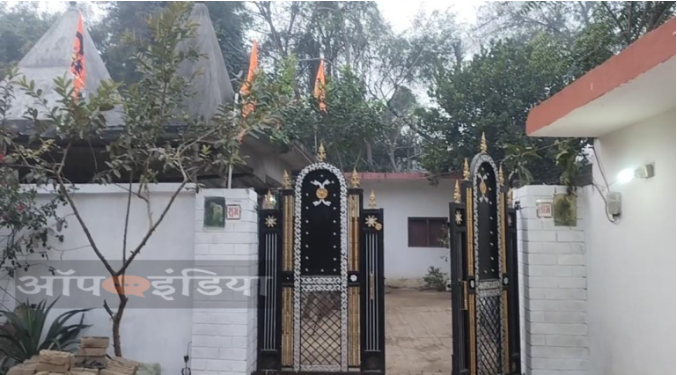
Devi Deen Pandey’s present residence. (Source: OpIndia Hindi)

Religiosity is everywhere even today in the house

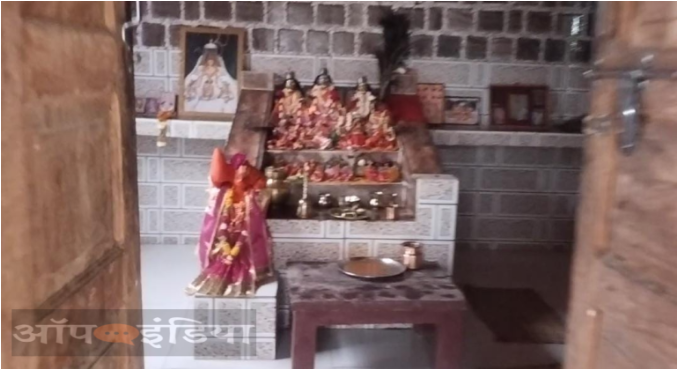
Upon our arrival at Devi Deen Pandey’s home, numerous family members were eagerly waiting for the OpIndia team at the entrance. The gate of the house is embellished with a Swastika, flanked by images of Lord Shiva and Lord Hanuman. Positioned at the entrance is a sizable temple, which, according to the family, has stood since the time of Devi Deen Pandey. The current generation undertook its renovation due to deterioration in the past, presenting it in a new form. Saffron flags are prominently displayed around the temple, and inside, there is a Ram Darbar (court) adorned with idols of various gods.

Devi Deen Pandey built the temple, and to this day, worship is conducted there by the prescribed rituals. The seventh generation of Devi Deen diligently carries on their age-old, traditional worship practices. The current hosts of this family are descendants whose forebears made sacrifices in defence of Ramjanmbhoomi alongside Devi Deen.

Devi Deen Pandey worshipped in this temple established in the house. (Source: OpIndia Hindi)


Saddened by the attack on Ram Mandir, he took up weapons

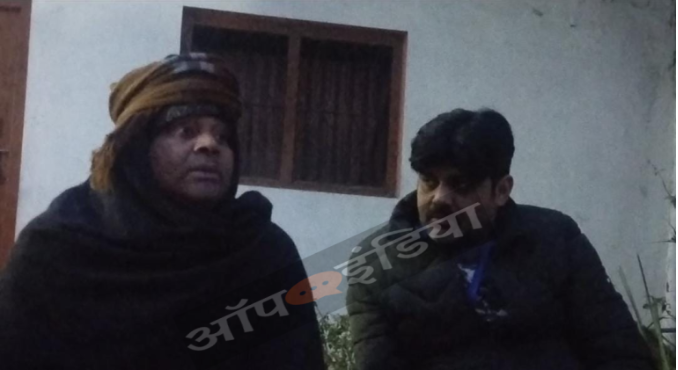
Rajendra Prasad Pandey, identifying himself as the seventh generation of Devi Deen Pandey, was present at his home. Reflecting on history, he mentioned that his ancestors were the first to disseminate scriptures to the nearby hamlets, yet they were also proficient in wielding weapons. When Pandit Devi Deen learned of the destruction of the Ram Mandir by Babur’s general Mir Baqi in the years 1526–1527, it deeply affected him. Discovering the story of King Mahtab Singh, who fought for the temple and sacrificed his life in the process, further fueled his resolve. Subsequently, Pandit Devi Deen abandoned the Vedas, embraced his weaponry, and journeyed to Ayodhya. His residence is approximately 15 kilometres from Ayodhya.

Devi Deen Pandey’s descendant Rajendra Prasad talking to OpIndia. (Source: OpIndia Hindi)

Devi Deen raised an army with the help of neighbouring villagers

The almost forgotten work “Shri Ramjanmbhoomi ka Romanchkari Itihaas” (The Thrilling History of Ram Janmbhoomi), authored by the late Ramgopal Sharad several decades ago, referred to Pandit Devi Deen. According to this book, Pandit Devi Deen organized an army of approximately ten thousand Hindus under his leadership, comprising individuals from the surrounding hamlets such as Sarairasi, Rajepur, and Sanethu villages, among others, with many of them being hosted by Pandit Devi Deen. The attack on Ram Janmbhoomi by Mir Baqi enraged all of them, and their conflict with the Mughal army stationed at Ramjanmbhoomi commenced immediately upon their arrival.

Mughals engaged in stone-pelting from the time of Babur

Balram Mishra, a local historian, informed OpIndia that Devi Deen Pandey, facing a Mughal army numbering in the millions with only 10,000 soldiers, initially found himself overwhelmed. Simultaneously, the Mughal army began throwing stones, utilizing bricks and blocks from the surrounding area meant for the construction of Babri. Due to the sudden stone onslaught, Devi Deen Pandey was momentarily unable to alter his attack plan. At that crucial moment, a stone struck his head, causing blood to spurt. Undeterred, Devi Deen Pandey used his turban to stanch the bleeding and resumed the fight.

Killed Mir Baqi’s elephant and its mahout

As per the account in historian Ramgopal Sharad’s book “Shri Ramjanmbhoomi ka Romanchkari Itihaas,” Devi Deen Pandey intensified his aggression against the Mughal army after sustaining a head injury. Mounted on his horse, he directly confronted the Mughal general Mir Baqi, who was seated on an elephant. Devi Deen Pandey’s relentless attacks wounded Mir Baqi’s elephant, causing it to collapse. The mahout, losing balance as he controlled the elephant, also perished. Although injured by the howdah fastened to the elephant’s back, Mir Baqi managed to survive. Subsequently, while concealed in the howdah, Mir Baqi drew a gun and shot Devi Deen Pandey.

Devi Deen killed 700 Mughal soldiers before sacrificing his life

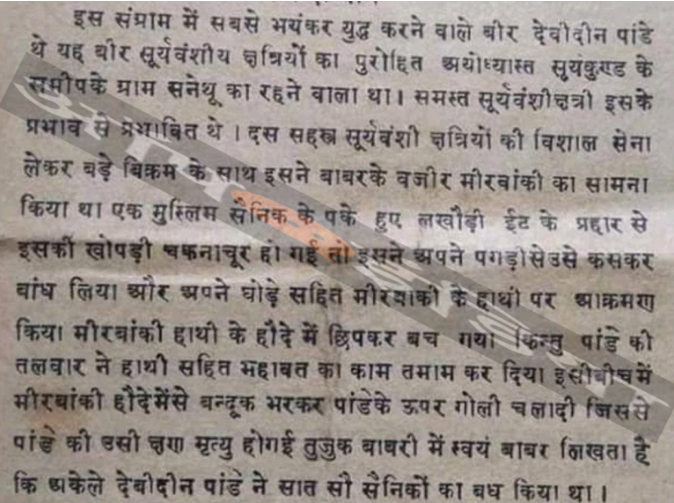
Family members of Devideen Pandey informed us that their ancestor met his martyrdom through a concealed bullet fired by Mir Baqi. They asserted that the Hindu side’s failure in the conflict was attributed to the opposition’s war strategy and the lack of sophisticated weaponry comparable to that of the Mughal army. The descendants recalled that the confrontation endured for several days before culminating in the ultimate sacrifice. Notably, Devideen, single-handedly, eliminated seven hundred (700) Mughal troops during this intense conflict. The late historian Ramgopal Sharad corroborated this figure in his book, emphasizing its presence in Babur’s memoirs ‘Tuzk-e Babri.’

Excerpts from the book “Shri Ramjanmbhoomi ka Romanchkari Itihaas” written by the late Ramgopal Sharad. (Source: OpIndia Hindi)

The battle claimed the lives of approximately 10,000 Hindus, excluding a few who fought alongside Devi Deen Pandey. According to the family, Devideen’s body lay where the current sanctum sanctorum of the Ram Mandir stands. The bodies of the soldiers were also subjected to brutalisation. This sacrifice incited anger among the neighbouring Kshatriya kings. Following Devidin Pandey’s sacrifice, the Kshatriya rulers initiated persistent attacks to liberate Ramjanmbhoomi. In the regions of Sarairasi, Rajepur, and Sanethu villages, all the Kshatriyas had pledged, since Devidin’s sacrifice, to fight for the liberation of Ram Janmbhoomi in every generation and had forsaken the tradition of wearing turbans.

Devideen’s sword is kept in the house even today

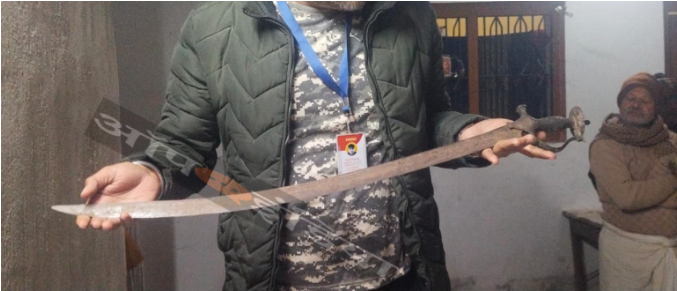
The family of Davideen presented to us an aged and rusted sword preserved in an ancient wooden sheath, adorned with a saffron cloth wrapped around its hilt. Notably, this sword bore visible scratch marks and exhibited a movable muzzle below. The family narrated that this sword had been saved and handed over to the community by a few Hindu soldiers who survived the intense battle. Additionally, they shared that Davideen Pandey’s military spear from the same battle remains lodged within Hanumangarhi. Positioned near the main gate of Hanumangarhi, this spot continues to command deep reverence from people who bow their heads in homage.

Devideen Pandey’s sword has been kept till today. (Source: OpIndia Hindi)

Most of the Muslims of Ayodhya district embraced Islam during the period of Babur

In an interview with OpIndia, Sunil Pandey, a relative of Devi Deen, asserted that the Muslims residing in and around the Ayodhya district were originally Hindus who underwent forced conversion during the period of Babur. As an illustration, he pointed to a Kshatriya family in Sirsinda, near his village, which identified as Hindu seven generations ago. This transformation coincided with the era when Babur’s general, Mir Baqi, was engaged in the destruction of temples in Ayodhya.

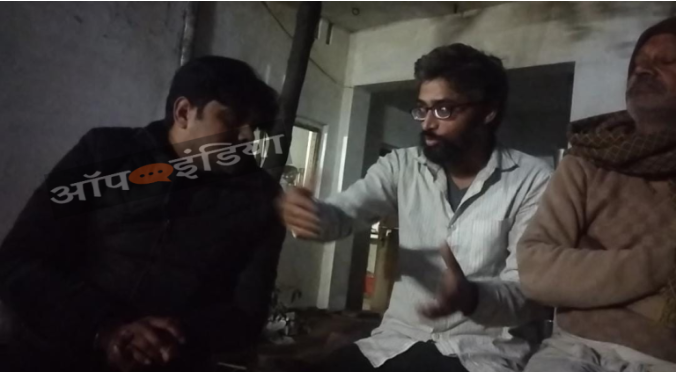
Sunil Pandey (in white shirt) narrates the history of his ancestor Devi Deen to OpIndia. (Source: OpIndia Hindi)

As per Sunil’s account, Ayodhya was once a prosperous city of gold before Babur’s invasion. Following the destruction of temples, the Mughal army seized the region and plundered its treasures. It is believed that the Mughal army employed force, using swords, to compel many Hindus to convert to Islam during this period. Sunil Pandey pointed out areas, like Tanda adjacent to Ayodhya, where the majority of the population is now Muslim. Devi Deen Pandey’s family has been urging Muslims, who are aware of their forefathers’ ordeal and forced conversion, to return to their original religion.

Ready to make sacrifices in the name of Lord Ram even today

Sunil Pandey, a descendant of Devi Deen, shared with OpIndia that his ancestor’s teachings continue to resonate in the hearts and minds of people, who remain ready to make sacrifices in the name of Lord Ram. This family is still prepared to lay down their lives for Lord Ram. The family characterized the 1990 shooting under the Mulayam Singh Yadav regime as an act of aggression. They expressed immense joy over the construction of the Ram Mandir and hailed Yogi Adityanath and Narendra Modi as divine messengers. The family was honoured with an invitation to the Ram Mandir Pran Pratishtha (consecration ceremony), and a descendant of Devi Deen Pandey actively participated in the event.

Muslim devotees must not be allowed to enter Ram Mandir, Ayodhya: All religions are not equal and neither are all ‘devotees’

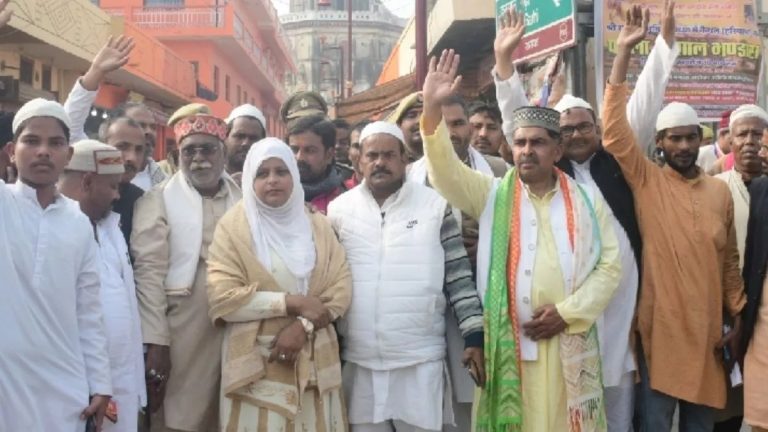
Only days after the Ram Lalla Pran Pratishtha, 350 Muslims embarked on a 6-day padayatra to reach the Ram Mandir in Ayodhya. These ‘devotees’ who reached Ayodhya after walking 150 kilometres belonged to the Muslim Rashtriya Manch – an organisation inspired by the RSS.

Shahid Saeed, the media in charge said, “Journey began on January 25, with the devotees covering 25 kilometres each day until they reached Ayodhya. The moment of the darshan of Imam-e-Hind Ram was viewed as an echo of enduring unity, integrity, sovereignty, and harmony from the Shri Ram Temple complex.” “The Manch strongly advocates participation in the joys and sorrows of the citizens as a way of promoting unity and strengthening the culture of love and harmony in the country,” Shahid added.

These Muslim devotees who reached Ayodhya also spoke about “respecting all religions” and how Indians should be united.

The statements by the Muslims who reached Ayodhya and their spokesperson Shahid Saeed are perfectly acceptable, just as most other tropes of Sarva Dharam Samabhava are – they are statements that display much bombast, with very little practical merit to them.

Of course, as this news emerged, the visuals of Topi-wearing Muslims taking Darshan of Ram Lalla were splashed all over social media, with the common theme being a sense of victory about the changing civilisational moorings of the Muslim community and the dawn of a new era of possible unity, harmony and brotherhood. The underlying messaging of this trope often is that the strife between the Hindu and the Muslim community is the eventual result of a minority within the minority – a few bad apples disturb the peace, the price of which has to be borne by the larger population of India – Hindus and Muslims both.

When one has done the job that I have done for almost a decade, the anger one feels while hearing such statements very quickly turns into pity – it is after all pity that one feels when one watches a pigeon close its eyes upon seeing a lurking cat hoping that the danger has disappeared in the darkness too. I have to at the very outset clarify that I truly have nothing against Shahid Saeed or any of the 350 Muslims who reached Ayodhya. I am positive that they genuinely believe this gesture would lead to better inter-religious understanding and acceptance. I genuinely believe that the Muslims who reached Ayodhya did so because they wanted the 500-year-old wound to heal – signalling to Hindus that they celebrate this victory with us.

However, one major fallacy while analysing such issues is that most people tend to focus on the micro while discussing the macro. As an experiment, try talking to a centrist, liberal Hindu about the ongoing Islamic onslaught against the Hindu community and try imposing upon them the importance of the Hindu community realising that demographic change heralds fresh, unyielding challenges. Very often, their natural response would be to tell you that their Muslim neighbour is lovely and has never treated them differently. Or that they have had a Muslim friend for the past 10 years and she is the nicest woman you would ever meet – never making her Hindu friends feel like any strife exists between the communities – “they are just like us!”, they say enthusiastically, with deer eyes. What they fail to realise is that the temperament or inherent goodness of the individual is never a question. Only a lunatic would say that one community would across the board have no decent people living among them. It is simply statistically impossible. However, the discussion is about the conduct of the community as a whole – conduct that is repeated over and over again across centuries – against other communities, particularly Hindus. Does that mean all Muslims are bad? Certainly not. Does that also mean that the community as a whole poses grave danger to Hindus owing to their religious doctrine and societal behaviour? Absolutely.

Now that the customary disclaimers are out of the way, we must proceed to examine the central premise of this article. To do so, it becomes important to first understand why Hindus celebrate such scenes with such enthusiasm – why are Hindus today so ecstatic about 350 Muslims showing some basic respect for their faith?

I don’t think there is any debate that Hindus are inherently plural. The Hindu community by and large simply wants to co-exist and is more than willing to concede space to other religious beliefs. Religious pluralism assumes that not only do all religions claim that their truth is the ‘only truth’ that exists, but that all religions are based on the principles of Universal Truths and thus, these are the two tenets that need to be dealt with if religions are to co-exist peacefully.

Religious Pluralism essentially says that firstly, all religions must acknowledge that certain truths exist in other religions as well, thereby declaring that it is not only their religion that is the ‘only truth’. Further, it says that all religions must acknowledge that every religion teaches basic universal truths that have been taught since before the advent of religion itself – certain universal goods and universal bads – killing is bad – raping is bad – torture is bad – honesty is good – charity is good – so on and so forth.

Hindus tend to see the world through their prism. They truly believe that being plural is the nature of humanity and that anyone who is pious would believe in certain basic acceptable principles of human co-existence assuming that every religion is equal in the sense that any faith in any form of divinity would make one far more tolerant than the unfaithful. Therefore, the moment they see Muslims grant even basic respect to their faith, it feeds their confirmation bias about religion, making them heave a sigh of relief – oh thank God they are not as bad as we are being told, they think to themselves. Besides that, the Hindus have been so humiliated by Muslims for over a thousand years and continue to be humiliated, that any basic decency extended seems like a victory – we may call this bigotry of low expectations.

So how do we dissect the claim that all religions are equal? At the outset, we have to acknowledge that Islam lays out a doctrine for the humiliation of Kafirs. When verses of the Quran ordain its followers to slay Kafirs and Polytheists, one has to wonder how can a religion that is at odds with Polytheism be equal and aspire to the same goals as that of a Polytheistic religion? When Islam is at odds with Polytheism and the religious texts explicitly mention the subjugation of any Polytheist faith, how accurate is it to say that all religions are the same?

It is a fact that Islam lays out the doctrine for religious warfare and strict rules as to what is to be done with the ‘spoils of war’. No other religion in the world has left behind a trail of mangled bodies, blood and gore in its wake as much as Islam and what is worse is that this carnage was sanctified in their religion it is one of the necessities of their religion.

What separates Islam from other religions, decrying the notion that all religions are equal, is that Islam is perhaps the only religion in the world that doctrines the use of unbridled and unashamed violence against those who refuse to believe in their doctrine and perhaps the only religion where the very existence of a non-Muslim is in itself an affront, enough to justify the worst form of violence known to man. What is far worse is perhaps the fact that the literal implementation of the religious doctrine ordaining such brutality is piously implemented to this day by a large swath of its adherents.

In fact, we don’t even need to go into Islamic theology to understand that their hate for Polytheists comes from their deep faith in their scripture. We don’t need to talk about Surah 2 (Al-Baqarah) Verse 191, Surah 3 (Ali ‘Imran) Verse 151, Surah 4 (An-Nisa) Verse 56, 89, 101, Surah 5 (Al-Ma’idah) Verse 14, 51, 57, Surah 8 (Al-Anfal) Verse 65, 69, Surah 9 (At-Tawbah) Verse 5, 14, 23, 28, 29, 37, 58, 111, 123, Surah 21 (Al-Anbya) Verse 98 so on and so forth. We just need to look at documented evidence about their collective conduct towards Hindus. 

When Hindus are up against an ideology where the principles of religious warfare are embedded in their piety, it is impossible to be the pigeon who believes that all religions are the same and therefore, if there is someone from another faith (Islam for this article) who wishes to accord respect to Hindus by visiting their temples, they should be allowed to do so.

As the logic flows, I have held the belief that Muslims specifically should not be allowed to enter any Hindu Temple. Now, I could say that no ‘non-Hindu’ must be allowed to enter Temples and that would certainly make my argument far more palatable – however – I would be dishonest if I took that line and reduced other Indic faiths to the same playing field as Islam. There are several faiths in this world, including other Indic faiths, that perhaps don’t subscribe to the Hindu faith, in the strict sense of the term. However, they have not launched murderous conquests against Hindus and neither does their doctrine ordain violent subjugation of Hindus. Islam in that sense has a unique place in the history of the Hindu people and an honest recognition of that is imperative.

It is also important at this juncture to take a moment and reflect upon the deep significance of the Ram Mandir in Ayodhya specifically. The construction of the Ram Temple is the successful culmination of a battle against the Muslim world, fought by Hindus, for over 5 centuries. It is the manifestation of a dream that Hindus lived and died for, generation after generation. Thousands of Hindus marched to their deaths with a smile on their face in the hope that someday, Raja Ram would return to his throne, a throne that was demolished by barbaric invaders. The Ram Mandir in Ayodhya is a unique symbol of the reclamation of not just the holy site itself, but of Hindu self-respect and dignity that for 500 years was crushed by Islamic barbarians. To this date, sections of Muslims have continued to unleash violence against Hindus in the name of Ram Mandir. Up until 7 days ago, OpIndia documented 18 incidents of violence against Hindus by Muslims as they celebrated the return of Bhagwan Ram. ISIS released its latest magazine and threatened Hindus with beheadings over the construction of Ram Mandir in Ayodhya. Hundreds of Islamists continue to insult Bhagwan Ram, vow retribution and the reconstruction of the abomination they called Babri on the sacred land of Hindus.

With a Temple that was wrested from Islamic barbarians and would forever continue to be under threat from the Islamists, the notion that those who belong to the very faith we fought against would be allowed inside the Temple, however well-meaning they are, simply for Sarva Dharam Samabhava optics, is an affront that the Hindu community must not mount against itself. The Hindu community needs to realise that those who chant “there is no God but Allah” 5 times a day and are willing to go to great lengths to ensure the world believes in it too have no place in a Temple – a space for Dhyan and Bhakti – for the very Gods sections of their community wish to annihilate. Perhaps the greatest testament to harmony and brotherhood would be Muslims like those 350 who walked to Ayodhya, reaching out to members of their community to convince them to right historical wrongs by handing over Hindu Temples, where mosques were built by invaders, back to the Hindu community. Perhaps the greatest testament to brotherhood and harmony would be for the good Muslims to tell the members of their community to stop being perennially outraged and unleashing violence against the Hindus. Perhaps the greatest testament to brotherhood and harmony would be an acknowledgement of historical truth since reconciliation is a pipe dream unless it is based on cold, hard, uncomfortable truths. What is certainly not needed is for Hindus to compromise on the sanctity of their places of worship simply to convince themselves that Muslims don’t hate them. Bigotry of low expectations certainly cannot replace the truth as the foundational stone of reconciliation.


More divide in INDI Alliance: UP Congress in-charge says SP not following alliance dharma, announcing candidates is unacceptable

0

There seems to be no headway as far as prospective alliances in the INDIA bloc are concerned. After the Samajwadi Party (SP) announced the names of 16 candidates for the upcoming Lok Sabha elections, Uttar Pradesh Congress in-charge Avinash Pandey said on Wednesday that the Samajwadi Party’s one-sided alliance policy is not at all acceptable to Congress and Congress workers.

The SP has offered 11 out of the 80 Lok Sabha seats in Uttar Pradesh to the Congress.

Samajwadi Party (SP) president and former U.P. Chief Minister Akhilesh Yadav, on January 27 said that their “alliance” is off to a good start in the State.

Both the Congress and the SP are members of the Indian National Developmental Inclusive Alliance (INDIA), formed to take on the BJP-led Centre.

“Samajwadi Party is not following the alliance dharma; SP is making one-sided announcements in the alliance. The list released yesterday also included many seats on which the Congress Party had a claim. What the Samajwadi party is doing is very dangerous and Congress itself is not getting information about it.” said UP Congress incharge Avinash Pandey said.

UP Congress in-charge Avinash Pandey also denied talking about seat sharing in Uttar Pradesh and claimed that this list was released without his knowledge.

” Congress follows the coalition dharma well and wherever Congress made an alliance, it followed its coalition dharma,” Avinash Pandey added.

Meanwhile, The SP has fielded Dimple Yadav, wife of former Chief Minister Akhilesh Yadav, from Mainpuri, Shafiqur Rahman Barq from Sambhal and Ravidas Mehrotra from Lucknow.

Dimple Yadav of the Samajwadi Party won the Mainpuri parliamentary byelection in December 2022, defeating Raghuraj Singh Shakya of the BJP by a margin of 2,88,461 votes.

Considered as SP’s bastion, the seat was held by party patriarch Mulayam Singh Yadav and it got vacated after his death on October 10.

Akshay Yadav has been fielded from Firozabad, while from Banda, the SP has fielded Shivshakar Singh Patel.

“Hoga PDA ke naam, abki ekjut matdan,” the SP said.

In the current Lok Sabha, the SP, that had fought in alliance with the Bahujan Samaj Party (BSP) in 2019, has three MPs while BSP has 10 MPs. Sonia Gandhi, who represents the Rae Bareli seat, is the lone Congress MP from the State.

On January 19, the SP and RLD had announced their alliance for the Lok Sabha election, with SP leaving seven seats in western Uttar Pradesh for the RLD.

Later on 27 January Akhilesh Yadav confirmed the offer of 11 seats to the Congress.

“Our cordial alliance with the Congress is off to a good start with 11 strong seats. This trend will move forward with the winning equation. ‘INDIA’ team and ‘PDA’ (Picchda, Dalit, Alpsankhyak) strategy will change history,” Yadav had said in a post on X.


(This news report is published from a syndicated feed. Except for the headline, the content has not been written or edited by OpIndia staff)

Mumbai: Hinduphobic comedian Munawar Faruqui’s fan, Arbaaz Yusuf Khan booked for operating drone camera sans permit during his Big Boss victory celebration

0

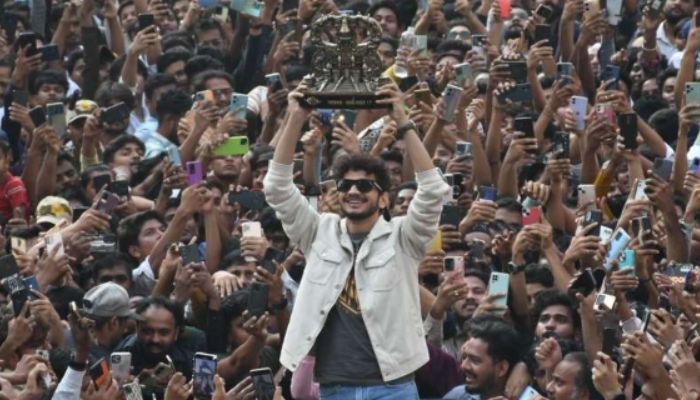
An FIR has been lodged against a fan of comedian Munawar Faruqui who recently won the reality TV show Big Boss 17. The FIR has been filed against 26-year-old Arbaaz Yusuf Khan for operating a drone camera without permission during Faruqui’s victory celebration in Dongri, Mumbai.

A massive crowd in the area had gathered for Faruqui’s victory parade as he stood on the sunroof of his car in the centre of the crowd showing his Big Boss trophy.

As per reports, the drone camera was first noticed by constable Nitin Shinde who was on patrol with PSI Tausif Mulla. The cops on duty informed the police station after operating the drone operator.

The operator did not have permission to use the drone. The drone camera was confiscated by the police.

Now a case has been filed against the accused for violating the orders of the Mumbai Police Commissioner regarding drone use. Using drones requires obtaining prior permission.

Moreover, the Mumbai police had issued prohibitory orders on flying objects including drone cameras given public safety.

Only specially-permitted aerial surveillance by cops in writing by the deputy commissioner of police is allowed.

On 29th January, Munawar Faruqui won the reality TV show Big Boss 17.

Big Boss is a reality show wherein just about anyone with a significant following on Instagram and a penchant for dramatics and controversies has to live with a similar group of people locked inside a house until only one member remains and emerges victorious having survived the drama that no one asked for.

Munawar Faruqui is one such figure who qualifies for the show. He sparked several controversies in the past mostly at the cost of the Hindu faith and deities during his stand-up comedy gigs.

Last year, his ex-girlfriend alleged that Faruqui had dated several girls at a time while making her believe that she was the only one he was in love with.

In May 2023, netizens hit out at Star Sports for getting Faruqui on board for its IPL coverage. In 2022, his shows were cancelled in several cities after Hindu groups were outraged against his insult comedy that demonised and maligned the faith.

Chhattisgarh: 130-metre long tunnel discovered by the CRPF after Naxal attack in Dantewada

0

On Wednesday, (31st January), CRPF personnel found a tunnel during a search operation in Dantewada. The tunnel, suspected to be intended as a bunker by Naxals, was found in the aftermath of a major attack on Tuesday (30th January) in Tekalgudem village, situated on the border area of Chhattisgarh’s Sukma-Bijapur district, where three CRPF personnel lost their lives in a fight against Naxalites.

The surfaced video from Dantewada captures security personnel using a stick to clear away leaves and debris from the ground. Upon entering, they unveil a sturdy and well-constructed bunker. The tunnel was constructed with deliberate gaps allowing natural light. The footage of the bunker showcases an armed security guard patrolling within the structure checking the tunnel.

This is the first time that Naxals have devised a strategy to attack the soldiers by building such a long tunnel. Naxals have dug this tunnel in such a way that more than 50 Naxals can hide in it. It is estimated that the Naxals may have taken about three to four months to prepare the tunnel. Dantewada SP Gaurav Rai said, “On Tuesday, Naxals of Bhairamgarh Indravati Area Committee of The District of Bhairongarh had a fierce encounter in Pindkapal Borga Takilor. The jawans had received information that 25 to 30 armed Naxals, including DVCM Mallesh, commander of Platoon No.16 of Bhairamgarh Indravati Area Committee, were present in the area.”

He added, “After this, DRG, Bastar fighters and CRPF 230 young platoon team personnel launched a search operation. During this time, naxals also opened fire on the soldiers with sophisticated weapons. On their way back after the encounter, the soldiers also destroyed three Naxal memorials as well as Naxal hide spots.”

The SP further said, “The jawans also recovered spikes, IEDs and cooker bombs planted in the way. The Naxals wanted to damage the road. The Naxals had built a 130-metre-long tunnel near the monument. Looking at this tunnel, it is estimated that they prepared it a few months ago so that they could easily hide in this tunnel after attacking the soldiers. Looking at the tunnel, it seems that a large number of people have dug it up and prepared it. However, after discovering the tunnel, now we are filling it with soil.”

Three Central Reserve Police Force (CRPF) personnel, including two Cobra commandos, were killed and 15 others injured during an encounter with Naxals on the border of Chhattisgarh’s Bijapur and Sukma districts on Tuesday. According to a senior police official, two belong to the 201st Battalion of Cobra and one belongs to the 150th Battalion of the CRPF. The police also informed that at least six Naxals had also been killed in the encounter.

‘MPs habitual of creating disturbances must introspect’, PM Modi slams opposition ahead of the Budget session

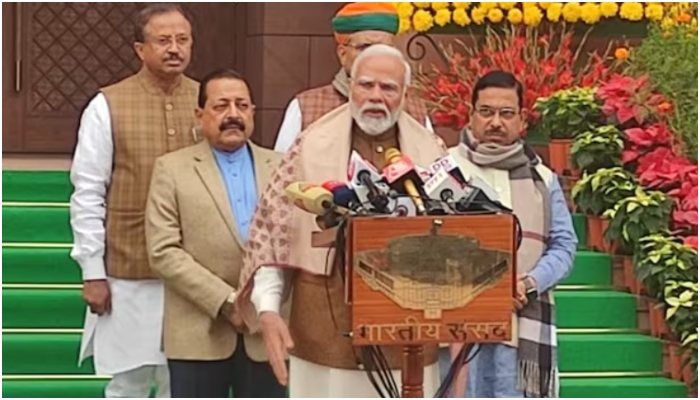
On Wednesday (31st January), ahead of the Budget Session in the Parliament, Prime Minister Narendra Modi slammed the opposition parties and asked them to recall and introspect their unruly behavior resulting in their suspension.

In his traditional address to the media before the commencement of Parliamentary proceedings, PM Modi greeted everyone with ‘Ram, Ram’ and stated that the Budget session was an opportunity for repentance and leaving constructive footprints, and he urged all MPs to do their best.

“I hope the MPs who are in the habit of ripping apart democratic values will introspect on what they did in their term as Members of Parliament. Those who contributed positively to Parliament will be remembered by all. But those members who caused disruptions will hardly be remembered,” he said.

“This budget session is an opportunity for repentance and to leave positive footprints. I urge all the MPs not to miss this opportunity and perform their best,” he added. He stated that President Murmu’s address to the joint session, as well as Finance Minister Nirmala Sitharaman’s presentation of the interim Budget, were Nari Shakti festivities.

PM Modi recalled how the women’s reservation bill was enacted in the new Parliament building during the winter session, saying, “At the end of the first session that was convened in this beautiful Parliament building, Parliament took a graceful decision – Nari Shakti Vandan Adhiniyam. Following that, on January 26, we watched how the country experienced Nari Shakti’s capability, valor, and resolve.”

“Today, when the budget session begins, President Murmu’s guidance and tomorrow when Nirmala Sitharaman presents the interim budget. In a way, this is a festival of the Nari Shakti,” he said.

The Budget Session of Parliament, the last session of the current Lok Sabha, commenced with President Droupadi Murmu addressing a joint sitting of the Lok Sabha and the Rajya Sabha. The new government will present the entire budget once it takes office.

Parliamentary Affairs Minister Pralhad Joshi told a gathering of political party floor leaders in Parliament that Sitharaman would also deliver the budget for Jammu and Kashmir, currently under the President’s Rule.

Joshi stated that the main agenda of the 17th Lok Sabha’s brief session, which will end on 9th February, was the President’s address, the presentation of the interim Budget, and the debate on the Motion of Thanks on the President’s Address, with a response from PM Modi.