Kerala has a history of Islamic radicalisation. Islamic terror group ISIS has long been associated with attempts at luring the Muslim youth from the state into its Jihadist crimes. On 14th November, a fresh case of ISIS recruitment emerged from Thiruvananthapuram, wherein 15-year-old boy was radicalised by his mother Fida Mohammad Ali and her second husband Ansar Aslam into joining the Islamic State terrorist organisation.
The minor boy was shown ISIS-related videos by the accused couple when he was in the United Kingdom. An FIR has been lodged at the Venjaramoodu Police Station in Kerala and the accused couple has been booked under the Unlawful Activities (Prevention) Act. The matter came to light after the teen escaped the attempt to push him into ISIS’s Jihadi terrorism. The police have arrested Fida and her husband Ansar.
The police swung into action after, the boy’s relatives learnt from him about the attempts being made to make him join the ISIS and the relatives approached the police.
The police then questioned the boy, who directly accused his parents of attempting to push him to join ISIS by showing him propaganda videos, including the beheading videos. The boy told the police that his stepfather assaulted him brutally for not accepting ISIS’s ideology.
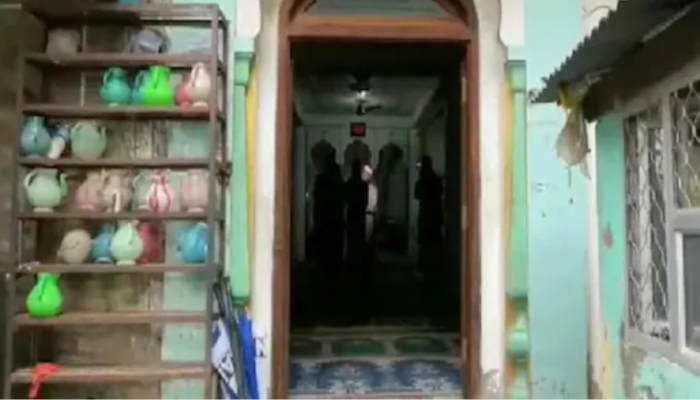
It has also emerged that the teenager was brought to a madarsa in Attingal by ex-terror convict Siddhikul Aslam (Some media reports say Siddiqui). NDTVreports that the madarsa staff said that Siddhikul Aslam had absolute control over the teen and the latter’s mother never visited. They said that Siddhikul Aslam was brainwashing the teen into hating others. Siddhikul Aslam is reported to hold Islamic Jihadist mindset.
The teenager did not like the Siddhikul Aslam extremist ideology and used to fear him. There were obvious behavioural changes in the teen’s behaviour. There were patterns that deviated from routine conduct and indicated distress. The institution informed the child’s relatives in Kerala and alerted them about the boy’s abnormal behaviour, suggesting he needed immediate attention. This communication became the turning point that eventually brought the matter before the police.
According to the police, the boy, who hails from the woman’s first marriage, travelled with her and her second husband, Ansar Aslam, to the United Kingdom in 2021. It was during that time the couple tried to push him to join ISIS. The boy told investigators that his mother and stepfather repeatedly showed him ISIS propaganda videos and pressured him to study the organisation’s ideology. They forced him to consider joining the terrorist outfit. The coercion attempts reportedly created friction within the household and the teenager resisted the extremist ideas being pushed on him.
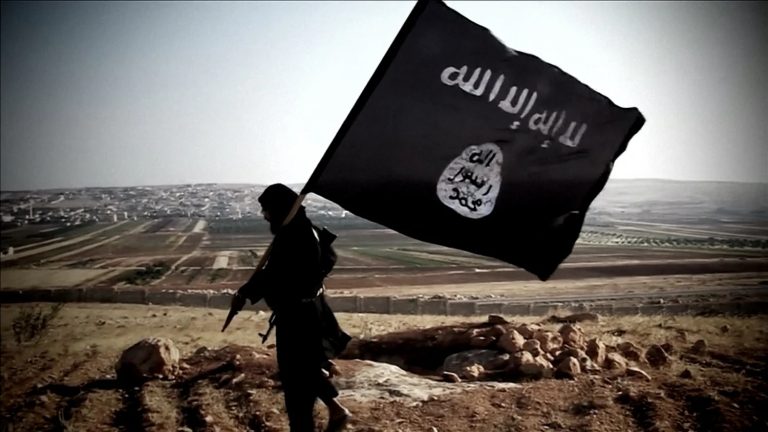
The probe agencies have found an ISIS flag and it is emerging that the accused persons have taken oath of allegiance to the Islamic terror group. The accused persons were planning to send the minor boy to Syria to join the ISIS. Ansar Aslam is also reported to have been in contact with his ISIS handlers.
At present, the Kerala Anti-Terrorist Squad (ATS) is probing the matter, although the NIA is expected to join or takeover the case.
After spending several years in the UK, the family returned to Kerala earlier this year. Soon after their arrival, the mother and stepfather admitted the child to a madarsa in Attingal.
Reports say that accused Fida had converted from Christianity to Islam before marrying her first husband. It was during her stay in the UK along with her first husband that she came in contact with Ansar, who eventually became her second husband.
Accused Fida married Siddhikul Aslamand was in live-in relationship with his brother Ansar Aslam?
However, a TimesNow report reports citing an insider source linked to the victim teen’s biological father and Fida’s first husband Mohammad Ali, that Fida married Siddhikul Aslam without divorcing him and was also in a live-in relationship with Ansar in Leicester, who happens to be Siddhikul’s brother.
Born in a Christian family, Fida fell in love with Mohammad Ali during her college days. The couple had three children, including the 15-year-old victim. However, after 17 years of marriage with Mohammad Ali, Fida came in contact with Ansar Aslam’s brother Siddhikul Aslam. Much like what was happening with her son, Fida too was radicalised by showing videos glorifying the ISIS. Siddhikul Aslam succeeded in completely brainwashing Fida.
As per a Republic TV report, Fida has claimed that her husband is an active member of the Social Democratic Party of India (SDPI), which is a political front of the banned Islamic terror outfit Popular Front of India (PFI).
Earlier this year, the Enforcement Directorate disclosed that the SDPI, a political party, relied on the banned organization Popular Front of India (PFI) for its daily operations, policy decisions, and candidate selection for election campaigns. Several SDPI office bearers were booked under the provisions of the Prevention of Money Laundering Act (PMLA), 2002.
OpIndia reported earlier how the PFI was involved in various Islamic Jihadist activities, including terror conspiracies and was working on its ‘Vision 2047’ plan to turn a Hindu-majority India into an Islamic nation.
Siddhikul Aslamconvicted in ISIS conspiracy case
Siddhikul Aslam was convicted in the 2016 Kanakamala ISIS conspiracy case, where 8 persons were chargesheeted for plotting terror attacks in Kerala and Tamil Nadu. Ansar could not be charged because he was living in Ukraine at that time.
It must be recalled that in 2016, the National Investigation Agency (NIA) busted an ISIS terror module called Ansar-ul-Khilafah Kerala. This group was linked to ISIS from Kanakamala in Kannur district. Its members were holding meetings to chalk out plan to do terror attacks in Kerala and Tamil Nadu. Back then, the security agencies arrested six people and Siddhikul Aslam was arrested from Delhi airport when he was deported from Saudi Arabia with Interpol’s assistance.
In 2022, a special NIA court found Siddhikul Aslam guilty under relevant sections of the UAPA. He was found to be a member of the ISIS and also supporting its terror activities. In addition to three years of rigorous punishment, Rs 60,000 fine was imposed on him.
Siddhikul was convicted under section 120B (Criminal conspiracy) of the Indian Penal Code (IPC), besides offences under sections 38 (offence relating to membership of a terrorist organisation) and 39 (offence relating to support given to a terrorist organisation) of the UAPA.
Interestingly, Siddhikul had pleaded guilty back then and also expressed ‘remorse’ over his Islamic terrorist activities. He had also told the court that he wants to give up terrorism and live a peaceful life with his family. Judge Kamanees had also stressed that given Siddhikul’s supposed ‘remorse’ over his jihadist deeds, a reformist approach should prevail in deciding his sentence.
However, Siddhikul’s emerging role in radicalising the minor boy in the present case makes it evident, his ‘remorse’ was a sham and tactic to secure lenient sentence. The episode also raises alarm over a radicalised individual who was planning terror attacks was given a lenient sentence despite posing a grave threat to national security, merely because he expressed remorse over his actions. It, however, is evident that Siddhikul Aslam never really abandoned his pro-ISIS ideology and was actively disseminating the same into the minor boy in the present case.
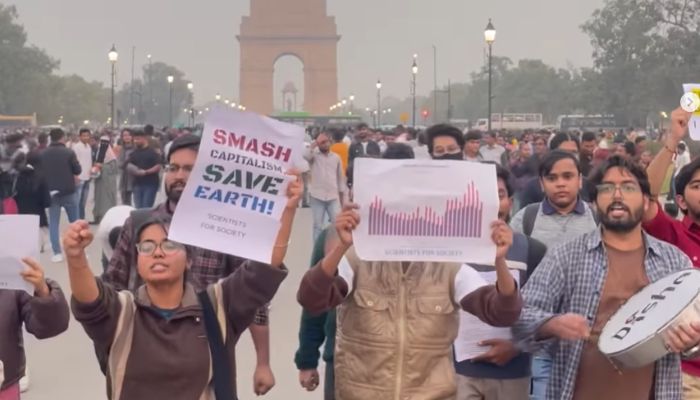
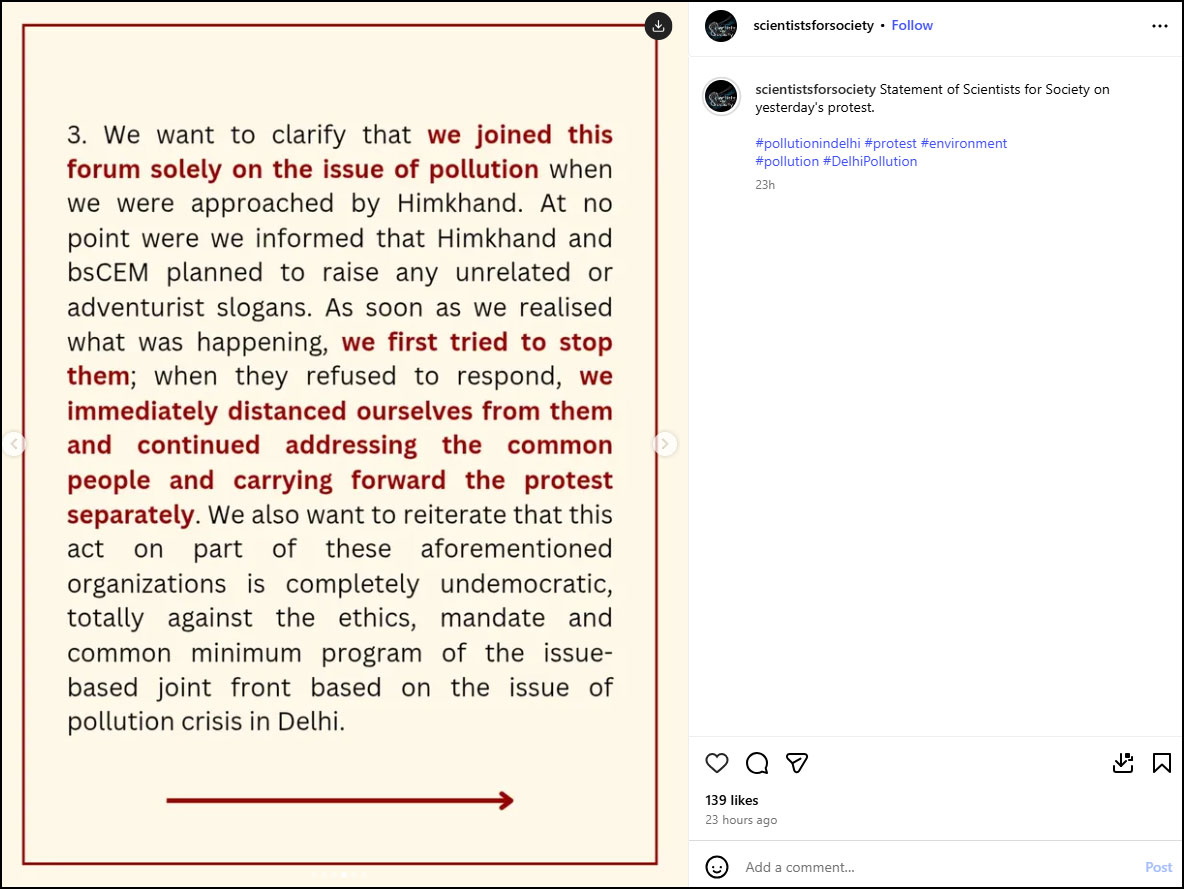
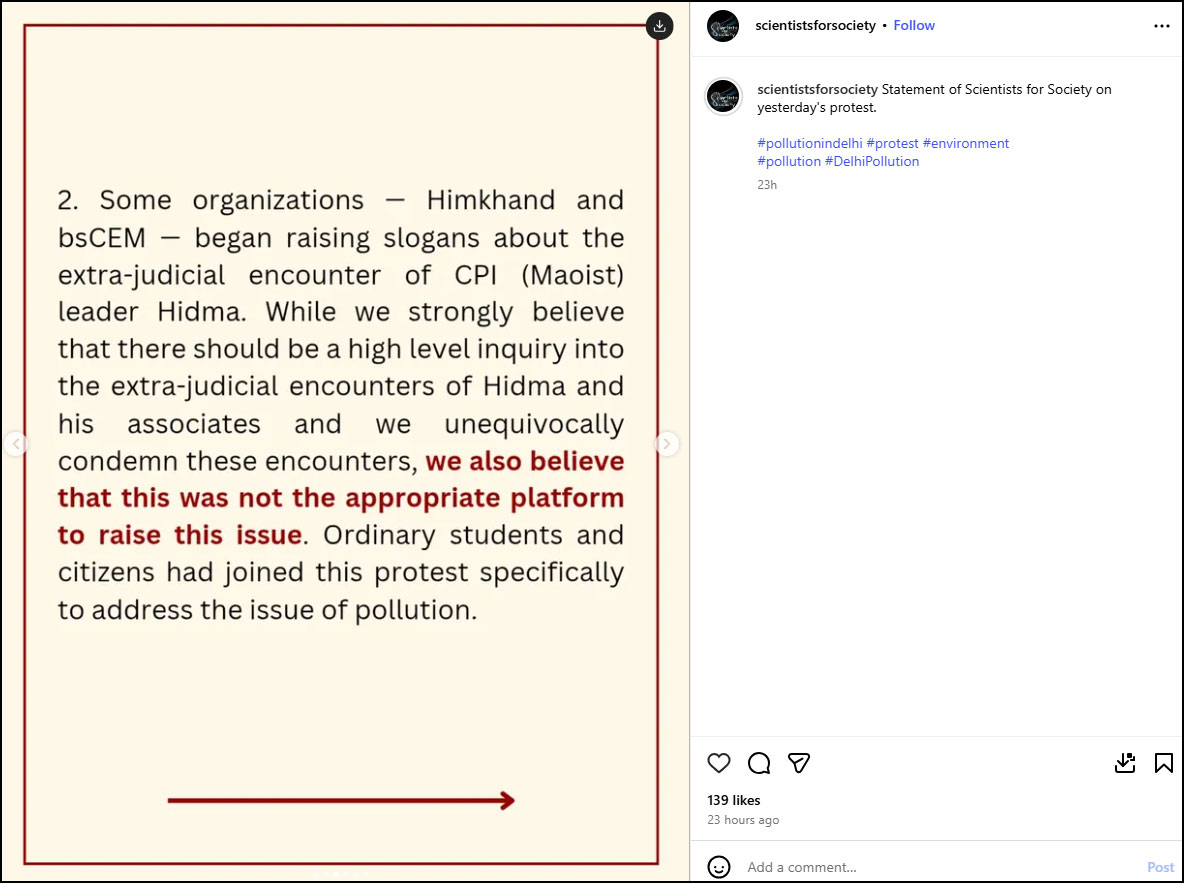
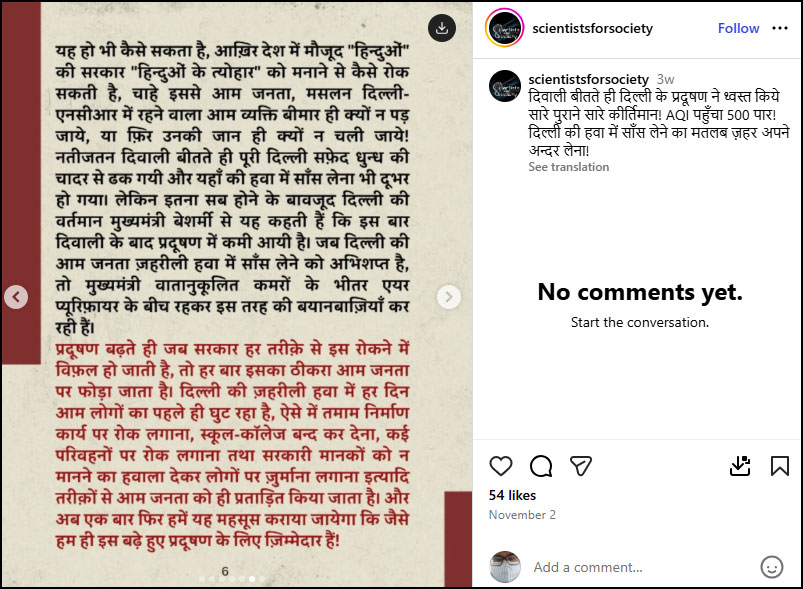
On 23rd November, the so-called ‘anti-pollution’ protest at C-Hexagon near India Gate in Delhi, spearheaded by left-leaning student organisations Bhagat Singh Chhatra Ekta Manch (bsCEM) and The Himkhand, quickly spiralled into a spectacle of glorified Naxalism and violence. Protesters, who claimed to have gathered to demonstrate against rising pollution in the National Capital, openly hailed slain Naxal commander Madvi Hidma. They even attacked police personnel with pepper spray.
As a result of the violence, 22 individuals have been booked. So far, police have arrested 16 of them, out of which 15 were sent to judicial remand and one was sent to a juvenile safe house. As the legal action against these individuals and groups intensified, their digital footprint has exposed a deeply problematic history.
Authorities have also invoked Section 197 of the Bharatiya Nyaya Sanhita, which pertains to acts or communications that threaten India’s sovereignty, unity, integrity or security.
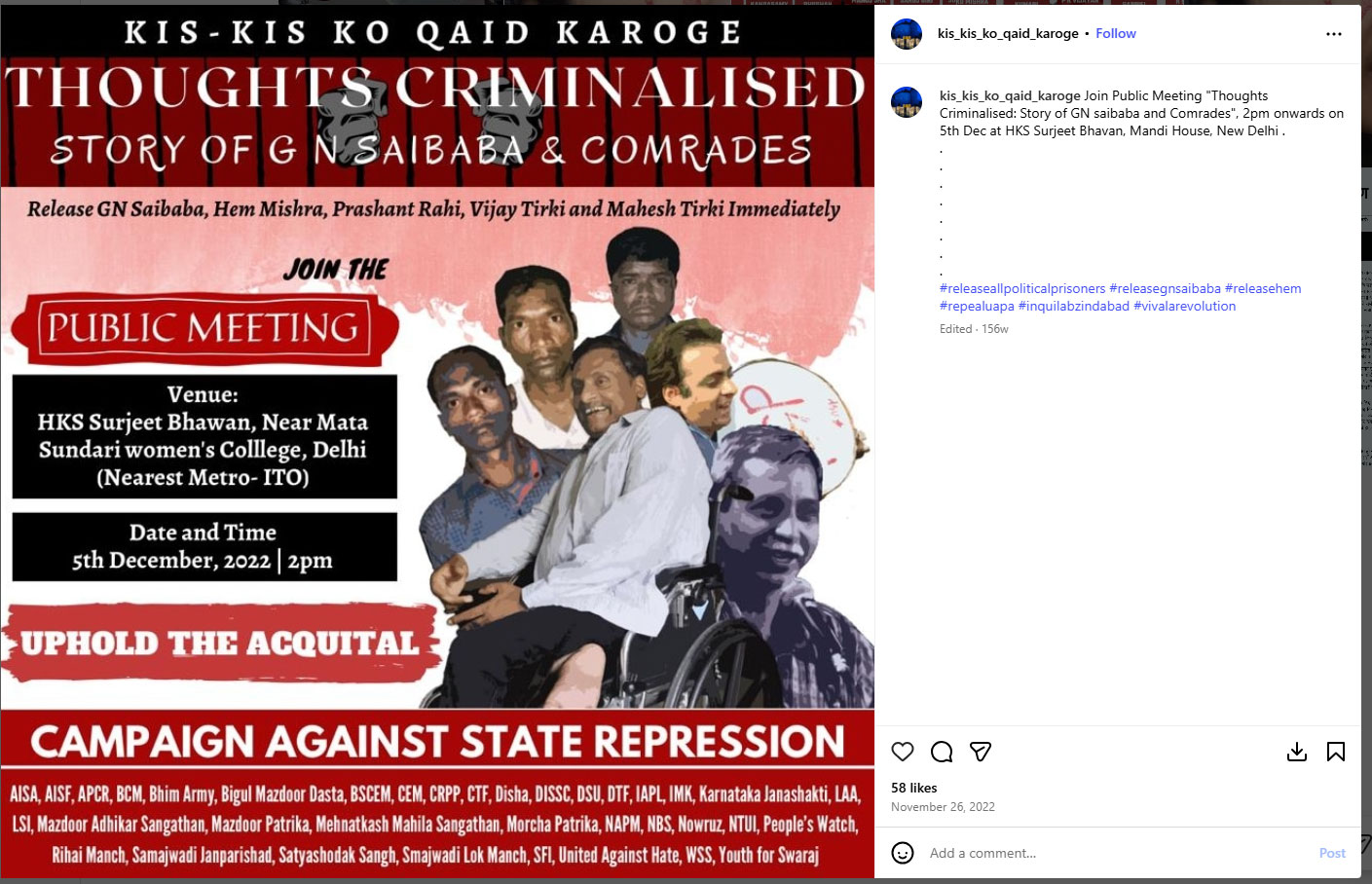
bsCEM is one of the 40+ organisations that formed a collective called “Campaign Against State Repression” or CASR. On Instagram, they run a page called “Kis Kis Ko Qaid Karoge”. They continuously campaign for the release of so-called “political prisoners”. The collective’s history can be traced back to 2018. On social media, there presence can be traced back to 2022 when they started a campaign for the release of now-deceased Naxalite professor Gokrakonda Naga Saibaba (GN Saibaba), who was in jail for his involvement with Naxal organisations. GN Saibaba died in prison.
Source: Instagram
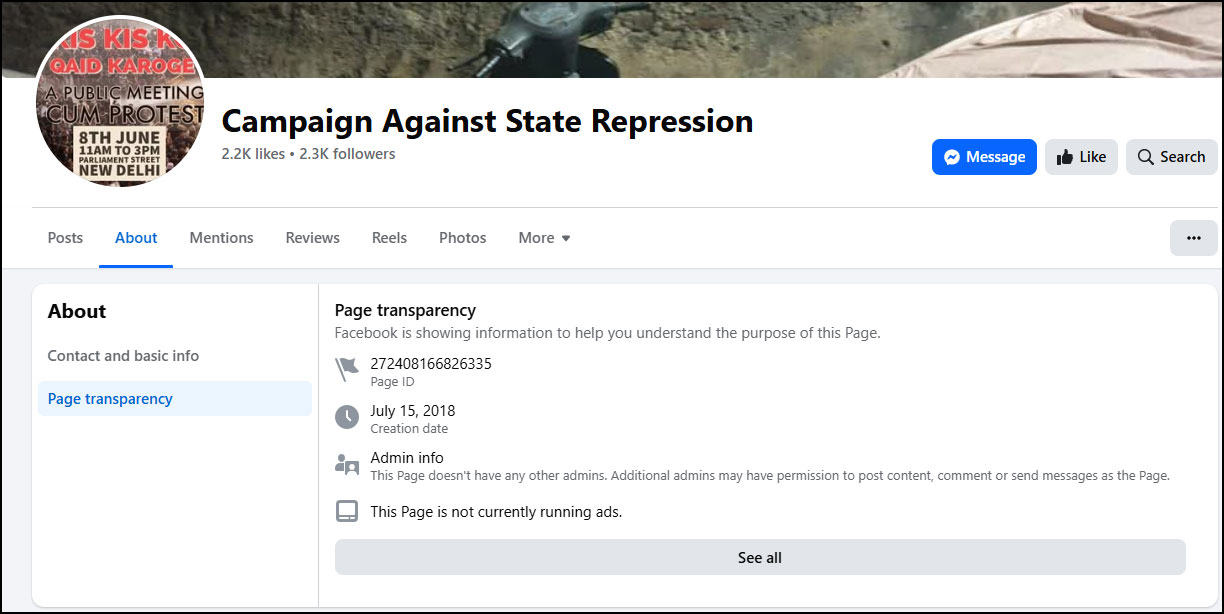
Earlier, there was a page with its Hindi name “Kis Kis Ko Qaid Karoge” that was created in 2018.
Source: Facebook
Information about the organisations under CASR banner reveals questionable past and associations. Interestingly, many of these organisations had supported propaganda event ‘Let Kashmir Speak’ in March 2023. The event was cancelled after Delhi Police revoked the permission for the event following uproar.
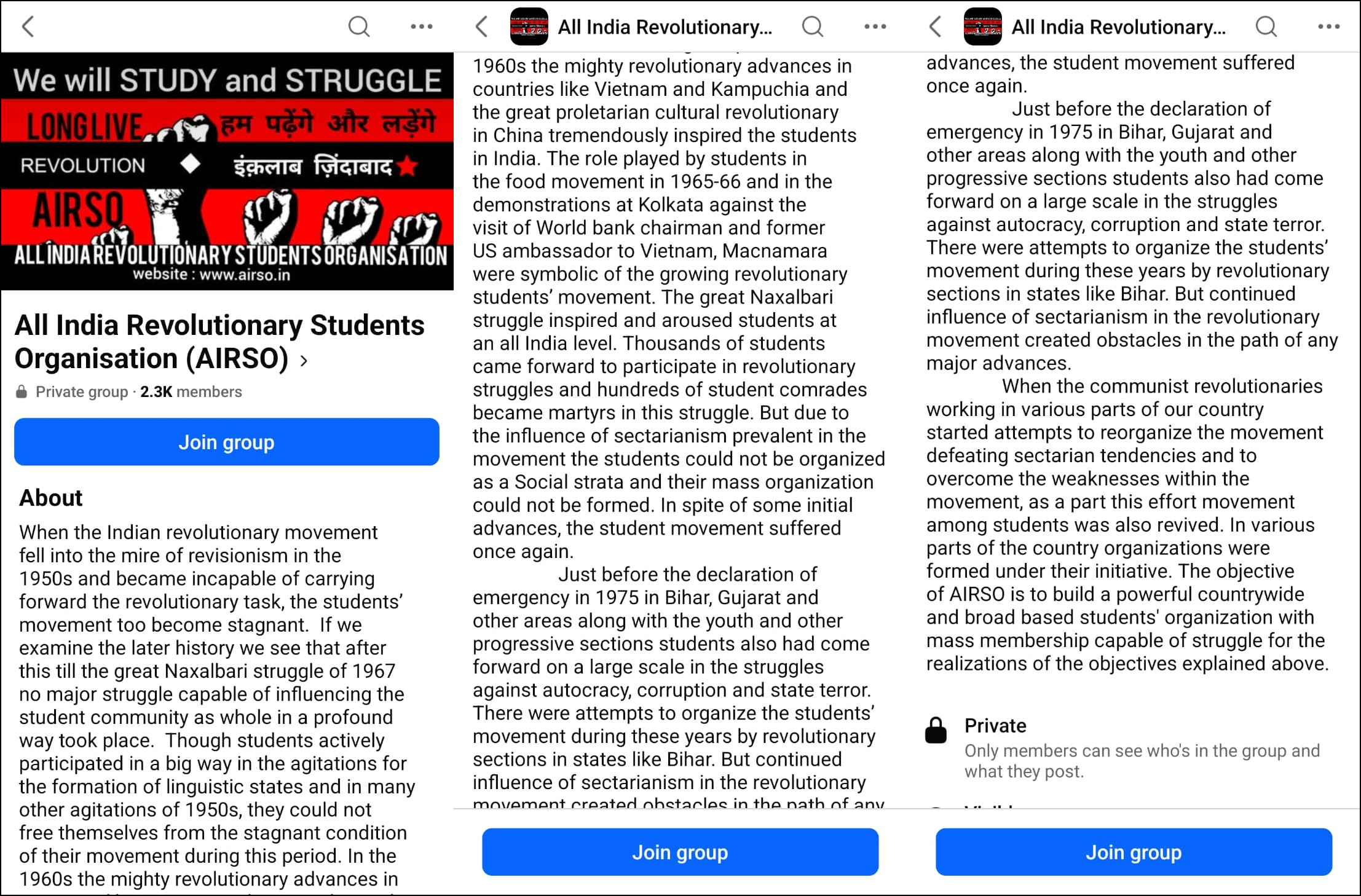
All India Revolutionary Students Organisation (AIRSO)
All India Revolutionary Students Organisation (AIRSO) is the student wing of Communist Party of India (Marxist–Leninist) Red Star which came into existance in 2009. While AIRSO presents itself as a students’ organisation, its own literature makes the ideology clear. The organisation romanticises the violent insurgencies of the 1960s and 70s. It idolises Naxalbari as a “great struggle” and frames the bloodshed of that era as a noble awakening of India’s youth.
Source: Facebook
Its stated objective is to build a “powerful, broad-based” nationwide students’ front aligned with the same revolutionary ideology that fuelled decades of extremist violence. AIRSO is not a students’ body, it is an ideological grooming platform that glorifies Naxalism under the guise of student activism.
All India Students’ Association (AISA)
All India Students’ Association (AISA) is a radical students’ movement. It was formed in 1990 and wraps itself in lofty rhetoric about “revolutionary transformation” and “a new world”, while functioning as a disruptive, ideological nuisance across university campuses, particularly in Jawaharlal Nehru University (JNU), where it proudly waves its red flag year after year. It is the student wing of Communist Party of India (Marxist–Leninist) Liberation. Recently, they condemned the killing of India’s most wanted Naxal Madvi Hidma.
AISA’s literature is packed with the usual jargon about neo-liberal assaults, imperialist aggression and anti-people politics. It celebrates confrontational street politics and frames its activism as a fight against everything from fee hikes to American imperialism.
It is less a students’ organisation and more a campus-based radical machinery that thrives on agitation, perpetual grievance and ideological posturing, all while destabilising academic spaces under the guise of student rights.
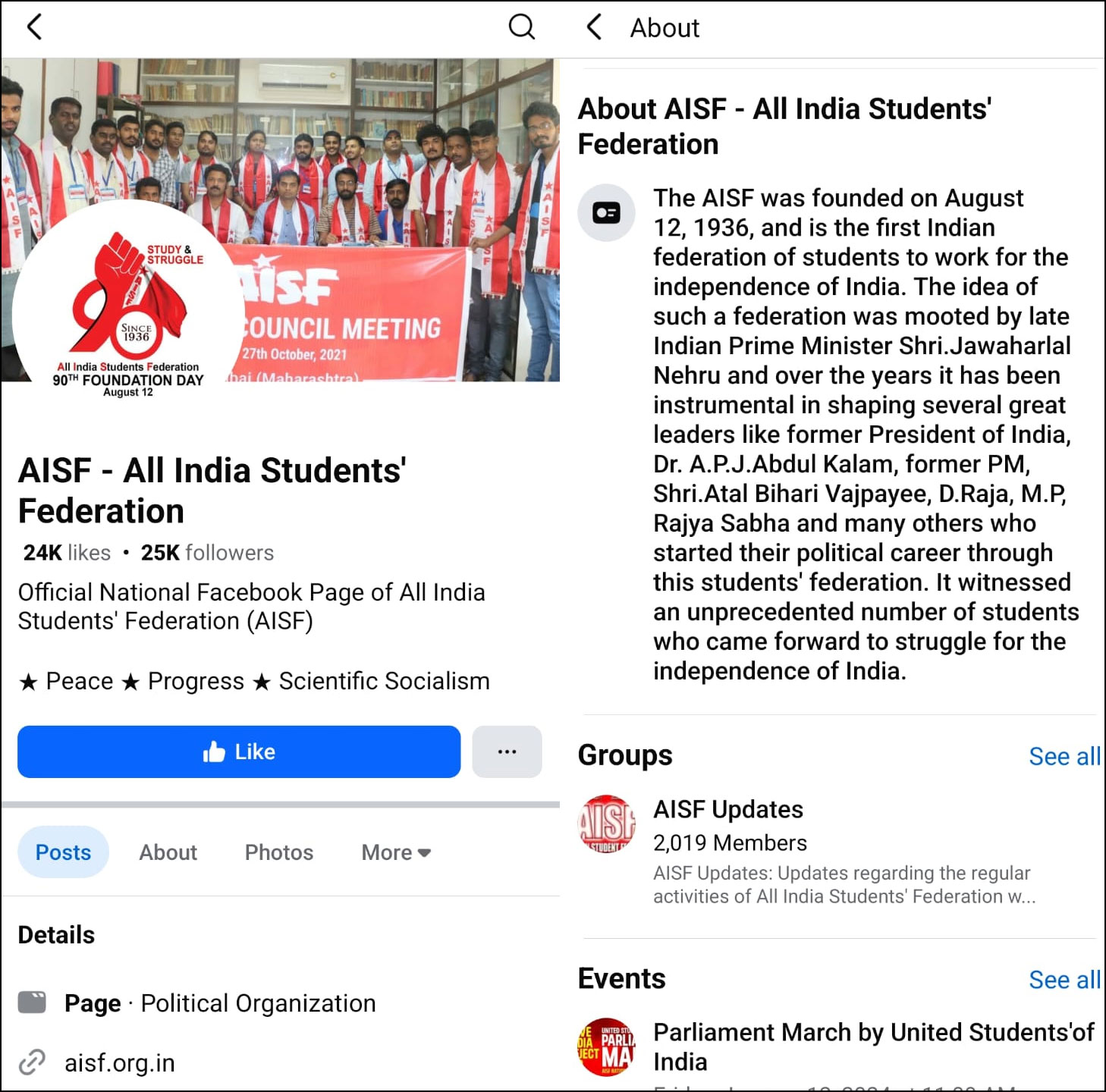
All India Students’ Federation (AISF)
All India Students’ Federation (AISF), formed in 1936, is the student wing of the Communist Party of India. It routinely projects itself as the “first” student federation to work for India’s independence, yet today it functions largely as an ideological relic kept alive to serve the CPI’s political interests on campuses.
Source: Facebook
AISF’s self-glorifying narrative leans heavily on invoking names like Jawaharlal Nehru, APJ Abdul Kalam and Atal Bihari Vajpayee, as though the organisation still bears any resemblance to what existed in the pre-independence era. In reality, AISF has long drifted from student-centric issues and now operates as a tired, doctrinaire extension of CPI’s outdated politics, clinging to nostalgia rather than addressing the real concerns of modern students.
Association for Protection of Civil Rights (APCR)
The Association for Protection of Civil Rights (APCR) presents itself as a non-profit working to “bridge the gap between law and justice”, but its track record tells a different story. Formed in 2006 and registered under the Societies Registration Act, the organisation claims to offer free legal aid, financial assistance and legal literacy programmes through workshops and seminars.
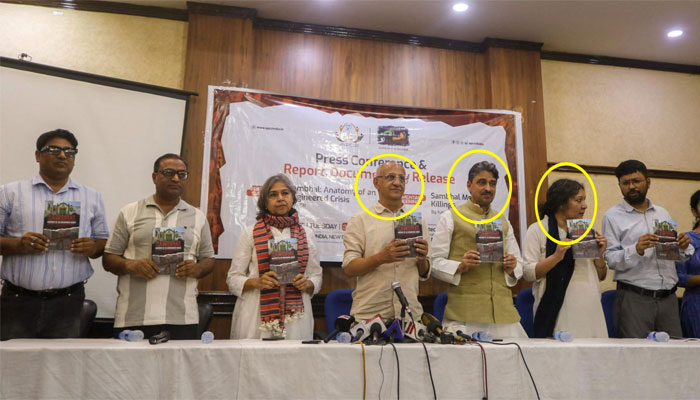
Harsh Mander and Saba Naqvi at APCR report release event on Sambhal. (Image: APCR)
Behind this polished description, however, APCR has repeatedly appeared in controversial cases, often extending legal aid to individuals accused in violent incidents such as the Sambhal violence and the anti-Hindu Delhi riots. Its so-called “fact-finding reports” read less like neutral documentation and more like one-sided propaganda designed to shield certain groups while vilifying others.
APCR’s leadership includes senior lawyers and long-time activists, yet the organisation functions less as a civil rights body and more as an advocacy front that selectively deploys the language of rights to defend the accused in communally charged cases.
APCR also has strong ties with the likes of Harsh Mander and Saba Naqvi. Harsh Mander who is known for his anti-India activities. In May this year, he tried to negotiate with the government on behalf of Naxals who are being neutralised under Operation Kagar. During anti-CAA protests, he was seen inciting Muslims against the central government using lies and fake information about the Citizen (Amendment) Act. In 2023, Ministry of Home Affairs had recommended inquiry against his NGO and in 2024, Central Bureau of Investigation had raided premises linked to him in FCRA violation case.
Saba Naqvi is known for her problematic remarks and her consistent anti-Hindu stance. In June 2022, she insulted the Shivling found at Gyanvapi. In May this year, when India counter-attacked Pakistan after the deadly Pahalgam terrorist attack, Naqvi was among the left-leaning, self-styled secular warriors who rushed to call for peace between India and Pakistan.
Imran Masood or “Boti Boti Masood”, who had once threatened to chop Prime Minister Narendra Modi into pieces, is also linked to APCR. His venomous remarks made him the “blue-eyed boy” of Islamic fundamentalists.
Bhim Army
The Bhim Army, founded in 2015 by Satish Kumar, Vinay Ratan Singh and Chandrashekhar Azad, projects itself as an Ambedkarite organisation working for Dalit rights. In reality, it has evolved into a hyper-confrontational outfit that thrives on street mobilisation, aggressive posturing and polarising identity politics. While it claims to run hundreds of free schools in Uttar Pradesh, the group’s public footprint is dominated far more by provocation, rallies, clashes and attempts to build a Dalit–Muslim political coalition.
Its stated mission of “direct action based on confrontation” speaks for itself. Led by Chandrashekhar Azad, the organisation routinely presents itself as a defender of “Bahujan identity” while openly positioning the BJP as its primary political enemy. Over the years, Bhim Army has found itself at the centre of violent flashpoints, from the 2017 Saharanpur clashes to its aggressive role in the anti-CAA protests, where its supporters engaged in street confrontations.
Despite repeatedly claiming constitutional loyalty, the group has consistently embraced high-voltage agitation over constructive engagement, operating more like a pressure group seeking to leverage caste fault lines for political mileage than a genuine rights-based organisation.
Chandrashekhar Azad ‘Ravan’, who is now a Member of the Parliament, has been accused of ruining the lives of multiple girls by a woman named Rohini Ghavari. In June this year, Azad’s party members were seen creating mahyem in Prayagraj. He has repeatedly pushed for reservations in the Private Sector. In February 2024, he was accused of threatening administrative officials that he would file a case against them under the SC/ST Act. Notably, the Act, which is meant to guard the marginalised communities from atrocities, is often used by some members of the community for vested interests. Recently, the Special SC/ST Court in Lucknow sentenced a woman to 3.5 years in prison for filing a fake SC/ST case.
Bhim Army Student’s Federation (BASF)
BASF is the student wing of Bhim Army.
Bhagat Singh Chhatra Ekta Manch (bsCEM)
Bhagat Singh Chhatra Ekta Manch (bsCEM) presents itself as a student-led “democratic” collective, but its own material makes the ideological tilt unmistakable. Formed in 2018 at Delhi University, bsCEM openly grounds itself in the revolutionary doctrines of Bhagat Singh and Charu Mazumdar, even declaring that students must “smash the old and create a new society” as part of a broader class struggle. This is not student activism, it is old-school Marxist agitation repackaged for DU campuses.
Its pamphlets repeatedly invoke Mao, call the education system “rotting”, and position students as foot soldiers who must integrate with “oppressed masses”, join bastis, oppose NEP, resist so-called “anti-people” policies, and fight “Hindutva ideology”. The organisation boasts of joining protests on CAA-NRC, the farmers’ movement, campus harassment cases, and even publishes a magazine pushing a self-proclaimed “revolutionary” worldview.
bsCEM functions less like a student support body and more like a radical mobilisation unit operating inside Delhi University. It thrives on agitation, ideological indoctrination and anti-establishment rhetoric, all while masquerading as a harmless student collective.
COLLECTIVE
COLLECTIVE describes itself as a student-youth movement “building a socialist future for India”, but its programme reads like an unfiltered ideological manifesto rather than anything remotely student-centric. Adopted during its first Delhi State Conference in March 2021, its worldview is built entirely on the classic far-left narrative that is, capitalism is collapsing, fascism is rising, and only a revolutionary uprising led by students and the “toiling people” can save the country.
According to COLLECTIVE, India today is under the “ascendancy of far-Right fascist forces”, empowered by neo-liberal capitalism, global finance, and supposedly anti-scientific, anti-secular tendencies. The organisation casts the RSS and BJP as central villains, accuses the state of “criminalising every voice of dissent”, and repeatedly frames modern governance as a slide into authoritarianism. Every policy from NEP to economic reforms is portrayed as a corporate conspiracy backed by imperialist interests.
The group situates students not as learners but as frontline participants in a global anti-capitalist struggle. It romanticises historical uprisings, glorifies Naxalbari, and constantly invokes revolutionaries from Bhagat Singh to Latin American agitators. Education, in its view, is merely another “apparatus of dominant hegemony” that must be resisted, overturned and repurposed towards class struggle.
COLLECTIVE recently came out in support of Kashmir Times after its office was raided. Police had recovered ammunition from the office.
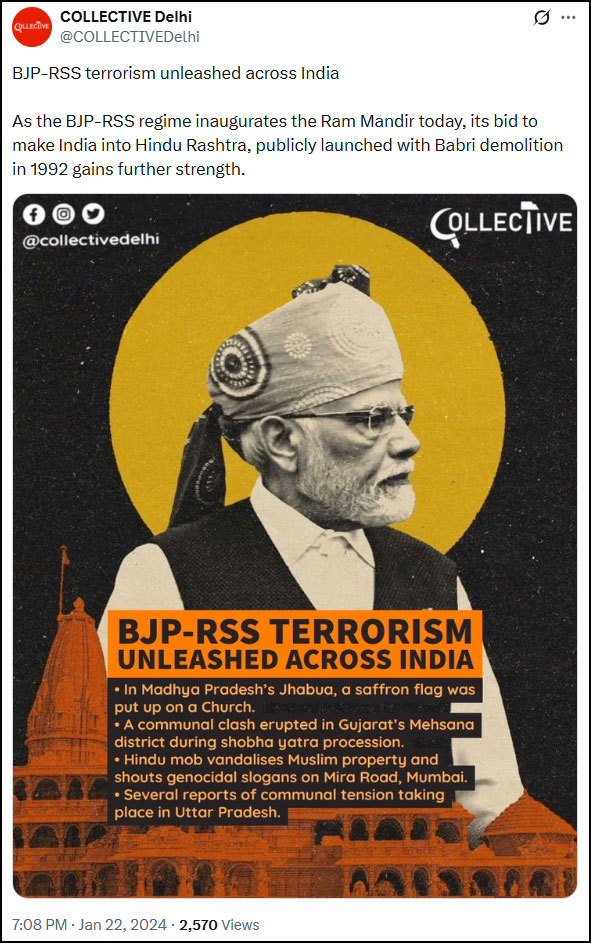
On 22nd January 2024, the day when Ram Lalla Pran Pratishtha took place at Ram Mandir, Ayodhya, COLLECTIVE wrote on X “BJP-RSS terrorism unleashed across India”.
Source: X
COLLECTIVE is not a student organisation but a doctrinaire Marxist platform pushing for revolutionary transformation. Its literature is steeped in crisis narratives, anti-state rhetoric and ideological alarmism. Under the veneer of student engagement, it aggressively calls for dismantling capitalism, patriarchy, caste structures, electoral politics and even the existing idea of the Indian state, making it one of the most openly radical groups operating on campuses today.
Committee for Release of Political Prisoners (CRPP)
The Committee for the Release of Political Prisoners (CRPP), founded in 2003 by Rona Wilson, Amit Bhattacharyya and SAR Geelani, has been described by the Ministry of Home Affairs as a front of the banned CPI (Maoist). Operating under the banner of “civil liberties”, it campaigns for the unconditional release of individuals it labels as political prisoners, many of whom face serious charges linked to extremist violence.
One of its founders, Rona Wilson, has himself been at the centre of multiple controversies. Pune Police had earlier recovered a sensational letter from his Delhi residence suggesting that Maoist elements were discussing a “Rajiv Gandhi–type” plot to target Prime Minister Narendra Modi, seeking Rs 8 crore to procure M4 rifles and ammunition. Wilson was later arrested in the Bhima Koregaon–Elgar Parishad case, with investigators alleging he coordinated between urban networks and jungle-based Maoist cadres and was a close aide of convicted Naxal ideologue GN Saibaba.
After over six years in prison, Wilson was granted bail by the Bombay High Court on 8 January 2025 due to the prolonged delay in trial and was released on 24 January under strict conditions, including surrendering his passport and regular appearances before the NIA. Though he has long denied Maoist links, Wilson has been repeatedly questioned since his JNU days for his association with figures like SAR Geelani.
Dayar-I-Shauq Students’ Charter (DISSC)
Dayar-i-Shauq Students’ Charter (DISSC) describes itself as a “progressive democratic” mass organisation at Jamia Millia Islamia, but in reality, it functions as a predictable left-wing political bloc on campus. Formed in 2015, it claims to revive debate and dissent, yet its activism has consistently aligned with the broader Left–Islamist ecosystem in Jamia, using student issues as a gateway to push ideological battles rather than academic concerns.
The group’s conduct during campus flashpoints speaks for itself. In June 2022, DISSC joined Islamist groups such as the Campus Front of India (the student wing of the now-banned Popular Front of India) to physically block an ABVP-organised environmental awareness event. Protesters shut Jamia’s gates, chanted “Nara-e-Takbeer Allah-Hu-Akbar”, “ABVP Murdabad” and “ABVP Campus Chhodo”, and prevented environmentalist Imteyaz Ali and DUSU President Akshit Dahiya from even entering the campus. DSSC members held placards calling ABVP “Islamophobic”, branding them “hatemongers”, and invoking Najeeb to whip up sentiment.
In short, DISSC is less a student body and more a frontline participant in the Left–Islamist coalition that routinely polices Jamia’s campus space, suppresses opposing viewpoints and aggressively frames even apolitical events as ideological battlegrounds.
Democratic Student Union (DSU)
The Democratic Students’ Union (DSU) is an openly radical student outfit active in Jawaharlal Nehru University and Delhi University. It is a constituent of the All India Revolutionary Students’ Federation (AIRSF) and explicitly works toward the goals of the so-called “New Democratic Revolution”, a doctrine rooted in far-left extremist ideology rather than any student-centric cause.
DSU is best known for the notoriety it brought to JNU in 2016. On 9 February that year, DSU members and allies organised a protest opposing the execution of Parliament attack convict Afzal Guru and Kashmiri separatist Maqbool Bhat. Slogans such as “Afzal hum sharminda hain, tere qatil zinda hain” were raised on campus. Former DSU leader Umar Khalid, along with Kanhaiya Kumar and Anirban Bhattacharya, was arrested for his role in the incident.
Umar Khalid’s trajectory further showcases DSU’s ideological ecosystem. He was later arrested under UAPA in the larger conspiracy case linked to the anti-Hindu Delhi riots 2020, with investigators alleging his involvement in orchestrating the violence. Khalid’s background too has raised questions, as his father, Syed Qasim Rasool Ilyas, was a member of the now-banned terrorist outfit SIMI.
DSU operates less as a student organisation and more as a hard-left political formation that has repeatedly pushed extremist narratives on campuses under the guise of activism.
Democratic teachers’ Front (DTF)
The Democratic Teachers’ Front (DTF) is a Left-leaning teachers’ organisation in Delhi University that positions itself as a defender of “democratic” academic spaces. It has long been involved in campus agitations, opposing central reforms including the Modi government’s education initiatives, the National Education Policy and the move to scrap the Senate in Panjab University.
Fraternity Movement
The Fraternity Movement is the student wing of the Welfare Party of India and operates with the slogan “Democracy, Social Justice and Fraternity”. Despite this benign framing, the group has repeatedly aligned itself with hardline positions. Fatermity was one of the organisations present at the so-called anti-pollution protests in Delhi.
During the anti-CAA protests in December 2019, its members even blocked Calicut International Airport. The Welfare Party of India itself is led by figures such as Syed Qasim Rasool Ilyas, former member of SIMI and father of Umar Khalid, and has long been associated with Islamist-leaning activism.
Several controversial activists are linked to the Fraternity Movement, including Afreen Fatima and Aysha Renna. Fatima has publicly defended Parliament attack convict Afzal Guru, repeatedly urging people to “revisit” his verdict. She has also questioned the Supreme Court over decisions like the Ram Mandir judgment. Renna, celebrated by sections of the media, openly backed Sharjeel Imam, calling police action against him a “witch hunt” and demanding that cases against him be dropped, despite his inflammatory secessionist speeches.
The Fraternity Movement, therefore, functions not as a student rights platform but as a political extension of the Welfare Party’s ideological ecosystem, frequently championing extremist, polarising and anti-establishment narratives under the cover of campus activism.
Indian Association of People’s Lawyers (IAPL)
The Indian Association of People’s Lawyers (IAPL) presents itself as a collective of “people’s lawyers” committed to justice, equality and human rights. Its constitution frames the Indian state as imperialist and oppressive, calls for resisting “unjust class rule”, and pledges support for anti-imperialist struggles. On paper, it is a national body of lawyers and legal activists; however, the National Investigation Agency’s findings paint a starkly different picture.
According to the NIA chargesheet in the Elgar Parishad case, IAPL is a frontal organisation of the banned CPI (Maoist). Investigators recorded witness statements describing how the group’s activities, fact-finding missions, legal support networks and meetings—often involved individuals suspected to be Maoists. One witness recounted a 2018 Kashmir fact-finding visit where non-lawyers, believed to be Maoist operatives, were present; when this was pointed out to accused Arun Ferreira, he reportedly “just smiled”, reinforcing suspicions about IAPL’s role.
The NIA emphasised that IAPL’s work consistently furthered the Maoist agenda under the guise of legal activism, and that multiple activists linked to Maoist cases operated through it. Although some members resigned citing ideological differences, the agency maintains that the outfit has served as a cover structure providing support to Maoist networks.
Despite its claims of safeguarding human rights, the organisation has repeatedly appeared in investigations as part of the broader urban support system of CPI (Maoist), using legal advocacy and fact-finding missions to shield operatives, influence narratives and advance extremist objectives. The organisation, however, has claimed it has nothing to do with CPI(Maoist).
Nazariya Magazine
Nazariya Magazine is an openly Marxist-Leninist-Maoist publication that frames India as a “semi-colonial, semi-feudal” state under “Brahmanical Hindutva fascism” and positions itself as an ideological weapon for militant revolutionary politics. It insists that Marxism-Leninism-Maoism is the only path to overthrow “class enemies” and build a new socialist order.
In 2024, Nazariya faced a major scandal when one of its own employees accused Mukundan Nair of sexual assault. Instead of supporting her, Nazariya formed an internal committee that recommended vague “rectification” for the accused. When the survivor objected, the organisation expelled her in November 2024 and released statements accusing her of “imperialist ideology”, “non-ideological sexual relationships” and violating “communist morality”, irrelevant attacks used to discredit her and protect the accused.
The survivor later revealed that activists linked to bsCEM had participated in slandering her and spreading false claims. Photographs surfaced showing bsCEM members socialising with Mukundan despite admitting privately that they knew about the allegations. Rather than confronting the misconduct, Nazariya, bsCEM, FACAM and even SfPD escalated the matter into an ideological war, deleting comments, blocking critics and using the survivor’s trauma to score political points.
The episode exposed Nazariya’s hypocrisy, revealing a collective that shields an accused offender while vilifying its own employee to preserve ideological purity.
Rihai Manch
It is a political front that claims to resist repression. It was involved in an array of protests including anti-CAA and farmer protests.
Students’ Federation of India (SFI)
Students’ Federation in India is a left-wing student organisation. OpIndia has covered the organisation extensively. It can be checked here.
United Peace Alliance
The United Peace Alliance is a political front led by Mir Shahid Saleem, positioned as a platform for “resistance against repression” in Kashmir. While it uses the language of peace and rights, the group consistently aligns itself with hardline narratives against the Indian state, particularly after the abrogation of Article 370.
Saleem, the organisation’s chairman, routinely asserts that the Centre has “intimidated”, “frightened” and “oppressed” Kashmiris since 5th August, 2019. Under his leadership, the United Peace Alliance has organised conferences, protested against marking 5th August as a day of celebration, and instead promoted it as “Black Day”.
The group’s activities revolve around amplifying anti-370 sentiment, portraying constitutional changes as repression, and creating political mobilisation around these claims. Rather than contributing to peace, the United Peace Alliance functions as yet another pressure group that keeps separatist rhetoric alive under the garb of rights advocacy.
Youth 4 Swaraj (Y4S)
Youth 4 Swaraj (Y4S) is the student-youth wing of Yogendra Yadav’s political party, Swaraj India. While it projects itself as a platform for “alternative politics” and youth mobilisation on issues ranging from drought relief to campus activism, the organisation has been marred by serious allegations of sexual assault and institutional apathy.
In 2020, a former Y4S member publicly accused Manish Kumar, the then President of Youth 4 Swaraj, of sexually assaulting her. She stated that she had informed Yogendra Yadav and other senior leaders about the abuse, but her complaints were ignored. According to her account, she was mentally traumatised by members of Swaraj India and eventually forced to resign. Even after she reported the assault, Manish Kumar continued to represent Y4S at the Singhu border during the farmers’ protests.
The survivor also alleged that when she approached Yogendra Yadav directly, he responded with silence, while Avik Saha, the Vice President of Swaraj India, merely asked her to go to the police. In her resignation letter, shared on Instagram, she wrote that the organisation protected abusers while shifting the burden and stigma onto women who spoke up.
Other organisations include ASA, BSM, CEM, CSM, CTF, LAA, Forum Against Repression Telangana, Karnataka Janashakti, Mazdoor Adhikar Sangathan, Mazdoor Patrika, NAPM, Nishant Natya Manch, New Trade Union Initiative (NTUI), People’s Watch, Samajwadi Janparishad, Samajwadi Lok Manch, Bahujan Samjavadi Manach, Women Against Sexual Violence and State Repression (WSS), Nowruz, Innocence Network and others.
Taken together, the events at India Gate and the profiles of these outfits make it clear that the ‘anti-pollution’ protest was never about air quality, it was about pushing a coordinated ideological agenda that glorifies Naxals, undermines Indian institutions and weaponises campuses, courts and “civil rights” language against the country. From students’ bodies and “rights” collectives to lawyers’ fronts and Kashmir pressure groups, the network around bsCEM and CASR is not accidental, it is an ecosystem that normalises anti-India rhetoric while seeking impunity for those facing serious charges. This report is only the beginning of an OpIndia series that will systematically expose the organisational web of pro-Naxal, Left-leaning groups that are indulging in anti-India activities under various respectable sounding labels.
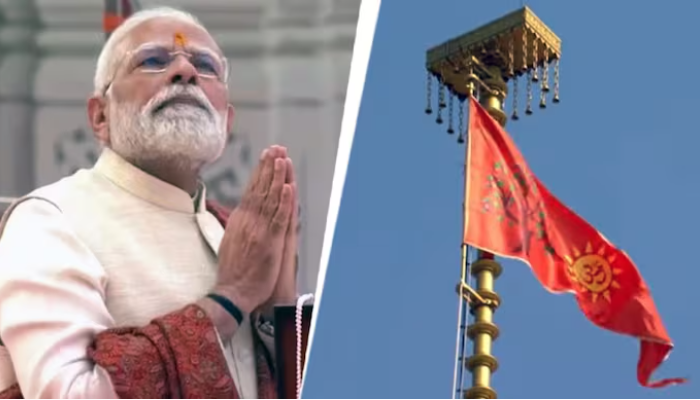
On 25th November, a grand event took place in Ayodhya for the Dhwajarohan (flag hoisting) ceremony of the Ram Mandir. The sacred ceremony signified the completion of the construction of the Shri Ram Janmabhoomi temple. The saffron flag was hosted by Prime Minister Narendra Modi atop the temple’s “shikhar” and even addressed a gathering, emphasising that the occasion represented the realisation of a 500-year-old civilisational commitment.
Nevertheless, how could such a momentous day for Hindus and the Vedic religion ever pass without the vitriol and hatred from Islamists, woke individuals as well as the terror state of Pakistan, which has been systematically destroying its shrinking minorities, especially Hindus, for decades, while admonishing India about upholding secularism?
The rectification of a historical injustice was labeled as “Islamophobia” and “heritage desecration” by jihad-led Islamabad, whereas the reality is that the contested structure had supplanted the true heritage of India which has been restored after centuries, following the return of the deity to his rightful abode.
The rhetoric against India and Hindumisia unfolded as expected, with irony facing countless deaths, as the Islamic Republic accused India of “discrimination towards minorities” and of “eradicating Muslim culture and heritage” by Hindutva forces, while depicting the second-largest majority in the country as “victims” of state oppression.
Afterward, the ministry requested the United Nations and the international community to intervene in India’s internal matters based on unsubstantiated charges of “hate speech” and “hate-motivated attacks.” The absurdity continued when it asked the Modi government to protect minorities and their places of worship, even invoking international human rights obligations.
?PR No.3️⃣5️⃣0️⃣/2️⃣0️⃣2️⃣5️⃣
Pakistan calls international attention to rising Islamophobia and heritage desecration in India
— Ministry of Foreign Affairs – Pakistan (@ForeignOfficePk) November 25, 2025
It is indeed Kalyuga when a nation where mere bogus claims of blasphemy suffice to lynch or burn individuals, particularly Hindus, to death, the judiciary acts as kangaroo courts to appease the Islamists and the greatest output is that of terrorism, sermons India on inclusivity and minority rights.
Indian wokes, Islamists join Pakistan to demonstrate their contempt for the event
Notably, there is not much difference in the hostility towards Sanatan Dharma from the leftist-liberal “woke” lobby in India and their Miuslim counterparts across the border. They are nearly tied together by their common loathing for all things Hindu.
The same was illustrated by the cabal when Congress leader Lavanya Ballal Jain criticised journalist Rahul Shivshankar and argued that his celebratory post over the flag hoisting program was not only a fabrication but also stemmed from fear.
Just because a journalist posts something it need not be true. The loudest are most often being loud out of fear. https://t.co/DdBRIlSB1q
Shivshankar had rightly pointed out how honouring India’s Hindu origins was viewed as “communal activism” under past governments and the nation has eventually emancipated itself from such mindset. Nevertheless, the truth consistently causes heartburn to this ecosystem and this instance was no exception.
A popular left-wing figure accused him of being a “collaborator” rather than a journalist. Siddharth attempted to suggest that the journalist had aligned himself with the “Hindutva forces,” merely for expressing pride in his religion and stating a fact.
An Islamist even stated that the removal of the disputed structure was “neither a civilizational victory for Hindus nor a detriment to the wider Ummah.” The person then took it a step further by threatening that it would be restored “like Hagia Sophia,” the church that was transformed into a mosque in Turkey and then gloated, “Hinduism eliminated from the historical centers of Hindu civilisation like Punjab, Sindh, Bengal, and Kashmir cannot be reversed.”
Loss of Babri is neither a civilisational achievement for Hindus nor L for broader Ummah, it is just a symbol which can be reversed like Hagia Sophia
This rotten faction laments the demotion of a purported mosque that was constructed over Ram Mandir, portraying it as a case of majoritarianism while simultaneously rejoicing in the murder, rape and brutal acts inflicted upon the native Hindu community by tyrant Muslim marauders.
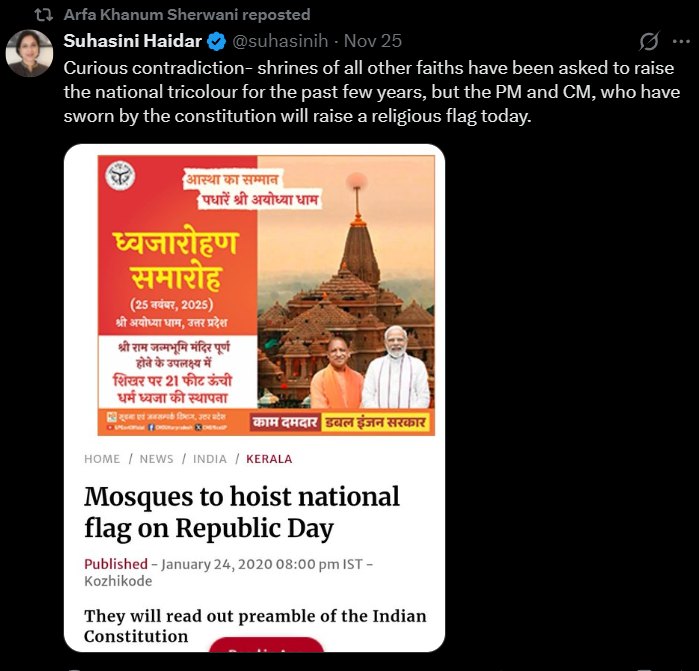
Suhasinsi Haider tried to create a deceptive equivalence by remarking that the government wishes for non-Hindu institutions to raise the tricolour, while PM Modi and Uttar Pradesh Chief Minister Yogi Adityanath, “who have sworn by the constitution will raise a religious flag.” This was also retweeted by Arfa Khanum Sherwani, the chief propagandist of The Wire.
Haider intentionally omitted to mention that there is no nationwide directive, but only state and local regulations for such institutions on specific national occasions like Independence Day. Furthermore, the Ram Mandir program did not coincide with any national day that would justify her statement. More importantly, the Dharam Dhwaj is an integral part of Hindu temples and was central to the religious function.
These people excel in the skill of masking the truth, particularly when it could challenge their carefully crafted propaganda. Similarly, the religious event outraged a leftist to such an extent that the individual demanded sedition charges against Shivshankar.
Another member of the cabal chose to ridicule the emotionally overwhelmed Prime Minister Narendra Modi, mocking that his hands trembled because of his advanced age. Fundamentally, every element of the program and the people associated with it as well as those who took joy in it, faced derogatory remarks.
Umar ho gayi hai… Modiji buddhe ho gaye hain… haath toh kaapenge hi na? https://t.co/PUvu56RP3Q
Likewise, a liberal inquired, “Godi media,” whether the Republic of India, established on 26-01-1950 was replaced by a new Republic in its stead. The hypocrisy is glaring, as he, like all members of his notorious group, conveniently forget that while they denounce the Modi government, their preferred Congress regime attempted to undermine the Republic not only by imposing Emergency but also by undemocratically distorting the preamble (soul of the constitution) while the opposition was illegally thrown behind bars.
So finally officially Godi Media has declared the Republic of India created on 26-01-1950 as dead, and a new Republic in its place ("the second republic"). #MotherOfDemocracy
The previously mentioned posts offer merely a fleeting insight into the enmity, spite and rage aimed at the sacred occasion, Prime Minister Modi, and those who took pride in it.
Pakistan, Islamists and their leftist-liberal apologist ecosystem dedicated the day to either mourning or hurling outrageous accusations at the collapse of their meticulously constructed narrative, wherein Hindus were compelled to grapple with an inferiority complex, and the nation’s religious and cultural heritage was denigrated to glorify oppressive foreign rulers, whether they were Muslims or British.
26th November is a day of immense pride for every Indian. It was on this very day in 1949 that the Constituent Assembly adopted the Constitution of India, a sacred document that has continued to guide the nation’s progress with clarity and conviction. That is why, nearly a decade ago, in 2015, the NDA government decided to mark 26th November as Constitution Day.
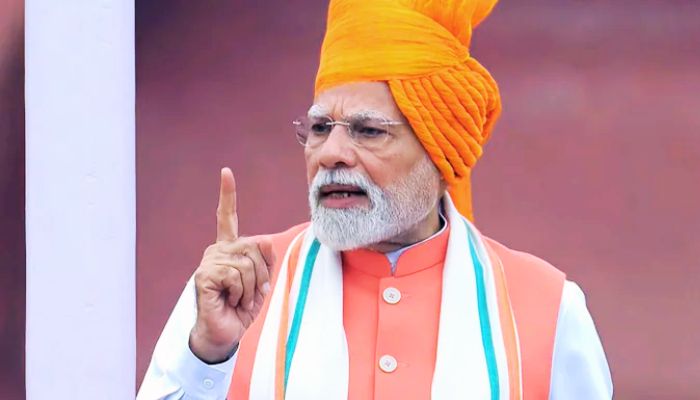
It is the power of our Constitution that enabled a person like me, coming from a humble and economically disadvantaged family, to serve as the Head of the Government continuously for over 24 years. I still remember the moments in 2014, when I came to Parliament for the first time and bowed, touching the steps of the greatest temple of democracy. Again, in 2019, after the election results, when I entered the Central Hall of Samvidhan Sadan, I bowed and placed the Constitution on my forehead as a mark of reverence. This Constitution has given several others, like me, the power to dream and the strength to work towards it.
On Constitution Day, we remember all the inspiring members of the Constituent Assembly, which was presided over by Dr. Rajendra Prasad, who contributed to the making of the Constitution. We recall the efforts of Dr. Babasaheb Ambedkar, who chaired the Drafting Committee with remarkable foresight. Several distinguished women members of the Constituent Assembly enriched the Constitution with their thoughtful interventions and visionary perspectives.
My mind goes back to the year 2010. This was when the Constitution of India completed 60 years. Sadly, the occasion did not receive the attention it deserved at a national level. But, to express our collective gratitude and commitment to the Constitution, we organised a ‘Samvidhan Gaurav Yatra’ in Gujarat. Our Constitution was placed on an elephant and I, along with several other people from different walks of life, had the honour of being part of the procession.
When the Constitution completed 75 years, we decided that this would be an extraordinary milestone for the people of India. We had the privilege of organising a special session of Parliament and launching nationwide programmes to commemorate this historic occasion. These programmes witnessed record public participation. This year’s Constitution Day is special for many reasons.
It marks the 150th birth anniversary of two extraordinary personalities, Sardar Vallabhbhai Patel and Bhagwan Birsa Munda. Both of them made monumental contributions to our nation. Sardar Patel’s visionary leadership ensured the political unification of India. It was his inspiration and courage of conviction that guided our steps to act against Article 370 and 35(A). The Constitution of India is now fully in force in Jammu & Kashmir, ensuring all constitutional rights for the people, especially the women and marginalised communities. The life of Bhagwan Birsa Munda continues to inspire India’s resolve to ensure justice, dignity and empowerment for our tribal communities.
This year, we also celebrate the 150th anniversary of Vande Mataram, whose words resonate with the collective resolve of Indians through the ages. At the same time, we commemorate the 350th martyrdom anniversary of Sri Guru Teg Bahadur Ji, whose life and sacrifice continue to illuminate us with courage, compassion and strength.
All these personalities and milestones remind us of the primacy of our duties, something the Constitution also emphasises through a dedicated chapter on Fundamental Duties in Article 51A. These duties guide us on how to collectively achieve social and economic progress. Mahatma Gandhi always emphasised the duties of a citizen. He believed that a duty well performed creates a corresponding right and that real rights are a result of the performance of duty.
25 years have already passed since this century began. In just over two decades from now, we will mark 100 years since freedom from colonial rule. In 2049, it will be a hundred years since the Constitution was adopted. The policies we frame, the decisions we take today and our collective actions will shape the lives of generations to come.
Inspired by this, as we move forward to realise the dream of a Viksit Bharat, we must always place our duties towards our nation foremost in our minds.
Our country has given us so much and this brings out a deep sense of gratitude from within. And, when we live with this feeling, fulfilling our duties becomes integral to our nature. To carry out our duties, it becomes imperative to put in our full capability and dedication in every task. Every action of ours should strengthen the Constitution and further national goals and interests. It is afterall our responsibility to fulfil the dreams envisioned by the framers of our Constitution. When we work with this sense of duty, our nation’s social and economic progress will multiply manifold.
Our Constitution has given us the right to vote. As citizens, it is our duty to never miss the opportunity to vote in national, state and local elections where we are registered. In order to inspire others, we can think of organising special ceremonies every 26th November in schools and colleges to celebrate those youngsters who are turning 18. This way our first-time voters will feel that in addition to being students, they are also active participants in the process of nation-building.
When we inspire our youth with a sense of responsibility and pride, they will remain committed to the values of democracy throughout their lives. This sense of commitment is the foundation of a strong nation.
Let us, on this Constitution Day, reaffirm our pledge to fulfil our duties as citizens of this great nation. In doing so, we can all contribute meaningfully to the building of a Viksit Bharat that is developed and empowered.
Yours,
Narendra Modi
The letter above is by PM Modi to fellow Indians on the occasion of Constitution Day. The letter has been reproduced here.
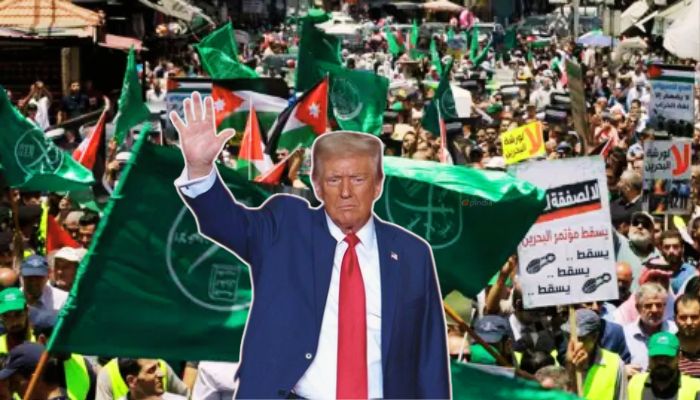
Inflicting a massive blow to Islamic terrorism, US President Donald Trump signed an executive order on 24th November, directing his administration to initiate the process of designating specific chapters of the Muslim Brotherhood (MB) as Foreign Terrorist Organisation (FTO) and Specially Designated Global Terrorists (SDGTs).
The executive order states that Secretary of State Marco Rubio and Treasury Secretary Scott Bessent shall submit a joint report to the President concerning the designation of any Muslim Brotherhood chapters or other subdivisions, including those in Lebanon, Jordan, and Egypt, as FTO and SDGTs.
This marks the fulfilment of Trump’s first-term ambitions, where he ordered a similar review against the Islamic terror outfit; however, due to bureaucratic resistance, the process could not be completed at that time.
What built momentum for Trump ordering a review of the Muslim Brotherhood are bipartisan congressional efforts, including the Muslim Brotherhood Terrorist Designation Act of 2025, the Republican advocacy in general against what they called “transnational Islamist organisation.
While the White House has stated there will not be a blanket label on the entire Muslim Brotherhood, Trump’s move marks a seismic shift. The timing of this is also crucial, given Trump’s efforts to restore peace in Gaza. It must not be forgotten that, contrary to the popular understanding of the Israel-Palestine conflict as a long-standing territorial dispute, it is, in fact, a religious dispute to its core, with territorial claims by both sides being the casus belli.
OpIndia earlier reported about the Palestinian Islamic terror group Hamas claiming the country of Israel as a ‘Waqf’ property in its 1988 Covenant or Charter and vowing to continue Jihad against Jews until the last one of them is killed. Hamas enjoys the support of the Muslim Brotherhood and joined the Palestinian terror group in carrying out airstrikes against Israeli civilians and military after the October 7 2023, massacre.
In its 2017 document, Hamas tried to distance itself from the Muslim Brotherhood, apparently, to better its relations with Egypt. Hamas also softened its stance on fighting the Jews by distinguishing between Zionists and Jews. The Islamic terror group’s actions since then have exposed their duplicity. The indiscriminate killing of Jews on 7th October 2023 laid bare Hamas’s hypocrisy and hatred for Jews.
It is essential to note that formally designating the Muslim Brotherhood as a terror group has always been difficult for the US government. The organisation is decentralised, with different branches operating in multiple countries, many of which function independently. Because of this structure, legal experts and intelligence officials in Washington have often found it challenging to apply a blanket terrorist label to the entire movement.
Apparently, due to this reason, the executive order signed by Trump mentions that only specific chapters of the Muslim Brotherhood will be designated FTO or SDGTs if required.
Muslim Brotherhood: From socio-political movement to global Islamist network
Founded in 1928 in Ismailia, Egypt, the Muslim Brotherhood or Ikhwan al-Muslimin, remains one of the most influential Islamic political movements in the world. It was founded by Hassan al-Banna, a teacher and Islamic scholar, on the premise of anti-Western colonialism and the supposed erosion of Islamic values in the post-Ottoman world. Al-Banna launched the Muslim Brotherhood as a pan-Islamist movement which focused on charity and Islamist advocacy.
In its early years, the Muslim Brotherhood filled gaps left by weak and nonchalant governments by building schools, hospitals and mosques for the poor and illiterate people in Egypt while also preaching Islam and ‘Tawhid’ (Allah’s oneness and supremacy) as some antidote to secularism and imperialism. The motto of the Muslim Brotherhood makes abundantly clear that it may not have initially been linked to violence, ‘Jihad’ has always been its way.
The Muslim Brotherhood’s motto says, “Allah is our objective; the Prophet is our leader; the Quran is our law; jihad is our way; dying in the way of Allah is our highest hope.”
MB ballooned into hundreds of thousands of members by the 1930s and resisted British rule. In 1936, the Islamist outfit entered politics, opposing the secular Wafd Party and organising protests during the Second World War. However, MB’s paramilitary wings, the “Secret Apparatus” also known as the Special Apparatus or al-Nizam al-Khas, engaged in violence, political assassinations, and subversive activities. In 1948, the Secret Apparatus members assassinated Prime Minister Mahmoud El Nokrashy Pasha for banning the Islamist outfit. In 1949, al-Banna was murdered by the Egyptian Secret Police in retaliation for Pasha’s murder.
The members of the Muslim Brotherhood’s Secret Apparatus used to undergo heavy physical and military training. They were trained to use firearms and carry out underground operations. Emphasising deception and secrecy (Taqqiya), the Jihadists belonging to the Apparatus infiltrate and subvert political parties, armies, intelligence, media, educational institutions and even NGOs.
Under the leadership of Sayyid Qutb, who was executed in 1966, the Muslim Brotherhood became radicalised further. Through his writings, especially Milestones (Ma’alim fi al-Tariq), Qutb promoted concepts like Takfir (declaring Muslims as apostates) and argued that modern nation-states are ‘un-Islamic’. Qutb went on to propagate that the Muslim world had reverted to pre-Islamic ‘ignorance’ due to the failure of leaders and governments to fully implement the Islamic Sharia law.
Qutb’s radical, or rather more pure, Islamic viewpoints resonated with jihadists widely and inspired many Takfiri groups who used Takfir as a justification for killing Muslims they deemed apostates or not Muslim enough. Be it Egyptian Islamic Jihad or later the Al-Qaeda, all drew inspiration from Qutb’s doctrines of Jahiliyyah (ignorance), takfir, and Jihad to justify violence against non-Muslims and Muslims they deemed infidels.
What turbocharged the Muslim Brotherhood’s ambitions was the Arab Spring. In 2012, MB won the elections and picked Mohamed Morsi as President. However, in 2013, a military coup led by then-General Abdel Fattah el-Sisi ousted Morsi. The Islamist outfit was banned and was declared a terrorist organisation.
Although the Muslim Brotherhood claims to have abandoned violence and embraced a democratic path to pursue their agenda, high-ranking defectors and independent expert analysis show that Secret Apparatus remains operational through clandestine committees.
The Muslim Brotherhood continues to be seen as a threat to political stability by many authoritarian governments in the Middle East and North Africa. Recently, Texas Governor Greg Abbott announced that the Muslim Brotherhood, including the Council on American-Islamic Relations, would be considered “foreign terrorist and transnational criminal organisations.”
The UAE, Saudi Arabia, Egypt, Bahrain, and Russia have already designated the Brotherhood as a terrorist organisation. Jordan banned the group in April after arresting people linked to the movement who were accused of plotting attacks using rockets and drones. In January this year, the UAE blacklisted 8 United Kingdom-based organisations for their ties to the Islamic terror outfit ‘Muslim Brotherhood.’
The disorganised outer structure of the Muslim Brotherhood allows it to maintain existence and operations while making it difficult for countries against Islamic terrorism and extremism to take concrete action against it. In short, the Muslim Brotherhood’s key to survival is coalescing ‘social welfare’, politics and terrorism as per their convenience.
Trump’s renewed efforts to designate the Muslim Brotherhood are not without challenges. Egypt’s ban on the MB in 2013, though it granted an immediate relief, ended up contributing to a massive surge in violent and extremist groups. Salafi-jihadist groups emerged in the Sinai Peninsula, including the ISIS affiliates.
Muslim Brotherhood and the Al-Jazeera connection
While Doha-based Al Jazeera is not a declared arm of the Muslim Brotherhood, it is a known megaphone of the Islamist organisation. In 2017, Saudi Arabia, the UAE and Egypt had a diplomatic fallout with Qatar over the latter’s backing of the Muslim Brotherhood and Hamas. Saudi Arabia had also demanded the closure of Al-Jazeera and its affiliates, as it accused Qatar of using Al-Jazeera to incite Islamist extremism and support jihadist groups like the Muslim Brotherhood. Back then, Al Jazeera had broadcast messages by exiled Muslim Brotherhood leader Yusuf al-Qaradawi.
Al-Jazeera’s biased and propaganda-riddled reporting during the Arab Spring must also not be forgotten.
In January 2024, a Yemeni-British journalist named Adnan Al-Ameri revealed how Al Jazeera carries out the agenda of the Muslim Brotherhood at the behest of the Qatari government.
Al-Ameri told Israeli newspaper The Jerusalem Post that he worked for the youth channel of Al Jazeera, named JeemTV, in Doha.
While he was initially unaware of the sinister agenda of the Qatari mouthpiece, the realisation dawned on him in the mid-2010s. At that time, Al-Ameri’s home country of Yemen, captured by Houthis, was being bombed by a coalition of Gulf States led by the UAE and Saudi Arabia.
The two nations were also behind the excommunication of Qatar by other Gulf States. When the civil war broke out in Yemen, the southern part of the country was sympathetic to both the UAE and Saudi Arabia.
The Yemeni-British journalist pointed out how one needs to parrot the propaganda of the Muslim Brotherhood to work at Al Jazeera. “When you work for their news channel, they need you to promote their Muslim Brotherhood agendas, and if you’re not there ideologically, they’ll make sure to buy you off,” Adnan Al-Ameri remarked, adding that Al-Jazeera backs Hamas as well.
Al-Jazeera’s persistent anti-India propaganda
The Qatar-based Islamist propaganda outlet has been peddling biased narratives against India and Hindus. Be it the 2020 anti-Hindu Delhi Riots, the Citizenship Amendment Act, or the Ayodhya Ram Mandir issue, Al-Jazeera has continuously been pushing a Muslim victimhood narrative and villainising the Hindu majority of India.
Al-Jazeera has a knack for concocting fake Muslim victimhood narratives while downplaying the real incidents of Islamic terrorism and extremism. OpIndia has reported earlier how Al-Jazeera downplayed the 2002 Godhra massacre and tried to peddle the Muslim victimhood bogey, even though in reality, a total of 31 Islamists were found guilty of setting the Sabarmati Express on fire, which claimed the lives of 59 Hindus (mostly women and children).
Even during the Islamist onslaught against Hindus in Bangladesh in 2024, Al Jazeera tried to pass off the incidents of Muslim mobs killing and raping Hindus, looting Hindu houses and desecrating Hindu temples as acts of ‘political retribution’. The Islamist propaganda outlet even claimed that Indian media houses reporting the attacks on Hindus in Bangladesh are Islamophobic.
Al-Jazeera also echoes the anti-India position on the Kashmir issue and even downplays the horrors endured by the Kashmiri Pandits.
Al-Jazeera has also been peddling falsehoods and propaganda against Indian Prime Minister Narendra Modi, especially concerning the 2002 Gujarat Riots when he was the state’s Chief Minister. This continues even as the Supreme Court gave a clean chit to Modi long back.
The Qatari propaganda outlet has also been platforming individuals inherently hateful towards India and Hindus. Al-Jazeera has a specific page on Kashmir where they try to show India as a villain and oppressor, and also ridiculous equivalence with the situation in war-torn Palestine.
In more recent months, Al-Jazeerareported about the ‘I Love Muhammad’ row in India by maliciously concealing facts and portraying Muslims as victims of persecution.
In April this year, when Muslim mobs protesting against the Waqf Amendment Bill attacked Hindus in West Bengal’s Murshidabad, Al-Jazeera downplayed the Islamist atrocities and even attempted to contextualise Islamist violence as ‘protest’ against the Waqf law.
Moreover, during Operation Sindoor in May this year, when India attacked Islamic terror establishments inside Pakistan after the Pahalgam attack, Al-Jazeera peddled pro-Pakistan narrative. It even published fake news that Pakistani forces had captured an Indian Air Force pilot, Squadron Leader Shivani Singh. A claim both the Pakistani and Indian sides denied, and months later, Singh’s picture with President Droupadi Murmu surfaced on social media, further exposing the Qatari Islamist propaganda outlet’s lies.
Shadow of the Muslim Brotherhood in India
While the Muslim Brotherhood does not essentially have a direct presence in India, its ideology has a profound impact on Islamist outfits in India. Not to forget, the Muslim Brotherhood inspired Maulana Abul Ala Maududi’s Jamaat-e-Islami in the 1940s. Banned Islamic terror outfits like the Student Islamic Movement of India (SIMI) and Popular Front of India (PFI), both of which have been involved in Jihadist attacks against Hindus and are working on plans to turn India into an Islamic nation, draw inspiration from Muslim Brotherhood tactics. Both relied on radicalising youth, pushing an anti-secular agenda, and framing the majority community and mainstream government as ‘oppressors of Muslims’ who must be fought against.
Many Kashmiri Islamic terror outfits are also reported to be influenced by the Muslim Brotherhood, which has historically backed separatist movements and advocated an anti-India narrative. Besides providing intellectual scaffolding, the Muslim Brotherhood-linked groups are also reported to be involved in providing financial and propaganda support to anti-India Jihadist elements.
Back in 2021, the Muslim Brotherhood had launched a #BoycottIndianProducts campaign against India, targeting India’s economic interests. The #BoycottIndianProducts campaign on social media was started after the eviction drive against encroachers in Assam, which had turned violent after some encroachers had attacked the police. Holding the government responsible for the incident, people mostly from Pakistan and Middle Eastern countries,, including Turkey, Egypt and Iraq, had launched the campaign to boycott products made in India.
Unsurprisingly, ‘news articles’ were also published that promoted this anti-India trend by several media houses connected to the Muslim Brotherhood, including Al-Jazeera.
In 2023, the Muslim Brotherhood conspired to paint a bad picture of India under the guise of defending the honour of the Islamic prophet Muhammad. Back then, the Digital Forensics, Research and Analytics Centre (DFRAC) reported that the Muslim Brotherhood also runs a smear campaign against the Hindus who work in the Gulf countries.
Donald Trump’s hypocrisy in dealing with Islamic terrorism is evident. He mollycoddles designated terrorist-turned-politician Sharaa of Syria and the Islamic terror-sponsoring army regime in Pakistan while acting against the Muslim Brotherhood. However, Trump’s action against the Muslim Brotherhood after the ordered review might help India in its fight against Islamic terrorism and foreign networks backing it.
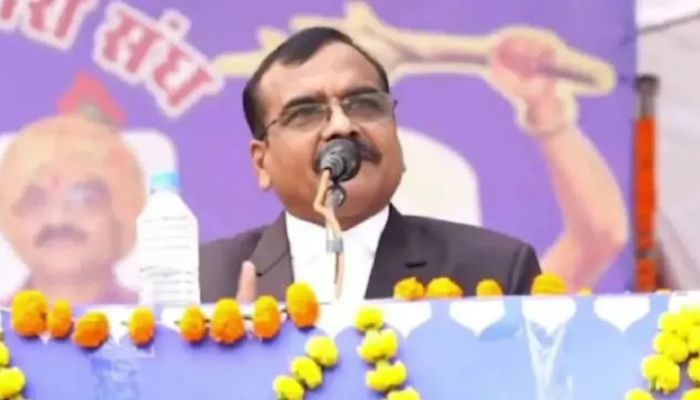
Bhopal witnessed a major controversy on Sunday, 23rd November, after senior IAS officer Santosh Verma, who was recently elected as the state president of Anusuchit Jati Evam Janjati Adhikari Evam Karmachari Sangh (AJAKS), made an extremely objectionable and casteist remark during a public event. The comment, made at the Ambedkar Maidan in the state capital, quickly snowballed into a statewide outrage, raising questions on his intentions, the organisation’s image, and the growing caste tensions in the political environment.
Verma said that reservation in India should continue until a Brahmin gives his daughter to his son in marriage or forms a relationship with him. A video of this statement went viral within hours, and the reaction was immediate, intense, and in many cases, deeply worrying.
Speaking on whether reservation should be granted on economic basis he said, “until a Brahmin donates his daughter to my son or has a relationship with him, reservations should continue.”
Many people have called the remark casteist, misogynistic, and deliberately provocative. Others believe it is part of a dangerous narrative that fuels division rather than strengthening social harmony. At a time when reservation is already a sensitive issue, this kind of statement has raised alarms across communities.
This report looks at what exactly happened, how different groups reacted, and why Santosh Verma’s past is also being discussed again after this latest controversy.
Where the controversial statement was made
The incident took place during the provincial convention of AJAKS, held at Ambedkar Maidan in Tulsi Nagar. The organisation represents SC-ST employees and officers working in various government departments, and its events usually discuss issues like reservation, promotions, workplace harassment, and representation.
During his speech, Verma started talking about economic reservation and social discrimination. But within minutes, his tone changed, and he made the remark that has now caused a political storm.
In the viral video, Verma is seen saying that reservation should continue until upper-caste families, especially Brahmins, accept SC communities as equals in social relationships. The way he framed it, “until a Brahmin donates his daughter to my son or forms a relationship”, has been widely condemned.
? IAS Santosh Verma: “Reservations should stay until a Brahmin gives his daughter to my son.”
? How can someone in public service speak with such a backward, caste-obsessed mindset…? pic.twitter.com/bnwNVwO3Pw
The reference to “donating a daughter” struck many as insensitive, patriarchal, and totally out of place in modern society. Several women’s groups have questioned the mindset behind such a statement, saying it treats women as objects rather than individuals with agency.
People are also asking whether reservation, a constitutional tool meant for social justice, should ever be discussed in terms of personal relationships or caste revenge.
Anger from Brahmin organisations and demand for action
The president of the Akhil Bharatiya Brahmin Samaj, Pushpendra Mishra, called the comment “highly condemnable” and demanded immediate action from Chief Minister Dr Mohan Yadav.
Mishra said that Verma’s remarks insulted the entire Brahmin community and that legal action should be taken against him under relevant sections. If the government failed to act, he warned of a state-wide agitation.
Similarly, Dr Shailendra Vyas, head of the Brahmin Sabha Madhya Pradesh, said the remark reflected a “cheap and divisive mindset.” He said that someone holding a high administrative post should behave responsibly, not make statements that can create tensions.
He added that if the government didn’t take action, the community would be forced to take matters into its own hands. His response itself showed how quickly caste anger can escalate when provocative comments are made from public platforms.
Sharp criticism from other employee groups too
It wasn’t just Brahmin organisations that opposed Verma’s remark. Employee associations from different castes and communities also condemned it.
The president of the Ministry Employees Association, engineer Sudhir Nayak, said Verma’s words insulted the entire upper-caste community and went against the spirit of equality. He emphasised that marriage is a personal choice and that daughters are not objects that can be “donated” or exchanged.
He reminded the audience that Indian society has already changed a lot. He cited examples such as Dr B.R. Ambedkar’s marriage to Savita Ambedkar, who came from a Brahmin family, and former Union Minister Ram Vilas Paswan’s marriage to Reena Sharma. These examples, he said, show that change should be natural, not forced through provocative statements.
Another association, the Class III Employees Union, also criticised Verma. Their general secretary, Umashankar Tiwari, said that statements like these create unnecessary tension among colleagues who already come from diverse castes and religions and work together every day. He asked why a platform meant for government employees was used for divisive rhetoric.
Many employee groups expressed concern that such comments destroy the atmosphere of cooperation inside government offices. When a senior leader makes such remarks, it becomes difficult for subordinates to trust each other.
Santosh Verma’s controversial past
As the controversy grew, many people started revisiting Santosh Verma’s past. This isn’t the first time he has been accused of misconduct.
In 2021, Verma was arrested in Indore on charges of criminal intimidation, harassment of a woman, and even producing fake court documents to secure a promotion from the state cadre to the IAS cadre.
According to a report by The Times of India, Verma created two fake court orders, one a settlement order and another an acquittal order. These documents carried the date of 6th October, 2020, but the judge was actually on leave that day, raising suspicions.
A departmental inquiry confirmed that only one genuine order existed, while Verma had submitted two. When the woman involved in the case complained to the Chief Secretary, the investigation deepened, and Verma was eventually arrested after 12 hours of questioning.
He had then claimed that the woman herself provided him the documents, but this argument collapsed during the inquiry.
Apart from the forgery case, Verma’s personal conduct has also been discussed before. Several reports claim that he has had multiple affairs, even while being married, and that complaints related to inappropriate relationships have been filed against him in the past as well. His reputation, many say, has always been controversial.
This history is now being linked with his latest statement, with critics saying that someone with such a record should not be leading an organisation representing thousands of employees.
When the leader is questioned, what happens to the organisation?
Verma’s new role as the state president of AJAKS has brought additional scrutiny. AJAKS is an influential organisation representing SC-ST employees across Madhya Pradesh. People expect its leaders to speak responsibly, especially on sensitive issues like reservation and social justice.
But Verma’s comment has placed the organisation in an uncomfortable position. Many fear that AJAKS could get branded as a divisive organisation even though past presidents have never made such statements.
This is why several employees believe the matter is not just about one individual, it affects the credibility of the entire organisation. When the person leading a major association uses caste-loaded language, it spreads negativity among thousands of employees, especially at a time when caste relations are already tense in many parts of the country.
When ‘social justice’ turns daughters into bargaining chips
Santosh Verma’s remark about “Brahmin daughters” mirrors a deeply problematic pattern seen in modern social activism, where women are reduced to symbols and bargaining tools to push larger ideological agendas. Much like how certain narratives project interfaith harmony by placing Hindu women at the centre of grand social experiments, Verma’s statement treats daughters not as individuals with agency but as instruments to “prove” social equality. This kind of rhetoric wrongly shifts the burden of social reform onto women’s bodies and personal lives.
What makes the remark particularly dangerous is that it echoes a long-standing tendency to romanticise social cohesion while ignoring uncomfortable ground realities. Just as glossy narratives promote idealised versions of inter-community relationships without acknowledging real-world conflicts and vulnerabilities faced by women, Verma’s statement trivialises the lived complexity of caste relations. It converts a constitutional tool like reservation into a crude, humiliating social test centred around marriage and family honour.
At its core, Verma’s statement reflects the same flawed mindset that views women as pawns in ideological battles, whether for caste “equality,” religious “harmony,” or political symbolism. Equality cannot be built on the symbolic “sacrifice” of daughters, nor can social justice be achieved through provocative, dehumanising language. When public officials speak like this, they don’t empower marginalised communities; they deepen mistrust, harden identities, and push society further away from genuine, voluntary social change.
A statement that threatens social harmony
India is a diverse country where castes, religions, and communities live together, study together, and work together. Reservation was introduced for social justice, not for revenge or caste retaliation.
But Verma’s statement links reservation to personal relationships and caste pride, which is not just offensive but also dangerous. It sends a message that empowerment should come at the cost of social tension, which was never the intention behind reservation.
If leaders continue making such inflammatory remarks, the consequences will be felt everywhere, offices, schools, families, and even politics. The gap between communities could widen, and trust could break down.
In workplaces, upper-caste employees might start feeling targeted or suspicious. Lower-caste employees might feel emboldened by provocative rhetoric rather than constructive dialogue. And ordinary citizens will find themselves caught in the middle of unnecessary caste disputes.
When Verma’s history, fake documents, criminal intimidation, complaints from women, is viewed along with this latest statement, many see a clear pattern. His latest comment isn’t an isolated mistake. It fits into a long timeline of questionable decisions and controversial behaviour. A person who breaks the law builds his identity by dividing society. Previous AJAKS presidents have never made such statements, which shows that Verma’s thinking is personal, but its impact is collective.
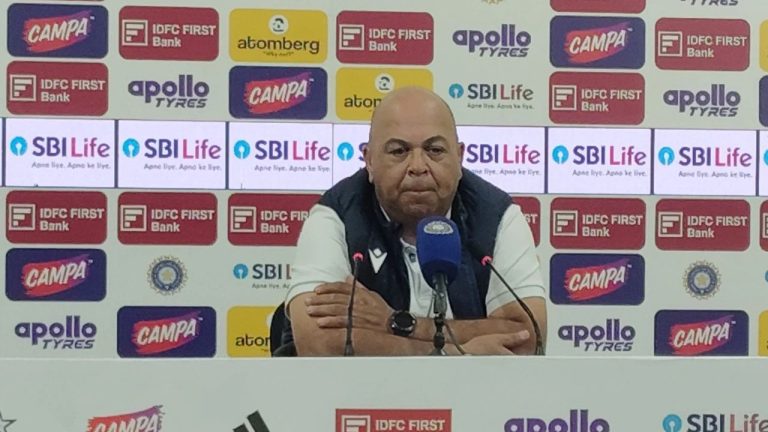
Cricket is a game obsessed with numbers: runs, wickets, overs, and sessions. But every once in a while, a single word carries more weight than an entire scorecard. Shukri Conrad’s remark after Day 4 of the second India-South Africa Test in Guwahati that South Africa wanted India to “grovel” was one such word.
And in no time, social media was up in arms. Conrad’s comment triggered massive outrage online and prompted newsroom discussions on the choice of words used by the coach of a team that has dominated the ongoing test series against India. Some of the fans were simply livid with the Indian cricket team’s head coach, Gautam Gambhir, the support staff, and the players for putting us in a position where we had to swallow insulting remarks from a visiting team.
When asked in the press conference about South Africa’s strategy to bat longer and not put India into bat earlier, Conrad said, “We obviously looked at how best we were going to use the new ball, because in the morning we still wanted a newish, hardish ball.”
He further added, “What we felt is that when the shadows come across the wicket in the evening, there’s something in it for the quick bowlers, so we didn’t want to declare too early and not be able to use that.”
“And then, obviously, we wanted the Indians to spend as much time on their feet out in the field, we wanted them to really grovel, to steal a phrase, bat them completely out the game, and then say to them ‘come and survive on the last day and an hour this evening’,” added Conrad, explaining the rationale behind South Africa batting longer than required.
In modern cricket slang, “grovel” is sometimes loosely used to imply subjugation through skill, making a team chase leather, bow for long spells, or survive under duress. Conrad likely meant it in this sporting sense: make India toil, physically and mentally, until resistance bends. Yet cricket is not played in a vacuum. Words in this game don’t float free of history. They carry their own bruises.
But his comments instantly triggered outrage on social media. On X, several users, including journalists, expressed shock and condemned the choice of words used by Conrad, pointing out that “grovel” is not a neutral cricketing term but one with deep racial and historical baggage.
South Africa, the land of Nelson Mandela and also Mahatma Gandhi, suffered so much due to apartheid. A South African should be the last one to say: “We wanted them (India) to grovel.” Maybe Mr Conrad didn’t mean the racial undertone. Hope so
South African head coach Shukri Conrad saying “We wanted India to grovel” in the press conference is a huge misstep. Grovel carries a long history of deeply offensive, racial undertones. Maybe a slip of the tongue, but a costly one.
In the Cricketing parlance, "Grovel" is considered as a highly offensive term. The world remembers what happened to the guy who said this the last time. Yet Conrad said it anyway. He knows there won't be a fight back. It's a dead horse. https://t.co/hW9ZJplaQN
But how did the seemingly benign word ‘grovel’ get its racial undertones in cricketing parlance? What was the incident that permanently etched ‘grovel’ as a racial slur never to be used again, until Conrad did for Team India?
When England captain Tony Greig used ‘grovel’ for West Indies
The word “grovel” is inseparable from 1976, from Tony Greig and the West Indies. When Greig, a white South African-born England captain, openly declared that England would make the West Indies “grovel,” it was not received as mere sledging. It was heard as racial and colonial condescension. Clive Lloyd, Viv Richards, and an entire Caribbean side understood it as an attempt to reduce proud, newly assertive Black cricketers to something beneath dignity. What followed wasn’t just a cricketing response, but a cultural and political statement: the rise of the most feared dynasty in cricket history.
That is why Conrad’s words cut deeper than he may have intended. South Africa, of all nations, cannot escape the shadow of apartheid when it comes to racial language. Even though Conrad himself comes from a marginalised community within South Africa’s racial hierarchy, the nation’s institutional memory still makes such words volatile. For Indian fans, already sensitive to historical patterns of condescension toward Asian and African teams, it sounded like an old colonial echo resurfacing in modern garb.
There is also an irony here that history loves. Tony Greig’s “grovel” comment didn’t weaken the West Indies; it forged them into something terrifying. England didn’t make the Windies grovel; the Windies made the world tremble. Cricket’s past teaches us that humiliation, when weaponised through words, often boomerangs.
But will Conrad’s remark spark a revolution of that scale in Indian cricket, which is currently in shambles? The Indian cricket team is already 0-1 down against the touring South Africa. In the ongoing match, they have a mountain of 522 runs to climb and emerge victorious. With just a single day left in the match, victory is no longer a realistic ambition. Survival itself now appears aspirational. It would take nothing short of a minor miracle for India to bat through the day and salvage pride from the wreckage of this collapse.
But the entire episode does serve as a reminder: Cricket is more than two teams battling out to emerge victorious. It is more than wins and losses. It is struggle. A coach explaining a declaration strategy probably did not intend to reopen old wounds, but in a sport whose history is soaked in colonialism, and racism, some words are never free of their past.
Shimla’s Sanjauli is in the news once again and the reason is a giant, five-story illegal mosque. The history of the mosque dates back nearly 30 years, when a controversy erupted immediately after it came into existence. The illegal mosque stands in contrast with the majority Hindu population in the area. A large number of Muslim immigrants come to offer prayers in the multi-storey mosque.
For political gains, the Congress government in the state overlooked the construction of the illegal mosque in a Hindu majority area. Initially, only one room was constructed and gradually the entire five-story mosque was erected. Municipal corporation records show the mosque as an illegal construction. Subsequently, the state goverment ordered the demolition of the mosque, but the order was stayed.
Hindus of Sanjauli have lost all patience due to the stay order and prolonged legal proceedings. As a result, the Hindu Sangharsh Samiti has launched protests against the illegal mosque.The Samiti had demanded that the water and power supply to the mosque should be cut off. The Municipal Corporation had assured the Samiti that the power and water supply will be cut off as demanded by them, however, no action has been taken so far.
A stage for the Hindu protestors has been set up near the Sanjauli police station. Days are warmer, but the temperature drops to 3 to 4 degree celcius at night, but Hindu protestors, disappointed with the Himachal Congress government and the local administration, are not willing to budge.
OpIndia spoke exclusively with members of the Hindu community who were protesting and listened to their concerns. According to Kamal Gautam, a member of the committee, the matter caught public attention on August 30, 2024, when a group of 5-6 Muslim immigrants assaulted a local youth and injured his head. The accused were sheltered in a mosque, from where they were nabbed by the police. Incidents like this have exhausted the patience of local Hindus. The peace of the hills has been plagued by rising crime committed by the Muslim immigrants. The illegal mosque in Sanjauli has become a haven for such criminals.
Conspiracy to change demographics
OpIndia spoke to Vijay Sharma, a local who is taking part in the ongoing protests. Sharma said that the number of people coming to Himachal Pradesh from outside has increased rapidly. He added that new faces appear in the area everyday and their activities seem suspicious. He expressed concern for the safety of local women. According to Vijay Sharma, the Muslim population in the area was about 3% but their has significantly increased in a short period of time. Infiltrators from outside, including Bangladeshi nationals, Rohingyas, and Muslims from other states, have contributing to this increase in the local Muslim population.
“The local demography is being altered as part of a conspiracy. There’s a well-planned plot to suppress Hindus. Shimla isn’t a big city, and Sanjauli is an even smaller locality. Settling in a small area like Sanjauli, far from the main city of Shimla, is not usual. There is no Muslim population here, but slowly, crowds are gathering here to change the local demography. Fruit vendors have started selling fruits at cheaper prices. Now, the situation has become so bad that locals are being attacked. We’re worried about the future. I think the next generation will start offerig praying,” Sharma said.
Mohammed Salim, who built the mosque, is the biggest conspirator
According to Vijay Sharma, the incident of the local youth being attacked by some Muslim immigrants sparked public anger. Massive protests erupted on September 5, 2024, and September 11, 2024. These sparks had been simmering for years.
Sharma said that Mohammad Salim arrived in Sanjauli in 1990. He was a tailor. He occupied a piece of government land after a school built on it was shifted. He constructed a single-story structure on it, which gradually tranformed into a multi-storey building. He developed the structure into a mosque. For political gains, he was granted an NOC from the Waqf Board for the mosque.
The mosque received huge funding, soon a full-fleged mosque came up. As the number of floors increased, so did the number of Muslims who came to offer Namaz in it. Th entire five-story structure began to be used solely as a mosque. Notably, the locality has no Muslim settlements nearby. The Muslims who come to the mosque to offer Namaz are predominantly outsiders.
Even though the mosque has a large structure, it has only two toilets on the ground floor. The number of toilets is insufficient for the large number of Muslims, who gather to pray in the mosque. Therefore, the Muslims perform ablution before offering Namaz in the open.
The area has a major Hindu community. In the afternoon, women walk their children home after they return from school or go out for daily chores. Such large number of Muslim men performing ablution in the open, causes inconvenience to the local Hindu women. When the women objected to Muslims performing ablution in the open, they faced lewd comments. However, they did not report the matter to the police, as it is common practice in the mountains not to involve the police in personal matters.
Amrita Chauhan, another local, said “When our sisters return from school with their children, they are stopped during namaz until the worshippers have left. Even Muslim carts and ready-made shops have started popping up in large numbers. Women face lewd comments when they go shopping.”
Mehboob Sheikh turned hostile after becoming Assistant Town Planner
The activities of Mohammad Salim, who laid the foundation for the illegal mosque, were suspicious. The Municipal Corporation had also demanded action against Mohammad Salim for the gathering a Muslim mob and the illegal construction of the mosque between 1990 and 2024. At that time, Inspector General Mehboob Shaikh had indicted Mohammad Salim in an investigation, but later reversed his decision.
Speaking to OpIndia, a local said that upon becoming Assistant Town Planner, Mehboob Sheikh gave a clean chit to Mohammad Salim in his report. He said that Mohammad Salim had no involvement in this matter. He suggested that the Waqf Board should be made a party in the case. Locals said that Mehboob Sheikh played a major role in arranging funds to expand the mosque. According to Vijay Sharma, people continued to demand an investigation against Mehboob Sheikh and his properties, but no the government paid no attention.
Attempt to set anti-Hindu narrative
During Congress rule, attempts were made to establish an anti-Hindu narrative. Recently, young children in a prestigious convent school, were asked to wear white kurta-pajamas and a net cap on Eid, and to bring vermicelli for lunch. This caused anger among the parents of the children. “Vermicelli isn’t a traditional food in the mountains. We asked them if they celebrated Mahavir Jayanti, Durga Puja, or Janmashtami. If not, why are you asking us to celebrate Eid?” said Kamlesh Mehta, a parent. Finally, under pressure from the parents, the school reversed its decision.
Kamlesh says that the Sanatan community in the state is concerned about their children and their future. They are concerned about the next generation. He added that a video of a Congress MLA has gone viral in which he was seen telling the Muslim side to thank him during a press conference. In fact, when the Chief Minister said that he came to power by defeating 98% Hindu ideology, what can we expect from him?
Local Hindus are demonstrating for the demolition of an unlawful mosque in Sanjauli which is near Himachal Pradesh’s capital Shimla. The Hindu Sangharsh Samiti asserted that the Congress government in the state has failed to act, despite directives from both the Shimla Municipal Corporation and the Sessions Court. In fact, the court ruled the mosque as an illegal structure and even mandated its demolition.
Due to protests from locals, no one is permitted to conduct prayers there. The OpIndia team visited the site and engaged with the residents to gain insight into their views.
The people stated that the victors to the illegal mosque often harass Hindu women and girls as they walk along the road. The sole access route to the mosque passes through a Hindu-inhabited area. Multiple incidents of voyeurism, stalking have been reported by locals, stating that some mosque visitors even peek inside Hindu houses and pass comments on women.
OpIndia also went to the mosque to talk with the Muslim cleric and learn about his perspective on the situation. However, neither the mosque committee member nor the imam was willing to comment, despite considerable efforts.
There was another staircase next to the unauthorised structure which we used to converse with a man. He immediately refused to talk when the journalist’s name was mentioned. He provided a phone number and several attempts were made to get in touch with the person who refused to speak and the call was cut off.
The call was terminated when we inquired about the response over the allegations. In an interview with OpIndia, local resident Rajkumar Sharma remarked that the construction of this mosque progressed at a slow pace. A primary school previously occupied this location and he was also a student there. The institution eventually relocated to Dharamshala. After some time, small mounds began to appear on this site as a small mosque came into existence which expanded over time.
This is the reason the lower floor of the mosque is plastered while the walls of the upper two floors were left unplastered. The first floor was built first and the two additional floors were added afterward. Prayers are conducted on the lower floor and the cleric stays on the upper levels. Two extremely dirty washrooms can be found upon entering the mosque. The area for performing ablution is also very filthy.
According to Rajkumar, the surrounding area is primarily Hindu and Muslims gathered in proximity to the mosque following its construction. They travel from distant locations to offer their prayers at this mosque. The route leading to this site includes a staircase and a mere glance at this pathway revealed that it was designed for the passage of a limited number of people.
"प्राथमिक स्कूल बना मस्जिद, सलीम टेलर ने इकट्ठा किए मुसलमान"
खिड़कियों से अब करते हैं आसपास के घरों में ताक-झाँक, बच्चियों को कहते हैं 'माल' @Anurragmishra को शिमला की अवैध मस्जिद के पास रहने वाले स्थानीय व्यक्ति ने बताई परेशानी! pic.twitter.com/mTcHmfroDL
As the OpIndia team progressed further, they attempted to speak with several individuals. RK Singh, a healthcare professional, noted that both the Bharatiya Janata Party and Congress governments have remained in power in the state. He raised the question of where the government was during the construction of the mosque.
Singh outlined that the matter is currently before the court, however, the government bears responsibility for the unlawful building. He added that the law applies equally to all citizens of the nation. Hence, everyone should await the court’s verdict and the mosque should be dismantled if it is pronounced illegal.
We had a discussion with Ravi Kumar, a nearby vegetable vendor. He indicated that some individuals are calling for the mosque’s removal. He has been living in this locality since 1990 at which time a small mosque was present. A significant number of Kashmiris, along with other outsiders, visit there to offer their prayers. He expressed that this matter should be resolved in line with constitutional guidelines.
While walking along the path, the OpIndia team noticed a collection of small houses in the vicinity. Hindus have lived in this area for many years. Out of concern for potential controversy, these people appeared reluctant to talk about the issue. Several closed their doors promptly when their names were mentioned. This reflects the scale of fear that the residents experience.
The presence of a mosque in this area raises considerable concerns, particularly given the absence of a Muslim community there. Additionally, the mosque does not align with the local cultural practices. The first floor is finished with plaster, while the upper two floors remain unplastered. Reaching the mosque necessitates ascending a flight of stairs and Hindu residences are situated on either side of the pathway.
According to the local populace, individuals from the mosque frequently peer into the windows of residences as they proceed to their prayers. They have been reported to intimidate females who are walking by. As a result, the residents are determined to see the mosque relocated at any cost.
The violence that took place during the so-called anti-pollution protests, where demonstrators glorified slain Naxal commander Madvi Hidma and attacked police with pepper spray, has attracted Section 197 of the Bharatiya Nyaya Sanhita (BNS) against the attackers, which deals with acts, statements or communications that threaten India’s sovereignty, unity, integrity or security. Twenty-two attackers were booked and fifteen are currently in judicial remand. While the attackers are facing strict legal action, the digital footprint of the organisations associated with the organising groups has revealed a problematic past.
Delhi Police has added BNS section 197 in the FIR registered at Kartavya Path Police Station in connection with India Gate protest: Delhi Police
As per the Delhi Police, "The protesters were holding posters of Maoist commander Madvi Hidma (who was recently killed in the…
On 23 November, a group of protesters gathered at C-Hexagon near India Gate to demonstrate against rising pollution in Delhi. The protest was spearheaded by left-leaning student organisations, Bhagat Singh Chhatra Ekta Manch (bsCEM) and The Himkhand, which had invited several other organisations to join.
Although the protest was ostensibly about pollution, it soon morphed into propaganda as members of The Himkhand and bsCEM raised pro-Naxal slogans. They glorified the recently killed Naxal commander Madvi Hidma and shouted slogans such as “Comrade Hidma Amar Rahe”. When the police tried to intervene, the protesters not only attacked police personnel but also used pepper spray on them, causing injuries to the eyes and face.
As a result, two FIRs were registered against 22 protesters, of whom 16 were arrested. Fifteen were sent to judicial remand by Patiala House Court on Monday, while one was sent to a juvenile safe house after claiming to be a minor. Furthermore, Section 197 of Bharatiya Nyaya Sanhita (BNS) has been added to the FIRs which deals with acts, statements or communications that threaten India’s sovereignty, unity, integrity or security.
Scientists For Society distances itself
While gathering support for the protests, bsCEM and The Himkhand contacted several other organisations that have similar ideological leanings. One such organisation was Scientists For Society. After the protests were derailed from the intended topic on Sunday, the organisation issued a statement distancing itself from the pro-Naxal slogans raised at the site that led to the violence, the attack on the police and the arrests.
Source: Instagram
In its statement, the organisation said, “We want to clarify that we joined this forum solely on the issue of pollution when we were approached by Himkhand. At no point were we informed that Himkhand and bsCEM planned to raise any unrelated or adventurist slogans. As soon as we realised what was happening, we first tried to stop them; when they refused to respond, we immediately distanced ourselves from them and continued addressing the common people and carrying forward the protest separately. We also want to reiterate that this act on part of these aforementioned organisations is completely undemocratic, totally against the ethics, mandate and common minimum programme of the issue-based joint front based on the issue of pollution crisis in Delhi.”
The organisation’s problematic stance on Hidma
While the organisation distanced itself from the “adventurist slogans” glorifying Madvi Hidma, it cunningly called the killing of the most wanted Naxal an “extrajudicial killing”. Even before distancing itself from the slogans, Scientists For Society categorically called for a “high-level inquiry” into the “extra-judicial encounters of Hidma and his associate”.
Source: Instagram
They said, “While we strongly believe that there should be a high-level inquiry into the extra-judicial encounters of Hidma and his associates and we unequivocally condemn these encounters, we also believe that this was not the appropriate platform to raise this issue. Ordinary students and citizens had joined this protest specifically to address the issue of pollution.”
Examining the organisation’s ideology
OpIndia looked into the history of the organisation, which started posting on social media around November 2020, to understand its ideology and the campaigns it had participated in previously, and some problematic things came to the fore. While the organisation claimed to be pro-science and stated that it works to encourage students to pursue science, build libraries and more, there are posts that categorically put them in the list of left-leaning organisations. Of course, while it is a fact that if bsCEM and The Himkhand had invited them, it was obvious that they shared similar ideology.
Pro-Palestine narrative
On 8 November, the organisation published a post that it claimed was about pollution in Delhi. However, during the protests, they admitted to having expressed solidarity with the people of Palestine.
One of the speakers at the protest spoke about pollution in Delhi and then continued to criticise the President of the United States, Donald Trump, for suggesting there is no problem of pollution. He then brought up the issue of Palestine and said, “The biggest example today is the liberation struggle of Palestinians against the ongoing barbaric genocide. Scientists For Society along with other organisations stand in solidarity with Palestine because we cannot talk about environment without standing with the masses, without standing with humanity.”
He then praised controversial environment activist Greta Thunberg and echoed her statement that there is no use talking about climate change when thousands of children are dying on the other side. He also raised the slogan “From the river to the sea, Palestine will be free”.
Greta Thunberg is known for participating in every protest even if it is not about the environment just for the sake of a photo-op. During the farmer protests in India, she accidentally shared a toolkit that was being used to paint India in a bad light on the international platform. Though she immediately deleted the link to the toolkit, it exposed how the farmer protests were hijacked by individuals and organisations with vested agendas.
The organisation has a long history of a pro-Palestine stance. On 23 October, it criticised esSENSE for “denying genocide in Gaza”.
Coming to the pro-Palestine slogans raised by the members of SFS, “From the river to the sea” is literally a genocidal call. It specifically alludes to the territory situated between the Jordan River, marking the eastern border of Israel, and the Mediterranean Sea to the west.
People raising this slogan want the land between the two boundaries to be free of Jewish people. They want the entire land between the Jordan River and the Mediterranean Sea to be Palestine, which means they want the elimination of the state of Israel. This is clearly a call for genocide of Jews, essentially another Holocaust.
The Islamist ideology behind the slogan “From the river to the sea, Palestine will be free” is often seen as an intent of genocide. In 1966, Hafez al-Assad, the Syrian leader and father of the country’s current dictator, stated, “We shall only accept war and the restoration of the usurped land to oust you, aggressors, and throw you into the sea for good.”
Terrorist outfit Hamas, responsible for the deaths of 1,400 people on 7 October, asserts its rejection of Israel with the statement, “Hamas rejects any alternative to the full and complete liberation of Palestine, from the river to the sea,” as outlined in the organisation’s 2017 constitution.
Targeting Hindus and Diwali
On 2 November, the organisation criticised the Government of Delhi for allowing fireworks on Diwali, which was actually allowed by the Supreme Court on the government’s request. The aim of the post was not only to criticise the CM Rekha Gupta-led BJP government in the National National Capital but also to present the Hindu festival of Diwali as a major contributor to the pollution problem. Phrases like “Godi Media” were also used in the post against media houses that left-leaning organisations believe are pro-government.
Source: Instagram
Targeting Hindus and Diwali, the organisation wrote, “How could this even be possible? After all, how can a ‘Hindu’ government in a country of ‘Hindus’ stop ‘Hindu festivals’ from being celebrated, even if it means ordinary people, such as those living in Delhi NCR, fall ill or even lose their lives?”
In the aftermath of the violence, several organisations that enthusiastically joined the so-called anti-pollution protest are now scrambling to shield themselves from police action by hurriedly disowning the pro-Hidma sloganeering. Yet their own digital footprints tell a very different story. Their posts, statements and past campaigns reveal that they all belong to the same ideological cult, united by a familiar script of Naxal sympathy, Palestine activism and routine Hindu-baiting. No amount of last-minute distancing can erase what their own public record has already made abundantly clear.