Home Blog Page 2421

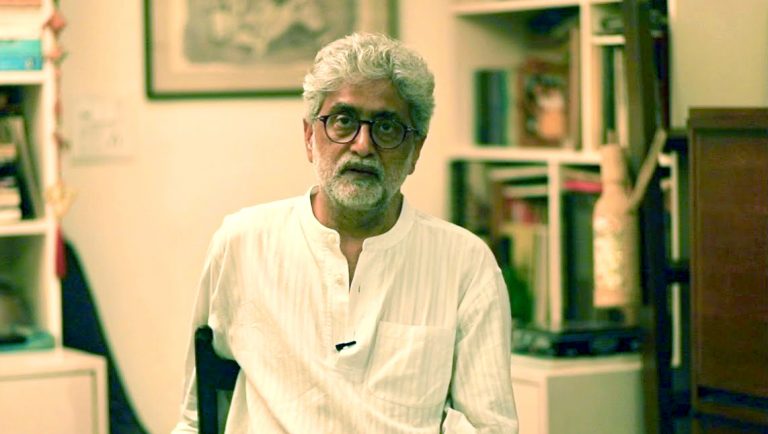
Lawyers give new twist to Urban Naxal Gautam Navlakha case, despite connections to ISI, argue that he went there as a “journalist”

On Tuesday, Gautam Navlakha’s attorney, Yug Mohit Chaudhri, told the Bombay High Court that Navlakha is being accused of having Maoist ties although he has only conducted a few interviews and published them as a ‘journalist’. Navlakha is one of the accused held in the Bhima Koregaon violence case.

“Allegations against me is that I have a connection with Maoist leader. That is correct because I have conducted interviews and published them. Consider if a journalist wants to interview Dawood Ibrahim and goes to Pakistan on a valid visa then would MCOCA be attracted?” the lawyer said on behalf of the accused.

He said that while it does not represent organized crime, contacting them is necessary in order to conduct an interview. He also cited the charge sheet’s reference to the paper that was discovered on Navlakha’s computer. He explained to the court that it was really a critique of Maoist ideology, practice, and brutality.

The attorney further relied on Navlakha’s book and said, “When you read the passages he is talking about the massacre conducted by Maoists and criticizing it and asking who is authorizing it. Can it be said he is indulging in violence? He is pointing to three acts of Maoist and asking who is authorizing them. I could point to a large number of articles written by him where he is criticizing Maoist but those are not part of the chargesheet.”

The Bombay High Court was informed by the NIA in its response to the bail motion made by the accused Gautam Navlakha that the terrorist Ghulam Nabi Fai had referred Gautam Navlakha to a Pakistani ISI General in order to recruit him.

Moreover, according to the NIA, Navlakha made three trips to the US to speak to the Ghulam Nabi Fai-founded Kashmiri American Council. The reply further indicated that Navlakha had written to the US Court requesting clemency after Fai was detained by the FBI.

Ghulam Nabi Fai was arrested by the FBI in July 2011 for accepting funds from ISI and Pakistan Government, but failed to report the origin of those funds, as required by US law. It is established that, accused Gautam Navlakha had written a letter to the Hon’ble Judge of the US Court, trying Ghulam Fai’s case for clemency. Accused Gautam Navlakha had also submitted letters to Hon’ble US Court on behalf of Fai,” the reply read.

After being detained at Taloja Jail cell, Gautam Navlakha was arrested among the other accused parties in the 2018 Bhima Koregaon Violence case. The Bombay High Court rejected Navlakha’s request in April of last year for a directive to be placed under house arrest till the conclusion of the trial. Navlakha had asked for a transfer out of Taloja Prison because of his old age and health issues.

The Supreme Court recently permitted his plea to be changed to house arrest in November 2022. In September 2022, a Special NIA Court denied Navlkha’s request for release, and he then appealed to the high court.
Bihar: Indian Army jawan assaulted and arrested by police after one Naseem Akhtar lodged an FIR against him

0

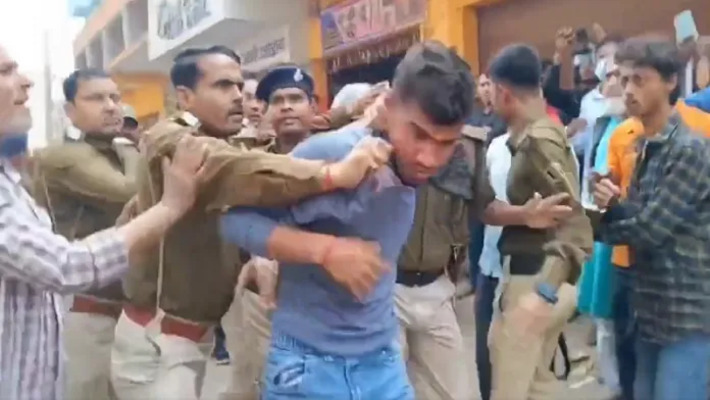
The Bihar Police has been marred by a case that has surfaced in Raxaul, a sub-divisional town of East Champaran, Bihar wherein an Indian Army soldier was beaten, dragged, harassed, and imprisoned by the Bihar Police.  The family of the soldier has demanded justice in the matter while the locals have launched protests against the police action.

The video shows Bihar police officers assaulting a man on the streets of Raxaul. While stopping the person filming the video, the man keeps referring to himself as an army soldier. Radha Mohan, a resident of Belaghati, is the son of Pramod Giri. He was travelling to Raxaul to drop off his wife Kajal, who was taking an exam. During their journey, a person in Lakshmipur allegedly got injured by his car’s side-view mirror.

An FIR was filed by one Naseem Akhtar against Radha Mohan claiming that his uncle got injured and fainted because of the mishap. When Inspector Jitendra Kumar arrived, he ordered take the army man to the police station. Near the main road’s Hazarimal High School, Radha Mohan Giri and along with his family dropped off his wife. As they started to park the car on one side of the road, the sub-inspector started misbehaving with him.

The family persisted in waiting for justice at the police station, but the officers paid them no attention. Even though the Superintendent of Police claimed that necessary action will be initiated against said officers, none of them have been punished yet despite a week having passed since the viral video surfaced. 

The copy of the FIR filed by Naseem Akhtar has also been shared by Manish Kashyap, a well-known YouTube journalist from Bihar. Complainant Naseem Akhtar claimed that his uncle fainted due to the injury and it was the army man who abused him.

Bihar Police misbehaves with and arrests father of a soldier who died in Galwan Valley clash, Deputy CM Tejaswhi Yadav gives clean chit to the police

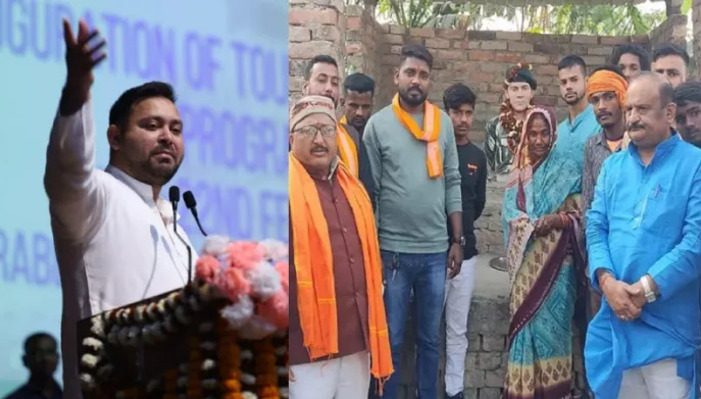
The issue of police misconduct involving Raj Kapoor Singh, the father of the martyred soldier Jaikishore Singh, in Vaishali reverberated in the Bihar Legislative Assembly. In protest over the matter, BJP MLAs walked out of the assembly during the session. On the other hand, Bihar Deputy CM Tejashwi Yadav tried to blame the martyr’s family.

The mistreatment of Raj Kapoor Singh in the Chakfateh village of the Jandaha police station area, Vaishali, triggered an uproar in the state assembly. Several BJP MLAs protested the arrest of the martyr’s father. When the BJP MLAs arrived at the Well, they raised slogans like “Shame on the Bihar government.” Tejashwi Yadav made an attempt to pin the incident on Raj Kapoor Singh.

Tejashwi Yadav claimed that the family members intended to erect the statue on the Dalit’s land. On the arrest of Raj Kapoor Singh, he said that the law is doing its work. On the other hand, the DGP of Bihar has handed the investigation into the police’s misbehaviour with the martyr’s father to the CID.

Tejaswhi Yadav blames the martyr’s father

Tejashwi Yadav claimed that although the martyr’s family wanted to erect a memorial, they were unwilling to give the property. Tejasw asserted that the family intended to build a statue on the nearby Dalit property. Tejashwi also questioned, “How is this even feasible?” In relation to Raj Kapoor Singh’s arrest, he claimed that the police are investigating it. Vijay Sinha, the leader of the opposition, expressed discontent over the imprisonment of the father of a martyred Jawan and accused the administration of demeaning soldiers and martyrs.

Rajwinder Singh Bhatti, the DGP of the Bihar Police, has tasked the CID team with conducting the investigation. According to an official statement released by police headquarters, the Criminal Investigation Department team will look into the entire episode. Rajwinder Singh Bhatti, the director general of police in Bihar, has stated that the police officer who was found guilty during the probe will face disciplinary action.

Ashok Choudhary, a JDU leader and the Building Construction Minister in the Bihar government, has expressed regret for the treatment Raj Kapoor Singh received. However, he did not utter a single word against the police officials who misbehaved with the father of martyr Jai Kishor Singh.

The issue

In order to honour his son who sacrificed his life for the country during the 2020 Galwan Valley clash with the Chinese troops, Raj Kapoor Singh, a resident of Chakfateh village in the Jandaha police station area of Vaishali district, was having a memorial built. The property on which the memorial is being constructed is in question. The owner of a plot next to the plot where the memorial is being built has alleged that Raj Kapoor Singh has encroached govt land to build the memorial.

Harinath Ram, who owns the plot located next to the land on which the memorial was being built, has alleged that it is actually government land, and the memorial is being constructedon without the government’s permission. Harinath levelled the accusations when Raj Kapoor Singh built a wall around the memorial.

Additionally, Harinath Ram also filed a case against Raj Kapoor Singh under the SC/ST Act including illegal possession of the land. Following this, the station in-charge Vishwanath Ram arrived to arrest Raj Kapoor. He is accused of assaulting Raj Kapoor Singh and insulting him while dragging him to the jeep.

Several activists belonging to the Bajrang Dal and other organizations, as well as the victim’s family, arrived on the scene as soon as they learned about the incident and accused the station in charge of acting in Harinath Ram’s favor. They claim that because of their fraternity, the station in charge is acting in favor of Vishwanath Ram and Harinath Ram. There are reports that the police intervention has also been captured on video. The station in charge’s resignation is also being demanded.

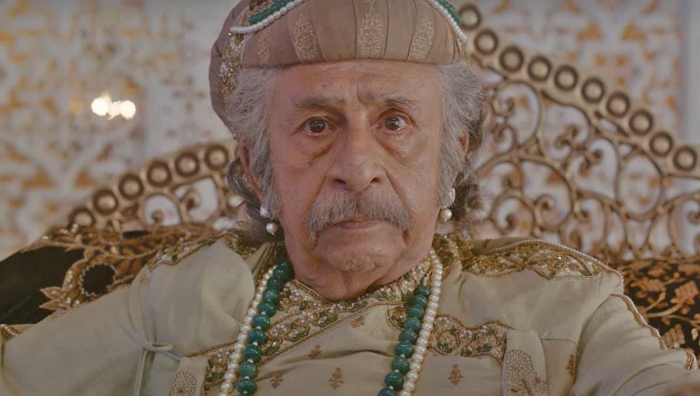
Naseeruddin Shah highlights ‘misinformation’ about Akbar in history books, says Akbar never used ‘Din-e-Elahi’ term, never wanted to start new religion

Bollywood actor Naseeruddin Shah has stated that Mughal emperor Akbar never used the term Din-e-Elahi and that he never intended to create his new religion. He said that his understanding of who Akbar was as an emperor and a person has evolved over the years and that misinformation is being spread about Akbar that he was a ruler who wanted to start his own religion.

In an exclusive interview with Indian Express, Shah said, “The picture drawn of Akbar was always that of a benevolent, kind-hearted, broad-minded, progressive ruler. The one fly in the ointment is his desire to start a new religion. We read about this in history books, which is absolute nonsense. I have checked this with authoritative historians and Akbar never did attempt to start a new religion. This is a fact which was in our history books called the Din-e Elahi. But Akbar never used the word Din-e Elahi, ever.”

He said Akbar used the term Wahdat-e Elahi which means oneness of the creator. “You may worship a stone, you may worship a crucifix, you may bow your head to the Kaaba, you may worship the rising sun and do what you like, but you are worshipping one and the same thing. That was his belief. This is what I found out,” he added.

Shah said that he tracked down the source of the ‘rumour’ and discovered that historian Abul Fazal, who disliked Akbar, was responsible for the term Din-e Elahi’s creation. It was referred to in his writings as the ‘divine faith’ in English, he noted.

According to the actor, the word ‘divine faith’ (din-e elahi), which Akbar never used, was later translated into Persian. “It’s similar to those South Indian movies that get remakes in both Hindi and the South! I had to talk to the writers about this significant revelation I had discovered regarding Akbar. Fortunately, my objections were upheld,” he said.

He meanwhile also showered praises for the Mughal emperor and said that he was a soft-hearted, vulnerable man and he was also a very passionate, sexually driven, ferocious, merciless warrior. “He must have been a great lover. I mean, he had hundreds of concubines and to keep each of them happy must have been some job! I don’t know if all of them were happy though. But I played him, to find the human being within this grandeur,” he was quoted as saying during the interview.

According to the popular, mainstream ‘history’ reports, Mughal emperor Akbar founded a new religion named Din-e-Elahi in 1582. There were only 19 followers of this religion which encouraged Suryapuja, Havan, and Murtipuja as well. The Mughal king attempted to build religious tolerance but made it mandatory for the followers of the new religion to worship him as the Prophet.

His faith was neither adopted by those outside of his court, nor did his own children adopt his new religion. It was also severely criticized by Sunni officials who had asked him to limit his wives from around 5000 to 4 as per Islam. The Sunni officials also criticized the new religion as it attempted to ban beef. The religion died with Akbar’s death. However, Shah claims that Akbar ever used the term Din-e-Elahi and that he never formed a new religion.

The actor will be seen portraying Mughal Emperor Akbar in the upcoming ZEE5 original series named Taj: Divided By Blood. The series aims to reveal the internal workings backed by the sensational drama of the Mughal empire.

Aditi Rao Hydari plays Anarkali in the ensemble cast of the show, which also stars Aashim Gulati as Prince Salim, Taha Shah as Prince Murad, Shubham Kumar Mehra as Prince Daniyal, Sandhya Mridul as Queen Jodha Bai, Zareena Wahab as Queen Salima, Sauraseni Maitra as Mehr un Nisa, Rahul Bose as Mirza Hakim, and Dharmendra as Sheikh Salim Chisti. The series will stream on ZEE5 from March 3.

NIA’s conviction rate touches 93.69 per cent with verdicts in ISIS Kanpur and ISIS Rajkot cases

0

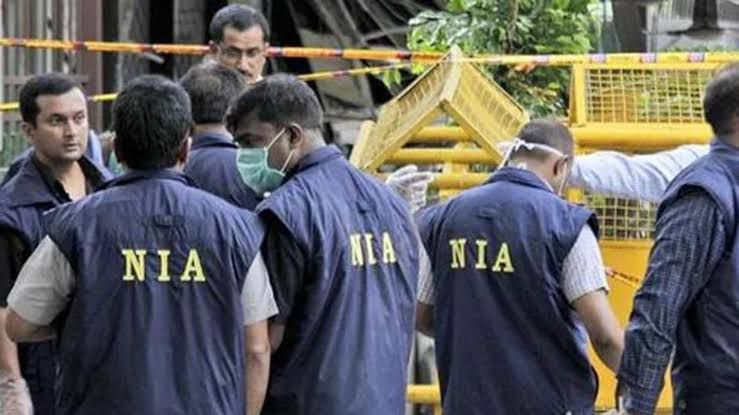
The National Investigation Agency’s conviction rate stands at 93.69 per cent with the pronouncement of sentences for 10 accused in two separate judgements by Special Courts at Lucknow and Ahmedabad.

Both cases relate to the online radicalization of the accused in the name of ISIS, and their motivation to commit violent Jihad and cause terror attacks in the country. NIA Special Court, Lucknow awarded death sentences against seven accused and life imprisonment for one in the ISIS Kanpur case on Monday. However, another NIA Special Court, Ahmedabad sentenced two to 10 years of rigorous imprisonment in the ISIS Rajkot case.

“With the pronouncing of these two sentences, the conviction rate of NIA cases stands at 93.69 per cent,” said the NIA in a statement.

Continuing the tradition of evidence-based investigations, which rely on scientifically collected hard evidence, the NIA said it has achieved yet another milestone.

The eight accused from Uttar Pradesh, Atif Muzaffar, Mohammad Danish, Asif Iqbal alias Rocky, Mohammad Atif alias Atif Iraqi, Mohammad Faisal, Mohammad Azhar and Gauss Mohammad Khan all hailing from Kanpur Nagar, Sayed Meer Hussain of Uttar Pradesh’s Kannauj along with deceased Md. Saifullah had set up a hideout in Haji Colony (Lucknow), said the agency.

“They had prepared and tested some IEDs and had unsuccessfully tried to plant them at various locations in Uttar Pradesh. Investigations have led to the discovery of several photographs of the accused making IEDs and even with weapons, ammunition and ISIS flag,” the NIA said.

“The group had reportedly collected illegal weapons, and explosives from various places.”

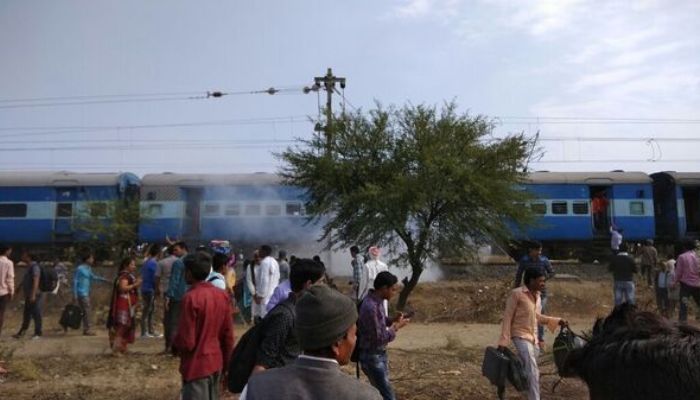
Atif and three others, identified as Md Danish, Sayed Meer Hussain and Md Saifulla had been responsible for fabricating the IED that was planted in the Bhopal-Ujjain passenger train, it said.

The train explosion on March 7, 2017, left 10 injured.

All eight had come together to propagate ISIS ideology and promote its activities in India, said the NIA.

In pursuit of this objective, the agency said, Mohammad Faisal, Gauss Mohammad Khan, Atif Muzaffar, Md Danish, and Md Saifulla had explored land routes and had visited several key cities across the country, including Kolkata, Sundarbans, Srinagar, Amritsar, Wagha Border, Badmer, Jaisalmer, Mumbai, and Kozhikode, for undertaking ‘hijrah’ (migration).

Gauss Mohammad Khan and Atif Muzaffar had, in fact, explored a route to cross over to Bangladesh via Sundarbans, as per investigations, said the NIA.

Faisal, Atif and Saifulla had also travelled to Kashmir in March 2016 in a bid to contact some terrorist groups that could help them to cross over to Pakistan, from where they could migrate to ISIS-controlled territories in Syria.

Another accused, Saifulla, was killed during an exchange of fire with the Uttar Pradesh Anti Terrorist Squad (ATS) on March 7, 2017, in Haji Colony.

The case was initially registered on March 8, 2017, by Lucknow ATS and re-registered by the NIA on March 14, 2017.

After investigations, the NIA said, a charge sheet was filed against eight persons on August 31, 2017.

Post the trial, eight accused persons were convicted on February 24 this year.

NIA Special Judge, Lucknow Court, Uttar Pradesh on Tuesday pronounced a sentence convicting the accused under various offences of the India Penal Code, Unlawful Activities (Prevention) Act, Arms Act and Explosive Substances Act.

Seven of the accused namely Mohammad Faisal, Gauss Mohammad Khan, Mohammad Azhar, Atif Muzaffar, Mohammad Danish, Sayed Meer Hussain and Asif Iqbal have been awarded the death penalty while Mohammad Atif has been sentenced to life imprisonment.

On the other hand, in yet another ISIS-related case, Gujarat NIA Special Court sentenced two terrorists to ten years rigorous imprisonment after the NIA found the use of social media platforms, such as Skype and Telegram, to radicalise and recruit cadres to carry out terror acts in India in the name of ISIS during its investigation.

Both accused Vaseem Arif Ramodia alias Ninja Fox and Naeem Arif Ramodia are brothers and residents of Rajkot in Gujarat.

“Investigations have revealed that they used online chats and messages to advocate and spread the ideology of ISIS. They arranged, participated and assisted in organizing online discussions and meetings among active ISIS operatives to plan and execute acts of violence and terrorism,” said the NIA.

They had tried to commit arson by burning vehicles and shops belonging to non-Muslims, said the agency, adding “they have unsuccessfully tried to fabricate an IED as well”.

On the directions of their online ISIS handlers, the NIA said, both the accused were preparing to carry out a lone-wolf attack at Chotila Temple.

“They had already recee’d the area but they were apprehended before they could carry out the attack.”

The case was initially registered by ATS Ahmedabad and re-registered by the NIA on May 25, 2017, and the Chargesheet was filed against them on August 22, 2017. After the trial was completed, judgment convicting the accused was pronounced on Tuesday.

Prayagraj: Bulldozers roll on properties of mafia Atiq Ahmed’s aides involved in Umesh Pal murder case

In an unexpected development in the Umesh Pal murder case, the Prayagraj Police on Wednesday employed bulldozers to demolish the premises of the accused, who are said to be close associates of gangster-turned-politician Atiq Ahmed. Bulldozers have been sent in to demolish the illegal structures built by the accused in connection with the shocking murder case in Prayagraj. 

According to the reports, the bulldozers were rolled over the properties of one Zafar Ahmed, where Atiq Ahmed’s wife Shaista Parveen was living. Umesh Pal, a key eyewitness in the 2005 murder of the then BSP MLA Raju Pal was shot dead at his residence in Uttar Pradesh’s Prayagraj on February 24.

Umesh Pal was taken to a hospital immediately, but he passed away while receiving treatment. After reviewing the CCTV video from the crime scene, the Prayagraj Police have identified the criminals. According to authorities, a list of suspects and other information has been compiled for further necessary action.

Reports mention that the list was sent to Prayagraj Development Authority (PDA) which gathered details of the unauthorised and illegally constructed buildings and residential properties belonging to the accused. Bulldozers are being utilised by the PDA against the accused in the Umesh Pal murder case after the UP government reportedly gave the PDA permission to do so.

Large scale action on multiple murder accused involved in the Umesh Pal murder case is expected as bulldozers were seen in several places.

Yogi Adityanath, the chief minister of Uttar Pradesh, had previously warned that his administration would decimate the criminals and mafias throughout the state. On Monday, the UP Police shot and killed Arbaaz, one of the suspects in the shocking murder of Umesh Pal, during an encounter. The Special Operations Group of the Uttar Pradesh Police conducted a search operation and spotted the accused near Nehru Park.

Subsequently, Arbaaz, the driver of the white vehicle that the attackers used to attack witness Umesh Pal, was surrounded by police teams as a result of an intelligence input, as per Deputy Commissioner of Police Navendu Kumar. At about 3 o’clock, there was an encounter in Nehru Park, under Dhoomanganj police station, during which he fired at the police and was wounded in the ensuing encounter, Kumar said. The officer added that after being transferred to the hospital, the doctors pronounced him dead.

Based on the complaint launched by Umesh Pal’s wife Jaya Pal, police booked Atiq Ahmed, his brother Ashraf, wife Shaista Parveen, two sons, aides Guddu Muslim and Gulam and nine others.

The accused have been booked under sections 147 (rioting), 148 (rioting, armed with deadly weapon), 149 (unlawful assembly), 302 (murder), 307 (attempt to murder), 506 (criminal intimidation) and 120B (criminal conspiracy) of the Indian Penal Code and provisions of the Explosive Substances Act and the Criminal Law Amendment Act.

Lucknow: NIA court awards death sentence to 7 ISIS terrorists convicted in Kanpur terror conspiracy case, one terrorist sentenced to life

On 28th February 2023, an NIA court in Lucknow awarded death sentences to 7 ISIS (Islamic State of Iraq and Syria) terrorists convicted in the Kanpur conspiracy case. One terrorist was given life imprisonment. On 24th February 2023, the NIA court in Lucknow convicted these 8 terrorists in a conspiracy case of planning terrorist acts.

Convicted terrorists Mohammad Faisal, Gaus Mohammad Khan, Mohammad Azhar, Atif Muzaffar, Mohammad Danish, Syed Mir Hussain, and Asif Iqbal Rocky have been awarded death sentences by the NIA court in Lucknow. The eighth convict Mohammad Atif Irani has been sentenced to life imprisonment. They have been found guilty under sections 121, 121A, 122, 123 of IPC, sections 17, 18, 18A, 18B, 23, 38 of the Unlawful Activities (Prevention) Act and sections 3/25/35 of the Arms Act.

Another accused in the case, Mohammad Saifulla, was killed during an encounter with the UP ATS in March 2017. Pronouncing the sentences, judge VS Tripathi said that the case fell in the rarest of rare category, and therefore the convicts were entitled to the severest punishment.

These ISIS terrorists were arrested in the Kanpur conspiracy case in 2017, and they were booked under various sections of the IPC, the Unlawful Activities (Prevention) Act, the Arms Act and the Explosive Substances Act. The case against the eight accused was initially registered on March 8, 2017, at Police Station Anti-Terror Squad (ATS), Lucknow and re-registered by NIA on March 14. NIA investigations had earlier revealed that the accused had prepared and tested some improvised explosive devices (IED) and had unsuccessfully tried to plant them at various locations in UP.

Investigations also revealed that Atif and three others, identified as Md Danish, Syed Meer Hasan and Md Saifulla, had been responsible for fabricating the IED that was planted in the Bhopal-Ujjain passenger train. The train explosion on March 7, 2017, left 10 injured. This case was also investigated by NIA and is currently under trial.

The breakthrough in the ISIS-backed criminal conspiracy case came when the main accused, identified as Md Faisal, a resident of Kanpur Nagar, was arrested for his involvement in the Madhya Pradesh train explosion of March 7, 2017. Disclosures made by him led to the arrest of two of his associates, Gauss Mohammad Khan alias Karan Khatri and Azhar Khan alias Azhar Khalifa, on March 9.

After taking over the investigations, NIA arrested five more accused in the case. They were identified as Atif Muzaffar, Mohammad Danish, Asif Iqbal alias Rocky and Mohammad Atif alias Atif Iraqi, all hailing from Kanpur Nagar and Sayed Meer Hussain of district Kannouj, UP. A chargesheet was filed by NIA against all the eight arrested accused on August 31, 2017.

A notebook seized from their Haji Colony (Lucknow) hideout was found to contain handwritten notes about potential targets and details about bomb-making. Investigations had also led to the discovery of several photographs of the accused making IEDs and even with weapons, ammunition and ISIS flag, NIA said before the court.

The group of terrorists had reportedly collected illegal weapons, explosives etc from various places. One of the accused, Atif Muzaffar, had also disclosed that he had compiled information on techniques to fabricate IEDs after collecting materials from various internet sources. According to the NIA spokesperson, investigations in the case had clearly shown that the accused were terrorists of ISIS and had sworn ‘bayat’ (allegiance) to the Islamic State and its leader Abu Bakr al-Baghdadi. 

‘I will pursue the case to its logical end’: Victim after SC orders probe into his assault at NCP MLA Jitendra Awhad’s home in 2020

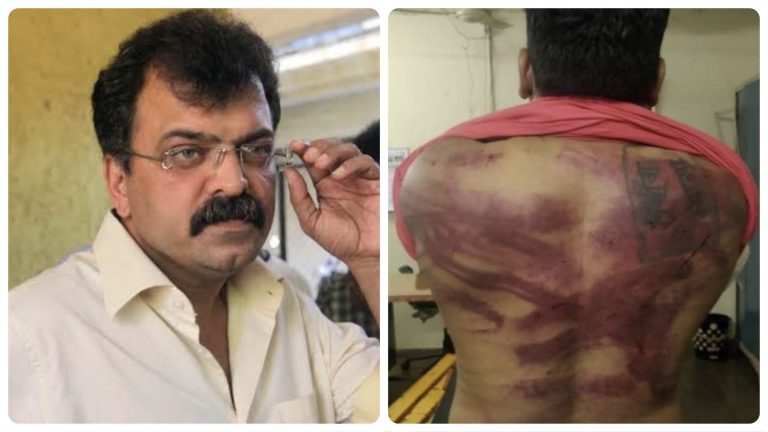
The Supreme Court last week directed the police to launch a probe into a case of assault filed against NCP MLA Jitendra Awhad by Thane resident, Anant Karmuse, who alleged that Awhad had him assaulted at his house in 2020 over a social media against the former Maharashtra minister.

The SC bench comprising Justices MR Shah and CT Ravikumar heard a plea filed by Karmuse against the NCP MLA. He claimed that on April 5, 2020, he was viciously attacked by a group of thugs who were reportedly acting under the direction of Awhad, the then-state housing minister. Despite Awhad’s arrest by the Thane police, he was granted bail on the same day. Karmuse approached the SC after the Bombay HC declined to transfer the investigation to the CBI, and the bench was hearing his case.

While the Supreme Court had turned down Karmuse’s request for a CBI inquiry into the matter, the apex court has nevertheless asked the police to launch an expeditious probe into the matter.

According to the SC order, “the current appeal has partially succeeded, as the Bombay HC’s decision not to order a CBI investigation has been upheld. However, the decision to disallow further investigation has been overturned. The court has instructed that a prompt and thorough investigation should be conducted, and a report should be submitted to the trial court in accordance with the law, so that the accused may be tried on the basis of merit.”

‘When I became unconscious from beating, they woke me up, just to continue the assault’: Anant Karmuse in interview

In his interview following the Supreme Court’s decision to direct the police to launch a probe into the assault case, Anant Karmuse said he has full faith in the Eknath Shinde-Devendra Fadnavis-led government in Maharashtra to get him justice. He explained in detail the sequence of events on the fateful night of 5 April 2020, when police officers took him to Jitendra Awhad’s residence where he was brutally assaulted for a social media post against the NCP leader.

“I was picked up by police officers from my residence on the pretext of being taken to the police station. But I was taken to Jitendra Awhad’s residence where 15-20 goons began beating me. I was not told why I was assaulted nor was I provided with an opportunity to explain myself. They thrashed me with sticks, iron rods, belts, and whatever things they could use to assault a man,” Karmuse said.

The victim further alleged that when he got unconscious from the beating, he was woken up, just to beat him again.

“When I told them I wanted to end the matter and assured them that I would not pursue a case against them, they threatened me with filing a case against me. I told them I am a family man and I don’t want to indulge in court matters, but they said that they would file a case against me and put me behind the bars for at least 3 years. It was then, in that very moment, I had resolved to legally pursue a case against Awhad come what may.” Karmuse said.

Karmuse also added that he was forced to apologise, a video of which was recorded by Awhad’s henchmen, and then used to file a case against him.

In fact, when Karmuse approached the police station to file a case against Jitendra Awhad and his aide for assault, he was made to sit the entire night in the police station with his hands plastered and suffering due to the injuries caused by the beating.

“After the beating when I went to the police station to file a case against Jitendra Awhad and his henchmen, the police officers seemed unbothered to file a case against them, even though they saw my condition and injuries on my body. I was made to sit the entire night in the police station with my hands plastered amid excruciating pain just to file a case against my tormenter,” Karmuse said.

Karmuse also asserted that when he approached the police after his assault, he was treated like a hardened criminal and not a victim. “When I went to the police, they treated me as if I was a serial killer with multiple offences under my name. They used to call me for questioning and made to sit for 3 to 5 hours in the police station.”

“Jitendra Awhad was a politician drunk on power. He acts as if he’s a law unto himself. Whether it is my abduction or the fracas at the Viviana Mall or others who attacked Ketaki Chitale and other such hooliganism cases related to Jitendra Awhad, you will find the same goons involved in it,” he added.

In a scathing critique of the Supreme Court bail order for Jitendra Awhad, Karmuse said, “Supreme Court said the accused should be treated as a common man until proven guilty. Does a common man get bail so fast?”

FIR against Jitendra Awhad for assaulting a man over social media post

The case dates back to April 2020 when an FIR was lodged at Vartak Nagar police station against Maharashtra cabinet minister Jitendra Awhad by a resident of Thane, alleging that two police constables and goons allegedly associated with Maharashtra minister and NCP strongman Jitendra Awhad had brutally assaulted him.

As per the FIR, around 11.50 pm on April 5, two policemen came to his house. The policemen asked him to come to the police station. The victim was not informed of why he was being taken to the police station. Why the victim’s wife enquired why is her husband being taken to the police station, and the policemen responded that it is general interrogation and they would return him within 10 minutes.

Thereafter, the policemen took the victim in their white Scorpio to NCP MLA Jitendra Awhad’s Nath Bungalow situated near Viviana Mall. He was frisked and the policemen had taken away his mobile phone.

The victim claims that Jitendra Awhad was present at his bungalow and a posse of 15-20 goons was already there to beat him up. He was then mercilessly assaulted by the goons under the watch of Awhad until their wooden sticks broke off, the victim has alleged in the FIR. 

After that, Awhad approached the badly injured victim and questioned him why did he make the offensive post. The young man then apologised to Awhad and said that out of enthusiasm, he uploaded the post. Awhad then called up the young man’s house and asked his wife to remove the contentious post. 

However, the young man was still not released even after apologising. He was assaulted again and a video of him admitting that he had made the post by mistake and being apologetic about it was recorded. The policemen later took him to the hospital for treatment, the complaint had said. 

After being treated at the hospital, the young man went to the Vartak Nagar police station where the police lodged a complaint against unknown assaulters. At the same time, a case was booked against the victim under the IT act.

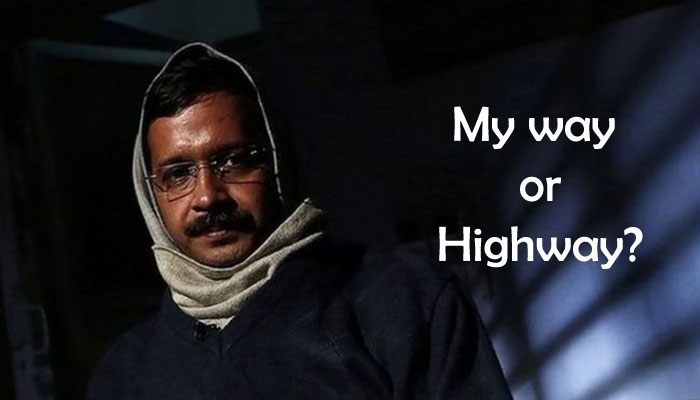
One by one, Kejriwal’s confidantes who wanted to ‘fight corruption’ ended up leaving him or becoming accused of it

On February 28, Aam Aadmi Party’s (AAP) leader and Deputy Chief Minister of Delhi, Manish Sisodia and jailed AAP leader Satyendra Jain resigned from their respective posts in the state cabinet. As per reports, the Chief Minister of Delhi, Arvind Kejriwal, accepted their resignations.

Widely known as ‘Handsome Sisodia’, the Deputy CM was in charge of 18 departments, including education, finance, planning, services, vigilance, tourism, health, and industries. He was named in the alleged excise policy scam and was arrested by the Central Bureau of Investigation (CBI) on February 26.

The Enforcement Directorate arrested Satyendra Jain in a money laundering case. Jain was arrested in May 2022 and had been avoiding resignation since then. Arvind Kejriwal, who thumped his chest for being “non-corrupt” so many times, did not bother to ask for his resignation on moral and ethical grounds. Kejriwal always emphasised that his colleagues were innocent, and the allegations against them is nothing but political vendetta.

With Jain and Sisodia, the list of Kejriwal’s confidantes who laid the foundation of the party has shrunk further. Over the years, since the formation of the Aam Aadmi Party, the top leadership has left the party for one reason or another. Though Jain and Sisodia have not left AAP per se, their names have already been tarnished completely in the coming days to a level they would be of virtually no use to the party.

After these two, only Raghav Chaddha, Bhagwant Mann, Atishi Marlena, Saurabh Bharadwaj, Sanjay Singh, and a couple more leaders are left that can be called the national face of AAP. Out of these, Bhagwant Mann is currently serving as Punjab’s CM, and Raghav Chaddha and Sanjay Singh are serving as Rajya Sabha MPs. Reportedly, Atishi and Saurabh are going to be elevated to cabinet ministers.

If we look at the history of the party, those who tried to fight corruption in the system at the national or local level by becoming prominent members of AAP either left the party or became accused of corruption. Here are some of the prominent names.

Prashant Bhushan: One of the founding members of AAP, Prashant Bhushan, was literally kicked out by the party members in March 2015. 

Yogendra Yadav: Another founding member of the party, Yadav, was also removed from the party in early 2015 along with Bhushan. Both Yogendra Yadav and Prashant Bhushan were seen at Rahul Gandhi’s Bharat Jodo Yatra.

Kumar Vishwas: In 2018, Vishwas was removed from key positions in the party. There was a scuffle between Kejriwal and Vishwas that continued for years. Before Punjab Assembly Elections, Vishwas accused Kejriwal of siding with Khalistani elements. Vishwas had also accused Kejriwal of selling’ Rajya Sabha nominations.

Shazia Ilmi: Ilmi was a member of the National Executive of the Aam Aadmi Party. She contested the 2014 Lok Sabha elections on AAP’s ticket but lost. Later, she left the party, saying she was unhappy with the way the party functioned. She joined Bharatiya Janata Party.

Kapil Mishra: Once a firebrand leader of AAP, Mishra was best known for standing to the opposition strongly on all grounds. He levelled allegations of delay of investigations in a water tanker scam worth 400 crores against the CM, after which he was sacked from the party’s primary membership in 2017. In 2019, he officially joined BJP.

Alka Lamba: A seasoned and controversial politician who joined AAP after leaving Congress in December 2014. In September 2019, she left AAP and rejoined Congress.

All six leaders mentioned above had the potential to reach top positions in the cabinet. However, they were either thrown out of the party or forced to leave the party.

The story of those who did not leave the party is also interesting. Two of the leaders who did make it to the top positions (Jain and Sisodia) are in jail over serious corruption charges. Two leaders (Chaddha and Singh) were shifted to Rajya Sabha, and one of the top leaders, the only Lok Sabha member from AAP (Mann), was made CM of Punjab. Now, the two AAP leaders (Atishi and Bhardwaj) who have the potential to hold key positions are reportedly being elevated to cabinet ministers’ positions.

Amidst all this, the Chief Minister of Delhi still holds no department. If he does not hold any portfolio, there is no way his name can surface in any controversy, at least related to governance. He can make all the bizarre claims, play national politics and roam around the country doing rallies for state elections as he did in Gujarat and Punjab. But when it comes to facing allegations in terms of governance, Kejriwal’s hands have been clean.

As Kumar Vishwas alleged in the past, Kejriwal dreams of ruling a country as Prime Minister. Could it be a strategy on that path, or is it just a coincidence that only he is ‘rising and shining’ while others are taking the heat? Only Kejriwal or time can tell.

‘Saat pheray nahi liye’: Pakistanis have a meltdown because actress Ushna Shah looked ‘too Indian’ at her wedding

On Sunday, February 26, Pakistani actress Ushna Shah got married to Austrian-Pakistani golfer Hamza Amin in presence of her close friends and relatives. However, as the pictures of Ushna Shah’s wedding emerged on social media her lehenga became a cause of outrage, as a section of Pakistani people brutally trolled the actress for wearing an ‘Indian style’ lehenga and looking more like a Hindu bride.

Ushna Shah shared her wedding pictures on her Instagram account and captioned it “I think it’s getting serious, @hamza.amin87 !”. Ushna’s wedding lehenga was designed by the Pakistani label Wardha Saleem. She wore a lehenga with a belt that was elaborately embroidered and a hefty assortment of jewelry, including a matha-patti, jhumkis, a choker, and a set of red bangles. 

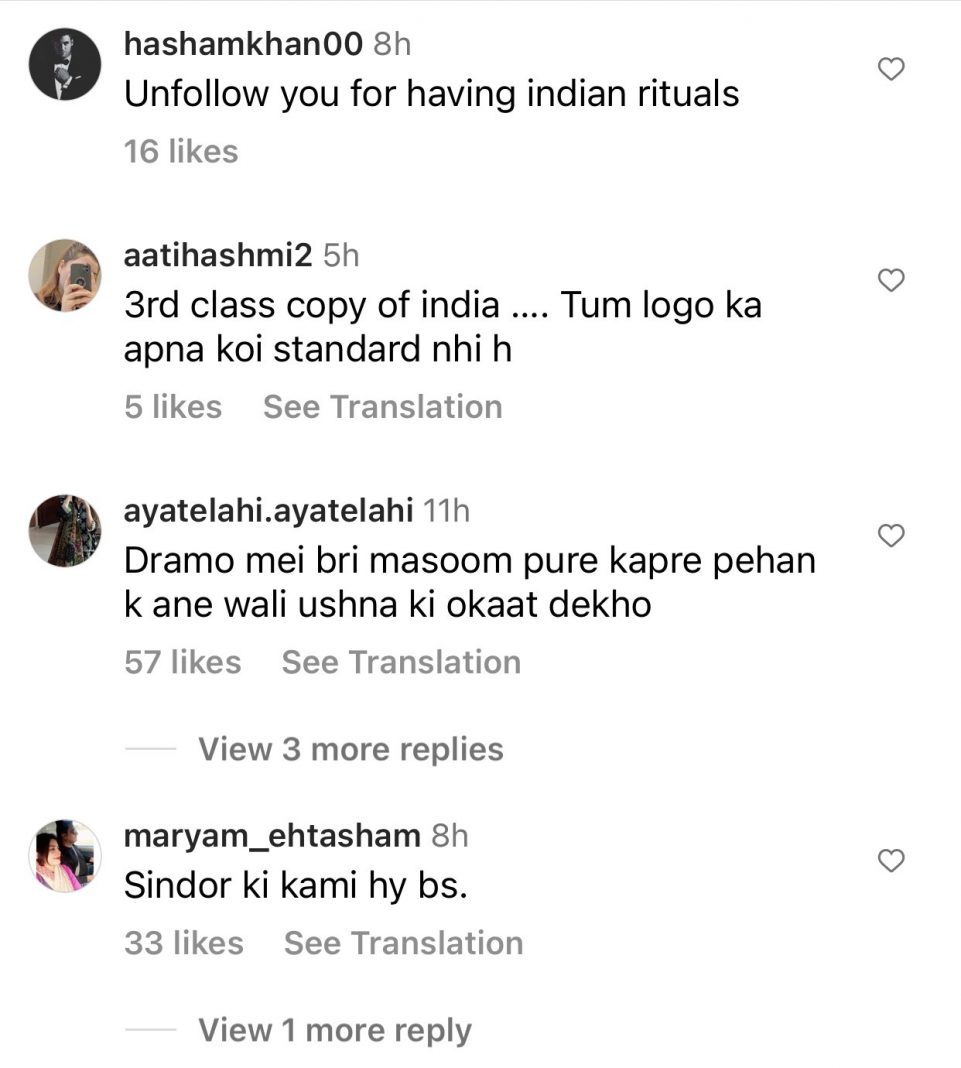
While some people showered the newlywed couple with congratulatory wishes and blessings for their married life ahead, others trolled the actress and flooded the comment section of Ushna’s Instagram post with hateful jibes and Hinduphobic taunts.

An Insta user (imemran10) questioned if the couple had a Nikah ceremony or took the ‘pheras’- an important ritual in Hindu weddings. While another taunted Ushna for thinking of herself as Deepika Padukone and being inspired by Bollywood.

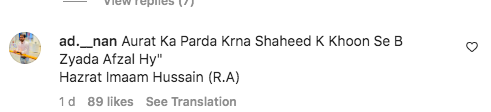
Another user took the onus upon himself to school the actress about the significance of doing ‘parda’ for a Muslim woman as he commented that the practice of parda by a woman is considered more venerable than the blood of a shaheed (martyr of Islam).

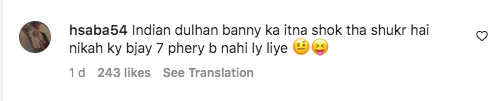
Another Insta user was content that at least the couple did not take the seven pheras though Ushna desired to become an ‘Indian Dulhan’.

Pakistanis were also upset over Ushna in another Instagram post called her husband a ‘Maharaja’ a Sanskrit term for a ‘great king’ and wore bangles similar to the ‘Choora’ worn by Punjabi brides.

While some called the couple ‘third class copy of India’ others said that only a pinch of Sindoor (vermilion) was missing.

(All images via Instagram)

A Twitter user and a ‘staunch supporter of IK (Imran Khan)’ Zartash Chaudhry questioned why the Pakistani actress “dressed up as an Indian bride on her big day?”

Following the heavy trolling and receiving uninvited hate, Ushna Shah took to her Instagram story to slam the trolls. Ushna Shah posted a note on Instagram, uploaded a photo of her engagement ring on her stories, and called out haters for mocking her for her bridal look. She wrote, “To those who have a problem with my dress: you weren’t invited, nor did you pay for my shade of red. My jewelry, my jora: Purely Pakistani. My heart, however, is half Austrian. Allah humey khush rakhein.”

Ushna Shah’s Instagram story

Notably, Ushna Shah is a well-known actress from Pakistan who has appeared in movies including Teri Meri Love Story, Oye Kuch Kar Guzar, and Punjab Nahi Jaungi. Ushna was born in Lahore and raised in Canada.