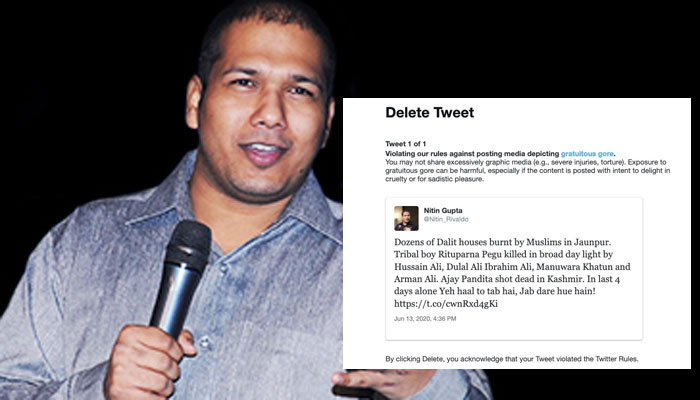
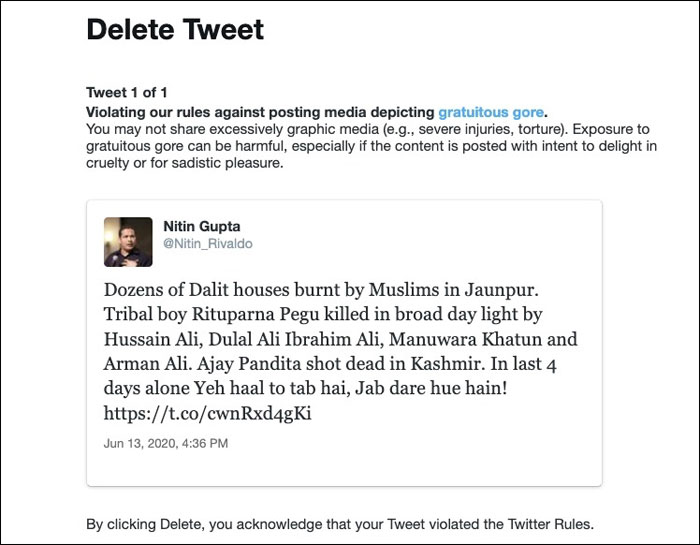
On June 30, Twitter restricted the account of standup comic Nitin Gupta for listing crimes committed by Muslim mobs and Islamists. It happened amid reports of the social media giant refusing to take action against those who hailed the murderers of Kanhaiya Lal on the microblogging site. In a notice received by Nitin, Twitter asked him to delete a tweet from 2020.
Twitter restricted Nitin Gupta’s account over a tweet he published in 2020 (Image: Nitin)
Twitter said his tweet was found “Violating our rules against posting media depicting gratuitous gore.” The notice added, “You may not share excessively graphic media (e.g., severe injuries, torture). Exposure to gratuitous gore can be harmful, especially if the content is posted with intent to delight in cruelty or for sadistic pleasure.”
Nitin’s tweet talked about houses of Dalits being allegedly burnt in Jaunpur and other incidents that had happened in a short span when the tweet was posted. It read, “Dozens of Dalit houses burnt by Muslims in Jaunpur. Tribal boy Rituparna Pegu was killed in broad daylight by Hussain Ali, Dulal Ali Ibrahim Ali, Manuwara Khatun and Arman Ali. Ajay Pandita was shot dead in Kashmir. In the last four days alone Yeh haal to tab hai, Jab dare hue hain!”
Twitter had refused to take action against handle hailing Kanhaiya Lal killers
Earlier, OpIndia reported that Twitter had initially refused to take action against a Pakistani Twitter user who hailed the killers of Kanhaiya Lal as ‘tigers of Islam’. Later, however, the account was suspended.
Kanhaiya Lal murder
On June 28, a Hindu man named Kanhaiya Lal was murdered at his shop by two Islamists who posed as customers. He was killed for allegedly making a post in support of BJP’s former spokesperson Nupur Sharma. Videos of the attack and his killers threatening PM Modi went viral on social media. In the video, the killers admitted to killing Kanhaiya Lal. The killers were arrested by the Police on the same day of the incident. The Ministry of Home Affairs had asked NIA to take over the case, and the investigation agency filed a formal FIR on June 29.
The Congress and the Sharad Pawar-led NCP have found themselves on a sticky wicket as Uddhav Thackeray decided to rename Aurangabad as ‘Sambhajinagar’ and Osmanabad as ‘Dharashiv’ in his last cabinet meeting before resigning as the Chief Minister. There had been a longstanding demand for renaming the two districts in Maharashtra, and equally old was the Congress and NCP’s opposition to the idea.
On Wednesday, in his last cabinet meeting as a Chief Minister, Maharashtra chief minister Uddhav Thackeray approved renaming two cities Aurangabad and Osmanabad as Sambhaji Nagar and Dharashiv respectively. It is speculated that Uddhav Thackeray took the decision igniting Hindutva, after the Eknath Shinde-camp that rebelled again him justified their splitting over the same issue.
However, it was more of a challenge for the Congress and the NCP which had long opposed the renaming of the cities. As the names ‘Aurangabad’ and ‘Osmanabad’ suggested Muslim identity, the parties’ opposition to the renaming got much to do with their vote banks – which are predominantly Muslim and ‘secular’ in parts of Marathwada in Maharashtra.
The parties however, agreed to Thackeray’s proposal and went ahead to pass the decision. But, there were reports of Congress leaders Varsha Gaikwad and Aslam Sheikh walking out of the cabinet while the decision was been taken. Though they have not cleared the reasons, it is being speculated that they registered their protest because of the Hindutva agenda Uddhav Thackeray suddenly started working on.
All our MLAs were present for trust vote today. But now the next strategy will be discussed in today’s meeting (in Maharashtra Vidhan Bhavan)… there’s no dispute in Congress regarding the name change of Aurangabad to Sambhajinagar: Maharashtra Congress leader Balasaheb Thorat pic.twitter.com/pNndNvoUFH
When asked by the media over this issue, Congress leader Balasaheb Thorat clarified that there’s ‘no dispute’ in Congress regarding the name change of Aurangabad to Sambhajinagar. NCP leader Jayant Patil too, during a press briefing, asserted the fact as one of the prominent decisions being taken at the last cabinet meeting.
However, for the Shiv Sena the road to renaming the cities was not easy as it appeared yesterday. Being in alliance with the so-called ‘secular’ parties in the MVA, the leaders had publicly denounced the idea every time the issue was raised. In December 2020, when the issue of renaming Aurangabad as ‘Sambhajinagar’ was raised, Balasaheb Thorat of the Congress had said to the media, “Our stand is clear. The MVA alliance is based on a common-minimum programme, which does not including the renaming issue. We are opposed to this, and believe development should be focused on first.”
When local Congress leaders in Aurangabad had protested against the renaming move by Shiv Sena, Thorat held a press conference in the city to note, “We do not believe in the renaming. We are indeed an ally in the MVA, but if such issue is raised in the future, they we will sternly oppose it.”
Moreover in September 2021, when ex-Shiv Sena cabinet Minister Subhash Desai has declared that this is the ‘right time’ to rename Aurangabad as Sambhajinagar, NCP’s Jayant Patil denied support for the decision publically. Patil said that such proposal had not come then in the cabinet.
However, yesterday the Congress and the NCP are said to have given their support for the renaming of Aurangabad and Osmanabad during the MVA cabinet meeting led by Uddhav Thackeray.
Rift over the issue persists
After the decision, a number of local Congress leaders from Aurangabad, including Mohsin Sheikh has resigned as a spokesperson and member of the party. The party’s U-turn on the issue came all of a sudden, leaving many party supporters flabbergasted.
According to the latest development, the dissent within the Congress over the renaming of Aurangabad could only be seen escalating. On Thursday, senior Congress leaders including Balasaheb Thorat and Ashok Chavan held a meeting with Muslim MLAs and leaders from the party who were miffed with the view.
The demand for ‘Sambhajinagar’ and ‘Dharashiv’
The renaming of Aurangabad and Osmanabad, the districts in the Marathwada region has been a longstanding demand from the local citizens. Aurangabad is now renamed Sambhajinagar after Chhatrapati Sambhaji Maharaj, who was sacrificed his life for Hindu Dharma while refusing to bow infront of Aurangazeb. The city was earlier it was named after the Mughal tyrant Aurangzeb, who had stationed there during his conquest of Deccan.
Osmanabad is now named Dharashiv – its actual name. When the Marathwada region was ruled by the Nizam of Hyderabad, during that period, Dharashiv was named Osmanabad after Mir Osman Ali Khan – one of the Nizam rulers. Now Osmanabad will get back its original identity Dharashiv.
As a BJP-Shinde camp of Shiv Sena alliance is set to form the next government in Maharashtra after the resignation of Uddhav Thackeray, Shiv Sena’s rebel leader Eknath Shinde said that there have been no discussions with the Bharatiya Janata Party till now about power-sharing in the government to be formed in Maharashtra. He said on 30th June 2022 that he will soon engage in talks with the BJP about the same. Shinde was still in Goa, and is reportedly moving to Mumbai today for talks with BJP.
Meanwhile, Shiv Sena spokesperson Sanjay Raut tried to play the emotional card and said in his tweets how Sharad Pawar took care of Uddhav Thackeray and how Sonia Gandhi and Sharad Pawar both have trust in Uddhav Thackeray. These remarks have come after Uddhav Thackeray resigned as the chief minister of Maharashtra and tendered his resignation to the governor of the state Bhagat Singh Koshyari on 29th June 2022.
Eknath Shinde and all the MLAs in his camp had reached Goa from Guwahati yesterday. They are expected to go to Mumbai from there. Eknath Shinde tweeted, “So far there have been no discussions with the BJP about which and how many portfolios will be given. That discussion will take place soon. Till then please don’t believe the rumors spreading about the list of ministers and portfolios.”
भाजपसोबत कोणती आणि किती मंत्रीपदे याबाबत अद्याप कोणतीही चर्चा झालेली नाही, लवकरच होईल. तोपर्यंत कृपया मंत्रिपदाच्या याद्या आणि याबाबत पसरलेल्या अफवा यावर विश्वास ठेवू नका.
— Eknath Shinde – एकनाथ शिंदे (@mieknathshinde) June 30, 2022
According to reports, Eknath Shinde will reach Mumbai first, and he will meet the Maharashtra governor along with BJP leader Devendra Fadnavis to stack claim for the next government. According to media speculations, a small ministry will take oath after that, either today evening or tomorrow. It is being widely speculated that Fadnavis will be the CM and Shinde will be the Deputy Chief Minister. Along with them, 2 ministers each from the two side
On the other hand, Shiv Sena spokesperson Sanjay Raut who was continuously making threatening and insulting remarks about the rebel MLAs in the last ten days, expressed his reactions and tried to play an emotional card while doing so. He said, “Yesterday when Uddhav Thackeray tendered his resignation from the post of the chief minister of the state, we all got very emotional. All of us believe in Uddhav Thackeray. People from all castes and religions support him. Sonia Gandhi and Sharad Pawar trust him.”
कल जब उद्धव ठाकरे ने मुख्यमंत्री पद से इस्तीफा दिया तो हम भावुक हो गए। उद्धव ठाकरे पर सभी को भरोसा है। हर जाति और धर्म के लोग उनका समर्थन करते हैं। सोनिया गांधी और शरद पवार को उन पर भरोसा है: शिवसेना नेता संजय राउत, मुंबई pic.twitter.com/joNobnNOP8
Maharashtra Navnirman Sena chief Raj Thackeray also took to Twitter and criticized Uddhav Thackeray without naming him. He tweeted, “When anyone misunderstands good fortune as one’s personal accomplishment; therein begins the journey towards one’s decline.”
Maharashtra’s chief minister Uddhav Thackeray resigned on Wednesday, June 29. Governor Bhagat Singh Koshyari has asked him to hold the post till a new government is formed. For the last 10 days, Uddhav Thackeray and his party Shiv Sena were facing the coup of its 40 out of 55 MLAs led by Eknath Shinde. Uddhav Thackeray resigned hours before the trust vote that was about to take place on June 30 as ordered by the Governor.
Showcasing again the crooks of the selective media reporting, one of the Asian News International (ANI) editors revealed on Wednesday that many of the western media outlets had chosen not to report about the brutal killing of a Hindu tailor named Kanhaiya Lal in Rajasthan’s Udaipur. Western media outlets, which work as the reflection of leftist, liberal understanding were given 5 detailed video stories by ANI on the Udaipur murder, but only a handful of them had reported the gruesome murder.
Elaborating the fact, ANI editor Ishaan Prakash on June 30 tweeted that ANI had globally shared 5 detailed video stories on Kanhaiya’s murder through Thomson Reuters, the largest news agency in the world. He stated that vast majority of the international media outlets had ignored the story. “ANI has pushed out 5 detailed video stories on the Udaipur murder through our partner Thomson Reuters. A handful of western outlets may have reported on it, the vast majority have ignored it. The stories are in their newsrooms, they ignore it”, he tweeted on Wednesday.
ANI has pushed out 5 detailed video stories on the Udaipur murder through our partner Thomson Reuters, the largest news agency in the world. A handful of western outlets may have reported on it the vast majority have ignored it. The stories are in their newsrooms, they ignore it
The handful of western media outlets who reported the incident as mentioned by Prakash include the BBC, Waco Tribune-Herald, The Washington Post, and the Toronto Sun. However, while the BBC highlighted the Hindu nationalists staging violent protests and the visible tensions between the ‘majority Hindus and minority Muslims’, it selectively failed to report the names of the Islamist murderers (Riaz Mohammed and Ghous Mohammed) who had identified themselves in a video released by them. Also, the Waco Tribune-Herald twisted the report to mention that the attack ‘represented a dramatic escalation of communal violence in a country riven by deep religious polarization’.
“There have been a spate of attacks by Hindu nationalists on minority groups, especially Muslims — who have been targeted for everything from their food and clothing style to interfaith marriages. Muslim homes have also been demolished using bulldozers in some Indian states, in what critics call a growing pattern of bulldozer justice against the minority group”, the Waco Tribune Herald wrote later stating the fact that Kanhaiya was killed for sharing a post in support of ex-BJP spokesperson Nupur Sharma who had made alleged ‘blasphemous’ remarks in the recent past.
The Western Media outlets have time and again proven their selective media stance when it comes to Indian politics. They chose to remain silent on Nikhil Bhamre, Ketaki Chitale’s unlawful arrest by the former ruling MVA govt in the state of Maharashtra for sharing a post against NCP supremo Sharad Pawar. They chose silence when Saad Ansari and ABVP worker Karthi were abused and illegally jailed for sharing a social media post in support of Nupur Sharma. They also chose silence on the recent beheading incident of Umesh Kolhe from Maharashtra for supporting Sharma. But the international media outlets screamed in support of Mohammed Zubair who has been arrested for inciting riots through social media posts and Teesta Setalvad who has been arrested for forgery and planting, influencing witnesses in the 2002 Gujarat riots case.
Meanwhile, editor Ishaan Prakash who highlighted the fact on June 30 stated that the international media organisation have a slant and that the Reuters had done its job as a responsible agency. “Reuters shows the news, all sides of it. It’s the other orgs that have a slant”, he tweeted in the series. It is notable that wire services like ANI and Reuters send reports to all media organisations who have subscribe to their services, but it is upto the media houses to decide which report to publish, which to ignore, and which report to highlight. In this case, it is clear that most media houses chose to ignore the Kanhaiya Lal murder case even though they had received the ANI reports through Reuters.
ANI has pushed out 5 detailed video stories on the Udaipur murder through our partner Thomson Reuters, the largest news agency in the world. A handful of western outlets may have reported on it the vast majority have ignored it. The stories are in their newsrooms, they ignore it
Kanhaiya Lal was murdered on June 29 by two radical Islamists named Riaz and Ghous Mohammed. The duo disguised as customers and entered the tailoring shop of the deceased. While Kanhaiya Lal was busy taking the cloth measurements, one of the accused attacked him with a long sharp knife. According to the post mortem report, he was stabbed 26 times on his body from his neck to shoulder. Kanhaiya Lal was killed for uploading a social media post in support of ex-BJP spokesperson Nupur Sharma.
On June 27, the Ministry of Electronics and IT (MeitY) warned social media giant Twitter to comply with its blocking orders by July 4, or risk losing its immunity as an intermediary. In the notice sent as ‘one last opportunity for microblogging website, MeitY said that the company has failed to comply with the user of the order Section 69(A) on multiple occasions.
Reports suggest that the Government had sent notices on June 6 and June 9 to block content that has not been complied with yet.
The notice was addressed to the Chief Compliance Officer of Twitter. It stated that the designated officer of the ministry issued several directions to block certain pieces of content and accounts under Section 69(A) of the Information Technology Act that empowers the GoI to issue blocking notices to the social media companies. However, Twitter did not comply with several orders. Notably, the company had submitted a list of 80 accounts blocked following the government orders from 2021.
If Twitter fails to comply with the orders by July 4, it will risk losing its status as an intermediary. In case it happens, the social media giant will be liable for the content posted by the users on the platform. Indian Express quoted a senior government official without taking his name. The official said, “The notices sent to Twitter pertain to several cases, both where the government had asked it to take down certain content and where the company had wrongfully taken down some content.”
Amendments in regulations expected soon
Notably, fresh amendments to the regulations issued by the government to govern intermediaries like Facebook, Twitter and others have been proposed by the ministry. One of the proposals suggests setting up government-appointed grievance committees that will have the power to review and revoke content moderation actions taken by the social media companies.
Twitter has failed to comply with orders before
This is not the first time Twitter found itself in trouble with the Government of India. In May 2021, after the new set of regulations to monitor and regulate the content of social media came to power, Twitter was supposed to appoint an external person as an India-based grievance officer. However, the company delayed it for months and got into a legal battle but, in the end, had to appoint the grievance officer. Twitter has, on multiple occasions, failed to comply with the blocking notices issued by the Government of India and has been warned of serious consequences by the GoI for the same.
While the nation is reeling in shock over the ISIS-style barbaric execution of a Hindu man named Kanhaiya Lal in Congress-ruled Rajasthan’s Udaipur city on June 28, Rakesh Tikait, the expelled spokesperson of the Bharatiya Kisan Union, is exploiting the heinous incident to engage in petty politics.
Speaking to the media, Tikait has not only blamed the BJP government for Kanhaiya Lal’s brutal beheading but also gone ahead to trivialise the horrific act by terming it a ‘petty’ matter. The expelled ‘farmers leader’ also went on to defend the Pakistani link in the heinous murder.
#Breaking | Rakesh Tikait has blamed the BJP for the #Udaipur beheading.
Listen in to what he has said.@_anshuls shares details.@Shehzad_Ind, BJP shares his views.
‘Zara sa kuch hota hai, they (BJP) say Pakistan is involved’, Rakesh Tikait on Kanhaiya Lal’s beheading
Speaking to reporters, Tikait also questioned why such incidents were only taking place in Opposition-ruled states and remarked that even if something ‘small’ happens, BJP rushes to claim Pakistan’s hand.
“In places where there is no BJP government, such incidents will increase. The BJP at the centre is getting it done. The BJP government is very dangerous. Whenever something small (zara sa kuch) happens, they say Pakistan is involved. India has Constitution, Law, and Sections, what happened to Section 302? What will Pakistan do in this? Those who have done this murder, book them under Section 302,” said Rakesh Tikait.
Notably, the Kanhaiya Lal murder case has been taken over by the National Investigation Agency (NIA) after a Pakistan link emerged. During a press conference on Wednesday, Director General of Police (DGP) ML Lather confirmed that one of the two accused, Ghouse Mohammad, who carried out the brutal murder of a tailor in Udaipur has links with Pakistan-based organisation Dawat-e-Islami and had visited Karachi in 2014.
Meanwhile, Republic TV quoted sources as saying that the accused allegedly visited Karachi twice and spent about 45 days in the Islamic country before returning to India and carrying out the heinous murder.
Murder of Kanhaiya Lal
On June 28, Hindu man named Kanhaiya Lal was brutally murdered in Udaipur, Rajasthan, over an alleged post in favour of former Bharatiya Janata Party (BJP) spokesperson Nupur Sharma. The post was allegedly made by accident from Kanhaiya Lal’s phone by his 8-years-old son while playing a video game. Earlier Kanhaiya Lal was arrested for making the post after his neighbour Nazim filed a complaint about the same.
After getting released on bail, Kanhaiya Lal started to receive threats. He was threatened not to open his tailoring shop. Kanhaiya Lal had approached Police for legal action against those who were threatening him and requested Police protection so that he could open the shop.
However, the police did nothing to restrain those who were threatening him and didn’t provide security to Kanhaiya. The police had called them and made them sign a compromise agreement. Kanhaiya Lal then submitted another application on the same day that he did not want legal action following the compromise. Scared for his life, Kanhaiya Lal kept his shop shut for six days.
On the 7th day, when he opened his shop, he was brutally murdered by two Islamists identified as Mohammed Riyaz Akhtar and Mohammed Gos. Notably, Kanhaiya Lal’s photograph, address and other information were distributed by Nazim and others. They had urged their community members to kill Kanhaiya Lal if they see him in the open or if he opened his shop.
Following the murder of Hindu tailor Kanhaiya Lal in Udaipur on June 28, his killers Mohammed Riyaz Akhtar and Mohammed Gos escaped the scene on a bike with number 2611, as per a Bhaskar report. 26-11 is the date of the Mumbai Terror Attack. The killers were nabbed by the Police 130 KM away from Udaipur at Bhim Highway.
As per reports, the bike with the 2611 number belongs to Mohammad Riyaz.
A high alert was issued by Rajasthan Police within 30 minutes of the incident. Following the high alert, National Highway was blocked by the Police. Reports suggest that the killers took side roads to avoid the Police. They first reached Mavli and then approached Maddi in Rajsamand through villages while avoiding main roads and the national highway.
Using the state highway, they reached Devgarh via Sardargarh-Amet. They approached a garage for help where Riyaz had worked six months ago. They did not get any help from the garage, after which they left for Bhim. Deogarh Police was tipped off about their presence in the area, and they alerted Bhim Police for the same. All the roads around the area were blocked.
The Police teams from Deogarh and Bhim Police Stations kept chasing them. At around 5 PM, they were surrounded by the Advana-Jasakheda highway that is 10 KM away from Bhim.
Murder of Kanhaiya Lal
On June 28, a Hindu man named Kanhaiya Lal was brutally murdered in Udaipur, Rajasthan, over an alleged post in favour of former Bharatiya Janata Party (BJP) spokesperson Nupur Sharma. The post was reportedly made by accident from Kanhaiya Lal’s phone by his son while playing a video game.
His neighbour Nazim filed a complaint against Kanhaiya Lal, following which he was arrested. Nazim also leaked Kanhaiya Lal’s number, photograph and address to his community groups. After being released on bail, he continued to receive threats.
Feared for his life, Kanhaiya Lal shut his shop for six days and approached Police for protection. Instead of giving him protection, the Police asked him to compromise with the Islamists who were threatening him. After six days, when he opened his shop, two Islamists came as customers and beheaded him. The two attackers, identified as Mohammed Riyaz Akhtar and Mohammed Gos, were arrested by the Police. The case has been taken over by NIA under the Ministry of Home Affairs’ direction.
How people buy special numbers
Many car and bike owners prefer to get special numbers for their vehicles either to showcase their wealth or to depict something that is important to them. The Transport Authority charges extra money for special numbers. As per the law, vehicle owners are allowed to choose the last four digits of their vehicle’s number plate.
These numbers are called ‘fancy numbers’. The first category is the numbers that have been put on sale by the RTO, and its list can be accessed from the Vaahan portal. The transport authority often conducts an auction of highly desired numbers like 0001 etc. The price of the number varies depending on its importance and demand. The vehicle owner can purchase the number of his/her choice using the transport authority portal or by visiting the RTO office and paying the required price. While registering for the vehicle, you can ask for a number of your choice, and it will be allotted if available.
Throughout the Middle Ages, Islamic invaders in India have executed genocides, mass murders, and destruction of public properties and have embarked upon setting the foundation for supremacy of the Abrahamic race, well before the British set in. Their brutalities were as much religious as they were political, duly glorified by their court chroniclers and historians.
This sanction of Jihad which set its precedent in medieval India has been whitewashed, religated to the moderation as mere politics of the time. That was a given as when the ‘founding fathers’ of Independent India championed secularism for integration with Islam, they negotiated for subsuming the Islamic tyranny and Hindu glory of any kind.
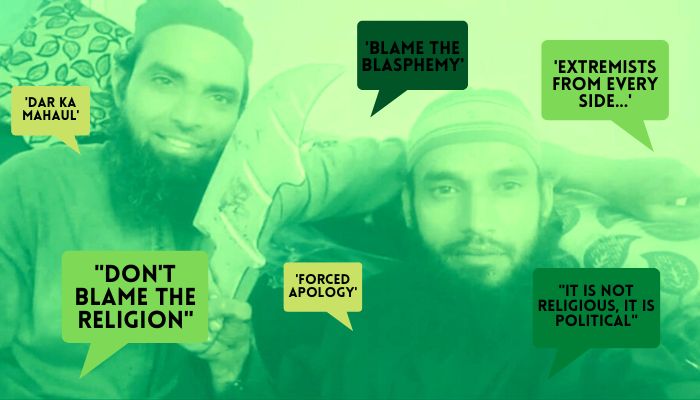
Centuries later, it is not Mohammed Ghori but Mohammed Riyaz Akhtar and his aide, who gathered the courage to behead Kanhaiya Lal in his tailoring shop in Rajasthan’s Udaipur in broad daylight. The two Islamist assailants, who were brought to their knees by Police had published a video taking responsibility for their gruesome action, in the name of ‘Allah’.
Kanhaiya Lal was murdered after his 8-year-old son shared a social media post supporting ex-BJP spokesperson Nupur Sharma’s comments on Prophet Mohammed, which accounted for ‘blasphemy’ in the Islamic worldview. While the Central Home Ministry has initiated action against the horrific crime, it is imperative to investigate the lines which have been crossed by Islamism, trickling down from the fundamentalist bastions to roadside radicalism of the worst kind.
The two murderers entered Kanhaiya Lal’s store disguised as customers and grab him by his neck to insert a knife and hack him to death, attacking him multiple times. Much like Makhan Lal Bindroo’s neighbours, who revealed his location and paved the way for Islamists to enter his house to butcher him during the Kashmiri Hindu Genocide of 1990. How and when did these footsoldiers of Jihad gather the audacity to wield their power with violence?
It is to be realised that much like how the Turkic invaders who sit on high horses today in the public discourse, radical Islamists of the modern age have similar grandstanding and intellectual backing for their crimes. They have a legacy to behold and an act of new revenge to carry out behind every offensive deeply taken. Their heinous acts are covered up by the Indian ‘secularists’, who refuse to identify these culprits with their religion.
More than the dissociation with their religion per se, it is this certain clique of politicians, political commentators and self-appointed intellectuals who play a role in detaching the Islamic angle in the acts of the Jihadis. They present the freshly-baked propagandist version of every tragedy every time when a Muslim is a culprit, as merely yet another act of communal hatred.
A case to be considered here is when the Times of India, reported the Udaipur incident with a headline, “Two ‘customers’ behead Udaipur tailor for post backing Nupur, both arrested”. This is the secularised version of the Islamist crime against a Hindu for not conforming to their worldview, which often finds a way in the deracinated public discourse.
The fundamentals of radical Islam that have plagued Indian society are systematically treated as natural. The technique to subdue rampant Islamism which is reflected in beheadings, rape and death threats to sleeper cell attacks and bomb blasts is carried out by whitewashing the incident as a normal communal incident at the outset. At the later stage, the blame is shifted from the religious warriors to someone else, at times even when the victim itself is blamed.
From being sympathetic to Islamic terrorism to becoming the enablers of it, the intellectual justifications of these public commentators have entrenched deep into every stratum of the society. With this normalization of the tyrannies of radicalization, they bask in the light of being ‘liberal’ in the public discourse.
Victim blaming, blame-shifting
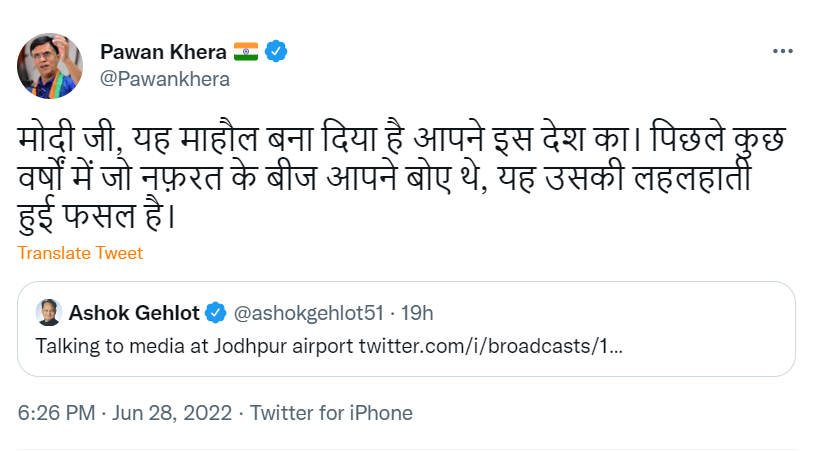
Congress Spokesperson Pawan Khera used the beheading of Kanhaiya Lal to target his political rival PM Narendra Modi by blaming him instead for the same. “Modi Ji, see what atmosphere you have created in the nation. The seeds of hate that you’ve sown over the years can be harvested in the deaths today,” Khera insinuated while writing an abstract assertion.
Screengrab of the tweet by Pawan Khera
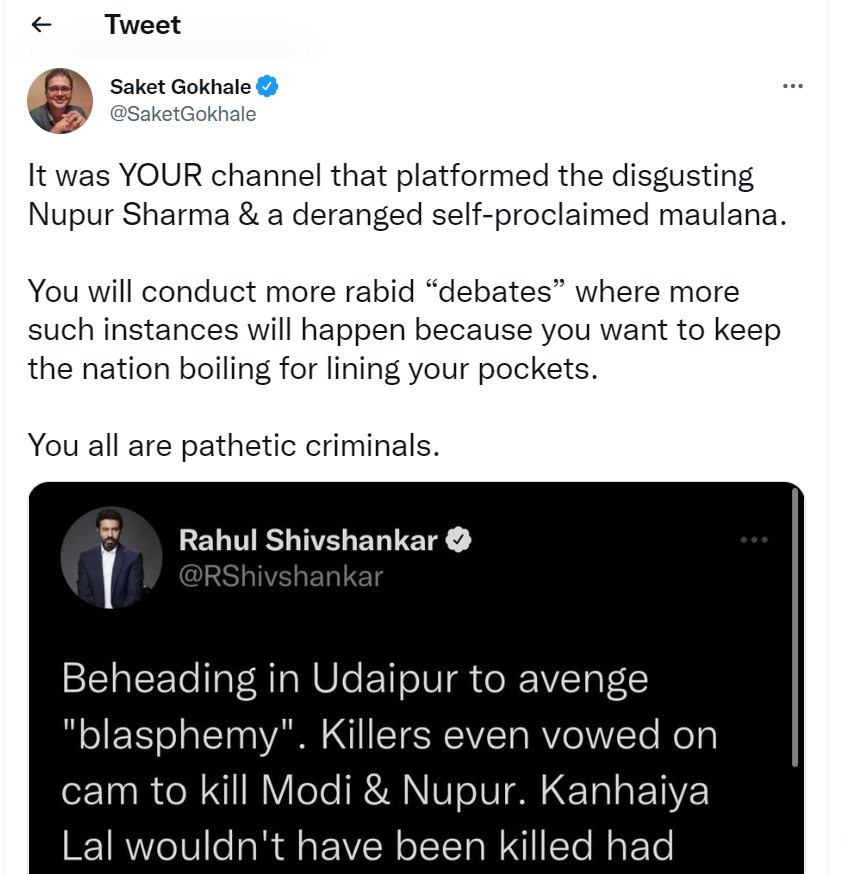
While it was very clear that it was the Islamic radicals who killed the tailor with an intent to avenge his death for alleged ‘blasphemy’, Khera found an opportunity to shift the blame upon Modi’s Hindu Nationalism from Islamic radicalism. Next, it was TMC leader Saket Gokhale who attempted to shift the blame of Kanhaiya’s killing to Times Now, the channel on which Nupur Sharma participated in a debate as an erstwhile BJP spokesperson.
Screengrab of the Tweet by Saket Gokhale
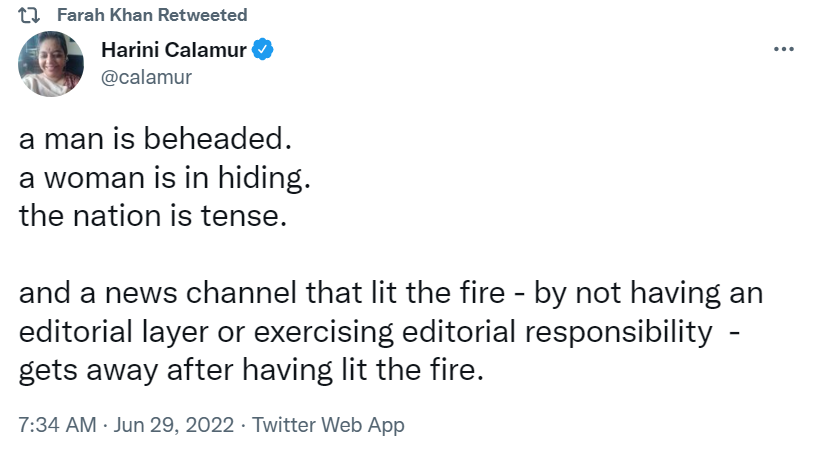
Gokhale has theorised that more such instances will happen because TV channels will keep airing Prime Time TV debates. Another “journalist” on Twitter asked for Times Now to have exercised ‘editorial responsibility’ (all of a sudden) when Nupur Sharma was making her comments. In this worldview of secularists, it is not radicalism but the TV channels which are platforms of expression, to be held responsible for disturbing the law and order.
Screengrab of a Tweet by Harini Calamur
This is a primary step to enabling rampant radicalization in Islamic society. When a spade is not called out, and the blame upon it is shifted to someone else – at times upon Hindus themselves, it creates an empty ground for more militant religiophilia that contests the multicultural fabric of countries like India.
It is this sympathization that has promoted assailants like Mohammed Riyaz Akhtar to be unapologetic about their stances.
Whitewashing the tyrant
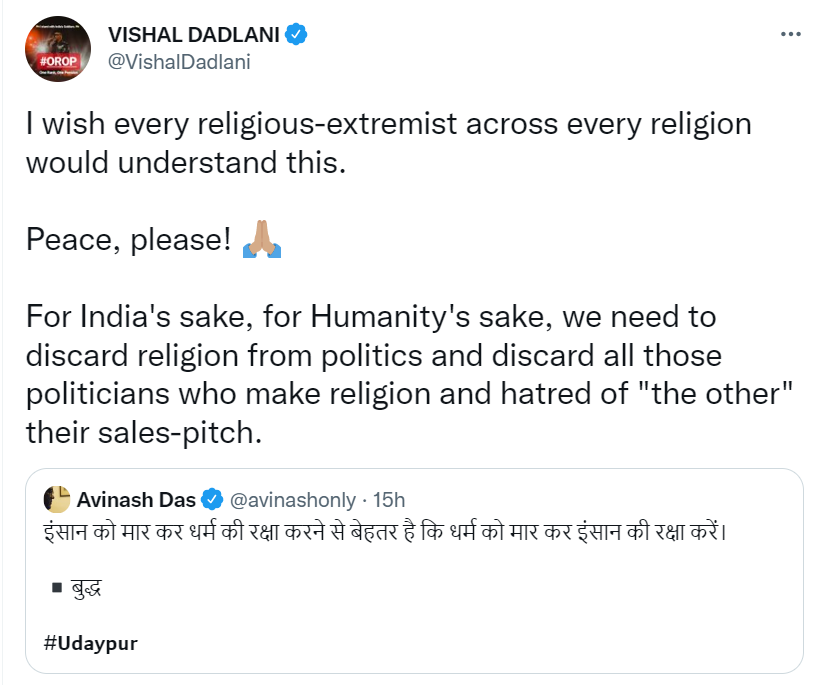
The criminalities of Islam are covered up in many ways. The ‘enablers’ of this rampant radicalism spanning across the society blame everything but the fundamentals that inherently promote or sanction these violent acts. For example, Bollywood music composer Vishal Dadlani could be seen here blaming ‘religious extremists across every religion’ for the beheading of Kanhaiya Lal at the hands of two Islamists.
Screengrab of a tweet by Vishal Dadlani
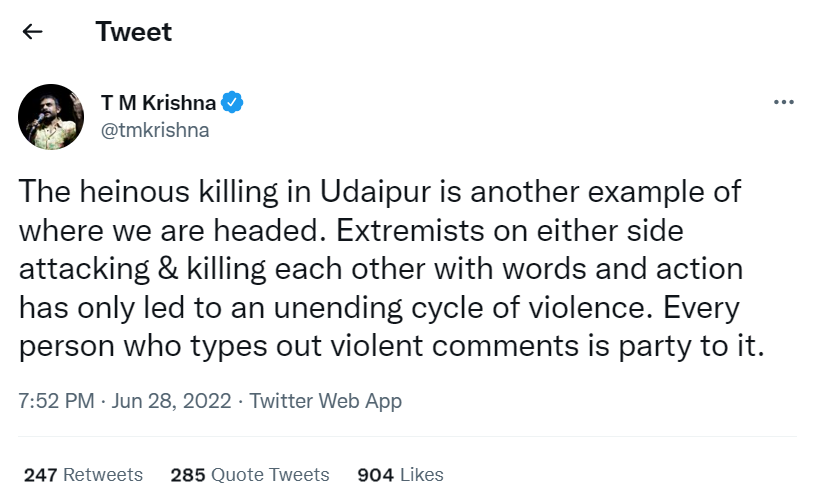
It is certainly not the case, that charlatans like Dadlani are incapable of fathoming the video put out by the assailants confessing that they were waging a war for Jihad, but they choose to gloss over the idea of ‘Sar tan see Juda’ that is championed as a treatment for the ‘blasphemer’. While it is amply clear that no religion beheads for blasphemy minus one, controversial Carnatic singer T M Krishna too was hell-bent upon whitewashing the Islamist crime while blaming the extremists on ‘either side’.
Screengrab of a tweet by T M Krishna
The psychological coverup wielded by these commentators to cover up the religious angle in every case of Hindu apathy and ironically highlight the same at the time of Hindu cruelty is unapologetically partial. The ideological world takes sides and asks Hindus to ‘condemn extremism on every side’ even at a time when the whole community is victimised.
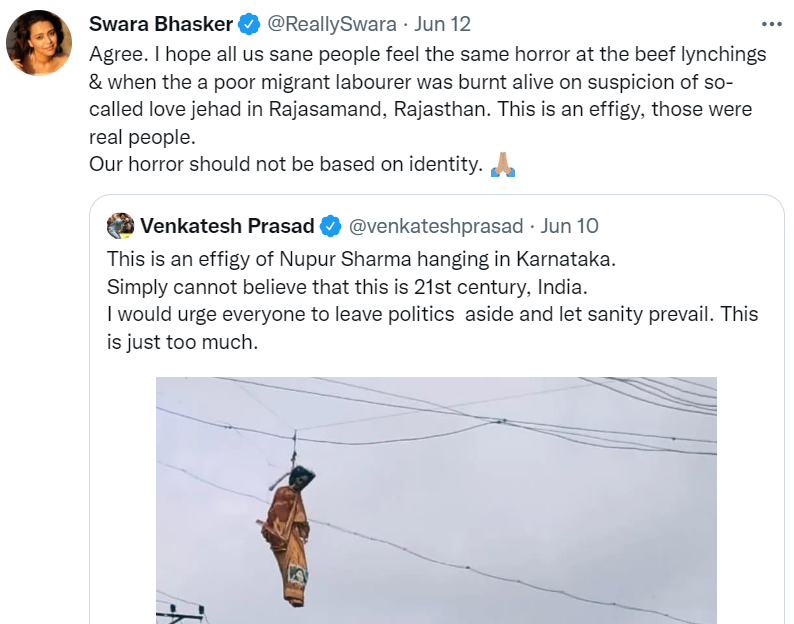
Screengrab of a tweet by Swara Bhaskar
To extract sense out of Swara Bhaskar is challenging, but when effigies of Nupur Sharma were hanged by Islamist mobs in Belagavi, Karnataka, the self-proclaimed feminist was busy diverting public attention to ‘beef lynchings’ from history. While with the effigy presentations of Nupur Sharma being hanged in open gave clear signals of mass violence in the name of the controversy, the likes of Bhaskar were asking us that ‘our horrors should not be based on identity’.
Clearly for Bhaskar, when the assailants invoked ‘Allah’ upon their butchering of Kanhaiya Lal it was not about identity. The culprits were standing on a moral base created by those like her and Dadlani because they knew when they will commit such gruesome acts, ‘extremists across religions’ will be blamed.
Much like what the ‘left’ historians do to whitewash the tyrannies of Islamic atrocities in the past, political commentators and parties in consideration here, gloss over the same in the present. The subtleties of whitewashing flame the brutalities on the road, and the cycle repeats.
Politicizing the religious war
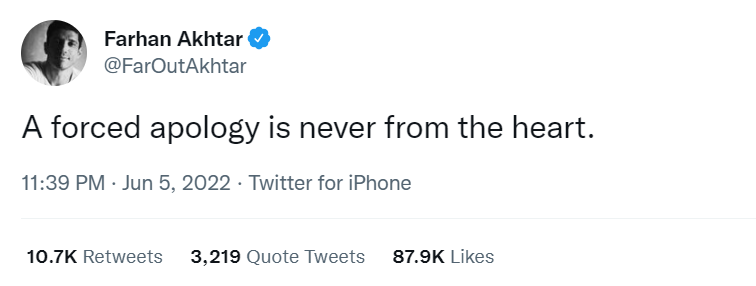
Many have argued, after the incident, that Blasphemy as a principle is problematic and has no place in a pluralistic society like India. Those who have taken this stand, also argue that it is the absolutist principles like blasphemy, Kafiriyat and violent Jihad that are the roots of the aggrieved expressions of supremacy today. However, time and again, we have seen that it is not the war of ideas but of identities at play.
Screengrab of a tweet by Farhan Akhtar
Clearly, it is political Islam contesting with unorganised Hinduism, when ‘revenge’ is taken for the acts of supposed blasphemy. Temples are attacked not because they are privy to looting but because idolatry is a sin in the religion of the perpetrator. ‘sar tan se juda’ too has a religious sanction. For the benefit of political correctness, one often reduces the religious angle in these cases to the margins.
In turn, a picture is painted that this is a political war, but not religious. The intellectual justifications for the gruesome acts, including the recent beheading, shows that one side always perceives this as a religious war, played with religious principles. By glossing over this fact, the unapologetic aspirations of Jihad become an enigma in the deracinated public discourse.
When such arguments are laid, citing political correctness or upholding ‘secularism’, the acts of terrorism which have a religious sanction are glossed over, whitewashed and eventually covered up with an intellectual justification. The ideologues who often come around as sympathizers of hate become enablers of extremism and radicalization while being often complicit in it.
On Wednesday, Marathi actress Ketaki Chitale who spent 40 days in the police custody for sharing a poem written by someone else allegedly against NCP supremo Sharad Pawar, slammed the state police for being mute spectators when she was being beaten and harassed by the NCP workers. She questioned the entire justice system and said that there was no way anybody could justify whatever happened to her while she was in police custody.
In an exclusive interview with CNN News18, the Marathi actress alleged that she was beaten, abused, and molested during police custody and the police did nothing to protect her from the NCP workers. “I was arrested unlawfully. No prior intimation or notice was served. The police arrived at my doorsteps and they just picked me up. Then I was shifted to the Thane Police custody where the NCP female workers, a mob of around 20 females threw toxic colour at me in the name of ink, they threw eggs, harassed me and molested me in the Police custody”, she said.
She stated that while the NCP workers harassed her, the Police did not take any steps to protect her. “I was molested and I wonder what was the Police doing. The NCP workers beat me and molested me for sharing the words which I had never written. I was wearing a saree, someone pulled it and my pallu fell, then someone pulled the saree away, hit me in my right breast. When they hit me I fell onto the Police car so my saree went up, my pallu fell down and the Police did nothing to stop this all”, she reiterated.
The Marathi actress also slammed the NCP female workers who displayed such behaviour towards another woman. She stated that she didn’t want such people to represent the people in the future. Yesterday, in an interview with Times Now, Chitale had said that no complaint was filed by the Police against the NCP workers and that they were allowed to go even after harassing and molesting her. “The people who molested me were not low-level NCP workers, one of them has plans to contest the upcoming elections. They all are in good positions. They also had hit the Police inside the Police station which is unlawful”, she had said.
Ketaki Chitale who also said that the post she shared was never directed to NCP supremo Sharad Pawar, affirmed on June 29 that she was deliberately targeted by the former MVA-led government. She said that the NCP workers had misused the power and harassed her for sharing a post that was declared as ‘against Sharad Pawar’.
The 29-year-old actress was arrested on May 15 for a Facebook post where she had shared a verse, allegedly written on Pawar, calling him a person who hates Brahmins. Soon after the post was shared, the actress got several cases registered against her under charges of defamation and promoting enmity between two groups. A case under the SC-ST Act had also been filed against her. The cases were filed in multiple police stations in Mumbai and its suburbs.
She was granted relief in the FIRs lodged against her on June 28 when the Bombay High Court ruled that police should not take any coercive action against her. She was charged under sections 500 (defamation), 501 (printing or engraving matter known to be defamatory), 505 (2) (making, publishing, or circulating any statement, rumour, or report promoting enmity, hatred, or ill will between classes), 153 A (spreading disharmony among people), of the Indian Penal Code. The complaints noted that the post was likely to cause conflict between political parties.
On June 30, Twitter user kansaratva shared screenshots of an email received from Twitter in response to a complaint he had submitted about a Twitter user who hailed Kanhaiya Lal’s murderers as ‘tigers of Islam’. In his tweet, kansaratva said, “Why I have absolutely no expectation from Twitter India that it would ever grow a spine. I just remembered to take a snapshot before reporting this tweet but this is just one of many for which the response has been the same.”
Why I have absolutely no expectation from @TwitterIndia that it would ever grow a spine.
I just remembered to take a snapshot before reporting this tweet but this is just one of many for which the response has been the same. pic.twitter.com/Muif5NEYlm
— Phūphā of the Constitution (@kansaratva) June 30, 2022
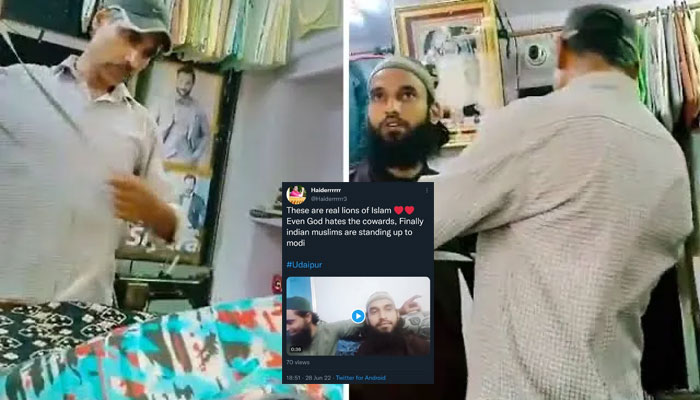
The Tweet that he had reported was by a Twitter user, Haiderrrrrr3, who had shared a video of the two Islamists who brutally murdered a Hindu tailor named Kanhaiya Lal in Udaipur, Rajasthan, for merely sharing a social media post in support of former Bharatiya Janata Party spokesperson Nupur Sharma. In his tweet, Haider wrote, “These are real lions of Islam. Even God hates the cowards, finally Indian Muslims are standing up to Modi.”
In response to the complaint by kansaratva, Twitter had said it did not find anything objectionable in the Tweet that had broken its regulations.
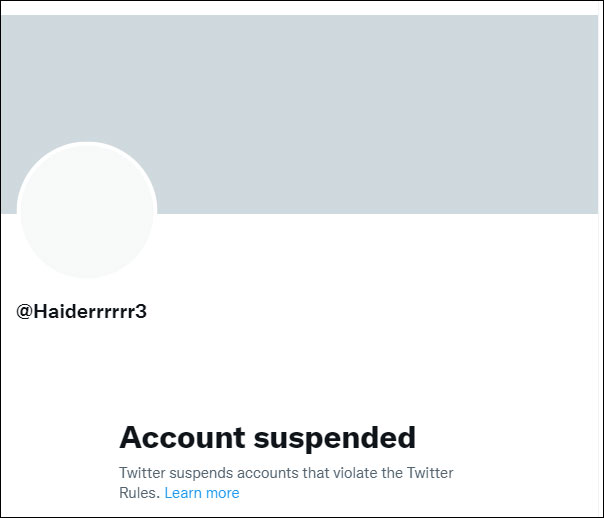
However, by the time this report was published, the account was suspended by Twitter.
Haider’s account suspended. Source: Twitter
It is notable that the account had the location set as ‘Delhi’, but according to researcher Ajayendra Urmila Tripathi, the account was being operated from Pakistan. In a tweet, Tripathi published multiple screenshots as evidence. In one of the screenshots, he showed his location as Lahore in one of the archived tweets from the account.
हैदर (@Haiderrrrrr3) नाम का हैंडल जो खुद को दिल्ली का बता कर भड़काऊ बयान दे रहा है, दरअसल वह लाहौर से चलाया जा रहा है।
— Ajayendra Urmila Tripathi (@ajayendra_) June 29, 2022
In another screenshot, the Twitter user shared a screenshot from his mobile that showed the Pakistani mobile network’s name.
Tripathi urged people not to fall for the Pakistani propaganda. He said, “The ID of Haider was being operated from Lahore though the location showed Delhi. Do not fall for the Pakistani propaganda as they will try to take advantage of the situation.”
The murder of Kanhaiya Lal
On June 28, a Hindu man named Kanhaiya Lal was brutally murdered in Udaipur, Rajasthan, over an alleged post in favour of former Bharatiya Janata Party (BJP) spokesperson Nupur Sharma. The post was allegedly made by accident from Kanhaiya Lal’s phone by his son while playing a video game.
His neighbour Nazim filed a complaint against Kanhaiya Lal, following which he was arrested. Nazim also leaked Kanhaiya Lal’s number, photograph and address to his community groups. After being released on bail, he continued to receive threats.
Feared for his life, Kanhaiya Lal shut his shop for six days and approached Police for protection. Instead of giving him protection, the Police asked him to compromise with the Islamists who were threatening him. After six days, when he opened his shop, two Islamists came as customers and beheaded him. The two attackers, identified as Mohammed Riyaz Akhtar and Mohammed Ghous, were arrested by the Police in Rajsamand. The case has been taken over by NIA under the Ministry of Home Affairs’ direction.