Home Blog Page 3241

Press Club of India Journalists whine over increased liquor prices in the club, allege that complimentary liquor from companies have gone missing

Journalist members of Press Club of India in Delhi are angry, not because of some political or ideological issues, but over alleged higher prices of alcoholic drinks served in the club. A flyer from the club’s members appeared on social media on Sunday, where the journalist members of the Press Club of India were seen complaining about the increased rates of liquor in the club, calling it a loot. Now, this has ignited a conversation over the comparative liquor prices in Press clubs across the country, rendering our journalistic eminences with quite a puzzle.

Image posted on Twitter by Sanjay Kaw

Be it a long reporting assignment on the field or after a heated debate in a TV studio, a chilled beer at one of the Press Clubs is a journalist’s last refuge to call it a day. As the temperatures in the country alongside the political cauldron have soared high, so have the liquor prices at Delhi’s Press Club of India. This seems to have added to the worry of PCI members who have taken it upon themselves to ask the administration over the increased liquor prizes at the club.

The Press Club which hosts its own restaurant-cum-bar in its premises in Lutyens Delhi, serves a host of liquor varieties including Vodka, Brandy, Whisky, Rum and Beer of various labels at the disposal of its members and guests. The PCI members however are miffed with the body over the increased prices. They have alleged that PCI members are being looted over this for several years. Alleging that the liquor in PCI is costlier than that served in other press clubs, the members have published a flyer that contains a chart comparing liquor prices of various labels served at PCI, Foreign Correspondents Club (FCC) in Delhi and Chandigarh Press Club.

According to the chart, a 30 ml serving of Johnny Walker Black Label costs Rs. 260 /- at PCI while it is available at Rs 200 and Rs 250 respectively at FCC and CPC. Kingfisher small beer costs Rs 105 per 30 ml serving while the same costs Rs 95 and Rs 62 at the other two clubs. Journalists and media personnel who are members of the PCI are calling this ‘The Great Press Club of India Loot’. While prices in Delhi and Chandigarh can be different because of different tax rates, it is indeed interesting that prices in Press Club of India is much higher compared to Foreign Correspondents Club, both of which are located in Lutyens Delhi.

Further, the members have asked why all the schemes on liquor granted to them have been stopped. They also alleged that complementary liquor given by companies have gone missing in recent times. “Where is the complimentary liquor from companies meant for the Press club members going missing?” the flyer asks. The aggrieved members also asked why some brands of liquor are not made available to them, and why the prices of food and drinks were increased without informing them. The members have also complained about same menu and food served at the club for years at high rates.

Interestingly, it is quite a revelation that companies offer complimentary liquor to the Press Club of India.

When Senior Journalist at The Asian Age and Deccan Chronicle, Sanjay Kaw posted the flyer on Twitter, Chander Shekhar Luthra, Joint Secretary at PCI responded and refuted the allegations. He said that the prices have been increased in order to meet the monthly expenditure at the club. In his rebuttal, he also blamed the increase in food prices for losses incurred by PCI on food. “PCI has not increased any food prices after Covid despite this failed govt has failed to check the food inflation…” he tweeted while targeting the Central government.

It should be mentioned that the Press Club of India is a meeting point for the journalists, with a campus located in Lutyens Delhi, near the Parliament. Started in the 1930s, the present premises were allotted to the Club by the government. The Club offers services including a conference room, a media centre, an indoor games room and a gymnasium for its members alongside a bar and a restaurant. Recently, the club was caught in a controversy when it cancelled Filmmaker Vivek Agnihotri from hosting a press conference regarding ‘The Kashmir Files’ at its conference hall.
Delhi police reach Rajasthan, direct rape-accused Congress Minister’s son to appear before them on May 18: Details

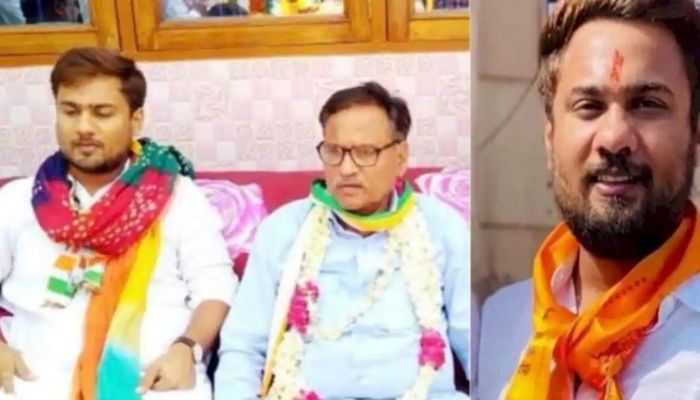
On Sunday (May 15), a 15-member team of Delhi police reached Jaipur to interrogate Rohit Joshi, who has been accused of raping a 23-year-old woman. Rohit is the son of Rajasthan Minister for Water supply, Mahesh Joshi.

While speaking about the development, a senior police officer informed, “Our team of officers have reached Jaipur in connection with the case to nab Joshi who has been absconding. Our teams are conducting a search to locate and trace him.”

The police reportedly visited two residences of Mahesh Joshi but have failed to trace the accused. On not finding him, the cops pasted a copy of the notice on the wall and asked him to appear before them on Wednesday (March 18).

“You are hereby informed that the above-mentioned case has been registered against you on the complaint of complainant ‘R’ at PS Sadar Bazar, Delhi,” the notice read.

It further added, “You are hereby directed to appear before the undersigned and to join investigation by 18th May 2022 at 1:00 pm at PS Sadar Bazar Delhi along with any relevant record/document with you.”

While speaking to India Today about rape allegations against his son, the Congress Minister remarked, “I have been informed Delhi police have arrived in Jaipur. Law should take its course. Truth should come out. A media trial should not take place.”

He claimed that the Delhi police team did not contact him and that he will cooperate with the investigation.

Rape allegations against son of Rajasthan Minister

A 23-year-old woman had filed a rape complaint against Rohit Joshi on May 8 this year at Delhi’s Sadar Bazar police station. A zero FIR was initially filed in Sadar Bazar police station and forwarded to Sawai Madhopur.

The victim stated in her police complaint that the accused raped her multiple times in Jaipur and Delhi. In addition, the victim has reported rape and unnatural sex with her in Delhi. She had stated in her complaint that Rohit attacked her and forced her to get an abortion when she became pregnant.

Rohit and the girl were Facebook friends for almost two years. On January 8 last year, Rohit drove her to his friend’s residence in Sawai Madhopur where he raped her after spiking her drink with psychoactive substances. When she became unconscious, Rohit filmed and photographed her naked.

The girl claimed that on August 12, 2021, Rohit summoned her to his friend Ajay Yadav’s workplace and assaulted her during a conversation. Rohit forced her to undergo an abortion. After that, on September 3-4 last year, Rohit brought her to a Delhi hotel and raped her. After that, on April 17, 2022, he raped her again under the guise of a conversation.

The victim had accused Rohit of intimidating her and her family. An FIR was registered under Indian Penal Code sections 376 (rape), 328 (causing hurt by means of poison, etc. with intent to commit an offence), 312 (causing miscarriage), 366 (kidnapping, abducting, or inducing woman to compel her for marriage, etc), 377 (unnatural offences), and 506 (criminal intimidation).

Watch: Armed Taliban men dance inside classroom after closing girls’ school

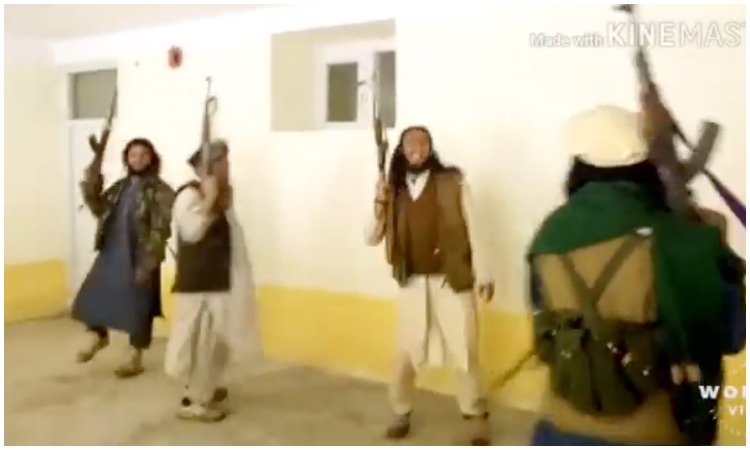
A video of Taliban men dancing inside a girls’ school has gone viral on social media. In the video shared by independent journalist Sajjad Nuristani, the armed Talibani men were seen dancing inside a girls’ school in Afghanistan after closing them.

According to the journalist, the Talibani fighters closed a girls’ school and celebrated their act by dancing inside the classrooms.

This classroom is from Weigel High School in Nuristan province in eastern Afghanistan. In the video, four fighters are seen with guns while the fifth person is making the video.

The Afghanistan-based journalist said that the men belonging to the Islamist group were ecstatic after closing the girls’ school.

The Taliban, which has firm control of war-torn Afghanistan, has decided to ban the higher schooling of girls. In Afghanistan, girls cannot study above the sixth grade. Meanwhile, the international community has been pleading with the Taliban to open schools and provide education to women.

Plight of women under the Taliban during its earlier stint

However, ever since the Taliban commenced its offensive to recapture Afghanistan last year, it has consciously sought to project greater moderation in its rule, something that is in stark contrast to its ham-handed rule from 1996 to 2001.

Back then, women were proscribed from attending school or working outside their homes, in conformity with Sharia Islamic law. Besides, they were also mandated to wear fully covered overgarments called chadaree and be chaperoned by a male relative whenever they went outside. The Taliban had also placed a ban on music and imposed severe punishments on those who violated the Sharia law, such as chopping off the hands of thieves, lashing women in public and stoning people over allegations of adultery.

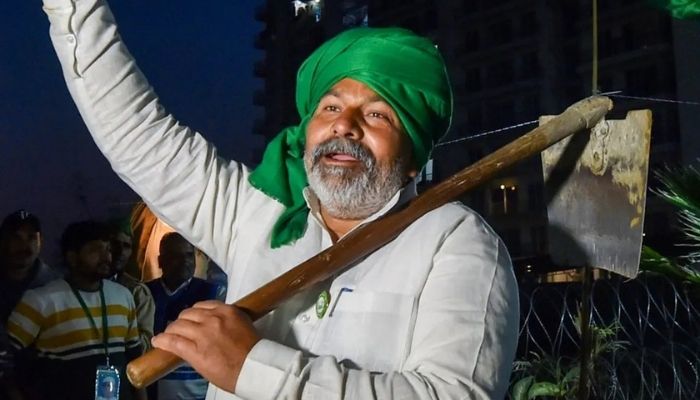
Rakesh Tikait ousted from Bharatiya Kisan Union for playing politics, the organisation splits into two

The Bharatiya Kisan Union (BKU), which has been at the forefront of anti-farm law protests, has expelled ‘farmer leader’ Rakesh Tikait from the organisation, according to reports.

Besides Rakesh Tikait, his brother Naresh Tikait has also been ousted from the position of the National President of BKU. Republic TV reported that the duo has been accused of playing politics and working for a political party’s interests. Not happy with the organisation’s involvement with politics, several leaders of BKU decided end their associations with Rakesh Tikait.

The farmer’s organisation has been split into two factions, with the breakaway BKU (Apolitical) faction being led by farmer leader Rajesh Singh Chauhan. While speaking about the development, Chauhan had accused the Tikait brothers of politicising BKU, which was supposedly created to serve the interest of farmers.

The new BKU (apolitical) chief remarked, “We have no comment on Rakesh Tikait, or Naresh Tikait, they can keep doing what they want to do. But the BKU was turned into a political zone. It was inspired by politics.”

He emphasised, “We spoke to Rakesh Tikait and expressed our concerns. We did a lot of hard work to create BKU, but he asked us to support one party. We object to that. Our motive is to look into the problems of farmers. We will not work for any party.”

On November 19 last year, Prime Minister Narendra Modi made a startling announcement saying that the government had decided to repeal the 3 farm laws, which had become the bone of contention between farmer protestors and the Union government.

Naresh Tikait supported SP-RLD alliance, but Rakesh Tikait contradicted him

Earlier in January this year, a video had emerged on social media in which Naresh Tikait was heard throwing his weight behind the SP-RLD alliance ahead of the Uttar Pradesh Assembly polls. This was despite the warning of the Samyukta Kisan Morcha that any farmer organisation contesting elections would have to leave the United Front.

Naresh Tikait had reportedly sent out messages to both the Samajwadi Party and the Rashtriya Lok Dal (RLD), encouraging them to contest the UP elections by labelling it as a ‘matter of prestige.’

A meeting was also organised in this regard at the Kisan Bhavan in Tikait’s native village Sisauli in the Muzaffarnagar district of Uttar Pradesh. Rakesh Tikait was also present in the meeting, where support to the joint candidates of SP and RLD, fielded from Budhana and Meerapur found a special mention.

Rakesh Tikait, who was at the vanguard leading the farmers’ protest against the Modi government’s farm laws contradicted his brother’s claim. Clarifying that BKU has not favoured any political alliance, he said that his party would communicate the same through their official social media handle.

“If someone comes to our house, we say ‘we are with you’. We are not telling anyone whom to vote for. We have decided that we will not support anyone. Even if we are against the government, everyone (the people) knows what they have to do,” Rakesh Tikait had claimed.

Uttar Pradesh: Illegal arms factory run near Idgah by father-son duo busted in Saharanpur, son Naeem absconding

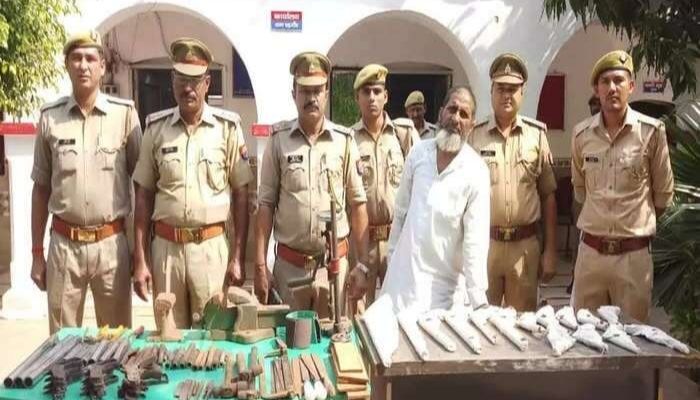
In Uttar Pradesh, Saharanpur police have busted an illegal arms manufacturing factory. As part of the drive being carried out under the directions of the SSP, the SWAT team of the Crime Branch and the Badgaon police station have arrested one of the accused and recovered a huge quantity of illegal and sub-fabricated weapons. The police have also found all the tools to make pistols from the spot. The accused father-son duo were making illegal weapons together. The father was caught and his son managed to escape. The police are also investigating where and to whom the arrested accused have supplied the weapons.

According to a report by Navbharat Times, SSP Akash Tomar said on Friday 13th May 2022 that as part of the ongoing drive to nab the culprits, the SWAT team of the crime branch and Badgaon police station busted an illegal arms manufacturing factory and arrested one of the accused and recovered a huge quantity of illegal arms from his possession. The SWAT team and the Badgaon police station received information from the informer that on the empty kiln near Idgah in village Ambehata Mohan illegal pistols were being made. Police raided the spot and arrested one of the accused.

According to the SSP, during interrogation, the accused told his name Mustakeem, son of Shaukat, a resident of village Sapla Bakkal police station Deoband. Mustaqeem’s son Naeem fled from the spot. Police are looking for the absconding accused.

This is not the first time that an illegal arms unit is busted in western Uttar Pradesh, especially in the Saharanpur district. In fact, the Muzaffarnagar and Saharanpur district is a hub of illegal arms factories. Uttar Pradesh police have busted many such illegal weapon-making units in the recent past.

Maharashtra: NCP workers beat BJP spokesperson Vinayak Ambekar over a Facebook post against Sharad Pawar

As opponents of the Bharatiya Janata Party from political and media fraternities keep blaming Prime Minister Narendra Modi for suppressing freedom of speech and expression in India during his regime, back-to-back arrests are seen in Maharashtra for social media posts against the leaders of ruling Maha Vikas Aghadi alliance. Now, in another recent incident, NCP goons have beaten a BJP spokesperson named Vinayak Ambekar in Pune for a Facebook post criticizing Sharad Pawar. It is notable that Sharad Pawar is being criticized in the last few days for his controversial remarks about Hindu deities which he made while hiding behind the shield of a piece of poetry penned by Jawahar Rathod.

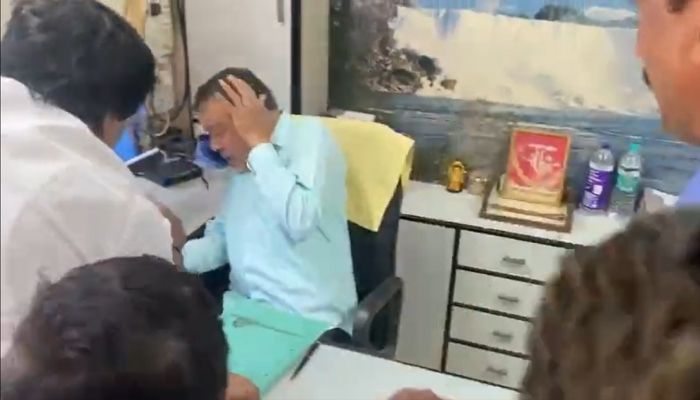
In the video of this incident, it is seen that Vinayak Ambekar who was sitting in his office was visited by a group of NCP goons to ask him a clarification about his Facebook post. Though Vinayak Ambekar was answering them patiently and was about to give an explanation, an NCP goon slapped him on his face.

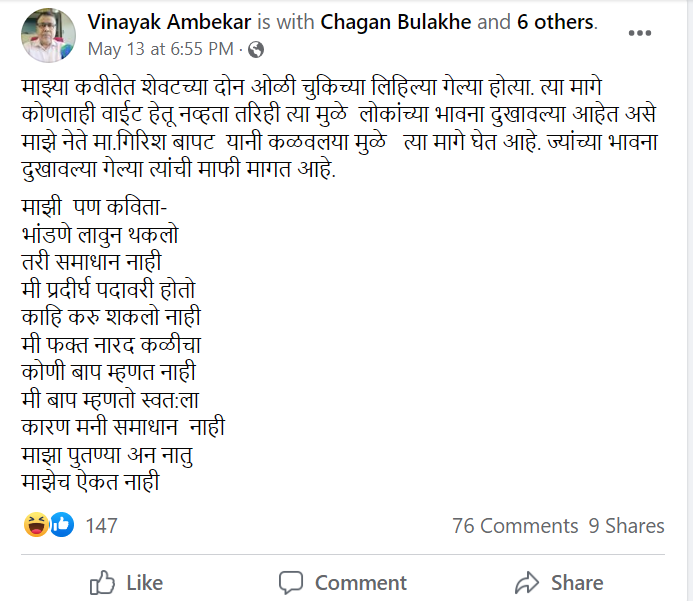
BJP spokesperson Vinayak Ambekar had actually made changes to his original post and reshared it. The modified post says, “Last two lines in my poem were written by mistake. There was no bad intention behind writing those lines. But my leader Girish Bapat has conveyed to me that people’s feelings are hurt due to this. I apologize to those whose feelings are hurt. Now my poetry is as follows – “

Below, Vinayak Ambekar wrote, “I am tired of setting people on fight with each other, but I am yet not content. I held a post for a long, but could not do anything. I am just a gossiper, no one calls me father. I myself say that I am a father because there is no contentment in my heart. My nephew and my grandson, both don’t listen to me.”

Sharad Pawar attracted much criticism after he recently called himself the father of the Hindu deities by quoting poetry. Arrests after such criticism have become normal and a large chunk of the regional leaders and media are seen supporting such arrests rather than protecting the freedom of expression and speech. Marathi actor Ketaki Chitale was arrested on 14th May 2022 for sharing an allegedly derogatory post on Facebook against NCP supremo Sharad Pawar. A youth named Nikhil Bhamre from Nashik was arrested for a critical social media post made against NCP president Sharad Pawar.

Congress drags Bhagyalaxmi Temple of Hyderabad as proof of ‘encroachment’ while giving clean chit to Aurangzeb over demolition of Kashi Vishwanath temple

On Saturday (May 14), the Congress party courted controversy after it tried to give a clean chit to Mughal emperor Aurangzeb for the destruction of the Kashi Vishwanath temple.

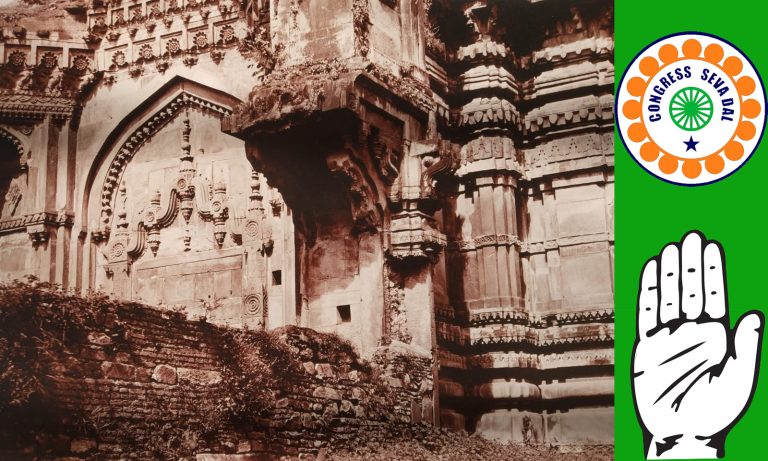
As the videography and survey of the disputed structure of Gyanvapi mosque is going on, popular Twitter handle (@IndiaHistorypic) had uploaded an old picture of a destroyed wall of Kashi Vishwanath temple on Twitter on May 12th. The image was sourced from the archives of the Archaeological Survey of India (ASI).

“1890 :: Wall of Kashi Vishwanath Temple ( Temple Was Destroyed by Mughal Emperor Aurangzeb) Now Part of Gyan Vapi Mosque , Varanasi,” the handle had tweeted, crediting ASI for the photo.

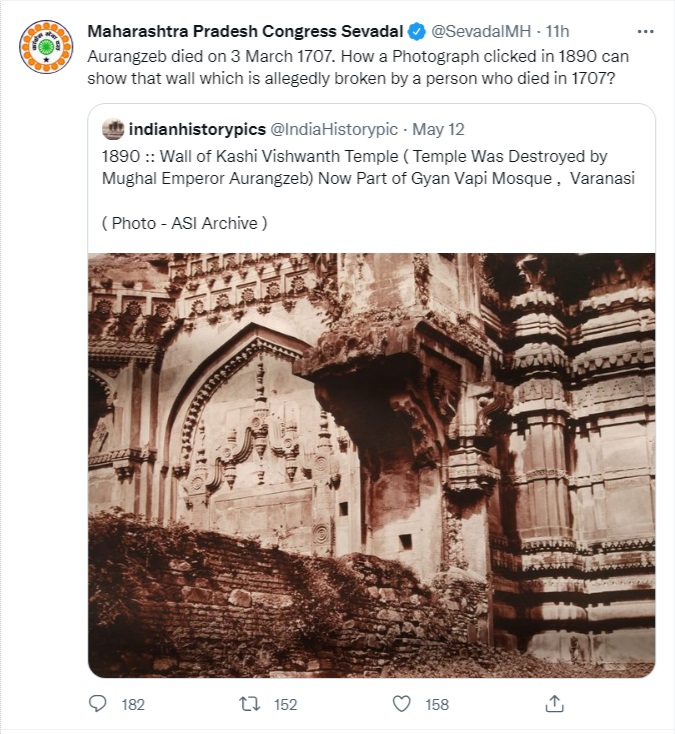
Given that the picture and the associated caption portrayed Aurangzeb as a tyrant, the Congress party came to the defence of the Mughal ruler. The official handle of the Maharashtra Pradesh Congress Sevadal insinuated that the ancient Hindu temple was not destroyed by the Mughal emperor, by claiming how the photograph taken in 1890 can prove that Aurangzeb had destroyed the temple when the Mughal emperor had died almost two centuries ago.

“Aurangzeb died on 3 March 1707. How a photograph clicked in 1890 can show that wall which is allegedly broken by a person who died in 1707?” the tweet by Maharashtra Congress Sevadal read.

Screengrab of the tweet by Maharashtra Pradesh Congress Sevadal

Allegations by Congress Sevadal junked

Twitter user ‘IndiaHistorypics’ refuted the claim by responding that the same destroyed wall is also seen in a lithograph made In 1834 by British scholar James Prinsep, which had mentioned that the temple was destroyed by Aurangzeb.

“Further you may take up the matter with ASI and British Library as the source belongs to them,” the popular handle told Congress Sevadal.

In another tweet, it emphasised, “Same Wall of Destroyed Kashi Vishwanath Temple Shown In This Lithograph Made In 1834 by James Prinsep. It Also Says That The Temple Was Destroyed by Aurangzeb”

James Prinsep (1799-1840) was an architect and European scholar who holds the distinction of deciphering the edicts of the ancient Indian emperor Ashoka. He is credited for reforming the Indian system of weights and measures and introducing a uniform coinage system.

Congress Sevadal tried to dismiss the fact that Aurangzeb had destroyed the temple to build just because a photograph of the partially destroyed wall was taken decades later. But the fact is, it is an undeniable fact that the original Kashi Vishwanath temple was destroyed during the regime of Arungzeb and the mosque was built on its ruins. Even the Muslims don’t deny this fact, they only justify this by saying that Aurangzeb had ordered to demolish the temple after spotting some crimes by the priests in the temple.

The Congress asked “how a photograph clicked in 1890 can show that wall which is allegedly broken by a person who dies in 1707”, which is a baseless question. Because while the temple was destroyed, it was not completely demolished, as seen even now, parts of the demolished temple were used for the mosque. Therefore, the photograph posted by IndiaHistorypics showed a partially destroyed wall. Also, the tweet clearly mentioned that this is wall of original Kashi Vishwanath temple which is now part of the Gyanvapi mosque. Walls of the temple are seen on the mosque even today, but still Congress tried to question the fact.

Congress Sevadal continued to defy

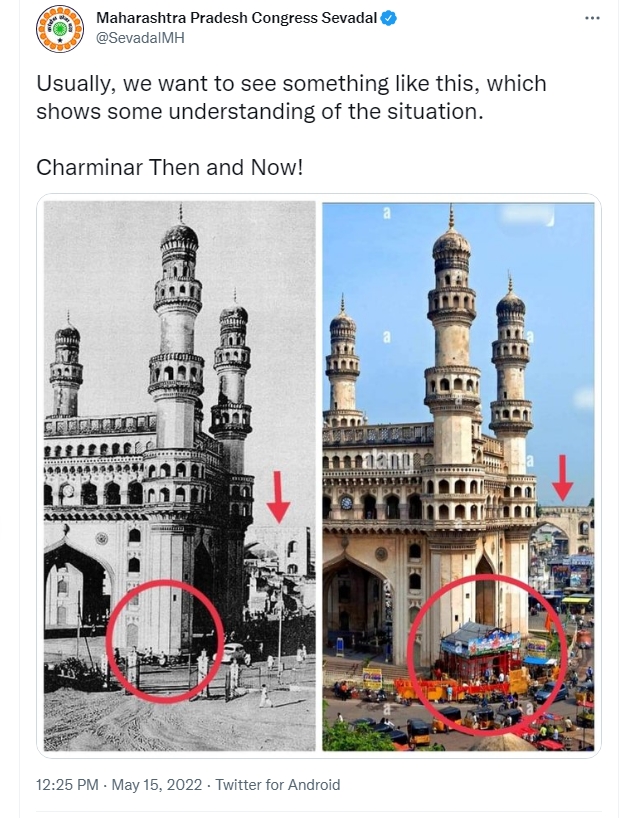
Despite the clarification that the images are from ASI and British Museum and that the wall of the destroyed temple is now part of the mosque, Maharashtra Congress sevadal continued to question the well-known fact. Instead of conceding, they brought up the matter of the Bhagyalaxmi Temple, located next to Charminar in Hyderabad. They said that to prove that Gyanvapi mosque was built after destroying the Kashi Vishwanath temple, they need before and after photographs, which shows the place in different points of time. As an example, they posted two images of the Charminar in Hyderabad from different. The second colour photograph showed the Bhagyalaxmi Temple next to Charminar, while the first black and white photo does not have the temple. The temple was constructed in 1960s, and is a disputed structure, expansion of which have been stopped by Telangana High Court.

Screnshot of Congress Sevadal tweet

Congress brought a completely unrelated topic to defend Aurangzeb. The Bhagyalaxmi Temple is a completely different issue in a different state, and as the temple was constructed just a few decades ago, photographs of the place without the temple are available. But it bizarre to demand photographic proof of the existence of the original Kashi Vishwanath temple, which was demolished centuries before photography was invented. Moreover, there are physical proofs of the temple, as the forms of walls and other ruins in the mosque, and there are several historical and literary evidence, but still Congress party claims it is not enough to prove that Aurangzeb had demolished the temple.

For some reason, they also pointed out the Char Kaman near the Charminar in both the images. The Kamans were built in 16th century after the completion of the Charminar, and it is known what point Congress party wanted to prove by showing it in both the images.

Gyanvapi mosque dispute and survey

The Gyanvapi Mosque complex is a disputed structure built over the ruins of the desecrated old Kashi Vishwanath Temple by Mughal emperor Aurangzeb after it was desecrated multiple times by Islamic monarchs such as Qutb al-Din Aibak and Aurangzeb.

To this day, parts of this ancient temple are clearly visible on the outer walls of the mosque, especially the western wall which has been kept intact. Even from afar, the statues of the bull Nandi and Maa Shringaar Gauri can be seen. Moreover, there are enough historical evidences of the demolition of the temple, building the mosque, and the rebuilding the temple at the current adjacent site.

The Kashi Vishwanath Temple complex, which is adjacent to the disputed mosque complex and where devotees can do puja and prayers, was built by Ahilya Bai Holkar of Indore in 1780.

A Varanasi court on May 12 allowed a videographic survey of the disputed structure. Varanasi’s Civil Judge (Senior Division) Ravi Kumar Diwakar issued guidelines for the same and added that the survey will now be held and a report to be submitted by May 17.

Badminton: Team India creates history, wins Thomas Cup by beating 14-time champions Indonesia

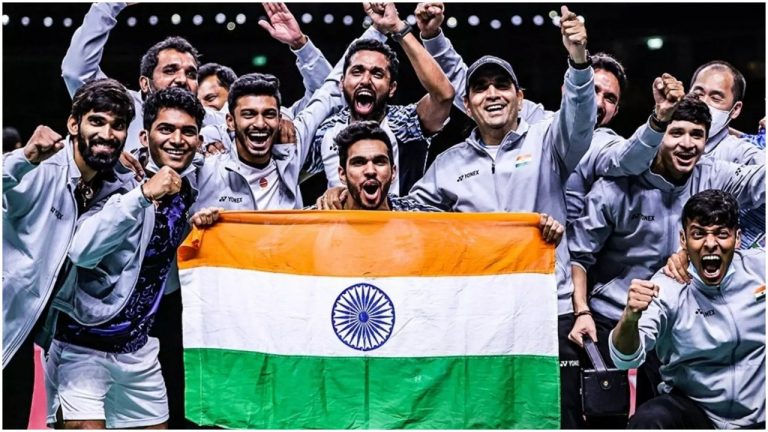
In a historic achievement, Indian shuttle badminton team has won the Thomas Cup 2022. The historic feat was achieved on Sunday as Indian shuttlers as they defeated the mighty Indonesian team in an unassailable lead of 3-0 margin.

This is India’s first Thomas Cup title, a tournament which is often considered the world cup of shuttle badminton. India emerged victorious after they crushed 14-time champions Indonesia into defeat in the final held on Sunday.

Kidambi Srikanth defeated Indonesian player 21-15, 23-21 to register a historic win for India in the Thomas cup 2022, which is considered to be the world cup of shuttle badminton.

Earlier, Lakshya Sen beat Anthony Ginting 8-21, 21-17, 21-16 to give India a 1-0 lead. 

In the second match, Satwiksairaj Rankireddy and Chirag Shetty registered a win in the first doubles to win 18-21, 23-21, 21-19 against Mohammad Ahsan and Kevin Sanjaya Sukamuljo in the final at the Impact Arena in Bangkok, Thailand.

The Indian Men’s Badminton Team had reached the final of the Thomas Cup after defeating Denmark 3-2 in the tournament’s semi-final to achieve the remarkable feat.

Uttar Pradesh: Auto driver Amjad traps BA student in love affair, implicates her in false case of child theft

In the Saharanpur district of Uttar Pradesh an incident of grooming jihad has surfaced, prompting activists from several Hindu organisations and the family of the victim to approach the SSP office and request assistance. The accused, an auto driver named Amjad, allegedly entrapped a woman in a ‘love affair’ before implicating her in a child theft case.

Amjad allegedly changed his name to dodge their daughter and then escaped with her, according to the woman’s relatives. After which she was implicated in a false case of child theft by him and sent to jail. When she was freed from jail after eight months, she was afraid to come home. She was subsequently placed in a shelter home.

The victim’s mother stated that her daughter is a BA student who used to take a three-wheeler to college every day from the bus stop. Amjad, an auto driver, trapped her daughter in a love affair. “Not only that, but he is already married and has two children,” she explained. “Amjad did not take her to his residence; instead, he took her to a relative who was hospitalised. He then kept her there for two days. Then, as part of a plot, they accused her of child stealing and implicated her,” she further added.

The lady had been in jail for the last eight months on charges of child theft. Her relatives went to the jail to meet the woman after receiving the information. Then she revealed the actual story to them. She did not return home after she was released from prison on May 13 because she was afraid. The authorities then sent her to a shelter home. The authorities have assured the family of proper action against the accused.

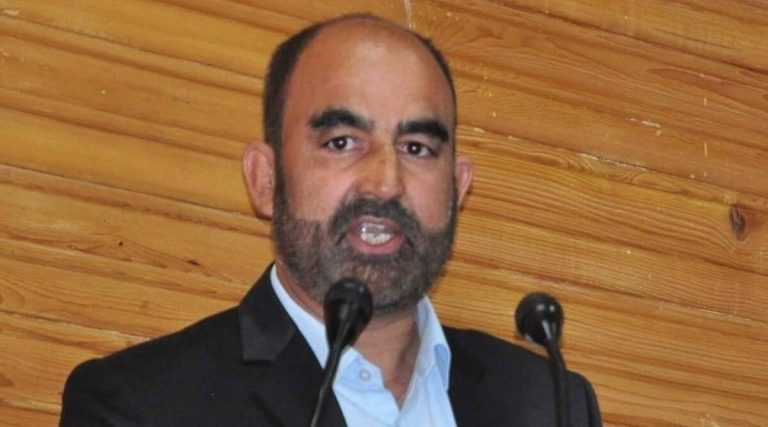
Kashmir: Chemistry Professor Altaf Hussain Pandit, known as ‘Geelani of Kashmir University’, sacked after his links with terror groups exposed

Former Jammu Kashmir Liberation Front (JKLF) Terrorist and Professor of Chemistry at Kashmir University, Altaf Hussain Pandit, has been sacked from his post on Friday. The decision came after Altaf Hussain Pandit’s links with terror groups were exposed.

It has been learnt that Pandit was an active terrorist with JKLF from 1990 to 1993. Despite his exercises in terrorism, he served as an executive member of the Kashmir University Teachers’ Association (KUTA) from 2015-17 and was its vice-president from 2017 to 2018. Pandit was involved in organising student protests against the Indian State, especially after the killing of Hizbul terrorist Burhan Wani in 2016.

Under Article 311 (2) C, the J&K government’s designated committee was scrutinizing cases on separatists active in the state. The committee recommended Pandit’s termination after it was found that he did not go the formal character and antecedent verification which is a mandatory requirement for government employees joining the service. A senior officer revealed that Altaf Hussain Pandit was one of the several others who managed to enter the public employment system despite challenging the security of the state because the system itself had become heavily contaminated.

Infamous as the ‘Geelani of Kashmir University’, Pandit peddled his separatist propaganda among the students in the university through his academic work. According to the dossier, Pandit often synchronised the university’s academic calendar with that of Hurriat’s Protest calendar in order to mobilize students toward secessionist agenda. He motivated students to join violent protests against the Indian administration and Army funded by separatist elements backed by Pakistan. He was reportedly surprised by the fact that no university student was killed during the 2016 protests after the killing of Burhan Wani.

The dossier by the investigation committee reveals that Altaf Hussain Pandit ran an anti-India cartel at the Kashmir University. For carrying out a separatist agenda for Pakistan and its local proxies in Kashmir, “Altaf was not a potential but a real danger,” according to an officer who has accused Pandit of influencing thousands of young minds in the university.

Who is Altaf Hussain Pandit?

Altaf Hussain Pandit, a separatist masquerading as a University professor, holds a PhD in Applied Chemistry from the Aligarh Muslim University. He joined as an Assitant Professor at Kashmir University in 2004. Brought up in the village of Wadoora in Sopore, Pandit was under the strong influence of Jammat-e-Islami since childhood. During his years as an active terrorist in the valley, he even crossed the LoC for arms training in Pakistan and returned to Kashmir in the same year when he was arrested. Further, he went to pursue higher studies at AMU while his association with JeM continued.

Pandit used to take the help of his like-minded colleagues and student in carrying out his operations at the University. Action against Altaf Hussain Pandit comes days after five government employees in the J&K administration were sacked in March this year over similar charges. It was revealed that the officers working under various departments were working as overground workers for the terrorist outfits. In April, Sheikh Showkat, Pro-Pakistan Principal of Kashmir Law College was removed after his association with tendentious personalities like Syed Ali Shah GeelaniArundhati Roy and Prof. SAR Geelani were exposed.