Home Blog Page 3275

‘Press Freedom Index’ and their bias: Despotic nations, that persecute journalists regularly, score better than India. Read about their track record

Recently, Reporters without Borders (RSF) published its annual ‘Press Freedom’ rankings for the year 2021-2022, in which India has been ranked 150th out of 180 countries ranked in the index. As we scroll through the website of the organization, RSF has appeared to be blatantly unapologetic about its biased indices, tweaked ranking logic and uncouth referral and unacademic judgement of some of the concerned countries in its list. India’s exceptionally lower rank in the list is amply clear when its justification is openly given by saying “The old Indian model of a pluralist press is being seriously challenged by a combination of harassment and influence,” on the website.

Having said this, if India’s rank is seen in the context of other countries, it may be noted that some of the most oppressive, authoritative regimes have found a place way ahead of India. RSF, this year, gained the audacity to put countries known for purging press freedom, killing journalists and reporters such as UAE, Hong Kong and Mexico way above India in its latest Press Freedom Index. While the organization has acknowledged abuses faced by journalists in the following countries, their rankings have been considerably higher than India.

Hong Kong – Rank 76

Administered as a special region under the sovereign state of the Republic of China, last year, Hong Kong was in the news for numerous police raids, and the seizure of assets of independent journalists – especially during the Covid-19 reportage. 2021 marked the subsequent closure of two major independent news organizations, namely – Apple Daily and Stand News. As of now, Thirteen journalists are in prison in the city-state, as claimed by RSF in its report.

RSF report mentions, “Since the 1997 handover to China, most media have fallen under the control of the government or pro-China groups.” The report also acknowledged that The Hong Kong government takes orders directly from Beijing on its reportage with full support to China’s attempts of imposing censorship and spreading propaganda through news channels. While the RSF claims to judge Press Freedom in countries based on liberty to report on contentious issues, detention of journalists, etc its rankings do not reflect the same.

While the recent index has ranked Hong Kong in the 76’th position, the internal picture of the city tells a rather grim story. Recently, a pro-democracy cartoonist Ah To announced that he’s leaving Hong Kong, saying he would face “great mental stress” if he were to continue producing political cartoons there. In January 2022, Independent Hong Kong media outlet Citizen News decided to halt its operations stating its concerns over the safety of the staff after a crackdown by authorities on fellow independent newsroom Stand News.

An example of China’s censorship in Hong Kong media is when the government-funded broadcaster RTHK took down a report from its website about Chinese tennis star Peng Shuai, who accused former Chinese Vice Premier Zhang Gaoli of sexual assault. A straightforward clampdown on free speech, followed by Beijing’s introduction of national security law that was enacted to quell anti-government protests in 2020 has rested the case for Hong Kong when it came to Press Freedom.

Moldova – Rank 40

Moldova was one of the first countries to ban Russian channels even before the Russia-Ukraine war escalated. In a move to control the alleged disinformation campaign peddled by Russia through its media, Russian TV channels remained banned in the country since 2018. The pro-European Union government in Moldova has brought a law to ban Russian channels in the country to control supposed curb Russian propaganda efforts. As anti-Russian hysteria runs in the Moldovan Parliament with its pro-West policies, the action against Russia accounts heavily for its citizens who are largely Russia sympathetic. In 2018, 62 per cent of Moldovans named Russian President Vladimir Putin as their favourite foreign politician. 

Moldova, which stands engulfed by Ukraine geographically on three sides bans Russian content right, left and centre. So much so, that a disinformation expert in the country has said that American presenter for Fox News, Tucker Carlson would be prohibited in Moldova. Valeriu Pasa, an expert on disinformation at a local anti-corruption campaign organization, said, “I’ll say simply: Tucker Carlson, in Moldova, would be prohibited.” He alleged that the prime-time Fox News anchor in an interview has previously ‘parroted’ Russian propaganda about Russia’s justification for aggression against Ukraine. With open anti-Russian credentials marked by purging of all things Russian in media, Moldova has been gifted with a 40th position on the Press Freedom Index by RSF.

United Arab Emirates – Rank 138

The International Campaign for Freedom in the United Arab Emirates (ICFUAE) has reported that UAE’s condition in Press Freedom is caused by an ‘increasingly repressive climate’ in the country where ‘government censorship and surveillance practices’ have been increasingly normalised throughout society. The country has seen the blocking of news publications such as The Huffington post, the New Arab, Middle East Eye, and Arabian Business by the authorities.

In 2012, the UAE government passed the ‘cybercrime law’ which grants authorities rights to more proactively control and sanction online activity on social media sites. Critics say that the cybercrime law heavily challenges freedom of expression and assembly in the UAE. The Islamic Emirates have been conscientiously using the law to detain and convict government critics and dissent among activists.

In 2016, journalist Tayseer al-Najjar and prominent UAE academic, Dr Nasser bin Ghaith were sentenced to three and ten years respective jail terms for comments made on social media that apparently ‘damaged the reputation of the UAE state’. Similarly, Human rights activist Ahmed Mansoor was held in an unknown location since his arrest after UAE authorities accused him of publishing “false information” and “spreading hatred and sectarianism” on social media. UAE authorities are infamous for purging press freedom and avenging dissenting reportage which often results in a threat to the life of journalists working under the Islamic monarchies.

Ukraine – Rank 106

Ukrainian President Volodymyr Zelenskyy, who has emerged as a new liberal icon post-Russia’s invasion of his country, is too guilty of being comparatively authoritarian than his neighbours in the region when it comes to muzzling the media and silencing the opposing voices. In early 2021, Zelenskyy decided to close down a series of Ukrainian TV channels with apparent links with the Kremlin linked as a national security measure. The concern over Zelenskyy’s commitment to media freedom was increasingly growing last year, in the pre-war scenario.

In 2021, Ukraine saw protests regarding attacks on journalists by the authorities. The country, however, has a history of clamping down on press freedom since its independence from Soviet Russia. In Zelensky’s tenure, criminal proceedings were opened in 2021 against journalist Yuriy Butusov, days after he had a spat with Zelenskyy during his annual press marathon. In the same press marathon, Zelenskyy also attacked another journalist, Mykhail Tkach, who had recently published an investigation into the birthday celebrations of Zelenskyy’s chief of staff, Andriy Yermak.

Beyond attacks on individual journalists, Zelenskyy is accused of pressuring opposition media as well. In 2021, Kyiv Post – the only printed English-language newspaper in Ukraine suspended its operations due to alleged pressure from Zelenskyy’s office. According to Mykhail Tkach, authorities put pressure on the owner of the publication’ in order to change the information policy of the media’. Media outlets including TV channel Pryamyy have also complained of ‘undue pressure’ from the Office of the President.

Journalists including Yanina Sokolova – who was interrogated for publishing internal documents in a scam, Meanwhile, Talk show host Natalia Vlashchenko – who was labelled “pro-Russian” following her criticism of Zelenskyy have been continuously targeted by the Zelenskyy regime over the last few years. Yet according to RSF, press freedom in Ukraine is way better than the same in India, with the 106th ranking in the table.

Turkey – Rank 149

Under the authoritarian regime of President Recep Tayyip Erdoğan, Turkey remains one of the world’s worst jailers of journalists. The Turkish government under its increased control over social media continues to exercise censorship on social media and the Internet, with the rise of independent journalists in the country. According to Freedom House’s yearly report on global Internet freedom, Internet freedom continued to decline for the third year in a row in Turkey. Hundreds of websites were blocked, and dissenting content critical of President Erdoğan or his ruling AKP was removed from websites and social media platforms last year. Detention of online activists, journalists and social media users with cases of harassment over social media content is common in the Erdogan regime.

“Questioning the authorities and the privileged is now almost impossible,” last year’s RSF report on Turkey stated. While the situation of rights in Turkey continues to deteriorate under Erdogan’s Islamist dreams, RSF has prompted the country four ranks higher – from 153rd last year to 149th in 2022. RSF has placed autocratic Turkey at par with India at the 150th rank this year.

Mexico – Rank 127

With around 1,945 attacks on Journalists, including 33 murders conducted between 2019 and 2021, Mexico remains one of the most dangerous countries in the world for press freedom anywhere in the world. According to the press freedom group Article 19, there were 664 documented attacks (one in every fourteen hours) on Journalists and reporters in the country in 2021 which include online threats, harassment, arbitrary criminal charges and seven murders. According to the reports, Government officials were linked to 274 of the reported incidents, while organised crime accounted for 42 of the above cases.

Since President Andrés Manuel López Obrador took office, Attacks against the press in Mexico have increased by 85%, the Guardian reported. Apparently, Reporters who cover corruption and politics continue to face the highest risks, as Mexico remains one of the highest corruption-infested countries. Breaking news reporters who cover shootings, accidents and migration were also targeted in large numbers. A country where violence against Journalists has become a norm over the last twenty years, and more so under the Obrador regime, enjoys 127th rank in the list, with over eight journalists killed so far only since the start of 2022.

Somalia – Rank 140

The West African country of Somalia stood at Rank 140, despite the fact that Media freedom and safety came under systematic attack in 2021. The year saw the killing of two journalists and 34 arrests of media persons. In its annual report, the National Union of Somali Journalists (NUSOJ) has revealed that President Mohamed Abdullahi Mohamed’s regime continues to attack and silence independent media including politically motivated killings and attracting arbitrary imprisonments.

The killings include that of Independent journalist Jamal Farah Adan being shot dead by two gunmen in Galkayo city in March. Another journalist Abdiaziz Mohamud Guled was killed in a targeted attack by a suicide bomber in the capital of Mogadishu, by Islamist terror group Al-Shabaab. Apart from killings led by armed groups, the federal government authorities are mostly responsible for the arrest of journalists. The report also records a rise in attacks against women journalists, highlighting the prevalence of gender-based violence. With a miserable situation when it comes to freedom of journalists in the country, Somalia has still placed ten ranks higher than India in RSF’s Press Freedom report.

RSF’s ‘Fact-File’ about India

With RSF’s generous rankings of these oppressive regimes, its definition of what freedom means to the organisation should clear the air around its credibility. However, its rose-tinted understanding of India, often lensed by actors in the media ecosystem funded by political dynasties, has been unequivocally published on its website. India ‘Fact-File‘ published by RSF starts off with putting an incorrect map of India with Pakistani-occupied Kashmir and Chinese-occupied Aksai Chin cropped off. The write-up contained a heavily biased, left-tilted narrative of India with formalized use of words like ‘Godi Media’ and ‘Bhakts’. RSF claims that the safety of Journalists in India is under threat from “supporters of Hindutva who wage all-out online attacks on any views that conflict with their thinking.”

RSF and its India correspondents are open about the narrative to paint media oppression in India or rather operation of any kind, the onus of which is put on Narendra Modi or the ruling BJP. To expect the mention of attacks by Shiv Sena, NCP mobs on journalists, politically motivated jailing of Republic’s Arnab Goswami, threats to the media by AAP for covering allegations of Khalistani connections, purging of Human Rights in Bengal or jailing of Journalists in Congress-ruled Chattisgarh would be too much upon us, since its agenda is blatantly clear.
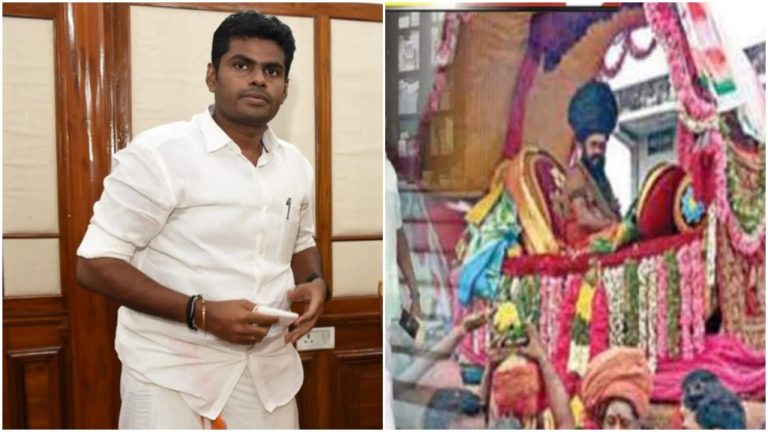
Tamil Nadu: BJP leader Annamalai challenges DMK govt over ban on ‘Pattina Pravesam’ of Dharmapuram Adheenam

A huge controversy has erupted in Tamil Nadu after the Mayiladuthurai collectorate refused permission to conduct the traditional ritual of ‘Pattina Pravesam’, a tradition of devotees paying reverence to the seer of the Dharmapuram Adheenam by carrying him on a palanquin.

According to the reports, The Mayiladuthurai Collectorate in Tamil Nadu had refused permission to ‘Pattina Pravesham’, claiming that it would create law and order problems. The Revenue Divisional Officer of Mayiladuthurai J Balaji issued the ban order and had also claimed that the practice was a “violation of human rights”.

The order was issued after the Dravidar Kazhagam, and other far-left outfits had objected to the traditional ritual. The Dravida Kazhagam and different outfits had cautioned the district authorities against permitting the event. They had also taken exception to the conduct of the ‘Pattina Pravesam’ of Thiruvavaduthurai Adheenam Gurumahasannidhanam, a Saivite Mutt based in the town of Tiruvavaduthurai in Kuthalam Taluk in the district in February.

Following the order issued by the Mayiladuthurai Collectorate, Hindu organisations and devotees have reacted strongly, demanding the withdrawal of the order.

The 293rd pontiff of Madurai Adheenam Sri La Sri Harihara Sri Gnanasambanda Desika Swamigal has also strongly advocated for the ‘Pattina Pravesam’ to continue.

“If permission is denied, then I will carry the palanquin myself,” the seer was quoted as saying.

Annamalai slams DMK-led govt, says he will personally carry the seer on a palanquin

Tamil Nadu BJP chief K Annamalai has also responded strongly against the order issued against the ‘Pattina Pravesham’ of the Dharmapuram Adheenam seer. He has challenged the MK Stalin-led Tamil Nadu government, saying he will personally carry the pontiff on the palanquin on his shoulders.

“Ban on Dharmapura Adheenam’s centuries-old ‘Pattina Pravesham’ is an affront to TN’s civilisational culture. I’ll be personally there to carry the Adhinam on Palanquin on my shoulders. We will request the Adhinam to allow us to conduct the event by overturning this illegal order,” Annamalai tweeted.

The former IPS officer-turned-politician also hit out at the MK Stalin-led DMK government, saying that the DMK party is built on sheer sycophancy.

“Servitude is serving one’s family, in this case, Gopalapuram, by sheer sycophants & serving one’s guru is through the institution of ‘Pattina Pravesham'” Annamalai said.

Meanwhile, Tamil Nadu Opposition Leader Edappadi K Palaniswami has also raised the issue of the Mayiladuthurai district administration denying permission for Dharmapuram Adheenam’s ‘Pattina Pravesham’.

Attacking the government, EPS said the ‘Pattina Pravesham’ event is a tradition, and hence it should be allowed since it’s a spiritual event.

Responding to this, Hindu religious & charitable endowments minister PK Sekar Babu has defended the ban on the ritual, saying that the government has rolled it out for the welfare of Aadheenams in Tamil Nadu.

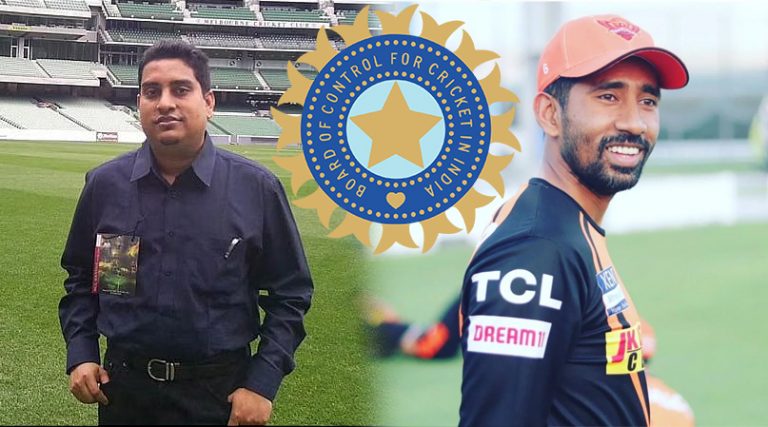
BCCI bans journalist Boria Majumder for two years for threatening, intimidating cricketer Wriddhiman Saha 

The Board of Control for Cricket in India has banned journalist Boria Majumdar for two years after he was found guilty of threatening and intimidating cricketer Wriddhiman Saha. In a statement issued today, BCCI said that a committee has found that the actions of Majumder were in the nature of threat and intimidation, and therefore he has been banned from BCCI related matches and other events for two years.

In the statement, BCCI said that it had taken cognizance of messages posted by Wriddhiman Saha saying that he felt bullied and threatened by the conduct of Boria Majumder. The cricketer had posted screenshots of the messages sent to him by the journalist. The board had formed a committee comprising vice president Rajeev Shukla, treasurer Arun Singh Dhumal and Councillor Prabhej Singh Bhatia to look into the matter.

The committee considered submissions made by both Saha and Majumder, and concluded that actions by Majumder were indeed in the nature of threat and intimidation. As a result, the committee recommended the ban to the Apex Council of BCCI, and the Apex Council accepted the recommendations.

According to the ban, for two years, Boria Majumder will not get any accreditation as a member of the press in any cricket matches held in India, both domestic and international. He will also not be able to interview any BCCI registered cricketer, and he will not get access to any cricket facilities owned by BCCI and its associates.

It was reported last week itself that Boria Majumdar faces two years ban as BCCI had found him guilty of intimidating Wriddhiman Saha.

This all happened after Wriddhiman Saha took to Twitter in February of this year to post a screenshot of threatening messages received by him from an unnamed journalist requesting an interview and then humiliating him for not responding. In the post, Saha wrote, “After all of my contributions to Indian cricket..this is what I face from a so called “Respected” journalist! This is where the journalism has gone.”

In the screenshot posted by Saha, the journalist was seen asking Saha to do an interview with him. The journalist also says that he will not be pushing Saha for an interview, however, the wicket-keeper must choose the person who can help him the most.

As Saha did not entertain the journalist’s request or call him back, the journalist became angry and said that he would never again take his interview. He had further stated in the message that he would not take this insult kindly. The journalist had even warned Saha that he should not have behaved in this manner.

While Saha had not named the journalist in the tweet, many had speculated it to be Boria Majumder, and during the hearing, the cricketer had named him. He said that he was “bullied” by Boria for an interview.

Mumbai: BMC team reaches MP Navneet Rana and MLA Ravi Rana’s Khar house to check alleged illegal construction

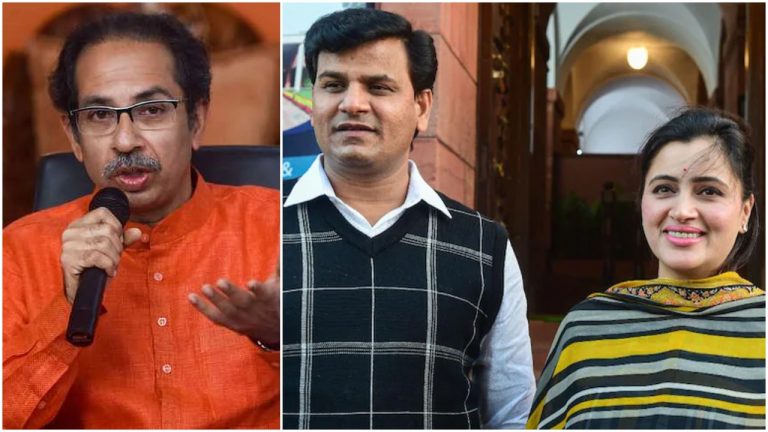
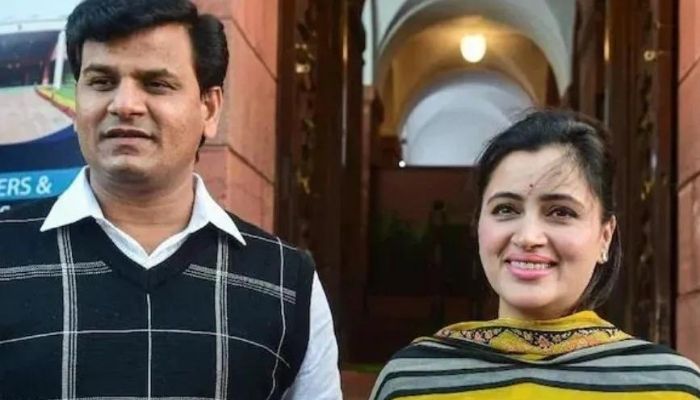
Hours after a special bench of Mumbai Sessions court granted bail to independent Lok Sabha MP Navneet Rana and her husband independent MLA Ravi Rana, the Shiv Sena-led Brihanmumbai Municipal Corporation (BMC) officials have arrived at their home in Mumbai’s Khar to inspect alleged illegal construction done by them.

BMC officials reached the couple’s residence on Wednesday afternoon after a notice regarding the same was sent to them a few days ago.

Navneet Rana and Ravi Rana are in judicial custody for the past twelve days. This came after Shiv Sena accused the Rana couple of hurting religious sentiments and trying to incite violence after they announced that they were going to recite Hanuman Chalisa in front of CM Uddhav Thackeray’s family house Matoshree. While after the granting of bail, both the Ranas are expected to come out of jail by evening, BMC officials have already reached their house to check if they could be charged with undertaking illegal construction on their property if any.

On May 2, the BMC had issued an inspection notice to Ravi Rana and Navneet Rana for alleged illegal construction in their Khar West flat.

It may be recollected that similar notices have been issued in the past to people who have challenged the ruling Shiv Sena openly. Central BJP Minister Narayan Rane was sent a similar notice concerning his Juhu building referred to as Aadish. When in 2020, actress Kangana Ranaut came down heavily on the ruling state government in Maharashtra regarding the Sushant Singh Rajput case, the BMC began a demolition drive at the Bandra office of the actor claiming that several alterations on the premises without the due permission from BMC.

Delhi HC directs Twitter to remove five more defamatory tweets posted by Audrey Truschke against Historian Vikram Sampath

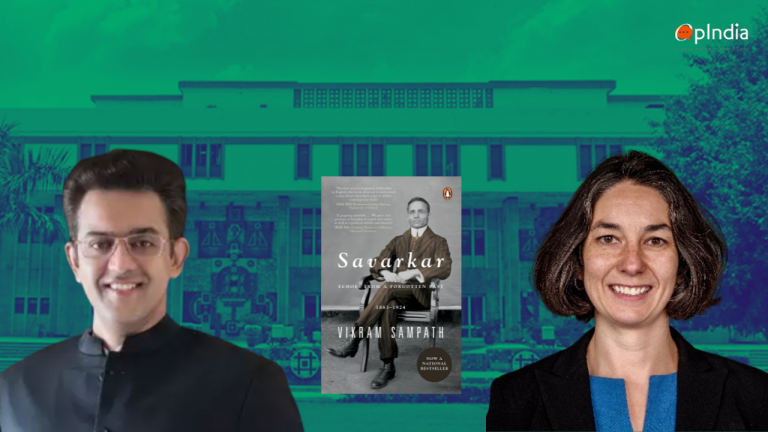
In a big blow to alleged historian Audrey Truschke, the Delhi High Court has directed micro-blogging site Twitter to take down five more tweets posted by her against historian Dr Vikram Sampath over alleged plagiarism in his two-volume biography of Vinayak Damodar Savarkar.

According to the reports, the Delhi High Court bench of Justice Amit Bansal observed that the tweets put out by Hinduphobic professor Audrey Truschke were defamatory in nature, and asked Twitter to remove five more tweets posted against Dr Sampath.

“Despite ad interim injunction passed by this Court vide orders 18th February 2022 and 24th February 2022, the defendant no.1 continues to post defamatory material against the plaintiff on the platform of the defendant no. 4/Twitter,” the court noted.

The court further noted that Truschke had failed to enter an appearance before the court and added that a prima facie case is made out on behalf of Sampath. The matter will now be heard on July 28.

The court was hearing a petition filed by Vikram Sampath filed by Audrey Truschke and others, including social media platform Twitter over defamatory comments and false allegations brought against him on the platform. In his petition, the distinguished historian sought a direction for taking down further defamatory tweets posted by Truschke on Twitter.

The suit had stated that Historian Audrey Truschke and other persons, namely Ananya Chakravarti and Rohit Chopra wrote the letter dated February 11 to the Royal Historical Society in London, raising serious allegations of plagiarism.

In February this year, the Court had also ordered the taking down of some tweets made by Truschke against Sampath.

Audrey Truschke’s hit job against Historian Vikram Sampath

The controversy started when associate professors of History and Communication from three universities in the USA, namely – Ananya Chakravarti, Rohit Chopra and the infamous Audrey Truschke, wrote to the Royal Historical Society, the UK, making a case for plagiarism against Sampath.

In the letter dated February 11, 2022, the professors have accused Sampath of allegedly “borrowing from essays, lifting sentences without attribution and merely paraphrasing material” from certain essays and thesis dissertations. Not only do their claims completely fall flat when they themselves find required references cited in the index, but their attempts to “dismantle” Sampath’s scholarship have also put their own academic credentials in question.

It is to be noted that on Thursday itself, while Truschke continued with her slander, the Delhi High Court ordered her to take down her defamatory tweets against Vikram Sampath within a period of 48 hours.

The Delhi High Court, on February 18, had passed an interim order restraining Audrey Truschke, Rohit Chopra and Ananya Chakravarti from publishing defamatory online content against Sampath, while the same has not budged to do so by now.

Los Angeles: Audience member attacks Comedian Dave Chappelle on stage at Hollywood Bowl, Chris Rock remembers ‘the slap’

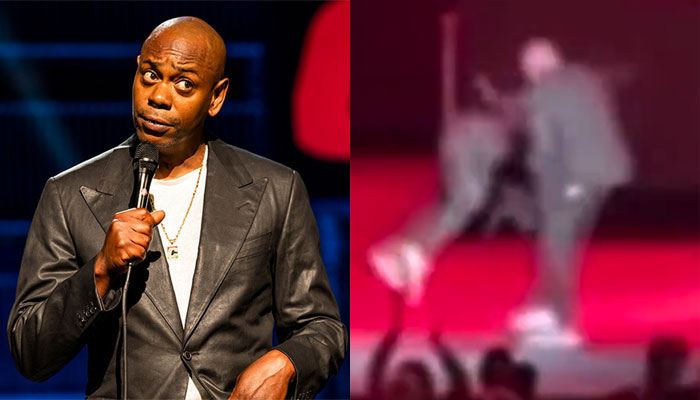
ON May 4 (local time), Comedian Dave Chappelle got attacked on the stage at Hollywood Bowl in Los Angeles, United States. The videos of the incident have gone viral on social media platforms. As per reports, a man from the audience tackled the comedian to the ground towards the end of his performance.

In the video, the comedian was seen standing on the stage. A man suddenly rushed towards him from the side and attempted to take him down on the ground. In another video shared on social media, the security personnel present at the scene detained the man and thrashed him.

In another video, the attacker was seen being taken by the LAPD and paramedics. LAPD confirmed in a statement that the man was in possession of a replica gun that could eject a blade if used properly. It was unclear if he tried to use the weapon.

Reports suggest that Chris Rock, who had performed earlier, joked after the incident and questioned if the attacker was Will Smith. Recently, Rock was slapped by actor Will Smith during the Oscars after he joked about his wife’s health condition during his monologue.

Following the attack, the comedian continued his performance. He said, “I grabbed the back of that n****s head, his hair was spongy, absorbent. Listen, I just want to say I’ve had an incredible time.” He added, “It was a trans man!”

Reportedly, the comedian has been criticized in the past for his jokes about the trans community and LGBTQ activism. Last year, he faced backlash for his Netflix special as well.

RSF targets India yet again in its Press Freedom Index: Here is a glimpse into their methodology that proves they are the mouthpiece of the global left

In the horrors of horrors and what constitutes one of the fantasies of the Left Liberals in India, ‘Reporters Without Borders’ (RSF) has downgraded India in the Press Freedom Index yet again. From a 142 rank last year, India now stands at 150, below regimes like that of UAE and even Hong Kong. The rankings were released on Tuesday, sending our homegrown ANTIFA enthusiasts in a celebratory tizzy.

Russia, which is currently at war, was placed at 155th position, down from 150th last year, while China climbed up by two positions with the Reporters Without Borders placing it at 175th position. Last year, China was placed in the 177th position.

“On the World Press Freedom Day, Reporters Without Borders (RSF) and nine other human rights organisations ask Indian authorities to stop targeting journalists and online critics for their work,” the international non-profit organisation said in a statement on its website. “More specifically, they should stop prosecuting them under counterterrorism and sedition laws,” it added.

“The authorities’ targeting of journalists coupled with a broader crackdown on dissent has emboldened Hindu nationalists to threaten, harass and abuse journalists critical of the Indian government, both online and offline, with impunity,” it said. “The authorities should also conduct prompt, thorough, independent and impartial investigations into allegations of threats and attacks targeting journalists and critics, including from government officials,” the RSF said, adding, “journalists should not have to risk their freedom and their lives to do their work.”

They mentioned all the right words for our Left Liberals to fawn over just how motivated, biased and ill-informed this survey was, the operative word being ‘Hindu Nationalists’. There is, of course, no basis for such assertions. Just unbridled hate by sections of the global Left for not just Hindus at large, but also the fact that post-2014, there has been a substantial shift in the power balance as far as narrative control is concerned. The power that rested in the hands of the few has shifted to the conscience of the many. Citizen journalism, thanks to Social Media is at its peak and average Indians have started calling out those who spread misinformation with impunity, sitting in their ivory towers, protected by global organisations like RSF.

But if we have learnt anything from the BBC fiasco, where they basically lied, claiming their survey proved Nationalists spread fake news in the country, is that there are two aspects that play a key role in deciphering why a particular organisation dishes out biased opinions against India – where the money comes from and what their methodology is. In this article, we will dissect their methodology.

How the methodology followed by RSF is bound to demonise India

On their website, RSF has diligently documented the methodology they follow in order to come up with the Press Freedom Index. Off the bat, it is important to understand that they follow both Qualitative and Quantitative methods, therefore, it is safe to assume that the opinions of a few, probably Left Liberals, weigh heavily on where India is placed in the ranking.

First and foremost, it is very interesting what RSF calls “press freedom” to begin with. On their Methodology page, RSF says, “Press freedom is defined as the ability of journalists as individuals and collectives to select, produce, and disseminate news in the public interest independent of political, economic, legal, and social interference and in the absence of threats to their physical and mental safety.”

One has to wonder what “mental safety” means in this context. After the shrill cacophony of “online trolling”, this only means that any disagreement online with the established network of journalists would be tantamount to “harassment” in the eyes of RSF. Would RSF consider an investigation into Rana Ayyub’s money laundering mental harassment? Absolutely. Essentially, RSF wants the process of the law and the will of the people to be thrown out of the window so their Liberal circle of journalists are free to further whatever misinformation they so choose and indulge in illegality with impunity.

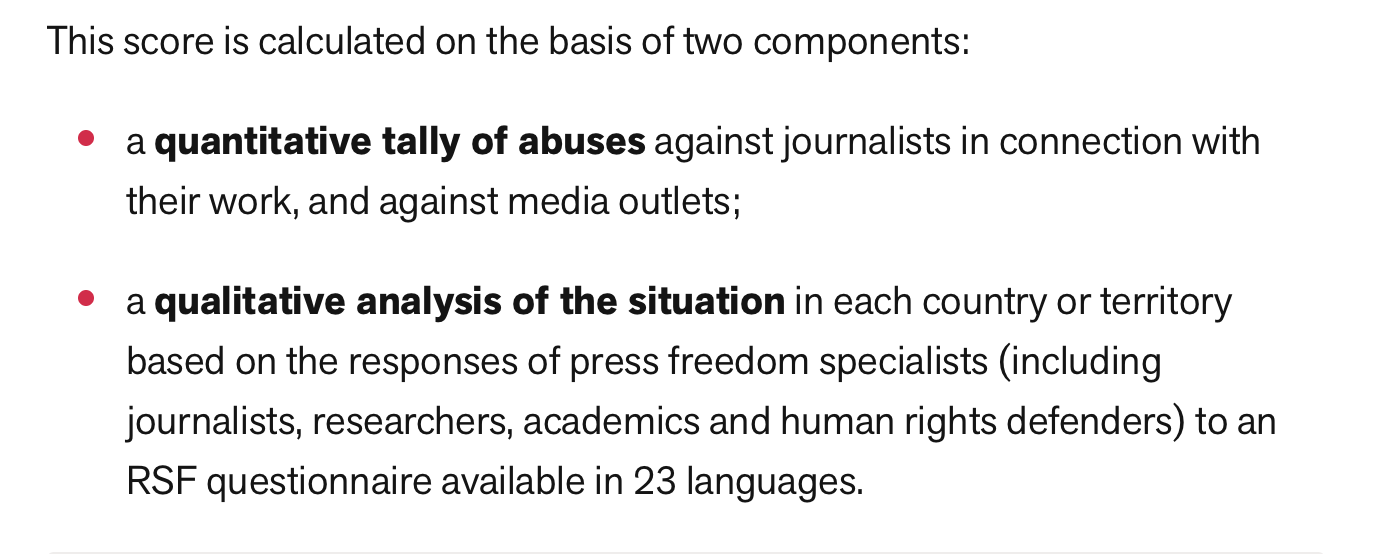
The score to be given to each country is decided, as mentioned earlier, on a qualitative and quantitative basis.

RSF Methodology document

Let us break this down.

In their quantitative analysis, every legitimate legal process against any individual or media house would also be counted as an “abuse”. Further, even online comments, for example, those against The Wire, would be counted as abuse given that they believe even the “mental safety” of journalists and media houses is paramount. Essentially, the RSF believes that no government can take action against journalists or media houses that indulge in illegality and individuals, other media organisations can’t point out how their circle of media houses indulge in rampant falsities. If either of these is done, it would amount to a country curbing freedom of the press.

In the Qualitative analysis, RSF relies on “press freedom specialists” to answer questions about their nation. Now, who would these “specialists” be, you think? Would it be beat reporters who go to the ground and get stories? Would it be those like Deepak Chaurasia, who was attacked by an anti-CAA mob at Shaheen Bagh or the ANI reporters Ujjwal Roy and Sarabjeet Singh who faced a dangerous attack by Jamia Millia Islamia Mob? Or those journalists displaced from Bengal during the post-poll violence? Would the fact that journalists and media houses are categorically told that they would not be allowed to do their job or get ad revenue from the government if they cover stories that don’t show Mamata Banerjee in a positive light feature? Would it feature the harassment of Arnab Goswami by the Maharashtra government?

Not really. They are not “specialists” in the eye of the global left cabal. Who would be specialists, then? Rana Ayyub who is under the ED scanner for money laundering and weaves fantastical tales of her own persecution because average citizens choose to call her out on her lies. Those at NewsClick, perhaps, who received several crores from US-based companies and China. The folks at The Wire who shill for Muslims, demonise Hindus and are run by an American passport holder. Those like Harsh Mander who get money from the Italian government. The list is, of course, endless.

So basically, any comment against journalists or a media house, any legal procedure against those indulging in illegality and the opinions of the members of the global left cabal form the foundation of the RSF Press Freedom Index. Are we surprised that India is constantly on their radar and is being targeted for being worse than Hong Kong?

The farce of their methodology does not end there.

Their questionnaire is based on 5 “contextual indicators” – political context, legal framework, economic context, sociocultural context and safety.

Let us look at each of these contextual indicators separately.

Political context

To evaluate the “political context”, the questionnaire has 33 questions that let the experts choose on a scale that ranges from ‘completely disagree’ to ‘completely agree’ and similar metrics.

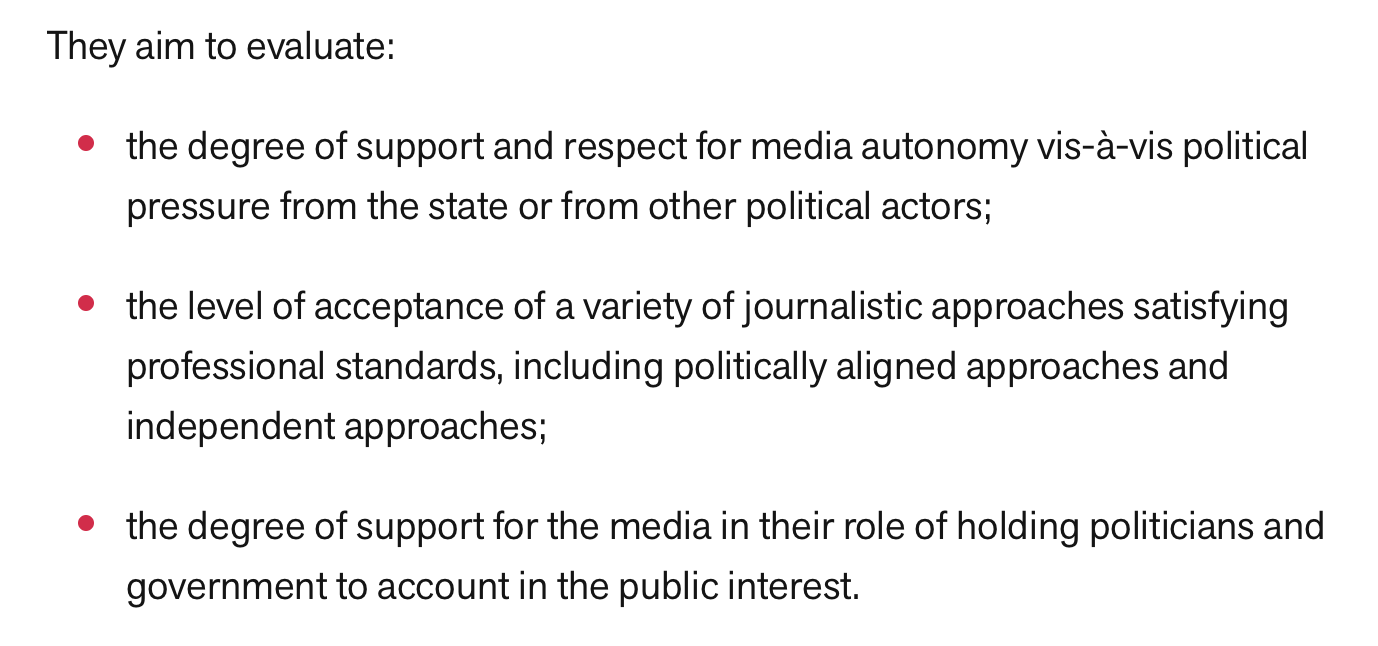
RSF Methodology document

Points 2 and 3 in their “political context” explanation are particularly interesting. RSF says that they want to evaluate the “acceptance” of “a variety of journalistic approaches satisfying professional standards including politically aligned approaches”. It further says that it wishes to evaluate “the degree of support for media in their role of holding politicians and government to account in the public interest”.

Now, when these are put together, one understands the kind of journalism that RSF specifically wants “supported”. Let us take an example. In November 2021, Amravati in Maharashtra saw rampant violence by Muslim mobs. The violence was a result of fake news being spread in Tripura, where journalists claimed that a mosque had been vandalised. At that time, in Tripura, Hindus were protesting against the violence against Hindus in Bangladesh. Muslim mobs came out on the streets and started vandalising Hindu shops and homes. Journalists then spread fake news that a mosque had been vandalised by Hindus. After this fake news spread, rallies were carried out in Maharashtra against the alleged vandalisation and it resulted in widespread violence by the Muslim mobs. Now, if the authorities were to act on the journalists who malicious spread fake news and then tried to escape the law, would it be considered an attack on freedom of the press? According to RSF, it most likely would.

Essentially, RSF says that if journalists don’t get explicit “acceptance” for reports that are false or twist facts to suit a political narrative, they would downgrade India’s press freedom. It is clearly not enough that egregious opinions against the government, Hindus at large etc are aired on a regular basis. They have to have explicit “acceptance and support”, otherwise, India is rallying against journalists.

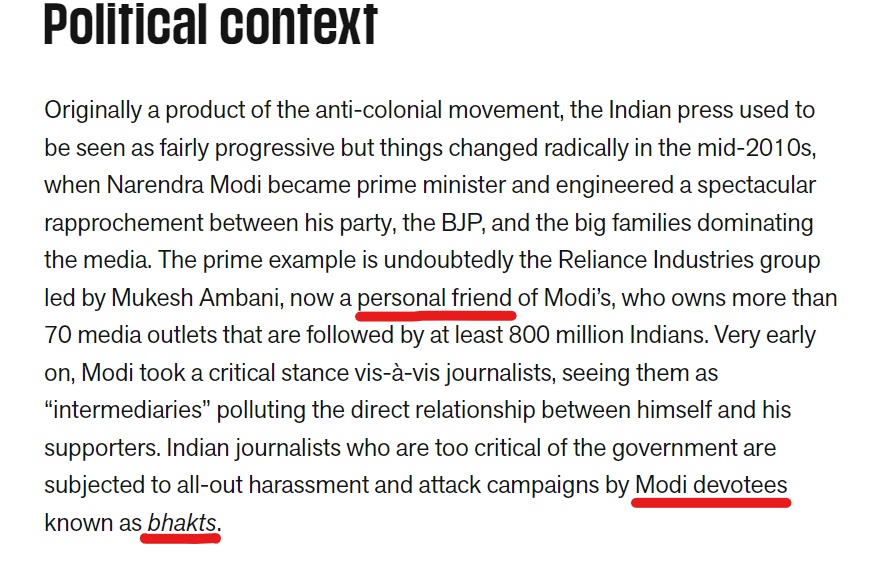
Their designs are also clear from another document where they explain the political context in reference to India.

RSF, while largely controlled by the French government, and NGOs like Ford Foundation have taken it upon themselves to demonise millions of Hindus they call “bhakts” or “Modi devotees”. They have also demonised one of the biggest business conglomerates of India simply because the Left media does not particularly like them. This is indication enough that RSF is a mouthpiece of the global left and even in India, it is working at the behest of bad actors and regime change enthusiasts.

Interestingly, they demonise one entire section of political opinion even as they claim they want acceptance of politically divergent political journalism.

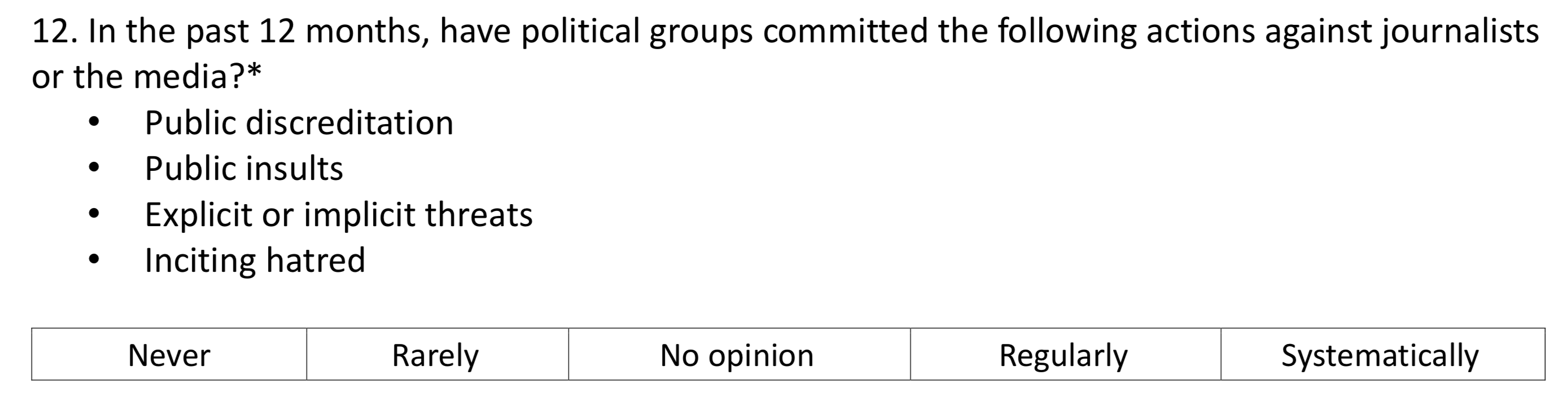
Let’s look at some of the questions that were asked in this section.

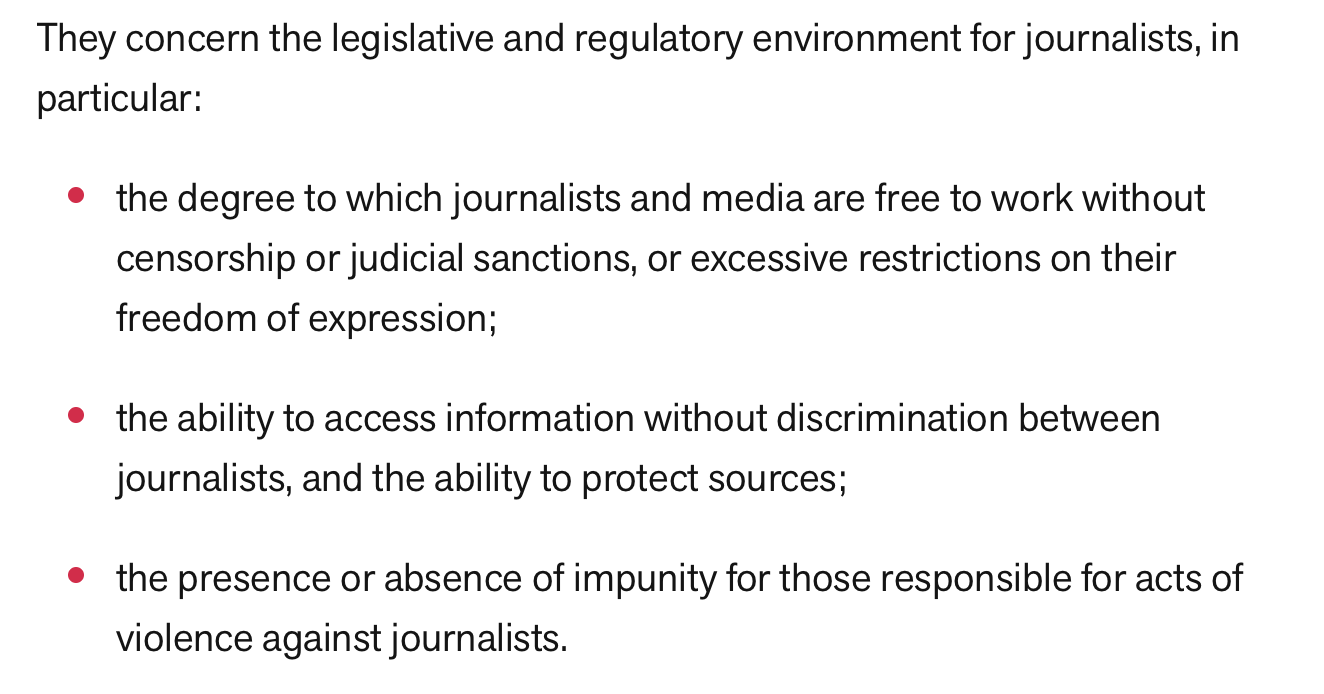
RSF Methodology document

RSF is evaluating if journalists get “public insults” and have hate incited against them. There is no quantitative definition of “hate” so it is left to the judgement of RSF and the clique they rely on to answer their questionnaire. Essentially, if any political group even counters a journalist for misrepresentation or bias, it would be tagged as discreditation, insult, hate or threat. So if Arfa Khanum Sherwani says that Muslims don’t commit religiously motivated crimes against Hindus and you, or any political faction, chooses to counter that, India as a whole would slip down the press freedom index.

Here is another question.

RSF
RSF Methodology document

There are only two options – yes/no. There is no context to it. Of course, the authorities have cut access to the internet in several parts of the country. When there was communal tension, in Kashmir when terrorists were being snuffed out, so on and so forth. However, the cabal would simply say “yes” and India would slip down the press freedom index. It’s just that simple.

What is interesting is that despite such questions, China, of all places, has improved its press freedom ranking. So has Hong Kong, where reports of CCP curbing independent news outlets have become par for the course, especially after China imposed a sweeping national security law that makes it easier for authorities to punish protesters and clamp down on the city’s autonomy. Those who sit in judgement of India are whitewashing despotic nations.

Legal framework

The legal framework evaluates countries based on 25 questions.

RSF
RSF Methodology document

One has to give it to RSF – they know how to keep their parameters completely vague so their “experts” can evaluate a nation based on their “feelings” and no empirical data. One of the interesting points in this section is that they want to evaluate whether there exists the “ability to access information without discrimination between journalists”. Now, if a Vir Sanghvi is asked this question, what do you think his answer would be as compared to a beat journalist on the ground? The Sanghvis and Dutts have lost the kind of access they had earlier. They are no longer able to fix ministries and therefore, the kind of individuals considered “experts” for the Global left would certainly say that they are discriminated against.

Here is one of the questions asked in this segment.

RSF
RSF Methodology document

Every country has laws against terrorism, separatism and extremism that can be used against journalists if they indulge in such activity. However, RSF asks a broad brush question where selecting anything other than “No, not at all” would mean that the press is not free in a country.

Here is another one.

RSF
RSF Methodology document

In this question, there is no quantitative measurement of “frequently” and therefore, it is a matter of perception or opinion. Even if 2 journalists have been convicted, the answer could be “systematically” and the country would slide down the press index.

Economic context

There are 25 questions in this part of the questionnaire.

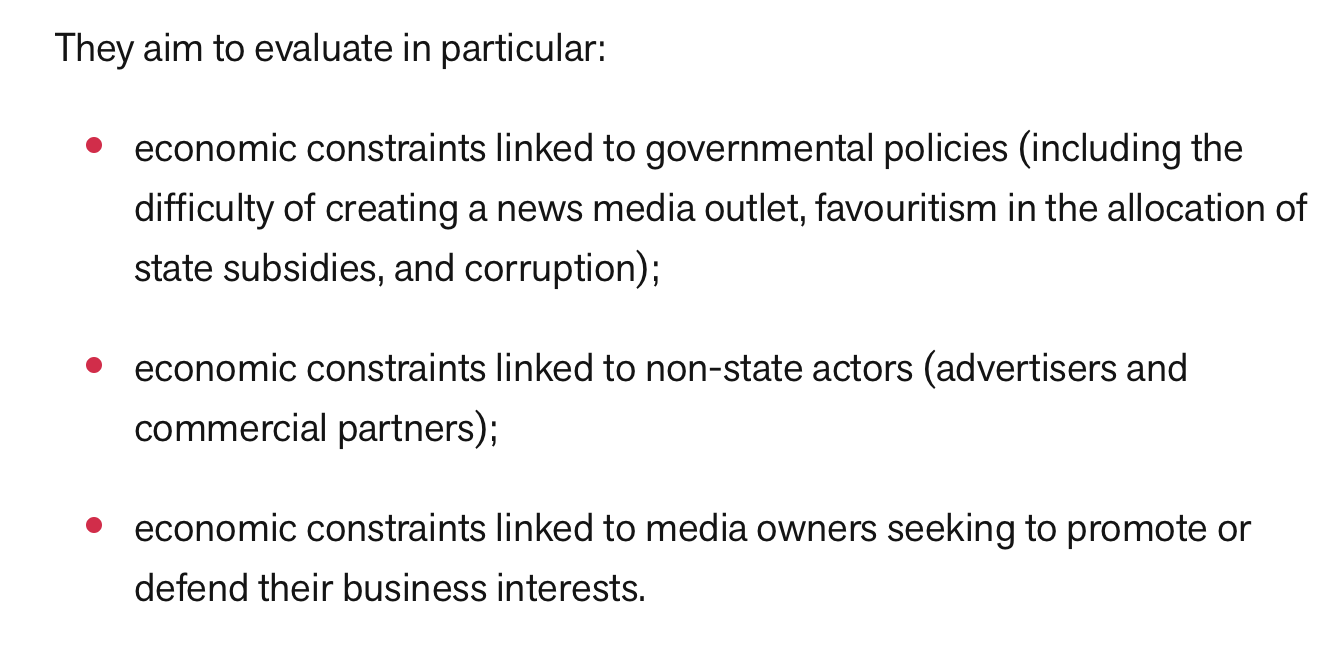
RSF
RSF Methodology document

In this section, it is evident that RSF wants to evaluate how much government support the Left media get and whether advertisers, governments and industrialists favour them still or not.

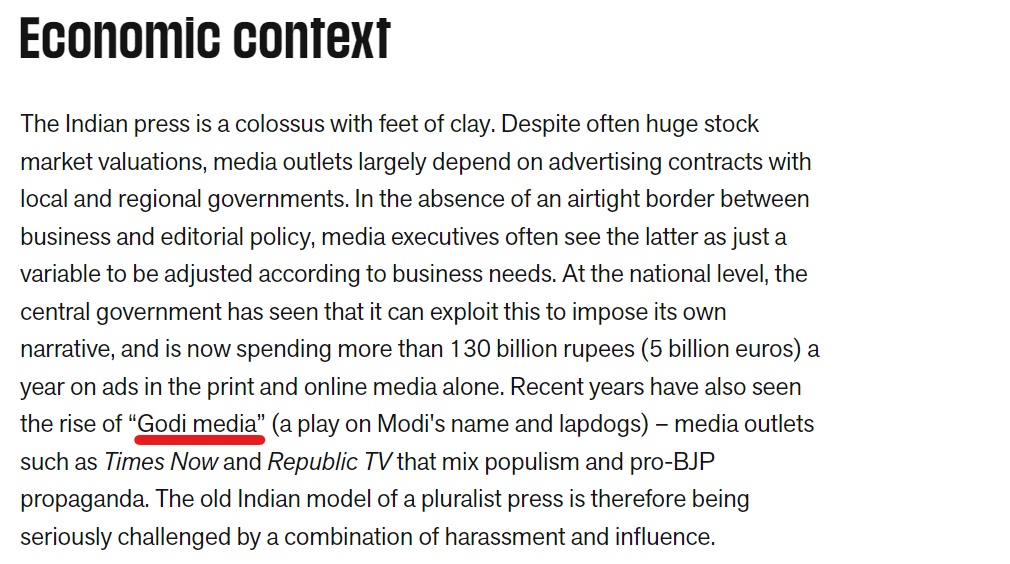
How do I know this? Sample this. Here is what they write in another document where they explain the economic context of India.

RSF
RSF Methodology document

RSF goes ahead and normalises terms like “Godi Media” to basically call an entire section of media PM Modi’s “Lapdogs” (A word they specifically use). Further, they call out Republic TV and Times Now specifically saying that they spread “pro-BJP propaganda”. Interestingly, they had earlier claimed that one of the essentials for a country to have press freedom is that it is “accepting” of politically divergent views, going as far as to say that even acceptance of “political affiliated” views is also a prerequisite. However, here they specifically demonise media houses that choose to not toe the Left’s line. It is therefore evident that this entire exercise is to arm-twist the entire nation, not just the government, into accepting and mainstreaming Left views, failing which, India would slide down the Press Freedom Index.

Now, here is one of the questions asked in this segment.

RSF
RSF Methodology document

Given that RSF is explicitly only interested in the Leftist point of view, do you think the fact that Mamata Banerjee categorically threatened media houses would feature as a consideration? Essentially, whether it has a factual basis or not, the Leftist “experts” would choose “not at all” because they regularly whine about channels like Republic, Times Now etc being espoused by the government. They would provide no evidence for it, however, that is a narrative they would stick to and employ even in this questionnaire.

In this section, there are several other questions that mainly revolve around the control and funding of media and journalists. They ask how much control financial entities with vested interests hold in media, how much handout is given to media houses to change their stand etc. Essentially, how much does money influence their opinions? Interestingly, the fact that Congress directly invests in media houses, that journalists in NDTV have familial ties to Congress and CPIM etc would not feature in the minds of the “experts” answering these questions. They would tarnish India based on conjecture, on their perception of government support for “godi media”, a term now mainstreamed by RSF.

While RSF asks questions about money exerting influence on the media, it is pertinent to note that they are not so free themselves. They had extensive ties to the French government and dubious regime change NGOs like Ford Foundation. While they stand in the judgement, it is evident that their own opinion is coloured by money, favours and ideology.

Sociocultural context

In this section, there were 22 questions.

RSF
RSF Methodology document

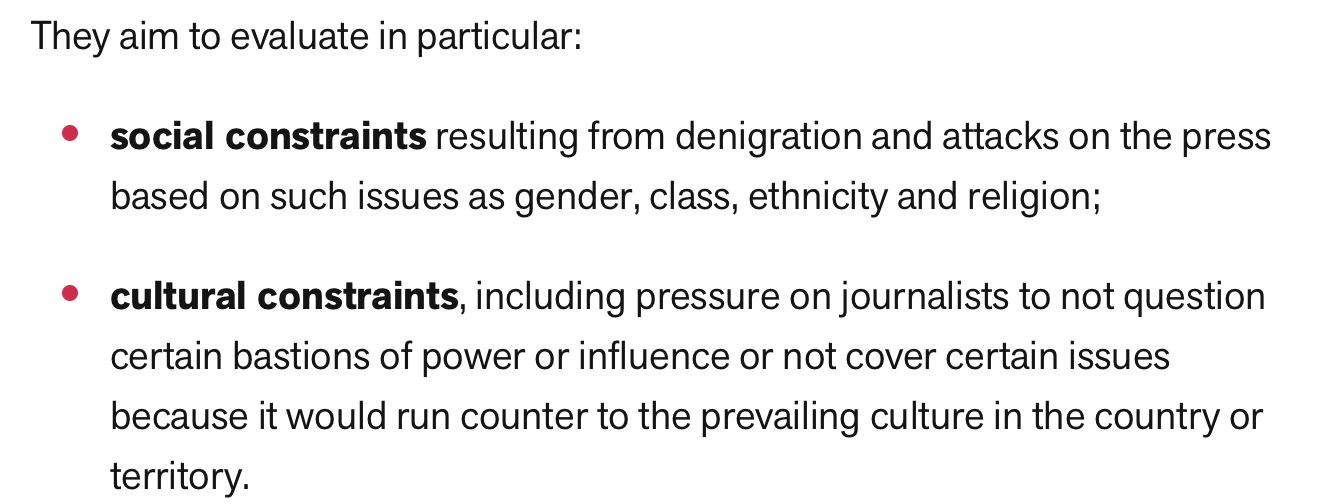
In this section, the foundation of their evaluation would include if journalists are “pressured to not question bastions of power or not cover certain issues because it would run counter to the prevailing culture in the country”. Now, what do you think the leftists would immediately think about when these questions are posed to them? The mythical Muslim persecution, of course.

Here is what they asked.

RSF
RSF Methodology document

We often like to say that the media is ideologically divided, however, it is a fact that in India, the majority of established media tilts towards the Left. RSF has categorically demonised Republic TV and Times Now that according to the Left, show a politically different opinion from theirs. While they do that, asking if the media reflects the pluralism of opinion is a sham that has to be called out. What they essentially mean is whether the media today has a free reign to spread propaganda against the government and Hindus, in India’s context, and the answer to that is certainly no. They may have a chokehold over the media, but there are voices that oppose their agenda and as long as those voices remain, the Leftists would continue to choose “no, not at all” to ensure India remains low on the Press Freedom Index.

Here is another intriguing question.

RSF
RSF Methodology document

I thought RSF was FOR freedom of the press and expression? If they are, then why would they have a problem with a popular opposition movement against media when they express opinions on culturally sensitive subjects? In a democracy, the very essence that we thrive on is the fact that there are various opinions on every sensitive subject and ultimately, the people get to choose what they want to believe in, after being given access to the entire spectrum of opinion. Why would RSF then say that there is no press freedom if an opposition movement of ideas blooms? Given that RSF has derided “bhakts”, Hindus and a section of the media against the left, it is evident that what they really want to understand is that has alternate media, or Hindus at large, gathered enough momentum yet to counter the Left media that RSF espouses.

In the last section, they talk about the safety of journalists. Intriguingly, not even one question talks about whether terrorist groups target journalists on a daily basis. What they do ask is how journalists are harassed and abused and also if journalists are spied on. It needs to be mentioned at this point that there is no denying that journalists in several parts of the nation work in extremely dangerous conditions. We have seen in several Sharia-compliant countries and even in others like the USA how journalists are harassed and abused, even physically attacked for the work they do. One recalls the case of Andy Ngo in the USA where he was assaulted for reporting against ANTIFA. However, in India’s context, the “experts” who would answer these questions have no idea about the real world and base these answers on how they are not being favoured by the government, not on the basis of the safety they enjoy.

For example, one of the questions asked in this segment is whether journalists are spied on. Now, those sitting in high chairs fancied themselves important enough to be surveilled during the Pegasus story. That entire sham was summarily debunked, however, they would continue to say that in India, journalists are spied on. This, while Honk Kong would feature above India in the Press Freedom Index.

The truth of the matter as far as RSF is concerned is that it is a biased index tailor-made to peddle the global left’s narrative and any individual taking this seriously based on this flimsy methodology is naive at best and malicious at worst.

Kerala, one of the worst-affected states in Covid-19, is now wasting 20% of vaccines due to expiry: Report

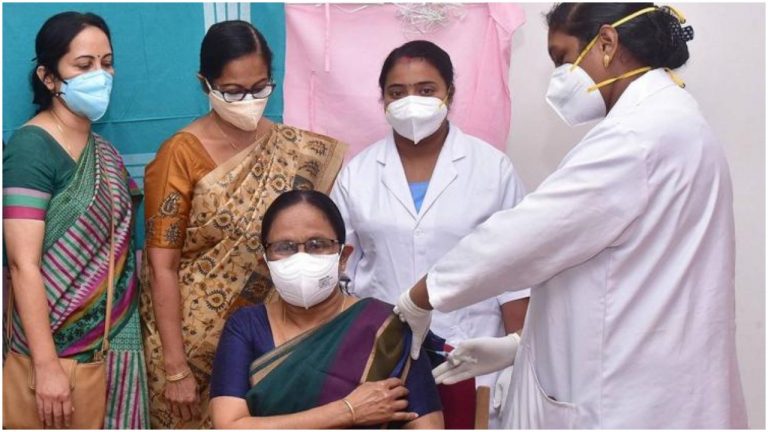
Kerala, which had allegedly claimed to have achieved zero-vaccine wastage of Covid-19 vaccines last year, now accounts for nearly 20 per cent of vaccine wastage, reports the Times of India.

According to the reports, there are no takers for vaccines in Kerala, especially in private hospitals, leading to the expiry of vaccines. Even the free vaccines provided by the government have reached their expiry.

“Despite best efforts, some hospitals could not attract people even for a free vaccination. Due to this, some of the vaccine stock was dumped as it expired. As a result, hospitals have incurred huge losses, and we have decided not to invest any more in Covid vaccine purchase. There is not much demand for vaccines now,” said Dr Anvar M Ali, general secretary, Kerala Private Hospitals Association.

According to Abdul Wahab, secretary of the Qualified Private Medical Practitioners’ Association, vaccine wastage is a reality in private hospitals in Kerala.

“We want to ensure that there is no wastage, but now that appears impossible. When vaccines are available easily for free in government hospitals, why would people be willing to pay for them? Therefore, either the government should buy back all vaccines or vaccine makers should. Otherwise, vaccine wastage will continue,” added Abdul Wahab.

As per the report, the private hospitals in Kerala had stocked up the vaccines during the peak of the second wave when there was a huge demand for vaccines grew. The private hospitals took bank loans at 5% interest to buy vaccines worth Rs 20 lakh to Rs 1 crore from the manufacturers.

However, post-Onam in 2021, there has been a drop in people approaching private hospitals for paid vaccines as there was enough stock in government hospitals. With this, in the majority of hospitals, 10% to 20% of vaccines were wasted despite the government’s efforts to replace near-expiry vaccines, as per the TOI report.

“The main reason for this is, what do we do with the exchanged vaccines? There are no takers for vaccines in private hospitals now,” a Kerala health ministry official was quoted as saying. Most of the private hospitals across the state are suffering from the problem, however, the situation is critical in Thrissur and Ernakulam districts.

Apparently, many private hospitals have recently incurred heavy losses due to expired Covishield stocks. Recently, the Serum Institute, which produces the Covishield vaccine, has also slashed the prices, resulting in losses for these private hospitals.

The health department officials worry that with the current low uptake of vaccines, even the existing stocks are likely to stay on the shelf and expire.

During the Covid-19 pandemic, Kerala turned out to be one of the epicentres of the pandemic, alongside Maharashtra. The two opposition-ruled states consistently recorded a high number of cases in both the waves of the pandemic. At one point in time, the two states accounted for nearly 70 per cent of the total cases in the country,

Hanuman Chalisa outside Matoshree row: Navneet Rana and Ravi Rana granted bail by Mumbai court, directed not to talk to media

A special bench of Mumbai Sessions court granted bail to independent Lok Sabha MP Navneet Rana and her husband independent MLA Ravi Rana on 4th May 2022. Both of them were under arrest for the last 12 days under serious charges including sedition, for announcing their intention to chant Hanuman Chalisa outside Matoshree, the residence of the Thackeray family. Justice Rahul Rokade agreed to the argument presented by the defence lawyers, and granted the bail to both of them with certain conditions.

Ravi Rana is kept in the Taloja jail while Navneet Rana is in the women’s jail at Byculla. The bail is subject to execution of personal bonds of ₹50,000 each. Both of them will be released after the order copy reaches the respective jails. Despite the granted bail, the court imposed certain conditions on the Ranas. The court said they would not talk to the media. There will be no press conference in this case. No one will tamper with the evidence and will not commit any such crime again.

The court’s decision is seen as a major setback to the state government. The court has held the arrest of the Rana couple illegal. The court said that it was necessary to give notice to the Rana couple before the arrest. The Mumbai police arrested them without going through any such legal process. Therefore, the court has accepted the arguments of the defence and granted bail.

Public prosecutor Pradeep Gharat has given his reaction after the Rana couple was granted bail. Speaking to the media, he said, “Though the Rana couple has been granted bail, the court has imposed certain conditions on them. They have been strictly forbidden to speak to the media on related matters. They have also been prohibited from contacting or pressurizing witnesses in any manner. Besides, various conditions have been imposed by the court that they should cooperate with the police in the investigation and be present at the police station for questioning within twenty-four hours of the notice from the police.”

Amravati MP Navneet Rana and MLA Ravi Rana had announced that they would chant Hanuman Chalisa outside Matoshree, the private residence of Maharashtra Chief Minister Uddhav Thackeray. For this, they had arrived in Mumbai. So tension was created between the Shiv Sena goons and the supporters of the Ranas. At this time the Rana couple was arrested on charges of disturbing law and order by making provocative statements.

Navneet Rana and Ravi Rana are in judicial custody for the past twelve days. Shiv Sena goons accused the Rana couple of hurting religious sentiments and trying to incite violence. In response to a complaint by these Shiv Sena goons, a case was filed against the Amaravati MP under section 153A of the IPC (promoting enmity between different groups on grounds of religion, race, place of birth, residence, language, etc., and doing acts prejudicial to the maintenance of harmony). The couple is accused of giving derogatory, offensive, and inciting statements against the Maharashtra govt and CM Uddhav Thackeray over the Hanuman Chalisa vs Azaan issue. Now after this decision, both can come out of jail by evening.

‘We don’t support any political party’: VHP says its activists won’t participate in Hanuman Chalisa events organised by MNS in Maharashtra

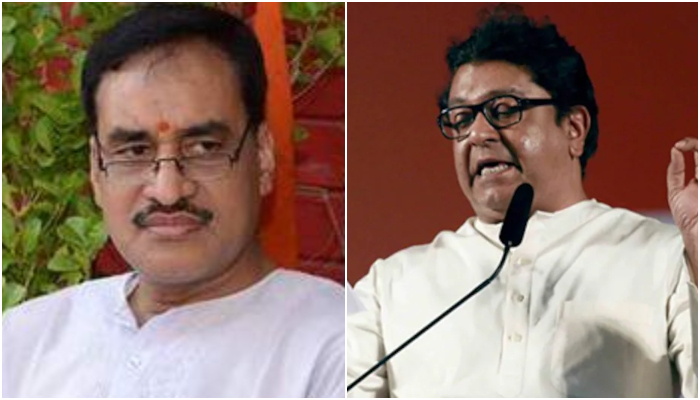
The Vishwas Hindu Parishad (VHP) has stated that it won’t participate in the Hanuman Chalisa event organized by the Maharashtra Navnirman Sena (MNS) in Maharashtra from May 4. VHP National Spokesperson Vinod Bansal said that VHP is an apolitical organization and they do not intend to support any political party or any program organized by any political party.

This is after reports emerged that VHP and Bajrang Dal activists supported the May 4 deadline for the removal of illegal loudspeakers from atop the mosques and would participate in the Hanuman Chalisa events organised by MNS from May 4. “Neither we nor the Bajrang Dal have extended any support to the MNS’ Hanuman Chalisa event. All the news coming in about the VHP and Bajrang Dal activists to be participating in the MNS’s program is fake, baseless, and far from the truth,” Bansal said on Sunday.

Thackeray in his Aurangabad rally had called the loudspeakers a nuisance and had said that he was firm on the May 4 deadline for the removal of loudspeakers from the mosques. He also had said that if the loudspeakers were not taken down by May 4, then his party workers would play Hanuman Chalisa outside the mosques.

“I won’t be responsible for what happens after the May 4 deadline to remove the loudspeakers from the mosques,” he had said, adding, “loudspeakers is a social issue, but if it is being made a religious one, then we shall give a reply in the same manner. Eid will be celebrated on May 3. We don’t want to vitiate the atmosphere. But from May 4, we’ll not listen to anyone. Loudspeakers have no place in religion. If they (Muslims) don’t understand nicely, we will show them the power of Maharashtra.”

The VHP National Spokesperson however added that it had no problem with any political party organizing the event of recitation of Hanuman Chalisa. “The VHP believes that there should not be a ban on the recitation of Hanuman Chalisa in the country. If someone, however, is doing it for some political reasons, we do not support it,” Bansal added.

On Wedensday, the members of Maharashtra Navnirman Sena played Hanuman Chalisa during the morning azaan in Mumbai’s Charkop area. The party workers also played Hanuman Chalisa in Nashik, Pune and other parts of Maharashtra. The state police who was on alert since Thackeray’s rally on Sunday, detained many of the MNS party workers for perform Maha Aartis and reciting Hanuman Chalisa on loudspeakers.

The Police also have booked Thackeray and the organizers of the Aurangabad rally for inciting the public. Thackeray however reiterated his remarks on Tuesday and appealed to all the Hindus to play the Hanuman Chalisa on loudspeakers if they heard the loudspeakers blaring the azaan from May 4. The Mumbai Police has served a notice to Thackeray under CrPC section 149 related to preventing cognizable offenses. While MNS leaders have threatened to hit the streets in case of further action against their party head, the security at Thackeray’s residence in Mumbai has been doubled.