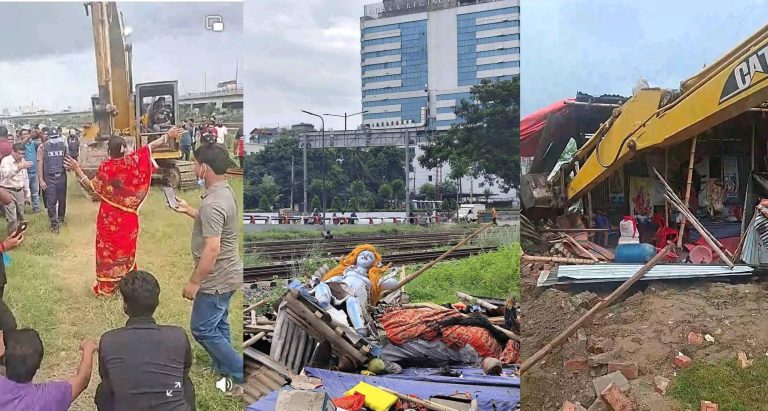
A Durga Mandir in Bangladesh capital Dhaka was demolishedv by the administration 2 days after a large mob threatened to bring it down. As per reports, the Khilkhet Sarbajanin Durga Mandir was demolished based on an order issued by Bangladesh Railway’s Dhaka Division Deputy Commissioner and Divisional Estate Officer Md. Nasir Uddin Mahmud on Wednesday.
The Durga Mandir was demolished on Thursday morning, surrounded by Hindu men and women breaking down in tears. A huge army and police bulldozer arrived at the Mandir premises from Purbachal Army Camp in Dhaka to carry out the order. Hindu devotees sat in front of the temple and tried to stop the demolition party, but army personnel removed them from the spot, and then the bulldozers proceeded to bring down the structure.
The demolition of the Sri Sri Durga Temple, including its idol, in Khilkshet is truly a heartbreaking incident.
There are many knowledgeable people in the country regarding laws and regulations, but the question remains couldn't the idol have been relocated elsewhere?
As a last resort, Hindus had requested to allow the Rath Yatra to take place tomorrow and postpone the demolition after that, but this was rejected. The idols in the temple, puja materials and other items in the temple were destroyed in the operation. The idols of Goddess Kali and Lord Shiva were crushed brutally under the bulldozer, shattered into pieces.
For more than half a century, annual Durga Puja is being held at the Khilkhet Sarbajanin Durga Mandir in Dhaka. In the temple premises, there is an idol of Goddess Kali also, regularly worshiped. The temple built with corrugated iron sheets was in a dilapidated condition, and was a makeshift temple built on Railway land, but was an important place of worship for minority Hindus in the Islamic nation.
On the night of June 24, a Muslim mob attacked the temple, attempted to vandalise it, and gave a deadline of 12 hours to vacate it. They also abused the devotees foul language and even threatened to kill them.
The makeshift Shri Shri Durga Mandir at Khilkhet Dhaka today has been vandalised by the local administration without any notice. #Khilkhet#খিলক্ষেতমন্দির#SaveHinduTemples Railway donated this land to Hindus many years ago, but now seems like they've reverted their actions pic.twitter.com/XlJvKnaAgF
They gave an ultimatum to the Hindu devotees to remove the temple by 12 pm on Tuesday (24th June), and vowed to demolish the temple if their diktat is not implemented. After that, the local Hindu leaders approached the Khilket police.
However, instead of protecting the temple, it was demolished suddenly in the name of eviction, just two days after the mob violence. The Railway Department of the Bangladesh Government led by Mohammad Yunus has said that under the powers conferred by Sections 5(1) and 5(2) of Ordinance No. 24 of 1970, a program to evict illegal establishments and squatters from Bangladesh Railway land in the Philkhet Bazar area from Kuril Bishwa Road intersection has been implemented to evict illegal encroachers from railway land.
The temple along with the Fetish was demolished in Khilkhet #Bangladesh. #Hindu communities had requested that at least the Rath Yatra be allowed to take place tomorrow. But the government did not seem to care about the emotions and requests of the followers of #Sanatan religion. pic.twitter.com/xMjWCchAK4
— Bangladesh Agniveer ?? (@BDAgniveer) June 26, 2025
As per the administration, the temple was located on encroached govt land. But the Hindus say that the temple was there for a long time with the knowledge of the administration, and it was never deemed to be illegal.
The demolition just before the Jagannath Yatra has created outrage among the Hindus in Bangladesh. While govt says it was eviction from encroached land, Hindus believe it just a part of ongoing atrocities against minorities in the country. Questions are also being raise while the idol could not be relocated instead of destroying it.
According to some locals, the land was actually donated for the temple by the Railways.
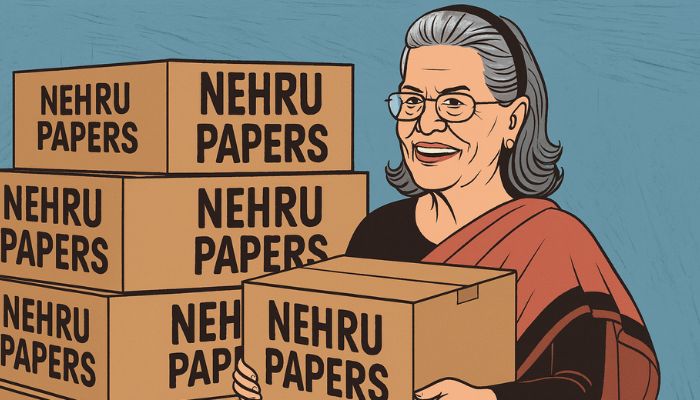
Congress leader Sonia Gandhi may find herself in a legal storm as the Prime Ministers Museum and Library (PMML) Society is considering legal action to retrieve private papers of former Prime Minister Jawaharlal Nehru that were taken away in 2008. The discussions at the 47th Annual General Meeting of the PMML Society were held on 23rd June, chaired by Prime Minister Narendra Modi. Reports suggest that there was a consensus among the members that the issue must now be pursued through legal channels.
Sources within the PMML Trust have confirmed to OpIndia that a case of theft is indeed being considered. The documents in question were donated and are legally the property of the institution. The alleged removal of the papers by Sonia Gandhi took place during the UPA era and is now under sharp scrutiny.
Letters packed in 51 cartons taken away in 2008 during UPA rule
The controversy revolves around a large cache of documents from Nehru’s private collection. It includes letters exchanged with historical figures including Edwina Mountbatten, Albert Einstein, Jayaprakash Narayan, Vijaya Lakshmi Pandit, Babu Jagjivan Ram and Aruna Asaf Ali. These papers were housed at the Nehru Memorial Museum and Library (NMML), which is now known as PMML, between 1971 and 2008.
In 2008, the papers were reportedly packed in 51 boxes and taken by Sonia Gandhi. These included material that was originally donated to NMML by former Prime Minister Indira Gandhi and later by Sonia Gandhi herself, who acted as the family heir.
PMML sent several official letters and appeals this year to Sonia Gandhi’s office, including those from Gujarat-based historian and PMML Society member Professor Rizwan Kadri. However, the Congress leader did not respond. Kadri had written twice, first to Sonia Gandhi in September 2024, and then to Rahul Gandhi in December, urging the Gandhi family to return the original papers or at least provide photocopies and digital scans of the same. However, neither Sonia Gandhi nor Rahul Gandhi responded to the requests.
PM Modi chairs crucial AGM; ministers and society members back retrieval
The 47th AGM was held at Teen Murti Bhavan. It was attended by senior Union Ministers including Rajnath Singh, who serves as Vice-President of the PMML Society, Nirmala Sitharaman, Dharmendra Pradhan and Ashwini Vaishnaw. Other notable members included BJP leader Smriti Irani, lyricist Prasoon Joshi, and former Railway Board chairman Ashwani Lohani, who now serves as PMML’s Director.
Reports suggest that the meeting revisited the issue discussed earlier in the February 2024 AGM, that of Sonia Gandhi having “reclaimed” a significant portion of papers donated by the Nehru-Gandhi family. The board reached a consensus that these papers are a national treasure and must be preserved by the institution.
Following legal advice received after the previous AGM, a formal communication had been sent earlier this year to Sonia Gandhi’s office. For the first time, it was officially put on record that the papers had been taken away and a request was made for their return. However, no reply came from Gandhi’s office. Members of the PMML Society now seek to “course correct” what they described as an “administrative lapse” from the pre-2014 era.
Trust asserts that donated papers cannot be reclaimed
The Trust is considering its legal position on the principle that once a donation is made, ownership cannot be reversed. Hence, the papers remain the rightful property of the museum. Discussions have also been held on related concerns of ownership, custodianship, copyright, and the scholarly use of these collections.
According to the PMML Society, it is essential to ensure that letters such as those between Nehru and Edwina Mountbatten are accounted for. There are demands among members for a forensic audit of the material that was taken to assess if any vital documents are missing.
New-look council backs action, PM suggests museum mapping and Emergency archive
The PMML executive council was reconstituted in January 2025. Notable new members including Smriti Irani, former NITI Aayog Vice-Chairman Rajiv Kumar, retired Lt Gen Syed Ata Hasnain, filmmaker Shekhar Kapur, and artist Vasudev Kamath were added to the council. Nripendra Mishra was given another five-year term as chairperson.
In the Monday meeting, apart from the Nehru papers issue, PM Modi proposed creating a “museum map” of India and a comprehensive national database of museums across the country. He also suggested compiling all legal cases and documentation related to the Emergency period to mark its 50th anniversary.
BJP dubs letters ‘historical documents’, Parliament had taken note too
In December 2024, BJP MP Sambit Patra reacted to the matter of papers linked to Nehru and stated that these are not just family correspondences. He asserted that those documents are valuable in national interest. He insisted that the public had a right to know what they contain. The issue was also raised in Parliament last year, signalling its potential to escalate further if legal proceedings are initiated against Sonia Gandhi.
If the PMML Trust goes ahead with formal legal steps, it could trigger a high-profile legal and political battle between the PM Modi-led NDA government and the Congress party.
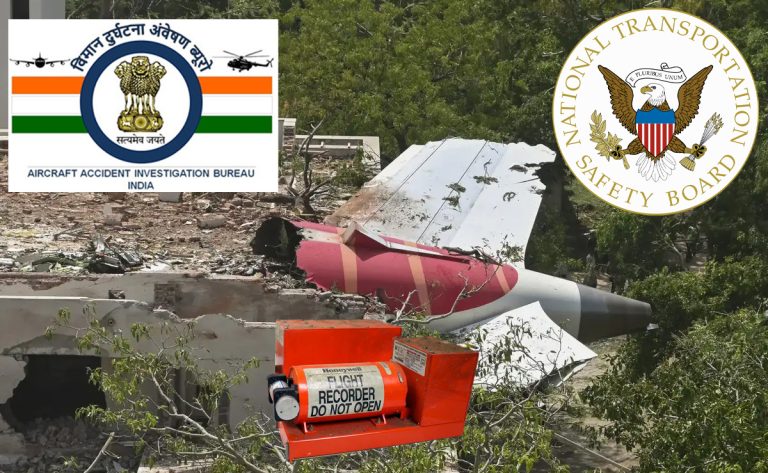
The Aircraft Accident Investigation Bureau (AAIB) and the National Transportation Safety Board (NTSB) have begun the data extraction process of the Black Box and the Cockpit Voice recorder (CVR) of AI-171, which had crashed in Ahmedabad, killing 241 passengers.
According to the Ministry of Civil Aviation, the memory module was successfully accessed and its data downloaded at the AAIB Lab. The analysis of CVR and Flight Data Recorder (FDR) data is underway.
These efforts aim to reconstruct the sequence of events leading to the accident and identify contributing factors to enhance aviation safety and prevent future occurrences.
Status Report on recovery and examination of data from Black Boxes –Air India Flight AI-171
The Crash Protection Module (CPM) from the front black box was safely retrieved on June 24, and on 25 June, the memory module was successfully accessed and its data downloaded at the AAIB… pic.twitter.com/JQ4Q85sYVg
The Aircraft Accident Investigation Bureau (AAIB) is the designated authority for such investigations, as India is a signatory to the ICAO Chicago Convention (1944) and investigates aircraft accidents per ICAO Annexe 13
Following the unfortunate accident involving Air India Flight AI-171, the AAIB promptly initiated an investigation and constituted a multidisciplinary team on June 13, in line with prescribed norms.
The team, constituted as per international protocol, is led by the DG AAIB and includes an aviation medicine specialist, an ATC officer, and representatives from the National Transportation Safety Board (NTSB) which is the government investigative agency from the state of manufacture and design, (USA), as required for such investigations.
Both the Cockpit Voice Recorders (CVR) and Flight Data Recorders (FDR) were recovered–one from a rooftop of the building at the crash site on June 13, and the other from the debris on June 16, 2025. Standard Operating Procedures were issued for their secure handling, storage, and transportation. The devices were kept under 24/7 police protection and CCTV surveillance in Ahmedabad.
Subsequently, the black boxes were brought from Ahmedabad to Delhi by IAF aircraft with full security on June 24. The front black box arrived AAIB Lab, Delhi with the DG, AAIB at 22 p.m. on June 24.
The rear black box was brought by a second AAIB team and reached AAIB Lab, Delhi at 3:15 p.m. on June 24.
On the evening of June 24, the team led by DG AAIB, with technical members from AAIB and NTSB, began the data extraction process. The Crash Protection Module (CPM) from the front black box was safely retrieved. On June 25, the memory module was successfully accessed and its data downloaded at the AAIB Lab.
The analysis of CVR and FDR data is underway, and all actions have been taken in full compliance with domestic laws and international obligations in a time-bound manner.
The first batch of pilgrims from India has reached Tibet as the holy Kailash Mansarovar Yatra resumed after a gap of 5 years. The yatra was suspended in 2020 due to COVID-19 pandemic and the subsequent Galwan Valley standoff between Indian and Chinese soldiers, which strained the relations between India and China. Starting on 30th June, the yatra marks a significant step towards improving people-to-people ties as the two countries work towards normalising their relations.
As per the information provided by the Ministry of External Affairs (MEA), the pilgrims will undertake the journey in two sets of batches between June and August. Five batches of 50 devotees each will travel through Pithoragarh in Uttarakhand via Lipulekh Pass and another ten batches of 50 devotees each will undertake the holy trek through Sikkim, crossing over at Nathu La Pass. The applications for the yatra were accepted through an online process and the selections were made in a fair, computer-generated, random, gender-balanced selection process. The application and selection process has been made entirely computerised since 2015.
Yatra resumed as India, China try to normalise ties
The development comes after PM Modi and Chinese President Xi Jinping met on the sidelines of the 16th BRICS Summit held between October 22 to 24, 2024, in Kazan, Russia. In the efforts to normalises ties, both the countries agreed to resume patrolling and disengage troops along the Indo-China border (Line of Actual Control) in eastern Ladakh.
Recently, on 23rd June, while attending the 20th Meeting of the SCO Security Council Secretaries in China, National Security Adviser Ajit Doval met Chinese Foreign Minister Wang Yi. During the meeting the countries reviewed recent developments in their bilateral relations and underscored the need to promote their overall development.
The arduous journey to Mount Kailash
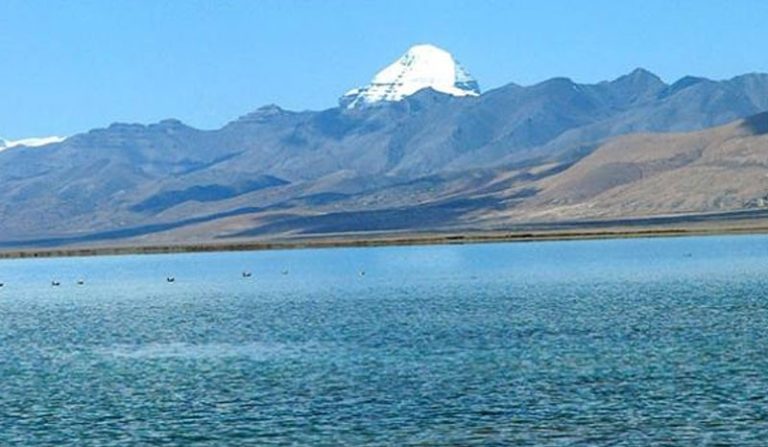
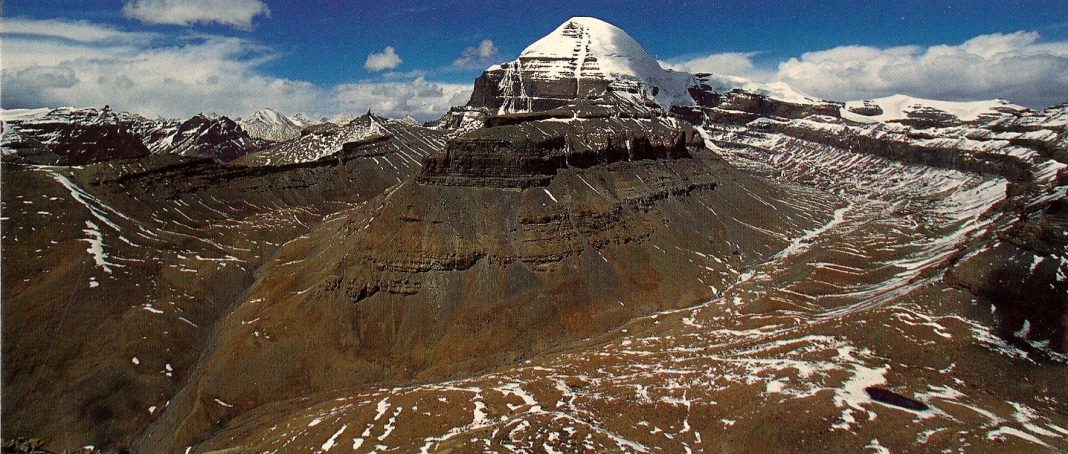
The Kailash Mansarovar yatra is a holy pilgrimage to Mount Kailash and Lake Mansarovar in Tibet. The yatra is an arduous journey of over 20 days involving high altitudes, difficult terrain and a challenging environment requiring physical and mental strength. A key part of the yatra is Parikrama, called Kora. It involves circumambulation around the base of Mount Kailash, which is a challenging trek of about 52 kilometres and takes up to 2-3 days.
Image via X
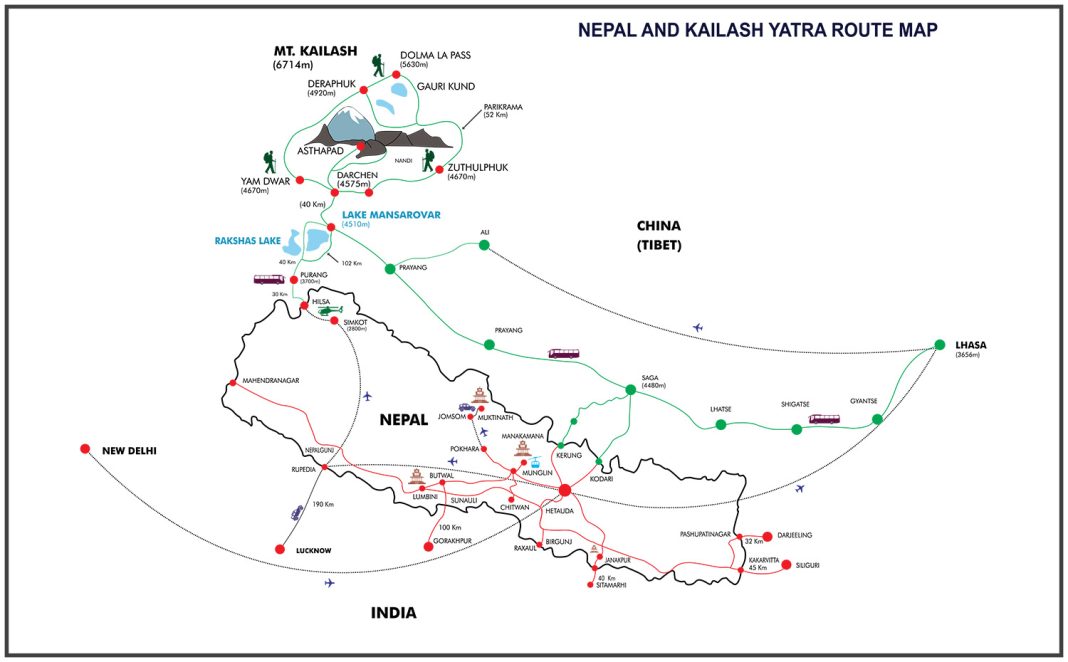
The Kailash Mansarovar yatra is undertaken through two main routes- via Lipulekh Pass in Uttarakhand and via Nathu La Pass, which opened in 2015. Lipulekh Pass route is shorter but it is known for its longer and challenging trek of around 200 km. The Nathu La Pass route is a longer but more motorable route, requiring minimal trekking of around 35 km.
Both the routes lead to Lake Mansarovar, where pilgrims perform circumambulation, puja and meditation as per their religious beliefs.
Image via thekailashmansarovar.com
As it is an international tour, the Ministry of External Affairs makes the arrangements. Medical check-ups of all the pilgrims are conducted before the journey to make sure that they are fit for the pilgrimage involving significant trekking. They are also required to sign an indemnity bond stating that they are undertaking the journey on their own risk.
The pillgrims further need to provide an undertaking for evacuation by helicopter in case of emergency, and sign an consent form for cremation in China in case of death there.
For the pilgrims travelling through the Lipulekh Pass, the journey usually begins at Delhi including stopovers in Uttarakhand, including Tanakpur, Dharchula, Gunji (acclimatisation camp), Nabhidang, before reaching the entry point in Taklakot (Tibet Autonomous Region). Their return journey to Delhi will have stopovers at Bundi, Alomra, and Chaukori. This is a 22 day journey in total, that includes walking over the Lipulekh Pass.
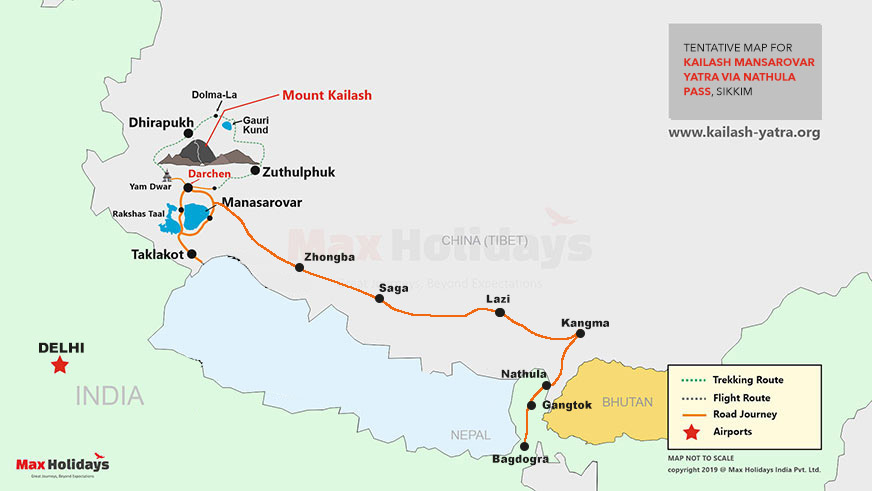
Image via kailash-yatra.org
The journey via the Nathu La Pass begins at Gangtok in Sikkim from where the pilgrims will proceed to Lake Mansarovar. Acclimatisation camps have been set up by the Sikkim administration at 18thMile, 16th Mile and Hangu Lake having accommodation, healthcare and other necessary services for the pilgrims undertaking the yatra this year.
After walking to a Chinese side after crossing the border, buses take the pilgrims in the Chinese to the Manasarovar, from where Kailash Parikramas are started. Before the parikrama is started, liasion officials check the health of the pilgrims, and not allow those deemed not fit for the trek.
The Kailash Parikrama starts at Yam Dwar, from where the walk begins, with ponies and porters. Pilgrims need to carry food items and cook themselves at designated places along the route, where basic amenities including stoves are provided. Important places along this route are Shiv Sthal near Dolma Pass and Gauri Kund.
After completing the Kailash Parikrama taking three days, the Manasarovar Parikrama begins, part of which is done on buses.
The local administration in Uttarakhand as well as Sikkim has geared up after the resumption of the Kailash Mansarovar yatra. The yatra not only provides a unmatched spiritual experience to the pilgrims but it also enriches the local economy of region falling on the route of the yatra. The preparartions for the yatra are being overseen by the Indian Army, Indo-Tibetan Border Police, Sashastra Seema Bal and Border Roads Organisation in coordination with the local administration.
The information guide for the yatra provides important information about the tour. It advises people having to motion sickness to carry proper medication, and details parts of the trekk which are difficult. The guide says that crossing the Dolma pass remains a test of faith and determination, as blizzards are known to strike without warning. It further states that people should not climb down to Gauri KUnd, instead ask porters to collect water to fill their cans in exchange of small tips.
Yatris are not allowed to take dip in the Holy Manasarovar Lake. However, Chinese authorities provide mug and bucket to take water from the Lake and take bath at the designated place.
The yatra is reverred across religions
Pilgrims undertaking the Kailash Mansarovar yatra come from different religions, including, Hinduism, Buddhism, Jainism and Sikhism. This is because Mount Kailash has immense spiritual significance across religions. Apart, from people visiting the mountain for spiritual reasons, Mount Kailash is also popular among adventure tourists and trekkers due to the challemge and the thrill the journey offers.
Hinduism
In Hinduism, Mount Kailash is the abode of Lord Shiva and his consort Devi Parvati. Shiva, is one of the three primary deities, Brahma, Vishnu, Mahesh (Shiva), representing the cyclical nature of existence. Brahma represents the enery of creation, Vishnu represents the energy of maintenance and Mahesh, i.e. Shiva represents the energy of destruction. The sacred mountain is considered as the centre of the world and a pathway to salvation. Hindus perform clockwise Parikrama around Mount Kailash.
Buddhism
Mount Kailash is known as Kang Rinpoche (Precious Jewel of Snow) in Buddhis. It is associated with deity Demchok (Vajrabhairava) and tanric yoga. Buddhists consider the mountain as the spiritual axis of the universe and the centre of the mantra “Om Mani Padme Hum”, which is considered a symbol of wisdom and compassion. Buddhists perfrom anti-clockwise Parikrama around Mount Kailash.
Jainism
Jains refer to Mount Kailash as Mount Ashtapada. They belive that the founder of Jainism and the first Jain Tirthankara, Rishabhadeva, attained liberation at Mount Kailash. Jains perorm clockwise Parikrama around the mountain.
Sikhism
Sikhs consider Mount Kailash as a sacred site. They believe that Guru Nanak Dev, the founder of Sikh religion, visited the mountain and meditated there.
Bon
Mount Kailash has huge spiritual siginificance in the Bon religion, the native religion of Tibet. Bonpos, the followers of Bon religion, associate the mountain with sky goddess Sipaimen. They perform clockwise Parikrama around the mountain.
At the roof of the world, where the Himalayan air is crisp and the Monpa people roam free, lies a centuries‑old secret: Mon Shugu, a handmade paper crafted not from trees, but from the bark of the Daphne papyracea shrub. What was once a sacred tradition on the brink of extinction has witnessed a renaissance—thanks to a unique blend of cultural pride, community leadership, and support by the Arunachal Pradesh government.
A journey through time and bark
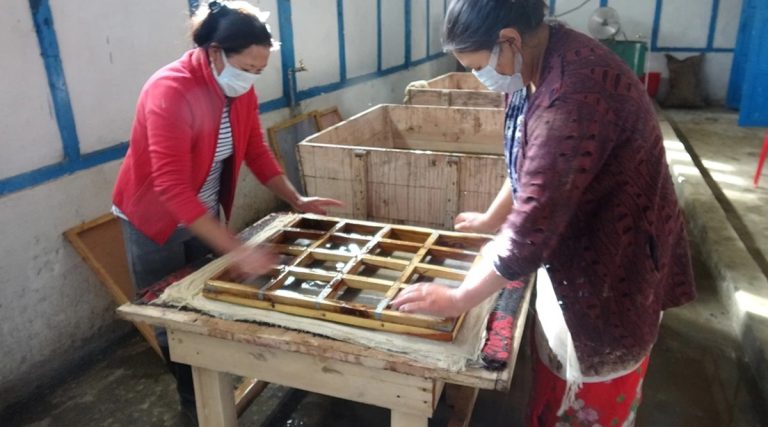
For over a millennium, Monpa monks and artisans in Tawang have been harvesting the inner bark of the Shugu Sheng shrub locally called the “paper plant”. The bark is dried, boiled in an ash solution, beaten into pulp, then streaked across bamboo sieves and dried under the sun. The result is a parchment-like sheet that’s naturally chemical‑free, incredibly strong, and resistant to decay perfect for religious manuscripts and calligraphy.
When the Mon Shougu art nearly vanished
As machine made paper invaded markets across India, Bhutan, Tibet, and beyond, Mon Shugu lost its dominance. Ancient family techniques persisted in only handfuls of Mukto village households. By the 1990s, only a few artisans continued, and their efforts were often overshadowed by cheaper, mass-produced alternatives.
Even when international NGOs and Khadi and Village Industries Commission (KVIC) attempted to set up a small paper unit in Mukto in the early 2000s, a lack of coordination and poor access to remote villages led to its collapse.
Inaugurated Monpa Handmade Paper Unit in Tawang, a major step to revive 1000 yrs old heritage local art.The cultural & religious values of Monpa handmade paper in Buddhist belt, add to its huge global potential.A historic feat for the entire North East.@PMOIndia@nitin_gadkaripic.twitter.com/RjZl1nQKZE
Enter Maling Gombu, a Tawang-based lawyer and social activist, whose impassioned appeal led KVIC to resurrect the craft. On December 25, 2020, KVIC backed by Arunachal Pradesh’s government and technical staff from the Kumarappa National Handmade Paper Institute in Jaipur, revived the project at a refurbished government facility in Tawang.
Despite rocky roads, heavy machinery, and weather setbacks, the unit sprang to life. Within six months, artisans were rolling out 500–600 high-quality sheets a day, each researcher-trained artisan earning ₹400 per sheet.
More than paper: Culture, Community, Conservation
This endeavor isn’t just about paper, it’s about staying true to your roots. Mon Shugu is a conduit of identity for the Monpa, interwoven with monastic rituals, traditional art, and environmental stewardship. The bark-harvesting cycle from March to December respects the plant’s reproductive phase, ensuring natural regeneration and ecological balance.
Economically, the unit has created a reliable livelihood link. Artisans, especially women, now work together, train youth, and strengthen their social fabric. The local Traditional Paper & Handicraft Marketing Society is exploring digital platforms, e-commerce, and tourism tie‑ins to expand reach beyond prayer wheels and local monasteries.
From “local to global”
The ancient paper has found a niche market with calligraphers in Japan, monks in Bhutan and Tibet, and eco-conscious artists worldwide. Pema Khandu, the Chief Minister of Arunachal Pradesh, shared a stirring video highlighting how this craft is “eco‑friendly, durable…and a testament to our cultural heritage”.
The Monpa community of Arunachal has long preserved the ancient art of making Mon Shugu—handmade paper crafted from the bark of Daphne papyracea. This eco-friendly, durable paper was once used for sacred texts and prayer flags in monasteries.
— Pema Khandu པདྨ་མཁའ་འགྲོ་། (@PemaKhanduBJP) June 25, 2025
The road ahead: Challenges & aspirations
1. Supply chain logistics: The bark lies scattered in high-altitude hills. Harvesting remains time-consuming; 4–5 shrubs yield only one or two sheets.
2. Limited digital access: Though e-market awareness is rising, poor courier links in far away villages inflate costs.
3. Youth engagement: Migration to cities threatens continuity. Yet, young champions like Nima Tsering (24) are returning to preserve the legacy.
Why Mon Shugu is worth saving?
1. Cultural sovereignty: It’s a living heritage intimately tied to Monpa beliefs and identity.
2. Eco-responsibility: Unlike wood-based paper, Mon Shugu relies on bark and eschews chemicals.
3. Economic promise: It fosters local production, women’s empowerment, and export potential under the “Local to Global” banner .
4. Education & Tourism: Workshops, storytelling, and showcasing the craft can draw curious global travelers and scholars to Tawang.
A call to action
As we navigate a world in search of sustainable traditions, Mon Shugu offers a blueprint. Support from rural credit, e-commerce logistics, eco‑tourism, and cultural preservation schemes can help scale the operation. KVIC eyes expansion across tribal-dominated zones with “plastic‑mixed paper” lines, tackling waste pollution while deepening the craft’s legacy.
An ongoing saga of resilience
What began as a local ritual has blossomed into a revival movement. Climate-conscious, driven by female artisans, and culturally anchored, Mon Shugu is now not just paper, but poetry etched in bark and belief. As grinders beat the pulp into paper, the hearts of the Monpa beat for their past and promised future.
And so, with each handcrafted sheet of Mon Shugu, a community turns over a new page safeguarding its heritage, earning its future, and reminding the world that true sustainability grows where roots run deep.
An alarming incident in Ashok Nagar of Delhi has caused a stir throughout the area. Neha, a 19-year-old, was pushed from the roof of a five-storey building by a 30-year-old man. The accused, Taufiq-ur-Rehman, entered the premises dressed in a burqa. It is reported that he had been pursuing her.
The police stated that the incident occurred at about 8:30 am on 23rd June (Monday), when the girl went to the rooftop to turn on the water pump after informing her mother. Neha plummeted approximately 50 feet onto the bricks in an unoccupied plot.
She was rushed to the Guru Teg Bahadur Hospital in east Delhi, however, succumbed to her injuries. She had just begun working for an oil business in Mandoli and her father, Surender Kumar, had also found a new job at a factory. The family had been looking forward to a more promising future until the disaster befell them. “All we want is justice for my daughter,” expressed the grieving father outside the hospital mortuary.
“I was downstairs doing my chores when I heard a commotion. I rushed up to find Taufiq attacking my daughter. He pushed her off the rooftop and she fell to her death. I tried to save her but he shoved me,” he disclosed. The hurting father mentioned that he hurried to protect his screaming daughter as the shocking scene transpired on the rooftop but Taufiq grabbed him and threw him to the ground.
He added, “After that attack, I couldn’t get up. My arm was hurting badly. I couldn’t even move to protect Neha.” Taufiq turned to her and shoved her over the rooftop as her father was hurt and couldn’t help. Everything happened right in front of his eyes. He sounded the alarm, but the offender had already left. “Some neighbours tried to catch him, but he was fast and slipped past the lanes before anyone could stop him,” he recounted the horrific incident.
Neha, who had finished Class XII, wanted to help her family, who unveiled that she and Taufiq had been friends for a few years. The latter even claimed that he had no sister. “She used to consider him a brother and had even tied a rakhi on his wrist. Over the years, Taufiq had also grown close to the family,” highlighted a relative.
The family eventually found out that he had a sister and Neha’s harassment commenced after she stopped speaking to him following the revelation. Her mother noted, “He would call her office repeatedly and had been warned to stop contacting her.” The family pointed out that Taufiq had begun to pressure Neha into marrying him.
He reportedly threatened her just a week before killing her, declaring, “Main tujhe kahin ka nahi chhodunga (I’ll completely ruin you).” She told her mother about the same. According to the mother, she woke up early and decided to wash her clothes outside on the terrace. She requested that her mother turn on the water pump.
“Then I heard screams, people shouting ‘catch him, catch him’ and I saw Taufiq fleeing. He was dressed in black. We had warned him to maintain a pure brother-sister relationship with Neha, but he didn’t listen,” she pointed out.
Neha’s older sister remarked, “We regarded him as a member of our family. We tied rakhi on him. We never imagined in our wildest dreams that he would act in this manner.” Her aunt called for the death penalty for the murderer and stated that had they been aware of his intentions, ther would have protected their daughter.
The event has resulted in unrest in Ashok Nagar. The Ashok Vihar market was entirely shut down on 24th June. Satendra Sharma, the general secretary of the Agrasen Market Association, voiced, “We convened a meeting on Monday evening and collectively agreed to keep the market closed on Tuesday to express our solidarity with the family. The association also resolved that shopkeepers will cease to hire any Muslim workers.” Members from various right-wing organizations also assembled outside the victim’s residence to support the family.
The Delhi Police apprehended fugitive Taufiq in the Tanda region of Rampur district in Uttar Pradesh. Multiple police units executed raids in both Delhi and Uttar Pradesh, successfully capturing him. His identity and location were determined through the analysis of CCTV footage and additional evidence.
According to the authorities, Taufiq is from Hapur in Uttar Pradesh and worked as a daily wage labourer in the local market of Ashok Nagar. He had a long-standing relationship with the victim’s family and celebrated festivals like Rakshabandhan with them. Neha and her two sisters used to Rakhi on him. Nevertheless, in the last three months, Taufiq had begun to follow Neha. He would exert pressure on her and threaten her if she refused his demands. The family stated that they never imagined he would take such a drastic measure.
On 24th June, Union Energy Minister Manohar Lal Khattar announced that the Centre was ready to set up a nuclear power plat in Bihar. The announcement was made as part of the Government of India’s plan to establish six Small Modular Reactors (SMRs) across the country. Notably, Assembly Elections are soon to happen in the state of Bihar and Bharatiya Janata Party (BJP) is hoping to come back to power as part of NDA in alliance with Nitish Kumar’s JDU.
Khattar was in Patna to preside over the fifth meeting of Energy Ministers of eastern States including Bihar, West Bengal, Odisha, Jharkhan and others when he made the announcement. Speaking to media, he said, “If the Bihar government wants to set up a nuclear power plant, the central government is fully prepared to provide support.”
Khattar added, “While agreeing to the demand of Bihar government to set up a nuclear power plant in the State, we also agreed on a proposal to provide additional 500 MW power to the State for three months.” He said that the government reviewed the power situation in eastern States, discussed the problems and vision for power sector in the country till 2035.
Khattar pointed out that Bihar has installed record number of smart meters. He said, “The State was said to be backward in power sector, but today it has come forward. Today, Bihar has demanded that a nuclear power plant be set up in the State, and the central government has agreed to support Bihar in setting up the plant.”
The power minister added that India was known as a power deficit country and in 2013-14 there was power deficit of 4.5% in the country. However, today not only India’s needs are being fulfilled but the power is being exported to countries like Bhutan, Bangladesh, Myanmar and Nepal. He asserted that India is becoming self-sufficient in power sector.
The Small Modular Reactors of nuclear power can be set up in a short duration and at a lower cost with enhanced safety as compared to traditional large nuclear reactors. The SMRs are best for regions with moderate power demand especially where large scale nuclear plants are not possible to set up.
Union govt asked states to examine feasibility of nuclear power plants
In May this year, Khattar informed media that the Centre asked the state government to examine the feasibility of setting up nuclear power plants and their respective states and send proposals. He said that the country is currently generating eight gigawatts of nuclear power, and the aim is to generate 100 gigawatts by 2047.
He informed the media that the feasibility of setting up a nuclear plant in Goa was discussed with the State officials including CM Pramod Sawant, Union Minister of State for New and Renewal Energy Shripad Naik, Goa Power Minister Sudin Dhavalikar and Urban Development Minister Vishwajit Rane during the review meeting. Goa notably does not have any thermal, hydro or solar power plants and depend on other states for its power needs.
In November 2024 as well, the central government had asked the states to consider moving away from coal-based power plants and consider setting up nuclear-based power plants. Khattar has said that states should consider setting up nuclear power plants at the sites where coal-based thermal power plants have completed their life.
Government of India’s push for nuclear-based clear energy
In February 2025, Union Budget 2025-26 outlined a significant push towards nuclear energy as part of India’s long term energy transition strategy. The GoI recognised nuclear power as a critical component for achieving energy security and sustainability and introduced Nuclear Energy Mission for Viksit Bharat. The initiative aimed at enhacing domestic nuclear capabilities, promote private sector participation and accelerate the deployment of advanced nuclear technologies including SMRs.
Notably, the government allocated Rs 20,000 crore for Nuclear Energy Mission that focused on R&D of SMRs aiming at developing at least five indigenously designed and operational SMRs by 2033.
In a significant push to decarbonise India’s energy sector and meet its long-term climate commitments, the Government of India unveiled a strategic plan in the Budget to partner with the private sector in the development of nuclear energy infrastructure. It included the establishment of Bharat Small Reactors (BSRs), research and development of Bharat Small Modular Reactors (BSMRs), and innovations in next-generation nuclear technologies.
BSRs are designed as 220 MW Pressurised Heavy Water Reactors. These are being optimised to require less land, making them suitable for industries like steel and aluminium that seek captive power resources. The proposed model includes private players providing land, water, and capital, while the Nuclear Power Corporation of India Limited (NPCIL) will take responsibility for design, quality assurance, and operations. This initiative will push India’s target of achieving 500 GW of non-fossil fuel-based power capacity by 2030.
Simultaneously, BARC is advancing Small Modular Reactors (SMRs) that offer scalable, factory-built solutions suitable for remote or retiring coal-based sites. These reactors, ranging from under 30 MWe to over 300 MWe, present a cost-effective and flexible alternative to large nuclear plants, helping to stabilise grids and complement renewable energy sources. India’s strong background in PHWR technology serves as a foundation for indigenising SMRs and supporting Paris Agreement goals.
India’s nuclear expansion plan includes raising total capacity from 8,180 MW to 22,480 MW by 2031–32, with reactors under construction in several states. In Andhra Pradesh, six 1208 MW reactors are planned with US cooperation. A major milestone came in September 2024 when RAPP-7 reached criticality, showcasing indigenous nuclear prowess.
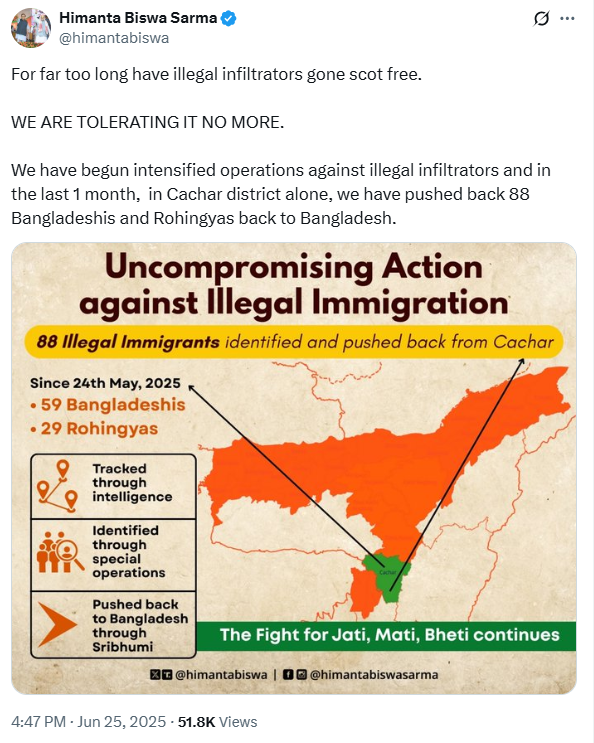
Assam Chief Minister Himanta Biswa Sarma, on Wednesday (25th June), announced that Assam government has identified and deported 88 illegal Rohingya and Bangladeshi immigrants from Cachar district in last one month. Taking to X, CM Sarma shared that his government has intensified operations against illegal infiltrators. Cachar district shares a 32 km-long border with Bangladesh.
“For far too long have illegal infiltrators gone scot free.WE ARE TOLERATING IT NO MORE. We have begun intensified operations against illegal infiltrators and in the last 1 month, in Cachar district alone, we have pushed back 88 Bangladeshis and Rohingyas back to Bangladesh,” the Assam CM posted.
CM Sarma added that among those pushed back into Bangladesh, 59 are Bangladeshi refugees and 29 are Rohingya refugees. These illegal infiltrators were tracked and identified through special operations.
Notably, a nationwide Operation Push-back is being conducted to detect, detain and deport Bangladeshi and Rohingya infiltrators and Assam is leading the way.
On 22nd June, Assam police detained 15 Bangladeshi infiltrators in Cachar and shifted them to a temporary detention facility in Silchar. As per the local police, several of these illegals were from Bangladesh’s Khulna area, and had been residing in Gujarat’s Surat for many years. With increased crackdown on illegal immigrants, they were trying to go back to Bangladesh via Assam.
In Cachar alone, the Assam Police has caught more than hundred Bangladeshi in the district’s sensitive Katigorah area.
Earlier this month, CM Sarma said that his government has pushed back over 330 illegal infiltrators in the last few months. He asserted that this operation will be expedited in the coming days.
We have pushed back over 330 illegal infiltrators in the last few months and this operation will be expedited in the coming days.
— Himanta Biswa Sarma (@himantabiswa) June 9, 2025
Recently, the Assam Chief Minister said that the Assam government does not need to go to court every time to deport illegal foreigners, as it can use an old law passed in 1950. Talking to reporters in Nalbari after an official visit, he said that the Supreme Court recently said that the Immigrants (Expulsion From Assam) Act, 1950, is still valid, and the state government can use it to deport illegal foreigners without approaching courts.
An incident in Etawah, Uttar Pradesh, has created a stir in social and political circles. The matter started with allegations of molestation against Kathavachak Mukut Mani followed by an assault on him and his associates, which was later presented as a caste dispute. The incident has now taken a socio-political turn with some trying to portray it as a Brahmin vs OBC-Dalit dispute.
There are several angles to be considered during this entire episode – caste sensitivity, the tendency to immediately rush to social media and give reactions without knowing facts of the case, and issues like the character of the Kathavachak.
In this article, we will understand these matters in detail. Along with this, we will also see that there has been no caste issue regarding Kathavachaks in the Sanatan tradition. We will also give examples of those Kathavachaks who are non-Brahmins. We will also tell you the reason for this particular case going viral, and how some people started playing their caste politics by targeting Brahmins without knowing the facts of the case
What is the Etawah case all about matter related to Etawah
Shrimad Bhagwat Katha was organized on 21 June 2025 in Dandarpur village of Bakewar police station area of Etawah. Kathavachak Mukut Mani and his associate Sant Singh Vyas were called by a Brahmin family for the Katha. Renu Tiwari, a woman from the host family, and her husband Jai Prakash Tiwari have said that the Kathavachak behaved indecently during and after the Katha.
The victim Renu says that the Kathavachak held her hand with wrong intentions during the Kalash Yatra and when it was opposed, he threatened that he is a relative of Samajwadi Party (SP) National President Akhilesh Yadav.
After this, the matter took a turn towards becoming a caste issue after it came to light that the Kathavachak had hidden his caste. Two Aadhar cards were found with him, in one of them, it was mentioned that he is a Brahmin (Agnihotri). The dispute escalated when the villagers came to know about his real caste (Yadav) and on the night of June 22, some people beat up the Kathavachak and his aides, and cut their braids. Four people were arrested after a case was registered against two named and 50 unidentified persons in Bakewar police station.
This incident sparked tension in the area. The Brahmin Mahasabha called it a conspiracy against Brahmins and demanded action against the Kathavachaks, while the Samajwadi Party and Yadav Mahasabha portrayed it as harassment of OBC-Dalit community by Brahmins. The matter also became a hot topic of discussion on social media and many people started targeting Brahmins without knowing the entire truth.
There is no caste barrier to become a Kathavachak in Sanatan Dharma
There has been no caste barrier to become a Kathavachak or for devotion in Sanatan Dharma. This tradition has been going on since ancient times and the biggest example of this is the ‘Vyadh Geeta’ of Mahabharata. In this story, a hunter (Vyadh), who was from a lower caste community, preaches karma and dharma to a Brahmin. These preaching are considered as important as the Bhagavad Gita. In the Sanatan tradition, caste has never come in the way of knowledge and devotion.
Even in modern times, there are many non-Brahmin Kathavachaks who are respected in the society and who are followed by millions of people. This can also be understood from some examples –
Morari Bapu: Gujarat’s famous Kathavachak Morari Bapu comes from the Bania community. His tales of Ramcharitmanas are heard by millions of people in the country and abroad. His devotees include people from every section of the society.
Acharya Manorama Singh Yadav: This Kathavachak from Uttar Pradesh narrates Shrimad Bhagwat Mahapuran and Ramkatha. Millions of people watch YouTube videos of her tales. Despite being from the Yadav community, she is respected by every section.
Neelam Yadav Shastri: She is also a popular Kathavachak, whose bhajans and stories are especially popular among women. Her events are attended by huge crowds and she is also a non-Brahmin.
Hemraj Singh Yadav: The videos of this Kathavachak, who does a unique blend of comedy and devotion, are always viral on social media. People from every section also attend his tales. Similarly, Manjesh Singh Yadav is also a famous Kathavachak.
Dr. Brajesh Yadav: Surgeon Dr. Brajesh Yadav of Bareilly distributes copies of Ramcharitmanas. He instills the message of ‘becoming a Ram devotee’ to everyone and enjoys a large following.
Hanuman Prasad Poddar: His Ramcharitmanas ki Tika published by Gita Press Gorakhpur is the most widely read in the world today. He was also a non-Brahmin. Thanks to people like Hanuman Prasad Poddar, Sanatan culture is present in every corner of the world today. He targeted the opponents of Sanatan, even if they were Brahmin Prime Ministers of the country like Jawaharlal Nehru, and he never backed down from the fight for Sanatan. Hanuman Prasad Poddar was never a Kathavachak, rather he was the protector, propagator and pioneer of Sanatan.
These examples prove that there is no caste barrier to becoming Kathavachak in the Sanatan tradition. Even in villages, the priests of most temples are from non-Brahmin communities. Anyone who has faith in the religion can worship in the temple. Yet some people look at every incident from the prism of Brahmin vs non-Brahmin and try to promote social unrest.
Akhilesh Yadav playing politics on Etawah case
This Etawah case soon started taking political colour. Samajwadi Party leaders, especially Akhilesh Yadav, presented it as OBC-Dalit oppression by Brahmins. SP district president Pradeep Shakya rejected the allegations of Brahmin Mahasabha and said that if there was any objection against the Kathavachaks, then why was no complaint made earlier. On the other hand, Brahmin Mahasabha President Arun Dubey called it a conspiracy against Brahmins and demanded action against the Kathavachaks.
Some people also started targeting Brahmins on Social Media through videos and posts without knowing the entire truth. Videos and posts made immediately after the incident, with half truths, went viral, in which Brahmins were described as casteists and oppressors. This trend is serious, because it not only increases social tension but also weakens the unity of Sanatan tradition.
Odisha example – Another case of false propaganda and targeting of upper castes
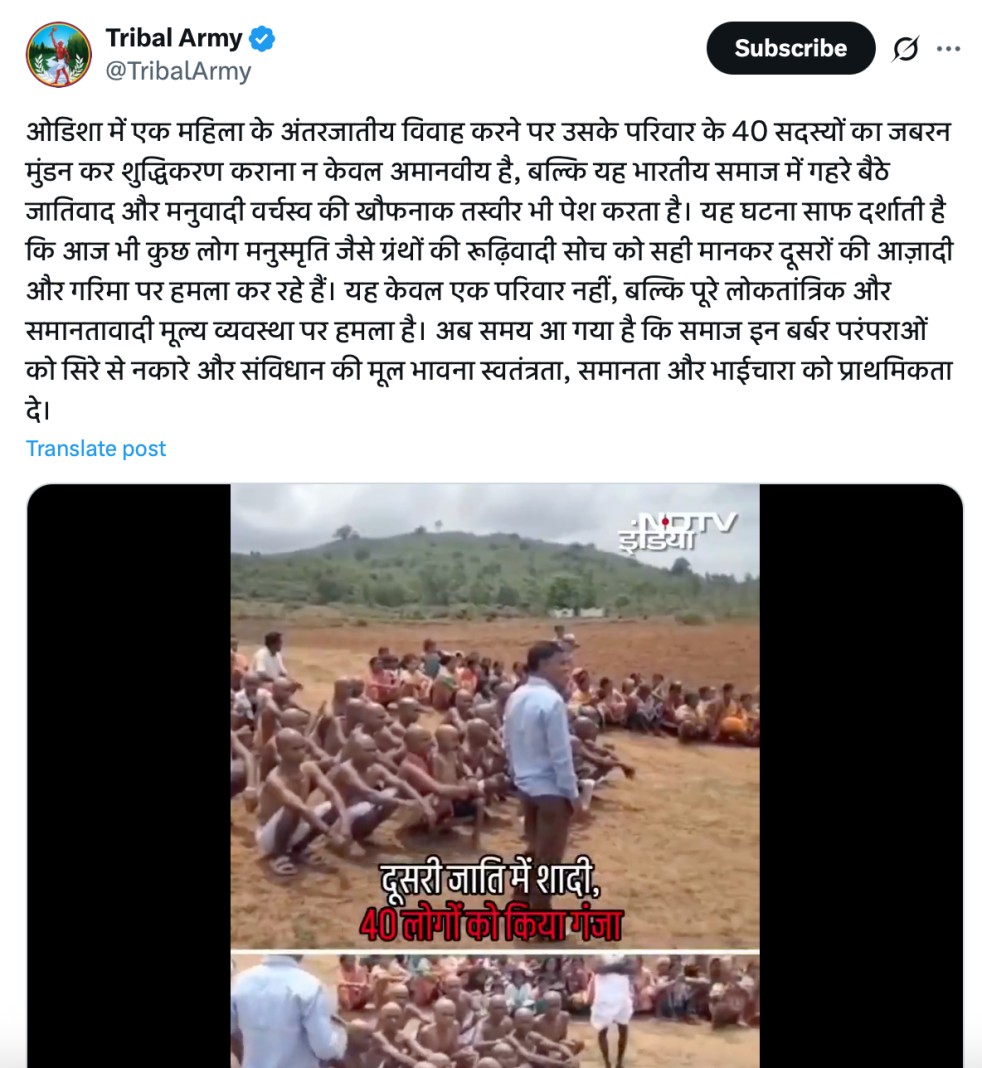
The Etawah case is not an isolated one. Recently, 40 members of a Scheduled Tribe (ST) family were ‘purified’ in Baigangoda village in Odisha’s Rayagada district because one of their young girls had married a Scheduled Caste (SC) boy. The village panchayat ordered the family to shave their heads and perform animal sacrifice. The video of the incident went viral on social media and some people attacked Brahmins and upper castes by calling it ‘Manuvadi supremacy’ and ‘oppression by upper castes’.
However, it later came to light that the ritual was performed by the family as per their own will following tribal traditions and no upper caste community had any role in it. Yet some handles on social media like ‘Tribal Army’ used it to target the upper castes and the BJP-RSS.
Several other handles also propagated this false propaganda to target the Brahmin community.
Why do Brahmins become easy targets
There are many reasons behind the repeated targeting of the Brahmin community. First, Brahmins are considered a symbol of social and religious traditions, due to which some people easily target them by calling them “Manuvadi” or ‘casteist’. Second, the Brahmin community usually does not play ‘victim’, due to which some people consider it as their weakness. Third – political parties and some people active on social media capitalize on such incidents for their vested interests.
In the Etawah case, the Samajwadi Party used it as an opportunity to divide Hindus and defame Brahmins. Leaders like Akhilesh Yadav gave it the colour of social discrimination without knowing the entire truth. Even on social media, some people immediately made videos and started cursing Brahmins, without understanding that the Kathavachak himself had misbehaved and hidden his caste.
Social expectations from Kathavachaks
A Kathavachak is highly respected in the society. He is expected to be pure, moral and simple. In the Etawah case, serious allegations like molestation and intimidation have been leveled against Kathavachak Mukut Mani. Apart from this, a fake Aadhaar card in his possession has also raised suspicion. Now, the question arises whether it is wrong to question the purity of a Kathavachak? And if a Kathavachak does comething wrong, should he be defended on the basis of his caste?
In the Sanatan tradition, the religion and conduct of the Kathavachak is paramount, not his caste. If a Kathavachak does something wrong, he should be criticized, no matter which community he belongs to. But it is wrong to use it as an opportunity to attack the entire community. In the Etawah case, some people used it against Brahmins, which is not only unfair but also harmful to social unity.
The need to understand the truth
The Dandarpur case in Etawah is a complex social and legal issue, involving several aspects like assault, molestation, and caste dispute. The police have arrested four people in the case, and the SSP has assured a fair investigation after hearing both sides. But presenting the case as Brahmin vs OBC-Dalit and giving quick reactions on social media is only increasing social tension.
In the Sanatan tradition, there is no caste barrier to becoming a Kathavachak. Non-Brahmin scholars-Kathavachaks like Morari Bapu, Manorama Singh Yadav, Neelam Yadav and Hanuman Prasad Poddar have proved that the basis of devotion and knowledge is conduct and faith, not caste. Yet some people make every incident an opportunity to campaign against Brahmins, which is not only wrong but also weakens the unity of Hindu society.
The law should do its job in this case. Serious allegations like assault and molestation should be investigated impartially and the culprits should be punished. But at the same time, society also needs to understand that targeting a particular community without knowing the entire truth is not only unfair but also dangerous. We have to avoid such politics and propaganda which works to divide the society.
The original article can be read on OpIndia Hindi here.
For the past five years, a covert religious conversion racket was operating under the guise of a “Jesus Darbar” (Jesus congregation) in Uttar Pradesh’s Prayagraj district. Vulnerable individuals were lured with false promises of jobs, miraculous healings, and even childbirth for women struggling with fertility. Under the tent of this so-called Sunday gathering, hundreds of Hindus from over 50 nearby villages were systematically converted to Christianity.
The racket came crashing down on Sunday, June 22, 2025, when police, assisted by Bajrang Dal activists, raided the site. The moment police arrived, chaos erupted as people scattered in panic, and organizers scrambled to cover their tracks. Shockingly, one of the event heads even tried bribing the officers to bury the case.
Police detained Pastor Anil Kumar along with his associates Krishan Kumar and Sanjay on the spot. Authorities revealed that this illegal congregation had been operating in Nevada village under Bahria police station limits, based on complaints by local BJP and VHP workers. An FIR has been registered against 18 individuals involved.
Further investigations exposed how residents like Usha Devi, Rajesh Kumar, and Vivek Kumar were coaxed into religious conversion with promises of employment, money, and health cures. It has also emerged that the Darbar was set up illegally on village land without any authorization. The village head, Shiv Kali Devi, has demanded its removal, and police assured action to dismantle the tent setup immediately.