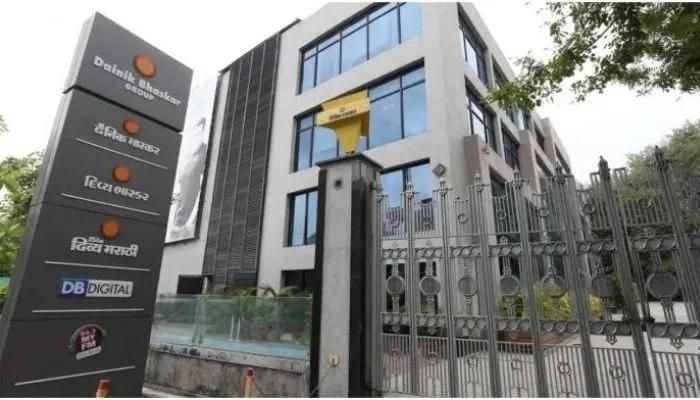
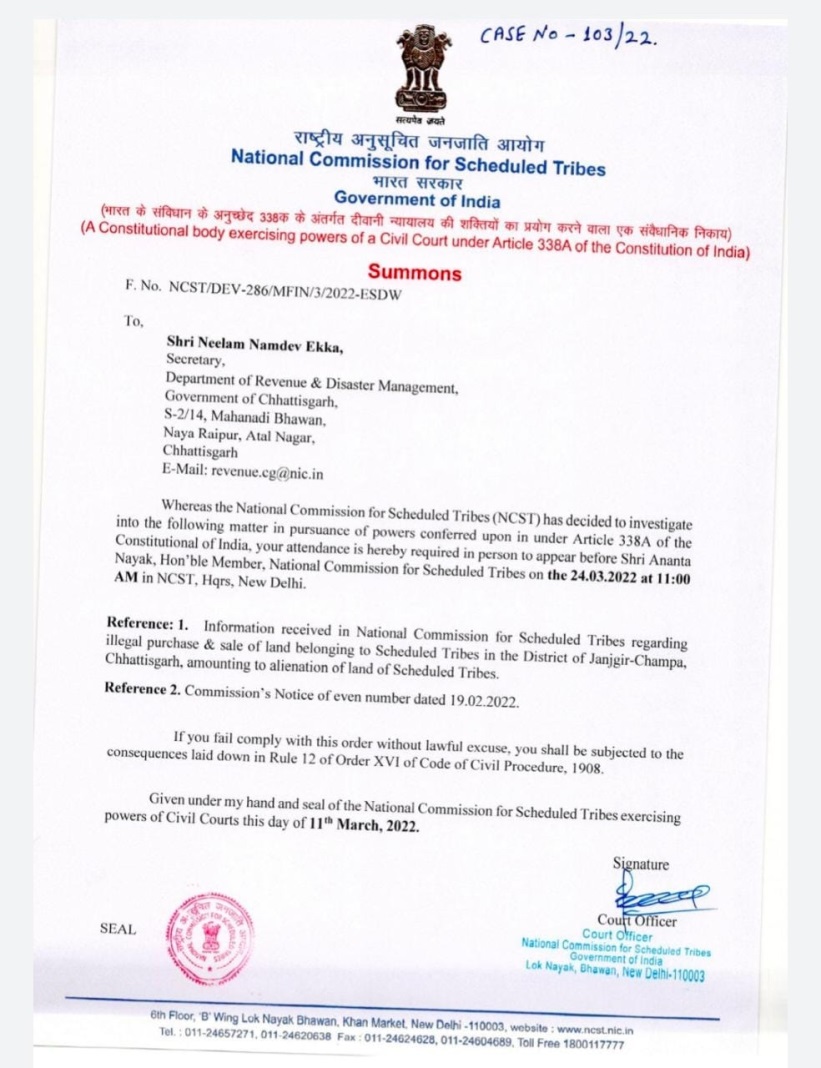
The National Commission for Scheduled Tribes (NCST) has issued a warrant to the DGP of Chhattisgarh and ordered the arrest of IAS Neelam Namdev Ekka, the revenue secretary of the state. The order has been issued in connection with the case of ‘DB Power Limited’ of Dainik Bhaskar (DB) Group fraudulently grabbing land belonging to Scheduled Tribe people in Janjagir-Champa district of Chhattisgarh.
Neelam Namdev Ekka has been ordered to appear before the Commission by 1st April 2022. The warrant was issued on Friday 25th March 2022.
The Revenue Secretary of Chhattisgarh was to appear before the Commission on 24th March 2022 and present his stand. The Commission had issued a notice in this regard on 11th March 2022. The notice also had an order to allow Chhattisgarh State Development Corporation MD Arun Prasad to appear before it. On 24th March 2022, Arun Prasad appeared before the Commission but Neelam Namdev was absent. Following this, the Commission has issued a notice for his arrest. ST Commission’s Delhi Court Officer S P Meena confirmed the notice to OpIndia.
Chhattisgarh’s revenue secretary did not appear despite receiving the NCST’s notice.
In July 2021, the Income Tax Department had raided the premises of Dainik Bhaskar due to allegations of financial misappropriation. The National Commission for Scheduled Tribes (NCST) has launched an inquiry into the allegations made on the DB group at Janjgir in Chhattisgarh. The commission has received a complaint about the illegal purchase and sale of tribal land by the Dainik Bhaskar group media institute.
According to a report by Asia Net News Hindi, the company of this group that operates in the power sector is called DB Power Limited. This company is accused of fraud in the purchase of land for setting up a power plant in the Janjagir-Champa district of Chhattisgarh. Dainik Bhaskar group had employed a local agent for land purchase. He first purchased the land from the tribal people at cheap rates.
According to the regulations, when a tribal person purchases land from another tribal person, he need not take any permission. But if a non-tribal wishes to buy any land from a tribal, it is a must for them to take permission from the district collector.
Big Breaking : Dainik Bhaskar Group is accused of illegally grabbing land meant for Scheduled Tribes in Janjgir of Chattisgarh. National Commission For Scheduled Tribes to look further into this matter. pic.twitter.com/EeeIjD5jqR
It is reported that the Dainik Bhaskar group first asked the employed agent to buy the land from the tribal people at cheap rates. He later sold the land to the Dainik Bhaskar group. In between, the Chhattisgarh State Industrial Development Corporation acquired a major part of the land which it later gave to the DB Power Limited. This was the extra land needed for setting up a power plant here.
When OpIndia called up The DGP IPS Ashok Juneja of Chhattisgarh Police in this case, he did not pick up the phone. Later, when OpIndia spoke to his PRO Bhagwati Singh, he refused to divulge anything about the matter. There was no response to the DGP’s official number even when asked through WhatsApp. The official landline number of IAS Neelam Namdev Ekka was also not picked up.
After the success of the Vivek Agnihotri film, The Kashmir Files, there’s a spontaneous explosion of emotions of people from Jammu to Kanyakumari. This catharsis follows because scores of people had absolutely no idea of the brutality of the Kashmiri Pandit genocide as part of a larger conspiracy.
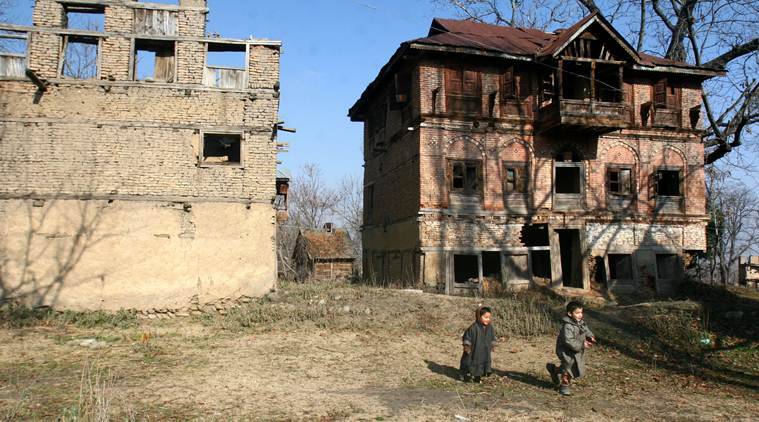
However, the exodus of Kashmiri Pandits in 1990 still appears sudden, which it was not. The genocide of a community/race is not about the numbers but the intent of the crimes committed against them. The intention to ethnically cleanse Kashmir of Kashmiri Hindus always existed. If one looks chronologically, the blood-thirsty Jihadis always wanting to purify the Kashmir-Vaadi, hunted the Kafirs out of the valley.
Kashmir, one of the cradles of Hindu Civilization, have been at the receiving end of varying hues from hostile foreign rulers from the early fourteenth century until the reign of Shah Mir in 1819 when Maharaja Ranjit Singh liberated Kashmir. Courtesy of the Sikh-Dogra kings, during 1819-1930, the indigenous folks had a brief respite from the vicious alien.
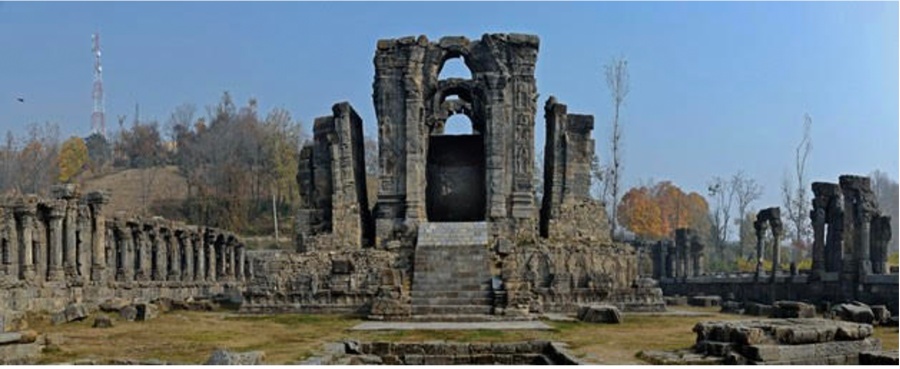
[Built in the 6th century, the Martand Sun Temple now lies in ruins]
From the 1930s, Kashmir was again infected by radical Islam, with critical characters like rabble-rouser Abdul Qadir and Sheikh Abdullah, a descendant of a Kashmiri Pandit named Rago Ram Kaul. After the arrest of Abdul Qadir sedition, the first-ever organized violent Islamist Jihad in the recorded history of Kashmir took place on this date, July 13, 1931. The clarion call was:
Ralive, Tsaliv ya Galive (convert, leave or perish)!
The mayhem continued for months. Countless Hindus were burnt alive, murdered, maimed, girls and women raped, molested, and even forcibly converted to Islam. Those who refused jumped into well after throwing their kids first. A few Jihadis who died after being challenged by the Police were hailed as martyrs. It’s ironic that in independent India, the J&K State Govt. sanctified those Jihadi terrorists as fallen heroes by commemorating them every year on July 13 as Martyr’s Day.
At the time of independence,the political integration of all Indian territories into India was the most critical objective of Sovereign India.
On August 11 1947, the Maharaja dismissed his Prime Minister Ram Chandra Kak, who had advocated independence for the state. Hari Singh was already tilted towards accession to India, but his only concern was Nehru’s interest in Sheikh Abdullah. Around that time, Pakistanis decided to preempt wresting Kashmir by force. They launched operation ‘Gulmarg.’ Led by Pakistani Army regulars, about 5,000 Jihadi tribes from FATA (today’s Taliban region) attacked the region on October 22, 1947, with the same clarion call:
Ralive, Tsaliv ya Galive (convert, leave or perish)!
When Maharaja Hari Singh made a desperate call, Nehru conveyed that Delhi was not in a position to rescue them.
The Muslim officers of State Forces betrayed the Maharaja, killed officers like Col Narayan Singh Sambyal and showed the enemy the way to Kashmir. The Mujahideens made rapid advances into the Baramulla sector, killing 11000 to 14,000 inhabitants – leaving the entire belt – from Bhimber to Mirpur to Kotli and Muzzafarabad to Baramullah annihilating Hindus and Sikhs. They stopped only to loot, burn houses, rape women, and abduct young women. They did not spare even the nuns of hospitals and convents. After throwing their children first, women jumped into the Kishenganga River to save their dignity.
When Sardar Patel tried to retrieve the lost ground in Kashmir due to Nehru’s recklessness, Indian troops were flown to Srinagar and began their swift operations. Within a few days Army recaptured Baramulla and significant parts of J&K. But before Hari Singh signed the ‘Instrument of Accession,’ on Nehru’s firm demand, Sheikh Abdullah was released and made Prime Minister of Jammu & Kashmir.
The transfer of power from British to Indian leaders led to the transfer of power from the Jammu-based Hindu ruler to Kashmir based Islamist leadership. The consequences have been tragic, and the chaos created 70 years ago remains far from being sorted out.
After being caught for his shenanigans, Sheikh was sacked and jailed for 11 years. During this time, Kashmir was relatively peaceful. Later, Nehru felt bad for Sheikh and released him before his death. That’s when aGilgit-born separatist Amanullah Khan founded Plebiscite Front in 1965, whose armed wing – Jammu Kashmir Liberation Front (JKLF) carried out the hijacking of a Srinagar-Jammu flight in January 1971. But their major terror activities peaked in the 1980s.
The 1971 war had a humiliating impact on Pakistan that their vehemence for Independent Kashmir diminished.Both India and Pakistan also had other significant domestic problems, which pushed Kashmir on the backburner. The attitude of Sheikh Abdullah and other Radical Islamic leaders also changed.
But not that the Islamist Jihadis were silent. During this period, Maqbool Bhat, the first poster boy of Kashmir’s Islamic terror, ambushed police personnel and a local CID Inspector, Amar Chand. After his arrest, local authorities helped him escape to Pakistan. Bhat was also accused of masterminding the hijacking of a Passenger Airline to Lahore.
After the Plebiscite Front was merged with the renewed National Conference in 1975, Sheikh Abdullah returned from the political wilderness. It resulted from a pact (stern warning) with then Prime Minister Indira Gandhi. He then won consecutive elections to remain Chief Minister of Jammu and Kashmir till his death in September 1982. Things were in better control.
Farooq Abdullah succeeded him as Chief Minister, and his shenanigans with Jihadis began. There were noises of internal quarrels post-June 1983 Assembly elections. In the meanwhile, several attempts were made by terrorists to release Maqbool Bhat through ransom. In 1984, when the JKLF kidnapped an Indian diplomat Ravindra Marathe in Birmingham and killed him, failing the demand for Maqbool’s release, Maqbool Bhat was executed in Tihar within weeks. Indira Gandhi appointed Jagmohan as the Governor of J&K in April 1984. Farooq’s Government fell in July 1984, after his brother-in-law Ghulam Mohammad Shah defected and assumed power with the support of the Congress. Zia-ul-Haq
After Mrs Gandhi’s assassination in 1984, Rajiv Gandhi succeeded.
The Islamic Jihad Re-Invented
With the loss of power, Farooq Abdullah playing in the hands of Pakistan instigated an upsurge in the Islamic fundamentalist activities in the valley. Amanullah Khan of JKLF was tasked to trigger an insurgency by the Pakistan Army, which later took official sanction as OPERATION TUPAC (or the Zia plan) by General Zia-ul-Haq. Pakistan-trained militants triggered the mayhem in Srinagar, Baramulla, Pulwama, Bhaderwah and Anantnag – and these urban centres turned into terror hubs. An orgy of riots, looting and arson against Hindus and several temples being burnt and razed to the ground every Friday paved the way for Jagmohan to dismiss Gul Shah’s Govt and impose Governor’s rule, and later President’s rule on September 7 1986.
After the infamous Rajiv-Farooq-Accord – the foundation stone of the ‘MODERN-KASHMIR-CRISIS’ – Farooq was again sworn in as CM in November 1986 in an NC-Congress coalition government.
The 1987 State election is the most-rigged election in India that triggered an alliance called the Muslim United Front MUF. The main force behind the coalition was pro-Pakistan Hurriyat chief Syed Ali Shah Geelani, JKLF head Yasin Malik and Hizbul Mujahideen head Syed Salahuddin, all hardcore terrorists. Funds from across the border generously started flowing to hardliner mosques and clerics to trigger religious passion.
Farooq Abdullah gave the disgruntled MUF leaders greater sympathy in the valley than their actual electoral strength, which helped them further boost Operation-Topac and unleash terror in the Kashmir Valley.
By 1988 mid-June, spontaneous demonstrations were held demanding commitment to Islamicise Kashmir through the imposition of Shariah Law. Three people died in police retaliation when two bomb blasts targeting the TV station and the Central Telegraph Office were engineered. The prestige of Farooq’s Government among Jihadis started suffering. Between July and December 1989, his Government released 70 hardcore Pak-trained terrorists. The Jihadi sentiments acquired a new terrorist character. Posters were pasted on select homes of Kashmiri Hindus, and the mayhem started.
The question here is, could this have been possible without the knowledge of the Rajiv Gandhi led Union Government of 1989?
Governor Jagmohan kept Prime Minister Rajiv Gandhi fully apprised of the developing situation was removed on July 11, 1989. Later he exposed Rajiv in an open letter what he had written to Rajiv when he was PM:
It was shocking that PM Rajiv Gandhi failed to take cognizance of such reports and any appropriate action for sheer appeasement politics. The Kashmir Valley was knowingly and systematically handed over to the Jihadi terrorists by the Rajiv-Farooq duo. The open proclamation of ‘Jihad had overtaken the so-called quest for ‘Azadi”.
March 14, 1989: Prabhavati from Budgam district was killed at Hari Singh High Street, Srinagar, J&K.
September 14, 1989: A top-rated lawyer and social and political activist, Tikka Lal Taploo, was put to bullets by the JKLF killers in Habba Kadal, Srinagar.
October 4, 1989: An ex-Sessions Judge Nila Kanth Ganjoo, who emerged as a detestable Kafir when ordered the execution of the dreaded Maqbool Butt, and based on the evidence deposed, that was later also upheld by the Apex Court.
October 31, 1989: Sheela Koul (Tiku), a housewife, was gunned down by JKLF terrorists at Shivapora, Srinagar. When the ambulance failed to arrive, she was carried to the hospital on a folding bed, where she was left unattended.
December 1, 1989: Ajay Kapoor was in his locality where he was showered a volley of bullets in cold blood by the JKLF butchers.
December 27, 1989: 57-year-old prominent lawyer Prem Nath Bhatt of Anantnag returned to his home when the Muslim terrorists pumped bullets straight into his head in full public view.
Rajiv Gandhi lost power at the Centre to his bête noir, Vishwanath Pratap Singh, in December 1989. VP Singh made Farooq Abdullah’s arch-rival Mufti Mohammad Sayeed his home minister.
The militants gained further after the kidnapping of Home Minister Mufti Mohammad Sayeed’s daughter Rubaiya Sayeed on December 8, 1989. In sheer panic, Farooq’s Govt agreed to release five more dreaded imprisoned Jihadi leaders.
The Kashmiri Hindu genocide of January 19, 1990, was only the culminating point of the surrender of governments before the ‘terror regime’ in Kashmir valley.
As the cold, dark night fell, the Kashmiri Hindus were panic-stricken when the valley began reverberating with the war-cries of Islamists, choosing carefully the highly provocative, communal and threatening slogans:
“ओ ज़ालिमों, ओ काफिरों, कश्मीर हमारा छोड़ दो
कश्मीर में अगर रहना है, तो अल्लाह-हु-अकबर कहना होगा
ला शरीक़ा ला घरबिया, इस्लामिया! इस्लामिया!
मुसलामानों जागो! काफिरों, भागो!
इस्लाम हमारा मक़सद है, क़ुरान हमारा दस्तूर है, जेहाद हमारा रास्ता है
Meaning: “O! Merciless, O! Kafirs leave our Kashmir. Anyone wanting to live in Kashmir will have to convert to Islam. From East to West, there will be only Islam. O! Muslims, Arise, O! Kafirs, scoot. Islam is our objective, Quran is our constitution, Jehad is our way! We will turn Kashmir into Pakistan along with Kashmiri Pandit women, but without their men.”
Thousands of Kashmiri Muslims poured into the valley’s streets, screaming from loudspeakers and crowded streets, giving a final push to the Kafirs and stirring the worst nightmares into the lives of Kashmiri Hindus and Sikhs. They were once again presented with three choices:
Ralive, Tsaliv ya Galive (convert, leave or perish)!
Sensing the inevitable, Farooq Abdullah abdicated his responsibilities as the Chief Minister on January 18, 1990, and ran away to London after presiding over full-blown Jihad. He didn’t even wait for handing over of charge. There was NO GOVERNMENT IN J&K FROM January 18, 1990, to January 22, 1990. Jagmohan, who was appointed the Governor again on January 19 1990, could reach Srinagar only on 22 Jan1990. By then, the jihadis had taken over the valley.
The terrorists systematically eliminated Kashmiri Pandits. The holy war didn’t spare any – the victims, including men, women and children, were subjected to the greatest indignities.
Only a handful of Indian Media reported this genocide, with barely two-three line news that too was carried out somewhere on the 14-15th page. The intelligentsia and over-ground sympathizers of this ‘Jihadi -movement’ kept guiding the militants from behind the scenes spouting lies through their teeth. That the 1990 genocide of the Kashmiri Pandits took place under the watch of Governor Jagmohan is the biggest lie!
All available evidence and witnesses confirm that the National Conference and Congress government in J&K and the Congress government at the Centre (from 1986 to 1989) miserably failed to protect against the Kashmiri Hindu genocide.
The targeted killing of Hindus residing in isolated pockets in the valley never stopped. By December 1990, 300 plus more govt employees, and security personnel, were killed by Jihadi Terrorists. The genocide of Wandhama, Parankote, Dakikote, Chapnari, Doda and Kishtwar, where Hindus were segregated and killed, was part of radical Islamic Jihad, is continuing even today.
The history of Kashmir for the last century and beyond concludes that the militancy and terrorism in the Kashmir valley was never a ‘Freedom Struggle.’ No freedom impinges upon others’ freedom. It was, and it is, out and out an Islamic Jihad and the refusal of democracy to seek Sharia.
It is overwhelming to witness that while expressing their anger against the tragic brutalities, the Kashmiri Pandits have only been stating facts without losing the decorum of language, debate, and discussion.
There won’t be another appropriate time for the Government to establish and institute a “Truth and Accountability” commission that holds everyone who perpetrated and enabled this genocide accountable. It is about time!
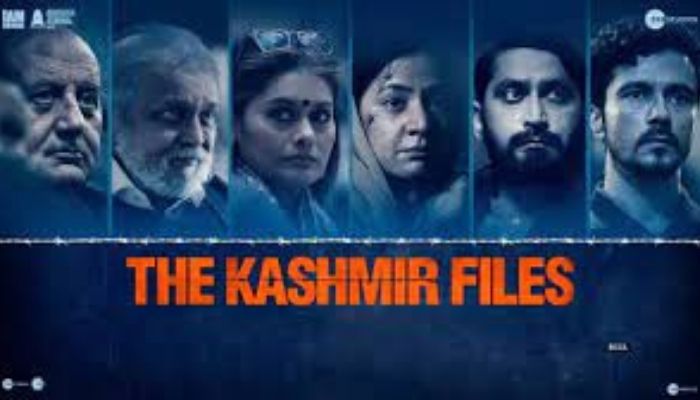
Telangana high court dismissed a writ petition about Vivek Ranjan Agnihotri’s film The Kashmir Files on 28th March 2022 as the petition was withdrawn by the counsel of the petitioner. The writ petition filed by Mohammed Sami Ullah Qureshi alleged that the act of the makers of the film ‘The Kashmir Files’ putting certain objectionable scenes in the film is illegal, arbitrary. The Kashmir Files is a film based on the genocide of Kashmiri Hindus by Islamic terrorists in Kashmir in 1990 and their subsequent exodus. The film was released on 11th March 2022.
It was claimed in the petition that the scenes showing mass murders of Kashmiri Pandits by Muslims and the exodus of some Kashmiri Pandits during the Kashmir Insurgency are causing hurt to the religious sentiments of several Muslims around the world. The petitioner Mohammed Sami Ullah Qureshi had requested the court to issue a writ of mandamus declaring the action of the respondents in making, releasing, and telecasting these objectionable scenes in the film as illegal and arbitrary.
Mohammed Sami Ullah Qureshi claimed that the scenes showing mass murders of #KashmiriPandits by Muslims and their #exodus during the Kashmir insurgency are causing hurt to the religious sentiments of several Muslims around the world.@ISalilTiwari reportshttps://t.co/CAMaFHNLQg
The bench of Justice P. Madhavi Devi heard the petition in detail. The court noted that the petitioner’s counsel sought permission from the court to withdraw the writ petition to pursue an alternative remedy. However, it is notable that no specific alternative remedy was mentioned.
Taking this into consideration, the court ordered, “Accordingly, permission is accorded and this writ petition is dismissed as withdrawn with liberty to pursue an alternative remedy.”
This is not the first time that a petition was filed against the makers of The Kashmir Files alleging that the film hurts ‘religious sentiments’. The PIL filed against Filmmaker Vivek Agnihotri’s movie The Kashmir Files by a resident from Uttar Pradesh named Intezar Hussain Sayed sought to stall the release of the film.
After the trailer of the movie was released, the petitioner had alleged that the trailer hurts the religious feelings of the Muslim community. However, Vivek Agnihotri had denied the allegations and said that his movie only shows the truth. The petitioner had also pleaded to immediately take down the trailer of this film till the hearing is done. This petition was dismissed by the Bombay High Court on Tuesday, 8th March 2022.
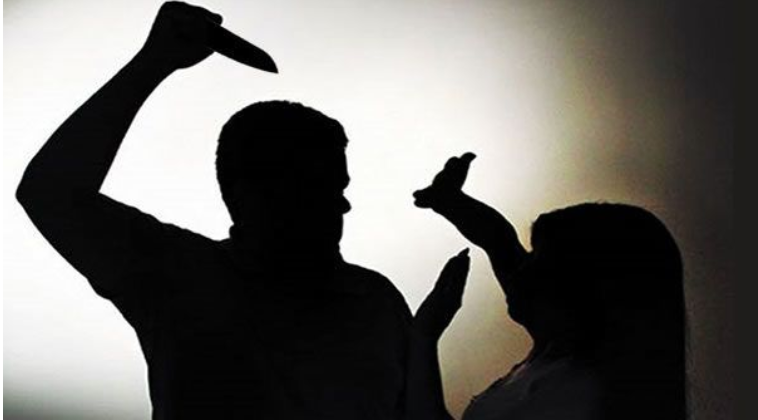
The police in Uttar Pradesh is looking for a man named Abid, who reportedly stabbed his wife Asma when she protested after Abid gave her triple Talaq. Abid and his family were forcing Asma for dowry, and when she couldn’t fulfil their demands, he gave her triple Talaq, reports Hindi daily Jagran. The incident reportedly took place in the Purwa Ilahi Baksh area in Meerut, Uttar Pradesh on Saturday night.
According to the report, Abid and his wife Asma got into a fight over the former’s increasing demand for money from Asma’s family. The argument became heated, and in a fit of rage, Abid yelled Talaq three times, declaring that the marriage was over. When Asma objected, Abid stabbed her repeatedly.
When the injured Asma began screaming, her neighbours came to know about the attack and informed her parents about it. Asma’s parents rushed to her in-laws’ house and took her to the district hospital, where she is being treated. According to the reports, Asma is no longer in danger.
Firoz Chand, a resident of Shyamnagar in the Lisadi Gate police station area, told police that his sister married Abid, a resident of Purva Elahi Baksh in the Brahmapuri police station area, around 13 years ago. The couple have three sons. Abid, according to Firoz, is a police informant who is addicted to alcohol.
Abid and his relatives have been demanding ten lakh rupees from Asma and her family for the past few days. Even though Asma had brought some money from her maternal family to give to her in-laws, the demands for more money continued.
On Saturday night, the duo got into an argument over it, and Abid gave triple Talaq to Asma, and stabbed her when she objected.
Speaking about the incident, the Police station in-charge Dinesh Chandra Sharma said that police are investigating the case and efforts are on to nab Abid.
In 2019, India had passed the landmark triple Talaq bill, declaring the practice of instant triple Talaq as void and illegal, making it a cognizable offence.
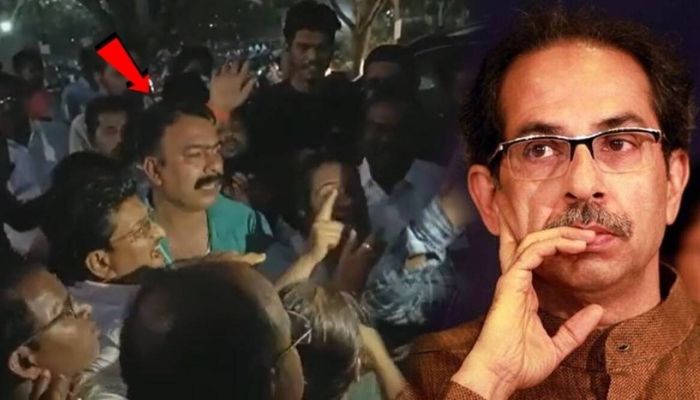
Shiv Sena goons attacked a man in Jalgaon in Maharashtra for a social media post against their party head and state CM Uddhav Thackeray. The incident took place near a local mall in the city. Subsequently, a video of the assault went viral on the internet.
Hemant Dwitiye, from Dharangaon in Jalgaon district, had shared a post on Facebook against the Chief Minister Uddhav Thackeray. Enraged over the post against the Chief Minister, his party’s goons, including some women members, approached the person in the Central Mall area in Jalgaon. After that, they beat up the person on the spot for his social media post.
After sharing the post in a Facebook group, the victim went to Inox theatre in the Central mall of Jalgaon to watch the film, The Kashmir Files. When he came out of the theatre after watching the film, the Shiv Sena goons kept a watch on him and thrashed him mercilessly in front of the theater. They even made him apologize for the post after beating him. After the attack, the victim was handed over to the Police.
Gulabrao Wagh, a district-level leader of Shiv Sena said, “Whenever anyone puts up such a post about the Chief Minister, he will be given similar treatment on the streets. It should be remembered that no one should put any such post about Shiv Sena and the Chief Minister.”
This is not the first case of Shiv Sena goons beating someone up for their social media posts. Earlier, the party workers had beaten up a retired Navy officers for a WhatsApp forward mocking the Maharashtra CM. There was another case of Shiv Sena workers beating someone up and shaving his head over a Facebook post critical of the sitting Chief Minister.
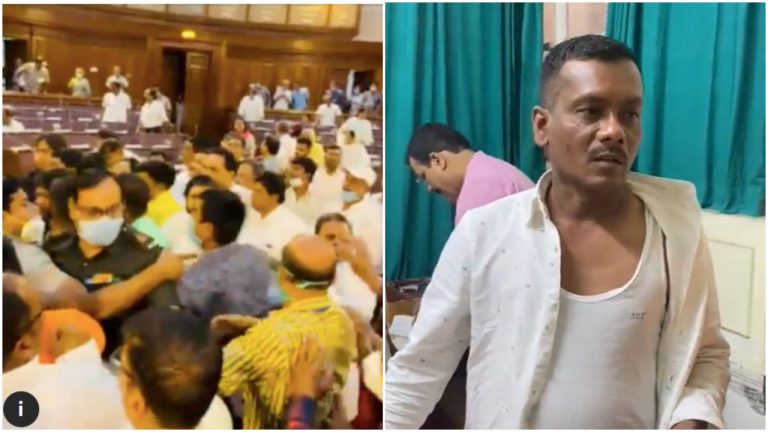
On March 28, Monday, a ruckus ensued inside the West Bengal Legislative Assembly as the opposition demanded a discussion on the recent Birbhum massacre. The BJP MLAs claimed that they were assaulted and manhandled by the TMC MLAs as they demanded Chief Minister Mamata Banerjee’s resignation over the law and order situation in the state in light of the Birbhum violence wherein eight persons were killed.
Videos of the incident have gone viral on social media where MLAs could be seen crowding the floors of the Assembly and fighting each other.
Bharatiya Janata Party (BJP) MLA and Chief Whip Manoj Tigga’s clothes were reportedly torn in the scuffle.
Following the incident, Amit Malviya, the BJP’s IT cell chief, took to Twitter to share a video of the chaos in the Assembly. Amit Malviya, who shared images of the fistfight, accused the Mamata Banerjee-led TMC government of attempting to conceal something.
Absolute pandemonium in the West Bengal Assembly. After Bengal Governor, TMC MLAs now assault BJP MLAs, including Chief Whip Manoj Tigga, as they were demanding a discussion on the Rampurhat massacre on the floor of the house.
“Absolute pandemonium in the West Bengal Assembly. After Bengal Governor, TMC MLAs now assault BJP MLAs, including Chief Whip Manoj Tigga, as they were demanding a discussion on the Rampurhat massacre on the floor of the house. What is Mamata Banerjee trying to hide?” Malviya tweeted following the chaotic incident.
BJP National General Secretary (Organisation) BL Santhosh also condemned the event on Twitter. The BJP leader accused the TMC of causing the uproar. He Tweeted, “West Bengal politics reaches another low today. Actually, it’s been on free fall ever since Mamata Banerjee took charge in May. Today BJP chief whip Sri Manoj Tigga and others were assaulted by TMC inside Assembly.”
West Bengal politics reaches another low today. Actually it’s on free fall ever since @MamataOfficial took charge in May. Today @BJP4Bengal chief whip Sri Manoj Tigga & others were assaulted by @AITCofficial inside Aaaembly .
Agnimitra Paul, a BJP leader, also took to Twitter to question Mamata Banerjee’s administration about its choices to muzzle the opposition’s voice.
Today inside the temple of DEMOCRACY….West Bengal assembly BJP MLAs men and women were attacked, heckled, harassed by TMC MLAs. @MamataOfficial ‘s wish to silence the OPPOSITION continues.
If you are not a TMC, you will be assaulted even if you are a MLA
Meanwhile, the TMC MLAs also alleged that they were injured amid the fistfight that broke out in the West Bengal Assembly. Reportedly, three Trinamool MLAs have gone to the hospital following the incident.
5 BJP MLAs, including the Leader of the Opposition Suvendu Adhikari, Manoj Tigga and Shankar Ghosh were suspended after the ruckus. LoP Adhikari will now be absent from the assembly until the end of the following session. In response to the suspension, Adhikari lashed out at the Mamata Banerjee-led TMC government, threatening to sue if appropriate action is not taken against the TMC MLAs responsible for the uproar.
TMC demands removal of West Bengal Governor for raising his voice against the Birbhum massacre
Interestingly, on March 24, a delegation of TMC MPs had met Home Minister Amit Shah in Delhi regarding the aftermath of the violent massacre in Birbhum which took place on Tuesday night. TMC MP Sudip Bandyopadhyay demanded the removal of West Bengal Governor Jagdeep Dhankhar after he questioned the Mamata Banerjee-led state government over the killings.
Birbhum carnage
On March 22 late-night, a group of enraged miscreants, reportedly a faction of TMC, set ablaze around 12 homes which resulted in the gruesome death of eight people including women and innocent children in Birbhum’s Rampurhat. The autopsy report of the burnt bodies shows that the people were beaten before they were locked in their homes before the houses were set on fire. The massacre had taken place in retaliation for the alleged murder of a TMC leader.
US-based non-profit organization International Commission for Human Rights and Religious Freedom (ICHRRF) has officially recognized the Kashmiri Hindu genocide in Jammu & Kashmir. The ICHRRF declared its recognition of the genocide of Kashmiri Hindus after a hearing on the issue.
According to a press release, on March 27th, 2022, the ICHRRF convened a special public hearing on the topic of the Kashmiri Hindu genocide (1989-1991), during which a number of victims and survivors of ethnic and cultural cleansing spoke under oath and provided evidence.
The ICHRRF was deeply moved by the occurrence. Several Kashmiri Hindus who were victims of genocide, ethnic cleansing, and exile from their country bravely told their harrowing experiences of endurance, survival, and rehabilitation from atrocious human rights crimes at the hands of radical Islamic terrorists, which resembled the Jewish Holocaust.
“Thousands of homes and temples were destroyed. Over 400,000 Kashmiri Hindu men, women, and children were forced into exile by Islamic terrorists at gunpoint, ejected from their homes and everything they’ve known. Women were gang-raped, cut into two pieces with a saw and killed in the most brutal manner. Now, this culture is on the brink of extinction after self-advocacy over the course of 32 years, has been unsuccessful. Those who chose to remain in their homeland did so in faith believing in the goodness of their neighbours. The victims and survivors affirmed hope, peace, nonviolence, and safety, and found themselves raped, tortured, and executed by radical Islamic terrorists. Abused corpses were denied cultural funeral traditions and desecrated in psychological warfare to intimidate and control the remaining masses,” the press release said.
When politicians, neighbours, friends, students, and local police turned a blind eye and deaf ear, the ICHRRF noted that it was terribly painful. Despite this, the Kashmiri Hindus have no desire for violent retaliation or the propagation of anti-Muslim rhetoric, the group observed.
“Having lived peacefully for thousands of years as an indigenous religious minority, the cry for help from these Kashmiri Hindus fell on deaf ears globally. While it was expected to a degree that each nation and media outlet chooses what and how much they report pertaining to global events, it was excruciatingly painful when politicians, neighbours, friends, classmates, and local police turned blind-eyes and deaf ears. Feeling repeatedly ignored, dismissed, and invalidated, the world remained silent as victims were blamed instead of condemning those who committed barbaric crimes against humanity. Despite all of this, they neither want violent revenge nor to spread Anti-Muslim rhetoric. Rather, they respectfully request togetherness for the betterment of truth, justice and humanity, while they peacefully engage a spiritual, psychological, and emotional journey to heal intergenerational traumas and advocate to prevent future atrocities,” the press release further added.
The hearing concluded with ICHRRF urging the Government of India and the Government of the Union Territory of Jammu and Kashmir to identify and recognise the atrocities against Kashmiri Hindus in 1989-1991 as genocide.
“The Commission exhorts other human rights organizations, international bodies and governments to step up to the plate and officially acknowledge these atrocities as an act of genocide. The world must listen to these profoundly moving stories, seriously introspect on the impact of their past silence and inaction out of political expediency and make proper recognition,” the statement said.
International Commission for Human Rights and Religious freedom
The International Commission for Human Rights and Religious freedom (ICHRRF) is a non-profit organisation established in the United States that promotes human rights, religious and philosophical freedom, and a polycentric worldview via continuous monitoring, education, policy research, and collaboration.
According to their website, they are focused on educational, scientific, legal, and human rights advocacy, as well as charity objectives, and they endeavour to be an advocate for the human rights and religious liberties of under-represented people worldwide.
The genocide of Kashmiri Hindus
Kashmiri Hindu genocide began in the late 1980s and early 1990s, when lakhs of Hindus, particularly Pandits, were tortured and forced to forsake their land and property. According to estimates, around 100,000 of the valley’s total 140,000 Kashmiri Pandit inhabitants fled between February and March 1990.
On January 19, 1990, Kashmiri mosques issued a warning to Kashmiri Pandits, referring to them as Kafirs. They were given three choices: leave Kashmir, convert to Islam, or be murdered. It’s been more than 30 years, yet the anguish, suffering, and tears of tens of thousands of Kashmiri Pandits can still be heard across the valley. According to reports, Islamists slaughtered around 219 Kashmiri Pandits.
According to some estimates, the number of displaced Kashmiri Pandits might be as high as 300,000. During that time, not only were Hindus driven out of Kashmir, but temples were demolished, residences were burned to the ground, and millions were alienated.
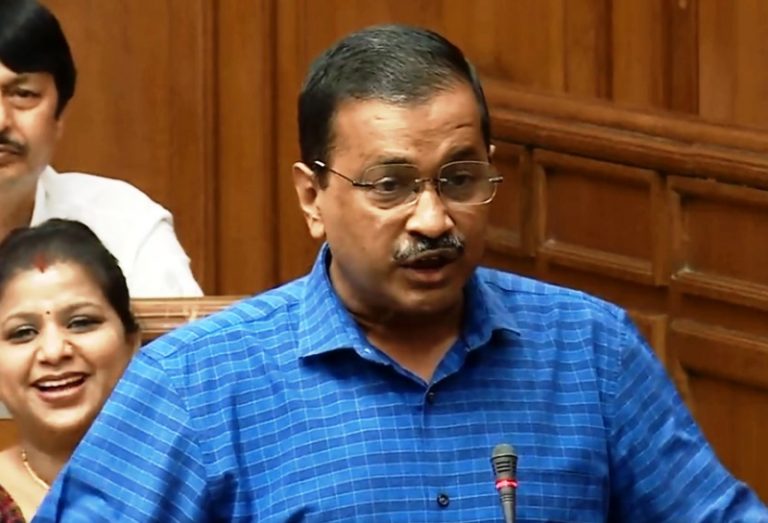
Delhi Chief Minister Arvind Kejriwal sparked a controversy last week when he called ‘The Kashmir Files’ a jhoothi filmon the floor of Delhi assembly. Even though the debate was on Delhi’s budget presented by Manish Sisodia, Arvind Kejriwal took his time out to attack the film.
His attack on the film expectedly brought strong reactions from Kashmiri Hindus who were displaced after the genocide they suffered in the valley. Kejriwal and his party were roundly criticized for laughing at the pain suffered by Kashmiri Hindus during their genocide and subsequent exodus from the Kashmir valley.
Now it looks like the Delhi CM has realized the folly of his actions and has started a damage control exercise. In an interview given to Times Now’s Navika Kumar, Arvind Kejriwal said they were not laughing at the Kashmiri Pandits’ exodus but laughing at BJP’s promotion of the film.
Even though CM Kejriwal openly called the entire film a jhoothi film on the floor of the Delhi assembly, he claimed that he was just laughing on BJP’s support of the film. Kejriwal further went on to say that BJP earned Crores through this film, even though neither BJP, nor any of their functionaries were involved in the making of the film.
Arvind Kejriwal also dodged the question on why he made multiple films like Swara Bhasker’s Nil Battey Sannata, Taapsee Pannu’s Saand Ki Aankh and Deepika Padukone’s ‘83 tax-free in Delhi, but refused to do so for a film on Kashmiri Hindu genocide.
During the interview, the anchor Navika Kumar also tried to give credit to Kejriwal for the regular jobs that few Kashmiri Pandits got in Delhi in recent years, even though that was after a High Court order.
Meanwhile, an FIR has been registered by Punjab Police against BJP leader Tajinder Pal Singh Bagga for criticizing Arvind Kejriwal’s mocking of Kashmir Files film.
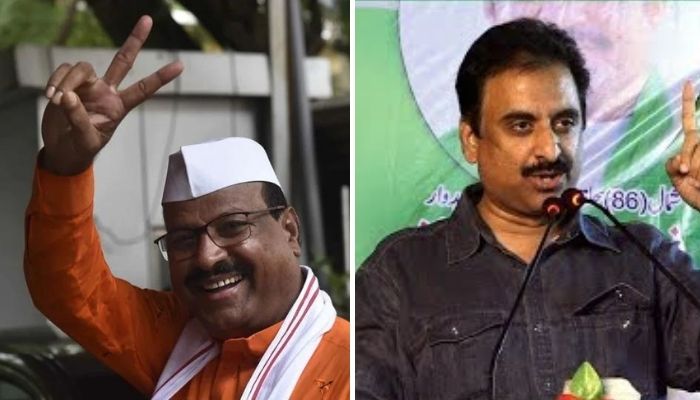
AIMIM MP from Maharashtra’s Aurangabad Imtiaz Jaleel has confessed that Shiv Sena Minister Abdul Sattar had played a lion’s share in his victorious candidature in the Lok Sabha Elections of 2019. Imtiaz Jaleel, a former MLA from Aurangabad, also currently retains his position as AIMIM Maharashtra state president besides his role as an MP.
Jaleel on Saturday, March 26, revealed how he sought internal political understandings with Abdul Sattar, Shiv Sena’s political strongman from Aurangabad, for the 2019 Lok Sabha elections. While speaking at an event held in Khandala, he threw light on his undeterred friendship with Sattar despite belonging to opposing political parties. Elaborating on this political partnership with Abdul Sattar, Jaleel said that the former had turned into a kingmaker in Aurangabad, adding that ever since Sattar became a minister, the city is witnessing ‘Acche Din‘.
In 2014, Muslims had already given up on the Congress-NCP alliance which was in power for 15 years. The breakup of Shiv Sena and the BJP on the verge of assembly elections resulted in the split of Hindu votes in the state. Asaduddin Owaisi saw this as a golden opportunity to spread his Islamist politics in politically divided Maharashtra. AIMIM which was earlier restricted to Hyderabad managed to bag 2 seats in the 2014 Maharashtra Assembly Elections, with Imtiaz Jaleel winning with a high margin from Aurangabad Central.
In the run-up to the Lok Sabha Elections of 2019, Abdul Sattar, a noted Muslim face of the Congress in the Marathwada region ditched the party owing to internal fighting. He was accepted by Shiv Sena, a party that had secured its base in Aurangabad as a hardline Hindutva outfit with its candidates representing the city as MLAs and MPs for more than two decades. At that time, Shiv Sena often touted Aurangabad as ‘Sambhajinagar’ making an argument that the city should be named after Chattrapati Sambhaji instead of the Mughal tyrant.
As Shiv Sena’s Hindutva face faded, it was time for AIMIM’s Imtiaz Jaleel to rise as Owaisi’s footsoldier from Aurangabad in Delhi. In the 2019 Lok Sabha elections, He managed to defeat Shiv Sena’s Chandrakant Khaire, a leader responsible for making Aurangabad a Shiv Sena stronghold by successively winning the Lok Sabha elections from 1999 to 2019. What helped Imtiaz Jaleel win the election was Shiv Sena’s declining interest to uphold Hindutva politics which resulted in many of its party workers deflecting to the BJP. Upon Jaleel’s confession, it is amply clear that Abdul Sattar, his Muslim compatriot in the newly-joined Shiv Sena also helped him galvanize Muslim votes in the constituency.
While Imtiaz Jaleel enjoys his grandstanding as a tall leader from AIMIM in Maharashtra, not many know he started his innings working as a journalist. Jaleel was an NDTV reporter based in Aurangabad for twelve years, a stance that helped him grab eyeballs for his coverage of Muslim issues in the state. He ended up as a talked-about leader in Maharashtra politics by participating in many agitations – one in which he made feminist writer Taslima Nasrin return back from the Aurangabad airport while she was on her visit to the Ellora caves in the city in 2017.
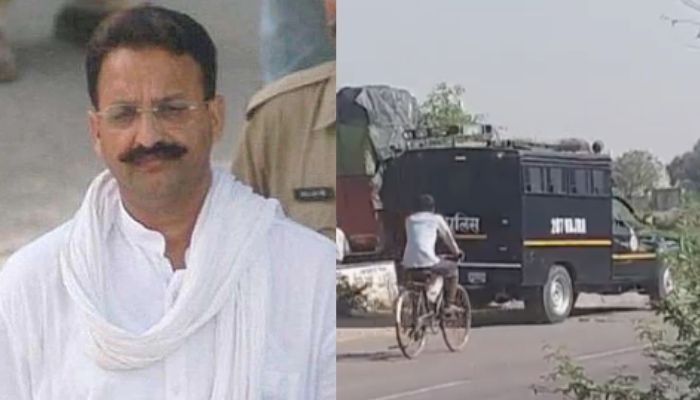
On Monday (March 28), the convoy carrying gangster Mukhtar Ansari to Lucknow broke down in Banda in Uttar Pradesh. Ansari was to be produced before a Lucknow court in connection to a case of illegal land grabbing through forged documents.
The notorious criminal was being ferried from Banda jail by the jail authorities and the district police when the vehicle broke down in the middle of the road. News agency ANI has shared visuals where two men were seen physically pushing the convoy of Mukhtar Ansari.
Uttar Pradesh | Van carrying Gangster-turned-politician Mukhtar Ansari to Lucknow breaks down, in Banda pic.twitter.com/Y6IPwdDrWc
Netizens share memes after car of Mukhtar Ansari broke down
The unexpected incident sparked a meme fest on social media, with netizens being amused at the impeccable record of UP Police and the vehicles carrying criminals having incidents. Several Twitter users said that Ansari must have been sweating profusely after realising that his van had broken down in the middle of the road.
One user shared an iconic dialogue from the movie ‘Dilwale Dulhania Le Jayenge‘ and expressed hope that the convoy of Mukhtar Ansari gets overturned during the journey.
Past incidents of car breakdowns while transporting criminals
In July 2020, a history-sheeter named Vikas Dubey was eliminated by the UP police in an encounter when he tried to escape while he was being transported to Kanpur from Madhya Pradesh. As per UP Police, the encounter broke out between Vikas Dubey and the Uttar Pradesh Special Task Force (STF) after the gangster tried to flee.
Reportedly, the police car toppled over after meeting with an accident. After the accident, Vikas Dubey tried to snatch the weapon of an injured policeman and attempted to flee. It was then that the police fired in retaliation, killing the gangster.
Later in September that year, another UP police car overturned in Madhya Pradesh on its way to Lucknow. As per reports, there were five passengers, including one gangster named Feroz Ali, his brother-in-law and three police personnel in the car. The police personnel got injured while the arrested gangster died in the accident.
Between March 2017 and August 2021, the Uttar Pradesh police led by Yogi Adityanath government conducted 8472 encounters during which the cops engaged in retaliatory firing on 3302 criminals. A total of 146 of them were neutralised in the police encounter.
Since then, people have started to believe that the police encounters in Uttar Pradesh follow a definite pattern and that includes toppling, overturning or breaking down of vehicles that carry criminals.