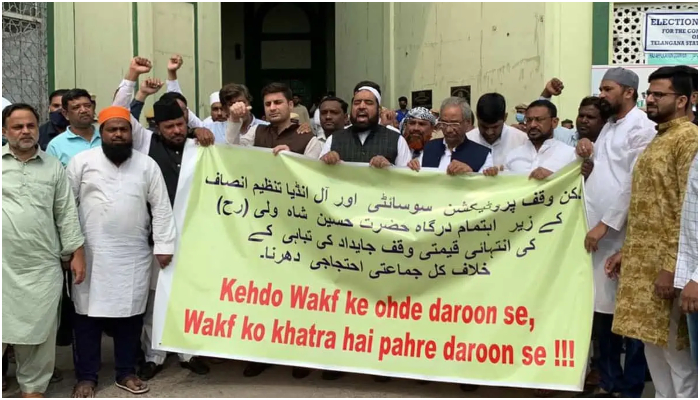
On February 11, the Muslim community backed by the political parties in the state of Telangana staged protests against the Supreme Court’s decision pertaining to 1,654.32 acres of Manikonda Jagir land. The Supreme Court last week had ruled in the decades-old litigation regarding the Manikonda land in favour of the state government saying that ‘all the lands are held with the state government only’.
The Muslim activists supported by the BSP criticised the state government, which they say had promised to resolve the issue. Targeting the state govt, the demonstrators held banners that loosely read ‘Waqf is in danger due to the state govt’. The community has decided to hold a ‘dharna’ on February 25 to draw the state’s attention to the issue. According to the reports, they have also decided to form a committee of 10 members including the lawyers to make submissions over the issue.
One of the activists while talking to the Siasat Daily claimed that the TRS govt had promised to secure the land for Waqf board, and also had promised to give judicial powers to the waqf after coming to power. He criticized the Telangana chief minister K Chandrasekhar Rao for not keeping up with the electoral promises. Communist Party of India leader and ex-Rajya Sabha MP Aziz Pasha also hit out at the state government for running away from the promises it made earlier.
Meanwhile, Waqf Properties Protection Cell president M Nayeemullah Shareef opined that 75% of the lands were occupied by the ‘encroachers’. The state waqf board has filed a review petition in the SC regarding its decision on Manikonda Jagir land and said that the board had spent Rs 3.27 crore on legal counsels in the final quarter of 2021.
On February 8, settling the old land tussle between Dargah Hazrat Syed Hussain Shah Wali and the State government on the other side, the court observed that all the lands are held with the state government only. The dispute had started in 2006 when the Waqf had issued a notification annexing 1,654 acres of prime land in Manikonda Jagir village, an upmarket tech-city area in Hyderabad. The Supreme Court had ruled that the land belonged to the state and not the waqf board.
The court had further said that the govt had sold some of these lands through e-auction to different individuals, companies and also allotted to various institutions, including Lanco Hills, Jana Chaitanya Housing Pvt Ltd, TNGOS Housing Society, Hyderabad Public Services Cooperative Society, Phoenix, WIPRO, ISB School and Urdu University.
The Supreme Court also took into consideration the Jagir Abolition Act and returned the land to the state. The waqf had argued that the concerned land had been given to Dargah Hazrath Hussain Shah Vali as ‘inam’ by the then Nizam of erstwhile Hyderabad State. But the court said that as the Jagir Abolition Act nullified any jagirs or inams, the said ‘inam’ by Nizam is no longer valid, and the land belongs to the state. The Court directed the government to make cash payments to the jagirs and imams in terms of the commutation regulation, 90 per cent of the gross basic sum referred to in Section 4 of the Commutation Regulation.
It is pertinent to note that ‘Waqf’ means the permanent dedication by a person professing Islam of any movable or immovable property for any purpose recognized by the Muslim law as pious, religious or charitable. This means that any property by a user can be registered with the Board and it becomes ‘waqf’ and it remains so even if the original owner of the property dies.
Reports mention that the protest was led by ex-MP and president of All India Tanzeem Insaf, Syed Azeez Pasha, and the president of Deccan Waqf Protection Society, Osman al hajiri, secretary City CPI. The protest was also joined by the All India Sunni Ulema Board, Telangana Pradesh Congress Committee, Telugu Desam Party, Congress and several others including the women protesters.
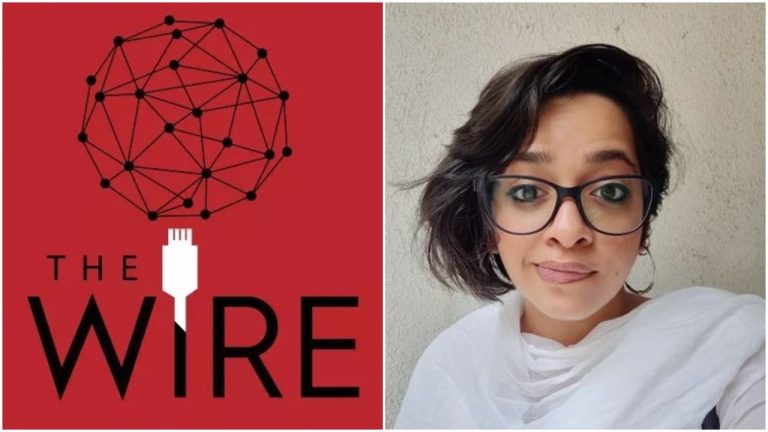
While the ban on hijab in educational institutions in Karnataka, which has erupted into a full-fledged controversy in the country, is only about adhering to basic school uniform requirements, a segment of the leftist intelligentsia and Islamists have cleverly misconstrued it to peddle their anti-Hindu agenda. On February 15 (Tuesday), one Naomi Barton who identifies herself as an ‘Audience Editor’ with leftist propaganda website The Wire used the ongoing controversy to openly incite violence against Hindus.
The Wire journalist Tweeted: “If any Muslim community had come together to so much as take a dupatta from a Hindu woman there would be blood in the streets. It is a particularly brutal humiliation that Muslims are forced to watch helplessly at the insult given to Muslim women for fear of retaliation.”
If any Muslim community had come together to so much as take a dupatta from a Hindu woman there would be blood in the streets.
It is a particularly brutal humiliation that Muslims are forced to watch helplessly at the insult given to Muslim women for fear of retaliation.
Brazenly displaying her hatred for Hindus, Barton remarked that if a Hindu woman’s dupatta had been taken away from her by any person from the Muslim community, the former would have flocked to the streets, not thinking twice before shedding the blood of Muslims. Many on social media saw this as an inflammatory Tweet to provoke Muslims to retaliate with violence in response to the hijab controversy.
Some are having a great time by instigating the Muslim community for violence by making outrageous but very moot & askew comparison. Please make a note of this tweet @DelhiPolice , just in case if any violence breaks out in Delhi following #HijabRow CC- @shashank_ssjhttps://t.co/f25Qx3yFYM
In essence, netizens felt that Barton appeared to be persuading Muslims to take up arms against Hindus by claiming that if the situation were reversed, this would be the natural response of Hindus. She gave no evidence or basis to back up her ridiculous claims.
Naomi Barton is one of the many so-called liberals who have been trying to milk the Karnataka hijab controversy that erupted earlier this month to propagate their anti-Hindu agenda. OpIndia reported earlier in the day how Bollywood entertainer Swara Bhasker had compared the hijab issue to Draupadi’s cheer haran episode in Mahabharta.
Many extremist Muslims backed Swara’s totally uncalled opinion, claiming that Indians were just spectators who were enjoying the entire hijab controversy. She also insulted Hindu culture by envisioning the Draupadi vastraharan episode from the Mahabharata.
Bhasker has often spoken the language of Islamic terrorist and made the ‘gau mutra’ jibe to mock Hindus.
Naomi Barton has also in the past openly indulged in using derogatory terms for Hinduism.
This is not a fake narrative, but yes, I fully agree with you.
Not every Hindu will know the Hanuman Chalisa.
Some will be even more disgusted by saying Jai Shri Ram than this Catholic girl is.
She had once shoddily brought in ‘Brahminism’ in a seemingly harmless video of a cute puppy.
This is, ostensibly harmless and cute but says a lot about how the entire edifice on which Brahmanism is built is a construct, given how this is now a Hindu Upper Caste… Golden Retriever?
Also it is 2020. Get rescued dog, and don’t contribute to awful puppy mills. https://t.co/KYRDBdNPeI
Commenting on a video where a social media user had shown her pet dog, a Golden Retriever, being welcomed into the house as per the Hindu rituals, the ‘journalist’ said that the video appeared cute and harmless but it actually showed how Brahmanism was a construct. She even went on to declare the Golden Retriever an upper caste and sermonised on adopting dogs. Apparently, welcoming puppies, in whatever way an individual wishes, is ‘Brahiminism’ and has roots in casteism for the journalist associated with the far-left propaganda website.
Amid the speculations of Russia invading Ukraine, India has issued an advisory for the Indian nationals living in the country and asked them to leave Ukraine temporarily. “In view of uncertainties of the current situation in Ukraine, Indian nationals, particularly students whose stay not essential, may consider leaving temporarily,” the Embassy of India in Kyiv said in a statement.
It also asked the nationals to keep the Embassy updated about their status of presence in Ukraine to enable the authorities to reach for help whenever required. It said that the embassy will continue to function normally. This is two days after the United States decided to evacuate its Embassy in Ukraine and asked all the American citizens to leave the country immediately. It warned that Russia could invade at any time and that the invasion remains a ‘distinct possibility’.
Breaking: India issues Advisory for its nationals in Ukraine as situation remains on tenterhooks over an escalation; Ask Indian students “whose stay is not essential may consider leaving temporarily” pic.twitter.com/I7AvIUPGCH
US President Joe Biden had stressed that the US won’t send its troops to Ukraine on any terms as Americans and Russians shooting at one another would be a ‘World War’. In a phone call to its Russian counterpart, Biden also had hinted of severe costs that the US would impose on Russia if it goes ahead with the invasion of Ukraine.
Russia also meanwhile has declared to cut its staff in Ukraine amid the massive build-up of troops near the border. It is important to note that Russia has deployed more than one lakh servicemen at the Ukraine border. While Russia has constantly stated that it has no intentions to attack, the US has suggested other countries around the world to leave the country of Ukraine as soon as possible.
Along with the US, countries including Germany, Italy, Britain, Ireland, Belgium, Luxembourg, the Netherlands, Canada, Norway, Estonia, Lithuania, Bulgaria, Slovenia, Australia, Japan, Israel, Saudi Arabia and the United Arab Emirates have also called on their nationals to leave Ukraine.
On February 1, India at UN had called for immediate de-escalation of tensions between Russia and Ukraine, taking into account the legitimate security interests of all countries. India’s Ambassador to United Nations, T S Tirumurti had focused on quiet and constructive diplomacy and said that ‘any steps that increase tension may best be avoided by all sides in the larger interest of securing international peace and security’.
During the meeting, Tirumurti had also highlighted that more than 20,000 Indian students and nationals live and study in different parts of Ukraine, including in its border areas. The Indian mission in Kyiv has collected data on the number of Indians in Ukraine as the well-being of Indian nationals remains of priority to the country.
Earlier on Friday, Russia practised naval drills in Crimea, blocking the access to the sea as accused by Ukraine. Also, 10 days of military exercises continued in Belarus to the north of Ukraine. According to reports, a bunch of troops in Russia’s military districts adjacent to Ukraine have returned to bases after completing drills today.
Reports further mention that the US has approved a credit guarantee of $1 billion to Ukraine amid the heightened tensions. According to US Secretary of State Antony Blinken, Ukraine is one of the poorest countries in Europe and the money would help the country to ensure economic stability and growth. The US had earlier approved military assistance of $200 million as part of American efforts to help Ukraine protect itself. Committed to Ukraine’s sovereignty and territorial integrity, the official had said that the US would continue to provide Ukraine with the support it needs.
It’s been one and a half months since the possibility of war between Russia and Ukraine is looming large. Russia has demanded in writing from the West to cease expansion of NATO. It has demanded that Ukraine should never be allowed to join NATO.
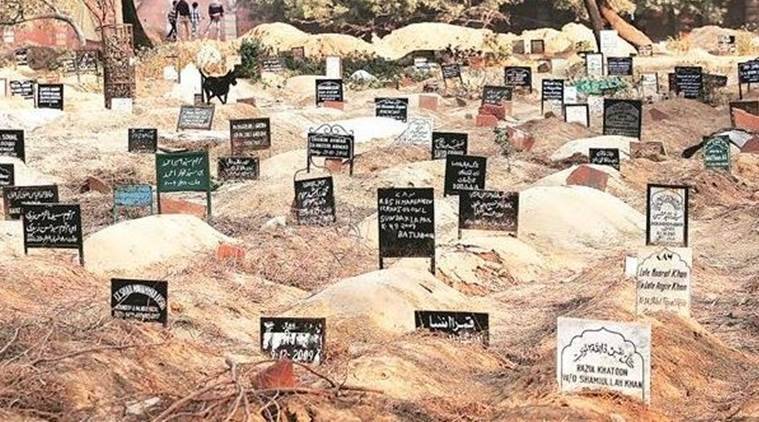
Last week, the Shihor Municipality in Bhavnagar was ordered to deconstruct the road built by demolishing the graveyard that was managed by the Shihor Memon Jamat. The Gujarat State Waqf Tribunal asked the municipality to reinstate the graves, fallen trees and the toilet back to its original position in the graveyard.
According to a Times of India report, the Shihor Municipality had built a road as a part of infrastructural development by demolishing the outer part of the graveyard. The tribunal in its order has said that the expenditure of the restoration shall be recovered from two of the officers who carried out the demolition.
Giving the ultimatum of 24 hours, the tribunal has further ruled that if the road is not removed within 24 hours, the restoration expense shall be borne by the chief officer of the govt body. On February 2, the municipality had carried out the demolition after it issued the notice to Shihor Memon Jamat to remove the part of its graveyard construction for road.
The matter escalated as the Jamat knocked the doors of civil court after the demolition. It later withdrew the suit from the civil court and approached the Gujarat State Waqf Tribunal to decide over the issue. The civic body in its argument claimed that the land on which the road had been built never belonged to the Shihor Memon Jamat while the city survey reported that the land was a graveyard that belonged to the waqf.
Citing the SC order, the tribunal further said that the land once becomes a graveyard, is always a graveyard. It has sought a detailed report from the civic body over restoration and has asked the city police to issue protection once the road is removed.
“Waqf” means the permanent dedication by a person professing Islam of any movable or immovable property for any purpose recognised by the Muslim law as pious, religious or charitable. This means that any property by a user can be registered with the Board and it becomes ‘waqf’ and it remains so even if the original owner of the property dies. Graveyards are also properties registered with the waqf.
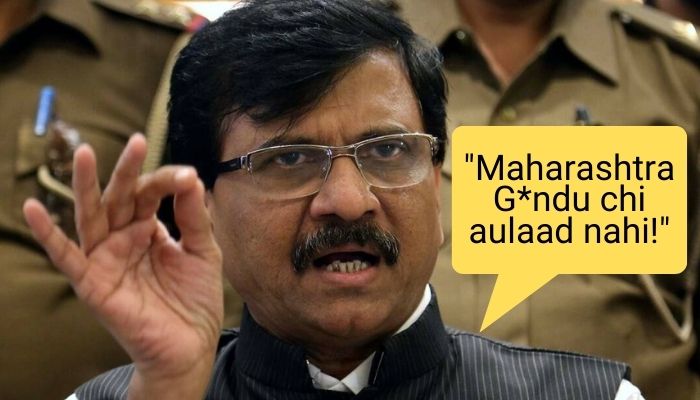
Shiv Sena leader Sanjay Raut has yet again used abusive and homophobic language while speaking at a press conference at Shiv Sena Bhavan in Mumbai today. While starting his address he said, “In today’s press conference we want to give a message that Maharashtra is not a child of a g*ndu (g*ndu is Urdu word for gay as per Urdupoint website.)”
In the press conference, The Shiv Sena firebrand leader was talking about ongoing ED enquires on Shivsena leaders and the Thackeray family. Indirectly targeting the BJP, Raut said, “Marathi manoos is honest, and even if you stab our backs in unmanly ways, Shiv Sena will not concede,” He further listed names of Shiv Sena leaders like Anandrao Adsul, Ravindra Waikar, Anil Parab, Bhavna Gawli and other leaders from the MVA Government on whom investigations by Central government authorities are going on.
Terming the enquires as attacks, Raut said, “This is not a disaster only Maharashtra is facing, but also on the nation including Bengal,” Sanjay Raut further alleged that (the Central Government) wants to dismantle the coalition government in Maharashtra, for which central investigation agencies are being used.”
Sanjay Raut’s affair with abusive words
However, this is not the first time when Sanjay Raut has hurled abuse in front of the camera. Earlier, he had used the vernacular slang ‘C*utiya’ against women BJP workers and had also justified it by saying that the word means ‘stupid’.
FIR registerd agnst me for the use of word Chutiya,tht means Stupid as per hindi dictionaries.Inspite of ths,if a case is registrd thn it’s nothing bt an attmpt to pressurize me! BTW,sm BJP leadrs hv usd more objctionble words agnst women leadrs,hvn’t heard of such FIR agnst thm
The Mumbai police had recently apprehended a 34-year-old man, who broke into a locked office in a black burqa and committed a burglary in the Dadar West area of Mumbai.
As per reports, the accused was identified as one Balwant Sudama Gupta. He stole 12.5 kg gold and silver jewellery, ₹15 lakh cash and the Digital Video Recorder (DVR) of a CCTV camera.
The burglary incident took place between January 29-30 of this year on the 14th floor of ‘Naman Midtown’, which is located on Senapati Bapat Marg in Dadar (West). A First Information Report (FIR) was registered on January 31, following a complaint by one Jignesh Mehta.
During the investigation, the cops analysed several hours of footage from 130-140 CCTV cameras. The police found that the accused, dressed in a burqa, first went to the 17th floor in a lift. The person then went to the 14th floor by climbing the duct area and removing the toilet window. He then broke into the office.
He then smashed the showcase and looted the jewellery. Gupta then turned the CCTV camera towards the wall. However, one CCTV camera located in another office showed him with a sack in his hand. This provided the first clue to the investigation authorities.
Senior police Inspector Mahesh Mugutrao remarked, “For 10 days we went through 130 to 140 CCTV cameras installed across Dadar, Matunga, Sion, Kurla and Panvel to get leads in the case and finally nabbed him.” Reportedly, Gupta came to know about the store when he visited the building in Dadar, a month prior to the incident for job-related work.
According to inspector Sagar Shivalkar, Gupta robbed closed shops in high-end areas during holidays. Reportedly, the accused had committed another burglary in a burqa in November 2021 at Ghatkopar in Mumbai and stole ₹5 lakhs.
The police recovered 8 kg silver and ₹ 5.35 lakh from the accused. It has come to light that Balwant Gupta is an electrician, who lost his job during the Covid-19 lockdown. He needed money for the treatment of his father, who is reportedly suffering from cancer. As such, the accused resorted to robbing shops to fund his father’s treatment.
On February 13, Reuters journalist Aditya Kalra expressed his shock on Twitter’s social media after discovering that the Dhani app disbursed a loan to him which he had never applied for. In his tweet, Kalra said someone used his PAN number to avail a loan from Dhani, an instant loan app by IndiaBulls. Kalra said, “Shocking revelation in my credit report. A loan disbursed by IVL Finance (Indiabulls) Dhani with my PAN number & name, addresses in Uttar Pradesh and Bihar. I have no clue. How can a disbursal happen on my name and PAN. In default already.”
Shocking revelation in my credit report. A loan disbursed by IVL Finance (Indiabulls) @dhanicares with my PAN number & name, addresses in Uttar Pradesh and Bihar. I have no clue. How can a disbursal happen on my name and PAN. In default already @RBI@IncomeTaxIndia@nsitharamanpic.twitter.com/LMMrwKyeit
Kalra also shared a screenshot of the loan information from the Cibil report. As per the documents, the amount disbursed was Rs 1000, and it was sanctioned on November 14, 2021. The person who availed the loan did not repay the loan, the pending amount was Rs 9,945. The amount overdue was Rs 5,126.
He was not alone who alleged that loans were disbursed on their PAN cards and that they were unaware about the same. Kalra shared multiple tweets of people who got duped by scammers and are now trying their best to clear their names. In every case, the scammers appeared to have used the PAN details to avail micro loans.
More from others with credit report photos. Same case. Loan disbursed to someone who submitted someone else’s PAN and name. Then default starts. Scary bad loans ticking bomb, fraud and more. @RBI@dhanicares@IncomeTaxIndiahttps://t.co/xX5X5XQ5rO
Kalra shared a screenshot of his credit score fluctuating since the loan was availed. His credit score was 801 in August 2021, drastically dropping to 666 in December 2021. It revived in January, possibly because of the other activities on his credit line.
Notably, in such cases, if Dhani or the financial institution does not act quickly, it will have a serious impact on the credit score of the victim. Also, as the fraudster has not paid a single penny back, it will harm the loan-availing capacity of the victim. Whenever he or she would try to avail a loan, this particular case may come up and put a dent in his or her reputation in front of the lender.
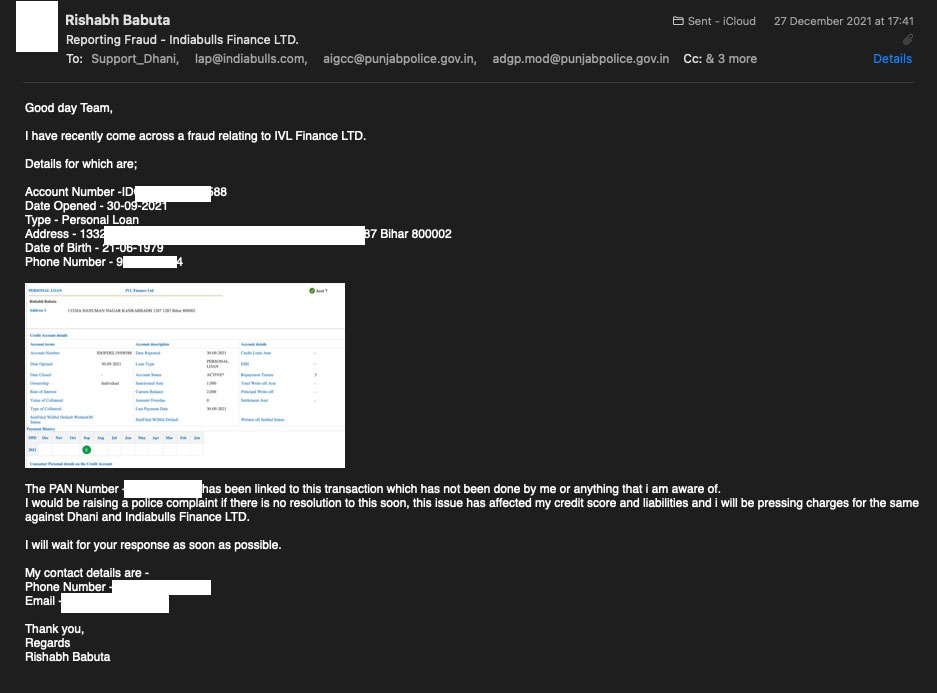
During the investigation, OpIndia came across numerous such cases. Speaking to OpIndia, Rishab Babuta, one of the victims of the alleged loan fraud, said he has been running from pillar to post to get out of the mess for the last three months but could not get a concrete solution for the problem. Babuta, who is an NRI (Merchant Navy Officer), said, “As I am an NRI, no banks or institutions can issue loans or cards to me without a mortgage or an overdraft account. Despite the regulations, the loan was dispursed by Dhani, and I am facing the problem.”
@FinMinIndia There is a new scam brewing at @dhanicares / @ibhomeloans – They are issuing loans without verification of PAN There are others like me, who never took these loans and are affected by them for non-payment. No one is listening today as this is not a Scam of Crores YET
Babuta found out about the scam in November 2021. Two loans were availed in his name of Rs 1,000 and Rs 2,000, he said. Due to non-payment of the said loans, the total amount due was Rs 12,000, including a penalty. He immediately checked if there was an error with the CIBIL report. On December 27, once he was sure that it was not an issue at CIBIL’s end, Babuta contacted Dhani for support.
Screenshot of the email sent to Dhani by Babota. OpIndia has hidden the personal information in the screenshot.
In every case, including Babuta, Dhani has replied to the complaint but did not provide any concrete solution. He said, “Dhani has not resolved this fraud; I am still trying to find a solution. I am in touch with their fraud team, who basically forced me to send across my original documents, which they did not have… claiming to be necessary for the resolution… but it changed nothing even after a month.”
It is noteworthy PAN authentication not done by Dhani; otherwise, the loan would not have been approved. Babuta also shared complaint numbers with Cyber Crime Unit, Income Tax department, CIBIL and RBI. A solution from all departments is awaited. He said, “I had shared the details with the Cyber Crime officer on the January 14. After I received a confirmation email from the cyber cell National account, but they never got back to me neither answered my calls after that.”
‘Inside involvement is possible’
Speaking to OpIndia, CA Guru Prasad said, “The credit score impacted by such frauds can only be rectified once the investigation is over. The first thing the victim needs to do after learning about the possible fraud is to inform the bank and file a police complaint.” There is no foolproof method to avoid such fraud. He said, “Unless there is some involvement in disbursing the loans from inside the company, it is not possible for such frauds to happen.”
‘Loan companies are not authenticating PAN’
As per the experts, there is a problem with the methodology these loan companies are following. Vinay Murarka, CEO V2Technosys said, “There is a mechanism in place with banks that they must follow while disbursing the loan. When you apply for a loan, the bank authenticates the documents and only then give you the loan. In cases like what is happening in the Dhani app, the company is not authenticating the documents.”
He further said the loan must be disbursed into the account linked to the PAN card. He said, “The loan must be disbursed in a bank account linked to the PAN card with the matching details mentioned on the PAN card and bank account. Also, the companies must do Aadhaar authentication before disbursing the loan. It is clearly the loan company’s fault as they are not authenticating the documents before disbursing the loan.”
While talking about the impact on CIBIL score, he said, “There is no way out for the victim other than contesting it in a court. If you are a victim, file a police complaint, inform the authorities and file a court case against the company.” He further expressed his surprise that CIBIL is not taking any action against these companies. “CIBIL must have multiple complaints against Dhani. I am surprised they are still taking these companies into consideration and adding the information to the CIBIL score of the victims. The same goes for the RBI. They should have suspended operations of the company by now.”
’75 million downloads, 25 million lines of credit issued – how many frauds?’
Experts believe every one of six downloads of the Dhani app could be linked to fraud. Srikant Lakshmanan, CashlessConsumer, a consumer collective on fintech, shared a detailed thread about the technical aspect of the alleged fraud. He said Dhani uses a random collection of PAN to give its users credit on their wallets. They have 75M installs, likely that PAN of 1 in 6 could be victim of these bogus line of credit issued and default of such affecting credit scores.”
So @dhanicares uses random collection of PAN to give its users credit on their wallet.
He further shared multiple tweets where so-called tech experts had shared detailed videos on how to get free recharge or login in the Dhani app without documents using random PAN numbers. The videos shared by him clocked lakhs of views. Shockingly, such activities have been happening since 2020, which could be seen from the tweets, but no action was taken by Dhani or any government agency.
For a Rs. 30 recharge, someone can enter random PAN and you might be lucky one! pic.twitter.com/wd56ptragq
Speaking to OpIndia, Srikanth said, “We can discuss different theories on how to avoid such scams, but we need an explanation from Dhani. From the range of complaints, these don’t seem to be individual instances of fraud, but an organized crime, with/without the knowledge of Dhani.”
While discussing possible reasons why Dhani did not act on the complaints or change its methodology to disperse the loans, he said, “The recent trend in the digital lending industry – there is a video KYC (especially, post covid this is normalized) besides Aadhaar/PAN-based eKYC. Most apps do OCR verification of ID proof, some even ask to take a selfie with the proof of ID. In this case, that certainly has not happened. They probably took just an input of ID.”
He further urged everyone not to share PAN and Aadhaar info to avoid such situations. He said, “The government must bring in data protection law and ensure the safety of citizens before seeking any linking mandate. PAN-Aadhaar linkage is due this March 31.” Srikanth also insisted on checking the credit report regularly to keep a check on such frauds and seek revision in credit reports to remove all such unknown loans.
What can you do if you are victim?
First of all, you must check your CIBIL report regularly to detect if any fraudulent activity has taken place. You can either check at CIBIL.com by paying a fee, or you can check it for free with service providers like Experian.
If you are a victim, experts suggest you should take the following steps:
Immediately inform the bank or financial institute about the fraud. Write an email or submit a complaint to their official mail ID or registered office. Keep a copy of the complaint and save the acknowledgement number for future reference. Make sure to include all the details you have about the fraud.
Collect all the documents and file a Police complaint. Make sure you have the FIR copy with you.
Submit the FIR copy to the bank or financial institute so that they have the information about the legal proceedings.
Do not wait for the financial institution to initiate any action and file a complaint in court. Experts say proceeding with the legal process is the only way out. As a consumer, you can either file a complaint with the consumer court, or you can file a criminal case against the bank. Consult an advocate to file the complaint.
Regularly follow up with the bank and police to know if there was any progress in the case.
At this time, the only thing a victim can do is to contest it legally in court.
OpIndia contacted Dhani via email. By the time this report was published, we did not receive any communication from their end. We are also in conversation with several experts over the matter. We will update the story as we get more information.
A bizarre yet heinous incident of a cow being raped has come to the fore in Rajasthan. In Chuhadpur locality of the Bhiwadi region in the Alwar district, police have arrested two people for allegedly raping a cow. The police came to action when a video went viral in which four individuals were seen doing unnatural sex with a cow.
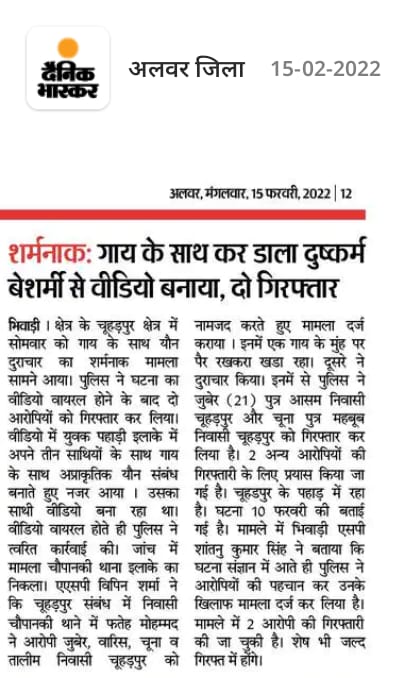
The incident was reported in Dainik Bhaskar. It occurred in the Alwar district’s Choupanki police station area. A police complaint was filed against four Chuhadpur residents, Waris, Zubair, Chuna, and Taleem. Zubair and Chuna have been arrested and the police are looking for the other two culprits in the case.
The incident allegedly occurred on February 10 when these four people took a cow to a nearby mountainous slope and three of them got involved in unnatural sex with the cow while the other one was filming the video. They smashed the mouth of the cow with their foot to prevent it from making any noise before raping it, as per the report.
The news was published in the e-paper.
The Superintendent of Police, Shantanu Kumar Singh said that the police sprung into action as soon as it got the news. “We registered a complaint and started the investigation. We have apprehended two of the culprits as of now and we are sure we will catch the other two very soon,” said the SP.
• पुलिस अधीक्षक श्री शांतनु कुमार सिंह के मार्गदर्शन व अति. पुलिस अधीक्षक श्री विपिन शर्मा के निर्देशन में DST_टीम,सोशल मीडिया टीम व थाना चोपानकी पुलिस टीम ने वायरल वीडियो एवं सूचना पर तुरंत संज्ञान लेते हुए घटना में संलिप्त दो आरोपियों को अल्पसमय में ही किया #गिरफ्तार। pic.twitter.com/sIle1yQawf
Several more incidences of animal mistreatment had been reported in the past by OpIndia. Toufeek Ahmed, a 20-year-old youngster, was captured on a CCTV security camera sexually assaulting a female dog in 2021. Ahmed was charged with ‘unnatural sex’ at the Vakola police station.
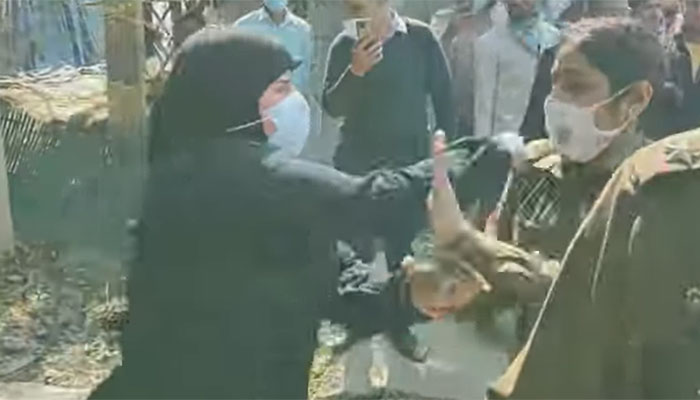
On February 15, a burqa-clad woman allegedly stabbed a cab driver in Gurugram, Haryana. When police tried to detain her, she attacked the female police officer. Initial investigation revealed the woman is from Egypt, but no travel documents were found on her.
Amidst the ongoing controversy over hijab, reports have surfaced that a burqa-clad woman allegedly stabbed a taxi driver. As per driver Raghuraj’s statement, he runs a rented taxi in Gurugram. The woman approached her when he was going to drop a ride. When asked what she wanted, the woman stabbed him and tried to flee the scene.
गुरुग्राम में बुर्का और हिजाब पहने हुई एक विदेशी महिला ने कथित तौर पर एक कैब ड्राइवर को चाकू मार दिया। घायल कैब ड्राइवर को इलाज के लिए अस्पताल में भर्ती कराया गया है। पुलिस आरोपी महिला को हिरासत में लेकर पूछताछ कर रही है। इस दौरान महिला ने पुलिसकर्मियों से भी हाथापाई की। pic.twitter.com/QYURAeY6iu
Raghuraj said, “I was going to drop a ride. When I saw her approaching the taxi, I rolled down the window and asked her if she needed a ride. She looked around and out of nowhere stabbed me with a small knife.” The driver tried to chase her when she tried to flee the scene. He said, “I tried to catch her when she tried to flee the scene. When I was almost caught her, she injured me using her nails.” He said the woman dropped the knife while running.
A PCR van that was parked nearby rushed to the spot. When the police tried to detain her, she attacked the police officers. As per reports, she was talking in an foreign language. She could not answer the police officers in Hindi or English. She demanded water from the police. When she was provided with a bottle of water, she took a sip and spilled the rest of the water on the road.
A female police officer tried to stop her, but the woman attacked her as well. Finally, a PCR van was called, and the burqa-clad woman was taken into custody. Inspector Ved Prakash, Sector 15 Civil Lines, said in a statement the woman hails from Egypt, and she was not cooperating with the police. As the police could not understand her language, a translator was being arranged.
The incident took place at around 11 AM at Rajiv Chowk. The reason for the attack is unknown. Further investigation into the incident is underway.
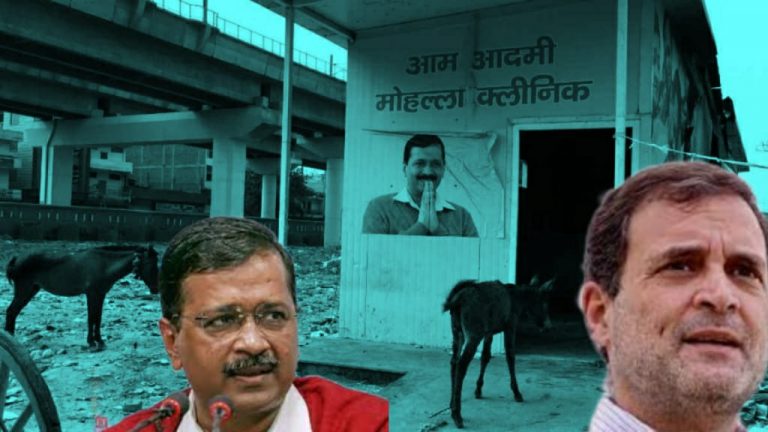
On February 15, Tuesday, the Aam Aadmi Party has accused at Rahul Gandhi for taking credit for the Mohalla clinics in Delhi. Sharing media reports from 2015 covering the inaugural of the first Mohalla clinic by AAP chief Arvind Kejriwal, the party tweeted: “If you (Congress) had done some work in Punjab, you wouldn’t have to steal credit”.
अगर Punjab Congress Govt ने कुछ काम किया होता तो आपको केजरीवाल जी के World-renowned Mohalla Clinics का Credit नहीं चुराना पड़ता। pic.twitter.com/7QljiCk4Bl
The AAP response came after Congress leader Rahul Gandhi, while addressing the Gurdaspur rally on February 14, claimed that the first Mohalla clinic in Delhi was established by the Congress party. Slamming Aam Aadmi Party (AAP) for the COVID crisis in the national capital, Rahul Gandhi said: “Kejriwal brags about Mohalla clinics in Delhi. Congress party and had opened the first mohalla clinics in Delhi.”
He added: “Kejriwal should answer – What happened during Corona? Where did the Aam Aadmi Party disappear? What happened in Delhi hospitals? Who arranged for the oxygen cylinders?”.
केजरीवाल को जवाब देना चाहिए कि:
– कोरोना के समय क्या हुआ? – आम आदमी पार्टी कहां गायब हुई? – दिल्ली के अस्पतालों में क्या हुआ? – ऑक्सीजन सिलेंडर किसने दिलवाए
AAP senior leader and Delhi Health Minister Satyendar Jain slammed Rahul Gandhi and accused him of lying about Delhi’s Mohalla clinics. He even challenged the Gandhi scion to disclose details to prove that the first Mohalla clinic was founded by the late Congress stalwart and former CM of Delhi, Sheila Dixit. Jain shared a report by TOI published on July 20, 2015, to call out Rahul Gandhi’s propaganda. The TOI report stated that on July 19, 2015, Chief Minister Arvind Kejriwal inaugurated the first mohalla clinic in Rajiv Gandhi JJ Punjabi Colony, a relief camp in Peeragarhi.
कांग्रेस के नेता अजय माकन जी ने 2016 में मोहल्ला क्लीनिक को बंद कराने के लिए एलजी के दरबार मे गुहार लगाई थी और मोहल्ला क्लिनिक मॉडल को बदनाम करने के लिए तब से लेकर आज तक कोई कर कसर नहीं छोड़ी ! (2/2) pic.twitter.com/zgrUTa6JJ8
The AAP leader further shared a letter written by Congress leader Ajay Makan in 2016 in which the latter had appealed to the then Lieutenant Governor of Delhi Najeeb Jung to shut down the Mohalla Clinic citing serious violations of public health and financial propriety by the AAP government.
Mohalla Clinic, the flagship healthcare model promoted by Arvind Kejriwal-led AAP govt in Delhi
It is worth noting that Arvind Kejriwal-led Aam Aadmi Party(AAP) had launched ‘Mohalla Clinics’ as their flagship healthcare model to strengthen the primary healthcare system in the city. In July 2015, Chief Minister Arvind Kejriwal had inaugurated the first-ever such clinic at Peeragarhi at a cost of Rs 20 lakhs. He had announced that Delhi would soon have 1,000 such clinics. According to a senior health official, there were more than 500 mohalla clinics in Delhi at one point. A mohalla clinic is supposed to consist of a doctor and a midwife-cum-nurse and provide a wide range of diagnostic services and essential medicines free of cost to patients.
Controversies surrounding AAP’s Mohalla clinics
However, soon these Mohalla clinics began facing the ire of the public due to gross negligence and violations of public health. Recently, a case of a toddler falling sick because of dextromethorphan poisoning came to the fore from one such Mohalla clinic in Delhi. The incident took place in January this year when the child was taken seriously ill after she was administered dextromethorphan syrup by a mohalla clinic in the city. The toddler was immediately rushed to Kalawati Saran Children’s Hospital and put on a ventilator support system after suffering from respiratory failure.
This was however the second such case of gross negligiance reported from the Delhi Mohalla clinic in the recent past. Prior to this, in December 2021, 16 children were poisoned and admitted to Kalawati Saran Children’s hospital in New Delhi after allegedly consuming a cough syrup that was administered by a mohalla clinic run by the state government. 3 of those 16 children died in the incident.
Reportedly, an inquiry that was carried out by the central government revealed that the children were poisoned by the drug after it was administered to them on the prescription of the state-run mohalla clinics.
In 2017, AAP govt’s pet scheme Mohalla clinic had come under the scanner of the Vigilance Department after they received complaints that the Mohalla Clinics’ doctors were seeing a very high number of patients during their stipulated clinic hours, which was practically not possible.
It was reported that if one went by records, the doctors were treating as many as 533 patients in 4 hours, which turns out to be about 27 seconds per patient. Rightfully, questions were raised over the quality of the treatment provided if each patient lasts just 27 seconds in front of a doctor.
There were allegations that the doctors were making up false patients as their earnings depend on the number of patients they treat. They reportedly earned about Rs 30 per patient. It was also alleged that the doctors were deliberately giving useless medicines that might ensure repeat visits from the patient, thus further pushing up their earnings.
Furthermore, these clinics have been scrutinised for using unqualified personnel to treat patients and dispense medications. It has also been accused of nepotism after news surfaced that Delhi Health Minister Satyendra Jain’s daughter was in charge of these clinics.