Home Blog Page 4326

Congress MP Abhishek Manu Singhvi defends Navneet Kalra in HC, ASG says concentrators black-marketed by him had only 32% output

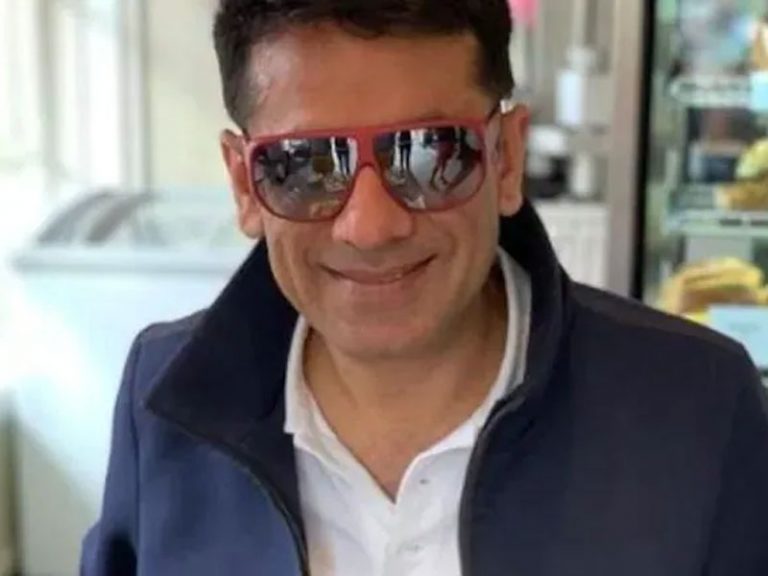
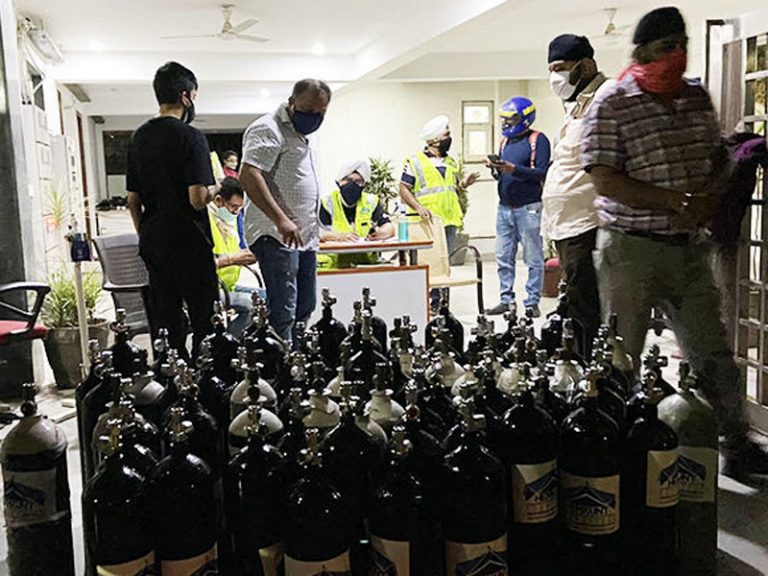
Navneet Kalra, who is accused in the Khan market oxygen concentrators black-marketing racket, had his anticipatory bail plea rejected by a local Delhi court on Thursday. Additional Sessions Judge Sandeep Garg dismissed the application of anticipatory bail filed by Kalra. Aggrieved by this order, Navneet Kalra filed an appeal in the Delhi High Court with Congress MP Abhishek Manu Singhvi appearing on his behalf.

In his submission, Singhvi argued that Navneet Kalra is neither an importer nor a manufacturer, merely a person who runs some restaurants and owns an old family business called Dayal Opticals. He further argued that the purchase of oxygen concentrators by Kalra was above-board and did not amount to hoarding.

However, the Court questioned Singhvi’s submission, asking that if Kalra was neither an importer nor a manufacturer, under what capacity was he holding 105 oxygen concentrators on his properties. Interestingly, when enquired by the Court if the MRP of the Oxygen Concentrators was Rs. 70,000, Singhvi sincerely replied, “It is 69,999 Rs.”

Assistant Solicitor General SV Raju called it a “classic case of black marketing by taking advantage of needy people”. ASG Raju also made an explosive submission that after testing two of the seized oxygen concentrators, the oxygen output was found to be only 32%, instead of the expected 90-95%. WHO guidelines call for an oxygen concentrator to provide at least 80-85% output.

“With responsibility I’m making a statement, that out of the seized Concentrators, two samples were checked and I’m shocked to see that the output is only 32%,” said ASG Raju.

“When a person goes to buy a Concentrator, he wants something which increases the oxygen level to 93 and not just 30%. There is a long-distance between 80 to 32. Persons were induced to buy machines which were useless.” ASG Raju added.

The Court then proceeded to adjourn the hearing, announcing that the hearing will commence at 12 PM on Friday.

Delhi Police raids Navneet Kalra’s restaurant in Khan Market

It is pertinent to note that Delhi Police on May 7 (Friday), recovered 105 oxygen concentrators during the raids at two restaurants – Khan Chacha and Town Hall, situated in Delhi’s Khan Market. On May 6, Delhi Police had also recovered 419 oxygen concentrators from a restaurant-cum-bar in south Delhi’s Lodhi Colony area.

Navneet Kalra is the owner of all three restaurants. Following the raids, Kalra switched off his mobile phone and believed to have fled the city. It is important to note that Navneet Kalra was felicitated by the Arvind Kejriwal-led Delhi government in 2020. He was among the 48 personalities honored as ‘Delhi ke Nirmata’ by the AAP government after returning to power.

According to the police, Kalra took orders for oxygen concentrators via an online portal as well as through WhatsApp groups. The accused has been importing the oxygen concentrators since October last year. As demands for Oxygen concentrators increased in February this year, he imported more such machines and stored them at different restaurants.

Delhi police had also arrested four men, Gaurav Khanna, Satish Sethi, Vikrant and Hitesh for hoarding and black-marketing the equipment. Khanna is the CEO of Matrix Cellular Services Ltd which is one of the companies involved in importing the equipment.

‘We were used by media, everyone from DM to CMO helped’: Family of RSS worker who died of COVID denies The Print report of not getting help

On 12th May, Shekhar Gupta’s The Print published a story that one PM Narendra Modi fan and RSS worker died of Covid-19 after getting no help from authorities for his treatment. Specifically adding in the headline that PM Modi follows him on Twitter, The Print claimed that RSS worker Amit Jaiswal’s family had alleged that they hoped that PM Modi will intervene after learning about his situation, but the PM didn’t provide any help. The report had also alleged that Jaiswal was admitted in a Mathura hospital because he didn’t find a bed in Agra.

Earlier, it was revealed that the entire report by Print false, and his close associates had revealed that Amit Jaiswal had received full support. It was also revealed that he had got himself admitted in the Mathura hospital on his own choice, and he was offered a bed in Agra. Contrary to claims by the Print, Amit’s associates and RSS workers had arranged Remdesivir injection, Plasma, Oxygen cylinders etc for him and his mother, who was also suffering from Covid-19.

Now, the family members of Amit Jaiswal have come forward to allege that The Print used them in the portal’s propaganda against the Modi govt, and denied the allegations of not receiving aides in the treatment.

Talking to journalist Sushant Sinha, Amit’s friends Vipul Bansal and Udit Singh denied the allegations, and confirmed that Amit had received adequate medical care before his unfortunate demise. RSS worker Vipul Bansal informed that BJP leader and Lok Sabha MP Rajkumar Chahar had also helped his best, who was in contact with the family of Amit. Udit Singh said Amit was given care 24 hours a day, and all the required medical supplies were provided.

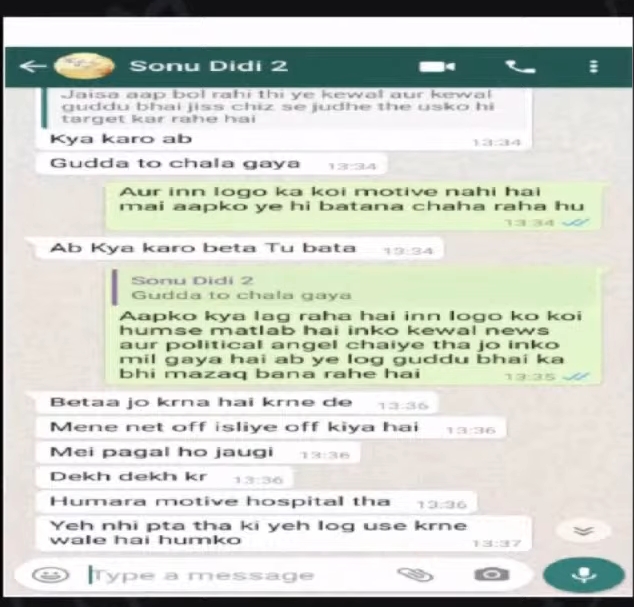
Sushant Sinha displayed a screenshot of WhatsApp conversation between Udit Singh and Amit Singh’s sister, where she had said that they were misused by media. She said that their motive behind talking to media was hospital, and they didn’t know that they were going to be used by the media. She had also said that she will go mad seeing the reports.

Sinha also played an audio recording of phone call between Vipul Bansal and Amit’s brother-in-law, who had alleged that they had not received any help. During the conversation, Amit’s brother-in-law had said that the administration had made full preparation for Amit’s treatment. He had said that the CMO has been called to inform that Amit is being shifted to Agra, and the DM in Agra had kept injections ready for Amit. Vipul also said that despite shortage of hospital beds in Agra, one bed was arranged in Prabha hospital.

Amit’s brother-in-law had confirmed the same in a phone call, who had said that even the hospital’s chowkidar knows that a patient of CMO is coming.

In the phone conversation, Vipul had informed him that people had arranged medications after he had asked for help on Twitter, and had asked him to pick up the phone as the people were calling him. The brother-in-law had put his phone number in his tweet, and well-wishers were trying to call him to find out what is needed and what has been arranged. He had told Vipul that he had spoken to the DM and the injections are being arranged.

He also confirmed that Amit could not be transferred to Agra from Mathura on time due to some mismanagement by the hospital, and there no lack of help from the govt. He told Vipul that everyone from CMO to the MP was providing help.

The brother-in-law further had informed that Amit was administered one Remdesivir injection when he was hospital. A phone call with Amit’s sister also confirms that Udit had informed that two Remdesivir injections and plasma were arranged by RSS workers.

Talking about the sister and the brother-in-law alleged not getting help despite all the evidence of getting help, both Udit and Vipul said that the sister had just lost her brother and mother within days, and she was manipulated by media and misused her. But they claimed that the brother-in-law belongs to the anti-Modi camp, and he gave the statements due to his anti-Modi sentiment.

While Delhi govt was alleging inadequate oxygen supply, data show it was returning oxygen to suppliers, asked them to store the excess

While the Delhi government was claiming till yesterday that it was not getting adequate oxygen from other states to meet its demand, a study done by the Petroleum & Explosives Safety Organisation (PESO) under the government of India has revealed that it was actually getting more oxygen than it needed.

While today the Delhi govt said that its oxygen demand has suddenly dropped to 582 MT per day despite number of active Covid-19 cases dropping only marginally, it was demanding 700 MT per day till yesterday, while saying that the state deserves 976 MT as per central govt calculations. The courts also had agreed to this demand, with Delhi High Court threatening to file a contempt of court case against the central govt if Delhi does not receive 700 MT oxygen per day. It is interesting to note that Delhi’s oxygen came down after the Supreme Court ordered an audit of oxygen used by various states, which the Delhi govt was vehemently opposing in the court.

But now it has been revealed that Delhi’s actual demand was much less than what the government was demanding, and they had to ask the suppliers to take back oxygen and store in their tanks as Delhi hospitals don’t have large storage tanks to keep the excess oxygen. According to a report on daily Liquid Medical Oxygen (LMO) supply to Delhi prepared by PESO, oxygen suppliers were asked to store Delhi’s allocated oxygen in their tanks on multiple occasions in this month.

For the study, stock data of Liquid Medical Oxygen (LMO) was collected from 45-64 hospitals out of 68 hospitals situated in Delhi and having Liquid Medical Oxygen (LMO) storage tanks, and also from 11 oxygen cylinder re-fillers having LMO tanks. The study revealed that on both 9th and 10th May, the hospitals in Delhi had oxygen stock for 12 hours to 24 hours. The oxygen stock in the hospitals ranged from 309 MT to 477 MT. Stock in the tanks of the re-fillers ranged from 39% to 74% of their total storage capacity.

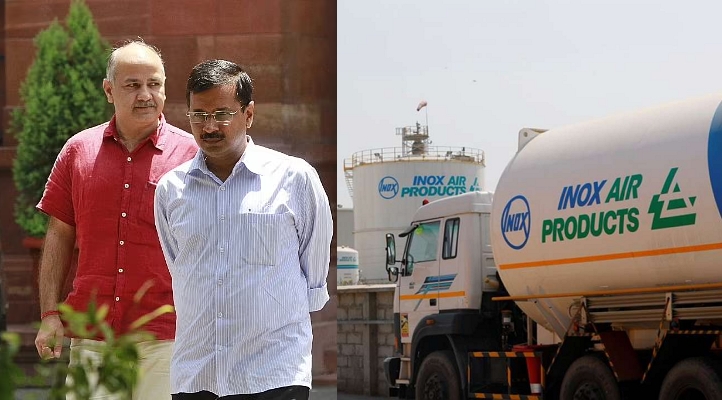
It may be noted that Delhi is supplied oxygen by 4 suppliers, Inox, Linde, Air Liquide and Goyal Gases.

The reason of the hospitals not having oxygen stock for more than 24 hours was not the lack of oxygen supply as the AAP govt is alleging, but it was due to lack of storage tanks in the hospitals. According to PESO, the Delhi govt is trying to address this issue since 9th May by trying to get alternate storage space in nearby states.

According to information received by the central govt organisation from Air Liquide, the Delhi govt had lifted only 150 MT of LMO on 10th May from their plants at Panipat and Roorkee against the allocated quota of 190 MT. The govt had asked the company to store the balance quantity in their own tanks. The Delhi govt had sent an email on 10th May to the company requesting them not to release 42 MT of LMO from Panipat plant and 20 MT of LMO from Roorkee plant and store these amounts in their storage tanks. In response, the company had assured the Delhi govt that they will store 62 MT in their tanks from 11th May.

On 9th May, the state govt also returned 74 MT Oxygen to Faridabad plant of Linde due to both non-availability of storage tanks and reduced demand in Delhi.

Details of excess LMO stored at various places: –

DatePlaceLMO Stored (in MT)Remark
09.05.2021Linde Faridabad74Out of 120 MT supplied directly to Delhi Govt. from Linde eastern sector plants, 74 MT was returned by Delhi Govt. to Linde Faridabad plant due to non-availability of storage space/less demand in Delhi.
10.05.2021Air Liquide, Panipat38M/s Air Liquide was Requested by Delhi Govt. to store their 62 MT LMO everyday at their plants at Roorkee and Panipat.
10.05.2021INOX Surajpur37M/s INOX was requested by Delhi Govt. to store 37 MT LMO at their Surajpur plant
10.05.2021Various re-fillers of Delhi37.5Directed by Delhi Govt to store at their re-filling plants.

Similarly on 10th May, Delhi govt had stored excess 38 MT oxygen at Air Liquide Panipat plant, 37 MT at Surajpur plant of Inox. Along with that, the govt had also asked the re-fillers to stock 37.5 MT LMO in their storage tanks.

When PESO asked the suppliers to explain the reason behind the reason behind shortfall in their supplies to Delhi, they gave various reasons. Linde said that it was due to delay in supply from their eastern sector plants, and also due to Delhi govt returning 74 MT oxygen due to lack of storage space. Supply from JSW, Jharsuguda fell as the Delhi govt didn’t lift their allocated oxygen from the plant. Goel Gases informed that due to unavailability of storage facilities in Delhi, turnaround time of tankers has increased, resulting in delay in supplies.

From this analysis, the PESO concluded that Delhi is receiving excess Oxygen, and as they are unable to store the oxygen, the tankers are having to wait for a long time. This has hampered the oxygen supply in the country, as the tankers are stuck in Delhi and not available to transport oxygen to places where it is needed.

In the last 10 days, Delhi received 530 MT of oxygen per day on average. But given the fact that the govt returned 74 MT on 9th May and later asked the companies to store around 100 MT in their tanks, it means that the actual demand in Delhi is less than 500 MT. This means the union govt’s estimate of Delhi’s demand was correct and the Delhi govt was demanding 700 MT despite using less than 500 MT per day.

Kamala Harris’ niece wants people to fight for Palestine to protect the LGBT community: Here is how they are treated in Gaza

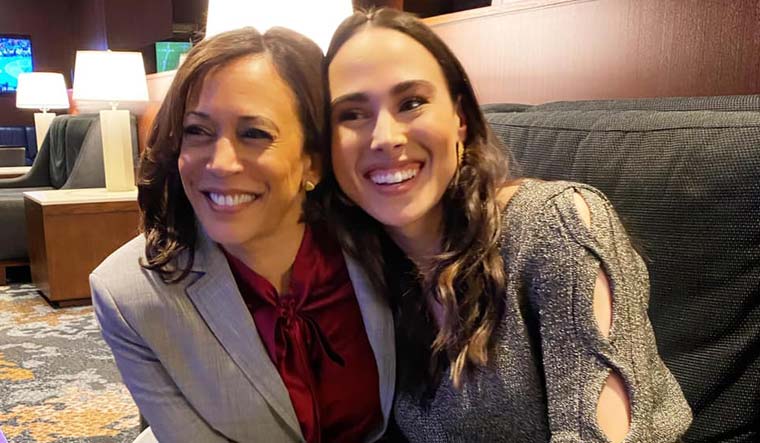
Kamala Harris’ niece Meena Harris has once again found herself in a controversial position. The 36-year old took to Instagram, urging people who care about LGBT rights to defend Palestine, despite the fact that gay people can face up to 10 years in prison in Gaza.

On Wednesday night, Meena shared her stance on the recent Israeli-Palestinian conflict, re-posting a widely-shared image discussing the ongoing conflict between Israel and Palestine.

“One cannot advocate for racial equality, LGBT & women’s rights, condemn corrupt and abusive regimes and other injustices yet choose to ignore the Palestinian oppression,” she wrote, seemingly failing to condemn the oppression of LGBT people in Hamas-ruled Gaza.

Meena Harris’ online activism seems to have missed the mark rather spectacularly. It is pertinent to note here that while Harris thinks fighting against Israel is essentially fighting for the LGBT community in Palestine, the Islamist rulers of Gaza, enforce a law, specifically Section 152(2) of the penal code, that criminalizes homosexuality and makes it punishable to up to 10 years in prison. On the other hand, in the Fatah-ruled West Bank, homosexuality is decriminalized but huge social pressures exist against it.

According to an Amnesty International report from May last year, “Lesbian, gay, bisexual, transgender and intersex (LGBTI) people continued to face discrimination and lacked protection.”

Interestingly, expecting criticism and severe backlash, Meena Harris turned off the comments on her Instagram post.

Meena Harris has been a constant source of embarrassment for her much more famous aunt, U.S. Vice President Kamala Harris. In February, according to a report by the Los Angeles Times, the promotional activities of Meena Harris raised eyebrows among Kamala Harris’ aides and advisors. These activities raised concerns that Meena will bring unwanted scrutiny on Kamala Harris.

In March, Meena Harris took to Twitter after the horrific Boulder shooting to claim that, “The Atlanta shooting was not even a week ago. Violent white men are the greatest terrorist threat to our country.” As it turned out that the killer was not a white man, Harris took a u-turn to apologize for her tweet and promptly delete the tweet.

“I deleted a previous tweet about the suspect in the Boulder shooting. I made an assumption based on his being taken into custody alive and the fact that the majority of mass shootings in the U.S. are carried out by white men,” she said.

Author attempts to defend Hemkunt foundation on receiving foreign donation without FCRA registration: Here is how she is wrong

A few days ago, OpIndia published a report on how Hemkunt Foundation and others are possibly breaking the FCRA law by collecting foreign funds via fundraisers. Notably, the organization has not explained the situation, but their supporters have come from every direction to defend them. One such case was also covered by OpIndia, where activist and media consultant Yuvraj Pokharna has been facing abuses and threats from Hemkunt Foundation’s followers.

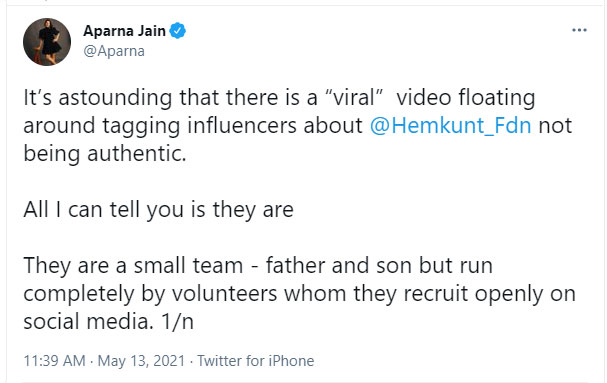
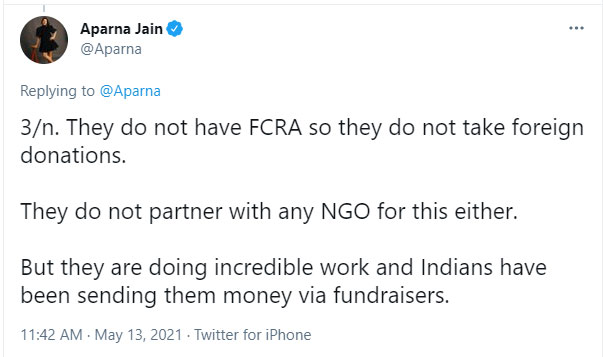
On May 13, author Aparna Jain posted a series of Tweets in which she defended Hemkunt Foundation. She claimed that the organization is authentic. They are a small team, but they are doing all the work with the help of “volunteers whom they recruit openly on social media.”

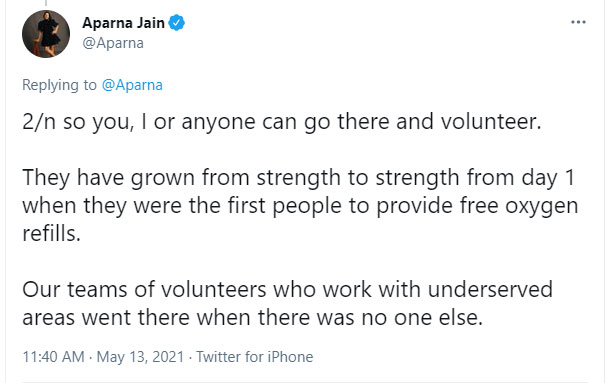
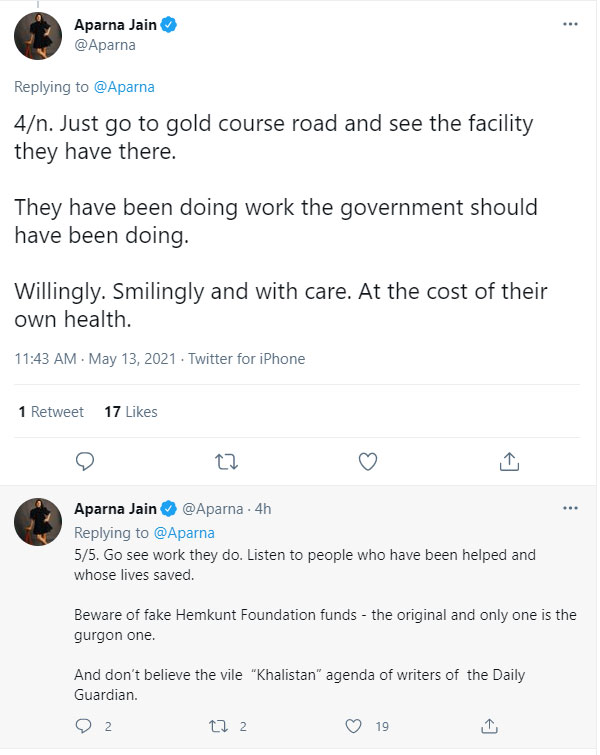
She further claimed that Hemkunt was the first to provide free oxygen, and they went to “underserved areas went there when there was no one else.”

She further claimed that as the organization does not have FCRA, they do not take foreign donations, and they have not partnered with any NGO for this either. “But they are doing incredible work, and Indians have been sending them money via fundraisers.”

They are doing the work, which the government should have been doing, she added. She also cautioned people of “fake” Hemkunt Foundations, whatever that means. In the end, she asked people not to fall for the “Khalistani” agenda some media houses are creating against Hemkunt. This is something we will talk about later.

No, Aparna, you are wrong about FCRA!

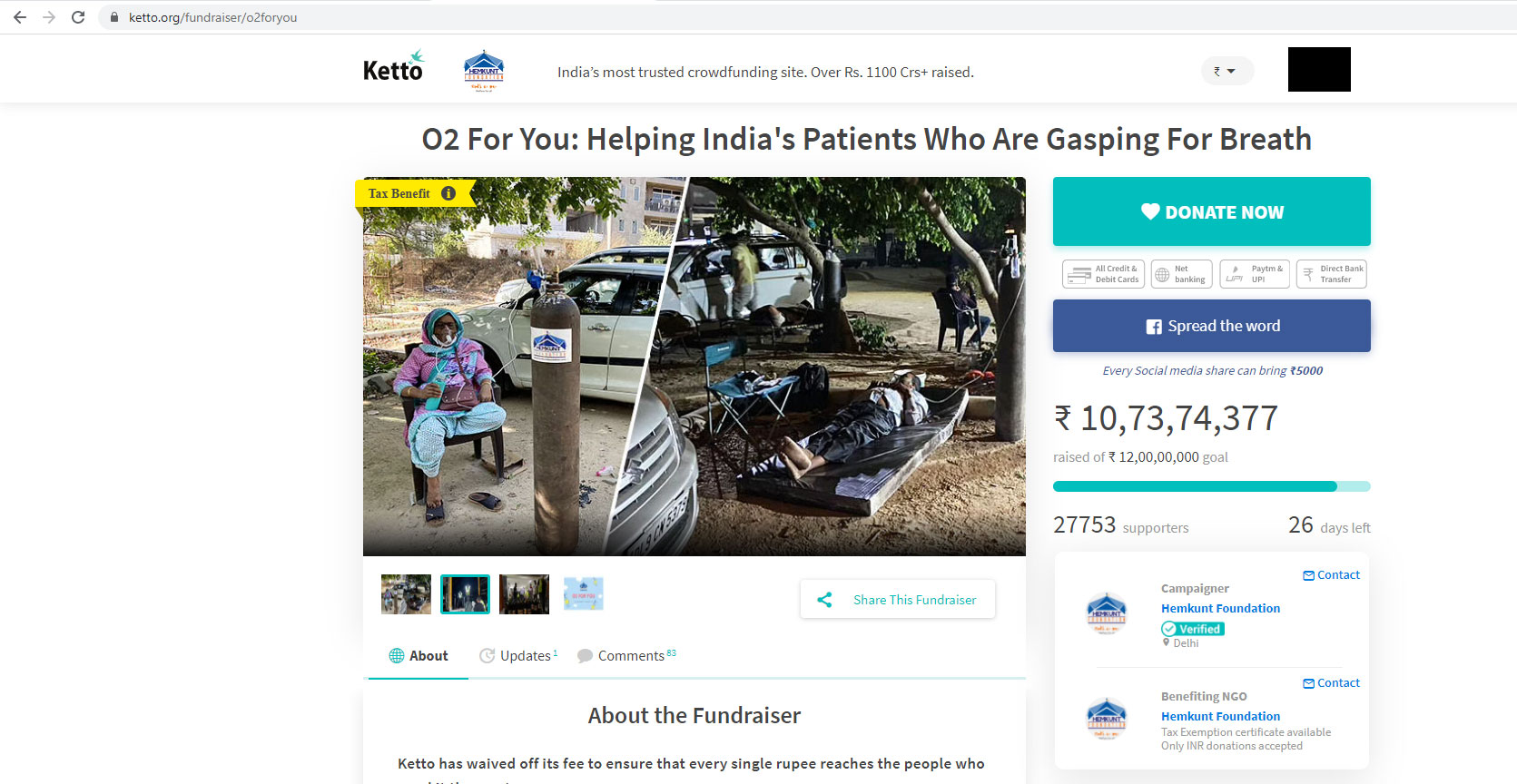
Aparna wrote that Hemkunt is not getting foreign funds, and they have not tied up with any other NGO to collect foreign funds. If we go back to our initial report on FCRA, we had posted screenshots of the fundraisers where it was clearly mentioned that Hemkunt Foundation has tied up with another organization for foreign funds.

There was a slight possibility that someone at Hemkunt woke up and realized they were breaking the law and modified the campaign. But, to our not-so-much-surprise, the primary fundraiser that has been running on Ketto under Hemkunt Foundation’s name is still collecting foreign funds. They have raised over 10.73 crore so far from the fundraiser and their target is Rs.12 crore. The last time when we checked, the target was 10 crore.

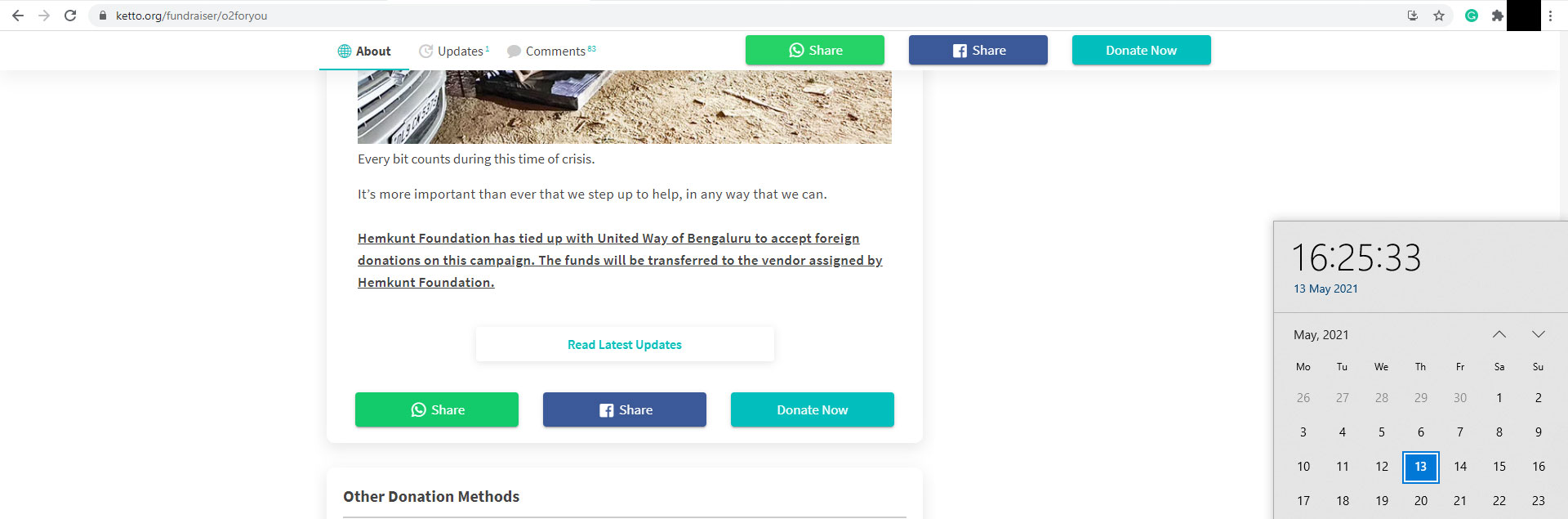
The disclaimer towards the end of the fundraiser’s description states that they have tied up with another NGO to collect foreign funds was still there. It reads, “Hemkunt Foundation has tied up with United Way of Bengaluru to accept foreign donations on this campaign. The funds will be transferred to the vendor assigned by Hemkunt Foundation.” We made sure to include the URL and date and time of the screenshot so that no one can question the authenticity of the screenshot.

This time, we decided to roughly calculate some of the foreign funds they collected from this one fundraiser. This is what we found.

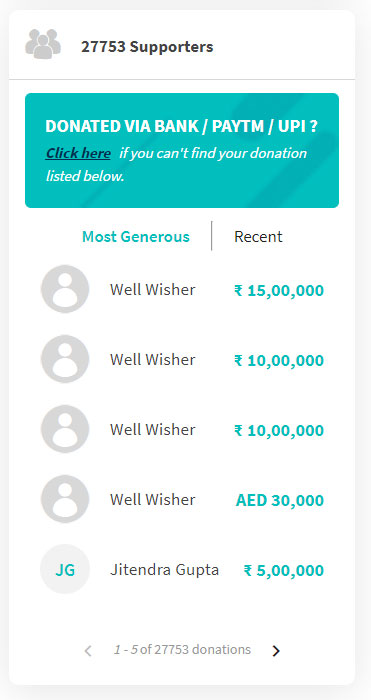
There are 27,753 donors so far in the campaign. It is obvious that we cannot scroll through the whole list of donors so we decided to check the recent 100 donors and see how much foreign funds Hemkunt Received via this particular fundraiser on Ketto.

27,753 donors have donated to Ketto fundraiser by Hemkunt Foundation

Out of 100 recent donors, as many as 63 were foreign donors. Here is a currency-wise breakdown of the funds received. (We used XE.com for currency conversion.)

  • AED 97,575 (Emirati Dhirams) which makes roughly Rs.19,55,501.63 as per today’s exchange rate.
  • USD 73,473 (United States Dollars) which makes roughly Rs.54,07,660.85 as per today’s exchange rate.
  • SGD 9,153 (Singaporean Dollars) which makes roughly Rs.5,04,558.09 as per today’s exchange rate.
  • GBP 17,908 (British Pounds) which makes roughly Rs.18,48,746.17 as per today’s exchange rate.
  • EUR 6,900 (Euro) which makes roughly Rs.6,13,082.07 as per today’s exchange rate.

That makes a total of Rs. 1,03,29,548.81 (One Crore Three Lakh Twenty Nine Thousand Five Hundred And Fourty Eight Rupees And Eighty One Paisa) in foreign funds just from the last 100 donors out of which 63 were foreign donors. If we generously deduct 10% as conversion charges, it still makes Rs. 92,96,593.93 (Ninety Two Lakh Ninety Six Thousand Five Hundred And Ninety Three Rupees And Ninety Three Paisa) in foreign donations from the last 100 donors out of 27,753 total donors till date.

One may ask, Hemkunt Foundation is collecting fund via Ketto and not directly in their bank account. So how are they liable to answer? We have explained the same in our previous report in detail. We will explain it briefly here as well. According to the Terms of Use and Guidelines published by Ketto, Foreign Funding is DISABLED by default. The organization is responsible for submitting FCRA certificate if they want to accept foreign funding. It can be read here and here.

Now, as Hemkunt Foundation does not have FCRA registration, they mentioned that they have tied up with United Way of Bengaluru, which is FCRA registered. If their fundraiser is accepting foreign funding, that means Ketto is transferring foreign funds to United Way of Bengaluru. Interestingly, the name of the organization is NOT mentioned in the beneficiary name but only in the description. How is this illegal? According to the recent amendments in FCRA laws, no FCRA registered organization can collect foreign funds for a non-FCRA organization. We had approached Ketto for answers, but they did not reply. We had approached Hemkunt as well but did not get any response. The only thing we are noticing is their followers coming out in their support and those who talk against them getting threats and abuses.

After several die of COVID-19 in AMU, Yogi Adityanath visits AMU to take stock, becomes the first CM ever to visit varsity

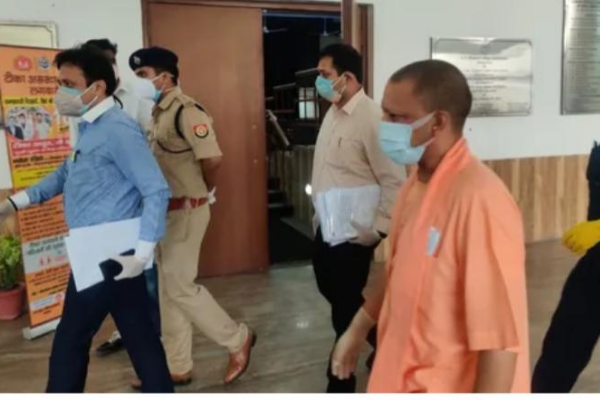
Uttar Pradesh Chief Minister Yogi Adityanath visited Aligarh Muslim University (AMU) on Thursday after reports of 50 current and retired staff of the university succumbing to COVID-19 surfaced. Yogi Adityanath is the first CM to visit the Aligarh Muslim University since its inception. The CM took stock of the situation after reports suggested the prevalence of a new variant of coronavirus in and around the campus. The visit to AMU was a part of CM Yogi Adityanath visiting Aligarh, Mathura and Agra to take stock of the COVID-19 situation.

Around 15 faculty members, 25 retired teaching faculty, 15 staff members, and 2 school teachers from AMU fell victim to the Chinese virus in the past 20-25 days. This led the Vice-chancellor Tariq Mansoor to write a letter to Balram Bhargava, director of the Indian Council of Medical Research (ICMR), urging him to undertake a probe suspecting a new variant of Covid-19 in the civil lines area of Aligarh where the AMU campus is located.

“This is to bring into your notice that 16 AMU faculty members, a number of retired teachers and employees in other categories, who were living in the university campus and adjoining localities have succumbed to Covid-19. This is giving rise to a suspicion that a particular viral variant may be circulating in the Civil Lines area of Aligarh in which AMU and many adjoining localities are situated,” the VC said in his letter.

Starting his tour with the AMU, Yogi Adityanath met the Vice-Chancellor and others from the administration to review the current worrisome situation. He assured all possible help and required medical facilities for the staff of AMU.

After the staff of the AMU panicked after the reports of multiple deaths on the campus, Bahujan Samaj Party (BSP) MP Kunwar Danish Ali wrote to Prime Minister Modi on Wednesday urging him to send a Central team to inspect and assist in the fight against the suspected new “virus variant” that is wreaking havoc in AMU.

“I, therefore, humbly request you to immediately send the central team to the AMU campus and provide medical assistance or allocate sufficient funds to Jawaharlal Nehru Medical College to fight the new Covid variant and save precious lives in the campus and surrounding areas,” Ali wrote.

The deaths also gave way to criticism and allegations on AMU administration for its handling of the Covid-19 pandemic especially after the head of medicine of Jawaharlal Nehru Medical College (JNMC), which is affiliated with AMU succumbed to Covid.

JNMC has also reported a shortage of medical staff to handle the crisis. The JNMC principal Prof Shahid Ali Siddiqi has however refuted the allegations of negligence.

The state of Uttar Pradesh reported 18,125 new cases of Covid-19 and 329 deaths on Wednesday.

Bharat Biotech welcomes other pharma companies to manufacture Covaxin, but only one other Indian company has the required facility

Amid growing demand for waiving Intellectual Rights over Covid-19 vaccines and even granting compulsory licences to Pharmaceutical companies to manufacture the vaccines to tide over the shortage, Bharat Biotech has said that it welcomes the suggestion of other companies manufacturing Covaxin. This was disclosed by NITI Aayog member Dr VK Paul during a Union Health Ministry press briefing over the Covid-19 situation in the country.

Talking about the suggestions made by many people to allow other Indian companies to manufacture Covaxin, the indigenously developed vaccine by Bharat Biotech in collaboration with ICMR, Dr VK Paul said that when they discussed the matter with Bharat Biotech, the company welcomed the decision.

The NITI Aayog member said that the government has issued an open invitation to the companies willing to collaborate with Bharat Biotech in manufacturing the vaccine. He said that govt will provide full support to the companies willing to come forward in making the vaccine, so that the supply of Covid-19 vaccine in the country can be increased by expanding the production capacity and the shortage of the same can be bridged.

However, even though Bharat Biotech has agreed to allow other companies to manufacture Covaxin, it is unlikely that a large number of Indian pharma companies will start manufacturing it soon. This is because, they don’t have the requisite facilities to produce the vaccine.

Covaxin is made from inactivated SARS-COV-2 viruses, which means, large batches of the highly-infectious vaccine are cultured and they are killed using an inactivating agent to produce it. As the process involved working with live virus, it requires to be made in production facilities having safety rating of Bio-Safety Level 3 (BSL3). Without such highly secure containment facilities, the live virus being cultured to manufacture vaccine may escape and cause a disaster, probably what happened at Wuhan Institute of Virology.

Not many Indian companies have BSL3 certified plants, which means they can’t make the vaccine without setting up such highly sophisticated plant first. In fact, only two Indian pharma companies have such plants, Bharat Biotech and Panacea Biotec.

In fact, Bharat Biotech is already in discussion with Panacea for contract manufacturing the vaccine.

Bharat Biotech is scaling up its capacities to 700 million doses of Covaxin per year. Along with this, Panacea Biotec may start producing the vaccine in the own plant. But apart from that, any other Indian company is not equipped to manufacture the vaccine at present, and setting up BSL3 level plant will take considerable amount of time if some of them are willing to do so.

It may be noted that while two India companies have BSL3 level production plants, the country has several BSL3 level laboratories to study highly infectious pathogens.  

Australia: Hindus outrage at the racist attack after minced beef was found dumped in a community cricket pitch

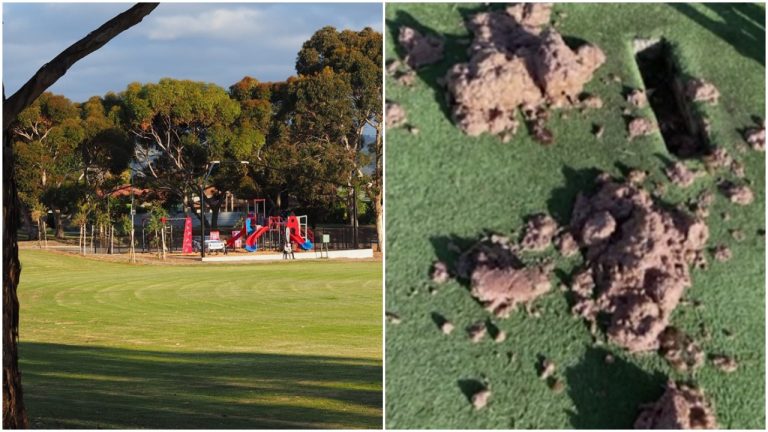
The Hindu community in Australia has been concerned over a recent racist attack at the Island continent’s north-eastern suburbs, where a pile of minced beef meat was found dumped on a community cricket pitch, where the Hindus living in that area played cricket every weekend.

According to a local news report, almost 2 kg of minced beef was found dumped on the wicket on the Hargrave Reserve Pitch at Modbury Heights in Adelaide, South Australia. The incident was reported on May 7.

The targeted attack has left locals disgusted and has angered Hindu players, who consider cows as sacred.

As reported by 7News, A local resident named Jan Snider said that the attack is sickening and not acceptable. She said she has retained a very small amount of the meet as proof, in case the police comes to inquire.

Another resident Stephen Pridgeon said the act was mortifying.

Meanwhile, condemning the alleged incident of racism against the Hindus in the area, a Hindu resident Nupur Shah, who also plays cricket at that particular community pitch every weekend, was quoted by 7NEWS as saying: “I would describe it as a racist attack because we believe the cow is a motherly figure. So it’s like a holy thing for us.”

Reacting to the incident, Lucas Jones, the Tea Tree Gully Deputy Mayor, Adelaide, South Australia, said: Council strongly condemns all acts of racism and damage to public property, which are not only unacceptable but illegal. Reports suggest that instead of mulling action against the detractors, a local council said they are considering removing the community cricket pitch after the vile attack on a group of Indian players at Modbury Heights. 

The local Hindus have, however, reacted strongly to the council’s decision to rip up the pitch. They say it’s ludicrous that the council is considering removing the cricket pitch. “It’s going to cost more than $20,000… it’s going to affect a lot of community people,” Nupur Shah said, adding: “I think the police need to intervene”.

“If they found a responsible person I think a fine is an appropriate thing to be done,” said the angered resident.

Indian cricketers face racist attack in Australia

Though this incident has left the local Hindus livid, it is not the only incident where people of Indian descent have faced discrimination and racism in Australia. In January this year, an Indian fan from Australia revealed that he was denied entry into the Sydney Cricket Ground on Day 5 of the third Test between India and Australia for carrying anti-racism banners with him.

The Indian had revealed that the Indians present at the stadium and the Indian players on the ground were being continuously addressed as ‘curry munchers’ by a section of Australian fans at the Sydney Cricket Ground.

Following the incident, Krishna Kumar had reportedly met the Venues NSW legal personnel and filed an official complaint in the matter.

For the uninitiated, this was the same Sydney Test that was marred with claims of racism as Indian players were allegedly subjected to racial abuse by a section of fans at the stadium.

Indian pacers Jasprit Bumrah and Mohammed Siraj were allegedly abused by a group of Australian supporters at the SCG on Day 3 of the third Test. Following the racial attack, India had lodged a formal complaint with the officials. On Day 4, the game had to be delayed for around ten minutes after racial jibes were once again thrown at Siraj on the boundary line.

The façade of Indian secularism: How the uncomfortable truth about realities of Sanatanis is hidden by Lutyens ecosystem

In Paddington, Westminster Borough in the heart of the City of London there is a street by the name of Leinster Gardens. Tall, ornate, mid-Victorian houses line one of the grandest, most opulent streets in all of England. Clean, orderly, prim and proper are a few of the adjectives that come to mind, Lutyens Delhi is one of the few locations that rival Leinster Gardens in that regard. 

However, a deception lies in the very heart of the street. The lie of Leinster Gardens, hidden in plain sight. Hardly ever noticed even by those who have inhabited the street for years. No doorknobs, no letterboxes, painted windows.

23 & 24 Leinster Gardens, the empty houses. Demolished years ago, to make way for the London Underground – vents for the old steam trains. Only the very front section of the house remains, nothing more than a façade.

A façade. 

The reason for the front end without anything in the back except for train tracks is a simple one. During the 1860s when the houses were knocked down to provide space to vent off fumes in an effort to reduce the smoke within the tunnels, a problem arose out of it.

The prim and proper Leinster Gardens turned into a sore sight, the smoke settled and congealed on the houses and the gap between the two houses showing the dirty underbelly of the city, destroying the look of the veritable paradise. Too much for the inhabitants of Leinster Gardens to bear. Hence the reason for the façade of 23 & 24 Leinster Gardens.

On the 28th of March, around 8 pm in the ancient Temple of Machhindranath atop the Malang Gad fort, Maharashtra on the auspicious day of Holi as the evening “Aarti” was taking place about fifty-sixty Muslim men forcibly entered the premises chanting “Allahu-Akbar” in hopes of disrupting the prayer ceremony, shoving around the devotees and creating ruckus in hopes of religious domination.

Reading about this incident it easy to count it as an instance of few bigots getting together and causing ruckus where there was a need for none. If the reader believes it so, this writer will not try to dissuade. The instance mentioned above nothing more than an insight to the writer’s mind as to how this particular piece came to being.

However, this piece is not written in hopes of bringing to light the various instances of Islamofascism over the Hindus but rather to address a much larger, pernicious point. Indian Secularism. 

Lawful Depredations  

The Preamble of the Constitution of India is a brief introductory statement that sets out guidelines, and present the principles of the Constitution, and indicate the source from which the document derives its authority, and meaning. The very same document proudly declares India to be a secular country and the Constitution, by the above definition, must strive for providing an environment where the goal can be achieved.

But it cannot be said that India is a secular country by the mere fact that the Preamble mentions it to be, the laws that are promulgated by the authority vested by the Constitution are what make it truly secular, in every sense of the word. Secularism, by definition, means the separation of religion and the State but this is not the kind followed in India.

Article 30 (Fundamental Right) allows for the establishment of Educational Institutions for religious and linguistic but only for minorities (meaning for everyone but the Hindus).

On the face of it appears to be benign at best, made so to ensure the minorities of the country have the constitutional protection for the continuance of their way of life. While operating under the assumption that the majority (i.e., Hindus) much larger in numbers than the others don’t need protection due to the sheer numbers professing the particular faith.

That, however, is just in theory. In practice it is a flawed concept at best, the legal blockade preventing Hindu Organisations from establishing institutions for providing religious education. Not being able to preserve their own way of life that has survived for thousands of years leading to the degeneration of the Hindu community as a whole.

Ever wonder why the Hindu youth today cannot recite, from memory, any verse of any Hindu scripture whereas the same does not hold true for Christian and Muslim youth? The above-mentioned provision of Indian Law is to blame.

Again, as mention above, it may appear to be benign. But it is not so.

Jawahar Lal Nehru, the very first Prime Minister’s idea of secularism meant providing for the Muslim majority state of Jammu and Kashmir special privileges and complete autonomy from the rest of the country under the assumption that they will have their way of life trampled under the Hindu majority country. While at the same time not providing for any special privileges to the minority of Hindus who resided in the same state.

Compound that with Nehru’s reaction at the reconstruction of the Somnath Temple asking Dr Rajendra Prasad not to attend as he feared it would lead to Hindu revivalism.

Nehru had earlier opposed its reconstruction hammer and tongs and may well have gotten away with it had it not been for Sardar Vallabhbhai Patel who went ahead irrespective of Nehru’s crusade against it.

The squint-eyed vision of Nehru would rear its ugly head again in 1955 when the King of Saudi Arabia would visit the country. The foreign dignitary’s visit lasted for seventeen days and visited various cities, one of them being Varanasi. A city of extreme religious importance to the Hindus, having the epithet of the city of temples owing to the numerous places of worship that call the city home.

Lo and behold, it was too much to bear for Nehru, who got every temple covered with curtains that fell on the route of the Saudi King’s cavalcade. Moreover, he also banned Aartis offered to the deities for that day. And as if adding insult to injury, he covered all the government buildings of the Holy city of Varanasi with banners of Kalima Tayyiba, one of the Five Pillars of Islam stating that “There is no God but Allah and Mohammed(sm.) is the messenger of Allah,”.

All of this was done to just to appease the Muslim King.

On a personal level, this writer has no qualms with Kalima Tayyiba being hung in any city. However, to do so to the extent it was done in a city considered to be the holiest for another religion reeks of hatred for that particular religion. Hinduphobia.

Another legal provision that sticks in the craw of the practising Hindus is the Hindu Religious and Charitable Endowments Act (HRCE) Act, 1951 which allows for state governments to take over control of the temples and maintain complete control over them and their properties.

There are over 15 state governments which control only Hindu religious institutions, specifically temples—right from the appointment of administrators to mandatory collection of 13-18% service charge. This takes away the community’s right and resources to protect its interests. This is discriminatory as only the Hindu community suffers this kind of treatment. The actual process of taking over Hindu institutions such as temples began under Mughal Rule and continued under the British.

Post-Independence the Nehru Government brought in the HRCE in 1951 for continuing the policy of policing the Hindu institutions. On the contrary no such laws were promulgated to put control of any other religious demography. Moreover, this is not the only discriminatory and draconian practice, Hindu religious institutions also happen to be the only religious bodies that pay tax to the state governments.

The State governments collect 23.4 per cent tax on the income of the temples including endowment administration tax (15 per cent), audit fee (2 per cent) and common good fund (2 per cent). That apart, money is also taken away from the temples for the Archaka Welfare Fund and other purposes. This is in direct contravention of the Article 27(another Fundamental Right) which states that no person shall be compelled to pay any taxes, the proceeds of which are specifically appropriated in payment of expenses for the promotion or maintenance of any particular religion or religious denomination.

Not only is this against what the Constitution decrees to be inviolable but is also a call-back to the draconian practices of the Mughals- The payment of taxes for practising and propagating the Hindu Faith. The Hindu Community for a long time has been paying a modern-day variant of the Jazia and seem to be none the wiser for it.

Explaining the legal aspect of the issue J Sai Deepak, noted Supreme Court Lawyer said: “Trust is a legal entity. The gold or wealth offered to the deity is object of worship and reverence. In fact, even the gold monetisation scheme is a fraud as nobody has the right to surrender it to anyone under any scheme. Any scheme seeking to take over such objects of worship is in violation of Articles 25 and 26 of the Indian Constitution. In any case, the Constitution says that no one has the right to touch religious autonomy.”

Asked about the gold monetisation schemes, Deepak said these are largely the product of State control of temples. “Temples are coerced by the state governments to monetise their gold against their will. The root cause of this issue is state control of temples, which is unconstitutional and discriminatory. Any scheme which does not translate to the principal being returned in gold is a loss to the community,” he said.

This is in adverse comparison to the Muslims in India. In the aftermath of the violence of the demolition of Babri Masjid in 1992, in order to appease the Muslim community simmering with anger permeating through it, the Central Government of time allowed for certain privileges to be granted to the Sunni Waqf Board.

One of the privileges granted to the religious body was to allow for them to annex any non-government land within their ambit irrespective of ownership by simply passing an internal resolution and there is no legal provision that enables for it to be challenged in any Court of Law.

The decision of the Board is final and paramount. Therefore, the Waqf board can annex even the land your house is situated upon and gain its ownership and you won’t even have a legal recourse to correct the wrong initiated upon you. This has resulted in the Sunni Waqf Board in holding the most amount of land in India behind only the Railways and the Defence Forces.

This is in stark contrast to where recently the Odisha Government has started the process of selling 35,000 acres of land registered in the name of Lord Jagannath. On one hand the religious body of one community can annex any land it so wishes and on the other, another community cannot even maintain the lands that have been gifted to the Temple Trust by devotees as a mark of their faith.

However, the depredations do not end here. The HRCE allows for appointing various IAS officers as heads of the Trust Funds in the names of State Government and in typical “Secular” fashion (there are not enough double quotes I can put around the particular word), there have been numerous instances where non-Hindus have been appointed as heads of Trust Funds for Hindu Institutions.

If anyone reading this piece tries to defend in by saying this is Secularism, this writer dares for anyone to imagine a situation where Christian Churches and Islamic Mosques are being managed by governments and being headed by Hindus.

A question that must arise in the minds of people, Why this Government control? The answer goes back to the colonial era. Using their doctrine of Divide and Conquer, the English had begun to try and reduce the unity of the country to smithereens. The Hindus at that time constituted about 83 percent of the total population, therefore it began with the Hindus. Upon realising that the Mughals despite imposing harsh taxes, cruel practices and even outright killing for practice of Hindu faith had not been able to convert as Islamic Bigots had done in places like Persia and Egypt took a much more refined approach.

Temples back then, according to author Sanjeev Sanyal, were managed by local communities. They were centres of dance and art, and at the heart of a massive decentralised trade network. Every temple had charitable endowments, including property given to temples, for the benefit of the community. The benefits included rest-houses, pathshalas, gaushalas, and institutions for the advancement of education and feeding of the poor.

For all intents and purposes, a temple was the beating heart of the community at large. For the British agenda of colonisation and conversions to succeed, the temple organisation had to be weakened. So, temples were brought under government control mainly in south India because not too many temples in the north possessed such massive property or wealth.

The British introduced The Madras Regulation VII of 1817 to do this. The Nehru administration post-Independence had an opportunity to correct the historical wrong but rather chose to further the debilitating practice of reducing the Hindu community to small discombobulated factions.

The Ecosystem

Another pernicious aspect of this spurious secularism is the Left Liberal Ecosystem which has been fostered by the Congress over the years. The Cabal has been at work, papering over the gargantuan cracks, serving faecal matter and making it appear like crème brulee. Consisting of certain media personalities, NGOs, civil rights activities, lawyers and smorgasbord of other influential personalities.

The Cabal has been put to use to slowly chip away at the roots of Hindu society. Every festival, practice and custom has been put under the scanner and used to denigrate the Sanatani way of life. Let any festival come and so begins the propaganda. Like a pack of hyenas, the Ecosystem starts spreading misinformation.

So Mahashivratri becomes a day for wasting of milk, Holi wastes water, on Janmashtami the height of the handi suddenly endangers the participants, Durga Puja is racist. Durga Puja of all festivals is racist even though the eponymous goddess has different forms with varying skin colours. Last year Rakshabandhan was harmful to animals as the rakhis as they were made from leather. To any individual who has ever celebrated the festival knows that rakhis are never made from that particular material.

To anyone who has not paid particular attention to these machinations it appears to be benign, perhaps even misguided but never malicious, which let’s be honest is almost everyone who pays little attention to the political discourse. This is what the Ecosystem thrives upon. So every time a Munawar Faruqui is arrested along with his cohorts for insulting Hindu Gods only his name is pushed up in limelight to push the agenda of Islamophobia.

Faruqui was arrested along with four others and this writer can bet most individuals won’t be able name a single one of the others. One of those, post of the crash and burn of his comedic career has been forced to work as a labourer earning less than the minimum wage.

A particular journalist even recently made a video with Faruqui on YouTube pushing the agenda of Islamophobia while making no attempt to cover the riots in Bhainsa, Telangana where Muslims were the perpetrators and the State Government had imposed Section 144, not allowing the members of the Media to cover the situation.

This is in stark contrast with reaction of the same Ecosystem when the same was done in Hathras.

Same holds true for any form of Jihad, the Ecosystem bends over backwards in trying to distance Islam, its preaching in calling for the death of all non-believer’s and the result of the same preaching when hundreds lose their lives in a terror attack. Stating that the belligerents are misguided youths bastardising the teachings of Islam, cogent position to take. But the same logic is not espoused whenever a Aklakh or Tabrez is lynched. Then it becomes a matter of Saffron Terror.

Gone is the same logic and the understanding nature of not blaming the entire community for the actions of a few. If a Muslim person is lynched, for whatever reason it maybe, the entire Hindu community is made to feel ashamed of the years of tradition that it follows. Soliloquy upon soliloquy, Op-eds upon Op-eds and campaign upon campaign of extremism, polarisation and #notinmyname are bombarded in a synchronised blitzkrieg targeted at the core of Sanatan Dharma.

Such is the efficacy of malicious Ecosystem that even the Kashmiri Hindu Genocide has been brushed under the carpet with so great an effectiveness that most born after 1990, don’t even know the date of the event. And look at even the nomenclature, 19th of January 1990 is called the date of the exodus. The closest meaning of the word being departure, a genocide is now called a departure or migration.

Bear in mind, as the exhortations by the Muslims of the Valley for the Hindus to leave the land continued between two to three months they were being done from the minarets of mosques. Calls for Ralive, Tsaliv ya Galive (Leave, Convert or die) were being blared from loudspeakers reserved for Namaz, there was an even more malevolent part to it that most don’t even know about. Leave, Convert or Die and while you’re at it leave your women behind, now for what women had to be left behind is pretty obvious for even the most optimistic.

The ontological animus aimed at the Hindus of the Valley ignored to such an extent that even women’s right activists/NGOs/ PIL lawyers who find time to knock on the doors of the Supreme Court for allowing women entry into the Sabrimala Shrine have not found a single second to spare even after thirty-one years.

After women, on the fateful day, had their breasts cut off after being gang raped, one particular one was forced to eat rice soaked in the blood of her husband’s blood who had hid in a sack to save his skin. Utter and complete silence in most cases, when in recent times it became too much to ignore spoken with subterfuge, muddying up the truth.

One top journalist even reported that the anger stemmed from the Hindus minority holding power over the Muslim majority. Her exact words- “They may have been a minority but at that time they had monopolised government jobs, plum postings and other such social benefits. In fact, the sharp economic disparity between the Pandits and the poor Muslim Majority was one of the earliest reasons for popular discontent in the State.”

Giving it a colour of a class-based struggle leading to a brutal conclusion as if some communist regime, not an Islamist one, had taken over the valley. Ask anyone to pontificate upon the Kashmir and they will most probably term it as a political issue whereas the truth remains it is, unquestionably, a religious one.

Look at more recent times, in the past one year, the Hathras rape got the most traction out of the Ecosystem. It ticked all the boxes that makes the day of the Cabal- BJP ruled state, Upper caste male upon lower caste woman violence and a cover up. The whole Ecosystem descended with a vengeance upon the issue, throwing everything to one side, Hathras for some time became the media capital of the country. Every individual owing allegiance to Ecosystem banging the drum of Brahmanical Patriarchy.

While personally, this writer, agrees with coverage of the crime with the intensity it was done especially considering the alleged cover up, it was quite clear for anyone who has followed politics and observed the actions of the Cabal the intention was solely for the purpose of hurting BJP before the Bihar Elections right around the corner. If there is any doubt in anyone’s mind over the veracity of the claim, try unearthing the coverage of the rape post the final phase of the elections. Good luck, you shall be busy for quite some time.

The coverage in sharp deviation from the coverage of another rape that took place in Rajasthan around the same time. The difference being, Rajasthan is a Congress ruled state and the crime was committed by Muslim man against a Dalit woman. Exactly the opposite of the Hathras rape. Complete radio silence on the issue.

The façade 

Much the like the façade of Leinster Gardens, Indian Secularism has been, continues to hide the ugly truth too much for the ones living in a fool’s paradise to bear. The neatly ordered world that we as Indians have been living in is too far from the reality. The neatly ordered world according to the Nehruvian idea of India is nothing more than brushing the rubbish under the carpet and pretending upon the cleanliness while ignoring the fact that someday the rubbish will overflow the bounds of the rug.

In the end I will like to end with a reference to a famous book, Harry Potter and the Goblet of Fire. Towards the end after Lord Voldemort’s resurrection and Harry Potter’s narrow escape. The eponymous hero tells of the impending danger which approaches the wizarding world. Cornelius Fudge, the minister for magic simply refuses to believe the harsh truth despite overwhelming evidence.

Citing that Albus Dumbledore was simply trying to start a panic that would destabilase everything they had worked for in the thirteen years before. In the end, the obstinacy of the politician cost the whole of the wizarding world.

Such is the current scenario in India. Whenever some individual sick of this one eyed secularism points out the colossal hypocrisy of the Ecosystem, the Cabal brands the person as a right wing bigot. Post 2014 right wing bigot has been replaced with Modi bhakt/Sanghi. The actions of the Ecosystem turns mere pointing out of the hypocrisy and reporting of facts into a perception of Hindutva terror and bigotry. Hark back to the social media reactions during the unrest in Jamia and JNU, Shaheen Bagh blockade, Delhi Riots and the so-called Farmer protest and you’ll catch my drift.

In the end the only hope and exhortation, of this writer, is for the readers to be like Dumbledore and not like Fudge. Do not ignore the writing on the wall. This is after all an existential and civilisational war brought upon our shores.


As COVID-19 spreads to India’s rural areas, states gear up to tackle the surge with the help of Central govt

After wreaking havoc in the urban area’s, the second wave of COVID-19 is fast spreading in India’s rural belts as well. This is due to several factors, including lack of awareness, a limited supply of clean water, low levels of nutrition, and most importantly, ill-equipped and insufficient public health centres and district hospitals.

To tackle the problem, the Ministry of Panchayati Raj has issued several advisories to the states aimed towards the management of the deadly pathogen at the rural level and has urged the States to take actions to effectively respond to the COVID pandemic in rural areas.

Stress on preventive measures, vaccination drives

The suggestions include that all states should adopt steps like introducing an intensive communication campaign for the awareness of rural communities on the nature of Covid infection, and preventive and mitigation measures, regular cleaning and sanitisation of villages, measures to dispel false notions and beliefs about the disease and setting up of specific quarantine/isolation centres for the needy and returning migrant labourers. Moreover, the ministry suggested that the Panchayats may be designated to facilitate vaccination drives to ensure maximum coverage of the eligible population.

Besides, the states must establish inter-linkages with the medical facilities at the nearby District and Sub-Districts so that ambulances, advanced testing and treatment facilities, multi-speciality care etc. are provided to the needy without much loss of time.

The states, in turn, have responded with the innovative steps they have adopted to curb its spread and deal with the pandemic in rural areas. The initiatives have been taken by states in consultation with the Centre to stop the virus from spreading further in villages.

As in the rest of India, the impact of the second wave of COVID-19 in Andhra Pradesh’s rural areas have been devastating. To tackle the crisis, the authorities in Andhra Pradesh have formed a Corona Kattadi (monitoring) Committee and taken up sanitation work and door to door surveillance proactively. A resolution on ‘NO MASK NO ENTRY’ has been initiated at the Gram Panchayat (GP) level.

Arunachal Pradesh administration has issued advisories to all District Commissioners with key directions including widespread sanitization of public places, formulation of village monitoring committees, initiation of community involvement and awareness programmes.

In Assam, the state government has formulated a Village Defence Party and Migrant Database for vigilant monitoring of mobility of people. Alongside the government has earmarked funds from the 15th Finance Commission (FC) untied grants for sanitization in the villages of Assam.

Bihar government has undertaken the responsibility of distributing masks amongst all the families of the villages in the state. Also, it has ordered that the masks be procured locally, so as to promote employment. Like Assam, the Bihar administration has also earmarked funds from the 15th Finance Commission (FC) untied grants for sanitization purpose.

In Gujarat, the state government has been conducting door to door surveillance through Pulse oximeter, temperature guns and antigen test kits in all the villages and remote hamlets of the state. Gram Yoddha Samitis have been formed in villages for supporting families of Covid-19 infected patients. Moreover, to contain the surge, self-proclaimed lockdowns have been imposed by the Panchayati Raj Institutions (PRIs).

Like other states, Haryana has also been proactively trying to battle the second wave of the pandemic and keep its rural belts safe from the scourge. The state administration has begun conducting periodic awareness programs in the rural areas. Moreover, Village Monitoring Committees have been formulated and specific Quartile/Isolation Centers for migrant labourers have been formed.

Himachal Pradesh also has been conducting door-to-door surveillance to ensure proper quarantine and isolation of those infected with the pathogen. Ration and medical kits are being distributed to Corona infected families. Alongside, the HP government has been carrying out sanitization drives and ensuring that the self-help groups (SHGs) are being engaged in the sewing of masks to promote employment. It has also started ‘eSanjeevani OPD’ for providing free online medical consultation to sick people.

Jharkhand, meanwhile, has converted Panchayat Bhawans, Government Schools and Community Halls into Quarantine Centres to ensure there is no shortage of beds amidst the rising number of COVID-19 cases in the state. On one hand, online platforms like Google meet are being used for spreading awareness, while on the other, messaging groups have been created for all the blocks in the villages.

In Karnataka, GPTF and VTF have been revived at the Gram Panchayat level and capacity building with ANS State Institute of Rural Development, Mysuru, which are providing essentials to the vulnerable population.

In a similar manner, Kerala has also intervened against the spread of the second wave of Covid-19 into its rural pockets. The state has established structural response mechanisms for contact tracing and providing support to families under home isolation or quarantine. Furthermore, the Kerala state govt has launched Kudumbashree Community Network in Kerala, a joint programme of the Government of Kerala implemented through Community Development Societies (CDSs) of poor women, serving as the community wing of local governments. Additionally, inventorisation and preparation and management of quarantines and COVID care centres have been prioritised.

Kerala has started a transportation plan by providing ambulances in each gram panchayat to support the health system besides providing two-chambered cars and auto-rickshaws for the needy.

Madhya Pradesh government has, meanwhile, established containment zones (as per the COVID guidelines) in villages with high infections. It has formed Red, Orange and Green zones in Villages/GramPanchayats, based on the number of active COVID patients. Also, control rooms have been established at the Block level, District level and State level.

Maharashtra, which has been one of the worst affected states has initiated ‘My Family My Responsibility’ awareness campaign in the rural areas of the state. Corona Prevention Committee has been formulated and door to door surveillance, to check vitals and any medical emergencies, are being carried out.

In Nagaland, village councils have been set up which are strong links between the panchayats and the people. These councils are ensuring proper training to its members, who in turn, are helping villagers fight the COVID-19 battle.

To curb the spread, Punjab has imposed strict mobility restrictions from other states. It has formed Village Monitoring Committees (VMC) in each village. Moreover, the villages are being encouraged to organize Thikri Pehras to ensure that ‘Night Curfew’ and ‘Weekend Curfew’ orders are complied with.

In Rajasthan, the Congress lead state government has appointed the CEO of the Zila Panchayat office as the nodal officer to carry out all COVID related instructions. They are required to make a daily assessment of survey reports and medical kit distribution status reports. The state govt, along with the active association of the Medical & health department is distributing medical kits amongst villagers.

Sikkim Govt has also been undertaking periodic interactions with the Panchayati Raj Institutions (PRIs) in the villages. It has been conducting training sessions through web-based tools such as Youtube live. Also, the Sikkim Govt is religiously conducting the inoculation drive to restrict the transmission of COVID.

In Tripura, extensive awareness drives on observing COVID-19 protocols behaviour is being conducted and the PRIs are being encouraged ordered to utilise funds available under Finance Commission Grants. Committees at the Gram Panchayat level have been formed to deal with the virus affected cases as well as to reduce the chance of it spreading.

The Yogi Govt in Uttar Pradesh has taken proactive steps to contain the spread of the virus. Amongst several measures, the village Nigrani Samiti in all the Gram Panchayats has been formulated which focuses on promoting cleanliness. Safai Karmacharis have been hired in every village for regular cleaning, fogging, mopping.

The govt has also been providing financial assistance for the cremation of COVID related deaths.

In fact, the global health body, WHO has also lauded the Yogi Government’s initiative of house-to-house active case finding of Covid-19 in rural areas to contain Covid-19 by testing people with symptoms, disease management and contact tracing.

Uttarakhand too has formed Village Monitoring Committees (VMC) in every Gram Panchayat. Block Response Teams have been formulated at the Block Level to ensure and monitor proper deliverables. A 24×7 help desk system has also been set up by the directorate of Panchayati Raj in the state.

West Bengal is undertaking awareness programmes in panchayats with the help of NGOs and self-help groups and is enabling safe operations of local markets/haats, besides smooth distribution of food grains to the poor under PDS.

Amongst the varied steps taken by the states, the central government specially mentioned few initiatives, which according to them are the most innovative. These included:

  • Self-proclaimed lockdown is done by PRIs in Gujarat
  • Assam’s initiative of formulating a migrant database for capturing the return migrants in the panchayats both from outside the state and within the state.
  • Himachal Pradesh’s eSanjeevani OPD and free online medical consultation for sick people
  • Kudumbashree Community Network is a joint programme of the Government of Kerala implemented through Community Development Societies (CDSs) of Poor Women, serving as the community wing of Local Governments. (KERALA).
  • Kerala’s Transportation plan – provisioning of ambulances in each GP to support the health system, also two-chambered cars and auto-rickshaws for the needy, ambulances in frontline treatment centres.

India added 3,62,727 new coronavirus infections in a day taking the COVID-19 tally of cases to 2,37,03,665, while the death toll rose to 2,58,317 with 4,120 daily fatalities on May 12th, according to the Union Health Ministry data.