On Wednesday (7th May), the world woke up to the news of India carrying out precision strikes on the terrorist headquarters of Jaish-e-Mohammed and Lashkar-e-Taiba in Pakistan and Pakistan-occupied Kashmir in Operation Sindoor. Pakistan, which has provided a breeding ground to terrorists, failed to garner global sympathy after the strikes. The US has adopted a neutral stance regarding India’s military action, while China naturally sided with its ally Pakistan, calling India’s military action ‘regrettable’.
Here is how different countries reacted to India’s military action:
Hope it ends soon: Trump
Responding to India’s military action, US President Donald Trump said, “We just heard about it as we were walking in the doors of the Oval. I guess we knew something was going to happen based on a little bit of the past.” Speaking to the media in the White House, Trump added, “They have been fighting for many, many decades, and centuries when you think about it. Nah, I just hope it ends very quickly.”
Israel supports India’s right to self-defence
Within hours after Operation Sindoor, Israel was among the first countries to express support for India and recognise India’s right to self-defence. Backing India in its fight against terrorism, Israel’s ambassador to India, Reuven Azar, wrote on X, “Israel supports India’s right to self-defence. Terrorists should know there’s no place to hide from their heinous crimes against the innocent”.
Israel supports India’s right for self defense. Terrorists should know there’s no place to hide from their heinous crimes against the innocent. #OperationSindoor
As expected, China’s Ministry of Foreign Affairs released a statement calling India’s military action against terrorists in Pakistan ‘regrettable’. “China expresses regret over India’s military actions this morning and is concerned about the current developments. China opposes all forms of terrorism. We call on both India and Pakistan to prioritise peace and stability, remain calm and restrained, and avoid taking actions that further complicate the situation,” the statement read. “China finds India’s military operation early this morning regrettable… India and Pakistan are and will always be each other’s neighbours. They’re both China’s neighbours as well,” the statement added.
Russia deeply concerned by the confrontation
The Russian Foreign Ministry spokesperson said in a statement, “We are deeply concerned about the escalation of military confrontation between India and Pakistan following the terrorist attack near Pahalgam. We call on the parties involved to exercise restraint in order to prevent further deterioration of the situation in the region.”
France and UAE cals for restraint
French Foreign Minister Jean-Noel Barrot called on India as well as Pakistan to show restraint in order to avoid escalation. The statement said, “Nobody has anything to gain from prolonged confrontation between India and Pakistan. These are two major military powers, that is why we call for restraint.”
Similarly, the Foreign Ministry of the United Arab Emirates said, “Deputy Prime Minister and Minister of Foreign Affairs of the UAE Sheikh Abdullah bin Zayed has called on India and Pakistan to exercise restraint, de-escalate tensions, and avoid further escalation that could threaten regional and international peace.”
Japan condemns the Pahalgam terror attack and calls for restraint
Reacting to India’s military action, Japanese Cabinet Secretary Yoshimasa Hayashi condemned the Pahalgam terror attack and called for restraint by India and Pakistan. “In regard to the terrorist act that occurred in Kashmir on April 22, our country firmly condemns such acts of terrorism. Furthermore, we express strong concern that this situation may lead to further retaliatory exchanges and escalate into a full-scale military conflict. For the peace and stability of South Asia, we strongly urge both India and Pakistan to exercise restraint and stabilise the situation through dialogue,” said Hayashi.
UN Secretary General calls for military restraint between India and Pakistan
The spokesperson of the UN Secretary General, Antonio Guterres, said in a statement that Guterres is concerned about Indian military operations.”The Secretary-General is very concerned about the Indian military operations across the Line of Control and the international border. He calls for maximum military restraint from both countries. The world cannot afford a military confrontation between India and Pakistan,” the spokesperson said.
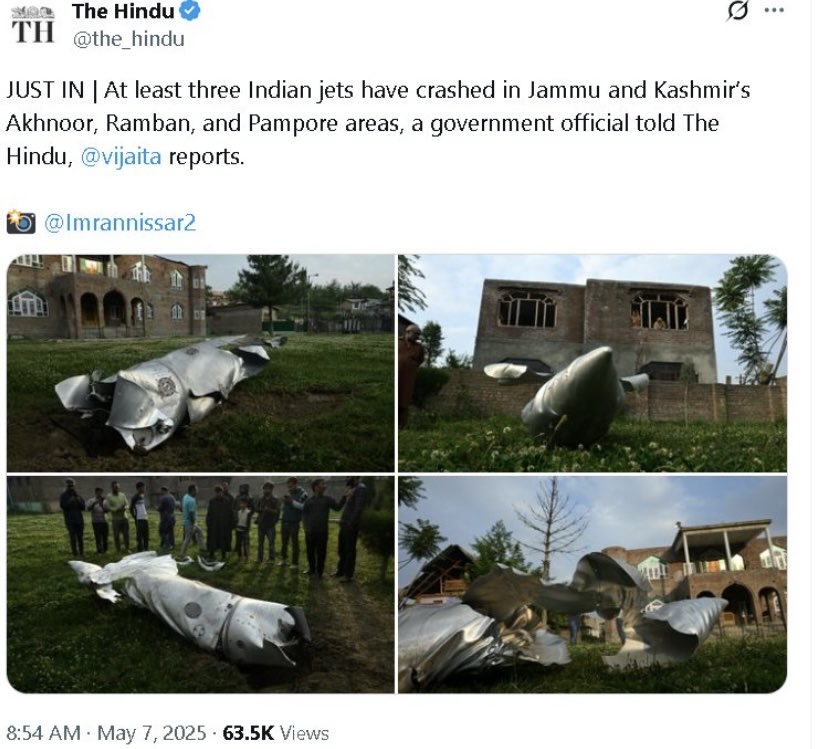
Hours after Indian forces launched a devastating strike on terror targets inside Pakistan and Pakistan-occupied-Kashmir, Pakistani media houses and social media users started to spread fake news of Indian fighter planes being hit by Pakistani forces. Many Indian left-liberals also circulated those claims, in an attempt to show that India’s action has proved to be costly. Newspaper The Hindu also joined in spreading this fake narrative, as it ‘reported’ that three Indian fighter jets crashed in Jammu and Kashmir.
However, after it was pointed by netizens that the news is fake and the images used by The Hindu were old, the newspaper was forced to remove the claim and issue an apology.
Earlier today, The Hindu posted on X, saying, “JUST IN | At least three Indian jets have crashed in Jammu and Kashmir’s Akhnoor, Ramban, and Pampore areas, a government official told The Hindu.” They stated that this report was filed by Deputy Editor Vijaita Singh, who has a long history of publishing fake and baseless reports.
The Hindu posted 4 photographs with the tweet, purportedly of the crashed Indian jets. They also published a report on the ‘crash’, saying that a govt official told the publication that at least three Indian jets crashed in Jammu and Kashmir’s Akhnoor, Ramban and Pampore areas on Wednesday. It added that the “officials are yet to reveal the exact circumstances behind these crashes.”
In one of the images used in the report, the caption said, “Wreckage of Indian Air force fighter jet that crashed in Wuyan Pampore, South Kashmir on May 7, 2025.” The caption of another image says, “Fire fighters douse smoke coming out from the debris of an aircraft near Akhnoor on the outskirts of Jammu, on May 7, 2025. “
However, no such crash took place, and the Hindu report was completely baseless. A study of the images published by them shows that the object that crashed onto the ground is actually an external fuel tank, not a fighter jet. Fighter jets on longer missions carry such external fuel tanks under its wings. After the fuels are used, the tanks are jettisoned, and they crash onto the ground. They are called ‘Drop tanks,’ as they are dropped from the air after they are no longer needed.
Therefore, this does not mean that the jets crashed; it just means the jets dumped their external fuel tanks inside Kashmir.
After the claim was found to be false, The Hindu deleted the post, and ‘regretted’ it created confusion among people.
We have deleted an earlier post about Indian aircraft involved in Operation Sindoor. There is no such on-record official information from India. We therefore decided to remove the post from our platforms. We regret that it created confusion among our readers.
The newspaper posted on X, “We have deleted an earlier post about Indian aircraft involved in Operation Sindoor. There is no such on-record official information from India. We therefore decided to remove the post from our platforms. We regret that it created confusion among our readers.”
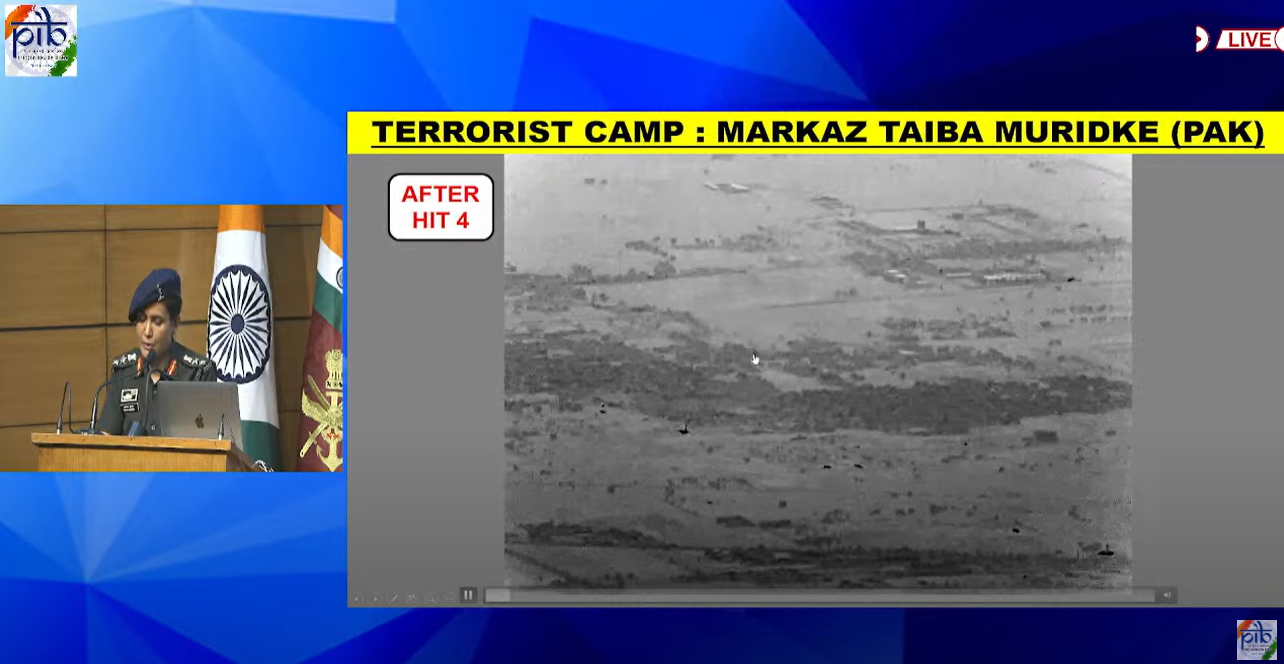
On the intervening night of 6th and 7th May, the Indian Armed Forces launched Operation Sindoor, a swift and precise response to the brutal Pahalgam terror attack of 22nd April 2025, in which 26 civilians, including one Nepali national, were killed by Pakistan-backed terrorists. In an official press briefing on Operation Sindoor, defence officials noted that the armed forces targeted and destroyed nine key terrorist camps spread across Pakistan and Pakistan-occupied Jammu and Kashmir (PoJK).
Indian Air Force Wing Commander Vyomika Singh, Indian Army Colonel Sophia Qureshi, and Foreign Secretary Vikram Misri briefed the media about Operation Sindoor.
Key takeaways from today’s press briefing on Operation Sindoor:
? On 22 April 2025, Pakistan-backed Lashkar-e-Taiba terrorists massacred 26 civilians in Pahalgam, including a Nepali national. ? Victims were shot in the head at close range — in front of family members — to… pic.twitter.com/Jilu5YxEwF
Among the most significant of the neutralised camps was Markas Taiba Muridke, the notorious Lashkar-e-Taiba base where Ajmal Kasab and David Headley, terrorists behind the 26/11 Mumbai attack, were trained. Officials revealed that this facility was also used in 2008 to train terrorists responsible for the killing of four J&K Police personnel.
SourcE: PIB
Other camps struck include Gulpur in Kotli, Bernala in Bhimber, and Mehmuna Jaya in Sialkot—all known Lashkar strongholds. The strikes were carried out with clinical precision, avoiding civilian infrastructure and the loss of innocent lives.
Justified, responsible, and necessary
The officials stated that the action was “measured, non-escalatory, and responsible.” It was necessary to destroy the camps as there was concrete intelligence suggesting further cross-border attacks in the future. Pakistan, despite international pressure, has taken no credible action against the terror infrastructure on its soil. It has, instead, indulged in denials and accusations.
“This was about justice. Justice for the families in Pahalgam who watched loved ones executed with bullets to the head, just for visiting Kashmir,” said the official.
UN, FATF, and global pressure ignored
The Indian government had previously raised concerns with the United Nations and the Financial Action Task Force about Pakistan’s support for terrorist fronts like the TRF, a Lashkar proxy that claimed responsibility for the Pahalgam massacre.
Operation Sindoor is a reminder: while India continues to show restraint, it will not hesitate to strike back when its civilians are slaughtered and justice is denied.
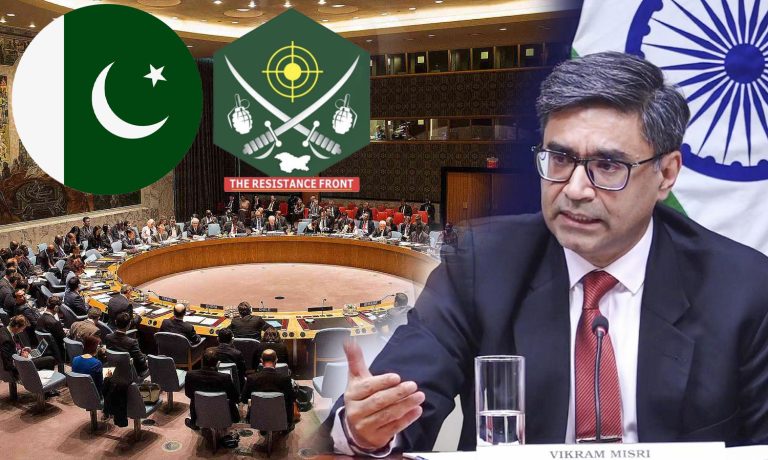
Foreign Secretary Vikram Misri has highlighted Pakistan’s role in removing references to the terrorist group The Resistance Front (TRF), which claimed responsibility for the Pahalgam terrorist attack, from the United Nations Security Council (UNSC) press statement issued on April 25.
While addressing a media briefing on Operation Sindoor in Delhi on Wednesday, Misri said that TRF, which is a front for the UN-proscribed terrorist group Lashkar-e-Tayyiba (LeT), claimed responsibility for the Pahalgam attack and added that claims made by TRF were reposted by LeT. He recalled how India had earlier shared inputs regarding the TRF with the UN, bringing out its role as a cover for terrorists based in Pakistan.
He said, “A group calling itself the Resistance Front has claimed responsibility for the attack. This group is a front for the UN-proscribed Pakistani terrorist group Lashkar-e-Tayyiba. It is notable that India had given input about the TRF in the half-yearly report to the monitoring team of the UN’s 1267 Sanctions Committee in May and November 2024, bringing out its role as a cover for Pakistan- based terrorist groups. Earlier, too, in December 2023, India had informed the monitoring team about Lashkar and Jaish-e-Mohammed operating through small terror groups, such as the TRF. Pakistan’s pressure to remove references to TRF in the April 25 Security Council press statement is notable in this regard.”
“Investigation into the Pahalgam terror attack have brought out the communication nodes of terrorists in and into Pakistan. The claims made by The Resistance Front and their reposting by now social media handles of the Lashkar e Taiba speak for themselves. Identification of the attackers based on eyewitness accounts as well as other information available to law enforcement agency has also progressed,” he added.
He said that Pakistan has a well-deserved reputation of being a haven for tourists from around the world with terrorists enjoying impunity there. He said that Pakistan also wilfully misleads the world and international forums like FATF on the terrorism issue.
Highlighting role of Pakistan-based terrorists to the Pahalgam terrorist attack, he said, “Our intelligence has developed an accurate picture of the planners and backers of this team. The features of this attack also tie in with Pakistan’s long track record of perpetrating cross-border terrorism into India which is well documented and beyond questions. Pakistan also has a well-deserved reputation as a haven for terrorists from around the world with internationally processed terrorist enjoying impunity there. In addition, Pakistan has been known to willfully mislead the World and International Forum as the Financial Action Task Force (FATF) on this issue. The Sajid Mir case in which this terrorist was declared dead and then in response to international pressure brought back to life, found alive and arrested is the most glaring example.”
He recalled how Pakistan-based terrorists conducted a “savage attack” on Indian tourists in Pahalgam on April 22. He said that the attack in Pahalgam was marked by extreme barbarity, with victims being killed with headshots in front of their families. He said that the attack was aimed to undermine the normalcy returning to Jammu and Kashmir.
Vikram Misri said, “As you are all aware, on April 22, 2025, Pakistani and Pakistan-trained terrorists belonging to the Lashkar-e-Taiba carried out a savage attack on Indian tourists at Pahalgam in Jammu and Kashmir in India. They murdered 26 people, including one national of Nepal, causing the largest number of civilian casualties in a terrorist attack in India since the 26th November 2008 attacks in Mumbai.”
“The attack in Pahalgam was marked by extreme barbarity, with the victims mostly killed with headshots from close range and in front of their families. Family members were deliberately traumatised through the manner of the killing, accompanied by the exhortation that they should take back the message. The attack was clearly driven by the objective of undermining the normalcy returning to Jammu and Kashmir. In particular, it was designed to impact the mainstay of the economy, tourism, with a record 23 million tourists visiting the valley last year,” he added.
Vikram Misri said that the terror attack in Pahalgam “generated deep anger in Jammu and Kashmir and other parts of India.” He said that Pakistan did not take any action against terrorists following the attack in Pahalgam and rather it resorted to denials and allegations.
Misri said, “Following the attacks, the government of India was naturally responded with a set of initial measures relating to any engagement with Pakistan. You are all aware of the decision that was announced on the 23rd of April. However, it was deemed essential that the perpetrators and planners of the 22nd April attack be brought to justice. Despite a fortnight having passed since the attacks, there have been no demonstrable step from Pakistan to take action against the terrorist infrastructure on its territory or on territory under its control. Instead, all it has been indulged in are denials and allegations.”
“Our intelligence monitoring of Pakistan-based terrorist modules indicated that further attacks against India were impending, there was a compulsion both to deter and to preempt. Earlier this morning, as you will be aware that India exercised its right to respond and preempt as well as deter more such cross-border attacks. These actions were measured, non-elementary, proportionate and responsible. The focus was on dismantling the terrorist infrastructure and disabling terrorists likely to be sent across India,” he added.
Indian Armed Forces successfully struck nine terror targets, four in Pakistan, including Bahawalpur, Muridke, and Sialkot, and five in Pakistan-occupied Jammu and Kashmir (PoJK), using special precision munitions in a coordinated operation, sources told ANI.
India’s Ministry of Defence said the action was in direct response to the terrorist attack in Jammu and Kashmir’s Pahalgam on April 22, which claimed the lives of 26 people and injured several others.
In its statement, the Ministry of Defence stated, “A little while ago, the Indian Armed Forces launched ‘OPERATION SINDOOR’, hitting terrorist infrastructure in Pakistan and Pakistan-occupied Jammu and Kashmir from where terrorist attacks against India have been planned and directed.”
“Our actions have been focused, measured and non-escalatory in nature. No Pakistani military facilities have been targeted. India has demonstrated considerable restraint in selection of targets and method of execution,” it added.
(This news report is published from a syndicated feed. Except for the headline, the content has not been written or edited by OpIndia staff)
Launching an offensive against terrorist launch pads located in Pakistan and Pakistan-occupied Kashmir, the Indian defence forces carried out precision strikes on 9 terror camps in the wee hours of Wednesday (7th May). The precision strikes carried out in retaliation for the April 22 Pahalgam terror attack were codenamed ‘Operation Sindoor’. According to NDTV, the operation involved utilisation of air, naval and land-based assets. This is the first time since 1971 that all 3 arms of Indian Armed Forces took part in the same operation together.
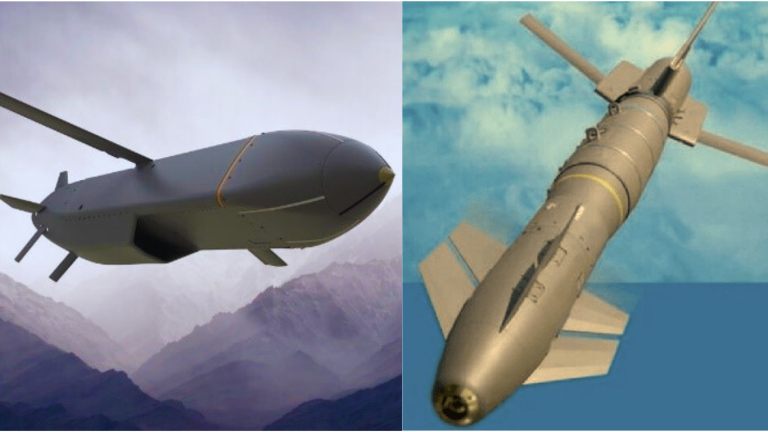
To target the terror infrastructures in a precise manner and avoid civilian casualties, India used a range of high-precision, long-range strike weapons like the SCALP cruise missile, the HAMMER precision bomb and loitering munitions.
SCALP (Storm Shadow)
The SCALP missile, also called Storm Shadow, is an air-launched long-range cruise missile with a range of over 250 km. The missile is loaded with stealth features, which make it suitable for deep strikes. It is an all-weather missile capable of being operated at night. The missile has an advanced navigation system which uses INS, GPC and terrain referencing, which enhances its accuracy. It uses an infrared seeker which matches the target image that is fed into it to carry out the strike precisely. The missile is tough to detect as it flies low. It is manufactured by the MBDA, a European consortium.
HAMMER, also known as a glide bomb, is an all-weather air-to-ground precision-guided bomb, which is preferred for targeting fortified infrastructure such as bunkers and multi-storey buildings. It is a precision-guided, stand-off munition with a range of 50-70 km. It is capable of being fitted to standard bombs. The bomb, immune to jamming, is capable of being launched from low altitude over rough terrain and is difficult to intercept. It is made by the French manufacturer Safran.
Loitering Munitions
Loitering munitions are a category of precision weapons that hover over the target area before striking. These weapons, known by names such as suicide drones, kamikaze drones or exploding drones, can act either autonomously or through remote control. Loitering munitions can wait around in the sky until they spot a target. They are useful for hitting short-term and hidden targets. They can also be fitted with artificial intelligence to improve their efficiency, requiring less human control.
Under Operation Sindoor, India successfully targeted nine sites linked to terrorist groups Jaish-e-Muhammad, Lashkar-e-Taiba, and Hizbul Mujhaideen, out of which four were located in Pakistan and five in Pakistan-occupied Kashmir. Among the sites targeted was the terror camp where Ajmal Kasab and David Headley received training.
The nine sites are –
1. Markaz Subhan Allah, Bahawalpur,
2. Markaz Taiba, Muridke,
3. Sarjal / Tehra Kalan, located in the Shakargarh Tehsil of Narowal District in Punjab, Pakistan,
4. Mehmoona Joya Facility, Sialkot
5. Markaz Ahle Hadith Barnala, Bhimber,
6. Markaz Abbas, Kotli,
7. Maskar Raheel Shahid, Kotli, PoJK,
8. Shawai Nallah Camp, Muzaffarabad, Shawai Nallah Camp, also known as Bait-ul-Mujahideen,
9. Markaz Syedna Bilal, located opposite the Red Fort, Muzaffarabad.
More than 15 Naxals were killed in an ongoing encounter near Keregutta Hills in Bijapur district in Chhattisgarh, police said on Wednesday. According to a police official, the encounter is still underway in Bijapur district along the Chhattisgarh-Telangana border under ‘Mission Sankalp’.
Meanwhile, a woman Naxalite was killed and a .303 rifle was recovered during an encounter with security forces in the forested border area of Bijapur district on Tuesday.
The gunfight took place on May 5 in the dense jungles along Bijapur’s southwestern border. After the exchange of fire, security personnel recovered the body of a uniformed woman Maoist along with a .303 rifle from the encounter site, officials confirmed.
Based on traces found at the site, there is a strong possibility that several other Naxalites were either killed or injured in the operation, an official statement said. So far, a total of four Naxalites bodies have been recovered since the start of the operation, including three bodies found on April 24 and one on May 5, officials added.
The anti-Naxal operation continues in the region, with forces maintaining pressure on the Naxalite network in the border areas, the statement noted.
Earlier on April 28, as many as 24 Naxalites, including 14 Naxalites carrying a reward of Rs 28.50 lakhs, surrendered before the police.
“14 Naxalites with a total reward of Rs 28.50 lakh surrendered, and a total of 24 Naxalites surrendered in Bijapur,” Bijapur Additional Superintendent of Police Chandrakant Governa said.
“Since January 1, 2025, 213 Naxalites involved in several incidents have been arrested, 203 Naxalites have surrendered, and a total of 90 Naxalites have been killed in different encounters in the district,” he added.
All the Naxalites who surrendered and joined the mainstream of society were given a cheque of Rs 50,000 each as an incentive.
(This news report is published from a syndicated feed. Except for the headline, the content has not been written or edited by OpIndia staff)
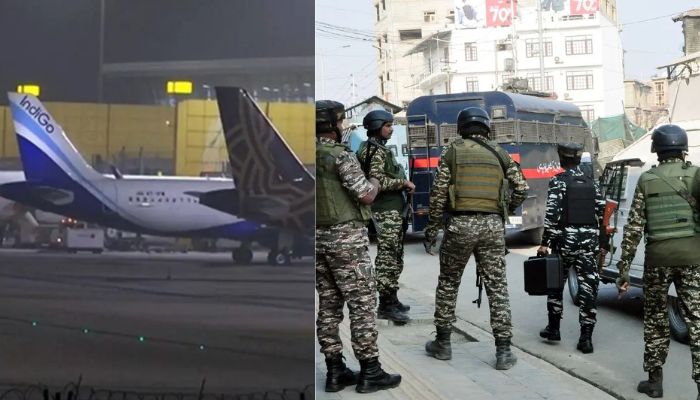
Amid ongoing tensions between India and Pakistan following the Indian Army’s precision strikes on Pakistani terror camps, Spicejet Airlines on Wednesday issued a flight advisory for airports in the northern parts of the country.
Taking to social media X, the airlines in a post wrote that airports including Dharamshala, Leh, Jammu, Srinagar and Amritsar would be closed until further notice, further stating that departures, arrivals and consequential flights would also be impacted.
The airlines also requested passengers to plan their journey accordingly and check their flight status before flying.
“Due to the ongoing situation, airports in parts of northern India, including Dharamshala (DHM), Leh (IXL), Jammu (IXJ), Srinagar (SXR), and Amritsar (ATQ), are closed until further notice. Departures, arrivals, and consequential flights may be impacted. Passengers are advised to plan their journey accordingly and check flight status,” the post read.
#TravelUpdate: Due to ongoing situation, airports in parts of northern India, including Dharamshala (DHM), Leh (IXL), Jammu (IXJ), Srinagar (SXR), and Amritsar (ATQ), are closed until further notice. Departures, arrivals, and consequential flights may be impacted. Passengers are…
Meanwhile, Indigo Airlines also issued a flight advisory for its commuters flying to and from selected cities in the country.
Taking to social media X, Indigo in a post on X stated that flights to and from Srinagar, Jammu, Amritsar, Leh, Chandigarh and Dharamshala would be impacted. The airlines requested passengers to check flight status before reaching the airport.
“Due to changing airspace conditions in the region, our flights to and from #Srinagar, #Jammu, #Amritsar, #Leh, #Chandigarh and #Dharamshala are impacted. We request you to check your flight status before reaching the airport,” the post read.
Furthermore, flights to and from Bikaner will also be impacted by the current airspace restrictions. “Update: Flights to/from #Bikaner are also impacted by the current airspace restrictions. We request you to check your flight status before reaching the airport,” the post further reads.
Meanwhile, Air India said, “In view of the prevailing situation, Air India has cancelled all its flights to and from the following stations – Jammu, Srinagar, Leh, Jodhpur, Amritsar, Bhuj, Jamnagar, Chandigarh and Rajkot – till 12 noon on 7 May, pending further updates from authorities. Two international flights en route to Amritsar are being diverted to Delhi. We regret the inconvenience caused due to this unforeseen disruption.”
Earlier, India’s Ministry of Defence confirmed that the strikes were part of “Operation Sindoor,” targeting nine terrorist camps in Pakistan and Pakistan-occupied Jammu and Kashmir. The ministry stated, “Our actions have been focused, measured and nonescalatory in nature. No Pakistani military facilities have been targeted.” The operation followed the “barbaric” Pahalgam terror attack, which killed 25 Indian nationals and one Nepali citizen.
Srinagar Airfield closed
Amidst the deteriorating situation after the successful execution of Operation Sindoor, the Airports Authority of India has said that Srinagar’s airfield will remain officially closed on 7th May. There will be no commercial flights operating in or out of the region.
Holiday declared in Jammu and Kashmir educational institutions
On Wednesday (7th May), the Jammu administration announced a holiday for all educational institutions in five districts across Jammu as tensions escalate with Pakistan in the border area. While Pakistani forces have continuously been violating the ceasefire after the Pahalgam attack, it violated the ceasefire on Wednesday, venting frustration over Operation Sindoor and resorted to arbitrary firing from posts across the Line of Control and the International Border opposite Jammu and Kashmir. Reports say that 10 civilians have lost their lives in the indiscriminate firing by Pakistan. Meanwhile, 38 are reported injured.
Taking to X, Divisional Commissioner Ramesh Kumar said, “In view of the prevailing situation, all schools, colleges and educational institutions in Jammu, Samba, Kathua, Rajouri and Poonch will remain closed today.”
Meanwhile, educational institutions, schools, and colleges in Baramulla, Kupwara and Gurez will also remain closed for today.
In a statement, Kashmir University said that all examinations scheduled for May 7th 2025, stand postponed and that fresh dates for the exams will be announced later.
Similarly, the Ferozepur Deputy Commissioner announced that all schools in Punjab’s border districts, including Ferozepur and Pathankot, will remain closed for the next 72 hours.
Operation Sindoor
On the intervening night of 6th and 7th May, India launched precision missile strikes on terror infrastructure deep inside Pakistan as part of Operation Sindoor, avenging the recent Pahalgam attack on Hindu pilgrims. Nine targets were hit in the coordinated offensive, all of which were successfully neutralised. One of the most significant targets was Markaz Subhan Allah, which is the operational headquarters of the banned terrorist outfit Jaish-e-Muhammad (JeM) in Bahawalpur, Punjab, Pakistan.
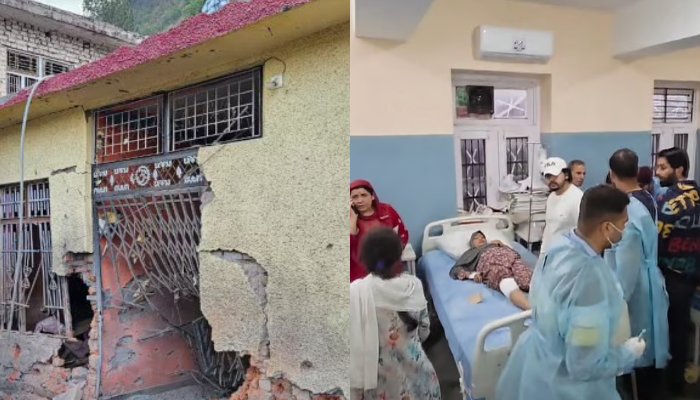
On 7th May, officials reported that at least ten civilians, including a woman and two children, have been killed and 38 injured in Jammu and Kashmir due to indiscriminate cross-border firing by Pakistani forces. This reckless firing from Pakistan came after India launched missile strikes on terror targets in Pakistan and Pakistan-occupied Kashmir. With the artillery pressed into action, a significant firefight broke out along the Line of Control and the international borders across Jammu and Kashmir. Officials informed that the civilians have died in Poonch and Mendhar.
Lt Colonel Suneel Baratwal, PRO (Defence), Northern Command informed, “During the night of 6-7 May, Pakistan Army resorted to arbitrary firing including Artillery shelling from posts across the Line of Control and IB opposite J&K.” Several sectors along the border experienced heavy bombardment. During the shelling, two members of the CRPF also sustained injuries but both are in stable condition now. Officials stated, “A shell landed at a bus stand, damaging a bus completely.”
According to local accounts, there was cross-border fire in Rajouri’s Laam, Manjakote and Gambeer Brahmana, as well as in Krishna Ghati, Shahpur and Mankote in the Poonch district. The Kashmir valley’s Uri and Tangdhar areas also reported heavy artillery bombardment. The Indian Army is retaliating proportionately to the shelling.
The indiscriminate firing started soon after India launched Operation Sindoor early on 7th May, targeting nine terrorist locations in Pakistan and Pakistan-Occupied Kashmir. These “precision strikes” on terror infrastructure were carried out using missiles. The Pakistan Army also verified that six targets had been hit. These include the Lashkar-e-Taiba headquarters in Muridke and the Jaish-e-Muhammad terror base in Bahawalpur in Pakistan’s Punjab province.
“Our actions have been focused, measured and non-escalatory in nature. No Pakistani military facilities have been targeted. India has demonstrated considerable restraint in selection of targets and method of execution,” the Indian Defence Ministry statement stated. The Border Security Force was placed on heightened alert, particularly along the western borders of India with Pakistan.
The escalation also impacted civilian life across the area. Citing security concerns, authorities have ordered the closure of schools and institutions in five border districts: Rajouri, Poonch, Kathua, Samba, and Jammu. Airport operations were halted in cities near the Indo-Pak border, including Jammu, Srinagar and Leh. Other airlines reported flight diversions and issued travel advisories, while Air India canceled flights to and from a number of northern places until at least mid-day on 7th May.
The recent hostilities are a result of the terror attack in Pahalgam where Pakistan backed terrorists killed 26 Hindu tourists in Baisaran Valley on 22nd April after confirming their religious identity.
On the intervening night of 6th and 7th May, India launched precision missile strikes on terror infrastructure deep inside Pakistan as part of Operation Sindoor, avenging the recent Pahalgam attack on Hindu pilgrims. Nine targets were hit in the coordinated offensive, all of which were successfully neutralised. One of the most significant targets was Markaz Subhan Allah, which is the operational headquarters of the banned terrorist outfit Jaish-e-Muhammad (JeM) in Bahawalpur, Punjab, Pakistan.
Markaz Subhan Allah, Jaish-e-Mohammad Bahawalpur, Punjab, Pakistan-This Markaz serves as the operational headquarter of JeM and associated with terrorist plannings including Pulwama attack on Feb 14, 2019. Perpetrators of Pulwama attack were trained at this camp. Target Achieved. pic.twitter.com/NXli9DmNpo
Headquarters of indoctrination and terror training
Markaz Subhan Allah is located near Karachi Mor on NH-5 and spread over 15 acres. It functioned as JeM’s central hub for training and radicalisation. It has been directly linked to the 2019 Pulwama suicide bombing. The terrorists involved in the attack received ideological and combat training within the compound.
The facility hosted around 600 terrorists affiliated with the outfit. It included residences of JeM’s key figures, including its founder Maulana Masood Azhar and his de facto successor Mufti Abdul Rauf Asghar. In the past few years, the complex expanded under the watch of the Pakistani government and added facilities for the terrorists living in the compound, including a gym, swimming pool, horse stables, and even an “Al Hijama” centre used for cadre conditioning.
Weapons, rhetoric and international links
It is believed that JeM-affiliated terrorists at this Markaz received weapons smuggled from Afghanistan, including leftover NATO M4 rifles. The site also served as a meeting point for JeM’s Afghan commanders and a launch pad for jihadi attacks, including those carried out by the close relatives of Masood Azhar.
The Markaz was partially funded by Pakistan’s provincial and federal governments and partially by donors from Gulf, African nations, and even from UK. As recently as November 2024, Masood Azhar publicly called for “revenge for Babri Masjid” from within the compound.
By striking such an important location for the terror outfit operating from Pakistan, India has sent a clear message that any attack on India’s sovereignty, its people, and national security will not go unanswered.
India on Wednesday carried out precision strikes aimed at the terror infrastructure in Pakistan. Nine sites were selected for Operation Sindoor, and all nine were reported to be successful. The operation was named Operation Sindoor to mark the barbarity of the Pahalgam attack by Pakistani terrorists on April 22, where Hindu male tourists were asked their religion and shot down while their wives and children watched.
The Pakistan Army, backed by its Inter-Services Intelligence (ISI) has been supporting, financing and sheltering the activities of anti-India terrorist outfits like Lashkar-e-Taiba, Jaish-e-Mohammad, Hizbul Mujahideen, among others and has systematically coordinated financial, logistics, doctrinal and military support to these outfits including providing direct combat trainings.
These terrorist groups have been provided with infrastructure concealed in government facilities to carry out their operations in Pakistan and Pakistan occupied Jammu & Kashmir (PoJK). Several training camps (Markaz), and Launch Pads of these terror outfits are currently being run near army facilities.
While Launch pads are extensively used for staging / arms training activities, religious indoctrination and other support activities such as funding, propaganda, expansion etc. are being carried out with backing of Pak Establishment in larger facilities that are located well-inside Pakistan.
The Pakistani Army acknowledged the attacks, declaring that Pakistan will retaliate.
Pakistani Army’s alert notice
On target for the precision strike were both the Markaz Taiba (a Lashkar stronghold) in Muridke and the Markaz Subhan Allah (the headquarters of the Jaish) in Bahawalpur. These Markaz not only serve as residences to major commanders of the outfits but also serve as epi-centre for radicalization and various training courses on intelligence, arms handling etc.
Pakistani news channels have reported that the Jaish-e-Muhammad headquarters in Bahawalpur, run from a madarsa, has been completely destroyed, and the sky looks red due to flames.
One of the targets was terror factory run by Masood Azhar. And this is from Pakistani TV, in case someone has any doubts
Additionally, the commanders of terrorist groups have used these facilities (Markaz) to deliver anti-India rhetoric to masses in order to motivate the recruits for Jihad against India such as in Dec, 2024.
India has launched #OperationSindoor striking multiple targets within Pakistan, hitting "terror linked infrastructure" – Pakistan is retaliating, has shut down its airspace – Intense crossfire is being reported at the Line of Control, targets sourced from Indian media below pic.twitter.com/WqEgkbzcPA
Sources have also confirmed the 9 locations were selectively targeted with the aim of destroying this anti-India Terror network. Among the targets for Wednesday’s precision strike were:
1.Markaz Subhan Allah, Bahawalpur, operational since 2015, is main centre of JeM for training and indoctrination and serves as operational headquarter of JeM. It is associated with terrorist plannings by JeM including Pulwama attack on Feb 14, 2019. The Markaz consists of residences of JeM Chief Maulana Masood Azhar, de-facto Chief of JeM Mufti Abdul Rauf Asghar, Maulana Ammar and other family members of Masood Azhar. Masood Azhar has made several addresses from this facility extolling anti – India rhetoric and appealing to youth to join Islamic Jihad. JeM conducts regular arms, physical and religious training for its cadres at Markaz Subhan Allah.
2. Markaz Taiba, Muridke, established in the year 2000, Markaz Taiba is the ‘alma mater’ and the most important training centre of LeT located in Nangal Sahdan, Muridke, Sheikhupura, Punjab, Pakistan. The complex holds arms and physical trainings facility, as well as dawa’h and radicalisation for terror entities both from within Pakistan and abroad.
This Markaz enrols around 1000 students in different courses annually thereby highlighting the role of this Markaz in churning out terror entities for LeT annually. Osama Bin Laden had financed Rs 10 million for construction of Mosque & Guest House within the Markaz Taiba complex. At the behest of Pakistan’s ISI, all the perpetrators of 26/11 Mumbai attack including Ajmal Kasab were imparted ‘Daura-e-Ribbat’ (intelligence training) at this facility. David Coleman Headley & Tahawwur Hussain Rana, the prime conspirators of 26/11 Mumbai attacks, had visited Muridke along with Abdul Rehman Sayed @ Pasha, Haroon and Khurram (coconspirators) on instructions of Zaki-ur-Rehman Lakhvi.
3.Sarjal / Tehra Kalan, located in the Shakargarh Tehsil of Narowal District in Punjab, Pakistan, is main launching facility of Jaishe-Mohammad (JeM) for infiltration of terrorists into JK. As part of concerted strategy of Pak- ISI to conceal terror infrastructure in government buildings, Sarjal facility is being operated from the premises of a Primary Health Center (PHC) in Tehra Kalan Village of Sarjal area. This JeM facility holds special prominence due to its close proximity of around 06 km from IB in Samba Sector of Jammu, J&K.
This facility serves as the base for the digging of cross-border tunnels for infiltration of terrorists. It also serves as the launching base for drones by which arms/ammunition/narcotics and warlike stores are dropped into Indian territory. JeM terrorists Mohammad Adnan Ali @ Doctor and Kashif Jan regularly visit this facility and JeM de-facto chief Mufti Abdul Rauf Asghar supervises overall operations of this facility. This facility is actively being used by JeM to infiltrate terrorists and for smuggling arms & ammunition into India.
4. Mehmoona Joya Facility, Sialkot: As another example of Pak-ISI establishing terror facilities in government buildings, Mehmoona Joya facility of Hizbul Mujahideen (HM) is located in premises of Bhutta Kotli Govt. This facility is used for infiltration of HM cadres into Jammu region of JK. HM cadres are also given training for terrorist operations and handling of weapons by the senior commanders at this facility. Mohd. Irfan Khan also known as Irfan Tanda is commander of this HM facility. Around 20 – 25 terrorists are usually present at this facility at any point of time overseeing infiltration bids and terrorist operations in India.
5. Markaz Ahle Hadith Barnala, Bhimber, located at outskirts of Barnala town on Kote Jamel road, is prominent Marjaz of LeT in PoJK and is used for infiltration of LeT terrorists and arms/ammunition into Poonch – RajauriReasi sector. This Markaz is also utilized as staging centre for LeT terrorists before infiltrating into Indian territory. It can accommodate 100 -150 cadres. LeT terror operatives Qasim Gujjar @ Mahrore, Qasim Khanda and Anas Jarar operate from this Markaz and reside in its vicinity. Operational commanders of LeT visit this Markaz for organizing and supervising terrorist activities of LeT / Jamaat-ud-Dawa /Jammu & Kashmir United Movement.
6. Markaz Abbas, Kotli, is an important terror facility of JeM located in Kotli. Hafiz Abdul Shakoor @ Qari Zarrar, ‘shura member’ of JeM Council and close associate of JeM top commander Mufti Abdul Rauf Asghar, is head of this Markaz. Qari Zarrar is directly involved in planning and execution of terrorist attacks in J&K and is wanted by National Investigation Agency (NIA) of India. Markaz Abbas can accommodate around 100 – 125 JeM cadres. JeM’s terror activities including infiltration of cadres from the Poonch – Rajouri sectors are planned and executed from this facility.
7. . Maskar Raheel Shahid, Kotli, PoJK, is one of the oldest facilities of HM. It can accommodate around 150 – 200 HM terrorists. HM terrorists visit this facility particularly for taking arms firing training and specialized physical training. In addition to providing conventional arms / physical training, this Camp specializes in training cadres for BAT/ sniping actions and fighting in hilly area & survival training.
8. Shawai Nallah Camp, Muzaffarabad Shawai Nallah Camp, also known as Bait-ul-Mujahideen, is located near Chelabandi bridge on Muzaffarabad-Neelum Road, Muzaffarabad, PoJK. It is one of the most important camps of LeT. Attackers of 26/11 Mumbai Attack including Ajmal Kasab had received terrorist training in this Camp. This camp is used for recruitment, registration and training of LeT cadres and has been functional since early 2000. It is used as base camp for imparting Daura-e-Aam training, which includes religious indoctrination, physical training, tactical training regarding use of GPS, map reading and arms training for rifles and grenades. Pak-ISI also facilitates by providing trainers of Pak Army to provide weapons training to LeT terrorists. It is a large training camp which can accommodate 200-250 LeT cadres at a time. This camp is also utilized as staging camp for LeT terrorists before infiltrating into Indian territory. LeT terrorists camping here are sent to launching facilities located opposite North Kashmir.
9. Markaz Syedna Bilal, located opposite Red Fort, Muzaffarabad. This facility is used as transit camp for JeM terrorists prior to their launching into JK. At any point of time 50-100 cadres resides in this facility. JeM operational commander and JeM head of PoJK, Mufti Asghar Khan Kashmiri is in-charge of the facility. Abdullah Jehadi@ Abdullah Kashmiri and Aashiq Nengroo (Indian Fugitive) also operate from this centre. Commandos of Special Service Group (SSG) of Pak Army also impart training to JeM cadres at this facility.
Indian Armed Forces successfully struck these nine terror targets, four in Pakistan, including Bahawalpur, Muridke, and Sialkot, and five in Pakistan-occupied Jammu and Kashmir (PoJK), using special precision munitions in a coordinated operation, sources told ANI.
The operation was jointly carried out by the Indian Army, Navy, and Air Force, with the mobilisation of assets and troops. Prime Minister Narendra Modi was constantly monitoring Operation Sindoor throughout the night, sources confirmed to ANI.
Reports say that all the Indian aircraft and the pilots who participated in the precision strike are accounted for, and are safe. Though details of the strike are yet to become fully clear, it is reported that it was a tri-service coordination. Assets of Indian Navy, Indian Army and Indian Air Force were used in coordination to launch and carry out the attacks. Loitering munitions and drones have also been used.
The Indian Ministry of Defence has made it clear that the targets were terrorist camps and no Pakistani military establishments have been hit. A detailed press briefing will be carried out in Delhi later today.