Home Blog Page 443

Muzaffarpur : Shamshad becomes Suraj to trap Hindu girl, sexually exploits her, forces her to convert and consume beef for marriage

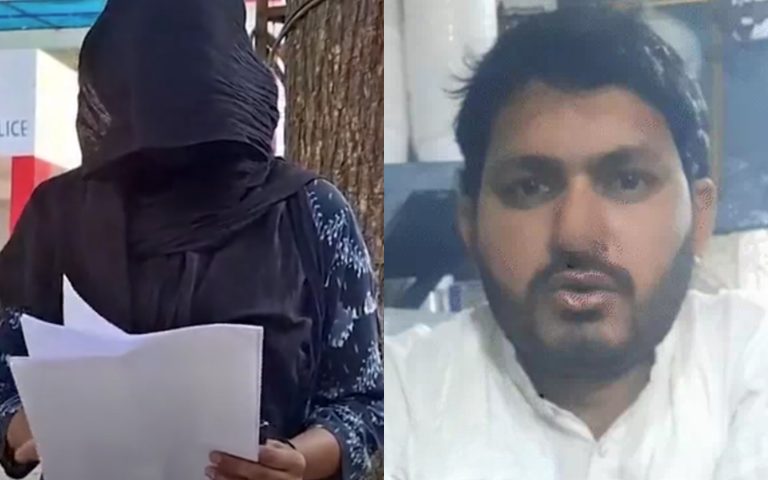
In a case of Love Jihad from Muzaffarpur, Bihar, a Muslim man Shamshad trapped a young woman from the Brahampura Police Station area. Shamshad posed as a Hindu man Suraj and exploited her sexually. When the victim asked him for marriage, he asked her to first embrace Islam and consume beef.

The victim has now filed a complaint with the Muzaffarpur Rural Superintendent of Police (SP) on 21st April. She named Syed Shamshad Hussain, his brother Almdar Hussain, his mother Mehrunisha, and his older sister as accused in her application to the official.

The victim’s complaint said, “A man named Shamshad introduced himself as Suraj and lured me into a relationship. He also took money under the pretext of his mother’s illness and to educate his siblings. He revealed his real identity when I brought up the issue of marriage. Now, he’s threatening to kill me.”

The perpetrator is from Kolhua, Paighambarpur, in Bairia area of Muzaffarpur. She stated, “I met him in 2007 at a coaching institute. We became friends and studied together. At that time, I didn’t have the awareness to check whether he was Hindu or Muslim. In 2017, I moved to Delhi for a private job but remained in contact with him. He told me that there was no earning member in his family and he had younger siblings who needed to study.”

“Suraj told me that he was responsible for the entire household. Given his situation, I also provided him with financial help multiple times. However, when I was in need of money and asked him to return the amount, he made excuses and claimed he couldn’t repay it which led to arguments between us. He then switched off his phone. After trying his number for several days, I eventually stopped calling him. My mother passed away in August 2023 and I returned to Muzaffarpur. One day, while I was out shopping, I ran into him in the market. He took my number again and we resumed our communication,” she mentioned.

She further disclosed, “We started meeting. We grew close, entered into a relationship and he promised to marry me. On 12th April 2024, he took me to Patna on his bike. He booked a hotel there and gave me a drink laced with a sedative. After that, I don’t remember what happened.”

According to the victim, Shamshad had physical relations with her without her consent. “When I protested, he vowed to marry me. He told me not to worry and assured that he would take good care of me and never betray me. I was reassured by his words. Afterwards, we started meeting regularly. However, he kept making excuses like his mother’s sickness or his sister’s upcoming wedding, whenever I reminded him of his promise,” she said.

As per the complainant, his behaviour started to change suddenly. She said, “When I started pressuring him for marriage, he declared that his mother would only accept it if I converted to Islam. He asserted that the nikah (Islamic wedding ceremony) would only happen if I converted to Islam. I was shocked to hear this. Only then did I realize that he was not Suraj but Shamshad. When I refused to comply, he abused me and directed me to eat beef.”

“One day, I went to his house to ask for my money and found out that Shamshad Hussain was getting married. I was abused by him, his brother, elder sister and mother. I returned home in tears,” she added.

According to other reports, she got in touch with his friends and learned that he had been using a fake name. He is Syed Shamshad Hussain, son of Syed Mumtaz Hussain, a resident of the Ahiyapur police station area in the district. The revelation infuriated her and the pair had a heated argument over the phone. She subsequently demanded her money back and warned him that she would report him to the police after which he issued death threats.

City SP Vidya Sagar reported that the victim has filed an application and indicated that she was living with her boyfriend who is now threatening to kill her. The same has been forwarded to the officer in charge at Brahampura Police Station and instructions have been given to look into the matter and pursue appropriate legal action.

How the Catholic church sexual abuse scandal in Chile tarnished Pope Francis’ legacy

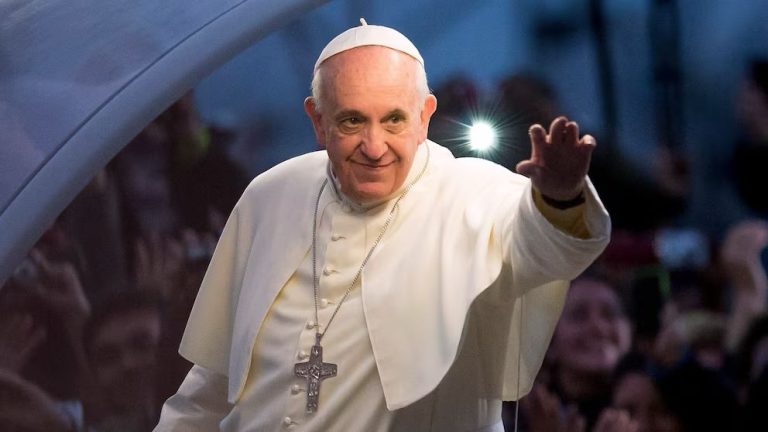
On April 21, Pope Francis, the 266th Pope of the Roman Catholic Church, breathed his last after battling a prolonged illness. He was 88 at the time of his death. Born as Jorge Mario Bergoglio, Pope Francis was the head of the Roman Catholic Church and the sovereign of the Vatican City State.

Cardinal Farrell announced the news of the Pope’s death, saying, “Dearest brothers and sisters, with deep sorrow I must announce the death of our Holy Father Francis.” He died at his residence in the Vatican’s Casa Santa Marta.

Even as the Catholic world drowns in mourning, it is worth pondering the legacy of the deceased Pope, a mixed bag of positives and negatives.

Pope Francis was the first Pope from the Jesuit order Society of Jesus, the first from the Americas, the first Pope from the Southern Hemisphere, and the first one born or raised outside Europe since the 9th-century Syrian Pope Gregory III. Though he will be remembered chiefly for championing inclusiveness and empathy, his conduct in the Chilean sexual abuse case continues to cast a pall on his legacy.

When Jorge Mario Bergoglio became Pope Francis in 2013, many thought, here is an unassuming Christian priest who comes without the baggage his predecessor had and has brought with him the promise of a different brand of papacy. A Pope who relinquished the splendour of the Apostolic Palace for a modest Vatican guesthouse. He spoke of a Church that stood up for the marginalised, welcomed the immigrant, sympathised with the poor, and supported the vulnerable, particularly the LGBTQ community. 

He told the world, “Who am I to judge?” when asked about gay priests. He denounced the criminalisation of homosexuality, saying laws that penalise same-sex relationships are unjust, stopping short of sanctifying it within the Catholic Church. However, in a world where religious authorities often cling to doctrinal purity over inclusivity, especially in monolithic faiths such as Christianity, Islam, and Judaism, Pope Francis presented himself as a breath of fresh air, positioning himself as a beacon of compassion and inclusion.

And yet, even the brightest lights cast shadows.

The Chilean sexual abuse scandal remains one of the darkest chapters of Pope Francis’ papacy—not simply because of the appalling crimes committed by Christian priests, but because of the way the Vatican treated those crimes: outright dismissal, disbelief, and denial. It is a sobering reminder that the Pope, who embodied compassion and empathy for millions around the world with his stance on the marginalised, was, after all, a human being, a fierce loyalist susceptible to overlooking crimes committed by their own ilk.

A church in crisis

The scandal’s roots reach back decades. Father Fernando Karadima, once a towering figure in the Chilean Catholic Church, was for years hailed as a spiritual father and mentor to many young men. 

Behind closed doors, he was a predator, preying on victims, mostly seminarians and young Catholics, who looked to him for guidance. Complaints about Karadima date as far back as the 1980s, but they were repeatedly ignored by Church authorities for the reputational fear it brought with it, besides the offence caused to the senior clergymen. It was only in 2011, long after many survivors had given up hope, that the Vatican found him guilty of sexually abusing minors. He was sentenced not to jail, but to a life of “prayer and penance.”

But Karadima was not the end of the story. He was the start of a wider reckoning. His influence extended throughout the Chilean clergy, including to Bishop Juan Barros, who had been one of his close protégés. Victims accused Barros of witnessing Karadima’s abuse and remaining silent. When Pope Francis appointed Barros as Bishop of Osorno in 2015, it precipitated widespread outrage in Chile. Victims spoke out. Protests erupted. Members of the clergy expressed concern. But Francis refused to pay heed.

But that was not the end of it. 

On a 2018 trip to Chile, Pope Francis went even further. He accused Karadima’s victims of “slander” and claimed there was “no proof” against Barros. The words acted as a serious assault on the ordeal of the survivors. They felt horrified for being betrayed by the Pope and the Vatican. And for the faithful, that one moment to witness a Pope celebrated for his pastoral sensitivity, discrediting the voices of the victims, was disillusioning. 

From denial to acceptance and finally, repentance

The backlash was fierce and global. Facing immense pressure, Pope Francis sent Archbishop Charles Scicluna, an experienced Vatican investigator, to probe into the allegations. The resulting report was devastating: a 2,300-page account of systemic abuse and institutional failure within the Chilean Church.

To his credit, Francis pivoted and changed course. He confessed to having made “grave errors in judgment.” He invited victims to the Vatican, met with them personally, and sought their forgiveness. In a move that had hitherto no parallel, all 34 Chilean bishops were summoned to Rome, and all offered their resignations. Several were later removed or sanctioned.

In many ways, this was a moment of institutional reckoning. The Pope’s initial disbelief, his public dismissal of credible victims, and his failure to investigate sooner revealed a troubling truth: even a reform-minded Pope could succumb to the age-old trap of clericalism, where protecting the Church’s image took precedence over safeguarding its people.

It was, in many ways, a moment of institutional reckoning. However, it also came too late for many survivors, as the damage had already been done. From initial disbelief to public dismissal of victims’ sufferings, and his failure to exhibit a willingness to look inward and commission an investigation revealed a discomfiting fact: even a reform-minded Pope could fall victim to the age-old trap of clericalism, where salvaging pastoral reputation took precedence over protecting its people.

The jarring reconciliation

This is what makes the Chile sexual abuse case incongruous to reconcile with the rest of Francis’s legacy. He has spoken out—often courageously—on issues held dearly by the conservative Catholics, but those which made the Catholic Church a source of condemnation rather than comfort. He grabbed headlines in 2023 for declaring that “being homosexual is not a crime,” and criticised countries where LGBTQ+ people face criminal prosecution. He called on bishops to welcome gay people into their communities and pastoral care.

At a time when religious leaders stoke communal sentiments and insist on clinging to exclusionary ideologies, Francis served as a beacon of hope for millions. His vision of the Church includes, embraces, and walks with the outcast.

Critics of Pope Francis argue that while he may articulate progressive ideas effectively, he often fails to implement them in practice. They contend that inclusion is not merely about delivering occasional catchy phrases; it requires a committed effort to transform those words into concrete actions.

In Chile, it didn’t. At least, not until the truth was undeniable.

The contradiction cannot be starker. The Pope who refused to judge gay people was, at least for a time, willing to judge—and dismiss—those who had suffered at the hands of priests. The same Pope who spoke of mercy failed to extend it to those who were in dire need of it and were demanding it, from none other than the Pope himself. 

This is not a call to cynicism. Pope Francis did much good. His commitment to climate action, interfaith dialogue, economic justice, and marginalised communities changed the perspective of many towards the Church. He had displayed the mettle of going against powerful structures, both within and outside the Vatican. And his eventual response to the Chile scandal, including his public repentance, was a rare and courageous act of papal humility.

But leadership is not just about owning mistakes and setting them right. It is also about building frameworks and structures where mistakes aren’t committed in the first place, especially when the cost of error is paid by the victims. 

A stained legacy

In the end, Pope Francis’s legacy will be complex. He will likely be remembered as a reformer, a pastor who tried to move the Church away from rigid legalism and toward the margins. But the Chile scandal will remain a shadow over that legacy—a moment when mercy faltered, when judgment failed, and when allegiance to the institution eclipsed the sense of morality. 

The Catholic Church has long grappled with contradictions: justice and mercy, tradition and reform, dogmatism and pragmatism, power and humility. Pope Francis exemplifies many of these ironies deeply entrenched in the system. In his embrace of LGBTQ+ people, his critique of economic injustice, and his call for inclusion, he has moved the Church forward. But in his handling of the Chile abuse scandal, he reminded the world that the road to reform is often filled with potholes, and that even those who are most alert and vigilant can meet with an accident.

Ultimately, a true leader is not judged by the perfection of his actions but by his ability to take responsibility. Pope Francis’s willingness to admit his mistakes and change course was meaningful. But so too is the pain of those who, in their darkest hours, were told their truth was nothing but a calumny designed to defame the Catholic clergy. 

In the end, the Pope, who famously said “Who am I to judge?” must also be remembered as the one who, in Chile, was too soon to judge—and paid heed too late to the atrocities faced by the victims of sexual abuse at the hands of the Christian clergy. 

Jathibhanga massacre: How Pakistani Army, Razakars and their Islamist associates slaughtered over 3,000 Hindus in Bangladesh

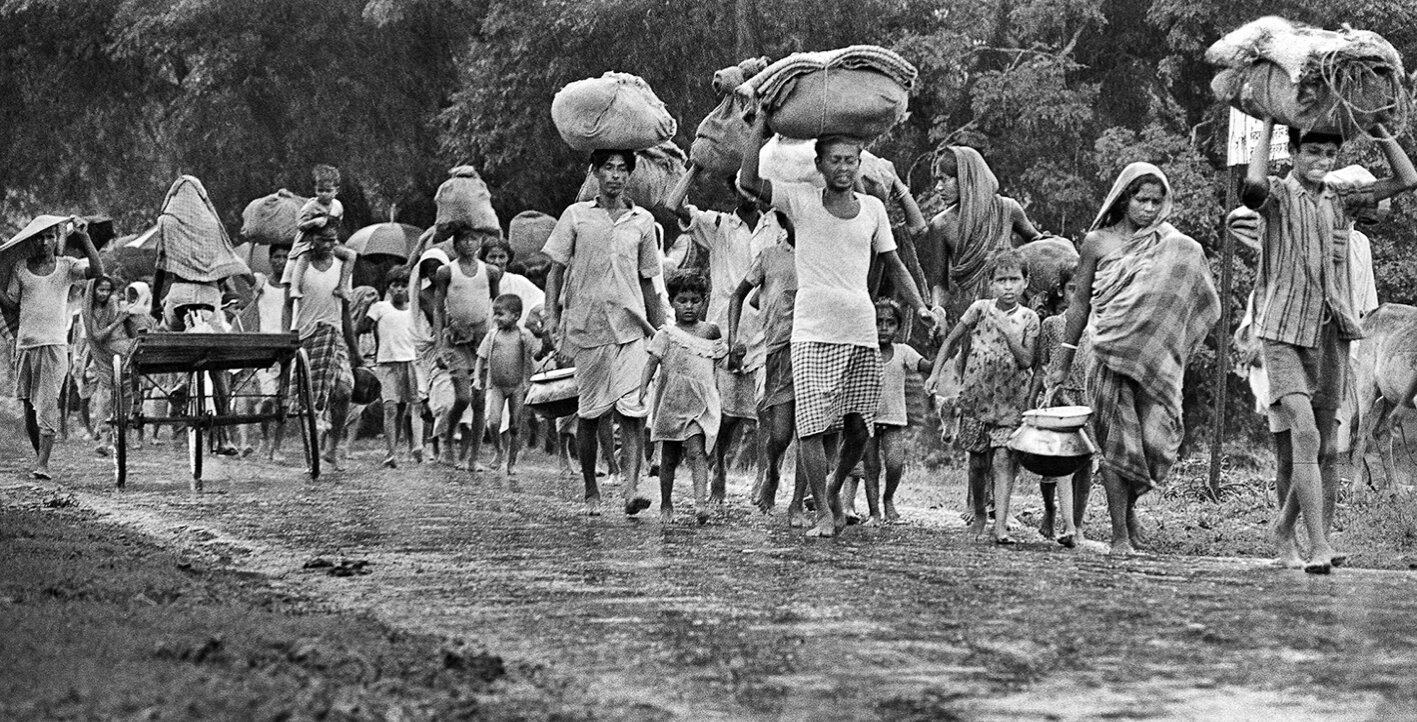
Bangladesh’s freedom movement has been marked by harrowing accounts of violence and bloodshed inflicted upon those resisting the repressive regime of West Pakistan which sought to retain its hegemony over East Pakistan at all costs. Notably, around 10 million refugees fled from then East Pakistan to India to escape the atrocities, resulting in a massive refugee crisis. India was eventually compelled to intervene to defend the oppressed population and lead them toward the dawn of independence.

Nevertheless, the violent actions of the Pakistani forces and their collaborators resulted in the tragic loss of thousands of freedom-loving individuals, including the minority Hindu community, who bore the brunt of the brutal suppression. The Hindu community faced a twofold danger from the Pakistani army and their jihadist allies, not only for their desire for independence but also due to their non-Muslim identity.

Bangladeshi refugees coming into India in 1971. (Source: Harvard International Review)

Consequently, the tyrants unleashed their full force to punish the Hindus for their defiance of the Pakistani state. The aggressive frontal attack led to a wave of massacres, resulting in the deaths of thousands as the Pakistani army and their radical lackeys assaulted innocent Hindus, a grim event that would resonate through history.

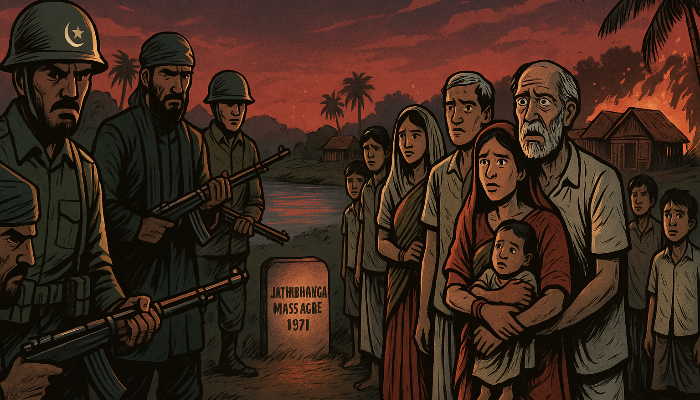
On 23rd April 1971, 54 years ago, one such horrifying incident occurred in the Jathibhanga (or Jathivanga) village, now known as Vidhapalli, in Kismat Sukanpukuri Mauza of Balia Union, located within the Thakurgaon sub-division of the greater Dinajpur district, involving the Pakistani army and the Razakars. Members of the Pakistan Democratic Party, Muslim League, and Jamaat-e-Islami were also among the aggressors. All of the Rajbanshi and Bengali people who died during the genocidal event were Hindus. The massacre took the lives of nearly 3,500 Hindus in a matter of hours.

On the fateful day, the jihadi associates of the Pakistani army apprehended innocent Hindu civilians and assembled them along the banks of the Jathibhanga River. Following a tip-off from the Razakars, the occupiers surrounded the men and women from all directions, eliminated them in cold blood and dumped their bodies in a mass grave at the location.

What happened in Jathibhanga

On 26th March 1971, Sheikh Mujibur Rahman proclaimed the independence of Bangladesh from Pakistan, signifying the onset of the country’s liberation war. The invading forces, aided by Razakars, Al-Badr and Al-Shams, unleashed a wave of inhumane torture and killings against those yearning for freedom, following the development.

Thousands of minority families from various villages in Thakurgaon, including Balia, Shukhanpukuri, Jagannathpur, Chakhaldi, Singia, Chandipur, Basudebpur, Milanpur, Gouripur, Khamar Bhopla, Palashbari of Birganj and Deviganj of Panchagarh, escaped to India with their women and children in a desperate bid to escape the brutality.

In the early hours of 23rd April, Hindus from the twelve villages commenced their journey towards India. During their journey, thousands assembled at Jathibhanga to proceed further. Unfortunately, shortly after their arrival, a local collaborator blocked their escape routes and informed the Pakistani army. The Hindu men were escorted in a procession toward the Jathibhanga grounds.

The Pakistani troops arrived in two military trucks, ordered the Hindus to line up and then opened a barrage of gunfire from machine guns. This wave of violence started in the morning and lasted until the afternoon. The army then left after the mass killings and their aides moved the bodies near the Pathraj river and buried them there. According to other reports, their bodies were dropped into the river.

The blood of defenseless victims changed the area into a sea of red, with 3500 individuals brutally slain by firearms and sharp instruments. Hundreds of women became widows that day. This tragedy was the largest genocide recorded in Thakurgaon district during the Bangladesh freedom struggle.

Commemoration of the massacre and demands for justice

The government of Bangladesh installed a memorial at the site of the mass killing in 2009. A condolence meeting was held in 2011 after the victims and survivors held a mourning rally to honor the deceased. The speakers called for the war criminals to stand trial. The government granted a one-time payment of BDT (Bangladeshi Taka) 2,000 to 89 widows in August 2011. Touhidul Islam, the Upazila Nirbahi Officer for Thakurgaon Sadar Upazila, announced that five hundred widows from Jathibhanga village will be included in this initiative in a phased manner.

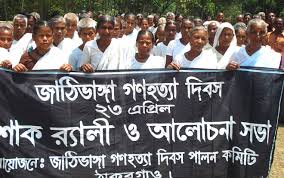
The community in Jagannathpur village situated in Thakurgaon Sadar upazila, marked the Jhathibhanga massacre day with various commemorative events, in 2014. The Jhathibhanga Ganahatya Dibash Palan Committee led a condolence procession. The event saw participation from over a hundred women who had lost their husbands, along with many others who had lost their fathers during the incident. They demanded the prompt arrest, trial and punishment of those responsible for the killings.

Women, left widowed by the brutal killing of their husbands at the hands of Pakistan occupation army and their local collaborators on 23rd April 1971, join a mourning procession at Jagannathpur in Thakurgaon Sadar upazila in remembrance of Jhathibhanga massacre day. (Source: The Daily Star)

Freedom fighter Dr Nipendranath chaired the gathering, which was addressed by a number of people, including journalist Abdul Latif, former Jagannathpur Union Parishad member Dhani Charan, Giren Chandra’s widow Shushila Bewa, Pobanshori and Roshni Rani. Speakers at the program noted that, despite the passage of 43 years since the Liberation War, the Razakars involved in the murders continue to roam freely, with many having risen to positions of influence within society.

Eyewitness Dhani Charan stated, “We decided to cross the border for refuge in India as it was not safe to live in the area. When we reached Jhathibhanga village, the sun was setting and we decided to stay for the night there and start next morning. But the Razakars of the area came to know about it and immediately informed the Pakistani army.”

“A contingent of the Pakistani army rushed to the area and encircled the hapless innocent people. Later the collaborators asked the male members of the minority community to stand in queues. The Pakistani soldiers and their collaborators killed around 3,000 people that day,” she further added. Other women who witnessed the violence, including Pabanshori, Gothan Bala and Roshni Rani also recalled the horrifying details of the terrible event.

This was not the only incident of mass murder in East Pakistan (now Bangladesh) by the Pakistan Army. On 25th March 1971, the Pakistani military executed a massacre of defenseless Bengalis, under “Operation Searchlight.” This event stands as one of the most horrific mass murder incidents in history. The Pakistan army, along with the Peace Committee, Razakar, Al-Badr and Al-Shams forces, perpetrated these killings. Bangladeshi authorities have uncovered five thousand boddhovumi (slaughterhouses) since gaining independence.

More than a thousand individuals have been identified from these sites. A significant number of skulls, skeletal remains and hair have been retrieved from the slaughterhouses. These shocking sites are distributed throughout the nation and the Jathibhanga slaughter ground stands as a stark reminder of the most brutal massacre that transpired in the Thakurgaon district. According to the definition of genocide provided by the United Nations, the horrific events of 1971 displayed the first four of the five characteristics. However, the genocide in Bangladesh has not yet gained international recognition.

These gut wrenching events and their residual effects serve as a testament to the abuse, persecution and cruelty by Pakistanis and their Islamist allies on Bangladesh and its people, especially Hindus.

The horror of Murshidabad: 10 Hindus, who lost everything in violence by Muslim mobs, narrate what happened to them

The Hindu community in Murshidiabad has been subjected to unspeakable atrocities by violent Muslim mobs. Hindu families have lost their homes and livelihoods.

Their water tanks have been poisoned and they have been subjected to both rape and death threats. Haragobindo Das and his son Chandan were hacked to death by their Muslim neighbours.

The Hindus, fearing for the safety and security of their families, had to flee to the neighbouring Malda district.

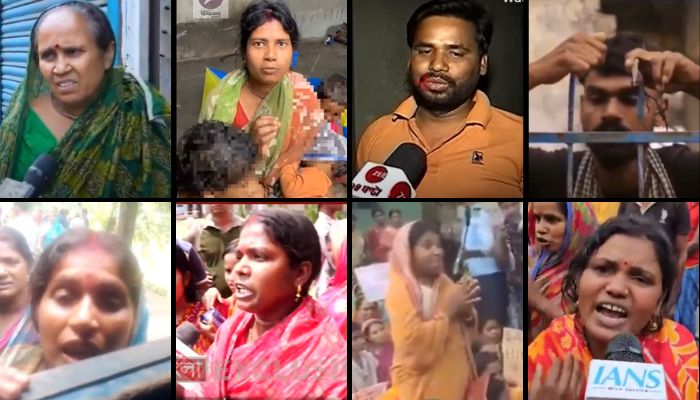
Here are 10 more videos (besides the 12 video testimonials covered by OpIndia) that capture the horror of Murshidabad.

While speaking to Panchjanya, a woman identified as Mamata Ghosh recounted, “They told me that they will forcibly make me a Muslim. They threatened to rape me and erase my sindoor (vermilion powder used by Hindu women)”

“They (Muslims) told me that we will remove the existence of India and turn this place into Bangladesh…They made it clear that they do not want Hindus here,” she emphasised.

Another Hindu woman has narrated how she was given a choice between being raped and protecting the lives of her children and husband.

“Get raped by us (Muslims), we will spare your husbands and children,” the victim recounted the threats issued to Hindu women in Murshidabad.

She added, “This is our situation. What else do I tell you? How can we return home under such circumstances? And where else will we go?”

The same allegations were made by another Hindu woman, who narrated, “They (Muslims) told us to give our izzat (dignity) and protect the lives of our husband and children”

A Hindu teacher in Samserganj in Murshidabad narrated how some of his Muslim students were part of the violent mob that laid siege to his house.

“My house was gheraoed by 100-150 people. I was shocked to see some of my own students were part of the mob that came to attack me. They were armed with weapons,” the teacher narrated to Zee24 Ghanta.

“If we remained here, then, we would have been dead. They looted everything, gold, money and other valuables. They even burnt my SSC books. How will I prepare now?” he added.

“Muslims burnt down our homes. There is nothing left. I am forced to wear the same clothes,” a Hindu youth who lost everything in the Murshidabad carnage told ‘The Rajdharma’ news channel.

The victim is now separated from his family of 7 members. He narrated that the carnage began in the afternoon of 11th April and continued till 12th April.

“They were raising Islamic chants and specifically burning the house of the Hindus. The attackers were not outsiders but Muslims from our neighbourhood,” he informed.

“We will always be fearful to return because these Muslims live in our vicinity. Everyone is living in fear,” the Hindu youth added. He has a pregnant wife who also had to leave behind her home.

“I had no option but to hand over my hard-earned money to them to save our lives,” a Hindu woman from riot-torn Murshidabad narrated.

“I had got ₹7 lakhs by selling land. I had about ₹4 lakhs. We had to hand over everything. I had about 4 bhori gold (~46 gram) and to give that up too,” she lamented.

The victim narrated that her husband was held hostage by the mob. She informed that the Muslims threatened to kill her husband, if she did not hand over her money, gold and other valuable items.

“My husband is more important to me. So I gave them everything to save his life…They have destroyed everything, including my house, ” the Hindu woman emphasised.

An elderly Hindu woman named Chanchala Ghosh told Jist News that her kirana store, where she sold groceries and other essential items, was looted by Muslims.

“I had shut the shop during the afternoon. They broke into the shop and looted everything. There is nothing much left here,” she informed.

Ghosh added, “They wanted to slaughter us, chase us with sticks and pelt stones at us. They lobbed gas bombs at us. We had to cover our faces to prevent our eyes from burning.”

“We want Presidential rule here or a camp of central forces. Else, we will not survive here. We do not have Faith in our local administration. There is a thana in the vicinity, but they did not do anything to stop the carnage that lasted for 4 hours,” the victim concluded.

Jist News shared disturbing visuals of the kirana store, which was vandalised by Muslim mobs.

“We do not want to go home. We will not be able to survive there,” narrated a Hindu woman who fled Dhuliyan in Murshidabad to reach Par Lalpur in Malda.

“Muslims will not allow us to live there. They have put knives to our throats. They had bombs and petrol in their bags. They were armed with weapons,” she added.

“They (Muslims) pulled the hair of Hindu women, held their hands forcibly…What did the Hindu women do to deserve this? Hindu men do not do this to Muslim women. Why are Muslim men doing it to Hindu men?” the woman asked.

A helpless Hindu woman from Murshidabad narrated her ordeal to the Chairperson of the National Commission for Women (NCW), Vijaya Kishore Rahatkar.

With folded hands, the victim recounted, “We pleaded with them (Muslims) to leave us and our house. We told that we are extremely poor people.”

While breaking down in tears, she said, “When we told them about our situation, they (Muslims) told us to hand over our girls to them. They told us they were there for the girls.”

A young Hindu girl from Dhuliyan in Murshidabad stated, “The situation in the area is extremely bad. There is an atmosphere of fear. We want peace and security. We need a solution for the situation that has arisen here. We do not want a repeat of this situation.”

She further added, “We want permanent deployment of central forces here. The ADG of BSF has come here and taken note of the damage caused here. He informed that BSF will be here for 1 month, but could not confirm about future deployment.”

Another Hindu man from Murshidabad narrated, “We talk about State-sponsored terrorism. What has happened here is State-sponsored mayhem. The police station is just 200 metres away. For 3 hours that day, they (Muslims) unleashed mayhem here. We are not safe here. The State (Mamata government) wanted these buildings to be looted and people (Hindus) to be oppressed.”

It is worth noting that under the Trinamool Congress Party’s rule, West Bengal has witnessed a deteriorating law and order situation.

Mamata Banerjee’s government has been unsuccessful in containing the escalating violence against the Hindu community.

Her appeasement politics have emboldened radical Muslims to the extent that they do not fear orchestrating violence, vandalism and arson against Hindus living in West Bengal.

How Vietnam is restructuring provinces, reducing beurocracy and cutting down govt jobs by 30% to increase productivity and efficiency in a changing world

Vietnam is undergoing one of the most ambitious overhauls of the administrative structure of the country. This is the first time since the Doi Moi reforms of 1986 that the country’s leadership has greenlit a sweeping plan to reduce bureaucracy, cut public sector jobs and improve administrative efficiency. The aim of such a significant overhaul is to meet the demands of the fast-evolving global economy.

Halving provinces and dissolving districts

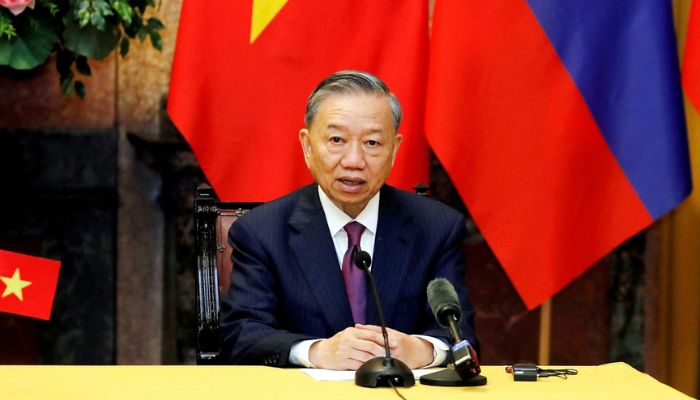
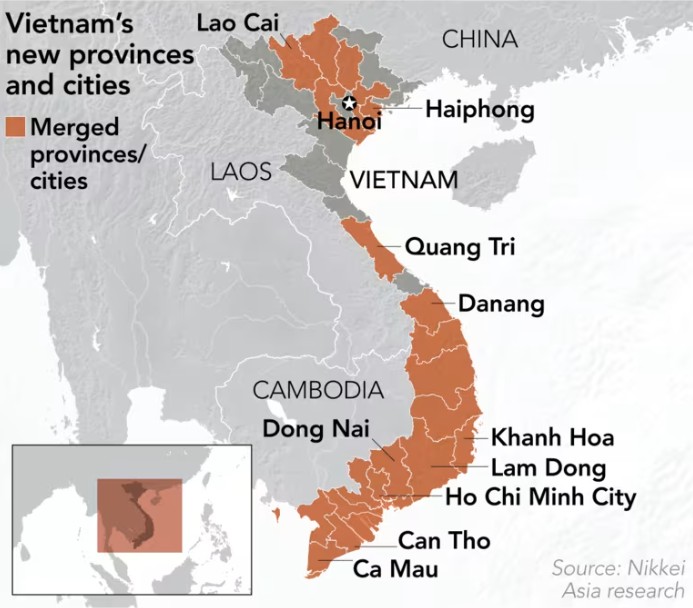
The Communist Party General Secretary and President of Vietnam, To Lam, has signed a new resolution which aims to reduce the number of provinces and cities from 63 to 34. The government of Vietnam wants to eliminate overlaps in governance and align the administrative boundaries in more effective ways with economic potential. Interestingly, Vietnam has decided to let go of districts altogether, which are currently serving as an intermediate layer.

Source: Nikkei Asia

There is a four-tier administrative system in Vietnam that includes central, provincial, district and commune levels. After the proposed changes come into effect, a three-tier structure will be in place with central, provincial or municipal, and commune or ward-level administration. It is similar to the model followed by over 80% of countries worldwide. The government has also planned to clarify roles across levels. For example, if the central government is handling a function, provinces will not duplicate it. Similarly, if a province has undertaken a task, communes will not replicate or mirror it. Such a system will ensure timely completion of projects or tasks with reduced bureaucracy.

Reports suggest that around 5,000 commune and ward-level units will be formed through mergers, which will reinforce the grassroots level of governance. At the moment, 44% of the provinces and cities have access to the sea. The government has aimed at increasing the access to 60%, which will improve opportunities for coastal development, port access, and sea-based industries such as tourism and seafood farming.

Reducing civil servants and merging ministries

Vietnam is aiming to cut its civil servant workforce by at least 20% by 2030. Ministries and agencies will be merged to reduce internal divisions by up to 40%. The government is hoping that downsizing the number of civil servants and merging ministries and agencies will help increase efficiency, enable a better pay scale and reduce corruption.

The decree signed to implement the changes came into effect in January 2025. It outlines provisions for early retirement, resignation, reskilling and training to facilitate the reorganisation of cadres, public employees and civil servants.

The number of ministries will soon be reduced to 17, from the current 22. Furthermore, government-affiliated agencies are expected to go down to 5 from 8. The Ministry of Finance will absorb the Ministry of Planning and Investment. The Ministry of Construction will be merged with the Ministry of Transport. A new Ministry of Agriculture and Environment will be formed, which will oversee both departments. The Ministry of Ethnic and Religious Affairs will be created. The Ministry of Science and Technology will absorb select functions of the Ministry of Information and Communications. The government has decided not to touch several ministries such as National Defence, Public Security, Justice, Foreign Affairs, and Health.

Streamlining administrative procedures and cutting red tape

One of the major issues that developing countries, including Vietnam, face is the long list of administrative procedures and red tape. Vietnam has aimed to bring a thrust of reforms to reduce existing administrative procedures by 30%. It will help businesses and investors gain easier access to government agencies and get their approvals done in reduced time with much less paperwork.

Vietnam is known for its red tape. In fact, a European businessman once reportedly described the paperwork needed to import a single container as difficult, reaching the height of a speaker’s podium. By removing barriers that are in place in the form of red tape, Vietnam is aiming to increase the country’s exports and meet foreign direct investment targets.

The government is seeing 2030 as a key milestone to redefine the country’s place in a shifting global order. Vietnam is hopeful of becoming a high-income nation in the coming years. Party chief To Lam, in a statement on national television, said, “If we do not innovate, we will lose.”

Economic context and targets

Notably, Vietnam’s economy has expanded rapidly. If its 2023 GDP is compared with that of 1986, there has been an increase of 96 times. In dollar terms, the economy has grown 3.3 times compared to 2010. Regional peers including the Philippines, Malaysia, and Thailand are not even close to such rapid development. The International Monetary Fund (IMF) has projected that the country’s GDP may surpass that of Thailand and Malaysia by 2028.

The government of Vietnam has aimed for an 8% growth rate in 2025. Furthermore, it is aiming at a 10% growth rate in the coming years. Thirty percent of the exports from Vietnam are to the US and despite US President Donald Trump’s trade war on several countries, Vietnam is hopeful of seeing an increase in exports.

Civil service reform and pay restructuring

Government jobs in Vietnam are considered to be secure despite the fact that they are low-income jobs compared to the private sector. With such a low-income scale, chances of corruption increase. The Ministry of Home Affairs has proposed aligning the salaries of civil servants with average private sector rates. However, whether the government will be able to implement the proposal is uncertain.

To Lam has called for “proactive resignation” in case government employees feel they cannot meet the new standards. Terming it as an “act of bravery”, he noted that it will give way to better-suited individuals.

Legislative push and public sentiment

The National Assembly will sit through May and June to pass key laws to enable the restructuring. The reform process has caused short-term delays in some administrative procedures. However, the country’s top leadership is determined to bring the changes, which reportedly has raised hopes among the citizens and businesses.

Conclusion

Vietnam is not only aiming to enhance operational efficiency but also to reposition the country on the global economic map. If the proposal is implemented successfully, it will help Vietnam achieve its goal of becoming a high-income, export-driven country by 2045.

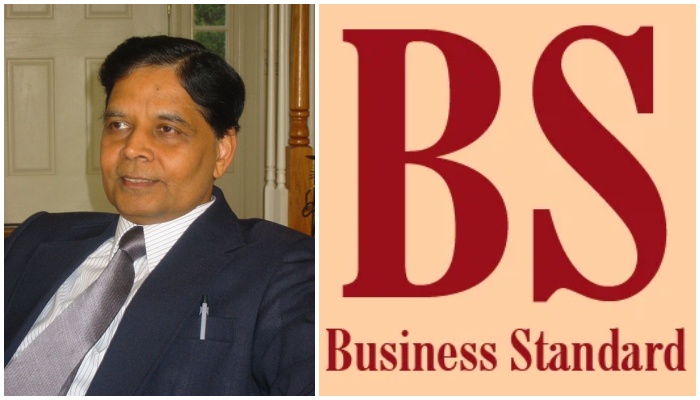
Business Standard invents quote from Arvind Panagariya, Chairman of the 16th Finance Commission, falsely claims Editorial opinion was written by him

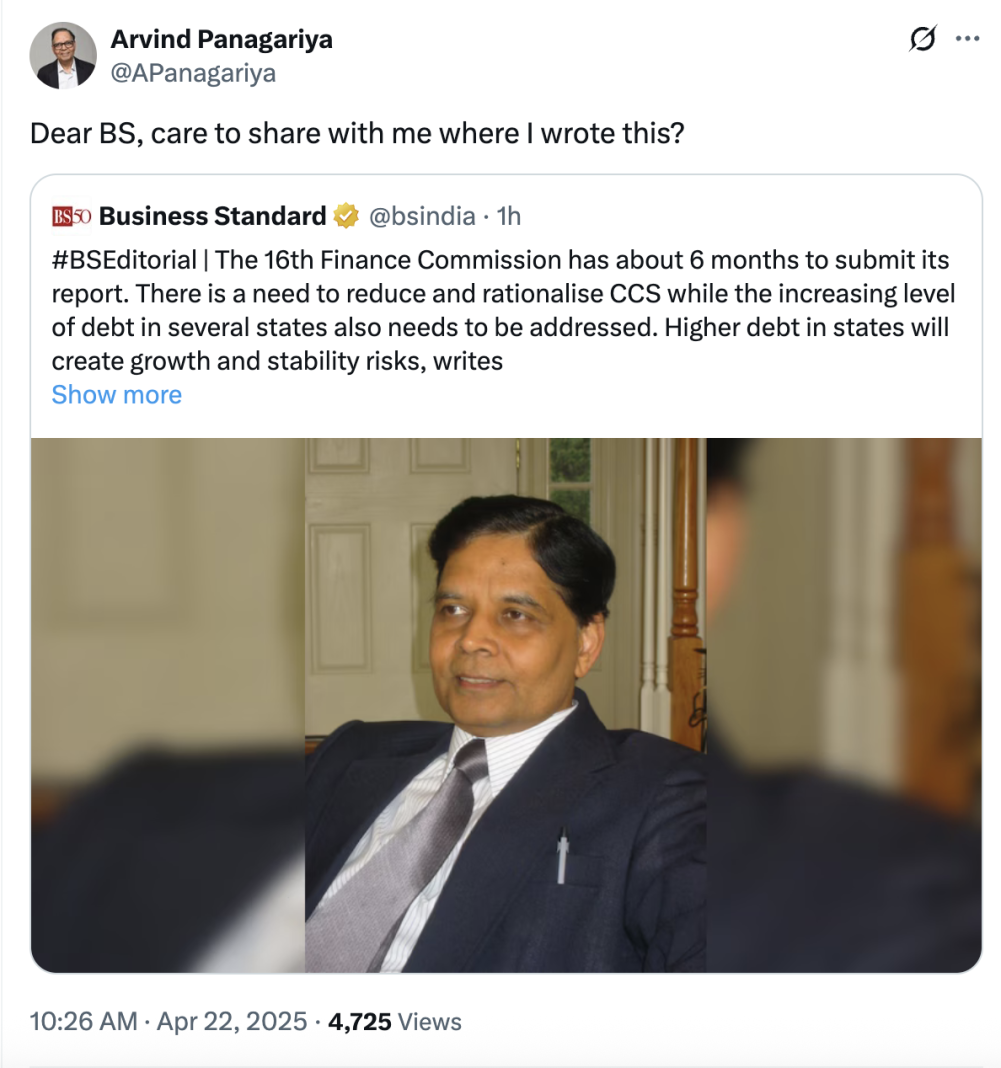
Arvind Panagariya, the chairperson of the 16th Finance Commission, has asked media outlet Business Standard to show him where he wrote the Editorial opinion they have attributed to him. Taking to X, the Economist and the chancellor of Nalanda University wrote, “Dear BS, care to share with me where I wrote this?”.

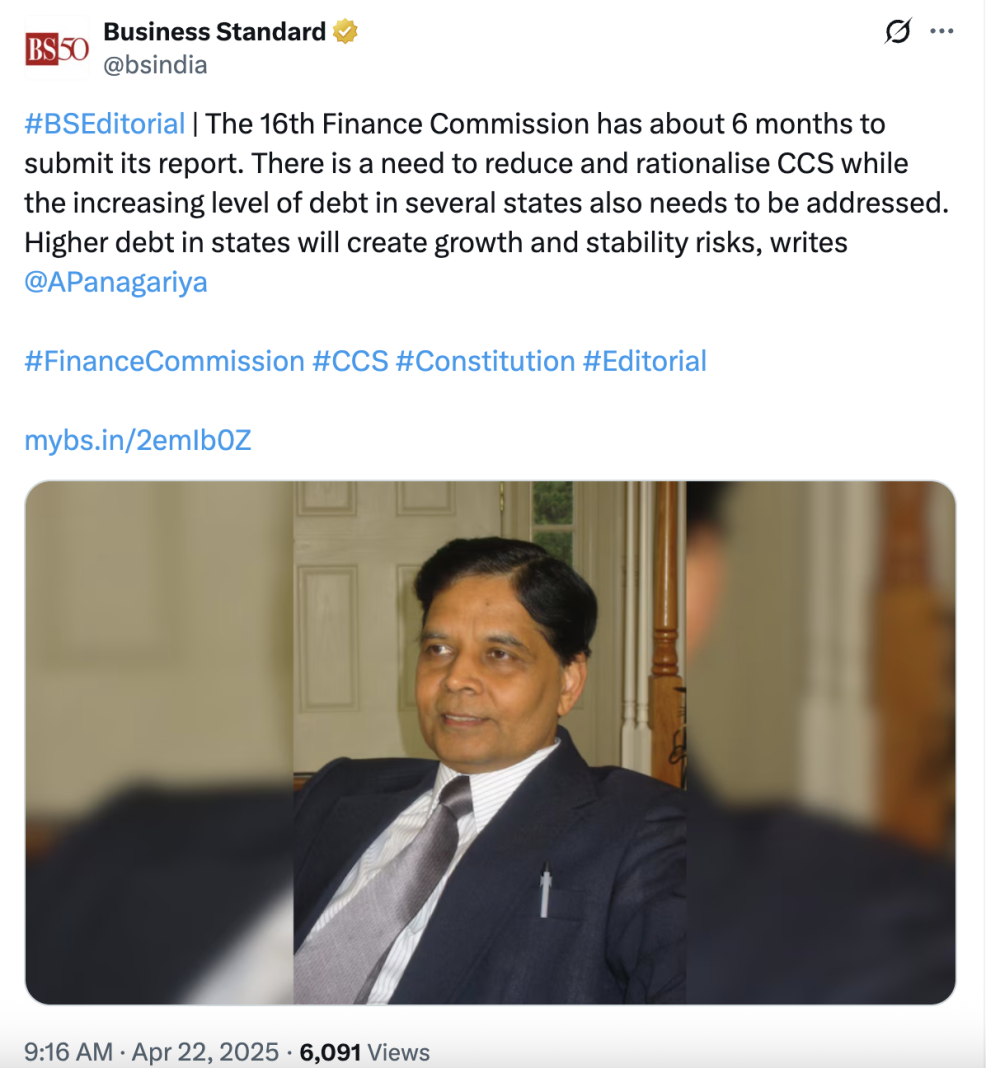
Panagariya was responding to a post by Business Standard that had attributed a quote in an Editorial to him, claiming he had ‘written’ it.

The post by Business Standard was shared at 9.16 AM today on April 22. However, the article shows it was published on April 21, at 9.17 PM.

It read, “The 16th Finance Commission has about 6 months to submit its report. There is a need to reduce and rationalise CCS while the increasing level of debt in several states also needs to be addressed. Higher debt in states will create growth and stability risks,” writes Arvind Panagariya. It had even tagged Panagariya’s handle on X.

The linked article has Panagaria’s image. It is titled ‘Resource allocation: Finance Commission needs to address multiple issues’. The article is categorised as an Opinion piece under ‘Business Standard Editorial Comments’ section.

Business Standard is yet to correct the attribution or provide any explanation for their mistake.

X users have also expressed shock at the blatant mistake that is yet to be even acknowledged. “Business Standard wrote an entire Editorial without the author’s permission or knowledge? Reason why I call them B*ll S**t India”, wrote one user.

Another user joked under Panagariya’s post, “They are using predictive AI. You will be writing this a few weeks later”.

Padma Bhushan Arvind Panagariya is a noted Indian Economist who was appointed as the Chairman of the 16th Finance Commission by the government of India. He also holds the position of Professor of Indian Political Economy at Columbia University, New York City. He served as the Vice-Chairman of the NITI Aayog from 2015 to 2017 and was earlier the chief economist of the Asian Development Bank.

Guwahati Tea Auction Centre sells tea worth a record Rs 3850 crores in FY 2024-25

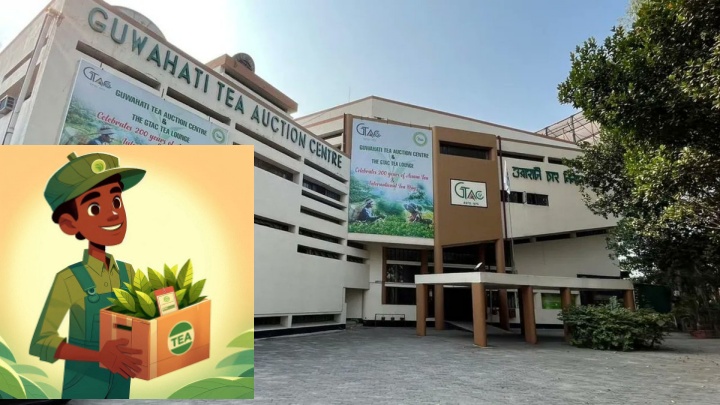
The Guwahati Tea Auction Centre (GTAC) has set a new record, selling tea worth Rs 3850 crore in the financial year 2024-25.

Dinesh Bihani, Secretary of Guwahati Tea Auction Buyers Association, on Tuesday told ANI that, in the FY 2024-25, the Guwahati Tea Auction Centre sold 169.13 million kg of tea with an average price of Rs 227.70 and the total turnover is Rs 3850 crore which is Rs 800 crore more compared to the previous year.

“In the financial year 2023-24, GTAC sold 166.34 million kg of tea worth Rs 3048 crore, and the average price was Rs 183.21. But in FY 2024-25, GTAC sold tea worth Rs 3850 crore, which is Rs 800 crore more compared to the previous year. In the last 52 years, this year the GTAC sold the highest tea. Last year Assam tea crop was short by 60-70 million kg, and despite it, we sold 3 million more tea in FY 2024-25,” Bihani said.

He further stated that, following the increase in the average price of tea, small tea growers in Assam are also benefiting.

“Tea price increase at GTAC means the green leaves price will also increase, and the small tea growers of the state are also getting benefits from it,” he said.

According to the reports of the Tea Board of India, there are over 1.22 lakh Small Tea Growers in 28 districts of Assam, and their tea area is 114847.89 hectares of land, contributing nearly 52 per cent of the total tea production in the state.

Four years ago, a special tea named Golden Tips from the Manohari tea estate was sold at GTAC for Rs 1 lakh per kg.

“We hope that the current financial year 2025-26 will be good for Assam tea. Our exports have also increased. Many large buyers are also coming to GTAC. Recently, a tea from Dhekiajuli tea garden was sold at a price of Rs 606 per kg. Following the initiatives of the government, quality tea production has also increased,” Bihani said.

On the other hand, the GTAC Tea Lounge has also recorded a turnover of over Rs 1 crore from its tea promotion and retail activities in the FY 2024-25.

Assam is the largest tea-producing state in India, and it produces over 50 per cent of the country’s total tea. Assam tea has completed 200 years of its glorious journey.

(This news report is published from a syndicated feed. Except for the headline, the content has not been written or edited by OpIndia staff)

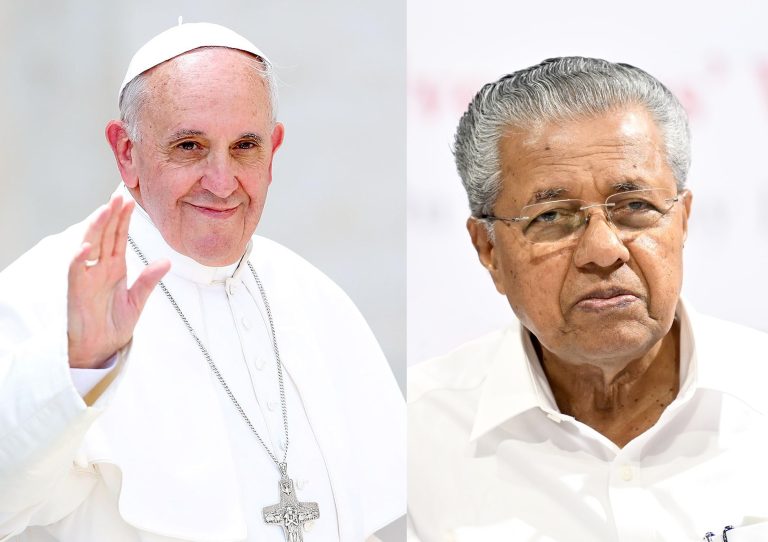
Kerala Government declares three-day mourning following the death of Pope Francis

The Kerala Government has announced a three-day state mourning on the passing away of Pope Francis.

A two-day state mourning will be observed on April 22 and April 23. Additionally, a one-day state mourning will be observed on the day of the funeral, which will be communicated separately.

The National flag will be flown at half mast, where it is regularly flown and there will be no official entertainment during the period of the state mourning.

Additionally, district collectors have also been requested to inform the concerned officers within their jurisdiction, where the national flag is regularly flown, about the state mourning and to fly the national flag on half-mast.

In a post on X earlier, Kerala Chief Minister Pinarayi Vijayan described the Pope as “a beacon of compassion who stood with the poor and marginalised, took a critical stance against global capitalism, and championed interfaith dialogue.”

“Pope Francis’ legacy will inspire generations striving for justice and equality,” the Chief Minister said.

Meanwhile, the entire country has also declared a three-day mourning as a mark of request, according to an official notification issued by the Ministry of Home Affairs (MHA).

The mourning will be observed across the country on April 22 and 23, and again on the day of the Pope’s funeral.

Pope Francis (88) passed away at his residence, Casa Santa Marta, in the Vatican on April 21.

The Home Ministry stated: “Three-Day State Mourning as a mark of respect on the passing away of His Holiness Pope Francis, Supreme Pontiff of the Holy See.”

“His Holiness Pope Francis, Supreme Pontiff of the Holy See, passed away today, the 21st April, 2025. As a mark of respect, three-day State Mourning shall be observed throughout India, in the following manner: Two days’ State Mourning on Tuesday, the 22nd April, 2025 and Wednesday, the 23rd April, 2025. One day’s State Mourning on the day of the funeral,” the statement added.

Prime Minister Narendra Modi had expressed deep sorrow over the Pope’s death. He said Pope Francis’ “affection for the people of India will always be cherished.”

“Deeply pained by the passing of His Holiness Pope Francis. In this hour of grief and remembrance, my heartfelt condolences to the global Catholic community. Pope Francis will always be remembered as a beacon of compassion, humility and spiritual courage by millions across the world. From a young age, he devoted himself towards realising the ideals of Lord Christ. He diligently served the poor and downtrodden. For those who were suffering, he ignited a spirit of hope,” PM Modi said on X.

(This news report is published from a syndicated feed. Except for the headline, the content has not been written or edited by OpIndia staff)

PM Modi, US Vice President Vance welcome “significant progress” in negotiations for India-US Bilateral Trade Agreement

0

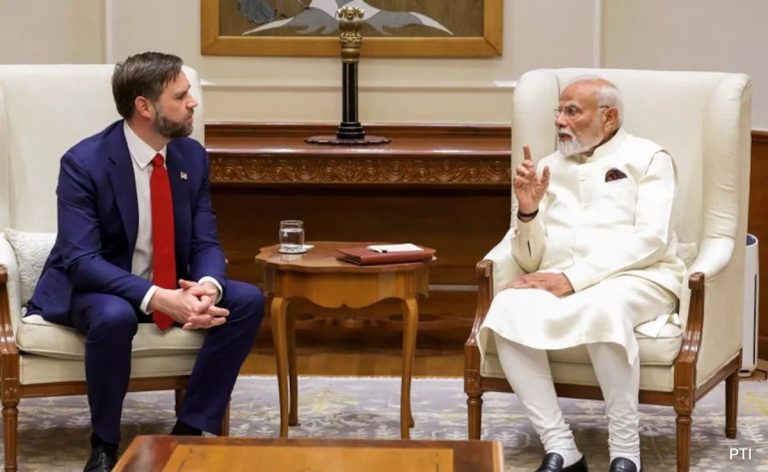
Prime Minister Narendra Modi met US Vice President JD Vance on Monday and welcomed the “significant progress” in the negotiations for a mutually beneficial India-US Bilateral Trade Agreement focused on the welfare of the people of the two countries.

They also noted continued efforts to enhance cooperation in energy, defence, strategic technologies, and other areas.

The two leaders also exchanged views on various regional and global issues of mutual interest, and called for dialogue and diplomacy as the way forward.

Vice President Vance was accompanied by the Second Lady Usha Vance, their children, and senior members of the US Administration.

“Prime Minister fondly recalled his visit to Washington DC in January and his fruitful discussions with President Trump, which laid down the roadmap for close cooperation between India and the US, leveraging the strengths of Make America Great Again (MAGA) and Viksit Bharat 2047,” the release said.

Prime Minister and Vice President Vance reviewed and positively assessed the progress in various areas of bilateral cooperation.

“They welcomed the significant progress in the negotiations for a mutually beneficial India-U.S. Bilateral Trade Agreement focused on the welfare of the people of the two countries. Likewise, they noted continued efforts towards enhancing cooperation in energy, defence, strategic technologies and other areas. The two leaders also exchanged views on various regional and global issues of mutual interest, and called for dialogue and diplomacy as the way forward,” the release said.

The Prime Minister extended his best wishes to the Vice President, the Second Lady, and their children for a pleasant and productive stay in India.

He also conveyed his warm greetings to President Trump and said that he looked forward to his visit to India later this year.

The US Vice President, who is on a four-day official visit to India, arrived in the national capital on Monday.

This is Vice President Vance’s first visit to India. He will also visit Jaipur and Agra before departing for Washington DC.

The high-level visit comes amid trade negotiations between the two countries following the US decision to impose reciprocal tariffs on several countries, including India.

The US has reduced new tariff rates on most of its trade partners to 10 per cent for 90 days to allow trade negotiations.

(This news report is published from a syndicated feed. Except for the headline, the content has not been written or edited by OpIndia staff)

PM Modi welcomes US Vice President JD Vance and his family at his residence, gives special gifts to Vance children: Watch

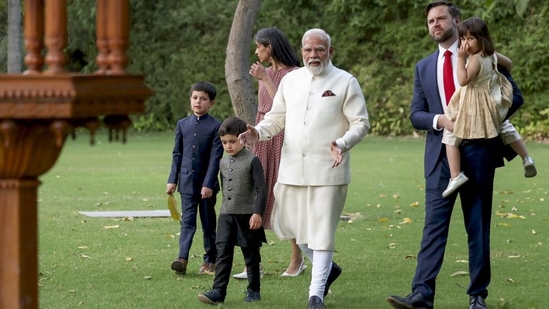
Prime Minister Narendra Modi warmly welcomed U.S. Vice President JD Vance, his wife Usha Vance, and their children—Ewan, Vivek, and Mirabel—on Monday.

Upon arriving at Prime Minister Narendra Modi’s residence at 7, Lok Kalyan Marg in New Delhi, U.S. Vice President JD Vance and his family were warmly received. PM Modi greeted Vice President Vance with an embrace and engaged in conversation with Usha Vance.

A video shared from the visit shows the Prime Minister playfully interacting with the Vance children, Ewan and Vivek, who are seen sitting on his lap and chatting with him. Modi is also seen giving the family a tour of his residence.

Later, the Prime Minister gifted each of the Vance children—Ewan, Vivek, and Mirabel—a peacock feather as a token of his affection.

Earlier in the day, the Vance family visited the Swaminarayan Akshardham Temple in Delhi, where the children were dressed in traditional Indian attire. Ewan and Vivek wore kurta-pyjamas, while Mirabel donned an Anarkali outfit with an embroidered jacket.

Vice President Vance expressed gratitude on social media following the temple visit, saying, “Thank you all so much for your hospitality and kindness in welcoming me and my family to this beautiful place… Our kids, in particular, loved it. God bless.”

The family also visited the Central Cottage Industries Emporium at Janpath.

Following their interactions, PM Modi and Vice President Vance held bilateral discussions, and the Prime Minister is expected to host a dinner for the Vance family later.

During his four-day trip to India, JD Vance is scheduled to visit Delhi, Jaipur, and Agra—Jaipur on Tuesday and Agra on Wednesday. The visit is viewed as a significant effort to enhance the India-U.S. Comprehensive Global Strategic Partnership. According to MEA spokesperson Randhir Jaiswal, the visit will address all major areas of cooperation and aims to further solidify bilateral ties.