Home Blog Page 4776

Woman files case against Palghar Shiv Sena MP, says he has been demanding sexual favours since 2004: Here are the details

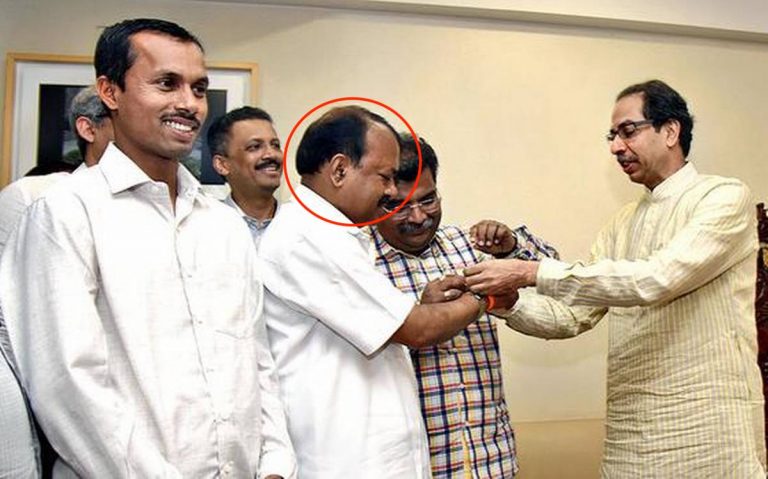
A 38-year-old woman from Palghar district on Friday filed a case of sexual harassment against local Shiv Sena MP Rajendra Gavit. The complainant, who worked at a gas agency in Mira Road, alleged that the MP, who owned the gas agency, harassed her sexually.

The complaint filed against the Shiv Sena legislator came a day after the Maharashtra state cabinet, headed by Shiv Sena leader Uddhav Thackeray, approved draft bills for strengthening laws on prevention of atrocities against women and children. The woman had approached the Naya Nagar police station on Friday to file her complaint. The police have filed an FIR under sections 354 (A) (sexual harassment) and 506 (criminal intimidation) in the case and launched a probe in the matter.

Complainant accuses Rajendra Gavit of demanding sexual favours since 2004

The woman, in her complaint, has alleged that a year after she took up a job as a customer care staffer at his agency in 2004, he started demanding sexual favours. The single mother also alleged that Gavit had visited her rented home and even lured her into a sexual relationship by offering her a flat and money. When she turned down her sexual advances, he started harassing her physically and mentally, the complaint alleged.

The woman had already filed two non-cognizable offences on October 13 and December 10, 2015 with the police against the Shiv Sena leader. She had alleged that Gavit had publicly groped her in front of other staff. The complainant lamented that she had held on to the job despite repeated molestation by the Shiv Sena leader because she was in desperate need of money to finance her son’s education.

The woman said that after her husband abandoned her and their son in 2003, she has been working with Gavit’s gas agency. The complainant stated that Gavit was aware of her situation and had tried to lure her into a sexual relationship. She has also alleged workplace harassment, stating that she was refused weekly holidays and made to work for long hours. Gavit would also call her to his cabin and threaten her, she said.

Shiv Sena leader refutes charges of sexual harassment

However, Rajendra Gavit has rubbished the allegations levelled against him and accused the woman of exacting revenge after being sacked for swindling agency’s money. In an interview with TOI, Gavit claimed that the allegations were made by the woman after she and her three associates were caught black-marketing LPG cylinders worth more than Rs 1 crore. Gavit said that the woman was fired and a case under the Essential Commodities Act and IPC section 408 (criminal breach of trust by clerk or servant) on November 26. 

Grooming Jihad: One Azad booked for sexually exploiting and forcing a minor girl to convert to Islam for marriage

0

In yet another case of Grooming Jihad (Love Jihad), a minor girl from Hardoi district in Uttar Pradesh has lodged a complaint at Shahbad police station against a Muslim youth named Azad. She has accused Azad of sexually exploiting her and forcing her to convert to Islam on the pretext of marriage.

It is pertinent to note here that Times of India reported that the victim is 21-years-old. Since there are conflicting reports on whether the victim was a minor or not, OpIndia contacted Hardoi police station for details. The police official confirmed to us that the victim is a minor and hence the POCSO Act has been invoked in the case.

Hardoi police books accused for rape, under the unlawful conversion law and for human trafficking

Based on the minor girl’s complaint, Shahdab police have filed an FIR and booked Azad under the newly promulgated law, the Uttar Pradesh Prohibition of Unlawful Conversion of Religion Ordinance, 2020. Police have also slapped relevant sections of the Indian Penal Code (IPC) and Protection of Children from Sexual Offences Act (POCSO) against the accused.

Since the complainant mentioned in the FIR that the two were in a relationship for the last two years and during this period, Azad “raped her repeatedly on the pretext of marriage”, Hardoi police have also booked the accused for rape.

The victim added that Azad had been pressurising her to convert and often threatened her with life if she reported the matter to the police. She also said that she suspected Azad of taking her to Delhi and trafficking her.

Hardoi superintendent of police (SP), Anurag Vats said that based on the victim’s allegations, Azad has been booked for rape, under the unlawful conversion law and also for human trafficking.

The SP also confirmed that the girl alleged in her complaint that Azad told her to convert to Islam just before the wedding on November 30. 

“The FIR was registered against a person identified only as Azad at the Shahabad police station. The complainant stated that she and the accused were in a relationship for the past two years and the man had promised to marry her,” Anurag Vats, Hardoi superintendent of police (SP) was quoted as saying.

UP registers first Grooming Jihad case under new anti-conversion law

After the promulgation of the new anti-conversion law, the Uttar Pradesh police have booked several people for allegedly forcing girls to convert their religion on the pretext of marriage. This Hardoi case is the fifth FIR registered under the new law against Grooming Jihad, under which as many as 28 persons have already been booked from places like Sitapur, Mau, Bareilly and Muzaffarnagar in Uttar Pradesh, ever since the law has come into force.

On November 29, the Uttar Pradesh police had registered its first-ever case against one Uwais Ahmed for trying to forcibly convert a Hindu girl to Islam. The case was registered against Ahmed after a family in Bareilly district of Uttar Pradesh had lodged a complaint with the Deorania police. The accused was booked under Section 3/5 of the Uttar Pradesh Prohibition of Unlawful Conversion of Religion Ordinance, 2020.

Provisions of the new law against Grooming Jihad

The new anti-conversion law is aimed at preventing forced conversions under the pretext of love and marriage. Under the new law, a jail term of 1-5 years is awarded to the accused (extended to 3-10 years in case of SC/STs) and a fine of ₹15,000 (₹25,000 in case of SC/STs). Moreover, the offender’s proven guilty for mass conversion will attract a jail term of 10 years.

Protesting ‘farmers’ perform dangerous stunts on tractor, try to mow down police personnel when stopped: Horrific visuals from UP

0

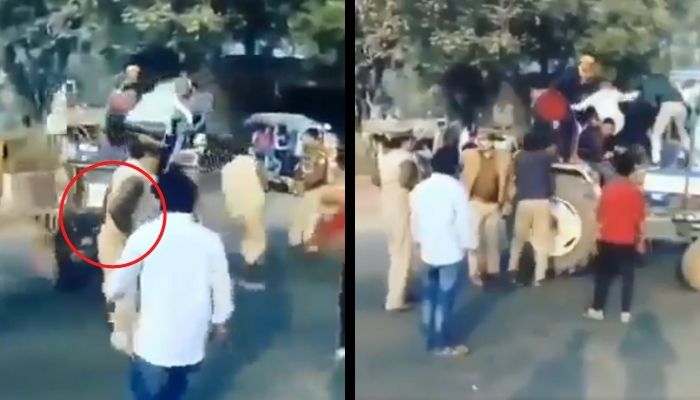
In a video that has now gone viral on social media, 6 unidentified accused, riding a tractor, tried to run over police personnel on Tuesday. The incident took place in Titavi area in Muzaffarnagar district of Uttar Pradesh on the occasion of Bharat bandh, which was announced as a ‘mark’ of protest against the newly enacted farm laws.

According to reports, the miscreants were found gambling when they were stopped by the police officials. They were also performing dangerous stunts on their tractors. As seen in the visuals, the cops initially tried to persuade the miscreants to get off the vehicle. When the police officials got hold of two miscreants, the undeterred driver tried to mow down the police personnel his tractor. The cops had a narrow escape as the tractor just whizzed past them at a high speed.

Muzaffarnagar police, responding to the video said that a case has been registered against unknown persons and the investigation is ongoing.

The Muzaffarnagar police have registered a case against the 6 accused under relevant IPC sections. While speaking about the incident, SP Abhishek Yadav stated, “Police are trying to ascertain the identity of the youths. They will be arrested soon and action against them will be taken as per the law.”

The Anti-farm law agitation

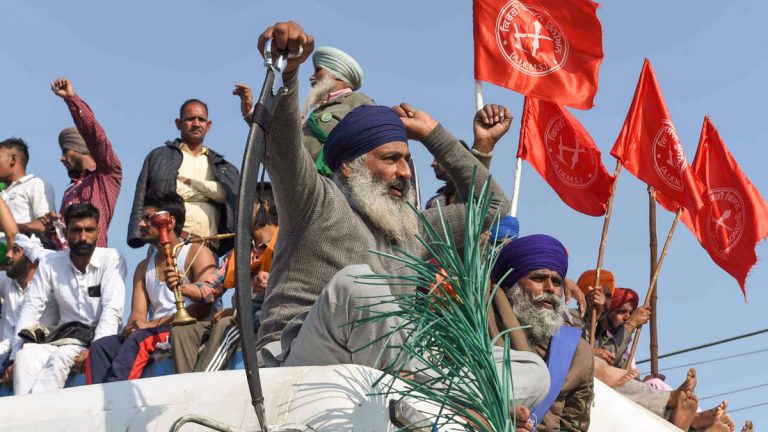
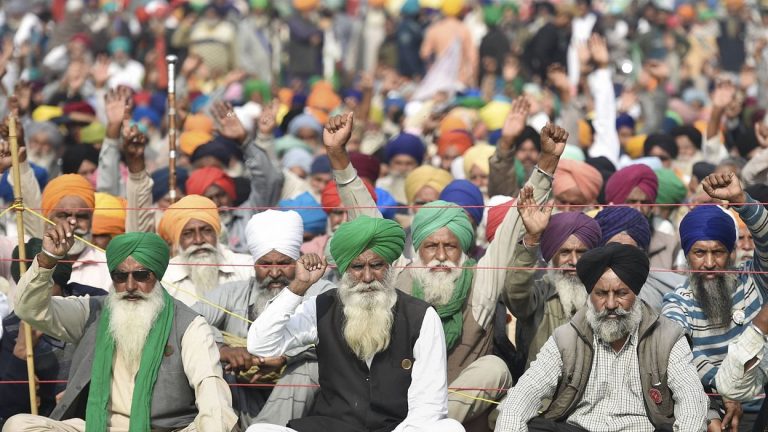
The renewed anti-farm law protests began in late November, with demands to repeal the three historic farm laws that are aimed at ending the monopoly of middlemen, APMC markets, and bringing prosperity to the lives of farmers through fair pricing for their produce. While their demands have been rejected, the government has assured that they are open to discussion on the subject. The BJP had accused the Congress and the commission agents of misleading farmers and spreading rumours about ‘abolishment’ of Mandis.

Khalistanis, Naxal sympathisers take centre stage in farmers protest

In a shocking incident on Thursday, the protestors along the Tikri border, who started their protest as a grievance against the farm laws, began demanding the release of terrorist sympathisers and enablers such as Gautam Navlakha, Sudha Bhardwaj, Varvara Rao, Anand Teltumbde, and riot accuses such as Umar Khalid, Sharjeel Imam, Khalid Saifi etc.

BKU Ekta Ugrahan, which claims to be a farmers’ organisation and had gathered some of the protestors along the Delhi-Haryana border observed ‘human rights’ day at Tikri border and demanded the release of Urban Naxals arrested in Elgar Parishad case, Islamists arrested in Delhi riots case and others. The protestors also demanded the government to release the accused of Anti-Hindu Delhi riots case.

It is important to note that the Khalistan organisation SFJ, funded by Pakistan, had earlier declared a grant of $1 million for farmers in Punjab and Haryana in lieu of their support for Khalistan. On 23rd September, it was reported that the SFJ had attempted to capitalise on the ongoing protests by farmers and had declared that it would distribute $1 million among farmers who had defaulted on agricultural loans.


Rajasthan: ACB officer caught taking bribe hours after delivering a speech on the ill-effects of corruption

0

In a bizarre incident in Rajasthan, a police official was arrested by the ACB officials for taking bribe just hours after he had delivered a speech on the ill-effects of corruption.

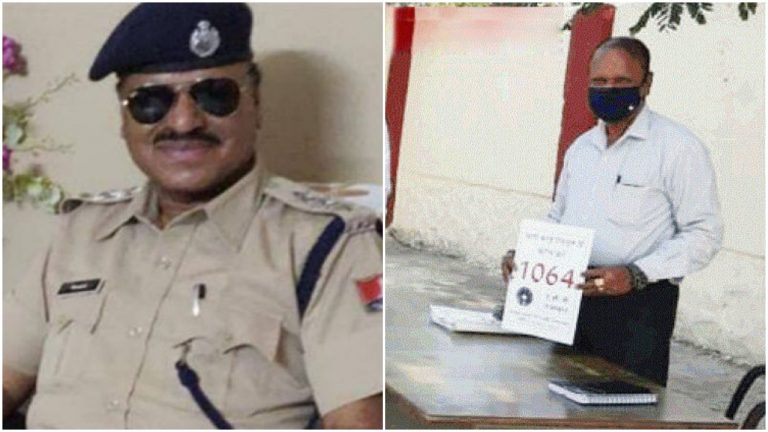
According to the reports, Bhairulal Meena, the DSP of ACB’s Sawai Madhopur unit, was caught by ACB officials red-handedly while allegedly taking a bribe of Rs 80,000 from the District Transport Officer. Meena was arrested by the anti-corruption officials after he had forced another official to pay him a bribe. Reportedly, Meena was taking bribes on a monthly basis from different departments.

The ACB officials had received several complaints against Meena and decided to investigate the matter. After verification, a team from Jaipur on Wednesday decided to trap DSP Meena. The officials continuously watched the ACB officials and set a trap to nab the corrupt officer.

Later in the day, the ACB officials raided DSP Meena, when he was taking a bribe of Rs 80,000 from District Transport Officer (DTO) Mahesh Chandra. The ACB officials have now arrested both the officials on charges of bribery.

Meanwhile, the ACB DG said a search operation is going on at Meena’s residence and other locations.

BL Soni, Directorate-General of ACB Rajasthan, revealed that Meena had been given the responsibilities of the outpost of the agency in Sawai Madhopur.

DSP Meena delivered a talk on effects of corruption before getting arrested

Ironically, just hours before his arrest, DSP Bhairulal Meena had delivered a passionate talk in Sawai Madhopur district about the menace of the corruption and its ill-effects on the society.

DSP Meena had addressed the public about the fight against corruption and had asked people to inform the officials if they found anybody taking bribe.

However, an hour after delivering the speech, the officer was caught red handed by officials for taking a bribe of 80 thousand rupees.  

One in three farmers in Punjab are absentee landlords, MSPs paid to middleman through DBT: Here is how Punjab farmers play by different rules than rest of country

Even as ‘farmers protests’ rage around the highway entrances to Delhi, causing inconvenience to the common man, more details are emerging out that shed light on how the farmers in Punjab play by different rules, especially in procurement and Direct Benefit Transfers than the rest of the country.

Amidst the debate over the credibility of such ‘farmer’ protests, interesting details about the extent of absentee landlordism in Punjab and its influence on the ongoing protests have come out. A report by Indian Express has revealed that at least 30-35% of Punjab’s farmers who cultivate land do not actually have any lands, but do farming in lands that belong to government employees, NRIs and permanent urban residents within and outside the state.

The report also cites one farmer named Balwant Singh Boparai, who has been cultivating in 10 acres in Ghudani Kalan village of Payal tehsil in Punjab’s Ludhiana district. The 58-year-old does not own the land, but cultivates on rented land at an annual rate of Rs 55,000-60,000 per acre. Interestingly, there is no record in any official document of his cultivating this land or its owner having given it out on lease. Boparai states that the land belongs to an NRI (non-resident Indian) based in Canada.

According to the prevailing rules to obtain institutional loans, insurance or even subsidies for that matter, one should be a registered farmer in any part of the country. Not being either the owner or a registered tenant farmer will not allow accessing any crop credit from the local primary agricultural cooperative society, loan waiver schemes or the Centre’s Pradhan Mantri Kisan Samman Nidhi (PM-Kisan) income support schemes.

Quoting Boparai, the report states that middlemen (arhatiyas) get the money to their account after the Food Corporation of India and state agencies undertake grain procurement in APMC mandis, which is then distributed to landless tenant farmers like Boparai after deducting the commission.

“Yes, the payment is made into the arhatiya’s account. But that money also comes to us. Moreover, he (arhatiya) is the one who is also giving us loans to raise our crop. If the government now starts transferring MSP money to the zamindar, what will happen to us?,” the report adds quoting Boparai.

Another tenant farmer, Jagjit Singh, who cultivates five out of the 15 acres owned by a zamindar of Jhumba village in Bathinda district and tehsil, said, “Whenever I take my crop to the mandi, the arhatiya makes sure that the J-form is filled not in my name. And he pays me after deducting interest and loans that I have taken from him”.

“Where will I go if the government pays only the zamindar and the arhatiya loses interest in giving me loan that he cannot recover from sale of crop to him?,” asks Singh, who has paid Rs 60,000 per acre for growing paddy and wheat this year.

“I pay 50% of the rent amount in April (ahead of the paddy season) and the balance 50% in September (before sowing wheat),” adds Singh, who have been cultivating the land rented from the same zamindar who has also rented his land to three other tenants for the last 15 years.

Ravinder Singh Gill, the sarpanch of Mehmuwal Yusufpur village in Jalandhar district’s Shahkot tehsil cultivates about 70 acres. Like Boparai and Singh, he too does not own the land that belongs to two NRIs, one living in Canada and the other in the United Kingdom.

“Whatever land you can call my own is too small. The 70 acres, on which I grow wheat, paddy and potato, is not in my name. So, I can neither avail any crop loan nor receive government benefit against this land,” Gill says.

In Punjab, MSPs through DBTs are transferred through intermediaries

Another interesting fact is, unlike the rest of the country where farmers are direct beneficiaries of MSPs through Direct Benefit Transfer scheme, in Punjab, it passes through intermediaries.

Under the current system in Punjab, the Food Corporation of India and state agencies procure the grains from arhatiyas and deposit the MSPs through DBT into their account. Arhatiyas, taking the outstanding loans, commission into account, settles farmers share out of the total transfers he received on behalf of the farmer.

Reportedly, Punjab has some 48,000 of these mandi intermediaries, of which 28,000-odd are active, who deals anywhere from 20 to 200 farmers.

The Punjab government has now made it compulsory for Arhatiyas to provide bank and Aadhaar numbers of all their farmers. The bank accounts of the farmers will be linked to the Centre’s Public Financial Management System (PFMS) network, which will enable direct payment of MSP monies into the accounts of farmers rather than that of the arhatiyas.

The move has predictably met with opposition from the arhatiyas, who had announced state-wide protests in March. It is reported that the current protests are also allegedly fuelled by these Arhatiyas, who fear of losing their existing hegemony in procurement process. The three farm laws passed by the Modi government aims to bypass these intermediaries in the procurement process.

The recent move by the Modi government to make minimum support price (MSP) payments directly into the bank accounts of farmers, from the ensuing wheat procurement season starting April has caused discomfort to both farmers and Arhatiyas.

The farmers, majority of them are tenant farmers fear that the money would be deposited into the account of absentee landlords. The direct transfer to farmers also disrupts the existing nexus of Arhatiyas, who will lose out big as he/she cannot arbitrarily avail commission fees and also high-interest rates for the loan availed to small farmers.

Punjab farmers – a major cause of air pollution, water level depletion

The Punjab farmers, one of the primary beneficiaries of Green Revolution in the 1960s, are also one of the major reasons for the rising air pollution in North India, especially during the winters.

In recent years, Punjab has recorded the highest number of incidents of stubble burning among the northern states. The incidents of crop burning in Haryana and Uttar Pradesh have drastically come down but Punjab has seen a marked increase in the number of stubble burning incidents that contributed to the exacerbating pollution in the Delhi-NCR region.

Even though the Supreme Court had rapped the state governments on the growing number of stubble incidents, advising them to incentivise the farmers to give up burning the residual, the Congress government in the state has conspicuously failed in stopping the farmers from doing the same.

As per data released by the Punjab Remote Sensing Centre, the State witnessed 73,883 incidents of stubble burning between September 21 and November 14, which is the highest since 2016. In 2019, Punjab had reported 51,048 cases of stubble burning and 46,559 such incidents in 2018.

It is interesting to note that in several other states, stubble is harvested by farmers, which is used as fodder for livestock during monsoons when the grazing lands are farmers. But it is claimed that stubble in Punjab is not suitable for for animals, and hence the farmers are forced to burn it.

Depleting groundwater a menace of equal proportion as stubble burning

Not just stubble burning, Punjab is also racked by the menace of depleting water reserves. The groundwater resources of Punjab also paints an alarming picture as agriculture experts in the state have expressed shock and worry over the diminishing water indices from the state. A report published in January 2020 points out how Punjab will have a net groundwater availability of -14.58 billion cubic metre (BCM) within the next 25 years and even the domestic and industrial water supply will reduce by 1.22 BCM.

An eminent agriculture expert Sucha Singh Gill of IIM, Ahmedabad, said that while Punjab had a net ground water availability of only 21.58 BCM, it was consuming at much higher levels of 36 BCM. A latest government report on Punjab’s groundwater resources observes that the groundwater pumpage has increased from 149% (of naturally available recharge) in 2013 to 165% in 2018. It also holds the distinction of being the state with the maximum percentage of wells showing groundwater depletion among all states in India.

A report tabled in Rajya Sabha a couple of months ago by the Department of Water Resources, River Development and Ganga Rejuvenation stated that 79 per cent of the assessment units showed the annual groundwater extraction in Punjab was more than the assessed annual extractable groundwater resource. In 2019, it was 76 per cent.


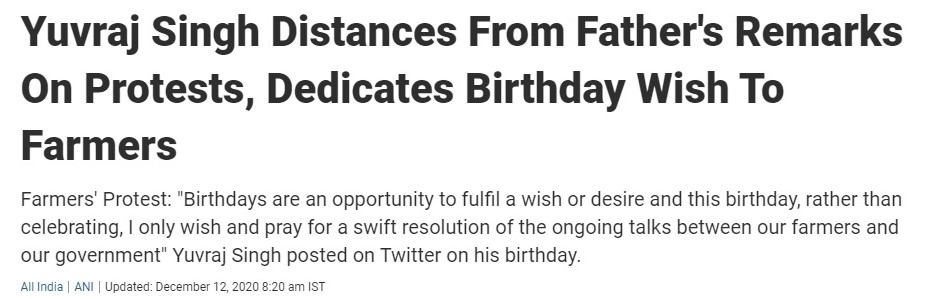
Mainstream media goes overboard in whitewashing Yuvraj Singh’s father Yograj Singh’s hate speech against Hindus: Read details

Former Indian cricketer Yuvraj Singh on Saturday distanced himself from the deplorable comments made by his father Yograj Singh. He made a statement to that effect on the occasion of his birthday. He said that the remarks were made in his personal capacity and he does not share the ideologies of his father.

While Yuvraj Singh does not specifically mention the statement made by Yograj Singh he is referring to, it appears safe to assume he is referring to the instance where Yograj made derogatory comments against Hindus and engaged in hate speech.

“Inki aurate take-take ke bhaw bikti thi” (their women were sold for two cents). When their women and daughters were abducted by people like Ahmed Shah Durrani and sold off for a paltry sum, it was we Sikhs who saved them. These are the people who have betrayed us. This community has been slaves for thousands of years,” Yograj Singh had said.

But the mainstream media, however, twisted itself up in knots trying to whitewash and even shamelessly hide what Yograj Singh had said even after Yuvraj Singh said that he was himself saddened and upset by the comments. One would assume that the media would report accurately on what was said at least then. But consistent with its record, it went out of its way to avoid mentioning the precise statements that elicited the response from Yuvraj.

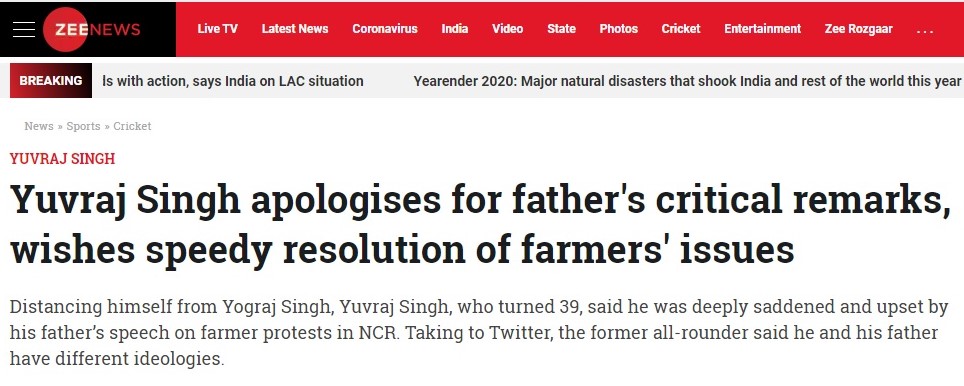
Zee News, for instance, reported that, “Former Team India all-rounder Yuvraj Singh has apologised for his father Yograj Singh’s extremely critical remarks concerning the farmers’ protest and wished for early resolution of their issues.” Nowhere in the report do they mention the anti-Hindu speech made by Yograj.

Zee News on Yuvraj Singh statement

According to Zee News, “This clarification from Yuvraj came days after Yograj Singh urged the Central Government to listen to the demands of the farmers, and backed sportspersons who were returning their awards to show support with the protesting farmers.” The report makes it appear the hate speech was never made.

Instead, the quote by Yograj that is mentioned is: “Farmers are demanding the right thing, the government should listen to them. It is really high time that the government should come up with solutions in this regard and I back all those sportspersons who are returning their prestigious award.” An unaware reader would come to the conclusion that Yuvraj Singh had made the statement because his father said the Central Government should listen to farmers, which is definitely not the case.

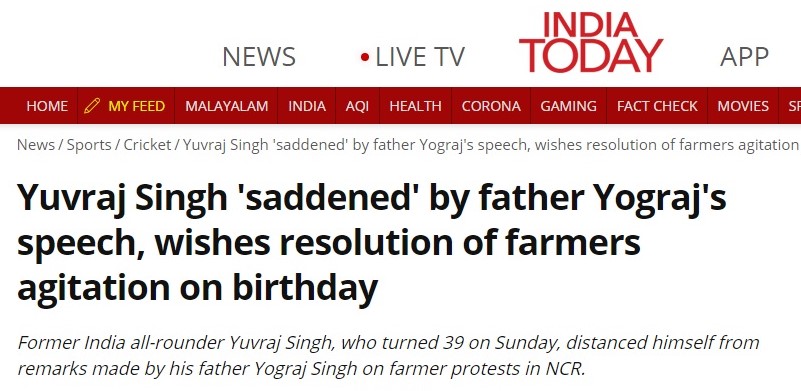
India Today reported on the matter similarly. They said, “This comes after Yograj Singh on Monday urged the Central Government to listen to the demands of the farmers, and backed sportspersons who were returning their awards to show support with the protesting farmers.” And then proceeded to cite the same quote as Zee News. Again, no mention of the hate speech against Hindus.

India Today on Yuvraj Singh statement

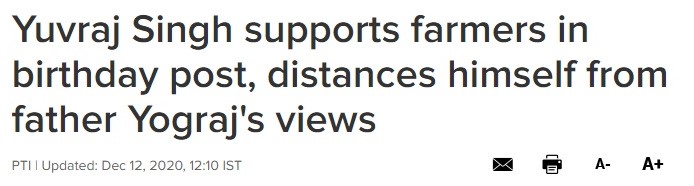
Times of India, reproducing PTI’s report, was kind enough mention that Yuvraj’s statement was in response to “unsavoury comments” made by his father at a rally but did not mention the exact words. And “unsavoury comments” is an extremely mild way of putting it. It was hate speech and yet, TOI would not say it as it is.

TOI on Yuvraj Singh statement

NDTV, reproducing ANI’s report, went a step further. They said that the statement by Yuvraj Singh was in response to “his father Yograj Singh endorsing the sportspersons returning their awards to support the agitation.” Again, a deliberate effort was made to obfuscate the matter and suppress the hate speech that was made by Yograj.

NDTV on Yuvraj Singh statement

Thus, there is clearly an organised effort underway to suppress the hate speech that was made by Yograj Singh against Hindus. From Yuvraj Singh’s statement, it is abundantly clear that he as not distancing from supporting farmers on the matter but the derogatory comments made by his father against Hindus. And yet, the mainstream media would have us believe that the former cricketer was distancing himself from his father’s stance on the protests.

It is, of course, consistent with the media’s penchant of denying the rampant Hinduphobia prevalent in public discourse. Confronted by undeniable and irrefutable evidence of hinduphobia, the media’s first reaction is to deny that it ever happened. In this case as well, the media is pretending that Yuvraj Singh was not referring the hate speech made by Yograj Singh but the latter’s comments on sportsperson returning their awards.

1500 vehicles of protesters from Punjab to reach Delhi to replenish the tired demonstrators: Here is what the report says

0

If there were still doubts that the ongoing farmers’ agitation is not organic but a well-thought-out plan to pressurise the Modi government, a report published in Navbharat Times decisively puts to rest the ambivalence surrounding the nature of the ongoing protests.

The report states that a large convoy of about 1,500 vehicles from 1000 villages of Punjab is about to reach the demonstration site along the Delhi border. This convoy will replenish the fatigued and tired protesters who have been demonstrating at the site for weeks now, in a bid to coerce the central government into repealing the newly introduced farm bills.

More than 1300 tractor trolleys, carrying people, food, clothing and other necessary equipment are expected to reach Delhi border from Punjab by this weekend, Kisan Mazdoor Sangharsh Samiti said. This is the same organisation which organised state-wide ‘Rail Roko’ agitation in the state in September this year to oppose the new agriculture laws passed by the government.

The report further mentions that Kisan Mazdoor Sangharsh Samiti had candidly admitted that the convoy reaching the protest site would replace those were involved in the agitation from the last two weeks. 

Satnam Singh Pannu said, “There is already a raft of people present at the Delhi borders. In such a situation, we will have to find a place to stay. If we don’t find any site, we will hunker down at the place where we can stay. In such a situation, we have to find a way. Apart from all this, we already have a ‘stage’ from which we can continue our protests. Those who are present at the protest site for a long time now and would return home, their place will be occupied by the inbound protesters.”

Protesters along Delhi borders enjoy massage parlours, gym langars and cook Pizzas and other delicacies

Earlier today, even as Delhi residents chafed at being held hostage to the ongoing protests along the borders, videos of protesters enjoying massage parlours, gym langars and demonstrators cooking and savouring pizzas led many to wonder if the protests were meticulously planned. Several netizens wondered how can they ‘join’ the protests where demonstrators had turned the public roads into a picnic spot by baking and distributing Pizzas to the so-called protestors.

Pro-Khalistani supporters hijack the farmers’ protest

The involvement of Khalistani proponents in the protests also seed doubts about the authenticity of the ongoing farmers’ protests. On several instances of blockades called out by the agitating demonstrators, Khalistani slogans were raised, and posters of Khalistani terrorist Jarnail Singh Bhindranwale were held. Deep Sidhu, who had become the face of the farmers’ protests after his video of arguing with a security official went viral, was seen in an interview with Barkha Dutt, defending Bhindranwale and hailing him as a revolutionary fighter who fought for a strong federal structure.

Several so-called protesters who had participated in the farmers’ protest were also seen gloating over the former PM Indira Gandhi’s assassination and dishing out menacing threats of meting out a similar fate to PM Modi if he refuses to heed their demands.

Khalistanis based out of India extend their support to the farmers’ agitation

Khalistani supporters based out of India also showed an eager alacrity to associate themselves with the ongoing protests. The Pro-Khalistani group Sikhs for Justice (SFJ) on Monday threatened that they would close down the Indian diplomatic missions in London, Birmingham, Frankfurt, Vancouver, Toronto, Washington DC, San Francisco and New York on December 10 through cars, tractors and truck rallies. It is a different thing that not a single protester turned up for the protest.

With Khalistanis being involved in the farmers’ protests, the shady role of the SFJ was being analysed as more and more details that emerged pointed towards the possible interference of pro-Khalistan elements to hijack the farmers’ protest. The Khalistan organisation SFJ, funded by Pakistan, had earlier declared a grant of $1 million for farmers in Punjab and Haryana in lieu of their support for Khalistan.

On 23rd September, it was reported that the SFJ had attempted to capitalise on the ongoing protests by farmers and had declared that it would distribute $1 million among farmers who had defaulted on agricultural loans.

Kerala: Irked by dog ‘creating trouble’ in his area, one Yusuf ties dog to car and drags her along, arrested for cruelty

0

The Kerala police have arrested a man named Yusuf in Ernakulam district for tying a dog to his car and dragging it for miles. The incident took place near Paravur at 11 o’s clock on Friday morning.

As per reports, Yusuf committed the barbaric act of animal cruelty as the dog was ‘creating’ problems along with other strays in his area. He decided to tie the animal to his car and drag it for miles, before abandoning it in the wild. However, the accused was caught red-handed on tape in the act by a passerby named Akhil.

In the video footage that has now gone viral on social media, the dog was seen initially keeping up with the pace of the moving car. However, soon, the canine became exhausted and lay down while it continued being dragged against the road by Yusuf’s car. When Akhil intervened, the accused remained adamant and asked, “What is your problem if the dog dies?” After being caught off guard, Yusuf left the dog on the street.

While speaking about the incident, the eye witness recounted, “It was a horrific scene. A rope was tied around the neck of the dog and it was being brutally dragged along the road.” He informed the animal rights organisation DAYA about the incident. The organisation filed a police complaint against Yusuf and he was arrested.

The cops have booked the accused under Indian Penal Code (IPC) Sections 428 (Mischief by killing/maiming animal), 429 (Mischief by killing/maiming cattle) and Section 11(1) in The Prevention of Cruelty to Animals Act, 1960. Meanwhile, the dog was taken to a government-run veterinary facility for further treatment.

Elephant killed in Kerala

In June this year, the case of a pregnant elephant from Palakkad, Kerala dying after consuming jaggery coated explosive came to the fore and led to widespread outrage. The picture, of the Elephant standing calmly in the water while she died, bit by bit, due to the explosives going off in her mouth was heart-wrenching. The initial outrage also revolved around whether this was a deliberate act to torture the elephant or was there more at play in this case.

One accused, P Wilson, who is an employee of an estate that cultivates cash crops and spices, was arrested. Two other suspects, Abdul Kareem and son Riyasudheen, owners of the estate where Wilson worked were said to be absconding. The accused reportedly said to the interrogators that they had set up a trap of fruit filled with crackers to scare wild boars, which destroy their farms often. Evidently, it is common to practise in Kerala to use jaggery-coated explosives or explosives stuffed in fruits to “scare away” wild boars who enter farms and destroy crops.

Kerala: Complaint lodged against a Hijab clad woman for entering a temple in Malappuram district wearing shoes

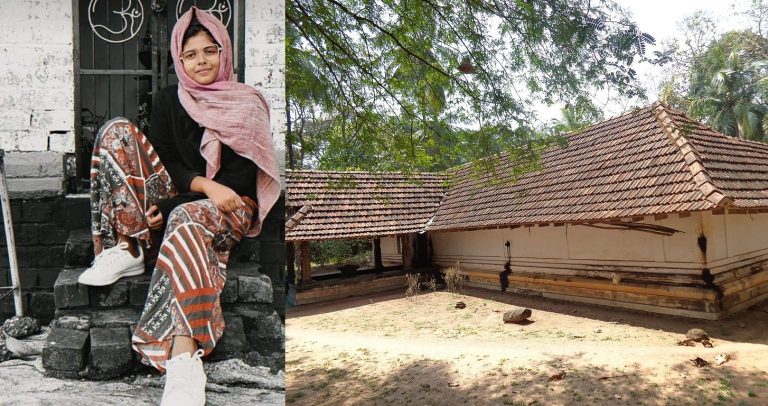
The secretary of Sree Thripurasundari Devi Temple, Sarath Kumar, has lodged a complaint against an unidentified Hijab clad woman for entering the Vanniyambalam temple in Malappuram district with her shoes on, reports Organiser. A picture of this girl sitting in the temple premises wearing her shoes went viral on social media platforms.

Kumar, in his complaint, has accused the woman of intentionally hurting the religious sentiments of Hindus and trying to stoke communal tension in the area. He said that the girl’s offence is punishable under the Indian Penal Code sections 153, 153A and 295A.

It is pertinent to note that Malappuram in Kerala has one of the highest concentration of Muslim population and according to Census data nearly 70% of residents of the district are Muslims. In fact, Malappuram is considered to be the hotbed for Islamist fundamentalism. The presence of the Muslim League as a formidable force has also resulted in the expansion of radicalisation in the Malappuram district.

In the beginning of the year, it was reported how the Hindu residents of a colony at Kuttipuram in Malappuram district were reportedly denied drinking water and had to face a boycott allegedly by Muslim groups for supporting the government on the historic Citizenship Amendment Act (CAA)

Muslim dominated Malappuram district in Kerala- a known Grooming Jihad factory

In fact, many controversial religious conversion centres operated through petrodollar are headquartered in this district. According to a 2016 intelligence report, two known religious conversion centres in Kozhikode and Malappuram converted as many as 5,793 people to Islam between 2011 and 2015. Conversion happening in unrecognised conversion centres must be much higher, the report said.

Recently, the Syro Malabar Church, The Kerala Catholic Bishops’ council and many Christian organisations had voiced their concerns over the growing number of Grooming Jihad (Love Jihad) cases in Kerala. This is something many Hindu organisations, grieving parents and families have also been alleging for the last few years too, that there are forces active in Kerala that are targeting young women, brainwashing them in the name of ‘religious studies’, forcefully converting them into Islam and then shipping them off to serve for ISIS as sex slaves.

These cases started getting media attention back in 2016. Almost all the missing women found linked to the Sathyasarani Trust or the Markazul Hidaya in Malappuram, an organisation run by PFI. An India Today sting into Sathyasarani and PFI had reported that PFI’s founder member had admitted on tape that their ultimate goal is to make India an Islamic State. It was also reported that NIA has taken cognisance of the investigative report.

Samsung to relocate mobile display plant from China, to invest Rs 4,825 crore in Yogi Adityanath’s Uttar Pradesh: Details of the deal

Smartphone major Samsung is all set to relocate its mobile and IT display production unit from China to Uttar Pradesh and invest Rs 4,825 crore in the state.

According to the reports, the new production plant by Samsung will be the first high-technique project, which is being set up in India after relocating from China. The new project is likely to generate 1,500 direct employment and thousands of indirect jobs.

On Friday, the UP government’s cabinet chaired by Chief Minister Yogi Adityanath approved special incentives to Samsung Display Noida Private Limited for setting up a manufacturing unit of mobile and IT display products in Noida.

“The unit intends to invest Rs 4,825 crore. It could be made possible by the sustained efforts of the UP government to create an eco-system in NCR in sync with the intent of the Centre to make an export hub in view of the ever-increasing demand of mobile and other gadgets in the country and abroad,” the Uttar Pradesh spokesperson said.

Samsung will get exemptions, central govt incentives

Under the state government’s “Electronics Manufacturing Policy 2017”, the South Korean telecommunication giant will get an exemption from stamp duty on the transfer of land. The state government will also make financial provision of Rs 250 crore for this project for the next five years, the official said.

Samsung will also receive a financial incentive to the tune of Rs 460 crore under the Centre’s Scheme for Promotion of Manufacturing Electronic Components and Semiconductors (SPECS).

The project will provide Uttar Pradesh with a global identity of an export hub and will help the state receiving more foreign direct investment (FDI).

In 2018, Samsung had built the world’s largest mobile phone manufacturing facility in Noida, Uttar Pradesh. The new facility had the capacity of shelling out 120 million mobile phones a year.

Uttar Pradesh turning out India’s manufacturing hub

Even as markets worldwide are reeling from the effects of the Wuhan Coronavirus pandemic, over twenty foreign companies are eyeing to invest over Rs 9000 crores in Uttar Pradesh. According to a government spokesperson, 57 domestic and foreign companies have signed agreements for investments worth Rs 46,501 crores with the state government. 

Out of these companies, 28 foreign companies have signed contracts worth Rs 9357 crores with the Yogi government. 29 domestic companies have made agreements worth Rs 37,441 crore.

It was also reported that industrialists and electronic makers from Korea were seeking to move investments out of China and invest in Uttar Pradesh.

The Uttar Pradesh government led by Chief Minister Yogi Adityanath has been putting in all efforts to attract these investors to the state, which would help in reviving the pandemic-hit economy. UP Chief Minister Yogi Adityanath has held video-conferencing with over 100 American companies recently in a webinar after these companies expressed their interest in India.

UP government has also started reformulating its various policies to suit these investors who are contemplating opting out of China in the wake of the coronavirus outbreak. Ever since Yogi Adityanath took the reigns of the state, the government has been pitching itself as an attractive investment destination in the country.