Home Blog Page 487

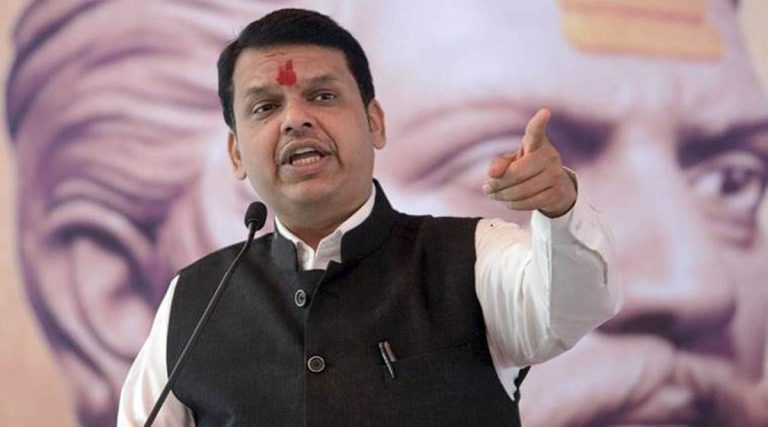
Maharashtra: CM Devendra Fadnavis directs cyber cell to contact Wikipedia over objectionable content against Sambhaji Maharaj

0

Amid the ongoing controversy over “objectionable” content against Chhatrapati Sambhaji Maharaj on Wikipedia, Maharashtra Chief Minister Devendra Fadnavis on Tuesday directed the cyber cell in the state to contact the open-source platform to remove the content.

“I have informed the IG (Inspector-General of Police) Cyber about the objectionable writing on Wikipedia. They have (been) ordered to contact Wikipedia and take action…It is not operated from India,” Fadnavis told reporters.

Noting that Wikipedia doesn’t operate from India, Fadnavis suggested that a set of rules must be in place to avoid distortion of historical facts.

“They have their own rules…We will give suggestions like this – instead of distorting historical things, create a rule…Freedom of expression is not unlimited. It cannot encroach on the freedom of others,” the Maharashtra CM said.

Speaking on the actions of Kalyan Dombivli Municipal Corporation (KDMC), Fadnavis said that police have been told to take action against developers who constructed buildings that have been declared illegal since they were built on government land.

“I am holding a meeting regarding Kalyan Dombivli. We will also go to the Supreme Court regarding how to save the needy. Ravindra Chavan has brought the incident to my attention. The police have been told to take action against the builder. The question is how to regularise the genuine buyers. Some buildings have been built on government land,” Fadnavis added.

Speaking on the water supply issue in Thane’s Badlapur, the Maharashtra CM said, “I promise you that funds of Mumbai Metropolitan Region Development Authority (MMRDA) will get to Badlapur as soon as possible. I will solve the water supply issue.”

He said dams were being constructed on the Ulhas River to resolve the flooding issue in Badlapur during monsoon season.

Earlier, Maharashtra CM Devendra Fadnavis on Monday attended the International Temples Convention and Expo event in Andhra Pradesh’s Tirupati and spoke about his experience, stating that many temple committees from India participated in the event and discussed how modern technology and ancient Sanskriti can be connected. 

(This news report is published from a syndicated feed. Except for the headline, the content has not been written or edited by OpIndia staff)

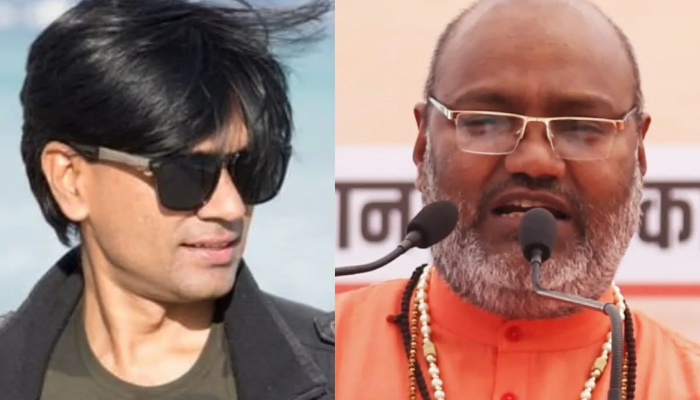
‘Added fuel to fire, built narrative, incited people’: UP govt tears into Mohammed Zubair during hearing in Allahabad High Court

On Tuesday, 18th February, during the hearing of the case against Mohammed Zubair in Yati Narsinghanand case, Uttar Pradesh government said that the state police had taken action against Yati Narsinghanand, and that the courts had granted him bail. The argument was presented in the Allahabad High Court in response to Alt News co-founder Mohammed Zubair’s appeal against the state police’s FIR over his “X” (formerly Twitter) post on Yati Narsinghanand’s allegedly “derogatory” speech.

The matter is before a panel consisting of Justices Siddhartha Varma and Yogendra Kumar Srivastava

According to the UP Government, which was represented by Additional Advocate General Manish Goyal, Zubair tried to stir the public by fabricating a storyline through his social media posts. The fact checker, AAG contended, had fueled the flames, and also questioned the timing of his posts.

“The date of Yati’s speech is 29th September, and the date of the tweet is 3rd October. Here comes the element of mens rea (guilty mind) because he says about his own will to post on social media. So he says there is rampant disinformation on social media, so he makes the post. He is saying that the video was already there. He takes responsibility for the post. He says that I have checked it. Whereas, he argues that he was sitting in Bengaluru, and he doesn’t know what is happening in Ghaziabad. This is corroborated by the statement that he has given to the police,” Goyal contended.

AAG Goyal mentioned that the tweet was posted four days after the occurrence, rather than right away, and highlighted that Zubair started tweeting from 3rd October till the morning of 5th October. “So these dates become very relevant,” Goyal noted. He says that no arrest was made, and weak sections were invoked against Yati Narsinghanand, but it is not like that. So to say that the police are not doing their job, and it was his (Zubair’s) duty is wrong. Police were doing their job, and it was the court granting him (Yati) bail,” he added.

Goyal further submitted that although Zubair acknowledged that Yati Narsinghanand had been arrested in eight FIRs, he attempted to portray that the authorities were supporting him and were bringing FIRs against him under weak sections, which was untrue. You are annexing the news report (regarding Yati Narsinghanand’s bail) in the writ petition once an FIR is registered against you. You can file as an annexure to the petition but not post it (online), AAG Goyal conveyed.

According to Goyal, even though Zubair claimed to have relied on a piece of news from Global Bharat, his tweet and the article were significantly different. “There are other things in the speech as well. It is talking about illegal immigrants and other issues also, but the petitioner has picked up 4-5 lines and has shown the video,” he stated.

All this has to be seen in the light of the mentality of a common Indian. What narrative is being shown? What will an Indian man think? Now, kindly see the timing of the speech, that is an important fact. 1st is regarding the deliberate intention of making the news. 2nd is claiming himself to a renowned global fact checker and 3rd is regarding how it will be perceived by a common man. We are sensitive. We are most sensitive to these things and the petitioner lordship is fully aware of this fact,” he pointed out.

You are fully conscious and disseminating the information that the police are hiding this person, and filing an FIR under weak sections, whereas the FIRs have not been lodged under weak sections. There have been arrests which you have not disclosed. There are 29K reposts to his post. He reposted one of the posts, by doing this, he is adding fuel to the fire,” Goyal said, and even quoted Zubair’s tweets saying, He is freely roaming out and spreading hate regarding Yati Narsinghanand.

AAG Goyal added, It is being posted in the same thread. Then the tweet where Kiren Rijiju was tagged. This is like taking the law into his own hands, building a narrative and trying to incite people. He also read out sections leveled against Yati Narsinghanand. “Now, what is the weak section and what is the strong section has not been spelt out by the petitioner in the paragraph under reply. Section has not been spelt out by the petitioner in the paragraph under reply,” he stated.

Now this perception is being created. A perception that is translated into a narrative and is being forwarded to the public at large,” Goyal replied when questioned if “there’s any authority regarding a weak section” by the court.

“Weak section is only a perception created by the petitioner being translated into a narrative, and then he says that he (Yati Narsinghanand) was on bail when he gave the speech. What were you doing, you did not mention that in your post,” he asked.

Additional Advocate General Manish Goyal also cited a post dated 5th October in which Alt News co-founder Zubair alleged that the police were doing nothing, after verifying the facts, thus, in addition to other areas of the country, Saharanpur, Bulandshahr, and Ghaziabad in Uttar Pradesh are tense.

All these events that started from the 3rd to the 5th show his intent. That is how it has a rippling effect, the cause and influence and the rippling effect on the common man. This is not news. This is not fact-checking. It is to develop a narrative,” he added.

Additionally, AAG Goyal emphasised that Zubair has more X followers than Alt News, and his account holds greater influence than anything else on his channel. That’s why people follow you and they believe that what you are saying is true and even if it is a lie they believe it to be true. This is not the idea of freedom of speech. This is called the principle of diminished autonomy of the person voicing his freedom of speech and expression because he doesn’t have the same voice as you do,” he observed.

Can it be his freedom of speech when the petitioner is critiquing,” inquired Justice Srivastava to which Goyal responded, You posted a video of 2021 in 2024, which has already been deleted. There have been FIR for that, but you will play it again in 2024. You are like, no, I will play it again. He further asserted, Fact finding would be mentioning the arrest and bail (of Yati Narsinghanand) for that video.

Goyal called him a “person of influence” and reiterated, He is saying that he is a co-founder of Alt News which has 3 lakh followers, and he has 15 lakh followers, so he is a person of influence,” and added that his opinion carries a lot of weight. He stated that the petition clarified Zubair’s objective which he created in reaction to false information in the media, by his own admission and stressed, The duty of the citizen should have been to point out that the FIR has been registered under these sections.”

Additional Advocate General Manish Goyal pointed out, When things are said with regard to the Constitution of India, the escalation is to the extent that it goes beyond Section 196, and once it goes beyond Section 196 it reaches Section 152 BNS,” and referred to Zubair’s post with “samvidhan ki tehrvi” words.

I read somewhere that a piece of news which is older than 24 hrs is not news, it has become scandalous. The opposition says random things and also burnt the constitution. The burning of the Constitution is an offence,” AAG Goyal also noted. The hearing was then concluded and Zubair’s interim protection which was earlier extended till 18th February was moved to 19th February.

Notably the Ghaziabad Police filed a formal case against Alt News co-founder Mohammed Zubair in October 2024, charging that he encouraged animosity amongst religious groups after an associate of Yati Narsinghanand’s filed a complaint. Mohammed Zubair filed a challenge in the high court against the FIR, which eventually included the offense of harming the sovereignty, unity, and integrity of India under Section 152 of the BNS (Bharatiya Nyaya Sanhita).

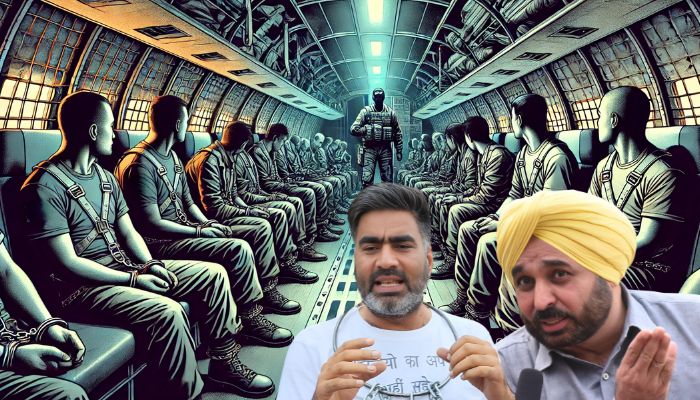
Paid lakhs for illegal entry into US because he hated family business: Why politicians should stop trying to portray deported Indians as victims

In recent weeks, the issue of illegal Indian immigrants getting deported from the United States has taken centre stage in the Indian political landscape. Several political leaders are engaging in performative gestures instead of addressing the root cause of the problem. If an Indian is getting deported from the US over allegations that he or she entered a foreign country illegally, it is neither a matter of pride nor a matter of sympathy. It is a matter of severe scrutiny to understand how such a nexus is active in sending Indians illegally to a foreign country, that too in exchange for tens of lakhs of rupees.

Leaders like Bhagwant Mann, Sukhpal Singh Khaira (Congress), and Partap Singh Bajwa (Congress) from Punjab, along with others from across the opposition spectrum, have questioned the government on the matter while offering support to the deported individuals. Interestingly, Punjab Chief Minister Bhagwant Mann provided them with food, and arranged transportation to their hometowns. On the other hand, Khaira demanded government job for the deported individuals and Bajwa questioned CM Mann if he had any plans for deported individuals or he was making false promises.

Interestingly, Mann has promised jobs to those who are “eligible,” portraying them as victims of circumstances. He even tried to claim that US planes carrying deported individuals are being landed in Amritsar as part of conspiracy and demanded they should land elsewhere.

Other leaders have demanded rehabilitation programmes and employment opportunities for the deported individuals and tried to set the narrative that it was the failure of the central government that these individuals attempted to go to the US illegally and lost money and dignity.

SP leader Atul Pradhan resorted to dramatic theatrics, appearing in chains to project the so-called “atrocities” faced by deported illegal immigrants. He accused the government of failing to take care of individuals who went to the US illegally and claimed it was an “embarrassment” for the government that they were deported in shackles. However, the reality remains that these individuals knowingly broke immigration laws, took the illegal donkey route, and were deported as per international protocols.

Not only leaders, some so-called journalists are also portraying them as victims. For instance, Ajit Anjum shared a news clipping where deported individuals narrated what they faced in detention centres in the US. It is understandable that detention centres cannot be 5-star hotels. These individuals went illegally and treated like criminals, as they should be.

Middle-class aspirations and reckless choices

However, a closer examination of the situation reveals that several of these individuals could have opted to live here and used the money to set up a business in India instead of taking the illegal route to the US. It is difficult to understand what kind of opportunity they think they would get in the US that makes them willing to take the illegal route, also known as the “donkey route,” to enter the US, live in shady circumstances, and do odd jobs for months or sometimes years before leading a sustainable life.

For instance, a man named Navdeep Singh from Punjab got deported not once but twice from the US. Navdeep’s father runs a sweet shop in Taranwala village of Mamdot block in the Ferozepur district. According to media reports, Navdeep found it “embarrassing” to work at his father’s shop. Navdeep, a graduate of Guru Nanak College, decided to go to the US for “better opportunities.”

His father, Kashmir Singh, sold land and took loans from relatives and friends to send him to the US, but not via a legal route. In his first attempt, Navdeep gave an “agent” ₹40 lakh, reached the US via the donkey route, and was deported in June last year. After returning, he thought of giving it another try. This time, too, he decided not to take the legal route and contacted the same agent, who demanded ₹15 lakh and sent him back to the US via an illegal route. He was again caught and is now awaiting his second deportation.

The dark side of illegal immigration

The story is similar for many other individuals from Punjab, Haryana, Gujarat, and other states. In some cases, reports suggest that the deported individuals turned out to be criminals who fled the country after committing crimes in different states. For instance, murder suspects who fled to the US have been arrested in Punjab, and a POCSO-accused individual has been arrested in Haryana.

Most of these individuals were well aware of the fact that they were taking an illegal route to the US. They knew about the consequences of their actions. Their only hope was that if they got caught, they would apply for asylum in the US, claiming atrocities faced by them in India.

Notably, in March 2023, OpIndia reported how former Sangrur MP Simranjit Singh Mann admitted to giving fake letters to “aspirants” who wanted to shift to foreign countries, stating that they faced atrocities in India. These “aspirants” would pay Simranjit money, which could be as high as ₹50,000 per letter. In such cases, these letters helped the “immigrants” pose as Khalistani sympathisers.

A recent report suggested that the parents of one of the illegal immigrants were desperately waiting for the “good news” that their son was caught in the US, as it would have meant that he could apply for asylum. Such individuals not only indulge in illegal activities but also defame India in foreign countries with false claims that they faced atrocities at the hands of law enforcement agencies.

Why do they not take the legal route?

Now the question arises: why do these individuals not take the legal route to go to the US and instead choose the donkey route to fulfil their dreams? There are several reasons.

First, as mentioned above, some of them are criminals running from the law. They cannot apply for passports or take the legal route without permission from the courts.

Secondly, there are several illegal and dubious immigration agencies that dupe naïve and innocent individuals, claiming that they are sending them legally to the US or other countries. It is only after reaching Mexico or another country that these individuals realise they have been duped.

Lastly, in the majority of cases, the individuals fail to secure the required band score on the International English Language Testing System (IELTS) test, which is essential to obtain a student or work visa for the US. In such cases, many immigration agencies suggest that individuals either get a proxy to take the IELTS test on their behalf, which is illegal, or take the donkey route, which is again illegal. For both options, individuals end up paying tens of lakhs and, in many cases, get deported back to India.

For example, 23-year-old Akashdeep Singh desperately wanted to move to Canada but could not clear IELTS. He went to Dubai and came in contact with a travel agent who helped him move to the US via the donkey route in exchange for ₹55 lakhs. Akashdeep was among the first set of deported illegal Indians.

There have been countless instances where proxy IELTS nexuses have been revealed by investigating agencies. Several immigration agencies were raided recently by Punjab Police in view of deportations from the US. Such actions have been taken by investigating agencies in the past, but the nexus has remained active in one way or another.

The misplaced dream of an easier life abroad

The number of immigrants, both legal and illegal, choosing to go to another country and leave their lives in India is huge. The hope for better opportunities, the lack of understanding of the difficulties faced in foreign lands, the lack of proper intervention by state and central governments in curbing the nexus pushing individuals to choose donkey routes, peer pressure to go to the US, and, in some cases, the feeling of “embarrassment” in opting for traditional family work are all leading to such situations.

The tens of lakhs these individuals are spending to enter the US or Canada illegally prove that they do not lack the means or resources. Their desperation is not driven by poverty but by an obsession with settling abroad at any cost. Instead of taking the legal route or using their funds constructively to build a future in India, whether by starting a business or acquiring skills, they willingly gamble everything on an uncertain and illegal path.

The problem of Indians choosing illegal routes to go to other countries cannot be solved just by attacking the nexus. It will grow again. The only way out is to put an end to the rhetoric that life abroad is better than in India. If you are not a highly educated or highly skilled individual, chances of survival in the US, Canada, or Australia are minimal. Sooner or later, you will come back with additional loans on your head.

With growing scrutiny over immigration policies in several countries and increasing sentiment against illegal immigrants, it is better to stay in India and seek better opportunities here. Navdeep, who felt embarrassed to work at his father’s sweet shop, got deported twice. That is much more embarrassing than working at a sweet shop. The mindset and mentality have to change; otherwise, this vicious circle will never end.

Simultaneously, political leaders should rise above their vested interests and not project these individuals as victims. They committed a crime and were deported as per the Standard Operating Procedure (SOP), which has been explained by the Minister of External Affairs, Dr S Jaishankar. What is needed here is for politicians and law enforcement agencies to sit together and come up with a plan not only to provide better opportunities in India but also to curb the nexus that lures individuals into taking the donkey route to foreign countries.  

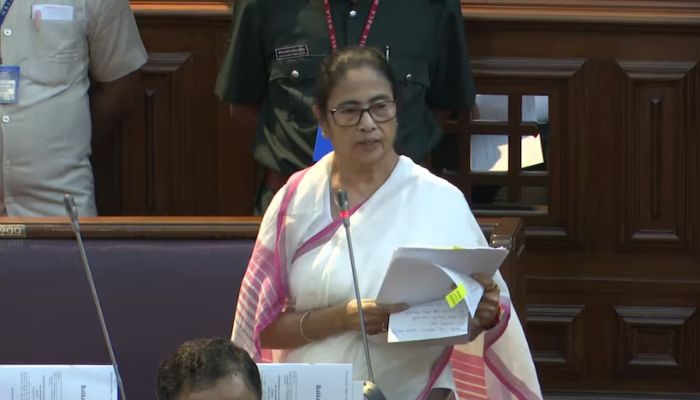
This is Mrityu Kumbh, not Maha Kumbh: Mamata Banerjee in Bengal assembly

West Bengal Chief Minister Mamata Banerjee has raised serious concerns over the management of Maha Kumbh 2025, calling the event “Mrityu Kumbh” due to what she described as a lack of proper planning.

The West Bengal CM, who was addressing the Legislative Assembly, expressed her respect for the holy Ganga Maa and the significance of the Maha Kumbh, but strongly criticized the organizers for the inadequate arrangements resulting in stampedes on January 29 in Prayagraj and February 15 in New Delhi Railway station.

In her statement, Mamata Banerjee said, “This is ‘Mrityu Kumbh’…I respect Maha Kumbh, I respect the holy Ganga Maa. But there is no planning…How many people have been recovered?…

She further on the disparity in the arrangements made for the rich and the poor saying, “For the rich, the VIP, there are systems available to get camps (tents) for as high as Rs 1 Lakhs. For the poor, there are no arrangements at Kumbh…”

Banerjee continued, “Stampede situation is common in a ‘mela’ but it is important to make arrangements. “What planning did you make?”

Meanwhile, former Union Railway Minister and RJD Chief Lalu Prasad Yadav responded to a question regarding crowd management for the Maha Kumbh on Sunday, stating, “Kumbh ka kahan koi matlab hai. Faaltu hai kumbh (Kumbh has no meaning. Kumbh is useless).”

His reaction came after stampede happened around 10 pm when thousands of devotees were heading to Prayagraj for the Maha Kumbh 2025 festival, claiming the lives of at least 18 people.

After the stampede in Delhi, A two-member committee was formed to investigate the stampede at the New Delhi Railway Station on February 15.

The committee comprised Narsingh Deo, Northern Railway’s Principal Chief Commercial Manager (PCCM), and Pankaj Gangwar, its Principal Chief Safety Commissioner (PCSC), the railways said on Sunday.

On Debraury 16, the two-member committee formed to investigate the stampede started examining CCTV footage and collecting evidence, an official of the Indian Railways said.


(This news report is published from a syndicated feed. Except for the headline, the content has not been written or edited by OpIndia staff)

Ranveer Allahbadia case: SC asks Central Govt to regulate obscene content on YouTube and other social media platforms

0

The Supreme Court on Tuesday asked the Centre to consider regulating obscene content on YouTube and other social media and said it would not leave a vacuum and barren area the way it is being misused by so-called YouTube channels.

A bench of Justices Surya Kant and N Kotiswar Singh asked Additional Solicitor General Aishwarya Bhati, who was sitting in the courtroom on another matter, to ask the Attorney General and Solicitor General for assistance in the court.

“There was this case of so-called YouTubers… We would like you (the government) to do something. If the government is willing to do something, we are happy; otherwise, we will not leave this vacuum and barren area the way so-called YouTube channels are misusing it and all these things are going on..,” Justice Kant told Bhati.

The bench said, “We should not overlook the importance and sensitivity of the issue.”

Justice Kant told Bhati, “Please request the Attorney General and the Solicitor General to be here on the next date of hearing.”

The top court’s remarks came in the wake of inappropriate comments by YouTuber and Podcaster Ranveer Allahabadia during his guest appearance on the show India’s Got Latent.

Today, the bench heard the plea filed by Allahabadia seeking direction to club the multiple FIRs registered against him and grant interim relief to him from arrest.

While hearing the YouTuber’s plea, the bench lambasted him and said his parents would feel ashamed; society would be ashamed.

“There is something very dirty in his mind, which has been vomited by him in the program,” said the bench during the hearing.


(This news report is published from a syndicated feed. Except for the headline, the content has not been written or edited by OpIndia staff)

Bangladesh: Karim Mia and his aides murder Hindu man in broad daylight after he objects to robbery, hit victim on the head repeatedly with hammer

On Saturday (15th February), a Hindu man named Sumon Kumar Pal was murdered in broad daylight in the Dakshin Khan area in Dhaka city of Bangladesh.

The victim was just 40 years old. Pal worked as a bKash (mobile financial services) agent at a pharmacy named ‘Bhai Bhai Medical Hall’. At about 12:30 pm, three men ambushed his shops and began looting the cash from the register.

Pal confronted the robbers, following which they hit him in the head repeatedly. He was rushed to the Kurmitola General Hospital but was declared dead on arrival. He was a native of Bauphal upazila in Patuakhali district of Bangladesh.

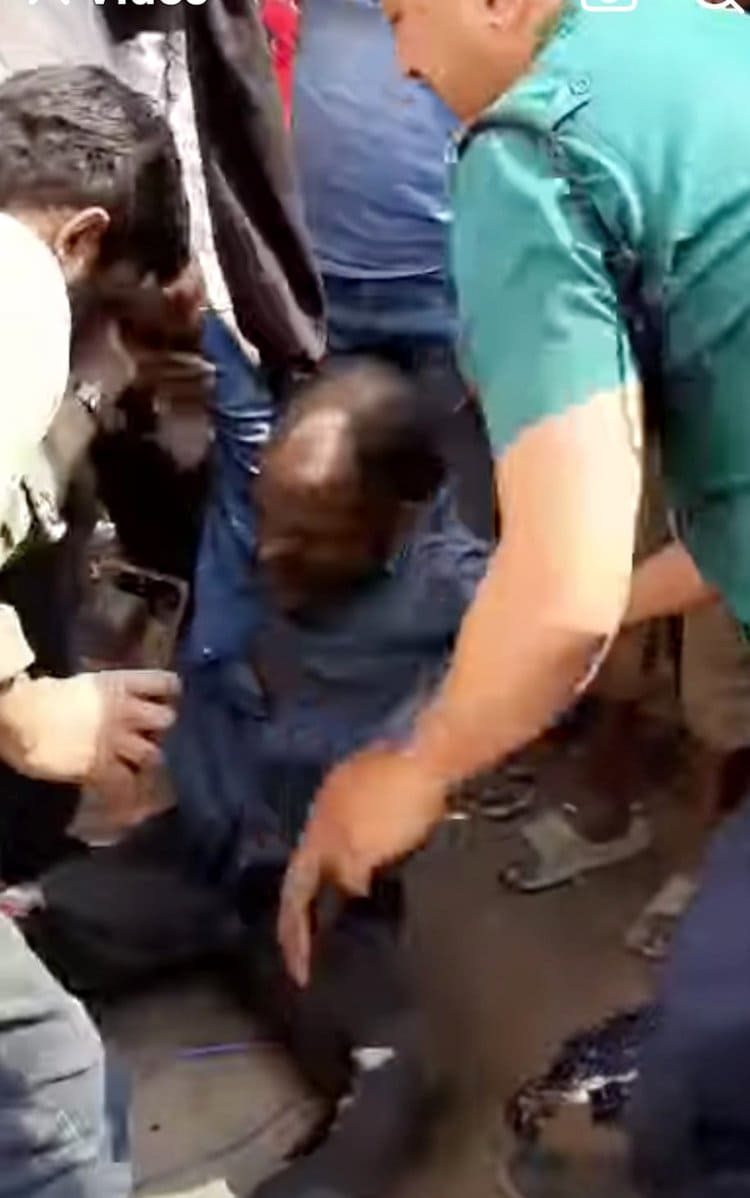
Locals apprehend robber Karim Mia, image via Ajker Patrika

Locals however succeeded in catching one of the robbers, who was identified as Karim Mia. They trashed Mia and handed him over to the police. He was admitted to another hospital for treatment. The other 2 robbers managed to flee the scene.

According to eyewitness Saiful Islam, a sum of Tk 10000- Tk 15000 was recovered from Mia. He informed that the victim had been living and working in the Dakshin Khan area for over 20 years.

“Sumon Kumar Pal was hit on the head. It was only after that they robbed the shop. If the purpose was robbery, then they would not have hit him with the intention to murder,” the locals told Ajker Patrika.

Hindu student shot dead in Khulna

On 24th January this year, a Hindu youth named Arnab Kumar Sarkar was shot dead at the Tentultala intersection in Khulna city of Bangladesh.

The victim was 26 years old and a master’s student at Khulna University. The incident occurred when Arnab was drinking tea on his motorcycle near a tea stall.

At that time, a group of bike-born men opened fire at the Hindu student and fled the crime scene. Arnab suffered a bullet injury to his head.

The chief of Sonadanga Police Station Shafiqul Islam stated, “Locals quickly rushed to his aid and transported him to City Medical College Hospital, where he was pronounced dead by doctors.”

The Deputy Commissioner of Khulna City Police (southern division) Md Moniruzzaman has referred to the attackers as ‘terrorists’, adding that an investigation was initiated to determine the motive behind the murder of the Hindu student.

Arnab Kumar Sarkar is now survived by his parents.

Nupur Sharma continues to get vilified, this time by Ranveer Allahbadia’s lawyer: Who is to blame? Abhinav Chandrachud or Justice Suryakant

The Supreme Court of India has granted protection from arrest to Podcaster Ranveer Allahbadia after his insidious remarks on the India Got Latent show. The court has further instructed him to surrender his passport to the Thane police station, join the investigation and do no shows until further notice.

During arguments, there was a heated exchange where Justice Suryakant expressed disgust at the remarks by Ranveer Allahbadia. Ranveer’s lawyer, Abhinav Chandrachud, listed the threats that were being given to Ranveer and his co-accused. In one of his arguments, he said, “One of the co-accused has been threatened with acid attack. In Nupur’s case, there were threats and the remarks were worse. The moment there is 2nd FIR, it constitutes an abuse of process”.

LiveLaw and Bar and Bench both reported the remark by Chandrachud.

With this remark, Abhinav Chandrachud seems to have continued the saga of the vilification of Nupur Sharma. In fact, Chandrachud did so in front of the very judge who had made insidious remarks against Nupur when she approached the Supreme Court for the clubbing of FIRs.

In July 2022, when Nupur Sharma had approached the Supreme Court for clubbing of the multiple FIRs filed against her, it was a bench of Justice Suryakant and Pardiwala which had made shockingly insensitive and insidious comments against Nupur Sharma. In that hearing, frankly, one cannot really decide which judge lowered the majesty of the court more – Justice Suryakant or Justice Pardiwala. The comments ranged from calling her a woman with a loose tongue to blaming her for the beheading of Kanhaiya Lal by Jihadis. The judges went as far as to say that Nupur Sharma had set the country on fire with her remarks – Nupur Sharma – not the petulant, violent and pampered minority which took to the streets chanting Sar Tan Se Juda – demanding the beheading of Nupur Sharma because she dared to repeat what is mentioned in the Islamic scriptures.

Abhinav Chandrachud, arguing for his client Ranveer Allahbadia said in court that, “In Nupur’s case, there were threats and the remarks were worse”. Now, before we comment on this statement, it is important we analyse what this statement means.

Legally, Abhinav Chandrachud means that if the FIRs can be clubbed for Nupur Sharma by the Supreme Court, given that she was getting death threats, then the situation should be much different for Ranveer Allahbadia. To make that point and for the benefit of his client, Chandrachud drew a parallel claiming that the comment by Nupur Sharma was far more egregious than the comments made by Ranveer.

One has to give it to junior Chandrachud – it was indeed a good legal strategy to make this statement, especially in this case. First and foremost, what Chandrachud did was show a “more egregious” statement compared to what Ranveer said, hoping to impress upon the judges that FIRs have been clubbed for “much worse” and therefore, Ranveer’s case should be considered. The second thing he did was invoke the memory of Nupur Sharma in front of the very judge who had made insidious remarks against her – in the probable hope that his disgust for Nupur Sharma was much more severe than his disgust for Ranveer.

Smart? Sure. Correct? Nope. Moral and just? Certainly not.

Let’s tackle the questions one by one.

Were Nupur Sharma’s comments worse than Ranveer Allahbadia’s?

The short answer is – No. But here is the long answer. What Nupur Sharma said (redacted because the author likes her head attached to her torso) was, firstly, a response to a Muslim panellist, Tasleem Rehmani, insulting Lord Shiva after a Shivling was found in the Gyanvapi disputed structure. Like many other Muslims, Rehmani too insulted the Shivling with expletives and it was only in response that Nupur Sharma quoted facts from the Islamic scriptures, asking him how he would feel if she were to repeat those facts.

Second, and most importantly, Nupur Sharma did not throw expletives or insult Rehmani – nor did she insult his faith, unlike what Rehmani said. All she did was, quite literally, repeat what the Islamic scriptures say.

Now, I really don’t want to repeat what Nupur Sharma said because I don’t want to further offend the perennially offended, petulant and violent barbarians who have made Nupur Sharma’s life miserable. But I will do one better – I will let the venerated terrorist Zakir Naik – who is considered one of the world’s foremost Islamic scholars – tell you what Nupur Sharma said.

Zakir Naik made this speech while he was in Dubai – supposedly an Islamic nation – and was not beheaded for it. Nupur Sharma, on the other hand, repeated exactly the same thing – and has been receiving death, beheading and rape threats from across the world for the past 3 years – with no respite.

While Nupur Sharma merely repeated what Zakir Naik himself had said, and something said by various Islamic scholars from across the world, Ranveer Allahbadia made a dumb, crass and sexual “joke” about parents – completely unprovoked.

While Nupur Sharma responded to religious insults being hurled by Tasleem Rehmani, Ranveer Allahbadia went online, sought this joke out from a German show, wrote it down, memorised it (I assume, since he wasn’t reading it off a paper), and asked a seemingly young person if they would watch their parents have sex for the rest of their lives or join them once to stop it.

Simply on the point of law, Nupur Sharma’s statement was not “worse” since a) it was factual and b) it was a response to insults, while Ranveer’s dumb joke was a thought-out, predecided and premeditated statement.

On the basis of facts – and I cannot say this enough – Nupur Sharma’s statement was FACTUAL. That Muslims took offence to it is a Muslim problem, not a Nupur Sharma problem. As I have said before – If the truth is Islamophobic then the problem doesn’t lie with the truth, it lies with Islam. In the case of Ranveer, I would imagine that a question about watching one’s parents fornicate would offend sane, thinking, civilised people. In fact, if someone does not take offence to a dumb podcaster talking about their parents fornicating, perhaps their moral compass is broken and they need medical help. Therefore, comparing the two cases may be a great legal strategy, but it is unconscionable on a moral plane especially when Nupur Sharma has been confined to her home, under strict protection, for 3 years with no end in sight because the crazed barbarians would never stop hunting her, just like they did not stop hunting Salman Rushdie.

If one were to say that the statements by Salman Rushdie were “worse” than the comments of Ranveer Allahbadia, it would draw sharper reactions in favour of Rushdie. But since the subject here is Nupur Sharma, Chandrachud felt comfortable vilifying her in front of the very judge who had essentially said she deserved the threats being given to her by crazy Muslims.

In short, the factual statements by Nupur Sharma cannot be compared to the deranged “joke” by a 31-year-old podcaster who thought displaying his secret Odiepus complex may invite a few laughs.

Who is the blame – Justice Suryakant or Abhinav Chandrachud?

One can be angry at Abhinav Chandrachud for bringing up Nupur Sharma, but frankly, Chandrachud was doing what was right for his client. The question is, why did he think it was acceptable to vilify Nupur Sharma in the highest court of the country merely for stating facts? Why did Chandrachud think it was ok to tarnish the reputation of a victim – yes – a victim of Islamic fanaticism and barbarism? Why did Chandrachud think that insulting Nupur Sharma would help his case?

Abhinav Chandrachud thought it was ok to stoop that low because the very judge who stooped lower was the one who held Ranveer Allahbadia’s fate in his hands.

It was Justice Suryakant who was one of the judges that made vicious comments against the very victim they were meant to protect. It was this very Supreme Court which incentivised the vilification of Nupur Sharma that Abhinav Chandrachud indulged in today.

It would be easy to simply blame Chandrachud and ask if this was the best argument he could make in the court of law to protect Ranveer Allahbadia. It would be easy to ask how he could indulge in such shenanigans after coming from a long, illustrious line of judges.

But frankly, he is only following the precedent set by this very Supreme Court and this very judge.

The statements by Justice Suryakant and Justice Pardiwala in 2022 ensured that Nupur Sharma could be thrown to the wolves with impunity because that is exactly what they did.

What the Supreme Court did years ago, will continue to haunt Nupur Sharma – because when they were meant to protect her, they blamed her for the actions of Jihadi, blood-thirsty murderers. That is the undeniable, unshakable truth – untarnished by the irate rants of the Judges and the screeching, murderous and bellicose rants by the barbarian mobs.

Do I think Ranveer Allahbadia should be jailed? No. Do I think the outrage is justified? Sure. Do I think he should be threatened? Absolutely not. Do I think the case of Nupur Sharma and Ranveer are the same? Absolutely, utterly, NOT.

Germany pontificated to India about freedom of speech, now it raids people calling their politicians ‘idiots’: Those Germany defended would be in jail if German law was followed

0

In 2022, Germany expressed concerns over the arrest of Alt News co-founder and propagandist Mohammed Zubair. In 2023, Germany tried to ‘educate’ India after the crackdown on the BBC documentary. This is not the end. Germany has repeatedly “expressed concerns” whenever India has tried to curb misinformation or stop false narratives and propaganda from spreading on social media in the country.

In short, Germany, while posing as a protector of free speech, has complained about India, claiming that law enforcement agencies “jail” journalists or target media houses.

However, recent reports emerging from Germany tell a different story about the country. A nation that poses as a protector of free speech has been hunting people for posting something which, according to German laws, can be considered “hate speech.” In fact, even posting a meme can lead to arrest and jail time in Germany if the publisher of the post is not careful enough with the words he or she is using.

The crackdown on ‘internet trolls’

On 11th February (local time), dozens of police teams initiated raids at houses across Germany in a coordinated crackdown on ‘internet trolls.’ There were 50 coordinated raids across the country involving hundreds of police officers confiscating the electronic devices of internet users who had apparently posted something online that could be classified as ‘hate speech.’

The prosecutors claim that the Constitution of Germany protects free speech, but there is no room for ‘hate speech’ in the country. Experts from Germany assert that free speech comes with certain limits. German law prohibits speech that could incite hatred or is deemed insulting.

In November 2024, a 64-year-old man faced action by German authorities for calling German Vice-Chancellor Robert Habeck an “idiot” on social media in June that year. According to media reports, a doctored image of Habeck alongside a shampoo brand was posted on social media with the pun “Schwachkopf Professional”—meaning “professional idiot.” A criminal complaint was filed, leading to a raid at the man’s house.

Not long ago, in 2021, a local politician, Andy Grote, was called a ‘pimmel,’ a German word for the male anatomy. Grote was enraged and filed a complaint against the person who used the term, leading to a police raid at the individual’s house. What followed were accusations of excessive censorship by the government.

Speaking during a discussion on 60 Minutes with correspondent Sharyn Alfonsi, German prosecutors explained that in Germany, it is acceptable to debate politics online, but if someone calls another person a ‘pimmel,’ including a politician, they can face legal consequences, including jail time.

Prosecutor Dr Matthäus Fink said, “Comments like ‘You’re son of a b—h,’ excuse me for using this, but these words have nothing to do with a political discussion or a contribution to a discussion.” While people in Germany fear that the country is backsliding into the Germany of 80 years ago, with the policing of ‘free speech’ resembling surveillance of citizens’ words, Josephine Ballon, CEO of HateAid, a Berlin-based human rights organisation, claims it is not surveillance and that free speech needs boundaries.

She said, “And in the case of Germany, these boundaries are part of our constitution. Without boundaries, a very small group of people can rely on endless freedom to say anything that they want, while everyone else is scared and intimidated.” Interestingly, Ballon claimed that half of internet users in Germany rarely participate in political debates because they are afraid of being attacked online.

Fink justified the crackdown on ‘internet trolls’ by suggesting that it is a bigger crime to insult someone online than in public. His argument was that a public insult fades away quickly, while an online insult remains indefinitely.

The statements given by German prosecutors even shocked American politicians. The Vice President of the United States JD Vance recently said in a post on X, “Insulting someone is not a crime, and criminalising speech is going to put real strain on European-US relationships. This is Orwellian, and everyone in Europe and the US must reject this lunacy.”

The Constitution and Criminal Code

Article 5 of the Basic Law, also known as the German Constitution, states that every person shall have the right “freely to express and disseminate his opinions in speech, writing, and pictures and to inform himself without hindrance from generally accessible sources. Freedom of the press and freedom of reporting by means of broadcasts and films shall be guaranteed. There shall be no censorship.” However, it places limitations on freedom of expression in Article 5(2), stating, “These rights shall find their limits in the provisions of general laws, in provisions for the protection of young persons and in the right to personal honour.”

Coming to the Criminal Code, Section 130 of the German Criminal Code criminalises acts of incitement to hatred, public disturbance, and violations of human dignity. There is a provision to penalise individuals who incite hatred or call for violence against racial, religious, or ethnic groups. Furthermore, anyone who insults, maligns, or defames someone in a manner that may disrupt public peace can be penalised.

Interestingly, the law also prohibits the production and distribution of any content that promotes hatred or degrades human dignity. The penalties range from fines to imprisonment for up to five years. It does not impose restrictions on hate speech solely in offline spaces but also in online spaces. According to German prosecutors, anyone who retweets hateful speech is equally involved in the alleged “crime” and can be punished with a fine or jail time, depending on the severity or frequency of the offence.

German laws, if applied in India, would have thrown left-liberals behind bars

Speaking to propagandist YouTuber Akash Banerjee, fake news peddler and YouTuber Dhruv Rathee had praised free speech in Germany. When Germany supported Mohammed Zubair and the BBC, the left-liberals applauded the “guts” the German government showed in “protecting” free speech. However, all these people, including Zubair, would have been in jail if German laws were followed in India.

Let’s take an example. Zubair, on several occasions, has indulged in activities that led to violence on the ground. In the case of former national spokesperson of the Bharatiya Janata Party (BJP), Nupur Sharma, he intentionally trimmed a clip from a Times Now debate and used it for propaganda against Sharma. He presented her as someone who insulted Islam without providing the context that another panellist in the debate, Tasleem Rehmani, had insulted Bhagwan Shiv, which incited Sharma’s remarks.

As a result, protests erupted across India against Sharma, with calls to behead her (commonly known as the call for ‘Sar Tan Se Juda’). In the aftermath of the uproar Zubair provoked, Kanhaiyalal from Udaipur, Rajasthan, and Umesh Kolhe from Amravati, Maharashtra, were brutally murdered simply for supporting Sharma. While Zubair roams freely, had he been in Germany and its laws been applied, he would have been behind bars.

Conclusion

The hypocrisy of Germany in terms of free speech is nothing short of laughable. It lectures India on human rights and press freedom. However, the law enforcement agencies in Germany are busy raiding homes in early mornings over internet memes. They are jailing citizens for calling politicians names. If such laws are followed around the world, half of the population would be in jail by now.

Germany actually thinks that words said online are more dangerous than actual crime. It is the same nation that wants to teach India about democratic values but run a digital police state where the bureaucratic apparatus decides what is “acceptable” speech and if the person for “insulting” a politician should be thrown behind bars.

The free speech laws in Germany seem so fragile that they consider retweeting a post an offense. While the country shelters Islamic radicals under the guise of asylum and allows them to spread extremist ideologies, they go ahead and arrest its own citizens for “offensive” humour. Instead of pretending to be the moral guardian of global speech, Germany should take a long, hard look at the dystopian nightmare it has created for its own people.

Ajmer 2.0 in Beawar in Rajasthan: Muslim youths exploit and blackmail minor girls, force them to convert, pressurise victims to introduce their female friends to them

A case of rape of 4-5 minor girls has come to light in the Beawar district of Rajasthan. The family members have shared that a gang was behind the heinous crime. They had taken obscene photos and videos of the girls and were blackmailing them. The victims were even pressurised to recite Kalma, keep fasts, and embrace Islam. The case pertains to Bijainagar police station area.

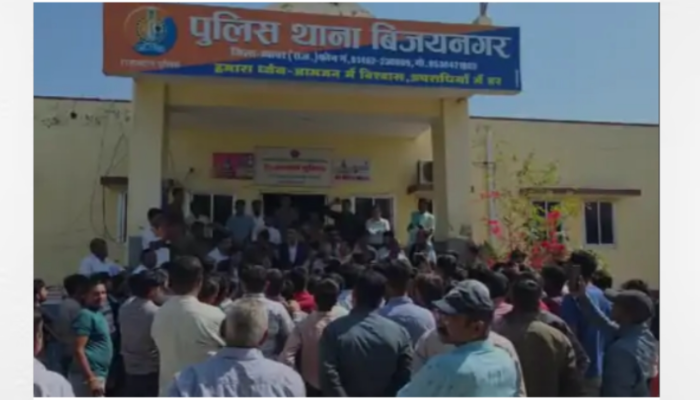
After the case came to light, people gheraoed the police station and demanded the arrest of the accused. Additional cops were summoned from 4 police stations as the situation grew tense and the protesters were assured by the Masuda deputy superintendent of police (DSP) Sajjan Singh to pacify them.

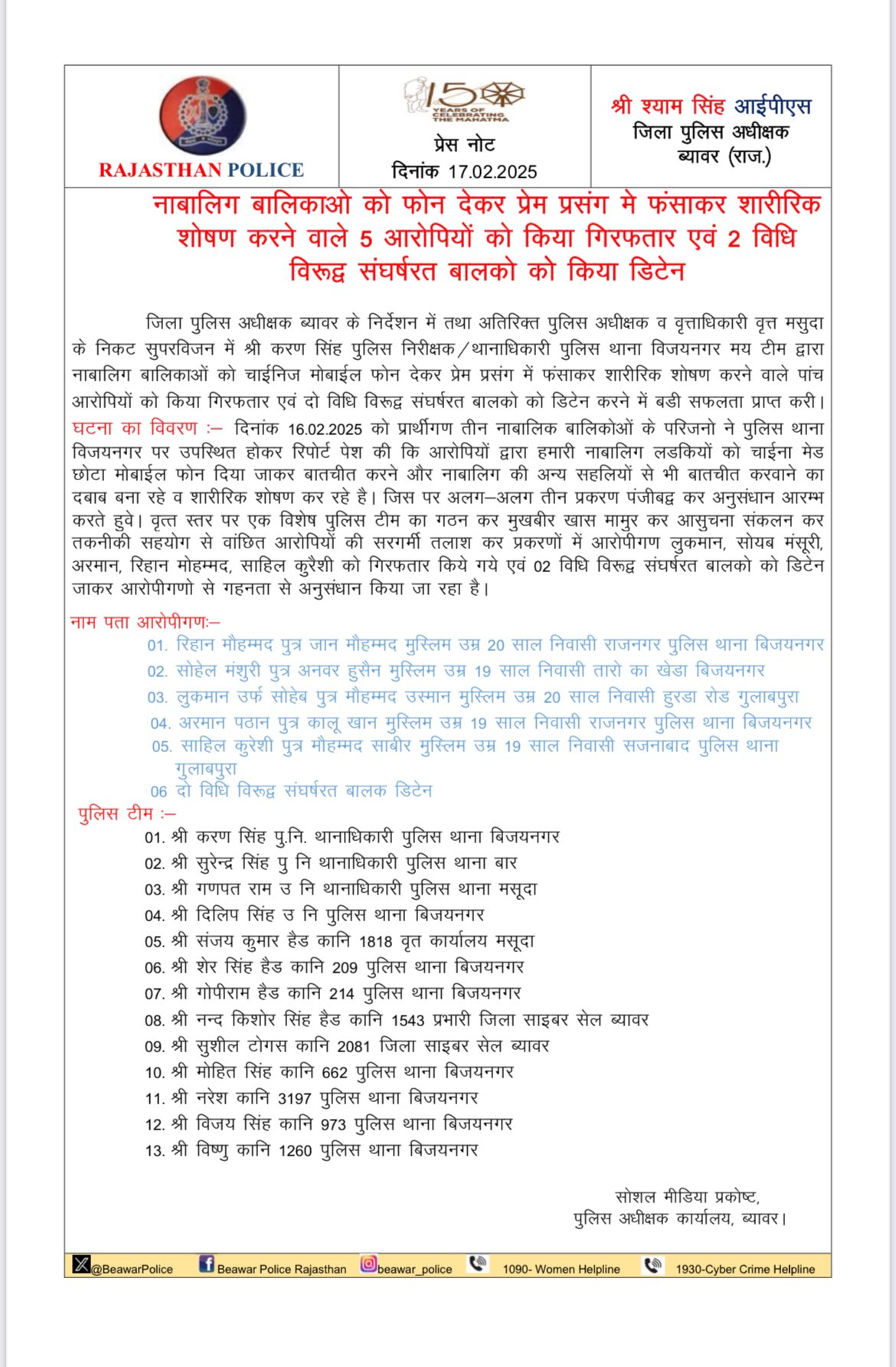
The accused have been identified as Rihan Mohammad (20), son of Jaan Mohammad, resident of Rajnagar Police Station area, Bijainagar, Sohail Manshuri (19), son of Anwar Hussain from Taro ka Kheda Bijainagar, Luqman alias Soheb (20), son of Mohammad Usman of Hurda Road Gulabpura, Arman Pathan (19) son of Kalu Khan, native of Rajnagar Police Station area, Bijainagar, Sahil Qureshi (19) son of Mohammad Sabir from Sajanabad Police Station area, Gulabpura. Two juvenile offenders have also been detained.

The family members of three minor girls reported the matter to the Vijayanagar Police Station and submitted a complaint on 16th February. They stated that the culprits had been pressurising their daughters to talk to them. They were given Chinese mobile phones and were even forced to make their underage friends to chat with the offenders who were sexually exploiting them.

“When we inquired from our daughters, we came to know that there is a gang, which includes Sohail Mansuri, Soheb, Arman, Sahil, Luqman, and 10-15 other boys. They also captured photos and videos of underage girls besides our daughters which were then used to blackmail them. The victims were also given false promises of erasing the explicit material if they introduce them to other girls. The accused threatened and pushed the girls to meet with them. They are trapping our daughters in their net. They are luring them by offering small toys and mobiles. The same is happening with other girls in the area as well. They forced them to go to cafes and wear clothes of their choice,” the complainants shared.

The complainants added, “We learned that the girls were forced to introduce each other’s friends for physical exploitation by the accused when we spoke with our daughters. They were also threatened with murder if they didn’t comply. We discovered that the girls have identical phones when we got in touch with the families of their friends. Likewise, they have experienced similar ordeal.”

Afterward, three separate cases were registered and an inquiry was initiated. A special police team was formed at the circle level, special informers were appointed and details were collected with the help of technical support, following which a rigorous operation was undertaken to nab the perpetrators who were eventually arrested.

Police station in-charge Karan Singh informed that at present 4-5 minors have come forward and gave a complaint revealing that some young men gave them mobile phones after which they pressurised and abused them. Local residents shared that the girls study in a private school and youths of a particular community trapped them, handed them cell phones and raped them.

Dhanraj Kavadia of Vishwa Hindu Parishad said, “I have spoken to the police officers. They have assured appropriate action. After this, the officers have been given an ultimatum till 6 pm. We will see what comes out in the police action. The entire society then will gather in the temple and take a decision. People of a particular community have carried out the incident. Strict action should be taken against the culprits. This is not a party issue, but of the entire society.”

“This incident is shameful for humanity. Whatever I have understood and heard about this instance, it is a part of an international conspiracy. These people do the business of blackmailing by seducing innocent females. A meeting of the officials of the entire society is to be held this evening. A decision will be taken by 6 pm. The culprits must face severe action. This concerns the entire society and not just one party,” said former Municipal Council President Dhanraj Gurjar.

Ajmer sexual exploitation case

In April  1992, Ajmer woke up to a shocking story of sexual exploitation of over 100 women aged 17 to 20. Notably, some of the later reports claimed the number could be as high as 250.

The story was written by journalist Santosh Gupta and it was published in Dainik Navjyoti. The report revealed that hundreds of schoolgirls were sexually exploited by the accused. They recorded the sexual assaults and used them to blackmail the girls to bring more girls to them.

Daughters of big leaders in Ajmer also became victims of the scandal and the story was published with the title “Daughters of big leaders are victims of blackmail’.

One of the biggest shocks for the people of Ajmer was that families of influential Khadims of Ajmer Dargah or the dargah of Khwaja Moinuddin Chishti were involved. These khakis identify themselves as the descendants of the original followers of the Sufi saint Khwaja Moinuddin Chishti. Two names that made headlines for their involvement were Farooq Chishti and Nafis Chishti, who were Youth Congress leaders at the time when the scandal came to light.

SC turns down petition for ‘urgent hearing’ by Soros-funded ADR, had challenged appointment of Chief Election Commissioner: All you need to know about the case and the propaganda

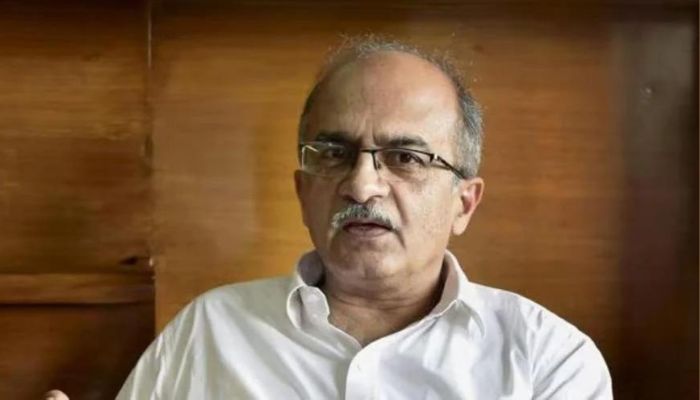
On Tuesday (18th December), lawyer Prashant Bhushan, representing the Soros-funded Association for Democratic Reforms (ADR), demanded the urgent hearing of a petition challenging the constitutionality of a law enacted by the Parliament for the appointment of the Chief Election Commissioner (CEC).

The matter was heard by a 2-Judge Bench of Justice Surya Kant and Justice NK Singh. “It is listed tomorrow as item 41, I am requesting that it be taken at top of the Board. It’s exceedingly important for future of our democracy,” Prashant Bhushan argued.

He claimed that the Centre was violating the judgment of the Constitution Court in the case by appointing Election Commissioners. “I won’t take more than 15-20 mins,” Prashant Bhushan further demanded.

However, Justice Surya Kant did not appear inclined to entertain Bhushan’s shenanigans. “We will see tomorrow subject to any other important matter,” he stated, refusing to direct Registry to take the matter higher up in order.

Justice Surya Kant further noted, “Interim application (to stay the law) has been rejected by coordinate bench vide a reasoned order.” He made the observation after another lawyer representing the petitioners claimed that 3 appointments were made under the contested law.

The court decided to hear the petitioners on Wednesday (19th February) after hearing urgent and fresh matters.

The Background of the Case

In March 2023, the Supreme Court of India resorted to judicial activism and tried to snatch the Central government’s power to appoint members of the Election Commission.

The apex court ruled that a 3-member selection panel, comprising of the Chief Justice of India (CJI), Prime Minister and Leader of the Opposition would jointly appoint the Election Commissioner until a law on the same is framed by the Parliament.

The dangerous precedent laid by the Supreme Court was corrected when the Modi government introduced The Chief Election Commissioner and Other Election Commissioners (Appointment, Conditions of Service and Terms of Office) Bill, 2023 in the Rajya Sabha.

Both the Houses of Parliament eventually passed the bill and it became a law. The government thus removed the CJI from the selection panel and replaced him with a member of the Cabinet.

The government made it stand clear before the Supreme Court in March 2024. 

It said, “The case of the petitioners is premised on one fundamental fallacy that the independence can only be maintained in any authority when the selection committee is of a particular formulation…The high constitutional functionaries ought to be presumed to act fairly and in good faith”…“To indicate, as the petitioners suggest, that selection committees without judicial members would invariably be biased is wholly incorrect”.

The government further added, “Where the Constitution itself specifically vests Parliament with the power to decide upon the appointments of the Election Commissioner, and Parliament exercises this power, no question of Executive overruling (can arise)…The (SC) judgment… had been conscious of the fact that the ultimate decision-making power in this regard lay with Parliament and so it had consciously evolved a time-limited mechanism for appointments to the EC. This mechanism was to last only till the time that Parliament made a law on the subject.”

After hearing the arguments made by the government, the Supreme Court refused to put a stay on the implementation of the Chief Election Commissioner and Other Election Commissioners Act, 2023.

Contrary to the past appointments of Election Commissioners, the selection panel for the first time had the Leader of the Opposition. Prashant Bhushan is demanding an urgent hearing of the case.

ADR, source of its funds and ties with Deep State

ADR is an FCRA NGO that receives foreign funds from some of the most dubious globalist organizations to have ever existed and has repeatedly targeted the Modi government.

ADR receives a huge amount of funds from the Ford Foundation, Google, HIVOS and the Omidyar network for the explicit purpose of electoral and political reform and ‘election watch’. Now, what is the HIVOS? This organization is intricately linked to George Soros’ Open Society Foundation and receives funds from various international governments.

HIVOS’ 2018 annual report says, “The key sources of grant income from governments included the Dutch Ministry of Foreign Affairs, The Global Fund, Swedish International Development Aid, the Millennium Challenge Account, the Swiss Agency for Development and Cooperation, the US Department of State, the Delegation of the European Union in Indonesia, and the Royal Netherlands Embassy in Costa Rica.” Its annual report further says that the key sources of income from non-profit organizations included the Ford Foundation.

At OpIndia, we have extensively documented the manner in which Soros is intimately involved in trying to destabilize democracies abroad. The interference of the Ford Foundation in the internal affairs of a country is well documented. Furthermore, we clearly see that ADR is funded by even foreign governments. It’s not too hard to imagine that it’s perfectly natural for foreign governments to try to undermine Indian sovereignty.

Here are details of who has been funding ADR.

  • Financial Year 2016-2017

ADR got crores from the Ford Foundation and Omidyar Neyword in 2016-2017. According to their FCRA receipts, they got over Rs 2 crores from Omidyar and over Rs 70 lakh from the Ford Foundation.

  • Financial Year 2017-18

In the financial year 2017-18, ADR got almost Rs 2 crores from the Ford Foundation.

  • Financial Year 2018-19

In the financial year 2018-19, ADR got more than Rs 60 lakh from the Ford Foundation.

  • Financial Year 2020-21

In the financial year 2020-21, ADR got Rs 1,13,60,000 from Omidyar.

In the same year, the organisation also received 14,74,000.00 from the US-based Thakur Family Foundation, run by Dinesh Thakur. The so-called public health activist has been targeting the Indian pharmaceutical sector for years, spreading and amplifying negative news about the industry.

One name that appears regularly in the FCRA donor name is Archesh Shah from Sydney in Australia. This mysterious person donates ₹25,000 regularly to ADR, but there is no detail on him on the internet.

Association for Democratic Reforms has links with several deep state entities. As shown above, it received foreign funding from the Ford Foundation, Omidyar Network etc. These entities have funded several anti-India campaigns, and continue to do so.

For example, Omidyar-funded Forbidden Stories was the source of the fake Pegasus report against India published by The Wire. FS was launched by Reporters Without Borders (RSF) and Freedom Voices Network. In the past, the RSF has funded media organisations that produce regime change propaganda against Syria and its president Bashar al-Assad.

Omidyar Foundation also funds several leftist portals in India, like Newslaundry and Scroll.

Thakur Family Foundation, one of the donors of ADR, also funds The Wire, the propaganda portal that has been forced to remove several fake stories against the BJP and the Modi government after they were exposed. It also backs Caravan, the ultra-left portal. The Foundation further funds several journalists, who have written multiple negative stories on India, particularly on the handling of COVID-19.