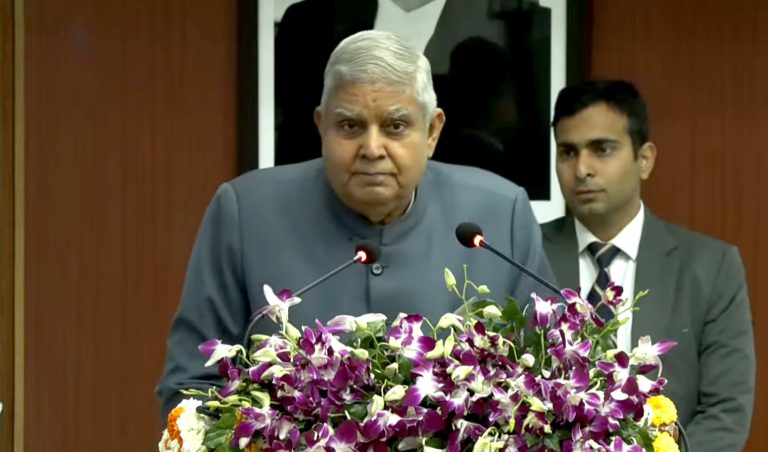
While the Supreme Court of India is hearing a petition seeking to include the Chief Justice of India in the selection committee for the Election Commission, Vice President Jagdeep Dhankhar on Friday questioned how the judiciary can be involved in executive appointments. He said while earlier the executive yielded to the inclusion of judges in executive functions, it was time to revisit the norms.
Speaking at the National Judicial Academy, Bhopal, Dhankhar said that such a system should not exist in a democracy like India. He wondered how the Chief Justice of India participate in the selection of the CBI director, even by “statutory prescription”.
The vice president said, “To stir your minds, how can in a country like ours or in any democracy, by statutory prescription, Chief Justice of India participates in the selection of the CBI director! Can there be any legal rationale for it? I can appreciate that the statutory prescription took shape because the Executive of the day has yielded to a judicial verdict. But time has come to revisit.”
VIDEO | Addressing a gathering at National Judicial Academy in Madhya Pradesh's Bhopal, Vice-President Jagdeep Dhankhar (@VPIndia) said: "To stir your minds, how can in a country like ours or in any democracy, by statutory prescription, Chief Justice of India participates in the… pic.twitter.com/2BUvcBfp5O
Jagdeep Dhankhar further said, “This surely does not merge with democracy. How can we involve Chief Justice of India with any executive appointment!”
In another significant comment, Dhankhar said that while the Supreme Court has the power to interpret the constitution, there can be no “arrogation of authority” under the guise of interpretation. The essence and spirit which the founding fathers had in mind under Article 145(3) must be respected, the VP said.
He added that when the number Supreme Court judges was eight, the size of constitutional bench was five. Now the number SC judges have increased fourfold, but the constitution bench strength remains five. He said that that now the constitutional bench strength should be increased, as originally the constitution bench comprised majority of total judges.
He said, “When the strength of the Supreme Court was eight judges, under Article 145(3), there was a stipulation that interpretation of the Constitution will be by a bench of five judges or more. Please note, when this strength was eight, it was five. And the Constitution allows the highest court of the land to interpret the Constitution. If I analyze arithmetically, they were very sure the interpretation will be by majority of judges, because the strength then was eight. That five stands as it is. And the number (of total judges) is more than fourfold.”
The WAVES Explorer Challenge is an exciting opportunity for creators and storytellers to showcase their vision of India through YouTube Shorts. Organised by the Internet and Mobile Association of India in collaboration with the Ministry of Information and Broadcasting, this initiative invites participants to capture the country’s vibrant streets, cultural heritage, scenic landscapes, and hidden gems. Centered around the theme “For the record, this is my India,” the challenge encourages creators to share unique perspectives that contribute to a larger narrative highlighting India’s diversity, authenticity, and creative spirit.
This challenge is part of the Create in India Challenges, a flagship initiative under the World Audio Visual & Entertainment Summit (WAVES), which will be held from 1st to 4th May 2025 at Jio World Convention Centre & Jio World Gardens, Mumbai. Bringing together industry leaders, creators, and innovators, WAVES will foster discussions on emerging trends, opportunities, and challenges while serving as a global platform to promote India’s creative potential.
At the heart of WAVES, the Create in India Challenges have garnered overwhelming participation, with over 70,000 registrations from across the world. Designed to inspire creativity and innovation, these challenges empower storytellers to push boundaries and redefine content creation. Of the 31 challenges launched so far, 22 have attracted global participation. As a flagship initiative of the Ministry of Information and Broadcasting, the challenges are strengthening India’s position as a dynamic hub for media and entertainment.
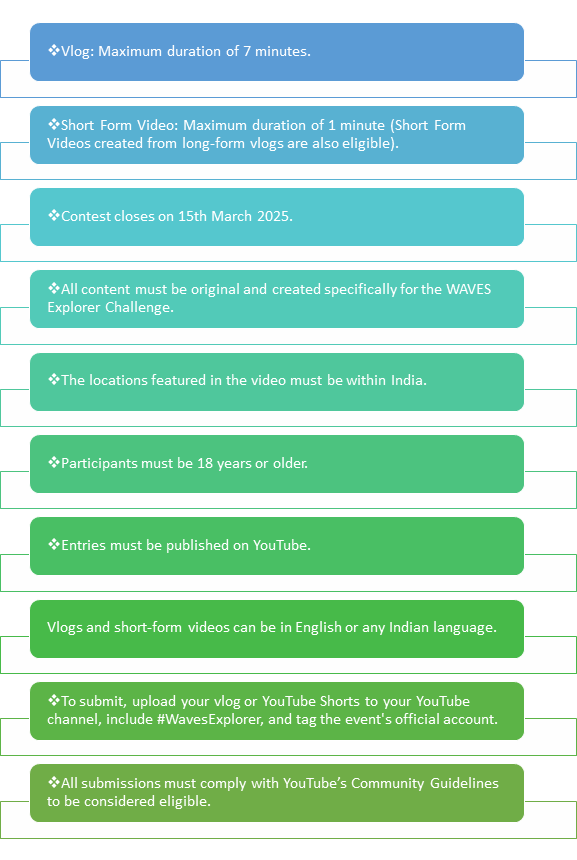
Rules and Guidelines
Awards & Recognition
Winners will receive an invitation to a YouTube-hosted event scheduled for 2025.
An exclusive, all-expenses-paid trip to attend the WAVES 2025 event.
Winning entries will be showcased in the WAVES Hall of Fame at the event.
In a remarkable turnaround, state-owned telecom operator Bharat Sanchar Nigam Limited (BSNL) has turned profitable for first time since 2007. In the third quarter of the financial year 2024-25, BSNL recorded profit of ₹262 crore, the first such quarterly profit in 17 years.
Network expansion, launch of 4G service, cost optimisation and growth in all business segments have been attributed to this achievement. The PSU expects the revenue growth to exceed 20% by the end of the financial year.
“This milestone reflects the company’s focus on innovation, aggressive network expansion, cost optimisation, and customer-centric service improvements,” the BSNL said in an official statement.
Announcing the quarterly financial results, Shri A. Robert J. Ravi, CMD, BSNL, said: “We are pleased with our financial performance this quarter, which reflects our focus on innovation, customer satisfaction, and aggressive network expansion.”
Ravi further said, “With these efforts, we expect revenue growth to improve further, exceeding 20% by the end of the financial year. Revenue from Mobility, FTTH, and Leased Lines has increased by 15%, 18%, and 14% respectively over Q3 of the previous year. Additionally, BSNL has successfully reduced its finance cost and overall expenditure, leading to a decline in losses by over ₹1,800 crore compared to last year.”
He added, “To enhance our customer experience, we have introduced new innovations such as National WiFi Roaming, BiTV – Free Entertainment for All Mobile Customers, and IFTV for All FTTH Customers. Our continuous focus on Quality of Service and Service Assurance has further strengthened customer trust and reinforced BSNL’s position as a leading telecom service provider in India.”
The company said that this ₹262 crore profit underscores BSNL’s resurgence and long-term sustainability. “As we continue on this growth trajectory, we remain committed to delivering higher value to our shareholders, expanding market opportunities, and driving innovation,” said the statement.
These were the key highlights of BSNL’s Financial Performance & Growth Strategy:
Strong Revenue Growth:
Mobility services revenue grew by 15%.
Fiber-to-the-Home (FTTH) revenue increased by 18%.
Leased Line services revenue rose by 14% over Q3 of the previous year.
Aggressive Network Expansion:
Accelerated 4G rollout and fiber-optic infrastructure upgrades.
Strengthened connectivity across urban and rural areas.
Customer-Centric Digital Innovations:
National WiFi Roaming for seamless internet access across networks.
BiTV – Free Entertainment for Mobile Customers, offering high-quality digital content.
IFTV – Exclusive Entertainment for FTTH Customers, enhancing digital engagement.
Operational & Cost Optimization Measures:
Significant reduction in finance costs and overall expenditure, resulting in a decline in losses by over ₹1,800 crore compared to last year.
Process automation and strategic resource management for improved efficiency.
Government Support: Strategic revival initiatives, spectrum allocation, and capital infusion have bolstered our operations.
BSNL outlined the following Future Growth Outlook:
Continued focus on service excellence, 5G preparedness, and digital transformation.
Revenue growth expected to exceed 20% by the end of the financial year.
BSNL said that this financial turnaround underscores BSNL’s commitment to providing high-quality, affordable telecom services while driving India’s digital growth. The company said it remains dedicated to enhancing service delivery, expanding its customer base, and contributing to the Digital India and Atmanirbhar Bharat vision.
BSNL registers a quarterly profit of close to Rs 262 crores for the FIRST TIME in 17 years. pic.twitter.com/szN8NqmBpE
Minister Jyotiraditya Scindia said that today is an important day in the journey of the telecom sector in India. He said that the Prime Minister’s dream is that the telecom sector will be the carrier of India’s digital future, and all our telecom service providers are working sincerely towards this goal.
Commenting on the Kottayam ragging case, the Congress-led opposition the United Democratic Front (UDF) on Friday alleged that the accused in the case are from Kerala Government Nursing Students Association (KGNSA) which is linked with the Left student organisation – the Students’ Federation of India (SFI).
Speaking to media, V D Satheesan, Leader of Opposition, said, “Everyone knows they are SFI activists, yet they are now denying it.” Satheesan further alleged that last year members of SFI were involved in the death of a student allegedly at the College of Veterinary and Animal Sciences in Pookode, Wayanad. ”In the Pookode ragging case, SFI members were accused, yet they were allowed to appear for exams, and the only ones who suffered were the victim’s family,” he added.
Meanwhile, the state Higher Education Minister R Bindu assured that strict action would be taken against the accused in Kottayam ragging case. She said that the government has directed authorities to take stringent action in the case. She said the government intervention in that case is limited since the institution is under Kerala University of Health Sciences. A team of the Directorate of Medical Education headed by Deputy Director of Nursing Education will be investigating the case as told by Bindu.
Condemning the incident as ‘very cruel and very brutal’, the state Health Minister Veena George said that the DME has received a preliminary report from the nursing school. George informed that the incident happened in the hostel of the nursing colleges and that the accused were general nursing students. “I asked the DME to send team of higher officers, and they are now in contact with the officials there. The nursing school has already suspended these students,” she said.
The National Human Rights Commission (NHRC) has taken cognisance of of the case. Turning the ragging incident as a ‘severe violation of human rights’, the commission sought an action report of the case from the state police on Thursday.
Several student organisations, including the Kerala Students Union and ABVP’s Kerala Student Workers took out protest March demanding stringent action in the case.
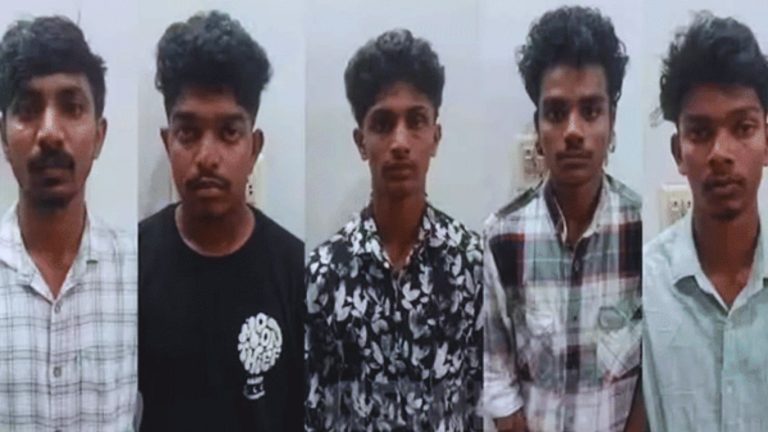
Five accused arrested by the police
The police arrested five senior students of the Government Nursing College, Kottayam, Keralal for assault and extortion of money on the complaint of a first year student on 11th February. Kottayam SP Shahul Hameed said that the police are investigating a how the video was made public and how recorded it.
”So far, only one student has complained. We are looking to see whether more students were tortured. We will record the statements of more students. Besides, we will also investigate whether the matter took place with the connivance of authorities, including the hostel warden,” SP Hameed said.
The SP said that ragging incidents took place between November 16 last year and February 10. He added that the ragging started with senior students forcing junior students to send them money online. Some senior students allegedly placed a knife on the neck of the complainant for not respecting them.
According to reports, the complainant’s family was not aware of the torture that their son was undergoing on the campus. His family came to know about it on the day he filed a complaint. “Only on February 11, the day he complains to the college principal, was I also told about the ragging. Many students have faced a similar experience but they are all afraid of speaking out,” said the complainant’s father.
Background of the case
An extremely disturbing video of the brutal ragging incident surfaced on social media on Thursday (13th February). The video shows a student helplessly tied to a cot and being subjected to horrifying torture. The semi-naked student is being pierced with a compass while the accused placed dumbells on his crotch and applied fevicol in his wounds.
Horrific. Is this ragging? No, it's clearly a criminal offense.
These "students" are associated with SFI, a left-wing student org, and since the Left is ruling Kerala, I don't expect strict action against them. They've been arrested, but they'll likely get away with it. pic.twitter.com/8gDvP0mOk2
Among the accused are two second year general nursing students named Samuel Johnson (20) and Jeeva NS (19) and three third-year students named Rahul Raj KP (22), Rijiljith (21) and Vivek NV (21). All of them have been suspended from the college and a case has been registered a under the Prohibition of Ragging Act of 2011. In addition to this, sections 118(1), 308(2), 351(1) of the BNS. The accused are currently lodged in the district jail after being remanded by the court.
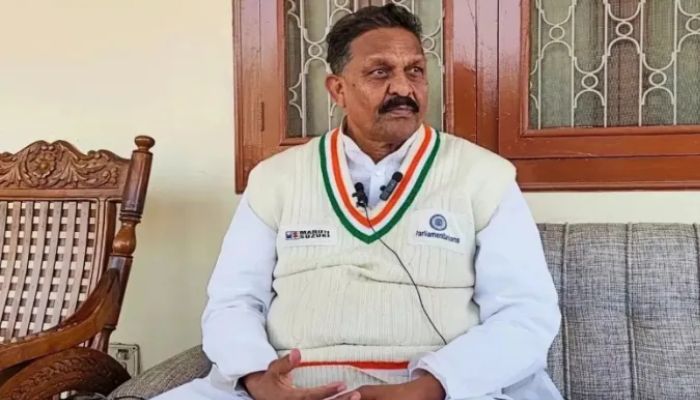
Ever since the Mahakumbh commenced on 13th January 2025, the Samajwadi Party leaders have been making one after another comments mocking the Hindu faith and politicising the grand Hindu festival. In this vein, Samajwadi Party MP Afzal Ansari ridiculed the Hindu beliefs associated with ritual bathing during Mahakumbh due to which a case has been registered against him.
On Thursday (13th February), a case was filed against the Ghazipur MP at Shadiabad Police Station on a complaint lodged by a resident of Budhpur village of Birno police station area named Dev Prakash Singh. In his complaint, Singh said that he came to know about Ansari’s offensive remarks through social media.
On 12th February, the birth anniversary of Sant Shiromani Guru Ravidas ji was celebrated at the Shadiabad intersection where Samajwadi Party MP Afzal Ansari was invited as the chief guest.
As per the complaint, while addressing the gathering, Afzal Ansari said, “On this festival of faith (Mahakumbh), it is believed that a person will become pure by bathing at the Sangam shore. Sins will be washed away. If sins are washed away, it means that the path to Baikunth will open up. In the situation that is visible, it seems that no one will survive in hell. No one will survive in hell and there (in Baikunth) the house will be full.”
The complainant further alleged that MP Afzal Ansari had earlier also made indecent remarks against the saints and sages of Hinduism. Based on the complaint, the Shadiabad police station has registered a case against Afzal Ansari under sections 299 and 253 (2) of the Indian Penal Code (BNS).
Notably, Afzal Ansari had made indecent comments on Maha Kumbh and saints. He had described the people visiting Kumbh as ganja addicts. A case was registered against him for this as well. Afzal Ansari had said that if a freight train full of ganja is sent to Kumbh Mela, it will also be consumed there.
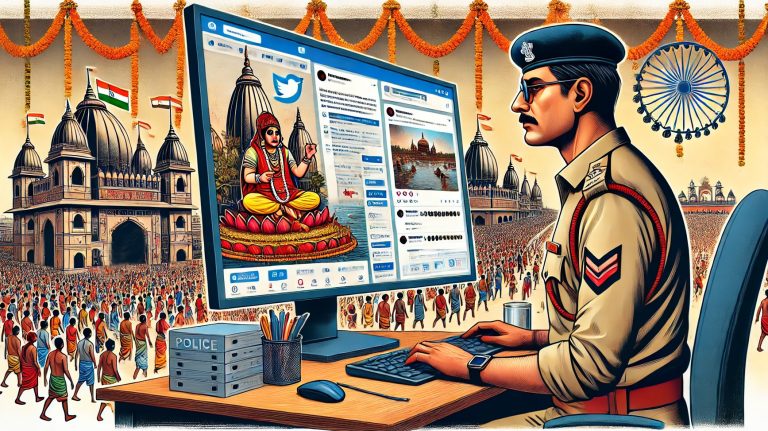
The Uttar Pradesh Police have intensified their efforts against individuals and social media accounts spreading false information to defame the Maha Kumbh 2025. Following directives from Chief Minister Yogi Adityanath, the police have been vigilantly monitoring online platforms and have taken legal action against 54 social media accounts involved in spreading misleading content.
On February 13, 2025, during routine social media surveillance, two misleading videos were identified. One video from Egypt and another from Patna was spread on social media claiming to be from Maha Kumbh in Prayagraj.
Egypt Fire Incident Misrepresented: One of the misleading videos shared by many claimed that a massive fire broke out at the Maha Kumbh bus stand, in which 40-50 vehicles were destroyed. But actually the video is from a 2020 pipeline fire in Cairo. Legal action was initiated against seven social media accounts, including India With Congress (@UWCforYouth) on X, responsible for sharing this misinformation. Police registered an FIR at Kotwali Kumbh Mela police station against the seven social media accounts responsible for spreading this false information.
The seven accounts booked are India With Congress (@UWCforYouth) X, Harindra Kumar Rao (@kumar.harindra.rao) Instagram, Anil Patel (@_1_4_3_anil_patel) Instagram, Vishal Babu (@a.v.r_rider_0) Instagram, Nemi Chand (@nemichand.kumawat.2022) Instagram, Sifa Bhadoriya (@bhadoriya6285) Instagram and Hello Prayagraj (@Hello_Prayagraj) YouTube.
Patna Event Misrepresented: Another video falsely claimed that “nationalist people threw slippers at army jawans in Kumbh.” However, in reality, the video of the chaotic scene was shot during the trailer launch event for the movie Pushpa 2: The Rule in Patna. Action have been initiated against 15 social media accounts by the police for this fake news.
Accounts that portrayed the Patna video as from Maha Kumbh are Inderjeet Barak (@inderjeetbarak) – X, SUNIL (@sunil1997_) – X, Nihal Shaikh (@mr_nihal_sheikh) – X, Dimpi (@Dimpi77806999) – X, Sat Sewa (@lalitjawla76) – X, Sandesh Vatak News (@Sandeshvataksv) – X, Lokesh Meena (@LOKESHMEEN46402) – X, Raj Singh Chaudhary (@RajSingh_Jakhar) – X, Yunus Alam – Facebook, Aminuddin Siddiqui – Facebook, Arvind Singh Yadav Ahirwal – Facebook, Shivam Kumar Kushwaha – Facebook, Jain Renu – Facebook, Amit Kumar II – Facebook and Mehtar Ek Yoddha Ballia – Facebook.
In addition to these, several other instances of misinformation have been addressed:
On February 2, seven accounts shared a video from Nepal, falsely suggesting it depicted bodies of stampede victims at the Maha Kumbh. On the same day, another account falsely alleged that bodies of Maha Kumbh attendees were being dumped into the river after organ harvesting.
On February 7, a Facebook account shared a misleading video, presenting a crowd management measure as a stampede. On February 9, fourteen accounts shared a video from Dhanbad, Jharkhand, falsely claiming that Uttar Pradesh Police were beating pilgrims searching for their missing relatives.
The Uttar Pradesh Police have emphasized their commitment to maintaining the sanctity and security of the Maha Kumbh. They have warned that strict legal action will be taken against individuals or groups attempting to defame the event or spread misinformation. The public is urged to rely on official sources for accurate information and to refrain from sharing unverified content.
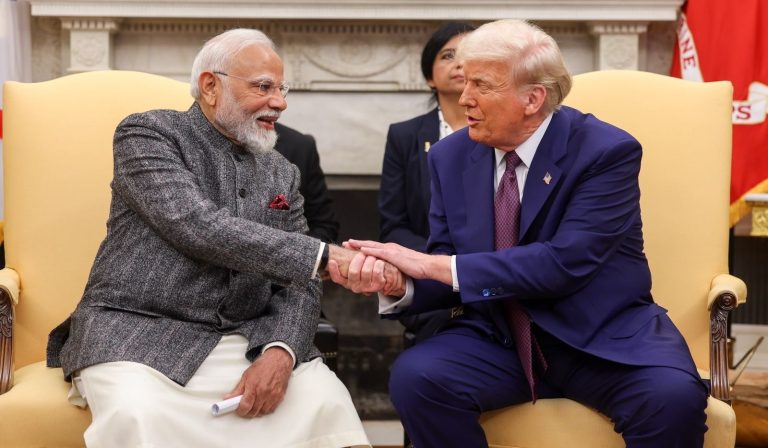
India and the US launched major initiatives following a meeting between Prime Minister Narendra Modi and President Donald Trump at the White House, focusing on advancing cooperation in emerging technologies, AI, and civil space.
Key announcements include the US-India TRUST initiative, a roadmap for AI infrastructure, and the INDUS Innovation platform to foster partnerships in defence, space, and energy.
According to the official statement, the leaders announced the launch of the U.S.-India TRUST (“Transforming the Relationship Utilising Strategic Technology”) initiative, which will catalyse government-to-government, academia, and private sector collaboration to promote the application of critical and emerging technologies in areas such as defence, artificial intelligence, semiconductors, quantum computing, biotechnology, energy, and space, while encouraging the use of verified technology vendors and ensuring the protection of sensitive technologies.
This initiative will see the private industries of both countries put forward a US-India Roadmap on Accelerating AI Infrastructure by the end of the year. This roadmap will identify constraints related to financing, building, powering, and connecting large-scale American-origin AI infrastructure in India, with milestones and future actions.
The two countries will also enable industry partnerships and investments in next-generation data centres, cooperation on the development and access to computing and processors for AI, innovations in AI models, and building AI applications to solve societal challenges, while addressing the protections and controls necessary to safeguard these technologies and reduce regulatory barriers.
In another significant development, the two leaders announced the launch of INDUS Innovation, a new innovation bridge modelled after the successful INDUS-X platform, that will advance industry and academic partnerships and foster investments in space, energy, and other emerging technologies to maintain India and US leadership in innovation and to meet the needs of the 21st century. The leaders also reinforced their commitment to the INDUS-X initiative, which facilities partnerships between U.S. and Indian defense companies, investors and universities to produce critical capability for our militaries, and welcomed the next summit in 2025.
The statement noted that the leaders also committed, as part of the TRUST initiative, to build trusted and resilient supply chains, including for semiconductors, critical minerals, advanced materials and pharmaceuticals. As part of this effort, the leaders plan to encourage public and private investments to expand Indian manufacturing capacity, including in the US, for active pharmaceutical ingredients for critical medicines. These investments will create good jobs, diversify vital supply chains, and reduce the risk of life-saving drug shortages in both the United States and India.
Recognising the importance of critical minerals for emerging technologies and advanced manufacturing, India and the US will accelerate collaboration in research and development and promote investment across the entire critical mineral value chain, as well as through the Mineral Security Partnership, of which both the United States and India are members.
The two countries have committed to intensifying efforts to deepen with respect to several aspects of technologies of critical minerals and the leaders announced the launch of the Strategic Mineral Recovery initiative, a new US-India program to recover and process critical minerals (including lithium, cobalt, and rare earths) from heavy industries like aluminum, coal mining and oil and gas.
The statement further noted that the leaders hailed 2025 as a pioneering year for US-India civil space cooperation, with plans for a NASA-ISRO effort through AXIOM to bring the first Indian astronaut to the International Space Station (ISS), and early launch of the joint “NISAR” mission, the first of its kind to systematically map changes to the Earth’s surface using dual radars. The leaders called for more collaboration in space exploration, including on long duration human spaceflight missions, spaceflight safety and sharing of expertise and professional exchanges in emerging areas, including planetary protection. The leaders committed to further commercial space collaboration through industry engagements in conventional and emerging areas, such as connectivity, advanced spaceflight, satellite and space launch systems, space sustainability, space tourism and advanced space manufacturing.
The statement also underlined that the leaders underscored the value of deepening ties between the US and Indian scientific research communities, announcing a new partnership between the U.S. National Science Foundation and the Indian Anusandhan National Research Foundation in researching critical and emerging technologies. This partnership builds on ongoing collaboration between the US National Science Foundation and several Indian science agencies to enable joint research in the areas of semiconductors, connected vehicles, machine learning, next-generation telecommunications, intelligent transportation systems, and future biomanufacturing.
The leaders determined that their governments would redouble efforts to address export controls, enhance high-technology commerce, and reduce barriers to technology transfer between the two countries, while ensuring technology security. The leaders also resolved to work together to counter the common challenge of unfair practices in export controls by third parties seeking to exploit the overconcentration of critical supply chains, the statement noted.
(This news report is published from a syndicated feed. Except for the headline, the content has not been written or edited by OpIndia staff)
In one of the biggest heroin seizures of this year in Punjab, Amritsar Rural Police has busted a cross-border smuggling racket with the arrest of a drug smuggler and recovered 30 kg heroin from his possession, said State Director General of Police (DGP) Gaurav Yadav here on Friday.
The arrested accused has been identified as Gursimranjit Singh alias Simran, a resident of Baserke Gillan in Gharindha, Amritsar. Apart from recovering a chunk of heroin, police teams have also impounded his car, in which he was going to deliver the consignment.
DGP Gaurav Yadav said that the arrested accused, Gursimranjit Singh, was involved in large-scale heroin smuggling, and it was reported that he had recently received a large consignment of heroin smuggled from across the border. Probe also suggested that Pak-based smugglers have used drones to transport the drug consignment, he added.
The DGP said that further investigations are ongoing to identify more individuals involved and to trace the origins of the smuggling network.
Sharing operation details, Senior Superintendent of Police (SSP) Amritsar Rural Charanjit Singh said that acting on intel input about the involvement of accused Gursimranjit Singh in the smuggling of narcotics, Police teams from Amritsar Rural Police led by SHO Gharinda stopped the suspected car for the routine checking. Upon conducting a thorough search, four packets of heroin– weighing 7.5 kg each– were found in a black bag, which was kept concealed in the vehicle, he said.
The SSP said that the accused is being interrogated to gather more details about the source and distribution network involved in this smuggling operation. More arrests are likely, he added.
A case FIR no. 30 dated 14-02-2025 has been registered under sections 21(c) and 25 of the NDPS Act at Police Station Gharindha in Amritsar Rural.
(This news report is published from a syndicated feed. Except for the headline, the content has not been written or edited by OpIndia staff)
While Kerala is often in the news over smugglers caught carrying gold in their rectums or locals ending up joining ISIS, this time around, the south Indian state has gained infamy for a multi-crore scam that had thousands of people duped.
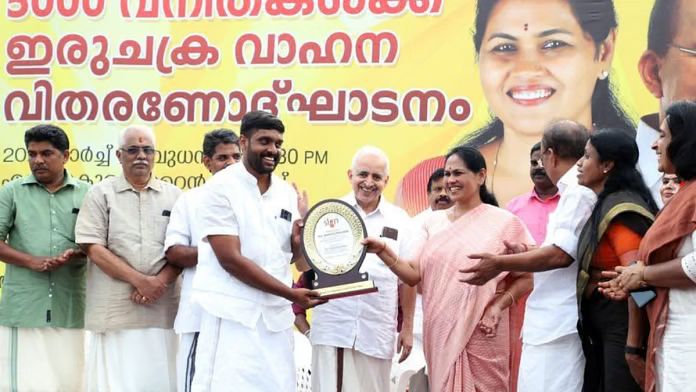
Orchestrated by 26-year-old Ananthu Krishnan and armed with a vast network of promoters and political backing, one of Kerala’s biggest scams—the Half-Price Scam duped over 40,000 people out of Rs 1,000 crore by falsely promising scooters, laptops, and appliances at half price, claiming CSR funds would cover the rest.
The state Crime Branch, investigating the case, raided the office of the prime suspect, Ananthu Krishnan, in Kadavanthra on Thursday, drawing national attention to the fraud that has shaken Kerala in recent days.
The scam has all the trappings of a masala Bollywood movie; entailed the exploitation of political ties, NGOs, and even a retired High Court judge to build legitimacy. Over 6,000 complaints have surfaced, leading to probes by the State Crime Branch and Enforcement Directorate (ED).
Victims fell for the scheme after seeing endorsements from local leaders. After paying a membership fee and transferring funds, they attended a distribution event featuring panchayat members, only to leave empty-handed with vague promises of delivery. The presence of familiar political faces, administrative authorities, and the pervasive promotion on social media platforms, including WhatsApp and YouTube, lent it an air of credibility, drawing victims in its inescapable grasp.
The scam primarily targeted middle-class women in low-paying private jobs. Government employees were ineligible, leading some unemployed individuals to forge job letters to qualify.
An extensive report published in India Today sheds light on the extent of the scam perpetrated by Krishnan, detailing tragic stories of victims who fell prey to the scam and lost their hard-earned money for the lure of getting things at a 50 per cent discount rate.
How victims fell pray to the Half Price scheme
A 23-year-old student from Kollam needed a scooter due to poor public transportation. Two years ago, she learned about a scheme promising brand-new scooters at half price, allegedly endorsed by local leaders. She discussed it with her family and conducted basic online research, which reinforced its legitimacy.
“The coordinators reached out to us. The offer was appealing—scooters costing over Rs 1 lakh were available at half price. We paid a Rs 320 membership fee, received an account number, and transferred the money,” she recalled.
“They organized an event at a community hall. The presence of panchayat members reassured us. We genuinely believed it was legitimate,” she said. However, she left the event empty-handed.
Instead, organisers distributed laptops and sewing machines and asked attendees to buy stamp paper. A lawyer was present to issue promissory notes, assuring delivery within 100 working days.
To win trust, Krishnan’s team initially distributed household appliances at staged events attended by politicians and police officers. WhatsApp groups and media coverage fueled the illusion of credibility.
The event the victim attended was one of hundreds held across Kerala. In the scam’s early stages, Krishnan’s team distributed household appliances like sewing machines and mixer grinders to gain public trust. These events featured local politicians, police officers, and even ministers.
Extensive media coverage and WhatsApp group promotions further cemented the scheme’s credibility. The scheme, called ‘Women on Wheels,’ included verification desks, displayed scooters, and test rides for applicants. Kavya received a token number 250.
Weeks passed, but no updates followed.
“Then, silence. When we inquired, the promoters lashed out, claiming we wouldn’t receive anything unless we paid the full amount. They insisted the scheme was government-backed and that crores in CSR funds were available,” the victim lamented.
As doubts arose, promoters became aggressive, insisting full payments were necessary and citing government backing. Distribution dates kept being postponed with excuses.
Two distribution dates were announced and postponed—one due to former Prime Minister Manmohan Singh’s death, another citing Republic Day venue unavailability.
Before the scam unravelled, YouTube videos actively promoted it, luring middle-class women into low-paying jobs. Some victims took loans or sold valuables to participate. Kerala Police estimate at least 40,000 were scammed.
Krishnan built his credibility over the years, engaging in social welfare programs and business ventures. He allegedly ran a chit-fund scam as well, though investigations are ongoing. Now, as the scheme is exposed, thousands of victims await justice.
Now that the scam has been exposed, the victim has filed a complaint and is awaiting a refund.
Victims made desperate sacrifices to participate. Rajila, a fabric shop salesgirl, sold her cows to join the scheme. Another took a loan using her children’s gold ornaments as collateral.
Krishnan’s history as a fraudster
Krishnan’s rise as a fraudster was a gradual process that spanned several years. Starting from a remote village, he gradually built a credible image through social welfare initiatives involving panchayats and the Kerala Women’s Commission.
Although reports are suggesting his involvement with the Kerala Women’s Commission in 2012, which he has officially denied, it is undeniable that he was actively involved in community programs during that time.
Additionally, Krishnan also ran a fungiculture business and organized promotional events across Kerala. However, some reports allege his involvement in a chit-fund scam, which is still under investigation by the police.
Now that the scam has been fully exposed, authorities are diligently investigating the extent of the fraud, while thousands of victims eagerly await justice.
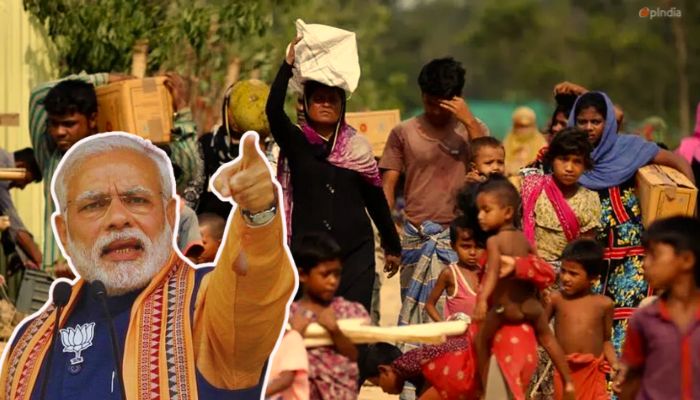
“Ensure no discrimination in education”, said the Supreme Court of India on 12th February 2025 while hearing a plea filed by the Rohingya Human Rights Initiative (R4R) seeking government benefits and free-of-cost school admissions for Rohingya ‘refugees’ residing in New Delhi.
The Supreme Court bench comprising Justice Surya Kant and Justice N Kotiswar Singh, directed the NGO to submit address proof of Rohingya immigrants in Delhi to assess possible relief measures. The court, however, added that before deciding on the benefits for the Rohingya refugees, the status of residence of their families needed to be ascertained. The SC bench directed the petitioner not to disclose details of minor children.
Representing the petitioner NGO, senior advocate Colin Gonsalves argued before the court last month that Rohingya illegals despite having a UNHCR refugee card are denied access to schools and hospitals since they don’t have Aadhaar cards. The petitioner not only sought free-of-cost school admission for Rohingya children but also sought an extension of the government’s free health services in government hospitals for Rohingya illegals alongside subsidised food grains as provided to Indian citizens under various schemes.
Apparently, under the garb of ‘humanitarian provisions’, the petitioners want the Central and Delhi governments to treat Rohingya ‘refugees’ as Indian citizens without them really having Indian citizenship and disregarding the fact they are illegal infiltrators.
While Rohingya illegals may brandish their UNHCR refugee card as much as they want, it must be noted here that having a UNHCR refugee card does not give any legal status for illegals in India as the UNHCR card is not recognised by Indian law.
OpIndia’s detailed report on advocate Colin Gonsalves’s Soros connection and the activities of those linked to R4R NGO can be read here.
The fact that Rohingyas somehow, through NGOs or by other means are able to approach Indian courts and seek free-of-cost school admissions, free healthcare, subsidised food grains and other benefits which under specific criteria are available to legal Indian citizens warrants a serious question. What empowers Rohingya illegals Rohingyas to move SC to demand ‘rights’ even though India is not a signatory to the 1951 UN Refugee Convention?
What empowers Rohingya illegals to demand ‘rights’ in Supreme Court?
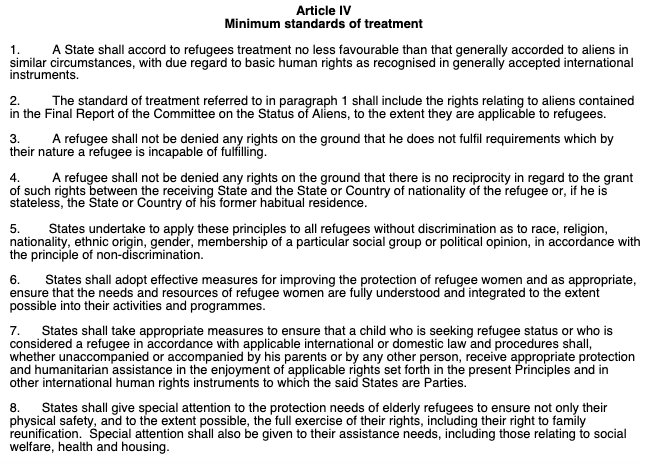
Even though India is not a signatory of the 1951 UN Refugee Convention or its 1967 protocol, the country has endorsed the 1966 Bangkok Principles on the Status and Treatment of Refugees also called the Bangkok Principles. These principles advocate for humane treatment of refugees and also emphasise non-refoulement.
About the minimum standards of treatment to refugees, the Bangkok Principles say, “A State shall accord to refugees treatment no less favourable than that generally accorded to aliens insimilar circumstances, with due regard to basic human rights as recognised in generally accepted international instruments.”
“A refugee shall not be denied any rights on the ground that there is no reciprocity in regard to the grant of such rights between the receiving State and the State or Country of nationality of the refugee or, if he is stateless, the State or Country of his former habitual residence. States undertake to apply these principles to all refugees without discrimination as to race, religion,
nationality, ethnic origin, gender, membership of a particular social group or political opinion, in accordance with the principle of non-discrimination,” it adds.
Source: Bangkok Principles
As per the latest UNHCR data as of 31st December 2024, there are over 95,000 Rohingya Muslims staying in India. his includes 22,500 refugees and asylum seekers considered stateless by the United Nations High Commissioner for Refugees. The majority of Rohingya Muslims, over 10 lakh, who fled Myanmar reside in Bangladesh, and they are supported by international aid agencies.
This further raises the question that when these principles are not legally binding, why should the Indian government heed them? Even though there is no specific refugee law in India as of now, these international treaties including the Bangkok Principles apply a framework of basic rights that should be extended to refugees.
The courts have on various occasions emphasised that Article 21 of the Indian Constitution which guarantees the right to protection of life and personal liberty, suggests that refugees cannot be deprived of basic rights. The courts also cite Article 51 of the Indian constitution which encourages fostering respect for international law and treaty obligations. Thus, despite the international treaties not being legally binding, the Indian government cannot completely disregard the treaties it is a signatory of.
In their quest for rights, Rohingyas are inadvertently doing NRC’s job
Interestingly, while in this scenario, amid all the ‘citizen-like’ rights the Rohingya demand from the government, the silver lining is that this entails the infiltrators voluntarily identifying themselves as non-Indians and registering themselves, a step helpful towards the National Register of Citizens (NRC), which otherwise has been resisted. The NGOs, individuals and other entities who unsurprisingly subscribe to the Islamo-leftist ideology, seeking judicial intervention to demand rights for Rohingyas are inadvertently identifying Rohingya illegals as non-Indians.
The NRC, aimed at identifying and documenting legitimate Indian citizens has faced significant opposition from the Islamo-leftist ecosystem and the opposition parties who push a false narrative that somehow NRC will disenfranchise Indian Muslims. Since 2019, the political parties that thrive on Muslim appeasement tactics and propagandists masquerading as journalists and intellectuals began inciting Indian Muslims by claiming that their citizenship will be revoked and they be dumped into detention centres randomly due to their religious identity.
OpIndia reported earlier about politicians like MamataBanerjee holding constitutional posts, the ‘elite’ members of the infamous Khan Market gang to ‘human rights’ bodies like Amnesty peddling falsehoods that if a nationwide NRC is prepared, people will lose citizenship. Not to forget how West Bengal CM Mamata Banerjee who on numerous occasions labelled her political adversaries like BJP as “Kafirs” (infidels) to bolster her Muslim-supporting credentials, declared in March 2024 that she would not let NRC be implemented in the state. The opposition to CAA, NRC and NPR has been so vehement that the Islamists ran riots against Hindus in India’s national capital in 2020.
It must be noted here that beyond the fear-mongering that somehow NRC will strip Indian Muslims of their citizenship and rights, the Islamo-leftist cabal including dubious NGOs with foreign funding especially those funded by regime change specialist George Soros, oppose NRC to prevent detection and deportation of illegal Rohingya immigrants. What makes Rohingyas special is their religious identity. Rohingyas are dear to certain NGOs, political outfits and the extended ecosystem not simply because of deplorable conditions or persecution in their own country but because they are Muslims. This can be understood from the fact that the very people who want Rohingyas to be allowed to stay in India and given rights, fiercely opposed the CAA, which granted citizenship to persecuted Hindus and other non-Muslim communities in Islamic nations of Pakistan, Afghanistan and a Muslim-majority Bangladesh.
We reported earlier, how the Aam Aadmi Party government wanted to give EWS flats to Rohingya illegals in Delhi, but wanted to jail persecuted Hindu and other religious minorities from Pakistan labelling them as “BJP’s votebank”.
After all these years of opposing the NRC, the Rohingya-sympathising entities who are taking legal recourse to demand rights for Rohingya illegals, are inadvertently facilitating the segregation and identification of these illegal immigrants. The Supreme Court has demanded the address proof and other details of Rohingya illegals in Delhi, who the petitioner NGO through its counsel said are residing in Shaheen Bagh, Kalindi Kunj, and Khajuri Khas areas.
As ironic as it sounds, the Rohingya illegals and the entities seeking free education, free healthcare and whatnot are essentially doing the work of NRC at no cost to the State, that too even before the NRC has been tabled before the parliament. While NRC implementation is the need of the hour, even without it, such information can be used to expedite the deportation of illegal immigrants residing in the country for years.
Challenges in deporting Rohingyas, and the risks posed by Rohingyas demanding ‘rights’
It must be noted here that mass deportation of Rohingya illegals is not pragmatic given the several challenges India faces in identifying and ousting them. One of the biggest challenges is the statelessness of Rohingyas. Due to the 1982 Citizenship Law in Myanmar, Rohingyas are not recognised as Myanmarese citizens and in 2017, they faced one of the largest exodus from their homeland.
These people over the years have illegally entered Bangladesh, India and Malaysia. Since Myanmar does not recognise Rohingyas as its citizens, these stateless people do not have a country where they can be deported. The situation becomes further exacerbated due to international non-refoulement laws which restrict the deportation of refugees back to countries where they might suffer persecution.
It is, however, pertinent to note that Rohingya refugee camps in India have been strongly suspected to be breeding grounds for radicalisation and terror activities. Rohingyas have been arrested in the past for involvement in human trafficking. They have been arrested for involvement in dacoities. There has also been the suspicion that there is a deliberate attempt to Islamicize Hindu-majority Jammu by settling Rohingyas. Rohingyas are known to have committed massacres of Hindus. They undeniably pose a threat to India’s national security and need to be ousted from the country.
Despite the UNHCR refugee cards having no legal significance in India, it creates moral and international pressure to provide basic rights to Rohingya illegals until they are deported. Besides, the deportation of Rohingyas becomes challenging due to their undocumented status. Since these illegal immigrants lack identification documents it is difficult to verify their nationality with Myanmar given the latter’s stance on their citizenship. The non-refoulement principles which even the Indian courts emphasise coupled with the resistance from Rohingya illegals to deportation further complicates the process. International norms, porous Indo-Myanmar border, domestic politics, and judicial interventions, among other challenges, make it a mammoth task to deport the illegal infiltrators.
The very fact that rights are being demanded for Rohingyas who entered illegally in India and are staying here illegally is alarming. While their voluntary identification as non-Indians facilitating NRC could be a silver lining since there are no signs of legislation in this regard being passed anytime soon, it is pertinent to look into the risks that these audacious demands for ‘rights’ pose.
Taking the Delhi Rohingyas case for example, if the Supreme Court which already has said that there is no question of denying education to Rohingya children, directs the Central and Delhi governments to provide free education alongside free healthcare to the illegal immigrants, it is plausible that these ‘refugees’ would seek more rights including employment.
Eventually, demands for citizenship could also be raised by the illegal immigrants or NGOs and political parties backing them, citing long-term residence or the “de facto integration” into Indian society. Given the lengths to which Muslim appeasing political parties, ‘intellectuals’ and NGOs travel to ensure rights for illegal Muslim immigrants, demands for granting citizenship to Rohingyas could be raised by arguing that in many countries long-term residency or principle of naturalisation are applied to grant citizenship to refugees, particularly to those considered stateless.
Thus, domestic politics coupled with international pressure to provide more than just temporary refuge to Rohingya illegals might create a pathway to long-term legal status or permanent refugee status if not citizenship especially since Myanmar remains largely uncooperative and unstable.
However, despite the challenges in deporting illegal Rohingya immigrants, OpIndia reported earlier how the Indian government has been deporting Rohingyas as well as Bangladeshi illegals and cracking down on those involved in obtaining forged documents and indulging in criminal activities.