Home Blog Page 494

‘No permission is needed for an FIR against Rahul Gandhi’: Odisha Police to a rattled Congress. All you need to know

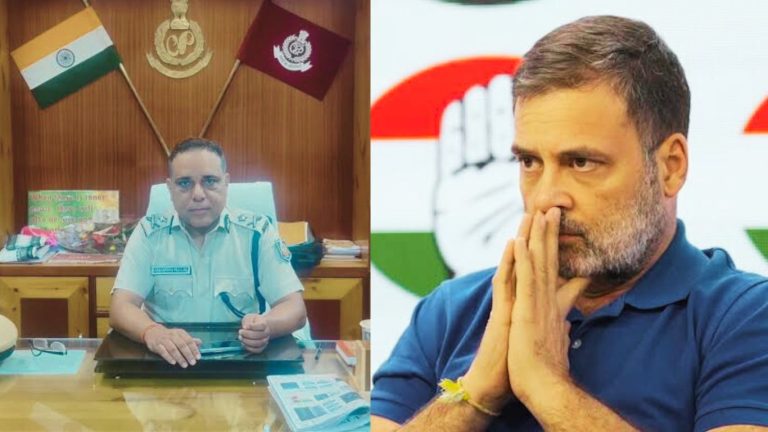
The Odisha Police clarified that they need no permission to file an FIR against Rahul Gandhi after the Congress Party questioned the legitimacy of the FIR registered against Congress leader Rahul Gandhi in Jharsuguda for making anti-India remarks.

Responding to the allegations of Congress leaders, IG Sambalpur Himanshu Lal, who directed the filing of FIR against Rahul Gandhi, explained the law on the point. He said that under section 173 of the BNSS, offences are registered in the area where they are committed. “However, if the statement was published or accessed in another state (e.g. through social media), jurisdiction can extend to that state as well if the complainant is affected by the action. The complainant must show that the statement caused harm within their jurisdiction. Here, the complainant has shown the same in the case of Jharsubuda that Rahul Gandhi’s statement has hurt him,” said the IG.

He further clarified that no prior permission is required to conduct an investigation, it is only required for prosecution. “There is no requirement for any permission for investigations against offence committed by any public servant under section 197 of CrPC. Permission is required only at the prosecution stage and that too when a public servant is discharging his official duty which is not applicable in this case,” IG Lal added.

During a press conference, Congress leaders including Sudarsan Das and Sibananda Ray, questioned if the Jharsuguda police had the jurisdiction to lodge the FIR against Gandhi. The leaders alleged that the FIR was filed on the direction of the BJP. They claimed that the law under section 197 of the BNSS can file an FIR but cannot conduct an investigation against public servants without permission from a competent authority.

Stating that they have sought an appointment with the DGP regarding the FIR, they said that the Jharsuguda police should have consulted senior police officials before lodging the FIR.

On 7th February, a case was registered against Rahul Gandhi under sections 152 and 197 (1) (D) of the BNS over a controversial statement made by him, urging his party to fight against the Indian state on 15th January 2025 during the inauguration of the new Congress headquarters at Kotla Road, Delhi. OpIndia has a copy of the FIR. Section 152 criminalises attempts to excite, secession or armed rebellion or subversive activities, or encourages feelings of separatist activities or endangers the unity, sovereignty and integrity of India. Section 197(1)(D) deals with the acts of making or publishing false or misleading information that can endanger India’s sovereignty, unity, integrity or security.

Supreme Court slams Tamil Nadu Pollution Control Board over two-year delay in petition against Sadhguru’s Isha Foundation

0

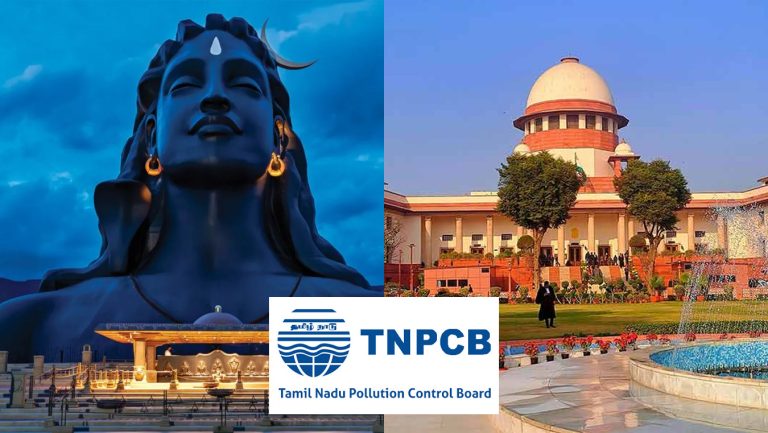
The Supreme Court on Friday slammed the Tamil Nadu Pollution Control Board (TNPCB) for the delay of two years in challenging a Madras HC order quashing a show cause notice against Sadhguru’s Isha Foundation over the construction of various buildings between 2006 and 2014 at Velliangiri hills, Coimbatore.

A bench of Justice Surya Kant and Justice N Kotiswar Singh termed the petition filed by the Tamil Nadu Pollution Control Board (TNPCB) as a “friendly match” played by bureaucrats wanting the apex court’s stamp on the petition’s dismissal. The bench questioned the delay of over two years in challenging the High Court’s order passed in December 2022.

“What prevented authorities from approaching this Court in time? When State comes belatedly, we become suspicious,” Justice Surya Kant asked Senior Advocate V Giri who was representing TNPCB. “You can’t be allowed to demolish construction which was raised before your eyes,” Justice Kant said.

The court also asked how the board could argue that the Yoga Centre is not an educational institution. The bench added that now that the Yoga Centre has been constructed, the authorities must ensure that all environmental parameters are complied with. “Sunlight, greenery, raise those issues. Everybody is obligated to comply with that,” the court said.

Senior Advocate Mukul Rohatgi, appearing for Isha Foundation, asserted that the construction had all clearances. “We have approvals. They are talking only about EC. Only 20% is constructed, 80% is green. It’s one of the best centres in India. We can take your lordships on a public tour,” Rohatgi said. 

Notably, Tamil Nadu Pollution Control Board had issued a show cause notice to Isha Foundation in November 2021 alleging that it carried out construction work without mandatory environmental clearance as per the Central Government’s Environment Impact Assessment Notification, 2006.

However, the Isha Foundation moved Madras High Court against the notice, saying that it has been carrying out construction activities since 1994, much before the cited Rules were framed. It also contended that the Yoga Centre falls under the category of educational institution, and as per a clarification by central govt, all educational institutions, industrial sheds and hostels are exempt from the requirement of obtaining mandatory environmental clearance before starting construction work.

While the state govt had opposed the plea, the central govt had supported it, saying that Isha Foundation was exempted from the requirement, as it was engaged in promoting education. The High Court quashed the show cause notice in 2022, agreeing that since Isha Foundation was carrying on construction work for promoting group development activities and for promoting yoga, it can be considered as an ‘educational institution’, and therefore it is exempted from the requirement of obtaining prior environmental clearance.

The matter has been adjourned for now and will be heard after Shivratri.

DY Chandrachud confirms OpIndia analysis on Umar Khalid’s bail case in SC: Adjournments and forum shopping by Kapil Sibal – breaking down what he said

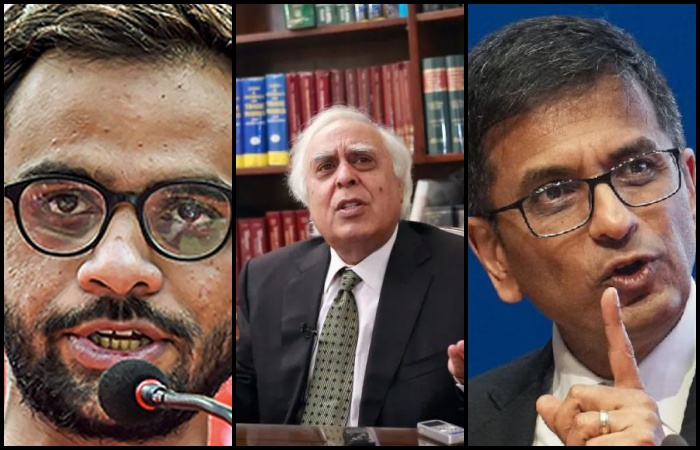
On the 13th of February, former CJI DY Chandachud was interviewed by Barkha Dutt on her YouTube channel – MOJO. During the interview, DY Chandrachud was asked a question about the denial of bail to Umar Khalid. Barkha Dutt asked about one of the main criticisms of the judiciary (by the Left) regarding the denial of bail.

Barkha says that DY Chandracud has in the past said that he has maintained parity in granting bail and has given bail to individuals from the Left and the Right (speaking about Mohammad Zubair and Arnab Goswami). She further says that “people” have claimed that he might be liberal on granting bail, however, whether someone gets bail or not depends on which bench hears the bail application – “the instance often cited is that of Umar Khalid”.

“Do you have regret in cases like that which weren’t actioned in a time frame”, asks Barkha.

After DY Chandrachud answers on the systemic functioning of the judiciary, he addresses Umar Khalid’s case specifically. Chandrachud says that while he is not addressing the merits of the case, it is important to point out that it was Umar Khalid and his counsel who had filed for 7 if not more, adjournments when the bail petition was pending in the Supreme Court.

“On the one hand, lawyers appearing for the accused repeatedly ask for adjournments of cases before a judge and then you withdraw a case. Can then everybody – can a segment of the bar or the civil society say – or they must at least be told – that look – look at the record. Here was a case where someone appearing for the accused had repeatedly sought time before the court. Why? Why this reluctance to argue a case? Either you argue it on the first day or you say I don’t want to press my application and I will reserve my application before the High Court or before the district court, as the case may be. But in the Umar Khalid case itself, if the record is seen, it is clear that repeated applications for bail were made before the court. Now at the end of it, what happens is, a particular perspective is conveyed on social media and media. Judges have no place to defend themselves. And if you look at the fine print of what really happens in the court, reality is a little more nuanced”.

The former CJI, in one fell swoop, punctured the motivated narrative surrounding the Umar Khalid case and that of the Delhi anti-Hindu riots.

In February 2024, Senior advocate Kapil Sibal, appearing for Khalid, told the Supreme Court bench that the petition was being withdrawn given a “change in circumstances” and to seek bail afresh before the trial court. Sibal said, “Bail matter, we wish to withdraw. There has been a change in circumstances, we will try our luck in the trial court.”

The narrative and what OpIndia had reported – confirmed now by former CJI DY Chandrachud

In 2023, as soon as Kapil Sibal, representing Umar Khalid, withdrew the bail petition, The Wire interviewed Umar Khalid’s father – former SIMI terrorist – SQR Ilyasi.

Speaking to Leftist propaganda outlet The Wire, the father of Umar Khalid said, “Since May 2023, there have been several adjournments. We were assessing that this is a lengthy procedure and the circumstances have changed. So, we decided to move the trial court again, and hope for an early judgment. So we will try our luck there now”. 

While the former SIMI terrorist did not clarify what the ‘changed circumstances’ were, he did attempt to play the victim by talking about the delay in the bail hearing, almost making it sound like the bail application was withdrawn due to the delay in the hearing.

Even beyond SQR Ilyasi, the narrative which was woven by the Left ecosystem was that the Supreme Court inordinately delayed the bail hearing, because of which Kapil Sibal had to withdraw the bail application and approach the district court anew.

In May, after the district court rejected bail for Umar Khalid, an Al Jazeera journalist tried to peddle the same propaganda – that Umar Khalid has been awaiting trial for years. The insinuation was that it was the court which was denying a hearing to Umar Khalid.

Prashant Bhushan in October 2024 had also alluded to the same “conspiracy” against Umar Khalid.

Several mainstream media outlets and the global press wrote articles insinuating a clandestine conspiracy against Umar Khalid to claim he was a victim of the system.

However, that was far from the truth.

In fact, we also explained that there was no delay in Umar Khalid’s trial itself.

After the first bail application was filed in the Sessions Court, within 8 months, his bail was denied. In the High Court, it took 6 months for the High Court to dismiss bail. Thereafter, Umar Khalid took a good 6 months to approach the Supreme Court, where he himself delayed heating 7 out of 14 times. In the sessions court round (the bail hearing after the previous one was withdrawn from the Supreme Court), it took less than 3 months for his bail to be rejected.

Change in judge: How adjournments were triggered by Kapil Sibal’s attempt at forum shopping

It was on the 31st of October 2023 when a Supreme Court bench of Justices Aniruddha Bose and Bela Trivedi tagged Khalid’s bail petition with other matters challenging the constitutionality of provisions in the Unlawful Activities (Prevention) Act, 1967. The petitions include Khalid’s writ petition challenging the UAPA provisions, and the UAPA Charges Related to Tripura Violence where FIRs were filed against lawyers and journalists who undertook a fact-finding mission in the Tripura violence of October 2021.

It is also on the 31st of October that the saga of adjournments by Kapil Sibal was triggered. 

On the 29th of November 2023, the petitioners wanted the petitions de-tagged. Prashant Bhushan said that the Tripura violence case had been heard by CJI Chandrachud 8 times and therefore, this case should be heard by him as well. Justice Bela Trivedi disagreed and said that the petitions would be heard by her and the newly appointed Justice S.C. Sharma. This exchange was even though the petitions had been tagged due to Umar Khalid’s lawyers’ request to begin with. 

In this instance, it was due to the unavailability of Kapil Sibal and the ASG that the hearing was pushed to January 2024. 

Interestingly, in December, Prashant Bhushan had shot off an angry letter to CJI Chandrachud over the Tripura matter, with which Umar Khalid’s plea was tagged, being listed in front of Justice Bela Trivedi instead of the CJI himself. There were other letters too complaining of irregularities in cases being listed in front of Justice Trivedi – by Dushyant Dave and Abhishek Manu Singhvi. 

Abhishek Manu Singhvi at the time, in a hearing related to Satyendra Jain’s bail petition mentioned the ‘irregularity’ in the case being listed in front of Justice Trivedi, which was promptly shut down by the CJI. 

The CJI responded to an urgent oral mention made by former Delhi Minister Satyender Jain’s lawyer, represented by senior advocate A.M. Singhvi about the listing of his bail petition in the Delhi liquor policy case before a Bench headed by Justice Bela M. Trivedi on December 14. Singhvi said a Special Bench of Justices A.S. Bopanna and Trivedi was already hearing the case. “We have been arguing before the Special Bench. The case is already partially heard… Now, today, it has been listed before a Bench headed by Justice Trivedi. Let it continue to be heard by the earlier Special Bench,” Mr. Singhvi urged. 

Post-lunch, when the court re-convened, the Chief Justice informed Singhvi that there had been a communication from the office of Justice Bopanna that he could not resume his judicial duties after the Diwali vacations due to medical reasons. The judge’s office had asked all the part-heard matters before him to be released. Consequently, the case of Jain was shifted to the judge, Justice Trivedi, on the Bench. 

“It is very easy to fling allegations and letters,” the Chief Justice said. Solicitor General Tushar Mehta, who was present in the courtroom, said the “only way to deal with malicious letters is by ignoring them”.

Thereafter, the hearings came up in front of the bench comprising of Justice Bela Trivedi and Justice Pankaj Mithal. This time, while the unavailability of ASG promoted the bench to postpone to hearing to 17th January, Kapil Sibal asked the court to delay it further – the hearing was set for 24th January 2024 instead. 

On the 24th, the case was listed before a Bench of Justices Bela M. Trivedi and Ujjal Bhuyan. It was again the advocate of Umar Khalid who asked for an adjournment, which was granted. 

On the 31st of January, a bench of Justices Bela Trivedi and Pankaj Mithal were to hear the plea. However, due to Justice Mithal’s unavailability, the newly appointed Justice P.B. Varale joined Justice Trivedi instead. While the court wanted to hear the case on the 1st of February, it was against Kapil Sibal who sought the case to be listed on another day since he would be busy with the AMU matter. To this, the judges had kept it open-ended, saying “We will see”. 

When the case came up for hearing on the 1st of February, as requested by Kapil Sibal – the bench adjourned the hearing to the 7th of February, however, on the 7th, the bench was occupied in another case. 

When the hearing came up on the 14th of February, Kapil Sibal withdrew the bail petition and the separate petition challenging the validity of certain sections of the UAPA. 

How CJI DY Chandrachud addressed bench fixing attempts subtly in his interview

In his interview with Barkha Dutt, former CJI DY Chandrachud was forthcoming in his response about the repeated adjournments taken by Kapil Sibal in the Umar Khalid case – and how – Sibal avoided arguing the case at all.

On the face of it, Chandrachud did not address the forum shopping attempts in the case, however, if one listens to what Barkha Dutt had said right before he spoke about the Umar Khalid case, it becomes evident that the former CJI indeed did hint at the bench fixing attempts.

Barkha Dutt says that Chandrachud himself might be a liberal on bail who believes in jail being the exception and bail being the norm, however, “when a case does not go to you, then what happens. And an instance that is cited again and again is that of Umar Khalid. You did the A to Z – but what about the U”. Having said this, Barkha says that she is not particularly making it about Umar Khalid, but only using him as an example to demonstrate how there are cases like that which contradict the beliefs held by DY Chandrachud about bail being the norm.

Before we get into the response of Chandrachud, it becomes important to briefly analyse what Barkha Dutt said. The question about Umar was specifically about “cases going to other judges” and how, despite Chandrachud being liberal when granting bail, “other judges” contradict his belief.

Barkha Dutt was very specific when she asked this question. She specifically mentioned “other judges” and it was them who were reluctant to give bail to Umar Khalid, while perhaps if it were the CJI, he might have got bail.

After this insinuation by Barkha Dutt, former CJI Chandrachud also addressed the question and alluded to the bench-fixing attempts by Kapil Sibal subtly. Chandrachud in his answers specifically asks why Kapil Sibal (without naming him) was reluctant in arguing the case before the court and instead, sought repeated adjournments. Given that it was CJI Chandrachud himself who had thwarted the attempts at bench fixing and the concerted campaign to ensure Justice Bela Trivedi does not hear the bail application, one has to assume that he knows exactly why Kapil Sibal was “reluctant to argue the case in front of the judge”.

With these statements of former CJI Justice DY Chandrachud, the entire conspiracy to manipulate the judiciary in the case of Umar Khalid, laid bare by OpIndia, gets confirmation. OpIndia had also reported about how there was a conspiracy afoot by those accused out on bail in the Delhi anti-Hindu riots case to delay hearings, in the hope that those still in jail can cite “delay in hearing” as one of the reasons to seek and get bail from the courts.

To understand the conspiracy to manipulate the judiciary, the following articles can be read here, here and here.


Madras High Court asks Bharat Hindu Munnani to change location for holding protest relating to the Thiruparankundram hill issue

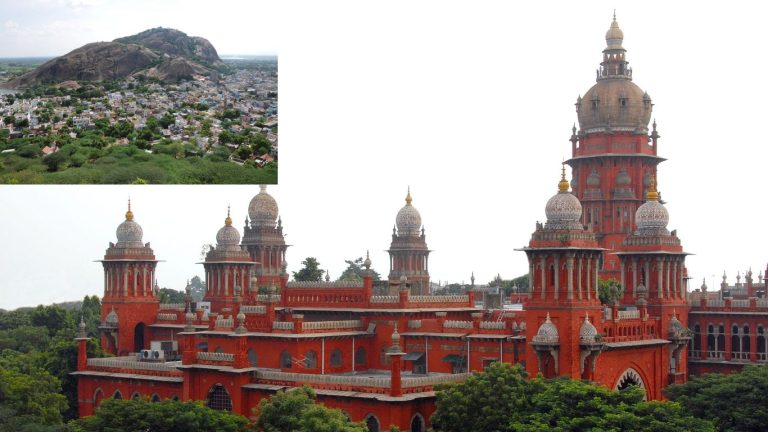
During the hearing of a matter relating to the Thiruparankundram hill issue on Wednesday (12th February), the Madras High Court questioned the Hindu organisation Bharat Hindu Munnani over its petition seeking a direction to police to grant permission for staging a protest in Park Town of Chennai on February 18.

A bench of Justice GK Ilanthiraiyan reportedly questioned the Hindu outfit why it wanted to hold protest in a ‘congested part’ of the city. The court asked the petitioners to suggest an alternative location to stage the protest. The organisation was seeking permission to hold the protest rally carrying vel (spear) and chanting Bhakti songs starting from Egambareswarar Temple passing through Rasappa Street to Muthukumarasami Kovil Devasthanam and Thanga Salai.

The petition was filed by the vice-president of Hindu Bharat Munnani, S Yuvarah after the Tamil Nadu government refused to grant permission to hold the protest rally. Appearing for the Tamil Nadu government, Special Public Prosecutor (SPP) Hasan Mohamed Jinnah opposed the petition calling it an attempt to disrupt peace and religious harmony.

Jinnah submitted that the state government would not allow anyone to disrupt peace and would ensure that religious sentiments and beliefs of either community are not harmed. The SPP argued that granting permission for the protest would disturb the communal harmony. Communal tensions have been flaring up over the Thiruparankundram hill which houses Thiruparankundram Subramaniyaswamy temple and the Sulthan Sikkandhar Avulia Dargah.

The SPP contended before the court that worship rights over the hill were settled before Independence by the courts. He said that a report was presentd before the court stating that “the practice of animal sacrifice and consumption of meat as form of worship exists as a tradition and is followed by the Muslim community”.

Background of theThiruparankundram hill issue

In December last year, a Muslim was detained by the police for attempting to take livestock on the hill for sacrifice at the Dargah. As a result, several people from the Muslim community protested against it. Another protest was held last month in January by Muslims demanded free access to the hill. Later on 18th January, a scuffle erupted between the police and members from Muslim community after the latter planned to sacrifice goats and chickens at the Dargah in a Sammanboj organised by the SDPI. Their plan was also resisted by Bharat Hindu Munnani. The police had allowed Muslims to carry cooked meat to the Dargah and consume it there. Sacrificing of animals was not allowed considering that the hill has the presence of ancient Jain caves and Lord Murugan temple.

The Muslims have been claiming the entire hill as the Waqf property and demanding the continuation of animal sacrifice calling it an old tradition. They even named the hill as ‘Sikandar Hills’.

A massive protest was organised by Bharat Hindu Mannani on 4th February at Madurai’s Palakkanatham over the ‘ownership’ issue of the hill.

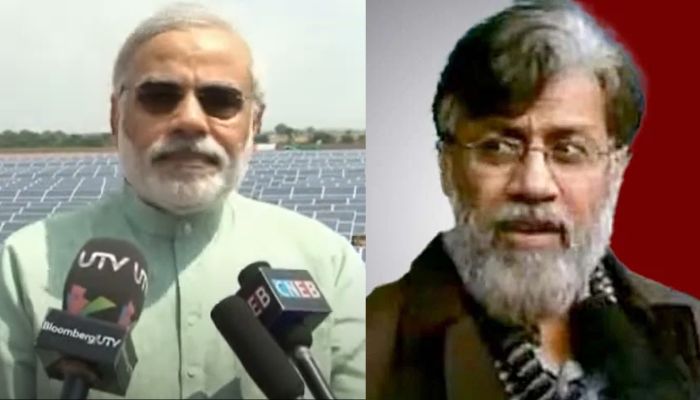
As Trump approves extradition of Tahawwur Rana, read how PM Modi condemned the acquittal of the Pakistani terrorist by US court in 2011 and demanded justice for 26/11 victims

On Thursday (13th February), US President Donald Trump announced the extradition of 26/11 terrorist Tahawwur Hussain Rana to India. The development comes weeks after the US Supreme Court cleared the name of Rana for extradition.

In a statement, Donald Trump stated, “I am pleased to announce that my administration has approved the extradition of one of the plotters (Tahawwur Rana) and one of the very evil people of the world, having to do with the horrific 2008 Mumbai terrorist attack to face justice in India.”

“He is going back to India to face justice,” he further added. For the unversed, Rana is a Canadian citizen of Pakistani origin. He is currently lodged in the Metropolitan Detention Centre in Los Angeles.

As Tahawwur Hussain Rana is all set to be extradited to India, it may be recalled that Narendra Modi had publicly criticised the acquittal of the terrorist by a US court in 2011. At that time, Narendra Modi was serving as the Chief Minister of Gujarat.

In a video shared on his YouTube channel on 11th June 2011, he was heard saying, “Today, the Chicago court in the US has decided to acquit a terrorist named Rana. This incident has raised questions for institutions and governments fighting against the menace of terrorism.

“What is the basis on which Chicago court has dared to acquit terrorists involved in the deadly 26/11 attack? Who investigated the matter? Who will now ensure justice for the victims here? America has done this to please Pakistan and has executed this conspiracy jointly,” he had said.

Narendra Modi emphasised, “Our Prime Minister (Manmohan Singh) is a good friend of America. How can this one-sided investigation (into Rana’s case) happen in his presence? After what happened today, all terrorists operating in India would want their cases to be heard in America.”

“I want to ask this: Can those accused in the 9/11 attack be heard in a court in India? Will America give us permission for this? Can the Indian judiciary make big decisions in the 9/11 case of the United States? This big question now looms large,” he added.

PM Modi concluded, “The Indian government should give its reaction immediately. It should raise its voice against the actions of the US. The need of the hour is that the Indian government takes firm steps in the face of America’s attitude towards Pakistan. Else all terrorists will go to US and get freed through their legal system for the benefit of Pakistan. A big problem has been created today in the context of international relations and bilateral ties between US, India and Pakistan.”

Charges against Tahawwur Rana in India

The National Investigation Agency is investigating Rana’s involvement in the Lashkar-e-Taiba terrorist attacks in Mumbai in 2008. Rana received an international arrest warrant, and the NIA submitted a charge sheet.

His involvement in the 26/11 terror attack is linked with his association with David Headley, the Pakistani-American LeT terrorist who played a key role in planning the attack including gathering intelligence and conducting reconnaissance.

Tahawwur Rana had allowed David Headley to use the cover of First World Immigration Services to establish a branch in India for reconnaissance purposes.

Apart from being implicated in the 2008 Mumbai terror attacks, Tahawwur Rana is also wanted for his involvement in plotting attacks on the National Defence College and Chabad House, a Jewish outreach center in Mumbai. 

He is also accused of aiding a plan to target a Danish newspaper over cartoons of Prophet Muhammad, a plot involving David Headley.

Mission 500 launched after Modi-Trump meet: India-USA bilateral trade to be doubled to USD 500 billion by 2030

0

 Following the bilateral meeting between Prime Minister Narendra Modi and President Donald Trump, Foreign Secretary Vikram Misri provided a detailed overview of the key initiatives launched during the visit and said that the leaders launched Mission-500 in the sector of trade and investment, aimed at more than doubling two-way trade to USD 500 billion by 2030.

He said that the leaders unveiled the US-India Compact for the 21st Century, to accelerate military partnerships, commerce, and technological advancements.

In addition, both leaders committed to negotiating a multi-sector trade agreement by the fall of 2025, with an approach to strengthen trade across the goods and services sector, Misri said.

Addressing a press briefing on Thursday (local time), Misri said, “Two leaders jointly launched the US-India compact for the 21st century, for catalyzing opportunities in military partnership, accelerated commerce and technology. In the area of trade and investment, the leaders launched Mission-500, aiming to more than double total two-way trade to USD 500 billion by 2030.”

The Foreign Secretary said, “The two leaders also announced plans to negotiate the first tranche of a mutually beneficial multi-sector bilateral trade agreement by the fall of 2025. Both countries will take an integrated approach to strengthen bilateral trade across the goods and services sector. There is a renewed commitment to making greenfield investments in high-value industries in each other’s countries.”

Misri further said that the leaders also unveiled plans to finalise a new 10-year framework for the US-India Major Defence Partnership, running from 2025 to 2035.

“The leaders announced plans to finalize a new 10-year framework for the US-India Major Defence partnership in the 21st century. This is a framework that will run from 2025 to 2035. They also agreed to move forward on ongoing defence procurement negotiations for a number of platforms, including land and air systems and coproduction agreements. There was also an agreement to initiate discussions on the reciprocal defence procurement agreement,” Misri said.

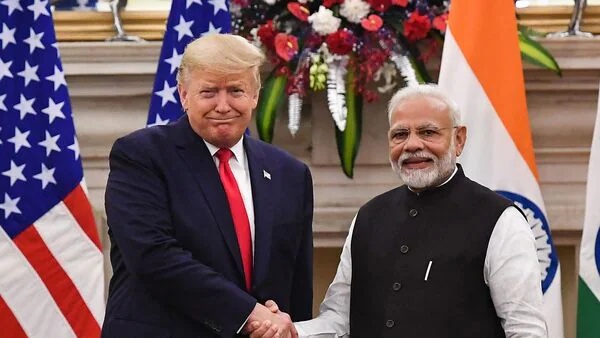
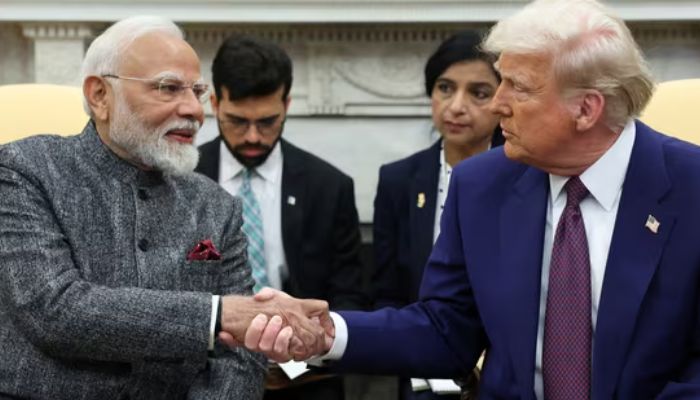
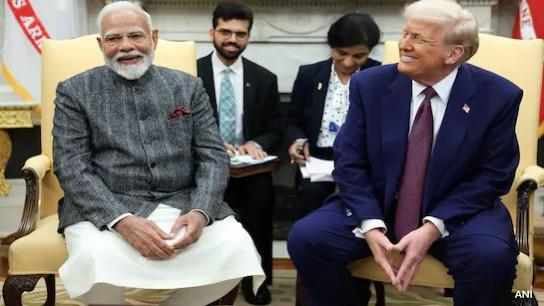
Notably, PM Modi and US President Trump shared a hug as the latter welcomed the former at the White House on Thursday (local time).

During his meeting with PM Modi on Thursday (local time), Trump stressed that the ties between the two nations are going to get closer.

PM Modi told Trump on Thursday that he is delighted to see him back at the White House for a second term and expressed confidence that the two countries will continue to advance India-US strategic partnership with the “same bond, trust and excitement.”

In his remarks, PM Modi said the people of India had also given him the opportunity to serve them for a third successive term, and this has happened after 60 years in the country’s history.

This is Prime Minister Modi’s first visit to the United States since President Donald Trump’s inauguration of the second presidential term last month.

PM Modi is among the first few world leaders to visit the United States following the inauguration of President Trump and has been invited to visit the US within barely three weeks of the new administration.


(This news report is published from a syndicated feed. Except for the headline, the content has not been written or edited by OpIndia staff)

Khalistanis, crime gangs, drugs, human trafficking and more: Read what the Modi-Trump bilateral said on the issues

The first Modi-Trump bilateral meeting after the new US President took office concluded with a number of key issues discussed and resolved between the two nations. The joint statement released by the two nations following the bilateral meeting emphasises on the need to address the cooperation between the two countries in the area of law enforcement.

The leaders also committed to strengthen law enforcement cooperation to take decisive action against illegal immigration networks, organized crime syndicates, including narco-terrorists human and arms traffickers, as well as other elements who threaten public and diplomatic safety and security, and the sovereignty and territorial integrity of both nations“, the joint statement read.

Ecosystem of human trafficking has to be ended: PM Modi

PM Modi has stated that the ecosystem of human trafficking that is the main player behind the illegal immigration of Indians into the USA must be dealt with.

Prime Minister Narendra Modi said that India is willing to take back its nationals if they live illegally in the United States and laid emphasis on the need to finish the “ecosystem” of human trafficking.

PM Modi also expressed confidence that President Donald Trump will fully cooperate with India in finishing this ecosystem.

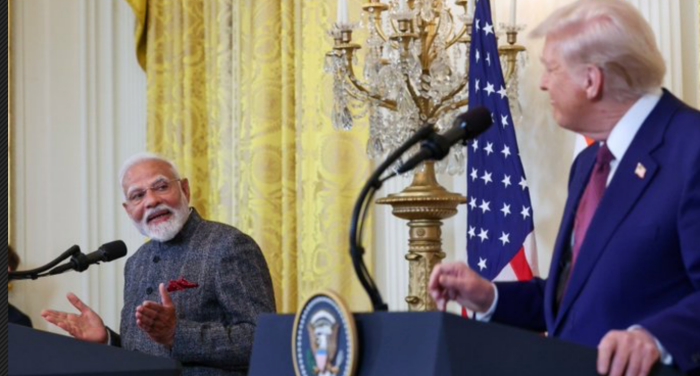
“Those who stay in other countries illegally do not have any legal right to be there. As far as India and the US are concerned, we have always said that those who are verified and are truly the citizens of India – if they live in the US illegally, India is ready to take them back,” PM Modi said, answering a query at the joint press conference with President Trump after their bilateral talks.

He said most of the people staying illegally are from ordinary families and are misguided by human traffickers.

“But it doesn’t stop just there for us. These are people from ordinary families. They are shown big dreams and most of them are such who are misled and brought here. So, we should attack this entire system of human trafficking. Together, it should be the effort of the US and India to destroy such an ecosystem from its roots so that human trafficking ends…Our bigger fight is against that entire ecosystem, and we are confident that President Trump will fully cooperate with India in finishing this ecosystem,” he added.

Joint statement mentions ‘elements that threaten diplomatic safety and territorial integrity, a hint at Khalistanis in USA

The joint statement mentions not only organised crime networks, human trafficking and narco-terrorists but ‘elements that threaten public and diplomatic safety’, an indirect mention of Khalistanis in the USA who have bene threatening Indian diplomats. The additional mention of elements that threaten the sovereignty and territorial integrity is a further emphasis on the Khalistani elements, without using the Khalistani word.

For years, Khalistanis in Canada and the USA have been threatening Indian diplomats and citizens, and openly campaigning for the territorial division of India to carve out the alleged ‘Khalistan’. Multiple so-called referendums have been held in these two countries, with their leaders using the free speech rights granted by the governments of USA and Canada to openly declare death threats against Indian leaders and diplomats, even civilians. Khalistani terrorist Gurpatwant Pannun, who lives in the USA and frequently travels to Canada to meet other Khalistani leaders, have been issuing terrorist threats to India from US soil, an issue that has been raised multiple times by the Indian government.

‘Inappropriate things were done under Biden administration’: Donald Trump

During the press conference, US President Trump was asked the Khalistan question. He was asked if the USA is going to extradite Khalistani terrorists the same way they agreed to extradite Tahawwur Rana, and whether he is going to relook into the Khalistan issue raised by India and reconsider the allegations brought by the Biden administration against Indian agencies.

The journalist here was referring to the allegations against Indian nationals and indirectly against Indian government of plotting the murder of Khalistani terrorist Gurpatwant Pannun.

In November 2023, the US Justice Department unsealed an indictment against an Indian national for his alleged involvement in a foiled plot to assassinate a US-based leader of the Sikh Separatist Movement and a citizen in New York (Gurpatwant Pannun). US Justice Department officials announced charges against Nikhil Gupta after he was arrested in June 2023 in the Czech Republic. They said Gupta would face extradition to New York.

The Justice Department claimed that an Indian government employee (named CC-1), who was not identified in the indictment filed in a federal court in Manhattan, recruited an Indian national named Nikhil Gupta to hire a hitman to carry out the assassination, which was foiled by US authorities, according to prosecutors.

In June 2024, Gupta was extradited to USA from the Czech Republic.

The allegations by USA had followed similar allegations by Justin Trudeau’s government in Canada that Indian agencies have been involved in the murder of another Khalistani separatist leader Hardeep Singh Nijjar, despite reports that the murder may have been the result of a gang war between Sikh crime gangs in Canada. The Canadian government could not provide any details or evidence to back their allegations and Trudeau was left red-faced, and with the burden of creating a deep discord between India-Canada relations.

Gurpatwant Pannun is an absconding terrorist wanted by Indian law enforcement under serious UAPA charges for multiple crimes. Nijjar was also a wanted criminal who had escaped to Canada under questionable circumstances and had managed to find citizenship despite his criminal record in India.

In this light, Trump’s statement that the Biden administration did ‘inappropriate things’ is important because it is an indirect admission that the whole affair was shady. The new Trump administration has come to power with a strong campaign to stop wasteful government expenditure and needless conflicts globally. DOGE is already working to stop money flow into questionable secret operations run by the US agencies for decades that have fuelled conflict around the world. The new DNI Tulsi Gabbard has also been vocal about stopping the US deep state that works to stir conflict and runs secret operations to destabilise countries and carries out ‘endless wars’.

There is reasonable ground to hope that the US government under Trump may realise hosting wanted Indian terrorists on their soil and allowing them to issue threats to India’s sovereignty and territorial integrity and call for violence against Indian diplomats is not going to do any good to their promise of a peaceful, prosperous USA. in Canada, separatist Khalistani elements are already politically powerful enough to control the political and even diplomatic narrative. Allowing these elements to grow on US soil is against everything Trump has promised to his people.

With Trump indirectly admitting inappropriate things done by the Biden administration and promising to ‘make it good’ for India, there is room to hope that the US government support for Khalistani terrorists may soon come to an end.

India and US extend support to ‘digital highways’ in Indian Ocean region, Meta’s project to build undersea cables: Here is what we know so far

On Thursday (13th February), US President Donald Trump hosted Indian Prime Minister Narendra Modi in Washington, D.C. During their joint statement, India and the US reiterated their commitment to strengthening global digital highways in the Indian Ocean and regions beyond it.

The US appreciates India’s role as a developmental, humanitarian assistance and net security provider in the Indian Ocean Region. In this context, the leaders committed to deepen bilateral dialogue and cooperation across the vast Indian Ocean region and launched the Indian Ocean Strategic Venture, a new bilateral, whole-of-government forum to advance coordinated investments in economic connectivity and commerce,” the statement read.

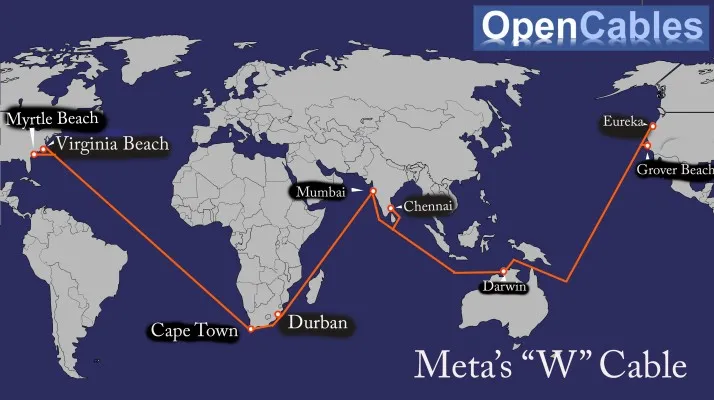
It further added, “Supporting greater Indian Ocean connectivity, the leaders also welcomed Meta’s announcement of a multi-billion, multi-year investment in an undersea cable project that will begin work this year and ultimately stretch over 50,000 km to connect five continents and strengthen global digital highways in the Indian Ocean region and beyond.

India has made its commitment clear in terms of its investment in the maintenance, repair and financing of undersea cables in the Indian Ocean through trusted vendors.

In November 2024, Tech Crunch reported that Meta (the parent company of Facebook) was planning to build underwater cables as part of a 40,000+ kilometre project. The cables will extend throughout the world and will require an investment of $10 billion.

According to the report, Meta will be the only owner and user of the undersea cable. The initial budget of the project is set at $2 billion. It will take several years before the project becomes operational.

A submarine cable industry analyst named Ranulf Scarbrough was quoted as saying, “There’s a real tight supply on cable ships. They’re expensive at the minute and booked out several years ahead. Finding the available resources to do it soon is a challenge.”

He stated that Meta could build the project in segments. The undersea cable will give Meta a dedicated pipeline for data traffic across the globe. The cables will run through the East Coast of the U.S. to India and then to the West Coast of the U.S. from India.

During PM Modi’s visit to the US, Donald Trump approves 26/11 Mumbai terror attack accused Tahawwur Rana’s extradition to India

0

US President Donald Trump on Thursday announced the extradition of the 26/11 Mumbai terror attack accused Tahawwur Rana to India and said he will face justice.

He made the announcement during a joint press conference with Prime Minister Narendra Modi following their bilateral meeting.

“I am pleased to announce that my administration has approved the extradition of one of the plotters (Tahawwur Rana) and one of the very evil people of the world, having to do with the horrific 2008 Mumbai terrorist attack to face justice in India. He is going back to India to face justice,” Trump said.

The US State Department had said last month that it is evaluating the next steps regarding Tahawwur Rana’s extradition to India.

A spokesperson from the State Department told ANI that the US has long supported India’s efforts to bring to justice the perpetrators of the 26/11 Mumbai attacks case.”

In view of the recent Supreme Court decision, and consistent with applicable US law, the Department of State is currently evaluating the next steps in this case, the statement said.

“We have long supported India’s efforts to ensure the perpetrators of the Mumbai terrorist attacks face justice,” the statement added.

Answering queries at a press conference last week Foreign Secretary Vikram Misri had said that India is in touch with US authorities for Rana’s extradition.

“On the extradition of Tahawwur Rana, from recent developments, you would be aware that he has exhausted all legal avenues in the United States with the US Supreme Court also dismissing his appeal and therefore we are now in touch with US authorities to work on the logistics of his surrender to Indian authorities,” Misri had said.

Pakistani-origin businessman Tahawwur Hussain Rana was convicted for his role in the 26/11 attacks on Mumbai.

Rana’s co-conspirators included David Headley, who pleaded guilty and cooperated against Rana.

On January 21, the US Supreme Court denied a petition for a writ of certiorari filed by Rana, seeking to prevent his extradition to India.

The petition, filed in November 2024, was against an earlier order of a lower court that had ruled in favour of his extradition. A writ of certiorari is a legal document that allows a higher court to review a case from a lower court.

The 26/11 attacks resulted in the death of 174 people, including 20 security personnel and 26 foreigners, and over 300 others were injured in the horrific attacks that took place at Mumbai’s Taj Hotel on November 26, 2008.

In his remarks, President Trump lauded the “special bond” between the US and India, he said that both nations are also announcing the framework to further strengthen the ties.

“I am thrilled to welcome PM Modi at the White House. We spend a lot of time here and also in India. We travelled to your beautiful country 5 years ago… It was an incredible period of time. There is a special bond between the US and India – the world’s oldest and largest democracies in the world. Today, the PM and I are announcing the framework to strengthen the ties further,” Trump said.

In another major announcement, President Trump said that the US will increase its military sales to India and pave the way to ultimately provide it with F35 Stealth fighters. He also reaffirmed the commitment to the Quad partnership to maintain peace and tranquillity in the Indo-Pacific region.

“Starting this year, we will increase military sales to India by many billions of dollars. We are also paving the way to ultimately provide India with the F35 Stealth fighters. In 2017, my administration revived and reinvigorated the Quad security partnership…Prime Minister and I reaffirm the strong cooperation among the United States, India, Australia and Japan, and it’s really crucial to maintain peace, prosperity, tranquillity in the Indo-Pacific,” Trump further said.

The US President further announced agreements on energy import agreement and trade routes.

“The Prime Minister and I also reached an important agreement on energy that will ensure the US to be the leading supplier of oil and natural gas to India, hopefully, the number one supplier. In the groundbreaking development for the US nuclear industry, India is also reforming laws to welcome US nuclear technology, which is at the highest level in the Indian market,” Trump said.

“We agreed to work together to help build one of the greatest trade routes in all of history. It will run from India to Israel to Italy and onward to the US, connecting our partners, roads, railways and undersea cables. It is a big development,” he added. 

(This news report is published from a syndicated feed. Except for the headline, the content has not been written or edited by OpIndia staff)

“Learnt from President Trump…I also keep national interest of India at top of everything else”: PM Modi in Washington DC

0

Lauding President Donald Trump’s unwavering focus on the national interest of the United States, PM Modi said he too is committed to “keep the national interest of India at the top of everything else”.

“One thing I deeply appreciate and I learnt from US President Donald Trump is that he keeps national interest supreme and like him I also keep the national interest of India at the top of everything else and this has been my fortune,” PM Modi said in his remarks after meeting President Trump at the White House.

PM Modi reiterated his promise to accelerate the ties with the US in his third term and President Trump’s second term.

“As I had promised to the people of India that in my third term as the Prime Minister of India, we will work with twice the speed. I firmly believe that with President Trump during the next four years during his second term, we will work with twice the speed that we did in the first term.”

Emphasizing the unique synergy between the two nations, PM Modi said, “US is the world’s oldest democracy and India is the world’s largest democracy, so when India and the US come together, they make one plus one, 11 and not two, and this is the power of 11 that is going to work for the welfare of the human humanity.”

PM Modi also reaffirmed resolve people to make India a developed nation by 2047. “In India, we have the resolve of 1.4 billion people of India that by the time India reaches the 100th anniversary of its independence, we will make our country a developed country by 2047.”

President Trump reaffirmed his administration’s focus on ensuring fair trade practices and strengthening economic ties with India.

“I call it an element of success, reciprocal tariffs so that if somebody charges us, we charge them the same amount, which is never been done in our country before. We’ve always been taking advantage of my other countries and we allowed that to happen foolishly. But we can and that we’re not going to allow that any longer.”

Trump also took a sharp dig at the previous US administration. “We’re not looking to beat anybody. We’re looking to do a really good job where we’ve done a fantastic job for the American people. We had a great four years and we interrupted by terrible administration, absolutely terrible.”

Emphasizing the significance of Indo-US trade relations, Trump expressed confidence in making landmark trade agreements.

“We had a great four years and we interrupted by terrible administration, absolutely terrible. They didn’t know what they were doing and now we’re putting it back together and I think it’s going end up being much stronger than it was before, even much stronger than it was before.”

Praising Modi President Trump said, “This is a terrific man. We’re go to make some wonderful trade deals for India and for the US”.

(This news report is published from a syndicated feed. Except for the headline, the content has not been written or edited by OpIndia staff)