Subramanian Swamy is taking particular interest in Sushant Singh Rajput case. While talking in a live Q&A session with “Virat Hindustan Sangam,” on 2nd August, he alleged that with the evidence he has collected, it is evident that someone is trying to scare the CM [Uddhav Thackeray]. He added, “that someone is trying to drag his son’s (Aditya Thackeray) name, but I can tell you from whatever material I have, his son may be having flings with the actresses, but he has nothing to do with Sushant’s death.”
In the interview, he expressed his views on various topics including IPL, “mafia” in Bollywood and Sushant Singh Rajput’s death.
Swamy alleged that the person who is involved in the case is probably the son of somebody else who he is not in a position to name as he does not have enough evidence. He claimed that the evidence against that “son” who is so powerful that he can influence the system will be out soon.
He added, “in all and all we have a situation where politicians, gangsters and cinema stars who people respect, have formed a cartel which wants to ensure that the worst possible human beings become our actors and actresses. Anyone else with some decency, some educational background, and some sense of morality gets eliminated, does not get roles or gets killed. This is something we cannot accept in a democratic country like ours.”
Swamy said that he is happy to see the uprising among the general public about the case, especially after he announced that he would be taking an interest in the case. He added that he had designated Ishakaran Singh to assist in the court as well as the investigation as the man of law. He added that the government should not only ask the Central Bureau of Investigation (CBI) to take up the case but also involve National Investigation Agency (NIA) as there is a terrorist angle of Dawood as well.
The Q&A session happened before CBI was instructed by the union government to take up the case. When the Attorney General on 5th August informed the Supreme Court of India that Indian government has already instructed CBI to take up the case, Swamy tweeted and said, “The Centre has informed the SC that Sushant case has been handed over to CBI. Have I completed my commitment and free to go?”
The SC has been informed by the Centre that Sushant case has been handed over to CBI. Have I completed my commitment and free to go?
Actor Sushant Singh Rajput allegedly ended his life by suicide on 14th June 2020. Though the Mumbai police had declared it as a suicide, Sushant’s family claimed that it is not and a thorough investigation needs to b conducted. After over a month, his father KK Singh broke his silence and filed a case against Sushant’s girlfriend Rhea in Patna.
Bihar police formed a team of four officers who went to Mumbai for an investigation that apparently irked the Mumbai Police. Stating that Bihar police has no jurisdiction, Mumbai police denied providing any support to them. So much so, when IAS Vinay Tiwari reached Mumbai to lead the investigation, BMC forcefully sent him to quarantine that officially made it a turf war between Bihar and Maharashtra police departments. Maharashtra government also had an earful from the Supreme Court for sending IAS Tiwari to quarantine.
Ankita Lokhande, Sushant Singh Rajput’s ex-girlfriend and co-star from Pavitra Rishta helped Bihar police not only with the evidence against Rhea but also in the investigation when they arrived in Mumbai.
While hearing Rhea’s plea to shift the case to Mumbai, the Supreme Court rejected the request and allowed the central government to hand over the case to CBI. AG informed the Supreme Court that the CBI has already been instructed to take up the case, and as soon as CBI got the official letter from the ministry, they started the proceedings. The investigation is taking place from different angles, including Rhea’s involvement, nepotism, the role of Bollywood Mafia and money laundering, making it a high-profile yet confusing case that may not fade away soon.
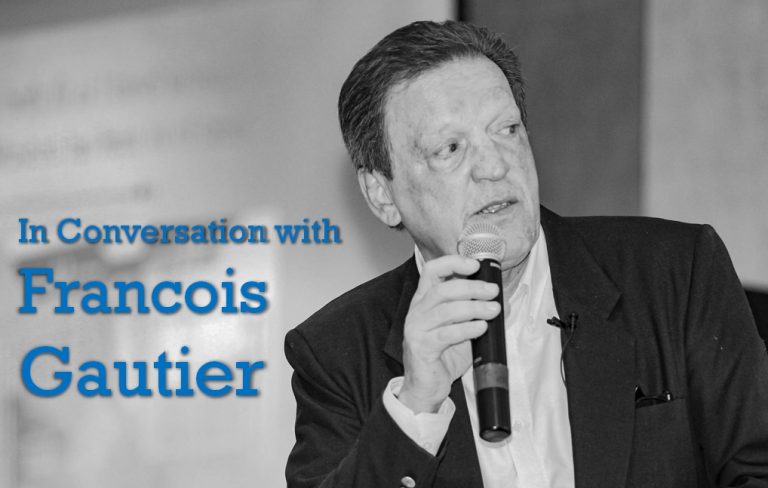
Francois Gautier is a vocal and visible Dharmic voice, a lover and defender of Hindus in India and abroad. He is an eminent journalist in his own right, and has worked with Le Figaro, DNA and Outlook India. He has written books such as The Guru of Joy and India’s Self Denial. He has in the past brought awareness to the idea of a ‘Hindu Holocaust‘ in the medieval ages and advocates the indigenous Aryan theory. He has also founded an NGO called the Foundation for Advancement of Cultural Ties. He has been awarded Panchjanya’s Nachiketa Award and the Bipin Chandra Pal Award in the past.
Here is a conversation with Francois Gautier.
You had an upper-class Catholic education, though you never really fitted in the system and revolted against it quite early, as you have shared in the past. Your family wanted you to be a businessman but your interest was in writing, which made you write for a small newspaper and then a film script for a friend. This is a fascinating life trajectory for any teenager, as you were back then. How do you see that period of your life and the way it shaped you?
I was looking for answers. I was looking for who I am, what is the meaning of life. To know myself and it was the time I arrived from Paris to India. It just so happened that there was a caravan of cars driving from Paris to Pondicherry. Auroville. I did not know anything about India or spirituality. I had a little bit of a mystic side from my childhood. So I took that caravan and drove to Delhi. From Paris to Delhi. In Delhi, I had a very strong experience in the Sri Aurobindo Ashram. It was an old building then, not the big school that is there now. I felt like I had come home and this was a place of knowledge.
Then from Delhi, we drove to Pondicherry and I met The Mother, who was Sri Aurobindo’s companion and a great Yogini. After meeting her, I took her as my Guru, and life transformed. And that is when I decided to stay and live in India, after meeting The Mother. I went on to live for 7-8 years in the Sri Aurobindo Ashram in Pondicherry. I started reading Sri Aurobindo and then, of course, The Mother died.
So I had done a little bit of journalism and photography before coming to India, and started freelancing in the south of India first. Slowly, I came to Delhi and became a political journalist for some of the major French-speaking newspapers and magazines. Atleast for 20 years, I was a reporter and a journalist, and of course from writing articles I started writing books, on Indian history, because I was covering Kashmir and I saw with my own eyes clash-ups between religions. I am not a historian but I started studying Indian history, started writing books on Indian history.
You came to India with the first wave of Auroville-migrants at the age of 19, in 1969. What makes Auroville so special, according to you, and how would you see the message of Sri Aurobindo as well as The Mother, whom you interacted with personally, guiding humanity going forward?
Sri Aurobindo is a giant, he is a Himalayan giant, for many reasons. First because he was one of the first to ask the British to leave India, much before Mahatma Gandhi. He was educated in England and came back to India, landing in Bombay. In the early 1900s, he first started writing articles. He was so passionate that he was ready to fight. His brother Barin manufactured bombs in the basement of Sri Aurobindo’s house, to attack and kill the British, and arm the people. So, he was not a pacifist. He felt India should become free, and in the spirit of the Bhagavad Gita, if necessary by force.
But his place is not there in (many) history books. He was the forerunner, you know (to Gandhi and the later independence movement). People say that the first mutiny of India could have ushered in the revolution that could have brought Indian independence by force but that is not true since the mutiny is a very complicated story and mostly tried to put back on the throne the Mughals. We cannot say this was really the first independence movement. But Sri Aurobindo’s was a struggle for complete independence, but his place in Indian history books is not there.
And of course, Sri Aurobindo was a great philosopher, with The Life Divine and Foundations of Indian Culture, which can called the bible of everything – philosophy, painting, architecture, everything. Today, from the perspective of Indian culture, we seem to have gone astray and not the Indian way. Sri Aurobindo was also an extraordinary poet. Some of the greatest writers in the world have compared his epic Savitri to the works of Shakespeare and other. It is of that caliber. He was an Avatar, a great Yogi. For me, Sri Aurobindo is like the Himalayas, not only in Indian history but also philosophy. His thoughts, ideas and works are of a very, very high level. Sri Aurobindo remains my Guru, my inspiration. The fact I met The Mother is a great privilege. I am very grateful to have come to Pondicherry and this changed my life.
That must have been quite a life-changing experience. I have been to Auroville myself, and found the ambience to have a very distinct and almost surreal side to it. That obviously and very naturally brought you towards spirituality, but your move towards Indology is what fascinates me. You have written extensively on the subject, in articles and in books. What made you interested in Indology and spirituality, over the years?
In the Pondicherry Ashram, I spent many spiritual years – interacting with The Mother, meditating. For me, the genius of India is spirituality. The people of India, the people of the countryside, they have this spirituality in a very innate, spontaneous manner. So we need to think – I have to be good, not kill, not steal, but here in India, when I started freelancing as a journalist, I was in Kerala and was doing this feature on the martial art of Kalaripayat, which was taken from India to Japan and China, in the villages I found in the people an acceptance, a natural sense of tolerance, of knowing that God manifested in different times, different names. The simple people of India, not intellectuals or Yogis! Looking at this at close quarters was a memorable experience and spurred me on, in my journey in Indology and spirituality.
You have taken exception to A. L. Basham’s ‘The Wonder that was India’ and see this as laying the groundwork for his later ideas around ‘Hindu Imperialism’. Did you write ‘The Wonder that is India’ as a reaction against Basham’s work and what are your thoughts on Basham’s book?
There was a gentleman known as Sita Ram Goel, and in those days I used to write in The Hindustan Times and in the Bombay paper Blitz. Mr. Goel sent me a letter and asked me if I would be willing to have a collection of my articles published as a book. I replied saying that I would rather write a book from scratch. So, that is what I did. I wrote The Wonder that is India. I had come across this bestseller by a guy called Mr. Basham called The Wonder that was India. It was a good book, but it said that India was very good and now not so good. So, I wanted to write a book called The Wonder that is India. I am very grateful to Mr. Sita Ram Goel on the making me embark on the path of writing books. The first one was important to me and I owe it to Sita Ram Goel, who was a pioneer and champion of Hindu Dharma and interests in a time even when it was seen to be shameful to defend Hinduism by some.
You have mentioned in the past that the foundations of the Indian society were unique since all the aspects of life were turned towards the spiritual. Do you see a need to incorporate ideas and elements from these foundations of ancient Indian society in modern times, for establishing a more Dharmic society?
Yes. I was driving from the Himalayas back to Delhi in ’96 and was looking at the architecture and what India had built since 1947, and except for a few exceptions, it seemed to be largely copies of what was done in the West in the ’50s and ’60s. You look at Indian modern paintings…again there might be some talent but its just a copy of what is done in the West. If you look at everything in India, if we look at literature..the literature that works, that sells in the West is mostly written by the people who are Anglicized, like Vikram Seth or Salman Rushdie or all these writers…they write in English for a western mind. So, it seems to me that India has gone the wrong way. Even education today, they only produce drones.
The education that is happening in India is to make drones that are good for export. So, yoiu don’t have the spirituality which is the very foundation of Indian culture, Indian lives, of everything. Even in Indian politics. If you look at Indian politics in the past, there were kings and emperors who had the sense of Dharma, of duty, as did the people. I think Mr. Modi does stand on and by that but if we look generally at the politicians in India, even from the BJP, they are at best working for the party and at worst working for themselves, but not for the people who have elected them. Everything remains to be done in India. So many things are so westernised – education, politically also.
We have a President and Vice-President, who have no powers at all, and then we have a system where anybody gets elected if you a have a lot of rupees and you can offer radios or computers to people. The whole thing is done wrong. So, I think after Sri Aurobindo died in 1950, even with all that he worked for and all his efforts, India was going in the wrong direction. Of course Mr. Modi has come and there have been some corrections but a lot more still remains to be done.
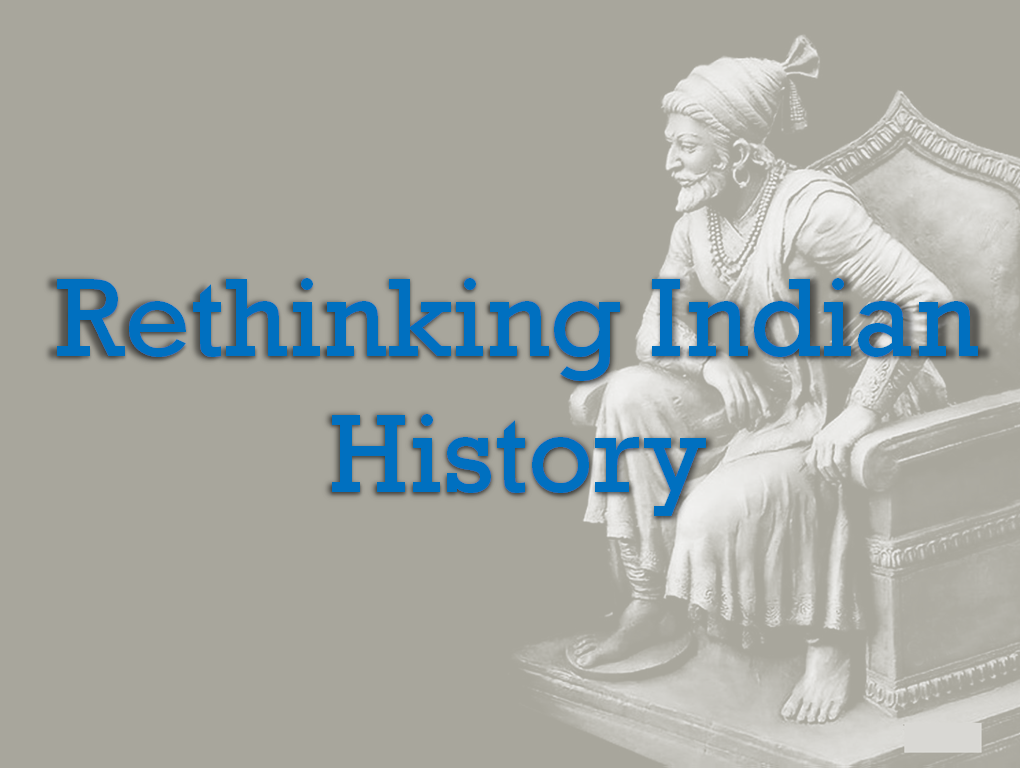
You have also spoken about the misrepresentation of Indian history, about the skewed projection of history in our textbooks and various modern historians. You have previously said that the whole Indian history, as we read it and study it today, is a huge scam: Ashoka was a butcher who was made a hero by Nehru because he was Buddhist, while Akbar was no better than Aurangzeb and Alexander was beaten out of India, and yet heroes like Shivaji Maharaj and Maharana Pratap are hardly mentioned. What are your thoughts on this?
For a long time, we only spoke about Ashoka and Akbar, who are emblems that Nehru propped up for various reasons but there are so many other kings and queens who stand out and yet are relatively lesser known. For instance, Shivaji Maharaj – known in Maharashtra but not so well known in the South. He was on par with Napolean or on par with the greatest warriors ever. And he was more than a warrior. He was an administrator. He was a man of extraordinary courage and intelligence, but does not have the place he deserves, in Indian history. Maharana Pratap was the only Rajput who actually fought the Mughals.
The Mughals, who took to Maharajas, fascinated the westerners so much but Maharana Pratap and Shivaji Maharaj treated them as invaders, as foreigners. So Maharana Pratap was the only Rajput who fought the Mughals and he fought Akbar, and Akbar definitely wanted to be friends with him, sending him letters and emissaries, but Maharana Pratap wanted to treat him as a foreigner, an invader. As someone who had killed 30,000 Hindus in Chittor. There was a huge Sati (Jauhar) also because the women and daughters did not want to get raped by the soldiers of Akbar.
So, Maharana Pratap held his stance. He never lived in the palace (after Haldighati) and slept on the ground. He was very secular, as was Shivaji Maharaj. They were secular in the true sense. They were Hindus but they would never kill or harm the daughters and wives of their enemies. They were true Hindus. Today, if you ask many in the South of India, nobody knows who he is. And yet he was an extraordinary man. We know the Rani of Jhansi but there were so many others like Rani Kittur Chennamma, whom not many know of.
What you have now in Indian history books is Akbar. And Ashoka, if you research on Ashoka, he did not become a Buddhist because he wanted to shun violence but he did it for political reasons. In those days, there was Jainism and Buddhism, and there was a conflict. To counter one of the sects of Jainism and the Ajivikas, he took the move. Ashoka was an extremely cruel man before that. So, the whole history is often not written as it happened.
Whether it will change now with the Modi government has to be seen. To rename a road, to rename the Aurangzeb Road as Abdul Kalam Road is good but that is a very, very tiny symbolic step. You need to write the true history. So this is what I have thought of doing in my museum but it is a very difficult task because Indians still have a very narrow mindset, even many Hindus. Majority of Hindus, they might go to the temple and perform Hindu practices, but they remain ignorant about their own history. They remain shy, they are not challenged and they themselves are not challenging those who kill them, those who attack them and take over their temples.
In A Western Journalist on India: The Ferengi’s Columns, you are critical of Partition 1947. You go on to say,”as long as Pakistan and India are divided there will be other Kashmirs, other Ayodhyas, other wars with Pakistan—nuclear maybe—and India will never be at peace with its own Muslim community, which is a permanent danger to herself” and have advocated for India-Pakistan reunification. Given current geopolitical realities, how do you see a closer working relation between, if not reunification of, the two nations?
There was a chance that India not be divided at independence, and there was a guy called Stafford Cripps who Churchill assigned because in the Second World War, Churchill needed India not only for man power but also for good and so many things. So, Cripps told Gandhi and Nehru that if they collaborated in the war efforts, we will give you the Commonwealth status, which Australia and other countries had, which would have meant that India would not have been divided. There was already a movement for Pakistan. Jinnah was there. Sri Aurobindo sent someone to Delhi saying that yes we need to accept this proposal because it will avoid bloodshed as it happened in 1947, when there was enormous bloodshed.
An enormous number of Hindus were killed, as were Muslims and Sikhs -who are a warrior race protected Hindus and finally retaliated. But then again, not everything is said. For instance, it is not said the massacres were started by the Muslims, whether it was in Calcutta or whether it was before that…the Moplahs, the revival of the Caliphate or whether it was the Hindu massacres in Pakistan. So, Indian history is again not written as it happened. At that time, there was a thought that as long as Pakistan and India are divided, there will be strife, there will be the sticking point of Kashmir, but things have changed.
I feel the Kashmir problem cannot be solved. Unless India and Pakistan come together, the Kashmir problem will not go away, but things have become more complicated now because the Americans are going to withdraw from Afghanistan. They are going to again leave a gap for the Taliban to take over. Taliban takes over then it will be supported by Pakistan and again they will try to create strife not only in Kashmir but also possibly in Punjab. There is only one positive: Pakistan has exported so much terror not only to India but all over the world that it is coming back to themselves.
There is a possibility that Pakistan will slowly, internally disintegrate, and South Asia, let us say the commonwealth of South Asia or a European Union of South Asia is what ideally should happen, with no borders and a common monetary system. It may happen, it may happen. But there is a Chinese element that can come on top of that, which is much more dangerous than Pakistan since the Chinese are better off, and have a lot of money. I think, at the moment, Pakistan is not India’s main problem. India’s main problem is China at the moment.
We share our interest in decentralization of the economy of India and Indianization of its social, political and educational systems. In your case, even at the cost of democratic principles and the constitution. What do you see are the major roadblocks on that path, be it with corruption, inefficiency or excessive centralisation and misuse of power in various levels of the administration, and how could we resolve them?
The problem is Delhi. The problem is the capital of India is Delhi. It was a place of the British. Delhi beared the brunt of the invasions that came from the Hindukush, Afghanistan through Pakistan, to Delhi. British wanted the capital to be Delhi because from the military point of view, it could control and check these invasions. Now, Delhi has become a big bubble. A bubble where you take a politician from Tamil Nadu, from Pondicherry, let us, who is sincere and hardworking. He comes to Delhi, gets a car and driver, so many people, servants. Then goes into the Parliament, which is like a fish market – there is no fresh air, no natural air. There is no natural light. He loses sight of why he has been elected. In Delhi, he is surrounded by seven wings of security, bureaucrats. He is not in contact with India. I am sorry to say. He loses contact with the real India. He had a connection with the ground, which he slowly loses. Delhi is a huge bubble – there are diplomats, there are journalists, intellectuals and politicians. They stay together happily, in luxury. They often have no clue what the people of India really need.
And the second thing is that India is governed by bureaucrats. This morning I met Ms. Nirmala Sitharaman, the Finance Minister. She is a wonderful woman, very sincere, a true Hindu. But then she herself has to work under the influence of the bureaucrats. Mr. Modi makes very good decisions but he needs the bureaucrats to implement them. And by the time it comes down from Delhi to Gujarat or Orissa or Tamil Nadu or Andhra Pradesh, they are diluted. The bureaucrats make their own rules.
I will give you an example. We were coming back from the Himalayas and we were to fly to Chennai on that day. So we needed a COVID test. Now, the government said anybody can have a COVID test but actually you need to bribe a doctor, get a certification so that you can have a COVID test. So, the whole system has become polluted. Some district magistrate or mid-level bureaucrat may have said that unless you have a certification from a doctor you cannot have a COVID test. Someone made the rule. I don’t think Mr. Modi made the rule. Some bureaucrat must have made the rule. So, it opens the door to corruption. India has become a place of corruption. It is not that the people are corrupt as much as the system is corrupt. But who is going to tell Mr. Modi that if you want to have COVID test, you have to bribe a doctor? Maybe I will tell him.
You have openly said that Hinduism is under threat from Christianity, Islam, Marxism and westernisation. You also have spoken up against what you see as a Buddhist-Jain tradition – Ahimsa. What do you feel is a way to stand up against the threats that Hinduism faces? Fundamentally, how must the inclusivist Dharmic traditions oppose the exclusivist traditions in the contemporary world, according to you? As they say, we may embrace them, they won’t.
Hindus in India have faced multiple attacks. Ofcourse some of the Gulf countries are much more radicalised. I have seen that Islam in India has also become much more radicalised, in places, than it used to be when I first arrived. More so probably because Indians have been going to certain Gulf countries, where you know it is much more strict and dogmatic. And many Muslims Indians feel they are Muslims before being Indian. That is a problem and poses a threat. But that is not the only one. Another is that westernisation is fast catching up in India, with televisions and cable. I feel westernisation is the greatest danger that India is facing at the moment. When Sonia Gandhi was at the fore, helping lead the government, I feel this was more, with the idea that the solutions to India’s problems lies with westernisation.
And this is a problem with most Indologists in the West, when they think that they are a superior civilisation and India needs the West to become a civilised country. And the media…the Indian media looks at India with western eyes. They do not look at India with Indian eyes. They are more concerned about what Amnesty International says or some senator is saying. So, where is the Indianness? I am a westerner who came to see that Indianness is great, is essential. Most Indians have lost their Indianness. And the school system, the education system in India hardly imparts any Indianness. Politics in India is just a copy of democracy in the West. And a bad copy, at that.
The Hindu holocaust over centuries is a reality, which we both have written and spoken about. Given the scale and number of years that this holocaust took place, it stands unmatched in the levels of barbarism and casualties in human history. Much like colonialism is seldom shown in the true light in modern Britain, the description of this holocaust is watered down in modern India by various historians. How do you see us moving away from this tradition of obfuscation of truth and yet not be absurdly revisionist?
Absolutely. You know, I started studying Indian history with the period of Aurangzeb since Aurangzeb is a venerated man by most historians, who portray him as a very staunch but a very just emperor. But I think he was a monster. Even with his own family, he imprisoned his father and beheaded his brother Dara Shikoh, who was a true Sufi. So, he was an absolute monster. Now, we did an exhibition on Aurangzeb according to his own records. He was a very meticulous emperor and every order he gave, he personally signed it and it had the emperor’s seal on them. Whether we speak of the temple raids he ordered or the Hindus being attacked and massacred, all of these orders are preserved. But when I showed this exhibition in Delhi, many people asked – ‘Why do you want to wake up the past?’
The same goes for the Kashmiri Pandits. I showed an exhibition of Kashmiri Pandits in London, where many people came. Again, people asked – ‘Why do you want to wake up the past?’ It seems like Indians are not ready to look at the past. The Hindu holocaust, you know, not only Aurangzeb, I mean Timur killed a 100,000 Hindus. It is recorded. He made a pyramid of 100,000 skulls of Hindus. So, I don’t know if many Hindus want to look at it and know about this dark chapter. I am not sure if the BJP government wants to look at it either.
But no nation can move forward unless they look at their own history – the good and the bad. There are a lot of good things in Indian history, lot of good things to say, but the Hindu holocaust is the greatest in the world ever. Research has showed that 100 million Hindus (roughly) died from the Hindukush to today. Whether it is 100 million or 80 million, it is the greatest holocaust ever. The burning of Kandahar, the razing of Delhi several times – these are all historical facts. These need to be put in books but nobody is willing to. I have seen three education ministers, the HRD ministers, you know, none of them had the guts to touch them (and address this). The one who was there who stood out was Murli Manohar Joshi but even for some of his good steps on this front, there was such outcry that he had to back off. That was 20 years ago but now, we have a billion Hindus worldwise and still not much is being done. They can do it. Hindus must unite. Every sixth person is a Hindu. They can do it. But not only some spiritual and social leaders can do it not the politicians, for I don’t think the politicians can do this. They don’t have the will or the courage to do it.
You have criticised the Indo-Aryan theory and promoted the indigenous Aryan theory. What do you think are the strongest evidence in support of that?
There are lots of evidence. Genetic evidence has shown this. It has been shown that most South Asians, most Indians have the same genetic genome, they have the same genome. So, there was no Aryan invasion. There were no white people who came and pushed back the tribals and the darker people to the centre, to the South. It has long been disproved, this theory. Even the historians like Romila Thapar and Irfan Habib have taken a step back, and have said maybe it was not an invasion but just a migration. We know that it never happened and yet it still remains in history books. Unfortunately still very much in the history books.
It is the furnishing of Indian history. So, unless the government does something, this may not change. It must be made clear that there was no invasion. On the contrary, the Aryan indigenous theory and the Aryan Hindu sway over Bali and the Philippines is history. The Chola Empire, the Chera Empire, their culture peacefully went inwards (into South East Asia). In the same way, the Indian culture went towards Iran, prior to Muhammad. Even Iranian culture has some Vedic elements in it. It is very well known but it has still not been put into history books. It is an old story.
You support the theory that Jesus Christ came to India, and was influenced by Hindu and Buddhist esotericism. Today, we live in a world of increasing differences and strife. In this context, how do you see the message of Dharma helping the world to move ahead in a harmonious manner?
Certainly. The Bhagavad Gita can become the bible of the world. The Truth about what we are and what happens when you die, what happens when you are reborn, what is an Avatar, what is Karma – these are truths in the Gita and there is a lot in it. A truth that the world has lost and India still preserves. Everything there has to be said is said in the Bhagavad Gita. It can become the bible of the world, the Dharma of the world. That sense of why am I on this earth (is addressed). Even now, during the period of the Coronavirus lockdown, people are asking pertinent questions and every answer is there in the Bhagavad Gita.
Sri Aurobindo said the 21st century will be the hour of the unexpected and this is what happened with COVID. COVID is that reshuffling of the pack of cards and we do not know what is going to come out of it. It is going to last quite a few years. It is painful and it is difficult. I find it very difficult to function in this world with everything just standing (still, mostly). But it will become a Dharmic world. It will certainly become Dharmic at the end and that will improve the world. Dharma is the Indian concept that the world needs to understand and practice.
Communist China has had a history of brutish assertion since early days of its existence. Tibet’s annexation was a gross violation of propriety and standards of international relations in front of what can ironically be regarded as imperialist tendencies while fighting ‘entrenched feudalistic and imperial forces’. India and China recently had a standoff in Galwan. In light of these developments, what do you see as the larger international geopolitical reality when it comes to China and how best can India face it?
It starts with the economic angle. The West has invested hugely, hugely, hugely in China. Every major company in the West, from Nike to Apple, have invested in China. Now the Coronavirus has raised some questions. The first question is about the virus – how it escaped from China, how China kept quiet about it. And the second question is around how countries have realized how dependent they were on China. 95% of antibiotics are made in China and so when the (COVID) crisis happened, there was a shortage of antibiotics. Almost every computer today is made in China. There is probably no laptop that is not made in China. So, countries, because of the COVID-19 have woken up to the fact that China is a very inscrutable place.
Of course, since then, we have seen how they acted tough, with India, with Hong Kong, with Taiwan, the Indo-China sea. But one must see that, economically, the West has put all their chips on China. Now, for a long time I have been saying that at some point, the West will have to take back some of those chips and invest them in India which is a natural economic destination for the West because in India people talk English, they are friendly to the West, they are not tough and crooked like the Chinese. This has started, but from the political point-of-view, it is more complicated because China is establishing a new Silk Road through the Himalayas since it wants to pour its goods into the West. It goes through Pakistan-occupied Kashmir, to Gwadar and other places.
It is something that even the West is taking notice of. It is a tactic to establish hegemony by China. The West does realise this. And the only country that can contest China, economically or politically, is basically India. The US has realised that the only country that can contain China, from a military point-of-view or even economically, is India, because India has a huge army and shares nearly 3500 km border with China. Now, China is also trying to control the seas. They want to control the entire traffic going from the South China sea to the Indian ocean and beyond, and this is frightening many, mostly the US because Europe is sleeping. I think India is going to play a very important role in the next few years. Economically, because some of the western nations will want to shift, delocalise manufacturing from China to India. Medicine, for instance. Politically because India is the only country that can contest with China there.
There is one element that nobody is speaking about – Tibet. Most of the border between India and China is Tibet. Unfortunately, India under Mr. Nehru allowed the China to establish suzerainty over Tibet. The Dalai Lama is 85 now and after he dies, the Chinese are planning to prop up their own Dalai Lama to succeed him. India must start using the Tibet card just like the Chinese are using their claim on parts of Arunachal Pradesh, which is ours. We don’t even have all of Kashmir. You know, again, Hindus are shy. Even Mr. Modi is shy to say that ‘Okay, you want to play a game with us, we have the Dalai Lama and claim that Tibet is a disputed country’. Tibet has always been the peaceful buffer between the two giants – China and India. And it was pro-India, it was Buddhist. Even today, the Dalai Lama is grateful to India. So, why not throw up Tibet?
The conversion mafia that operates in many parts of India have forced masses to convert, sometimes by enticement, sometimes by force and at other times by misprojection (such as the presentation of Yesu Namaskar). How do you see this all-too-evident reality of India today?
The government must come down on such organisations but it is not doing that. People are poor and if you give them free education, free loans or free medicines (as enticement), they will convert out of need. It is a completely unethical conversion. Only the government that can do anything about this. The Hindu temples are in the government’s control but the churches and the mosques have independence. The government has to step in but I don’t think it will because I don’t think they have the willpower to do it.
Last week, a 25-year-old Madarsa teacher, Maulana Mohammed Arshad Rehmani, was arrested in Raipur, Chhattisgarh for the alleged rape of a 9-year-old girl. As per reports, the family of the Maulana is pressurizing the family of the victim to marry her to the alleged rapist. They have also been threatening the girl’s family to withdraw the case against their son.
According to reports, the victim’s father has filed a complaint with the Khamardih police station in Raipur, in this regard. The police who have already started probing the rape charges will now also investigate the alleged threats issued to the girl’s family, based on the complaint lodged by the victim’s father.
The police had arrested Maulana Mohammed Arshad Rehmani, who was also a teacher in a Madarsa, on August 9 (Sunday) after he had allegedly raped the 9-year-old girl. The Maulana had been visiting the home of the 9-year-old girl for the past fifteen days to teach her younger sister Arabic. Recently, he began teaching the victim too.
Maulana was booked under POCSO Act
The accused, who reportedly had been accused of a similar crime in the past too, has been booked under sections 376 (rape) and 506 (criminal intimidation) of the Indian Penal Code and relevant provisions of the Protection of Children from Sexual Offences (POCSO) Act.
The incident
In what transpired, the Maulana assaulted the girl sexually on Sunday after he found the little girl alone in her house. After committing the heinous crime, Rehmani reportedly fled from there. Afterwards, the child told her parents about the ordeal following which they promptly reported the matter to the police.
Victim’s father says he is being threatened
As per reports, the father of the victim has stated that he is getting threats from the local madarsa to withdraw the case against the Maulana. He has stated that some people associated with the madarsa have asked him to withdraw the rape case, failing which his daughter (the victim) will be vilified and ostracized from the local community. The victim’s father has stated that he will now register complaints against anyone who asks him to take back the complaint or ‘compromise’ with the Maulana.
Maulana Mohammed Arshad Rehmani originally hails from Bihar’s Banka district. He has reportedly been staying in the madarsa at Pandhri area in Raipur.
Tamils in Tamil Nadu have had the benefits of national integration, wider exposure to language among others, denied to them by the Dravidian agitation. We will look at the long history of sabotage that the Dravidian leaders have carried out, beginning with the closure of V.V.S. Iyer’s Gurukulam at Cheranmadevi and till today.
Along this journey, we will see their behaviour and intentions in the Hindi agitations of 1937 and 1965, their propaganda of casteism behind the education policy introduced in the 50s, the opposition to Navodaya Vidyalayas till today’s opposition to the New Education Policy of 2019.
Almost always, their cries have been those of casteism and ‘Aryan hegemony’. We will investigate these claims and see the damage they have done over the years.
Abhinava Bharatam and the Nationalist Movement in Tamil Country
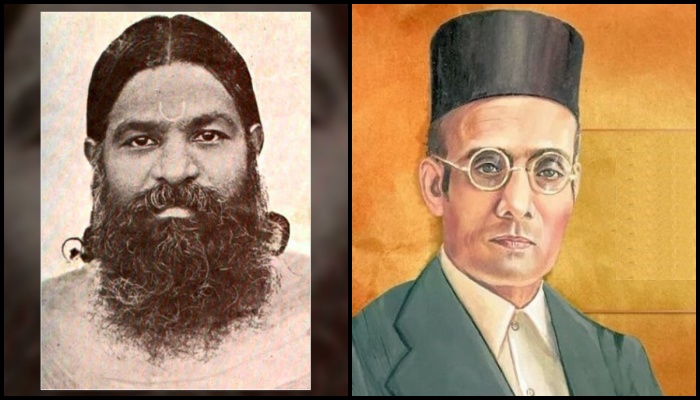
Our story begins with India House, which was a London-based student residence promoted to encourage nationalist sentiment among young Indians who were in London at the time. In 1906, V D Savarkar was a leading member of the India House, which served as a hub for meeting and exchanging views among young students.
Veer Savarkar and his brother had earlier formed a secret society called Abhinav Bharat in Pune. In this environment, a young lawyer called VVS Iyer, who had come to London to study for the Bar. The Abhinav Bharat society had the agenda of building the propaganda, popular support, logistics and weapons for an armed insurrection to free India.
In 1910, Iyer had already come under the British Secret Police’s surveillance and escaped to France and from there, to Pondicherry, where he lived for 10 years.
In this decade, he came into contact with the revolutionary poet, Subramania Bharati and Sri Aurobindo, who were in favour of militant means to achieve freedom. Subramania Bharati had an earlier history of collaboration with such leaders as V O Chidambaram Pillai and Subramania Siva.
One of Iyer’s students was a young man called Vanchinathan. Between Vanchinathan and Nilakantha Brahmachari, they plotted and assassinated the Collector of Tirunelveli District, Ashe. Nilakantha Brahmachari was jailed. Subramania Siva and V O Chidambaram had also been arrested and were in jail.
Iyer was under pressure by the British. When Emden bombed Madras Harbour in 1914, the British tried in vain to implicate him in a sedition plot.
Eventually, all the militant factions were pacified, with Subramania Siva dying a lonely death, Subramania Bharati dying young, V O Chidambaram eking out a difficult existence. The only political forces left in Madras Presidency by 1922 were the Indian National Congress, by then dominated by the Moderates that believed in a policy of gradual devotion of powers and the Justice Party, dominated by landlords, big businessmen loyal to the Crown, that wanted British rule to continue in order to perpetuate their privilege.
Cheranmadevi Gurukulam
In 1922, Iyer was released from prison after a short spell of 9 months for sedition. At this same time, a young landlord from Erode, EV Ramasamy, became President of the Madras Presidency Congress Committee. Over the next few years, EV Ramasamy’s differences with the Brahmin leaders of the Congress widened due to varying opinion on caste-based reservations in Government jobs.
In 1920, as part of the Non-Cooperation movement, it was suggested that Indian children be removed from schools run by the British Government and placed in schools run by Indians on a nationalist basis.
In 1925, Iyer was given funds of Rs 10,000 from the Congress to start a residential school for boys that would be run on a nationalist basis. This would have boys from all caste backgrounds living and studying together. However, the parents of a couple of the Brahmin students objected to the dining arrangements and insisted that their children would have to be served food separately. Iyer agreed, on the condition that the boys would be given provisions from the common store and they could prepare food for themselves or they could take food from the common utensils and eat separately.
EV Ramasamy and Varadarajulu Naidu, Thiru Vi Kalyanasundaram among others objected to this situation based on a totally false allegation that Kalyanasundaram published in his Tamil separatist magazine ‘Tamil Nadu’. They alleged that there was a separate mess for Brahmin students alone, and that superior quality rations and food were served to the Brahmin boys.
Iyer offered to have the two boys be removed from the school after the academic year and for the school to continue in an article he wrote in The Hindu Newspaper. He also appealed to Gandhi, when Gandhi was in Vaikom in 1925. Gandhi was also not in favour of forcing the Brahmin boys to eat with the others. It was decided that common dining facilities be made a pre-condition for future admissions.
This had become such a major controversy that it was among the chief items discussed at the 1925 Madras Presidency Congress Committee meeting in Trichy.
At this time, the scholar, philosopher and social reformer ‘Kavyakantha’ Ganapati Shastri, also known as Ganapati Muni, who was respected by the Congress and often sought after for his opinions on the issue related to traditional shastras, was sought out for his opinion. Ganapati Muni suggested that the mess be run by a cook from the Adi-Dravida community so that all parties would have to make a compromise. This suggestion was, of course, ignored by all concerned.
It may also be noted that the Gurukulam had no students from the Depressed Classes (most of those communities are now in the Scheduled Caste List). Dr Varadarujulu Naidu, Thiru Vi Ka or EV Ramasamy, never saw this as an issue and made no efforts to correct this deficiency.
The Congress Committee passed a resolution against such restrictions. A separate committee composed of S Ramanathan, Thiagaraja Chettiar and EV Ramasamy was constituted to look into this issue. However, by this time, due to the pressure, Iyer left the Gurukulam which had been his brainchild. Without his driving force, the institution naturally closed down. Iyer himself died mysteriously after when he dived into a river to save his daughter who was drowning.
The Congress Committee never revived the Gurukulam. EV Ramasamy himself left the Congress in 1925, claiming caste-based discrimination against him.
The dream of an India-wide chain of schools, run on nationalistic lines and providing education that would help Indian gain a sense of historical pride, remained stillborn. In some ways, VVS Iyer’s dream has not fructified, close to a century after his death.
Prime Minister Narendra Modi launched a transparent taxation platform, “Transparent Taxation – Honoring the Honest” on 13th August 2020. During the launch, Finance Minister Nirmala Sitharaman and PM Modi addressed the nation informing about the platform and the changes it will bring in the taxation mechanism in the country.
Starting the program, FM Sitharaman said that today is the landmark day in the history of tax administration. Following the vision of the Prime Minister to empower the taxpayers, to develop a transparent system and to honour the honest taxpayer, the Central Board of Direct Taxation (CBDT) has given a framework and developed order in the form of this platform.
This platform brings in a transparent, efficient and accountable tax administration. “It uses technology, data analytics and also uses Artificial Intelligence. It eases the compliance burden. It brings in fair, objective and a just system,” she added. There will be no direct interaction between the department and the taxpayer.
She said that the Income Tax department had undertaken several reforms that would have been considered a significant milestone in a normal era.
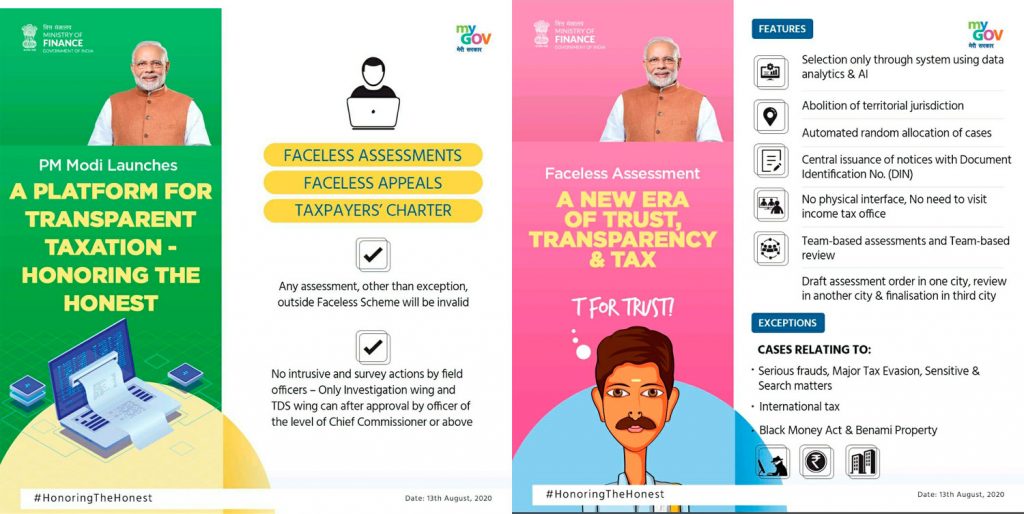
Features of “Honoring the Honest” platform
Faceless assessments
Faceless appeals
Taxpayers charter
Any assessment outside faceless assessment will be invalid.
Any assessment without DIN will be invalid.
No intrusive or survey actions by field officers.
Selection only through system using data analytics and AI
Automated random allocation of cases irrespective of the city of the tax payer.
No Physical interference.
Features of “Honoring the Honest” (Images from @/NSitharamanOffice Twitter account)
PM Modi said that the trend of structural reforms taking shape in the country had reached a significant point with the launch of “Honoring the Honest” platform. This platform has major reforms such as Faceless Assessment, Faceless Appeal and Taxpayer Charter. Faceless Appeal and Faceless Assessment are applicable from today while Taxpayer Charter will start functioning from 25th September, the birth anniversary of Deen Dayal Upadhyay.
इस प्लेटफॉर्म में Faceless Assessment, Faceless Appeal और Taxpayers Charter जैसे बड़े रिफॉर्म्स हैं।
PM Said, “though the tax system is becoming faceless, it will assure Fairness and Fearlessness to the taxpayer.” In the last six years, the focus of the government was on the major reforms that are banking the unbanked, securing the unsecured and funding the unfunded.
“Honoring the Honest- ईमानदार का सम्मान”
Prime Minister said that taxpayers play an important role in building the nation. When the life of a taxpayer becomes easier, he moves ahead, and the nation moves forward with him. This new platform is in sync with the government’s vision of Minimum Government and Maximum Governance. It is a significant step in reducing the interference of the government in a taxpayer’s life.
Honoring the Honest- ईमानदार का सम्मान।
देश का ईमानदार टैक्सपेयर राष्ट्रनिर्माण में बहुत बड़ी भूमिका निभाता है।
जब देश के ईमानदार टैक्सपेयर का जीवन आसान बनता है, वो आगे बढ़ता है, तो देश का भी विकास होता है, देश भी आगे बढ़ता है: PM @narendramodi#HonoringTheHonest
“Today, we are removing process and power centric structure of every policy and making it people-centric and public friendly. It is the new governance model of India, and we are getting favourable results,” he added.
He said that the people of India understand their duty as a taxpayer. He added that the change in the mood of the taxpayers is not because of the strictness or punishment. He said there was a time when decisions taken under compulsion were projected as reforms. They did not show the desired results. The government has changed the thinking and approach. Now reforms are policy-based and holistic. These reforms build the base for future reforms. “It is a continuous process, and the government is bringing more reforms as required,” he said.
हमारे लिए Reform का मतलब है, Reform नीति आधारित हो, टुकड़ों में नहीं हो, Hollistic हो और एक Reform, दूसरे Reform का आधार बने, नए Reform का मार्ग बनाए।
PM Modi said that the taxation system was developed under British before independence. Though the previous governments made changes in the structure of the taxation system in India, the base remained the same. India needed fundamental and structural changes in the tax system that could not happen to the extent required. “When there is complexity, compliance becomes difficult.” He added. When there are lesser laws and regulations, taxpayers become happy, so does the nation. In the last few years, the government is working in the field, and GST is one of the finest examples of reforms brought by the government.
जहां Complexity होती है, वहां Compliance भी मुश्किल होता है।
कम से कम कानून हो, जो कानून हो वो बहुत स्पष्ट हो तो टैक्सपेयर भी खुश रहता है और देश भी।
PM Modi said that there was a time when the government used to appeal in High Court for the cases involving revenue of Rs.10 lakhs. Now, the government has set a limit of Rs.1 crore for the high court and Rs.2 crore for the Supreme Court. The idea is to solve maximum cases outside court. The results are favourable, and more than 3 lakh cases have already been cleared.
The taxation system has been simplified for the taxpayers. Now there is no tax for income less than 5 lakh. Taxes for the remaining slabs have also been reduced. India is among the nations with the lowest corporate taxes. “The government is working on making the system seamless, painless and faceless. The idea is to help the taxpayers in understanding the system rather than confusing them,” he added.
कोशिश ये है कि हमारी टैक्स प्रणाली Seamless हो, Painless हो, Faceless हो।
Seamless यानि टैक्स एडमिनिस्ट्रेशन, हर टैक्सपेयर को उलझाने के बजाय समस्या को सुलझाने के लिए काम करे। Painless यानि टेक्नॉलॉजी से लेकर Rules तक सबकुछ Simple हो: PM @narendramodi#HonoringTheHonest
Now, with the new system, the scrutiny cases, notices, surveys etc. will not be handled by the tax department of the city of the taxpayer. The computer will randomly select the tax department of another city to handle the case. The order form that department will be reviewed by the tax department of another city that has been picked up by the computer randomly.
अब टैक्सपेयर को उचित, विनम्र और तर्कसंगत व्यवहार का भरोसा दिया गया है। यानि आयकर विभाग को अब टैक्सपेयर की Dignity का, संवेदनशीलता के साथ ध्यान रखना होगा।
अब टैक्सपेयर की बात पर विश्वास करना होगा, डिपार्टमेंट उसको बिना किसी आधार के ही शक की नज़र से नहीं देख सकता: PM @narendramodi
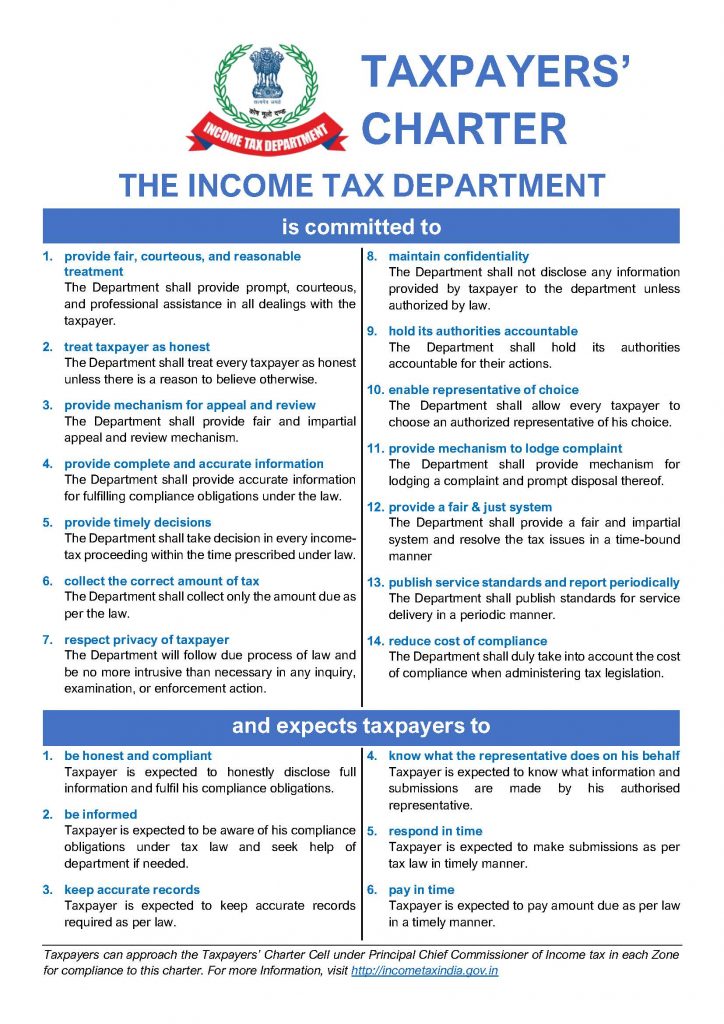
Under the Taxpayer’s Charter, the tax department has to handle the taxpayers’ cases with dignity and sensitivity. The department has to trust the taxpayer, and if there is any doubt, it has to be handled with fair and rational methodology.
The Taxpayer’s Charter
PM Modi said that scrutiny figures have come down by four times in the last six years as compared to 2012-2013. Though the number of taxpayers has increased in the last six years, it is still less compared to the total population. PM Modi requested the taxpayers who are capable of paying taxes but are not paying taxes should come forward and join the drive to build new and self-reliant India.
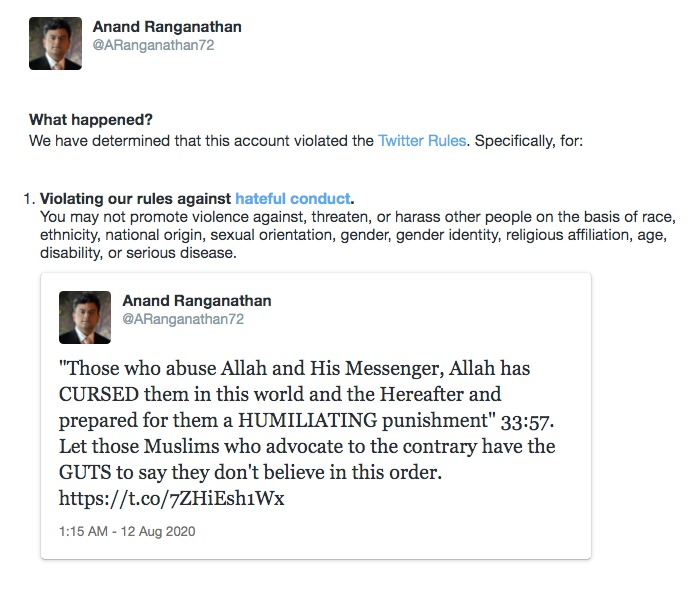
Microblogging site Twitter on Wednesday blocked and scientist and columnist Anand Ranganathan on the platform for posting a Quranic verse.
In his tweet, Dr Anand Ranganathan had quoted a verse from Quran which stated that those who abuse Allah and His Messenger (Prophet), Allah has cursed them in this world and the hereafter and prepared for them a humiliating punishment. The verse can be found here.
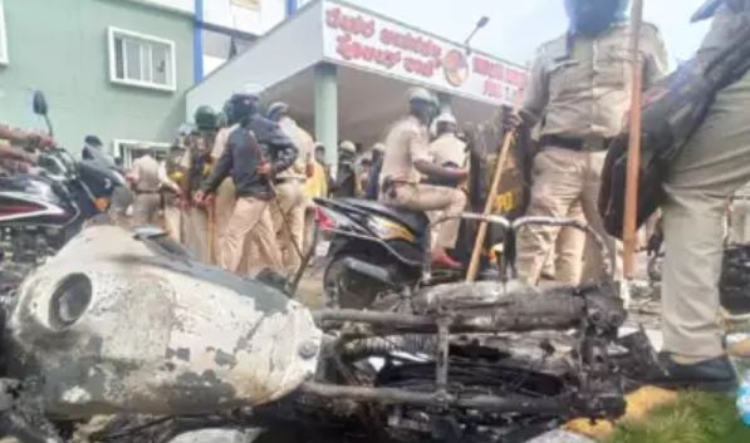
On 11th August 2020, Muslim mobs took to street in Bengaluru and torched house of Congress MLA over a Facebook post by his nephew which was allegedly derogatory to Prophet Muhammad. Later the rioters took to police station and attacked cops and torched the vehicles. Following the riots, many ‘moderate Muslims’ claimed how this (violence) is not what Islam teaches. Reacting to this, Dr Ranganathan informed them what Islam teaches. He said that those ‘moderate Muslims’ who think this is not what Islam teaches, they should say that they don’t agree with what is mentioned in the Quran.
However, his Twitter account was blocked by the platform. Twitter claimed that citing a Quranic verse is against the rules of the platform and is ‘hateful conduct’.
Netizens on Thursday took to Twitter to protest against the same.
He is one of the most knowledgeable voices I know. All he did was quote verses from the Quran. @ARanganathan72 did not violate any rules. This is censorship of the worst kind @TwitterIndia. Bring him back!#BringBackAnandRanganathan
So please do not quote any verse from the Quran as it will be considered Hate Speech. However, you are free to mock, deride, insult anything Hindu. #BringBackAnandRanganathan
Some even expressed their concerns over the neutrality of the platform which is dominated by the leftists, especially considering the censorship on display on the platform.
I always suspected and maintained that @twitter is primarily a tool of leftists and would be used to censor any factual discussion–Shame to block @ARanganathan72 oneof the finest and sharpest gentleman on this media —#liftbanonRanganathan72 RT
He is one of the most knowledgeable voices I know. All he did was quote verses from the Quran. @ARanganathan72 did not violate any rules. This is censorship of the worst kind @TwitterIndia. Bring him back!#BringBackAnandRanganathan
— Nationalist (hate hypocrites) (@shashi111) August 13, 2020
Anand Ranganathan and Twitter censorship
Dr Anand Ranganathan has been a target of Twitter censorship time and again where his tweets are blocked or his account locked out over alleged violations of Twitter rules.
Five people have been named in the FIRs filed pertaining to the incident of mob violence in Bengaluru on Tuesday evening. Reportedly, the five people had led a mob of 200-300 Islamists during the Bengaluru riots, called for ‘hacking the cops to death’, reports Times of India.
The FIR states that these Islamists who were armed with machetes, stones, rods and other weapons allegedly raised slogans of “kill the cops and finish them” as they ransacked KG Halli and DJ Halli police stations on the night of August 11. The irate mob even carried plastic bottles filled with petrol which they hurled at cops.
The report further adds that, the riots began after a small meeting of local Muslim community members. The agenda of the meeting was to discuss the derogatory Facebook post by Naveen- the relative of local Congress MLA Akhanda Srinivasamurthy. The members decided to take up the matter with the police. The Islamist leaders, including members of the radical Islamic organisation Social Democratic Party of India (SDPI), decided to press for action against the MLA’s relative. Aa per the police, false news spread that cops on duty were not accepting a complaint against Naveen, which led to the horrific riots, that killed three people and injuring more than 60 police personnel.
According to a report by The Economic Time, 9 FIRs have been filed so far and it says that the Cyber Police are likely to file more complaints in the case.
Helpless cops asked permission to fire in self-defence
We reported earlier how the Muslim mob which had entered the basement area of the DJ Halli police station during the violence and reportedly set some 200-250 vehicles on fire. Videos emerged where the helpless police officials were seen crying and requesting their seniors to grant them permission to open fire at the approaching bloodthirsty Islamist mobs in self-defence.
SDPI pushed the blame of the Bengaluru riots on the cops
A day after radical Islamic organisation Social Democratic Party of India (SDPI) led a violent Muslim mob to unleash riots on the streets of Bengaluru, the Islamist organisation had pushed the blame on the Bengaluru police.
According to Suvarna News, Elyas Muhammad Thumbe – the state president of the SDPI on Wednesday claimed that the inaction of the Bengaluru police to act on Naveen- the person who had allegedly posted derogatory comments, made Muslim angry, who then resorted to violence on the streets of Bengaluru.
Bengaluru riots were a pre-planned attack by Islamists on police personnel
Three people were killed and more than 60 police personnel were injured in the stone-pelting and the subsequent riots unleashed by the irate Muslim mobs. At least 10 vehicles, including Innovas of two DCPs, were damaged in front of the stations. The mob also set fire to the vehicles in front of the DJ Halli police station.
During the pre-planned attack, the Muslim mob, carrying petrol bombs and other weapons, also barged into the nearby police quarters and attacked the premises. The Muslim mob was seen raising Islamic slogans like ‘Allah-hu-Akbar’ and ‘Nara-e-Taqbeer’ outside the police station.
Meanwhile, on Wednesday, the Karnataka Home Minister Basavaraj Bommai said that a district magistrate will hold an inquiry into mob violence in Bengaluru and also informed that so far 146 people have been arrested.
Advocate and PIL activist Prashant Bhushan along with N Ram and Arun Shourie decided to withdraw a petition filed in the Supreme Court challenging the constitutional validity of a provision of the Contempt of Court Act today. The petition was filed by the trio after a contempt of court case was filed against Prashant Bhushan for his tweets against the Chief Justice of India.
Senior advocate Rajeev Dhavan, who appeared on behalf of the petitioners, informed the court of Justice Arun Mishra that they have decided to withdraw the petition for the time. He said that the “issue is important but the petitioners would not like to raise the issue at this stage”. Dhavan also sought the liberty to raise the issue again at a later stage, maybe after two months or so, indicating that Prashant Bhushan will file the petition later, perhaps after the retirement of Justice Arun Mishra.
According to the submission, the Supreme Court allowed the petitioners to withdraw the petition, with the liberty to file it before another appropriate forum, not the Supreme Court.
The development came after the case was re-listed in the court of Justice Arun Mishra, after it was wrongly registered before the court of justices D Y Chandrachud and K M Joseph by the Supreme Court Registry officials. This was considered as a violation of court rules, as Justice Mishra was hearing two contempt of court cases against Bhushan. Along with the petition challenging the contempt of court law, the petitioners had also sought stay in the cases against Bhushan, and therefore the case should have been listed with that court which is already hearing similar cases, which was the court of Justice Arun Mishra in this case.
After the error was pointed and the officials were asked to explain the wrong listing, the case was deleted from the listing before of justices D Y Chandrachud and K M Joseph, and it was correctly listed before the court of Justice Mishra.
It may be noted that bypassing the court of justice Arun Mishra by the registry officials in listing Prashant Bhushan’s petition had raised eyebrows, because Prashant Bhushan has been openly critical of the Supreme Court Justice. He has attacked the third-most senior justice in the Supreme Court numerous times in the court.
Therefore, Rajeev Dhavan’s comment that the petitioners may file the petition again after around two months assumed significance, because by then Justice Arun Mishra will retire. Justice Mishra is scheduled to retire on 2nd September. Clearly, after the case was moved to his court, Prashant Bhushan and others lost confidence in their petition, and they will like to try their luck with other justices after justice Mishra retires.
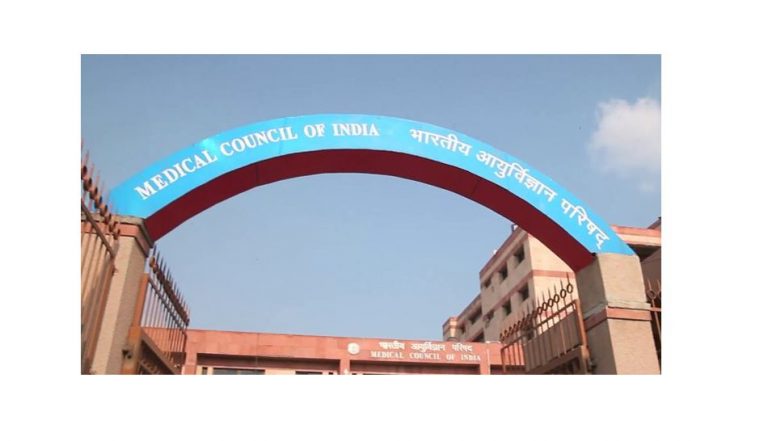
Months after the Jammu and Kashmir High Court asked the Medical Council of India (MCI) and external affairs ministry to review its stand to see if students who study medicine in Pakistan-occupied Jammu and Kashmir and Ladakh (PoJKL) could be allowed to practice in India, the country’s top medical education regulator has refused for the same.
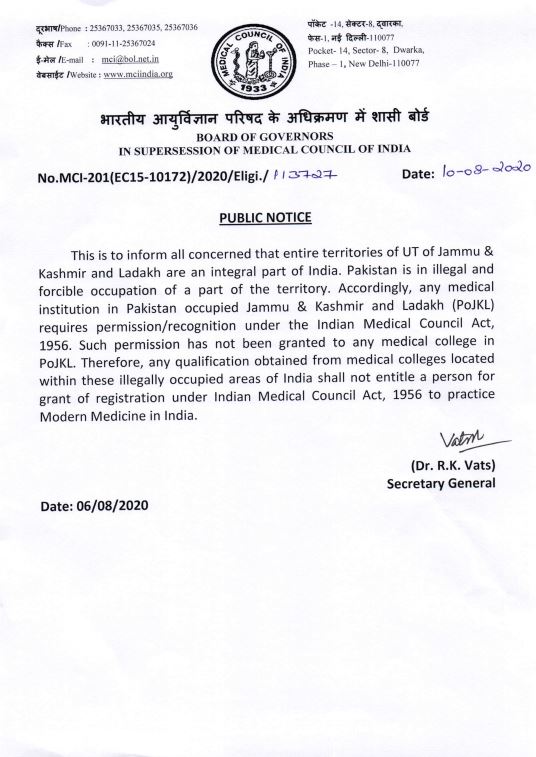
In a public notice (pdf) issued on August 10, MCI has barred doctors with degrees from colleges situated in the “illegally occupied parts of India” to practise modern medicine in India.
In the notice, the board of governors (BoG) in supersession of the Medical Council of India (MCI) said that the entire territory of Jammu and Kashmir, and Ladakh is an integral part of India and that Pakistan is in illegal and forcible occupation of a part of the territory.
The notice issued by Dr R K Vats, the Secretary-General of the BoG, read: “Accordingly, any medical institution in Pakistan occupied Jammu and Kashmir and Ladakh (PoJKL) requires permission and recognition under the Indian Medical Council Act, 1956. Such permission has not been granted to any medical college in PoJKL”.
“Therefore any qualification obtained from medical colleges located within these illegally occupied areas of India shall not entitle a person for grant of registration under Indian Medical Council Act 1956 to practice modern medicine in India”, the notice said.
J and K HC asks MEA and Medical Council of India to clear its stance
In December 2019, the Jammu and Kashmir High Court had asked the Ministry of External Affairs and Medical Council of India (MCI) to decide and inform the citizens of India about the status of educational institutions “operating in the territories of India under occupation and the administrative control of Pakistan.” The decision would help students and citizens understand the legal standing of qualifications and degrees from such institutions, said the HC while hearing a petition filed by one Hadiya Chisti who had completed her MBBS from Benazir Bhutto Medical College from Mirpur area of PoK.
“The Home Ministry, Ministry of External Affairs and Health Ministry then examined the matter and informed the high court that medical institutions in areas of PoJKL have not been granted permission and recognition under the Indian Medical Council Act,” a senior official with knowledge into the matter said.
“The high court had asked Government of India to publicise this fact so that students are not misled in obtaining medical qualifications from institutions in PoJKL,” the official explained.
While many leftist Indian media houses like India Today have shamefully parroted Pakistan’s stance on Pok, the government of India has repeatedly conveyed in plain-spoken terms that the entire Union territories of Jammu and Kashmir, and Ladakh, including the areas of Gilgit and Baltistan, have been, are, and will be an integral and inalienable part of India.
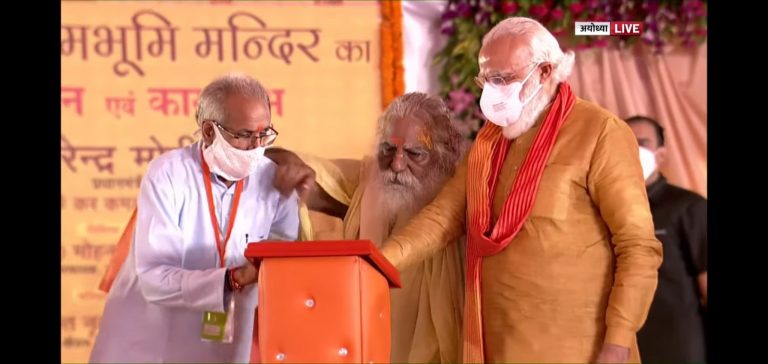
Ram Janmabhoomi trust chief Mahant Nritya Gopal Das tested positive for Chinese coronavirus. On 5th August, 2020, the day Bhoomi Pujan of Bhavya Ram Mandir took place he had shared the stage with PM Modi and RSS chief Mohan Bhagwant.
He was in Mathura for Krishna Janamashtami celebrations when he developed breathing difficulties. He is now being moved to Medanta hospital, Gurugram for further treatment. Uttar Pradesh Chief Minister Yogi Adityanath and Anandiben Patel were also on stage with him on 5th August 2020.