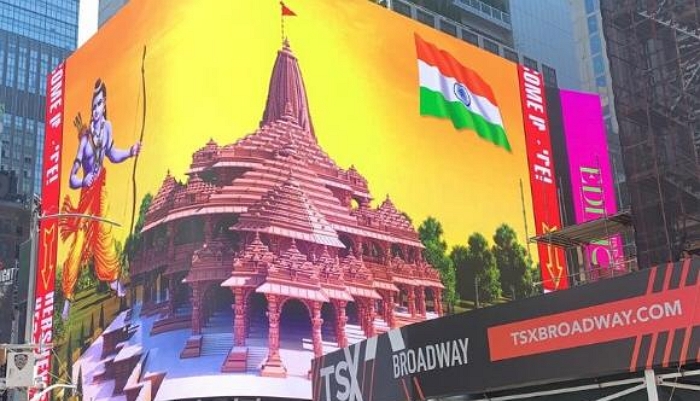
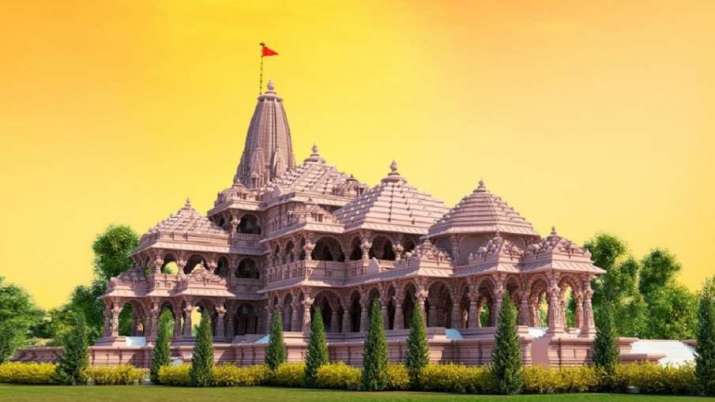
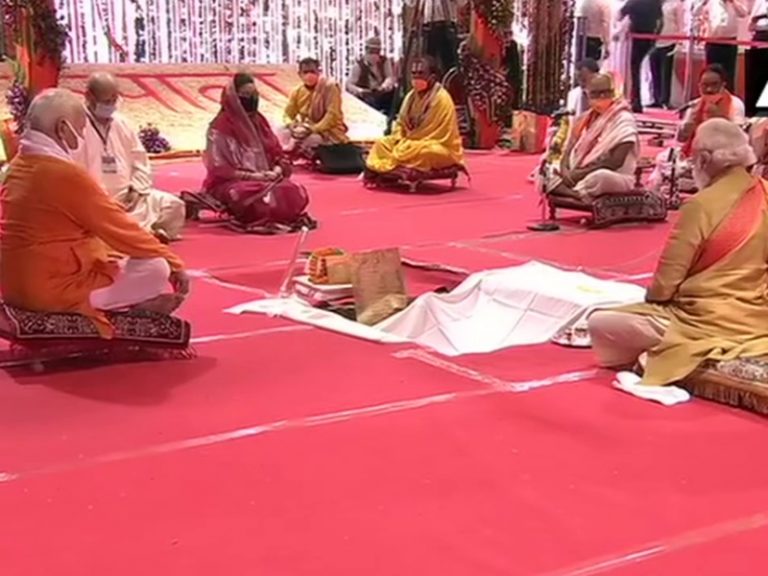
On the day the construction for Ram Mandir at the Ram Jamnabhoomi in Ayodhya started with the Bhoomi Pujan conducted on the presence of prime minister Narendra Modi, imagery depicting the upcoming Mandir were displayed at the Times Square in New York, USA. Video posted by ANI shows a large curved digital billboard with the images of Lord Ram and the Ram Mandir on it, located at the iconic Times Square. The Indian tricolor can also be seen in the billboard.
#WATCH USA: A digital billboard of #RamMandir comes up in New York’s Times Square.
Hindus in the USA have rented several billboards in the are to display text and images related to the Ram Mandir on the historic occasion. American India Public Affairs Committee had made arrangements to celebrate the historical moment of Ram Mandir Bhoomi Pujan in New York on 5th August, and they had leased prominent billboards for the occasion including the 17,000-square-foot wrap-around LED display screen and the giant Nasdaq screen at the Times Square. These are highest-resolution exterior LED screens at Times Square in New York.
Muslim groups in the USA and left-liberal activists in both India and USA had tried hard to stop the display of Ram Mandir’s imagery on the digital billboards at Times Square. They had launched a campaign against it after it was known that Hindu groups had hired billboards for 5th August. They had also contacted the advertising agencies that own the billboards to stop the display, but apart from one agency, others didn’t agree with them.
Several Muslim groups including Indian Minorities Advocacy Network- ImanNet, Justice for All, Coalition of Americans for Pluralism in India CAPI, North American Indian Muslim Association NAIMA, Islamic Circle of North America -Social Justice ICNASJ and The International Society for Peace and Justice filed the petition and asked the ad companies that manage the billboards not to project the images on the LED billboards managed by them. Accordingly, ‘Branded Cities’, the firm that manages the NASDAQ digital billboard had said that they have decided not to give the said billboard for the 5th August event to the Hindu groups.
After a decade long historical, political and legal dispute and with a Supreme Court intervention brought to closure in the matter of construction of Ram Mandir and, finally, Lord Rama shall get its abode to live. With Sacred soil from holy places and prominent temples from across the country and almost, all religiously significant water bodies in India are going to play a pivotal role during the construction of the Ram Mandir. The holy elements were in Ayodhya when PM Modi attends the ‘Bhoomi Poojan’ on August 5 for the construction of the temple.
Stories of ‘Maryada Purushottam’ Ram who is a reincarnation of Lord Vishnu and an epitome of righteousness was prevalent in every corner of India through tradition and culture. Therefore, the presence of sacred soil and water from every region of India naturally going to signify the age-long cultural roots existed during the pre-Colonial period across the country. This shall reflect the sentiments and emotion of people of India which is passing from generation to generation through many folk-tales and songs.
The word ‘Ram’ is not merely a word for an ancient civilization like India which is still in existence till date. The name represents identity, a value which has been in practice and alive superseding all historical ages. It lives in the hearts of people through folk stories from northern to southern region of India than from West to Eastern part of India. If there is a name in all parts of India that a child reveres early on his life, it is the name ‘Rama’. His legendary life stories have travelled beyond the shores of India to countries in South-East Asia where the Ramayana – which is artistically depicted through drama, music, dance, art and sculptor, even today.
India is a homeland to Ramayana, one of the largest epic poems in Indian Literature, a tale of spiritual heroism and the struggle for truth through an era, unapologetically true to its time period holding within its lessons for people of all times and places. However, it is distressing to note that for decades there was an ongoing and continuous distressing happened with this legendary figure in a spiritual country like India. There were less consensus and more controversies.
The saga of Ramayana was also prevalent in present North-eastern part of India. The whole idea that North-East of India was peripheral to Indian civilization and culture in the early centuries of the Christian era is based on the inadequate data and unfounded suppositions. Very little effort has been done so far to explore the North-East Indian land route through which elements of Indian civilization were exported to the South-East Asia. T
he Tra-Kieu inscription of King Prakashdhara of Champa (A.D. 653-679) mentions the erection of an image of Valmiki in the southern part of present-day Vietnam. It shows that how Indians travelling from the North-eastern land route, carried the eastern version of the epic story to the countries of Indochina is a hypothesis which cannot be dismissed together. The Rama legend, which travelled through north-eastern land route, was considerably transformed into its new home of adoption and returned to the North-East states of India by the 18thcentury with the Indochinese population trekking down along the Brahmaputra valley or the Patkai hills.
However, as I mentioned earlier it is a misfortune that there were more controversies regarding the name Lord Rama in Indian than a word of reverence in the last few decades. It is maybe because many of us now lived with a kind of mixed identity not knowing our own cultural and ancient root. The struggle of Ram Mandir becomes a matter of irrelevant for many people because of excessive induction of foreign ethos without understanding its intricacies.
Still, as it says time is everything. It is a matter of pride for each one of fellow Indians to witness a recent development related to Ram Mandir, where a century-old dispute over the site was resolved in November last year, as the Supreme Court of the Temple trust so, finally after loads of turmoil Ram Mandir foundation likely to laid on August 5th 2020 with a Bhoomi Pujan ceremony in Ayodhya. Consequently, Ram Janmabhoomi Teertha Kshetra Trust Member, said water and soil from the sacred river and holy places have been sending from across the country to Ayudhya.
Therefore, with the ‘Bhumi Pujan’ is nearing the holy soil water of Kamakhya Temple, which is one of the 51 Shaktipeeth, sent to Ayodhya. The Doloi of Maa Kamakhya Devalaya Committee, Kavindra Sharma said that collected soil and water from the temple to be used in the foundation laying ceremony for the Ram Mandir in Ayodhya.
Similarly, soil and water from Meghalaya’s Jaintia Hills were also collected to be used in building Ram Mandir. The Water collected from two rivers namely Myntdu and Myntang and soil from Syntu Ksair, Jowai and Nartiang. It is said that a 600 years old Durga Temple is located at Nartiang in the West Jaintia Hills district of Meghalaya.
This temple is also one of the 51 Shaktipeethas and is one of the holiest sites for devotees. A section of the ethnic community of Jaintia Hills of Meghalaya who are the followers of Sanatan Dharma believes that this temple is the permanent abode of Goddess Durga. Myntdu river is one of the major water bodies in West Jaintia Hills district, locally known as ‘Ka Tawiar ka Taken (Our Guardian Angle) in the Pnar dialect.
In addition waters and soils are being collected from other states of North-East India too. These are as follows:
List of Soils and Water Collected across North-Eastern States
River
Area
State
Brahmaputra
Assam
Assam
Dhansiri
Dimapur
Nagaland
Barak
Cachar
Assam
Dhaleshwari
Cachar
Assam
Surma
Cachar
Assam
Disang
Sivsagar
Assam
Kopili
Dima Hasao
Assam
Mahur
Dima Hasao
Assam
Jatinga
Dima Hasao
Assam
Langting
Dima Hasao
Assam
Gumati
Tripura
Kushiyara
Cachar/Barak
Assam
Longai
Karimganj
Assam
Tut
Mizoram
Tlawng
Sairang
Mizoram
Karnaphuli
Mizoram
Imphal
Mizoram
Jairl
Manipur
Lohit
Parashuram Kund
Arunachal Pradesh
Sipu
East Siang
Arunachal Pradesh
Siyom
West Siang
Arunachal Pradesh
Tirap
Arunachal Pradesh
Dicrong
Doimukh
Arunachal Pradesh
Myntdu
Jowai
Meghalaya
Morangang
Nartiang
Meghalaya
Moragang
Majai
Meghalaya
Umiam Lake
Bada Pani
Meghalaya
Till the present day. North-Eastern culture of India has always been treated and looked upon as a unique entity by many native historians who are already crippled by the crooked power of colonialism with no connection with the rest of India and Indian civilization per se. Unfortunately, no concrete work has been done to supersede that hegemonic power even after reaching the heights of information and knowledge society.
In fact, there is an ample of evidence in the tradition and culture of North-Eastern culture to prove that how the stories of Rama were predominant. For example, a close look at the Mizo version has disclosed that most of the Mizo folk-tale has the presence of Ramayana. The Karbis of North-Eastern India has a folk version of Ramayana which is popularly known as Sabin Alun (Chabin Alun). The tradition of song and music in Karbi Society started with Sabin Alun.
It literally means Sabin’s songs, which has been composed by Hemphu, the supreme creator, akin to Lord Vishnu. Even in Assam also 14 different forms of Kamrupi or Assamese Ramayan are so far collected and these are written in Different period by different writers. Madhav Kandali was the old and foremost one who translated this epic from the Sanskrit language to old Kamrupi Language in 14thCentury. It is one of the sources of the Old Assamese language and literature.
It is also known as Kamrupi Language which is very old in form and nature. In Tripura, if you visit the hills and deep forests and Chittagong hills Tract the old people often found reading Ramayana and Mahabharata both. Actually, the epics have been found themselves to be perennial sources of inspiration and an ocean of wisdom from which a galaxy of folktales, proverb, riddles, poems, songs, drama, dances, dialogues and visual arts have been composed by people.
Manipuri Literature which has a rich old heritage from about 10th century A.D. has a Manipuri Ramayana with all 7 cantos. King Garibniwaz entrusted one Pandit Angom Gopi or Kshema Singh Moiramba with his assistants to compose the Ramayana with a regional complexion and a large dose of the cultural soil of Manipur and it’s become a national epic of the Manipuris. The story of Ramayana is also known among the Khasis and is used to be narrated by the elderly people while sitting around the hearth. It is said that in Meghalaya the names of Rama and Lakhan are common for twin brothers and Durga and Ganga (pronounce as Konga) for twin sisters.
Conclusion
The existence of Lord Rama is not merely limited to a concrete structure. It is a wave of cultural phenomena. Indian culture is not just the domain of art and its understanding but includes literary texts that created meaning through practices, rituals, events and structures. It manifests a way of life that is based on universal values. In the context of North-Eastern India in particular and the whole country in general Ramayana has best served the purpose of cultural continuity and integration. And the construction of Ram Mandir shall further strengthen this value which has been revered since time immemorial.
It is a matter of great disappointment till now that there are lots of forces were working to disrupt this bridge. The north-Eastern part has been treated in isolation for many decades. A myth was propagated through a different medium that there was no connection between North-eastern India with the greater part of India.
Numbers of conspiracies were written to show that people living in hills and forest has nothing with Sanatani values. Whereas the fact was there has always been a cultural oneness from Iran to Indonesia (Angkor Vat). North-east was never an excluded part of India. Sanatan Dharma was extended throughout Northeast India and there was a similarity between life philosophy between hills and valley people. Hope such a great endeavour of cultural oneness that going to happen through the construction Ram Mandir shall unravel the true story of Northeastern Bharat.
(This article has been authored by Dr Phirmi Bodo who is the Assistant Professor at Centre for the Study of Social Systems, Jawaharlal Nehru University, Delhi)
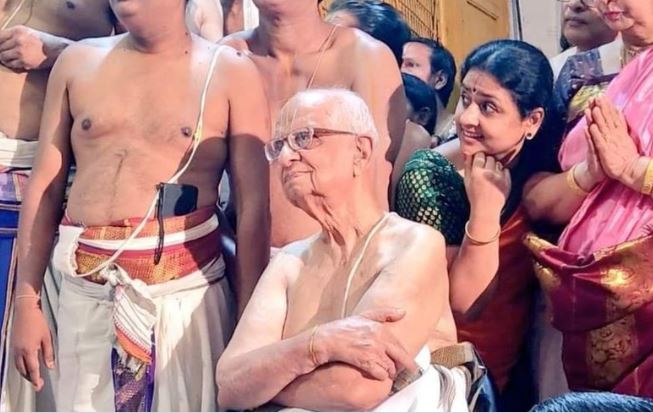
93-year-old K Parasaran, who successfully led the legal fight of Hindus to construct the Ram Mandir, was today pictured watching the Bhoomi Pujan from his home. BJP national general secretary BL Santosh and many others took to Twitter to share the picture of the eminent lawyer who spent all of his life devoted to Ram Lalla.
Respected Advocate Sri K Parasaharan who argued for Sri Ram Lalla Virajmaan viewing Bhumipujan of #SriRamMandir at his home with deep devotion . Heartfelt moments … ??? pic.twitter.com/PSC4do4zvC
Though today is an extremely special day for all the Hindu devotees, it is particularly significant for the veteran lawyer who had once said that the logical end to Ram Janmabhoomi case was his last dream. Such was his faith and devotion that, the 93-year-old lawyer for ‘Ram Lalla Virajman’, use to argue the Ramjanmabhoomi case barefoot standing for 4-5 hours at a stretch, as his faith felt the presence of God Ram.
K Parasaran and his illustrious career
K Parasaran is a senior Supreme Court advocate who in a legal career spanning over six decades, served as the Attorney General of India from 1983 to 1989. He had earlier served as the Advocate-General of Tamil Nadu in 1976.
He was awarded the Padma Bhushan and Padma Vibhushan in 2003 and 2011. He was nominated to the Rajya Sabha by the Indian President in 2012 for a period of six years.
K Parasaran said that the historic wrong was committed by Babar and it needed to be corrected
In the 40 gruelling days of final arguments of Ramjanmabhoomi case, Parasaran would exhibit infectious energy and would go well prepared every day for the sessions that began at 10.30 am and closed around 4 or 5 pm. It was K Parasaran’s legal brainchild to make Ram Lalla a litigant in the case, which cemented the case for the Hindu litigants.
During the course of the hearing, Parasaran argued that a historic wrong was committed by Babar 433 years ago when he constructed a Mosque at Lord Ram’s birthplace and it needed to be corrected.
One of the most notable arguments by Parasaran, in this case, was, “Muslims can pray in any other mosque in Ayodhya. There are 55-60 mosques in Ayodhya alone. But, for Hindus, this is the birthplace of Lord Ram, which we cannot change”.
Since 2016, Parasaran’s court cases have been rare. He has picked up only two cases after that – the Sabarimala case and the Ayodhya dispute. During the hearings, he expressed his deep desire when he had said: “My last wish before I die, is to finish this case.”
Chief Justice of Madras High Court called him ‘Pitamah’ of Indian laws
He had argued in Sabarimala case as well. He is considered an expert in Hindutva. Parasaran, who was a Rajya Sabha Member of Parliament from 2012 to 2018 has been a favourite lawyer for many state governments. He has so much knowledge about religious books that he cites them even during his arguments in the court. Sanjay Kishan Kaul, former Chief Justice of Madras High Court called him ‘Pitamah’ of Indian laws who contributed a lot without compromising on the religion.
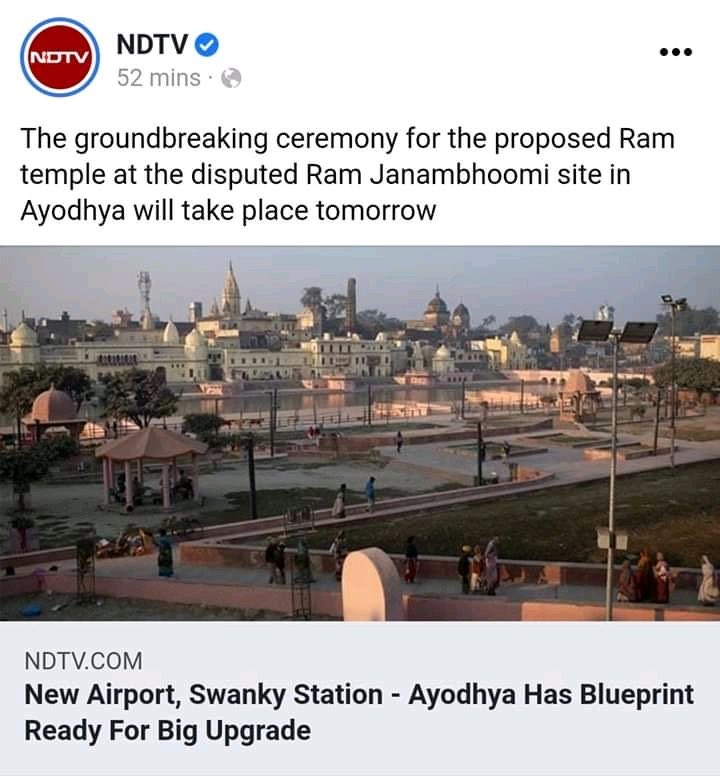
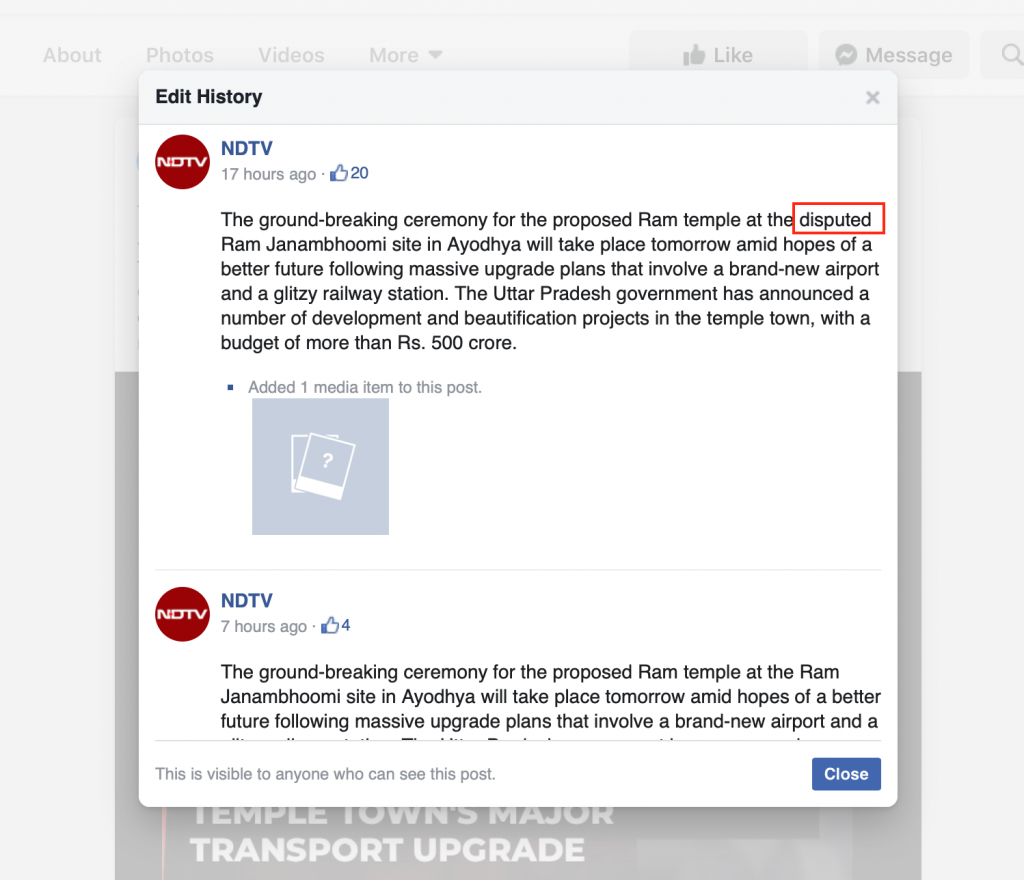
As the country was preparing itself for the historic day when the consecration of the much-awaited Ram Temple in Ayodhya would take place, habitual offender NDTV continued uploading posts on its social media pages, describing the Ram Mandir site as “disputed”.
“The groundbreaking ceremony for the proposed Ram temple at the disputed Ram Janmabhoomi site in Ayodhya will take place tomorrow,” read one of the Facebook posts uploaded by NDTV yesterday.
NDTV post on Facebook describing Ram Mandir site as disputed
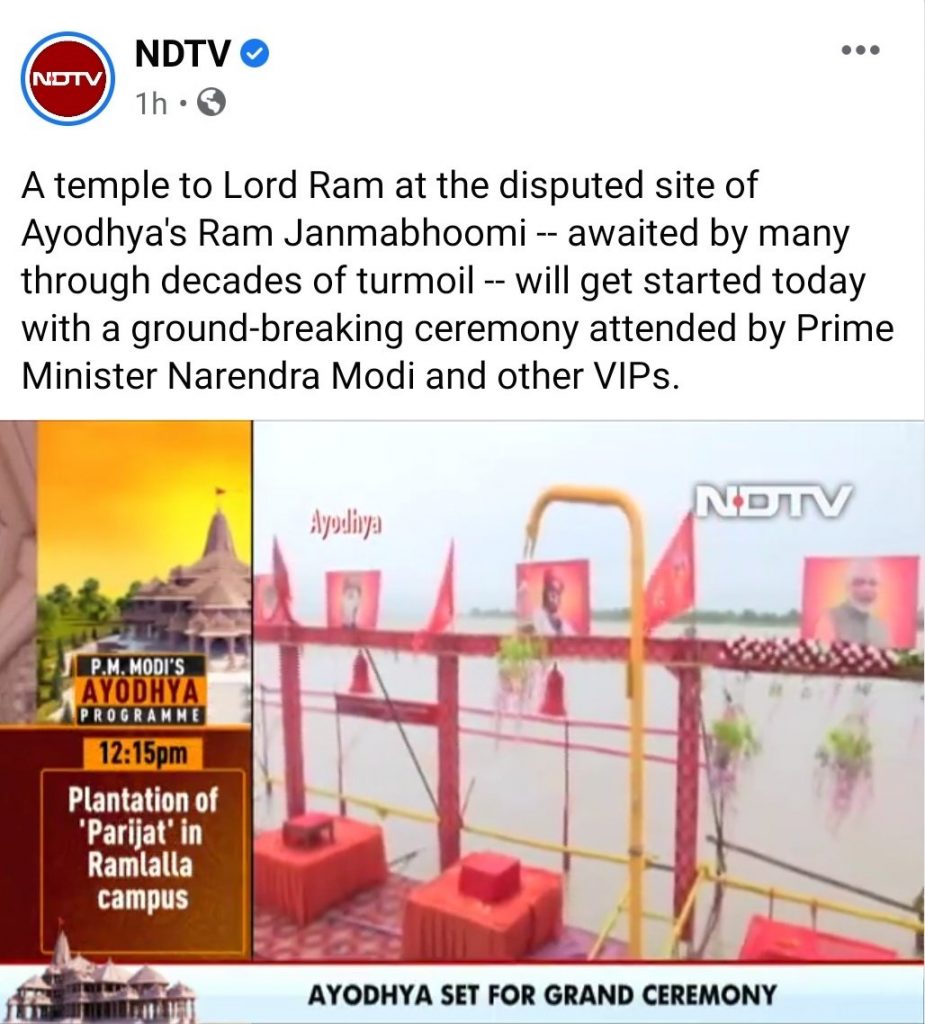
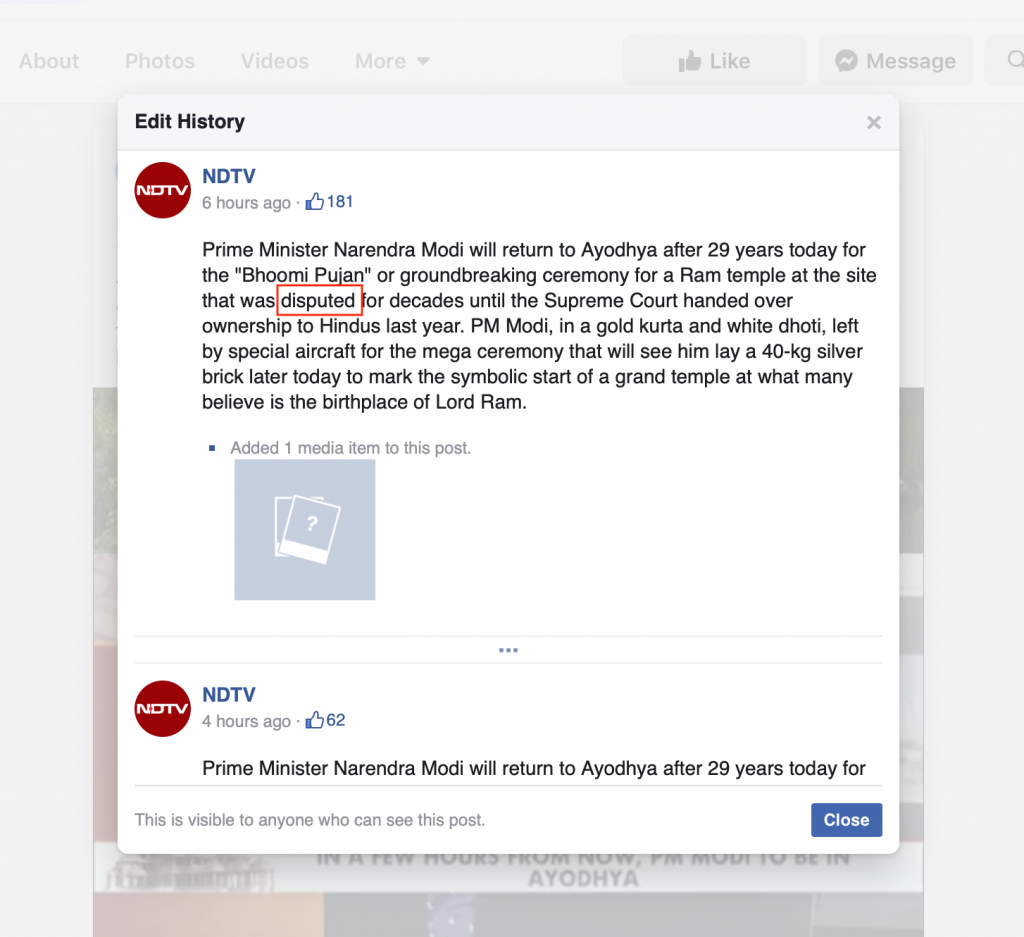
This was not an aberration as another post uploaded this morning on NDTV’s Facebook page once again described the Ram Janmabhoomi as “disputed”.
“A temple to Lord Ram at the disputed site of Ayodhya’s Ram Janmabhoomi—awaited by many through decades of turmoil—will get started today with a ground-breaking ceremony attended by Prime Minister Narendra Modi and other VIPs,” the post read.
Facebook post by NDTV describes Ram Janmabhoomi site as disputed
The perverse and prejudicial posts by NDTV drew the ire of the Hindus, who slammed the news channel for its wrongful description of the Ram Janmabhoomi site. A barrage of criticism was directed at the NDTV for continuing to depict Ram Janmabhoomi as “disputed”, even though the Supreme Court, in its landmark judgment last year, had granted Hindus the site for the construction of a Ram Mandir over it.
Similarly, there were two other posts, in which NDTV had wrongly referred to Ram Janmabhoomi site as “disputed”.
The Ram Janmabhoomi site was disputed till the time the title case over it between Hindus and Muslims was being heard in the Court. But after the Supreme Court awarded the site to the Hindus, and as no petition has been filed against the verdict by any side, the site is no longer disputed, and the highest court of the country has ruled that Ram Lalla and his devotees own the place.
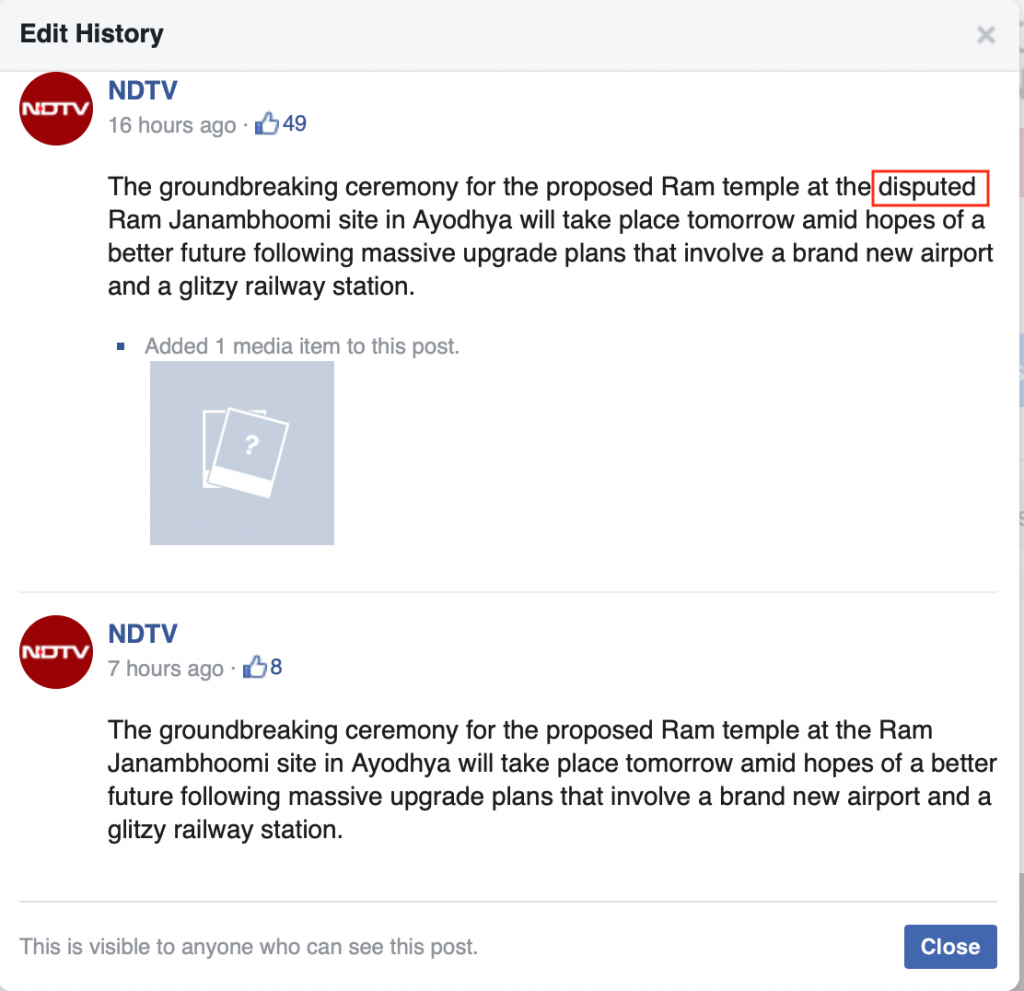
As the public backlash against NDTV’s dishonest reporting grew, the channel, realising that it has infuriated the Hindus on social media, quietly proceeded to rectify its posts. The word “disputed” was edited out from the posts that had garnered negative reactions from users.
One of the posts which were uploaded yesterday and had described Ram Janmabhoomi site as “disputed” was changed about 9 hours later. The word “disputed” was removed from the post. The ‘View Edit History’ option on Facebook lets users go through the changes that were made on the posts by the admin. It can be found by selecting the ‘View Edit History’ on the dropdown menu on the top right corner of the post.
Edit history of a post uploaded by NDTV on Facebook
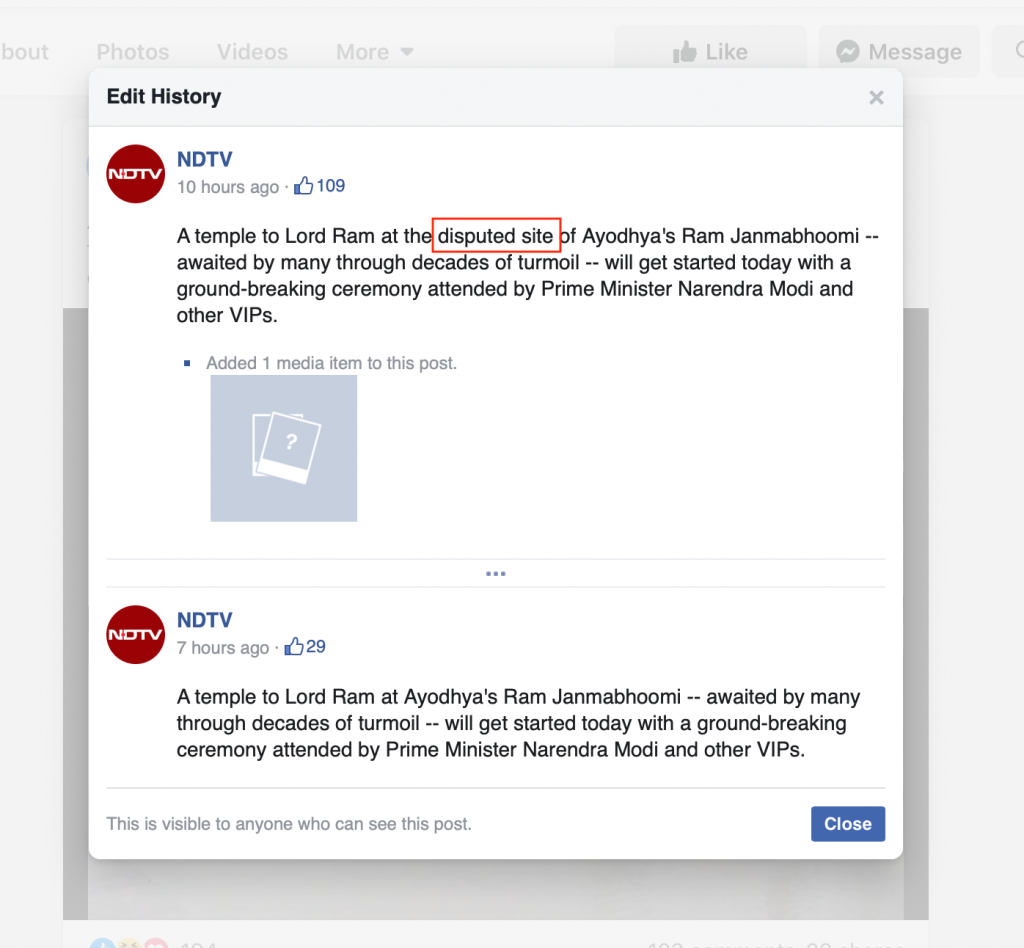
Another Facebook post which is shared above had been sanitised by the NDTV. The words “disputed site” were removed and the post was shared once again.
Edit history of a post uploaded by NDTV on Facebook
Similarly, one more NDTV post which had earlier mentioned Ram Janmabhoomi as disputed was edited by the admin of the NDTV page and the word “disputed” was redacted.
Edit history of a post uploaded by NDTV on Facebook
Likewise, a post that provided an account of PM Modi’s schedule for today had also referred to Ram Janmabhoomi site as “disputed”. The ‘View Edit History’ shows that even that post was tinkered with.
Edit history of a post uploaded by NDTV on Facebook
Bhoomi Pujan ceremony of Ram Mandir at Ayodhya
NDTV’s reports casting aspersions on the legitimacy of Ram Janmabhoomi site came at a time when the nation was gripped in a festive mood over the Bhoomi pujan ceremony of the Ram Mandir in Ayodhya. The Bhoomi pujan ceremony was scheduled for August 5 after the Supreme Court of India had last year gave a verdict in the protracted legal dispute of Ram Janmabhoomi and terminated its disputed status by granting it to the Hindus.
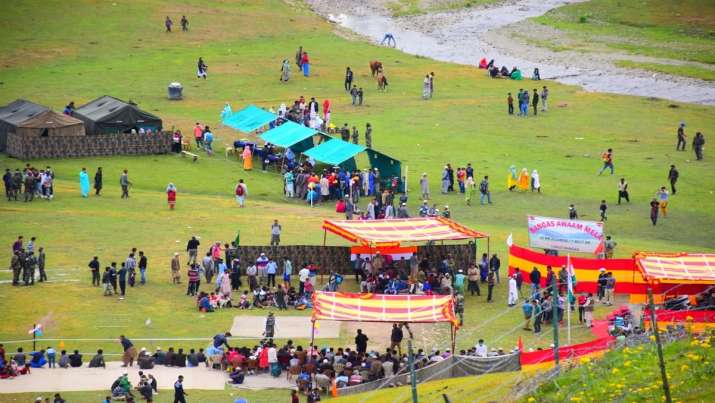
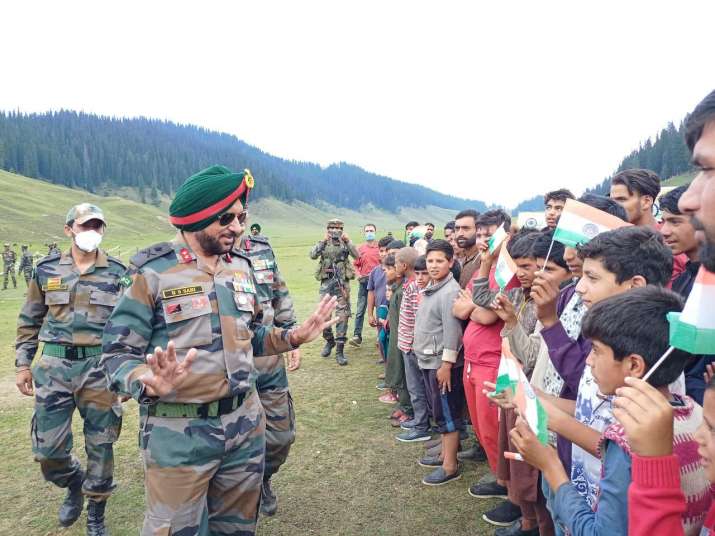
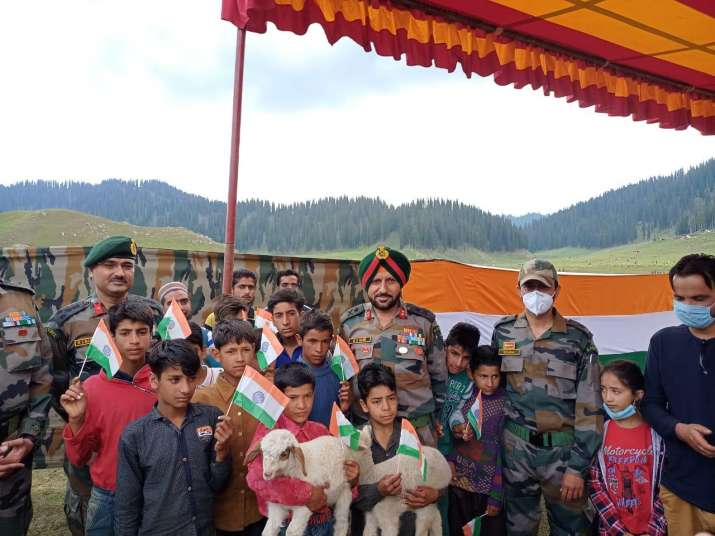
Hundreds of Gujjars, Bakarwals and other Kashmiri’s from Kupwara, Tangdhar and Handwara on Wednesday celebrated Bangus Awaam Mela to commemorate the first anniversary of the abrogation of Article 370 in the valley. The local administration officials said: “Soundly rejecting the efforts of Pakistan to create a false narrative around the first Anniversary of Abrogation of Article 370 in Jammu and Kashmir, Kashmiris on Tuesday celebrated the event by holding the Bangus Awaam Mela in District Handwara with great fanfare.”
Two-day event organised to celebrate the first anniversary of Abrogation of Article 370 in Jammu and Kashmir
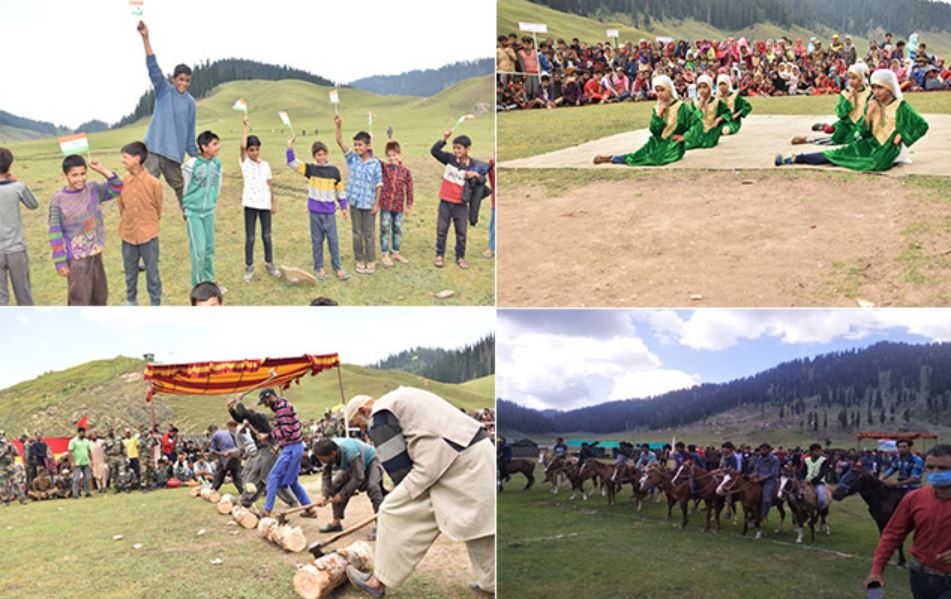
The two-day event, commencing on August 3 with the grand finale on August 4, was organised in the Lokut Bangus valley by the 21 Rashtriya Rifles (GUARDS), under the aegis of Headquarters 7 Sector Rashtriya Rifles. The event was inaugurated by Col Gangandeep Singh, YSM, Commanding Officer, 21 Rashtriya Rifles on 03 August 2020 followed by free medical and veterinary camp and village games.
Free medical camp
A Veterinary and Medical Camp was organised with an aim to provide basic health care facilities along with free medicines to the locals who are residing in the remote region of Bangus valley and do not have access to the basic medical facility. The camp was a combined effort of the 03 Army doctors and 08 Civil Medical Authorities. A total of 678 patients including 328 males, 271 females, 80 children were given treatment and advice by the doctors.
Free Veterinary camp
The veterinary camp was organised to provide medical aid to 135 Live Stocks and give free medical advice.
Village Games were organised
On the first day of the event, competitions like Horse Racing, Sheep Shepherding Challenge, Tugs of War and Wood Chopping were held among the residents of the Gujjar Bakerwal Community. The second day witnessed a variety of events including Karate Display, Songs by locals and School Children, Folk Song & Dance by local group and finals of village games.
The event ended with the Army distributing Solar Lamps to Gujjar Bakarwal families and prize distribution to the participants. The community elders also gave a vote of thanks to the Army for its support. The two-day event was concluded with the recitation of the National Anthem.
Apart from this event, BJP also celebrated the occasion at many places across Srinagar with functions held by party leaders. The Indian flag was hoisted at the BJP office in Srinagar and slogans were chanted.
BJP spokesperson said: “After the revocation of Article 370, the development was seen on ground in Kashmir. For a long time now the stone pelting has come down to zero. BDC members get Rs 25 lakhs for development in their own respective areas. All elections in the Kashmir valley have been held peacefully.
Besides Srinagar, BJP members also celebrated by unfurling the national flag and raising “Bharat Mata ki jai” slogan at Anantnag, Ganderbal and Kupwara.
BJP leader Altaf Thakur said that the abrogation of Article 370 provisions of the Constitution, which accorded special status to Jammu and Kashmir, had brought about many positive changes and put an end to stone pelting in Kashmir.
“There used to be stone pelting during encounters that have stopped. There used to be ISIS flag, Pakistani flag…that has stopped. That is what we are celebrating,” he added.
Social media was abuzz with pictures of local BJP Leader Rumisa Rafiq hoisting and saluting the Indian tricolour at Lal Chowk in South Kashmir’s Anantnag district on the 1st anniversary of Article 370 and 35A abrogation from Jammu and Kashmir.
Local BJP Leader Rumisa Rafiq hoists and salutes the Indian tricolour at Lal Chowk in South Kashmir’s Anantnag district on the 1st anniversary of Article 370 and 35A abrogation from J&K inspite of repeated threats of Pakistani terrorists and radical separatists. pic.twitter.com/O6i4wg86iU
Pakistan planned to organise a series of events to denounce the abrogation of Article 370 on its first anniversary
This atmosphere of celebration and exuberance in the valley is surely a big slap on the faces of the Pakistani propaganda machine which had reportedly organised a series of visits/events leading up to August 5, in a bid to once again dredge up the issue of Jammu and Kashmir. A tweet posted by retired Major Gaurav Arya had thrown light on Pakistan’s nefarious plans ahead of the first anniversary of the abrogation of Article 370.
Protests and demonstrations are also chalked out by the Pakistani propaganda machinery in its embassies around the world, perhaps, in their bid to internationalise the issue of Jammu and Kashmir and draw the international attention towards the abrogation of Article 370, notwithstanding its numerous failures at the same in the last 12 months.
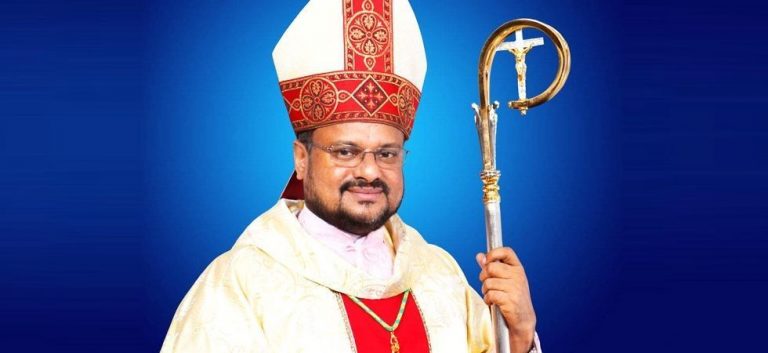
In a big setback for the rape-accused Bishop Franco Mulakkal, the Supreme Court on Wednesday dismissed his petition seeking to clear rape charges against him. Bishop Franco, who is accused of raping a 44-year-old nun will now have to face trial in the rape case.
According to the reports, Bishop Franco Mulakkal had filed a petition in the Supreme Court seeking to quash Kerala High Court’s order that had dismissed his discharge plea in the rape case. The Kerala High Court had ruled that the rape-accused Bishop must face trial in the case after the prosecution had argued that there was enough evidence against him.
“You don’t have a case and there is no merit in your petition,” said Chief Justice of India SA Bobde hearing Mulakkal’s petition.
Franco Mulakkal had moved Supreme Court after a trial court in Kottayam had cancelled his bail on grounds that he had failed to appear before the court several timings despite several warnings. On July 13, the Kottayam court had cancelled Mulakkal’s bail and had issued a non-bailable warrant against him.
However, Franco Mulakkal’s counsel had claimed that the accused had tested positive for coronavirus and hence was not able to appear before the court.
Franco Mulakkal, Bishop of the Roman Catholic Diocese of Jalandhar, was accused of raping a 44-year-old nun at a guest house in Kuravilangad in May 2014 and subsequent sexual exploitations afterwards. The nun had registered a complaint in June 2018 and has also claimed that despite her complaints, the church took no action on the bishop.
Bishop Franco was granted bail in the nun rape case in 2018
Bishop Franco Mulakkal, Archdiocese of Jalandhar, Punjab, was arrested by the police officials on September 21, 2019, after the investigating team finally found evidence that linked him in the sexual harassment case. The court had pointed out the availability of evidence to pursue the case.
However, the Kerala High Court later issued some directions to the rape accused before approving his bail plea. The court ordered the bishop to be present before the investigating officer once in two weeks.
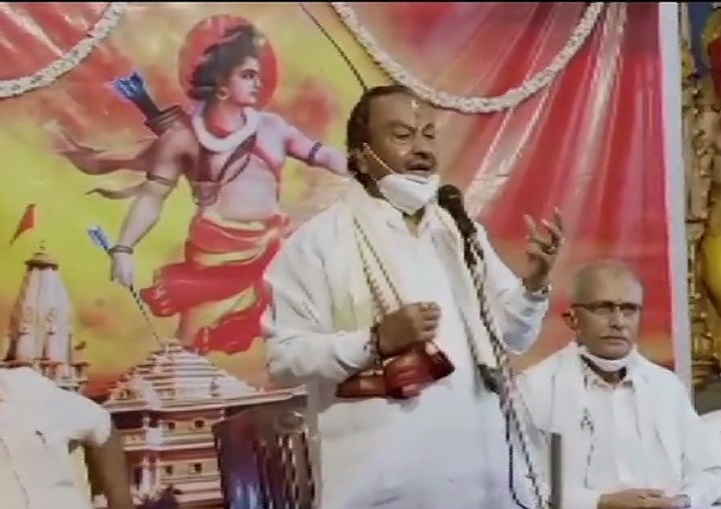
Senior BJP leader and Karnataka Minister KS Eshwarappa on Wednesday said that the Ram Mandir Bhoomi Pujan ceremony, which is being held in Ayodhya in Uttar Pradesh, is the first step towards eradicating the culture of slavery and restoring the Hindu culture in the birthplace of Lord Rama.
Speaking at an event in Shivamogga, which was organised to celebrate the Bhoomi Pujan ceremony of Ram Mandir at Ayodhya, minister KS Eshwarappa said that the Mosques at Kashi and Mathura were constructed by demolishing temples and hence there is a need to build Hindu temples at both the places. He said that there are Mosque at both the sites, which means we are still slaves.
In both these places, when we offer prayers, there are mosques on sides, which say that you are still a slave. It is necessary to liberate these temples: K. S. Eshwarappa, Karnataka Minister https://t.co/7mPMPi24Za
“It’s a good day that the foundation stone for Ram Temple has been laid. A beautiful temple will come up, but there are Kashi Vishwanath & Krishna Janmasthan temples which have to be liberated,” said KS Eshwarappa, who is the Rural Development and Panchayat Raj Minister of Karnataka.
The Minister added that Hindus feel enslaved when they visit temples at Kashi and Mathura and added that it is difficult to offer prayers with devotion at these temples as the Mosques present at the site remind Hindus of their subjugation. Hence, we need to liberate these temples, said the minister.
KS Eshwarappa also asserted that there will be temples at both Kashi and Mathura in the near future just like Ayodhya. He added all the three Hindu temples, once constructed, will be the symbol of nationalism in the country.
The senior leaders remarks comes on the day when Prime Minister Modi performed Bhoomi Pujan for the proposed Ram Mandir at Ayodhya.
Reclamation of Kashi and Mathura temples
Following the Supreme Court verdict on Ram Janmabhoomi case, there has been a growing demand among Hindus to reclaim Kashi and Mathura, along with Ayodhya. Taking back the disputed sites of Kashi Vishwanath temple and Krishna Janmabhoomi temple at Mathura has now become a priority for various Hindu groups in the country.
The Gyanvapi Mosque was built by the Islamic invader Aurangzeb after destroying the Kashi Vishwanath temple. The remnants of the ancient Hindu temple can still be seen on the walls of the Gyanvapi Mosque. The temple was an earlier restoration of the original Kashi Vishwanath temple, which was destroyed and rebuilt several times in history. The current Kashi Vishwanath was built on a site adjacent to the Mosque in 1780.
Similarly, the Shahi Idgah Mosque stands at the Krishna Janmabhoomi in the city of Mathura. The Islamic invader Aurangzeb had destroyed the ancient Keshavnath temple and built the Shahi Idgah Mosque on its plinth in 1669.
Ram Mandir Bhoomi Pujan completed in the presence of PM Modi along with 174 leaders and saints. Due to Covid-19 pandemic, Ram Bhakts could not visit Ayodhya to witness the once-in-a-lifetime event. To overcome the loss of opportunity, many artists have come up with amazing illustrations, sculptures and paintings in the last few weeks. Here are some of the best artworks we found across social media platforms.
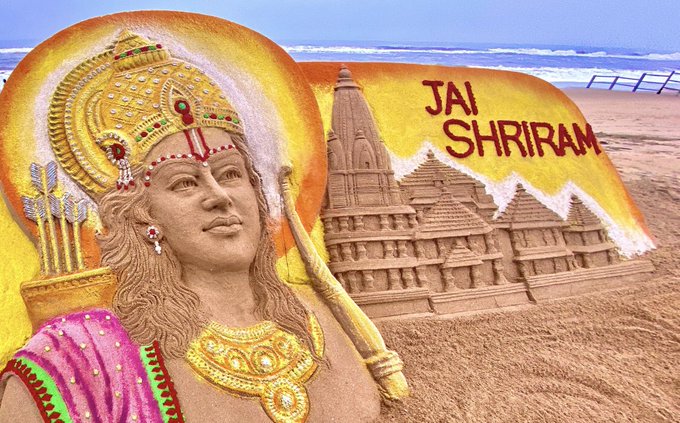
Sudarsan Pattnaik, famous sand artist posted photos of his sand sculpture of Bhagwan Ram on his social media accounts.
Karan Acharya, who became a popular name in every household for his Rudra Hanuman sketch, made a few illustrations in the last couple of weeks. The first one is of Ram Lalla.
A post shared by pawan boloor (@pawan_acharya_boloor) on
There are hundreds of illustrations posted by artists from across the world showing their happiness and enthusiasm towards Ram Mandir. As per the information provided by Ram Janmbhoomi Teerath Kshetra Trust, it will take around 3.5 years to complete the construction work.
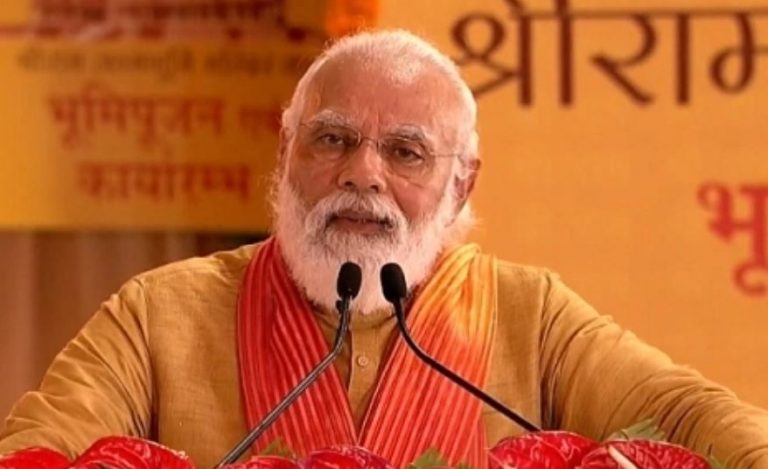
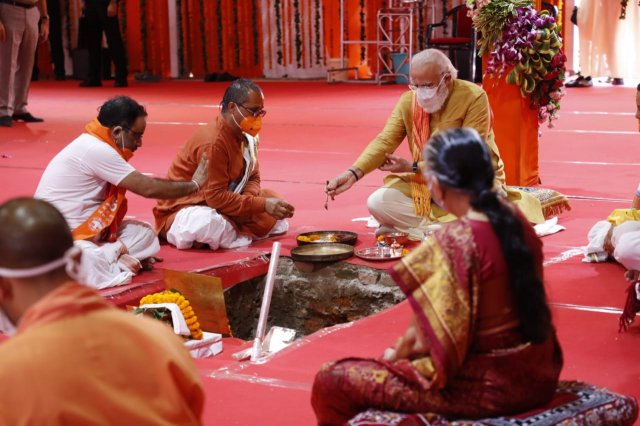
The 500 years of struggle came to fruition for millions of Hindu devotees across the world today as Prime Minister Narendra Modi performed the Ram Mandir’s Bhoomi Pujan at 12.44.08 PM. PM Modi who returned to Ayodhya after 29 years, expressed gratitude to all citizens of this nation, Indian diaspora across the world and all the Ram Bhakts on today’s auspicious occasion.
Overwhelmed by Sri Ram Janmabhoomi Tirtha Kshetra Trust’s decision to invite him and provide him with the opportunity to witness this historic moment, PM Modi said that “It is my good fortune that I was invited to witness this historical moment… From Kanyakumari to Kshirbhavani, from Koteshwar to Kamakhya, from Jagannath to Kedarnath, Somnath to Kashi Vishwanath…today entire country is immersed in Lord Ram.”
“Ram Janmabhoomi has got its freedom today. Like August 15 is Independence Day for the country, today holds a similar significance for crores of those who devoted their lives for the cause of Ram temple”, said PM Modi addressing the luminaries and dignitaries present for the Ram Mandir’s Bhoomi Pujan ceremony.
PM Modi during Bhoomi Pujna for Ram Mandir
“The way Dalits, OBCs, tribals, every section of the society supported Gandhiji during the freedom struggle, this pious work of building Ram temple has started with the cooperation of people from all over the country. The way boatmen and tribals helped Lord Ram, the way children helped Lord Krishna lift Govardhan mountain, similarly, the temple’s construction will be completed with everyone’s efforts,” he added.
There is no such aspect of life where Lord Ram does not come as an inspiration. Structures were destroyed, efforts were made to eradicate Lord Ram’s existence, but it is his immense power that he continued living in our hearts and is the basis of our culture. There has been no ruler as idealistic as Ram in the history of the world. “Ram sab me hain, Ram sabke hain”, Lord Ram is omnipresent, he belongs to all humanity, Ram is etched in our hearts and will continue to be so, said our Prime Minister.
भगवान राम की अद्भुत शक्ति देखिए।
इमारतें नष्ट कर दी गईं, अस्तित्व मिटाने का प्रयास भी बहुत हुआ, लेकिन राम आज भी हमारे मन में बसे हैं, हमारी संस्कृति का आधार हैं।
“A grand temple will now be built for our Ram Lalla who had been staying in a tent. Today Ram Janambhoomi breaks free of the cycle of breaking and getting re-built again, a process that had been going on for centuries”, said Prime Minister Modi.
This process of construction of Ram temple is an attempt to connect the entire nation. This festival is a celebration of connecting faith with the existing, connecting past with the present, the world with faith and connecting oneself with sacraments, said Modi. I believe that this grand Ram temple, like the name of Shri Ram, will reflect the rich heritage of Indian culture. I believe it will inspire the entire humanity till eternity.
PM Modi paid his tribute to the lakhs of Ram Bhakts who laid their lives for the Ram temple. He said that this auspicious day could only come into our lives because of the sacrifices made by the Hindu devotees generation after generation. “This day is proof of the truth of the resolve of millions of devotees. This day is a unique gift of the non-violence, faith and sacrifice shown by millions of devotees”.
आज का ये दिन करोड़ों रामभक्तों के संकल्प की सत्यता का प्रमाण है।
He said that we have to ensure that the message of Lord Ram and the Ram Temple, the message of our thousands of years of tradition reaches the whole world continuously.
The Prime Minister concluded his speech by chanting “Siyapati Ram Chandra Ki Jai”.
Prior to the PM’s address, Uttar Pradesh Chief Minister Yogi Adityanath has said that the centuries-old struggle for the temple was taken to its logical conclusion by the Modi government.
“The ‘Bhumi Pujan’ will not only mark the beginning of the construction of the Ram temple but also ‘Ram Rajya’ as envisaged by the Prime Minister. We started the ‘Deepotsav’ programme three years ago to give the people a feel of Ram Rajya and we also worked alongside for beautification and development of Ayodhya that will now emerge as one of the most prosperous religious destinations. The Prime Minister has already earmarked projects for the Ramayana circuit,” Yogi Adityanath said.
Similarly, Rashtriya Swayamsevak Sangh chief Mohan Bhagwat said that today is the joy of the fulfilment of centuries and that the ritual of making India self-reliant has been completed today. Remembering Ashok Singhal, Paramhans Das and LK Advani on this pious occasion, Mohan Bhagwat said that the beginning of temple constructions proves “we can do what we want to do”.
The day for which millions of Hindu devotees have been waiting with bated breath is finally here. Ayodhya’s Bhavya Ram Mandir’s construction will now speed up as the Bhoomi Pujan has been successfully completed today. It is being estimated that the Ram Mandir construction would approximately be completed in three and a half years. But as we celebrate this auspicious day today, one should also reminisce those thousands of Hindu devotees and Karsevaks whose extreme sacrifices laid the foundation for the Hindu reclamation of the Janmabhoomi of Bhagwan Ram.
The despicable act of police brutality that was inflicted on Hindus in November 1990
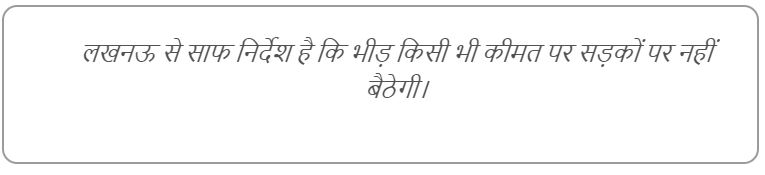
2nd November 1990, IG SMP Sinha said to his subordinates: There is a clear instruction from Lucknow that the crowd will not sit on the streets at any cost.
Who was sitting on the Lucknow’s chair then? Why was he giving such orders? Who was wanting to come across as the ‘Messiah’ of Muslims? Before these questions could be answered, we should know what had exactly happened in Ayodhya on 2nd November 1990.
2nd November, 1990, Hindu massacre in Ayodhya
It was 9 am on the auspicious day of Kartik Purnima when Hindu saints and thousands of Karsevaks, comprising also of women and elderly people, resumed their march towards the Ram Janmabhoomi site where the disputed structure then stood. The security forces, who were instructed to stop the Hindus from reaching the site, lined up on the road to block the way.
Whenever the security personnel tried to impede the Hindu devotees, they would sit there and start chanting the name of Lord Ram and reciting Bhajans (religious songs). They touched the feet of the security personnel, deployed to prevent them from marching ahead. Each time they did this the security personnel would move back and the Karsevaks would move forward. Though unarmed, the Karsevaks remained undeterred.
This kept happening in a loop until the IG passed orders and the police personnel sprung to action. Tear gas shells were fired, lathis were rained at the Karsevaks, but the resolute Ram Bhakts neither counter-attacked nor did they agitate or falter. Suddenly the security personnel started responding by opening fire. Many Hindu devotees were targeted and gunned down. It’s believed that the security personnel hunted and targeted Hindus in every lane and bylane leading to the Ram Janmabhoomi and within no time the streets converted into a war zone.
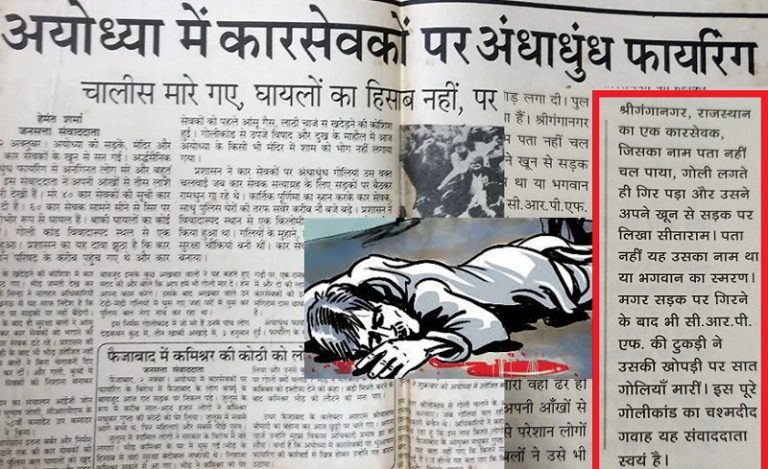
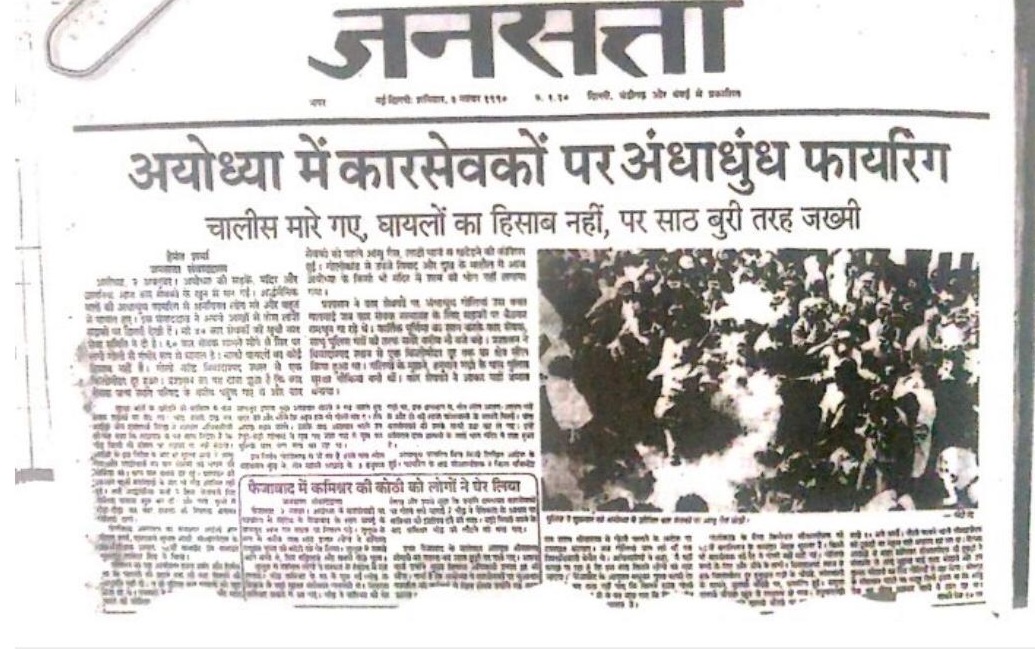
On 3rd November 1990, a report published by Hindi daily Jansatta wrote:
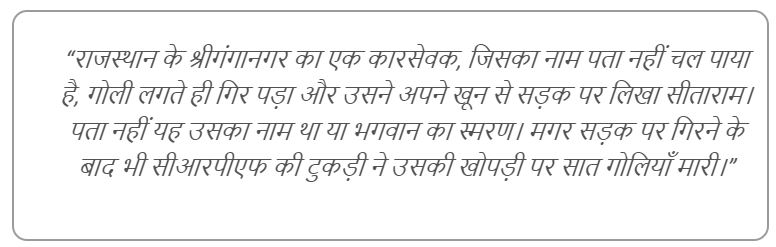
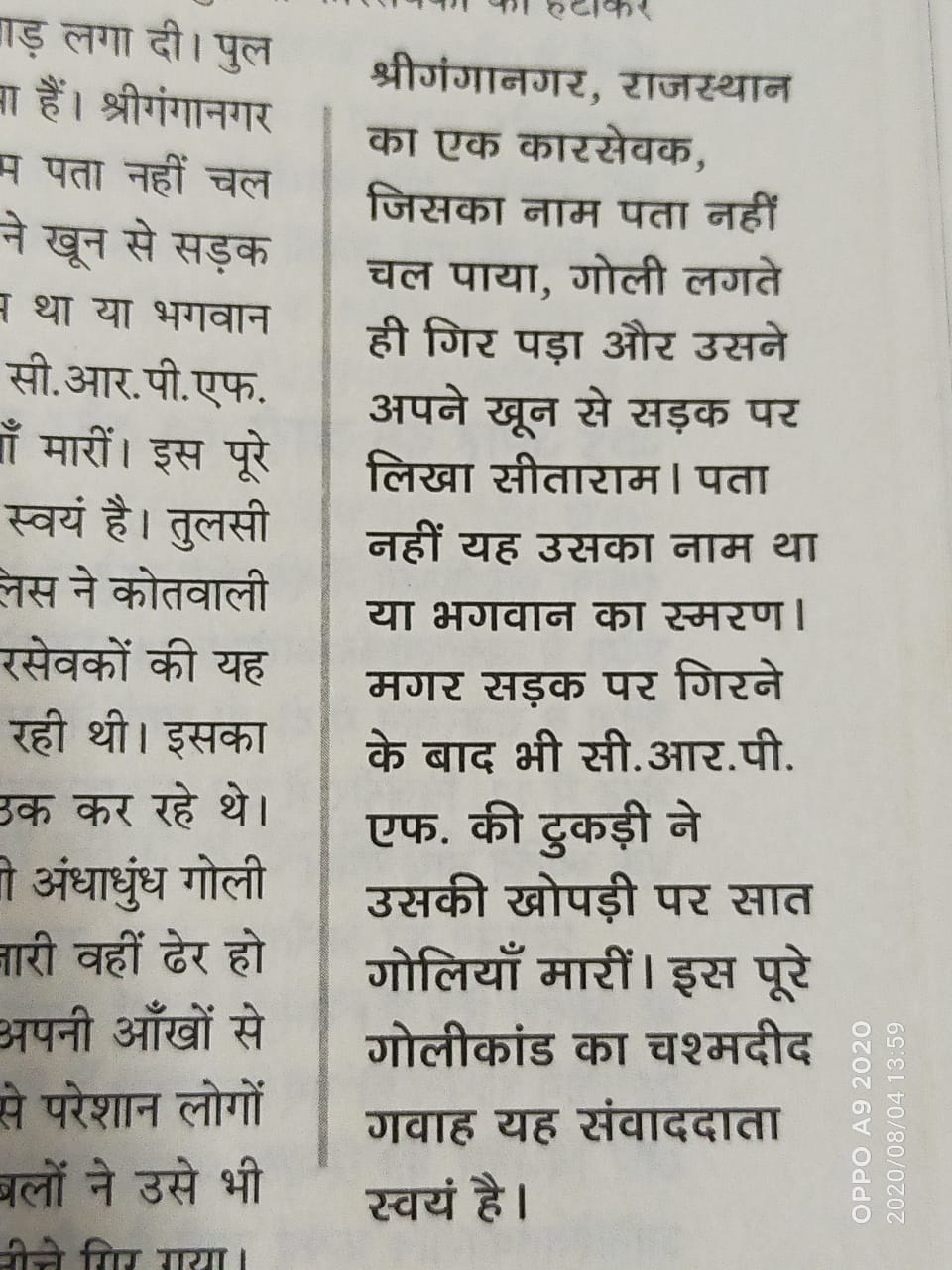
A Karsevak of Sriganganagar, Rajasthan, whose name was not known, fell as soon as he was shot by the security personnel. As he fell, he wrote “Sitaram” on the road with his blood. It remains a mystery whether the Karsevak had written his own name or was it his devotion and adherence towards Lord Ram which made him write “Sitaram” in his own blood. The report had mentioned that even after the Karsevak fell to the ground, the CRPF personnel had shot seven bullets into his skull.
The report published by Jansatta on November 3, 1990.
An extract from the e-book “Ayodhya ka Chashmadeed”
More details which had emerged regarding the November 2 carnage:
The security personnel neither offered help to the injured nor allowed anyone else to help them.
The police did not have any prior written order for firing. In fact, the district magistrate had signed the order after the police had carried out the firing.
No Karsevak was shot in the leg. All of them were shot in the head and chest. Which means that the security personnel had fired with an intention to kill and not just injure.
The Tulsi crossing was converted into a battlefield with the streets soaked in the Karsevak’s blood. Kothari brothers were dragged out of the Digambar Akhara and shot at.
Ramachal Gupta, a 26-year-old Karsevak, was attacked by the police personnel from behind, while he led a group of two dozen devotees towards the Ram Janmabhoomi.
Security forces entered the Digambar Akhada and started indiscriminately firing at the Sadhus present there.
The priest of a Hindu temple situated in front of the police station was shot at.
A Sadhu, who was standing on the rooftop and throwing buckets of water to help the tear-gassed people was also shot at.
After the firing, the bodies of the devotees lying on the streets were filled in sacks and were disposed off.
It was in this carnage that the heroic Kothari brothers lost their lives
On November 2, 1990, a large group of Karsevaks, including the Kothari brothers, started to gather in front of Hunumangarhi, a stone’s throw away from the disputed structure that was eventually demolished later. The group led by Bajrang Dal’s Vinay Katiyar started moving ahead but were stopped by police.
All of them sat on the road in protest and started singing ‘bhajans’ (religious songs) when suddenly, the security personnel at the behest of the then CM Mulayam Singh, started firing at the crowd and chased Karsevaks across the area. Many people died from head wounds. There was a stampede at the Saryu Bridge, which killed a number of people. According to eye-witnesses, the Kothari brothers mounted a saffron flag atop the Babri Masjid, but however, fell prey to the brutality meted out at the Karsevaks.
How many karsevaks actually died in the November 1990 carnage?
The incident which occurred in Ayodhya, almost 30 years back, left an ineradicable mark in the history of India. After the brutal massacre, different media houses had come up with different numbers of those killed on November 2, 1990. In a report published the next day by Jansatta, the number of dead karsevaks was stated to be 40. It had also stated that 60 others were badly wounded in the incident while it could not give the exact number of people who escaped with minor injuries. Meanwhile, a journalist who was on the spot during the incident, reported the death toll to be 45.
The Hindi daily Dainik Jagran had said that 100 people had died in the police firing, while Daily Aaj said this number was 400. Though the official report on the incident concluded that 16 people had been killed in the firing, however, the fact remained that the number was potentially far higher.
Interestingly, the administration had not provided any data on its own immediately after the incident, but the media data was not denied. Even the then Faizabad Commissioner, Madhukar Gupta could not tell how many rounds were fired until hours after the firing. He did not even have the data of the dead and the injured.
Jansatta had written clearly in its report: “By firing on unarmed Karsevaks, the administration has committed a far more heinous crime than the Jallianwalabag incident.”
What delibrated ‘Mulla’ Mulayam to take such a whimsical stance
Most of them think that the demolition of the disputed structure on December 6, 1992, altered the communal landscape of India. But there is a background to this incident which shaped the events which led to the demolition of the Babri Masjid.
These series of events include LK Advani leading a nationwide Rathyatra, to persuade people to join in the construction of Ram temple at the Ram Janmabhoomi, where the disputed structure stood.
The VP Singh-led government then was on shaky ground at the Centre due to infighting in the ruling Janata Dal. In Uttar Pradesh, Mulayam Singh Yadav of the same party was the chief minister. The Janata Dal was vehemently against the Ayodhya campaign by the RSS, the BJP and the VHP.
“Let them try and enter Ayodhya. We will teach them the meaning of law. No masjid will be broken.” Mulayam Singh Yadav, in an attempt to please the Muslim vote bank, had declared in October 1990, opposing the rath yatra of LK Advani.
LK Advani could not enter Ayodhya as he was arrested in Bihar by the Lalu Prasad government of the Janata Dal. Advani’s arrest by Lalu Prasad proved to be a game-changer. Lalu overnight became a hero in the eyes of the Muslims. Mulayam Singh, miffed by this strategy laid by Lalu Prasad at the behest of VP Singh at the centre thought of doing something which could immediately pose him as the hero in front of the Muslim vote bank. Mulayam Singh probably then decided that killing unarmed Karsevaks will project a heroic image of him for the Muslims.
On the morning of October 30, the police had barricaded about 1.5 km-long pathway to the disputed structure. Ayodhya was in an unprecedented security cordon. Curfew had been imposed. Yet, sadhus and Karsevaks marched towards the structure.
By noon, police received orders from then Chief Minister Mulayam Singh Yadav to open fire at the karsevaks. The firing led to chaos and stampede. Police chased down the karsevaks in the streets of Ayodhya.
Another round of clash erupted on November 2, when the Karsevaks came back and resumed their march towards the Ram Janmabhoomi site.
It was reported then that the police had disposed of many dead bodies, either by cremating them at unknown places or by dumping them into the Saryu River in sacks. The news of the shootings was mostly suppressed from the Indian media then, however, the Chief Minister of Uttar Pradesh was given the sobriquet ‘Mulla’ Mulayam Singh for his pro-Muslim stance during the incident.