Home Blog Page 5116

Memoirs of a Karsevak: A Karsevak recalls his memories of the Karseva to Ram Janmabhoomi in 1992

0

Self-aggrandizement is something which I loathe. But this, I guess is that kind of day and this is the story which needs to be told.
Sometime in 1989 when I came to know, that Hindus are struggling to built Ram Mandir in Ayodhya, I was shocked. I got associated with Ram Janmabhoomi, when L K Advani went on Rath Yatra in 1990. Somehow that year, Secular Socialists were able to stop him. But the movement only got stronger. RSS/VHP/BJP kept the pressure on. It was decided, that thousands of Karsevaks will agitate in Ayodhya in Dec 1992.


And on the evening of 25th Nov 1992, along with many friends, I was on Mahanadi Express. As the train moved towards Bhopal, more and more Karsevaks were added. In a while, it was packed to the roof. If my memory is not failing me, the train went smoothly till Bina. From there it was sent back promptly to Vidisha. After a while it rolled again, only to be sent back immediately, not sure to which station this time.

By now more than 12 hours of the journey was gone. Not an inch to move. Dabba given by Mom was over long back. Now it had become impossible to bear inside the train. People started getting out. Reluctantly the leaders amongst us, allowed everybody to get down. After a while, it was realised that the train won’t be allowed in UP.

From there, we were put on buses and taken to the picturesque lovely temple town of Chitrakoot. Where I met Uma Bharati for the first time.
We were at Chitrakoot for 3 days. It was 5 days since spoken to parents. Most of my friends in their twenties started getting jittery. Travel back towards South was available. Lot of them chose to go back. I was not sure. My childhood friend (Can’t name him) said “Wapas Nahi Jayenge.” And so we stayed.

Next 7 days were one of the most physically trying times of my life. We were taken to a small city called Banda in UP. Where we slept on open ground. (Imagine UP chill in Dec). Only to be put in detention in a school for the next 2 days by UP police. Somehow escaped with a small group. And on the banks of Ganga stayed in a temple for one day. Transport towards the South was still available and free. From there Allahabad, which on other shore was visible. Our leader asked us “Kashi ka Allahabad Kaise ho Gaya?” Valid question.

Next day morning 5.30 march towards Ram Janmabhoomi began. We walked, through the villages and green open grounds and farms. We walked early morning and when the sun was shining brightly. And when it was tilting. Villagers made sure drinking water, tea, jaggery and food is available at all times. We stopped in the evening. My legs were aching is an understatement. I had lost feelings of limbs being there. Thankfully again tea and jaggery were ready. After a little while, dinner was served. Sumptuous village food.

Took our dinner early, and slept like toddlers at 8 pm. Up again at 4.30. Started walking at 5.30. Same routine for the next 2 days. Early evening 3rd day I lost my patience. And blasted our leader, “How much longer we have to go?”. He promised, today we are going to be there. And, truly, sometime after sunset as we were walking, a local who was accompanying us showed a temple top and said “Dekho Ayodhya…”

Folks, words have limits. I can not describe my feelings! I thought Tenzing Norgay and Sir Edmund Hillary must have the same kind of feeling when for the first time they made it to the top of Kanchenjunga.

We were taken to a huge temple. Joy got multiplied to find an RSS friend from my locality already there. We were fed again and beds were made available. This was all good, it was close to 15 days since had spoken to parents and sister. And now what? Where do we go from here? Again one RSS leader told us, “Dhiraj rakho. Sleep now. Jai Shree Ram”.

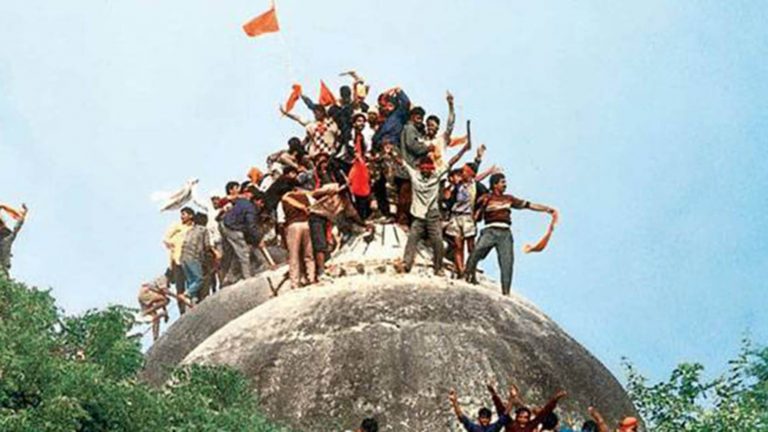
Next morning we were woken and told today’s the day. As we got ready and started walking with hundreds of volunteers, news came in that the Mosque has been taken down. Police were overrun and administration has collapsed. Stay where you are. We have distributed sweets and we celebrated. Mission accomplished! The town was reverberating with “Jai Shri Ram” and “Mandir Wahi Banayenge”! It was unbelievable.

We celebrated like crazy. And wanted to visit the site. But, we were told, by our leader who was with me right from the start till here, we should stay where we are. There is nothing to be done now. And the danger of a stampede is very high. Was there through the morning. At around 10 am took a train to Lucknow. Reached at 2.05 PM. A train was getting ready to move at 2.10. I asked a Coolie, “Kaha Jayegi?” (Where to). He replied “Madras”. I thought this must be going through Nagpur. I saw a man sitting inside. Went to him, and asked “Nagpur jyegi kya”. Came back the reply in Marathi “Aat madhe ye” (Come inside). I broke down in tears!

Sometime next day in the afternoon, reached home.

जय श्रीराम

PM Modi visits Hanumangrahi temple, lays silver brick at Ram Janmabhoomi site to begin construction of Ram Mandir in Ayodhya

0

On Wednesday, Prime Minister Narendra Modi landed in the ancient holy city of Ayodhya to participate in the historic Bhoomi Pujan ceremony for the construction of Ram Mandir.

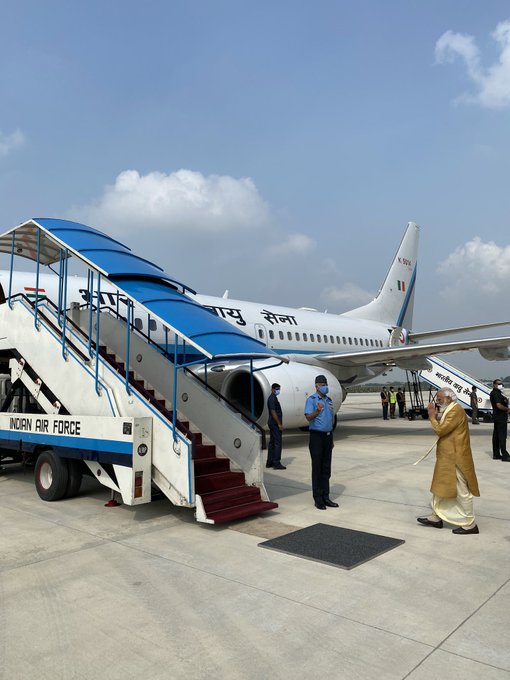
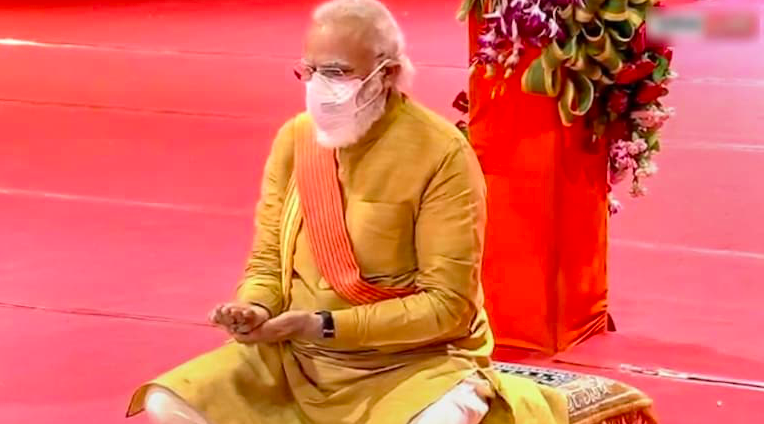
The Prime Minister had left Delhi in the morning in an Indian Air Force (IAF) plane and landed in the Uttar Pradesh capital city Lucknow from where he boarded a helicopter to travel to Ayodhya. In a gold silk kurta and white dhoti, Prime Minister Modi landed in the historic city in a helicopter for the first time in 29 years.

The Prime Minister first offered prayers at the 10th century Hanumangarhi temple – a shrine to Lord Hanuman. PM Modi was presented with a headgear, silver ‘mukut’ and a stole by Sri Gaddinsheen Premdas Maharaj, head priest of the ancient Hanuman Garhi Temple.

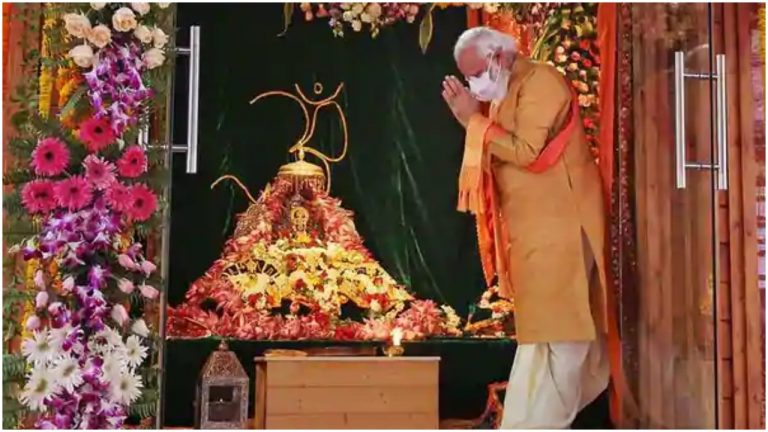
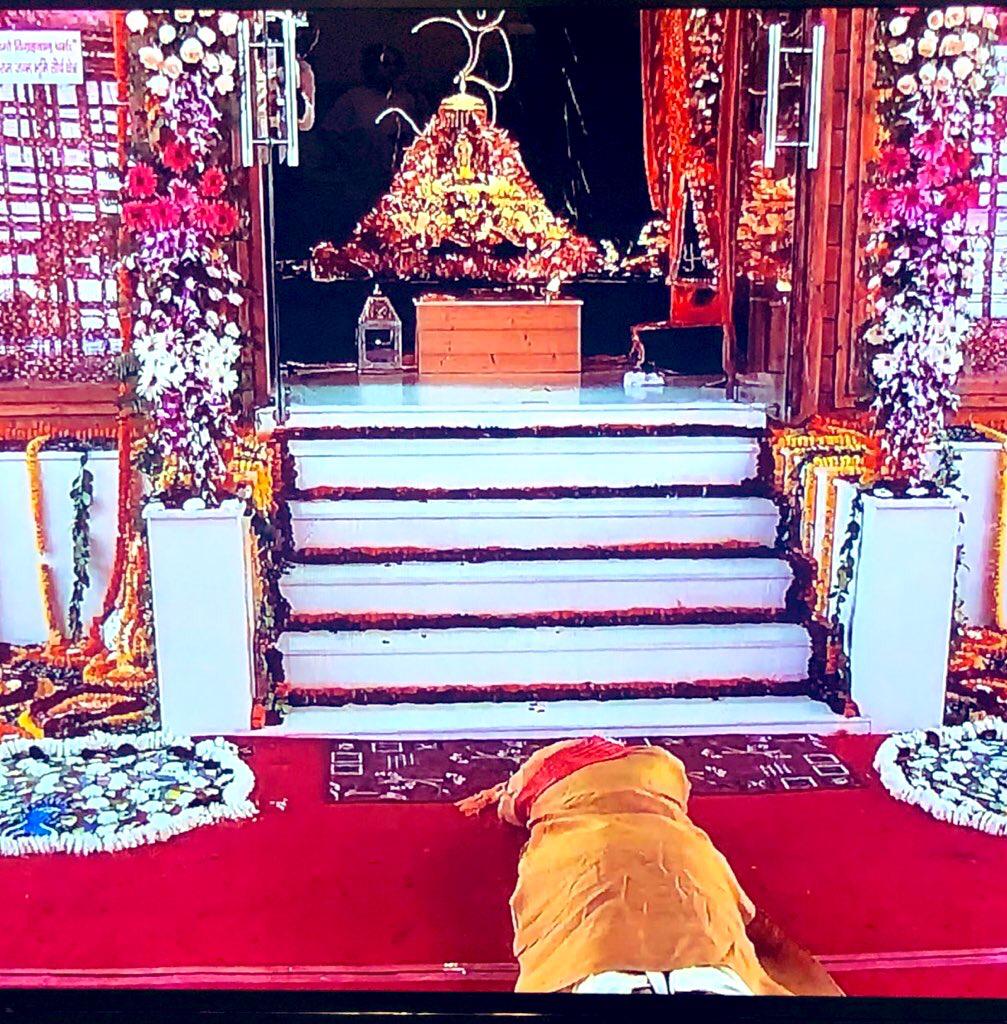
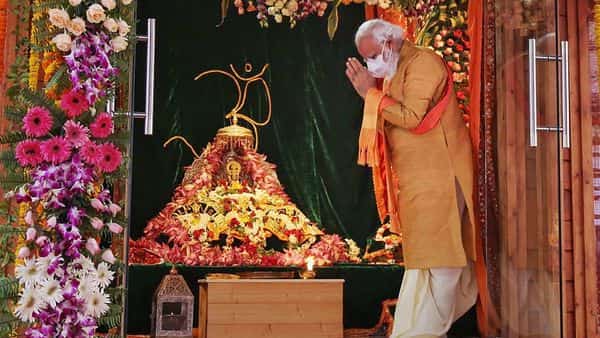
From Hanumangarhi temple, Prime Minister Modi visited the Ram Lalla or the infant Lord Ram to offer prayers and performed ‘sashtang pranam’ at Ram Janmabhoomi.

PM Modi also participated in a tree plantation programme inside the premises and planted a Parijat sapling, considered a divine plant, ahead of foundation stone-laying of Ram Mandir.

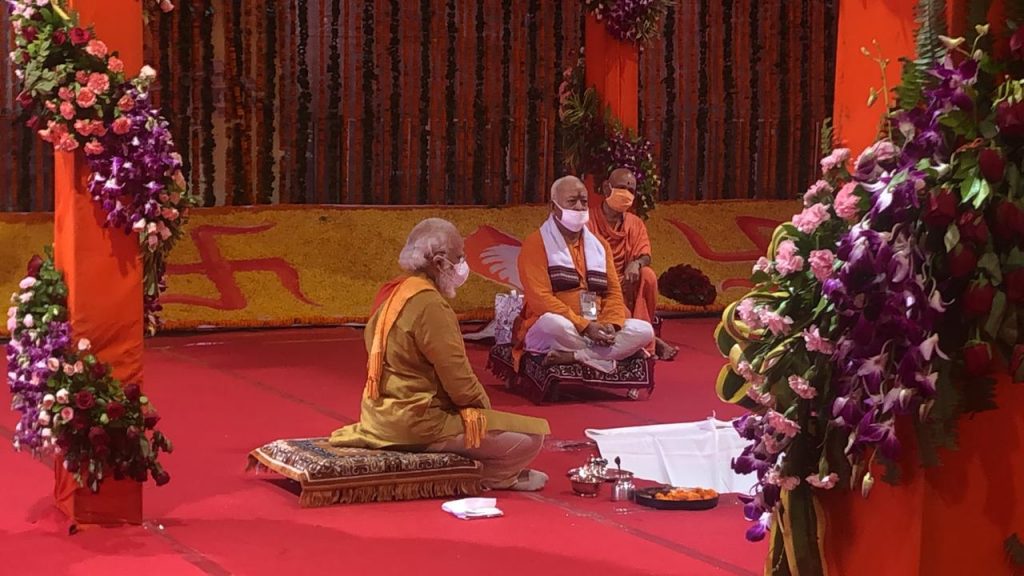
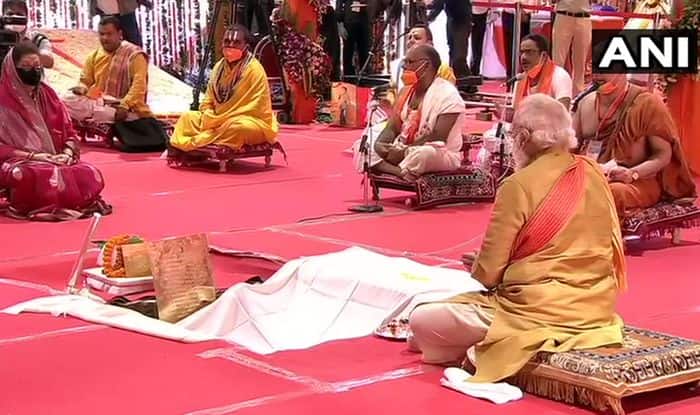
Later, Prime Minister Modi visited the Ram Mandir site to perform Bhoomi Pujan ceremony. He was accompanied by RSS chief Mohan Bhagwat, Uttar Pradesh governor Anandiben Patel and others.

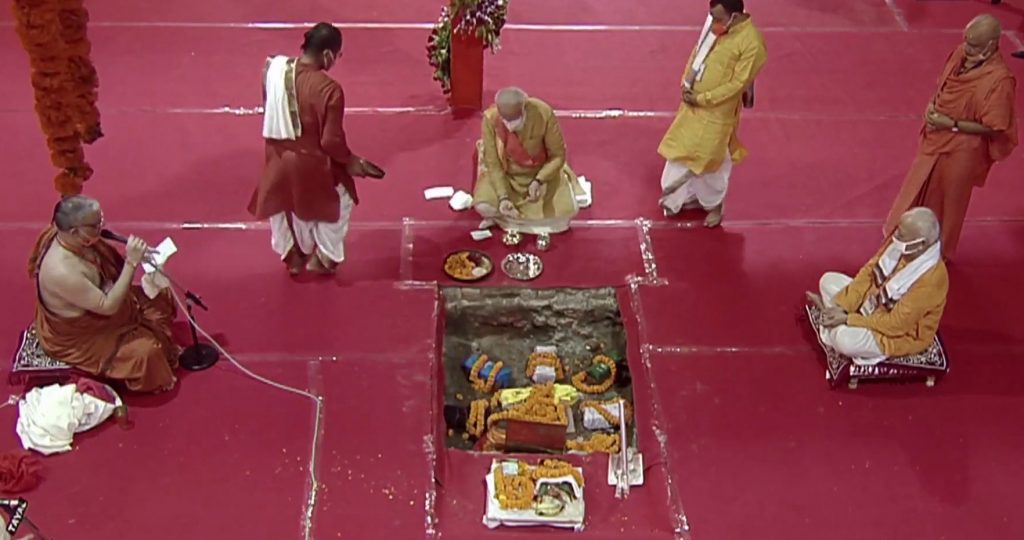
During the Bhoomi Pujan ceremony, Prime Minister Narendra Modi laid a 40-kg silver brick to symbolise the beginning of construction of Ram Mandir. As per the priest at Ram temple Bhoomi Pujan, nine bricks were placed at the site of the ceremony, which was sent by the devotees of Lord Ram from around the world in 1989.

“There are 2 lakh 75 thousand such bricks out of which 100 bricks with ‘Jai Shri Ram’ engraving have been taken,” the priest said during the ceremony.

Prime Minister Narendra Modi also unveiled the plaque of Ram Mandir at Ayodhya. President of Ram Mandir Trust Mahant Nitya Gopal Das, Uttar Pradesh CM Yogi Adityanath, Governor Anandiben Patel and RSS Chief Mohan Bhagwat were also present alongside Prime Minister Modi him.

After performing the ceremony, the Prime Minister also released a commemorative postage stamp on the ‘Shree Ram Janmabhoomi Mandir’ and addressed the nation on the historic occasion.

PM Modi is expected to be in the city of Ayodhya till Wednesday evening, which has been decked with over 1,50,000 lamps to celebrate the historic event.

PM Narendra Modi and the journey from Ayodhya Andolan to Ram Mandir Bhoomi Pujan: Then and now

When PM Narendra Modi took charge of the government at the centre, one thing must be on his mind and that it the construction of Ram Mandir. Bharatiya Janata Party’s manifesto has always emphasized on the construction of the Mandir, but as the case was in court, there was nothing much that could have been done. There is no denying that PM Modi does not shy away from wearing his identity as a Hindu and often flaunt ethnic attire with Tilak on his forehead and Rudraksha Mala in his neck.

His role in Ayodhya Andolan has come to life in the last few days after several photos and stories emerged on social media. Here is a look on Modi’s journey from Ayodhya Andolan to Bhoomi Pujan in Pictures. Before we begin, here is a video of PM Modi chanting “Jai Jai Shri Ram” during his election rally in Ayodhya ahead of 2019 elections.

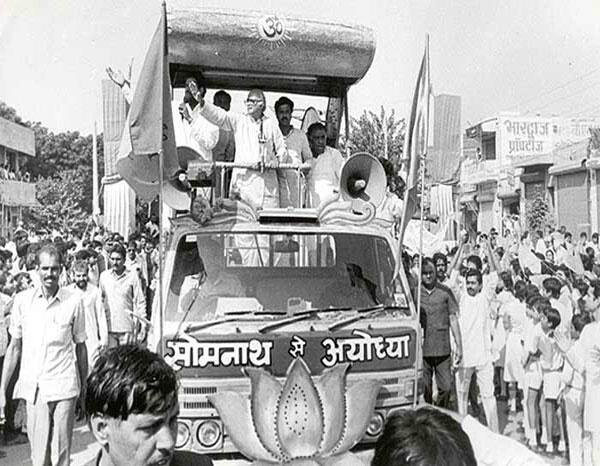
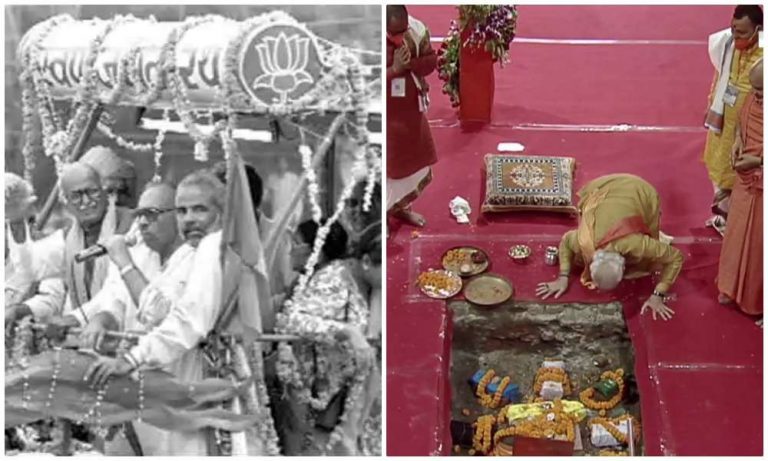
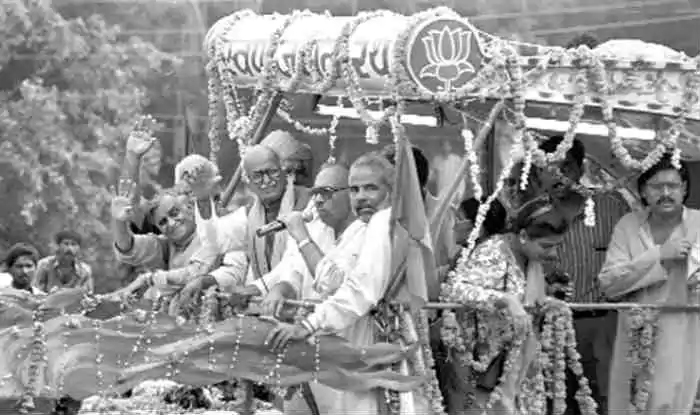
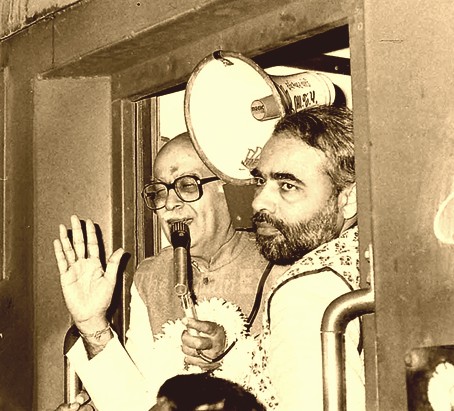
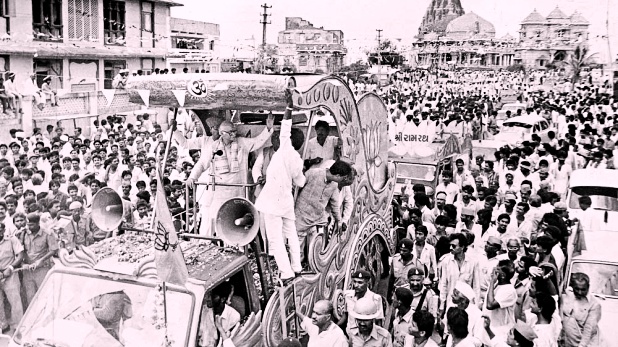
PM Modi was an important part of the Rath Yatra organized by LK Advani in 90s before demolition of disputed structure.

PM Modi was often seen as Saarthi for LK Advani during Rath Yatra (Source: Twitter)

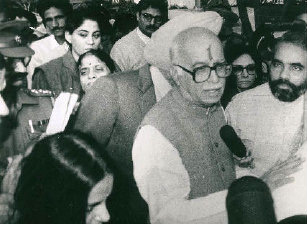
He remained on the side of LK Advani supporting him during his speeches.

PM Modi with LK Advani during his election speech (Source: Twitter)

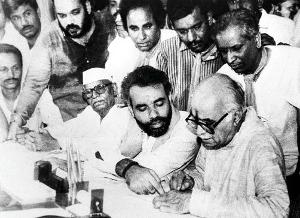
PM Modi and HM Amit Shah were present during LK Advani’s nomination filing as well.

In the photo PM Modi can be seen sitting next to LK Advani and Amit Shah is visible in the background. (Source: Twitter)
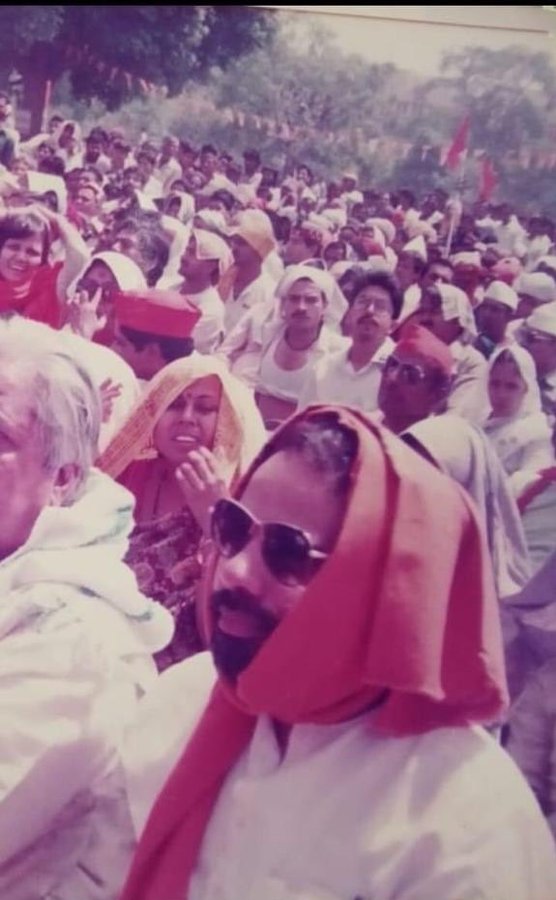
PM Modi with a crowd of people as volunteer at a VHP rally at the Delhi Boat Club (Source: Twitter)
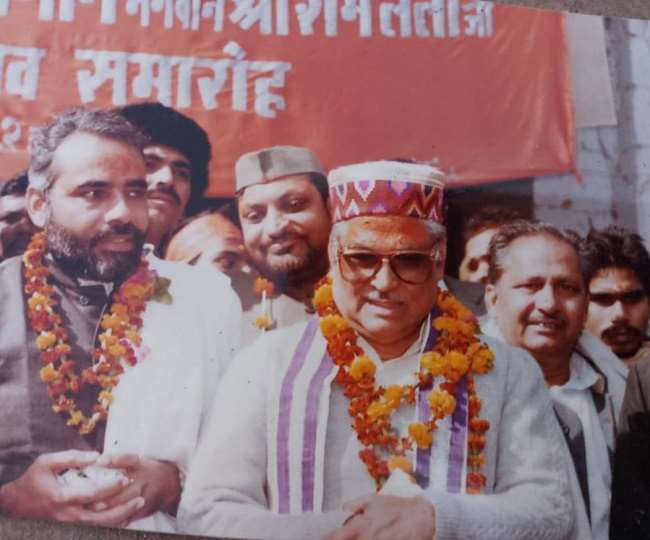
PM Modi with Murli Manohar Joshi (Source: Twitter)

When PM Modi was with Dr Murli Manohar Joshi in Ayodhya in 1991, veteran photographer Mahendra Tripathi clicked his photograph and asked him when will he come back to Ayodhya. As per Times of India report, he replied, “I will come back when the construction of Ram Mandir will begin.”

And so it did. On 5th August 2020, the Bhoomi Pujan of the Ram Mandir was done by Prime Minister Narendra Modi.

PM Modi leaving for Ayodhya
PM Modi bowing down to Ram Lalla
PM Modi conducting the Bhoomi Pujan
PM Modi performs Bhoomi Pujan for Ram Mandir in Ayodhya

Today the chants of Jai Siya Ram echoed throughout the world as dream of crores of Hindus who have fought for the battle for over five centuries is finally coming true.

India’s Functioning Systems Seen through Cracks in NYT Propagandist-in-Chief Basharat Peer’s narrative

0

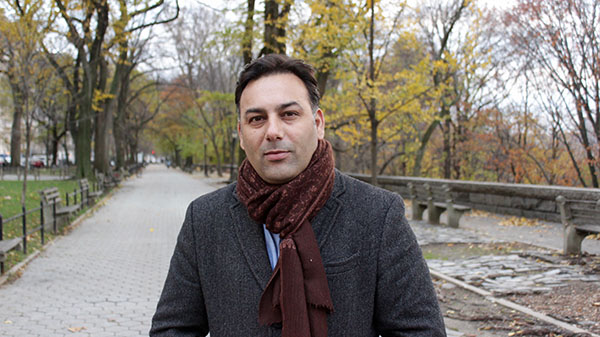
When the truth is sacrificed for propaganda, all we see is lopsided stories and victim narrative with a hidden political message. Basharat Peer, in his latest piece in New York Times, precisely tried that. But he probably didn’t realize the flaws in his own writing.

Peer picks up a tragic incident of two migrant friends Amrit and Saiyub who travelled from Surat to Devari in Uttar Pradesh due to lockdown. Amrit died en route unfortunately and Saiyub helped him all through. Doesn’t it sound like a perfect Hindu-Muslim harmony against a “Hindu nationalist” Narendra Modi? Well, we thought the article focuses on the sad death. But it turns out the article stoops low enough to use a tragic death as a political tool.

Peer Only Sees Politics Everywhere

Deeply moved by the great friendship of Amrit and Saiyub, Basharat Peer takes it onto himself to visit Devari and talk to Saiyub about the entire episode. Peer now reaches Ayodhya enroute to Devari. Of course, Ayodhya had to feature, right?

As the highway crossed a massive bridge over the Sarayu River and past the paddy-green fields and stacks of dried dung cakes, I could see the outlines of the temple town of Ayodhya, where in 1992 a Hindu mob destroyed a 16th-century mosque because they believed it had been built on the exact birthplace of Rama, the Hindu deity.”

No mention of the fact that there is clear evidence of a temple at the disputed site, based on which the Supreme Court decided the case. Obviously, if he mentioned that, India wouldn’t look ‘majoritarian’, would it?

On The Tragic Death

Basharat Peer now starts illustrating the story of the unfortunate death of Amrit. But while doing that, there are some things that balanced reader can easily glean. After the lockdown on 25th March, the workers in Surat including Amrit and Saiyub were told work won’t resume till lockdown lifts. It was a challenging situation. But what did the factory owners in Surat do?

“Saiyub’s boss gave everyone rice and lentils and about 1,500 rupees. Amrit’s boss offered his workers rice and lentils, but no cash.” 

In his address to the nation on 23rd March while announcing the lockdown, PM Modi had specifically asked employers to help their employees in this tough time.

Almost a month and a half after the lockdown was announced, Amrit and Saiyub decided to travel back to Devari in May 2020. Since railway tickets were overbooked, they finally managed a truck which would take them back to Devari. But when truck was in Kolaras in Madhya Pradesh, Amrit felt sick. He got cold and fever. This made other passengers fearful that Amrit had coronavirus and he would transmit it to others. They made both of them alight in the middle of the road.

A poor Muslim and a poor Dalit, stranded in the middle of a backward region. In the typical NYT liberal’s worldview, no help should have arrived at all. But here’s what happened. Peer’s own article ends up telling what actually happened:

  • As they were lying on the road “A politician arrived with a few cars and distributed food and water.” 
  • Saiyub requested for an ambulance for Amrit. “An ambulance arrived and drove them to a small hospital in Kolaras. A doctor found that Amrit had low blood sugar and a high temperature and feared he had suffered a heat stroke”
  • Amrit got primary treatment at the local hospital. “(doctor) tried oral rehydration therapy to revive Amrit, whose consciousness was fading. A few hours later, Amrit was transferred to a better-equipped hospital in Shivpuri, a town about 15 miles away, where doctors diagnosed severe dehydration and moved him into the intensive care unit.”

Kolaras and Shivpuri are backward regions. Still, an ambulance arrived and shifted them to a better hospital in Shivpuri which had ICU facilities. Amrit despite being in hospital was critical. Yet Peer himself tells us about the kind of treatment that was available in a backward region. “The doctors tested the two friends for coronavirus, sent their samples to a laboratory and put Amrit on a ventilator”.

Tragically, Amrit died, despite the efforts that were put into treating him as Peer’s own piece says. His coronavirus test was negative. He died due to dehydration. The fact is that had it not been government hospitals and the help, Amrit would have been even more critical lying on the highway. Peer doesn’t feel it necessary to highlight that.

Government Help during Lockdown

Now started the daunting task of taking Amrit’s body back to Devari from Shivpuri. Basharat Peer says, “He (Saiyub) received several calls from officials who administered Shivpuri, the district where the hospital was located.” How can this show government apathy when officials contacted Saiyub? Isn’t it an indication of the dynamic nature of handling of the pandemic?

“In the evening, after a few hours of paperwork, Saiyub was allowed to return home with Amrit’s body. An ambulance was ready”, says Basharat Peer. In the middle of a lockdown, an ambulance was readied to take Amrit’s body home for last respects.

Impact of Economic Relief Package Seen

Peer finally reaches Devari where he meets Saiyub and the family of Amrit. He hears how Amrit was buried and how Amrit’s family was devastated by his death. Saiyub and many others were jobless in their village.

Talking to Amrit’s father, Peer gets to know that “Since the pandemic began, (Amrit’s poor father) has found three days of work overseeing laborers cleaning an irrigation canal in the village, making 202 rupees, or about $2.70, a day” 

Peer probably doesn’t realize he is talking of MGNREGA. In the declaration of PM Garib Kalyan Package and the Aatma Nirbhar Bharat Package, the government laid focus on MGNREGA as a provider of employment in rural areas for migrants who went back. It increased the daily wage from Rs 182 to Rs 202.

Talking to Saiyub, Peer asks him about his job in Surat. “The factory owner in Surat had called the day before. Some of the workers were already back. He wanted Saiyub to return”  Unlock 1 and 2 were at work as economic activity resumed and factory owners are keen on having workers back.

Peer, aiming at misery tourism, ends up portraying how government programmes are reaching intended beneficiaries and things are slowly creeping back to normal.

Political Rants In, Facts Out

Peer starts his rant by first invoking the caste and religious identities. Identifying Amrit as a Dalit and Saiyub as a Muslim, Peer tries to convince the reader how Dalit-Muslim unity is great, only to hide the fact that Dalits have suffered the worst of Islamist violence.

Not stopping there, Peer feels the need to tell the reader who the Dalits are. “…Dalit, a term for those once known as “untouchables,” people who have suffered the greatest violence and discrimination under the centuries-old Hindu caste system.”

What Peer does not mention is that India has taken steps like reservation and Atrocities Act to make efforts to substantially reduce the injustice against Dalits. Of course, not everything is perfect, but shouldn’t these be mentioned?

Drifting away from the main issue of death of the worker, Peer forced in Ayodhya and now also forces in a biased portrayal of Gujarat. After all, Saiyub used to work in Surat with his friend Amrit, how can Peer stop from writing a word or two about Gujarat?

On his arrival in Surat, Saiyub had some apprehensions about being Muslim and working in Gujarat, Mr. Modi’s home state and the strongest bastion of Hindu nationalism.” 

But Peer’s propaganda flops when he hears the reply of Saiyub. “Nobody bothered me,” he said. “I did my job. I got paid.” What does this tell us about the ‘strongest bastion of Hindu nationalism’?

While speaking about India’s healthcare, Peer claims “Treatment costs because of an illness push more than 63 million Indians into poverty every year.” He even claims health treatment is linked to domicile of the individual. And what is the source of this information? Peer uses Draft National Health Policy of 2015! Perhaps Peer forgets that in 2018, India launched Ayushman Bharat, world’s largest healthcare program progressively looking to cover about 50 crore people, mostly poor and vulnerable. It has enabled free healthcare for India’s poor, stopping their lapse into abject poverty.

But who cares about facts when propaganda reigns? The New York Times has been famous for such hateful coverage of India. It is the same newspaper that mocked India’s space achievements with the infamously racist ‘cow cartoon’. However, even the concerted propaganda of Peer and NYT fall flat as, through the cracks of their story, the India that Peer and NYT seek to hide is seen.

Read about Raja Suhaldev, who was mentioned by PM Modi in his speech after Ram Mandir Bhoomi Pujan in Ayodhya

During his speech at the Ram Mandir Bhoomi Pujan ceremony, Prime Minister Narendra Modi made a reference to Raja Suhaldev. Following the completion of the Bhoomi Pujan ceremony, Chief Minister Yogi Adityanath, RSS Chief Mohan Bhagwat and Prime Minister Modi delivered speeches on the occasion.

Narendra Modi said that the manner in which the poor and people from backward classes came to Raja Suhaldev’s support in repelling foreign invaders, in a similar manner the Bhavya Ram Mandir will be constructed at Ayodhya with support from people of the entire country.

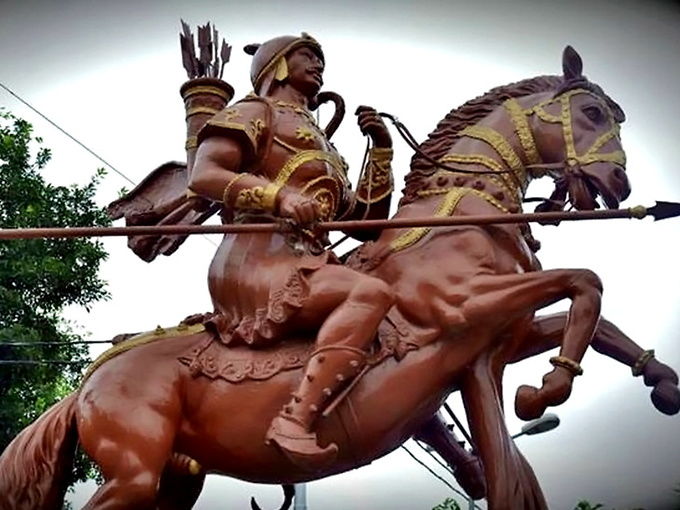
Very little is known about Raja Suhaldev today. He was an 11th Century ruler from Pasi community of Shrasvati, a kingdom which was located in present-day Bahraich district of Uttar Pradesh. He is said to have ruled the state from 1027 to 1077.

It is generally agreed that Raja Suhaldev had defeated Ghazi Salar Masud in the Battle of Bahraich in 1034 and killed the invader. Earlier, the local Raja of Bahraich had formed a confederation of Hindus to combat Salar Masud, however, the Islamic invader managed to defeat them. Ghazi Salar Masud was the nephew of barbaric invader Mahmud of Ghazni.

Masud had managed to conquer Multan, Delhi, Meerut and marched forward. Along the way, the Islamic invader displayed his fanaticism and is said to have destroyed numerous Hindu Temples and Muths. His advent was halted by Raja Suhaldev.

After several kings were defeated by him, some other kings from Meerut, Badayun, Kannauj etc decided to ally with instead of fighting against his mighty army. After conquering these places, Masud had planned to invade Ayodhya, a sacred city for Hindus. But to reach Ayodhya, his army had to cross Bahraich first, place under Shrasvati. But Raja Suhaldev became aware of Masud’s plans, and he prepared a counter-attack. He talked to kings of the neighbouring states, and they together formed a large defence force against the invader.

Although the Suhaldev’s army had to face defeat initially, the king motivated the soldiers to fight back with full force, saying that not a single foe should not return alive. After days of intense battle in 1034, Raja Suhaldev was able to trap Salar Masud, and the Muslim invader was killed in the battle. According to legends, none of the 1.5 lakh soldiers in Masud’s army survived the battle.

Raja Suhaldev is regarded as a Gaurakshak, patron of Saints and patron of Hindus. Amish Tripathi’s book on the legendary king calls him a “charismatic leader”, a “fierce rebel” and an “inclusive patriot”. While there are numerous Hindus communities that lay a claim to him, he is believed to be from the Pasi community, which belongs to the Scheduled Castes.

Prime Minister Modi and other leaders of the Bharatiya Janata Party have paid homage to the legendary King in the past as well. In 2016, then BJP President Amit Shah inaugurated a statue to the iconic King and launched a book on him. Shah described him as a “Rashtriya Nayak” whose accomplishment ought to serve as an inspiration to the youth of today.

Shah had said, “Brave King Suheldev is not forgotten by the people of this country even after 1,000 years. People who don’t remember their brave ancestors cannot make history. Only those who carry on with their fight can make history.” Prime Minister Modi released a commemorative postage stamp on Raja Suhaldev two years later.

The Hindu King was also mentioned by Prime Minister Modi in an Independence Day Speech and again, today, he made a reference to the Monarch during his speech at the Ram Mandir Janmabhoomi ceremony. The King who belonged to the Dalit community defeated the Islamic invader and helped protect the Hindu Civilization from further plunder.

Shekhar Gupta remembers how Gujarat edition of India Today had to be shut down after their Hindu-shaming coverage of Ayodhya movement

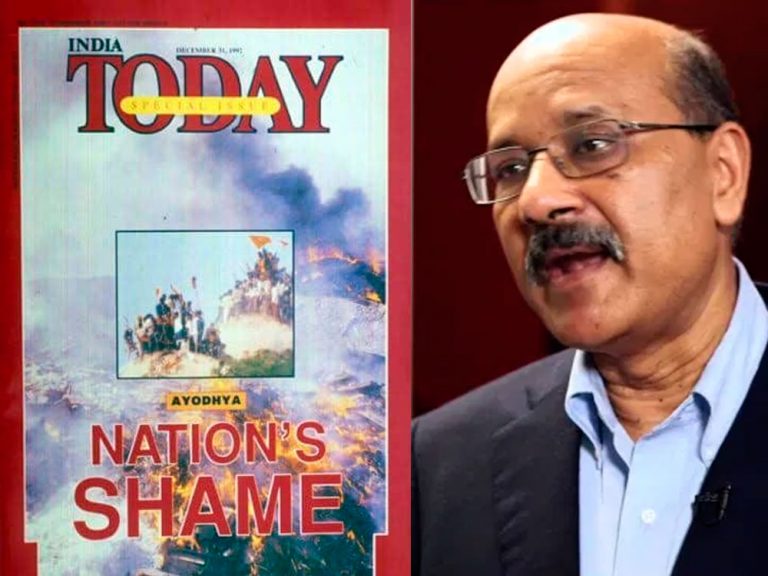
As Ram Mandir Bhoomi Pujan is happening, it has brought out old wounds of those who opposed the Ayodhya Andolan and demolition of the disputed structure. Shekhar Gupta, who now runs The Print, has shared some information on how their coverage of the demolition and Hindu-shaming cost them. Gupta was the editor of Gujarati edition of India Today back in 1992.

In a tweet, Sheela Bhatt, the then-senior editor of the magazine, said that in December 1992, the magazine ran the cover story “Rastra nu Kalank” (Nation’s Shame), calling the demolition of the disputed structure at Ram Janmabhoomi as a shame, a blot on the nation. She added that the magazine had to close down as people of Gujarat retaliated the coverage.

Shekhar Gupta quoted Bhatt’s tweet and wrote that the Gujarat Edition of India Today was launched in October 1992. In six weeks the readership rose to 75,000 copies which was a huge deal at that time. However, when they published the report with the said headline, shaming the people and calling the demolition a national shame, their office was filled with an avalanche of protest letters.

Gupta further stated that in the next four weeks, their readership fell to mere 25,000 and eventually they had to close the Gujarat Edition. He also mentioned that their marketing head at that time predicted that the Gujarat edition would die soon after seeing the response to the coverage.

Ram Mandir Bhoomi Pujan

Bhoomi Pujan for Bhavya Ram Mandir has been completed in the presence of PM Narendra Modi, CM Yogi Adityanath, RSS head Mohan Bhagwat and many other leaders and saints on 5th August 2020. The construction will take around 3.5 years to complete. The historic event marked the culmination of the centuries-old struggle for Hindus to claim the birthplace of Lord Ram, one of the most sacred sites for the Hindu faith.

Ram Janmabhoomi: An account of Hindu efforts to reclaim the sacred land and a tribute to the centuries old struggle

Ramayana narrates the story of lord Ram, the seventh incarnation of Lord Vishnu. It is believed He had taken birth as a human to restore balance in this world. Ram was a descendent of Ikshvaku, a legendary king of ancient India. The dynasty originates from Shraddhadeva Manu, the seventh of 14 Manus of current aeon. According to Matsya Purana, Shraddhadeva Manu had saved the lives of Saptarishis during the great deluge.

He was the son of Vivasvan hence is also called Vaivasvata Manu. One of the ten sons of Shraddhadeva Manu was Ikshvaku, who was the progenitor of the solar dynasty or Suryavansh. The region of Koshala (modern day Awadh in the Indian state of UP), was their kingdom. Koshala had three major cities, Saket, Shravasti (birthplace of Maharaja Suheldev) and Ayodhya.

According to Hindu religious text “Garuda Purana”, Ayodhya is also considered as one of the seven sacred places to attain “Moksha” – the Indian concept of liberation of the soul from the cycle of birth & death. It is also the very place where billions of Sanatanis believe lord Ram was born. So, Ayodhya is considered to be one of the most sacred places as the lord Himself had taken birth in the sacred city.

Historical References

The great Sanskrit poet Kalidas in his immortal work “Raghuvamsa” mentions different rituals related to Lord Ram in Ayodha during 600 B.C. Ram is considered to be one of the 63 illustrious people known as Salakapurusha. Ram is considered to be a Bodhisattva in Buddhist literature in Dashrath Jatak, Anamak Jatak etc. Ramayan is mentioned in at least four places in the Mahabharata.

Innumerable places, temples have been associated with Ramayana across the subcontinent, since time immemorial. There are hundreds of versions of Ramayana within India and many more like Turkistan’s khotani Ramayan, Tibetian Ramayan, Indonesian Kakben Ramayan, Thailand’s Ramkiyen, etc all celebrate the story of lord Ram in much grandeur and passion.

Around 11th century A.D. many temples of Lord Ram were build up by the King of Gahadavala dynasty. The famous Historian and Indologist Hans T. Bakker clearly mentioned the existence of many temples including a Vishnu temple in the birthplace of Lord Ram in his book “Ayodhya: A Hindu Jerusalem. Besides Parabhram Shiva temple in Java and ancient Angkor Wat temple in Cambodia has Ramayan engraved on it. Every ancient or medieval temple have references to Ramayan curved on it’s walls.

Destruction of Temples: Mughal period

Many researchers and Hindu leaders claimed at least sixty thousand temples were destroyed during the Mughal period (1526-1857) in India. However the numbers are sure to rise if the earliest Islamic invaders are considered starting from Arab invasion of Sindh in the 7th century followed by Mohammed Bin Qasem, Mahmud Ghazni, Salar Masood, Muhammad Ghori or Afghan, Turkik invasions.

Though it is claimed the disputed structure was constructed after demolishing the existing Ram temple by Mir Baki following orders of Babar, the Mughal invader. In 1574 the Vaishnav saint Tulsidas in his writing “Ramcharitmanas” and in 1598 Abu al-Fazal also in his third volume of ‘Akbarnama ” mentioned the Lord Ram birthday festival in Ayodhya. They did not mention any existence of a mosque.

The first existence of a mosque was mentioned in a book written by the granddaughter of Aurangzeb and she also mentioned demolition of temples and desecration of other sacred Hindu cities like Varanasi and Mathura. Similar observations were also mentioned by many foreign travellers like William Finch and Joseph Tiefenthaller.

Constant struggle

In 1717, Jaisingh II purchased lands and established Jaisnighpura in all Hindu religious centres across North India including Ayodhya. This provided “safe space” for the Sanatanis where they could perform their daily rituals without fear or intimidation. There is recorded history that Guru Govind Singh ji came to defend the temple and fought alongside Sant Vaishnav Das ji against the iconoclastic forces of Islam.

Since the temple complex was occupied and desecrated by Mir Baki, Babur’s general, Hindus have waged constant battle to reclaim the land. The history of Mewar by James Todd mentions multiple attempts by descendants of Rana Sangha to reclaim the sacred land. ‘Sanatani’ people from across the country have waged multiple battles with a fair share of success and failure.

The only example of an inspired human effort of such a large scale to reclaim something held so sacred can only be found in the history of Crusades. An FIR was filed by the police official of Awadh on 28th November 1858 mentioned that about 25 Nihang Sikhs entered the Babri structure, conducted ‘HawanPujan’ for weeks. Using charcoal, they had also graffitied the inner walls with the name of Ram.

This shows the name of Ram is held sacred by the different Dharmic traditions born in India. In 1885 Hindus appeal for construction of Ram Temple was rejected by Court to favour status quo condition.

Post Independent Movement

In 1949, Sant Digvijay Nath of Gorakhnath Math organised a 9-day continuous recitation of ‘Ramcharit Manas’ and at the end of which the Hindu activists broke into the mosque and placed idols of Rama and Sita inside. In the 1980s Vishwa Hindu Parishad (VHP) started a campaign to build Ram temple in Ayodhya.

In 1984 the president of VHP Ashok Singhal initiated a nationwide movement. As a result, PM of that time Shri Rajiv Gandhi ordered the opening of the mosque door for Hindus to perform their rituals.

BJP: the political face of the movement

In 1990, Iron Man of BJP Shri LK Advani started Rath Yatra from Somnath with full support from Vajpayeeji. Present PM Narendra Modi was the organizer in charge of that Rath Yatra. Dr. Murli Manohar Joshi, Sadhvi Ritambhara, Uma Bharati were some of the other heavyweight leaders who actively shaped up the last struggle for reclaiming the sacred land.

Demolition of Babri structure

6th Dec 1992: Thousands of ‘Kar Sevaks’ of VHP and allied organisations were accused of demolishing the mosque. Advani Ji famously roared “30 Oct ko waha pahuch kar kar seva karenge aur Mandir Wahi Banayenge. Usko kaun rokega, kaunsi sarkar rokne wali hai ” (We will reach there on oct 30th for KarSeva and we will build Mandir on the sacred space. Who can stop that? Which government can prohibit that?)

BJP stalwart Vajpayee Ji gave an iconic speech when he said “zameen ko samtal karna padega” (the land has to be flattened) for doing Bhajan, kirtan. Kalyan Singh Ji, the then UP Chief Minister refused to fire bullets on ‘Kar Sevaks’ and later resigned. He will always be remembered for his decision which saved thousands of lives.

The iconic leader of this movement was Ashok Singhal Ji who had a very simple opinion. He said we are not against Islam or Masjids, you are welcome to make your player hall at a place of your choice; but, it cannot happen in the birthplaces of Ram (Ayodhya), Krishna (Mathura) or one of the 12 original Jyotirlingas (Varanasi), the Tridev (3 great lords) of Hindu Pantheon.

Some observers may be of the opinion that it was a gender specific movement where only “men” participated. It may be a news for them that Sadhvi Ritambhara, Uma Bharti ji inspired the whole generation of Kar Sevaks. Sadhvi Ritambhara insisted “Mandir Wahi Banayenge” (We will construct the temple on the very spot) while Uma Bharti ji bellowed “unki goliya kam padh jaengi lekin sina kam nehi padenge” (they will run out of bullets but we will not run out of people to face them).

Liberhan Commission

PM Narasimha Rao ordered an investigation and formed the Liberhan Commission under the Justice Liberhan. Hindu and Muslim groups filed petition in Court for the land. The Archaeological Survey of India (ASI) studied in depth in order of the High Court and concluded the existence of a large temple under the Babri mosque. To maintain status quo Allahabad High court ordered to distribute the disputed land between Hindu and Muslim group.

Petition to Supreme Court

Challenging Allahabad High Court’s verdict, all parties appealed to the Supreme Court. K Parasaran and Dr. Subhramanian Swamy are the most prominent faces who fought for Hindus’ demand of Ram temple. While Parasaran Ji was fighting on the technicalities of the case, Swami Ji, inspired by Periyava (the jagatguru of Kanchi Peeth) opened a new front that played a huge role in this case.

Swamiji appealed on the basis of fundamental right to worship at the stop where tradition tells us Shri Ram was born. And as it is well known that a mosque is a prayer hall which can be shifted according to convenience, it is very different from a temple. Sanatanis believe that post the elaborate process of “Pran-Pratishtha” a deity is invoked at a sacred spot and the God lives there.

And the devotees may only see the moorti (idol), but the God residing in it observes us. Hence it is a personal question of faith and according to the Supreme Court of India, faith is unquestionable. As ASI (Archeological Survey of India) under KK Muhammad ji provided proof of a pre-existing Hindu temple structure, it became obvious that the medieval structure was constructed by demolishing an older Hindu temple, a residence
of the residing deity and also, according to an interpretation of Islamic laws, no mosque can be erected by demolishing any other place of worship.

Final Verdict from the Supreme Court

6th August 2019: 5 judge constitution bench headed by CJI Ranjan Gogoi started final hearing. In the end, the disputed land was given to the Hindu party only for construction of temple and ordered the Government of India to provide alternative land to the Muslim for construction of mosque.

Back in the day when the ironman of BJP, Shri LK Advani ji had thundered that we will go to the very spot and construct a grand temple to Ram, no government, no individual can stop it, he was mocked and jeered by the self declared progressives, liberals and leftists. Now after all these days, Advani Ji has the last laugh.

Conclusion

As Swami Vivekananda said “I am proud to belong to a religion which has taught the world both tolerance and universal acceptance”. The World’s largest democracy again proves the realization of Swamiji. Almost 80% of the population patiently waited for seven decades after independence for their fundamental right to pray.

Such is the integrity of India and patience of Sanatanis. But the world usually interprets patience as cowardice. The construction of this Ram Temple is an assertion of the indigenous Hindu identity. The declaration to the world that we can be defeated only for a time being, but we will always be back to reclaim what is rightfully ours.

We are the most stubborn of all as time and again we have proved our mettle. Be it reconstructing Somnath Mandir, Puri Jagannath Mandir over and over again at the same spot or the Grand Ram temple now. We Indians have proved ourselves to be the rightful descendants of our ancestors who refused to succumb under constant barbaric Islamic onslaught during the middle ages.

Jai Shree Ram, Bharat Mata Ki Jai.

Rudra Prasanna Banerjee is a Genetics Researcher in University of Alberta in Canada and Rajarshi Mukherjee is a Community Medicine Expert in Alberta in Canada.


From ‘nothing new about Shilanyas’ to ‘I will not find Ram there’, Bhoomi Pujan ceremony of the Ram Mandir in Ayodhya triggers a meltdown for liberals

Amidst much fanfare, the Bhoomi pujan ceremony that marks the construction of Ram Mandir was performed in Ayodhya earlier today. PM Modi graced the occasion and participated in the ceremony before laying the first brick for the soon-to-be constructed Ram Mandir.

While most of the country rejoiced at the development, some individuals who identify themselves as ‘liberals’ were busy crying themselves hoarse that the construction of Ram Mandir in Ayodhya is a death knell to India’s secular credentials. ‘Liberals’ had a hard time comprehending the fact that Lord Ram will finally reside in his rightful abode and a Bhavya Ram Temple will be erected at the place. One of the reasons ‘liberals’ were also flustered with the construction of Ram Mandir in Ayodhya is because the development enjoyed the Supreme Court’s imprimatur.

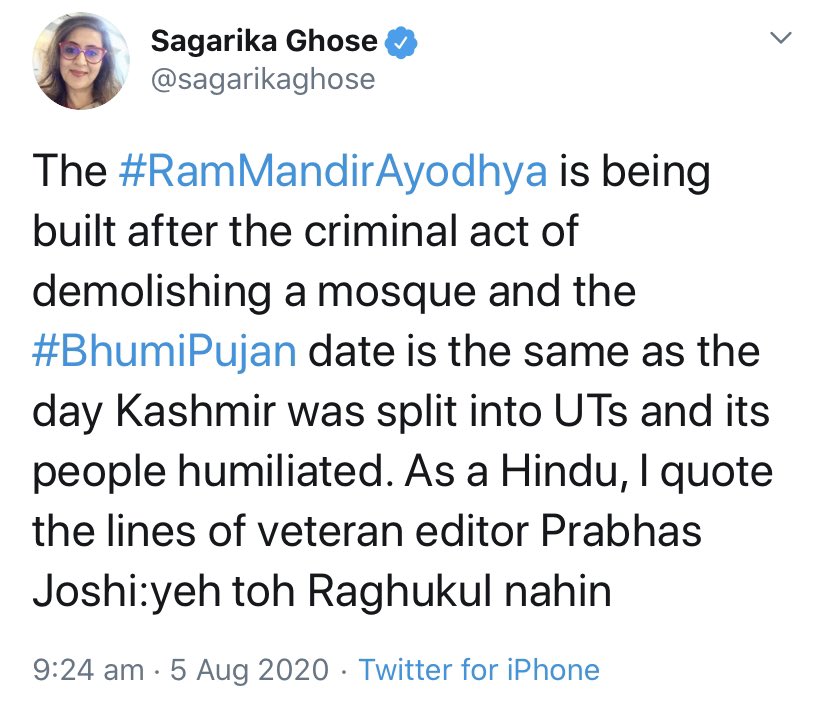
Sagarika Ghose, infamous for her legendary journalism of determining one’s religion by a mere cursory glance at his semen, couldn’t bring herself to the fact that the construction of Ram Mandir is now a reality. In addition, the divine providence of the auspicious Bhoomi pujan of the Ram Mandir coinciding with the first anniversary of the abrogation of Article 370 added insult to the injury for Ms Ghose who went on to quote Prabhas Joshi:”Yeh toh Raghukul nahin” to express her disapproval.

Sagarika Ghose flustered with the construction of Ram Temple

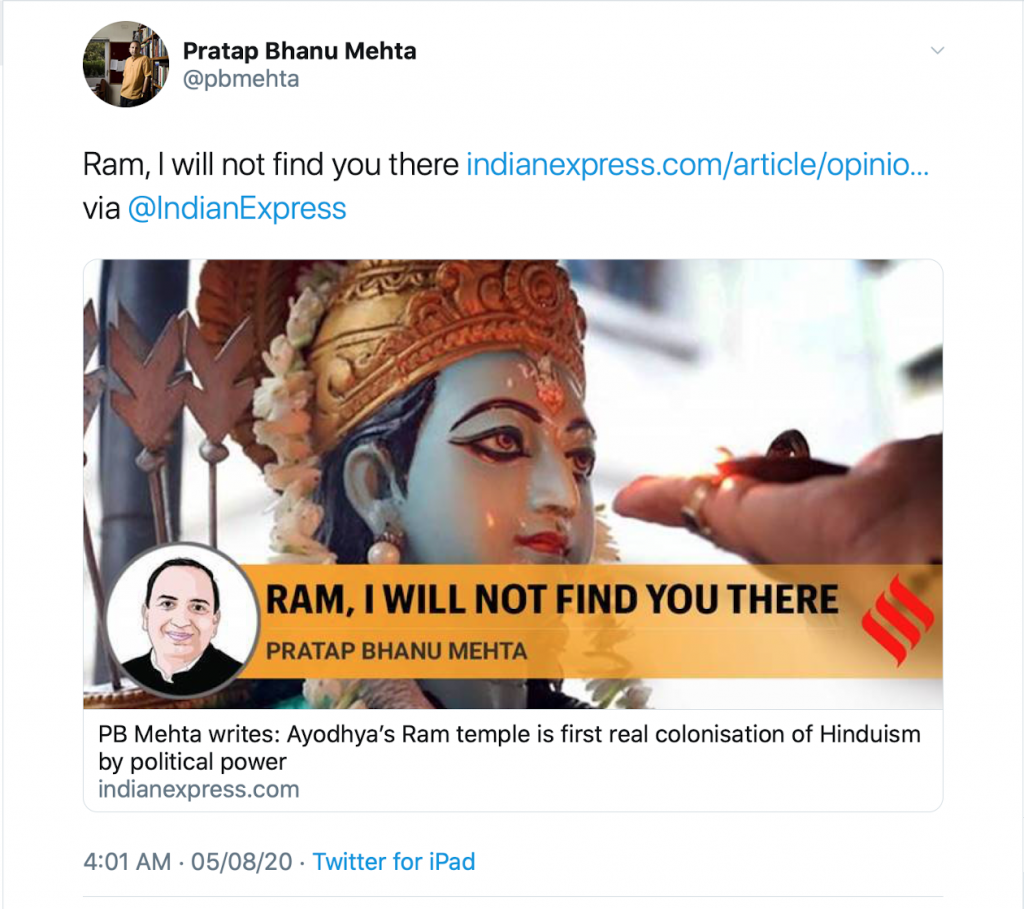
Pratap Bhanu Mehta, one of the luminaries of the left-leaning intelligentsia, had such an extended meltdown that Twitter’s 280 characters limit did not suffice his vitriol against the construction of Ram Temple. Instead, he penned an article in the Indian Express, postulating a preposterous theory that Ayodhya’s Ram Mandir is the “first colonisation of Hinduism by political power”.

Pratap Bhanu Mehta denigrates Ram Mandir as colonisation of political power

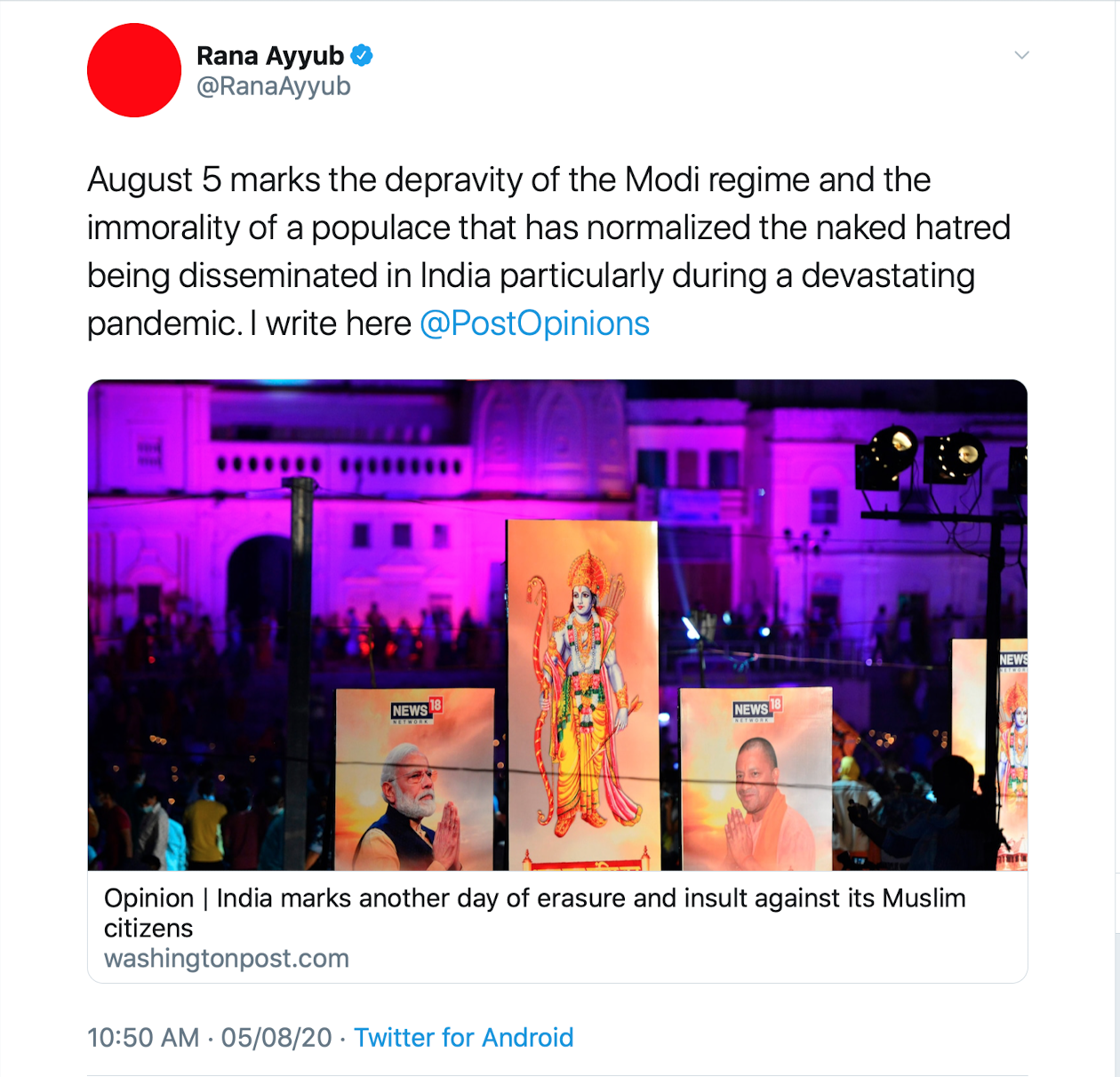
Controversial journalist Rana Ayyub, who is known for her unbridled hatred towards PM Narendra Modi and Amit Shah, couldn’t hide her frustration against the Modi government for fulfilling the dreams of millions of Hindus across the world. In an attempt to undermine the citizens of India, Rana, in her opinion column in the Washington Post, lamented that the populace of the country had normalised the dissemination of “naked hatred”.

Rana Ayyub wrote an article in Washington Post condemning the Bhoomi pujan ceremony of Ram Mandir

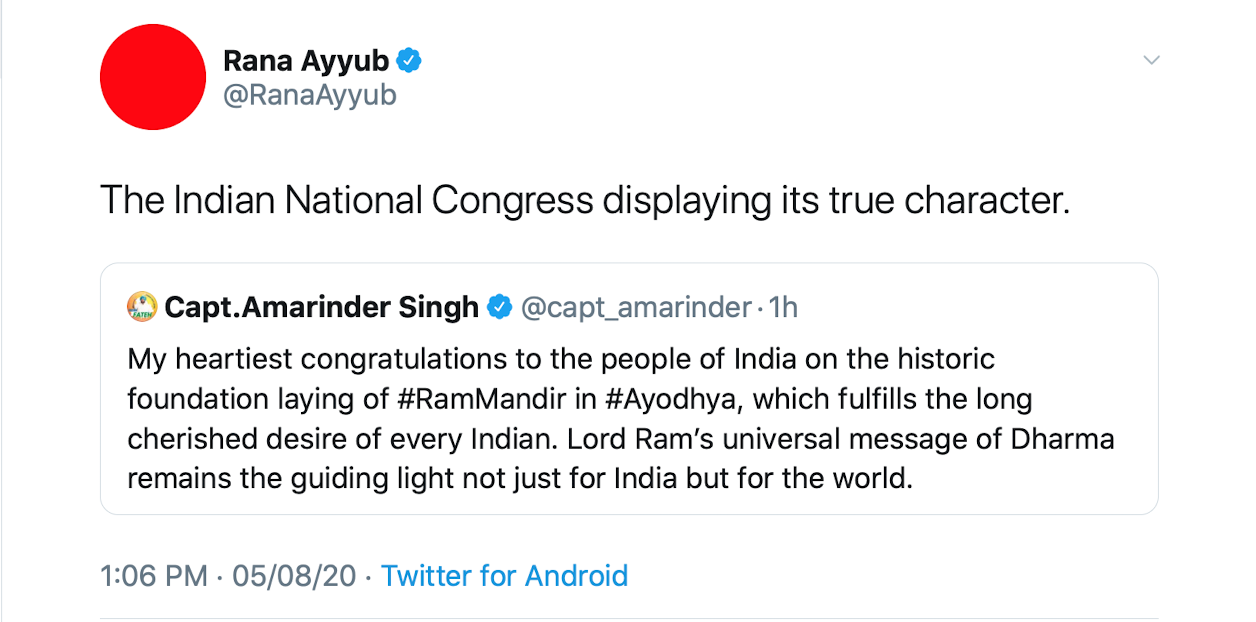
Rana Ayyub also appeared profoundly dismayed as the opposition parties celebrated the historic foundation laying ceremony of the Ram Mandir in Ayodhya. “The Indian National Congress displaying its true character,” Ayyub despondently noted as Capt Amarinder Singh posted a tweet congratulating Indians for their cherished dream of a Ram Temple in Ayodhya finally turning into reality.

Rana Ayyub expresses her displeasure with the Congress party

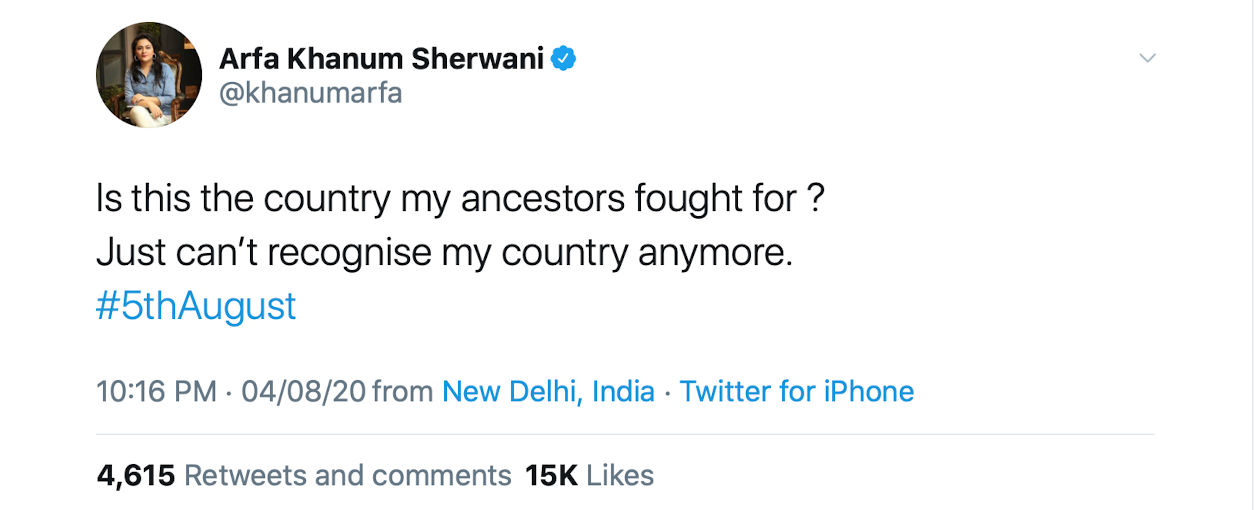
The Wire journalist, Arfa Khanum Sherwani, expressed her disappointment questioning if this was the country her ancestors allegedly fought for.

Arfa Khanum Sherwani disgruntled with the Bhoomi pujan ceremony of Ram Mandir

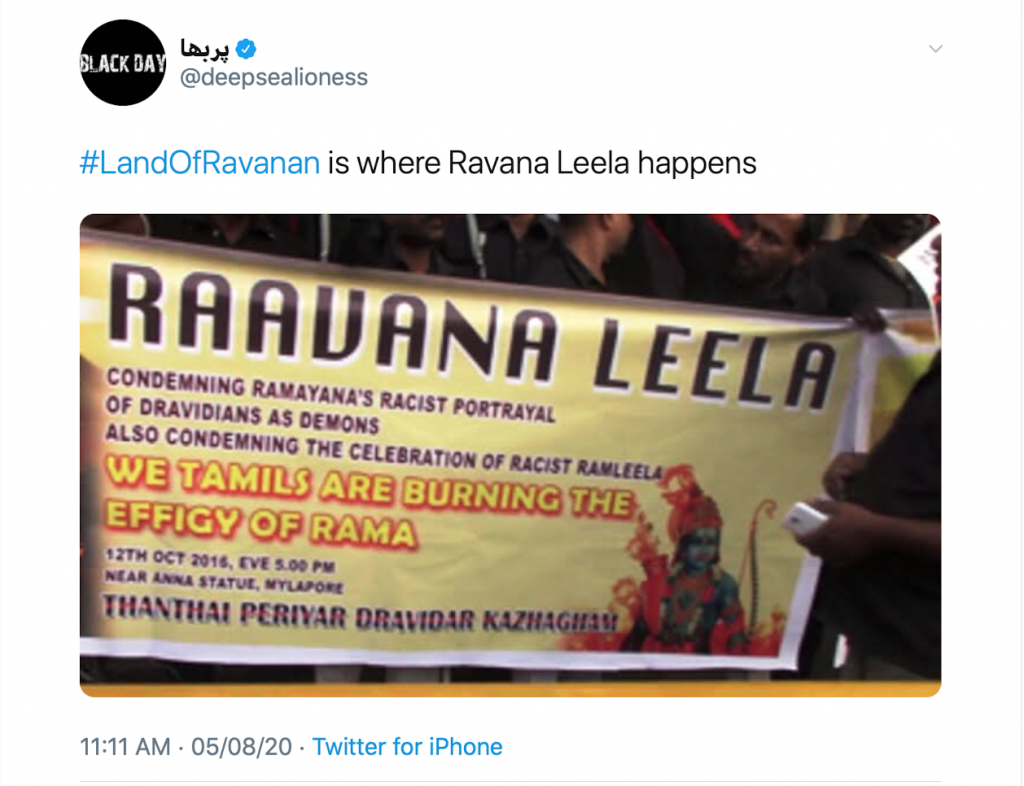
Another Wire journalist, Prabha Raj, could not digest the fact that Ram Mandir is soon going to be a reality. Raj went so far as to condemning Ramayana altogether, contending that it was a racist portrayal of Dravidians as demons.

Prabha Raj condemns Ramayana for its alleged “racist portrayal” of Dravidians

Habitual fake news peddler, Ashok Swain, who harbours pathological hatred for PM Modi, having realised that nothing could stop the construction of Ram Mandir in Ayodhya, departed from his usual way of foul-mouthing the PM and the BJP and instead indulged in making platitudinous remarks on the solemn occasion. He remarked that nations do not become stronger by building temples and cited Kingdoms who built temples but have disappeared now.

Ashok Swain questions the wisdom of building Ram Temple

Even though Ram Mandir is being built as per the Supreme Court verdict, senior advocate Prashant Bhushan today took to Twitter to allege that the government has built a new Republic, defying the country’s Constitution. ‘The Constitution in danger’ is a familiar refrain espoused by the liberals to condemn the government policies and decisions that do not conform to their worldview.

Possibly still in disbelief, the Wire co-founder MK Venu tried to trivialise the historic occasion of Bhoomi pujan by branding it to be a part of a political ploy by the government. He added that there had been several such “Shilanyas” since December 1949.

MK Venu alleges Ram Mandir construction a political ploy

Congress-friendly troll Sanjukta Basu belted out a tweetstorm to express her disapproval over the construction of Ram Temple in Ayodhya.

Rahul Gandhi supporter claims barbarism has won.

Similar thoughts were echoed by numerous others.

The Wire journalist Rohini Singh, took this opportunity to mock the BJP and claim the party even made Lord Ram hold on to PM Modi’s finger.

What she does not know, or perhaps pretends not to know, is that the Ram Mandir is for ‘Ram Lalla’, i.e. the infant, toddler Lord Ram. And as any other child, He would also hold on to a finger of an adult. That by no means makes the God small.

While an overwhelming section of the Indian population went into raptures over the Bhoomi pujan ceremony of the Ram Mandir in Ayodhya, the liberals predictably had severe heartburn, considering their intense hatred for Hinduism and their pathological detestation for PM Modi. It was a momentous occasion for millions of Hindus around the world who witnessed the ceremony that paves the way for the homecoming of their revered God. The liberals can continue fuming, despairing, or fulminating, but the die has been cast, and there’s no stopping Bhagwan Shri Ram from claiming what is rightfully His.

Ram Mandir Bhoomi Pujan: Shiv Sena’s advertisement on Babri Masjid demolition triggers controversy

0

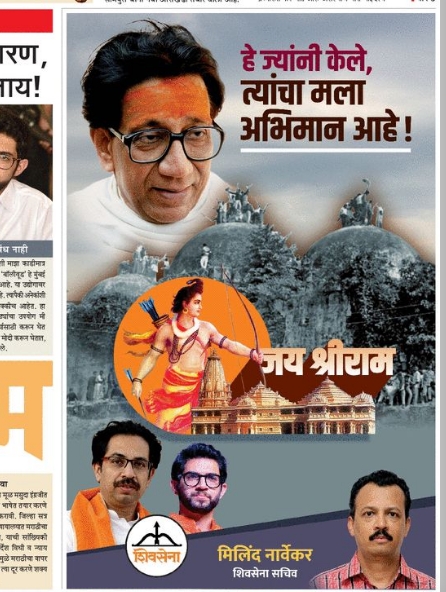
A controversy has been kicked up on the day of the Bhoomi Pujan ceremony of the Ram Mandir in Ayodhya after a contentious advertisement surfaced in Shiv Sena’s mouthpiece ‘Saamana’.

The controversial advertisement that was published in the Wednesday edition of Saamana depicts a picture of Babri Masjid structure along with a photo of Balasaheb Thackeray. The picture also carries a statement which reads, “I am proud of the men who did this”.

The advertisement which was apparently given by Shiv Sena secretary Milind Narvekar, also carries the photos of Maharashtra CM and Sena chief Uddhav Thackeray and Environment minister Aaditya Thackeray.

Advertisement published in Saamana (source: Saamana epaper)

The Shiv Sena mouthpiece has also glorified the party’s role in the Ram Mandir movement in its articles, claiming that the party and founder late Balasaheb Thackeray played an instrumental role in the Babri demolition case, but still has not been invited for the Ram Mandir Bhoomi Pujan ceremony.

The advertisement has triggered controversy because although Shiv Sena has been supporting the cause of Ram Mandir, it is currently in alliance with Congress and NCP in Maharashtra, two parties which have opposite stand on the matter of Babri Masjid and Ram Mandir.

Earlier this week, Shiv Sena spokesperson Sanjay Raut had said that Maharashtra CM Uddhav Thackeray was unlikely to visit the Bhoomi Pujan ceremony, owing to the raging coronavirus crisis in the country, especially in Maharashtra.

“It is important that PM Modi visits Ayodhya. CM Thackeray can go there any time he wishes to,” Sanjay Raut had said.

Saamana hails PM Modi laying ground for Ram Mandir as a gold moment

However, in an editorial piece published in Saamana on Tuesday, the Shiv Sena mouthpiece said there is no other golden moment similar to PM Modi going to Ayodhya and participating in the Bhoomi pujan ceremony of the Ram Mandir.

“The country has become excited in view of the ”bhoomi pujan” ceremony. There is no other golden moment like the country’s prime minister presiding the ground laying ceremony,” the Sena said.

‘I, Narendra Damodardas Modi, on behalf of my country and its people’: Read what the PM’s ‘Sankalpa’ at Ram Mandir Bhoomi Pujan meant

Bringing a just, pious and glorious end to the 500-year-old struggle of Hindus to claim the birthplace of Lord Sri Ram in Ayodhya, PM Modi today did the Shilanyas and Bhoomi Pujan for the proposed Ram Mandir at the Ram Janmabhoomi. The Bhoomi Pujan was not just a symbolic event, it was the materialisation of a 500-year-old dream. By placing the Shilas at the birthplace of Bhagwan Ram, PM Modi today made the dream real, and founded the base where over a billion Hindus worldwide will put their faith and bow their heads.

As reported, PM Modi’s day at Ayodhya began with praying at Hanuman Garhi temple. PM Modi then proceeded to the Ram Mandir site where he first bowed to Ram Lalla Virajmaan, the Lord of the temple.

The rituals that preceded the Bhoomi Pujan event were as important and significant as the event itself. The priest performing the rituals first addressed the Prime Minister and appraised everyone of the significance of the event.

“It is the kindness of our gods. Centuries of believers in our country waited for this day to arrive. But Bharat Maata wanted this pious work of building the Ram Mandir to be done by the hands of her beloved son, that is you. Bharat maata has bestowed her blessings upon you. The entire world is delighted today, by the unlimited blessings of Shri Sita Ram, you, dear Prime Minister, have been chosen to do this work”, the priest said.

He further told the PM, “The whole universe is delighted, singing the glories of Ram and singing praises for you. They are praying that you are blessed with more power, more energy to spread the environment of divinity across the world. We all pray that under your rule, we witness the establishment of Ram Rajya very soon. Jai Shri Ram”.

The 9 Shilas

In the Shilanyas ritual, PM Modi placed 9 Shilas at the Ram Janmabhoomi site, the sanctum Santorum of the Ram Mandir. The priests informed that the 9 Shilas were chosen from over 2 lakh and 75 thousand Shilas sent by Hindus all over the world, with ‘Ram’ written on them.

The Shilanyas ritual included the worshipping of the 9 ‘Adharshilas’ of base-stones of the temple. The Shilas are named as Nanda, Bhadra, Jaya, Rikta, Purna, Ajita, Aparajeeta, Shukla, and Soubhgyani, as per Vedic traditions.

The Sankalpa performed by the PM

As per Hindu Vedic rituals, a yajmaan, or the person who performs a puja, is first required to perform a ‘Sankalp’ or oath, regarding the nature and the purpose of this Puja. The priest explained to everyone present at the event that, the Sankalpa has been specially prepared for the PM, highlighting the significance of the event. The Sankalpa started with holding ‘Jal’ (water) and Pushpa (flowers) in the palm.

PM Modi at the Bhoomi Pujan, image by ANI

The Sankalpa done by PM Modi for the Shilanyas, and Bhoomi Pujan for the Ram Mandir reads as follows:

“I Narendra Damodardas Modi, on behalf of the people of India, as the representative of my country, my people and all its elements of our nation, on behalf of all the living beings of this material world, am doing the Sankalpa for the removal of all obstacles and negativity around us. I am making this Sankalpa for all of us to be blessed with divine joy, health, and prosperity. I am praying to the Lord of the Universe Bhagwan Sita Ram for his blessings as I undertake the task of constructing his new palace, hereby performing the Shilanyas and Bhoomi Pujan for the same.”

The words of the Sankalpa were significant. It narrates the responsibility of the PM and the fact that he was not there as an individual but as a representative of the people of India, who have chosen him as their ruler. PM Modi’s Sankalpa at the Ram Janmabhoomi is also symbolic of the dedication and goodwill that has been behind the Ram Mandir and the sheer power the Mandir represents, for billions of people around the world, placing their faith on the Sanatana Dharma, with several thousand years of a civilisational history as witness.