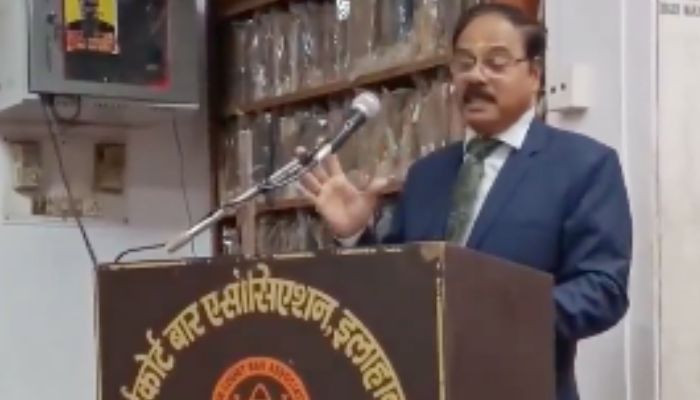
On Sunday (8th December), a sitting judge of the Allahabad High Court delivered a lecture on the constitutional necessity of the Uniform Civil Code at an event hosted by the Vishva Hindu Parishad’s (VHP) legal cell in Prayagraj. In his speech, Justice Shekhar Yadav said “Kathmullas,” in an apparent reference to Islamic fundamentalists, are dangerous for the country. He was speaking on the topic Uniform Civil Code: A Constitutional Necessity.
“Lekin yeh jo kathmullah hai jo…yeh sahi shabd nahi hai…lekin kehne mein parhez nahi hai kyunki woh desh ke liye bura hai…desh ke liye ghatak hai, khilaaf hai, janta ko bhadhkane wale log hai…desh aage na badhe is prakar ke log hai…unse saavdhaan rehne ki zaroorat hai (But these kathmullah… this may not be the right word… but I won’t hesitate to say it because they are harmful to the country…they are detrimental, against the nation, and people who incite the public. They are the kind of people who do not want the country to progress, and we need to be cautious of them),” Justice SK Yadav remarked.
A sitting Judge of Allahbad High Court, Justice Shekhar Kumar Yadav uses the term 'Kathmulla' for the 'extremists' in the Muslim community, saying that we should beware of them. pic.twitter.com/x4tCtEdtaK
Justice Shekhar Yadav also stated that children in one community are taught the principles of kindness and nonviolence, and people there are nurtured to be tolerant. But in the other community, it is hard to expect tolerance from children especially when these children see animal slaughter in front of them.
“In our country, we are taught from a young age to respect all living beings, even the smallest animals, and to avoid harming them. This lesson becomes a part of who we are, which is perhaps why we are more tolerant and compassionate, feeling pain when others suffer. But this isn’t the case for everyone. In our culture, children are raised with guidance towards God, taught Vedic mantras, and instilled with the values of non-violence. However, in some other cultures, children grow up witnessing the slaughter of animals, which makes it difficult to expect them to develop tolerance and compassion,” Yadav said.
Regarding the Uniform Civil Code, Justice Shekhar Yadav remarked that while women are revered as goddesses in Hindu scriptures including shastras and vedas, members of a certain community continue to claim the right to take multiple wives, indulge in Halala, or practise Triple Talaq.
You can’t disrespect a woman who has been recognised as a goddess in our shastras and vedas. You can’t claim the right to have four wives, perform halala, or practice triple talaq. You say, we have the right to say ‘triple talaq,’ and not give maintenance to women. This right will not work. UCC isn’t something that VHP, RSS, or Hinduism advocates. The country’s top court also talks about it…This is the historic library hall of the court, where so many great personalities have been… I vow that this country will surely enact a uniform law, and it will happen very soon,” Justice Yadav said.
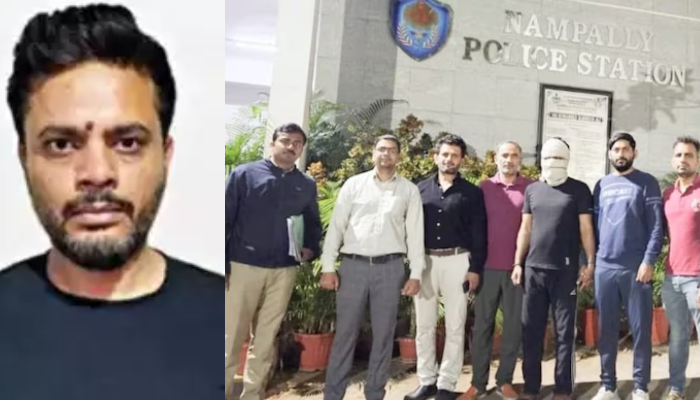
On 7th December notorious human trafficker Kamran Haider, also known as Zaidi from Jasola, was nabbed from Hyderabad by Delhi Police’s special unit following a 2,500-kilometer pursuit.
Kamran Haider used phony call centers to coerce numerous young guys from India into committing cybercrimes in exchange for jobs overseas. National Investigation Agency (NIA) had announced a reward of Rs 2 lakhs on him. According to police, Haider headed a sophisticated network of touts and traffickers. He took money from victims through cryptocurrency wallets.
Haider was arrested near Nampally Railway Station in Hyderabad, Telangana. Haider enticed young Indians with fictitious job offers, only to entrap them in cybercrimes for call centers operated by Chinese companies. The authorities faced a difficult challenge because he was constantly moving to avoid being arrested. He was preparing to escape to another hideout when police arrested him after months of operations across several states.
Haider is charged with participating in the unlawful trafficking of Indians to Thailand and Laos, together with four other individuals, Manjoor Alam alias Guddu, Sahil, Ashish alias Akhil, and Pavan Yadav alias Afzal. Ali International Services, the name of the consulting business he operated in the national capital, was a front for human trafficking. The syndicate transported vulnerable Indians to nations like Thailand and Laos under the pretense of job opportunities.
A complaint from a man named Naresh Lakhavath led to the registration of a case at the New Friends Colony police station in Delhi on 27th May. He stated that Haider’s company offered him a position in Thailand and Laos. His passport was seized after he landed in Thailand and he was forced into working for a Chinese cyber fraud organization in Thailand. After the accusation, a human trafficking case was filed against Haider and an investigation was started in June of this year.
Later, the matter was turned over to the NIA, whose investigation showed that the company had deceived people into participating in cyber scams that targeted Americans and Europeans. Haider was also involved in extorting victims who attempted to flee the Chinese scammers via cryptocurrency wallets. All five of the accused were reportedly involved in the trafficking of vulnerable Indian youngsters to the Golden Triangle Region in Laos.
The company transferred potential victims for illegal activities in South Eastern Asian countries, according to NIA. The victims were forced to work in inhumane conditions, according to the central agency. Deputy Commissioner of Police Manoj C informed, “The main accused was identified as Kamran Haider. Kamran Haider absconded and despite all efforts, accused Kamran Haider could not be arrested. He was trying to go abroad to Thailand and Laos.”
Police disclosed, “The syndicate, led by Haider, was involved in the operation of an unlicensed manpower supply agency, illegal transfer/transport of potential victims for criminal activities in south-east Asian countries. The trafficked persons were being used as slaves and forced to work in inhumane conditions.”
Kamran Haider remained at large despite the announcement of a Rs 2 lakh reward for his capture. The Delhi Police Special Cell was assigned the responsibility of apprehending him and teams were deployed throughout Madhya Pradesh, Chhattisgarh, and Maharashtra to collect information and leads.
The Police official added, “Zaidi was located in Hyderabad, Telangana. Immediately two different teams of the special cell were sent to Hyderabad. He was apprehended on 7th December after a long persevering chase of 2,500 kilometres by the team without any rest. He was apprehended near Nampally Railway Station, Hyderabad, Telangana while trying to escape to another hideout.”
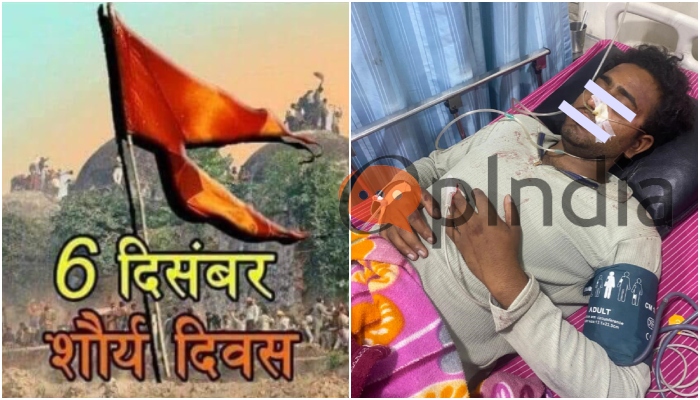
On Saturday, 7th December, the Nashik Police in Maharashtra booked 5 persons, Mizan Sheikh, Ayaan Sheikh, Aayesh Shah, Sharik Shah, and Fahim Sheikh, for brutally assaulting a Dalit Hindu for sharing an Instagram story commemorating Shaurya Divas (The day when Babri Mosque standing at Ram Janmabhoomi was demolished).
The accused persons pelted stones at the Dalit Hindu and also assaulted him with wooden sticks for sharing a story celebrating Shaurya Divas on social media.
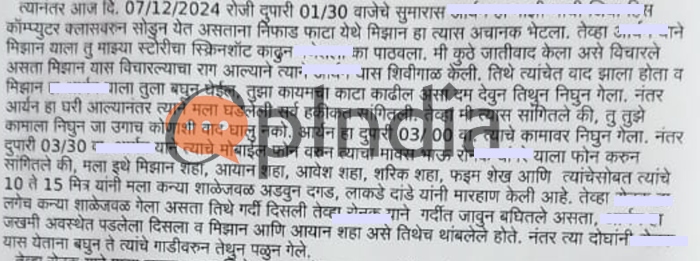
The incident is said to have happened in the Pimpalgaon region of Nashik’s Niphad. Team OpIndia has obtained an FIR copy of the incident. As per the FIR, the victim identified as Nayan (name changed for security reasons) shared a story on his Instagram account celebrating the valour of Hindu activists on 6th December, on the occasion of Shaurya Divas. This irked Mizan Sheikh, who is allegedly a ‘friend’ of the victim. The accused person poked the victim initially and blamed him for practicing alleged ‘casteism’.
Mizan abused the victim and said that what pleasure did the latter get by practicing alleged ‘casteism’. Responding to this, the victim cross-questioned the accused saying that there was no link between casteism and the post that celebrated the Shaurya Divas. Following this, the accused attacked the victim and continued to abuse him.
Hours later, when Nayan was on his way to pick up his sister from school, he was stopped by the accused who by then had called 15-20 of his associates including Ayaan Sheikh, Aayesh Shah, Sharik Shah, and Fahim Sheikh. The accused persons then pelted stones at the victim and beat him with wooden sticks for celebrating the Shaurya Divas.
They assaulted the victim brutally. The victim somehow managed to call his cousin for help who later took him to the hospital. The accused persons, in the meantime, managed to flee from the spot. However, they were booked by the police based on the complaint filed by the father of the victim.
The accused persons have been booked by the police under sections 109, 118(1), 115(2), 352, 351(3), 126(2), 189(2), 191(2), 191(3) and 190 of the Bharatiya Nyay Samhita, 2024 and section 3(2)(va) of the SC/ST Act. No arrests in the case have yet been made. Further probe into the case is underway.
Notably, in India, the date 6th December is celebrated as Shaurya Divas in memory of the Babri structure demolition. The Babri structure was symbolic of brute strength, of how native culture was subjugated, and how the universally adored Lord Ram was insulted by the invaders. It was a dark symbol of tyranny and barbarism. On December 6, the disputed structure in Ayodhya was brought down by various Hindu activists in 1992. While the day is termed the ‘Black Day’ by the Islamist community, the day is marked as Shaurya Divas by others.
On 8th December, the sitting judge of the Allahabad High Court, Justice Shekhar Kumar Yadav, attended and spoke at an event organised by the Vishva Hindu Parishad (VHP) legal cell in Prayagraj, Uttar Pradesh. In his address at the event, he emphasised the cultural and constitutional significance of Bhagwan Ram Mandir in Ayodhya, the urgency of implementing a Uniform Civil Code (UCC), and the role of the majority in shaping the future of India. In his speech, Justice Yadav covered a wide range of topics, from societal reforms to national unity.
‘Ram Mandir is a testament to sacrifices of our ancestors’
Justice Yadav began his address by paying tribute to the sacrifices made by countless individuals for the construction of Bhavya Ram Mandir in Ayodhya, Uttar Pradesh. He said, “Did you imagine seeing the Ram Mandir with your own eyes? Many of our ancestors made sacrifices in the hope of seeing Ram Lalla freed and witnessing the construction of a grand temple. They couldn’t see it but did their part, but now, we are witnessing it (the temple).”
Uniform Civil Code – a promise of unity and justice
He expressed optimism about the implementation of the UCC and assured the audience that the day is not far when UCC will become a reality. He said, “I assure you, you will see this (UCC) bill very soon. The day is not far when it will be clear that if there is one country, there should be one law, and one penal law. Those who try to deceive or run their own agendas will not last long.”
Justice Yadav took an oath in the historic library hall of the Allahabad High Court and declared, “This country will definitely bring a uniform law, and it will bring it very soon.” Referring to the 1985 Shah Bano case in the Supreme Court of India that upheld the right to maintenance irrespective of religion, he called the case a stepping stone for the implementation of the UCC.
‘Majority’s wishes define the law in Hindustan’
Justice Yadav remarked on the principle that the interests of the majority are central to governance in a democracy like India. He said, “I have no hesitation in saying that this is Hindustan; this country would function as per the wishes of the bahusankhyak (majority) living in Hindustan. This is the law. The law, in fact, works according to the majority. Look at it in the context of family or society… Only what benefits the welfare and happiness of the majority will be accepted.” He further stressed that such principles ensure the harmony and welfare of society at large.
Reforming women’s rights and ending discrimination
Moving further in his address, Justice Yadav criticised the discriminatory practices that affect women in certain communities and called them unconstitutional. He said, “If you say that our personal law allows this, it will not be accepted. A woman will receive maintenance, bigamy will not be allowed, and a man will have only one wife, not four wives… If one sister receives maintenance and the other does not, then that creates discrimination, which is against the Constitution.”
Justice Yadav strongly condemned practices like Halala and Triple Talaq and said, “You can’t disrespect a woman who has been recognised as a goddess in our Shastras and Vedas. You can’t claim the right to have four wives, perform Halala, or practise Triple Talaq. This right will not work.”
In relation to such practices, he emphasised that UCC is not only supported by organisations like RSS and VHP but that the Supreme Court of India has also advocated for it, suggesting it is a constitutional necessity.
The essence of Hindu identity and cultural respect
In his address, Justice Yadav elaborated on the broad definition of being Hindu. He said, “A person who takes a dip in the Ganga or applies chandan is not the only definition of being Hindu. Anyone who considers this land their mother and is willing to lay down their life for the country in times of crisis, regardless of their religious practices or beliefs, whether they follow the Quran or the Bible, is a Hindu.”
He further underlined the importance of respecting the culture, heritage, and great personalities of India. He said, “It is not expected for Muslims to follow our culture, but it is definitely expected that they do not disrespect the culture of this country, the great personalities, and the God of this land.”
Warning against disruptive elements and societal degeneration
Justice Yadav issued a stern warning against certain elements within society that are disruptive. He referred to such elements as “Kathmulla”, a term usually used for Muslims, who hinder national progress. He said, “The word may be inappropriate, but there is no hesitation in saying it because they (‘Kathmulla’) are harmful to the country. They are people who incite the public, and they are the ones who prevent the country from progressing.”
He further issued a warning that if Indians fail to uphold their cultural values, “It won’t take long for this country to become like Bangladesh or the Taliban.”
On tolerance and upbringing in different communities
He also drew comparisons between how children are raised across communities. He pointed out that values of compassion and non-violence are deep-rooted in Hindu traditions. He questioned, “In our country, we are taught not to harm even the smallest animals, not to kill ants, and this lesson is ingrained in us. Perhaps that is why we are tolerant and compassionate; we feel pain when others suffer. But you do not have this. Why? In your culture, from a young age, children are exposed to the slaughter of animals. How can you expect them to be tolerant and compassionate?”
A call for unity and strength
While concluding his address, Justice Yadav urged the people of India to recognise the significance of their cultural identity and values. He said, “I won’t say ‘ek rahenge to safe rahenge,’ but would say that once these values are realised, no one can harm us.”
Justice Yadav’s statements spark uproar
Justice Shekhar Kumar Yadav’s address at the VHP’s event has drawn sharp reactions from the left-liberal cabal. They have accused the sitting judge of the Allahabad High Court of making controversial statements favouring one community over others. His support for the UCC, critique of Islamic practices like Triple Talaq and Halala, and emphasis on the role of the majority in shaping the country triggered outrage to the extent that some demanded action against him by the apex court.
CPI(M), from its official handle on X, wrote, “His speech is akin to hate speech. Justice Shekhar Yadav, a sitting judge of the Allahabad High Court, addressed a VHP meeting. That he should do so is bad enough. That he should promote majoritarian views and communal hatred is unacceptable. Supreme Court should take suo moto notice and sack him!”
Social media user Aditi Sharma wrote, “”Our (Hindus) children are non-violent & tolerant because they read Vedas but their (Muslims) children can’t be tolerant as they do animals sacrifice” -Justice Shekhar Yadav, sitting judge of Allahabad High Court. With such a biased mindset, how can this judge provide justice?”
"Our (Hindus) children are non-violent & tolerant because they read Vedas but their (Muslims) children can't be tolerant as they do animals sacrifice"
-Justice Shekhar Yadav, sitting judge of Allahabad High Court
TMC MP Mahua Moitra said, “Sitting HC judge attends VHP function, says country will function as per Hindus. And we are celebrating 75 years of our Constitution! Supreme Court, Hon’ble CJI – suo moto cognizance anyone?”
Sitting HC judge attends VHP function, says country will function as per Hindus. And we are celebrating 75 years of our Constitution! Supreme Court, Hon’ble CJI – suo moto cognizance anyone? https://t.co/VpASRR6YaJ
In a post on X, AIMIM chief Asaduddin Owaisi wrote, “The VHP was banned on various occasions. It is associated with RSS, an organisation that Vallabhai Patel banned for being a ‘force of hate and violence.’
It is unfortunate that a High Court judge attended the conference of such an organisation. This “speech” can be easily rebutted, but it’s more important to remind his honour that the Constitution of India expects judicial independence & impartiality. May I direct his attention to AoR Association vs Union of India “Impartiality, independence, fairness and reasonableness in decision-making are the hallmarks of the judiciary.” The Constitution of India is not majoritarian but a democratic one. In a democracy, the minority’s rights are protected. As Ambedkar put it “…as a King has no Divine Right to rule, so also a majority has no Divine Right to rule.” This speech indicts the collegium system and raises questions on judicial impartiality. How can a minority party expect justice before someone who participates in VHP’s programs?”, Owaisi wrote.
The VHP was banned on various occasions. It is associated with RSS, an organisation that Vallabhai Patel banned for being a ‘force of hate and violence.’
It is unfortunate that a High Court judge attended the conference of such an organisation. This “speech” can be easily… https://t.co/IMce7aYbcf
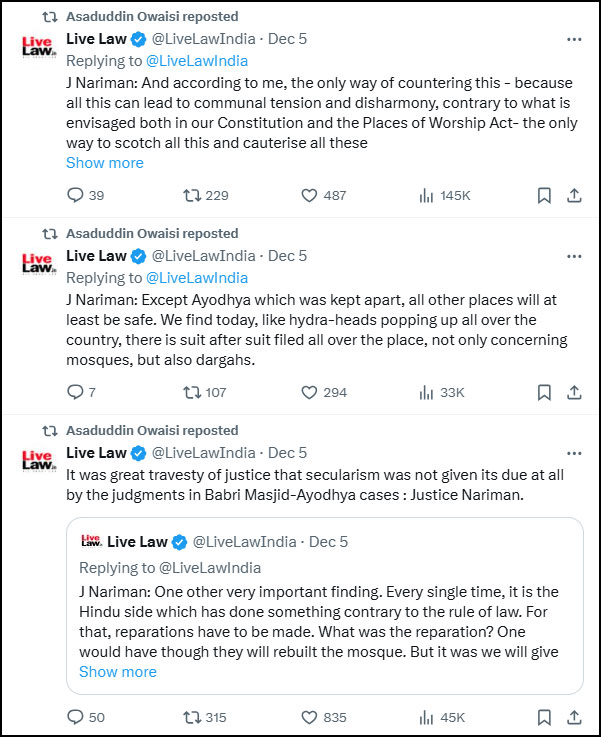
Just a couple of days before Justice Shekhar Yadav’s address, Owaisi was reposting speech excerpts of former Justice Rohinton Nariman.
Source: X
The left-liberals condemned Justice Yadav’s remarks and labelled them divisive. They argued that his statements were inappropriate for a sitting judge and reignited debates on judicial propriety and ideological bias among members of the judiciary.
Double standards – Praise for Nariman but outrage over Yadav
Interestingly, the same left-liberal cabal crying foul over Justice Yadav’s remarks lauded former Supreme Court judge Rohinton Nariman for his sharp critique of the 2019 Ayodhya verdict, delivered just days before the VHP event. Justice Nariman, during a lecture for the Ahmadi Foundation on 6th December, two days before Justice Yadav’s address, called the Supreme Court’s ruling on Ram Janmabhoomi a “mockery of justice” and accused the five-judge bench of violating “secularism, which, according to him, is a basic feature of the Constitution.”
Justice Nariman went further, describing the VHP-led karseva movement as “dictatorial” and the demand for the Ram Mandir as “tyrannical.” He claimed that the Places of Worship Act was disregarded in the Ayodhya judgment and criticised notices being served to mosques and dargahs, terming them “hydra heads” that could incite communal discord. He argued that the strict enforcement of the 1991 law, which prevents Hindus from pursuing historical claims, is the only way to ensure communal harmony.
Despite his harsh criticism of Hindus, Justice Nariman was widely celebrated by the left-liberal ecosystem. This stark contrast in the reception of similar issues, depending on the speaker and their stance, highlights the ideological bias prevalent among left-liberal circles. Justice Yadav’s call for cultural respect and constitutional uniformity was branded divisive, whereas Justice Nariman’s pointed remarks, which dismissed centuries of injustice faced by Hindus, were applauded as progressive.
The selective outrage undoubtedly raises questions about the deep-rooted ideological bias among left-liberals. Justice Nariman’s statement that “secularism would only have been upheld if Hindus had abandoned their claim” underscores the one-sided expectations placed on the Hindu community. His criticism of notices to mosques and dargahs, without acknowledging the historical destruction of Hindu temples, further reveals the hypocrisy of those claiming to champion secular values.
Former Justice Nariman also expressed disappointment over the failure to rebuild a mosque on the disputed site after the demolition of the Babri structure, calling it a “travesty of justice.” However, he overlooked the fact that Hindus adhered to the legal process for decades, seeking rightful ownership of their place of worship. Had the Hindu community acted outside the law, the disputed structure known as the “Babri Masjid” would not have stood until 1992, nor would the Ram Mandir have been planned nearly three decades later, only after the court ruled in favour of the Hindu community.
Late Fali Nariman celebrated his son’s priesthood but criticised Yogi’s
There are certain elements of irony about the whole secularism sermon by Nariman. Former Justice Rohinton Nariman’s father, the late Fali S Nariman, once criticised Chief Minister Yogi Adityanath becoming the head of the state because he is a Hindu priest. He claimed that CM Yogi’s appointment was a threat to secularism.
However, he completely ignored the fact that his son, Justice Rohinton Nariman, is himself a Parsi priest. Rohinton was ordained at the age of 12 and performed religious ceremonies. He has credited his priesthood for shaping his life and career.
The starkly different receptions to Justice Yadav and Justice Nariman’s statements expose a deep-seated bias within sections of the left-liberal ecosystem. While one judge is vilified for his calls to respect the Constitution and cultural heritage, another is glorified despite undermining the historical and legal struggles of a community. This selective appreciation serves as a glaring example of the hypocrisy that continues to plague public discourse on India’s socio-religious landscape.
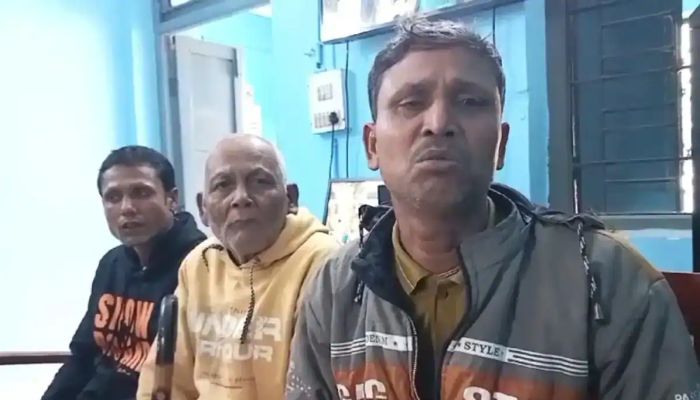
On 7th December ten members of a Hindu family from Bangladesh recently made it into Tripura by trekking through deep woods without taking a moment to rest in the middle of the night. However, Indian security forces apprehended them at the Ambassa Railway Station in the Dhalai area. The anti-Hindu violence and tensions in the neighbouring countries caused them to evacuate their hamlet and enter India to protect their lives. They are from Dhanpur village in the Kishorganj district of Bangladesh.
The family included three women (mother-in-law and her daughters-in-law) along with three minors, two boys, a girl, and an elderly person. They were caught while trying to board a train to Silchar in southern Assam. The family reportedly stated during the preliminary interrogation that they were forced to cross the border because of the growing atrocities committed against the minority Hindu community in the neighbouring country after the Awami League government led by Sheikh Hasina collapsed in August.
“After trekking the forested hills of an arduous route overnight, we entered India on Saturday through Kamalpur (in Tripura’s Dhalai district). We were trying to go to Silchar in Assam to stay in a rented house. We would never return to Bangladesh under any circumstances. The situation in Bangladesh is very grim. Attacks on the lives and properties of Hindus have become an everyday affair,” Shankar Chandra Sarkar one of the arrested Bangladeshi Hindus expressed.
“We had to take cover of the darkness and jungles and walk throughout the night. We eventually managed to cross into India through the Srimangal area of Bangladesh. We started on Friday and reached Tripura on Saturday,” he further narrated their hectic journey to India. According to him, they travelled from Kamalpur to the Ambassa railway station, where they intended to catch a train to Silchar, Assam.
He added, “We have come from Bangladesh. We came to India because we can’t stay there (Bangladesh) anymore in the face of atrocities. I worked as a driver at Dhanpur in Kishorganj district. People tried to assault me. Our women are not safe there. I shall not go back from India even if I am jailed,” he voiced their terrible ordeal.
“We will not go back. We will not go back to Bangladesh at any cost. We have sold whatever we could before coming here. We can’t get justice there, we are assaulted, we are unsafe in Bangladesh,” the victim of Islamist attacks reiterated. He pointed out that they had to abandon many of their properties and household goods as well as assets.
Sarkar mentioned that hundreds of Hindus, like himself, are considering escaping to India because of the unrest in Bangladesh, but many have not dared to do so for several reasons. “It is not a petty matter to leave behind your house, and belongings, and come to another country. My father also walked through the jungle. He is a senior citizen and could have died,” he highlighted their miserable situation.
“During the Awami League government headed by then Prime Minister Sheikh Hasina, we were happy and there was no enmity between the Hindus and Muslims in our areas. But after the caretaker government headed by Muhammad Yunus assumed office, we were continuously harassed and threatened,” he conveyed underlining the unbridled assaults on minorities especially against Hindus and their temples, religious institutions as well as properties.
Meanwhile, on 8th December, seven members of the Hindu family were placed in 14 days of judicial custody by a local court in the Dhalai district of Tripura for breaking the Indian Passport Act by entering the country illegally. Seven adult members of the family have been sent to Chailengta subdivisional jail while the three underage children were sent to Narsingarh juvenile home in Agartala.
Sudhir Sarkar (70) the patriarch of the family, expects to become an Indian citizen through the Citizenship (Amendment) Act, 2019 which makes it possible for undocumented non-Muslim migrants from Pakistan, Bangladesh and Afghanistan who arrived in India before the 31st December 2014, including Hindus, Sikhs, Jains, Buddhists, Parsis, and Christians to be granted Indian nationality. “Nobody wants to leave his or her birthplace and fights to stay back till the end. But if a situation has arisen where a Hindu family from Bangladesh is forced to seek refuge in India, the Indian administration should deal with it sympathetically,” he told the media before going to jail.
Recounting his horrific experience at home, he stated that since deposed prime minister Sheikh Hasina’s ouster, his sons, Shankar and Adhir, had been subjected to atrocities by anti-Hasina groups. Their livelihoods were stolen, women were prohibited from leaving the house and their children were prevented from attending school. “Our Muslim neighbours, with whom our families lived peacefully for generations, became our sworn enemies overnight. They would torture us, not allow us to go to the market. They simply wanted us to die either by suicide or starvation. We had no option but to leave our country,” he disclosed.
According to him, they fled their house with a few possessions before the sun came up on 6th December and arrived in Sri Mangal town (on the Bangladeshi side) in the evening. They succeeded in reaching the international border, but they had to wait to avoid being caught by the Border Security Force (BSF) and Bangladesh’s Border Guard. The whole family spent the night in the jungle between Ambassa and Kamalpur and took an autorickshaw to get to the train station, the next morning where they were arrested.
The 25th edition of Nagaland’s iconic traditional ‘Hornbill Festival’ has begun. The festival not only is an expression of Nagaland’s distinct culture, but also allows people to learn about the customs, food, songs, and dances of Nagaland’s diverse tribes.
Lakhs of people from India, and from around the world, attend this 10-plus day festival, which is also regarded as Nagaland’s largest public event. This festival is popular across the state, but this year’s celebrations have sparked controversy due to Christian forces. Let us explain why this is so.
Significance of Rice Beer in Naga Culture
‘Rice beer’ is a significant beverage in Nagaland’s culture and at the Hornbill Festival. Nagas consume and offer it as a traditional liquor during social and cultural festivities. It is sometimes served in a bamboo glass and other times mixed into a dish.
As this drink is quite popular among the tribes of Nagaland and foreign tourists, the Nagaland government decided that it will give some relaxation from the strict laws of alcohol ban in the state, and even the sale of Indian Made Foreign Liquor (IMFL) will be allowed in this festival. Tourism Minister Temjen Imna Along also said that this step has been taken to attract tourists.
रंगों में रची हमारी परंपरा, त्योहारों में बसी हमारी संस्कृति!
The Hornbill Festival is back, grander than ever, with a celebration like no other! This 25th edition is not just a festival; it's a vibrant jubilee of tradition, culture, and unity.
The Church, however, has aggressively objected to this exemption in the state, despite the fact that it was granted not only to attract tourists but also to preserve the culture of the tribes. They portrayed the exemption in such a way that people believe the government is encouraging alcohol in the state, whereas rice beer has long been a part of Naga culture. The Church is opposed to it because they claim that consuming tribals’ customary drink is socially and morally wrong.
Reports say that the Nagaland Baptist Church Council (NBCC) said that the main reason tourists visit Nagaland is to experience its culture and heritage, not to consume alcohol. NBCC has also threatened the tribal community against the use of traditional alcohol in this festival by saying that if the sale of alcohol is promoted in the state, it may have long-term negative effects.
Christian population and their rules dominate the Naga culture
It is worth mentioning that the majority of the population in Nagaland is Christian, so Christian forces want all rules to be made according to their religious beliefs and other castes should also follow the rules made by them. Due to the pressure of these Christian forces, a complete ban on alcohol was imposed in the state about 35 years ago and even today those forces are not ready for any kind of change. The churches in Nagaland still think that other tribes should follow them and even if this pressure destroys Naga culture forever, they should listen to them.
"The Hornbill Festival is a vibrant celebration of Nagaland’s rich heritage, showcasing the North East’s unparalleled culture, traditions, and unity. It’s a testament to the spirit of #EkBharatShreshthaBharat, bringing together the essence of India’s diversity.
Baptists from America entered Nagaland 184 years ago
Zutho – traditionally brewed rice beer of Naga's plays an integral role in the day-to-day life of the #Angami Nagas people and several other communities in the region. – The rice beer with lot many medicinal & therapeutic properties. #beer#ricebeer#naga#zutho#tribe#liquorpic.twitter.com/472p6mtJ1i
Although a blanket ban on alcohol was officially imposed in Nagaland in 1989 after discussions and pressure from women’s organisations, the infiltration of Christian forces in Nagaland started in 1870. Reports mention that when American Baptists came to Nagaland in 1870, they declared alcohol as a sin and made provision for strict punishment for those who converted to Christianity. After this, whoever was caught consuming alcohol was punished by expelling him from the community. Today, the result of that influence is that the population of the state is 87% Christian.
Three people died in a shocking instance on the night of 8th December in the Khairtala area of Sagarpara police station area of West Bengal’s Murshidabad district where an explosion took place during the making of a homemade bomb. It also caused the neighbouring house to vibrate. According to the police and locals, the incident took place at the house of Mamun Molla. The house collapsed and its roof fell off due to the powerful explosion. Three dead bodies were recovered during a rescue operation after the incident.
VIDEO | West Bengal: At least three people have been reportedly killed in an explosion at a house in #Murshidabad. More details are awaited.
Mamun Molla and Sakirul Sarkar from Khairatala and Mustakin Sheikh from Mahtab Colony were making bombs when the blast took place and all three lost their lives. The bombs exploded, filling the house with thick layers of white fumes after which the neighbours immediately contacted the police. There is a large police presence at the location and initial investigations have discovered bomb-making materials. Additionally, authorities are looking into whether the blast was connected to other crimes or had a political motive.
On the other hand, the family members of the three men dismissed their role in the bomb making and claimed that the bombs were thrown at the place. A relative of one of the deceased alleged that unknown individuals bombed the house. However, locals asserted that the residence was used to manufacture improvised explosive devices. Police have registered a case and started an investigation. They are now probing into every possibility to determine the cause of the explosion or if it was an external conspiracy. Police personnel are in the area to control the situation and conduct an inquiry.
Local authorities are probing the matter to uncover the motive behind the bomb-making activity and to determine if others were involved in the operation. According to officials, the wreckage of the house is being probed to find out who else was behind the incident. Police have also appealed to residents to be vigilant and report any suspicious activity immediately. “The government must take action to ensure that such incidents do not happen again. This is a serious failure in maintaining law and order,” stated a local leader. People also voiced growing concerns about their safety and urged authorities to take swift action to bring about justice and prevent similar instances.
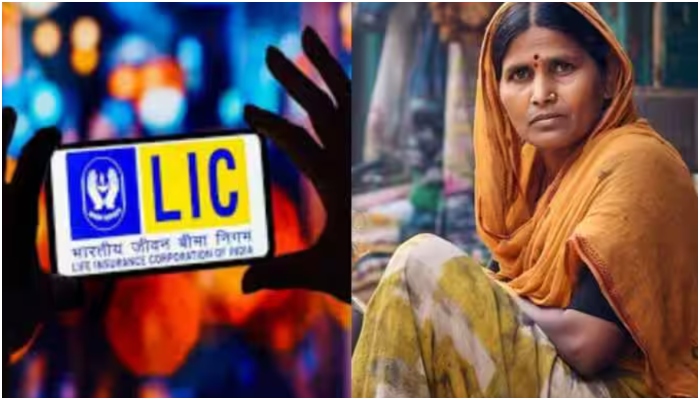
On Monday, 9th December, PM Modi is going to inaugurate the Life Insurance Corporation of India’s Bima Sakhi Yojana at an event in Haryana’s Panipat to empower the women’s community for a developed India. As per the government release, the program will help women adopt the opportunities to become LIC agents and will receive monetary support of a maximum of up to Rs 7000 per month.
The event is scheduled to be attended by several Union leaders like Finance Minister Nirmala Sitharaman, Haryana Governor Bandaru Dattatreya, Haryana Chief Minister Nayab Singh Saini, and other ministers from both the center and the state.
PM Modi shared insight about the project and said on X that the center was committed to empowering women for the development of the country.
“We are committed to the empowerment of mothers, sisters, and daughters across the country. In this series, I will get the opportunity to launch the Bima Sakhi Yojana in Panipat, Haryana at around 2 pm today. During this time, I will also lay the foundation stone and inaugurate many other projects,” he said.
देशभर की माताओं-बहनों और बेटियों के सशक्तिकरण के लिए हम प्रतिबद्ध हैं। इसी कड़ी में आज दोपहर बाद करीब 2 बजे हरियाणा के पानीपत में बीमा सखी योजना की शुरुआत का सुअवसर मिलेगा। इस दौरान कई और परियोजनाओं का शिलान्यास और लोकार्पण भी करूंगा।https://t.co/KcBMt7fFry
As per the government sources, the initiative by the Life Insurance Corporation of India (LIC) looks forward to empowering women aged between 18 to 70 who have completed their basic Class 10 education. The women interested in the scheme will be given specialized training and a monetary stipend for the first three years to encourage financial literacy and insurance awareness.
“After training, they can serve as LIC agents and the graduate Bima Sakhis would have the opportunity to qualify for being considered for Development Officer roles in LIC. Prime Minister will also distribute appointment Certificates to prospective Bima Sakhis,” the official statement added.
During the first year, the women will receive Rs 7,000 per month. The following year, the sum will be reduced to Rs 6,000 per month and by the third year, the women will be paid Rs 5,000 per month. They will further receive an additional Rs 2,100 as an incentive. Reports suggest that commission-based incentives will also be offered for meeting insurance targets.
Notably, the program will first be launched in Haryana in phases and later will be introduced to the entire country. As per the reports, in the first phase, around 35,000 women will be recruited and later around 50,000 women will be given an opportunity.
During the event, apart from the Bima Sakhi scheme, the Prime Minister will also lay the foundation stone of Maharana Pratap Horticultural University’s main campus in Karnal. The main campus and six regional research centers will cover 495 acres and cost more than Rs 700 crore. As per the government release, the University will have one College of Horticulture for graduate and post-graduate programs, as well as five schools that include ten horticulture fields. The initiative would aim to diversify crops and conduct world-class research to improve horticultural technology.
A group of Christian MPs has urged the Catholic Bishops Conference of India (CBCI) to support the Muslim community in opposing the Waqf (Amendment) Bill, 2024. The Opposition MPs told the CBCI that the church should take an in-principle stance in support of ‘minority rights’ guaranteed by the Constitution. This followed a meeting in New Delhi on Tuesday (3rd December), during which several Christian MPs resolved to support the Muslim community in opposing the Waqf Bill even as the Waqf Board has on several occasions claimed ownership of churches.
An opposition MP who attended the meeting also urged that community leaders promote the Muslim community’s ‘positive contributions’ rather than ‘simply reacting to negative reports’. Chaired by Archbishop Andrews, the meeting covered a wide range of topics, including the role of Christian MPs in supporting and protecting the community and its rights, the growing attacks and threats against minorities, particularly Christians, and the alleged ‘misuse’ of the Foreign Contribution (Regulation) Act (FCRA) against Christian institutions.
Reports say that TMC MP Derek O’Brien, Congress MPs Hibi Eden, Dean Kuriakose, Anto Antony, CPI (M) MP John Brittas and Union Minister of State George Kurian were among the MPs who attended the meeting.
While the Christian MPs are extending support to the Muslim community to oppose the Waqf Bill, the Waqf Board has often been laying claims over churches and religious places of other faiths.
In November this year, Union Minister Shobha Karandlaje alleged that the waqf board aimed to claim ownership of land parcels, temples, and churches where people from other religious communities have resided for generations.
“When the Constitution was drafted in 1950, the term ‘waqf’ was not even included. The Waqf Act was created in 1954 under the pretext of protecting the land of Muslims who migrated to Pakistan after the partition. According to an amendment made in 1995, the waqf can claim any land it considers its own. Other communities residing there for years cannot file a complaint in any court and can only rely on the waqf tribunal, which consists solely of Muslim members,” Minister Karandlaje said adding that in 1954, the Waqf Board had not more than 10,000 acres of land but now it has nearly 3.8 million acres.
Last month, OpIndia reported that the Kerala State Waqf Board laid claim over 404 acres of land in the Munambam suburb of the Ernakulam district in Kerala claiming that the said land was granted as waqf property in 1950. Waqf Board’s absurd claim sparked outrage among the affected 600 Christian and Hindu families who said that they had purchased their land decades ago. Extending support to the protesting Christian families, the Syro-Malabar Church organised solidarity events at around 1000 churches across the state.
Major Archbishop Raphael Thattil, head of the Syro-Malabar Church had sought help from the state and union governments saying that this matter be resolved in accordance with the constitution.
Notably, the Waqf Boards of various states declared villages, big hotels, and even colleges as their property. In the latest case, the Maharashtra Waqf Board has staked its claim on the lands of 103 farmers of Latur. It has also issued notices to the farmers who own these lands.
Similarly, the Uttar Pradesh Waqf Board has also staked its claim on the famous Uday Pratap College (UP College) located in Varanasi. The board says that this property belongs to it. Uday Pratap College was established about 115 years ago in 1909 by Raja Uday Pratap Singh Judev of Bhinga (Bahraich, Uttar Pradesh).
Additionally, in the year 2022, the Waqf Board of Tamil Nadu staked its claim on the entire Thiruchendurai village of Hindus, calling it a Waqf property. There is a 1500-year-old temple there, but still, the Waqf Board also declared it as its property. In this way, the Waqf Board has staked its claim on 369 acres of land.
In Karnataka, the Waqf Board has claimed 1200 acres (about 2000 bighas) of land as its property by calling it Shah Aminuddin Dargah’s land. After this, the Congress government of the state sent notices to the farmers asking them to vacate those lands. Later, the farmers of Honwada village in Tikota taluk of Vijayapura district complained about this to Minister MB Patil.
Notably, the literal meaning of Waqf is detention, confinement, and prohibition. According to Islam, the property marked as Waqf is now available only for (Islamic) religious or charitable purposes, with any other use or sale prohibited. According to Sharia law, once a Waqf is established and property is dedicated to it, it becomes Waqf property forever.
In a major financial fraud case, 1,425 Kerala nurses have been accused of collectively defrauding a Kuwaiti bank of nearly Rs 700 crore before leaving the Gulf nation. The accused allegedly acquired huge loans from the Gulf Bank while working for Kuwait’s Ministry of Health (MoH), and then deliberately defaulted on repayments before fleeing to Canada, Australia, and European countries.
Mohammed Abdul Vassey, Deputy General Manager of Gulf Bank, filed a complaint, which resulted in the registration of cases against ten individuals in Kerala. These individuals are suspected of taking out crores of loans and then leaving Kuwait without repaying their bills. The cases were filed under Sections 420 (cheating) and 406 (criminal breach of trust) of the Indian Penal Code (IPC). The complaints have been lodged at Kalamassery, Njarackal, Varapuzha, Kaladay, Muvattupuzha, Onnukal, Kodanad, and Kumarakom police stations.
Even though the financial fraud was committed in Kuwait, the Indian law permits prosecution in such cases if the accused persons are Indians. After the Gulf Bank learnt that legal proceedings could be initiated in India in this matter, complaints were lodged and Kerala Police swung into action. The police are reported to have recorded statements of the accused and are coordinating with the Gulf Bank. The bank has assured the police of cooperating in the probe and provide further details.
Advocate Thomas J Anakkallumkal, who is representing the Gulf Bank in Kerala, said, “Most of these nurses had taken loans earlier and promptly repaid them. However, when the demand for medical practitioners boomed in Europe, Australia and Canada, they took huge loans from the bank and migrated to greener pastures. Then they stopped the loan repayments. The company identified 10 loan defaulters who are currently in Kerala. The police have registered FIRs against them. One of the nurses returned to Kerala, purchased a luxury apartment in Kochi, and works at a hospital here. We are in the process of identifying more nurses. More FIRs will follow.”
As per a TNIEreport, the police have registered cases against Shafeek Ali of Kalamassery, who allegedly defaulted Rs 1.25 crore, Delna Thankachan of Vadayampady (Rs 93.10 lakh), Biju Moonjely of Anappara (Rs 98.40 lakh), Rita Shibu of Aimury (Rs 1.22 crore), Raghul Retheeshan of Muvattupuzha (Rs 1.21 crore), Robin Mathew of Nellimattom (Rs 63.24 lakh), Sindhya Alex of Varapuzha (Rs 70.07 lakh), Deepak Gopi of Nayarambalam (Rs 1.16 crore) and Keerthimon of Kumarakom (Rs 1.10 crore).
Meanwhile, OnManoramareported that some of the accused claimed to have defaulted the loan payment because they failed to return to Kuwait or sought relief from the Gulf Bank earlier. Biju moonjely Joseph, one of the accused who worked as an X-ray technician in Kuwait said that he took a loan in 2015-16 and paid instalments as well. However, he claimed that in 2020, he was compelled to return to Kerala due to the spread of Covid pandemic.
Similarly, another accused Rita Shibu, who worked as a nurse in Kuwait claimed to have communicated with the bank authorities for a final agreement. She said that she had quit her job due to back pain issues and even continued paying the instalments after returning to Kerala, however, she spoke to the bank for a final settlement. According to accused Rita Shibu, the bank told her that a final decision would be taken and she would be informed about the same. However, now she has been booked in a loan default case based on the Gulf Bank’s complaint.