Home Blog Page 684

Bangladesh interim govt to decide on removing the president amid protests over his comments on Sheikh Hasina’s resignation letter: Read what is happening

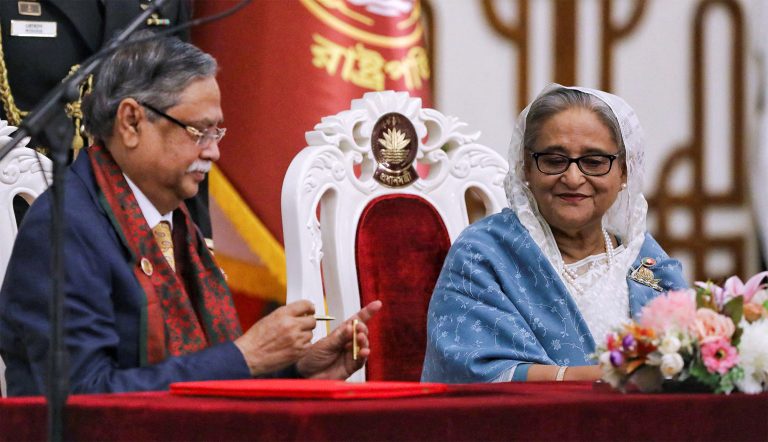
After a few weeks of relative calmness in Bangladesh, protests by students have again erupted, this time against President Mohammed Shahabuddin. Hundreds of protestors attempted to break through security barriers in front of the Bangabhaban on Tuesday evening, in an apparent attempt to repeat the incidents of 5th August that forced PM Sheikh Hasina to flee the country. However, the protesters were chased away by police.

The new storm in Bangladesh is over the resignation letter of Sheikh Hasina, or rather, the apparent lack of it. This all started earlier this week when President Mohammed Shahabuddin said that he does not have the resignation letter of Sheikh Hasina. In an interview published on Sunday, the president said that while he had heard that Hasina has resigned, he does not have documentary proof for the same.

This contradicts his earlier statement that Sheikh Hasina has resigned, after which he had appointed the chief adviser and other advisers to run the interim govt. This U-turn over Hasina’s resignation letter has triggered protests against him, demanding his resignation. The interim govt has said that while no decision has been taken, the matter is under discussion. This means the govt may take steps to remove the president.

Sheikh Hasina had left the country on 5th August in a hurry, and she could not even record her planned speech farewell before departing. As the protestors were moving fast towards her residence, the army gave her just 45 minutes to pack up and leave the country to save her life.

In the interview the president said that on 5 August, there was a call from the prime minister’s office at 10:30 AM informing that Sheikh Hasina will visit the Bangabhaban to meet the president. But an hour later, there was another call came saying she wouldn’t come.

President Shahabuddin said that he was waiting for the PM, and he didn’t know what was happening. The president had heard that the PM had resigned, but he didn’t receive any letter. He said, “At one point, I heard she had left the country. She didn’t tell me anything. I just told you whatever is true. Anyway, when Army Chief General Waker came to the Bangabhaban, I tried to know if the prime minister resigned. He gave me the same answer: ‘I heard she resigned’.”

He said that he tried to collect the resignation letter but could not do. “May be she did not get time,” he said. “When things came under control, one day the cabinet secretary came to collect the copy of the resignation letter. I told him that I too am looking for it,” the president told Manab Zamin Chief Editor Matiur Rahman Chowdhury. The interview was published on “Janatar Chokh”, the political magazine of Manab Zamin.

However, it was reported at that time that Hasina went to the president’s house and tendered her resignation, before leaving for India. After her departure, the president had announced that she had resigned. President Mohammed Shahabuddin said in his address to the nation, “You know that prime minister Sheikh Hasina has submitted her resignation letter to the president and I have accepted it.”

After this, the president had appointed the chief advisor and other advisors to run the executive functions of the government, as there is no provision to form an interim govt in the constitution of Bangladesh.

But now, the president is saying that he does not have the resignation letter, and there is no official document showing that Sheikh Hasina resigned from the post. However, he added that the fact is that the PM has left the country. He said, “There is no room for debate in this regard anymore. The prime minister has left and that is the truth.”

Sheikh Hasina is not in Bangladesh, and she is not expected to return anytime soon. Elections will be held after some months in which Awami League will not be allowed to contest. Therefore, whether the resignation letter exists or not does not matter. However, there is a legal issue associated which could question the legality of the Md Yuns led advisory body.

The presence of the resignation is important to prove the legitimacy of the caretaker govt. If there is no resignation letter, this means officially Sheikh Hasina still the prime minister of Bangladesh. This makes the caretaker govt illegitimate. “Sheikh Hasina did not resign from her prime Minister post and she is still alive. Therefore, Yunus govt is illegal,” tweeted Taslima Nasrin, Bangladeshi author living in India.

However, the president said that to be legally sure, he had taken the opinion of the Supreme Court before appointing the Chief Advisor. The Supreme Court on 8 August gave its opinion on the matter, saying that the president can appoint a chief adviser and other advisers of the interim government, to ensure smooth functioning of the executive.

Law adviser Asif Nazrul presented the court’s opinion in front of the media yesterday, in which the court stated that the prime minister had resigned and that the president had the power to appoint chief adviser and other advisers.

Therefore, the question is now less about the validity of the interim govt, and more about the president’s U-turn over the resignation letter. He is being asked to resign for creating confusion over the Sheikh Hasina’s resignation, which can enable some people to question the legitimacy of the interim govt.

Law advisor Asif Nazrul has already accused him of lying, saying that the president’s comments in this regard was akin to misconduct, and if he maintains this position, the government should reconsider his position. He said, “If you contradict something you have said in front of the whole nation, then that is akin to misconduct. Then the question arises if you have the mental capacity to serve as the president. These questions may arise … you have created the scope for that.”

Later in the day, the president’s office issued a statement urging everyone to refraining from creating a controversy over a settled issue.

The interim govt has not taken a decision on removing the president yet, Chief Adviser’s Press Secretary Shafiqul Alam said today. “We will inform you of any developments regarding the matter,”  the press secretary told the media.

On the other hand, Information and Broadcasting Adviser Nahid Islam said that the resignation of President Mohammed Sahabuddin is a political decision that will be made within a reasonable timeframe, based on public sentiment.

He said, “We formed the government on August 8 to ensure stability and security for the state. However, if the people feel that this setup needs to change, the government will certainly take that into consideration. The president’s resignation is not a legal issue but a political one.” However, he said that the decision will be made soon.

“We have received the message from the people that they no longer want this president. The government understands this, and a decision will be taken in due time,” he said.
Rani Chennamma of Kittur led a armed revolt against the British decades before 1857: Read about her valour and honour in face of abject oppression

India has long been home to bravehearts who have never even thought twice about giving their life to defend their great country. They made their names as valiant leaders and freedom fighters by putting up an unprecedented fight against the invaders and colonisers.

India under British rule suffered two centuries of trauma and exploitation at the hands of its white colonisers which led to widespread unrest and distress among the people. Their plight drove them to raise their voices against the persistent cruelty and injustice which fell on deaf ears. As the discrimination and brutality intensified, the spark of protests soon took the shape of large-scale revolutions like that of the rebellion of 1857 which was started by Mangal Pandey. The same shortly turned into a nationwide freedom struggle in the wake of outrageous British tyranny aimed at curbing the growing voices of independence by whatever means necessary. However, the Indians finally succeeded in uprooting the Britishers from their land.

Unbeknownst to most people, South India was the starting point for most uprisings against the British. Puli Thevar and Veerapandi Kattaboman, Palayakkarars (Poligars) of the mid and late eighteenth centuries in Madras Presidency, the Marudu Pandyan brothers who revolted between 1799 and 1801, the Vellore Sepoy mutiny of 1806 and the revolt of Pazassi Raja of Kottayam in Kerala (1792 to 1805), are few instances of the revolts that occurred before 1857.

The mutineers were all mercilessly put to death by being blown from cannons, beheaded or hanging, a glaring bloody hallmark of British rule. However, they declined to issue an apology or be reinstated under the Britishers, There was a lot of discontent in South India because the British were annexing land without cause and eliminating thriving local industries like agriculture, metallurgy, and textiles in order to replace them with the profitable export of local resources to the United Kingdom to support the British economy. Unsurprisingly, similar policies were enforced throughout India to damage indigenous industries and deplete its coffers while strengthening the British economy as well as pursuing its expansionist agenda. 

Who was Rani Chennamma

Today, 23rd October is the birth anniversary of the queen of Kittur, Rani Chennamma. She was one of those nationalist warriors who helmed a war against British forces in the early 19th century as she was aware of the nefarious objectives of the British administration when many were oblivious. She launched an armed revolt against them and became the first Indian ruler to do so. The two battles of Kittur (in Karnataka) in 1824 were among the first armed pushback against the evil designs of the British East India Company in South India and Rani Channamma, commanded them against the British agent in Dharwad during October and November of 1824. She is renowned for spearheading the uprising against British authority in India, despite being outnumbered which didn’t deter her. The brave queen was later arrested.

She was born in Kagati, a small village in the present-day district of Belagavi in 1778. She belonged to a Panchamasali Lingayat family and learned archery and horse riding at a very young age. She was married to Kittur’s King Mallasarja of the Desai family, who ruled over the region until 1816 after ascending the throne in 1782, at the age of 15. She was his second wife. According to legend, the two met during a tiger hunt. Shivalingarudra Sarja, Mallasarja’s eldest son, succeeded to the throne upon his death in 1816. However, his health began to deteriorate shortly which resulted in a massive challenge before the kingdom that needed an heir to survive.

Rani Chennamma’s palace at Kittur. (Source: Deccan Herald)

Chennamma too had lost her son in 1824 and didn’t have any other children which further complicated the situation. However, she adopted an heir Shivalingappa to rectify the problem. Nevertheless, the British East India Company rejected Shivalingappa as the kingdom’s heir using the “doctrine of lapse.” It alleged that if the monarch of a princely state or territory that was under the British East India Company’s paramountcy (direct influence) as a “vassal” under the British subsidiary system was “manifestly incompetent or died without a male heir,” the state or territory would be automatically annexed.

It is pertinent to remember that the same law was used by the Britishers to attack the kingdom of Jhansi and was meticulously utilised to extend the British Empire. The East India Company essentially deprived local rulers of their sovereignty when it conquered a number of princely territories under the Doctrine of Lapse, notably Satara (1848), Sambalpur (1849), Jhansi (1854), and Nagpur (1854).

The long-standing right of an Indian monarch without an heir to select a successor was rejected by this doctrine. Indians considered the doctrine to be invalid. Kingdoms that had no direct heir were taken away by this arbitrary policy. It was imposed by the British East India Company in 1824 to seize the princely state of Kittur, even before Lord Dalhousie, had officially articulated it. He was employed as the Governor-General of India from 1848 to 1856. It was most likely the first time the policy was imposed. In 1848, Lord Dalhousie simply formalized it by putting it in writing. The doctrine and Dalhousie’s annexations infuriated India’s reigning princes, which contributed to the mutiny of 1857.

The British used the principle of paramountcy and absolute power to order Rani Chennamma to banish the adoptive child Shivalingappa. However, the defiant queen disobeyed the directive. Rani Chennamma wrote to Bombay Presidency Lieutenant-Governor Lord Elphinstone to support Kittur’s cause, but her request was denied which led to a war. The British attempted but were unsuccessful, to seize Kittur’s gems and riches, which were worth about Rs. 1.5 million. It was attacked by a force of 20,797 men and 437 guns, primarily from the Madras Native Horse Artillery’s third troop.

British soldiers suffered severe losses in the first engagement in October 1824, which was overseen by a British agent and collector in Dharwad, St. John Thackery, claiming that any princely state without a natural heir would fall and be absorbed by the Company. According to historian Queeny Pradhan’s book Ranis and the Raj, Thackery gave the order for a company of infantrymen and two cannons of horse artillery to enter the fort. Rani Chennamma led the Kittur troops in a counterattack that resulted in heavy fire. Her bravery was rewarded with a victory as Thackeray was slain.

Chennamma’s lieutenant, Amatur Balappa was behind the casualties and Thackeray’s demise. Sir Walter Elliot and Stevenson, two British officers, were also captured and were only freed after the Britishers assured her that they would end the conflict as the unbridled violence had also troubled her. However, like all good things, this triumph didn’t last long. True to their nature, they had tricked her and again began a campaign to capture Kittur as they couldn’t handle their humiliating defeat, especially from a woman.

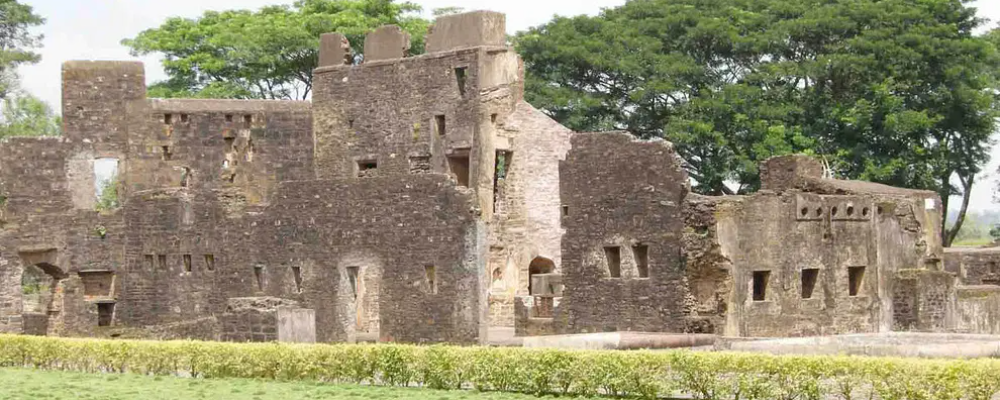
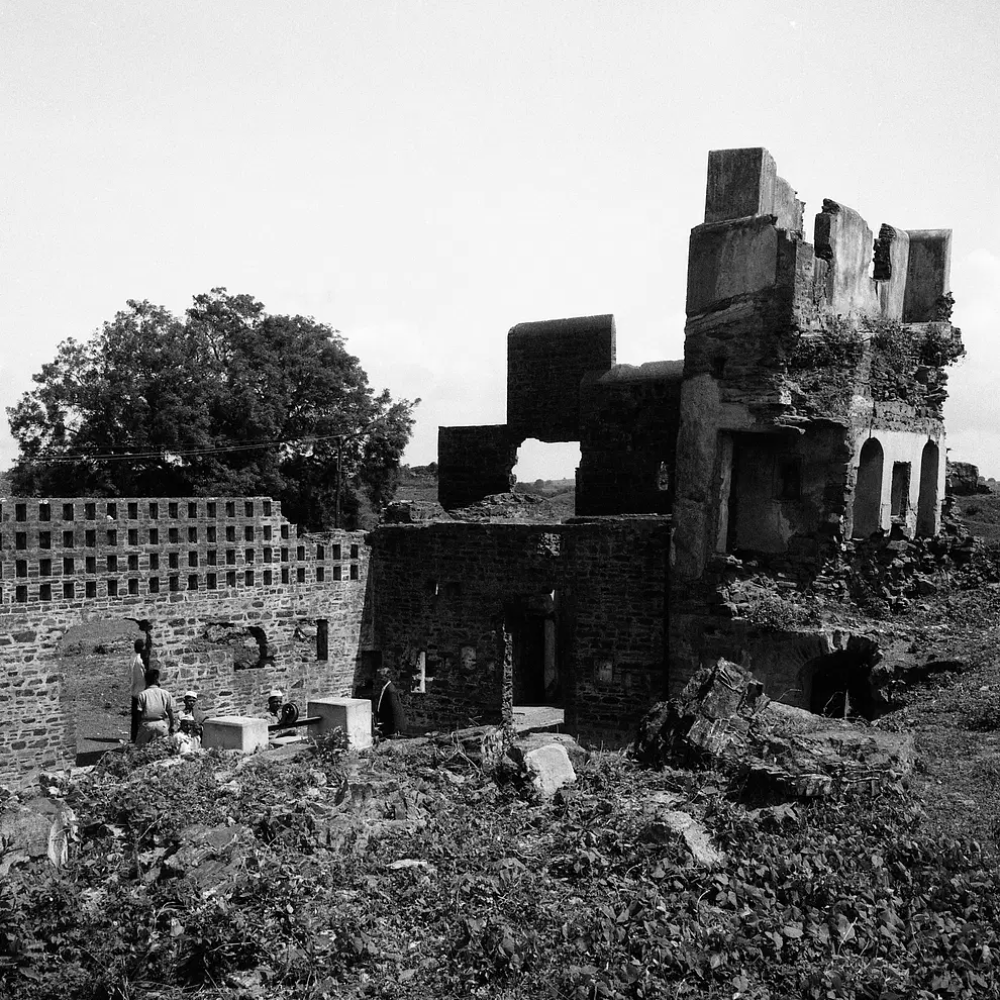
A view of the ruins of Kittur fort. (Source: Deccan Herald)

British Commissioner and Governor of Bombay Chaplin entered the dispute with additional troops. Munro, a sub-collector of Solapur and the nephew of Sir Thomas Munro was killed by her. The Kittur Fort was attacked and taken by the British on 3rd December 1824. Rani Chennamma battled heroically, but she was betrayed by some of her people. The traitors Mallappa Shetty and Venkata Rao combined gunpowder and cow dung and fired it from cannons. She was also outnumbered and eventually taken prisoner at Bailhongal Fort with her family.

The queen prayed for her release during her final years by reading sacred scriptures and doing poojas. She eventually lost all hope and was unable to stand the miserable circumstances any longer due to which her health steadily declined and he passed away on 21st February 1829 inside the fort. She is buried in Bailhongal taluk.

Rani Chennamma’s legacy lives on

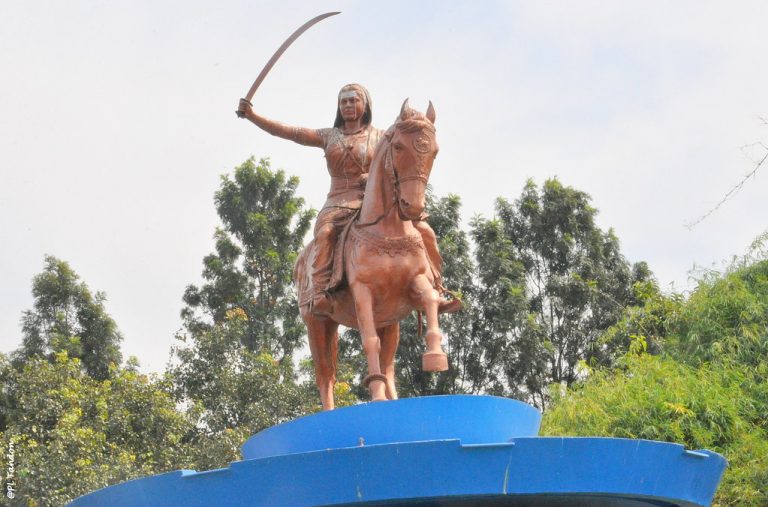
Rani Chennamma’s life was ended soon, but her protests against the British gave the Kittur people the strength to resist persecution. Despite the unfortunate outcome, the nation will always remember Chennamma’s unparalleled strength and valour. Numerous Kannada Lavanis, or folk songs, honour Rani Chennamma as a guardian and defender. Her equestrian statue in the village of Kakati lies to the south of the Bengaluru-Pune national highway. Amatur Balappa, Sardar Gurusiddappa, Gajaveera Siddi, Avaradi Veerappa, Bichugatti Channabasappa and Sangoli Rayanna who were her close associates are also celebrated and their heroic tales are narrated in several Lavani songs.

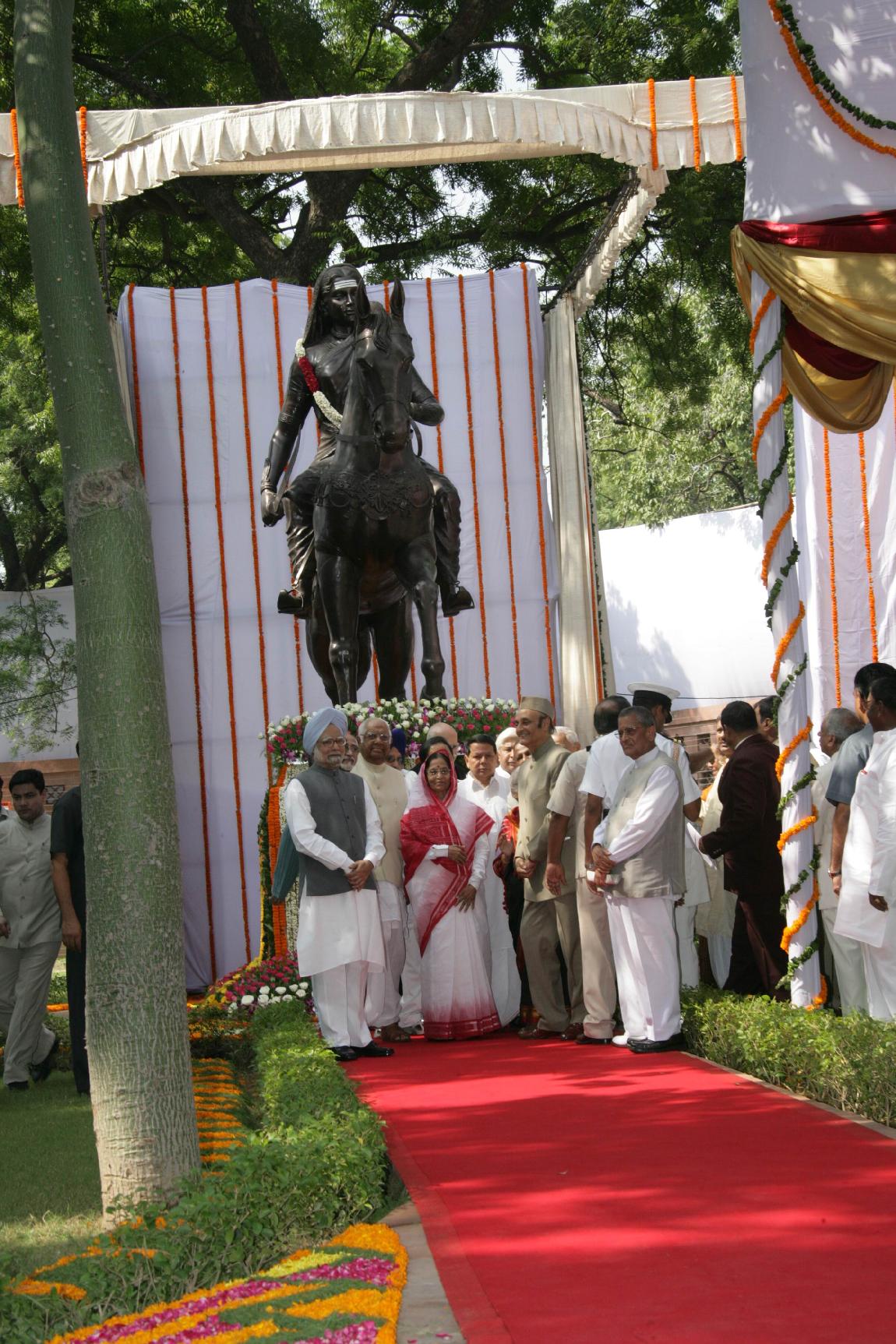
Rani Chennamma’s statue at the Parliament. (President of India – Digital Library)

The Kittur Utsava, which takes place every year from 22nd and 24th October honors Chennamma’s maiden win and her legacy. Her samadhi is located in a government-maintained little park. India’s first female president, Pratibha Devisingh Patil, unveiled a statue of Rani Chennamma of Kittur at the Parliament complex in New Delhi on September 11, 2007. Vijay Gaur created the sculpture, which was donated by the Kittur Rani Chennamma Memorial Committee. Other statues of Rani Chennamma revere the many Karnataka cities, with her eyes glimmering with intense passion, a silver sword gleaming in her hands, and a horse carrying her with pride. Her unwavering courage and stories of indomitable spirit continue to reverberate throughout the state and nation as well as inspire many, today and always.

‘Will give a strong blow to anyone who looks at Muslims with ill intent’: RJD leader Tejashwi Yadav sparks a row with contentious remarks

0

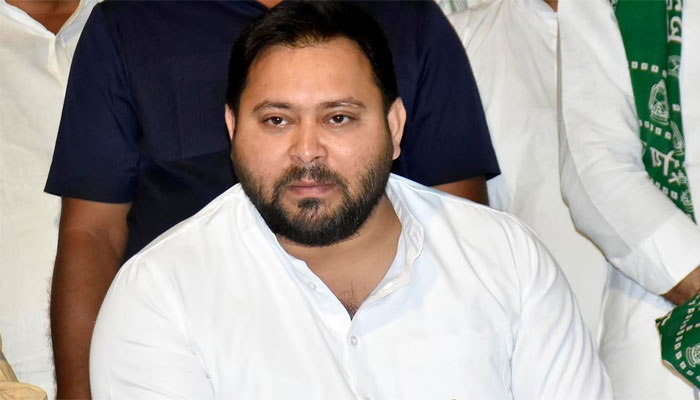
On Wednesday, 23rd October, Rashtriya Janata Dal (RJD) leader Tejashwi Yadav lashed out at former Union Minister Giriraj Singh’s Hindu Swabhiman Yatra and Araria Bharatiya Janata Party (BJP) MP Pradeep Kumar Singh over his statement. Yadav claimed that there has been an attempt to create divisions and riots between communities. He said, “The way Giriraj Singh is organising a Yatra and the absurd statement given by BJP’s Araria MP, there is an attempt to create a rift and riots between two communities.”

Sharing a video statement, he wrote on X, “Today, a BJP MP made an inflammatory statement to disrupt the atmosphere in Bihar, and on the very same day, Nitish Kumar Ji provided additional security to that MP. In this country’s soil lies the fragrance of everyone, and everyone has contributed to its freedom. I assure every individual that as long as I breathe, I will stand firm against anyone who tries to throw Bihar into the fire of communalism, and we will give a strong blow to anyone who looks at Muslims with ill intent.” (Hindi post on X by Yadav translated to English)

In the 7-minute long Facebook Live video, Yadav condemned the hateful language used by Singh during the Hindu Swabhiman Yatra in Araria, accusing him of attempting to provoke riots between Hindus and Muslims. He also slammed Nitish Kumar for providing security to individuals spreading hate, calling it a betrayal of Gandhi’s values. Yadav asserted that the Rashtriya Janata Dal has always fought against communal and feudal forces, vowing to continue this fight. He warned that if any communal violence occurs in Bihar, Nitish Kumar will be solely responsible. Emphasising unity, Yadav appealed to the people to focus on key issues such as education, healthcare, unemployment, and poverty, instead of communal hatred and called for building a peaceful and progressive Bihar. He added, “RJD has always been a party of social justice and secularism. We have always sacrificed whenever needed. We have always fought against communal and feudal forces and will keep doing so.”

But RJD leaders have often relied on mouthing off platitudes to defend their brazen minority appeasement aimed at rallying Muslim votaries behind the party. The effort to woo Muslims has intensified as RJD fears further losing stature in the INDI alliance, especially after the disastrous Lok Sabha elections, wherein Lalu Prasad Yadav’s party won only 5 seats, serving a body blow to the opposition alliance.

Since then, RJD has been courting different communities lest the political ground slips further, particularly in the wake of a new political party floated by election strategist Prashant Kishor, who has been challenging the party and its leaders in its stronghold and drawing huge crowds to his rallies.

Even so, this is not the first time that RJD has indulged in minority appeasement. Ahead of the Lok Sabha elections, Lalu Prasad, the former Chief Minister of Bihar and leader of the Rashtriya Janata Dal (RJD), sparked controversy by advocating for a “complete” reservation for Muslims. This stance triggered sharp criticism from Prime Minister Narendra Modi and his former ally, the JD(U).

Addressing the media in Patna, Lalu Yadav accused the ruling BJP of aiming to abolish reservations by dismantling the Constitution. “Muslims should receive full reservation… They (BJP) aim to dismantle the Constitution and democratic fabric of our nation,” asserted the RJD leader, a lie that has been menacingly weaponised by the opposition to project the BJP was against the Constitution.

Another FIR on journalist Mahesh Langa held in GST fraud case, now booked for possession of confidential govt documents

0

On Tuesday, October 22nd, Gujarat Police raided the Gujarat Maritime Board office in Gandhinagar following the arrest of Mahesh Langa, a Gujarat-based reporter for the English newspaper The Hindu, in connection with a GST scam. This raid has led to significant revelations leading to the increase of the legal pressure on Langa. A complaint has been registered against him at the Gandhinagar Sector 7 Police Station as the investigations in the given case continue.

The FIR has been classified as ‘sensitive,’ so specific details are unavailable despite attempts to obtain them. However, media reports suggest that Langa allegedly exploited his position as a journalist to acquire government documents, which he then shared with others. The investigation is focusing on identifying the recipients of these documents and how they were utilized. Authorities are also probing whether Langa received any financial benefits in return.

On Tuesday, more than five teams of Gandhinagar police conducted a search operation at the Maritime Board office, where they recovered documents indicating that Langa, along with certain officials, had leaked sensitive information related to a private port, the Gujarat Maritime Board (GMB). As a result, some officials may also face questioning. Additionally, police have reportedly retrieved chat records between Langa and the involved officials. A detailed investigation is expected to follow.

During the preliminary investigation, police discovered that Langa had obtained government documents from certain officials and shared them with opposition parties and industrialists. Notably, none of these documents were ever published in The Hindu. Based on this information, authorities conducted a search operation at the Gujarat Maritime Board office.

According to a report from Jagran, Langa, as a journalist, is accused of misusing documents related to Gujarat’s ports and policies, either by obtaining or stealing them. It is suspected that he may have used this information to fuel political or business rivalries. Several officers and employees are currently being questioned in connection with this case. Additionally, a new FIR has been lodged against Langa at the Gandhinagar Sector 7 Police Station.

Sector 7 Police Station’s PI Bharat Singh Gohil confirmed in an interview with OpIndia that the FIR has been registered. However, since the investigation is being handled by higher authorities, the local police do not have further information at this stage. The charges include violations under Sections 303(2), 306, 316(5), and 61(2) of the Indian Code of Justice (BNS), along with Sections 7(a), 8(1), and 12, 13(1) of the Bribery Detention Act. Initially, Langa is the only named accused, but further revelations are expected as the investigation continues.

Meanwhile, the Ahmedabad Detection of Crime Branch (DCB) arrested five more individuals on Tuesday as part of the ongoing investigation into a nationwide GST evasion racket involving a network of 220 shell companies, many of which are based in Gujarat. DCP Ajit Rajian identified the five arrested as Adil Kadar Khokhar, Kadar alias Navdi Rafiqbhai Khokhar, Akil Anubhai Pathan, Shahrukh Rafiqbhai Rangrej, and Sarfaraz Mustafa Chauhan, all residents of Bhavnagar.

With these latest arrests, the total number of individuals apprehended in the case has risen to 13. The first individuals arrested in connection with the case were Mahesh Langa, Aijaz alias Maldar, Abdulkader alias Bapu, and Jyotish Magan Gondaliya. On October 13th, Faizal Munaf Shaikh, Irfan alias Padu Sattar Jethwa, Jignesh Himmatlal Desai, and Paresh Pradeep Dodiya were apprehended. After their police remand expired on October 18th, they were all transferred to judicial prison at Sabarmati Central Jail.

Mahesh Langa approached the Gujarat High Court about ten days ago, challenging his 10-day police remand, claiming it was politically motivated. However, at the plea hearing on October 14th, he withdrew the request.

Langa’s arrest came after 13 enterprises and their owners were charged with alleged input tax credit (ITC) fraud, according to a complaint filed by the Directorate General of GST Intelligence. The Crime Branch is now investigating the case. According to investigators, the GST fraud caused huge losses for the government, with the accused collecting and passing on false ITC via fake invoices. The FIR states that the scheme comprised over 220 shell firms formed using falsified documentation.

UP: Christian conversion racket operating in network marketing style in Meerut, poor Hindus were being offered cash, free weddings and exorcism

0

In the Meerut district of Uttar Pradesh, a Christian conversion racket has been exposed. The police conducted raids at a house in Vikas Nagar Colony and found over 40 children and women. It has been reported that in a network marketing style, the non-Christian people were being brainwashed with the promise to bear the expenses of getting their children married, money, and curing their diseases.

A pastor named Bijju, from Kerala, rented a house in the Vikas Enclave Colony in the Kankerkheda police station area two months ago and now resides there with his family. He used to organise prayer gatherings here every Sunday, and a big number of people would attend from the morning till the evening. Seeing this, the locals became suspicious and alerted the local police and Hindu organisations.

On Sunday, 20th October, when the police and Hindu activists arrived at Bijju’s rented house, they found women and children sitting on the ground while Bijju and his wife were seated on chairs and inciting them against Hinduism. “Love the one who loves you. Today is Karva Chauth but the family does not love you, God does, so take refuge in God,” Bijju was heard saying.

He further said: “You have to worship Jesus. What is money? You will get whatever you want. What have your gods given you to date? You don’t even get respect in society. Come to Jesus. You will get everything here.” Bijju’s remarks enraged the local people and Hindu activists. Meanwhile, BJP councillor Rishipal Singh was also present there.

Following this, the police transported Bijju, his wife, and another individual to the police station. The police investigated and arrested these three people after receiving a complaint. BJP leader Anmol alleged that after interrogation, he learned that pastor Bijju and his wife had converted 300 individuals so far.

During its ground investigation, Bhaskar’s team found that this conversion racket was being operated in a planned fashion. Akin to network marketing, the person who is converted has to bring two other people and get them converted and in exchange, they receive certain benefits.

The accused pastor Bijju used to make three promises to lure people into converting to Christianity, First, he would arrange the marriage of the boy or girl of the converted family and the expenses would be borne by the church. Second, he would promise to give Rs 2 to 5 lakhs to the converted person or family to start their own business. Third, he would promise holy water and exorcism to “cure diseases.”

According to BJP leader Anmol, women and children have been visiting Bijju’s house for the past one and a half months. Later, it turned out that they were propagating Christianity. Anmol reports that Bijju and his wife have been renting houses in different areas of Meerut for the past 15 years, converting people to Christianity through prayer gatherings.

The BJP leader added that a woman who came here told that anything they learnt about Christianity had to be shared and taught to two other people. They were asked to tell them about God’s grace and miracles. Once converted, that person’s task was to prepare another one for conversion to Christianity. In this fashion, the network continued to form, particularly targeting women and poor families. 

Speaking about the matter, SP City Ayush Vikram Singh said that there is an allegation of conversion and its investigation has been handed over to CO Daurala Suchita Singh. He said that further action would be taken on the basis of whatever facts emerge after the investigation. SP Ayush Vikram Singh said that if the matter of conversion turns out to be true, then stringent action will be taken against the accused.

India-China patrolling agreement also includes parts of Arunachal Pradesh, Army Chief says ‘need to restore trust and assure each other’

New Delhi and Beijing have agreed to resume patrolling to the “agreed perceived Line of Actual Control,” including in Depsang Plains and Demchok, the two lingering flashpoints in eastern Ladakh where the two countries have been eyeball-to-eyeball for almost four-and-a-half years. Furthermore, the agreement with China will involve reducing the number of locations in Arunachal Pradesh, which during the previous four years have become hotspots for tension, reported The Economic Times.

The new agreement with China specifically covers two regions, Yangtse and Asaphila. Tensions were rekindled in December 2022 when Indian and Chinese troops engaged in a large-scale confrontation in Yangtse. Chinese troops attempted to breach the LAC and destroy the Army’s freshly erected defences, which led to the conflict. The attack was foiled after it occurred on an Indian post overlooking recently constructed PLA infrastructure. Over the past few years, there have also been numerous faceoffs and small-scale conflicts in the heavily forested Asaphila sector. The broader disengagement and de-escalation process in Arunachal Pradesh is expected to require more time, effort, and communication with China because it is far more complicated than the situation in Ladakh, according to sources.

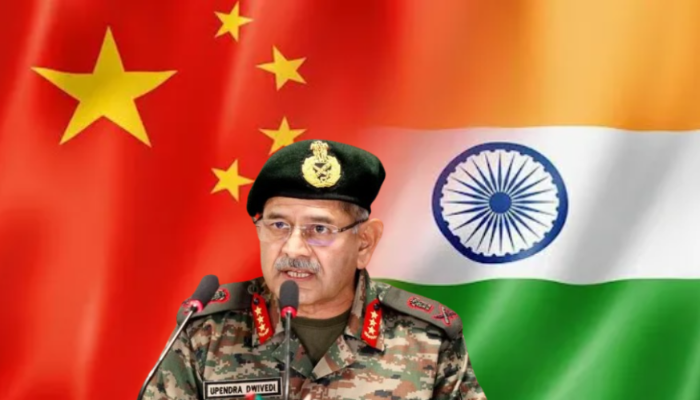
On 22nd October, a day after the development transpired, Army Chief General Upendra Dwivedi emphasised that multiple measures need to be taken after which disengagement, de-escalation, and regular Line of Actual Control (LAC) management will follow. He mentioned that the two sides are trying to “restore trust” and “reassure each other” while addressing the 28th Colonel Pyara Lal Memorial lecture organised by the United Service Institution of India.

“As of now what has happened? We are trying to restore the trust. How will the trust be restored? It will get restored once we can see each other and convince each other that we are not creeping into the buffer zones that are there and have been created. Both must reassure each other. Patrolling gives you that kind of advantage. So that is what something which is commencing. And as we restore the trust, the other stages will also follow through soon,” he conveyed to the audience.

He was alluding to a more extensive de-escalation process that will entail the withdrawal of hundreds of troops who have been stationed in eastern Ladakh since 2020. The external affairs ministry stated that a patrolling agreement with China has been reached, and as of April 2020, the status quo will be reinstated. According to information obtained, positions in Arunachal Pradesh that have had flare-ups over the previous four years would also witness ease in positions as part of the broader agreement.

General Dwivedi stated, “As far as we are concerned, we want to go back to the status quo of April 2020. Thereafter we will be looking at disengagement, de-escalation and normal management of LAC. The normal management of LAC will not stop there. There are phases in that also. This has been our stance since April 2020, and even today it remains the same. As we restore the trust, the other stages will also follow through. This has been our stance from April 2020 when Lieutenant General YK Joshi was the Army Commander and even today that remains the same.”

The agreement on patrolling arrangements is expected to lead to disengagement, de-escalation and de-militarisation in areas where 50,000 to 60,000 troops are stationed on either side. Indian and Chinese troops will reportedly patrol the territories as they did before April 2020, and the departure of competing troops from Depsang and Demchok would undoubtedly not entail the establishment of designated buffer zones. There will be a difference between this disengagement and the earlier troop withdrawal rounds that included the formation of buffer zones. According to reports, the disengagement of front-line Chinese and Indian soldiers from Depsang and Demchok is anticipated to start in a few days and conclude in a few weeks.

The troop withdrawal is anticipated to be executed in stages as the intricate plan develops, as both parties can verify it on the ground. Additionally, it will gradually remove weapons and equipment to a predetermined distance until the status quo ante (early April 2020) is restored.

After troop disengagements on both banks of Pangong Tso, encompassing the Kailash range, Galwan Valley, and the greater Gogra-Hot Springs area, earlier in September 2022, China and India established no-patrol buffer zones, ranging from 3 to 10 kilometres. The purpose of these zones of separation was to prevent violent confrontations.. Thousands of soldiers from both armies remain in the Ladakh theatre, along with their cutting-edge equipment.

A senior officer warned that India should take precautions against “Doklam being repeated” in eastern Ladakh, as the pullout is now planned for the strategically important Depsang Plains and the Charding Ninglung Nallah track junction close to Demchok. “Trust but verify. China should not be allowed to change facts on the ground and then present them as a fait accompli,” he voiced.

In 2017, Indian troops halted Chinese attempts to expand its motorable route towards the Jampheri Ridge, which overlooks the strategically sensitive Siliguri Corridor, resulting in a 73-day standoff on the Bhutanese territory of Doklam. The PLA (People’s Liberation Army) built extensive military facilities and permanently stationed troops in north Doklam following the disengagement.

On 1st October General Dwivedi expressed that trust between the Indian Army and PLA was “the biggest casualty” of the military stalemate, characterizing the situation along the LAC in eastern Ladakh as “stable but sensitive.” He highlighted at the time that while diplomatic signals are encouraging, military leaders on both sides must carry out their options on the ground to move things along.

On 29th August, the Working Mechanism for Consultation and Coordination (WMCC) on border issues between China and India convened in Beijing for the seventeenth time since the conflict began in May 2020. To reduce tensions along the LAC, the two forces have also had 21 rounds of discussions at the corps commander level.

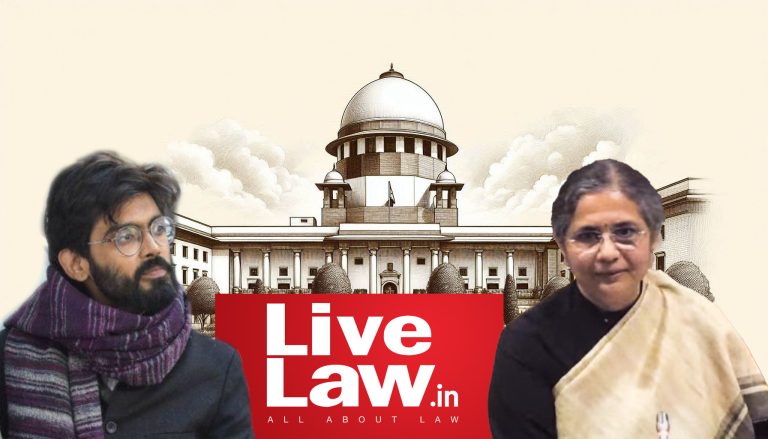
MA Rashid’s LiveLaw misrepresents Sharjeel Imam hearing in SC, Managing Editor tries to defend error, misrepresents facts again

On the 22nd of October 2024, LiveLaw – a legal news portal founded by MA Rashid – tweeted that the bail hearing of Sharjeel Imam, the “student activist,” had been delayed again.

“Student activist #SharjeelImam‘s petition assailing delay in hearing of his bail plea in the Delhi Riots Larger Conspiracy case not taken up today by the #SupremeCourt Next hearing likely on Friday ie 25th October” read the tweet.

In their previous tweet, they wrote, “#SupremeCourt to hear student activist #SharjeelImam‘s petition assailing Delhi HC’s delay in deciding his bail plea in the 2020 #DelhiRiots larger conspiracy case Bench: Justices Bela M Trivedi and SC Sharma. Imam has been in custody for over 4 yrs”.

The archived links of the tweet can be accessed here and here.

The tweets by LiveLaw essentially made the following assertions:

  1. The hearing was in the Supreme Court
  2. The hearing was about the delay in the High Court regarding the hearing of his bail petition
  3. The hearing pertained to the Delhi Riots larger conspiracy case (FIR 59/20)
  4. The bench of the Supreme Court which postponed the hearing comprised of Justice Bela Trivedi and SC Sharma

There was indeed a hearing in the Supreme Court in an ongoing case involving Sharjeel Imam, however, it was not a bail hearing, it was not about the delay in High Court, it was not pertaining to the Delhi Riots larger conspiracy case.

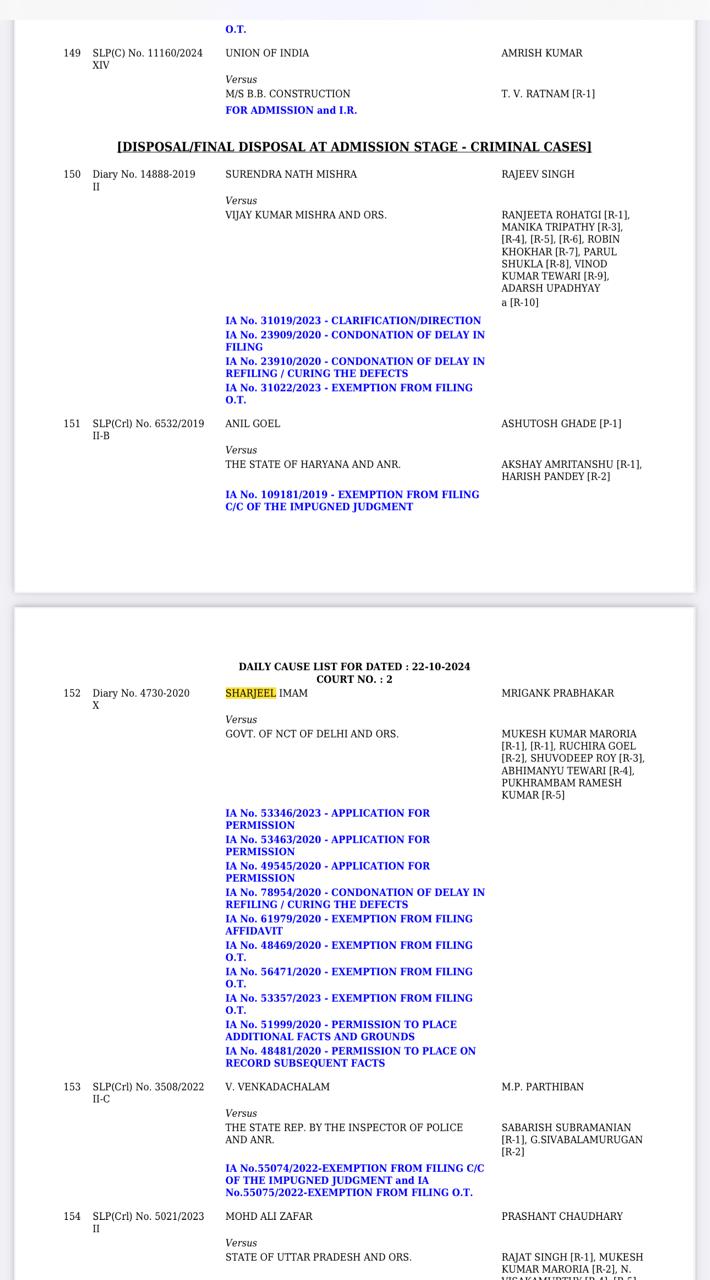
We checked the Supreme Court listings to understand what ongoing case was being heard in the Supreme Court of India pertaining to Sharjeel Imam.

Supreme Court listing

As can be seen, the Sharjeel Imam vs Govt of NCT and others case (#152) has been assigned a diary number. The Diary Number assigned by the Supreme Court is 4730-2020.

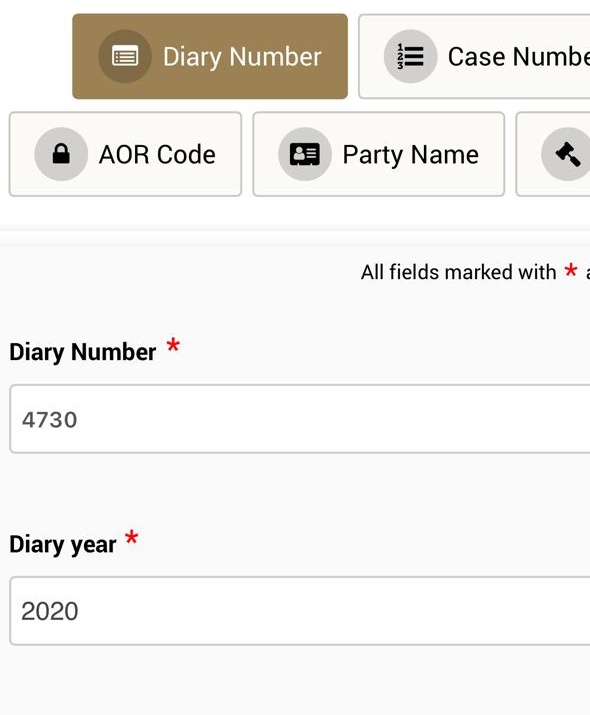
We then searched the case by diary number.

Diary Number case search

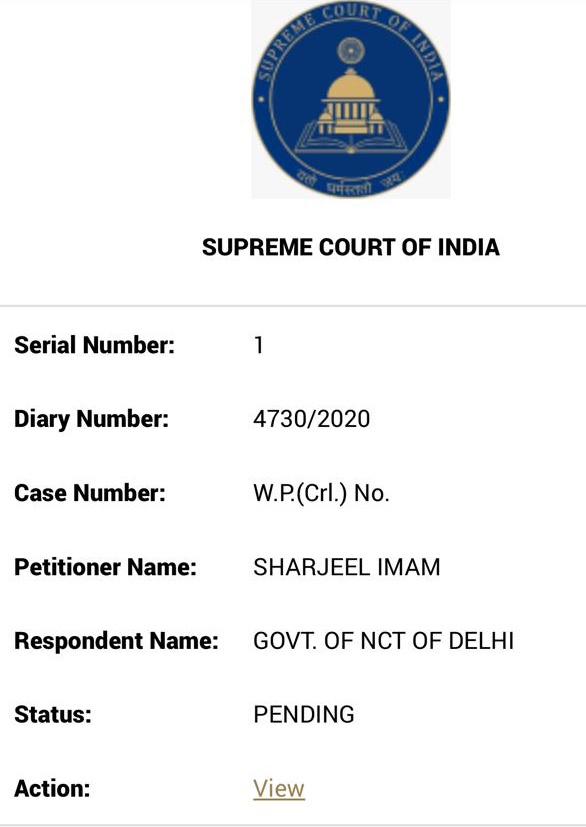
The search threw up the result for the case.

As can be seen, the diary number is the same – 4730/2020 – and the petitioner is Sharjeel Imam.

When one clicks on “view”, the website of the Supreme Court of India throws up details of the case.

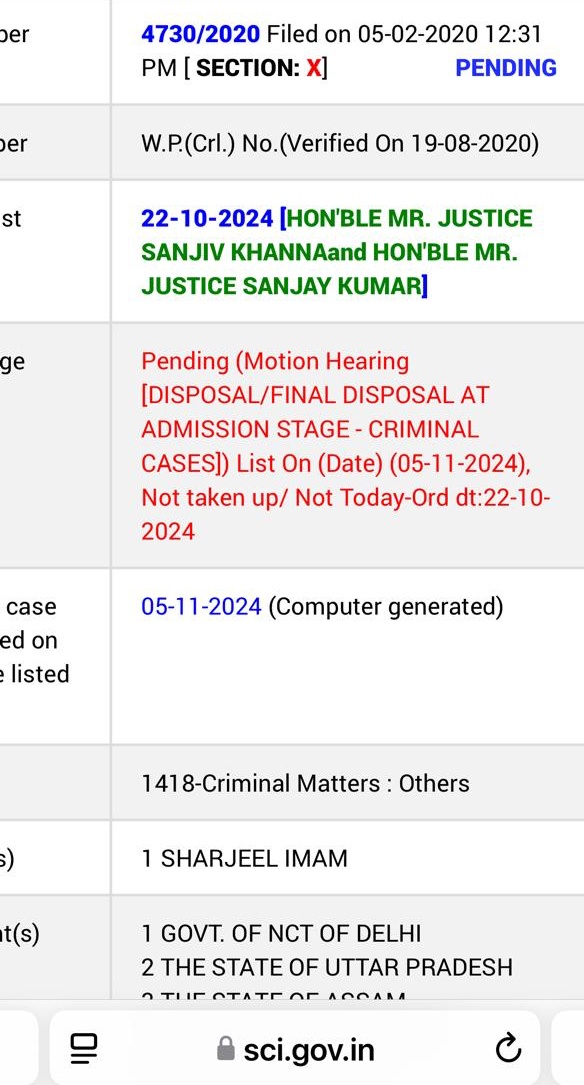
Supreme Court case details

As one can see, the diary number reflected is the same. What acts as proof that it is the same case that LiveLaw was tweeting about is that the date of hearing as listed in the Supreme Court website is 22nd October 2024. The LiveLaw tweet was also on the same date.

According to the information on the Supreme Court website, the case was listed in front of a bench comprising of Justice Sanjiv Khanna and Justice Sanjay Kumar.

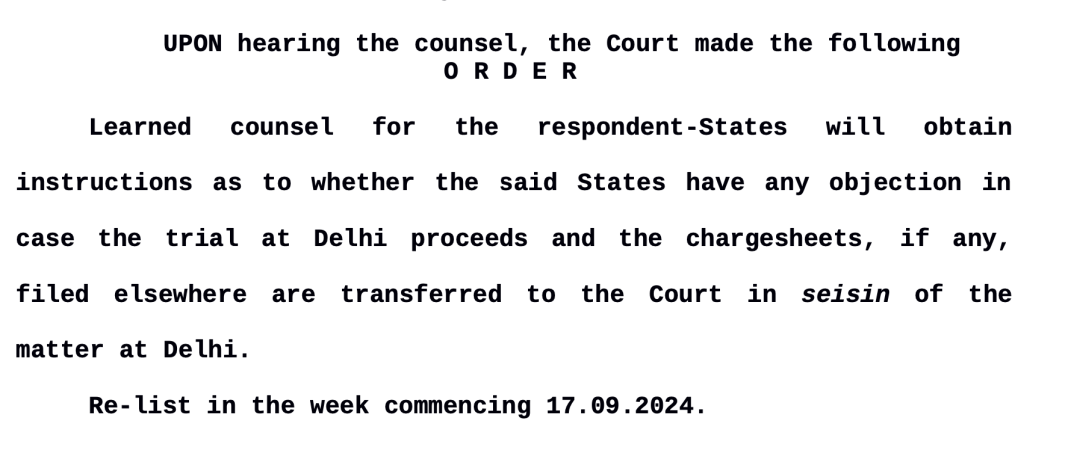
In an August hearing, for example, the bench comprising of Justices Sanjiv Kumar, Sanjay Khanna and R Mahadevan had ordered that the “respondent-states will obtain instructions as to whether the said states have any objection in case the trial at Delhi proceeds and the chargesheet, if any, filed elsewhere are transferred to the court in seisin of the matter at Delhi”.

The order itself makes it evident that the case in the Supreme Court has nothing to do with bail in the High Court but is about the clubbing of FIRs.

This case pertains to a 2020 plea by Sharjeel Imam after he was arrested for seditious speeches. FIRs were filed against him in Uttar Pradesh, Assam, Manipur and Arunachal Pradesh. The petition by Sharjeel Imam in 2020 essentially requested for the clubbing of the FIRs and for the hearing in the sedition cases (for the speeches he delivered) to be continued in Delhi. If the Court agreed to the clubbing of the FIRs, Sharjeel Imam would get default “bail” in the other FIRs in different states with the case being heard only in Delhi.

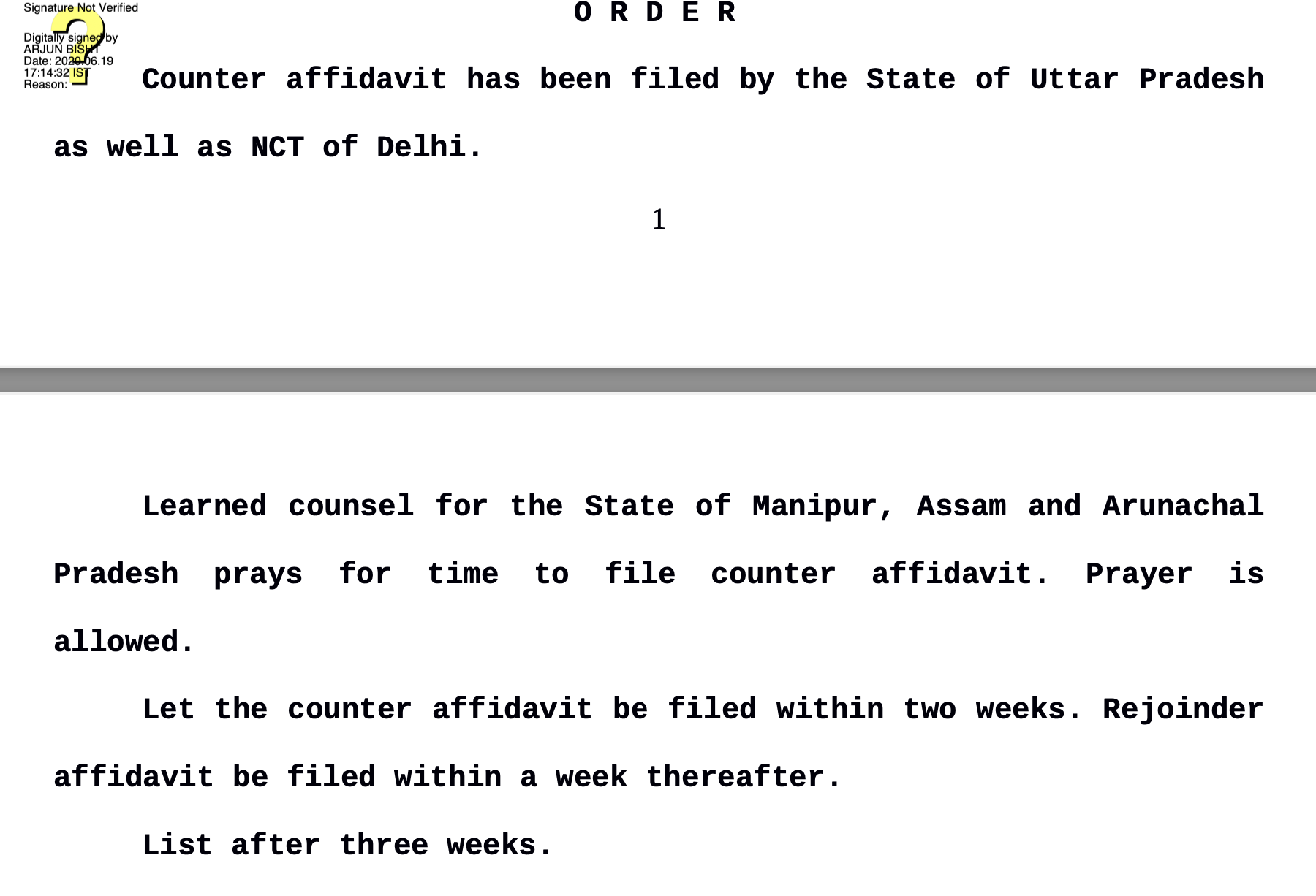
In a 2020 order, the states that were set to respond to the petition at the time were also mentioned, proving, that the case pending in the Supreme Court had nothing to do with bail hearings or the conspiracy case, but in fact, was about clubbing of the FIRs in the sedition case pertaining to the speeches he had delivered in Jamia Millia Islamia and Aligargh Muslim University.

Court order from 2020 in the same case

It is, therefore, evident that the information published by LiveLaw is misleading.

The explanation provided by the cabal who is set on ensuring that Sharjeel Imam, the UAPA accused Islamist, and others like Umar Khalid are painted as the victim of the system was that there indeed is a “hearing” pending before Justice Bela Trivedi’s bench.

Mohammad Zubair of AltNews, who regularly shields Islamists and paints a target on Hindus, posted a screenshot from the cause-list showing a listing of Sharjeel Imam’s petition in front of a bench comprising of Justice Bela Trivedi and Justice Satish Chandra.

Interestingly, the screenshot posted by Zubair, meant to discredit the report confirmed the report.

The screenshot proves that the only ongoing case in the Supreme Court by Sharjeel Imam is the one to club FIRs and not the bail hearing.

The screenshot shared by Mohammad Zubair is a listing of a FRESH petition filed by Sharjeel Imam only on the 9th of October 2024. The verification of the petition, as is a legal requirement, was done on the 21st of October 2024.

The Supreme Court website clearly specifies that the petition is listed for admission.

When the petition is listed for admission, it cannot be deemed as an ongoing hearing especially after 2 days of verification and when the petition hasn’t even been accepted by the court yet.

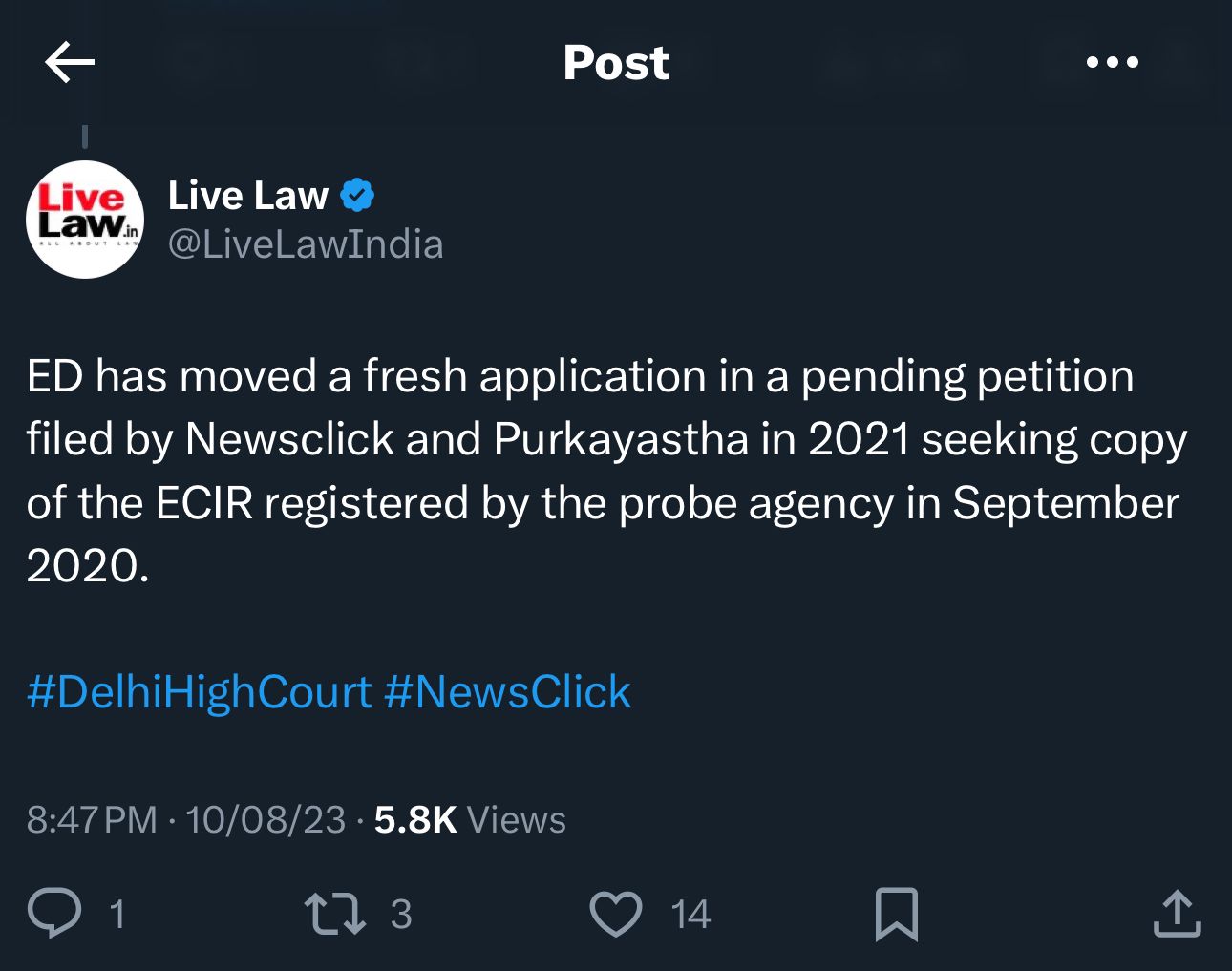
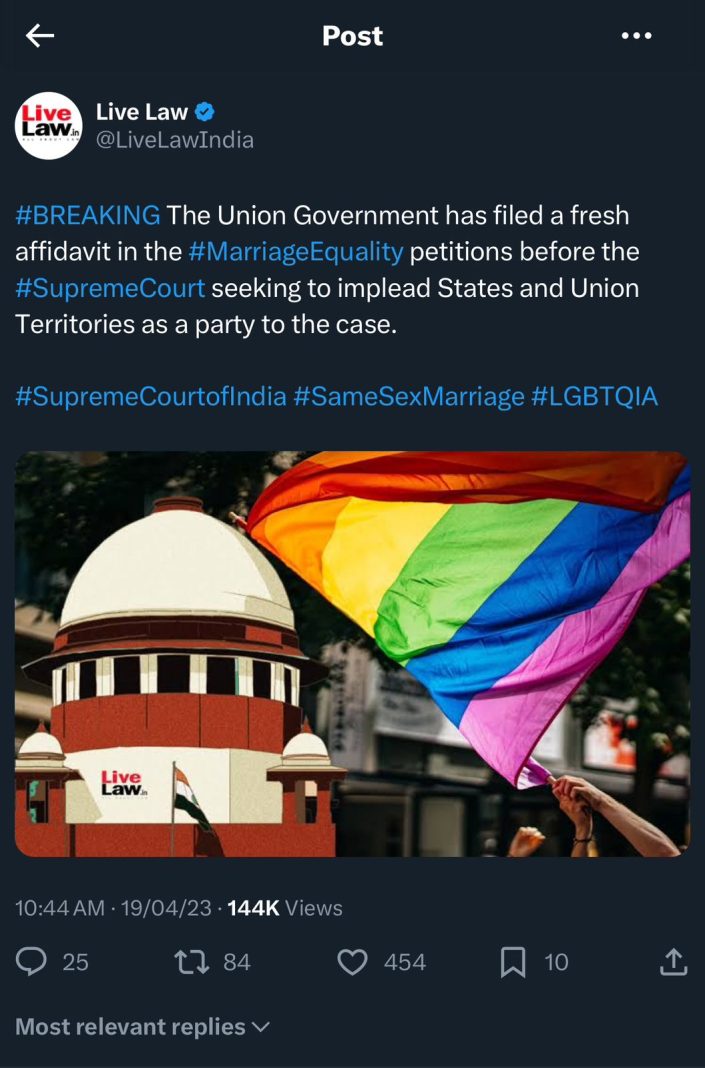
The sleight of hand by LiveLaw is evidenced by the fact that in the past, LiveLaw reported hearings of fresh petitions by clearly mentioning that a fresh petition had been filed – pending acceptance by the court.

This only goes to show that LiveLaw deliberate left that detail out from its reportage to give the impression that a regular bail hearing was delayed by the Supreme Court so that a narrative can be created in favour of Sharjeel Imam and against Justice Bela Trivedi – which has been the norm in the Left-Islamist circle.

To remind our readers – even when the bail application of Umar Khalid was pending before the Supreme Court, which was eventually withdrawn by Umar Khalid and his lawyer Kapil Sibal, there was a concerted effort to tarnish the image of Justice Trivedi and an active campaign to ensure that the case can be heard by a different judge – spearheaded by Prashant Bhushan and Kapil Sibal. OpIndia had written about how this is an effort at potential bench fixing. To the CJI’s credit, he had put his foot down and ensured that the bench fixing efforts fail. It was after the CJI’s decision that Sibal had decided to withdraw the bail application of Umar Khalid from the Supreme Court and approach the lower court again to “try his luck”. The detailed article can be read here.

This misinformation and half truth by LiveLaw and Mohammad Zubair seems to be a step in a similar direction.

Case against Sharjeel Imam

Sharjeel Imam was booked by several states in 2020 for his provocative speeches during anti-CAA, including the call for ‘cutting off’ Assam from the rest of India. FIRs were filed at Police stations in Assam, Arunachal Pradesh and Manipur for his speech.

Imam was also accused of making provocative speeches outside Jamia Milia Islamia University in December 2019 that led to violence outside the campus. In 2022, a Delhi court framed charges of sedition and UAPA against him for his inflammatory speeches against CAA.

Sharjeel Imam was arrested by Delhi Police on 28th January 2020, from Bihar over inflammatory speeches against the Citizenship Amendment Act, advocating for the secession of Assam from the rest of India. He delivered several such speeches in December 2019 and January 2020 at various places including Jamia Millia Islamia University and Aligarh Muslim University.

The accusations against Sharjeel Imam were framed under sections 124A (sedition), 153A, 153B, 505 of the IPC, and 13 of the UAPA. Imam has been charged with sedition, promoting enmity between different groups on grounds of religion, race, place of birth, imputations prejudicial to national integration, and public mischief under the Indian Penal Code, and indulging in unlawful activities under the Unlawful Activities (Prevention) Act.

As per the Delhi police chargesheet against Sharjeel Imam in the matter, he offered statements inciting hatred, contempt, and disaffection toward the central government, as well as instigating the people who resulted in the December 2019 riots.

Editors note: This article has been updated by the the explanation offered by AltNews and our counter to those claims.

Addendum

After the publication of this article, Manu Sebastian, the managing editor of LiveLaw took to X to offer an explanation and call the report by OpIndia “fake news”.

In a long thread, Manu Sebastian called the report “malicious, factually wrong & a blatant misrepresentation of the court proceedings, which can amount to contempt of court”.

In the thread, Sebastian made the following claims (the following are verbatim quotes from Manu Sebastian’s thread on X):

  1. LiveLaw had posted that Sharjeel Imam’s petition regarding bail in the Delhi riots larger conspiracy case was listed before a bench of Justices Bela Trivedi & SC Sharma on October 22. LiveLaw had also updated that the matter was posted to Oct 25 as it was not taken up that day.
  2. What the OpIndia article terribly concealed was that there were two petitions of Sharjeel Imam which were listed in the Supreme Court on October 22 before two different benches (of Justices Khanna & Trivedi respectively).
  3. One petition (WP (Crl) 422/24) was listed before Justice Bela Trivedi’s bench. This was seeking directions for expeditious hearing of his bail plea in the Delhi High Court in the riots conspiracy case. The other petition of Sharjeel Imam (Diary no.4730/2020) was listed before Justice Khanna. This petition was to consolidate various FIRs against him.
  4. What OpIndia omitted to tell its readers was that both the petitions of Imam were listed on the same day in the Supreme Court before different benches.

Interestingly, in his need to defend the shoddy reportage of LiveLaw, Manu Sebastian misrepresented facts yet again and deliberately left out critical details. In his explanation, Manu Sebastian was right that there was indeed 1 petition listed in front of Justice Bela Trivedi – a fact that OpIndia missed because it was not an ongoing case and LiveLaw had no report on its website indicating the same.

While Manu Sebastian is maintaining that it was a bail petition which was listed in front of Justice Bela Trivedi. He says in his thread, in an attempt to counter OpIndia, that LiveLaw reported that the bail hearing was posted before Bela Trivedi on the 22nd of October and that the matter was posted on the 25th of October.

The critical information that Manu Sebastian missed in his thread is that this is a FRESH petition filed by Sharjeel Imam which is not at a hearing stage as far as bail is concerned. The FRESH petition was verified only on the 21st and on the 25th, it is set to be heard for ADMISSION. This would mean that on the 25th and thereafter, the court would first decide whether the petition itself is to be admitted. If the court decides to admit the petition, only then would the hearing on the bail and the prayers mentioned in the petition start. The court can just as well refuse to admit the petition and if that happens, the Supreme Court would not be hearing the merits of the bail and the prayers made in the petition at all.

Therefore, it is important to mention here that there is, currently, only ONE ongoing case in the Supreme Court pertaining to Sharjeel Imam – which is one that was filed in 2020 – for the clubbing of FIRs. The petition to club FIRs is in the hearing stage, while the FRESH bail application is not. The latter has not even been admitted yet.

This critical detail which is being omitted by the likes of Manu Sebastian and Mohammad Zubair serve a specific purpose.

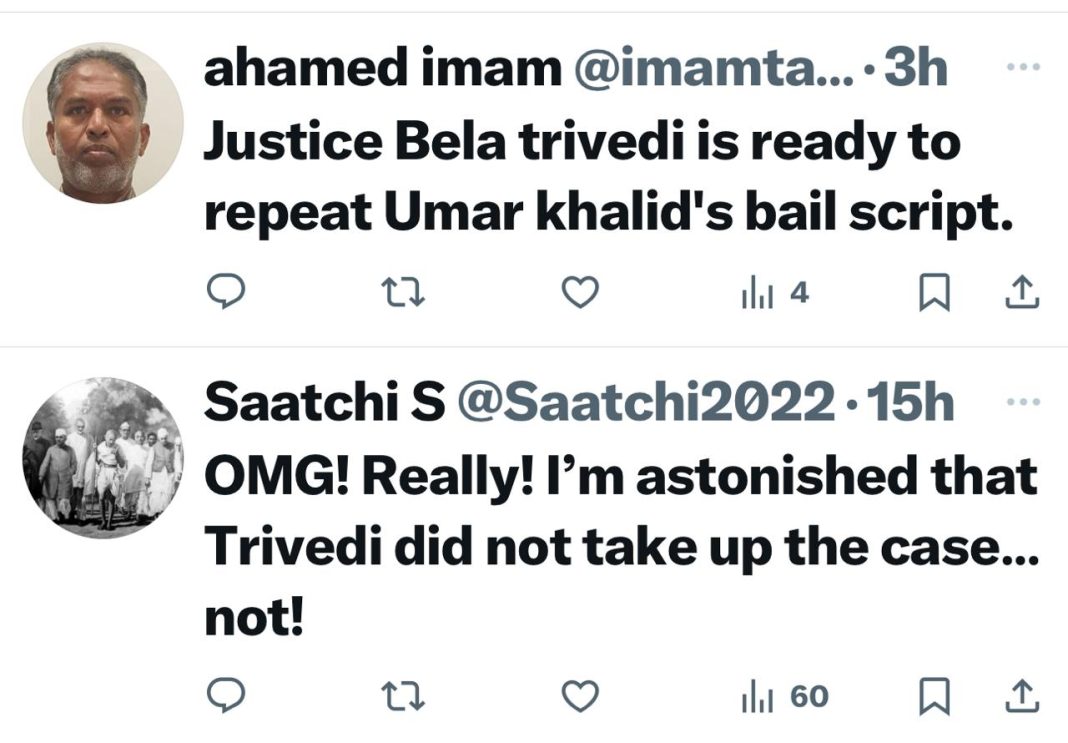
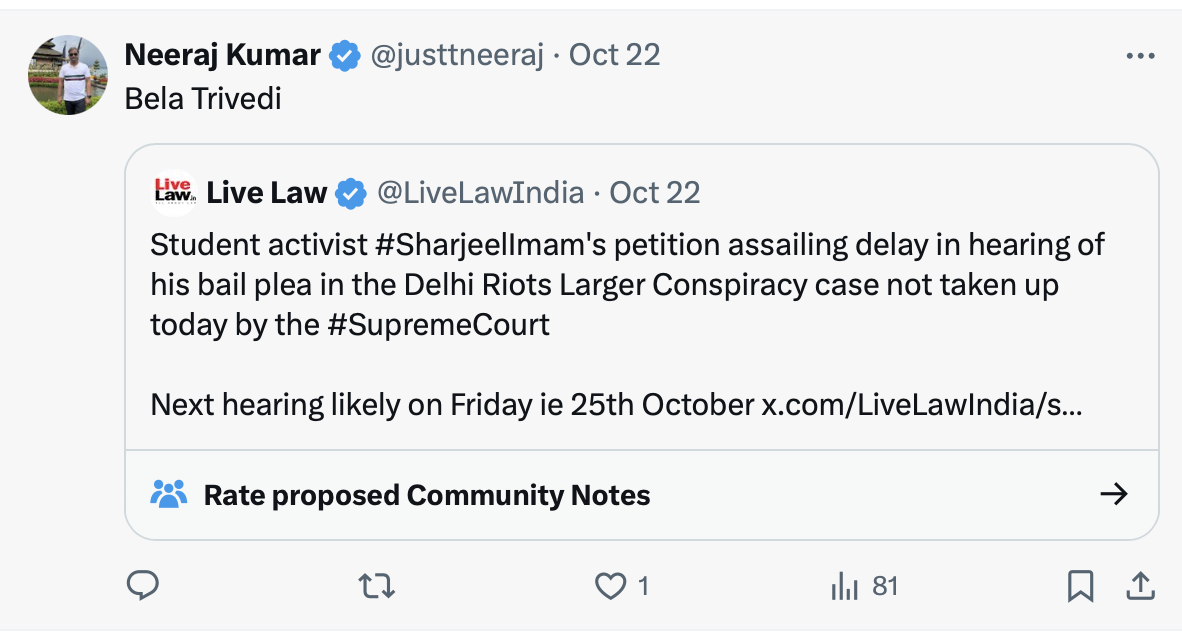
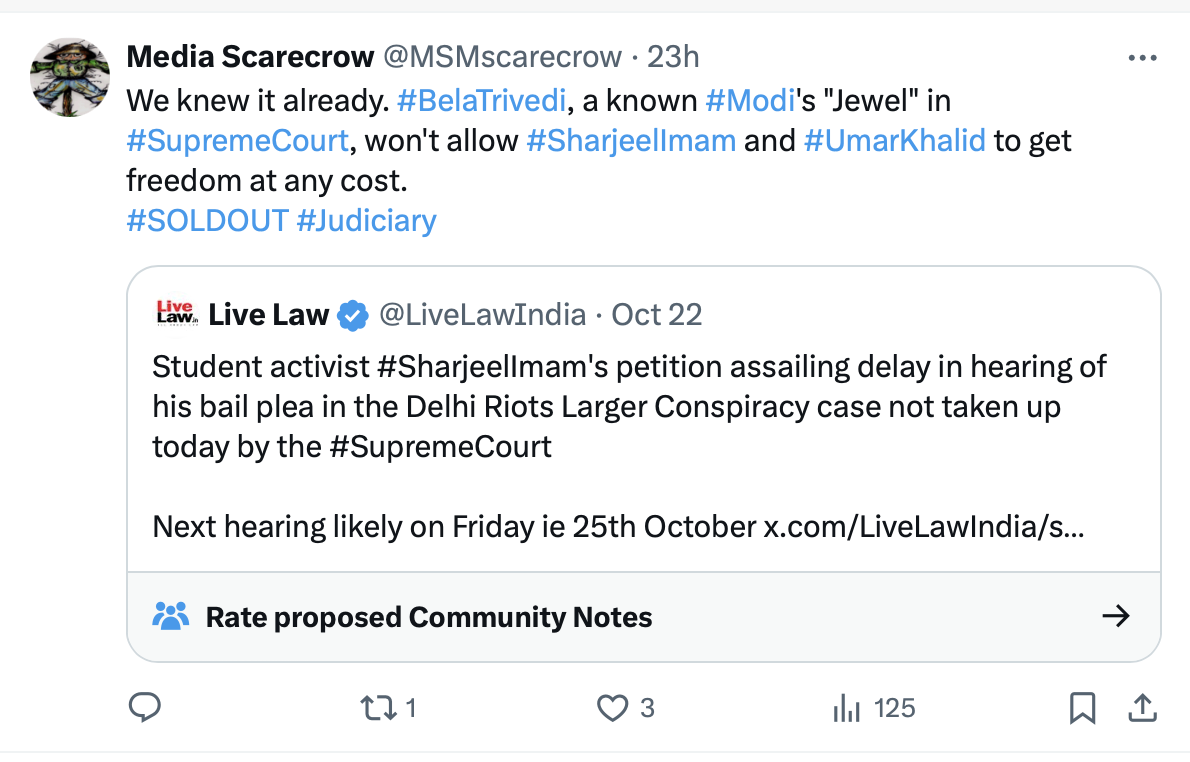
As soon as the news was posted by LiveLaw, which Manu Sebastian now defends, there were a flurry of tweets blaming Justice Bela Trivedi and painting Shajeel Imam as an innocent man denied justice. Pertinently, LiveLaw too had called Sharjeel Imam an “activist”.

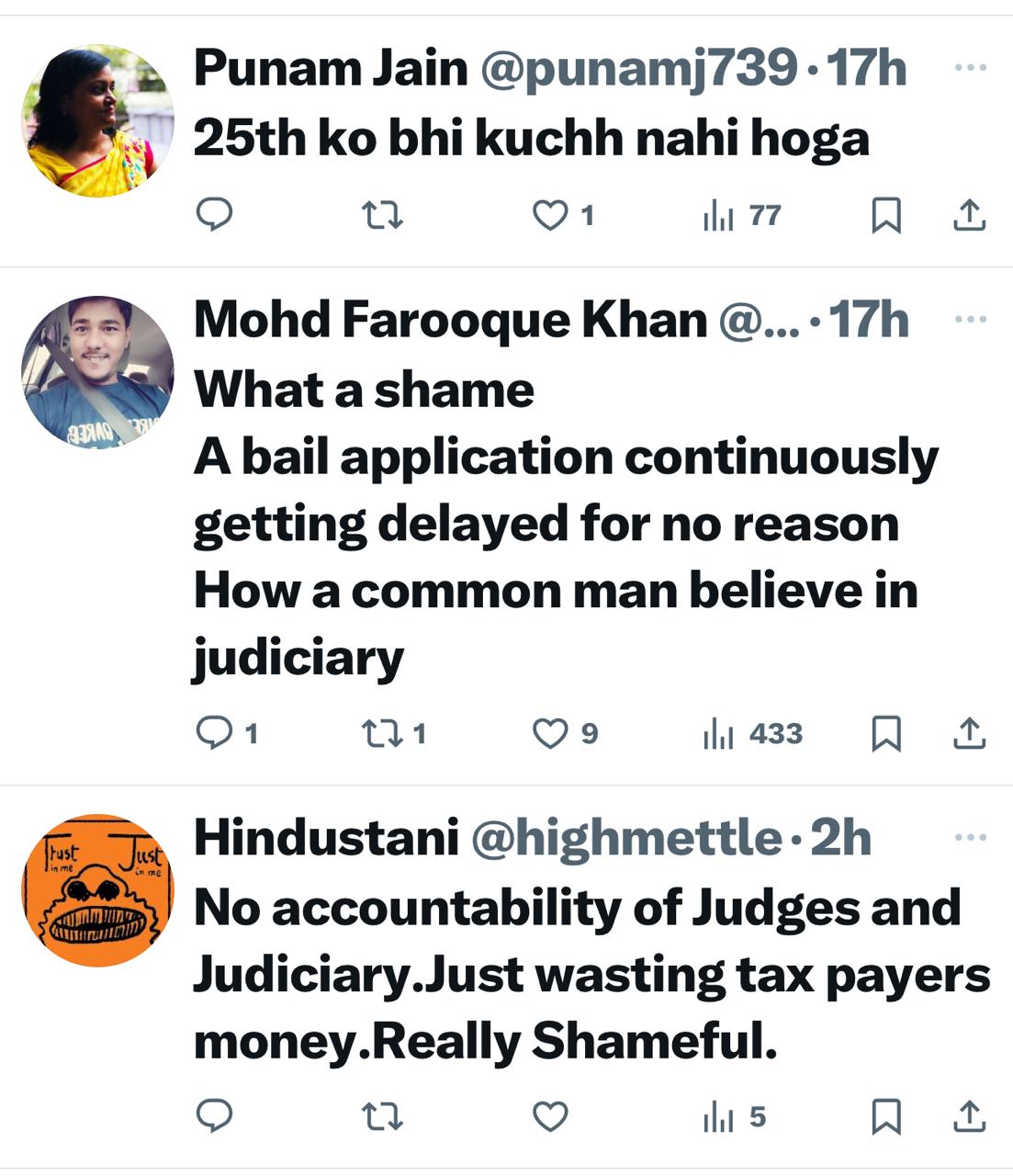
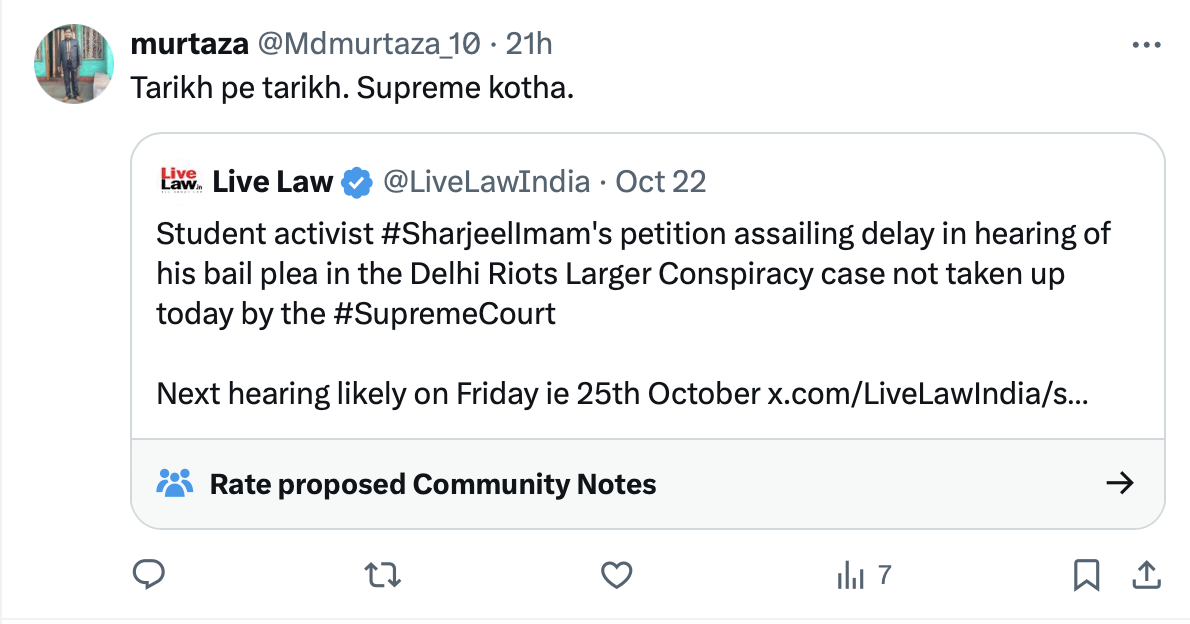
The tweets in response to the reportage by LiveLaw, which missed critical details, led to several reactions where the Supreme Court was called a brothel (kotha) and assailed for denying justice and delaying giving bail to Sharjeel Imam.

Further, Justice Bela Trivedi was personally targeted.

The misrepresentation by LiveLaw led to personal targeting of a judge and contemptuous statements against the Supreme Court. Had LiveLaw represented the facts accurately, stating that it is a FRESH petition and that it had only been verified 2 days ago, allegations of bias and delay in hearing would not have arisen. Even in Manu Sebastian’s explanation, this important detail is missing, furthering the narrative that the Supreme Court, especially Justice Bela Trivedi, is deliberately delaying the bail proceedings of Sharjeel Imam.

Bihar: Bengal TMC leader Ashok Ojha arrested along with 4 others for alleged smuggling of elephant tusks, expelled from party

0

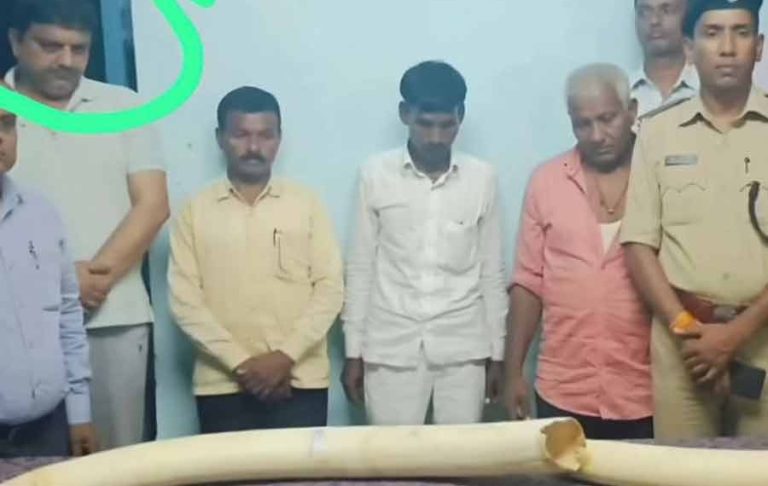
On Wednesday, 23rd October, the joint team of Bihar police and forest department arrested Trinamool Congress leader Ashok Kumar Ojha from West Bengal and 4 others for smuggling elephant tusks in Buxar district of Bihar. The officers raided a house in Devkuli village, located under the Brahmpur police station area in Bihar, and recovered two elephant tusks weighing around 23 kg, worth lakhs of rupees. The operation was executed as the police followed a tip-off of the illegal sale of tusks in the illegal market.

As per the reports, the house that was raided by the police in Devkuli, from where the recovery of tusks was made, belonged to Burrabazar TMC leader Ojha. He has been the vice president of the North Kolkata Trinamool Hindi Cell and has been closely associated with the Jorasanko TMC MLA Vivek Gupta. After the arrest, the leader was notably expelled from the party.

The five arrested persons including Ojha are being questioned. After the reports of his arrest, TMC reportedly expelled him from the party.

However, as per MLA Vivek Gupta, this is not a case of smuggling. He claimed that Ashok Ojha used to keep elephants at his Bihar house, and one of his elephants died recently. The tusks belonged to the dead elephant, Gupta claimed. He added that the party has nothing to do with the incident and Ojha has been expelled from the party.

BJP’s Suvendu Adhikari took cognizance of the event and commented on X criticizing TMC for allegedly being a ‘general store of crimes’. He indicated that the party leaders had been involved in all types of scams and were now not even sparing the wildlife.

“TMC is the general store of Crimes:- Coal Smuggling, Cow Smuggling, Illegal Sand & Stone Mining, MGNREGA Job Card Scam, Mid Day Meal Scam, Ration – Food grains Smuggling, Teacher Recruitment Scam, Medical Equipment/Medicines Smuggling, Admission Scam.. The list grows… Now Wildlife is also not being spared. I wonder what’s next !!!” he said.
Notably, the other four accused persons arrested by the joint team along with Ojha have been identified as Ganpat Sah from Begusarai, Manoj Kumar Pandey from Pipra Jagdishpur, Paras Nath Ram from Karakat, and Dhananjay Prasad Singh from Tirasi Bigha, Rohtas.

According to the police investigation, the smuggling network intended to sell the tusks after an elephant died in Devkuli during the COVID-19 outbreak.

Police said that after the elephant died during the pandemic, an attempt was devised to sell its tusks illegally. According to forest department officials, transporting elephant tusks is a serious violation of the Wildlife Protection Act. Legal action will be taken against the accused to the full extent of the law. Further investigation is underway to discover more of those involved in the smuggling network. 

Modi govt introduces Draft National Sports Governance Bill 2024 to reform sports administration

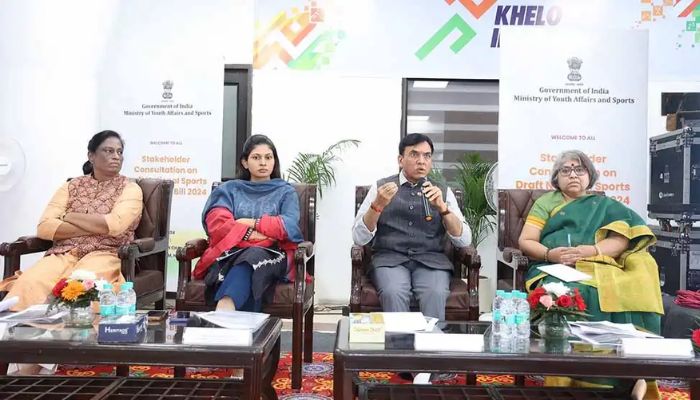
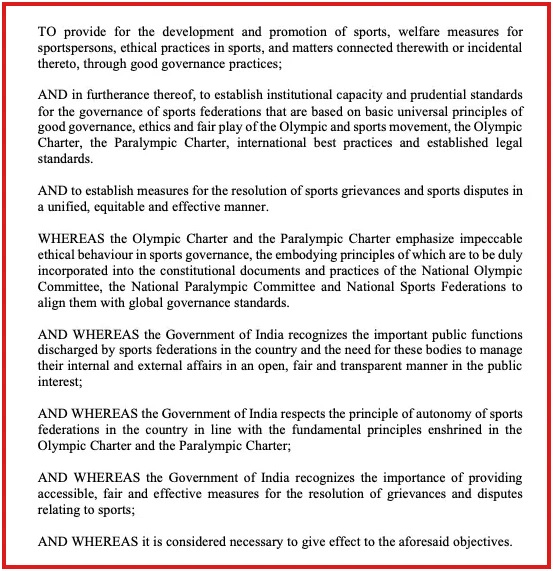
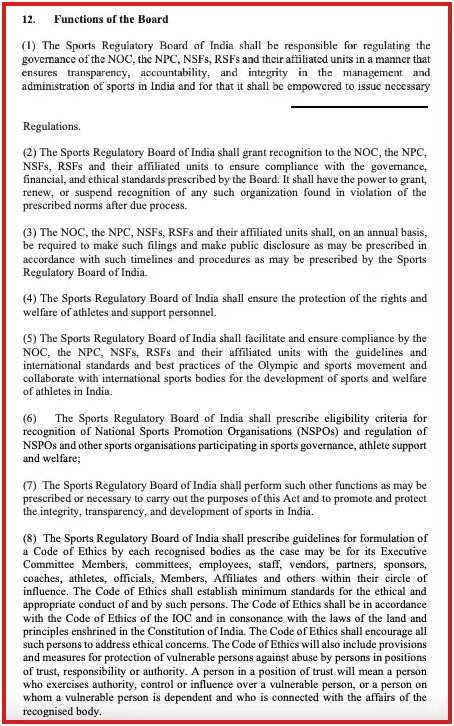
In a major step towards sports reforms, the Modi government has introduced the Draft National Sports Governance Bill, 2024 for public consultation. This Bill aims to promote sports, athlete welfare, and ethical sporting conduct by means of good governance, institutional capacity building, and conformity with international norms.

According to the Ministry of Youth Affairs & Sports, unlike the 2013 Draft National Sports Development Bill, the 2024 Sports Bill lays emphasis on building institutional capacity and governance standards for National Sports Federations [NSF] in alignment with the Olympic and Paralympic Charter.

“…to establish institutional capacity and prudential standards for the governance of sports federations that are based on basic universal principles of good governance, ethics and fair play of the Olympic and sports movement, the Olympic Charter, the Paralympic Charter, international best practices and established legal standards,” a point in the Bill reads.

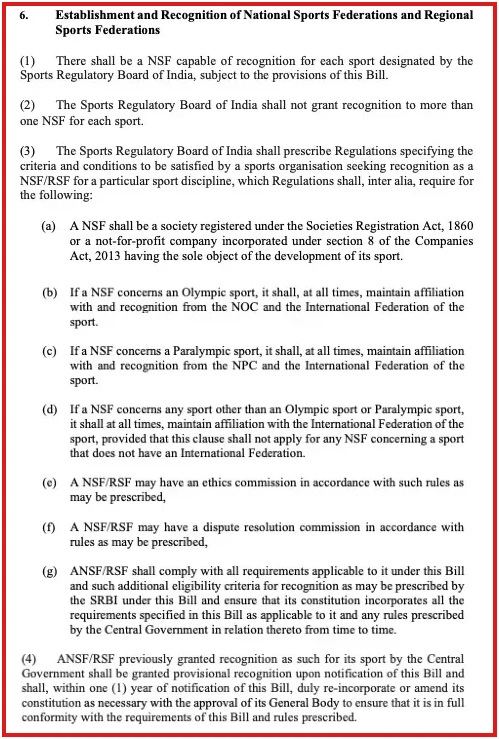
The draft proposes the creation of a central regulatory entity [Sports Regulatory Board] to award recognition to National Sports Federations (NSFs) and monitor compliance with governance, financial, and ethical guidelines.

“The Sports Regulatory Board of India shall be a body corporate by the name aforesaid, having perpetual succession and a common seal, with power subject to the provisions of this Act, to acquire, hold and dispose of property, both movable and immovable, and to contract, and shall, by the said name, sue or be sued,” the Bill states about the proposed Board.

This Board will be entrusted with the task of regulating the governance of the NOC, the NPC, NSFs, RSFs and their affiliated units to ensure “transparency, accountability, and integrity in the management and administration of sports.”

“The Board will ensure compliance with governance standards, protect athlete welfare, and handle recognition and enforcement, shifting these duties from the ministry to an independent body for more streamlined and transparent regulation,” Sports Secretary Sujata Chaturvedi and public policy professional Aatman Shah wrote in an article published in Hindustan Times explaining the provisions and benefits of the proposed bill.

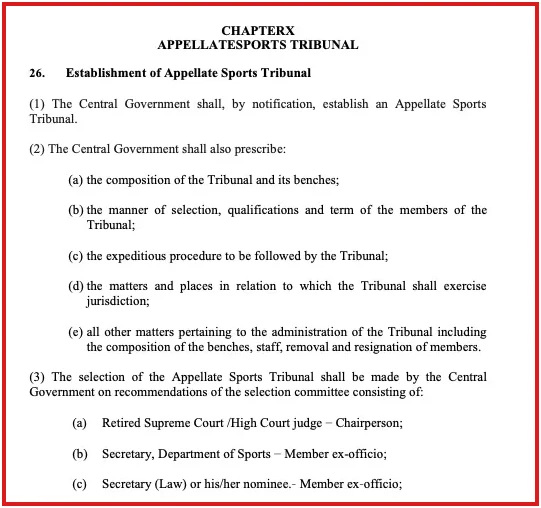
Another important provision of the Bill is the establishment of an Appellate Sports Tribunal to expedite sports-related disputes. As per the Bill, this Tribunal will have the same powers as are vested in a civil court under the Code of Civil Procedure, 1908, to discharge its functions under this Bill while dealing with matters like “summoning and enforcing the attendance of any person and examining him on oath; requiring the discovery and production of documents; receiving evidence on affidavit, calling for any public record or document or a copy of such record or document, from any office, subject to the provisions of section 123 and 124 of the Indian Evidence Act, 1872; issuing commissions for the examination of witnesses or documents;  reviewing its decisions; dismissing an application for default or deciding it, ex parte; setting aside any order of dismissal of any application for default or any order passed by it, ex parte; and any other matter which may be prescribed.

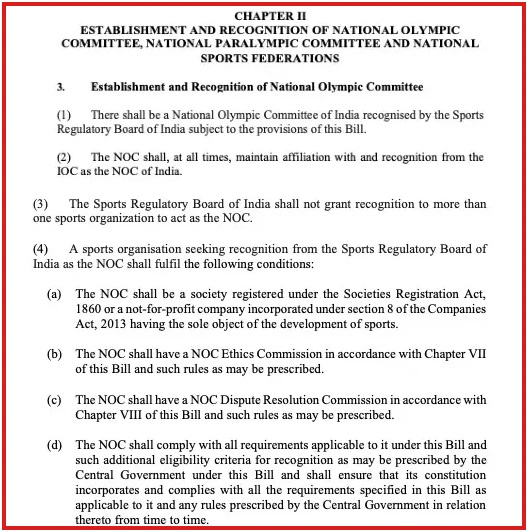
In addition, the Bill proposes the organisation of national sports governing bodies such as the Indian Olympic Association (IOA), the Paralympic Committee of India (PCI), and NSFs to prevent exploitation. Moreover, the Bill also states mandatory provisions for ethical governance by setting up Dispute Resolution Commissions and Ethics Commissions. The Bill also listed certain provisions to be mandatorily incorporated in the constitution of the National Olympic Committee as well as the National Paralympic Committee.

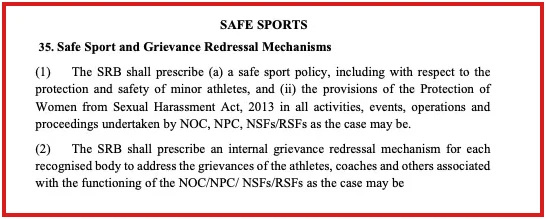
The 2024 Sports Bill also provides representation and participation in policy-making by establishing an Athletes Commission with government financing and a ‘Safe Sports Policy’. The legislation also includes guidelines for recognising and regulating National Sports Promotion Organisations (NSPOs), the establishment of a dedicated appellate sports tribunal, and ad hoc Normalisation Committees.

The Bill also necessitates gender representation in Executive Committees and other governing bodies, guaranteeing that at least 30% of members be female. This is consistent with global trends in gender equality and inclusivity in sports. The bill also establishes a Sports Election Panel. The IOA/PCI/NSFs will enlist electoral officials to conduct free and fair elections on behalf of a Sports Election Panel.

With this Bill, the Modi government aims to connect India’s sports governance framework with global charters and best practices in order to develop an internationally acceptable structure for hosting international sporting tournaments.

UP Police arrests 19 people, including AIMIM members, for inciting riots in Budhana over alleged ‘blasphemy’ against Hindu youth Akhil Tyagi

0

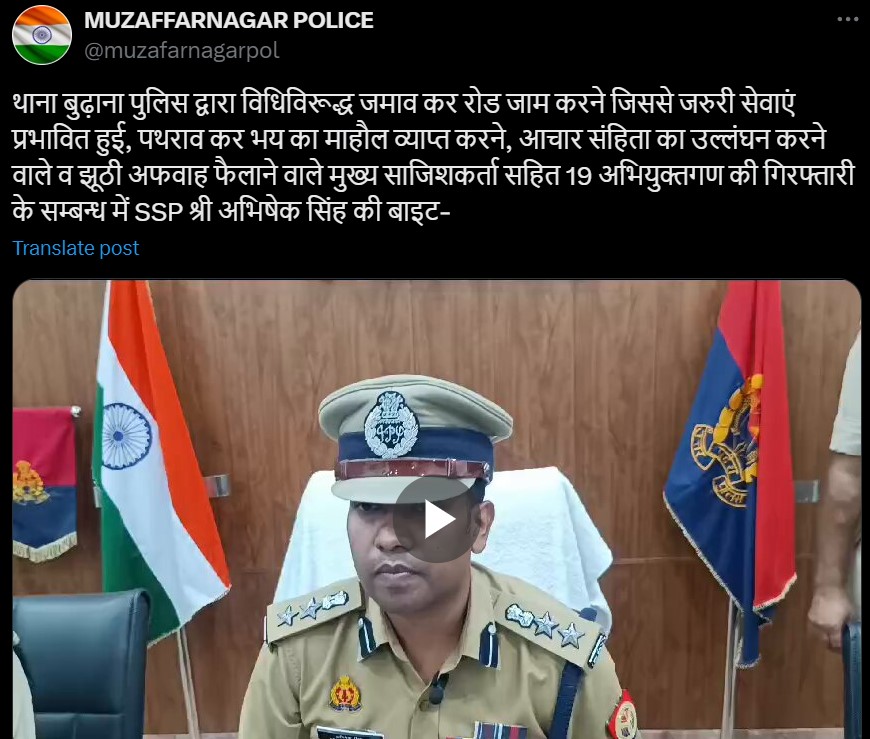
On Tuesday, October 22, the Muzaffarnagar police arrested 19 people, including All India Majlis-e-Ittehadul Muslimeen (AIMIM) leaders, for their alleged involvement in stone-pelting and vandalism in Budhana. The arrest was made in connection with the incident that unfolded on Saturday, October 19 when a mob of Islamists took to the streets to indulge in stone pelting and violence and to raise slogans calling for beheading one Hindu youth named Akhil Tyagi for alleged ‘blasphemy’.

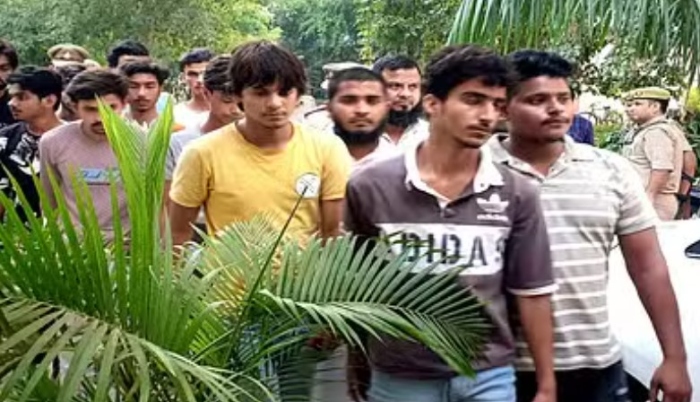
Senior Superintendent of Police, Muzaffarnagar, Abhishek Singh, stated that five key individuals responsible for planning and carrying out the vandalism and stone-pelting have been identified. The accused are named Hasnain, Rameez, Azam, Tariq, and Rahil. While Tariq and Rameez remain at large, the other three have been arrested as part of the 19 individuals taken into custody. Singh further noted that Rameez holds the position of Deputy District President of AIMIM, while Azam is the City President of the party.

Screenshot of Muzaffarnagar police post on the arrest of 19 individuals for their alleged involvement in stone-pelting and vandalism in Budhana

Singh further revealed that the violence was orchestrated through various social media platforms, including WhatsApp. Provocative messages calling for violence against Akhil Tyagi were widely circulated within the WhatsApp group of AIMIM’s Vidhan Sabha unit.

Abhishek Singh added, “When the police calmed the mob and attempted to disperse them, Hasnain, along with his group members Kaif, Faiz, and Sameer, began throwing stones. Based on CCTV footage, we have arrested 19 individuals, and efforts are ongoing to identify and apprehend the remaining suspects.”

Muslim mob chant ‘Sar Tan Se Juda’ slogans in Muzaffarnagar, call for beheading of Hindu youth Akhil Tyagi over ‘blasphemy’

On the night of Saturday, October 19, thousands of Muslims gathered in Budhana town, Muzaffarnagar, following rumours about the release of a man accused of making a blasphemous social media post, escalating tensions in the area. The crowd raised slogans demanding the beheading of Akhil Tyagi, who was alleged to have made objectionable comments on social media.

The mob threw stones at Tyagi’s shop while chanting “Sar Tan Se Juda” (beheading slogans). Tyagi had been arrested earlier based on complaints about his post, but after rumours spread that he had been released, a large Muslim mob took to the streets.

They blocked the Kandhla road in Budhana, raised provocative slogans, spread false information, and hurled stones, including at Tyagi’s shop. A significant police force eventually arrived to disperse the crowd.

In videos of the protest, the mob can be heard chanting the violent Islamic slogan, “Gustakh-E-Nabi Ki Aik Saza, Sar Tan Se Juda, Sar Tan Se Juda” (There is only one punishment for insulting Prophet Mohammad, separation of head from torso).