Home Blog Page 901

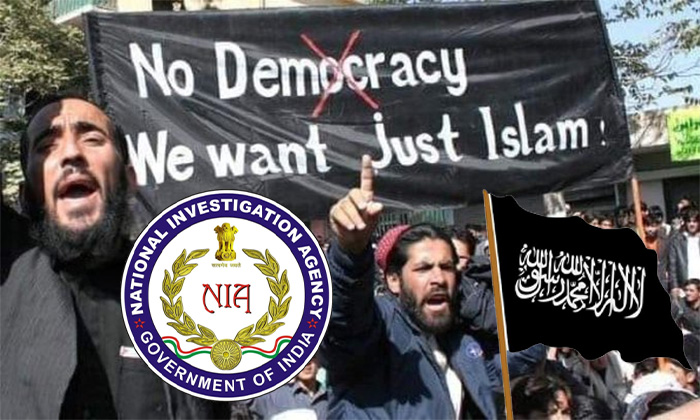
Arabic schools were used to radicalise, mastermind pledged allegiance to Darul-e-Islam: What NIA said chargesheeting 4 in Tamil Nadu ISIS module

0

The National Investigation Agency (NIA) on August 6 informed that they have filed a chargesheet against 4 men for radicalising youths and recruiting them for terrorist outfit ISIS. The accused have been identified as Jameel Basha, Mohammed Hussain, Irshath and Syed Abdur Rahman, a statement issued by the NIA said. The accused have been charged under the relevant sections of the IPC and UA (P) Act.

The chargesheet relates to the case filed by the NIA Chennai branch in August last year, based on the investigation into the blast triggered by an explosives-laden car outside the Sangameswarar Temple temple at Kottaimedu in Coimbatore in 2022.

The charge sheet pertains to case RC-01/2023/NIA/CHE, which was initiated by the NIA Chennai branch in August 2023 following discoveries made in the Coimbatore car bomb blast case, the statement read.

The NIA, during the investigation into the explosion that was triggered outside an ancient temple in Coimbatore, had established that the majority of the accused arrested in the case were engaged in the recruitment of gullible youth to the ISIS fold for the commission of unlawful and terrorist activities.

The religious indoctrination was carried out by the accused at an Arabic language centre called Madras Arabic College (at Coimbatore), later rechristened as Kovai Arabic College, the statement said.

Jameel Basha was the patron and chief mentor, who had guided his alumni to establish Arabic language centres at the district level, it said. The centre at Coimbatore was set up by Mohammed Hussain and Irshath.

According to NIA’s statement, Jameel Basha’s live or recorded speeches were played for the students at these centres. Social media platforms were also utilized to radicalize young people.

The IED planted in a car exploded outside the Coimbatore temple “as part of the violent jehad espoused by the accused”, the agency said.

The investigation agency further stated that accused Jamesha Mubeen, who died, was radicalized by accused Syed Abdur Rahman and swore allegiance to Darul-e-Islam, or ISIS. He carried out the IED blast as part of the terrorist group’s anti-India campaign.

Coimbatore blast

On October 23, 2022, there was an explosion at about 4 AM in a Maruti car just opposite the Kottai Eswaran temple in the Ukkadam area of Coimbatore. The vehicle, a Maruti 800 hatchback, was shattered into pieces as a result of the bomb blast. One Islamist accused identified as Jamesha Mubin also died in the incident.

It was reported earlier, that Mubin was an engineering graduate and was influenced by ISIS. He was caught on CCTV, loading a large object (LPG cylinder) wrapped in a white bag onto his Maruti 800 car. It was around 11:25 pm. Mubin was accompanied by 3 other men, namely, Mohammad Riyaz, Feroz Ismail, and Mohammad Navaz Ismail.

The Police during the investigation also recovered unexploded LPG cylinders, steel balls, glass pebbles, and aluminum and iron nails from the spot. A total of 6 people, namely, Mohammad Thalka, Mohammad Azarudheen, Riyaz, Nawaz, Afsar Khan, and Feroz had been arrested in connection to the case. The accused were charged under Section 174 of the Code of Criminal Procedure and Section 3A of the Explosive Substances Act by the Ukkadam police.

Coimbatore car blast terrorist Jamesha Mubin was completely radicalised

Investigators probing the October 23 Coimbatore blast had concluded that Jamesha Mubin was indeed on a suicide mission as he had shaved his body before the mission, a usual practice of suicide bombers following ISIS ideology.

Among the handwritten entries in Tamil that Tamil Nadu police found at Jamesha Mubin’s home in the Kottaimedu neighbourhood of Ukkadam were references to Muslims as “second-class citizens,” the Citizenship (Amendment) Act, the hijab dispute in Karnataka, and a flow diagram with the names of Gods from various religions.

Along with a prayer that featured on the IS flag, Mubeen inscribed on the slate in Tamil, which translates to ‘those who dare to touch Allah’s house will be uprooted,’ according to the source. “We have evidence that he was influenced by videos of Sri Lankan Easter bombings mastermind Maulvi Zaharan Bin Hashim,” the official said.

Mubeen also left a scribbling on a white piece of paper that stated the call to Jihad,” an officer said. 

Centre rolls back Union Budget 2024’s indexation proposal on real estate after backlash

Following concerns and criticism regarding the Budget proposal to remove the indexation benefit on long-term capital gains (LTCG) from the sale of unlisted assets, the government has decided to offer taxpayers a choice in cases of property sales. Taxpayers can choose to either pay LTCG tax at a rate of 20 per cent with the indexation benefit or at the new rate of 12.5 per cent without the indexation benefit. Taxpayers would be expected to pay the lower of the two tax amounts, according to amendments in the Finance Bill.

These amendments are seen as a significant rollback of the earlier LTCG-related Budget announcements. Initially, the government defended the new LTCG tax regime, arguing that the removal of the indexation benefit was offset by the lower 12.5 per cent tax rate for most property transactions. However, the proposals faced backlash, with demands for a rollback or relief from various sectors, including real estate investors and property owners.

“For the transfer of a long-term capital asset, such as land or buildings, by an individual or Hindu Undivided Family (HUF), acquired before July 23, 2024, the taxpayer can calculate their taxes under the new scheme (12.5 per cent without indexation) and the old scheme (20 per cent with indexation) and pay the lower of the two amounts,” a source explained, detailing the key amendment.

Bangladesh: Rioters loot and vandalise before torching Indira Gandhi Cultural Centre in Dhaka, had earlier set fire to Bangabandhu Bhaban

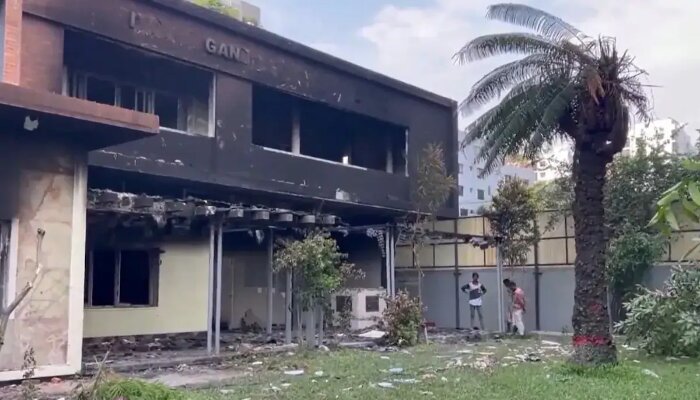
A disturbing video of the damage inflicted on the Indira Gandhi Cultural Center (IGCC) in Dhaka’s Dhanmondi area has surfaced amid the instability in Bangladesh, where violent protests over a jobs quota have resulted in over 400 deaths and the enforced resignation of Prime Minister Sheikh Hasina. The incident transpired on the afternoon of 5th August. The footage shows the building’s charred appearance. The contrast between the scorch marks and the stunning green of the lawns presents a dramatic image. On the front, where previously the sign read Indira Gandhi Cultural Centre, now only the letters ‘G’, ‘N’ and ‘A’ remain, with broken windows and twisted metal rods from an awning staring mournfully.

Debris is all over the ground at the centre’s main entrance. Additionally, the clip shows some unknown young men wandering around the institution’s grounds. It appears like they are hauling away rubble, including what appear to be big pipelines. Furthermore, it displays partially burned bags that might be gifts from the cultural centre’s gift shop spread out around the floor. The footage shows a room that has been entirely wiped bare, which highlights the scale of the destruction and looting. Chipped bricks are showing through the scorched paint on the walls. A person is shown going across several old VHS cassettes that seem to be from the archives department, as they lie broken and crunch under his feet.

The Indira Gandhi Cultural Centre was opened in March 2010 to strengthen cultural relations between Bangladesh and India. The centre partners with India-based specialists in Hindi, Yoga, Indian traditional dances like Kathak and Manipuri as well as classical vocal music in addition to hosting a variety of cultural events and seminars. It also engages with high-calibre and leading professionals from Bangladesh who have obtained training from Indian gurus or organizations. The centre, a part of the Indian Council for Cultural Relations of India, also includes a library with over 21,000 books on issues relevant to Indian art, culture, politics, economics, and fiction.

On 5th August, amid widespread violence in the Bangladeshi capital, vehicles were set on fire and the homes of ruling Awami League leaders were vandalized. During the unrest, mobs torched several key locations in Dhaka, including Bangabandhu Bhaban, also known as the Bangabandhu Memorial Museum at Dhanmondi 32, a museum dedicated to Sheikh Mujibur Rahman who was Bangladesh’s founder, Sheikh Hasina’s father and the nation’s most prominent leader. He was assassinated in 1975 while he was serving as president of the country.

Large portions of Dhaka were affected by the violence that destroyed the Indira Gandhi Cultural Centre and Bangabandhu Bhaban in recent days. This included the Prime Minister’s house, which was stormed and looted by demonstrators soon after Sheikh Hasina resigned and left the country. Hindus and their temples are also under attack from the violent throngs.

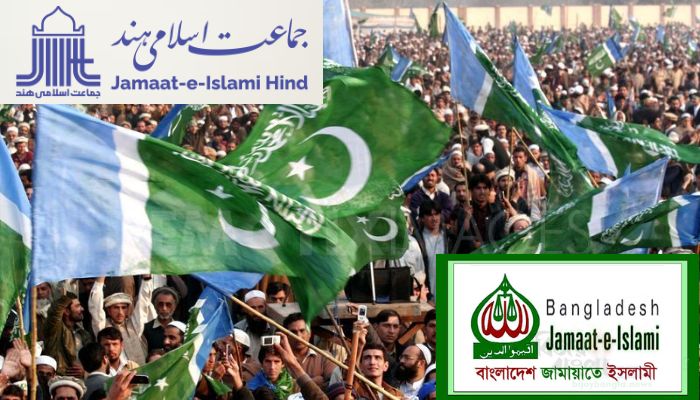
Jamaat-e-Islami wreaks havoc after Sheikh Hasina’s ouster: Their Jihadi activity in India, funding to Hamas, genocide of Hindus, and the security risk to India

Following the violent ouster of Bangladesh Prime Minister Sheikh Hasina, radical Islamist groups including Pakistan-linked Jamaat-e-Islami (JeI) Bangladesh have gained power through street violence and arson. Several gruesome reports of attacks on Hindus, their houses, and their temples have surfaced as Islamist groups have been running havoc on the streets and terrorising minority communities, particularly, Hindus. 

Earlier, OpIndia reported how Pakistan’s ISI, Bangladesh Nationalist Party and Bangladesh JeI were the main actors that orchestrated and fueled the Hasina Out campaign in India’s neighbourhood. It is pertinent to note that JeI is a banned Islamist outfit that was responsible for the genocide of the Hindus and Bengali-speaking Muslims during the 1971 war. 

The Bangladeshi branch of JeI played a vital role in forming the Pakistani army’s auxiliary forces, such as the Razakar, Al-Badr, Al-Shams, and the Peace Committee, which actively participated in atrocities against Bengali freedom fighters, especially Hindus. Hundreds of thousands of Hindu men, women, and children were massacred by JeI and its forces, while a large number of Hindu girls and women were raped.

A few years ago, the International Crimes Tribunals in Bangladesh described JeI’s role during the war of independence in 1971 as an active cohort of Pakistani occupation forces.

Strikingly, JeI was founded by Muslim Brotherhood leader Sayyid Abul A’la Maududi with the agenda of Islamic conquest and “bringing the world under the flag of Islam”. In the wake of its terror and extremist Islamist activities, the Bangladesh government banned it along with its student wing Chhatra Shibir as terrorist organisations under section 18/1 of the Anti-Terrorism Act of 2009. However, its student wing, which is allegedly backed by Pakistan’s ISI, incited violence in the name of student protest and provoked it to turn violent and directed it against the democratically elected Sheikh Hasina government. 

Its student wing fuelled unrest by openly supporting anti-government protests that provoked the recent turmoil and challenged the authorities’ efforts to maintain stability. However, it is alarming that JeI is not only active in Bangladesh, it is said to be the offshoot of parent organisation JeI Pakistan which has links with other proscribed terror organisations. It is also active in all major countries of the world including India, Europe, the UK and the USA. This dangerous Islamist terrorist entity has had a presence in Europe since the 1960s, while it has a prominent presence in the United States.

The parent Islamist organisation, Jamaat-e-Islami is based in Pakistan and there it is working as an Islamist “political party”. It is said to be the Pakistani successor to Jamaat-e-Islami, which was founded in colonial India in 1941. It was founded by Abul Ala Maududi in Lahore and soon after the partition, it split into Jamaat-e-Islami (Hind) and Pakistan. 

The Pakistani Jamaat-e-Islami has remained the most prominent, due to its involvement in electoral politics. In the 1950s, Jamaat-e-Islami Pakistan launched a militant student wing – Islami Janiat-e-Talaba, which successfully gained control of many urban colleges and universities, often through violent tactics.

The student wing, which maintained control in many areas until 1988, marked Jamaat’s first use of violence. Jamaat-e-Islami maintains deeper links with various militancy outfits, including Gaza-based Hamas and Palestinian Islamic Jihad (PJI). It also maintains deeper ties with the Muslim Brotherhood.

In 2006, JeI reportedly transferred $1,00,000 to the terror outfit, Hamas, to continue their Jihad against Jews and the State of Israel. Additionally, Rabah Times had flagged how the organisation had been working closely with the ‘Helping Hand for Relief and Development (HHRD)’, a Muslim American charity.

Apart from terror activities, JeI funds and supports other terror outfits around the world and provokes the Islamic world, Ummah, to take action against India regarding Kashmir. JeI Pakistan had constantly invoked the International Brotherhood of Islam for the ‘Liberation’ of Kashmir. This terror outfit in Pakistan has been raising funds globally in the garb of charity for humanitarian assistance in Pakistan. Notably, in October 2022, a Diwali party was held in Brooklyn, New York to raise funds for this Pakistani jihadi outfit.

Under the pretext of raising funds for victims of flooding in Pakistan, the proceeds from the event were being funnelled to the Alkhidmat Foundation (the charity wing of the radical outfit Jamaat-e-Islami).

However, in 2021, Jamaat-e-Islami chief Siraj-ul-Haq rejected the idea of using taxpayers’ money for constructing temples in Pakistan. 

Earlier OpIndia reported how the organisation is receiving funds from Saudi Arabia universities to spread radical Islam in India. Additionally, the outfit was banned in 2019 for involvement in terrorist and secessionist activities.

JeI’s terror and extremist activities in India and the impact of JeI getting mainstreamed in Bangladesh

While the social unrest and democratic collapse in Bangladesh could unfold a humanitarian crisis on the Indian border, the surge of radicalism on our Eastern front, particularly with banned Islamist groups like JeI gaining an active share in power, has added security concerns for the Indian state. The JeI is not only banned in Bangladesh, it is also banned in India and Russia. 

India banned JeI in February 2019 in the wake of the terror attack in Pulwama that claimed the lives of forty paramilitary CRPF members.

Back then, the government had detained 350 leaders of the Jihadi terror outfit. Moreover, 70-Srinagar-based bank accounts were seized, assets worth Rs 52 crore were confiscated and action was initiated under the Unlawful Activities (Prevention) Act. The government crackdown had also affected the separatist organisation’s 400 schools, 350 mosques and 1000 seminaries across Jammu and Kashmir. In 2019 it was estimated that Jamaat-e-Islami has properties worth Rs 4,500 crores.

This year, on 27th February, the Union Home Ministry extended the ban on Jamaat-e-Islami (JeI) Jammu and Kashmir for another five years with immediate effect declaring it as an “unlawful association.”

The government’s decision followed days after searches by the National Investigation Agency (NIA) in connection with a terror funding case were conducted on the Jamaat-e-Islami chapter in Kashmir. More than Rs 20 lakh and incriminating documents and digital devices relating to the activities of Jamaat and its affiliated Trusts were seized during the raids conducted in Srinagar, Jammu, Budgam, Kulgam and Anantnag.

An NIA spokesperson revealed, “The investigations in the case, registered on February 5, 2021, have so far revealed that JeI and its members have continued to promote terrorist and secessionist activities in J&K even after the outfit was proscribed under Unlawful Activities (Prevention) Act in February 2019.”

The J&K State Investigation Agency (SIA) took possession of many assets owned by the Jamaat in four districts of the Kashmir Valley in December 2022, valued at Rs 100 crore. 

The radical Jamaat-e-Islami J&K has long been at the centre of the Kashmir dispute, supporting separatist ideas and contesting Indian sovereignty over the area. It adheres to the teachings of Hasan Al Banna, Syed Qutb and Maulana Maududi which state that politics and society must be in line with Sharia. It backs Pakistan’s illegal claim to Kashmir. The Hizbul Mujahideen, the largest indigenous terrorist group in Kashmir was regarded as JeI’s military wing in the 1990s. Security services suspected that even though the JeI publicly disassociated itself from the Hizbul in 1997, it is still secretly supporting the outfit.

It is said that JeI is supporting demands for secession from India, and has been supporting terrorist and separatist groups. Its notorious leaders include Abdul Hamid Fayaz, Zahid Ali, Mudasir Ahmad and Ghulam Qadir.

Apart from terror activities, JeI Hind has been fueling and attempting to mainstream radicalism and extremism in India. In October 2023, the radical Islamic organisation Jamaat-e-Islami Hind (JIH) hosted an event to show ‘solidarity’ with the Hamas terrorists who massacred hundreds of innocent civilians in Israel. The event named ‘Palestine Solidarity Convention’ was held in Muslim-majority Malappuram District in Kerala on 13th October, last year, just days after the brutal terror attack took place in Israel. The banned Jihadi outfit later justified it saying there was nothing unusual or illegal about holding an event in support of a terrorist outfit.  

OpIndia had earlier reported how a Kerala-based journalist revealed that this banned Jihadi terror outfit was receiving funds from Saudi Arabia universities to ‘Islamise’ India. 

Terror outfit JeI Hind and affiliated units undertaking Islamic brainwashing and orchestrating protests to Islamise India

OpIndia earlier widely reported how Jamaat-e-Islami orchestrated the hijab protests in Karnataka using foreign funds. Apart from SIMI’s offshoot PFI, Jamaat-e-Islami also played an active role during the Hijab protest in Karnataka. Incidentally, the Hijab protesters had also received backing from Pakistan branch of JeI and the nexus indicated that a meticulous plan had been hatched to instigate Muslim students in the coastal districts of Udupi, Dakshina Kannada to create chaos that could have eventually been used to radicalise and recruit young Muslims into their organisation.

Apart from the Islamisation of India’s educational institutions, the JeI Hind and its affiliated units in India have been holding events to radicalise Muslim youth and lure non-Muslims, particularly Hindu girls to Islam. 

Incidentally, in March 2023, Jamaat-e-Islami Hind put out a poster stating that it was holding an “awareness program” for Muslims to make them “full Muslim”. The banner read, “‘poore ke poore Islam mein aa jao’ (turn fully to Islam)”. It is supposed to mean that Muslims who practice the faith but half-heartedly should embrace it fully and become ‘full Muslims’.

Additionally, in October 2022, JeI Hind organised a get-together event for ‘non-Muslim’ girls in the Karimnagar area of Telangana. However, the Telangana Police refused to grant permission for the event after the Vishwa Hindu Parishad (VHP) intervened in the matter.

The radical Islamist outfit had also supported AAP councillor Tahir Hussain who was arrested in connection with the murder of Intelligence Bureau sleuth Ankit Sharma during the anti-Hindu Delhi riots. During the 2019 elections, the Jihadi terror outfit banned under UAPA had issued appeals to Muslims to cast their vote for the SP-BSP-RLD alliance in Uttar Pradesh. 

Furthermore, following numerous arrests and busting of several Bangladesh-linked terror networks, the Indian security agencies had time and again alerted about the surge of Islamist terror outfits in Bangladesh that conspired to carry out terrorist activities in India even when pro-India Awami leader Sheikh Hasina was in power. 

Now, with JeI, a banned Islamist and terror outfit, gaining power on our Eastern border, New Delhi braces itself for an alarming rise in the risk of cross-border terrorism as well as a large influx of refugees, creating a humanitarian crisis as well as a security crisis on the border. The Bangladeshi terror modules which had been attempting to carry out terror attacks in India may try to smuggle Islamist extremists as well as terrorists in the garb of Hindu refugees fleeing persecution and furthering their agenda of Islamising India through radicalism, brainwashing and increased terror activities and insurgencies on India’s eastern front.  

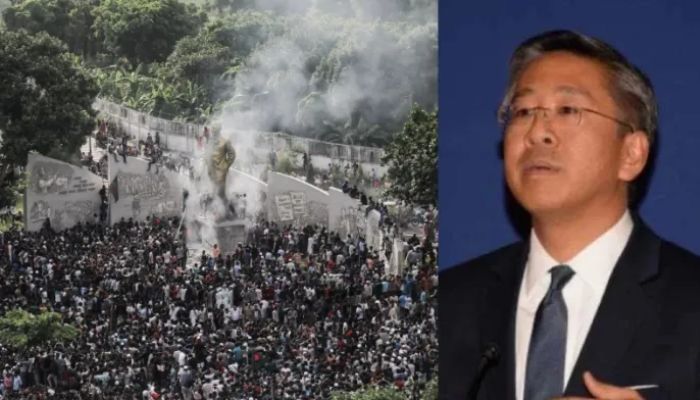
Kyrgyzstan, Pakistan, Sri Lanka, Bangladesh: How US Diplomat Donald Lu, whom Rahul Gandhi met during ‘secret visit’ to White House, has mastered regime change operations

In Bangladesh, thousands of rioters succeeded in their ‘regime change’ plans as they created unrest throughout the country demanding the resignation of the democratically elected Prime Minister Sheikh Hasina. As thousands of rioters marched towards her official residence in Dhaka, Gana Bhawan, she was forced to flee the country for her safety and take temporary refuge in India. In the meantime, the celebrating protesters stormed her house, ransacked and looted everything they could lay their hands on. While some of the rioters waved looted animals, others displayed her sarees and undergarments as spoils of war. 

However, in India, the Islamists, left-leaning journalists and other usual suspects have been peddling this as some sort of a ‘victory of democracy and youth’, despite numerous reports of targeted attacks against Hindus, their houses and their temples coming out from Bangladesh. Additionally, several Hindu leaders and journalists have been killed in the so-called protest for upholding democracy. 

Nonetheless, the protest which initially began with the demand to end the reservation for the families of freedom fighters ‘liberation warriors’ of Bangladesh, finally culminated in ‘regime change’ in India’s eastern neighbour. As more pictures and videos have been emerging out of Bangladesh, the apprehensions of persecution of minority communities, particularly, the Hindus are increasing alarmingly. 

However, the global reactions over the sudden and chaotic developments have again underscored the fact that there are multiple things at play, behind the scenes, and there is more than what meets the eye. Amidst all the preliminary observations, the role of one man, Donald Lu, is emerging as a critical factor in sealing the outcome of events in Bangladesh.

Who is US Diplomat Donald Lu who made a sudden visit to India during the Lok Sabha elections; Rahul Gandhi reportedly also met him during a secret visit to the White House

Donald Lu is an American diplomat who currently serves as the Assistant Secretary of State for South and Central Asian Affairs since September 2021. Earlier, he was the US Ambassador to Albania and Kyrgyzstan. He has a controversial track record and is notorious for interfering in the political processes of other countries.

The self-anointed Human Rights, democracy and virtue-signalling Police of the World, the United States of America has earned infamy for meddling in the internal affairs of other countries, their election process and their key policy measures in the garb of Human Rights reports and sermons thereof. Donald Lu is the American equivalent of a ‘Chinese wolf warrior’. He had often expressed concerns about Human Rights issues (read warnings to countries that do not toe US dictation) in India under the tenure of the Modi government as well as several other countries around the world.  

Taking a step further, he made a sudden visit to India when the Lok Sabha elections in 2024 were in full swing. Interestingly, he didn’t land in the National Capital, New Delhi but he visited Chennai, the capital of Tamil Nadu, so far which is said to be a stronghold for Dravidian politics and a bastion where BJP is considered weak. The leaders of the DMK party had often raised the secessionist demand for a separate nation, ‘Dravida Nadu’. Regarding his visit, the US had released a controversial press release claiming that Donald Lu embarked on a visit to Chennai to ‘strengthen bilateral relations with South India’.

Back then, a Geopolitical expert Dr. Anant Bhagwat had said that the Biden administration did not want a stable government in India, because during the ten years of the stable Modi government, India followed a strong and independent foreign policy and it was undeterred by external pressures. 

Strikingly, last year, Congress leader Rahul Gandhi reportedly had a secret meeting at the US White House where he met Donald Lu as well as other officials of the Biden administration. Incidentally, during his US trip, the Congress leader made several contentious remarks including seeking ‘foreign intervention’ to restore ‘democracy in India’ as it was a global public good. 

Regarding Donald Lu, the founder of Pune-based ‘Global Strategy Foundation’, Bhagwat said, “Donald Lu is a hated figure in India due to his interference attempts in Indian democracy. Last year, he entertained Indian opposition leader Rahul Gandhi at the White House.” However, the Ministry of External Affairs of India did not have any information related to this.

Donald Lu and his observations about India, ‘concerned’ about Jammu and Kashmir, Human Rights and more

When Donald Lu appeared before the US ‘Senate Foreign Affairs Committee’ in March 2023, he expressed concern about human rights issues in India. He had expressed concern over the absence of assembly elections in Jammu and Kashmir and ‘ongoing human rights violations’.

After the abrogation of Article 370 and 35 A, Ladakh was carved out of the erstwhile state of Jammu and Kashmir and the remaining part was given the status of a Union territory. Post the abrogation, there has been a marked reduction in stone pelting, on average over 2 crore tourists have visited the UT in a year. While elections were held in the valley for the first time for third-tier governance, the USA expressed concerns that India was not holding elections for the J&K assembly. 

Regarding Jammu and Kashmir, Donald Lu told the US Senate, “We are closely monitoring reports of discrimination against Muslim communities and other religious minority groups as well as limits on free speech and NGOs.” 

He added that it is critical that India’s partners speak up when they “witness troubling events”, however, stating that they also support India’s democratic institutions which are the country’s key defence against the erosion of human rights. 

He added, “We have not seen the holding of Legislative Assembly elections in Jammu and Kashmir.” He had also expressed concerns about the arrests of ‘prominent journalists’ in the Kashmir valley. 

It is pertinent to note here that so far, over 70 government employees have been dismissed in Kashmir for helping terrorists or for involvement in anti-India activities. For example, the editor of a media organisation named ‘Kashmir Wala’ was jailed because Fahad Shah had glorified terrorism. Despite these grave concerns for India’s national security and territorial sovereignty, the US ‘expressed concerns’ on these arrests of ‘prominent journalists’ despite it being the internal matter of its “ally” country.

During the Senate hearing, he also gave his observations about India-Taiwan relations.  

“We have seen the Indian Navy sail into the Taiwan Straits. I think that’s symbolically very important at the time when we all are looking to provide reassurance to Taiwan about their security,” he said.

While India has maintained that the USA is an important partner, the USA which is driven by a hegemonistic worldview, has been co-opting its partners/allies to play its junior partner or even a second fiddle and act as its weapon against China. 

During the same trip, he also visited Bangladesh and Sri Lanka. 

By the time of his visit to Bangladesh, Sheikh Hasina came back to power for the fourth time. US Ambassador to Bangladesh Peter Haas has been accused of supporting the opposition party Bangladesh Nationalist Party (BNP), which had boycotted the last elections.

People close to Sheikh Hasina then believed that America was mounting pressure on Dhaka to follow the anti-China line. In the Indo-Pacific frontier, the USA was continuously trying to court Bangladesh on its side. For this, it had also expressed ‘concerns’ (read warnings for Independent foreign policy) about human rights issues in Bangladesh, before the elections. 

Donald Lu’s involvement in other countries

Additionally, in Pakistan, the elected Prime Minister Imran Khan was ousted in April 2022 and a temporary government was established after he was publicly seen at odds with the US administration. He was ousted by the Pakistani military and replaced by a coalition of several parties. 

The ousted Pakistan PM Imran Khan had alleged that he was removed because of ‘foreign interference’ and had mentioned the name of Donald Lu as the facilitator. However, Lu had termed all these allegations as false and rubbished it as a ‘conspiracy theory’. 

It is said that even though the US imposed sanctions on Russia in the wake of its war against Ukraine, Imran Khan was improving diplomatic ties with Russia, which angered the USA. 

All this indicates that the deep state of the United States of America has increased its meddling and intervention efforts in South Asia. 

Furthermore, Donald Lu had also mentioned ‘political reforms’ in Bangladesh. Sheikh Hasina’s party ‘Awami League’ had raised the issue of US support to their rival party, BNP and its leader Khaleda Zia. In the current unrest in Bangladesh, the mobs of violent protesters have been targeting ‘Awami League’ leaders and have killed several of them. 

Incidentally, similar unfortunate scenes had emerged from Sri Lanka in July 2022 as it got trapped in the US-China rivalry. Back then, violent protesters had stormed the Rashtrapati Bhavan of Sri Lanka and indulged in vandalism and loot. It is said that as Sri Lanka was getting deeper in the Chinese debt trap, America desperately wanted to stop Chinese influence in the island nation.  

The Sri Lankan protests yielded the same outcome as it did in Bangladesh, President Gotabhaya Rajapaksa had to resign from his post and leave the country. Likewise, his brother Mahinda Rajapaksa had to leave the post of Prime Minister. 

Meanwhile, this year, Donald Lu has claimed that Sri Lanka is now making a comeback. Now, America is funding the Colombo West Terminal Port. Financial assistance was given to Sri Lanka through USAID. USAID is an ‘International Development’ organisation, however, it has also been accused of funding regime change. 

Incidentally, while praising the ‘new’ Sri Lanka, Donald Lu had warned India-Bangladesh regarding Rohingya. Notably, illegal Rohingya immigrants have become a major problem for law and order and national security in India as they have been found committing crimes and many of them have been living in India on forged documents. 

Now the question arises whether Donald Lu wants to carry out similar ‘regime change’ operations or colour revolutions in India that he is accused of orchestrating in Pakistan, Bangladesh and Sri Lanka? However, such an operation is very difficult in India as it involves more complexities with every state and UTs having their own unique issues and strengths. In India, the sources of income and priorities of people keep changing in every region, with agriculture being the only profession that unites the entire country.

US deep states and why it is irked that the Modi government is in power in India

It is an open secret that majorly all global powers follow a containment strategy and want to ‘check’ the progress of other countries including their allies and the US has a similar stance towards India, especially led by a stable and progressive government which has a Nationalistic worldview. Having said that, the US deep state would obviously prefer a weak coalition anti-BJP government in India rather than a strong Modi government. For this, propaganda and global smear campaigns against India are in full swing.  

On the internal front, all efforts have been made to spread confusion and chaos by provoking sentimental issues be it Agniveer, regarding which false claims were openly made even inside the Parliament. A concerted campaign is going on to divide the Hindu community on caste lines with Rahul Gandhi promising inside Parliament that the opposition would carry out a nationwide caste census. 

During the ‘Farmers Movement’, the country witnessed how ‘protesters’ rampaged Delhi on Independence day and Khalistani flags were seen on the Red fort. Additionally, the protesters gheraoed the national capital for over 1 year. Even today many farmers are sitting on the Shambhu border of Punjab-Haryana.

These are all such issues which can be used to instigate a large section of the people of the country. Incidentally, journalists, particularly Pakistani journalists expressing concerns about Indian democracy, pose questions to the ‘prepared’ spokesperson of the Biden administration on every trivial matter or protest which is and should have been left to India to tackle as it is the country’s internal matter.   

As an ambassador in Albania-Kyrgyzstan, Donald Lu instigated people to overthrow the government

Apprehensions take flight especially when a notorious US diplomat like Donald Lu is in charge of such things who has a tainted tenure in Albania. During his tenure in Albania, he publicly provoked people to overthrow the country’s government. He had asked the public to pose questions to the leaders and change the government.

Provoking the public in the garb of genuine issues like parliamentary and judicial reforms, he asked the Albanian youth to put pressure on their government to lead a better life than their parents, adding that otherwise, they should overthrow the government.  

Additionally, the American Ambassador then toured several cities of the small country and held ‘discussions’ with the youth. 

Similarly, when Donald Lu was the US Ambassador to Kyrgyzstan, political tensions prevailed in that country. He stayed there from 2018 to 2021, and in between his tenure, Kyrgyzstan witnessed a major protest. In June 2019, lawmakers voted to open a criminal case against then-President Sooronbay Shiripovich Jeenbekov.

He finally had to resign in 2020, as there were many protests against him. Something similar happened there too as there were allegations of rigging in the elections held in October 2020. It is said that America also had a hand in pressuring President Sooronbay Shiripovich Jeenbekov to resign. Protests are still going on in Albania to remove Prime Minister Edi Rama. Force had to be used to stop the demonstrations in many cities. Because of these developments, Donald Lu is also credited for the unrest in Kyrgyzstan and Albania.


Not just 54: Here are 7 more incidents of targeted violence against Hindus in Bangladesh after the coup against Sheikh Hasina

On 5th August, it came to light that Jihadis attacked Hindus’ houses, shops and temples in Bangladesh in the guise of protests against the Sheikh Hasina government. Despite the resignation by Hasina from the Prime Minister’s post, the protests continued and so did the attack on Hindus. Minister of External Affairs Dr S Jaishankar has also expressed concerns over attacks on Hindus and other minorities in Bangladesh. Earlier, OpIndia reported about the list of 54 attacks released by the Bangladesh Hindu Buddhist Christian Unity Council and attacks reported by The Daily Star, a Bangladeshi newspaper. Several videos and photos of attacks on Hindus surfaced on social media.

As the day passed by, more details of the attacks with photos and videos surfaced. In a video shared by X user YearOfTheKraken, a woman in Bangla was heard saying, “They are destroying our Mandir. They are destroying our Mandir. Have they ‘freed’ the country to destroy Mandirs?”

An X user, Rahul Verma, shared the ordeal of a friend whose ancestral house in Bangladesh was set ablaze. The mob also tried to rape his aunt. He wrote, “One of my friends whose ancestral home is in BD and currently living in Gede(Border area) in WB India told me that his house set ablaze and they also tried to r@pe their masi… The situation is too tough to control,” and urged Prime Minister Narendra Modi to help Hindus in distress in Bangladesh.

In a post, Executive Editor of TV9 Network, Aditya Raj Kaul said, “Evidence of Hindu Temples attacked by Islamist mobs in Bangladesh. This ISCKON Temple is in Meherpur, Khulna Division of Bangladesh. I spoke to senior ISCKON office bearers who confirmed that at least 5 temples in Bangladesh have been attacked and gutted. Many Hindus are in hiding.”

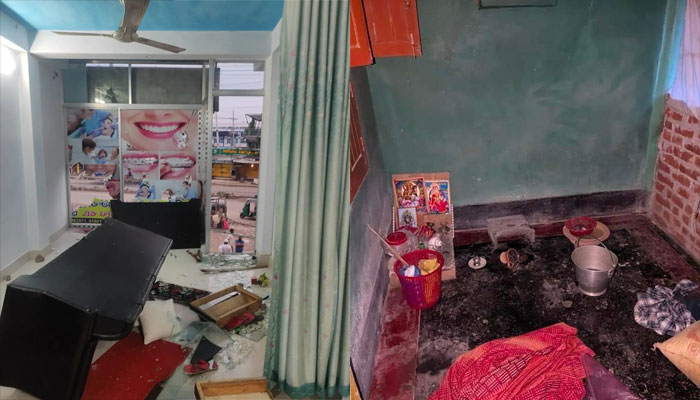
Voice of Bangladeshi Hindus, one of the most prominent accounts sharing the details of the attacks, shared pictures of a clinic of a Hindu ransacked.

In another post, the handle shared visuals of the house of a Hindu doctor being burnt.

Indira Gandhi Cultural Centre has also been burnt.

Islamists attacked a Hindu village in Thakurgaon. Houses, shops and temples were burnt.

On 5th August, Bangladesh was pushed into chaos after a successful coup leading to the ouster of PM Sheikh Hasina. Later, she fled the country to a safer location as the agitated mob was about to reach her residence. The protests that started against reservation for the family members of the freedom fighters turned into full-fledged violence against the government. Several protesters were killed as the government used armed forces and police against the protesters leading to the fall of Hasina’s government.

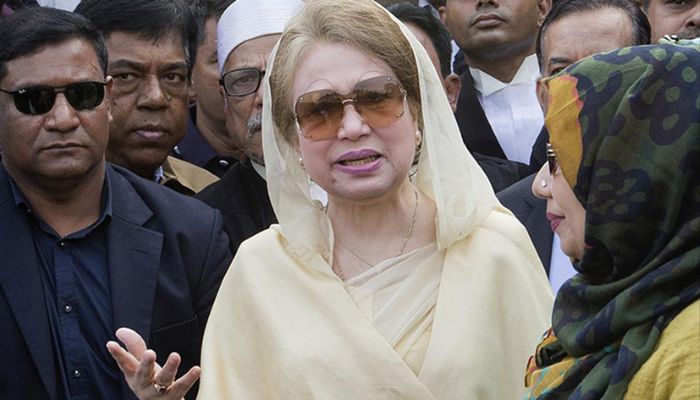
As Khaleda Zia is released from prison, read how her party supported insurgency in India’s NorthEast and carried out anti-Hindu attacks along with Jamaat

On Monday (5th August), the incumbent Bangladeshi President Mohammed Shahabuddin ordered the immediate release of Begum Khaleda Zia, who had previously been jailed for embezzling $250,000 in donations meant for an orphanage.

The development came hours after Sheikh Hasina resigned as the Prime Minister of Bangladesh and fled the capital city of Dhaka.

In a statement, Shahabuddin said, “(It was) decided unanimously to free Bangladesh Nationalist Party chairperson Begum Khaleda Zia immediately…The meeting has also decided to free all the people who have been arrested during the student protests.”

While it was not immediately clear whether Khaleda Zia would head the ‘interim government’, the increased role of the radical Bangladesh Nationalist Party (BNP) and its ally Jamaat-e-Islami (JeI) in the context of Bangladesh’s politics became imminent.

When the Chief of Army Staff Waker-uz-Zaman addressed the nation on Monday evening, he made it clear that he has been in consultation with both JeI and BNP leaders and was yet to ‘talk to student activists’ (who spearheaded the protests against Sheikh Hasina).

OpIndia had previously reported how Islamists had infiltrated the anti-government protests and are now eyeing to turn the country bankrupt.

Insurgency in North-eastern India, ISI’s role and BNP’s support

The decision to free Begum Khaleda Zia, the Chairperson of the BNP since 1984, has brought back dark memories of the Indian subcontinent.

Under her Prime Ministership, there was severe mushrooming of radical Islamic outfits in Bangladesh, increased infiltration in India’s North-east region and systematic persecution of the Hindu community.

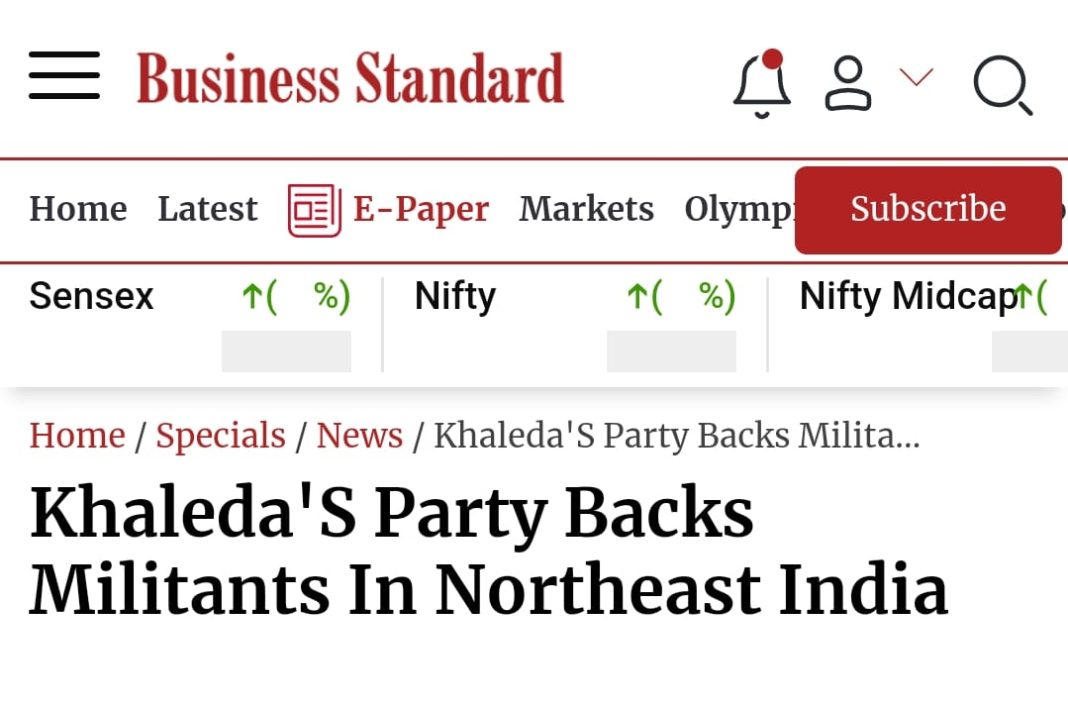
In March 1997, Khaleda Zia had expressed open support for insurgents in India’s North East by labelling them as ‘freedom fighters.’

Screengrab of the 1997 report

During a public meeting in the Feni district of Bangladesh, she said, “They are fighting for independence. We also fought for it, so we are always in favour of any independence movement.”

She also made it clear that Bangladesh would not use its army against the insurgency in the seven North-Eastern States. Her stance was reiterated by BNP’s secretary general Abdul Mannan Bhuyian.

Khaleda Zia lamented that Sheikh Hasina was not allowing insurgents easy transit to India through Bangladesh. It is interesting to note that BNP came to power

Screengrab of the report

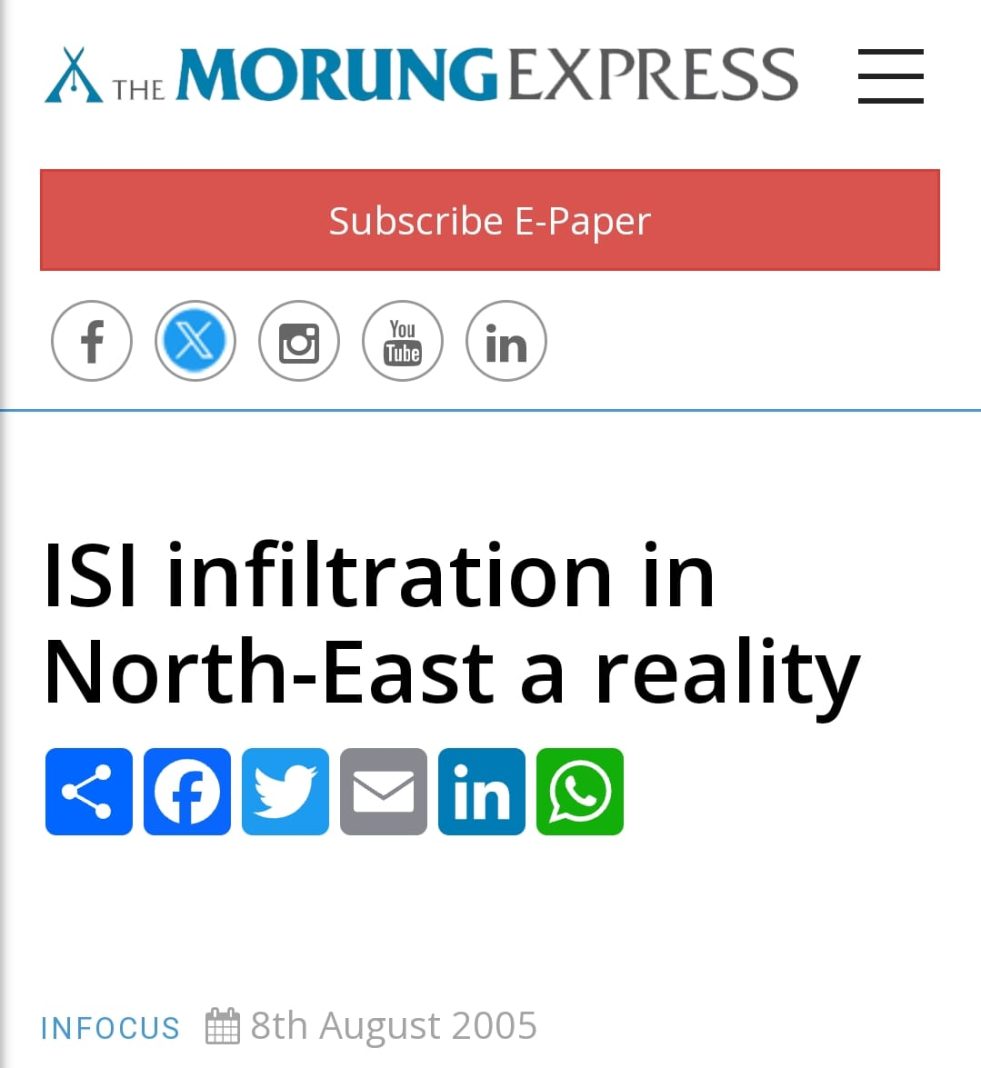
According to reports, insurgent outfits such as the Liberation Front of Asom (ULFA), All Tripura Tigers Force (ATTF) or National Liberation Front of Tripura (NLFT) received arms training in Bangladesh under the supervision of Inter-Services Intelligence (ISI).

“ISI exerts on north-east militant groups. This effort has been greatly boosted with the Bangladesh Nationalist Party (BNP) assuming power in Dhaka in 2001. Dominated by policy-makers who advocate an anti-India line, Khaleda Zia’s government has been a silent abettor of the ULFA-NDFB-ATTF-NLFT-ISI nexus,” wrote leading strategic analyst Nitin A Gokhale in August 2005.

BNP has been vocal about its anti-India stance. Until recently, it was urging its party members and radical Islamists in Bangladesh to boycott Indian products.

The ‘India Out’ campaign in Bangladesh, modelled along the lines of Maldives, was supported by BNP’s senior joint secretary general Ruhul Kabir Rizvi. However, the anti-India propaganda was short-lived due to the efforts by the Sheikh Hasina government to curb it.

Imtiaz Ahmed, a political science professor at Dhaka University told Frontline magazine, “It is mainly being driven by the Bangladeshi diaspora who are either BNP members or closely associated with the party.”

Anti-Hindu stance and targeting of the community

Begum Khaleda Zia had spread canards against the minority Hindu community in Bangladesh time and again to keep Muslim hardliners on her side.

She had once infamously claimed in 1996 that if the Awami League came to power, Azaan (Muslim call to prayer) would be replaced by Shankhadhoni (blowing of conch shells by Hindus).

It must be mentioned that the BNP was in power when Islamists went on a carnage to avenge the demolition of the disputed structure in Ayodhya.

On 6th December 1992, a strong mob of 5000 Muslim men, armed with bamboo sticks and roads, tried to storm a cricket match played between India and Bangladesh at the Dhaka National Stadium.

Screengrab of the 1992 news report by United Press International

Their attempts were foiled by the police, who fired tear gas and rubber bullets at the frenzied mob. As per a report by United Press International, a mob of 1000 Muslim men barged into the Hindu Shiva temple in Thatari Bazar district of Dhaka and razed it to the ground.

Islamists also attacked a Hindu temple in the Narinda district and gravely injured an 88-year-old Hin du priest in a bomb attack. Muslim mob also tried to break into the Dhakeswari Mandir in Dhaka.

They also looted shops belonging to the Hindus and smashed the cars of the minority community with sticks and iron bars.

According to the Human Rights Congress for Bangladesh Minorities (HRCBM), the pogrom was executed by the radical Islamist outfit Jamat-i-Islami which was an alliance partner of the ruling Bangladesh Nationalist Party (BNP).

The riots were not spontaneous but rather well-planned. An estimated 2400 Hindu women were gang raped, and 3500 temples and religious establishments were destroyed by frenzied Muslim mobs.

Over 28000 homes and 2500 commercial buildings belonging to the Hindu community were razed. An estimated 700 Hindus were killed in the carnage. The numbers were conservative as acknowledged by several prominent politicians at that time.

Role of BNP in the infamous 2001 and 2014 anti-Hindu riots

In 2001, about 25000 Islamists including 25 MPs and Ministers of BNP carried out targeted attacks on the Hindu community.

“Hindu leaders said there were a series of attacks against them, including murder, looting and rape which began as the results were announced. They said Islamist parties and the BNP targeted them because they supported the rival Awami League political party in those elections,” a report by BBC stated.

Many Bangladeshi Hindus were forced to flee the country after the planned carnage. In 2014, BNP members and Jamaat-e-Islami thugs carried out 160 attacks on the Hindu community.

Bangladesh crisis: Australian Jewish Association condemns attack on Hindus, highlights the danger posed by radical Islamists

On Tuesday, the 6th of August, the Australian Jewish Association (AJA) condemned the ongoing violence against Hindus in Bangladesh after the country’s PM Sheikh Hasina resigned on Monday. Calling out the violence by radical Islamists against Hindus in Bangladesh, AJA CEO Robert Gregory said that such incidents show the threat and danger posed by radical Islam all over the world.

“As Jews, we are familiar with persecution under radical Islam. We have seen terrible footage from Bangladesh, including the violence directed against #Hindus. Our thoughts are with the victims. These scenes are reminiscent of scenes in numerous countries across the world and show the dangers posed by radical Islam,” the official statement read.

“The Albanese Government must speak out against these atrocities. I urge Foreign Minister Penny Wong to make a statement. The Albanese Government has provided thousands of visas to Gazans where polls show extremely high levels of support for Islamic terrorist groups. Members of the Hindu community in Bangladesh would be much more suitable candidates for visas to Australia,” he added.

After Sheikh Hasina’s resignation as the Prime Minister of Bangladesh, several Hindu temples have been attacked at the hands of Muslims. Also, more than 50 attacks have happened against Hindus. According to X handle Voice of Bangladeshi Hindus, these attacks happened within five hours of Sheikh Hasina’s resignation. Notably, the actual number of attacks could be much higher than reported in the list below. The document has listed 54 attacks.

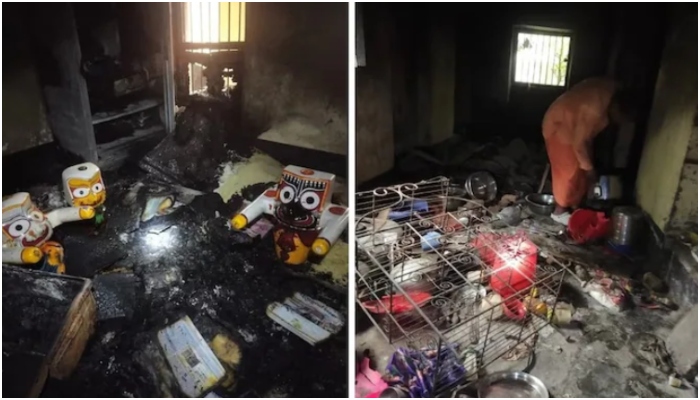
Along with several other local temples, the Islamists also attacked the ISKCON temple as confirmed by the Spokesperson for ISKCON India, Yudhistir Govinda Das. “As per the info I have received, one of our ISKCON centres (rented) in Meherpur (Khulna division) was burnt including with the deities of Lord Jagannath, Baladev, and Subhadra Devi. 3 devotees who lived in the centre somehow managed to escape & survived,” Das confirmed.

The Islamists also are believed to have targeted Hindu families residing in the country, the videos of which have been making rounds on social media.

While the political landscape of Bangladesh is witnessing one of the toughest times in history, Hindus and other minority communities are the most vulnerable as Islamist mobsters are taking advantage of the situation to attack them. Amidst these attacks, left-liberals and Islamists have been seen either denying or justifying the attacks.

US revokes Sheikh Hasina’s visa after her removal from power, UK tells her ‘no provision’ for asylum

0

The United States has revoked the visa of ousted Prime Minister Sheikh Hasina, according to reports. This development follows reports that Western countries, including the US, wanted her removed from power.

After resigning and fleeing to India amid violent protests in Bangladesh, Hasina is currently at Hindon Airbase in Ghaziabad.

British immigration rules do not permit individuals to travel to the country to seek asylum or temporary refuge, as per reports citing the UK Home Office. This statement comes amid ongoing speculation that ousted Bangladesh leader Sheikh Hasina, currently in Delhi, might fly to London to seek sanctuary.

The UK government, now led by Sir Keir Starmer following Labour’s recent landslide victory, also emphasised that individuals seeking asylum must do so in the first safe country they reach.

“The UK has a proud record of providing protection for those in need. However, there is no provision for someone to travel to the UK specifically to seek asylum or temporary refuge,” said a UK Home Office spokesperson.

“Those requiring international protection should claim asylum in the first safe country they reach, as this is the quickest route to safety,” the spokesperson added.

Nonetheless, sources indicate that a formal asylum request is being processed.

On Monday, the military facilitated Sheikh Hasina’s departure from Dhaka after weeks of growing pressure from anti-government protests against her reservation policies. These protests escalated into violent unrest, resulting in over 440 deaths in recent weeks. Shortly after her resignation, protesters stormed her residence, causing widespread vandalism.

Upon her arrival in India on Monday, Hasina was greeted by National Security Advisor Ajit Doval and senior military officials, who assured her of complete security. The Indian Air Force monitored her flight, deploying Rafale fighter jets to ensure her safe passage. The situation in Bangladesh remains volatile, with the military announcing the formation of an interim government led by Nobel laureate Dr. Muhammad Yunus.

On Tuesday, External Affairs Minister S. Jaishankar informed Parliament that Hasina had reached out to India for safe passage following her sudden resignation. In a suo motu statement in the Rajya Sabha, Jaishankar mentioned that Hasina was granted approval to travel to India on “very short notice.”

“On August 5th, demonstrators gathered in Dhaka despite the curfew. Following a meeting with security establishment leaders, Prime Minister Sheikh Hasina seemingly decided to resign,” Jaishankar stated in Parliament. “On very short notice, she sought approval to come to India temporarily. We simultaneously received a flight clearance request from Bangladeshi authorities. She arrived in Delhi yesterday evening,” he added.

Branded ‘bloodsucker’ by Sheikh Hasina to being a ‘US asset’: Meet Muhammad Younus, chief advisor of interim govt of Bangladesh, who was interviewed by Rahul Gandhi in 2020

A day after Sheikh Hasina resigned as the Prime Minister of Bangladesh, controversial Nobel laureate Muhammad Yunus on Tuesday (6th July) announced that he would be the chief advisor to the interim government.

“When I was contacted on behalf of the students, I didn’t agree at first. I told them I have a lot of work to finish. But the students repeatedly requested me,” a source of The Daily Star quoted him as saying.

Yunus, who had previously expressed his happiness over the anarchy that led to the ouster of Sheikh Hasina, added, “If the students can sacrifice so much, if the people of the country can sacrifice so much, then I also have some responsibility.”

Journalist Sidhat Sibal informed on Monday that Yunus is all set to return to Bangladesh from France. The controversial Nobel laureate had hailed 5th August 2024 as ‘Second Liberation Day.’

In January this year, a labour court in Dhaka found him guilty of violating the labour laws of Bangladesh. He was convicted, sentenced to 6 months of simple imprisonment and fined Tk 30000 (~$260).

Yunus and three other directors at ‘Grameen Telecom’ violated labour laws by failing to create a welfare fund for the workers in the company. 

The labour court Judge, Sheikh Merina Sultana, noted that 67 Grameen Telecom employees were supposed to be made permanent in the company which did not happen.

As per the company’s stated policy, it is supposed to share 5% of the dividends with the staff, which failed to materialise. Muhammad Yunus is currently facing 100 other charges for graft and labour law violations in Bangladesh. 

The 2006 Nobel Peace Prize winner founded Grameen Bank in 1983 to lend small loans to the poor. He was earlier fired as Managing Director of his bank for violating retirement regulations of the Bangladeshi government.

Yunus was also on trial for receiving money in 2013 for receiving money without government permission. He was infamously called a ‘bloodsucker’ by Sheikh Hasina for giving out loans to the poor at extremely high interest rates.

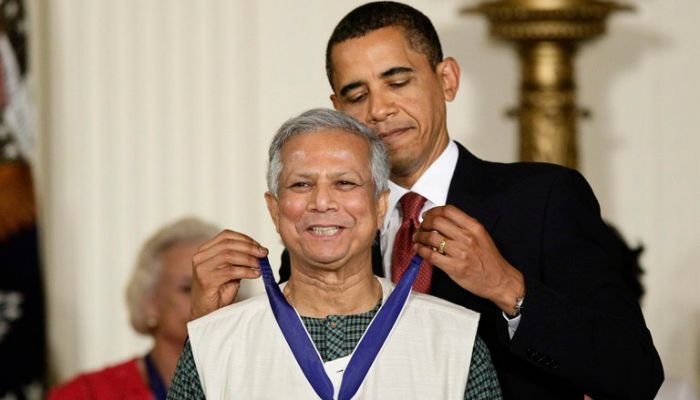
However, nothing compares to the fact that he is an asset to the Western World, particularly the United States. In 2009, Muhammad Yunus was awarded the Presidential Medal of Freedom by the then US President-turned-war criminal Barrack Obama.

A year later, he was felicitated with the Congressional Gold Medal. He was also the recipient of the Fulbright Scholarship from the US State Department.

When he was convicted in January this year, the United States came to his rescue and highlighted the ‘global criticism’ surrounding his sentencing by a labour court in Dhaka.

Muhammad Yunus is the recipient of the Ramon Magsaysay Award, which was established by two CIA-linked American organisations in memory of a CIA groomed Philippines president.

It may be noted that the award was constituted by New York-based Rockefeller Brothers Fund. In 2000, Ramon Magsaysay Emergent Leadership Award was established by Ford Foundation, another American organisation.

Both these organisations are known for working for American interests in foreign countries, and have a history of closely working with the CIA. In fact, the Ford Foundation is alleged to be a philanthropic facade of the Central Intelligence Agency.

It is interesting to note that Congress leader Rahul Gandhi interviewed the controversial Muhammad Yunus in July 2020 during the Coronavirus pandemic.

He had raked up the issue of ‘migrant workers’ in a bid to internationalize the issue.

“We have people working for us, cooking food for us, security persons, darbaan for us, they are taking care of our children. We knew them. But suddenly we see millions of them on the highway trying to go home. Suddenly, all the city migrant workers are coming out of the city in a big crowd and going out. For a simple reason, they have nothing here, no life here, no money here to survive. So, ultimate place they can go back to is their home. So, desperately they are going home. And then on foot, thousand-mile journeys. That is the saddest part that Coronavirus has revealed,” Yunus had said during the interview.