Home Blog Page 55

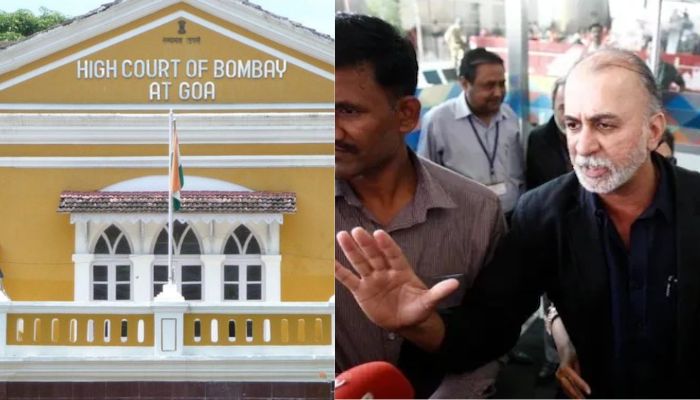
As Goa High Court reserves its order, know about the 2013 sexual assault case against Tehelka’s Tarun Tejpal, and the ‘apology email’ 

On Thursday (30th July), the Goa High Court reserved its order on the appeal by the Goa Government against the acquittal of the former editor-in-chief of Tehelka, Tarun Tejpal, in the sexual assault case.  

A bench of Justices Dr Neela Gokhale and Amit Jamsandekar focused on whether Tejpal’s apology email to the complainant and Tejpal’s journalist colleague amounted to an admission of the occurrence of a physical encounter. 

The court reserved its order after hearing Solicitor General Tushar Mehta, who represented the Goa Government, and advocate Abad Ponda, who represented the controversial journalist, Tarun Tejpal.  

Back in 2021, Tarun Tejpal was acquitted by a Goa Sessions Court in the sexual assault case filed by his colleague. Tejpal’s acquittal, however, was challenged by the Goa government before the High Court. 

During the High Court hearings, Solicitor General Tushar Mehta slammed the trial court’s decision, criticising its evaluation of the complainant woman’s conduct against preconceived notions of how a sexual assault survivor should behave. 

“My primary objection is to the way in which the trial court has examined the entire matter as if it is setting down a model code of conduct on how the victim should behave and if the victim does not behave in this way, then it is not right,” Mehta said. 

Mehta further argued that since the conduct of sexual assault survivors varies based on their social background, education levels, and circumstances, courts cannot reject allegations just because a complainant did not exhibit a stereotypical behaviour. 

“The behaviour of a victim of molestation can be different based on the background they come from, their educational qualifications. One cannot say one’s behaviour is not like the other, so it is to be disbelieved,” Mehta said. 

The Goa High Court has reserved its order after hearing arguments from both sides; however, it has not specified the date for the pronouncement of the verdict. 

Background of the sexual assault case against Tarun Tejpal 

Tarun Tejpal (full name Tarunjit Tejpal), the far-left journalist, was accused of forcing himself on a colleague against her wishes inside an elevator of the Grand Hyatt, Bambolim, Goa, on November 7, 2013, during a Tehelka magazine event.  

The matter became public after several media houses published a leaked trail of emails exchanged between the woman, Tejpal and the managing editor of Tehelka, Shoma Chaudhary.   

Tejpal had stepped down as editor six months after being accused of sexual assault to ‘recuse’ himself. 

Tarun Tejpal was arrested in November 2013 and later released on bail in July 2014. Tejpal was charged under IPC Sections 341 (wrongful restraint), 342 (wrongful confinement), 354 (sexual harassment), 354A(1)(I)(II)(demand for sexual favours), 354B (assault or use of criminal force to woman with intent to disrobe), 376 (2)(f) (person in a position of authority over women, committing rape) and 376(2)(k) (rape by a person in a position of control). 

The trial against Tejpal began in 2017. Meanwhile, Tejpal had filed a petition in the Bombay High Court seeking dismissal of the case against him, claiming that the charges were fabricated. Both the High Court and the Supreme Court had also dismissed the plea in 2019. 

When Goa High Court called the sessions court’s order acquitting Tarun Tejpal a “manual for rape victims” 

It must be recalled that back in September 2021, the Goa Bench of the Bombay High Court noted that the sessions court’s verdict read like a “manual for rape victims”. The High Court had said that the lower court’s order had described how a sexual assault survivor should or should not respond in such cases. 

“The judgement goes into how she (survivor) responded. There are some observations on this. It is like a manual for rape victim. There is a prima facie case to consider the leave (permission) to appeal (against the acquittal). Issue notice to the respondent (Tarun Tejpal) returnable on June 24,” Justice S C Gupte had said. 

Justice S C Gupte had also noted that the lower court’s judgment did not even include the prosecution’s case. 

Highlighting the sessions court’s sheer lack of understanding of a sexual assault survivor’s post-trauma conduct, and attacks on her character, the BJP government in Goa had contended that the order warranted a retrial. 

“(The court) considered the evidence given by defence witnesses as gospel truth, but at the same time discredited without any finding the evidence given by the victim and the prosecution witnesses,” the government said back then. 

Tarun Tejpal’s ‘apology email’ to the sexual assault survivor 

In late November 2013, Tehelka’s Tarun Tejpal had purportedly written an email to his journalist colleague who filed the sexual assault case against him. 

In his purported email, Tejpal had admitted a “shameful lapse of judgement” that led him to attempt a sexual liaison with the survivor on two occasions. 

“It wrenches me beyond describing, therefore, to accept that I have violated that long-standing relationship of trust and respect between us and I apologise unconditionally for the shameful lapse of judgement that led me to attempt a sexual liaison with you on two occasions on 7 November and 8 November 2013, despite your clear reluctance that you did not want such attention from me,” Tejpal wrote. 

“…I know you feel I used my position as Editor, Tehelka to force my attention on you, and I acknowledge that I did at one point say to your contention that I was your boss, “That makes it simpler,” but I do want to put on record that the moment those words escaped my lips, I retracted them saying “I withdraw that straight away – no relationship of mine has anything at all, ever, to do with that,” it added. 

Tejpal had reportedly described his alleged indulgence in sexual predation as a “moment of insanity”. 

“I have often spoken for the absolute rights and freedoms of women, and it shames me beyond words, to find myself located in this awful context. I would say it was a moment of insanity, except that would mean evading responsibility for it, and that I will not do. I hold myself, first and last, accountable,” he purportedly wrote back in November 2013. 

“In extreme contrition, I would like you to know that but for this unconscionable lapse, that man still exists and holds you in highest regard. If an apology can heal, please consider this an unconditional one,” he concluded. 

Tarun Tejpal had received support from Congress leaders 

Following his acquittal by the lower court in May 2021, Tarun Tejpal issued an official statement thanking people who helped him with the legal fight. 

“In these 8 years a host of outstanding lawyers came to our aid, and we owe them all a deep debt, prime among them Pramod Dubey, Aamir Khan, Ankur Chawla, Amit Desai, Kapil Sibal, Salman Khurshid, Aman Lekhi, Sandeep Kapoor, Raian Karanjewala, and Shrikant Shivade,” Tejpal said. 

In September 2021, Congress MP Manish Tewari had even claimed that Tarun Tejpal was ‘politically persecuted’ and that he has been “honourably exonerated”. 

“My college Senior the much maligned, hugely politically persecuted &now honourably exonerated, the brilliant & mercurial Tarun Tejpal has written this teaser of his new book Animal Farm. Tarun at his evocative & provocative best. Welcome back friend,” he posted on X. 

Tewari had faced backlash for backing Tejpal and disregarding the seriousness of the allegations against him. 
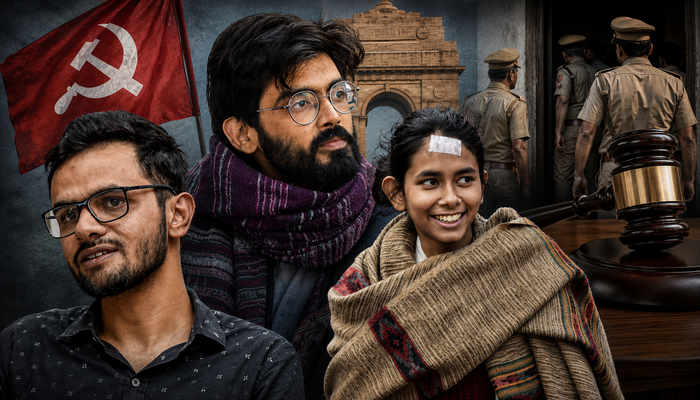
Not for CJP protest, Aishe Ghosh was picked up in a 2021 case after repeated court no-shows: How the Left twisted the narrative

0

A Delhi Court on Thursday (30th July) stayed the non-bailable warrants (NBWs) issued against Communist and Students Federation of India (SFI) leader Aishe Ghosh in connection with a 2021 criminal case. The order was passed by Judicial Magistrate First Class Vijayshree Rathore of the Patiala House courts, a day after the Delhi Police arrived at the New Delhi office of the Communist Party of India-Marxist (CPI-M) to execute the non-bailable warrants issued against Ghosh.

The non-bailable warrants were issued by the court after Ghosh failed to appear before the court during the last hearing of the case. Advocates KN Jayasankar and Subhash Chandran KR, representing Ghosh, moved an application before JMFC Rathore, stating that she could not appear on the last date of the hearing due to unavoidable circumstances. Subsequently, Ghosh was granted relief by the court.

However, the Communist cabal distorted the facts, as usual, and grabbed the opportunity to cast aspersions on the Delhi police and the Modi government, claiming that the police action was motivated by Ghosh’s involvement in the recent Cockroach Janta Party (CJP) protests. Despite the Delhi Police’s clarification that the investigating officer showed up at the CPI-M office to execute court-issued non-bailable warrants in the 2021 case, the CPI-M alleged that the police targeted Ghosh for supporting the student protests.

The CPI-M posted a video of the incident on X and described the police action as a “brazen intrusion”. The party portrayed a completely valid police action as illegitimate and unlawful and misrepresented it as an attempt by the Modi government to stifle students’ voices.

What is the case against Aishe Ghosh?

The case relates to an agitation held by the SFI and the Democratic Youth Federation of India (DYFI) members on February 12, 2021, outside Banga Bhawan in Chanakyapuri. The agitation was organised against an alleged police crackdown on student unions and youth protestors in Kolkata for opposing the Citizenship Amendment Act-National Register of Citizens (CAA-NRC).

According to police, the protest was held in a prohibited area in violation of prohibitory orders. The police said that the protesters raised slogans and blocked the road, refusing to disperse despite clear directions. Subsequently, an FIR was lodged by the police at Barakhamba Road Police Station against Aishe Ghosh and 15 others, under sections 188 (disobedience to order duly promulgated by public servant), 34 (common intention), and 447 (criminal trespass) of the Indian Penal Code, the same day. The case arising from the FIR is being heard at the Patiala House Courts complex. OpIndia accessed court documents related to the case. FIR in the case was not publicly available.

Multiple non-bailable warrants issued by the court against Ghosh

The case has been going on for about six years and has not yet reached the stage of final judgment. Multiple bailable and non-bailable warrants have been issued by the court against Ghosh since the commencement of the trial to secure her presence on the hearing dates. A total of six bailable warrants and four non-bailable warrants have been issued by the court so far.

A court issues bailable warrants after an accused repeatedly fails to appear and respond to court summons. It is issued by the court when an accused fails to appear before the court, but the court does not yet consider detention necessary. A bailable warrant is a less coercive way than a non-bailable warrant of securing the appearance of an accused before the court. It allows the police to arrest the accused but allows the person to be released on bail after fulfilling the conditions specified in the warrant, without having to be produced before the court first.

However, if the accused does not respond to bailable warrants, the court then goes on to issue non-bailable warrants. A non-bailable warrant directs the police to arrest the accused without giving them the discretion to release the accused on bail without being produced before the court. The accused, however, can file an application requesting the court to cancel or withdraw the non-bailable warrant. This is what Aishe Ghosh has been repeatedly doing. She has been ignoring the court’s summonses and bailable and non-bailable warrants. Whenever the court issues non-bailable warrants against Ghosh, she appears before the court and requests cancellation.

The non-bailable warrants that the Delhi police went to execute at the CPI-M office were issued by the court on April 11, 2026, after noting that the warrants issued against her on December 12, 2025, had been returned without being executed. The reason the warrants were returned to the court is that Ghosh was not found at her given address, even though she was informed on a call about the date of the hearing. Subsequently, the court went on to issue the warrants against her through the Deputy Commissioner of police.

A perusal of the court records shows that Ghosh and her counsel have not appeared before the court since August 2024. The court has issued multiple bailable warrants and non-bailable warrants against Ghosh due to her non-cooperation in the trial. She has repeatedly failed to appear on the dates of hearing, causing delays in the trial of the case.

The Leftist modus operandi of delaying trial

What Aishe Ghosh has been doing in her criminal trial is a classic leftist tactic for delaying court proceedings. We have seen this happen in the case of Delhi anti-Hindu riots accused like Umar Khalid, who engineered delays and indulged in forum shopping to secure bail.

Umar Khalid’s applications were rejected by both the District Court and the High Court. After a gap of six months, he approached the Supreme Court requesting bail. His bail hearing was adjourned 14 times, out of which 7 times it was Umar Khalid and his legal team (Kapil Sibal) who had requested the adjournment.

Subsequently, Kapil Sibal withdrew Umar Khalid’s SLP from the Supreme Court, citing a ‘change in circumstances’, saying that he would “try his luck” in the Sessions Court. The Delhi High Court, while rejecting Khalid’s bail plea, saw through his tactics and refused to allow the legal procedure to be exploited and misused.

Khalid had been delaying his own trial while his lawyers kept blaming the slow pace of the proceedings for his prolonged incarceration. One wonders why a person languishing in jail would delay his own trial while claiming innocence before the court. Why would an accused who is sure of his innocence want to delay the judgment in his case, which could acquit him and set him free? This is only possible when the accused has a guilty conscience and is aware that his acts will be laid bare and he will have to face justice once the judgment is delivered.

Explained: Why RBI Governor said that Indian rupee is undervalued and what it means 

In an interesting development, Sanjay Malhotra, the Reserve Bank of India (RBI) Governor, has stated that the Indian rupee is “not overvalued” and can be considered undervalued in nominal terms and Real Effective Exchange Rate (REER) terms.  

In a recent interview with The Hindu Businessline, RBI Governor Sanjay Malhotra attributed the rupee’s weakness to prevailing geopolitical tensions, the strengthening of the US dollar, and volatility in emerging markets.  

Governor Malhotra’s assessment suggests that the rupee’s sharp depreciation against the US dollar is primarily driven by global factors rather than domestic economic weakness. 

The RBI Governor publicly commenting on the rupee’s value at a time when the markets are volatile is a rare public statement. 

Indian rupee undervalued in nominal and REER indices: What does it mean 

The RBI Governor emphasised that the RBI does not target any specific exchange rate or band; its interventions are aimed only at curbing excessive volatility or speculation. 

“We do not target any specific exchange rate or band for the rupee. Our intervention, whenever necessary, is targeted to curb excessive volatility,” Governor Malhotra said. 

“The Indian [currency] rupee is “not overvalued” and could even be considered undervalued in both nominal and real effective exchange rate terms,” he added. 

A currency is considered undervalued when its market exchange rate is weaker than the levels indicated by economic fundamentals, including relative inflation rates, productivity growth, trade performance, and various other indicators of purchasing power or competitiveness. 

In a nutshell, the rupee buys fewer foreign goods or requires more units to purchase a dollar than its underlying strength would imply. 

On the contrary, when a currency is overvalued, it is stronger than the country’s economic fundamentals justify, making exports less competitive. 

Since bilateral rates, take rupee versus US dollar for example, can be misleading given they ignore trade with other partners and inflation differences. For this reason, the RBI relies primarily on effective exchange rates, NEER and REER. 

The Nominal Effective Rate or NEER is a trade-weighted average of the value of the rupee against a basket of around 40 currencies of key trading partners, covering 88% of India’s trade, while weights are based on trade shares, with the base year typically 2015-16. NEET captures pure nominal movements without inflation adjustment. 

Under REER interpretation, if the rupee is above 100, it is relatively stronger or overvalued, meaning that Indian goods are more expensive compared to partners. 

If the rupee hovers below 100, it is relatively undervalued. Major deviations below long-term averages indicate potential undervaluation beyond what economic fundamentals warrant. 

The Real Effective Exchange Rate (REER), on the contrary, involves adjustment of relative inflation between India and its trading partners.  

REER’s formula is expressed as REER=NEER*(domestic price index/foreign price index). It better reflects real competitiveness and purchasing power. 

Simply put, a REER above 100 indicates an overvalued currency, and a REER below 100 indicates an undervalued currency. 

From overvalued to undervalued rupee: Tracing the shift 

For a period, the rupee was overvalued; however, it has since pivoted into the undervalued territory following sharp depreciation. 

In around November 2024, Averaged INR/USD was around 84.4, with NEER 91.68 and REER 108.03, making the rupee overvalued by over 8% relative to the base (100). REER remained above 100 until July 2025. 

A shift, however, was seen by April-May 2026. REER slumped to multi-year lows, recorded at around 90.96 in April and 89.08 in May. Meanwhile, NEER was at a record low of around 77.19 in May. The average INR/USD stood at 95.5 in May 2026. 

June 2026, however, witnessed a partial recovery; REER was recorded at 91.26 and NEER at 78.21, still indicating an around 8-9% real undervaluation. 

Other indices and gauges also indicate a similar trend, with the Indian rupee becoming more competitive even relative to the Chinese Yuan in some specific comparisons.  

An interesting thing happened: the rupee depreciation exceeded what relative inflation differentials alone explain, partly due to India’s inflation being relatively contained. 

Undervalued rupee boosted Indian exports by 18% in a year: Implications of undervaluation 

Rupee overvaluation makes travelling and studying abroad relatively inexpensive, although imported goods, such as mobile phones, electronics, oil, and gas, become cheaper, making inflation somewhat easier to control.  

However, when the rupee is overvalued, exports are affected because goods abroad become more expensive, causing an increase in the trade deficit. 

On the contrary, when the rupee is undervalued, crude oil, gas, and electronic goods imported from abroad become expensive. Petrol and diesel prices rise, leading to higher inflation. 

However, an undervalued currency boosts exports and helps to bridge the trade deficit. Indian goods become cheaper abroad. Moreover, it becomes cheaper for foreign investors to purchase property or shares in India, boosting investment. 

An interesting example of this can be understood from a June 2026 Commerce Ministry dataset.  

The Commerce and Industry Ministry dataset indicated an 18% jump in goods exports during May compared to last year. This increase was owed to a 10% decline in INR during the last 12 months, in addition to a partial recovery in exports to the West Asia region. 

India’s trade deficit also swelled from $22.56 billion in 2025 to $28.21 billion in May 2026.  While goods exports increased by 18% to $45.2 billion from $38.3 billion in May 2025, imports also surged by 20.62% to $73.41 billion. 

In a press briefing on 15th June 2026, Commerce Secretary Rajesh Agarwal said that exports to West Asia in May 2026 have almost reached the level of last May despite disruptions in that region.  

In May this year, India’s exports to the UAE surged by 3.18% and to Saudi Arabia jumped by 11.12%. However, the imports from the US increased dramatically by 54.43% in May to $5.87 billion due to India’s increasing energy imports during the West Asia war.  

The data indicated that a weaker rupee helped India’s goods exports log a 6-month high. 

On 28th July, the Central government released a press release which stated that India has recorded its highest-ever exports in FY 2025-26, reaching a record US$ 863.1 billion, with merchandise exports reaching US$ 441.8 billion and services exports expanding further to US$ 421.3 billion.

It is notable that an excessively strong rupee can also pose a challenge for the economy, impacting exports. But a moderately undervalued rupee can benefit exports and domestic industries.  

However, persistent or excessive rupee weakness can cause a sharp surge in inflation and external risks that the RBI monitors.  

Since much of the recent rupee value dynamics are attributed to transitory global shocks rather than structural domestic problems, the RBI Governor’s stance suggests room for recovery once external conditions improve, while the central bank stands ready to ensure orderly markets.  

The RBI’s assessment essentially implies that the Indian rupee’s current level reflects global headwinds rather than domestic frailty. Rupee remains competitive, undervalued on key metrics, with potential to bolster as shocks fade, without overlooking the need for vigilance on volatility, inflation, and external balance. 

On the bright side, India’s rupee becoming cheaper than the Chinese Yuan has handed India an advantage that Indian goods will become competitive with Chinese goods in the foreign market. As their prices decline, India’s penetration in the foreign market will increase. 

Furthermore, Indian exports will gain new momentum, with Indian textiles, footwear, medicines, auto parts, and other goods becoming cheaper than the Chinese ones. 

Meanwhile, expensive imports will become a headache, but this may boost domestic manufacturing and competitiveness.  

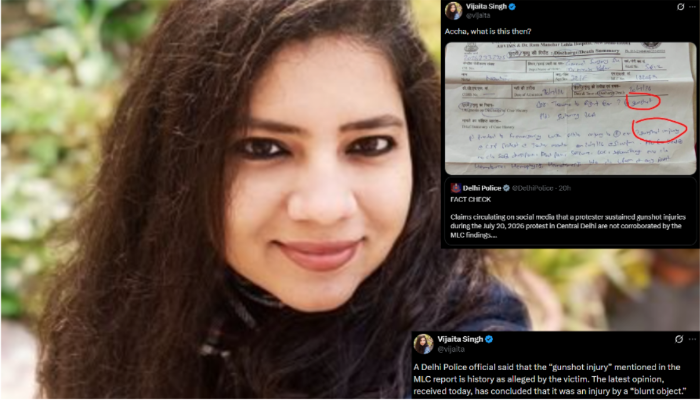
The Hindu’s Vijaita Singh tried to fact-check Delhi Police, then had to fact-check herself: The ‘gunshot wound’ mystery during CJP violence

Vijaita Singh, who serves as the deputy editor of The Hindu, has found herself in a self-created cycle of fact-checking after asserting that a 32-year-old woman named Nutan endured gunshot wounds during the 20th of July demonstration led by the Cockroach Janta Party (CJP). On 29th July (Wednesday), the Delhi Police rubbished the charge by emphasising that the findings of the Medico-Legal Certificate (MLC) do not substantiate the same and identified it as “a lacerated wound in front of the right tragus, with the nature of injury described as blunt.”

The authorities further noted that the doctor referred to it as “simple injury and there is no evidence of gunshot injury. Afterwards, they urged, “The public is advised to verify information through authentic sources before sharing such claims.” A senior official mentioned, “An MLC is a medico-legal certificate prepared by doctors and provided to the police, forming the basis for further legal action in a criminal case.”

Singh, however, promptly rejected the counter and shared the protestor’s cropped discharge report from Dr Ram Manohar Lohia (RML) hospital, which included terms such as “gunshot” and “gunshot wounds” to support her allegation.

Notably, the summary of the case, which is a medical narrative told by the patient and documented by the doctor, was intentionally portrayed as factual, even though it cannot be deemed definitive or conclusive until a comprehensive examination is performed.

The “trauma to right ear” and “gunshot” listed in the diagnosis section are similarly accompanied by a question mark, indicating that they could be potential possibilities but require analysis for validation. Predictably, the truth inevitably came to light and exposed “the journalist.”

A few hours later, Singh had to verify her own misleading arguments after it was confirmed that the wound was indeed caused by a “blunt object” and not otherwise, but instead of removing her earlier fabrication, she shamelessly decided to quote it. She was compelled to accept that the statements regarding the gunshot wound were “history as alleged by the victim. The latest opinion, received today, has concluded that it was an injury by a blunt object.”

Singh then tried to indirectly double down on her false claim and “recounted” Nutan’s account, who told The Hindu that she was standing with others in the park’s upper area away from the main protest location close to Jantar Mantar.

She then quoted the complainant, who insisted, “I can describe the spot; there is a fountain and a steel statue of a lion. I was standing right next to that, up in the higher part of the park. I was fired at from below. I can’t say for certain if I was the specific target, but the gun was aimed in our direction.”

“Seeing that, we all got scared and started running. There were quite a few of us up there, so we were all fleeing together when the shot was fired, and it grazed right past my ear,” she conveyed.

Delhi Police’s Public Relations Officer, Deputy Commissioner of Police Ranjeev Ranjan, also highlighted that the lesion was caused by a “blunt weapon” and not any firearm. Insiders unveiled that Nutan went to a private facility in Gurugram after leaving the hospital, and another medical document was issued there, but the accusations have already been proven unfounded by the medical assessment.

Left-liberal lobby, opposition ecosystem amplifies the lie

The left liberal lobby, as expected, quickly took advantage of the golden opportunity to launch an attack on the police without verifying the validity of the charges. The All-India Students Association (AISA), which is connected to the Communist Party of India (Marxist–Leninist) Liberation, hailed Singh as a crusader for truth and scoffed, “Delhi Police thought how anyone would even know (about the purported use of guns on agitators).”

Indian National Congress secretary Pranav Jha wrote that the greatest concern of everyone involved with the government, from top to bottom or an individual to an institution, is only their reputation instead of people. He alleged, “They go to great lengths to protect their image, ensuring that no stain tarnishes it,” even if it means telling several lies.

Jha argued that this behaviour was not coincidental but morally sanctioned by those at the highest level and is a reflection of their political ideology. “When the top leadership prioritises propaganda over accountability and image management over truth, that same culture permeates the entire system. Unfortunately, this has been the decades-old history and working style of their politics: propaganda over truth, image over accountability and concern for power over public welfare,” Jha added.

Ironically, the Congressman was distributing faulty details while denouncing the BJP for deceiving people.

Another “journalist”, Tamal Saha, advised Singh to “move forward as they are with her.” Was he implying that she should persist in promoting such dubious claims with their backing? He did not take the time to clarify, just as he failed to ascertain the accuracy of the accusations.

A user expressed pride in the doctors who presented the report to Singh. He declared the police culpable for employing pellet guns and inflicting gunshot wounds on the protesters.

A member of this cabal expressed gratitude to Singh and made a comparison with revered British journalist Mark Tully in relation to his historical coverage of “Operation Blue Star.”

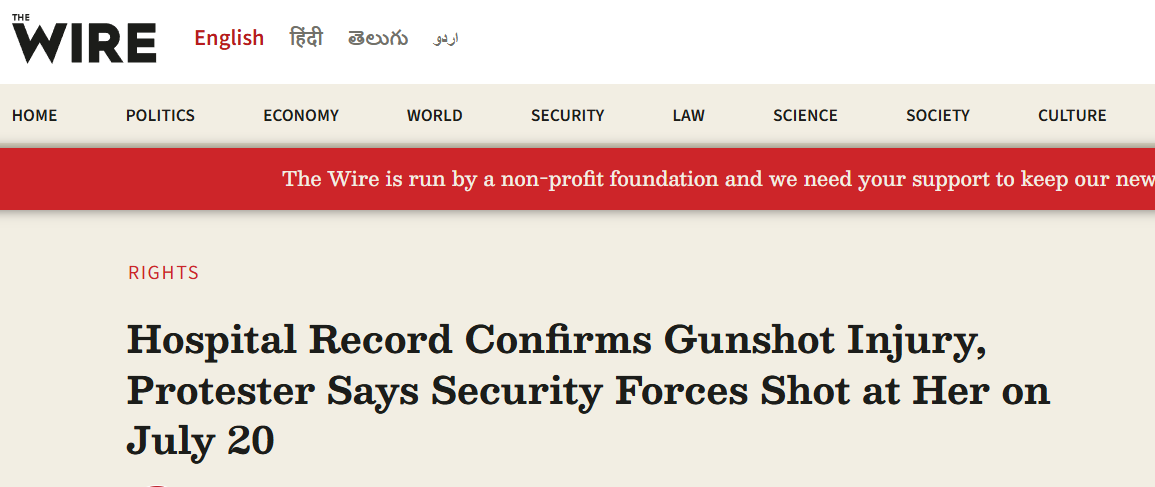
The propaganda website “The Wire” also jumped on the bandwagon as it utilised The Hindu article and the contorted hospital report to assert that the woman suffered a “gunshot injury” because “security forces shot at her.”

What did the woman claim

On 27th July, The Hindu published a report by Ashok Kumar on the claims of Nutan, a native of Ranchi and has been employed at a private company in Gurugram’s Millennium City. She has returned to her hometown and held a telephonic conversation with the media house.

She stated that a bullet skimmed by her ear and added, “At that very moment, I realised I had sustained a very serious injury to my ear; I had stopped hearing.” The woman stressed, “When I checked with my hand, I saw heavy bleeding. My hand was covered in blood. I quickly covered the wound with a handkerchief and rushed to the hospital,” and was transported to RML Hospital for a two-hour surgery.

“I was hit on the right side. The gun was pointed directly at us; that’s how I knew the injuries were caused by a gunshot. I didn’t really know much about rubber bullet guns or pellets, but two people had their guns aimed right at us. They were wearing blue uniforms. The person involved wasn’t wearing a name plate,” she contended.

Nutan mentioned that she was asked to leave and released within 15 minutes after the procedure, remarking, “While there, I saw four or five police personnel come in. They didn’t have any real injuries, maybe just a slight scratch on a leg or hand, yet they were lying on stretchers, unbuttoning their shirts.”

Nutan alleged that she had to travel from Gurugram to RML Hospital to change the dressing over the course of two days, but she encountered “roadblocks” and “harassment.” She insisted, “I have stitches all over my ear now. My health has deteriorated significantly since that day.”

Conclusion

Singh, similar to her colleagues in mainstream media, has resorted to disseminating disinformation, only to be busted later. In fact, she has even allied with individuals such as Arfa Khanum Sherwani to justify assaults on journalists if they do not align with their ideological beliefs. These issues represent yet another instance of the decay within the liberal media, which otherwise professes to be the bearers of truth and advocates for freedom of expression.

The entire ecosystem is solely focused on advancing their own narrative to malign the government and even the nation, rather than seeking the truth. The excesses committed against the protesters, as well as the targeting of police during the recent agitation, are already under judicial consideration. The truth must be revealed, and the perpetrators must face punishment, but there should be no room for propaganda in the process.

Why India needs a comprehensive critical infra law, ASAP

During Operation Sindoor, some Pakistani linked accounts spread a claim that a cyberattack had shut down 70 per cent of India’s power grid. The claim was false, and the PIB cleared it within hours. But for those few hours, it still worked because it sounded believable, because anyone reading it could immediately understand that India’s grid is a real target.

What almost nobody paused to ask in that moment was the more important question. What law is actually protecting it?

The honest answer is that India mostly has one cyber security law, written in 2000 and updated in 2008, and it was never really designed to deal with a bridge, a railway yard, or a power substation. It was built for computer systems, not for the wider world of infrastructure. That gap is not just theoretical. Modern conflict now treats grids, ports, cables, and data centres as targets in their own right, not just as things that get damaged by accident. The very meaning of infrastructure has expanded far beyond what Parliament imagined nearly twenty years ago. And this government has already shown, by striking nine coordinated targets across the Line of Control in one operation, that it can act decisively when it wants to. The next test is whether it can show the same decisiveness in the laws that protect India’s infrastructure.

The law we have was written for a smaller, weaker India

Section 70 of the Information Technology Act, 2000, is still the main law the system relies on, but it was never designed for a country with the kind of security challenges this government is dealing with today.

It defines Critical Information Infrastructure as a computer resource whose failure could harm national security, the economy, public health, or safety, and it allows the government to notify such a resource as a protected system. 

Section 70A, which was added in 2008, created the National Critical Information Infrastructure Protection Centre under the National Technical Research Organisation, with reporting routed through the National Security Adviser. In practice, this has meant protecting the IT systems of institutions like ICICI, HDFC, and the National Payments Corporation of India by placing them under the protected systems category.

But the definition matters here. The law protects computer resources, and only computer resources. It does not directly cover a bridge, a power substation, a water treatment plant, or a railway yard unless a computer system happens to be the point where everything fails.

That leaves big gaps. There is no comprehensive national registry, no mandatory audit system covering both physical and cyber sides with unified and consistent national obligations, no sector-wide threat modelling, and no compensation framework for ordinary citizens who are affected when something goes wrong. That old framework may have made sense then. But this government is now defending a 2026 India against drone incursions, coordinated sabotage, and mixed cyber-physical attacks that Parliament in 2008 could not have fully imagined.

What counts as critical infrastructure now?

Cut out the jargon, and critical infrastructure simply means everything a country cannot afford to lose for more than a few days without the state starting to look weak.

That includes roads, bridges, and tunnels, railways, police stations, airports, and ports, the power grid and telecom networks that everything else now depends on, data centres that hold the digital equivalent of a nation’s records; and hospitals and water systems that keep people alive.

A generation ago, most of this meant concrete and steel. Today, the physical and digital have become tightly linked. A ransomware attack on a hospital can be just as dangerous as a device at its gate, and a cut cable can do more economic damage in one afternoon than many floods do in a month.

When undersea cables in chokepoints like the Red Sea or the Strait of Hormuz get damaged, a large chunk of India’s westward internet traffic suddenly comes under strain. And you don’t feel that impact in some abstract cyberspace; you feel it in everyday UPI payments that start lagging, trading screens that freeze, and government cloud services that begin to fail. In the same way, when a premier institution like AIIMS has its systems knocked out by a targeted cyberattack, it’s not just an IT outage. It’s a moment when the Republic’s ability to care for its own citizens is temporarily switched off by a few lines of malicious code. So any law written for today’s India that only protects one side of this reality and leaves the other exposed is already out of date the day it’s passed.

What the law should contain?

None of this stuff needs inventing. Pretty much all of these ideas already exist in some form in the laws or day to day practice of working democracies. And a government with a majority this big really has no good excuse for still stitching the whole system together bit by bit.

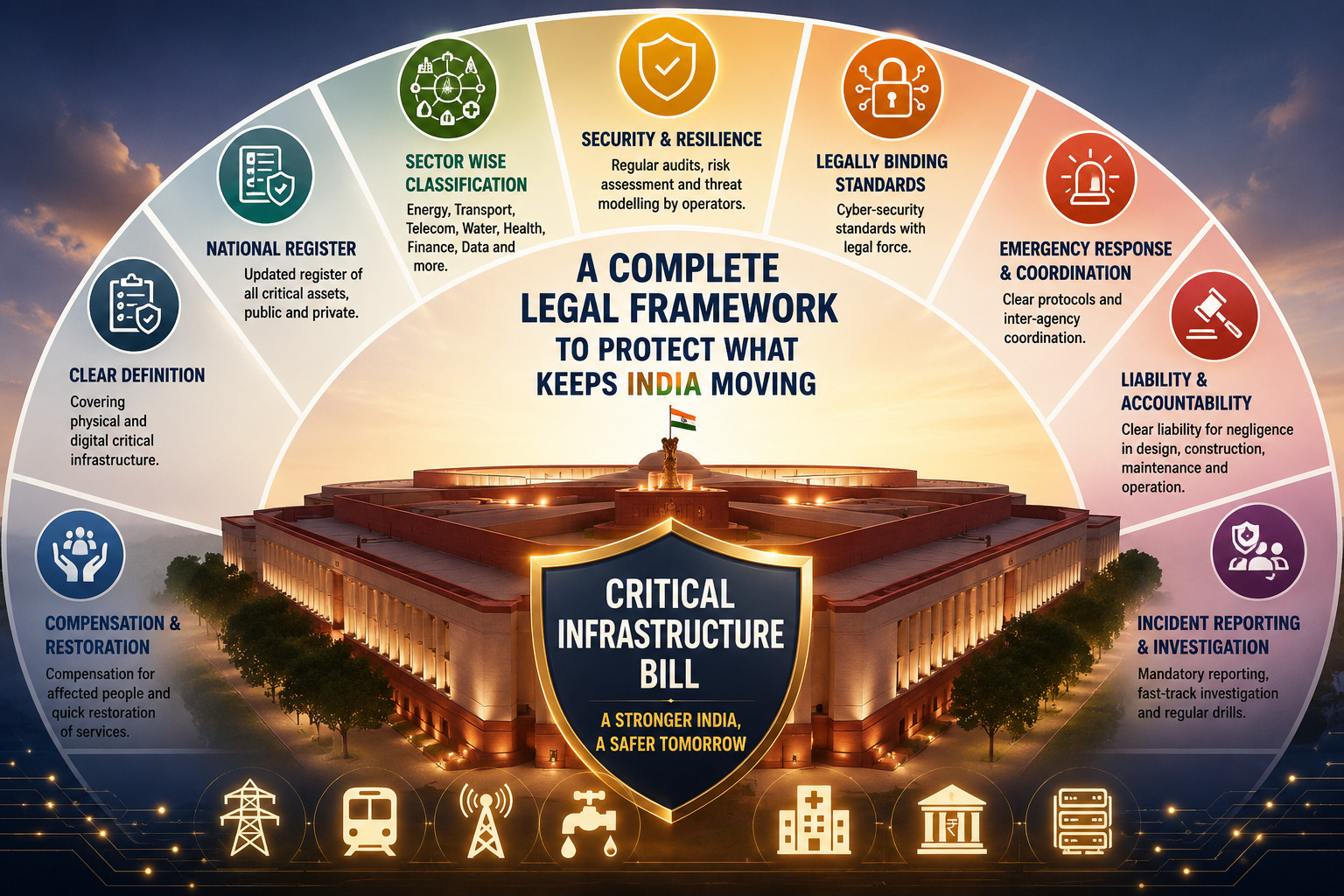
What it would actually look like is pretty simple. India would need a proper legal definition of critical infrastructure that covers both the physical and the digital side, not just the cyber only wording that’s currently sitting in Section 70. It would need a national register of critical assets, public and private, that gets updated regularly instead of only being dusted off when a crisis hits. And it would need clear sector by sector classification, so energy, transport, telecom, water, health, finance and data infrastructure don’t all get bounced from one ministry to another after something goes wrong.

The system would also have to insist on regular resilience and security audits, rather than waiting for a failure to make the news. Operators, whether they’re public or private, would need to be made responsible for looking at risks and modelling threats ahead of time. On top of that, cyber security standards should actually have legal force behind them, instead of just being advisory circulars that nobody really has to follow.

A proper framework would also need clear emergency response rules and interagency coordination, so a sabotage incident doesn’t create the same jurisdictional mess that often follows a protest or a law-and-order situation. There should be clear liability for negligence in design, construction, maintenance and operation, plus regular drills, mandatory incident reporting, and a fast-track investigation the moment sabotage is even suspected. And if ordinary people get harmed, there should be a proper compensation and restoration system so recovery doesn’t just rely on informal goodwill after the fact. This is the basic operating manual that every serious government in India is competing with already has in place. There’s really no reason a government sitting on a majority this large should still be missing it.

What other nations have done?

The United States has been having something like this since 2013. Think of it as drawing up a clear list of the sixteen most important parts of the house, the ones that, if they collapsed, would bring the whole building down. Security, the economy, public health, etc. Presidential Policy Directive 21 does exactly that. Then in 2024 they updated the rules so one single agency, the Cybersecurity and Infrastructure Security Agency, became the main coordinator for all of them. And every two years there’s a national risk report that forces everyone to check the foundations again instead of just hoping they’ll hold.

Australia’s version, the Security of Critical Infrastructure Act from 2018, is tighter and easier to adapt. It covers eleven sectors, keeps a national register of the key assets, makes risk management plans and incident reporting compulsory, and, this is the crucial bit, gives the minister a last-resort power to tell a private company ‘do this’ or ‘stop doing that’ when national security is at stake. That last power is the one that really matters for any Indian government that cares about sovereignty. It means Canberra never has to stand outside a private port or power company asking nicely for cooperation. It can simply issue the order.

The European Union’s approach is probably the most useful to look at. Its NIS2 Directive covers sixteen sectors of ‘essential’ and ‘important’ entities, and it sits alongside a separate Critical Entities Resilience Directive that deals specifically with physical security. So a single power utility ends up protected on both its digital side and its physical side by design, not by accident. That’s exactly the gap Section 70 falls into, like having a strong lock on the front door but leaving the back window wide open, and it’s exactly the gap this government’s law should close.

None of this means India has to copy anyone else’s blueprint wholesale. No serious person is saying Delhi should take orders from Washington, Canberra or Brussels on how to run its own house. It’s simply pointing out that a government aiming for a five trillion dollar economy and a permanent seat at the top table can’t keep protecting its most important systems with the legal equivalent of a side door left ajar.

Parliament needs to finish what it started

Here is the reason for optimism, and it comes from this government’s own side. In February 2026, Rajya Sabha MP Kartikeya Sharma introduced the Critical Infrastructure (Resilience, Protection and Accountability) Bill, 2026. The basic idea behind it is simple and right: when public infrastructure fails, and people die, responsibility now gets spread so widely across contractors and consultants that, in the end, nobody is clearly answerable.

The Bill would change that. It would move major infrastructure failures from civil liability into criminal liability, require digital twins and a national monitoring dashboard, and extend defect liability on large projects to twenty five years. It covers dams, expressways, power grids, ports, and transit systems.

This is a real and serious proposal, and it should be supported, not allowed to quietly fade away like so many private member’s bills do. But it only answers one part of the problem. It tells us what should happen when a bridge collapses because of negligence. It says nothing about what should happen when a hostile state, or someone taking advantage of unrest especially looting police stations of weapons, deliberately cuts the cable instead. If the government is serious about finishing this work, it should take Sharma’s accountability framework and combine it with a proper security and sabotage response framework. Then it should pass the whole thing as a government bill, backed by the full strength of its majority, instead of leaving a good idea stuck in the Rajya Sabha’s private member’s list, where too many good ideas end up being forgotten.

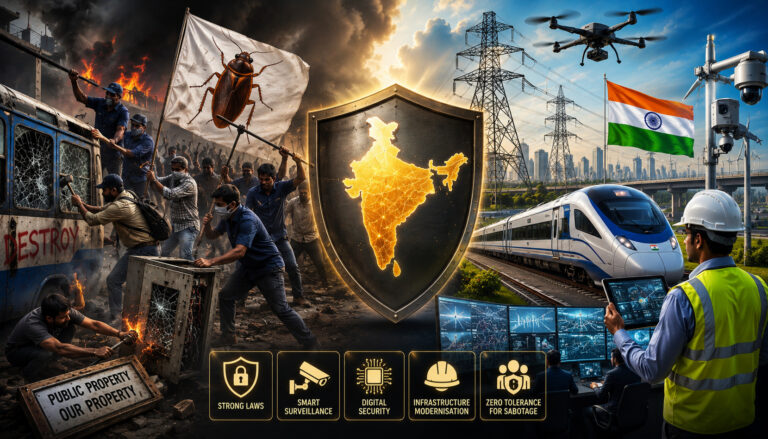
Zero tolerance for sabotage, applied lawfully and without apology

This is the point where the argument has to be made cleanly, without any careless wording. If the law gets drafted sloppily here, critics will jump on it and use it against the government, and there’s no reason to hand them that kind of ammunition. India already has a legal base for punishing the deliberate destruction of public property during unrest. It just needs updating for today. The Prevention of Damage to Public Property Act, 1984, already covers damage to things like water, power, transport and telecom systems, and it can put offenders away for up to five years. Back in 2009 the Supreme Court also made it clear that once organised participation is shown, the burden of proof can shift to the accused, and High Courts can assess the damage and order compensation.

Uttar Pradesh, under Yogi Adityanath, didn’t wait for Delhi. Its tribunal-based recovery ordinance already lets the state attach the property of people found responsible for damage during riots and unlawful agitations. That’s a model other states, and now Parliament, should be looking at. The Law Commission also pointed out in 2024 that a 2015 attempt to modernise the 1984 Act was quietly dropped, even though the scale of damage during unrest has only got bigger since then.

A national Critical Infrastructure Protection Act should take that idea further. It should create a fast track offence for deliberate attacks on critical assets, fibre cables, substations, rail yards, water systems, with quick arrest, fast prosecution, and penalties tough enough to actually deter people. It should also give security forces clear legal power to stop sabotage while it’s still happening.

But that power has to be written carefully. Protest and dissent are protected by the Constitution, so a law like this should target sabotage, not ordinary public order policing. Its real strength should come from being precise. It should focus only on deliberate attacks on the systems that keep the country running. A narrow, clear law is far more likely to survive a court challenge and win public trust. A vague one would just create a fresh issue for the opposition to exploit.

Conclusion

This is not an argument against the government of the day. In fact, it is the opposite. This government has already shown that it can move at the speed a serious state needs, on the battlefield, on ceasefire terms, and on the big strategic decisions that matter.

So it has no real excuse left for moving slowly on the two reforms sitting right in front of it. A state that could strike nine targets across the border in one coordinated operation can surely find the parliamentary time to pass a law protecting its own grid. And it can certainly find the will to make its information system as confident and effective as its foreign policy.

Operation Sindoor proved that this government can win the argument on the battlefield. The unfinished job is making sure it can win the argument about itself just as quickly, and making sure that no foreign or domestic actor ever again gets ninety days to control the story, or an open door to a substation, before the Indian state moves in to shut it.

Johnson & Johnson baby powder causing cancer? What is behind the $5.5 billion settlement 

First introduced in 1894, Johnson & Johnson baby powder is one of the most well-known baby-care products globally. However, the company behind it has also found itself at the heart of a global controversy spanning a decade over asbestos (carcinogen) contamination. To settle thousands of prolonged lawsuits alleging that the company’s discontinued talc-based baby powder caused ovarian cancer, Johnson & Johnson has offered $5.5bn.

The initial formal lawsuits were brought forth in 2009, which charged that the talc-based baby powder leads to mesothelioma and ovarian cancer. The US Food and Drug Administration’s advisory revealed that Johnson & Johnson recalled a shipment in 2019 after a sample revealed a small level of asbestos.

Afterwards, the product was discontinued in the United States in 2020, and in other countries in 2023, but the charges were repeatedly countered.

However, the row escalated, marked by tens of thousands of lawsuits and multibillion-dollar settlement offers targeting the baby powder and other products. Johnson & Johnson and Kenvue Inc have agreed to pay $5.5 billion, or ₹52,668 crore, to resolve these cases in the latest landmark development.

The announcement was made on 27th July (Monday) by Johnson & Johnson, which is headquartered in New Jersey.

Kenvue functioned as its consumer health division and was responsible for the baby powder outside of North America. It later separated in 2022 and started to own famous brands like Band-Aid, Listerine and Calpol.

Approximately 76,000 claims, including those consolidated in a federal court in New Jersey and associated proceedings in state court, are addressed by the arrangement, which represents almost all of the remaining pleadings against the pharmaceutical giant. This covers 99.75% of America’s outstanding talc-related cases.

The majority of the complaints had similarly been handled by the multinational enterprise, which stopped making and selling its baby powder in the US and international markets, stating, “As part of a worldwide portfolio assessment, we have made the commercial decision to transition to an all cornstarch-based baby powder portfolio,” at the time.

Notably, Johnson & Johnson’s production licence for baby powder made at its Mulund facility was revoked by Maharashtra’s Food and Drug Administration in 2022 after samples were deemed “not of standard quality” by a government laboratory. However, the former approached the Bombay High Court, which overturned the order in January 2023 after identifying flaws in the regulatory process.

No proof of cancer: Johnson & Johnson refutes charges

Johnson & Johnson maintains that the products are neither unsafe nor have asbestos and stressed that there is no proof that talc causes cancer. It also insisted that its current move is only meant to conclude years of expensive litigation and allow it to concentrate on its primary healthcare business.

Its vice-president ​of litigation, Erik Haas, argued that the accusations are “meritless” and remarked that the conglomerate would have succeeded through further legal action “as it has in the vast majority of cases tried to date.”

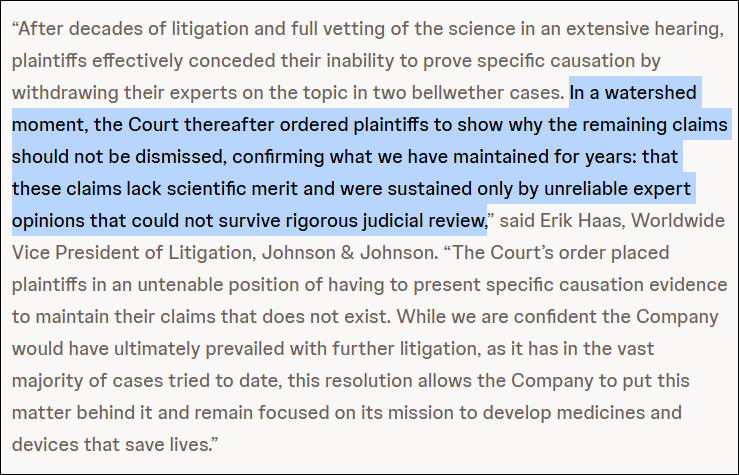
“After decades of litigation and full vetting of the science in an extensive hearing, plaintiffs effectively conceded their inability to prove specific causation by withdrawing their experts on the topic in two bellwether cases. In a watershed moment, the Court thereafter ordered plaintiffs to show why the remaining claims should not be dismissed, confirming what we have maintained for years: that these claims lack scientific merit and were sustained only by unreliable expert opinions that could not survive rigorous judicial review,” Haas said.

Excerpt taken from the official statement issued by Johnson & Johnson on 27th July 2026. (Source: jnj.com)

He then added that ‌”this resolution allows the company to put this matter behind it and remain focused on its mission to develop medicines and devices that save lives.”

Johnson & Johnson conveyed that it would make an offer of up to $3 billion next year with no subsequent payments required prior to 2028. However, the deal is not going to be finalised unless it is approved by 95% of the claimants in state or federal courts.

According to lawyer Chris Seeger, the figure could eventually touch $7 billion or more. He represents roughly 2,500 clients and assisted in negotiating the accord, which does not cap Johnson & Johnson’s ultimate payout, but it assigns certain values to eligible ovarian cancer complaints. “We got ‌a fair settlement, and our clients are going to be happy with it,” he expressed.

The fresh pact is limited to existing cases. “The exclusion of future claims made more money available to current plaintiffs than the bankruptcy proposal did, and it also accelerates the payments so that all claims will be paid within 18 months instead of being spread out over more than a decade,” Seeger pointed out.

Meanwhile, almost 7,000 potential similar claimants are engaged in the most significant product liability lawsuit in the history of the United Kingdom against Johnson & Johnson.

The alleged bankruptcies

The litigation restarted in March 2025 after more than three years on hold when Johnson & Johnson altered the baby powder’s formula. On the other hand, Johnson & Johnson adopted a tactic known as the “Texas two-step” and lodged three bankruptcies through its shell-company subsidiary to manage the cases; however, it faced rejection each time.

It commenced a corporate reorganisation in October 2021 by forming “LTL Management LLC” to handle the issue. The latter then declared bankruptcy, but the court dismissed this application, finding that sufficient funds were available to proceed with the dispute.

The company then conveyed that its subsidiary would re-file for voluntary Chapter 11 bankruptcy to address the charges, in the securities statement in April 2023. It declared to spend $8.9 billion over 25 years to resolve “all current and future” allegations. However, the offer was turned down due to problems with the method for gaining the permission of claimants.

LTL Management filed for bankruptcy a second time in July 2024 with the intention of reaching a restructuring contract to settle the disagreements. However, the court prohibited this approach because of difficulties in collecting claimant votes and other legal reasons.

Johnson & Johnson filed for bankruptcy for the third time in late September 2024, intending to resolve these outstanding litigations through a comprehensive settlement package. It asserted to have resolved almost all of the cases, thereby removing them from the larger lawsuit, in January 2025.

However, its $8 billion package was disallowed by a judge a few months later in March because of defects in the process for gathering votes from personal injury claimants. The court shut down the bankruptcy strategy for the third time with this ruling.

Johnson & Johnson had a mixed record prior to this strategy with a multibillion-dollar ruling in favour of 22 women who reported that baby powder was the cause of their ovarian cancer. Some trials were secured by the business, and other verdicts were overturned on appeal.

The enduring legal battle

Johnson & Johnson underwent its first major trial in 2013, after which greater judgments in later years were made possible and laid the groundwork for further action. It was ordered by a US jury to pay $72 million, comprising $10 million of actual and $62 million of punitive damages to the family of a woman who passed away from ovarian cancer. The decision was made in 2016.

The family’s counsel had alleged that the company “knew as far back as the 1980s of the risk” but chose to “lie to the public, and lie to the regulatory agencies.”

This was the first such occurrence associated with the application of the mineral in the US. Even though the judgment was overturned a year later, juries all around the country have awarded the plaintiffs in multiple other lawsuits against it.

Substantial rulings were rendered in a variety of jury trials between 2016 and 2018. The enterprise recalled 33,000 bottles of the product after the aforementioned FDA disclosure in 2019 and stated that it would cease to sell the talc-based baby powder in North America that same year. However, it publicly challenged the assertions regarding cancer.

Johnson & Johnson offered a $6.5 billion settlement in May 2024. The proposal was the result of continuous legal conflicts. The company raised the amount to $8 billion in September of that year in a bid to allay the court’s prior worries and win over more people. The court declined this amended plan despite the increase.

A California jury in October directed Johnson & Johnson to cough up $966 million for the family of a woman who highlighted that applying its baby powder for decades had caused her cancer. The amount was the largest verdict in a case involving a single plaintiff.

However, Johnson & Johnson recently tasted a series of victories, including wins in individual trials, successful attempts to disqualify attorneys from the case and decisions against experts that were utilised to support the contentions of plaintiffs.

Last week, a federal judge cast doubt on the ability of 69,000 filings to concretely demonstrate that talc directly caused their ovarian cancer, giving the manufacturer a major triumph in the protracted legal struggle.

Johnson and Johnson was asserted to be aware of the presence of asbestos in its baby powder for decades by Reuters. “From at least 1971 to the early 2000s, the company’s raw talc and finished powders have tested positive for small amounts of asbestos, and the company’s executives, mine managers, scientists and doctors had actively discussed the issue while failing to disclose it to regulators or the public,” highlighted an inquiry that examined documents, depositions and trial statements in 2018.

However, if accepted, the settlement could put a lid on the most extensive and enduring product liability disputes in corporate history.

Who is Shikha Dalmia, who features on the list of journalists given sponsored trips to China for writing pro-China articles

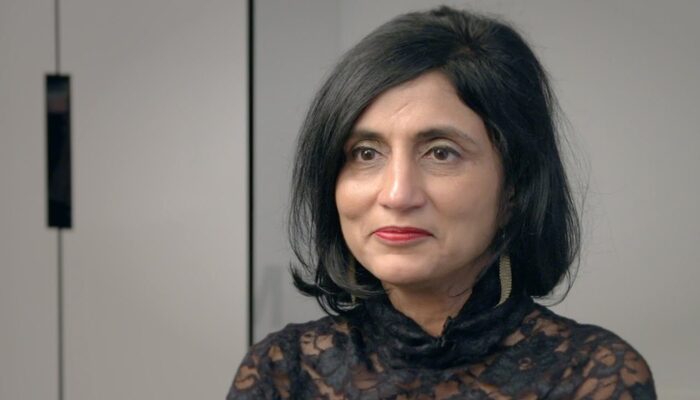
A recently published investigative article on Substack revealed that some prominent American journalists were given funded trips to China by the China-United States Exchange Foundation for pushing a pro-China narrative in the American media. The article written by Natalie Winters listed the names of American journalists who went on these funded trips. The list includes the name of Indian-origin American journalist, columnist, and policy analyst, Shikha Dalmia.

The article relies on U.S. Foreign Agents Registration Act (FARA) filings, which disclosed that the CUSEF hired Washington lobbying firms with the stated objective of generating “favorable coverage” and “positive messages” about China in the American media.

According to Natalie Winters, the FARA filings did not directly name the American journalists who received these sponsored trips. To identify these journalists, she cross-referenced the FARA filings with archived trip rosters, program brochures, and lobbying disclosures.

She examined archived participant lists for China exchange programs, internal planning documents describing media outreach objectives, and the articles written by some of these journalists following their visits. According to Winters, these articles were relatively favorable toward China.

Among these articles was an article written by Shikha Dalmia, titled “China bashing is for Losers”, published in Forbes. Dalmia wrote the article the same year she traveled to China. In the article, she argued that China bashing had become a “bipartisan sport” for the election season at that time.

Screenshot via Forbes

“Republicans and Democrats are sowing the seeds for their own destruction by running on an anti-China platform. Rather than vilifying China, they would do themselves – and the American economy – a world of good by trumpeting the benefits of trade with it. There is not just a very good economic — but also a very good political — argument for taking a more enlightened approach to China,’ Dalmia wrote in the article after arguing at length about how bashing China was self-damaging for American politicians.

Who is Shikha Dalmia?

Shikha Dalmia has written for publications like Reason, The Week, The New York Times, The Wall Street Journal, USA Today, and Bloomberg Opinion. Shikha is popular among the liberal circles for her articles ‘bashing’ Prime Minister Modi, the BJP, and the Hindutva ideology. She has written articles accusing the Modi government of weakening India’s liberal democratic institutions, eroding religious pluralism, and encouraging majoritarian politics.

In February 2020, during US President Donald Trump’s visit to India, Dlamia wrote an article titled “While Trump Was Praising Modi for Religious Freedom, Modi-Supporting Hindus Slaughtered Muslims in the Streets”. In the article, Dalmia wrote about the Delhi anti-Hindu riots and gave her own distorted and whitewashed version of the riots. She claimed that “Hindu militants” clashed with ‘protestors’ agitating against the Citizenship Amendment Act (CAA).

She described the CAA as Modi’s plan to “strip an untold number of India’s 140 million Muslims of their citizenship rights and perhaps throw them in detention camps”. Brazenly pushing her anti-Hindu propaganda, Dalmia wrote, “The militants lobbed petrol bombs at Muslim homes in northeast Delhi, set a mosque on fire before hoisting a Hindu flag on it, and looted Muslim-owned shops.”

Screenshot via Reason

She went on to claim that “Anti-Muslim violence has become a depressingly regular fact of life in India” since the Modi government came to power. She also slammed Trump for not preaching to the Indian government about the allegedly deteriorating human rights situation in the country.

A month before, in January, she wrote another similarly vile piece titled “Indian Prime Minister Modi’s Lawless Reign of Terror,” claiming that PM Modi had implemented his Gujarat Model across the country. According to Dalmia, the Gujarat Model led to “the slaughter of more than 1,000 men, women, and children, mostly Muslims, over the course of a few days in 2002”. Dalmia blaming PM Modi for the Gujarat riots is a peculiar characteristic of the so-called Left-Liberal cabal that Dalmia is a part of.

Screenshot via Reason

Moving on, Dalmia went on to describe student clashes at JNU as a case of Modi’s “private militants” and members of Akhil Bharatiya Vidyarthi Parishad (ABVP) going on a rampage in the campus, targeting Muslim students and those having pictures of Dr. B.R. Ambedkar in their rooms.

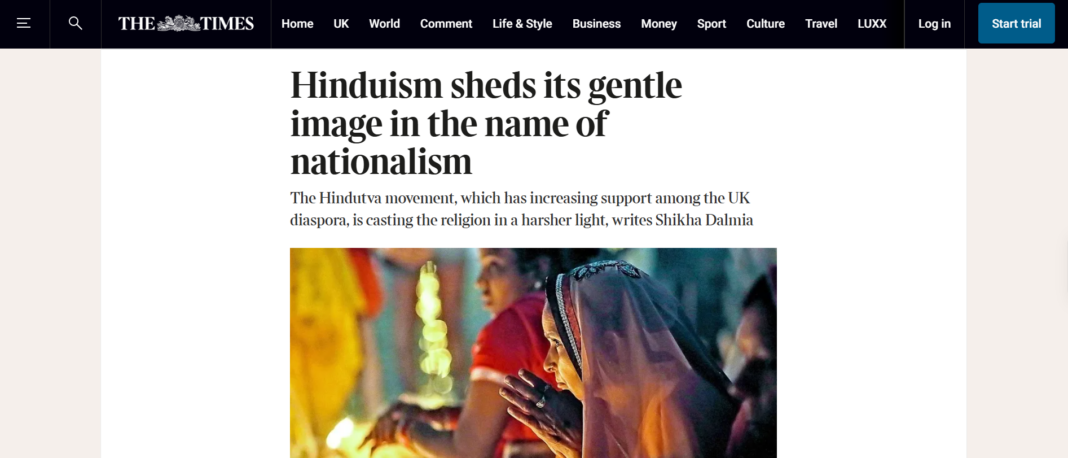
PM Modi and his party are not the reasons that Dalmia’s is unhappy about; her hatred naturally extends to the Hindutva ideology. In an article titled “Hinduism sheds its gentle image in the name of nationalism”, Dalmia makes a bogus claim that religious freedom in India was facing an increasing threat from “Hindutva-Hindu nationalism”.

Screenshot via The Times

This is followed by another bogus claim, presented as a fact, that “Hindu militants” have been unleashing unspeakable violence against Muslims since the partition of India.

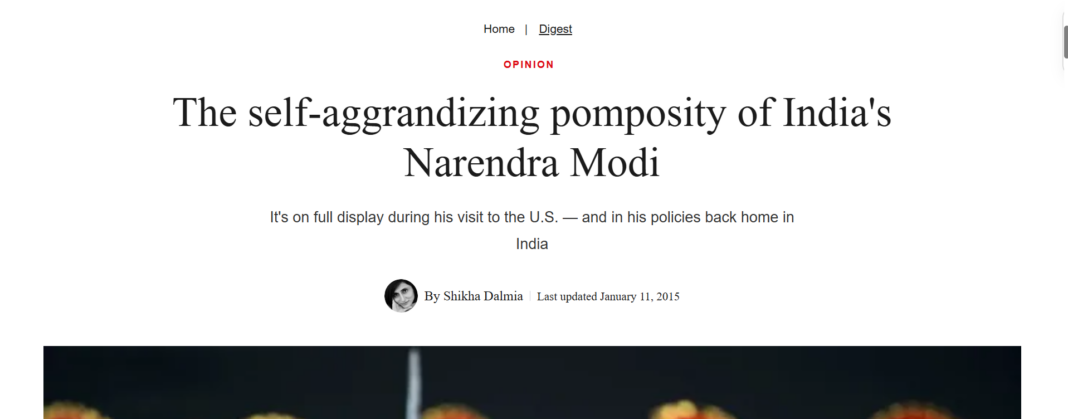
Dalmia’s hatred of Modi peaked soon after he was elected as the Prime Minister of the world’s largest democracy with a landslide victory. She expressed her disappointment over PM Modi’s visit to the US after taking charge as the Prime Minister. She claimed that the visit was not a step towards improving the bilateral ties between the two countries but instead was an expression of what she claimed was Modi’s need for star attraction, self-aggrandisement, and ego inflation.

Screenshot via The Week

In an interview featuring her fellow Left-Liberal Siddhartha Vardarajan, Dalmia first expressed deep shock that “somebody like Narendra Modi” became the Prime Minister of India. She then whined about how, in her (clearly biased) opinion, India had become similar to Pakistan with shrinking minority religious rights. The two together ranted about how, according to them, India had changed for the worse under PM Modi’s rule.

Dalmia’s venomous outpourings regarding PM Modi and Hindutva make sense in light of the revelation about her sponsored trips to China.

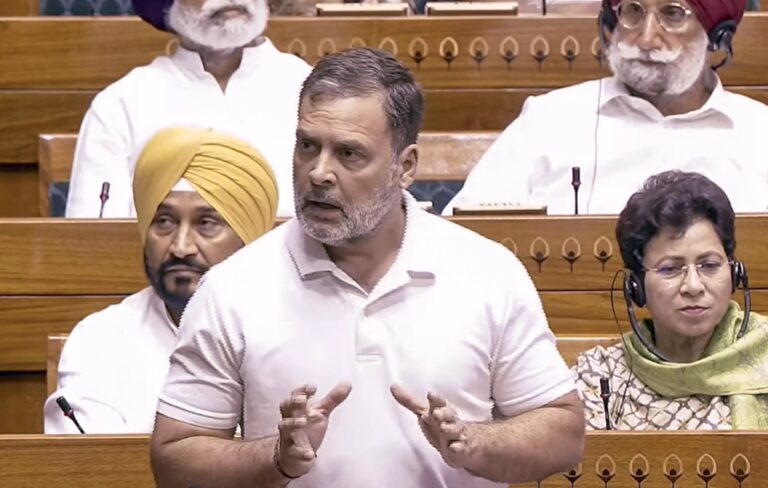
Did Amit Shah order pellet firing on CJP protesters? Rahul Gandhi’s Lok Sabha charge falls apart against police records and ongoing probe

Congress leader Rahul Gandhi on Wednesday attempted to pin direct responsibility for the alleged use of pellet rounds during the July 20 Parliament march on Union Home Minister Amit Shah, telling the Lok Sabha that the Home Minister “authorised the shooting” of students. However, the claim is not supported either by India’s established policing hierarchy or by the material that has emerged from the ongoing investigations.

Speaking in the Lok Sabha on July 29, Gandhi alleged, “Sir, the Home Minister authorised the shooting of our students, sir. He put… he put pellets into the blood of our students. He ordered the students of India to be shot.”

The statement suggests that the Union Home Minister personally directed operational crowd-control measures during the protest. There is, however, no evidence in the public domain to support such an assertion.

Home Minister does not direct field operations

India’s law enforcement functions through a clearly defined chain of command. While the Union Home Minister oversees the Ministry of Home Affairs and broad internal security policy, operational decisions during protests are taken by officers deployed on the ground in accordance with established police procedures.

Crowd-control measures, including the use of lathis, tear gas or other non-lethal equipment, are ordinarily authorised by officers commanding the deployment at the scene, with responsibility resting on field commanders rather than the political executive. During the July 20 violence, protesters pelted stones at security personnel, leaving several law enforcement officials injured. Faced with an escalating law-and-order situation, it fell upon the commanding officer on the ground to assess the threat and take operational decisions deemed necessary to protect his personnel and restore order.

Consequently, attributing a tactical decision allegedly taken during a field deployment directly to the Union Home Minister bypasses the institutional hierarchy governing police operations.

General diary entry points to field-level authorisation

A general diary (GD) entry recorded at Parliament Street police station and first reported by Hindustan Times states that Rapid Action Force personnel informed police that certain crowd-control equipment, including two rounds of plastic pellets, was used during the July 20 protest on the orders of a Deputy Commissioner of Police attached to the deployment.

The diary mentions the use of anti-riot gun ammunition, tear smoke grenades, ballistic cartridges and two plastic pellet rounds while dispersing the crowd.

Importantly, the GD entry does not mention any direction from the Union Home Minister or any political authority.

Officer named in diary disputes the allegation

The matter has since become the subject of parallel inquiries by the Delhi Police and the Central Reserve Police Force (CRPF).

According to officials cited in media reports, the Deputy Commissioner of Police named in the GD entry has informed senior officers that he was not present near the location where pellet rounds were allegedly fired.

The officer reportedly stated that he was deployed near Patel Chowk and Gol Dak Khana, away from the Outer Circle and Jantar Mantar area where the alleged incident took place. He has also questioned the timing of the Rapid Action Force’s diary entry, noting that it was recorded nearly two days after the violence.

Police officials have further indicated that multiple DCP-rank officers from different districts had been deployed with separate RAF teams in and around Connaught Place that day, making the precise chain of authorisation part of the ongoing investigation.

Internal inquiry still underway

Both the Delhi Police and the CRPF have initiated internal inquiries into the alleged use of plastic pellets.

According to officials familiar with the probe, senior Delhi Police officers are examining deployment records, general diary entries, communication logs and authorisation documents to determine who, if anyone, approved the use of pellet rounds.

Officials have also indicated that the authorisation available with police pertained to the use of lathis and tear smoke, while the question of pellet firing remains under investigation.

Until these inquiries are completed, responsibility for the alleged use of plastic pellets remains undetermined.

Political allegation runs ahead of facts

Rahul Gandhi’s remarks in Parliament effectively attributed criminal intent and operational responsibility to the Union Home Minister despite the absence of any publicly available evidence linking Amit Shah to tactical decisions made during the protest.

The available records instead point to an ongoing effort by law enforcement agencies to establish which officers were present, what authorisations were issued, and whether standard operating procedures were followed.

Unless investigators establish otherwise, the assertion that Amit Shah “ordered the students of India to be shot” remains a political allegation rather than a conclusion supported by the evidence currently in the public domain.

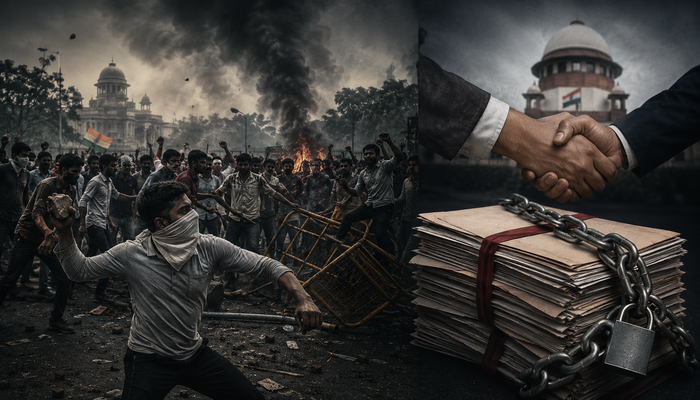
Can the Centre really withdraw FIRs against hooligans who indulged in violence during CJP protest? Here is what the law says

The recent Cockroach Janta Party (CJP) protests triggered by the NEET paper leak ended after the Centre promised to fulfil all their demands, including the resignation of the Education Minister Dharmendra Pradhan. The protests took a dangerous turn on Monday, July 20, when the CJP decided to march to Parliament, where the Monsoon Session was about to start, through a high-security area, beyond the Jantar Mantar site. It is notable here that the permission for protest was only for the Jantar Mantar site, not beyond that.

The protestors continued to hold up at Jantar Mantar until 20th July, when, during an unauthorised march to the Parliament, incidents of stone pelting and clashes with security personnel happened. The CJP leaders continued to press their demands as the ‘protesters’ held the state to ransom by creating a ruckus on the streets of the national capital.

Are the CJP and its ‘protesters’ above the law?

One of the demands put forward by the CJP leaders was a promise from the government not to take any coercive action against any of the ‘protestors’, including those who attacked police personnel, created a ruckus, and vandalised public property during the protests, and to withdraw the FIRs already filed against such ‘protestors’.

Clearly, the party was trying to shield the hooligans who helped it build pressure on the government through violence, triggering the use of force by the security personnel. A scrutiny carried out by the Delhi Police of people present at and around the Cockroach Janta Party’s (CJP) protest at Jantar Mantar has found that a large number of those in the crowd had previous criminal records.

Surprisingly, and to the disappointment of ordinary, law-abiding citizens of the country, the central government conceded to this demand as well. The decision of the government leaves the ordinary citizens of the country with many questions, such as: Can the government be blackmailed into surrendering to anti-social elements and watching vandals, who damaged not just material things but the social fabric itself, walk free? Or, in legal terms, can the executive/government really stop the course of law already set in motion? Or is the government legally empowered to withdraw FIRs filed against individuals who held the state to ransom? Let’s take a look at the law to find answers to these questions.

A crime is a wrong against the state

Criminal jurisprudence treats an offence as a wrong against the entire society and not just against an individual. This is the reason that whenever a crime is committed, the state steps in to prosecute the offender. This rule acts as a legal safeguard intended to protect the rights of vulnerable victims and maintain peace and order in society. An extension of this legal safeguard is the rule that once the legal machinery is kicked into motion, it cannot be stopped without the permission of the court.

One of the ways to kick the legal machinery into motion is by filing an FIR regarding a crime that has been committed. Once an FIR is registered regarding the commission of a crime, it cannot be cancelled or withdrawn without the court’s approval. The rationale behind the unwritten rule is to protect the victim from being pressured into not taking legal action against an influential or powerful offender.

In the present scenario, even though the government promised to withdraw all the FIRs registered against violent protesters, it cannot directly do so. However, there are certain legal provisions that allow for the withdrawal of an FIR or the stopping of legal proceedings. Let’s take a look at them.

An out-of-court settlement

There is a legal provision in the Bharatiya Nagarik Suraksha Sanhita, 2023, that allows parties in a criminal trial to ‘settle’ the case out of court or without undergoing a full trial. However, this is only allowed in certain minor offences, usually affecting private interests, which have been categorised as compoundable offences under the BNSS.

Compoundable offences are listed under and governed by Section 359 of the BNSS. Some examples of compoundable offences are simple hurt, cheating, house-trespass, some cases of wrongful restraint, and theft. Serious offences like rape, murder, rioting, and dacoity are not compoundable. While some compoundable offences can be settled without the court’s permission, others require the court’s approval.

The government will not be able to make use of this provision as the acts of violence committed during the CJP protests, such as attacking security personnel, stone pelting, and damaging police vehicles and public property, certainly do not fall within the category of compoundable offences.

Cancellation or withdrawal of an FIR

Well, thankfully, it is beyond the power of the executive to withdraw a case or an FIR once it is filed. Once an FIR is registered, the judiciary takes over the matter. The executive cannot order the concerned police station to withdraw an FIR or command the concerned court/magistrate not to proceed based on the FIR. This protects a victim and even a weak state from surrendering to brute force.

This makes one wonder, if the law does not confer the executive with the power to cancel or withdraw an FIR, why did the government promise to withdraw all FIRs filed against violent protestors? Well, there is another way the accused can still be discharged or acquitted, or the case can be closed, which is a closure report by the police.

A closure report

A closure report or final report is filed by the police under Section 193 of the BNSS after completing the investigation. The report is filed in cases where the police fail to find any evidence prima facie indicating the commission of the crime disclosed in the FIR, fail to trace the accused, or find that the complaint was false.

That’s not it. Filing a closure report does not itself close the case; it depends on the court’s satisfaction whether it will accept the closure report or order further investigation. If the court is satisfied with the police’s investigation, it can accept the closure report and close the case. In that case, the FIR remains on record, but the case is closed. But if the court is not satisfied with the police’s findings, it can order further investigation.

So in the present situation, the police may, on tacit direction of the government, try this route and file closure reports in all the FIRs registered against violent protestors. But considering that the entire country, including the courts, witnessed the CJP protests turn violent, and the acts of perpetrators being recorded on phone cameras and CCTV, using this route would be challenging for the government. Besides, the final decision to close the case would depend on the discretion of the court.

Withdrawal of prosecution

Another way in which the Indian criminal law allows for stopping legal proceedings after the filing of an FIR is through the public prosecutor. Under Section 360 of the BNSS, the public prosecutor may seek permission from the court for the withdrawal of an FIR. But in this situation as well, the final decision rests with the court.

While making such a request, the public prosecutor needs to first show the court that he/she had the Central government’s permission to make the request for withdrawal. The court then examines the request to ensure that it was made in good faith, in the interest of justice, not under political influence, and not to protect influential people. If the court is satisfied that the withdrawal of the prosecution serves the interest of justice, it may allow it.

However, here too, where both the vandalism and the subsequent promise of the Centre not to take coercive action against the miscreants were so public, it would be challenging for the public prosecutor to convince the court that the withdrawal would serve the interests of justice.

Besides, the provision bars the public prosecutor from seeking permission for withdrawal in cases involving damage to public property belonging to the central government. Therefore, the FIRs disclosing that the protestors openly damaged public and government property cannot be withdrawn using this provision.

Quashing of FIRs

The Supreme Court and the High Court can use their inherent powers to quash an FIR if this is needed to prevent the abuse of the process of law and secure the ends of justice. The power is exercised rarely but certainly when the Supreme Court or a High Court is satisfied that this is required for doing complete justice in a case. However, the current scenario does not seem to fit the case. Quashing FIRs filed against ‘protestors’ who publicly indulged in acts of vandalism and violence would definitely not serve the ends of justice.

The Supreme Court mulls an independent investigation

Meanwhile, the Supreme Court has adopted a stern approach and clearly stated that whoever took the law into their own hands during the CJP protests must face the law. The court passed an interim order allowing authorities to continue the investigation into the FIR already registered.

Chief Justice of India Surya Kant said that an independent probe must investigate the allegations both against the police and protestors. The top court, however, directed the states, where similar protests were held, to release protestors with no criminal past.

The Apex Court’s stance did not sit right with the CJP leadership, who behave as if they and their hooligans are above the law. The CJP wanted to secure immunity for the goondas, who caused havoc during the protests, and help them evade the law using the government’s word. It goes without saying that the CJP’s demand to allow hoodlums to get away with their illegal acts has neither a legal nor a moral basis.

People living in civilised societies governed by law cannot be allowed to evade the law by mutual agreements. For a functional democracy governed by the rule of law, it is imperative that those who violate the law, be they protestors or ordinary citizens, face the consequences of their actions. If anti-social elements are allowed to scot free after brazenly committing violence, it would lead to complete chaos and a state of anarchy, which the CJP claims to fight.

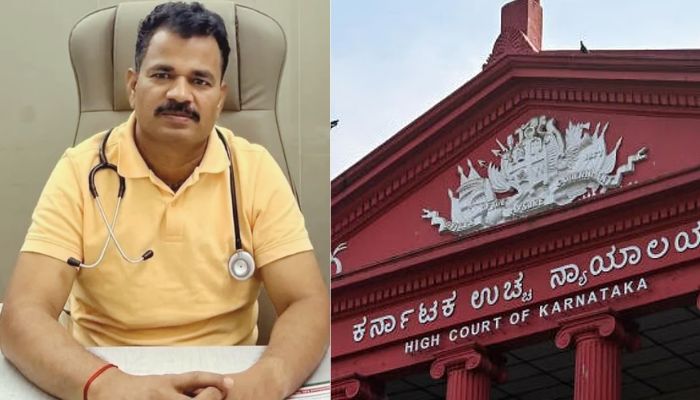
Bengaluru Police arrested man for reporting Bangladeshi illegal immigrants, Karnataka HC stays probe: Details 

On Tuesday (28th July), the Karnataka High Court rebuked the Bengaluru Police over filing two criminal cases against a doctor-activist, Nagendra, who flagged the presence of two illegal Bangladeshi immigrants in Bengaluru. The court asked the police to stop this practice of appeasement.

Justice M Nagaprasanna ordered a stay on further investigation in the two criminal cases filed against Dr Nagendra. 

“Ask them to control this (illegal immigration), leave other talks. What is the (Home) Department doing? Busy with other speeches?” Justice Nagaprasanna remarked. 

The court opined that police’s inaction against illegal immigrants can cause severe national security consequences. 

“If the police act against the security of the nation, if police act like this in support of illegal immigrants of Bangladesh against the people of this city… it is dangerous to the system. The security of the nation is under threat. The system should not support such things,” Justice Nagaprasanna said. 

Doctor-activist flagged presence of Bangladeshi illegal immigrants, Bengaluru Police arrested him instead 

Petitioner Dr Nagendra’s advocate, Girish Bharadwaj, submitted before the court that his client is a social activist who has been helping the police in detecting illegal Bangladeshi immigrants staying in Bengaluru. 

Dr Nagendra, of Sai Clinic-Bettadasapura-Bellandur, had informed the Investigation Officer about the presence of alleged illegal Bangladeshi immigrants on 22nd July 2026.  

Just 15 minutes after the information was communicated to the Foreigners Regional Registration Office (FRRO), one of the alleged Bangladeshi illegals filed a criminal complaint against the petitioner. 

In response to another complaint filed by the petitioner regarding Bangladeshi infiltrators allegedly illegally residing in Bengaluru, a criminal case was registered against the doctor-activist at another police station. 

Consequently, petitioner Dr Nagendra was arrested and remanded to custody on Thursday (23rd July). He was released on bail the next day. 

Dr Nagendra was booked on charges of assaulting a Bangladeshi couple, Naseerna and Mohammad Bilal, who were alleged to be illegally residing in Whitefield, Bengaluru. 

The 23-year-old Bangladeshi woman filed a complaint against Dr Nagendra, accusing Dr Nagendra of dragging and assaulting her and her husband Mohammad Bilal, a driver, over their nationality.   

Naseerna was reported to have claimed that Dr Nagendra hurled verbal abuses at them in Hindi and threatened to kill the Bangladeshi couple if they approached the police. 

Based on the complaint, the Bellandur Police booked Dr Nagendra on charges of assault, insulting the modesty of a woman, wrongful restraint, and criminal intimidation. Subsequently, the doctor-activist was arrested by the police on 23rd July. 

However, before his arrest, Dr Nagendra published a video related to the incident on his Facebook page. In the video, he can be purportedly heard accusing the complainant couple of being from Bangladesh, and that they were previously deported from India before returning. Bilal, on the contrary, claimed to be residing in Bengaluru for the last 20 years. 

The police had confirmed that the complainant couple were indeed from Bangladesh, and that they were gathering more information in this regard. 

Court raps Bengaluru Police for Dr Nagendra’s unusually quick arrest, urges them to stop appeasing Bangladeshi illegal immigrants 

The Karnataka High Court heard the matter on Tuesday (28th July). The court not only stayed the probe in the two criminal cases against Dr Nagendra but also came down heavily on the Bengaluru Police for the “abuse of the process” and “appeasement”. 

Dr Nagendra’s lawyer submitted that if the police actually intended to act against illegal immigration in Bengaluru, they would have acted against landlords who had allegedly rented their premises to illegal immigrants. 

Meanwhile, Special Public Prosecutor, BN Jagadeesh submitted that the alleged Bangladeshi illegals were already produced before the FRRO and were placed in a detention centre. The SPP, however, maintained that the complainant had alleged assault by petitioner Dr Nagendra. 

“We are saying they are illegal immigrants. They are staying illegally. They have been kept in the detention centre. Let the FRRO be made a party. We will secure all documents. There is no question of shielding anyone,” the SPP said. 

The court, however, noted the unusual dexterity shown by the Bengaluru Police in registering cases against the petitioner and arresting him. 

Justice Nagaprasanna noted that the Investigating Officer had at 11:30 pm on 22nd July officially informed the FRRO that the complainant, Nasreena Bilal, was a Bangladeshi illegal immigrant who should be detained and deported to Bangladesh. 

However, within 15 minutes, the same Bangladeshi woman, Nasreena Bilal, filed a criminal complaint against the petitioner. 

Justice Nagaprasanna rebuked the police and questioned how they could even take a complaint from an illegal immigrant who has mentioned her address as Bangladesh.  

The court said that when it was confirmed by the complainant herself that she is from Bangladesh, the police should have conducted a preliminary inquiry before booking and arresting the petitioner. 

“If you ask to send illegal immigrants out, based on the illegal immigrant’s complaint, you register a crime. They say they were beaten. Their address is Bangladesh. How are you registering a crime on such a complaint? Look at the complaint itself. It mentions Bangladesh. How did you even take this complaint?”  Justice Nagaprasanna orally asked. 

The Karnataka High Court also observed that the timing of the complaint filing against the petitioner indicated that the Bengaluru Police registered what seemed to be a counter-case after Dr Nagendra informed the authorities about Bangladeshi illegal immigrants. 

The court also blasted the state’s Congress government, saying that “This is why illegal immigrants continue to stay. If the government supports them like this, this is what will happen. It is a straight counterblast.” 

Regarding the assault allegations, the court highlighted the absence of any medical evidence that confirms that Dr Nagendra assaulted the complainant. 

The court also noted that filing of a complaint against the petitioner within minutes of his communication to the authorities about illegal immigrants, “illustrated abuse of the process”. 

“There is no wound certificate. No medical examination. At 11.30 pm the investigating officer found nothing. Within fifteen minutes, a complaint is registered. Can there be a better illustration of abuse of the process? Stop appeasing; how long can this continue? It is appeasement,” the court said. 

The court also raised concerns over Indian citizens allegedly providing rented accommodations to illegal immigrants.  

“Many people give houses on rent for a few extra rupees. If greed overtakes the security of the nation, what else can be done? Action must also be taken against those who provide shelter to persons who have no visa or documents,” the court said. 

The court further urged the police to stop targeting individuals who flag the presence of undocumented foreign nationals with FIRs. 

Justice Nagaprasanna noted that the facts that emerged in the matter prima facie indicate an abuse of the criminal process. Thus, the court stayed further probe in both criminal cases against petitioner Dr Nagendra until further orders.  

Meanwhile, the FRRO has been directed to become a respondent in the case and issue instructions regarding the status of the alleged Bangladeshi illegal immigrants before the court. 

The next hearing in the matter will be held on 6th August 2026.