Home Blog Page 8

Parvinder Singh Jhota’s murder and the Bhindranwale playbook: How anti-drug activism has become a gateway to Khalistani politics

0

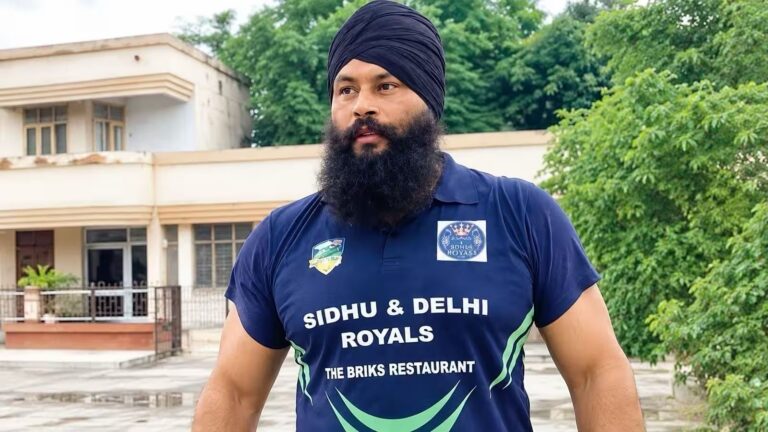
Parvinder Singh Jhota was fighting what he saw as Punjab’s drug menace. He confronted medical-store owners, challenged the alleged illegal sale of addictive medicines and built a following by publicly exposing what he believed was a criminal network destroying the state’s youth. On October 13, 2026, his campaign came to a tragic end when he was shot dead in Mansa during a confrontation with a medical-store owner.

His murder has triggered outrage, protests and accusations against the Aam Aadmi Party (AAP) government. But beyond the immediate questions surrounding his killing lies a wider political story: Jhota had reportedly grown disillusioned with the Bhagwant Mann government’s handling of drugs and had moved closer to Amritpal Singh’s Waris Punjab De, an organisation led by a man who openly advocates Khalistan.

The photograph of Jhota standing in front of Bhindranwale adds another dimension to this story. Bhindranwale, whose legacy continues to inspire sections of the Khalistani movement, also rose to prominence amid a campaign against tobacco in 1981. He subsequently became a central figure in the Khalistani terrorism that engulfed Punjab.
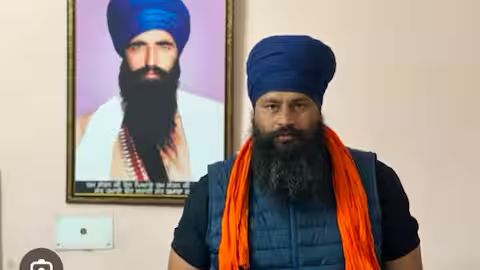
Parvinder Singh Jhota (Image Source: India Today)

The parallel is worth examining, not because Jhota’s photograph or reported association proves that he was a Khalistani, but because Punjab’s history demonstrates how campaigns built around legitimate social and religious concerns can become intertwined with a much larger political project.

Jarnail Singh Bhindranwale: The anti-tobacco campaign of 1981

In May 1981, Amritsar became the centre of a bitter confrontation over tobacco. Sikh organisations demanded restrictions on tobacco sales and sought recognition of the city’s religious character. The agitation escalated when opposing groups staged a procession in support of smoking, inflaming tensions between Sikh and Hindu organisations.

Bhindranwale, then emerging as an influential religious preacher, mobilised supporters around the anti-tobacco campaign. The agitation brought him greater public visibility at a time when Sikh identity, religious authority and political representation were becoming increasingly contentious issues.

The anti-tobacco campaign was not, in itself, a separatist movement. Opposition to tobacco has a basis in Sikh religious norms, and people could support restrictions on smoking without endorsing Khalistan. Yet the events of 1981 helped bring religious mobilisation and the politics of Sikh identity into sharper confrontation.

Historical accounts identify the tobacco controversy as an important episode in the escalation of tensions that would subsequently shape Punjab’s politics. The issue became entangled with competing political agendas, militant assertions and the broader question of Sikh political identity.

Bhindranwale’s subsequent trajectory went far beyond campaigning against tobacco. He emerged as a central figure in Khalistani terrorism, a movement seeking a separate Sikh homeland. His growing confrontation with the Indian state culminated in Operation Blue Star in June 1984, during which he was killed.

Amritpal Singh: From anti-drug preacher to Khalistani politics

Four decades later, Punjab witnessed another figure whose rise to prominence was closely associated with a campaign against intoxicants.

Amritpal Singh returned to Punjab from Dubai in August 2022 and began mobilising young people around religious revival and the drug problem. His message resonated with sections of the youth in a state where addiction, unemployment and the social consequences of substance abuse have become persistent concerns.

His father, Tarsem Singh, spoke about the impact of the campaign in an interview with The Times of India. According to him, young people responded to Amritpal’s appeal, with some abandoning drugs and returning to religious observance.

The anti-drug campaign helped Amritpal establish a public profile. But his political messaging soon extended well beyond addiction and rehabilitation.

Amritpal openly invoked Bhindranwale’s legacy, adopted a similar appearance and began advocating Khalistan. His turban-tying ceremony as the head of Waris Punjab De was held in September 2022 in Rode, Bhindranwale’s native village. Some of his supporters began referring to him as “Bhindranwale 2.0”.

In February 2023, Amritpal and a large group of supporters stormed the Ajnala police station over the arrest of an associate. Six police personnel were injured during the confrontation, according to contemporary reports. The incident brought national attention to his confrontational methods and political influence.

After a 37-day manhunt, Amritpal was arrested on April 23, 2023, and detained under the National Security Act. In the 2024 Lok Sabha election, he contested from Khadoor Sahib while in detention and won by a margin of nearly two lakh votes.

His electoral victory demonstrated that his appeal extended well beyond a small circle of followers. It also underscored the political reach he had acquired through religious mobilisation and his messaging on Punjab’s social and political grievances.

Amritpal’s trajectory therefore presents an important distinction: his anti-drug campaign was one aspect of his public profile, while his advocacy of Khalistan represented a separate political objective. The existence of the former does not erase the latter.

Jhota’s reported proximity to Waris Punjab De

This brings us back to Jhota.

His campaign against the alleged illegal sale of addictive medicines addressed a serious problem. Reports following his death indicated that he had become increasingly disillusioned with the AAP government’s handling of the drug menace and had grown closer to Waris Punjab De.

That association is relevant because of the organisation’s leadership and political outlook. But the available reporting does not conclusively establish that Jhota was a formal member of Waris Punjab De, had adopted Amritpal’s separatist ideology or intended to pursue a Khalistani political agenda.

The photograph showing Jhota in front of Bhindranwale cannot establish any of those things either. It is a reason to examine the context of his reported associations, not proof of his personal beliefs.

Nevertheless, the broader political question remains. When a campaigner fighting a genuine social problem moves closer to an organisation led by an unabashed separatist advocate, it is legitimate to ask whether the social cause is becoming intertwined with a wider political mobilisation and separatist ambitions.

This is particularly relevant in Punjab, where the memory of terrorism and Khalistani separatism remains politically consequential and where public anger over governance failures can create opportunities for alternative political actors.

The danger is not that every anti-drug activist is secretly a separatist. Such a claim would be both unfair and unsupported. The danger is that a legitimate public grievance can be used to build political influence that eventually serves objectives extending beyond the original cause and promotes a radical ideology that calls for the secession of Punjab, thereby offering ammo to Pakistan-based terrorists and intelligence agencies to foment trouble in India.

Jhota’s murder becomes a political flashpoint

The reaction to Jhota’s killing has demonstrated how quickly the tragedy has become a political confrontation.

Balwinder Kaur, mother of Amritpal Singh, accused the Punjab government of killing Jhota and demanded Bhagwant Mann’s resignation, underscoring the close association of Jhota with Singh’s group.

“Parvinder Singh Jhota, who used to raise his voice against drugs, was killed by the Govt. Why are you killing those who are trying to stop the drug menace?” she said, alleging that people had been detained and prevented from travelling to Mansa for a protest.

The political significance of the episode lies in how Jhota’s death is now being invoked to challenge the AAP government and mobilise public anger. Such mobilisation is not inherently illegitimate. Demanding justice for a murdered activist is entirely reasonable. But the wider political objectives of those participating in that mobilisation must remain open to scrutiny.

The photograph of Jhota with Bhindranwale has added to the controversy because the latter remains an icon for sections of the Khalistani movement.

The more substantial question is whether the drug crisis is becoming a platform through which organisations with separatist objectives garner sympathy among the public and strengthen their influence.

The lesson Punjab cannot afford to ignore

Punjab’s drug crisis is real. Families have lost children to addiction, criminal networks have profited from the illegal supply of intoxicating substances, and successive governments have faced questions over their ability to dismantle these networks.

The AAP government must be judged on its record: whether illegal supply chains are being broken, traffickers are being prosecuted, rehabilitation services are accessible, and people who expose criminal activity are adequately protected.

But the legitimacy of the anti-drug cause must not become a shield against examining the political objectives of those who claim to champion it.

Bhindranwale’s rise amid the anti-tobacco agitation of 1981 and Amritpal Singh’s emergence through an anti-drug campaign offer two historical reference points for understanding the relationship between social grievances and political mobilisation. Their subsequent trajectories demonstrate why the stated objective of a campaign cannot be the only factor in assessing the movement surrounding it.

Jhota’s story is not yet evidence of a similar trajectory. But his proximity to Waris Punjab De and the picture of him with Bhindranwale’s portrait reveals a clear pattern of how an anti-drug campaign is used to fuel Khalistani politics.

Yet his death presents Punjab with two urgent challenges. The first is to establish the truth about his murder and hold those responsible accountable. The second is to ensure that the state’s drug crisis is addressed through effective governance rather than being reduced to a political contest.

The fight against drugs must remain focused on saving lives, dismantling criminal networks and restoring families. Governments must answer for their failures, while political organisations must answer questions about their ideology and objectives.

A genuine social cause deserves public support. It does not confer immunity from scrutiny on every person or organisation that invokes it. And it also presents the government with the challenge of scrutinising the anti-drug crusade as a platform to further the Khalistani movement.

That is the lesson Punjab’s history offers, and one the state cannot afford to ignore.
The two sides of India’s electricity story

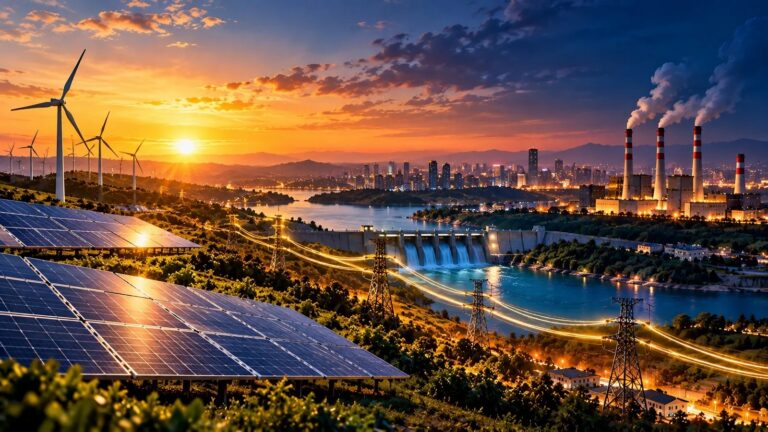
India’s electricity sector is undergoing a remarkable transformation, but there exists a contradiction. Renewable energy capacity is expanding at an unprecedented rate, with non-fossil sources now accounting for more than 54% of the country’s installed power capacity. Yet coal remains the backbone of electricity generation, particularly during periods of peak demand. 

This contradiction reveals one of India’s most pressing energy challenges: installing clean energy capacity is not the same as ensuring a reliable electricity supply around the clock.

On September 10, 2026, India’s peak electricity demand reached 269.2 gigawatts (GW), an exceptionally high level for the monsoon season. Humid conditions, uneven rainfall and increased agricultural pumping contributed to the surge. The figure offered a glimpse of India’s rapidly growing electricity requirements. According to Central Electricity Authority projections, peak demand could rise from 243.3 GW in 2023–24 to 334.3 GW by 2029–30 and 366.4 GW by 2031–32.

These projections are crucial because India’s energy transition is occurring alongside rapid industrialisation, urbanisation and rising household consumption. Air conditioning, electric vehicles, data centres and expanding manufacturing facilities are adding substantial demand. India must therefore achieve two objectives simultaneously: produce significantly more electricity while progressively reducing dependence on fossil fuels.

The fundamental difficulty lies in the difference between installed capacity and actual generation. Solar plants produce electricity when sunlight is available, while wind generation depends on weather conditions. Neither can independently guarantee continuous supply. Solar output falls sharply in the evening, precisely when household electricity consumption increases. This creates the electricity-grid challenge commonly called the duck curve, requiring other sources to rapidly compensate for declining solar generation.

The September demand surge demonstrated why coal remains indispensable. Coal and lignite reportedly supplied approximately 188.8 GW, or 70.1% of peak demand. Wind contributed 18.2 GW, large hydropower 24.5 GW and nuclear energy approximately 6.2 GW. Solar generation was unavailable at the reported evening peak.

Consequently, despite expanding renewable capacity, India is planning to add approximately 80–97 GW of coal-based generation capacity, including more efficient ultra-supercritical plants. This reflects the need for dependable electricity during periods when renewable generation cannot meet demand.

Hydropower provides another important source of flexibility. Hydro turbines can increase output within minutes, helping balance fluctuations in electricity consumption. However, hydropower depends on adequate reservoir storage. Uneven monsoon rainfall and reported regional water-storage deficits of 8–15% during 2026 constrained its contribution, increasing reliance on thermal generation.

This exposes the interconnected nature of India’s water and energy security. Reservoirs must support irrigation, drinking water and electricity generation. Climate variability can therefore affect agricultural production and power availability simultaneously.

Energy storage is emerging as the critical missing component of India’s renewable transition. Grid-scale batteries can store surplus daytime solar electricity for evening consumption, while pumped-storage hydropower can shift energy between periods of low and high demand. Without sufficient storage infrastructure, adding renewable capacity alone cannot eliminate the need for conventional power stations.

Nuclear energy offers another potential solution. India’s installed nuclear capacity stands at approximately 8.78 GW, with ambitions to reach 14.8 GW by 2028, around 20 GW by 2031–32 and eventually 100 GW by 2047. Unlike solar and wind, nuclear reactors can provide continuous low-carbon electricity. However, substantial investment, regulatory requirements and long construction periods mean there is a long wait before we reach there.

India’s energy future will therefore depend on combining multiple technologies rather than relying on any single source. Solar and wind can provide increasingly affordable clean electricity, batteries and pumped storage can address intermittency, hydropower can balance sudden fluctuations, and nuclear energy can strengthen dependable low-carbon supply. Coal will remain necessary during the transition, but its contribution can decline as these alternatives mature.

Ultimately, the success of India’s energy transition cannot be measured merely by the number of solar panels installed or the percentage of renewable capacity added. What matters is how much clean electricity actually reaches consumers, how reliably the grid handles peak demand, and how effectively storage and transmission infrastructure reduce fossil-fuel dependence.

Read the real data behind India’s electricity production, goals and roadmap in the full article here on Chapter One Magazine.

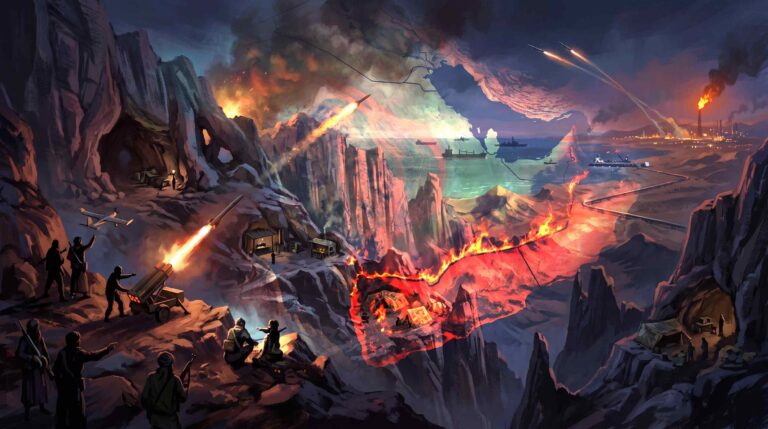
Why West Asia’s richest army can’t stop poor Yemen’s militia

0

On July 13, 2026, Saudi-backed forces fundamentally altered the regional security architecture by bombing the runway of Sanaa International Airport. While ostensibly executed to intercept an Iranian civilian aircraft carrying a returning delegation, the strike officially terminated a fragile, multi-year de-escalation protocol. Consequently, the Houthi militia initiated a calculated campaign of strategic strikes against Saudi aviation and energy infrastructure. Despite possessing an annual defence budget exceeding $83 billion and advanced American hardware, Saudi Arabia remains fundamentally vulnerable to this impoverished insurgency. This persistent vulnerability exposes a systemic mismatch between conventional military doctrine and unconventional asymmetric reality.

The tactical engagements across the border are defined by extreme financial disparity. The Houthi arsenal heavily relies on mass-produced kamikaze drones, such as the Qasef and Sammad variants, costing merely ₹12 lakhs to ₹15 lakhs to manufacture using smuggled commercial components. To intercept these rudimentary systems, the Royal Saudi Air Defense Forces must routinely fire sophisticated Patriot PAC-3 missiles, which cost upwards of ₹33 crores per launch. Consequently, this unsustainable dynamic weaponises the kingdom’s own high-tech defence budget against itself, granting the Houthis a massive economic victory even when aerial interceptions are completely successful.

Furthermore, the physical geography of northern Yemen severely handicaps conventional mechanised military operations. The Houthi heartland comprises rugged, serrated mountain ranges riddled with labyrinthine cave systems, rendering heavy Saudi armour virtually useless. Lacking the capacity for effective ground combat, Riyadh relies almost entirely on high-altitude aerial bombardment, which historically fails to uproot entrenched guerrilla infantry. Importantly, this operational failure is compounded by the deliberate institutional fragmentation of the Saudi armed forces. Engineered around a doctrine of “coup-proofing” since an aborted 1969 overthrow attempt, the military apparatus is intentionally divided into competing fiefdoms, severely undermining modern joint-force coordination.

Beyond military attrition, the Houthis have successfully weaponised regional geography to execute strategic economic blackmail against the Saudi state. For decades, Riyadh invested heavily in the 740-mile East-West Petroline to transport crude oil to the Red Sea port of Yanbu, specifically designed to bypass the Iranian-controlled Strait of Hormuz. However, by establishing a physical blockade at the southern Bab el-Mandeb Strait, the Yemen-based militia has effectively nullified this strategic bypass. Therefore, maritime tankers must still navigate heavily contested waters, allowing the Houthis to directly threaten the sovereign revenue streams required to fund the Saudi administration.

Ultimately, the current framework of localised airstrikes and reactive naval patrols has comprehensively failed to restore credible deterrence against the Iran-aligned proxy network. The Saudi administration finds itself trapped in a profound strategic dilemma, caught between the absolute necessity of securing its borders for its Vision 2030 economic transition and its inability to militarily defeat a hardened militia. Until the broader architectural flaws of Middle Eastern security are decisively addressed, the asymmetric conflict will continue to bleed conventional state powers, fundamentally altering how modern wars are fought, funded, and ultimately lost.

Read the full article on Chapter 1 Magazine.

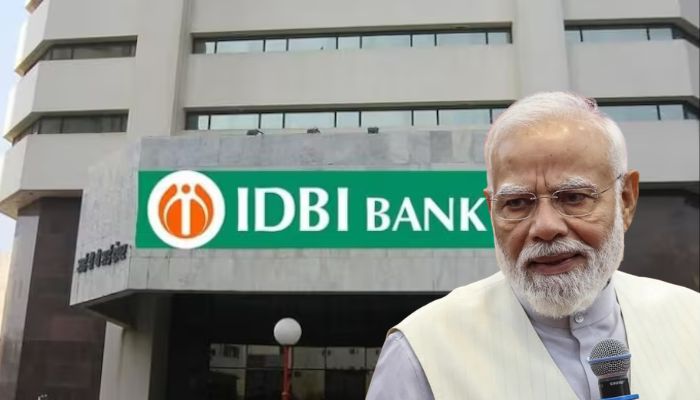
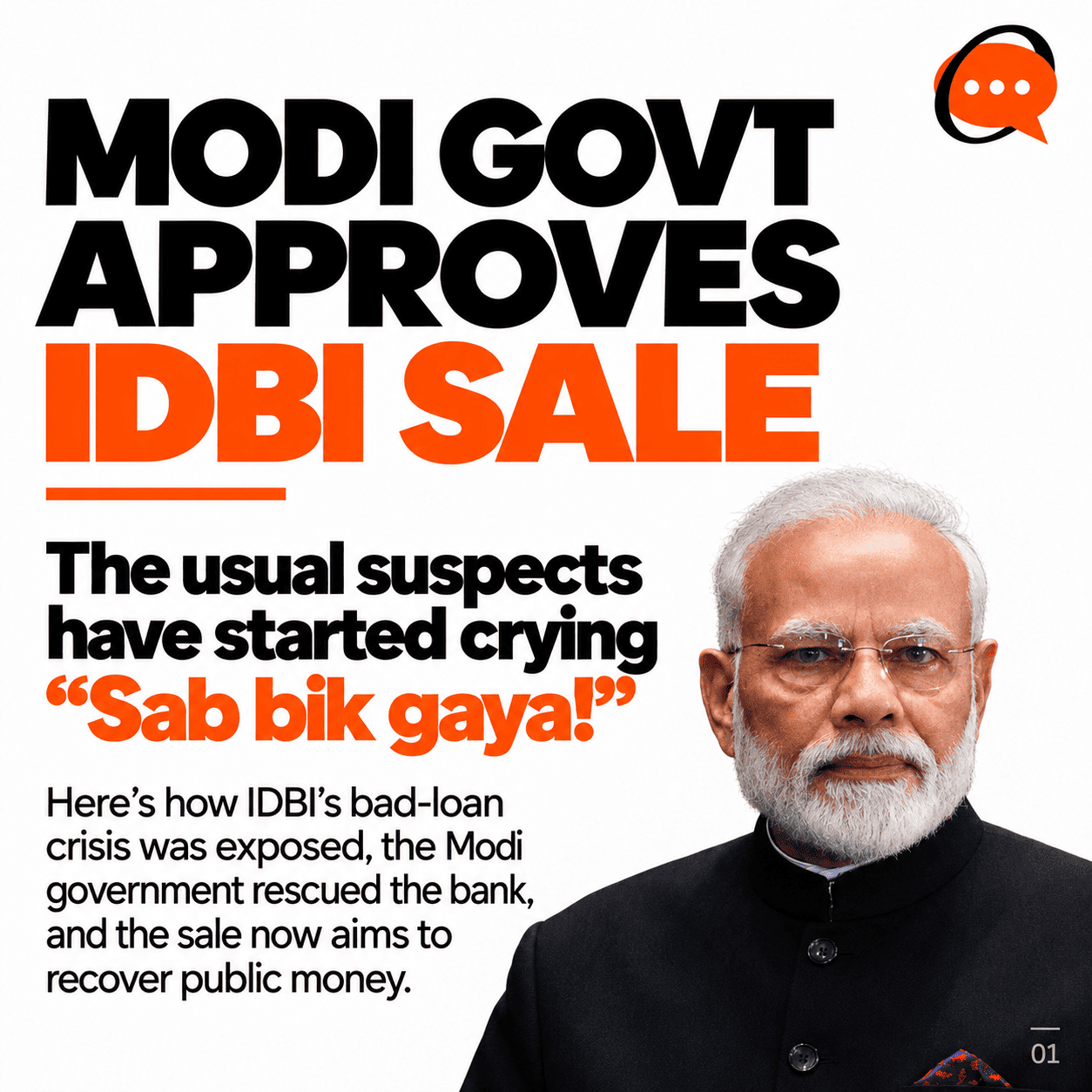
Modi govt approves IDBI sale: While Opposition cries ‘sab bik gaya’, read how the strategic restructuring of the bank is an economic triumph

The Modi government’s formal approval of the sale of a 60.72% controlling stake in IDBI Bank for ₹52,878 crore marks a defining moment in India’s modern economic history. This one move will dismantle years of fiscal drag and create a blueprint for strategic restructuring.

While the Opposition and the left-liberal cabal are fearmongering about the Modi government selling off the country’s assets, a thorough examination of the balance sheet data and key metrics demonstrates that the transaction is an economic masterstroke.

The Modi government has acknowledged the inherited debt from the Congress-led UPA, turned around the fortunes of the bank, and is now monetising it to fully recover public money while retaining substantial equity.

Between 2014 and 2026, IDBI transitioned from a lender crippled by crony capitalism into a high-earning institution. By securing ₹52,878 crore through this strategic restructuring, the Narendra Modi government has reversed the cycle of endless taxpayer bailouts.

It has further insulated the public from systemic banking liabilities and proven that strategic governmental intervention can be of public good.

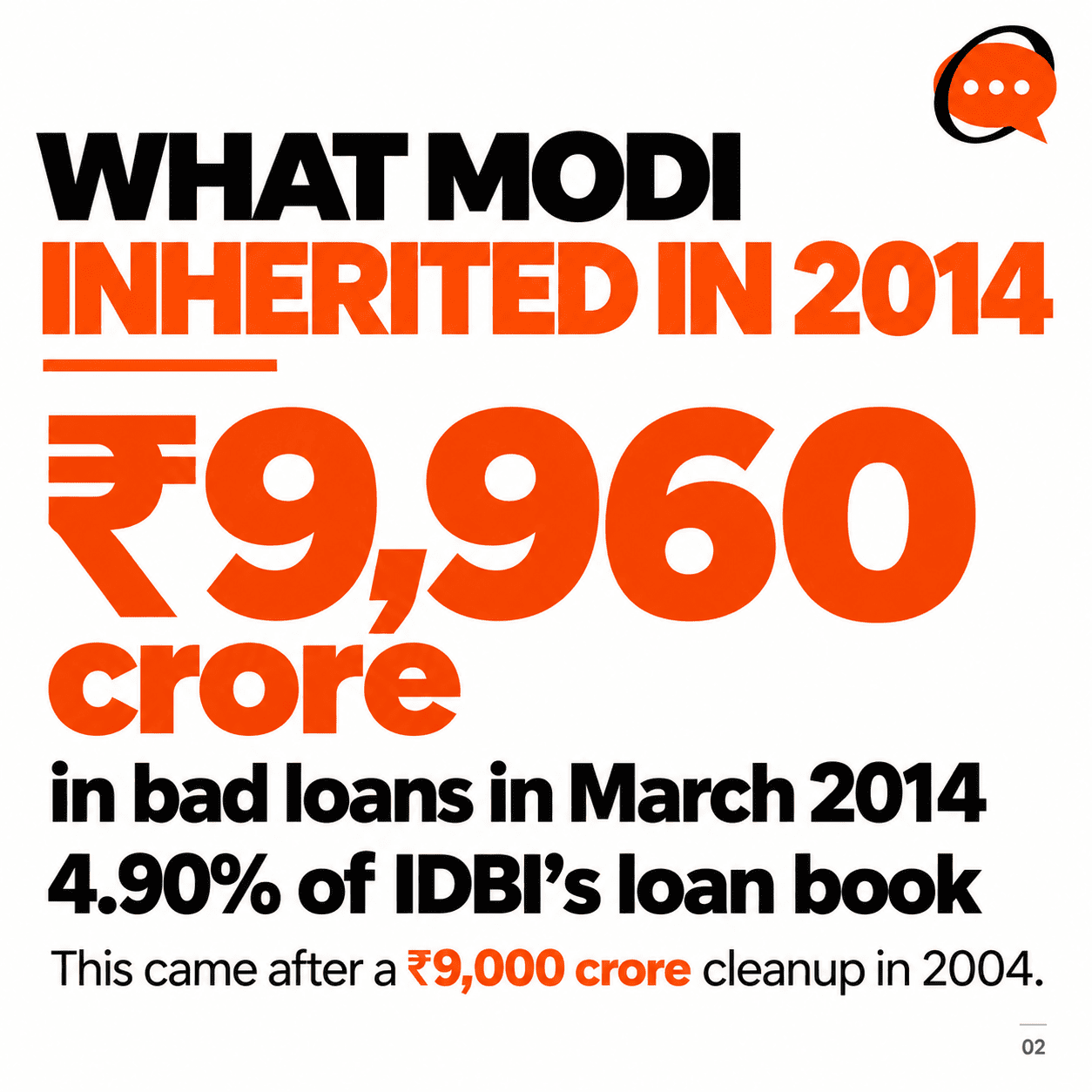
To understand why the sale of IDBI Bank is an economic masterstroke, we need to first understand the institutional wreckage inherited by the Modi government in May 2014. IDBI was transformed into a full-service commercial bank in 2004, although it was originally established in 1964.

The bank required a ₹9,000 crore government cleanup package in 2004 to absorb industrial debt and enable its commercial conversion. During the Congress era, IDBI witnessed aggressive, politically connected balance-sheet expansion.

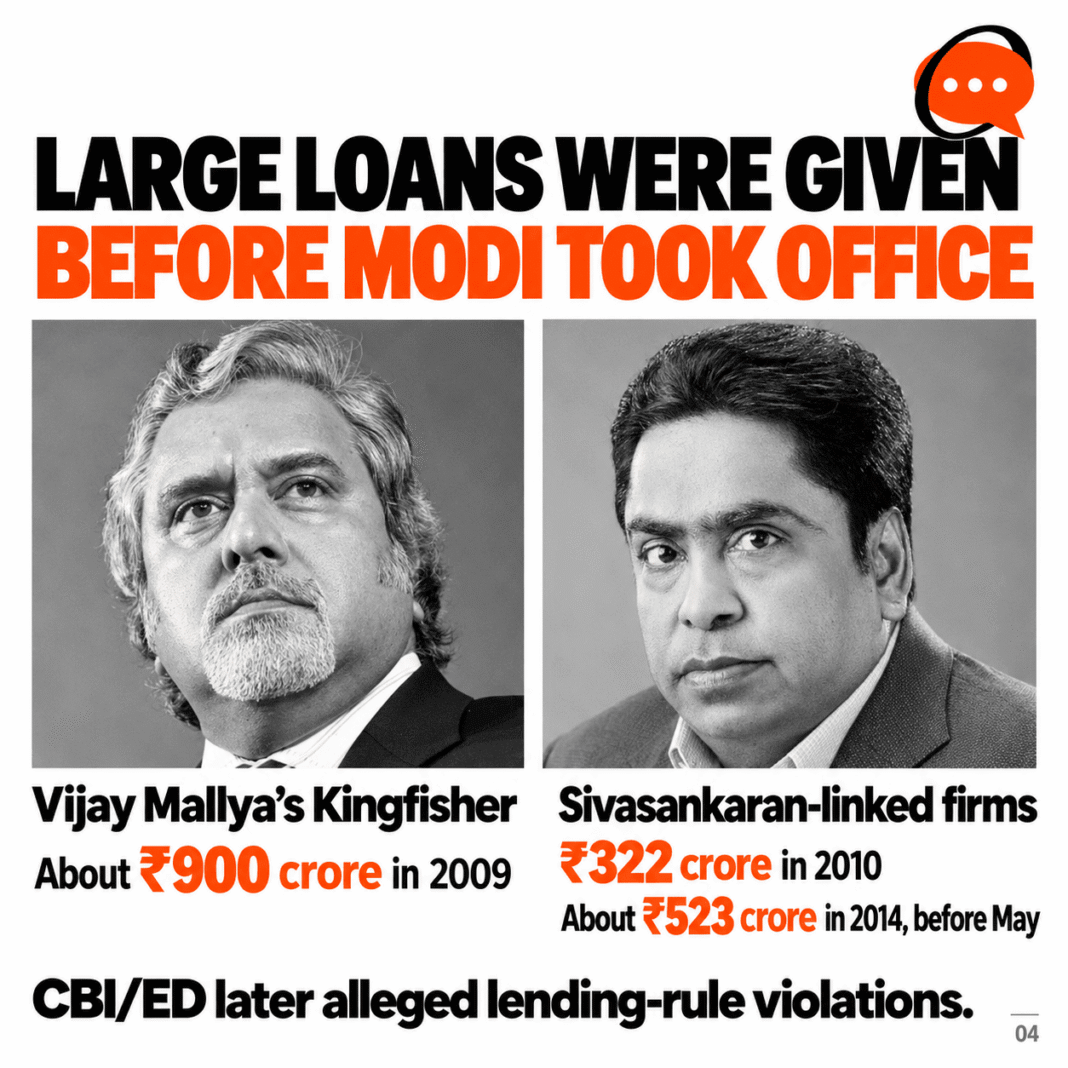
By March 2014, the bank carried ₹9,960 crore in gross bad loans, officially constituting 4.90% of its total loan book. IDBI extended roughly ₹900 crore to Vijay Mallya’s Kingfisher Airlines in 2009, despite internal cautionary red flags.

Loans linked to serial defaulter C. Sivasankaran totalled ₹322 crore in 2010 and approximately ₹523 crore in early 2014 prior to the May general election.

Subsequent investigations by the Central Bureau of Investigation (CBI) and the Enforcement Directorate (ED) revealed systemic violations of central credit appraisal guidelines, including top-tier management collusion and bypassed credit committees.

Under the Congress-led regime, standard banking practice relied heavily on loan restructuring schemes and issuing new debt to repay maturing interest, which artificially disguised the depth of bad loans.

When the Modi government assumed office in 2014, it confronted a choice. Either continue to conceal non-performing debt or choose transparency. The government and the Reserve Bank of India (RBI) chose the latter.

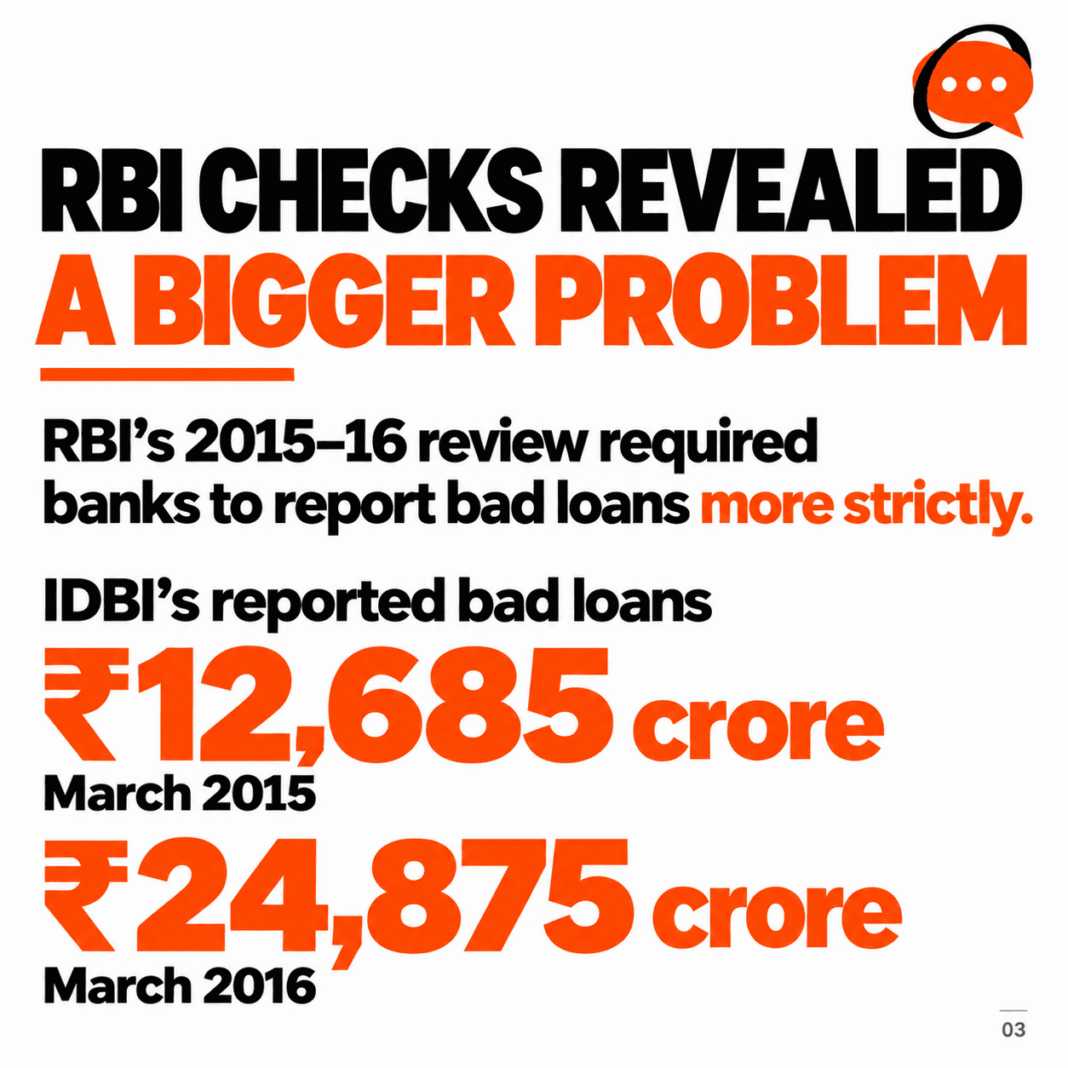
In late 2015, the RBI launched the Asset Quality Review (AQR), mandating that all commercial lenders uniformly classify stressed assets and set aside cash provisions against deteriorating accounts. The impact on IDBI was catastrophic:

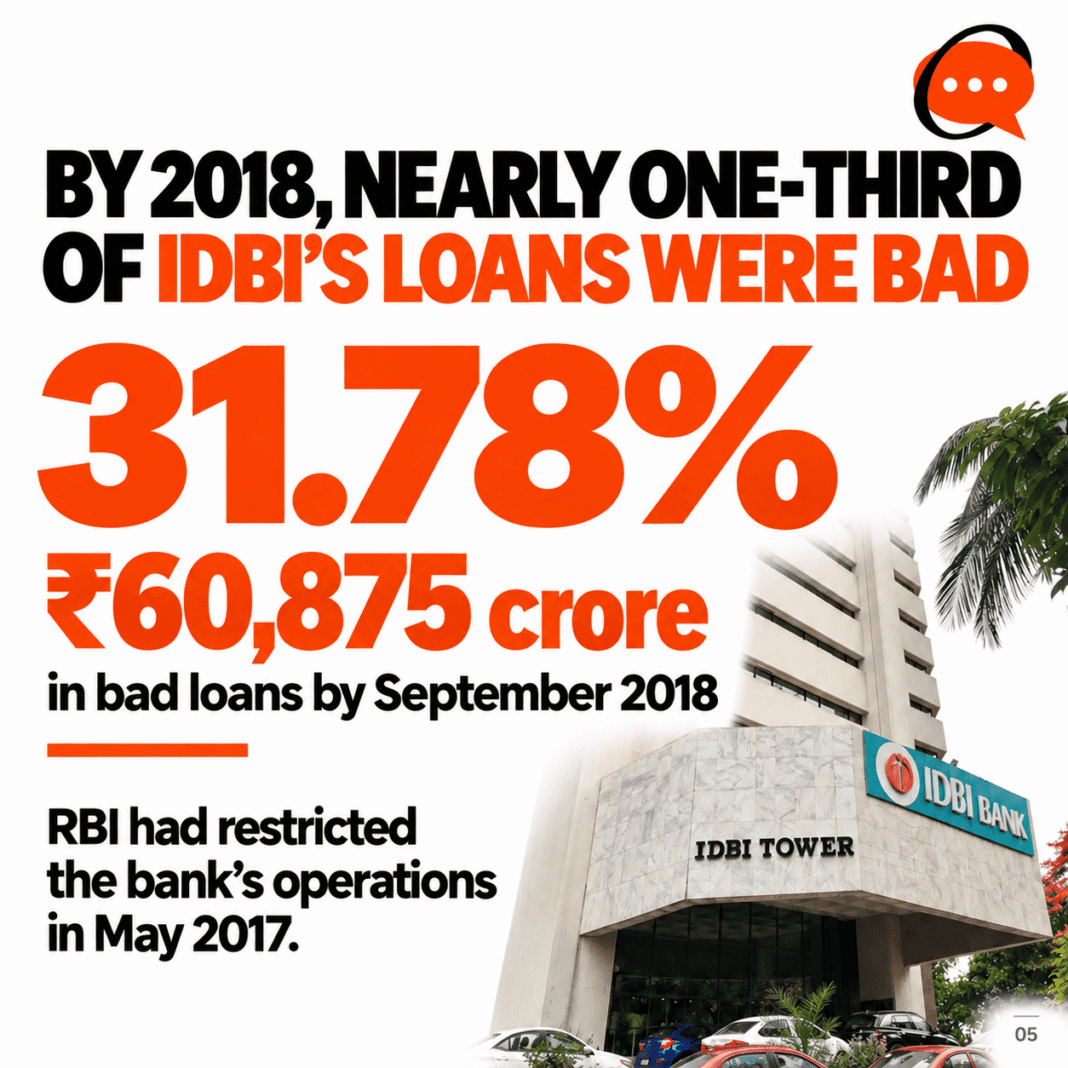
In March 2015, IDBI reported ₹12,685 crore in bad loans as initial scrutiny began. Within 12 months of strict reporting rules, reported bad loans doubled to ₹24,875 crore. As legacy infrastructure, steel, and power loans unraveled, IDBI’s gross bad loans reached an unprecedented ₹60,875 crore by September 2018.

At its peak in September 2018, bad loans swallowed 31.78% of IDBI’s entire loan book. Nearly one out of every three rupees lent was non-performing. The bank was technically insolvent.

In response, the RBI placed IDBI Bank under the Prompt Corrective Action (PCA) framework in May 2017. Under PCA sanctions, IDBI was barred from opening new branches, issuing large-ticket corporate loans, or paying staff bonuses.

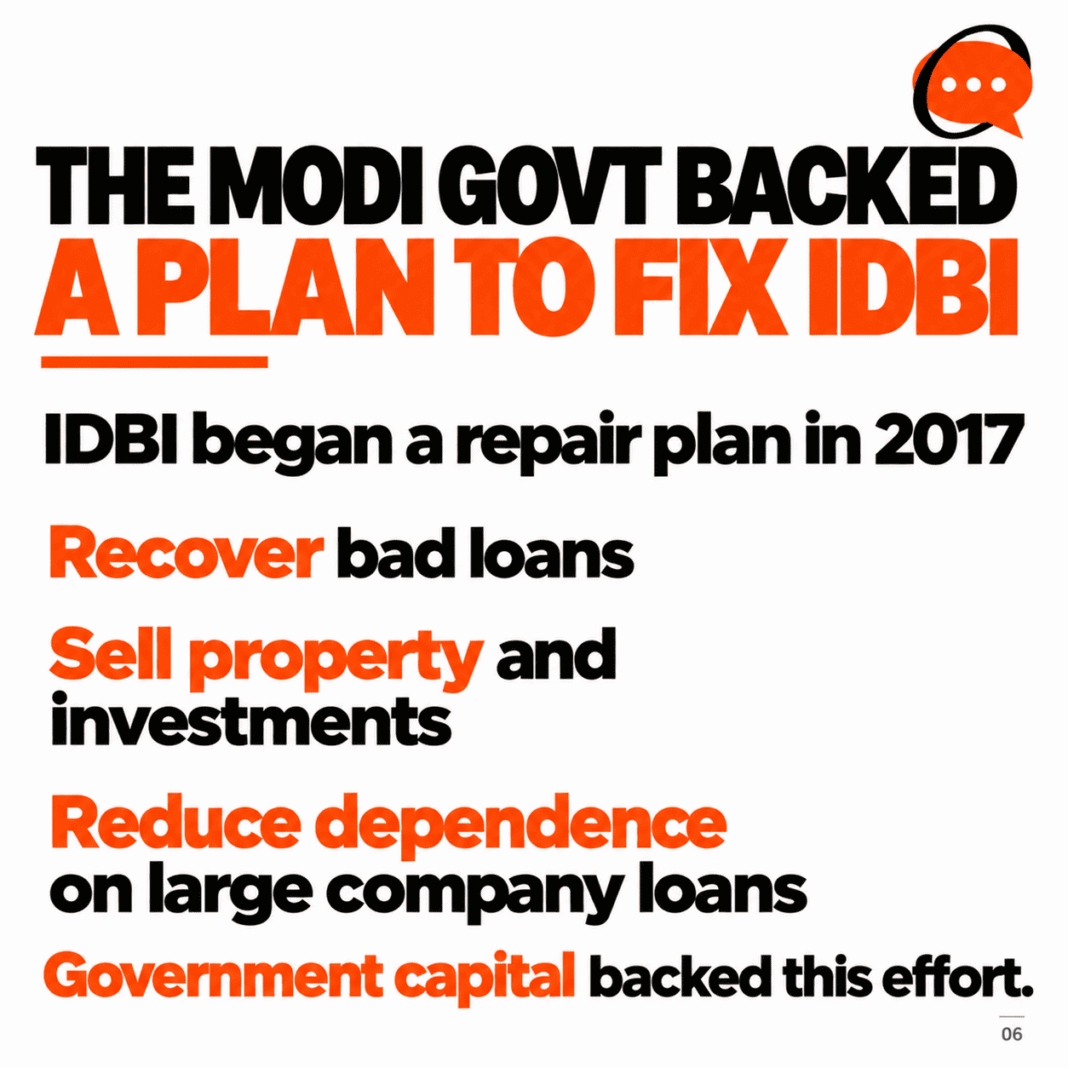
Stripped of its core commercial function, the institution faced liquidation or permanent subsidisation at direct taxpayer expense. Faced with a collapse that could trigger a tsunami across India’s financial sector, the Modi government devised an aggressive turnaround strategy.

The bank refocused on personal loans, auto finance, home mortgages, and small enterprise lending. Simultaneously, the Insolvency and Bankruptcy Code (IBC) allowed IDBI’s recovery teams to take chronic industrial defaulters directly to the National Company Law Tribunal (NCLT). In this way, the banks recovered tens of thousands of crores in previously write-off-bound debt.

Liquidating the bank would have devastated millions of retail depositors and erased public trust. The Modi government structured a phased recapitalisation model combining direct exchequer support with institutional equity from the Life Insurance Corporation of India (LIC).

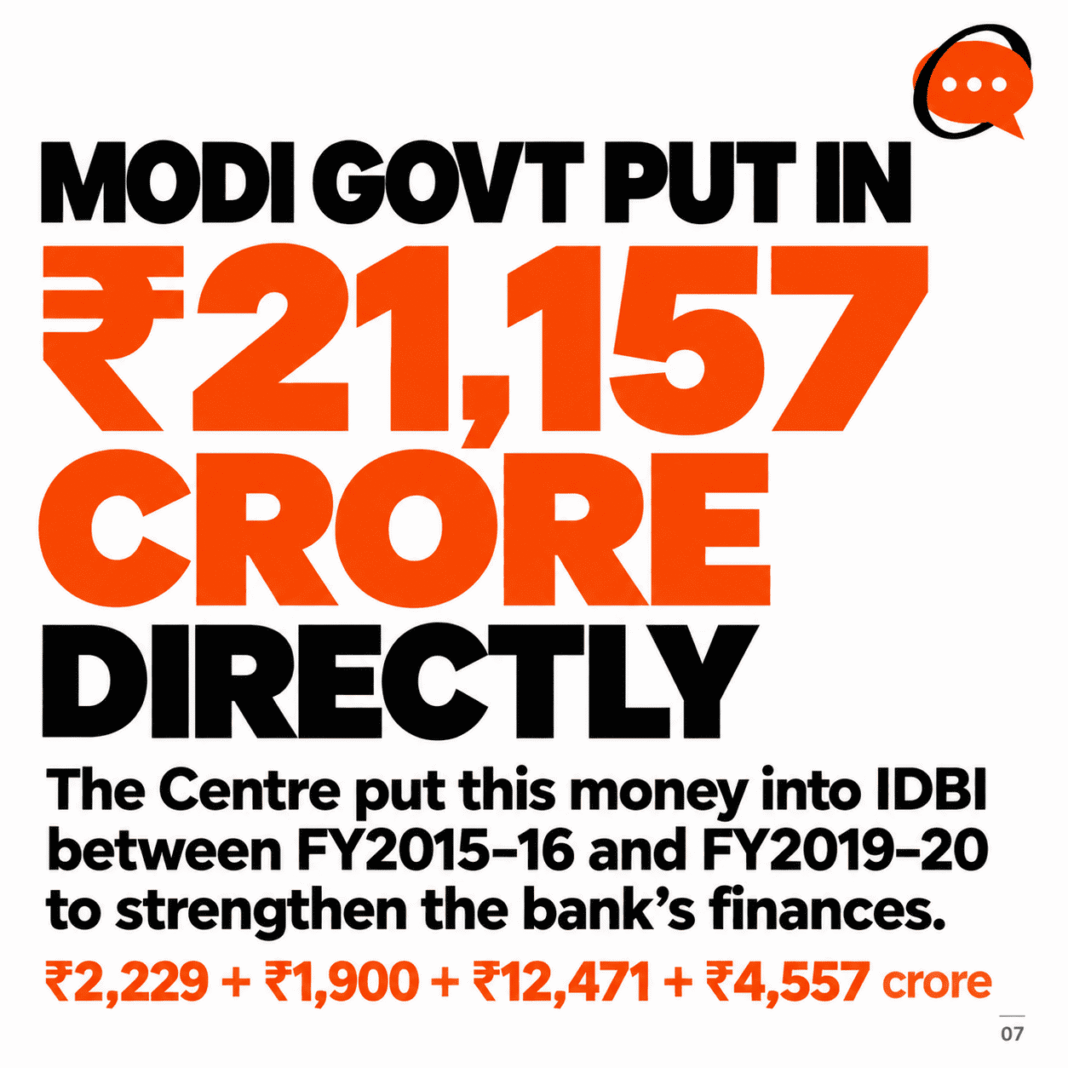
Between FY2015-16 and FY2019-20, the Centre injected ₹21,157 crore of direct equity into IDBI Bank across four separate tranches.

FY 2015–16: ₹2,229 crore

FY 2016–17: ₹1,900 crore

FY 2017–18: ₹12,471 crore

FY 2019–20: ₹4,557 crore

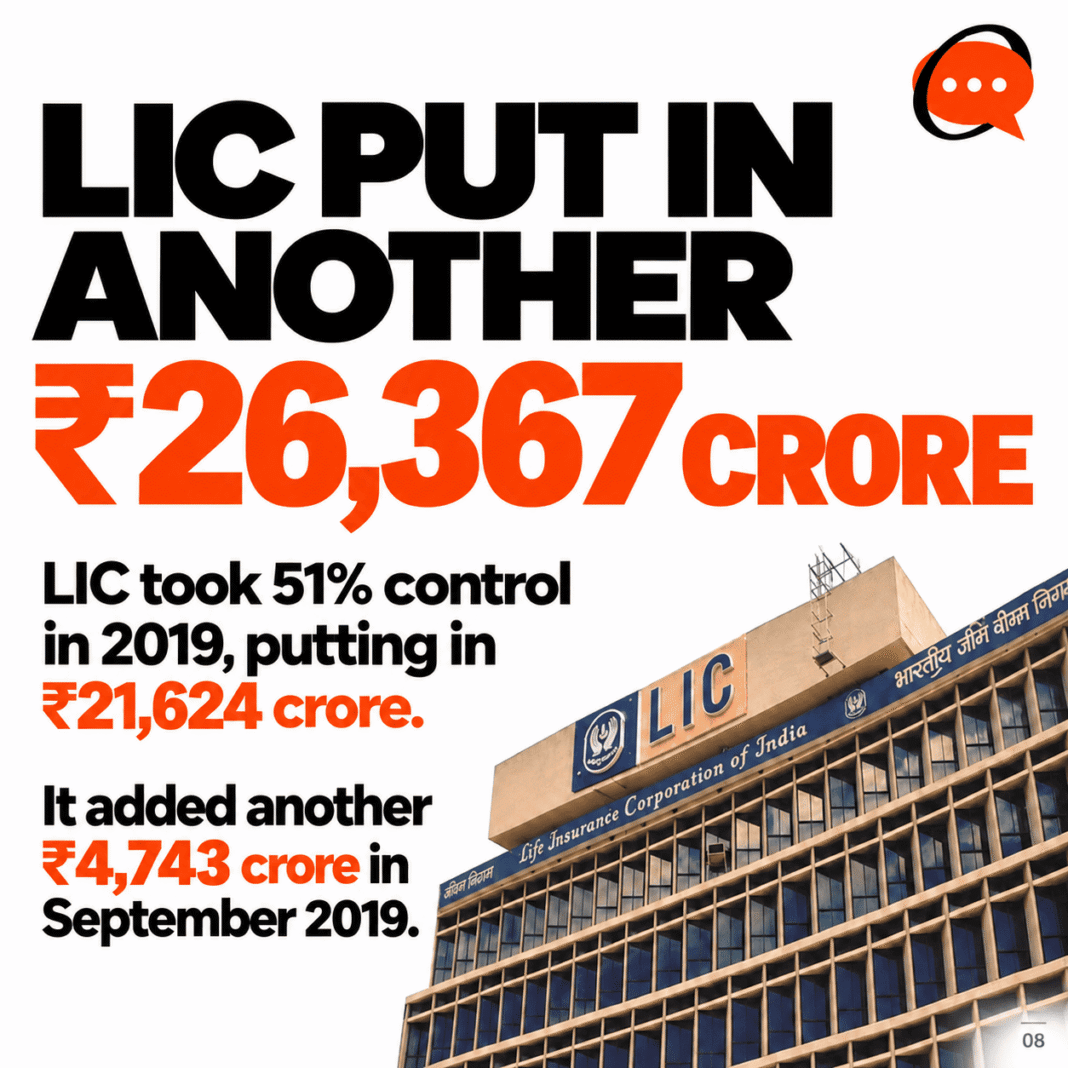
To lift the bank out of the PCA framework without breaching sovereign fiscal deficit targets, the government brought in LIC as a strategic co-promoter. In January 2019, LIC acquired a controlling 51% stake in the lender:

Initial 51% Acquisition (Early 2019): LIC infused ₹21,624 crore in equity.

Follow-on Rights Capital (September 2019): LIC infused an additional ₹4,743 crore.

Total LIC Investment: ₹26,367 crore.

Across both state institutions, total capital deployed to rescue IDBI Bank amounted to ₹47,524 crore. While it was dubbed a “backdoor state bailout,” the strategic rationale was clear.

It was to protect retail deposits, recapitalise the lender’s eroded net worth, purge legacy NPAs, and wait for the asset to appreciate before executing an organised exit.

The restructuring turned IDBI Bank from one of India’s most distressed state lenders into a competitive, profitable commercial bank.

By cleaning up provisions, reining in high-cost bulk deposits, leveraging LIC’s nationwide network for retail bancassurance, and adhering to strict risk-weight filters, IDBI steadily restored its operating ratios.

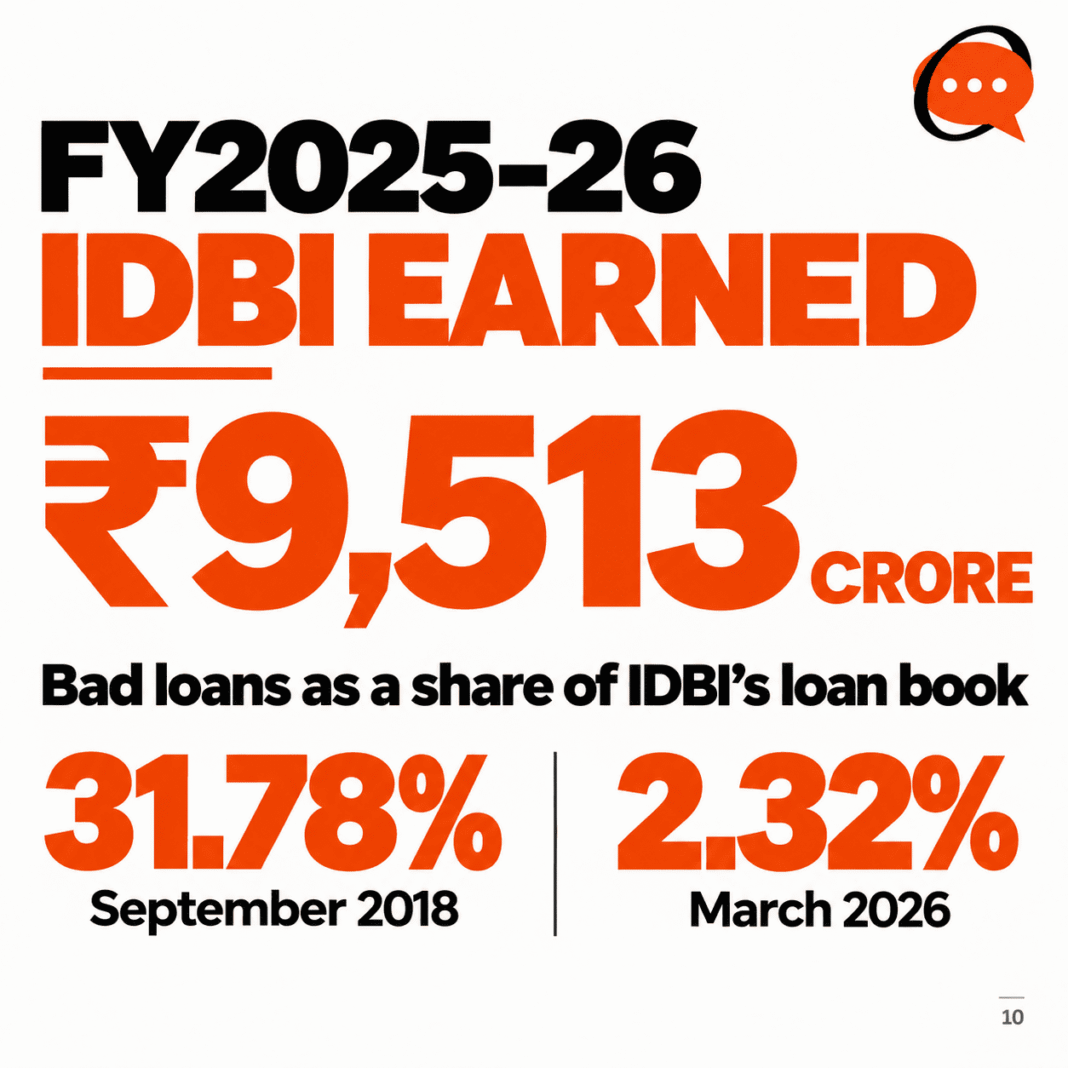
Gross NPAs plummeted from an alarming 31.78% in September 2018 to just 2.32% by March 2026. This drop of over 2,900 basis points was achieved through cash recoveries via the IBC, write-offs of uncollectible corporate loans, and a shift toward low-default retail lending.

After enduring heavy losses from 2016 through 2020, IDBI achieved a historic turnaround, generating ₹9,513 crore in consolidated net earnings in FY2025-26. Satisfied with the bank’s sustained capital adequacy ratio (CAR > 14%) and declining net NPA levels, the RBI formally lifted all PCA restrictions in March 2021, restoring full commercial operational autonomy.

The bank shifted away from volatile, high-cost wholesale deposits toward low-cost Current Account Savings Account (CASA) deposits, fortifying its net interest margins (NIM) against rate volatility. By early 2026, IDBI was no longer an impaired public liability.

It had become an efficient, well-capitalized commercial lender with strong return on assets (RoA).

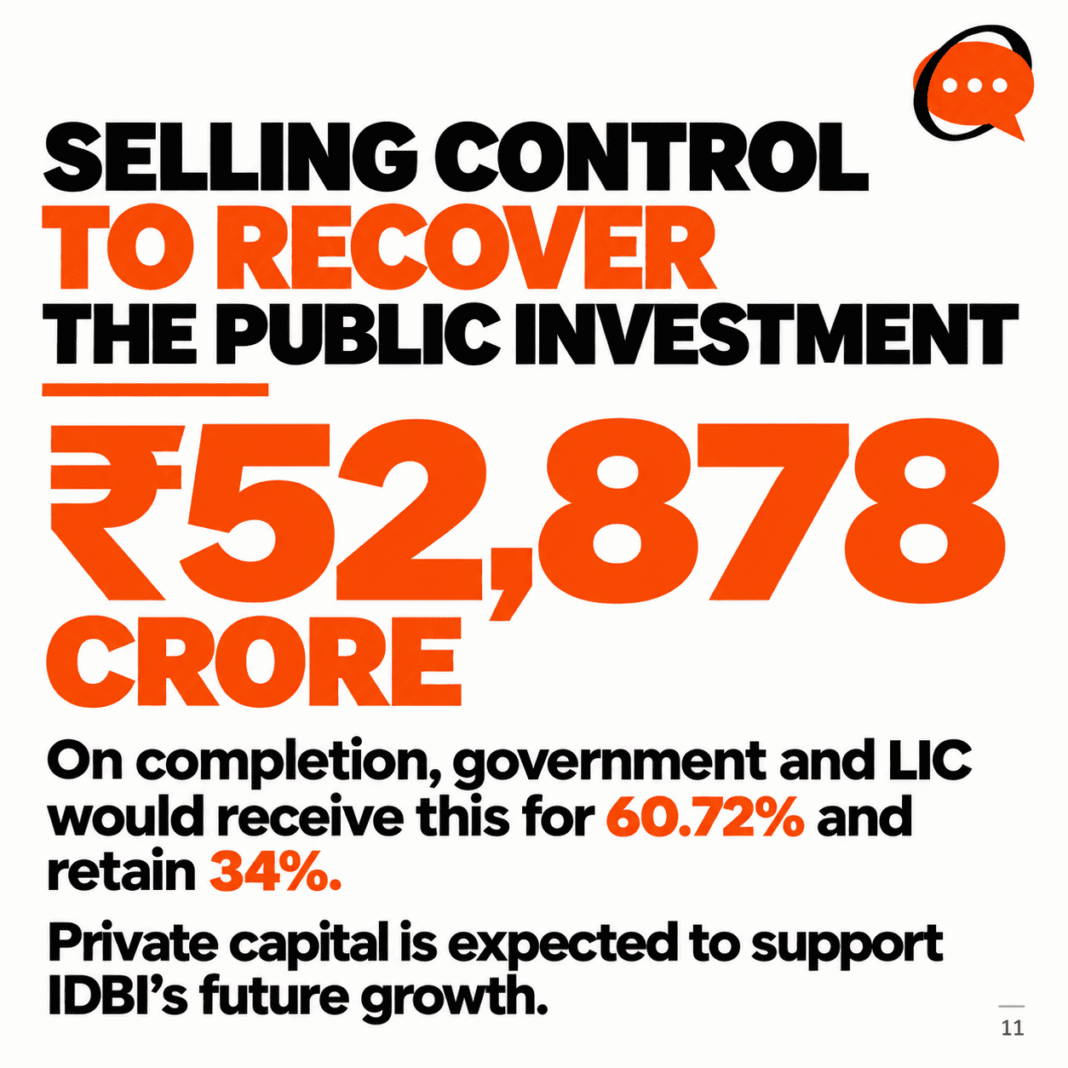
With the balance sheet restored, the Cabinet Committee on Economic Affairs (CCEA) approved the strategic sale of IDBI Bank to global investment giant Fairfax Financial Holdings, founded by Prem Watsa. The approved transaction parameters confirm that this sale is an economic masterstroke.

The Modi government and LIC together retain a 34% equity stake (Government 15%; LIC 19%). The government has not only recovered 100% of every rupee injected by both it and LIC during the crisis, but has extracted an immediate net cash profit of ₹5,354 crore.

Under private management led by Fairfax, IDBI will gain access to private global equity markets, streamlined credit risk systems and advanced digital banking architecture without needing sovereign recapitalization bonds.

With the bank generating ₹9,513 crore in profit and non-performing loans down to 2.32%, the Modi government executed a planned strategic restructuring for ₹52,878 crore.

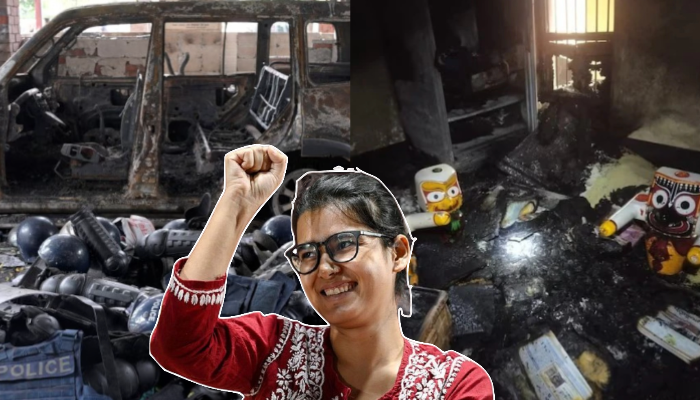
Far-left anarchist Neha Bora’s Bangladesh-style regime-change pitch for India: What does her dangerous desire mean for the country

The implicit has been made explicit by far-left anarchist Neha Bora. She has credited the “Gen-Z movement” of Bangladesh, which resulted in the forceful removal of a democratically elected government in August 2024, as a source of inspiration for the ongoing protests in India, intending to replicate similar scenes in the nation.

She is the national president of the All India Students Association (AISA), the student wing of the Communist Party of India Marxist–Leninist Liberation (CPI-ML).

Bora shared her sinister desires after Nahid Islam, a staunch Hinduphobic and anti-India voice, extended his support to the Cockroach Janta Party (CJP) and its agitation. He also praised the Shaheen Bagh demonstration, which paralysed the national capital for over 100 days and spread disinformation about the Citizenship Amendment Act (CAA) and the proposed National Register of Citizens (NRC).

Islam was among the names associated with spearheading the unrest that destabilised Bangladesh under the guise of anti-government resistance, only for the upheaval to descend into persecution of minorities, particularly Hindus. Bora, however, described the bloodshed as a “revolution,” hoping for the same to unfold in India.

Further highlighting her apparent admiration for such destructive turmoil, she was recently seen wearing a red T-shirt emblazoned with the Jolly Roger symbol of the Straw Hat Pirates from the popular “One Piece” manga, which has been prominently linked to deadly uprisings across Asia and the world, including Nepal, Indonesia and the Philippines.

A free hand for jihadis and Islamists to target Hindus: Neha Bora’s idea of “revolution” in India

The anti-Hindu onslaught unleashed by radical entities in Bangladesh became a defining feature of the widespread protests that had initially been presented as a student-led revolt against the government. On 5th August 2024, the very day Prime Minister Sheikh Hasina was forced to leave the country, the Bangladesh Hindu Buddhist Christian Unity Council released a list documenting attacks on Hindu temples, homes and establishments.

It included 54 incidents, a figure that soon rose to more than 200, with the actual scale of the violence vastly exceeding the disclosed cases as numerous such occurrences remained unreported. The gravity of the situation compelled External Affairs Minister S Jaishankar to address the issue in Parliament, drawing attention to the precarious position of Hindus in Bangladesh.

However, this was only the beginning of a prolonged plight for a vulnerable community left increasingly exposed to extremists. Hindus, both commoners and notable personalities alike, found themselves at the receiving end of a campaign marked by intimidation, arson, vandalism and unprecedented brutality.

Hate preachers and fanatic foot soldiers mobilised to incite hostility against Hindus, target women, torch properties, desecrate temples, damage idols and assault religious institutions and their members. Lynching and mob violence became recurring horrors for the community, with Islamist mobs celebrating over the bodies of their victims. Jamaat-e-Islami even prepared a list of their targets and blocked roads to prevent them from escaping.

On the other hand, Muhammad Yunus, who assumed charge as chief adviser of Bangladesh’s interim government, blamed the Indian government and the media for spreading “propaganda” about the dire condition of Hindus rather than offering any protection or bringing the culprits to account.

His government repeatedly either denied or painted the communal violence as political retaliation, fake news or isolated conflicts, as relations with India hit a new low with each remark. The Indian High Commission was targeted as the strident anti-India rhetoric amplified, which also involved provocative statements over the “Seven Sisters” of the Northeast.

Hindus continued to be lynched while those entrusted with maintaining law and order appeared unwilling to address the grave situation. The ground reality pushed the minority groups to suspend their religious events due to the intensifying fear. Similarly, Durga Puja came under attack from the Islamists, who started to demand jaziya from Hindus in order to live in the country.

Meanwhile, the Islamo-leftist ecosystem, including their supporters in India, downplayed, sanitised or dismissed the massacre, reducing the future of Bangladeshi Hindus to a chilling ultimatum: convert or die. Their pain has shown little sign of easing, as those who speak out against the atrocities, including monk Chinmoy Krishna Das, have to endure the wrath of both Muslim hardliners and the government.

The frightening future Neha Bora envisions for India

This is not even a preview of the immense tragedy borne by the Hindu community due to protests that began under the banner of popular rebellion, which Bora and many like her want to mirror on the streets of India. More importantly, Bangladesh’s slide since Sheikh Hasina’s resignation has extended far beyond human and minority rights, affecting its economy, soaring inflation and other critical sectors.

The promise of a better tomorrow has proved to be an illusion. People have raised concerns over political suppression and unchecked surveillance, while bans on Islamist parties have been lifted. Bangladesh, where even walking alone has become a challenge, has to persistently grapple with deep-rooted lawlessness.

The demonstrations only succeeded in toppling the government and causing attacks on Hindus, but failed miserably to translate into any meaningful improvement in the overall state of affairs. If anything, conditions have deteriorated further.

The Indian opposition has been obsessed with the fantasy of somehow imposing a similar model in India to oust the democratically elected Modi government. These people champion the Constitution and constitutional institutions, such as the Election Commission and the judiciary, only when it suits their political interests and have no qualms about driving the country into permanent disarray and reducing it to a theatre of mass violence.

It goes without saying that such a volatile scenario would leave lasting scars and carry irreversible, dangerous consequences not only for the nation but also for countless people whose lives could be devastated in the process. Furthermore, the very symbols of a nation’s sovereignty, dignity and integrity, history as well as heritage are brought to ruin during such episodes, as starkly illustrated in Bangladesh.

Thus, this might offer an appealing prospect to leftists like Bora, who romanticise the carnage for political gain, but the implications would be catastrophic, in light of the size and population of India.

A fraction of such a breakdown could result in pervasive riots that spiral out of control, with repercussions spreading rapidly across the nation. It would also open a door for India’s adversaries, both within and outside its borders, allowing them to exacerbate the mayhem and add to the already daunting predicament.

The world’s largest democracy could find its foundations shaken, its Constitution stripped of meaning and mob violence replacing the ballot box. All this will happen without any certainty that the installed government would yield even marginal advantage for the nation in any regard.

However, the dismal ramifications are both evident and far-reaching. A regime change might appeal to Neha Bora in India or George Soros in the United States, but for the country itself, it would only usher in a mountainous set of crises, undermining its democratic values, eroding constitutional principles and crippling its institutions.

Cherry-picking “revolution”: The quintessential hypocrisy of the Left

The decision by Bangladesh’s High Court to reinstate the quota system, which reserved 30% of government posts for descendants of 1971 Liberation War veterans and raised the overall quotas to 56%, sparked outrage in Bangladesh. The students considered it discriminatory and unjust to merit-based recruitment.

However, in a classic example of the hypocrisy that has become synonymous with the Islamo-leftist ecosystem, Bora conveniently ignored the reasons behind the protests in Bangladesh, which she desperately wants to emulate in India. The Bangladeshi students took to the streets because they believed that quotas were introduced at the expense of merit, but Bora would never dare to make an argument remotely along these lines.

On the contrary, she has been among the loudest voices supporting reservations. She did not stand with students opposing the University Grants Commission (Promotion of Equity in Higher Education Institutions) Regulations or those fighting for merit-based opportunities, even though the similar premise was central to the agitation in Bangladesh.

Bora wants to cherry-pick even the prime motivation of a movement she claims to idolise. Her selectivity exposes the shallowness of her “activism” and unmasks the pretence of “concern” for the nation.

The fundamental truth is that the opposition has consistently failed to defeat Prime Minister Narendra Modi and the Bharatiya Janata Party (BJP) in the elections. Hence, they are looking for alternative means of achieving their political objectives due to their inability to dislodge the saffron party.

They remain indifferent to what turning India into another Bangladesh or Nepal would mean for its people, democratic institutions and future. Their overriding aim is to capture political power and fulfil their own ambitions, by one means or another. As a result, they are eager to sacrifice India and its people, who will suffer the fallout of such a forsaken situation, in pursuit of these goals.

Conclusion

The irony is that those who assert to stand for India, its people and the Constitution happily overlook all three when it comes to achieving their political objectives. Bora’s calculated endorsement of the Bangladesh protests only reinforces this contradiction. Her complete disregard for democracy, the rule of law and constitutional ideals is revealed by her ominous vision for regime change.

However, the nation’s destiny cannot be relegated to the status of a political trophy for those who cannot secure power through elections. A country of more than a billion people is not a playground for experiments, and its citizens should not have to pay the price for anyone’s political prospects.

There is no place or takers for such a perilous gamble that could permanently jeopardise both India’s present and tomorrow. Bora and the opposition are unable to grasp this reality, but the people of India understand what is at stake.

Who is Pramila Jayapal, the US politician who extended support to protests against CEC Gyanesh Kumar over 130 million ‘voter purge’? Know about the Neville Roy Singham funding link and her anti-India attacks 

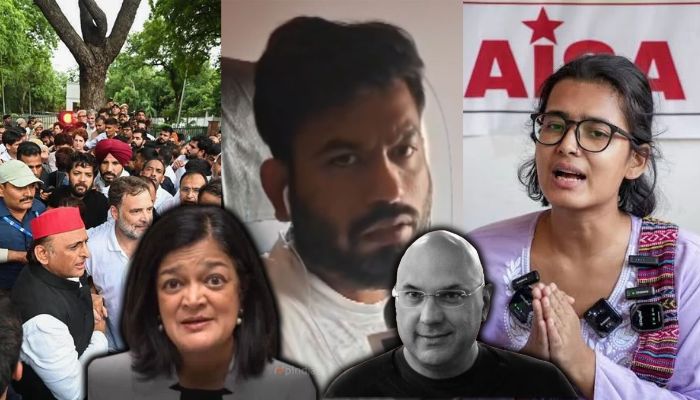
After the leftist foreign media and human rights groups with mastery in selective outrage, US politicians have also begun expressing their unsolicited ‘concerns’ about the deletion of 130 million or 13 crore voter names from draft electoral rolls after the Special Intensive Revision (SIR). Amid the Cockroach Janta Party and Opposition’s protest theatrics against Chief Election Commissioner Gyanesh Kumar, Indian-origin US Congresswoman Pramila Jayapal extended support to the ongoing protests in Delhi. 

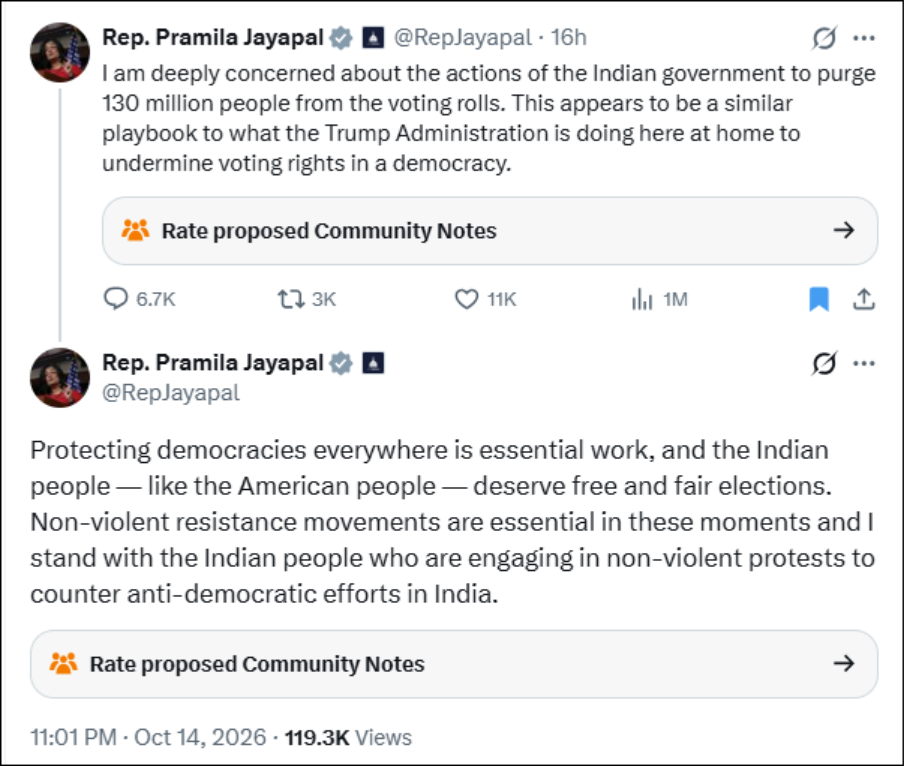
In an X post published on 14th October 2026, Pramila Jayapal wrote, “I am deeply concerned about the actions of the Indian government to purge 130 million people from the voting rolls. This appears to be a similar playbook to what the Trump Administration is doing here at home to undermine voting rights in a democracy.” 

In continuation, the US Congresswoman representing Washington’s 7th congressional district wrote, ” Protecting democracies everywhere is essential work, and the Indian people — like the American people — deserve free and fair elections. Non-violent resistance movements are essential in these moments and I stand with the Indian people who are engaging in non-violent protests to counter anti-democratic efforts in India.” 

Have 130 million people been ‘removed’ from voting rolls as Pramila Jayapal claims? 

Contrary to the insinuation that somehow 130 million or 13 crore voter names have been arbitrarily struck down from voter rolls, in a politically motivated mass disenfranchisement manoeuvre by the Election Commission of India, these are exclusions from the draft electoral rolls, not permanent final deletions. 

The Special Intensive Revision (SIR) of electoral rolls across the country in recent months was conducted after a monumental gap of nearly 24 years.  The SIR was not an illegal mass disenfranchisement action but a constitutionally aligned house-to-house enumeration exercise to update and clean electoral rolls. 

The latest SIR was conducted across 30 states and Union Territories, scrutinising about 95.4 crore voters. Nearly 13.39 crore voter names were left out of the draft electoral rolls. These voter names were not singled out based on their religion, caste, gender or political leanings. These voter name deletions fall mainly under the ASDD, which means Absent, Shifted, Dead, and Duplicate voters. 

Of the 13 crore names removed from the draft electoral rolls, 6.30 crore were Permanently Shifted, 3 crore Absent or not traceable, 2.80 crore Dead, 1.02 crore Duplicate and 0.26 crore under other categories. 

As per the stated rules, there is a claims-and-objections window after the draft is published. After processing claims, objections, and any related appeals, the final rolls are published; only then are the voter’s name exclusions for that revision finalised. 

Though there was an attempt by the Opposition to allege malice over the Supreme Court’s remark that it has not approved any fresh changes to Form 6, the apex court recently clarified that it has not disapproved of it either.  

Pertinently, the ECI has maintained that Form 6 has not been altered or replaced. It pointed out that a new declaration mapping the parents of a prospective voter in the previous SIR was introduced as a separate eligibility verification requirement, and it wasn’t a modification of Form 6. 

Previously, the ECI had pointed out that the decision to introduce this new declaration was taken unanimously by the Chief Election Commissioner and both Election Commissioners Vivek Joshi and Sukhbir Singh Sandhu. It has maintained that prescribing additional information for eligibility verification falls within its residual powers. 

This interpretation was backed by the Supreme Court’s order dated 27th May 2026 in the Bihar SIR. The top court had recognised the ECI’s authority to prescribe documentation for verifying voter eligibility. 

However, for the likes of Pramila Jayapal who are driven by their political-ideological agenda do not necessarily care about facts but are focused on making their contribution to stoking anarchy in India against the Modi government. 

It is interesting that despite being an active politician in American electoral politics, Jayapal is more concerned about Indian electoral processes than about her own country’s flawed electoral system. 

The US has a highly decentralised electoral system, with each state setting its own rules on voter registration, identification requirements, voting methods, and ballot access. Most of these remain contested. Jayapal should advocate modifications to the Electoral College in the US, which allows candidates to win the presidency despite their failure to secure the national popular vote. From voter suppression, non-citizen voting, gerrymandering, and controversies relating to mail-in and early voting, Jayapal will do better if she devotes her energy to domestic American matters, including structural issues in the electoral system, than be concerned about Indian electoral issues. 

Nevertheless, as the US politician jumps on the bandwagon of foreign meddling in India’s internal electoral-political affairs, it is pertinent to know about her anti-India activities and her financial links with Chinese Communist Party (CCP) stooge Neville Roy Singham, who leads the transnational pro-CCP information laundering network, House of Singham. 

Pramila Jayapal: A rabid Hinduphobe and anti-India Democrat leader 

Pramila Jayapal is a notorious anti-India and anti-Hindu Democrat leader active in American politics.  

In December 2019, she brought a Congressional resolution urging India to end restrictions on communications in Jammu and Kashmir. Her stand against the Indian Government’s decision to abrogate Article 370 in the state made the Indian American community feel betrayed, cheated and saddened. 

Following her resolution, MEA Jaishankar famously cancelled his meeting with a group of United States lawmakers following their refusal to exclude anti-India Congresswoman Pramila Jayapal from the delegation that was scheduled to meet him. “Don’t think her report has a fair understanding of the situation in Jammu and Kashmir or a fair characterisation of what the Government of India is doing. I have no interest in meeting her,” the External Affairs Minister revealed after speculations of cancellation of the meeting came forth. 

In January 2026, Pramila Jayapal joined 7 other US lawmakers in signing an open letter to the Indian government demanding bail and a free trial for 2020 anti-Hindu Delhi Riots accused mastermind Umar Khalid. Even as Khalid’s case remained sub judice, the US lawmakers declared him downright innocent. Jayapal and other signatories demanded that Umar Khalid be released from jail, claiming that the anti-CAA protests were ‘peaceful’ and even painted Muslims as the victims of the anti-Hindu riots in 2020. 

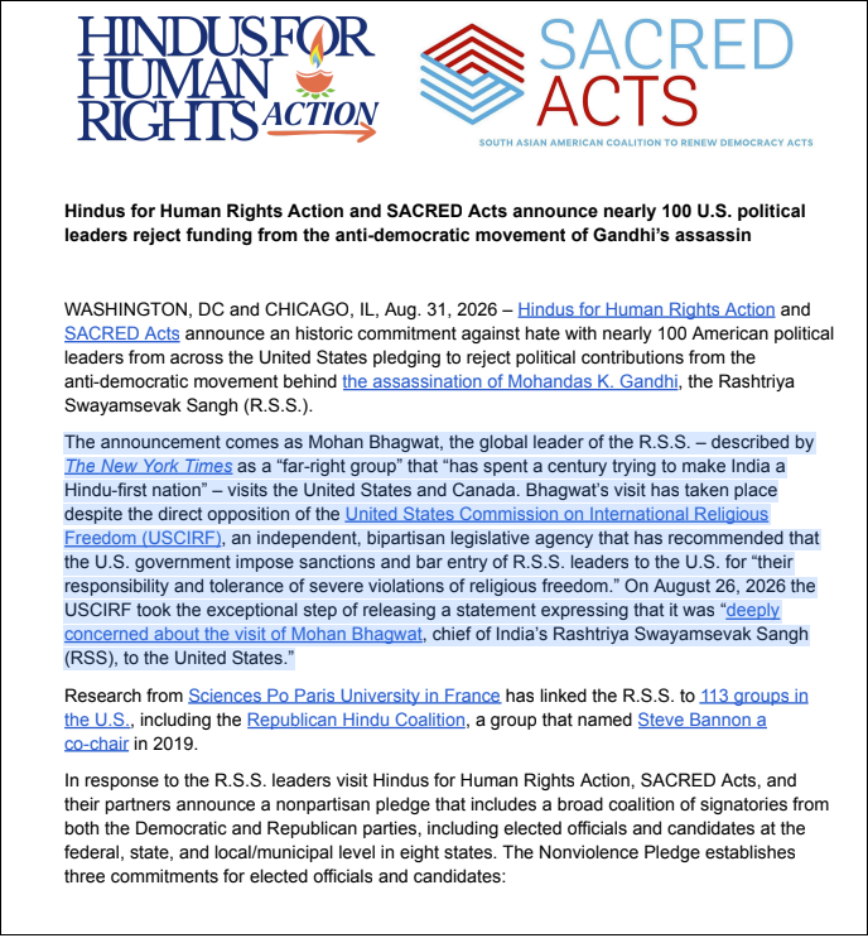
More recently, Pramila Jayapal was one of the 100 US politicians who signed a pledge prepared by Hindus for Human Rights (HfHR) Action and SACRED Acts, which urged them to stop accepting funds from   Rashtriya Swayamsevak Sangh-linked entities or its supporters. 

In a press release issued on 31st August, Hindus for Human Rights Action and SACRED Acts said, “– Hindus for Human Rights Action and SACRED Acts announce an historic commitment against hate with nearly 100 American political leaders from across the United States pledging to reject political contributions from the anti-democratic movement behind the assassination of Mohandas K. Gandhi, the Rashtriya Swayamsevak Sangh (R.S.S.).” 

This move came when RSS Chief Mohan Bhagwat was on a visit to the US. OpIndia has consistently reported about the anti-Hindu track record of Hindus for Human Rights and its Islamist parent bodies, the Indian American Muslim Council (IAMC) and the Organisation for Minorities of India (OFMI).   

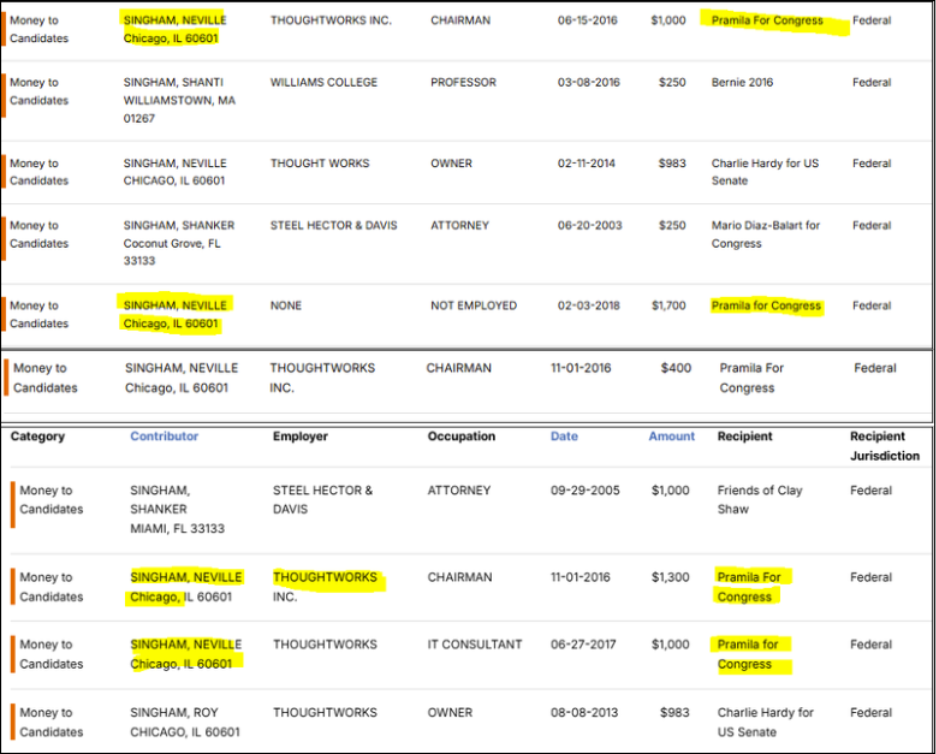
Pramila Jayapal received over $40,000 in funds from Neville Roy Singham and his wife, Jodie Evans 

Pramila Jayapal has a documented record of having received more than $40,000 in donations from Neville Roy Singham, the US-born tech tycoon who sold his IT consulting firm Thoughtworks for about $785 million in 2017 before relocating to Shanghai, and his wife Jodie Evans, the Code Pink co-founder. 

Jodie Evans (Source: CBS)

Jayapal began receiving funds from Roy Singham since 2016. 

It was only after the media exposed Neville Roy Singham’s pro-China information laundering networks that Pramila Jayapal returned the funds in 2023 to evade backlash. 

The House of Singham pro-China/Communism propaganda network 

The pro-China information laundering network House of Singham is led by Neville Roy Singham, the US-born tech tycoon who sold his IT consulting firm Thoughtworks for about $785 million in 2017 before permanently moving to Shanghai.   

This network is a sophisticated “information laundering” or “narrative laundering” machinery that modifies raw activism into polished propaganda, which is then amplified by the Roy-Singham-funded network to sow discord in the US, France and other democracies while burnishing China’s image as a ‘benevolent’ counterweight to ‘imperialism’, particularly American imperialism. The left-wing activism in Cuba and violent protests in France perfectly exemplify this.    

Roy Singham is reported to have s funnelled over $278 million directly into his pro-China propaganda network since 2017, with total money flows exceeding $591 million across 223 transactions spanning five continents through the year 2025. The massive amount was pumped into over a thousand interconnected organisations, of which around 200 are directly involved in generating and propagating pro-China and anti-America messaging at the behest of the CCP.   

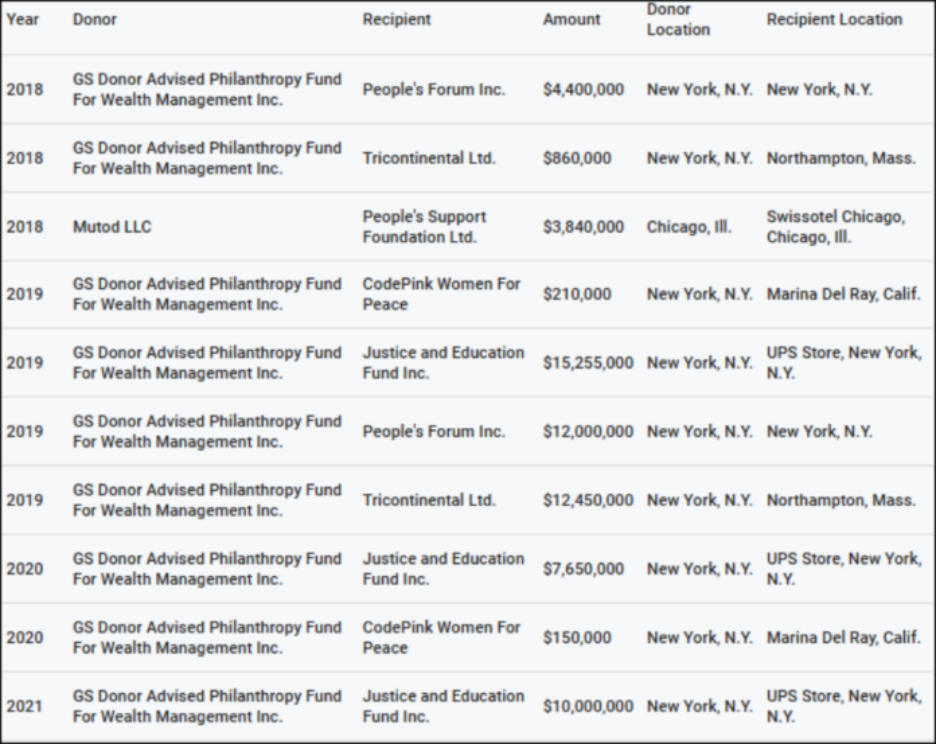
The CCP-aligned propaganda launderer first established a system to funnel tax-exempt dollars via two shell entities and a donor-advised fund with links to Goldman Sachs, “GS Donor Advised Philanthropy Fund for Wealth Management Inc.” Goldman Sachs philanthropy arm “terminated” Singham’s donor-advised fund in February 2024.   

Source: Fox News Digital

The House of Singham pro-China propaganda and activism network traces its origins to Neville Roy Singham’s wedding to Jodie Evans, the co-founder of CodePink Women for Peace, in Jamaica in 2017. The wedding event was attended by more than 80 core leaders, including Vijay Prashad of “TriContinental: Institute for Social Research”. Vijay Prashad, a Marxist journalist, later populated other boards within the network across shell-like entities, including Mutod LLC and Likewise Conceptions LLC. Fox News investigation finds that many of these organisations are registered at generic locations like hotels or UPS stores, apparently to obscure flows.  

Eleven US non-profits are serving as a hub, redistributing funds, coordinating protests, generating media content, political education, and “Liberation Centres” that are similar to the infamous 20th-century Chinese leader Mao Zedong’s “united front” strategy of embedding ‘revolutionary’ actors in superficially independent social, media, labour, cultural, and educational groups to erode the targeted country’s state legitimacy from within.  

From three organisations, GS Donors Advised Philanthropy Fund for Wealth Management Inc., and the two apparent shell companies, Roy Singham pumped $278 million into six nonprofits.  

These nonprofit organisations include People’s Forum, which received $22.4 million; People’s Support Foundation, which received $167.5 million from Singham-linked sources; and the Justice and Education Fund, which received $68.7 million. BreakThrough BT Media, CodePink, co-founded by Singham’s wife Jodie Evans, and Tricontinental Ltd, which has Marxist ‘journalist’ Vijay Prashad as its Director.  

Experts like Adam Sohn of the Network Contagion Research Institute and co-founder of Narravance opine that this structure enables an information laundering operation and a narrative laundering operation that is selling China’s propaganda to the world while sowing discord in America. A Fox News investigative report cites that the grassroots-looking protests, be it against ICE enforcement, the US offensive against Iran, the abduction of Venezuelan leader Nicholas Maduro, or in support of the Communist regime in Cuba, are all filmed, packaged into videos and commentary by House of Singham-linked media outlets like BreakThrough News, and recirculated to form a chimaera of organic global ‘resistance’. 

Roy Singham-backed BreakThrough Media has been actively peddling an anarchist narrative in France, where student protests have been co-opted by pro-Palestine Islamist and Communist adult-led groups. 

Notably, the Roy Singham-led pro-China information laundering network in the US also has a presence in India.  

There are many Roy Singham network-backed pro-China propaganda factories actively peddling anti-India and anti-government narratives. OpIndia has reported on such entities, including People’s Dispatch, TriContinental, People’s Forum, among others.  

From Kashmiri separatism, anti-Hindu tropes, glorification of Kerala’s ‘communist’ model, to Muslim victimhood, and propaganda maligning India’s global image, the core agenda of these CCP asset Roy Singham-backed entities is to weaponise relevant socio-political issues, nonprofit laws, digital media, and every other resource at hand to undermine rival states, influence policy decisions, weaken India, and deliver a geopolitical edge to China. 

Roy Singham’s Justice and Education Fund donated $10.5 million to Delhi-based pro-China propaganda outlet, NewsClick.  

One of the most prominent members of Roy Singham’s evil empire is Vijay Prashad. He has contributed several propaganda anti-India articles to NewsClick. Prashad is the nephew of Brinda Karat, a CPI(M) leader and wife of Prakash Karat, also a senior CPI(M) leader, whose email exchanges with Neville Roy Singham earlier revealed their close ties in the NewsClick Chinese funding scandal.  

Vijay Prashad has also been a council member of the Progressive International, an international organisation that mobilises leftist activists and groups globally. OpIndia earlier highlighted how this outfit persistently publishes propaganda articles and statements peddling the insidious Muslim victimhood narrative to slander the Modi government. It regularly platforms notorious anti-Hindu and Islamist apologists like Harsh Mander and has Islamo-leftist cheerleaders like Jayati Ghosh and former Labour MP Jeremy Corbyn as its council members.  

Roy Singham’s propaganda network has a connection with the pro-Hamas Tides Foundation. Tides Foundation is notorious for funding several anti-Hindu, anti-India organisations and elements. The Foundation gave grants to Hindus for Human Rights (HfHR), which has links to Islamists and Khalistanis, and was formed in 2019 by two Islamist advocacy groups, the Indian American Muslim Council (IAMC) athe nd Organisation for Minorities of India (OFMI).  

Tides also funded AMAN Public Charitable Trust (AMAN). This trust is connected to the NewsClick-China funding scandal, where it is alleged that Chinese entities funded NewsClick to disrupt Indian sovereignty.  

Among Indians introduced by Neville Roy Singham to his larger team, who worked with Tricontinental, one of the nonprofits that the New York Times said was involved in pushing Chinese talking points, were Prabir Purkayastha, Srujana, Prasanth, and Vijay Prashad.   

Prashad also has close ties with Urban Naxal P Sainath, whose propaganda portal PARI recently removed references to Singham after his connection with the Chinese propaganda arm had come to light. 

The pro-China propaganda portal NewsClick first made headlines when it came under the radar of the Enforcement Directorate in 2021. The portal was reportedly accused of fraudulently receiving foreign funds amounting to around Rs. 38 crores.   

In 2023, the Delhi Police Special Cell filed an FIR and later an extensive chargesheet under the Unlawful Activities (Prevention) Act (UAPA) against NewsClick founder Prabir Purkayastha, HR head Amit Chakraborty, among others. 

Interestingly, akin to the pattern seen in French protests, the ongoing anti-CEC Gyanesh Kumar protests in India also have Communist/leftist outfits and leaders at the forefront.  

Although the political Opposition and the Cockroach Janta Party, an Opposition-aligned ‘pressure group’ with most of its leadership tracing political roots in the Aam Aadmi Party, are actively involved, the anti-CEC protests are mainly led by the communist-leftist student groups like the Student Federation of India (SFI), All-India Students’ Association (AISA), and their leaders like Neha Bora. The leftist goons were found to be involved in clashing with the police and vandalising barricades, etc. 

Pramila Jayapal’s unsolicited concerns about India’s electoral process and support for anti-CEC protestors suggest that she may have returned Roy Singham’s funds to avoid the allegations of being a CCP stooge; her ideological alignment with Singham and the broader anarchist Communist coterie remains intact. 

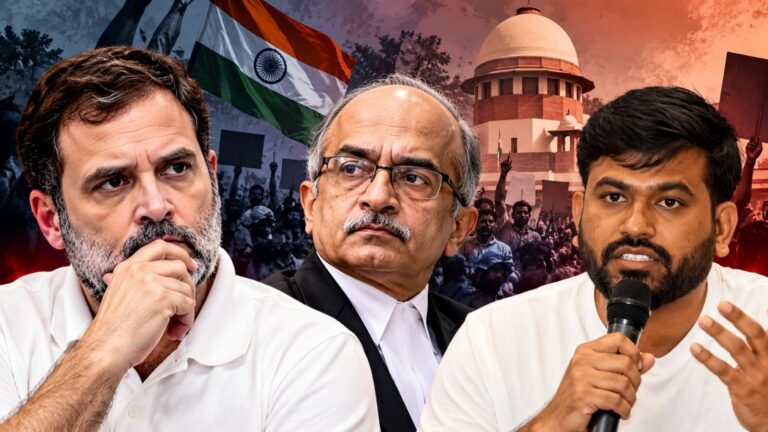
Desperate Congress reaches out to CJP through Prashant Bhushan after calling it an ‘AAP proxy’; gets snubbed

The Opposition’s campaign against Chief Election Commissioner Gyanesh Kumar has exposed an interesting spectacle of political opportunism, competing egos and selective solidarity. The Congress, which viewed the Cockroach Janta Party (CJP) as an Aam Aadmi Party (AAP) proxy, has now reached out to the same outfit through lawyer-activist Prashant Bhushan. CJP leader Dipke, however, was reportedly not particularly enthusiastic about the overture.

There is a lesson here for all three parties to this little political drama: Congress, CJP and Prashant Bhushan. None emerges from this episode looking particularly principled.

Let us begin with the Congress.

The grand old party reportedly kept a close watch on CJP’s October 10 protest against CEC Gyanesh Kumar in Delhi. Its assessment was that CJP had failed to mobilise a sufficiently large crowd, unlike the protests at Jantar Mantar in June and July. A section of the Congress leadership also reportedly viewed CJP as an offshoot or front of AAP, with concerns that it could occupy political space that the Congress would rather control itself.

Yet, within days, the Congress was attempting to establish contact with CJP through Bhushan.

What changed? Did the Congress suddenly develop confidence in CJP’s political credentials? Did it discover some extraordinary ideological affinity with the outfit? Or did it simply conclude that every additional organisation protesting against the CEC could help its campaign?

The last explanation appears the most plausible.

Rahul Gandhi declared on Monday that all protests against the CEC were part of one movement and that the Congress would support anyone defending the Constitution, regardless of the political formation they belonged to. On paper, this sounds like a reasonable appeal for Opposition unity. In practice, however, the reported outreach to CJP raises questions about the Congress’s earlier assessment of the organisation.

If CJP was merely an AAP proxy, as sections of the Congress leadership reportedly believed, why was its participation suddenly desirable? And if CJP was a legitimate political formation capable of contributing to a common cause, why was the party so concerned about the political space it might occupy?

The Congress cannot have it both ways. It cannot dismiss a rival formation when it fears competition and then seek its cooperation when doing so becomes politically convenient.

The party’s problem is not merely that its overture reportedly received a lukewarm response. It is that its conduct reinforces the impression that its appeals for Opposition unity are often subordinate to calculations about who gets to lead, who gets visibility and who gets credit.

CJP wants political relevance but cannot escape questions about its own motives

CJP, meanwhile, should not mistake the Congress’s reported outreach for a political victory.

The outfit has emerged as a recent phenomenon in the Opposition ecosystem and has sought to establish its identity through protests against everything under the sun. From resignation of the Education Minister to the resignation of the CEC, it appears that resignation is the currency on which CJP operates. And this currency is fuelled by the ‘blackmailing’ and holding the nation hostage through disruptive protests.

CJP has every right to organise demonstrations, criticise the government and demand accountability, but it must also accept that its political positioning and methods will attract scrutiny.

According to the report, Congress believed that CJP had failed to mobilise the numbers it had hoped for during its October 10 protest. The protest was disrupted by a substantial security deployment and police action, with an estimated 7,000 people detained across Delhi. The circumstances make it difficult to draw definitive conclusions about CJP’s mobilisation capacity from that episode alone.

Nevertheless, the organisation faces a basic question: does it want to function as an independent political force, or does it want to become part of a larger Opposition campaign whenever doing so offers greater visibility?

Its decision to stay away from the INDIA bloc’s march to the Supreme Court on Monday suggests that it was not prepared to participate in that particular programme. That is its prerogative. But if CJP insists on maintaining an independent political identity, it must be prepared to build its own support base rather than depend on the recognition or endorsement of established Opposition parties.

There is also an uncomfortable irony in the organisation’s position. If CJP resents being viewed as an AAP proxy, it must demonstrate that its political decisions are driven by its own priorities rather than by the calculations of another party. Independence cannot be established merely by refusing an invitation from the Congress. It must be demonstrated through consistent political positions, transparent objectives and an ability to mobilise supporters on its own terms.

At the same time, CJP should not be expected to join every Opposition programme simply because Congress or Rahul Gandhi calls for unity. A common cause does not require every organisation to surrender its identity. The point is that CJP cannot simultaneously seek recognition as an independent political force and treat every question about its political positioning as illegitimate.

Why is Prashant Bhushan being used as the intermediary?

Then there is Prashant Bhushan, whose reported role as an intermediary adds another layer to this political spectacle.

According to The Indian Express, the Congress approached Bhushan and asked him to reach out to Dipke. Sources close to Bhushan confirmed that a request came in, though the circumstances made direct coordination difficult: Dipke was in Maharashtra, while senior CJP leaders Ashutosh Ranka, Saurav Das and Ajinkya Shinde were in police custody.

Bhushan is a “lawyer-activist” who has frequently been associated with political and civil society campaigns. He has long been a fervent critic of the Modi government, often amplifying fake news and blatant lies before quietly deleting them after being called out. His name also came up as the facilitator of the meeting of the characters currently charged with orchestrating the bloody anti-Hindu riots in Delhi in 2020.

But the episode raises a legitimate question about the political networks and individuals who project themselves as intermediaries that emerge around such campaigns. When a party that reportedly suspects a new organisation of being a rival’s proxy seeks to approach it through an “activist” who operates in overlapping Opposition circles, it becomes difficult to separate the language of a common cause from the practical business of political networking.

If the objective was simply to convey an invitation, there is little to criticise about the act of mediation itself. The larger question is whether the participants are interested in building a coherent campaign around clearly defined demands or merely coordinating whenever their immediate interests overlap.

An intermediary can bring people to the same table. He cannot manufacture ideological consistency where none exists.

Kejriwal’s snub avenged?

There is also a delicious irony here, given how Congress treated Arvind Kejriwal in 2019. Ahead of the Lok Sabha elections, Kejriwal had desperately sought an alliance with the grand old party, arguing that the anti-BJP vote should not be divided. “Humare mann mein desh ko lekar bahut zyada chinta hai… Usi wajah se hum lalayit hain. Unhone lagbhag mana kar diya hai,” he said on February 14, 2019, effectively admitting that Congress had almost rejected his overtures.

The remark became a political meme, immortalising the humiliation of a party chief seeking an alliance with a Congress that was not particularly interested. Nearly seven years later, the tables appear to have turned. Congress, which reportedly viewed CJP as an AAP proxy, is now reaching out through Prashant Bhushan, only to encounter a lukewarm response from Abhijit Dipke. Did CJP just deliver Congress its own “unhone lagbhag mana kar diya” moment?

Opposition unity or a convenient political arrangement?

Rahul Gandhi’s subsequent condemnation of the arrests of CJP leaders further demonstrated the Congress’s willingness to extend public solidarity to the organisation. On Wednesday, he declared that waving the Tricolour at Jantar Mantar during a peaceful protest was not a crime and described the jailing of young protesters as an act of cowardice.

Dipke thanked Gandhi for speaking out against the arrests and later called for Tiranga marches, including one at Central Park in Delhi’s Connaught Place on Friday, October 16.

These exchanges may help the two sides find common ground. But public messages of solidarity do not resolve the underlying tensions between competing Opposition formations. Nor do such exchanges whitewash the fact that CJP leaders were arrested not for unfurling the Tiranga but because they intended to protest at a site that was denotified as a protest site. However, truth hardly matters when the goal is to build opportunistic alliances and wrest power from the democratically elected entity.

The INDI bloc is supposed to bring together parties that disagree on numerous political questions but cooperate against a common opponent. It is obvious that removing the Modi government from power is the glue that is keeping these disparate elements together. Otherwise, there is no vision or ‘concern for democracy’ that has brought them together.

The problem arises when the language of constitutional principles becomes inseparable from calculations about political ownership. If every protest is one movement, as Gandhi argues, then the Congress must be willing to recognise the autonomy of other organisations even when they do not participate in its programmes. Equally, CJP must accept that independence brings responsibility and that it cannot demand recognition without demonstrating sustained political credibility.

And Bhushan, like other activists who facilitate these interactions, should be judged by the substance of the causes he supports rather than by his proximity to political figures. He should also be judged for subsequent violence and disruptions such associations and alliances may cause.

There is a distinction between cooperating on a specific demand and pretending that all participants share the same political objectives. The former is practical politics; the latter is often little more than messaging.

The Congress wants to lead the Opposition. CJP wants to establish itself as a political force in its own right. Activists such as Bhushan operate in the space where these ambitions intersect. Their interests may occasionally align, but that does not automatically make them a coherent movement.

Ultimately, the reported outreach and the lukewarm response tell us less about a sudden political realignment than about the transactional nature of Opposition politics. The Congress appears willing to approach a formation it reportedly viewed with suspicion. CJP appears unwilling to be drawn into a programme on the Congress’s terms. And Bhushan has reportedly been asked to help bridge the divide.

Everyone is entitled to pursue their political objectives. But none should be allowed to disguise political calculations as unquestionable moral virtue.

If the campaign against the CEC is genuinely about constitutional principles, its participants should be able to explain their demands, defend their methods and cooperate without pretending that their competing ambitions have magically disappeared. If the CEC is compromised, which all three actors — CJP, Prashant Bhushan, and Congress—believe, then why can’t they explain how the same CEC presided over Opposition victories in Punjab, Karnataka, Kerala, and Telangana?

Until then, the spectacle of the Congress courting CJP, CJP maintaining its distance and Bhushan being asked to facilitate contact looks less like a united political movement and more like a negotiation over who gets to occupy the Opposition’s increasingly crowded stage.

Supreme Court verdict on ‘Backward Class’ certificate for Muslim converts should lead to national review of non-Hindus getting reservations

A landmark ruling against automatic reservation entitlement after conversion exposes the dangers of executive shortcuts, competitive-pool switching and vote-bank-driven classification — and invites a wider audit of OBC entries across states.

On 15 October 2026, the Supreme Court upheld the Madras High Court’s decision, striking down Tamil Nadu’s G.O. (Ms) No. 31 of 9 March 2024. The decision transforms the Sameer Ahmed dispute from a pending constitutional question into an important judicial affirmation: changing religion does not, by itself, make a person a member of a notified backward community in the adopted religion. Nor can an executive order or a private religious body manufacture the legal foundation for that entitlement.

The judgment does not restrict religious conversion. Instead, it prevents governments from making conversion an automatic route to reservation benefits. It also raises a serious political question: why are governments creating such pathways instead of ensuring that reservation is granted only on the basis of objectively established social and educational backwardness?

The case and the Supreme Court ruling

Sameer Ahmed, formerly Paramasivam, converted from Hinduism to Islam in 2015 and sought a Muslim Lebbai certificate to claim Backward Class Muslim (BCM) reservation. After his application was rejected, Tamil Nadu’s G.O. No. 31 came under challenge. The order allowed converts from BC, MBC, Denotified Communities and Scheduled Castes to be classified within one of seven notified Muslim backward communities. The Madras High Court quashed it on 25 June 2026.

Tamil Nadu argued that a person’s earlier disadvantage should not disappear after conversion. But the Supreme Court, through Justices Prashant Kumar Mishra and Shree Chandrashekhar, upheld the central finding: conversion alone cannot establish membership of a particular Muslim backward community. A community certificate records an existing status; it cannot create that status. Nor can a private religious body conclusively decide a statutory reservation entitlement.

The Court also addressed the separate Scheduled Caste rule under the Constitution (Scheduled Castes) Order, which limits SC status to persons professing Hinduism, Sikhism or Buddhism. Claims following reconversion require examination of their own facts, not automatic restoration.

Why this judgment matters

The distinction is straightforward. Article 25 protects the freedom to choose one’s religion; Articles 15 and 16 govern affirmative-action classifications. Exercising the first right does not, by itself, establish eligibility under the second. A government cannot simply transfer a person from an earlier caste or community category into a new reservation-bearing group through an executive order.

This is a significant check on arbitrary reservation policy. It requires the State to establish the legal and social basis of membership, rather than treat a change of religious label as sufficient proof. Comparable rules elsewhere may now face challenges, although this judgment does not automatically cancel them.

Reservation arbitrage and the risk of double benefits

Tamil Nadu has a separate 3.5% BCM quota. This makes the possibility of “reservation arbitrage” worth examining: a convert could, under an automatic certification rule, enter a different competitive reservation pool without independently proving membership of the notified group. The Court has rejected that shortcut.

There is also a legitimate need to examine whether benefits claimed before and after conversion overlap, or whether incompatible concessions are being obtained through different certificates. But the ruling does not establish that converts generally receive double benefits or that an organised conversion racket exists. Such allegations require evidence. The policy concern remains serious even without assuming that every conversion is motivated by reservation.

The political question: Social justice or vote-bank policy?

G.O. No. 31 attempted to create a broad administrative route into seven Muslim backward communities. Its rejection raises a question for political parties: are reservation policies based on verifiable disadvantage, or are governments using convenient identity rules to expand electoral support? Social justice cannot become a justification for bypassing eligibility tests. The Court’s legal finding concerns the order’s validity; vote-bank motivation is a political criticism, not a judicial finding.

Mandal Commission and the basis of non-Hindu OBC classification

The Mandal Commission considered backward groups among Muslims and Christians, including occupational communities and parallels with groups among Hindus. But neither religious identity nor occupation alone should replace evidence of an identifiable socially and educationally backward group. Equally, the egalitarian teachings of a religion do not prove that social disadvantage cannot exist among its followers.

The Supreme Court’s reasoning makes the distinction between religion and community membership especially important. A convert does not automatically acquire the history, characteristics or recognised membership of a particular backward group merely by adopting its religion.

A question mark over Muslim OBC lists in other states

The wider significance now goes beyond Tamil Nadu’s certificate policy. If conversion cannot automatically confer membership of a notified Muslim backward community, what is the basis on which Muslim groups have been included in OBC lists in other states? Were individual communities identified through evidence of social and educational backwardness, or did any entry or certification process rely mainly on religious identity? Are those original grounds still valid?

These are questions that can now be brought before Backward Classes Commissions and courts. State-specific OBC entries, particularly those based on broad religious labels or automatic post-conversion classification, may face closer judicial scrutiny. The same test should apply to Christian entries and, indeed, every other listed community.

The judgment does not strike down Muslim OBC reservation as a whole, nor does it declare Muslims ineligible for OBC status. Its significance is that it strengthens the case for examining each classification on objective evidence rather than accepting religion or conversion as a substitute for community membership. Where that evidence is missing, inclusion should be open to challenge.

Conclusion: A wider test for reservation policy

The Sameer Ahmed judgment is a landmark against automatic reservation entitlement through religious reclassification. Faith remains a matter of individual freedom; a reservation certificate must reflect a legally established social status.

It also puts political shortcuts under the spotlight. Governments should examine possible reservation arbitrage, overlapping benefits and weak certification rules instead of using conversion as an administrative gateway to a new quota. Most importantly, the ruling opens the door to wider scrutiny of Muslim and Christian OBC entries across states: every group should meet the same transparent constitutional test. Reservation must rest on demonstrated backwardness, not merely on a change of faith or an executive decision.

Supreme Court upholds Madras HC verdict quashing Tamil Nadu govt order granting reservation to new converts to Islam: Read about the judgment and the background of the case

In a major development, the Supreme Court has upheld the Madras High Court judgment that struck down Tamil Nadu government order allowing people belonging to SCs, backward classes, most backward classes and denotified communities to avail backward class (BC) Muslim certificate after conversion to Islam.

The verdict comes months after the Tamil Nadu government filed a Special Leave Petition (SLP) before the apex court. A 2-judge bench of Justices Prashant Kumar Mishra and Shree Chandrashekhar decided the matter.

The court held that the caste/ community status prior to conversion cannot be transposed upon conversion to a new religion. It pointed out that a government order like the one issued by the Tamil Nadu creates an artificial route for availing reservation.

The Judges held, “We therefore affirm the central conclusion of the High Court, though our reasoning proceeds on the constitutional foundation set out above. A person who converts to Islam does not by that act alone become a member of any one of the seven notified backward class Muslim communities in the state. His former caste or community status cannot automatically be transposed into the Muslim backward class category, nor can a private religious body conclusively determine such statutory entitlement.”

They further added, “Tested on that standard, we are of the view that the impugned GO cannot be sustained and has been rightly quashed by the High Court. It creates an artificial route by which a person moves from a pre-conversion social or backward social order into a notified Muslim backward class without establishing the necessary social and legal link. Therefore, the declaration made by the High Court that the impugned GO itself (is) unsustainable in law calls for no interference“, the apex court stated.

The Supreme Court pointed out, “A person who converts from a Hindu social order to a non-Hindu social order cannot claim affirmative action under Article 16(4) of the Constitution merely on the basis of the social backwardness associated with his pre-conversion status. The backwardness suffered in the antecedent social order cannot by itself be carried forwards so as to confer upon him the status of a backward class in the religion to which he has converted.“

“By virtue of paragraph 3 of the Constitution (Scheduled Castes) Order, a person who professes a religion other than Hinduism, Sikhism or Buddhism cannot be deemed to be a member of a Scheduled Caste. Consequently, upon conversion to a religion not specified therein, such person ceases to possess the Scheduled Caste status attached to his antecedent caste and cannot claim any affirmative action benefit of a backward class under Article 16(4) of the Constitution which is predicated upon membership of a Scheduled Caste,” it emphasised.

The Background of the Case

The original petition was filed by a Muslim convert named Sameer Ahamed (formerly Paramasivam) in 2022. The man was born into a Hindu family in the Thoothukudi district in April 1993 and had converted to Islam in September 2015. He was issued a certificate of conversion by Sunnath Jamath, Kayathar.

Subsequently, he filed an application before the Tahsildar, Kayathar, seeking to be certified as ‘Muslim Lebbai’, a community of Muslims eligible for reservation benefits in the state. However, his application was rejected, prompting him to file a writ petition before the High Court.

The petitioner relied on a Tamil Nadu government order dated March 3, 2024, which allowed a convert to Islam from Backward Classes (BCs), Most Backward Classes (MBCs), Denotified Communities (DNCs), or Scheduled Castes (SCs) to be treated as BC (Muslim) for availing the benefit of reservation.

As per the order, such a convert could avail the reservation benefits meant after obtaining a community certificate certifying that he belongs to either of the notified communities. In other words, the government order provided that converts who enjoyed reservation benefits before conversion to Islam can continue to avail reservation benefits after conversion.

The petitioner’s counsel admitted that the petition filed in 2022 became legally arguable only after the 2024 government order. The High Court, therefore, examined the constitutional validity of the government order.

The Madras High Court concluded that the Tamil Nadu government order was unconstitutional. Citing judicial precedents, the court said that if a person converts to Islam, he becomes a Muslim, and his place in Muslim society is not determined by the caste to which he belonged before his conversion.

The High Court explained that the seven Muslim categories recognised for reservation are historically identified communities and membership in those communities is ordinarily determined by birth, not conversion.

“As a corollary, we hold that a convert to Islam cannot claim the status of Backward Class Muslim. He is only a Muslim, and that’s all there is to it,” the High Court held.

Regarding the Tamil Nadu government order, the Division Bench observed that the Tamil Nadu government came up with the order just to override the judicial precedents prohibiting reservation benefits for converts to Islam, as they disincentivised conversion to Islam.

This would not have sat right with the Muslim community, as Islam is a proselytising religion, and thus the government passed the order to extend reservation benefits for converts to Islam.

The Madras High Court also pointed out that the order was passed merely for the purpose of extending reservation benefits for converts to Islam.

Striking at the validity of the government order, the High Court said that the legislature cannot declare a binding judicial precedent void or ineffective. The court further reasoned that the executive does not have the privilege to pass an order overriding a final judicial decision.

“While the legislature has the power and competence to make a validating law, the executive has no such privilege. It can never go against the final judgment of a court,” it added.

The Division Bench further noted that the government order was not only unconstitutional and arbitrary but also opposed to the ideology of Islam.

The court noted that preachers of Islam have long effected conversions by claiming that their religion is free from hierarchies and is egalitarian, unlike Hinduism. Considering this, the government order goes against the values and principles of Islam.

“We have no option but to conclude that, only to undo the judgments of this Court, has the Government come out with an innovation that is not only unconstitutional but also un-Islamic,” the High Court said, striking down the government order on 25th June 2026.

Manifesto of Aurora Hindu temple Neo-Nazi shooter described Indians as ‘subhumans’: How hate speech by White supremacists and Indian leftists is putting Hindus and their temples under target in the US

Alexandros Paporakis, a 19-year-old white supremacist man from Palatine, Illinois, in the US, was arrested on 11th October for plotting a mass shooting of Indian origin Hindus temple in Aurora at the start of Navratri. The police recovered an AR-style rifle, 300 rounds of ammunition, tactical gear, Nazi symbols, and a manifesto in which he described himself as a “sociopathic white supremacist Neo Nazi.” 

The white supremacist wanted to carry out mass killings of Indian Hindus; a rifle jam averted the terror attack 

The Palatine Police, Mount Prospect Police and prosecutors have stated that the accused, Alexandros Paporakis, who worked as a Taco Bell cashier, drove to the area where the largest Hindu temple in Aurora, the Sri Venkateswara Swami Temple, is situated, with the intention of carrying out a mass shooting of Indians. 

As the Navaratri festival was underway, the temple was busy with people. Paporakis’s rifle jammed; he fled the spot, searched online how to unjam it, and contacted a co-worker about his murderous plan. The co-worker, however, alerted the police. 

Thereafter, the local police arrested the accused, Alexandros Paporakis, outside his house before any further attempt at a mass shooting. 

During a search at his home, the police recovered an AR-style rifle, multiple magazines, nearly 300 rounds of ammunition, a tactical vest with body armour and a white supremacist patch, along with Nazi imagery including the Hakenkreuz symbol, which the Western media continues to wrongly report as ‘Swastika’, and a gas can. 

The Aurora Hindu temple shooter’s manifesto dehumanising Indians, Jews and African Americans 

Pertinently, the police have also found an eight-page document, the Aurora Hindu temple shooter’s manifesto titled: Why I Fought: A.K.A.  

The manifesto contains racial slurs, declaring Indians/Hindus, Jews, and African Americans “subhumans” and expressing fantasies about mass murder nearly every day. Paporakis repeatedly emphasised his desire to kill as many people belonging to the races and nationalities he hated as he could before he dies. 

According to the prosecutors, accused Alexandros Paporakis, has openly identified as a white supremacist at work, made racist comments against Indians, discussed Nazis and their armed struggle. He also said that he could not wait to kill Indian people.  

Reports say that the accused shooter told his co-worker that 11th October would be a “special day” and planned a mass shooting at the largest Hindu temple in Aurora.  

The Palatine Police said that the accused was planning for a mass shooting attack for about two years, and he researched the specific target, the Hindu temple, recently. 

The police have booked him on charges of making a terrorist threat and unlawful possession of a weapon, specifically a rifle with a barrel under 16 inches.  

A Cook County judge ordered him held without bond. As per court records, the accused was being treated for ADHD, depression, and anxiety, and received hormone injections related to gender transition. 

Meanwhile, the top US Hindu temples body, the Hindu Mandir Empowerment Council (HMEC), issued an urgent security alert for temples in the US after the thwarted Aurora temple shooting plot. 

White supremacism, Christian extremism, and MAGA rhetoric are collectively fueling hatred against Indians, mainly Hindus 

From the orientalist caricatures in the 19th-20th century, fears of ‘eastern/Asian mysticism’ eroding Protestant ‘purity’ to anti-Hindu violence, racism is deeply entrenched in American socio-political structure. However, ever since Donald Trump assumed office as the President of the United States in January 2025, the agitprop against Indians, particularly Hindus, has increased manifold.  

OpIndia has reported earlier on how the debate around H1-B visas and highly skilled Indians using the same to explore career opportunities in the US in recent months snowballed into a full-fledged anti-India and anti-Hindu campaign.  

There has been an alarming mainstreaming of Hinduphobia in the US in recent years. Incidents of temple vandalism, online slurs, racist attacks on American Hindus, and Christian extremists openly mocking and vilifying Hinduism online or on podcasts have become an opprobrious ‘normal’ in the country.  

The anti-Indian and anti-Hindu hate and its online expression is so scathing that white supremacists, Christian extremists and a significant section of MAGA racists have not spared even the top Indian/Hindu Trump administration officials. 

From vilifying FBI Director Kash Patel and US Director of National Intelligence, Tulsi Gabbard for wishing everyone a happy Diwali, mocking the Trump administration for celebrating Diwali in the White House, attacking JD Vance’s Hindu wife Usha Chilukuri, and questioning Vivek Ramaswamy’s Hindu faith, to making absurd ‘Indians poaching wildlife in Canada and America’ claims, Indians and Hindus, who are a peaceful, law-abiding community making significant contributions to American economy, have been constantly targeted for their faith. 

Besides, White racists and Christian supremacists have been villainising Indian Americans to lend credence to their ‘White Replacement Theory’. In fact, ‘Nuke India’ calls by these Christian extremists have also become a new ‘cool’ among American racists and Hinduphobes. 

The unchecked expression of Hinduphobia by the many Joel Webbons, Alex Steins, Alexander Duncans, Nick Fuentas, Elijah Schaffer and others is now becoming the precursor of race- and religion-based violence against American Hindus of Indian origin. 

In fact, even mainstream political leaders have publicly or in private expressed their pro-Nazi and anti-India views. 

Last year, an exposé revealed that the leaders of a Republican Party-affiliated group, Young Republicans, exchanged racist, anti-India, anti-Black, pro-Nazi, and homophobic messages in a Telegram group chat. From furthering hygiene stereotypes against Indians to suggesting that Indians are not trustworthy, the Republican leaders of the now-disbanded group demonstrated how India-hate has been normalised in the American political circle. 

It was reported earlier that US Vice President JD Vance’s wife, Usha Chilukuri Vance, a Hindu by religion and a daughter of Indian immigrants, was subjected to racist and Hinduphobic attacks from White Christian supremacists who are mostly Republican Party supporters. Vance was also called names for marrying an Indian Hindu ‘heathen’. 

Earlier, American commentator and author Ann Coulter told Vivek Ramaswamy on his podcast that she wouldn’t have voted for him because he is an Indian. On numerous occasions, during his stint for the Presidential nomination bid from the Republican Party, he had to face questions on Hinduism. Even a patriot like Tulsi Gabbard has been attacked for her Hindu faith and Indic roots. Kash Patel was condemned by the same racist lot for taking his oath to office as FBI director on the sacred Hindu scripture, the Bhagavad Gita. 

Ron DeSantis, the Florida Governor and Republican leader, earlier dismissed Indian tech workers as a “cottage industry” scam. His remarks added fuel to the MAGA narrative, which portrays Indians as ‘job-stealing invaders’. His anti-H1-B rhetoric has added to online racist attacks on Indian-Americans, Indians and Hinduism. OpIndia reported earlier on how the debate around H1-B visas and highly skilled Indians using the same to explore career opportunities in the US snowballed into a full-fledged anti-India and anti-Hindu campaign. 

In September last year, Alexander Duncan, a Texas GOP official, demanded the removal of an idol of Lord Hanuman from public space, calling the Hindu deity a “false God.” In an X post published on 20th September 2025, Duncan shared a video showcasing the 90-foot-tall statue of Lord Hanuman installed in the Sri Ashtalakshmi Temple in the town of Sugar Land, Texas, and wrote, “Why are we allowing a false statue of a false Hindu God to be here in Texas? We are a CHRISTIAN nation!” 

Donald Trump’s Trade Adviser, Peter Navarro, whom Trump had unleashed as his attack dog to vilify India over its Russian oil purchases, slandered the Brahmin community. In an interview with Fox News, Navarro invoked caste and accused the Brahmins of India of “profiteering at the expense of the Indian people.” 

From using fake caste-discrimination narratives to villainise Hindus in American universities, bringing up SB-403-like outrageous caste bills, relying on fake litigation like the 2019 CISCO caste discrimination case, running anti-Brahmin DEI programs, to targeting Hindu gods and temples, directing hate towards Hindu officials in the Trump administration, anti-Hindu and anti-India forces, be it Islamo-leftists or white racists and Christian extremists, all are essentially spreading, normalising, and celebrating Hinduphobia and anti-India racism. 

In 2022,  the Teaneck Democratic Municipal Committee, a section of the New Jersey Democratic Party, approved a resolution labelling certain Hindu organisations as ‘dangerous hate groups’ and offshoots of the Rashtriya Swayamsevak Sangh (RSS). The motion urged that the government classify several American Hindu organisations, including the Hindu American Foundation (HAF), the Vishwa Hindu Parishad of America (VHPA), and SEWA International, as “domestic branches” of “foreign hate groups.”    

In recent years, hate crimes against Indian Americans have also been on the rise. According to the FBI’s 2020 data, hate crimes against Indian Americans are up by 500 per cent. 

In addition to politics and social media, even the American media and academia perpetuate anti-Hindu bias through selective outrage and erasure. OpIndia has on numerous occasions reported how newspapers like the New York Times, among others, have also been complicit in spinning and amplifying anti-Hindu narratives. 

OpIndia previously reported how DEI programs have been normalising hatred against Hindu Brahmins in the US. In their attempts to foment the same hate Nazis had for Jews, several DEI programs were creating prejudices against Hindus, particularly the so-called “upper-caste” Hindus like Brahmins, who are already at the receiving end of hate campaigns by anti-Hindu elements. 

White supremacists and Christian extremists have normalised slandering and mocking Hindu deities, labelling them ‘demonic’ and ‘false gods’. This anti-Hindu and anti-India hate has triggered real harm against the American Indians, particularly Hindus. 

In July 2025, a video of a White American berating an Indian man with “Why are you in my country? I don’t like you guys here. There are too many of you guys here. Indians! You guys are flooding all the white countries. I am tired of it. Americans are sick of this sh**. I want you to go back to India…” 

In Irving, Texas, three masked men carrying “Don’t India My Texas” signs showed up in a suburb where thousands of Indian tech professionals reside in October 2025. 

The concerted campaign of dehumanising Indians, especially Hindus, is further aided by Indian Islamo-leftists, who share nothing in common with American Christian and white supremacists but their hate for Hindus.  

Indian Islamo-leftists have consistently indulged in the demonisation of Hindus, and egged on criticism of Indians abroad by design to blame everything on the Modi government in India.  

Any US leader makes an anti-India statement, or a US government-funded entity like the USCIRF churns out a propaganda report against India, vilifies Hindutva, or slanders Hindus, the Indian left is quick to portray it as a matter of national shame and a ‘Hindutva is the new Nazism’ narrative is pushed, all to score political points against the Modi government and for the ideological pursuit of demeaning Hindus. 

In fact, there is a documented pattern of many leftist and pro-Congress online trolls supporting MAGA to attack Gujaratis, who are largely pro-BJP and Modi, as a proxy to attack the Modi government.  

In November 2023,  after India lost the ICC World Cup Final at Gujarat’s Narendra Modi Stadium, Indian leftists somehow found it an occasion to blame Gujaratis and berate Gujarati culture. Even as cricket fans were discussing what went wrong on the field, liberal eyes were fixed on one thing – identity, the Gujarati identity. 

The left-liberals targeted Gujaratis for lacking sportsmanship and lacking a ‘sporting culture’ because the crowd apparently failed to cheer the home side properly.   

This, however, was not really about the sport, but a manifestation of hate against Gujaratis as well as against anyone supposedly ‘jingoist’ that has been on the rise since Narendra Modi won the general elections in 2014. 

This hate against Gujaratis was first mainstreamed by Congress MP Rahul Gandhi in 2021, who said that if Congress came to power in the state, he would increase the wage rate of tea workers, emphasising that he would take money from Gujarati tea traders to fund that extra wage rate.   

In September 2021, when authorities were busy busting drug rackets, which are often used for terror funding, Rahul Gandhi again attacked Gujaratis and cast aspersions that we are drug addicts.   

In January 2022, former Uttar Pradesh chief minister and MP Akhilesh Yadav spewed hatred on Gujaratis and accused them of ‘taking away everything’. Before that, Mamata Banerjee had led a hate campaign against Gujaratis and vowed not to let ‘Bengal turn into Gujarat’. In a blatant display of hatred against Gujaratis, she alleged, “Gujaratis are trying to capture Bengal by bringing goons from UP and Bihar.” The West Bengal CM had emphasised, “We will not allow Bengal to become like Gujarat.” 

This hatred of Indian left-liberals is shared by Khalistani terrorists in the US, UK and other foreign nations. In May 2023, a video surfaced from the UK wherein a pro-Khalistani goon could be seen threatening a man of Gujarat origins. The viral video showed a Gujarati Hindu man trying to have a conversation with the protesting pro-Khalistanis when one of them got agitated and started shouting at him. 

Earlier, Sujata Anandan, the editor of the fraud-accused Congress mouthpiece National Herald, who equated vegetarianism of Gujaratis and Jains living in Mumbai to “food terrorism”, had asked Gujaratis to leave Maharashtra is they don’t like the smell of fish. 

While these anti-India and anti-Hindu online attacks by foreign and Indian Hinduphobes may not always be coordinated, there is a broader pattern of fueling hatred and even inciting violence against Indians, particularly Hindus, in countries like the US, UK, and Canada, further exacerbated by the surging fascination for Neo-Nazism, as seen in the case of Alexandros Paporakis.