Modern geopolitics often refers to the idea put forward by Geopolitical theorist Nicholas Spykman that “Those who control the rimland, control the heartland.” While this theory is usually treated as a 20th-century concept, India had understood this reality much earlier.
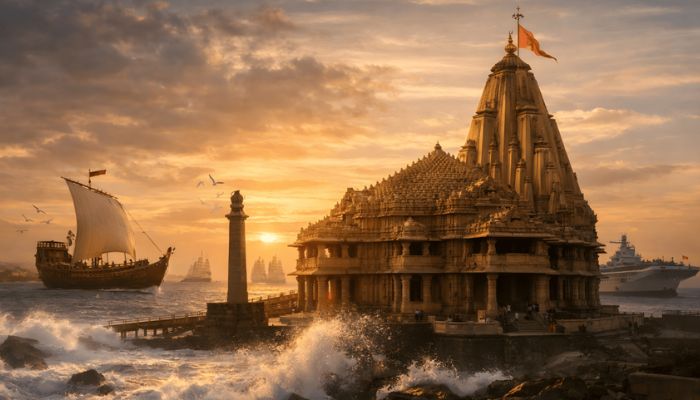
For ancient India, the sea was not separate from the land. Those who knew the sea could protect the land, grow wealth, and connect civilisations. The strongest symbol of this knowledge was the Somnath Temple, a place remembered today mainly for its destruction, but once known as the gateway to India’s maritime world.
Somnath is often spoken about as a single tragic episode: Mahmud of Ghazni came, the temple was destroyed, and history moved on. This view misses the larger picture. The attack on Somnath was not an isolated act. It marked the beginning of a long and carefully unfolding process that weakened India’s control over the seas.
If Somnath is not seen together with Kutch, Bharuch, Surat, the Konkan coast, and finally Goa, the deeper pattern of India’s maritime decline remains hidden.
India before the 11th Century: A Civilisation of the Oceans
Before the eleventh century, India was not only a land-based society. It was a strong maritime civilisation without colonies or overseas empires. Indian traders, sailors, monks, and pilgrims moved freely across the Arabian Sea and the wider Indian Ocean. They traded, taught, learned, and settled peacefully without fear.
This reality is recorded in the Greek text “Periplus of the Erythraean Sea”, written in the first century, which clearly describes Indian trade routes reaching Oman, Yemen, Basra, and the eastern coast of Africa. These were not small or occasional journeys. They formed a regular and trusted network connecting ports, cultures, and economies.
India’s relationship with the sea was not built on conquest but on confidence and knowledge. Navigation, astronomy, shipbuilding, and seasonal winds were well understood. This maritime wisdom did not vanish; it survived quietly in traditions, coastal communities, and temple records.
A living memory: The voyage of INSV Koundinya
This heritage is not only preserved in history books. It has been brought back to life in recent times. Economist and policy advisor Sanjeev Sanyal, who serves as an economic advisor to Prime Minister Narendra Modi, is currently undertaking a sea voyage aboard the INSV Koundinya.
This ship is not a modern steel vessel. It has been built using the same method that Indian merchants used a thousand years ago. There is not a single iron nail in it. Coconut ropes stitch the wooden planks together, just as they once did when Indian ships sailed confidently across the Indian Ocean. The voyage began in Gujarat and covers nearly 1,400 kilometres to Oman, following ancient trade routes.
The mission of the Indian Navy is not symbolic alone. It demonstrates that India’s maritime systems were practical, durable, and globally connected long before modern navies came into being.
Temples as economic powerhouses
One of the most misunderstood aspects of India’s maritime past is the role of temples. Between the tenth and twelfth centuries, especially during the Chola and Solanki periods, temples were not only religious centres. They functioned as financial, legal, and social institutions.
Kings, traders, and common people donated wealth to temples. This wealth was not locked away. Temples acted like banks. They lent money at interest to merchant guilds, helping them fund risky overseas journeys to Sumatra, Java, Zanzibar, and East Africa. Sea trade involved dangers like storms, piracy, and shipwrecks, risks that individual traders could not bear alone. Temple treasuries could absorb losses, making long-distance trade possible.
When voyages succeeded, merchants returned a share of their profits to the temple. In this way, religion, economy, and maritime trade formed a strong and balanced system.
Guilds, Ships, and the central role of Somnath
Indian maritime trade was organised through powerful guilds such as the Manigramam and the Ainnuruvar, also known as the Five Hundred Lords. These guilds maintained their own security forces and fleets to protect ships from pirates. They operated by rules, contracts, and shared responsibility.
In western India, Somnath stood at the heart of this system. The port of Prabhas Patan had been active since Harappan times. Trade from the Roman world, West Asia, and Africa passed through this coast. The route from Dwarka to Somnath and Khambhat was not just a trade corridor. It was also a path of pilgrimage, culture, and social exchange.
Somnath was therefore more than a shrine of Lord Shiva. It was a legal authority, a financial hub, and a cultural anchor for India’s maritime civilisation.
Ghazni’s strike and the breaking of a network
After the seventh century, Arab and Persian traders became active in the Indian Ocean. They formed trading groups such as the Anjuvannam, based around mosques and markets. Over time, these networks grew faster than the temple-based Hindu system.
When Mahmud of Ghazni attacked Somnath in the eleventh century, the aim was not simply religious destruction. The plunder of wealth, said to be worth around 20 million dinars, struck at the financial backbone of the maritime system. No mosque was built on the site because the purpose was not conversion. Destroying the Shivalinga symbolised the destruction of a legal and economic institution.
For Islamic empires, trade was a tool of power. When they saw that India’s maritime system could not be easily controlled or conquered, they focused on breaking its centres instead. Somnath was the first major and symbolic target.
Losing the Sea, One coast at a time
The fall of Somnath damaged more than a temple. It shook India’s maritime confidence. Slowly, ocean crossings began to be discouraged, later becoming known socially as “kala pani.” What began as a strategic defeat slowly turned into a social habit.
This decline was not uniform across India. While Ghazni attacked in the west, Rajendra Chola was leading powerful naval campaigns in the east, reaching Sri Lanka, Sumatra, and Southeast Asia. Gujarat’s rulers also valued the sea for defence and trade. As a result, India’s maritime civilisation did not collapse overnight. It was weakened piece by piece.
The Ban Stambh, or arrow pillar, at Somnath still stands as evidence of ancient Indian knowledge of astronomy and geography. It states that there is no land obstruction from that point to the South Pole, a claim later confirmed by modern science.
From sultanates to the Mughals: A land-based turn
After Somnath, pressure increased along the western coast. Bharuch, Konkan, and Saurashtra gradually fell under new powers. The Delhi Sultanate and later the Mughal Empire were largely land-focused. Their strength lay in agriculture, forts, and armies, not navies.
Even during the Mughal period, rulers depended on foreign sailors to protect pilgrim ships going for Hajj. The sea was not seen as a space of power. This distance from the ocean slowly disconnected India from its maritime roots.
By the time Vasco da Gama reached India in 1498, the once-busy Indian seas were largely empty of Indian fleets. European powers came not just to trade, but to dominate. By the sixteenth century, Hindu-led maritime networks had been nearly wiped out.
Somnath rebuilt and memory revived
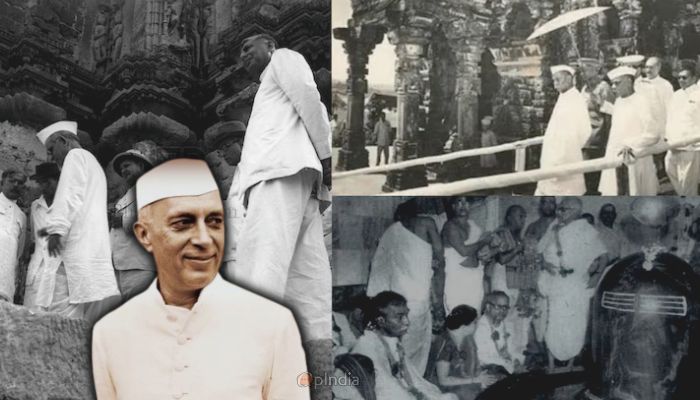
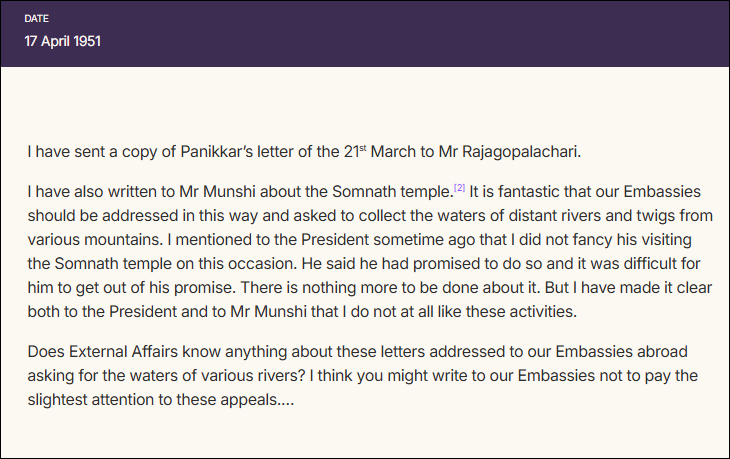
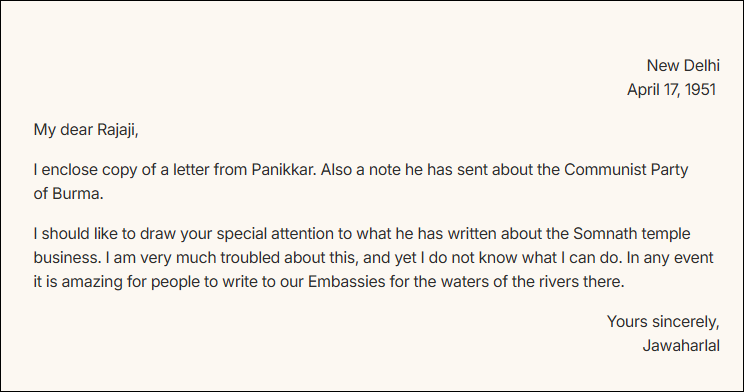
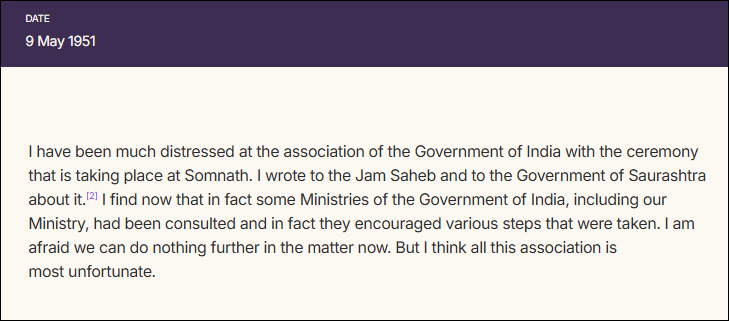
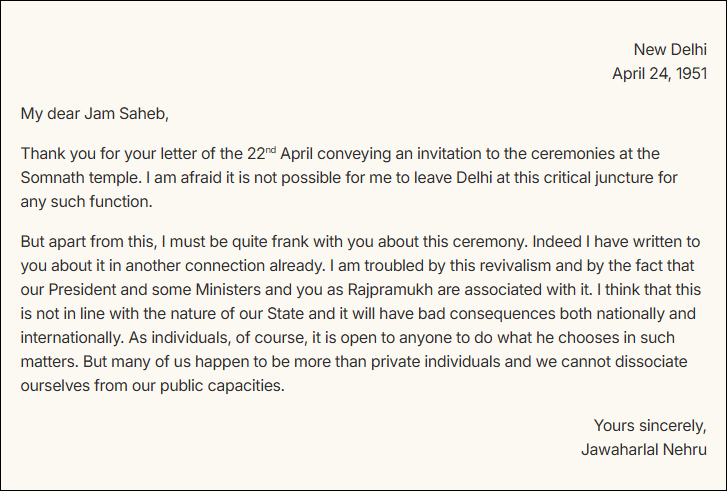
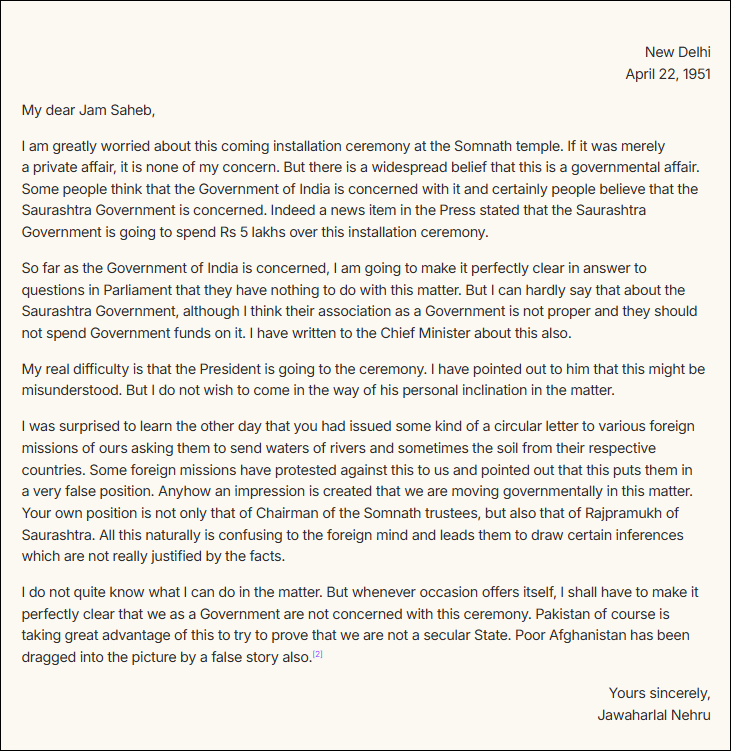
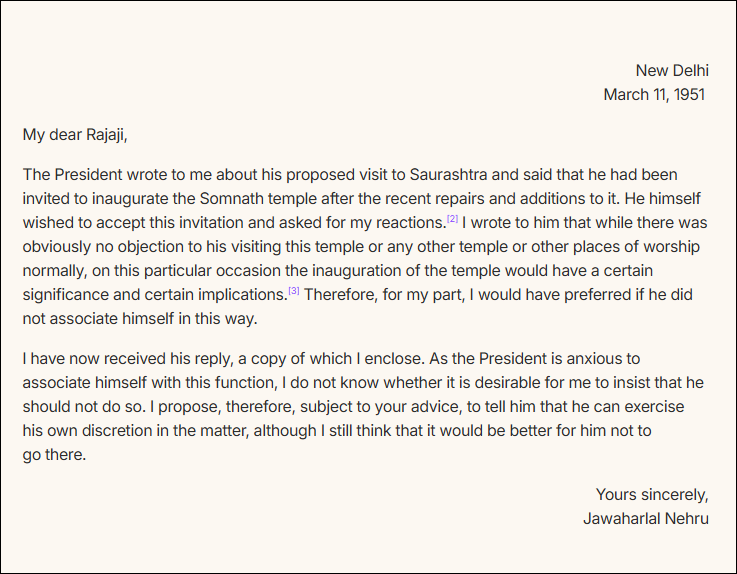
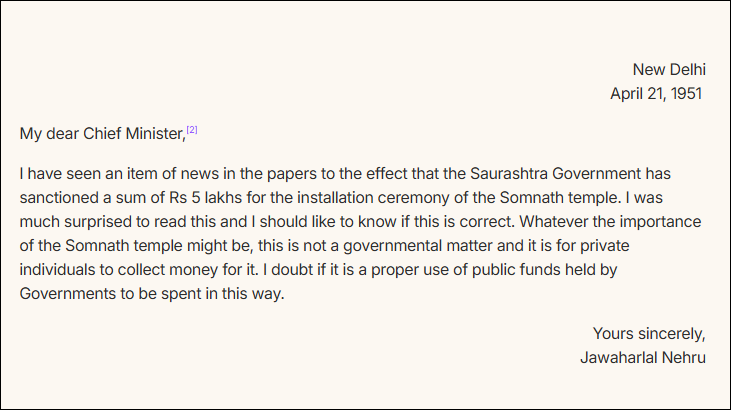
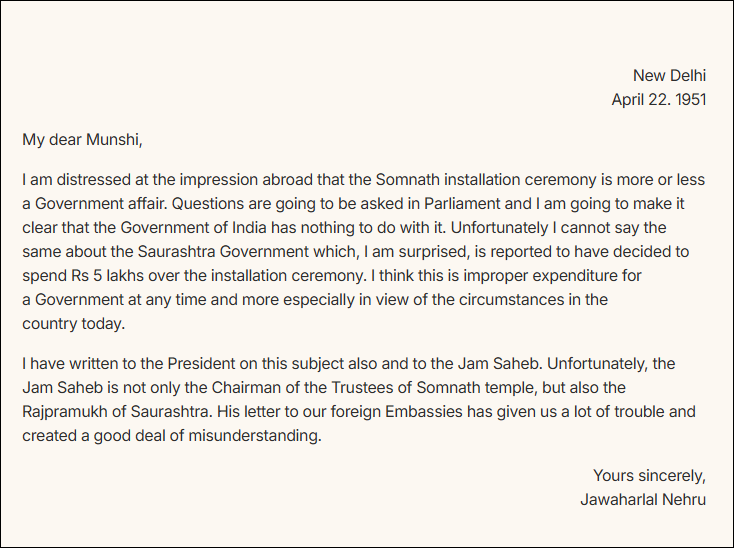
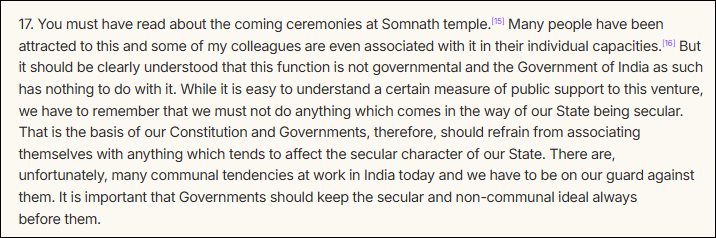
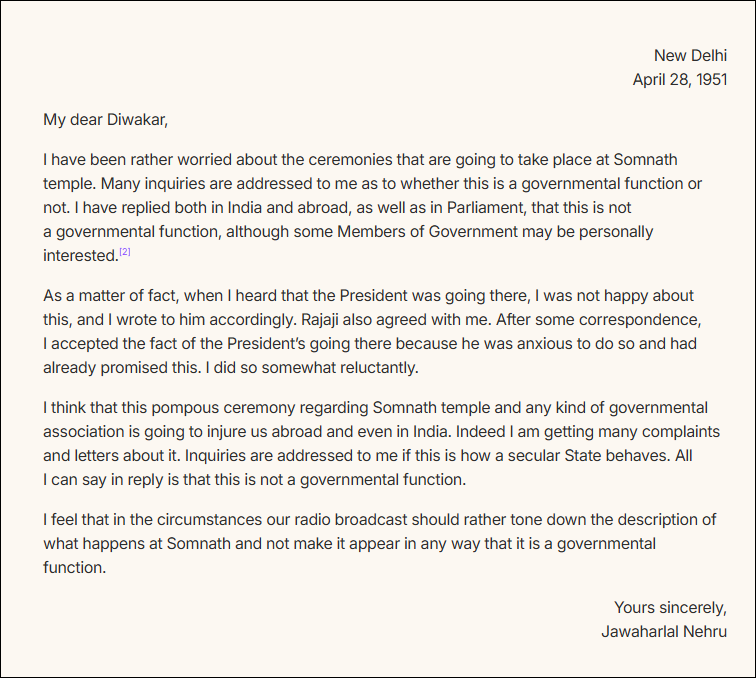
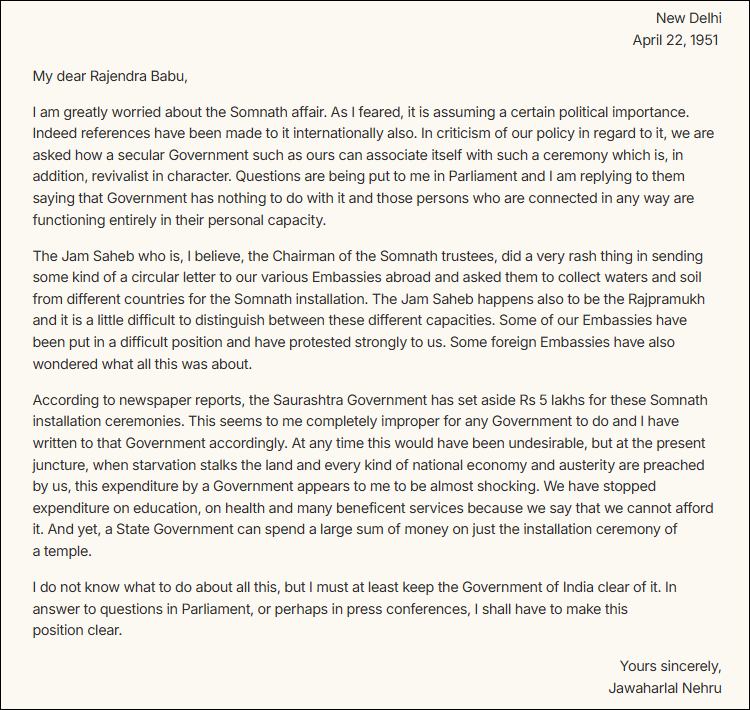
The reconstruction of Somnath in 1951 was more than an architectural project. It was an attempt to restore a civilisational memory. Sardar Vallabhbhai Patel saw it as the return of national confidence, while Jawaharlal Nehru feared its political meaning.
Yet the rebuilding signalled that India’s connection to the sea, though weakened, was never erased. As Al-Biruni once observed, kingdoms may fall, but memories endure.
India and the Indo-Pacific: An unfinished journey
India’s growing role in the Indo-Pacific today is not a sudden shift. It is the continuation of a journey paused centuries ago. While many see the Indo-Pacific only through global power rivalry, for India, it is a familiar space of old trade routes and cultural ties.
India’s naval partnerships, participation in QUAD, and investments in naval strength are part of this return. When Prime Minister Narendra Modi spoke at the Shangri-La Dialogue in 2018, he described a free, open, and inclusive Indo-Pacific, echoing India’s ancient maritime values.
India’s approach is not about domination but balance. It recalls a time when the sea was a space of rules, trust, and shared prosperity.
Somnath marked the moment India began to drift away from the sea. Today, India’s return to the Indo-Pacific marks the revival of a forgotten habit of civilisation. What is coming back is not just naval power, but memory, confidence, and continuity.
The civilisation that once shaped the Indian Ocean cannot remain on the shore forever. From Somnath to the Indo-Pacific, India is slowly completing a story that was left unfinished for nearly a thousand years.
India and Germany are set to ratify one of the most consequential defence-industrial agreements in India’s naval history, with German shipbuilder Thyssen Krupp Marine Systems (TKMS) set to partner Mazagon Dock Shipbuilders Limited (MDL) for the construction of six advanced conventional submarines for the Indian Navy. The deal is expected to be finalised during German Chancellor Friedrich Merz’s visit to India on January 12–13, 2026.
Valued at around $8 billion (Rs 72,000 crore), the deal marks the decisive conclusion of the long-running Project-75I Tender, a programme that had remained stalled for years due to shifting policy frameworks, technical demands, and India’s insistence on proven and survivable submarine technology.
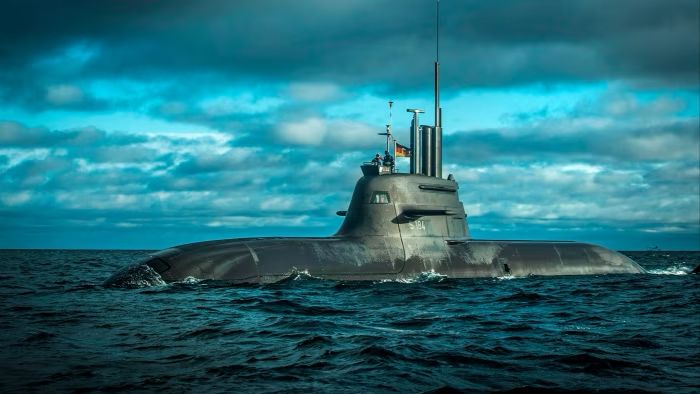
At the centre of the agreement is the Indian Navy’s selection of the German Type-214 Next Generation (214NG)submarine, a 2,500-ton diesel-electric platform equipped with air-independent propulsion (AIP). The German design edged out Spain’s S-80 Plus, offered by Navantia, primarily due to its operationally validated AIP system, superior acoustic stealth, and lower lifecycle risk. For a navy that operates in contested waters and depends on undersea persistence rather than surface visibility, the maturity of the German platform proved decisive.
Why AIP and stealth tipped the scales
AIP technology has become a baseline requirement for modern conventional submarines. Traditional diesel-electric boats must periodically surface or snorkel to recharge batteries, exposing themselves to detection. AIP-equipped submarines, by contrast, can remain submerged for weeks, allowing them to conduct extended patrols, surveillance, and strike missions with minimal acoustic and electromagnetic signature.
The Type-214NG employs a fuel-cell-based AIP system, widely regarded as one of the most reliable and battle-tested solutions in service today. Spain’s bio-ethanol-based AIP, while innovative, has not yet achieved comparable operational validation. In undersea warfare, where failure is not an option, the Indian Navy opted for technology that has already proven itself in real-world naval environments.
Karachi 1971: The moment India understood naval power
India’s insistence on stealth, endurance, and survivability is rooted in hard historical experience. During the 1971 India-Pakistan war, the Indian Navy executed Operation Trident and Operation Python, devastating Karachi Port, Pakistan’s primary maritime hub. The strikes crippled Pakistan’s naval logistics and fuel infrastructure to such an extent that sustained naval operations became impossible.
That attack was not merely tactical; it was strategic. It hastened Pakistan’s defeat and played a critical role in the war’s outcome, culminating in the creation of Bangladesh. For the first time, India’s political and military leadership fully grasped that control of the seas could decisively shape conflicts on land.
Yet, despite this lesson, India’s submarine modernisation moved slowly in the decades that followed. Procurement delays, technological dependence, and policy inertia left the Navy with an ageing underwater fleet even as regional threats evolved. Project-75I, therefore, is not just a procurement programme; it is the long-overdue institutional response to lessons learnt in 1971.
Operation Sindoor and the return of Karachi as a strategic pressure point
The relevance of this lesson resurfaced dramatically during Operation Sindoor in May 2025, when hostilities between India and Pakistan escalated following a major terror provocation. Between May 8 and May 11, the Indian Navy was placed on heightened operational readiness, with credible reports indicating that India was prepared to strike Pakistan’s financial and logistical nerve centre, Karachi Port, once again if escalation continued.
Karachi remains the backbone of Pakistan’s economy, handling the overwhelming majority of its maritime trade, energy imports, and financial flows. The very fact that the Indian Navy could credibly threaten a repeat of 1971, this time with far more advanced maritime surveillance, missile platforms, and undersea assets, underscored how naval power functions as strategic leverage even without shots being fired. Operation Sindoor reinforced a hard truth: Pakistan’s greatest vulnerability lies at sea, and India’s ability to exploit that vulnerability depends heavily on undersea dominance.
In this context, the India–Germany submarine deal assumes far greater significance. It is not a peacetime modernisation exercise but a capability upgrade shaped by recent, real-world hostilities. Once, the Indian Navy is equipped with new-age submarine, it’s capability to strike Karachi will be further enhanced, reinforcing deterrence through credible, survivable, and persistent undersea strike capability.
Make in India at the core of Project-75I
A defining feature of the India–Germany agreement is that all six submarines will be built in India, with MDL acting as the primary construction agency. TKMS will provide design authority, engineering expertise, consultancy, and critical technologies, ensuring that India acquires not just platforms but deep technical competence.
The programme is expected to begin with approximately 45% indigenous content, rising to nearly 60% by the final submarine. This phased indigenisation directly aligns with India’s Atmanirbhar Bharat objectives and addresses a long-standing weakness in defence procurement—dependence on foreign OEMs for upgrades, spares, and lifecycle support.
The framework for this collaboration was established in June last year, when TKMS and MDL signed a memorandum of understanding to jointly pursue Project-75I. MDL’s experience with the Scorpène-class submarines under the earlier Project-75 has positioned it as India’s most capable submarine-building shipyard, making it a natural partner for the programme.
Strategic timing and geopolitical relevance
According to sources familiar with the negotiations, the final contract could be concluded within the next three months, with momentum expected during German Chancellor Friedrich Merz’s visit to India on January 12–13. The timing is geopolitically significant. Germany is seeking a larger strategic footprint in the Indo-Pacific, while India is consciously diversifying its defence partnerships beyond legacy suppliers.
For New Delhi, the deal comes amid growing undersea challenges. China’s rapidly expanding submarine fleet, including nuclear-powered platforms, is increasingly active in the Indian Ocean. Chinese submarines have docked in regional ports and conducted patrols close to Indian waters. Meanwhile, Pakistan, with Chinese assistance, is also upgrading its submarine capabilities.
In this environment, India’s ageing conventional submarines represent a strategic vulnerability. Project-75I addresses that gap by restoring undersea deterrence and enhancing India’s ability to monitor, deter, and if necessary, deny adversaries freedom of movement in critical maritime corridors.
Long-term impact on India’s naval posture
Once inducted, the six Type-214NG submarines will significantly enhance the Indian Navy’s capacity for covert surveillance, sea denial, and precision strike operations. Equipped with advanced sensors, torpedoes, and missile launch capabilities, these platforms will form a critical layer of India’s maritime deterrence architecture.
Equally important is the industrial legacy of the programme. By absorbing advanced submarine design and construction technologies, India positions itself for future indigenous submarine projects and follow-on orders. The programme strengthens MDL’s role as a strategic asset and helps create a specialised supply chain capable of sustaining India’s long-term naval ambitions.
A quiet but decisive milestone
When finalised, the India–Germany Project-75I agreement will rank among the most consequential naval procurement decisions in India’s recent history. It strengthens underwater combat capability, advances genuine indigenisation in one of the most complex domains of warfare, and elevates Germany as a key long-term defence-industrial partner.
From the burning docks of Karachi in 1971 to the silent depths of the Indian Ocean in 2026, India’s naval journey has come full circle. Project-75I signals that the lessons of history have finally been institutionalised—not through rhetoric, but through capability, technology, and strategic foresight.
Many brave men have nurtured India’s soil with their blood and contributed to its prosperity and glory. Millions of young Hindu warriors sacrificed their lives to protect the Sanatan Dharma and the Sanatan heritage. It is because of such young warriors that the Sanatan legacy lived on. One such young warrior was Veer Hamirji Gohil (Hamirsinhji Gohil), who made the supreme sacrifice in a religious battle, giving up his life to protect Somnath Mahadev. Leftist historians have always ignored Hindu warriors and attempted to erase them from history, and Veer Hamirji Gohil was no exception.
The history of Veer Hamirji Gohil is sparsely documented in the history of 14th-century Gujarat. He finds mention in some independent Hindu texts. Veer Hamirji is still remembered in the Kathiawar region through folk tales. Hamirji Gohil and some of his companions fought against the Islamic invaders to protect the Somnath temple. Let’s take a look at his complete history.
Who was Hamirji Gohil?
Chapter 9 of the Kathiawar Sarvasangraha mentions that in 1391 AD, Zafar Khan bin-Wazir-ul-Mulk was the governor of Gujarat, and it was during this time that Somnath was attacked. Furthermore, the Gujarat Sarvasangraha also contains an account of Zafar Khan’s invasion of Somnath. Poet Kalapi’s work, ‘Hamirkavya’, also mentions this event. More recently, books such as ‘Gohil Veer Hamirji’ (Dhirsinh Gohil), published in 1921, and ‘Somnath and Hamirji Gohil’ (Jaymall Parmar) provide impartial historical accounts. Based on the references in all these books, we have attempted to understand the history of Hamirji Gohil.
Hamirsinhji Gohil was the ruler of the Arthila state, located in the Amreli region of the Saurashtra (Kathiawar) district of Gujarat state. Bhimji Gohil of Arthila had three sons: Dudaji, Arjanji, and Hamirji. Dudaji ascended the thrones of Arthila and Lathi, Arjanji ruled over 11 villages of Gadhali, and the youngest son, Hamirji, ruled Samadhiyala. Notably, Hamirji Gohil was an ancestor of Sursinhji Takhtsinhji Gohil, who was famous as the poet ‘Kalapi’. In 1398 AD, Hamirji was on the throne of Samadhiyala, and it was during this time that Zafar Khan attacked Somnath.
Arjanji and Hamirji Gohil shared a deep, affectionate bond. However, one day, a quarrel erupted between the two brothers over a rooster fight, and in a fit of rage, Arjanji banished his younger brother Hamir from their home. Following this incident, Hamirji left Gohilwad and went to Marwar, where he lived with his brave Rajput friends, who empathised with him.
Zafar Khan’s Attack on the Somnath Temple
The history of the attack on the Somnath Temple is also found in the 14th-century Islamic Persian historical accounts (Mirat-i-Sikandari). At that time, the Tughlaq dynasty ruled Delhi under Muhammad Tughlaq II. After the defeat of his governor, Shamsuddin, in Junagadh, Zafar Khan was appointed as the governor of Gujarat. Over time, he became the independent ruler of Gujarat. He established his centre in Somnath. He was a staunch opponent of idol worship, and his gaze fell upon Somnath, a place of immense religious significance for millions of Hindus.
Zafar appointed a Muslim named Rasul Khan as the police chief of Junagadh. Shortly afterwards, Zafar ordered that ‘idolaters’ (Hindus) should not be allowed to gather in Somnath. At that time, the Shivaratri fair was being held in Somnath. Rasul and his men began a massacre and ordered the extermination of the Hindus. In response to this incident, the local Hindus killed Rasul Khan. When Zafar Khan came to know about this, he became enraged and marched to quell the unrest in Sorath. Zafar Khan issued a decree to attack Somnath and set out towards it. He departed with Muslim soldiers from the Kabuli, Makrani, Afghani, and Pathan communities to wreak havoc on Somnath.
Meanwhile, Arjanji Gohil became very distressed and ordered a search for Hamirji at Mansura fort. Hamirji had gone to Garhvi in Marwar and was informed about Arjanji’s condition. Hamirji became concerned and returned to his brother in Arthila and started living there.
“Have the Rajput women died? Will the Rajput army attack Mahadev in front of them?”
One day, after strolling in the forest with friends like Chhatrapal Sarvaiya, Patalji Bhati, Sanghdevji Solanki, and Nanji Maharaj, a Brahmin from Sihor, Hamirji returned home and started eating hurriedly. Dudaji’s wife, Hamirji’s sister-in-law, said to him, “Why are you in such a hurry? Do you want to climb Somaiya Mountain (the local name for Somnath) immediately?” Hearing this, Hamirji asked, “Sister-in-law, is Somaiya in danger?” His sister-in-law replied, “The army has come to demolish the Somaiya temple, and the Governor of Gujarat’s army is advancing towards Somnath.”
Upon hearing his sister-in-law’s words, Hamirji immediately stood up without finishing his food and said, “What are you uttering? Is there no Rajput who will go and die for Somnath? Will the army of the Mlecchas (Muslims) attack Somaiya (the local name for Somnath) while there are still Kshatriyas around? Has Rajput valour died?” With these questions, Hamirji stood up in anguish. His sister-in-law said to him, “There is no shortage of Rajputs in Kathiawar; they are countless, but no true hero seems willing to come forward to defend Somnath. This is not some ordinary hunting game; this is about having the courage to face a powerful army in defence of Mahadev. And if you are so troubled, then you yourself should take up arms, brother-in-law. You are also a Rajput, aren’t you?”
Hamirji’s sister-in-law spoke her mind frankly, but Hamirji’s pride was deeply wounded. Hamirji said to his sister-in-law, “Please convey my Jajera Johar to both my brothers. Whether anyone accompanies me or not, I will go to the Somnath temple.” His sister-in-law tried to dissuade him, but Hamirji remained resolute. Hamirji set out for Somnath with around 200 warriors. At a time when the people were gripped by fear of Zafar Khan and the kingdom was plagued by internal strife, Hamirji embarked on his journey to the Somnath temple alone.
Phase A: Gifts on the way and a marriage at Dronagadha
Hamirji was travelling on the road to Somnath when he came across a Nesada, a settlement of Maldharis such as Bharwads and Ahirs. At midnight, he heard an elderly woman singing a Marsiya (a folk song sung at someone’s death). Hamirji went to her and asked, “Whose Marsiya are you singing?” The elderly woman replied that her son had recently died, so she was singing his Marsiya. Hamirji insisted, “Will you sing my Marsiya? I want to hear it.” The woman shockingly replied, “What did you say? How can I absolve myself of sin by singing your Marsiya while you are still alive?” Hamirji said, “We are on the path of death. We have set out for Somaiya to protect Somnath. We will not return from there.” The elderly woman blessed Hamirji and said, “Get married on the way, for a warrior should not step onto the battlefield unmarried. Saying this, the elderly woman started walking towards Somnath and told Hamirji, “I will go to Somnath and wait for you.”
From there onward lay the expanse of Dronagadhda, spread across the Gir region, where Vegdaji, a Bhil Chiefain, held great influence and authority. All the Bhils considered Somnath their revered deity. Vegda Bhil had a daughter named Rajbai. Once, a Jethwa Rajput was going on a pilgrimage to Tulsishyam, and a war broke out between the Bhils and the Jethwas. The Jethwa Rajput died, but before dying, he entrusted his young daughter to Vegdaji. The Jethwa Rajput took a promise from Vegdaji that he would raise his daughter and marry her to a Rajput warrior.
The elderly woman reached Vegda Bhil’s place and said, “Hamirji Gohil is on his way to the Somnath temple; arrange your daughter’s marriage with him. He is a brave Rajput from Gohilwad.” Some time later, Hamirji arrived in that area and, by chance, met Vegda Bhil. At Vegda’s insistence, Hamirji stayed in his hut for two days. Afterwards, Vegdaji arranged the marriage of Hamirji and his daughter. Thus, Hamirji’s marriage took place en route to the Somnath temple.
The Rajputs sacrificed their lives to defend Somnath
The very next day after his wedding, Hamirji set off for Somnath. Vegdaji and other Bhils were with him. He had also gathered young men from other castes, including Rajput, Kathi, Rabari, Bharwad, Ahir, and Mer. This small band of warriors finally reached Somnath. Hamirji, Vegdaji, the priests, and the residents of Prabhas Nagar, along with some Rajputs, were patiently waiting for Zafar Khan in the temple courtyard. Zafar Khan had heard that some Hindu warriors would confront him, but he was not worried. Zafar Khan reached the foothills of Prabhas Mountain. At that moment, Vegdaji’s Bhil soldiers greeted Zafar Khan with arrows, and the Muslim army cried out in distress.
On one side was the religious fanaticism to destroy the temple of Lord Shiva, and on the other lay the fierce desire to protect Somaiya. Zafar advanced his cannons, but the Bhil soldiers, employing guerrilla warfare tactics, broke the morale of the Muslim army. Soon, the number of Bhil soldiers started dwindling, and Vegdaji was also martyred. The battle lasted for nine days. By then, only a few warriors remained with Hamirji. As the battle was nearing its end, Hamirji performed the Somnath Aarti early in the morning. Red Gulal showered on the warriors who had come to bid farewell to death in the courtyard. The elderly woman (bard) was also in the temple. Hamirji requested her to sing a Marsiya. For an hour, the courtyard echoed with the sound of the Marsiya. Sitting on the shore, turning her prayer beads, the elderly woman said, “O brave one, you are blessed, for you have preserved the water of that heroic manhood of Kathiawar which was destined to die.” She sang the Marsiya–
The battle began with the Marsiya. On one side were Hamirji Gohil’s warriors, and on the other, Zafar Khan’s Islamic soldiers. The remaining Hindu warriors fought in the temple courtyard to protect the Shiva Lingam. Hamirji’s entire army was annihilated, but being a Rajput, he single-handedly charged into the Islamic army. His entire body was mutilated. As Zafar struck Hamirji Gohil with full force, his head was severed from his body and fell onto the Shiva Lingam of Somnath. It is said that despite a severed head, Hamirji’s body continued to fight till the destruction of the Islamic army. The Islamic army was annihilated on the battlefield, and in the end, victory belonged to Hindu pride. Hamirji himself had attained martyrdom, but his vow to protect Somnath had been fulfilled as the remaining Islamic army fled.
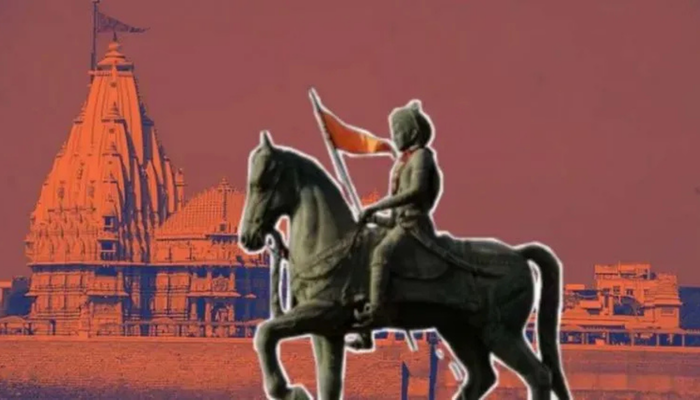
The incident shows how a lone Kathiawar Rajput, along with a few devoted warriors, offered his life at Somnath when the valour of Saurashtra faltered. Today, outside the Somnath temple stands the temple of Vegdaji, and within the temple complex, directly opposite the Shiva Lingam, is the statue of Hamirji Gohil. To express their gratitude, the devotees of Somnath established a tradition according to which the saffron flag of the Somnath temple is first taken to Hamirji’s statue before being hoisted to the temple’s pinnacle. This tradition continues to this day.
The story of valorous Hamirji Gohil, who sacrificed his life before the Shiva Lingam of Somnath, was not a figment of imagination or a fiction, but a historical truth. Hamirji was a man who dared to lay down his life for his faith. When kingdoms were engrossed in their own self-interest, when power had become inert, and when people silently endured everything out of fear, a young Rajput, along with a few warriors, stood up to defy death at the feet of Somnath. The sacrifice of Hamirji Gohil often conveys the message that history is not written by those in power, but by the blood of heroes who remain unwavering even in the face of death for the sake of their faith. The Somnath Temple, as it stands today, is not merely a pile of stones, but a witness to the sacrifices made by heroes like Hamirji before the Shiva Lingam.
(This article is a translation of the original article published on OpIndia Gujarati.)
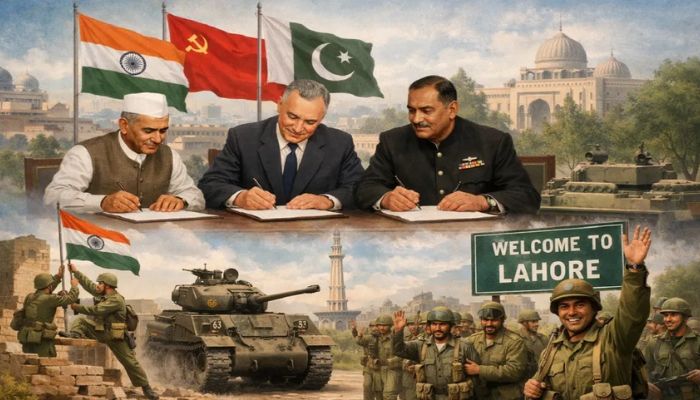
10th January, 1966, is a dark chapter in Indian history that still haunts us. On this day, an agreement was reached between India and Pakistan in Tashkent, known as the Tashkent Agreement. Under this agreement, the territories our brave soldiers had won in the 1965 war, risking their lives and shedding enemy blood, were simply returned at the negotiating table.
Imagine if the Tashkent Agreement hadn’t been reached, the city of Lahore would be part of India, not Pakistan. Our map would have looked so different and stronger. But that didn’t happen, and the then Congress government’s weak and pressure-stricken foreign policy was responsible for this. This single decision caused centuries of damage to the country, a price we still pay today.
Infiltration in Kashmir, terrorist incidents, attacks like Pulwama… all stem from that mistake. In this report, we will examine the entire story of that period in detail, so that lessons can be learned from history and such mistakes can be prevented from happening again.
Pakistan was badly defeated by India in 1965
The 1965 Indo-Pak War was primarily triggered by the Kashmir issue. Pakistan’s then-President, Ayub Khan, devised an ambitious plan, dubbed “Operation Gibraltar.” Under this operation, Pakistan sent thousands of infiltrators and soldiers into Jammu and Kashmir to incite locals to revolt and seize Kashmir. Ayub Khan was so arrogant that he declared that he would capture Delhi and have “dinner in Delhi.” However, the Indian Army shattered his dream.
Our soldiers not only apprehended the intruders but also retaliated against Pakistan. India’s Prime Minister at the time was Lal Bahadur Shastri, a simple but strong-willed leader. He told his soldiers, “We’ll have breakfast in Lahore tomorrow.”
This was not just a slogan, but a symbol of the courage of the Indian Army. And indeed, it would prove to be quite true during the war, as our soldiers reached the borders of Lahore. This war demonstrated how prepared and brave the Indian Army was, but political decisions changed everything.
Indian troops overwhelm from Kashmir to Kutch, enter Lahore sector as well
The war was fought on multiple fronts, and the Indian Army prevailed everywhere. In the Lahore sector, Indian troops destroyed Pakistani defence lines. We reached the Ichhogil Canal, considered the last line of defence for the city of Lahore. A further advance would have led to the capture of Lahore. Similarly, India captured strategically important areas like the Haji Pir Pass in Kashmir, a significant blow to Pakistan, as this pass controlled the infiltration route.
The Pakistani army was facing a crushing defeat. Thousands of its soldiers were killed, its most modern Patton tanks were destroyed, and its aircraft were shot down. India had clearly gained the upper hand. Pakistan suffered so many losses during the war that it was left with no fighting strength. Internationally, India was hailed as the victor, having not only defended itself but also entered enemy territory. But alas, this victory hung in the balance.
Stories of the bravery of Indian soldiers are still told today and fill us with pride. Consider, for example, the Battle of Asal Uttar. There, Pakistan’s most advanced Patton tanks were destroyed by the Indian Army. Our Sherman tanks overpowered them, demonstrating that courage is greater than weapons.
Officers like Major Bhupinder Singh sacrificed their lives in this battle, but they pushed the enemy back. Similarly, in the Chamb sector, our troops repelled Pakistani attacks and captured it. Pakistan suffered heavy losses, with over 4,000 soldiers killed, while India lost approximately 3,000 soldiers.
Over 200 Pakistani tanks were destroyed, while ours were only 80. In the air battle, the Indian Air Force shot down several Pakistani F-86 Sabre jets. The international media was also talking about India’s victory. But this is where the story changed, as political interference took hold, shifting the outcome of the war from the battlefield to the table.
The world was divided during the Cold War; talks were held at the invitation of the Soviet Union.
It was the era of the Cold War, when the world was divided into two camps: the United States on one side and the Soviet Union on the other. Both superpowers wanted to prevent an Indo-Pak war, which was spreading instability in Asia. The United States had supplied weapons to Pakistan, but when the war broke out, it halted arms supplies to both countries. The Soviet Union initiated mediation. Soviet Prime Minister Alexei Kosygin summoned India and Pakistan to Tashkent.
Our Prime Minister, Lal Bahadur Shastri, accepted the invitation and went to Tashkent. Pakistan was represented by Ayub Khan. Negotiations began, and pressure mounted. The Soviet Union wanted peace because it considered India an ally, but it also didn’t want to lose Pakistan. The United States was also exerting pressure from behind. This pressure on Shastri ji became so intense that, despite his strong position, he was forced to yield.
The government buckled under international pressure, and Nehru had initiated it
The Congress government came under international pressure, and this proved to be its biggest weakness. The United States had imposed an arms embargo, which was particularly damaging to Pakistan, which was dependent on American weapons, but India was also affected to some extent. The Soviet Union wanted peace and persuaded Shastri that continuing the war would be disastrous for both countries.
Shastriji was a strong leader, but the weak diplomacy of the Congress Party and its bureaucracy left him isolated. Party leaders and advisors buckled under pressure, as Congress’s long-standing policy was to yield to international pressure to secure peace. This trend had been ongoing since Nehru’s time, when he had even come close to victory in the 1948 war, taking the matter to the United Nations, thus giving Pakistan an advantage. Shastriji was under so much pressure that he agreed to a compromise, even though victory was ours on the battlefield.
We handed over our conquered territories to the enemy.
The Tashkent Declaration was signed on 10th January, 1966, and this day proved to be a tragic turning point for India. The key points of the agreement were that both countries would vacate all territories occupied during the war and restore the status quo ante bellum, as it existed before 5th August, 1965. Furthermore, both countries would resolve their disputes peacefully and refrain from using force. Diplomatic relations would be normalised, trade and communication channels would be opened. There would be no interference in each other’s internal affairs, and prisoners of war would be treated humanely.
All this sounds good, like a major step towards peace, but in reality, India completely squandered its strategic advantage. We returned the Lahore sector, Sialkot, and key areas of Kashmir, while Pakistan gave up nothing. This agreement was one-sided, proving detrimental to India.
Returning Haji Pir Pass was India’s biggest mistake
Returning the Haji Pir Pass was a grave mistake, and this decision haunts us to this day. This pass was crucial to preventing infiltration into Kashmir, as it controlled the routes from Pakistan into India. Our soldiers had captured it in the war, but it was returned in the agreement. What was the result?
Pakistan later began sending terrorists through this route. The return of areas like Haji Pir was a major reason for the terrorism that spread in Kashmir in the 1980s and 1990s. Similarly, the territories captured in the Lahore sector were also returned. Had we retained these, Pakistan’s defense lines would have been weakened and its claim to Kashmir would have been further weakened. The security of Lahore city would have been affected, and Pakistan would never have been so aggressive. But Congress’s weak policy returned all this, giving Pakistan new strength.
Pakistan took advantage of India’s weakness in foreign policy
This submissive policy of the Congress party has been in place since Nehru’s time and has been the biggest weakness of India’s foreign policy. Even in the 1947-48 Kashmir War, Nehru stopped the war when it was close to victory and took the matter to the United Nations, which benefited Pakistan, and the Kashmir issue remains unresolved to this day. Congress suffered the consequences of its weak preparation and policy in the 1962 China War. The same thing happened in 1965; standing on the brink of victory, Congress surrendered everything. This was a political weakness, as the party buckled under international pressure.
Nehru’s policy of nonviolence and peace was good, but it proved so weak in the face of the enemy that it cost the country dearly. Even strong leaders like Shastri fell victim to this policy. Had the Congress taken a firmer stance, history would have been different.
Ayub Khan became a hero despite losing
India suffered minimal losses in the war, proving how clear our victory was. Over 4,000 Pakistani soldiers were killed, while India lost nearly 3,000. Over 200 Pakistani tanks were destroyed, and their F-86 Sabre jets were shot down. Our soldiers pushed back the enemy in Sialkot, Lahore, and the Rann of Kutch.
But the Tashkent Agreement evened the waters . Pakistan was given a new lease of life, even though it had been defeated. Ayub Khan returned home a hero because he had lost nothing. India proved itself weak by returning the captured territory. This decision was the result of Congress’s weak leadership.
Even today, there is a demand for an inquiry into Shastri’s death.
Shastri’s mysterious death on 11th January, 1966, the day after the agreement, remains a mystery to this day. Officially, it was attributed to a heart attack, but many questions arose. His body turned blue, suggesting poisoning. A postmortem was not conducted, further fueling suspicion. The family suspected poisoning and claimed Shastri was unhappy with the agreement. Some allege a Soviet or Pakistani conspiracy, as the Soviets wanted the agreement and Pakistan benefited from Shastri’s death. This death sparked numerous theories about the agreement, and even today, demands for an investigation persist. Shastri’s death shocked the entire nation.
Shastriji was a strong leader, and his slogan “Jai Jawan Jai Kisan” still resonates today. He rescued the country from a food crisis and boosted the morale of the army during the war. However, the Congress party’s old policies put him under pressure. Had he asked for more time or taken a firmer stance, the outcome might have been different. His death plunged the nation into mourning, and criticism of the agreement increased. People say that Shastriji was unhappy with the agreement and this stress led to his death.
Criticism in both India and Pakistan
The Tashkent Agreement was met with strong criticism in India, and understandably so. People took to the streets, demonstrating. Disillusionment spread even within the military, as no one was willing to return the land the soldiers had won with their blood. Opposition parties accused the Congress of weakness, saying this amounted to treason. This proved that Congress’s foreign policy had always yielded to pressure and failed to protect national interests.
The agreement was also criticised in Pakistan, as it achieved nothing in Kashmir. However, it did regain Indian territory, which was a significant relief. Tashkent allowed Pakistan to spread terrorism. Returning Haji Pir facilitated infiltration, leading to decades of unrest in Kashmir.
India is still suffering the consequences of Congress’s mistakes.
Today, when attacks like Pulwama and Uri occur, we remember Tashkent. If India had those areas, Pakistan would not have been so strong, and terrorism would not have been so deeply rooted. The country continues to suffer from this Congress‘s mistake, with thousands of lives lost. The current government has changed its policy. Operations like the surgical strike and Balakot demonstrate that we no longer bow to pressure. The enemy retaliates. This change was necessary. Strong diplomacy is needed to prevent a mistake like Tashkent.
Had the Tashkent Agreement not been signed, Lahore and Sialkot would have remained part of India.
Had the Tashkent Agreement not been reached, the map would have been different. Cities like Lahore and Sialkot would have belonged to India, and Pakistan would not have become such a significant threat.
Even today, 60 years later, the lesson remains: even after winning a war, one must remain vigilant. Negotiations are good, but compromising on national interests is not. Learning from Congress’s past policies, India is becoming stronger today, and the enemy is being given a befitting reply. This is a painful historical event. The sacrifices of our soldiers deserve respect, not retribution. The Tashkent Agreement reminds us of this and shows us how high the cost of weakness is.
(This article is a translation of the original article published on OpIndia Hindi.)
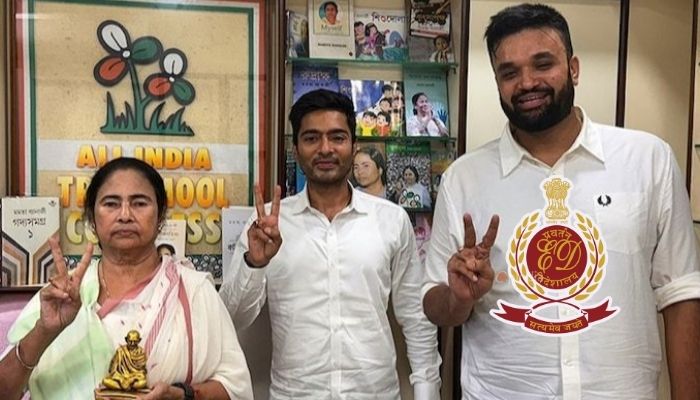
Pratik Jain, the co-founder of the political consultancy firm Indian Political Action Committee or I-PAC, has come under scanner over alleged links to the coal mining scam. On 8th January 2026, the Enforcement Directorate raided at several locations in Kolkata and Bidhannagar.
The ED searched I-PAC’s office located on the 11th floor of a building in Salt Lake, the Loudon Street residence of I-PAC’s head, Pratik Jain, and the office of a trader in the Posta area of Burrabazar, Kolkata.
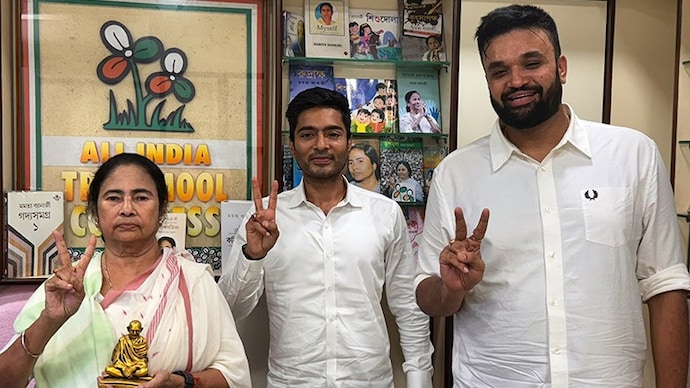
Pratik Jain also heads the IT Cell of the Trinamool Congress (TMC). Due to this, apparently, West Bengal Chief Minister Mamata Banerjee was furious over the ED action against Pratik Jain and caused chaos during the raids.
Banerjee made a surprise visit to the residence of Pratik Jain while the ED conducted searches. “This is most unfortunate. The ED has raided the house and office of our IT wing and its head. They are trying to collect all kinds of information,” Banerjee said. She added that she had spoken to Pratik Jain, whom she described as being in charge of her party’s work.
The I-PAC, the Coal Mine Scam, and TMC’s Goa poll campaign connection
Founded in 2013 by poll strategist-turned-politician Prashant Kishor, I-PAC is a successor to Citizens for Accountable Governance (CAG). The I-PAC is a political consultancy providing campaign strategy, data analytics, and grassroots mobilisation services to various political parties across India. The I-PAC is having close links with the Trinamool Congress since 2019 and delivered a success a decisive victory to the party in 2021 West Bengal state assembly elections.
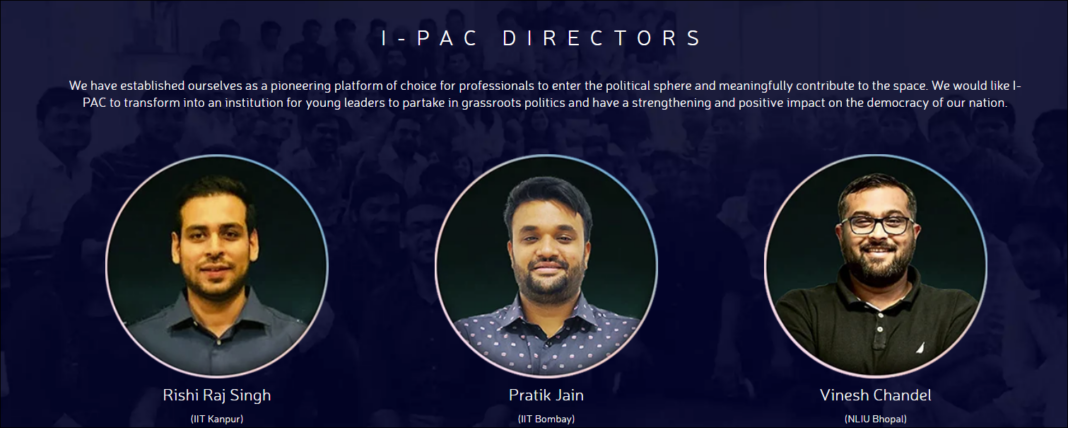
However, after Prashant Kishor’s exit in 2021 and Rishi Raj Singh and Pratik Jain taking over the consultancy’s control as Directors, alongside Vinesh Chandel, I-PAC faced electoral setbacks in Delhi wherein its client Aam Aadmi Party lost election to the Bhartiya Janata Party (BJP) in 2025. Before this, the I-PAC failed to generate momentum for its client YSRCP in Andhra Pradesh where the BJP-Telugu Desam Party alliance emerged victorious in 2024.
Source: I-PAC’s website
Besides, the I-PAC came under scrutiny over alleged financial improprieties, opaque funding, and links to political corruption. The current ED action stems from the evidence, the probe agency says it has about Jain’s connection with some hawala transactions pertaining to a coal mining scam in West Bengal.
“One hawala operator linked to layering of proceeds of crime of coal smuggling had facilitated transactions of tens of crores of rupees to Indian Pac Consulting Private Limited,” the ED said, adding that the raids were a part of investigation under the Prevention of Money Laundering Act (PMLA).
Back in 2020, an FIR was filed in the illegal coal mining scam case. The investigation revealed that coal was being mined and stolen from the lease zone of Eastern Coalfields Limited (ECL) in and around the Paschim Bardhaman district in West Bengal. This was happening in collusion with the railways and CISF officials alongside other relevant department. The probe further traced presence of Hawala operators in the case.
It emerged that the illegally mined and stolen coal was being sold in plants in Bardhaman, Purulia, Bankura, and other districts in West Bengal. The probe revealed that most of the coal was being sold to Shakambhari group of companies. The investigators found that around Rs 2,742.32 crore, including taxes and royalties, was siphoned off via illegal mining from the ECL lease area between December 2017 and October 2020.
The ED probe found that the illegal mining syndicate illegally mined around 25.51 lakh metric tonnes (MT) of coal worth Rs 1,114.35 crore.
A man named Anup Maji was reported to be the mastermind of the coal mining scam. Between the years 2000-2015, around 16 FIRs were registered against Maji.
In 2020, the Central Bureau of Investigation (CBI) registered a fresh case of coal theft and smuggling. It was found that Anup Maji had hired several employees for the maintenance of record of the illegally mined and stolen coal which was sold to various companies. The probe further revealed that one Gurapada Maji transferred Rs 89 crore as proceeds of crimes via Anup Maji’s associates between 2017 and 2020. Meanwhile, another accused person Jayadev Mandal transferred proceeds of crime amounting to Rs 58 crore.
Between January and April 2021, the Enforcement Directorate carried out search and seizure operations at 46 locations linked to the accused persons under Section 17 of the PMLA.
The I-PAC came into the picture here after the ED investigation found that one of the Hawala operators in the coal mining scam had facilitated the transfer of crores of rupees to the I-PAC. Following this, the ED launched searches on the premise linked to I-PAC chief Pratik Jain.
It has alleged that coal scam money from Anup Maji were routed through hawala to IPAC, were used for TMC’s Goa election campaign. Thus, there emerged an alleged direct link between the coal scam funds and TMC’s Goa political financing.
The Enforcement Directorate has alleged that the TMC used “Rs 20 crore proceeds of crime” in Goa between 2021 and 2022. The probe agency mentioned this in a writ petition filed before the Calcutta High Court on 9th January.
The coal mining scam proceeds of crime were routed via a firm R. Kanti Lal in Kolkata and through some other hawala operators before reaching I-PAC and its director Pratik Jain. Once the money reached I-PAC, the ED alleges, it was used for TMC’s poll strategy in Goa in 2022.
Notably, on during the Thursday raids, the ED also searched R. Kanti Lal firm’s office in Kolkata.
The ED said that a WhatsApp conversation between Anup Maji’s accountant Niraj Singh and his associate station Ashok Kumar Mishra who was the former in-charge of Bankura police from 26th August 2020, showed that the firm R. Kanti Lal was used for transfer of proceeds of crime via illegal channels.
Notably, Ashok Kumar Mishra was arrested by the ED in 2021. Mishra is currently out on bail.
“Intelligence was received that around Rs 20 crore of proceeds of crime from Kolkata to Goa was transferred through R. Kanti Lal firm. The employee who handled the hawala transfers at Goa is Sagar Kumar Patel,” the ED said in its petition.
The probe anti-graft agency said that during interrogation, Patel told them about one Akshay Kumar, who admitted that he received cash in Goa through a hawala channel arranged by ASM Event Technology’s proprietor Pankaj Malik.
According to the ED, Akshay Kumar is an employee of event management companies ASM Event Technology, and Hertz and Pixelz.
Furthermore, the ED revealed that Akshay Kumar was questioned twice, on 26th October 2023 and 10th January 2024. During this, Akshay Kumar said that the two event management companies ASM Event Technology, and Hertz and Pixelz, worked for the I-PAC. These companies managed I-PAC’s events during the years 2021 and 2022.
During questioning, Alpesh Patel, an employee at R. Kanti Lal firm confessed that he had arranged Rs 20 crore cash in Goa from Kolkata and that this money was given to Akshay Kumar. It further emerged these funds were arranged at the behest of one Mukesh Patel, the owner of Rajesh Maganlal firm.
The questioning of Mukesh Patel led ED sleuths to one Mukesh Thakkar alias Munna. The ED said that Mukesh Patel arranged the illicit funds at the request of Mukesh Thakkar.
Thakkar revealed that Jitendra Mehta, who ran a non-banking financial company (NBFC) in Kolkata, had aided in transferring the proceeds of crime linked to the coal mining scam.
“Jitender Mehta has assisted in transferring the proceeds of crime through hawala from Kolkata to Goa. He has assisted in transferring Rs 20 crore to Goa to be used by I-PAC in Goa. As per information, Pratik Jain, Co-founder and Director of I-PAC, has handled I-PAC operations in Goa. The funds have been handed over to Akshay Kumar, who is an employee of Hertz and Pixel and ASM Event Technology which have admittedly worked for I-PAC in Goa,” the Enforcement Directorate said in its petition filed before the court.
Who is Pratik Jain?
Notably, Pratik Jain is an engineer-turned-political consultant. He is the co-founder of the I-PAC. Jain did his Bachelor of Technology (B.Tech) from IIT Bombay in 2012. He previously interned at the Axis Mutual Fund. Jain also worked at Deloitte for a brief time period before becoming a founding member of ‘Citizens for Accountable Governance’ NGO.
Importantly, Pratik Jain is the head of the IT Cell of the West Bengal’s ruling party Trinamool Congress. Jain’s I-PAC played a significant role in TMC’s victory in the 2021 state elections.
During Thursday ED raids, Mamata Banerjee’s dramatic arrival at the scene and taking away of some files and a hard disk raised eyebrows with questions being raised if the Chief Minister acted out of fear and desperation to cover up a scandal yet to be fully unearthed.
#WATCH | Kolkata | TMC Chairperson and West Bengal CM Mamata Banerjee leads a rally following the ED raid on I-PAC yesterday pic.twitter.com/CkYfedjywC
On 9th January, TMC leaders, including CM Mamata Banerjee and loudmouth Mahua Moitra are staging a sit-in protest and holding a rally against the Central government over the ED raids at Pratik Jain’s residence. In fact, CM Banerjee has personally lodged a police complaint against the Enforcement Directorate at Kolkata’s Shakespeare Sarani station. Questions are being raised over why the TMC is so rattled over probe agency investigating a private consultancy firm.
“इतना नाटक क्यों? I-PAC एक प्राइवेट कंसल्टेंसी है, कई क्लाइंट्स हैं पर TMC ही सड़कों पर हल्ला बोल रही है क्यों? क्या I-PAC सिर्फ TMC का IT-सेल है?
अगर मामला निजी कंपनी का है, तब इतनी उतावली क्यों? ममता दीदी प्रूफ नहीं, ड्रामा बाँट रही हैं।
— Shivam Tyagi (Modi Ka Parivar) (@ShivamSanghi12) January 9, 2026
YSRCP government gave Rs 274 crore to I-PAC via shell companies: When TDP accused Jagan Mohan Reddy’s party of diverting public funds for I-PAC
Back in 2023, the Telugu Desam Party (TDP) accused then CM Jagan Mohan Reddy-led YSRCP government of diverting Rs 274 crore of public money to the Pratik Jain-led I-PAC. It was alleged that under the pretext of supervising village and ward volunteers, the Jagan government illegally diverted Rs 274 crore to the I-PAC.
TDP spokesperson Neelayapalem Vijay Kumar had alleged that in July 2021, a GO was issued by the Andhra Pradesh government which appointed the consortium of Ram Info, Vupadhi Infotech, and Max Security Detective Agency for surveillance of volunteers across the state. The TDP alleged that the employees working at Ram Info were actually I-PAC employees.
It was further alleged that a post-facto GO was issued by the YSRCP government to pay Rs 68.02 crore annually to a consortium named eld Operation Agency (FPO) from June 2020 onwards.
The appointment of a private agency for volunteer supervision was illegal since volunteers are a part of the government. Moreover, issuance of a GO without calling tenders was a further violation of the law by the YSRCP government, the TDP alleged.
The TDP this was only one part of a larger scam. “The actual motive was to benefit I-PAC which works as political consultant for YSRCP. The employees working in Ram Info are actually employees of I-PAC. The conspiracy was hatched to pay for the services rendered by I-PAC to YSRCP from the public exchequer by creating shell companies,” the TDP leader alleged back in 2023.
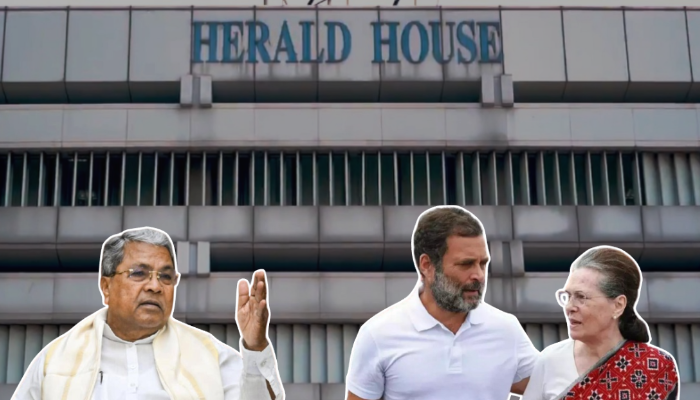
The Karnataka government reportedly gave more money to the controversial newspaper National Herald for advertisements than any other national daily, raising concerns over the use of public funds. The official documents revealed that the National Herald received crores of rupees from the government’s advertising budget despite its lack of distribution and negligible readership in the state.
The data unveiled that National Herald was awarded Rs 1.90 crore in 2023–2024 and approximately Rs 1 crore (Rs 99 lakh) in 2024–2025, while reputable national newspapers were given significantly less, with some even securing less than half of the amount allocated to Herald.
The government spent Rs 1.42 crore on advertisements in national publications in 2024–2025, and roughly 69% of this was paid to the National Herald alone. On the other hand, prominent national dailies remained empty-handed during the same time frame. The government has devoted more than Rs 4.31 crore on advertisements for the National Herald over the past three years, the most of any national media expenditure.
The government has already released Rs 99 lakh for the year 2025–2026. Interestingly, Chief Minister Siddaramaiah is in charge of the Information Department. The National Herald has turned out to be the largest recipient of Karnataka’s advertising budget among national newspapers for the past two fiscal years, despite the dismal number of readers.
Open loot, daylight robbery: BJP lashes out as Congress defends the spending
The details sparked a political uproar in the state as the opposition slammed the decision, while the ruling party audaciously justified the same. Dr CN Ashwath Narayan, a senior Bharatiya Janata Party leader and former deputy chief minister, described the development as “open loot of the money of taxpayers.” He added that the National Herald is already under inquiry by the Enforcement Directorate.
Narayan outlined, “Why should public money be given to a newspaper that has no circulation in Karnataka or anywhere else? Why associate government funds with an entity already facing serious financial investigations?”
Union Minister Prahlad Joshi launched a similar attack and expressed that National Herald has “more advertising revenue than any established newspaper, which in itself is a scam. The so‑called owners Sonia Gandhi and Rahul Gandhi in the scam are under scrutiny, and are currently on bail.”
#WATCH | Bengaluru, Karnataka: On National Herald Case, Union Minister Pralhad Joshi says, "… They have more advertising revenue than any established newspaper, which in itself is a scam. The so‑called owners Sonia Gandhi and Rahul Gandhi in the scam are under scrutiny, and are… pic.twitter.com/w9Cm5L0biP
However, Karnataka Minister Eshwar Khandre referred to the enquiries as “anti-national” and claimed, “What is wrong in giving advertisements to National Herald,” charging politicisation of the matter by the saffron party. His comments provoked further backlash as with opposition leaders accusing Congress of trying to stifle criticism by labelling valid concerns as unpatriotic.
Likewise, another minister and Congress chief Mallikarjun Kharge’s son Priyank Kharge dragged the Rashtriya Swayamsevak Sangh to create a false equivalence and asked the BJP to furnish the financial details about “Organiser” magazine.
“BJP should bother about the funding of the RSS magazine organiser, not the National Herald. They say that they do not have bank accounts and are not registered. Here it’s clear. There is a legal entity called National Herald and government and corporate entities are giving advertisements. Is there a law against it? If there is a law, let them inform us which law we are violating.”
Deputy chief minister DK Shivakumar also advocated for the government’s actions amidst the intensifying criticism. “Any government can give advertisements to any media outlet it feels is doing its work. We have seen many other states giving ads to Kannada newspapers. What are they doing? Can we question that? There is nothing wrong with it,” he insisted.
VIDEO | On BJP’s allegations that the state government spent crores on ads in the National Herald, Karnataka Deputy CM DK Shivakumar said, “Any government can give advertisements to any media outlet it feels is doing its work. We have seen many other states giving ads to Kannada… pic.twitter.com/FbLX0fwLqb
Leader of the Opposition of the state’s Legislative Assembly countered that Shivakumar was granted bail in the National Herald case, however, this did not stop Siddaramaiah from funnelling money to a Congress organisation from the government coffers. He argued, “The Karnataka government’s advertisement revenue constitutes 69% of the total revenue of the National Herald, while the contribution to this paper from all other sources constitutes only 31%. This is daylight robbery.”
Shivakumar had acknowledged last year that he had given Rs 25 lakh to the National Herald, claiming it was a party-run publication. The response followed the inclusion of his brother DK Suresh and Telangana Chief Minister Revanth Reddy in the ED’s chargesheet.
The BJP at present has asked the Siddaramaiah-led government to answer for its actions and to provide a thorough explanation of the standards by which advertising monies are distributed.
Meanwhile, Congress veteran who also heads the party’s media and publicity department, Pawan Khera declared, “National Herald is a national heritage since Independence. What problem does the media have if funds are given to the media itself,” in a CNN-NEWS18 interview and even contended that it was appropriate to support legacy institutions.
National Herald’s history and the origin of a scam
The National Herald has been at the centre of an ongoing high-profile matter related to the Enforcement Directorate’s money-laundering probe involving the newspaper’s parent company, Associated Journals Limited (AJL). Sonia Gandhi and her son Rahul Gandhi have been named as accused in the case alongside other Congress leaders.
Pandit Jawaharlal Nehru and other freedom fighters founded the National Herald in 1938, which shifted into the Congress party’s mouthpiece when India gained its independence. The National Herald newspaper was published by Associated Journals Limited (AJL). It owed the Congress an amount of Rs 90.26 crores by April 2008. The party occasionally approved loans to AJL at zero per cent interest to keep it operational, but it shut down in 2008 due to unsustainability.
Afterwards, another business was established under the name Young Indian Private Limited (YIL) in 2010. Sonia Gandhi, Rahul Gandhi, and prominent Congressmen Motilal Vora, as well as Oscar Fernandes, were its owners at the time of incorporation. The party transferred recovery rights for its Rs 90 crore debt to the fresh firm in exchange for Rs 50 lakh, allowing it to acquire majority ownership of AJL.
AJL was unable to pay off its debt, and Young Indian bought most of its shares and eventually the entire company. As a result, all of its assets were taken over by the Gandhi-controlled organisation. This comprised real estate holdings in upscale areas of Mumbai, New Delhi, Lucknow, Bhopal, Indore, Patna, and others, valued at more than Rs 2000 crores.
Young Indian then announced that publishing newspapers was not its goal, however, the non-profit began to republish three newspapers, including the National Herald, in digital format in 2016. A massive row transpired after Subramanian Swamy in 2011 conveyed that the Gandhi family founded YIL to purchase AJL’s real estate properties.
He took the issue to the trial court and charged Rahul Gandhi and Sonia Gandhi of defrauding their party. He pointed out that YIL was able to wipe off debt totalling Rs 90.26 crores for Rs 50 lakh. According to Swamy, the party’s choice to lend money to AJL for commercial reasons was unlawful.
Investigation spanning several years
Sonia Gandhi, Rahul Gandhi, and others were called by a magistrate’s court in 2014. It was observed that YI seemed to be a “sham structure” that moved public assets for private use. Furthermore, both the ED and the Income Tax Department launched independent preliminary inquiries the same year. The Gandhi family’s appeal was denied by the Delhi High Court, which maintained the summons. Sonia and Rahul had to show up in court and were given bail.
A few years later, the Income Tax Department’s findings and Swamy’s complaint served as the premises for the ED’s 2018 formal submission of a case under the Prevention of Money Laundering Act (PMLA).
The investigation grew more intense in 2022 when Sonia was questioned in several sessions in July and Rahul was also grilled for more than 50 hours over the course of five days in June. Additionally, premises connected to Young Indian and AJL were searched. The agency initiated a new case under the PMLA’s criminal provisions in 2022 after a trial judge took notice of an Income Tax Department probe against Young Indian on Swamy’s 2013 complaint.
AJL properties in Delhi, Mumbai, and Lucknow were provisionally confiscated by the ED in 2023. They had an estimated worth of more than Rs 750 crore. Congress office-bearers and former AJL employees were subjected to more interrogation sessions in 2024 as another PMLA complaint was initiated by the agency.
Last year, the ED filed a PMLA chargesheet with the Special MP/MLA court in Delhi with Sonia and Rahul as the principal accused. The Economic Offences Wing (EOW) of Delhi Police also received a letter from the ED requesting the registration of a new First Information Report owing to its findings.
Afterwards, the official complaint was lodged which featured the names of Sonia and Rahul along with Congress leaders Suman Dubey and Sam Pitroda as well as unidentified individuals. However, a Delhi court dismissed the money laundering charges because it was on the basis of Swamy’s private complaint.
It was pronounced that the Delhi Police’s Economic Offences Wing (EOW) presented a formal complaint in the case, and the judge did not consider it appropriate to review the ED’s arguments on the veracity of the claim. Nonetheless, the court stated that the central agency may carry out its inquiry because the Delhi Police had filed a formal complaint.
It is important to note that criminal conspiracy, misuse of party finances, money laundering, tax evasion, and commercial misuse of publicly leased land are the grave charges in the National Herald case, which also include fraudulent takeover and land grab.
Karnataka: A cash cow for Congress
Congress has not only depleted Karnataka’s resources to finance its giveaway politics aimed at securing power, but it has also exploited the state’s assets to support a corrupt entity like National Herald. This has come to symbolise yet another dubious step by the government to take advantage of the vulnerable exchequer for selfish interests.
The publication, labelled as a “legacy institution” by Congress, might have qualified as such had it not been for the corrupt practices of Congress. However, it is now far removed from that due to the severe allegations that are associated with it. The devious activities within the National Herald were even emphasised by Sardar Vallabhbhai Patel, only to be predictably rejected by Nehru. The grand old party has illustrated, “The more things change, the more they stay the same,” in this regard as well.
Furthermore, the Congress leaders stood by the move and even tried to involve the RSS, conveniently overlooking the fact that the outfit’s publication, “Organiser,” is neither implicated in corruption nor facing any such allegations.
The expectation of objectivity and honesty from Congress is akin to the quest for a unicorn. However, the possibility of locating the mythical creature is greater than that of finding the former. Furthermore, these actions are not surprising, considering the corruption-laden track record of Congress.
The party that once ruled with an iron fist was ousted from power in 2014 due to the incredible scale of its scams and has since been restricted to a few pockets of the country. Currently, it is making do with what it can and employing the states where it is in power to perpetuate its corrupt legacy.
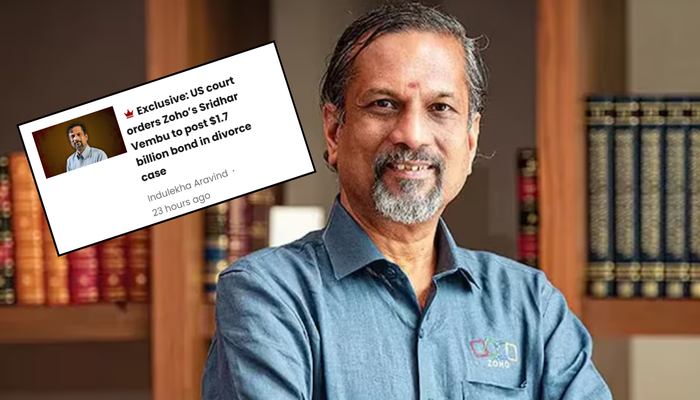
After spearheading the malicious media campaign to malign a Hindu religious institution in the Dharmasthala mass grave hoax, Dhanya Rajendran’s The News Minute has now stooped to a new low by monetising on someone’s personal agony. In a recently published “exclusive” report, The New Minute carried out a hit job against Zoho founder Sridhar Vembu by misrepresenting a California court order in his divorce case.
In the article, The News Minute relied on a year-old court order in his divorce proceedings to mar Vembu’s reputation. The article claimed that Vembu’s public image of a role model and someone with “simple living and high thinking” was contradicted by the pre-trial findings of the Superior Court of California, County of Alameda, which is hearing his divorce case. The article mentioned that the court order directed Vembu to post a bond of $1.7 billion, and appointed a receiver over multiple Zoho entities in the US and his personal assets, to protect his ex-wife Pramila Srinivasan’s rights.
It produced an excerpt from the court order which read: “The record in this case demonstrates that Petitioner (Sridhar) has acted without regard for Respondent’s (Pramila’s) interests in community assets and without regard for the law, and that Zoho Corporation, T&V Holdings, Inc., Tony Thomas, ZCPL and related entities will act at Petitioner’s direction to further Petitioner’s interest and prejudice Respondent’s interests.”
The media outlet presented the allegations levelled by Vembu’s wife, Pramila Srinivasan, as facts to insinuate that he did not want to give his wife her due share in their shared assets. The article also stated that an “extensive profile of the tech billionaire” was soon going to be published in The News Minute.
The News Minute’s propaganda countered by Vembu’s attorney
The online media portal’s attempt to tarnish the image of Vembu, a supporter of nationalist causes, which seems to have made him a target of the hit job, was countered by his attorney in an online post. Vembu’s attorney, Christopher C. Melcher, called out The News Minute for relying on a January 2025 court order, which was on appeal, and pointed out that some facts were missing from their article. Melcher explained that the allegations levelled by Vembu’s wife against him were “outrageously false” and that her lawyer, who accordting to Melcher, is not even licensed to practice law in California, misled the judge. He stated that the part of the California court order relating to the appointment of a receiver over multiple Zoho entities has been stayed on appeal and that the $1.7 billion bond order is on appeal.
As Sridhar Vembu’s counsel, I can add some facts missing from the article. The order was made 1 year ago on an emergency application by his wife, meaning we had little time to response to the outrageously false allegations she made against Sridhar. The judge in California was…
The news article refers to an old order partially stayed on appeal: Vembu’s lawyer
Melcher clarified that Vembu offered his wife 50% of his shares in ZCPL, but she refused to accept it and went on to claim that he was trying to cheat her in the divorce. He further stated that Vembu had already transferred his share in the family home to her. Regarding the $1.7 billion bond, Melcher said that the order had no legal authority. “Despite acting honourably during this process, the judge was fooled into making an order that Sridhar post a $1.7 billion bond for the wife’s supposed protection. There is no legal authority for such an order. A subsequent judge acknowledged that the amount seemed absurd. Sridhar was able to borrow up to $150 million against his shares, which was the extent of his ability to comply, but his wife would not accept the money,” Melcher wrote on X on Thursday (8th January).
Vembu’s attorney further stated that the wife did not even seek alimony and is merely wasting his time. “This was a waste of time by the wife, as she has nothing to show for her effort to disparage Sridhar. Her attorney misled the court and may be misleading her, too, about reality, while he has billed millions of dollars in fees. This has nothing to do with alimony, by the way, as the wife has not even sought an order for support. Sridhar is in full compliance with all lawful orders of California,” Melcher added.
The News Minute tried to pass off interim court observations as a final verdict
The libellous article by The News Minute is a testament to the portal’s predatory journalism. Just because Sirdhar Vembu does not align with the media outlet’s ideological leanings, it exploited his marital dispute to pass a moral judgment on him, while also making money from his personal distress. The article cherry-picked the court’s observations from the pre-trial stage, when the evidentiary record available before the court is limited. It attempts to pass off interim observations of the court, which are often overturned, as the final verdict in an ongoing divorce proceeding. The malice of the media outlet is laid bare by the fact that the article insidiously omits to mention that the court order has been appealed from and part of it has been stayed.
The media outlet is loved by anti-India forces
This exposes how The News Minute misuses journalism as a tool to further its agenda by targeting individuals who do not fit its ideological narrative. It is pertinent to mention here that in October 2025, the editor-in-chief of The News Minute, Dhanya Rajendran, was nominated for “Impact Prize of the Year 2025” by Reporters Without Borders (RSF), weeks after she amplified the baseless Dharmasthala “mass grave” hoax in efforts to malign a Hindu religious institution. Notably, the donors of the RSF, a Paris-based NGO, include the French Foreign Ministry, European Commission, Swedish SIDA, the Ford Foundation, the National Endowment for Democracy (NED), a U.S. government-funded organisation widely known as the CIA’s soft arm for regime change, and George Soros’s Open Society Foundations (OSF). OSF network funds a web of Indian NGOs, media portals, and “civil society” actors that consistently amplify anti-India and anti-Hindu narratives.
Why Sridhar Vembu is targeted by the Left
This is not the first time that Sridhar Vembu and Zoho have been attacked by the left-liberal ecosystem. In January 2020, the left cabal ran a boycott campaign against Vembu and Zoho after he was invited as the chief guest at an event organised by the Rashtriya Swayamsevak Sangh (RSS). However, Vembu refused to bow down to the leftist hounding and said that he would not let his views be affected by Twitter attacks. Vembu’s unapologetic nationalism and his pro-India ideology have placed him on the hit list of the left-liberal media, which is sold to foreign buyers.
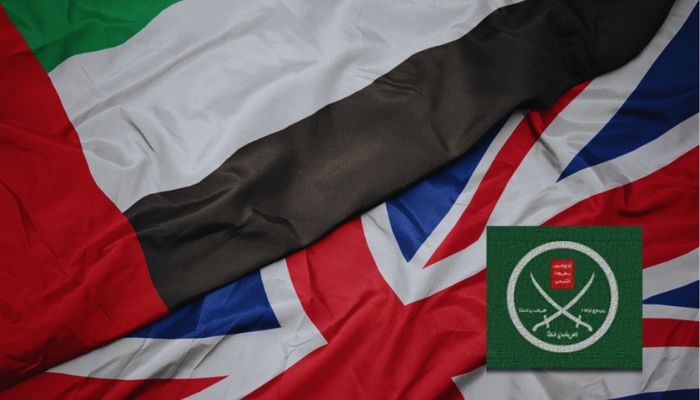
In a major move aimed at preventing Islamic radicalisation of youth, the United Arab Emirates (UAE) has slashed funding for its citizens interested in studying in the United Kingdom (UK). The UAE’s decision comes after the UK refused to ban the Islamic terrorist organisation Muslim Brotherhood.
The UAE excluded UK institutions from the list of global universities for which scholarships would be approved and qualifications certified, amidst deteriorating relations with the UK. Abu Dhabi’s decision stems from the concerns that there is a risk of Islamist radicalisation on UK campuses, a report in FT stated.
When the UK officials asked the UAE about the names of their universities missing from the revised list of overseas universities eligible for state scholarships and official recognition, the UAE officials confirmed the omission was deliberate, as per the report.
“[The UAE] don’t want their kids to be radicalised on campus,” one person privy to the discussions was quoted.
Data shows that in the academic year 2023–24, 70 students at UK universities were reported for possible referral to the Prevent deradicalisation programme for symptoms of “Islamist radicalisation”. This was almost double the number recorded in the previous academic year. This was out of a total higher education student population of around three million.
Over the past decade, the UAE has cracked down heavily on Islamists within the country, and in 2014, it designated the Muslim Brotherhood a terrorist organisation. The UAE has long advocated that the UK must proscribe the Muslim Brotherhood. However, the latter remains reluctant.
In November 2025, the US government also initiated the process of designating specific chapters of the Muslim Brotherhood (MB) as Foreign Terrorist Organisation (FTO) and Specially Designated Global Terrorists (SDGTs).
UAE blacklisted UK-based organisations linked with the Muslim Brotherhood, the UK’s nonchalance emboldening the Islamist outfit
In January 2025, the UAE blacklisted 8 United Kingdom-based organisations for their ties to the Islamic terror outfit ‘Muslim Brotherhood.’
The 8 outfits were identified as Cambridge Education and Training Centre Ltd, IMA6INE Ltd, Wembley Tree Ltd, Waslaforall, Future Graduates Ltd, Yas for Investment and Real Estate, Holdco UK Properties Limited and Nafel Capital.
Notably, the Islamist outfit Muslim Brotherhood has been banned even in Muslim-majority Arab countries such as Egypt, Saudi Arabia, and the United Arab Emirates. However, the UK, a ‘secular’ country, has neither banned the outfit nor declared it a terrorist organisation.
The United Kingdom has been grappling with rapid Islamic radicalisation and conversions to Islam. The Muslim Brotherhood is reported to have expanded its presence in the UK through students coming to study there and Islamist exiles who fled repression in their home countries. Muslim Brotherhood-linked organisations collaborate with Islamists from South Asia, established to promote the work of Abu A’la Mawdudi and representing Jama’at-e-Islami.
In 2024, former Communities Secretary Michael Gove MP named the Muslim Association of Britain (MAB) as an affiliate of the Muslim Brotherhood. Back in 2015, the UK government’s review of the MAB revealed that the outfit was “dominated” by the Muslim Brotherhood.
The review detailed how the Muslim Brotherhood gradually expanded its footprint in the UK over the past five decades. By the late 1980s, the Muslim Brotherhood began mobilising settled second-generation Muslims in the UK using the Iraq and Palestine issue.
By the 1990s, the Muslim Brotherhood established various organisations to promote their jihadist viewpoints and lure in supporters.
“None were openly identified with the Muslim Brotherhood and membership of the Muslim Brotherhood remained (and still remains) a secret. But for some years the Muslim Brotherhood shaped the new Islamic Society of Britain (ISB), dominated the Muslim Association of Britain (MAB) and played an important role in establishing and then running the Muslim Council of Britain (MCB). MAB became politically active, notably in connection with Palestine and Iraq, and promoted candidates in national and local elections. The MCB sought and obtained a dialogue with Government. MAB were active partners in a security dialogue with the police and collaborated with the police in ejecting Abu Hamza, the militant Salafist preacher, from a mosque in north London. The MAB have participated in the governance of this mosque ever since,” the 2015 report on the Muslim Brotherhood reads.
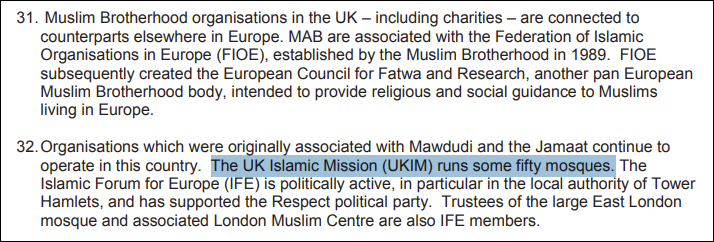
The review also found that through its various organisations, the Muslim Brotherhood has been raising funds in the UK. Muslim Brotherhood-controlled organisations like the UK Islamic Mission (UKIM), and Islamic Forum for Europe (IFE), among others, run dozens of mosques in the UK. These organisations have been open supporters of the Palestinian Islamic terror group Hamas.
The 2015 review further highlighted that while the Muslim Brotherhood in the UK has claimed to be opposed to ‘militant’ Salafism and Al Qaida, the UK government’s engagement with the Muslim Brotherhood “did not take account Muslim Brotherhood support for a proscribed terrorist group and its views about terrorism which, in reality, were quite different from our own; – aspects of Muslim Brotherhood ideology and tactics, in this country and overseas, are contrary to our values and have been contrary to our national interests and our national security.”
Despite the 2015 review tracing the Muslim Brotherhood’s jihadist proclivities, the UK government did not proceed with banning the outfit, saying that there was no evidence linking the Muslim Brotherhood to terrorist activities in Britain.
Muslim Brotherhood: History, motto and jihadist activities across the world
The Muslim Brotherhood or Ikhwan al-Muslimin was founded in 1928 in Egypt by Hassan al-Banna, a teacher and Islamic scholar. The Islamist outfit’s foundation was based on the premise of anti-Western colonialism and the supposed erosion of Islamic values in the post-Ottoman world. Al-Banna launched the Muslim Brotherhood as a pan-Islamist movement which focused on charity and Islamist advocacy.
In its early years, the Muslim Brotherhood filled gaps left by weak and nonchalant governments by building schools, hospitals and mosques for the poor and illiterate people in Egypt while also preaching Islam and ‘Tawhid’ (Allah’s oneness and supremacy) as some antidote to secularism and imperialism. The motto of the Muslim Brotherhood makes abundantly clear that though it may not have initially been linked to violence; ‘Jihad’ has always been its way.
The Muslim Brotherhood’s motto says, “Allah is our objective; the Prophet is our leader; the Quran is our law; jihad is our way; dying in the way of Allah is our highest hope.”
By the 1930s, the Muslim Brotherhood had gained thousands of members and entered politics as well. However, the Islamist outfit had a paramilitary wing called the Secret Apparatus or al-Nizam al-Khas. This wing carried out political assassinations and jihadist violence. In 1948, the Secret Apparatus members assassinated Prime Minister Mahmoud El Nokrashy Pasha for banning the Islamist outfit. In 1949, al-Banna was murdered by the Egyptian Secret Police in retaliation for Pasha’s murder.
The members of the Muslim Brotherhood’s Secret Apparatus used to undergo heavy physical and military training. They were trained to use firearms and carry out underground operations. Emphasising deception and secrecy (Taqqiya), the Jihadists belonging to the Apparatus infiltrate and subvert political parties, armies, intelligence, media, educational institutions and even NGOs. While in countries like the UK, violence may not be the go-to tactic of the Muslim Brotherhood, using media, politics, educational institutions, and charities for furtherance of the Islamic jihadist agenda continues.
In 2012, MB won the elections and picked Mohamed Morsi as President. However, in 2013, a military coup led by then-General Abdel Fattah el-Sisi ousted Morsi. The Islamist outfit was banned and declared a terrorist organisation in Egypt.
The Muslim Brotherhood continues to be seen as a threat to political stability by many authoritarian governments in the Middle East and North Africa. Recently, Texas Governor Greg Abbott announced that the Muslim Brotherhood, including the Council on American-Islamic Relations, would be considered “foreign terrorist and transnational criminal organisations.”
The UAE, Saudi Arabia, Egypt, Bahrain, and Russia have already designated the Brotherhood as a terrorist organisation. Jordan banned the group in April 2025 after arresting people linked to the movement who were accused of plotting attacks using rockets and drones.
The Muslim Brotherhood also inspired Maulana Abul Ala Maududi’s Jamaat-e-Islami in the 1940s. Banned Islamic terror outfits like the Student Islamic Movement of India (SIMI) and Popular Front of India (PFI), both of which have been involved in Jihadist attacks against Hindus and are working on plans to turn India into an Islamic nation, draw inspiration from Muslim Brotherhood tactics. Besides influencing Islamic terrorist groups active in India, the Muslim Brotherhood had launched a #BoycottIndianProducts campaign against India, targeting India’s economic interests in 2021. In 2023, the Muslim Brotherhood conspired to paint a bad picture of India under the guise of defending the honour of the Islamic prophet Muhammad.
The Somnath Temple in Gujarat has been a witness to the numerous attacks by foreign Islamic invaders on the Hindu Dharma and civilisation. It stands tall as a symbol of Bharat’s resilience and civilisational continuity. On the 8th of January 2026, the nation is celebrating Somnath Swabhiman Parv. While the Hindu temple came under attack by Islamic invaders since 1026, its reconstruction and return to its original glory irked even the ‘secular’ leaders like Jawaharlal Nehru in independent India.
India was partitioned on Islamic lines, and the Islamic Republic of Pakistan was created on the corpses of countless Hindus, Sikhs and other non-Muslims. While the Muslim-majority Pakistan became an Islamic republic, the Hindu-majority India adopted a ‘secular’ character. However, India’s ‘secular’ and ‘progressive’ political leadership significantly undermined Hindu rights and interests, apparently to appease the Muslims who did not go to Pakistan even though the majority of Muslims voted for Pakistan’s creation.
From the British Colonial Raj to Congress Raj, the blatant snubbing of Hindu rights continued in both pre- and post-independent India. Jawaharlal Nehru, the first Prime Minister of an independent India, was outspokenly against the reconstruction of the Somnath Temple.
PM Nehru wrote a series of letters between 1950 and 1951, wherein he expressed opposition to the reconstruction and consecration of the Somnath Temple. Nehru wrote around 17 letters to various officials, including Cabinet ministers, chief ministers, the President, the Vice President, and even to the Prime Minister of Pakistan, making his deep disdain for the Hindu community’s quest for reclamation of its destroyed temples known.
Jawaharlal Nehru objected to President Rajendra Prasad’s decision to attend the Somnath Temple consecration ceremony
On 2nd March 1951, Prime Minister Jawaharlal Nehru ‘confessed’ that he was against the idea of President Rajendra Prasad associating himself with the grand opening ceremony of the Somnath Temple. He urged Prasad not to preside over the ceremony.
“…I confess that I do not like the idea of your associating yourself with a spectacular opening of the Somnath temple. This is not merely visiting a temple, which can certainly be done by you or anyone else, but rather participating in a significant function which unfortunately has a number of implications. Personally, I thought that this was no time to lay stress on large-scale building operations at Somnath. This could have been done gradually and perhaps more effectively later. However, this has been done. I feel that it would be better if you did not preside over this function,” Nehru wrote.
This letter came in response to President Prasad’s letter informing PM Nehru that Navanagar’s Jam Saheb at invited the President to preside over the Somnath consecration ceremony. President Prasad wrote, “I personally do not see any objection to associating myself with the function, particularly because I have never ceased visiting temples, and… denominational religious or semi-religious institutions….”
Nehru did not “like” the waters of distant rivers being collected for the Somnath consecration, asked the Foreign Secretary to write to embassies not to arrange waters sought from various rivers
In a note to the then Secretary-General and Foreign Secretary, PM Nehru said that he did not like the idea of collecting waters of various rivers and twigs from mountains for the Somnath consecration ceremony. He also expressed his disappointment over then-President Rajendra Prasad visiting the Somnath Temple to attend the Pran Pratishtha ceremony.
“I have also written to Mr Munshi about the Somnath temple. It is fantastic that our Embassies should be addressed in this way and asked to collect the waters of distant rivers and twigs from various mountains. I mentioned to the President sometime ago that I did not fancy his visiting the Somnath temple on this occasion. He said he had promised to do so and it was difficult for him to get out of his promise. There is nothing more to be done about it. But I have made it clear both to the President and to Mr Munshi that I do not at all like these activities,” PM Nehru wrote in the note dated 17th April 1951.
Not only this, but PM Nehru also asked the Ministry of External Affairs official to write to Indian embassies abroad not to heed requests to fetch waters from various rivers for the relevant purpose.
“Does External Affairs know anything about these letters addressed to our Embassies abroad asking for the waters of various rivers? I think you might write to our Embassies not to pay the slightest attention to these appeals.…” Nehru wrote.
In a letter to then Union Home Minister C Rajagopalachari, PM Nehru expressed amazement over letters being written to Indian embassies abroad for the collection of waters from various rivers for the Somnath temple ceremony.
“…I should like to draw your special attention to what he has written about the Somnath temple business. I am very much troubled about this, and yet I do not know what I can do. In any event it is amazing for people to write to our Embassies for the waters of the rivers there,” PM Nehru wrote.
PM Nehru was ‘distressed’ about the President and some cabinet ministers attending the Somnath Temple inauguration
In a note to MEA Secretary S Dutt on 9th May 1951, PM Nehru expressed ‘distress’ over the association of the Indian and Saurashtra government with the Somnath Temple consecration ceremony.
“I have been much distressed at the association of the Government of India with the ceremony that is taking place at Somnath. I wrote to the Jam Saheb and to the Government of Saurashtra about it. I find now that in fact some Ministries of the Government of India, including our Ministry, had been consulted and in fact they encouraged various steps that were taken. I am afraid we can do nothing further in the matter now. But I think all this association is most unfortunate,” Nehru wrote.
Nehru’s letter to Navanagar Jam Saheb expressing worry over the Islamic nation Pakistan accusing India of not being secular over government involvement in the Somnath Temple consecration
Hardly five years after Pakistan came into existence after the slaughter of Hindus, Sikhs, Buddhists and other Kafir communities, Prime Minister Jawaharlal Nehru was worried that Pakistan was accusing the Indian government of not being secular.
In a letter to Maharaja Digvijaysinhji Jadeja, the Jam Saheb of Navanagar or the modern-day Jamnagar, PM Nehru not only raised objections over the Saurashtra government spending Rs 5 lakh on the Somnath Temple ceremony and President Rajendra Prasad attending the event, but also lamented that Pakistan is taking advantage of this to prove that India is not secular.
“So far as the Government of India is concerned, I am going to make it perfectly clear in answer to questions in Parliament that they have nothing to do with this matter. But I can hardly say that about the Saurashtra Government, although I think their association as a Government is not proper and they should not spend Government funds on it. I have written to the Chief Minister about this also…Pakistan of course is taking great advantage of this to try to prove that we are not a secular State,” PM Nehru wrote in the letter dated 22nd April 1951.
Such was the desperation to appear secular and distance the State from Hindu Dharma or Dharmic/civilisational event that PM Nehru did not want Pakistan to be able to question India’s secularism. Pakistan, officially being an Islamic Republic, with nothing remotely to do with secularism, had no locus standi to question whether India is a secular state or not.
Nehru declined Navanagar Jam Saheb’s invitation to the Somnath Temple consecration ceremony, calling the event ‘Hindu revivalism’
In a letter responding to the invitation extended by Maharaja Digvijaysinhji Jadeja, the Jam Saheb of Navanagar or the modern-day Jamnagar, to the Somnath Temple consecration ceremonies, Nehru declined the invitation.
PM Nehru went as far as to call the reconstruction and consecration of the Somnath Temple an act of ‘revivalism’. He also lamented that the President, some ministers and the Jam Saheb were a part of it. Nehru even stressed that the President of India and cabinet ministers attending the ceremony will have ‘bad consequences’.
The letter dated 24th April 1951 reads, “Thank you for your letter of the 22nd April conveying an invitation to the ceremonies at the Somnath temple. I am afraid it is not possible for me to leave Delhi at this critical juncture for any such function. But apart from this, I must be quite frank with you about this ceremony. Indeed I have written to you about it in another connection already. I am troubled by this revivalism and by the fact that our President and some Ministers and you as Rajpramukh are associated with it. I think that this is not in line with the nature of our State and it will have bad consequences both nationally and internationally. As individuals, of course, it is open to anyone to do what he chooses in such matters. But many of us happen to be more than private individuals, and we cannot dissociate ourselves from our public capacities.”
Nehru told Home Minister C Rajagopalachari that the President should not go to the Somnath consecration ceremony
In a letter dated 11th March 1951, PM Nehru informed the then Union Home Minister C Rajagopalachari about the President receiving an invitation to the Somnath Temple consecration ceremony. The Prime Minister wrote that although he is not opposed to President Prasad going to a temple or any place of worship, he does not want the President to attend the Somnath temple function. Nehru opined that the President’s presence in the ceremony of the Hindu temple will have several implications, although the PM did not elaborate on what sort of implications.
“… As the President is anxious to associate himself with this function, I do not know whether it is desirable for me to insist that he should not do so. I propose, therefore, subject to your advice, to tell him that he can exercise his own discretion in the matter, although I still think that it would be better for him not to go there,” Nehru wrote.
Nehru fumed over the Saurashtra government providing Rs 5 lakh for the Somnath Temple consecration ceremony
Prime Minister Jawaharlal Nehru was so keen on keeping his ‘secular’ credentials intact that on 21st April 1951, he wrote a letter to then Saurashtra Chief Minister U.N. Dhebar questioning him about the reported allocation of Rs 5 lakh for the Somnath Mandir ceremony by his government. Nehru dubbed the fund allocation an improper use of public funds.
“I have seen an item of news in the papers to the effect that the Saurashtra Government has sanctioned a sum of Rs 5 lakhs for the installation ceremony of the Somnath temple. I was much surprised to read this and I should like to know if this is correct. Whatever the importance of the Somnath temple might be, this is not a governmental matter and it is for private individuals to collect money for it. I doubt if it is a proper use of public funds held by Governments to be spent in this way,” PM Nehru wrote.
Nehru irked over the impression abroad that the Somnath consecration was a government-funded affair
Prime Minister Nehru felt that the secular and progressive image of his government was tainted by the impression abroad that the Somnath Temple ceremony was a government-linked or, rather, government-funded affair. In a letter to Kanhaiyalal Maniklal Munshi, or simply KM Munshi, who was then Food Minister and oversaw the Somnath temple’s reconstruction, Nehru called the Saurashtra government’s decision to spend Rs 5 lakh on the Somnath consecration ceremony “improper expenditure”.
In the letter dated 22nd April 1951, Nehru was also upset about Navanagar Jam Saheb writing letters to Indian embassies for waters of various rivers for the ceremony.
“I am distressed at the impression abroad that the Somnath installation ceremony is more or less a Government affair. Questions are going to be asked in Parliament and I am going to make it clear that the Government of India has nothing to do with it. Unfortunately I cannot say the same about the Saurashtra Government which, I am surprised, is reported to have decided to spend Rs 5 lakhs over the installation ceremony. I think this is improper expenditure for a Government at any time and more especially in view of the circumstances in the country today,” Nehru wrote.
“I have written to the President on this subject also and to the Jam Saheb. Unfortunately, the Jam Saheb is not only the Chairman of the Trustees of Somnath temple, but also the Rajpramukh of Saurashtra. His letter to our foreign Embassies has given us a lot of trouble and created a good deal of misunderstanding,” he added.
Ahead of the Somnath consecration, Nehru directed Chief Ministers not to do anything that affects the secular character of the State
In one of his letters to various Chief Ministers in the country about the Somnath Temple consecration ceremony, PM Nehru directed CMs of all states to “not do anything which comes in the way of our State being secular.”
“That is the basis of our Constitution and Governments, therefore, should refrain from associating themselves with anything which tends to affect the secular character of our State,” Nehru wrote in the correspondence dated 2nd May 1951.
‘Governmental association with Somnath ceremony will injure us abroad and even in India’: When Nehru feared the world would cancel his ‘secular’ certificate if his government had links with the inauguration of a Hindu temple in Hindu Hindu-majority country
In another letter addressed to a government official, wherein PM Nehru expressed his objection regarding the supposed government ‘association’ to the Somnath Temple’s consecration ceremony. This letter was written on 28th April 1951 to Ranganath Ramchandra Diwakar, then Minister of Information and Broadcasting.
Nehru expressed worries about the ceremonies set to take place at the Somnath Temple, saying that he was troubled by the inquiries about whether it is a government function or not.
“I have been rather worried about the ceremonies that are going to take place at Somnath temple. Many inquiries are addressed to me as to whether this is a governmental function or not. I have replied both in India and abroad, as well as in Parliament, that this is not a governmental function, although some Members of Government may be personally interested,” Nehru wrote.
He also expressed discomfort over a ‘pompous’ ceremony being held at the Somnath Temple and any government association with it, asserting that this will injure his ‘secular’ government, inside and outside India.
“I think that this pompous ceremony regarding Somnath temple and any kind of governmental association is going to injure us abroad and even in India. Indeed I am getting many complaints and letters about it. Inquiries are addressed to me if this is how a secular State behaves. All I can say in reply is that this is not a governmental function,” Nehru added.
He further urged that the radio broadcast should tone down the description of the events at the Somnath Temple consecration ceremony and that it should not appear in any way as a governmental function, as if he was worried ‘someone’ would be upset about Hindus doing worship in Hindu temples and the President and some cabinet ministers attending the event as practising Hindus.
“I feel that in the circumstances our radio broadcast should rather tone down the description of what happens at Somnath and not make it appear in any way that it is a governmental function,” PM Nehru’s letter reads.
‘How a secular Government such as ours can associate itself with such a revivalist ceremony’: PM Jawaharlal Nehru’s letter to President Rajendra Prasad
In the letter dated 22nd April 1951, Prime Minister Nehru raised serious concerns over the events related to the Somnath Mandir. Nehru said that his ‘secular’ government is facing questions about come his government is associating itself with such a ‘revivalist’ ceremony. He further highlighted the Somnath Trustee and Navanagar Jam Saheb’s letters to various Indian embassies about collecting water from various rivers and the soil of specific mountains.
“I am greatly worried about the Somnath affair. As I feared, it is assuming a certain political importance. Indeed references have been made to it internationally also. In criticism of our policy in regard to it, we are asked how a secular Government such as ours can associate itself with such a ceremony which is, in addition, revivalist in character. Questions are being put to me in Parliament and I am replying to them saying that Government has nothing to do with it and those persons who are connected in any way are functioning entirely in their personal capacity,” Nehru wrote.
Mentioning the Rs 5 lakh expenditure the Saurashtra government was making on the Somnath ceremony, PM Nehru deemed this “undesirable”, saying that amidst starvation and economic challenges, such expenditure was inappropriate.
“At any time this would have been undesirable, but at the present juncture, when starvation stalks the land and every kind of national economy and austerity are preached by us, this expenditure by a Government appears to me to be almost shocking. We have stopped expenditure on education, on health and many beneficent services because we say that we cannot afford it. And yet, a State Government can spend a large sum of money on just the installation ceremony of a temple,” Nehru wrote.
PM Nehru’s reasoning behind opposing the Saurashtra government’s decision to spend Rs 5 lakh on the Somnath consecration ceremony reminds one of the hue and cry Islamo-leftists made over the construction of the Ayodhya Ram Mandir and Prime Minister Narendra Modi being the representative Yajman during the Pran Pratishtha of Shri Ram Lalla.
For years, liberals have argued that instead of building Ram Mandir, hospitals, schools, and universities should be built, suggesting that Dharmic expenditure at massive levels is a waste, as if building the temple would have prohibited construction of schools, colleges, or there would be no other land left for such buildings.
PM Modi’s active participation in the Ayodhya Ram Mandir consecration ceremony was in sharp contrast to PM Nehru’s idea of ‘secularism’, where Hindu grievances are dismissed as a revivalist agenda. India owes its secular character to Hinduism and Hindus with the Hindu consciousness and civilisation; India would be as soulless as Pakistan.
PM Nehru’s letter to beloved ‘Nawabzada’ Liaquat Ali Khan of Pakistan about the gates of Somnath Temple being brought back from Afghanistan
The most outrageous of all the letters Nehru wrote regarding the Somnath Temple consecration ceremony was the one he wrote on 21st April 1951 to Pakistan’s Prime Minister Liaquat Ali Khan. Addressing Khan as “Dear Nawabzada”, Nehru described the Pakistani media reports that the gates of the original Somnath Temple, destroyed by Mahmud Ghazni centuries ago, were being brought back ahead of the consecration ceremony, as “completely false”.
“…A recent broadcast from Peshawar in Pushto on the 17th April is an example of extreme irresponsibility and falsehood. I shall be grateful if you will consider this.The story of the gates of Somnath temple being brought back to India from Afghanistan is completely false and there is not an atom of truth in it. This has been publicly denied. In fact nobody knows if there are any such gates anywhere and nothing of the kind is being sent from Afghanistan to India. Nevertheless, the Pakistan Press has been full of this story,” Nehru wrote.
“I leave it to you to judge how far the broadcast, a report of which I am enclosing, is decent or desirable from any point of view,” PM Nehru added, demonstrating the extent he went to appease and placate Muslims not only in India but even in Pakistan.
All relevant letters and notes accessed via Nehru Archive.
Nehru’s letter to Liaquat Ali Khan reminds one of how he wrote to Mohammad Ali Jinnah, informing him that to appease Muslims, his party had truncated the four stanzas of the nationalist song Vande Mataram to remove references to Maa Durga. The truncated version was then adopted by the party in 1938.
In consequence of Congress’s abject surrender before Islamists and fixation with being ‘secular’, the Vande Mataram song was mutilated, and four stanzas were dropped out of six to placate those who, just years after, betrayed the nation.
Jawaharlal Nehru opposed the reconstruction of the Somnath Mandir
Jawaharlal Nehru’s strong opposition to President Rajendra Prasad and some cabinet ministers attending the Somnath Mandir consecration ceremony was not surprising, given that he tried his best to prevent the reconstruction of the temple destroyed by Muslim invaders.
The former Prime Minister was opposed to Hindus having the authority to reclaim their most revered religious places, even after the nation suffered through a brutal, religiously motivated partition. If not for Sardar Vallabhbhai Patel, the revival of Somnath Mandir would have been a long and bloodied struggle, as the Hindus did for the Ram Janmabhoomi.
On 13th November 1947, Sardar Patel reached Junagarh to a roaring welcome from the state’s citizens, promising to restore the Somnath Mandir. After his return to Delhi, a cabinet meeting decided to reconstruct the temple and determined that the state would cover the costs. However, Mohandas Karamchand Gandhi wanted people to cover its expenses, which led to the decision being overturned. He was killed in 1948, and Sardar Patel passed away in 1950, after which Kanhaiyalal Maneklal (KM) Munshi, the cabinet minister at the time, became chairman of the trust’s advisory committee, which was tasked with restoring the temple.
In a clear declaration of his position on the Somnath Mandir revival issue, Nehru told Munshi, “I don’t like your trying to restore Somnath. It is Hindu Revivalism.”
Conclusion
From truncating the song Vande Mataram due to its glorification of Maa Durga after Muslim outrage, reducing the historic Tamil sceptre Sengol, which had Nandi, the vahana of Lord Shiv seat atop, to Nehru’s ‘walking stick’, opposing construction of Somnath Mandir, to rejecting the existence of Lord Ram in the 2007 affidavit in Sethusamudram Project case, Congress has historically attacked and undermined Hindus, Hindu Dharma and Sanatan civilisation.
On 7th January (Wednesday), San Francisco-based artificial intelligence, OpenAI, introducedChatGPT Health, a specialised feature to safely link people’s health apps and medical records. More than 260 doctors from 60 nations worked closely to create the new experience.
Users can ask health and wellness-related queries in this exclusive, sandboxed area of ChatGPT. They can choose to link their medical records and fitness or nutrition applications so that their answers are based on personal information.
OpenAI informed, “You can securely connect medical records and wellness apps to ground conversations in your own health information, so responses are more relevant and useful to you. Designed in close collaboration with physicians, ChatGPT Health helps people take a more active role in understanding and managing their health and wellness while supporting, not replacing, care from clinicians.”
System intended to aid, not replace
The tech giant mentioned that health is already one of the most popular reasons people use ChatGPT. Over 230 million people globally ask health-related queries each week, according to its de-identified study. Many people do it late at night, after clinic hours, when there are no doctors available, as Google searches spiral.
Fidji Simo, CEO of Applications at OpenA, I discussed the idea behind this design and stated that it is to make users feel “more informed, prepared, and confident navigating their health” while upholding the distinction between critical medical data and general AI use. She highlighted the complexity of navigating the healthcare system, even with excellent care, and how AI could assist both doctors and patients with some of the most pressing problems.
However, Simo emphasised, “AI doesn’t replace medical care, but it can play an important role in helping people navigate a complicated healthcare system.” She pointed out that ChatGPT excels at synthesising vast volumes of information and providing straightforward explanations.
Connect health data in a separate system with data protection
OpenAI outlined that people have the option to link Apple Health on iOS devices, electronic medical records, which are currently only available in the United States, and wellness applications, including MyFitnessPal, Peloton, Weight Watchers, Function, AllTrails and Instacart. According to the company, ChatGPT can consult lab results, visit summaries, sleep patterns, exercise levels and diet diaries after access is specifically granted.
The corporation instructed that customers must opt in, app by app, as nothing is linked by default. OpenAI has teamed up with b.well, a US-based digital health firm that already links data from over 2.2 million healthcare providers for medical records. The latter pulls records from patient portals, cleans them and makes them AI-usable via healthcare interoperability standards. OpenAI stated that users have the option to disconnect records at any time. It would delete the data from b.well’s systems.
Moreover, OpenAI has been trained not to save personal information from discussions, and users will be able to remove chats from its servers within 30 days. Although ChatGPT automatically encrypts chats and data while they are at rest, access controls can be enhanced by turning on multi-factor authentication.
OpenAI maintained that health information is held apart from the rest of the chatbot. According to the organisation, ChatGPT Health functions independently and has its own memory, files and chat history. OpenAI’s foundation models are not trained using health conversations, and routine chats do not include health data. For further security, ChatGPT might recommend relocating to the health chat in relation to a conversation outside the specific feature.
A platform to educate users without alarm
According to OpenAI, ChatGPT Health has been adjusted to be educational without being alarming and to send users to medical specialists when necessary. Simo asserted, “We’ve done a lot of work to make sure the model is informative without ever being alarmist.” The rollout is going to happen gradually in order to learn and continue improving the experience. A sign-up is needed for a waitlist.
People outside of the European Economic Area, Switzerland, and the UK who have ChatGPT Free, Go, Plus, and Pro plans are eligible. Access will initially be granted to a small beta group with hopes to eventually extend it to all users, including free-tier users.
The launch coincided with a review of health technology monitoring by regulators. Commissioner Marty Makary of the US Food and Drug Administration announced that the agency would restrict oversight of wearable technology and software intended to promote healthy lives, a day earlier. He referred to ChatGPT as a product that should be advertised while warning about serious safety issues.
Conclusion
The technology has experienced an unprecedented transformation over the past few years, reaching new heights in this extraordinary era of AI. However, these advancements are not without their risks. On the one hand, the lives of individuals have become considerably smoother due to the availability of technology at their fingertips; however, on the other hand, their privacy has been significantly compromised.
Major technology companies have often been under fire for this issue. Meta has already been caught up in the controversy where the information of millions of users was acquired from Facebook without their consent by Cambridge Analytica. The practice of sharing data with third-party applications has raised grave worries. Chinese applications, such as TikTok, which has been banned in several countries, permit third-party trackers to gather data.
Likewise, YouTube, owned by Google, is infamous for its collection of personal user information. OpenAI has declared that ChatGPT Health will take special measures regarding sensitive health information, but this does little to mitigate the vulnerability of the users. Furthermore, these apps continue to make similar assurances, which have proven futile. OpenAI might be an exception to the rule; however, security concerns will remain until it delivers on its promise.