Home Blog Page 126

Dollar dethroned? India’s use of Chinese yuan for Russian oil redraws the global financial map

As India continues to purchase Russian crude oil despite Donald Trump’s additional 25% tariff, Indian refiners now have started making payments to Russia in China currency Yuan.

Russian oil buyers have been avoiding payment by US dollar due to sanctions. India used to use Yuan to pay for Russian oil earlier, but it was stopped after the relation with China deteriorated. As a result, oil refiners made payment by dollar or dirham, which was then converted to yuan, as only yuan can be directly converted to ruble. But now Indian refiners can directly use the Chinese currency as relationship with China has improved.

India’s choice to pay for Russian crude oil imports in Chinese yuan is a significant geopolitical shift, highlighting both the practical constraints of global sanctions and the accelerating trend of dedollarisation in international trade. The creation of a multipolar system in global finance, where alternatives to the US currency are becoming more and more viable, is reflected in this development, which goes far beyond a tactical reaction to banking obstacles.

The Yuan: India’s Conduit For Russian Oil

Leading Indian refiners, such as the Indian Oil Corporation, have recently disclosed that they had concluded a number of significant oil transactions from Russia, this time settling the deals in Chinese yuan rather than the US dollar or the Indian rupee. The complicated fallout from Western sanctions on Russian energy trade caused negotiations for these payments to stall for months before resuming. The yuan gives Russia a currency that is more convertible, more globally disposable, and connected into global commodities markets, whereas earlier attempts to use rupee-rouble settlements stagnated because of ongoing trade imbalances.

Why Not The Dollar? Why Not The Rupee?

Hard nosed economic reasoning is the foundation of India’s shift away from the dollar. Many dollar-based transactions became impossible or too hazardous for Indian refiners as a result of Western sanctions, such as limitations on financial channels. Since India sells very little of what Russia needs, Russia accumulated rupee reserves that it was unable to use, leaving the balances stuck in Indian accounts. Attempts to pay in rupees, the obvious alternative, were thwarted. Payment in Chinese yuan provides Russia with instant benefits, enabling conversion into rubles or spending in international markets, particularly China.

The Geopolitical Calculus

India recognizes changing realities in international trade, where old Western currencies are no longer unquestioned judges of value, by using yuan to pay for Russian oil. Sanctioned economies are looking for strong alternatives as a result of US and EU sanctions as well as exclusionary policies like SWIFT bans.

Yuan-based transactions are now more than just a token gesture, they are laying the foundation for a post-dollar world. China’s Cross-Border Interbank Payment System (CIPS) and Russia’s own SPFS are positioned as non-Western pipelines for global settlements.

Dedollarisation In Actions

In energy transactions between India and Russia, dedollarisation is the conscious effort to lessen the US dollar’s hegemony in global trade and reserves is increasingly evident. In addition to undermining the “petrodollar” base, India and Russia further enhance the legitimacy of non-Western financial infrastructure with every yuan payment. The ramifications are enormous:

  • Economic Autonomy: Extensive usage of alternative currencies gives Russia and India more diplomatic wiggle room while protecting trading partners from unilateral US sanctions.
  • Lower Costs, Reduced Risks: In order to save transaction costs and regulatory complexities, direct Yuan settlements avoid bank detours and intermediate conversions.
  • A Rising Yuan: The Chinese currency’s worldwide standing and that of China’s financial industry both rise in tandem with its increasing integration into significant commodities trades.
  • Blueprint For Others: A dollar centric world is becoming more fragmented as a result of India’s pragmatic decision, which encourages other major economies to follow suit.

Strategic Stakes For India

India’s embrace of yuan settlements involves both strategic hedging and practical issue fixing. India avoids overdependence on a single power or payment system by diversifying its payment portfolio, which includes rupees, UAE dirhams, and now the yuan. This balancing act, based on the notion of ‘strategic autonomy’ that has traditionally guided Indian foreign policy, reduces vulnerability to both Western sanction regimes and Chinese supremacy, giving Indian importers flexibility and resilience.

Russia’s Benefit: Rebalancing Reserves And Surviving Sanctions

Moscow’s economic survival and strategic independence depend on its capacity to accept payments in a currency that can be freely spent or transferred, unlike the rupee or even the dirham in some situations. Russia may now maintain export earnings by selling oil to Asian consumers like India and getting useful cash in exchange, while its access to Western markets has collapsed. This helps finance ongoing imports from non-Western suppliers and increases the value and liquidity of its hard-currency reserves.  

The Global Currency Chessboard

The size and openness of the American financial markets undoubtedly contribute to the US dollar’s continued overwhelming supremacy. However, the yuan experiment between Russia and India points to a world in transition: multipolar trade finance systems are emerging as a result of China’s internationalisation of the yuan and the strengthening financial ties between the BRICS nations. The allure of exclusively dollar-based settlements will probably diminish over time as other nations closely monitor India’s actions.  

Cautions And Complications

India’s transition to yuan payments remains noticeably limited, notwithstanding the symbolism. Given the ongoing border issues and competitive pressures, India is still hesitant to increase its reliance on China. The yuan itself does not yet represent a systemic challenge to dollar dominance because it is still governed by the Chinese government and is not completely convertible. Additionally, India gains a lot from Western technology and investments, which guarantees the importance of its ties with Western financial markets. 

The Way Forward: A Multipolar Moment

India’s decision to pay Russia in Chinese yuan is essentially a symbol of a shifting global order, where creative financial arrangements, strategic autonomy, and economic pragmatism are replacing long-held beliefs. Every transaction is a little but important step toward dedollarisation proof that the dollar’s grip can be resisted if alternatives are available.

The world system is moving away from unipolarity and toward pluralism as China, Russia, India, and other emerging powers test out new trade and financial models. As the globe moves away from the dollar’s dominating practices, the capacity of these alternatives to provide convertibility, transparency, and confidence will determine the system’s long-term stability and impact. India’s Yuan settlements with Russia may be necessary for the time being, but they also portend a new era in world politics and the economy. 

Claims of miraculous healing, propaganda against idol worship, and more: The sinister agenda of Steven McEwan, the prime accused in the Nadiad conversion racket, exposed online

Recently, a major religious conversion racket was busted in Nadiad, Gujarat. The key accused, identified as Steven McWan, has been arrested and is currently in judicial custody. The Kheda Police are conducting a detailed investigation into what appears to be a large-scale religious conversion scam.

According to initial findings, McWan ran a trust named “Restoration Revival”, through which he allegedly brought people from other states, brainwashed them, and converted them to Christianity illegally without any formal paperwork. Nadiad served as the main center of operations, though police suspect the racket had links to other states as well.

Further investigation revealed that McWan received foreign funding to carry out these conversion activities. Authorities are currently probing suspicious financial transactions worth ₹1.33 crore, believed to have been used to run the racket. He was earlier placed under five days of police remand for interrogation, after which the court sent him to judicial custody.

Active on Social Media

Steven McWan was reportedly very active on social media. He had created a Facebook page under his trust’s name and also ran a YouTube channel, both of which were launched around 2020 and remained active until a few months ago.

These platforms were filled with videos claiming to “heal people through divine miracles.” Many of them showed McWan allegedly curing illnesses or solving people’s problems through prayers in the name of Jesus. In some videos, he even claimed to bring dead people back to life, using these videos to lure and brainwash vulnerable individuals into conversion.

On Steven McEwan’s YouTube channel, several videos feature him claiming to heal people

Miraculous “healings” and fake testimonials

His YouTube channel contains several videos claiming to cure diseases like cancer and COVID-19 or “revive” people from near-death conditions, all supposedly through the power of Jesus. Each video follows a similar script: a person thanks Jesus after being “healed,” while McWan or one of his associates is seen beside them.

Certain details have been concealed to maintain confidentiality.

A Facebook post from August 24, 2018, for instance, claimed that a Hindu girl who was born deaf and mute was miraculously healed after prayers in the name of Jesus. The post stated that her parents couldn’t afford an expensive surgery, but after joining McWan’s “Restoration Movement,” the girl allegedly started speaking and hearing without any medical procedure.

Brainwashing through seminars

McWan also conducted seminars where he preached using Christian literature. He distributed books to attendees, read passages aloud, and explained them while urging people to “believe in Jesus” for the cleansing of their souls. He often told his audience that faith in God would remove all life’s problems, and that Satan would not harm those who believed in Jesus.

In several videos, children and youth can also be seen participating in his sessions. Some of his seminars even featured guest pastors from abroad, who repeated the same core message that accepting Jesus would automatically solve all problems in life.

Anti-idolatry propaganda

In one of his speeches, McWan openly criticized idol worship, describing it as unnecessary and misguided. He mocked the practice of Murti Puja (idol worship), referring to idols as “stones,” and argued that even valuing one’s family or loved ones more than God was wrong, asserting that Jesus must always come first.

Given that idol worship is central to Hindu traditions, these remarks were clearly aimed at indoctrinating Hindu attendees during his seminars. The video containing such comments can reportedly be heard after the 27:00-minute mark.

Expansion to other cities

Beyond Nadiad, McWan is believed to have expanded his activities to Ahmedabad, Vadodara, and other cities. He would invite poor and sick individuals to gatherings, where he would deliver sermons claiming to invoke the “presence of the Holy Spirit” and then lay hands on attendees while praying for them.

His social media pages also show pictures of food distribution drives and charitable activities, purportedly to help the needy. However, investigators believe these acts were a cover to lure and convert economically vulnerable people, similar to previous cases of conversion through inducement.

Ongoing investigation

Police have seized multiple devices including McWan’s phone and hard drives, which reportedly contain a large amount of incriminating material: videos, photos, and documents. All this evidence is undergoing forensic examination.

Officials suggest that the investigation may soon reveal deeper links, possibly including foreign collaborators and funding networks behind the organized conversion racket.

Allahabad HC frames contempt charges against man over WhatsApp message accusing a judge of corruption: Court to decide how much criticism of judiciary is acceptable

The Allahabad High Court has framed charges under the Contempt of Courts Act, against a person named Krishna Kumar Pandey, a Kanpur resident over a WhatsApp message accusing a judicial officer of accepting bribe and fabricating order sheets in specific cases in Basti district.

Krishna Kumar Pandey had posted a message on a lawyer’s WhatsApp group accusing a sitting Additional District Judge of corruption and fabricating judicial orders.

A Division Bench comprising Justice J.J. Munir and Justice Pramod Kumar Srivastava stated that a prima facie case was made out against the contemnor for acts that ‘scandalise’ and lower the authority of the court. The court also dismissed Pandey’s argument that prior permission from the Advocate General is required before initiating such proceedings. The court then proceeded to frame charges under the Contempt of Courts Act, 1971.

Moreover, the court noted that Krishna Kumar Pandey is not a practicing lawyer, leading to the court to scrutinise how he became a member of a lawyer’s group on WhatsApp.

“That you, Krishna Kumar Pandey…by your act in publishing the following post on the WhatsApp Group on 14.07.2023 from your Mobile No… committed an act which scandalises and lowers the authority of the Court of the Additional District Judge/Fast Track Court-I, Basti by bringing the Court to disrepute on account of the insinuations made… and thereby committed criminal contempt of Court punishable under Section 12 read with Section 2(c) of the Contempt of Courts Act, 1971,” the court observed.

Pandey further asserted that a separate “in-house procedure” was in place to look into WhatsApp-based complaints. The court, however, rejected this argument too, stating that such disciplinary action is handled directly under administrative and vigilance procedures. Notably, in-house procedure is a 1999 self-regulatory mechanism for judicial misconduct, outside parliamentary oversight.

The Additional District Judge of Basti forwarded the case to the High Court. Legal proceedings against Krishna Kumar Pandey were initiated based on a reference dated 10th August 2023, from the Additional District Judge/Fast Track Court-I, Basti. The ADJ stated that Pandey had published a WhatsApp message in the group of Basti advocates.

In his message, Pandey accused the Presiding Officer, Vijay Kumar Katiyar, of “taking a bribe” and “writing forged, fake, and fabricated order sheets” in several pending cases.

Furthermore, the message alleged that the judge’s alleged corrupt practices amounted to crushing the law and constitution. It added that such actions create a “new jurisprudence” and lead to “end of the rule of law in India”. The message also urged member lawyers to demand an investigation into the alleged corruption. The referring judge, however, opined that the viral message sent by Krishna Kumar Pandey, was “calculated to deliberately scandalise and lower the authority of the Court.”

Apparently, this case will decide how much criticism of the judiciary is too much and also which form and manner of expressing criticism is appropriate and which isn’t. The judiciary conveniently adopts the approach of a reflexive invocation of criminal contempt powers to protect itself from even informal, unproven allegations, as if judiciary is sacrosanct to criticism. One WhatsApp message, however reckless, triggered formal charges, but no inquiry was ordered against the judge whom Pandey accused of corruption.

In case of Krishna Kumar Pandey, the court rejected the in-house procedure demand, reflecting judiciary’s selective self-regulation. In the case of a former Delhi High Court judge Yashwant Varma, who became a national news in March this year, after sacks of partially burnt cash were found in the storeroom of his government-allotted Delhi residence, the Supreme Court invoked its “in-house procedure” and constituted a three-member (judges) committee.

However, the aversion in Pandey’s case stifles basic criticism including social media commentary on alleged biases, delays or corruption. Criticism becomes even more important to ensure transparency in a system plagued by 5.35 crore pending cases as per the findings of the National Judicial Data Grid. This pendency rate exceeds 40 per cent in lower courts, sparking frequent criticism. Besides pendency, cases of bribes being demanded have also surfaced further exacerbating the situation. This raises many questions. are contempt proceedings meant to merely gag whistle-blowers rather than addressing root causes? Does judicial prestige take precedence over judicial integrity?

Rajasthan: Pastor and son booked for converting villagers under guise of faith healing; read how he faces court proceedings for insulting Hindu religion and deities

A case of forced religious conversion has surfaced in Khatalbana village near the Indo-Pak border in Rajasthan’s Sriganganagar district. A pastor, identified as Baggu Singh, and his son have been accused of converting poor villagers to Christianity by promising miraculous cures for illness. Furthermore, he is also accused of making derogatory remarks against other religions. A case has been registered on the complaint of one Satnam Singh, whom Pastor Baggu Singh tried to convert. The FIR has been registered under relevant sections against Baggu Singh and others on 6th October. The main accused, Pastor Baggu Singh, is absconding, but his son has been arrested by the police.

Promised healing in exchange for conversion

In his complaint, Satnam Singh told police that he had been suffering from a long-term illness. Pastor Baggu Singh, who is a local, visited his home and allegedly told him that his ailments would be cured if he adopted Christianity. He then took Satnam to his house and gave him water to drink while reciting Christian prayers. He placed his hand on Satnam Singh’s head and declared, “Now you have become a Christian. Lord Jesus will cure your illness.” During the encounter, Baggu Singh allegedly made offensive remarks about Sikhism and its Gurus.

Threats from pastor and his son

When Satnam informed his son Sukhwinder Singh about the incident, the latter confronted Baggu Singh. In response, Baggu allegedly threatened them and claimed he had high-level connections. He claimed “no one could touch him.” His son, Amandeep, also reportedly issued threats over the phone. The complainant family submitted call recordings and videos to the police as evidence.

Church built inside home

Satnam further told police that Baggu Singh had constructed a church within his residence in Khatalbana, where he conducted daily prayers and conversion activities. The family of Baggu Singh has been accused of luring poor and labour-class villagers to convert to Christianity with false promises of divine healing.

Case registered, investigation underway

Hindumalkot police registered the fresh case on 6th October. The police have collected video and audio evidence from the complainant, and questioning of villagers has begun. According to the SHO, around 25 households in Khatalbana may have been converted by Baggu Singh. Amandeep Singh, his son, has been arrested, while the pastor remains on the run.

Protest erupts, demand for arrest within 48 hours

On 8th October, members of Team Azad Club led by coordinator Rinku Thakre held a protest outside Baggu Singh’s house. Later, the group staged a sit-in protest outside the Hindumalkot police station, accusing police of shielding the main accused. Thakre alleged that even when the complainant’s family was assaulted outside the police station, officers failed to intervene and arrested only the pastor’s son to “close the case superficially.” Protesters have warned that if the pastor is not arrested within 48 hours, they will launch a larger agitation.

Baggu Singh was booked for using derogatory language for Hindu deities

This is not the first time Baggu Singh has faced similar accusations. While the current case pertains to a Sikh family, previously, Baggu Singh and his accomplice were booked for passing derogatory comments against the Hindu religion and deities.

In February 2024, Baggu Singh and his accomplice Anil Kumar were booked by Sangaria police under Sections 505(2), 295A, 298, 420, and 120B of the Indian Penal Code (IPC) on the complaint of Banshilal. According to the court documents of the case accessed by OpIndia, a gathering was held at Anil Kumar’s house in Bolanwali village. Some people had come to preach Christianity. The meeting was organised without any permission from the administration, and during the event, inflammatory remarks were allegedly made against the Hindu religion.

Source: Sangaria Court

Furthermore, indecent comments were made about Hindu deities, hurting religious sentiments. The accused were enticing people to convert their religion by offering them inducements. They reportedly told the villagers, “Each of you can adopt Christianity for one lakh rupees. There is nothing left in Hinduism; Christianity is the greatest religion in the world.”

In March 2024, Baggu Singh and Anil Kumar were granted bail by Sangaria Court. That case is still pending before the court.

Allegations of widespread conversions

Villagers claimed that the conversion network has been operating in the border area for years under the pretext of “miracle healing.” Several locals alleged that over 100 people may already have been converted, with many too afraid to come forward. Reports also suggest that women have been threatened when they opposed the activities.

Police tighten probe into conversion network

Sriganganagar Superintendent of Police Dr Amrit Duhan confirmed that a detailed investigation is underway to trace the pastor and uncover the larger network behind the alleged forced conversions. Police are verifying digital evidence and will produce the arrested accused before court.

Did you know? Murshidabad and large parts of Nadia, 24-Parganas, Malda, in Bengal had become ‘East Pakistan’ for a few days after partition. Read how they were brought back

Bengal was one of the worst-affected areas during the colonial rule, enduring not only the scars of communal violence inflicted by Islamists but also suffering from the divide-and-rule strategy employed by the British. Subsequently, it was separated into two parts by a permanent boundary, with one section being transferred to Islamists under the guise of religion during the partition of the country in 1947.

While the nation was emancipated from the bonds of the British Empire, the colonisers left a violent legacy with this move. It stood as a stark manifestation of their brutality that dimmed the dawn of independence for India. The situation was dire in Bengal during partition. Millions of people were forced to migrate as partition ripped over the region like a jagged wound and wreaked unprecedented havoc.

An indifferent barrister sketches India’s future

Sir Cyril Radcliffe was entrusted with the task of splitting the country into two parts. He was a London-based barrister who had “never travelled east of Paris,” much less visited India. However, he was entrusted with the crucial responsibility, illustrating their commitment to the future of a nation and its populace which they had already torn apart during their nearly 200 years of oppressive regime. .

The mission assigned to Radcliffe was to draw the border that would split the undivided nation into India and Pakistan within 5 weeks. He drew two international borders while serving as the chair of the Boundary Commission: one in Bengal that split India from East Pakistan (Bangladesh) and another in Punjab that parted India from West Pakistan (Pakistan).

His primary criterion was that areas with a greater proportion of the Hindu community should be given to India while those with Muslim majority should belong to Pakistan.

Radcliffe created a line that led to one of the biggest humanitarian catastrophes in history and profound errors began to surface. India gained independence but his actions left residents of several border towns in Bengal on edge for three full days. People were filled with anxiety, uncertainty and confusion. The same delayed their independence from 15th August to 18th August 1947.

Image via Peepul Tree

Radcliffe awarded a portion of Nadia to East Pakistan while drawing the line that would later bisect Bengal. East Pakistan was also given the possession of the entire Murshidabad and sizable portions of Malda, Dinajpur and 24 Parganas.

Independence arrived three days later in some parts of Bengal

A few days before 15th August 1947, an All-India Radio broadcast revealed that East Pakistan had been granted authority over portions of Bengal’s border districts, including Malda, Nadia, Murshidabad and North 24 parganas. These towns and villages had a large Muslim population. However, they were dominated by Hindus and had ended up on the wrong side of the boundary.

People were in a panic and large-scale protests transpired in a few border towns and villages on 15th August. There was a complete blackout in several areas and women refrained from cooking for two days. The Hindu majority launched strong demonstrations.

The Muslim League retaliated by hoisting their crescent flag on 14th August and their followers marched through the streets while yelling “Allahu Akbar” slogans as tensions flared. The documented history of the partition disclosed that Muslim League supporters in Nadia’s Town Hall, English Bazar, Murshidabad, Ranaghat and other parts of the new frontier displayed the flag of Pakistan.

Tushar Kanti Ghosh, a retired teacher recounted, “It was the darkest dawn ever when we saw the Pakistan flag hoisted atop the Malda district collectorate’s office,” reported The Times of India. The fear of potential assaults by Muslim mobs was so great that Hindus were advised to keep boiled water in large containers to protect their homes from possible attacks.

The Nadia royal family was leading the agitation against the decision as East Pakistan had also acquired their capital, Krishnanagar. The raising of the Pakistani flag by the Muslim League at the Krishnanagar District Library which is close to the royal palace, particularly infuriated the family.

Similar reports emerged from other areas as many people including prominent figures registered their opposition. “It was an error by the Boundary Commission that created the misunderstanding. Eminent personalities like Ashu Choudhury and Baldevananda Giri were in Kolkata overnight and appealed to the commission to include Malda in India,” highlighted senior journalist Md Ataullah.

Lord Louis Mountbatten, the final British Governor-General who presided over the handover of sovereignty from Britain to the two nations, received appeals from prominent figures in Bengal and the Nadia royal family. Radcliffe was then instructed to correct his wrongdoing by Mountbatten.

These regions were regarded as Pakistan for three days from 14th to 16th August. However, the commission then formally declared that only parts of three districts (Malda, Dinajpur, and Jalpaiguri) and three Muslim majority subdivisions of Nadia (Meherpur, Chuadanga and Kustia) would be transferred to East Pakistan as India would retain the rest, on the night of 17th August.

A historical injustice was corrected. As a result, these towns and villages observe 18th August as the “Bharat Bhukti Dibas” (India Inclusion Day). They now raise the tricolour on 15th August in unison with the rest of India as well as on 18th August which is their own Independence Day.

Rectification of the “Radcliffe Line”

The Radcliffe Line was changed in response to uprisings in a number of these regions with a Hindu majority. Murshidabad was returned to India as the districts of Malda, Nadia and Dinajpur were divided and distributed between both nations.

24 Parganas and the Bongaon subdivision of the Jessore district of East Pakistan were merged. Three days later, eleven of the 16 police station areas in the Malda district were returned to India, after Radcliffe gave them to East Pakistan on 15th August.

On 18th August, Ashok Sen, the district magistrate of Malda at the time, raised the Indian national flag in the district’s administrative building to signify the district’s integration into India.

The genesis of a blunder

On 9th August, Radcliffe submitted the award report on Bengal. The paperwork concerning transfer of power outlined that Lord Mountbatten asked his staff whether it would be preferable to publish it immediately. The counsel appeared to have supported postponing the announcement. They alleged that British would be held accountable for the ensuing “disturbance.”

Hundreds of thousands of unassuming individuals had no idea where their house and homeland stood after boundaries were formed. Their lives were put at stake merely to uphold British interests. The Congress party had claimed 59% of the entire undivided region for India. However, roughly 36% of the territory was granted to West Bengal by Radcliffe’s boundary commission.

Radcliffe also ceded the entire Chittagong Hill Tracts to Pakistan which were dominated by Buddhist tribal people, on the grounds that its economic survival depended on connections to Chittagong port, despite fierce opposition.

Furthermore, political figures, powerful businessmen, regents and even Lord Mountbatten made numerous demands of Radcliffe. On the other hand, the maps and census records that were provided to him were either out-of-date or inaccurate. Additionally, he was not pleased with the Boundary Commission members.

The commission was set up for disaster which it indeed turned out to be as a result of the negligence and reckless attitude of the British.

Celebrations to commemorate integration into India

Local historian Anjan Sukul had contacted the state government, presenting documentary evidence to seek authorization for the Independence Day celebrations on 18th August. However, the then-Chief Minister Jyoti Basu denied the request.

Afterward, he met with Prime Minister P V Narasimha Rao. The Ministry of Information and Broadcasting then approved the submission to celebrate Independence Day on 18th August 18th and raise the tricolor flag.

Now, the national flag is hoisted, cultural activities are organized and processions are taken out on 17th August while separate celebrations of an even grander scale are held on 18th August.

“I’m a Dalit myself”: Advocate Rakesh Kishore, who hurled shoe at CJI Gavai, rubbishes ‘casteist attack’ trope in conversation with OpIndia

On the 6th of October 2025, Supreme Court lawyer Rakesh Kishore attempted to hurl a show at Chief Justice of India (CJI) B.R. Gavai during court proceedings. Ever since, the left liberal cabal has taken it upon itself to portray Rakesh Kishore as anti-Dalit and shoe-hurling episode a ‘casteist’ attack.

Some on social media are even calling the accused lawyer a Brahminist or Brahmin supremacist, however, in an exclusive interview with OpIndia, lawyer Rakesh has now stated that he is a Dalit. He says he is also influenced by the teachings of Lord Buddha.

Originally from Bareilly, Uttar Pradesh, Rakesh currently lives in Delhi’s Mayur Vihar Extension. Speaking to OpIndia, he said, “People may not know me, but I am a Dalit myself. My name is Rakesh Kishore, not Pandey, Tiwari, Gupta, or Jaiswal. I am willing to show my caste certificate and other documents to prove this.”

 “I am saddened that there is a group that is separating itself from Hindus. They surrounded my house yesterday and they are also tyrannical people. It is difficult for anyone else to have as much knowledge of Buddhism as I do.” Rakesh further spoke about Lord Buddha, saying that Gautam Buddha never abused Hinduism or spoke ill of it,” advocate Rakesh Kishore said.

 “Buddhism is ours; it originated from us. It grew out of our own great tree. I respect Lord Buddha very much. I read him a lot. I also follow his teachings,” he added.

Speaking about CJI Gavai outrageous comment on Lord Vishnu, Kishore said, “The feelings in his heart came out. The anger and resentment he felt for Hindus and Sanatan Dharma came out spontaneously.”

Rakesh Kishore, on CJI Gavai pardoning him, says, “The CJI knows that this man will speak the truth and I (CJI) will be disgraced.”

Following this incident, the Bar Council has revoked his license to practice law. Regarding the question of risking his career, Rakesh says he didn’t risk his life; he simply did what God commanded. He said, “I didn’t do anything on my own. I have no regrets. I wasn’t drunk at the time; I was fully conscious. I tried to awaken Hindus. With God’s grace, it will happen.”

When asked about his thoughts on the supporting pouring in for him on social media, advocate Rakesh Kishore said, “Don’t sit quiet for Sanatan. Tell your children to launch a campaign for the broken idols in the country and get them renovated. Don’t take money from the government for this, but invest your own money. If possible, start a movement and get permission from ASI.”

 “I will not ask for violence, block roads, vandalize, set fire, protest, etc. Do your work peacefully and within the ambit of the law. We all should be ashamed for not doing this for 70 years. I have decided that now, before I die, I have to do something for Hindu religion, my Sanatan,” he added.

Christian officer terminated for refusing to enter temple sanctum: As SC takes up the case, a reminder that in the Indian Army, command stands above religion

It is often said that India’s outrage economy has a short memory and an even shorter attention span. But when a shoe was flung toward CJI B.R. Gavai, presumably over his remarks in a plea concerning the restoration of Lord Vishnu’s idol, it was enough to set the social media circus ablaze. Media went berserk, Opposition parties and the usual suspects of India’s secular ecosystem gave it a ‘caste spin’, and ‘neutral’ journalists began sermonising about “respect for institutions.”

In fact, days later when the issue should have died down on its own, there are still propagandists like Arfa Khanum Sherwani and assorted other leftists, trying to frame the incident from a ‘casteist‘ lens, hoping that it would help them cast a dent in the Hindu society’s unity that’s primarily responsible for catapulting and maintaining Modi in power for the third time in a row.

And while the Left ecosystem was busy milking the incident, a far more consequential judicial development quietly slipped through the cracks. One that speaks not to the judiciary’s prestige but to the very spine of India’s Armed Forces: discipline, hierarchy, and duty above all else.

It concerns a Christian Army officer, Lieutenant Samuel Kamalesan, who refused to enter the inner sanctum of his regiment’s temple to perform a brief ritual during a ceremonial duty, not out of defiance per se, but on the ground that it would “violate his monotheistic Christian faith.” For this refusal, he was terminated from service. He challenged the decision, and on October 5, 2025, the Supreme Court of India heard his plea to examine whether an individual’s right to religious freedom under Article 25 can ever supersede the iron law of military discipline and unit cohesion.

The Delhi High Court had earlier upheld his termination, stating unequivocally that “keeping one’s religion above a lawful command from a superior officer is an act of indiscipline.” The court’s reasoning was simple yet profound, in the Army, faith is personal, but discipline is institutional.

This case is not about a man’s faith being persecuted. It is about understanding that the Army is not a temple, mosque, or church, it is a sanctum of service. And in this sanctum, the only deity every soldier bows to is the Tricolour.

The Case: Where a Christian soldier refused to enter inner sanctum of a temple

Lt. Kamalesan’s service record shows he was attached to the 3rd Cavalry Regiment, comprising squadrons of Sikh, Jat, and Rajput troops. The regiment maintained a mandir and a gurdwara, not a “sarv dharm sthal.” He participated in festivals like Diwali, Gurpurab, and Holi alongside his troops. By all accounts, he was a sincere and respectful officer. But when ordered to enter the sanctum to perform aarti as part of a regimental ritual, he politely declined.

His reasoning? That entering the inner shrine would conflict with his Christian belief in one God.

But this is where the civilian lens falters. The Army doesn’t function on personal preference. When a superior gives an order, especially a lawful one, there is no “if” or “but.” A hesitation, a refusal, or an exception creates a crack in the wall of command. And in the theatre of war, such cracks can be fatal.

The Army’s response to the High Court was therefore categorical: the devotional practices to a deity form part of regimental identity, unity, and morale. When an officer distances himself from that practice, he risks alienating himself from his troops, men whose faith often intertwines with their battle cries and courage.

This is not about Hindu versus Christian. It’s about understanding that a regiment’s “religious” rituals are not meant for worship but for fostering cohesion. They are symbols of unity, much like how the Ardas before a Sikh battle, or a war cry of “Bajrang Bali ki Jai” before charging an enemy, is not a theological statement but an emotional anchor that binds men in uniform.

Why the Army is not a democracy

Civilians often misunderstand this fundamental truth, the Army is not a democracy. It cannot function on consensus, debate, or personal interpretation. It functions on command and obedience.

Every order, however trivial, is sacred. It may be an instruction to shine boots, clean rifles, or, as in this case, perform a symbolic ritual. The moment personal belief starts dictating which orders one will follow and which one will politely ignore, the very structure of the military collapses.

Because tomorrow, if a soldier says he won’t fire at the enemy because his religion forbids killing, what then? If another refuses to hoist the flag because his sect doesn’t recognize national symbols, what then?

The Army’s oath is not “to God.” It is to the Constitution of India, to the Republic, and to the Commander-in-Chief, who represents the collective will of the people. Religion, caste, and creed must dissolve the moment one dons the uniform.

That’s why the Army’s ethos proudly proclaims: “The religion of the troops is the religion of the units.”

The danger of personal exceptions

Lt. Kamalesan’s defenders argue that he showed “mutual respect,” that he stood respectfully outside the sanctum, removed his shoes, observed the rituals, and thus maintained fraternity. Fair enough. But discipline is not about intent; it’s about execution.

He was not punished for disrespect. He was punished for disobedience.

The moment a soldier starts negotiating the boundaries of an order, even politely, he introduces subjectivity into a system that must remain absolute. And absolutism in command is not tyranny; it’s survival.

During a counter-insurgency operation in Kashmir or an ambush in Manipur, no commanding officer has the luxury to explain why an order must be followed. Soldiers don’t get to “agree”, they execute. That’s why even an act as seemingly minor as refusing a ceremonial duty becomes a question of principle. And that’s why, exemplary punishment has to be awarded for insubordination, something which the Delhi HC too agreed in this case.

A soldier’s refusal in peace may become another’s hesitation in war. The Army punishes such acts not out of arrogance but out of prudence and a precedent for others to not follow.

Faith in the foxhole

No one denies that soldiers are deeply religious. In fact, religion often gives them strength to fight, to endure, to sacrifice. From Gurkhas invoking Goddess Kali before charging with khukuris, to Sikh soldiers shouting “Bole So Nihal,” to Rajputana Rifles crying “Raja Ramchandra ki Jai,” religion is woven into the Army’s cultural fabric.

But there is a line. The Army allows religion to exist as a source of strength, not as a reason for division. Every regiment celebrates each other’s festivals; Hindus celebrate Eid, Muslims celebrate Diwali, Christians join the Holi revelry. Yet none of them let personal theology override collective identity.

A soldier can be devout in private. But in uniform, he represents something far bigger: the soul of a billion Indians.

In that sense, to serve in the Indian Army is itself a sacred act, a form of worship where the deity is the nation, and the prayer is service.

The Supreme Court’s role

The Supreme Court, led by Justice Surya Kant, has rightly taken up the question: is the right to religious freedom subordinate to military discipline?

The answer, if India is to remain secure, can only be yes.

Because the Armed Forces do not exist to accommodate personal faith. They exist to defend collective faith; the faith of 1.4 billion Indians in their nation’s security.

The court’s task is not to weigh one man’s theology but to preserve the moral and operational cohesion of a force that stands as the last line of defence between order and chaos.

When the High Court said that “things work differently in the Army compared to the civilian world,” it wasn’t diminishing religion; it was protecting the sanctity of service. The same way a doctor must set aside emotion while performing surgery, or a judge must set aside bias while delivering justice, a soldier must set aside personal belief while executing a command.

Religious freedom vs National discipline

In a liberal democracy, religious freedom is cherished. But in the military, discipline is sacred.

The Constitution itself recognizes this distinction. Article 33 allows Parliament to restrict fundamental rights of Armed Forces personnel “to ensure proper discharge of their duties and maintenance of discipline.” That’s because freedom in uniform is not absolute, it’s conditional on national security.

So, while Lt. Kamalesan may have a genuine theological concern, his refusal challenges a structure that depends on absolute subordination of the individual to the institution.

And that’s the paradox of the uniform: to defend freedom, one must surrender a part of it.

The larger message

This case is not about punishing a Christian or defending a temple. It’s about reminding India that when you wear the olive green, the only religion that matters is duty.

The regimental temple is not a religious space; it is a symbol of continuity, a place where generations of soldiers have prayed before marching to the frontlines, where plaques bear the names of martyrs, where the spirit of camaraderie lives.

When a young officer refuses a ritual that connects his men to that lineage, even if unintentionally, he disrupts something sacred, not to any god, but to the idea of the regiment itself.

Because regiments are not mere military units, they are living legacies of brotherhood and sacrifice.

A soldier’s only Dharma: Nation before everything else

The Supreme Court must remember that while priests, maulvis, and pastors may find their highest calling in faith, a soldier’s altar is the battlefield, and his god is Bharat Mata.

A priest’s religion teaches him to worship God. A soldier’s religion teaches him to protect those who worship freely.

If religion becomes an excuse to dilute obedience, tomorrow the uniform will be nothing but fabric.

India’s Armed Forces are not Hindu, Muslim, Sikh, Jain, or Christian; they are the steel spine of a civilizational nation that has survived and won several wars, most recently its spectacular triumph during Operation Sindoor, because its soldiers never asked whose god was being prayed to before battle.

Lt. Kamalesan’s faith is respected. But his refusal is not. Because when duty and religion collide, only one can win and for the Indian soldier, that must always be duty.

Scam in candidate suggestion forms, dissatisfaction among leaders, clashes among workers: Prashant Kishor’s Jan Suraaj faces internal problems as Bihar Elections draw close

The election campaign has commenced in Bihar with both primary alliances, Mahagathbandhan and National Democratic Alliance actively engaged in preparations for the electoral battlefield. On the other hand, former election strategist Prashant Kishor is striving to establish a third front through his newly formed “Jan Suraaj” party. He has even adopted a confrontational approach in a bid to set himself apart from the two dominant blocs.

Prashant Kishor is vigorously challenging all opponents. He is also assertive regarding his poll campaign and is gearing up for the polls. He has declared that he will be the first to announce his party’s candidates in Bihar. The election dates have been confirmed, yet the names of his candidates remain unknown. However, leaders and activists of Jan Suraaj have already begun to clash over nominations.

Jan Suraaj: promises vs realities

When Prashant Kishor, the architect of Jan Suraaj, announced its launch, he claimed to foster the most democratic structure within the party and made similar statements on multiple occasions. He also insisted that the candidate selection process would be completely transparent.

Prashant chose to select candidates based on the preferences of the public, to present his party as democratic. It was decided to seek public input on this matter. The party created “Candidate Suggestion Forms” which feature the names of several potential candidates for each constituency. Citizens had to express their opinions and then vote for the Jan Suraaj candidate they supported.

Candidate suggestion forms provided by Jan Suraaj

While Jan Suraaj wanted to demonstrate the party’s commitment to democracy via these forms, they unveiled the existing mob mentality within the party. These led to disputes between supporters of various candidates in various parts of the state. The distribution of an excessive number of forms to supporters of a single potential candidate led to uproar in some areas while at other places, members of the party were seen filling out forms in the name of their favorite candidate inside closed spaces.

A viral video from the Aurai assembly constituency in Muzaffarpur has surfaced on social media, showcasing three or four individuals seated in a room completing numerous forms for their preferred candidate. Furthermore, they openly acknowledged their support for the person they were endorsing. Allegations have arisen that the forms are not being delivered to the public and prospective candidates are putting their own names in them, since the release of the footage.

When the videographers posed questions to the people filling the forms in the room, they brazenly replied, “The public lacks awareness, thus we are undertaking this task ourselves.” They were in the process of stamping around 300 forms.

This incident is not isolated. It has occurred in different locations and has become increasingly prevalent. A similar situation was reported in Darbhanga where chaos transpired during the candidate selection process. A conflict over signatures on ballot escalated into a brawl with workers throwing chairs at one another. Several individuals were injured as a result.

A ruckus was observed in Benipur where people complained that they had not been given papers. They also charged that rigging was taking place. A person mentioned that several bundles were provided to the supporters of a candidate. Insults were also exchanged. Another individual stated that some people were handed over six papers each while others were not receiving even one.

Unrest also broke out concerning the voting at the convention of Jan Suraaj workers, in Bisfi. The party nominated Nagendra Yadav, Mohammad Kaleen and Vashishtha Narayan Jha as potential candidates. Forms featuring the names of all three were handed out to the public, but an altercation transpired among them. The candidates accused one another of hiring goons. It has been reported that Jha was notified beforehand about the voting while the other candidates were not.

Meanwhile, he declared his support for the voting and his willingness to participate. He stated that anyone involved in hooliganism will be treated as a thug. However, the other two voiced their discontent.

Now, this internal division has become the reality of the party. This indicates that Prashant, despite his grand promises has been incapable of establishing democracy within his own political party.

Why the delay in ticket distribution

Jan Suraaj had long ago claimed a strong presence and introduction of “new politics” in Bihar, but when it came to ticket distribution, many layers within the party began to unravel. Despite Prashant’s months-earlier declaration that his party would independently participate in the polls and proceed with ticket announcements, he has yet to fulfil the same. This delay can be attributed to many factors.

The primary reason is that the party knows that its existing support base merely serves as a vote splitter. Numerous party members also recognise that if tickets are allocated and elections are held, the competition is unlikely to progress beyond third or fourth place in most constituencies.

Prashant is probably biding his time for other parties to allocate tickets, allowing leaders or factions discontented with a major party and possessing a robust support base to align with him.

The secondary reason pertains to the locals managing Jan Suraaj’s organization. The entire structure is under the control of those who have been engaged with the campaign since its inception. These workers have conducted surveys in every village, organized meetings and established the party’s foundation. Furthermore, they have also invested financially on the ground.

With the arrival of ticket distribution, they have taken on the role of contenders. Hence, if someone is denied a ticket or is shown preferential treatment, rebellion is a certainty. Meanwhile, Prashant is waiting for the opportune moment to safeguard his party from this revolt. Jan Suraaj claimed to be different, but now it faces the challenge the age-old compulsions in a complex political landscape.

Read the report in Hindi here.

Keir Starmer arrives in India with 125 member business deligation: What is India-UK Vision 2035, and how the nations are set to benefit from the trade deal

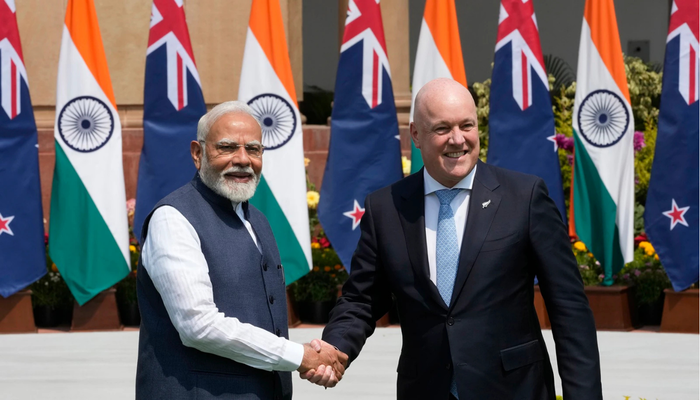
On 8th October, British Prime Minister Keir Starmer arrived in Mumbai on his first official visit to India. His office has described this visit as the largest ever UK government trade mission to India. Starmer is joined by 125 top CEOs, entrepreneurs, university leaders, and cultural representatives. The two-day visit marks a crucial step in strengthening the India-UK Comprehensive Strategic Partnership and advancing the recently signed India-UK Free Trade Agreement (FTA), which both India and the UK have hailed as historic.

Landmark trade deal sets the tone for Starmer’s visit

In July this year, the landmark India-UK FTA was signed in London in the presence of Prime Minister Narendra Modi and Starmer. The agreement, as described by the UK government, is “the best any country has ever secured with India,” and reduces India’s average tariff on UK products from 15 per cent to 3 per cent.

British exports to India are projected to grow by around 60%, and bilateral trade is expected to rise by £25.5 billion annually. The deal is set to boost the UK’s GDP by £4.8 billion per year, increase wages by £2.2 billion, and create jobs across Britain.

Whisky producers are among the biggest beneficiaries of the deal. Tariffs have been cut from 150% to 75% immediately. Furthermore, it will come down to 40% over the next decade, which will give the UK a significant edge over competitors in the Indian market.

Government of India on Vision 2035 and economic roadmap

Ahead of Starmer’s visit, the Ministry of External Affairs (MEA), Government of India, said in a statement that the two Prime Ministers will meet on 9th October in Mumbai to review progress under the ‘Vision 2035’ roadmap, a ten-year plan aimed at deepening cooperation across trade, technology, defence, climate, health, education, and people-to-people ties.

A key highlight of their discussions will be the Comprehensive Economic and Trade Agreement (CETA), poised to become a cornerstone for future collaboration. The leaders will also address the 6th Global Fintech Fest, engaging with industry leaders, innovators, and policymakers.

The MEA statement emphasised that the visit reflects the shared commitment of India and the UK to “foster collaboration across critical sectors and reinforce their strategic ties.”

What is the India-UK Vision 2035

The India-UK Vision 2035 is an ambitious roadmap endorsed by Prime Ministers Narendra Modi and Keir Starmer during their meeting in London on 24th July 2025. It reaffirms the shared commitment of both nations to unlock the full potential of a revitalised partnership, steering their cooperation towards mutual growth, prosperity, and global leadership in a rapidly evolving world.

The vision builds on the Comprehensive Strategic Partnership established between India and the United Kingdom, setting clear milestones for collaboration across trade, technology, defence, education, climate action, and people-to-people exchanges. It aims to transform bilateral relations into an enduring framework for sustainable development, innovation, and global influence.

Anchored in high-level political engagement, Vision 2035 outlines a series of flagship partnerships and measurable outcomes to be reviewed annually by the Indian External Affairs Minister and the UK Foreign Secretary. Ministerial mechanisms will oversee cooperation in trade, technology, finance, and investment to ensure that the partnership remains dynamic, responsive, and future-ready.

The plan rests on multiple pillars, growth and jobs, technology and innovation, defence and security, climate and clean energy, and education. Each pillar is designed to reinforce the others, creating a partnership greater than the sum of its parts. From reducing trade barriers and boosting job creation to advancing green energy and defence collaboration, the roadmap envisions deep-rooted, long-term engagement between the two countries.

At its core, the India-UK Vision 2035 represents not just economic ambition but a shared strategic purpose, to strengthen a rules-based international order, reform multilateral institutions, and promote a BRISK partnership built on Business, Research, Innovation, Science, and Knowledge. It embodies the belief that cooperation between India and the UK can help shape a more prosperous, secure, and sustainable global future.

UK Government calls CETA ‘a launchpad for growth’

In an official statement, Starmer said, “We signed a major trade deal with India in July, the best secured by any country, but the story does not stop there. It is not just a piece of paper, it is a launchpad for growth.”

He added that with India projected to become the third-largest economy by 2028, British businesses have “unparalleled opportunities” to grow, expand, and create jobs at home. Business and Trade Secretary Peter Kyle echoed this optimism, calling the FTA “a massive win that puts British businesses at the front of the queue” for access to the Indian market.

125-strong business delegation – driving investment and collaboration

The delegation that has arrived with Starmer includes officials from major UK companies including Rolls-Royce, British Airways, Diageo, British Telecom, London Stock Exchange, and others. Officials from SMEs across the UK are also part of the delegation.

Notably, British Airways has already committed to starting a third daily flight between Delhi and London Heathrow by 2026. Furthermore, Manchester Airport has confirmed a new direct route to Delhi via India’s leading airline IndiGo. These initiatives are expected to generate £75 million in trade and tourism income and create 450 new jobs in northern England.

Top university leaders, including those from the British Film Institute and National Theatre, are part of the mission. The aim of their visit is to seek new partnerships in higher education, digital culture, film, and creative industries.

Strengthening technology and security cooperation

UK PM Starmer and Indian PM Modi will meet on 9th October and are expected to discuss expanding cooperation under the UK-India Technology Security Initiative that was signed in 2024. Their discussion will focus on AI, telecom, and defence technology. This will create new investment opportunities while strengthening national security.

By 2030, India’s technology sector is projected to be worth £1 trillion, and it is one of the top sectors for India and the UK’s shared vision for sustainable and innovation-led growth.

A trade deal that redefines global engagement

The FTA between India and the UK can be described as a blueprint for modern global partnerships. This will balance ambition with pragmatism. In past deals, progress was stalled by regulatory bottlenecks and political caution. However, the new deal demonstrates mutual confidence between two countries that are determined to create a framework for long-term economic partnership.

As both countries have sharply reduced tariffs and opened access to key markets, it gives businesses unprecedented leverage in multiple sectors. For India, the deal comes at a time when it is expanding its footprint as a global manufacturing and digital hub. It complements New Delhi’s push for Viksit Bharat 2047 and strengthens its engagement with major developed economies. The fact that both sides concluded negotiations within months signals a shift in the pace and intent of diplomacy, a willingness to move beyond symbolism towards results that translate into jobs, innovation, and mutual prosperity.

Shared vision for the future

The trade deal that was signed in July, followed by Starmer’s current visit, is a clear sign of renewed momentum in India-UK relations. The two nations have set the target of USD 120 billion in bilateral trade by 2030. The UK PM’s visit to India revolves around the strategic depth of this partnership, one that blends economic ambition with mutual respect and shared global responsibility.

As both leaders prepare to meet in Mumbai, their emphasis will be to turn the promises of the India-UK Vision 2035 into visible outcomes that will bring prosperity, innovation, and security for both nations.

Who is Chhota Matka, the ferocious tiger viral on social media, and the legend behind his name

It is not unusual for people to take social media by storm and become overnight sensations in this age internet. Some turn into instant celebrities, while others have a substantial body of work that validates their claims to fame.

This stardom transcends the limitations of gender, shape, form, size and this time around even species, as people’s fascination has been captured by a magnificent four-legged creature with a regal lineage who is certainly a legend in his own right.

This is the story of Chhota Matka (T-126), a tiger that ruled over territory of the Tadoba Andhari Tiger Reserve (TATR), in the Chandrapur district of Maharashtra.

Kings from several dynasties have dominated the Tadoba range since the beginning of recorded history, reported Saneev Siva. Every set has been more ambitious, deadly and war-mongering than the last. The males of Old Katezhari, Hilltop and W-male (Vasant Bhandara) were replaced by Narasimha, Tyson, Gabbar and Saturn who were then followed by Matkasur and Kali.

Interestingly, Matkasur ruled over a larger territory than either his predecessor or any of his successors at the pinnacle of his reign. He mated with the iconic queen Choti Tara and she gave birth to two cubs during the 2016 monsoon season.

The origins of Matkasur are unknown but it appears that his roots were in a separate range, perhaps Brahmapuri. Choti Tara was a member of the Moharli range’s circuit family. The two wonders of the wilderness paired and produced equally strong and resilient cubs. The mother who was a skilled huntress raised the two cubs, Chhota Matka and Tara Chand, in the Jamni region.

A fateful occurrence

One incident altered the course of the future for Chhota Matka who derived his name from his father. He suffered severe injuries to his right abdominal flank during one of the hunting excursions in October 2017. The forest department also attempted to step in and suture the deep incision, even though the mother would try to lick the wound to heal.

Tara Chand intervened and prevent any personnel or vehicles from approaching his wounded brother. The consequences of this incident would have a significant impact on Chhota Matka as the fraternal bond grew stronger and they hardly ever fought, even in a playful way. He would eventually have to bear the repercussions of this later in life.

As part of a study to determine dispersal patterns, both of these tigers were collared by June 2018. However, Tara Chand died in December 2018 after being electrocuted in a farm’s fence in the Moharli zone buffer, while Chhota Matka continued to live in his father’s territory.

Tara Chand and Chhota Matka most likely left their original territory after meeting their father Matkasur a month earlier in November 2018. However, the latter stuck to the same area and even encountered other tigers.

Matkasur faced the challenge of other males encroaching upon his territory, during his prime. The veteran warrior was no stranger to skirmishes. However, he had to endure his share of battle scars and was eventually overthrown in late 2019.

A ruler is born in Tadoba

The throne became vacant and a struggle for power erupted, transforming the wilderness into a battlefield, although it was already one.

Chhota Matka’s early years were characterised by violent conflicts before his ascent to power. He was one of the most attractive males with a captivating jawline, trimmed ruff and sparkling blue eyes. Nevertheless, the territorial disputes quickly tarnished his handsome appearance and left the imprints of a fiercely contested kingdom.

Chhota Matka did not had the practice to fight in the real world because he did not engage in play fights with his brother when they were little. Hence, his forelimbs and paws were frequently injured and he was often observed limping.

Chhota Matka’s main adversary, Mowgli severely mauled him during the 2021 monsoon season, leaving him permanently deformed. However, the former’s will to succeed never wavered. He retaliated with fury and this made him the unopposed and ultimate monarch of his realm.

Meanwhile, new tigers tried to take over the sought-after Panderpauni-Tadoba Lake region and tensions only escalated when Balram, a new tiger from Brahmapuri, arrived on the scene. On the other hand, Chhota Matka swiftly recovered by eating the cattle that lived on the outskirts, similar to his father. He then targeted Mowgli, in a series of attacks and succeeded in wounding and banishing him in April 2022.

Chhota Matka also seized all of Mowgli’s territory. Later, he killed Jharni and Mowgli’s kids and fathered his own cubs with her. He further promoted his bloodline by claiming two other females, Babli and Bhanushkindi.

Chhota Matka inherited his mother’s patience and his father’s strength as he reigned as the most formidable tiger of Tadoba. He ruled like a king over the largest region of any of his contemporaries and killed at least four strong males to uphold his authority. A king must continually strive to maintain his power and he did so with the zeal of a possessed entity.

End of an era

The jungle law dictates that one lives by the sword, dies by the sword and even the supreme tiger was not an exception to this rule either. Chhota Matka had a territorial altercation with another large cat on 12-13 May. The former reportedly killed his nemesis but was discovered gravely wounded, likely from deep wounds. On 27th August, he was rescued and moved to the Transit Treatment Centre for treatment after being tranquillized, leaving his territory open to attempts at annexation.

“A tiger named Bali has already moved into that area and another, called Virbhadra, is being sighted more frequently now,” disclosed a senior forest official, according to The Times of India. Their presence increased the potential of confrontation as they both tried to establish their dominance without the previous ruler.

Forest officials expressed alarm over Chhota Matka’s deteriorating health, stating that he had been under close observation recently due to a series of livestock fatalities near the Tadoba boundary. He was subsequently found with wounds and taken to Chandrapur for specialised care.

Image via Indian Masterminds

Now, Chhota Matka will probably spend the remainder of his life in a rescue center, away from his majestic and serene kingdom. However, the colossal figure left a giant and magnificent mark as the spirit and soul of TATR, ruling with peace and quiet for years without losing his composure while defending his territory with just as much determination and resolve.

Chhota Matka demonstrated that it was not only the name he inherited from his father but also his will and bravery. This is what shaped his life and transformed him into the glorious king he was.